


Abstract
Background: Autonomous ships have the potential to increase operational efficiency and reduce carbon footprints through technology and innovation. However, there is no comprehensive literature review of all the different types of papers related to autonomous ships, especially with regard to their integration with ports. This paper takes a systematic review approach to extract and summarize the main topics related to autonomous ships in the fields of container shipping and port management. Methods: A machine learning method is used to extract the main topics from more than 2000 journal publications indexed in WoS and Scopus. Results: The research findings highlight key issues related to technology, cybersecurity, data governance, regulations, and legal frameworks, providing a different perspective compared to human manual reviews of papers. Conclusions: Our search results confirm several recommendations. First, from a technological perspective, it is advised to increase support for the research and development of autonomous underwater vehicles and unmanned aerial vehicles, establish safety standards, mandate testing of wave model evaluation systems, and promote international standardization. Second, from a cyber–physical systems perspective, efforts should be made to strengthen logistics and supply chains for autonomous ships, establish data governance protocols, enforce strict control over IoT device data, and strengthen cybersecurity measures. Third, from an environmental perspective, measures should be implemented to address the environmental impact of autonomous ships. This can be achieved by promoting international agreements from a global societal standpoint and clarifying the legal framework regarding liability in the event of accidents.
1. Introduction
The maritime industry is undergoing a transformation with the advent of autonomous ship technology. Fully or even partially autonomous vessels promise to revolutionize cargo transportation and navigation. Therefore, it is crucial to understand the various research topics and methodologies that are driving their development, especially from the perspective of container ports.
The integration of autonomous ships into container ports is a topic that has gained significant attention in recent years. As technology continues to advance, the shipping industry is exploring ways to leverage autonomous systems to improve efficiency, safety, and sustainability. The main benefits of autonomous ships in container ports can be summarized in three areas: (1) increased operational efficiency, which can lead to faster turnaround times and reduced congestion; (2) improved safety and reduced risk of accidents through advanced collision avoidance systems; (3) reduction of greenhouse gas emissions through operation on cleaner energy sources. However, the integration of autonomous ships into container ports raises a number of challenges. Regulatory frameworks need to be established to ensure the safe and reliable operation of these vessels. Cybersecurity measures need to be implemented to protect autonomous systems from potential hacking or malicious activity. In addition, standardization and collaboration among stakeholders, including port authorities, shipping companies, and labor unions, need to be addressed to facilitate the successful integration of autonomous ships. In conclusion, the integration of autonomous ships into container ports has significant potential to transform the shipping industry.
Autonomous ships have the potential to increase operational efficiency and reduce carbon footprints through technology and innovation. There is a growing interest in this new concept in both academia and industry, as the required technologies for autonomous ships are almost available. Several review papers on autonomous vessels are available, including those by Yu et al. [1], Ziajka-Poznańska and Montewka [2], and Veitch and Andreas Alsos [3]. While the existing literature focuses on specific topics such as safety or economic impacts, a comprehensive review is lacking. However, there is no comprehensive literature review for all the different types of papers related to autonomous ships, particularly in regard to their integration with ports. This study aims to address the research gap by reviewing all related research articles using a machine learning algorithm. The goal is to identify the main topics, key areas of investigation, and methodologies used to improve the integration of autonomous vessels in the container port ecosystem.
This paper takes a systematic review approach to extract and summarize the main topics related to autonomous ships in the fields of container shipping and port management. More specifically, this study analyzes over 2000 scientific papers published in journals indexed in Web of Science (WoS) and Scopus. The data are converted from PDF to text format and analyzed using machine-learning-based natural language processing (NLP) techniques, including BERTopic [4].
Our study sheds light on critical issues such as technological challenges, cybersecurity vulnerabilities, data governance procedures, and the structural regulations necessary for a regulatory framework. Firstly, we argue for increased support for research and development of autonomous underwater vehicles (AUVs) and unmanned aerial vehicles (UAVs), rigorous safety protocols, mandatory testing of wave prediction systems, and the pursuit of global technology standards. Secondly, it is important to strengthen logistics and supply networks that are tailored to autonomous ships. Additionally, a comprehensive data management strategy should be created, and strict cybersecurity safeguards should be enforced. And thirdly, we suggest implementing initiatives to mitigate the environmental footprint of autonomous ships, encouraging the formation of international agreements to assess broader social impacts, and refining legal frameworks to ensure clear accountability in the event of accidents and attacks involving these ships.
Based on our analysis, we have determined that NLP is a useful technique for identifying and analyzing the major issues and trends in autonomous shipping. Our research makes two contributions. First, it addresses the technical, regulatory, and legal frameworks required to govern the operation of autonomous ships in container ports. Second, it provides valuable insights into the evolving landscape of autonomous ships and their integration into container ports. The research results contribute to informed decision making and strategic planning, which are essential for the successful deployment of autonomous ship technology in the maritime industry.
The subsequent sections of this paper are structured as follows: Section 2 presents a review of the literature on autonomous ships and the use of topic modeling techniques. Section 3 describes the data used in this study. Section 4 outlines the analysis methods employed in the research. Section 5 presents visual representations of the primary findings and discusses these key findings. Section 6 concludes the study, emphasizing the practical implications of this work and identifying avenues for future research.
2. Literature Review
2.1. System Literature Review
System literature review (SLR) is also known as secondary research, while the individual studies that contribute to the systematic review itself are known as primary studies [5]. An SLR is a research approach that reviews the related literature with respect to one or more particular research questions [6].
This research establishes a framework for SLR by developing the process proposed by Xiao and Watson [7]: (1) formulate the research question (Section 2); (2) prepare the literature database and extract information (Section 3 and Section 4); (3) report the findings (Section 5).
To frame the research questions, we will discuss the related literature in Section 2.2 and Section 2.3, and present our research questions in Section 2.4.
2.2. Autonomous Ship
An autonomous ship is a ship with an advanced sensor module that takes over the lookout duties on board (e.g., radar and AIS, combined with modern daylight and infrared cameras). Its autonomous navigation system follows a predefined voyage plan and can adapt to unexpected events, such as collision situations or significant weather changes. Additionally, it is equipped with an autonomous engine and monitoring control system that ensures overall reliability and anticipates potential failures. Finally, the autonomous ship is equipped with a shore control center that continuously monitors the operation of the autonomous ship and is prepared to intervene in certain emergencies.
The International Maritime Organization (IMO) has defined four degrees of autonomy (DoA) related to maritime autonomous surface ships (MASS) in Table 1. MASSs may operate at one or more degrees of autonomy during a single voyage [8].

Table 1.
Degrees of autonomy for maritime autonomous surface ships.
From a logistics and supply chain perspective, this paper investigates the key issues related to the integration of autonomous ships in ports. The review primarily focuses on papers published within the last five years and is divided into six categories, as outlined in Table 2.
Table 2.
Category of previous studies.
Table 3 outlines a summary of key publications for each category.
Table 3.
Summary of key publications for each category.
2.3. Topic Modelling
Topic modeling is a machine learning technique that belongs to the category of unsupervised learning. Its purpose is to analyze a collection of text data. By using NLP, this technique enables users to discover the primary topics present in a corpus of documents. It achieves this by identifying recurring patterns of words and phrases, grouping similar terms together, and determining the ones that encapsulate the essence of the documents most effectively. By analyzing linguistic patterns such as word frequency and co-occurrence, topic modeling groups together content with similar themes, ultimately revealing the central issues addressed within the document collection.
Topic modeling involves several conventional and widely recognized algorithms, including latent semantic analysis (LSA) [28], probabilistic latent semantic analysis (pLSA) [29], latent Dirichlet allocation (LDA) [30], nonnegative matrix factorization (NMF) [31], Top2vec [32], and BERTopic [4].
In their recent study, Egger and Yu [33] compared four different topic modeling algorithms for analyzing Twitter data. The study confirmed the effectiveness of BERTopic and NMF, followed by Top2Vec and LDA. In our study, we chose to use the BERTopic model due to its strong performance in extracting topics from text corpus. Section 4 provides details on the BERTopic algorithm used.
2.4. Research Questions
Through the manual literature review in Section 2.2, we identified the lack of a systematic review on the topic, especially one powered by machine learning methodology. This motivated us to conduct this research. We present our research questions (RQ) as follows:
- RQ1:
- How does a machine-learning-based SLR compare to a human-based SLR?
- RQ2:
- What key issues can container ports face in integrating autonomous ships?
- RQ3:
- With a machine-learning-based SLR, what policy recommendations can be made?
3. Literature Database Preparation
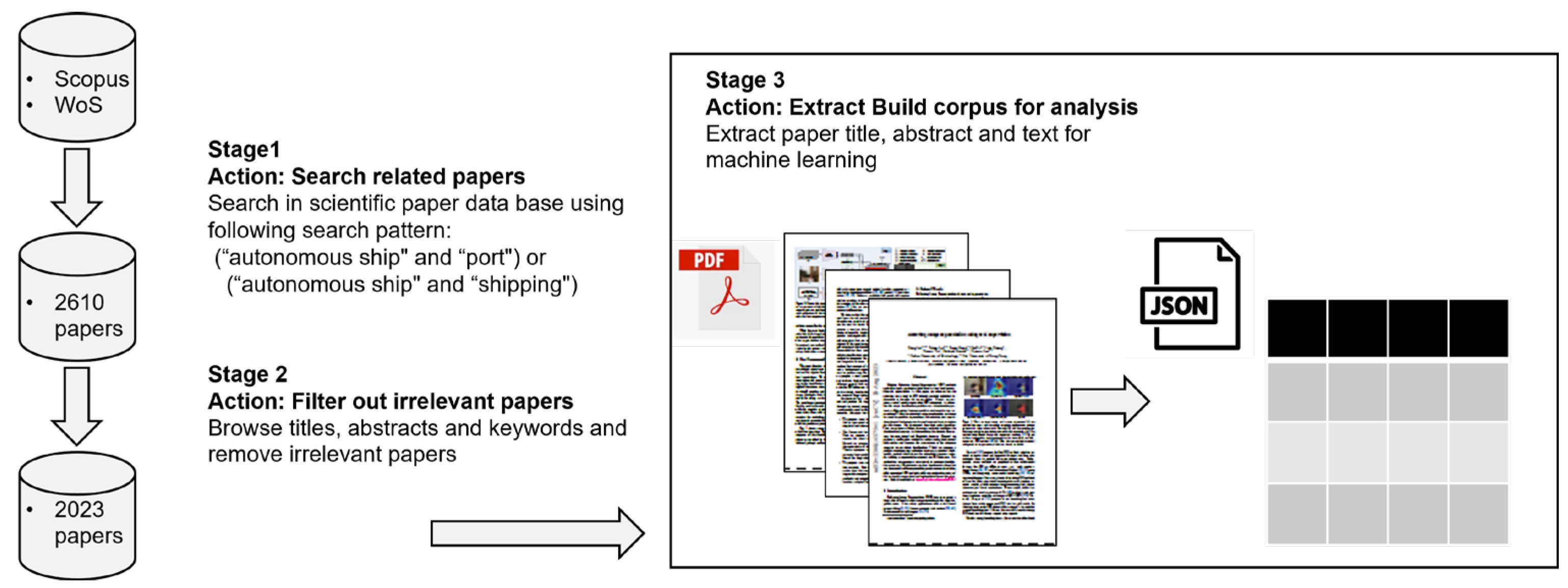
The study employs a dataset obtained from the Scopus and Web of Science scientific paper databases. To create the dataset, we conducted a search using the keywords “autonomous ship” and “port” or “autonomous ship” and “shipping” on 24 September 2023. We used a three-stage process (see Figure 1) to construct the corpus for analysis. During the first stage, where the initial search is performed, 2610 papers were found. After filtering out irrelevant papers in the second stage, we obtained a total of 2023 papers for analysis. In the third stage, the text mining technique is applied to extract information from the papers in PDF format and convert it into structured data in JSON format. These data can then be used for further training in machine learning models.
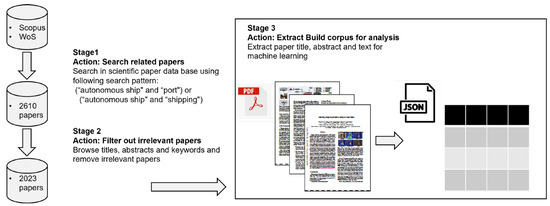
Figure 1.
Database generation. The literature database was prepared in 3 stages. Stage 1 searched for related papers, stage 2 filtered out irrelevant papers, and stage 3 extracted information from the PDF version of the papers into JSON format, which is machine-readable.
4. Methodology
4.1. Analysis Process
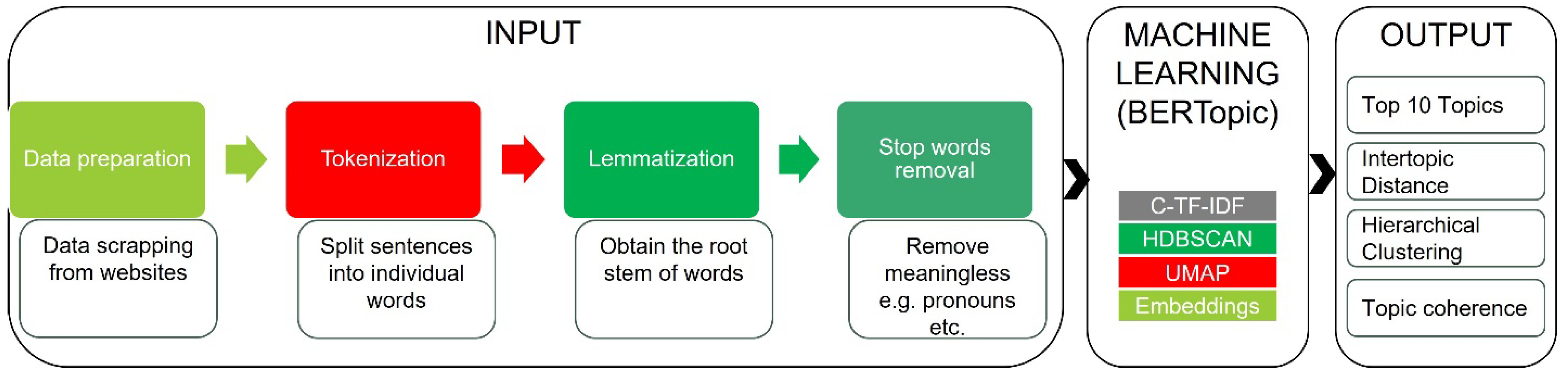
The analysis process is presented in the following manner, as shown in Figure 2. Details of the input and machine learning model are discussed in Section 4.2 and Section 4.3. The output is presented in Section 5.
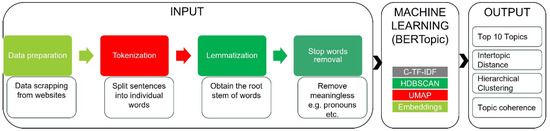
Figure 2.
Analysis process.
4.2. Input Data
After the data collection process described in Section 3 has been performed, the data are pre-processed in a way to prepare them for the training of the BERTopic model. This pre-processing consists of three steps and employs the Python package gensim, which was chosen for its open source status, speed, and ability to handle large datasets.
The first step is called tokenization. Tokenization treats each word or punctuation mark in a sentence as a standalone unit. This makes it easier for the language model to learn by breaking the text into smaller chunks.
The second step is called lemmatization, which identifies the root form, or lemma, of each token. For example, the token “undivided” would match the lemma “divide”. Lemmatizing helps to avoid redundant root forms, such as “ships” and “ship”.
The third step is the removal of stop words, frequently used words in a language, such as pronouns, determiners, and conjunctions. Eliminating stop words improves language model trainability by decreasing the noise in the data.
4.3. Training with BERTopic Model
Using machine learning, BERTopic is a topic modeling method. It is built on BERT, presented by Devlin et al. [34] in 2018, and is used as a fine-tuning strategy. By using BERT, a pre-training strategy for NLP, the rich semantic information contained in sentences can be effectively leveraged [35].
In 2020, Grootendorst [36] proposed a method that combines transformer models with traditional TF-IDF classification to create understandable and expressive clusters. In this way, it is guaranteed that key words in topic descriptions are retained during the computation process.
In this study, a novel method for training BERTopic using a matrix-based corpus is presented. The procedure of topic modeling consists of five steps, which are described in the following subsections.
4.3.1. Word Embedding
The first step of the model focuses on the transformation of the text corpus into numerical representations, which are called word embeddings. The process of embedding is the process of translating natural language into a format that can be easily processed by computers. BERTopic begins this process by transforming the input documents into these numerical forms. While there are several techniques available for this purpose, we use sentence-transformers, specifically the “all-MiniLM-L6-v2” model, for its ability to measure the semantic relationships between documents.
4.3.2. UMAP
Uniform manifold approximation and projection (UMAP) is a dimensionality reduction technique. It allows for visual representation and provides extensive functionalities for nonlinear dimensionality reduction [37]. With UMAP, data are mapped from a high-dimensional space to a lower-dimensional space while still keeping the complex topological structures of the source dataset.
4.3.3. HDBSCAN
HDBSCAN, short for hierarchical density-based spatial clustering of applications with noise, is a clustering method that was developed by Campello et al. [38] in 2013. It uses a density-based technique for clustering, which allows it to avoid creating strict boundaries between clusters. As a nonparametric method, the goal of HDBSCAN is to reveal the underlying hierarchical clustering structure of the data by identifying areas with a high concentration of data points. The BERTopic framework leverages HDBSCAN’s ability to identify clusters that do not conform to conventional geometric shapes by focusing on regions of higher data density compared to the surrounding space. In doing so, HDBSCAN becomes an invaluable asset in identifying clusters with varying densities.
4.3.4. C-TF-IDF
C-TF-IDF stands for class-based term frequency–inverse document frequency. It is a modified version of the well-known TF-IDF metric, which is used to identify topics by highlighting the most important words within their respective clusters. The modified version of the TF-IDF metric is designed to isolate topic-specific attributes from clusters of documents by assigning a unique identifier to each topic. Whereas the original TF-IDF evaluates the importance of words within individual documents, this modified version emphasizes the contextual relevance of words based on their relevance to a particular topic. This technique precisely measures the frequency of words within clusters, thereby facilitating the creation of unique topic-related word distributions for each document cluster.
The modification of the traditional TF-IDF formula combines all documents related to the same topic into a single collective document. For each labeled cluster or topic, c, the frequency of a specific word, x, is determined as and then adjusted using L1 normalization to represent the TF. The IDF is calculated by taking the logarithm of 1 plus the average number of words per class A, which is divided by the frequency of word x across all classes. The formula is as follows:
In Equation (1), is the frequency of word x in class c, is the frequency of word x across all classes, and A is the average number of words per class. The TF-IDF equation multiplies a word’s TF (term frequency) by its IDF (inverse document frequency), which is calculated by taking the logarithm of 1 plus the average number of words per class A, divided by the frequency of the word x across all classes. By deriving topic signatures from the document clusters, a unique topic identifier is assigned to each cluster. This modified version of TF-IDF emphasizes the importance of words in the context of their relevance to a particular topic, rather than in an individual document. This approach effectively measures the importance of words within clusters, and thus allows for the establishment of specific topic–word distributions associated with every document cluster.
4.3.5. Fine-Tuning
In machine learning, fine-tuning is a process of further training an existing model that has already been trained on a large dataset, a step commonly known as pre-training. This is performed by using a new dataset, typically smaller in size and more narrowly focused. The objective of this procedure is to tune the model for a specific function or to increase its accuracy on a dataset that is somewhat different from the one used in the initial training. The underlying idea of fine-tuning is that the model, having learned a set of features or patterns during its initial training phase, can leverage this pre-learned knowledge and apply it to new data. In doing so, the model adjusts its parameters to fit the unique characteristics or requirements of the new task. Fine-tuning is a broadly used strategy in domains such as NLP and computer vision. Extensive models such as BERT are pre-trained on large datasets to capture a wide range of features, and then fine-tuned for specific applications such as sentiment analysis, question answering, or topic modeling.
In the fine-tuning phase, we use the maximal marginal relevance (MMR) [39] technique. After the generation of C-TF-IDF representations, we obtain a set of words that accurately represent a group of documents. Although C-TF-IDF is an efficient method for generating accurate topic representations, we need to refine these C-TF-IDF-based topics to ensure that they accurately reflect current topic discussions. The MMR evaluates the similarity between individual word embeddings and the aggregate topic embedding to reduce word redundancy between different topics.
5. Experiment Results
The experiment’s results were obtained using the parameters outlined in Table 4. The following subsections present a summary of these results.
Table 4.
Experiment parameters.
5.1. Top 10 Topics
Table 5 summarizes the top 10 topics. Topic −1 refers to a group of documents that could not be categorized into any other topic. Therefore, it will be excluded from our discussions.
Table 5.
Overview of topics information.
Topic 0 is related to time management and control of port systems. Topic 1 is related to seawater and marine data, potentially covering aspects such as oceanography or marine research. Topic 2 is related to ship collision risk, suggesting a potential focus on safety measures and collision prevention. Topic 3 is related to underwater vehicles, suggesting a focus on topics such as underwater exploration or remotely operated vehicles. Topic 4 is related to wave modeling, which could include the study of wave patterns, ocean dynamics, or wave forecasting. Topic 5 focuses on learning and applying image detection techniques. Topic 6 is related to UAV detection. Topic 7 is related to oil spill pollution, suggesting a focus on topics such as oil spill response, environmental impact assessment, or remediation strategies. Topic 8 is related to the Global Positioning System (GPS) and the Global Navigation Satellite System (GNSS) for navigation purposes.
5.2. Relationships between Top Topics
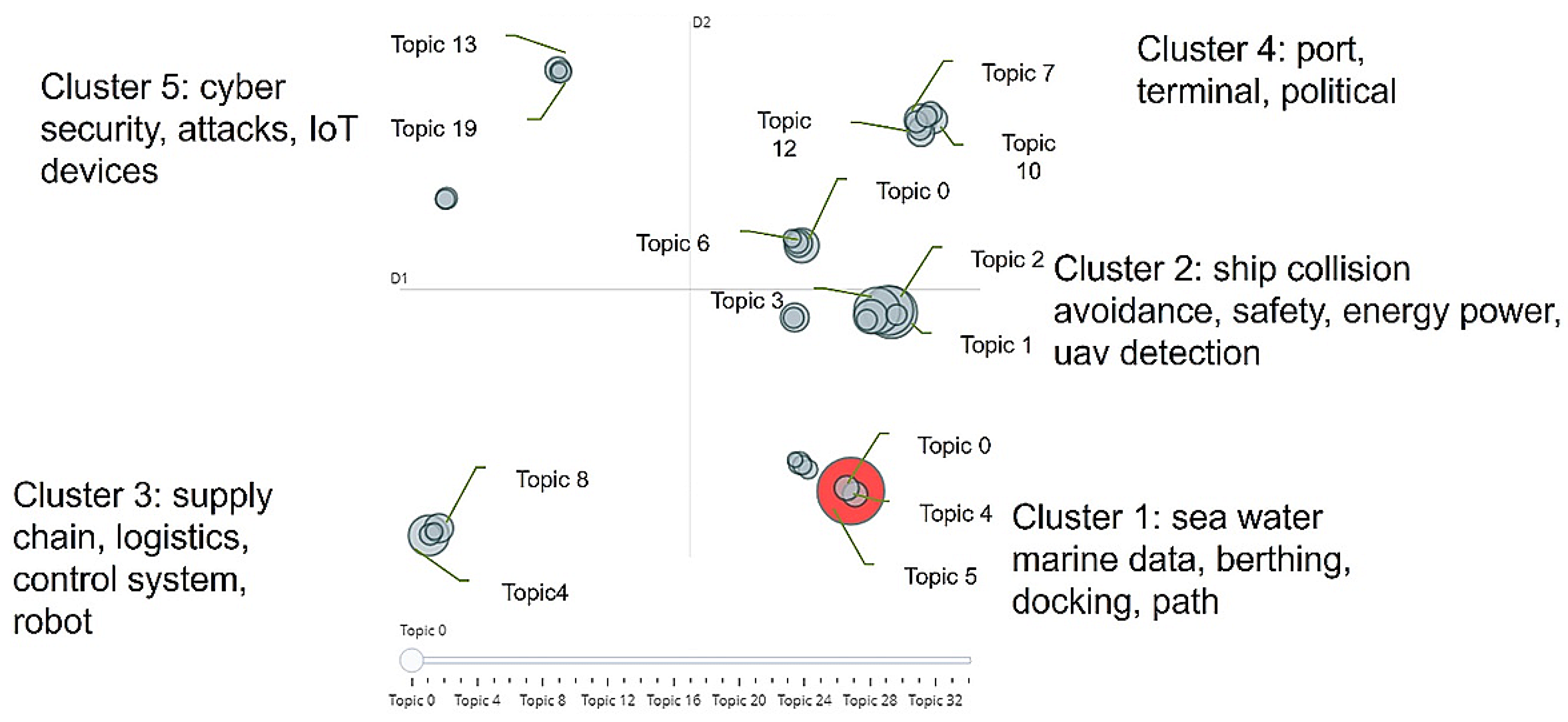
To visually represent the relationships among the topics, we generated an intertopic distance map (Figure 3). Intertopic distance maps exhibit a two-dimensional embedding of the topic centers while preserving the distances to other centers. The distances are calculated using cosine similarity, which measures the cosine of the angle between the vectors. The results show five clusters. Cluster 1 describes the data related to seawater, berth, docking, and path. Cluster 2 is related to safety, which includes collision avoidance, energy performance, and UAV detection. Cluster 3 covers logistics and supply chain control systems and robotics. Cluster 4 describes port, terminal, and policy issues. Cluster 5 addresses cybersecurity, attacks, and IoT devices.
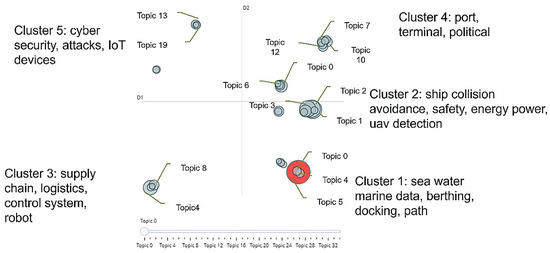
Figure 3.
Intertopic distance.
5.3. Hierarchical Groups
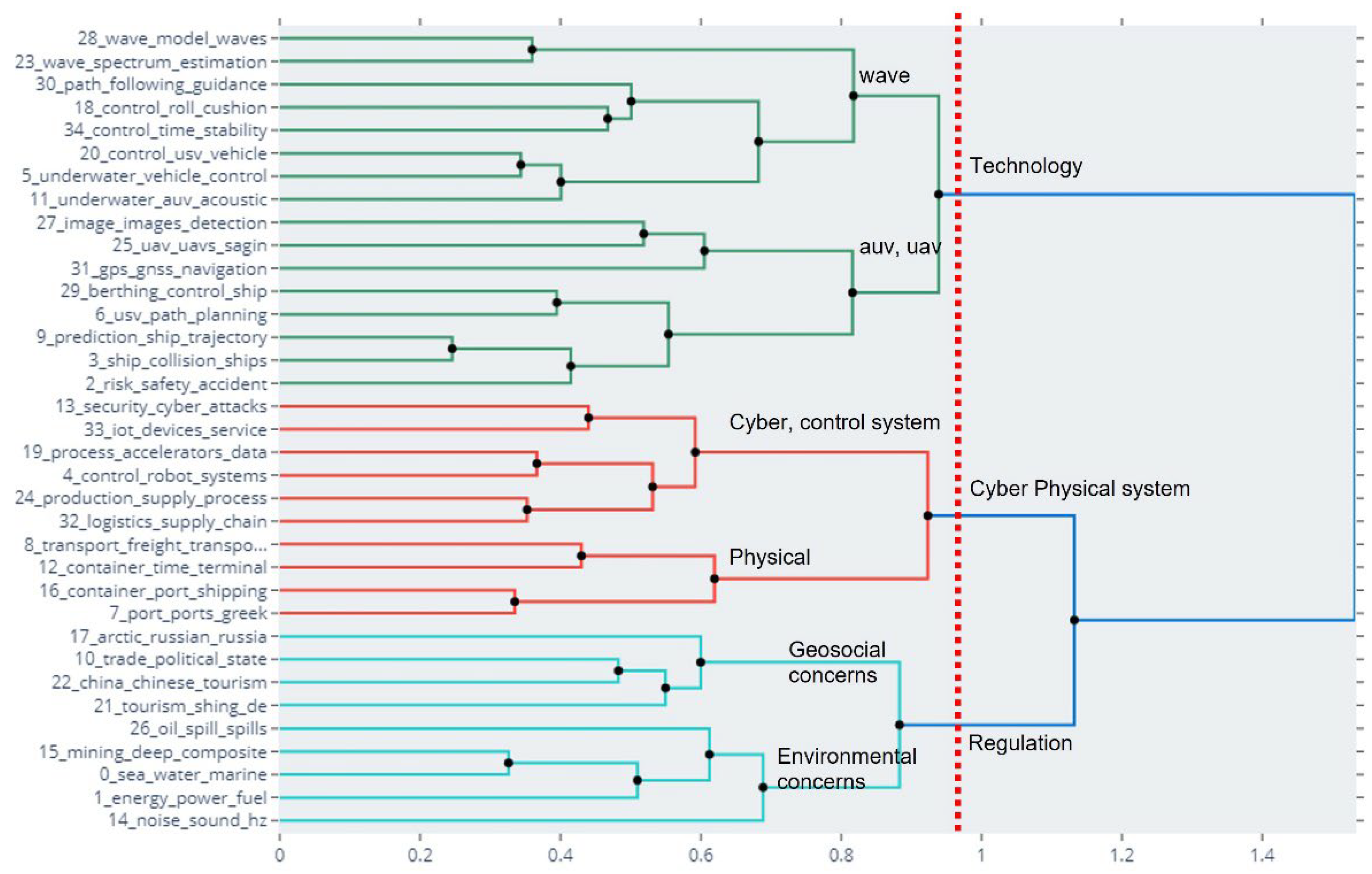
To gain deeper insights, a hierarchical grouping was conducted, resulting in three distinct groups of topics (Figure 4). The first group focuses on technology, which includes AUV and UAV technology and wave model estimation for ship collision avoidance. The second group is focused on cyber–physical systems, including physical logistics and supply chain networks, data, IoT devices, robotics, and security measures to prevent cyber-attacks. The third group is related to regulation, which requires measures to address concerns arising from environmental and geosocial perspectives.
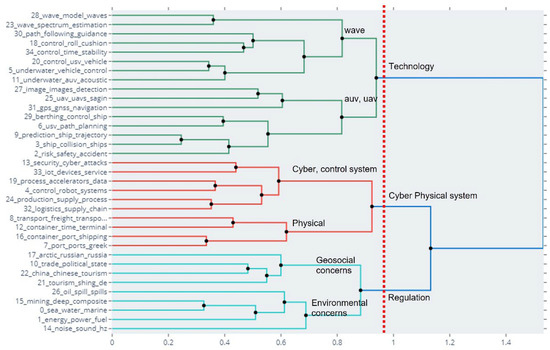
Figure 4.
Hierarchical group of topics.
5.4. Performance Measurement
To evaluate the semantic significance of our topics, we use a coherence score. Specifically, we employ the C-v coherence score [40] for our computations. The C-v coherence score is a metric used to evaluate the coherence of a topic model. Coherence refers to the degree of semantic similarity or meaningfulness among the words in a topic. In other words, it measures how well the words within a topic are related and form a coherent topic. The C-v coherence score assesses the co-occurrence between word pairs, using only the model’s training documents and not relying on an external corpus. The C-v measure uses a boolean sliding window to judge whether two words co-occur, and then the confirmation measure, which includes direct and indirect confirmations, is obtained using normalized pointwise mutual information (NPMI) and cosine similarity. For interpretation, the score is normalized and scaled between 0 and 1, where a score of 1 represents the highest possible coherence. A score closer to 1 indicates higher coherence and understandability of a topic from a human perspective. Our model achieved a C-v coherence score of 0.65, indicating its relatively high reliability.
6. Discussion
On the basis of the results of the experiments described in Section 5, we can make the following policy suggestions.
6.1. Technology Dimensions
To support research and development in AUV and UAV technologies, it is recommended to increase financial support and tax incentives. Additionally, strict safety standards should be established for wave model evaluation systems, and continuous testing should be required to minimize accident rates.
To ensure reliable collision avoidance for autonomous ships, it is critical to implement comprehensive testing protocols for wave model estimation systems. Additionally, working with international bodies to standardize technology protocols is necessary to ensure compatibility and safety across global fleets.
6.2. Cyber–Physical Systems Dimensions
First, to improve logistics and supply chain networks, the government should invest in strengthening and securing measures for logistics and supply chain networks dedicated to autonomous ships. This requires investment in the improvement of physical logistics and supply chain networks specifically designed to serve autonomous systems that ensure efficiency and responsiveness.
Second, data governance should be developed. Establish regulations for managing data collected from IoT devices to protect privacy and improve data security. Set strict standards for the collection, processing, and storage of data from IoT devices to prevent breaches and misuse of information.
Additionally, it is important to establish cybersecurity measures. Collaboration with the industry is necessary to develop and mandate the application of advanced security measures to protect autonomous marine systems from cyber-attacks. To protect against cyber threats, it is recommended to develop robust cybersecurity measures and mandate regular security audits for autonomous marine systems. Additionally, further regulation of robotics is necessary. For instance, a framework for the ethical and safe use of robotics in the maritime context, including maintenance and potential search and rescue operations, should be created.
6.3. Regulatory Dimensions
From an environmental regulatory perspective, it would be beneficial to introduce measures that address the environmental impacts of autonomous ships. This could include regulations on emissions and waste management systems in line with maritime environmental standards.
From a geosocial perspective, it is recommended to develop international agreements that consider the impact on local economies dependent on traditional shipping. Measures should be taken to address the dependence of communities on traditional shipping operations and maritime-related employment.
From a liability perspective, it is recommended to establish clear legal frameworks to clarify liability in the event of accidents involving autonomous ships. This includes delineating responsibilities between technology providers and operators.
These policy proposals aim to address the various aspects of autonomous ship technology, cyber–physical systems, and regulatory frameworks to enable the safe, secure, and sustainable integration of autonomous ships into the global maritime industry.
7. Conclusions
This research provides a comprehensive review of the recent literature on the integration of autonomous ships in maritime ports, using a machine learning approach. The research findings identify a number of major concerns from those in human manual review papers. Furthermore, our study demonstrates the usefulness of NLP techniques in identifying and analyzing key issues and trends in autonomous ship integration in the maritime industry, providing valuable insights for industry stakeholders.
While the human review categorized the literature into six groups (design, navigation, safety, implementation, impact, legal), the machine learning model clustered the literature into three clusters (technology, cyber–physical system, regulation). This comparison suggests that the machine learning model’s approach to categorization differs from human categorization, resulting in a different grouping of the literature. The machine learning model’s clusters focus on broader themes such as technology, cyber–physical systems, and regulation. It is important to note that both approaches have strengths and limitations. Human reviews can provide more nuanced categorization based on domain expertise and contextual understanding. On the other hand, machine learning models can quickly process large amounts of data and identify patterns that may not be immediately apparent to humans. Overall, this comparison highlights the potential of machine learning models to provide alternative perspectives and insights in literature categorization, complementing human review processes.
From the results of machine-learning-based SLR, the policy recommendations are as follows:
- (1)
- From a technology perspective, this review recommends supporting research and development of AUVs and UAVs, implementing comprehensive testing protocols for wave model systems.
- (2)
- From a cyber–physical system perspective, this review suggests the development of logistics, supply chain networks, and data governance, especially to protect data privacy and improve data security for data collected from IoT devices, and establish cybersecurity measures.
- (3)
- From a regulatory perspective, this review suggests the introduction of measures for environmental, geosocial, and liability aspects to handle emissions, employment, and accident handling issues.
The research findings highlight key issues in technology, cybersecurity, data governance, regulation, and legal frameworks. Future research and development may prioritize the following:
- (1)
- The findings suggest the need to enhance support for research and development of AUVs and UAVs, establish safety standards, mandate testing of wave model evaluation systems, and promote international standardization.
- (2)
- To strengthen logistics and supply chain for autonomous ships in cyber–physical systems, it is necessary to establish data governance and strict control of IoT device data, as well as cybersecurity measures.
- (3)
- The investment in the infrastructures of logistics and supply chain network.
- (4)
- Environmental regulations require measures to address the environmental impact of autonomous ships.
- (5)
- Additionally, from a global social perspective, it is important to advance international agreements and clarify the legal framework in the event of an accident with regard to the pursuit of liability.
The significance of this research is twofold. Firstly, it addresses the important technical, legal, and regulatory measures required for the management of autonomous ships in container ports. Second, it provides a critical perspective on the ever-evolving field of autonomous shipping. In particular, it focuses on its integration into container ports. The insights gained from this study will aid in making informed decisions and developing essential strategies for the successful integration of autonomous ships into the shipping sector.
The limitation of this paper is that it focuses on the integration of autonomous ships with ports and only includes studies published in English. Future studies can conduct similar machine-learning-based reviews on a wider range of the literature.
Author Contributions
Conceptualization, E.H. and A.S.H.; methodology, E.H.; software, E.H.; validation, E.H. and A.S.H.; data curation, E.H.; writing—original draft preparation, E.H. and A.S.H.; writing—review and editing, E.H. and A.S.H.; funding acquisition, E.H and A.S.H. All authors have read and agreed to the published version of the manuscript.
Funding
This research supported by JSPS KAKENHI [Grant Numbers JP 23K04076, JP], JSPS KAKENHI [Grant Numbers JP 21H01564], and Danish Agency for Higher Education and Science: International Network Grant: Global Ports and Shipping.
Data Availability Statement
The data presented in this study are available on request from the corresponding author.
Conflicts of Interest
The authors declare no conflicts of interest. The funders had no role in the design of the study; in the collection, analyses, or interpretation of data; in the writing of the manuscript; or in the decision to publish the results.
References
- Gu, Y.; Goez, J.C.; Guajardo, M.; Wallace, S.W. Autonomous Vessels: State of the Art and Potential Opportunities in Logistics. Int. Trans. Oper. Res. 2021, 28, 1706–1739. [Google Scholar] [CrossRef]
- Ziajka-Poznańska, E.; Montewka, J. Costs and Benefits of Autonomous Shipping—A Literature Review. Appl. Sci. 2021, 11, 4553. [Google Scholar] [CrossRef]
- Veitch, E.; Alsos, O.A. A Systematic Review of Human-AI Interaction in Autonomous Ship Systems. Saf. Sci. 2022, 152, 105778. [Google Scholar] [CrossRef]
- Grootendorst, M. BERTopic: Neural Topic Modeling with a Class-Based TF-IDF Procedure 2022. arXiv 2022, arXiv:2203.05794. [Google Scholar]
- Ierardi, C.; Orihuela, L.; Jurado, I. Distributed Estimation Techniques for Cyber-Physical Systems: A Systematic Review. Sensors 2019, 19, 4720. [Google Scholar] [CrossRef] [PubMed]
- Khan, N.; Solvang, W.D.; Yu, H. Industrial Internet of Things (IIoT) and Other Industry 4.0 Technologies in Spare Parts Warehousing in the Oil and Gas Industry: A Systematic Literature Review. Logistics 2024, 8, 16. [Google Scholar] [CrossRef]
- Xiao, Y.; Watson, M. Guidance on Conducting a Systematic Literature Review. J. Plan. Educ. Res. 2019, 39, 93–112. [Google Scholar] [CrossRef]
- IMO. IMO Takes First Steps to Address Autonomous Ships. Available online: https://www.imo.org/en/MediaCentre/PressBriefings/Pages/08-MSC-99-MASS-scoping.aspx (accessed on 11 January 2024).
- Li, S.; Xu, Z.; Liu, J.; Hu, X. Towards the Testing and Validation of Autonomous Ships: Design of a Variable Stability Ship Control System. J. Mar. Sci. Eng. 2023, 11, 1274. [Google Scholar] [CrossRef]
- Tsimplis, M. Designing Norms for Autonomous Ships: The Obligation to Call for Help and the Duty to Save Life in Danger at Sea. In Autonomous Vessels in Maritime Affairs; Johansson, T.M., Fernández, J.E., Dalaklis, D., Pastra, A., Skinner, J.A., Eds.; Studies in National Governance and Emerging Technologies; Springer International Publishing: Cham, Switzerland, 2023; pp. 99–118. ISBN 978-3-031-24739-2. [Google Scholar]
- Chaal, M.; Banda, O.A.V.; Glomsrud, J.A.; Basnet, S.; Hirdaris, S.; Kujala, P. A Framework to Model the STPA Hierarchical Control Structure of an Autonomous Ship. Saf. Sci. 2020, 132, 104939. [Google Scholar] [CrossRef]
- Fan, C.; Wróbel, K.; Montewka, J.; Gil, M.; Wan, C.; Zhang, D. A Framework to Identify Factors Influencing Navigational Risk for Maritime Autonomous Surface Ships. Ocean Eng. 2020, 202, 107188. [Google Scholar] [CrossRef]
- Utne, I.B.; Rokseth, B.; Sørensen, A.J.; Vinnem, J.E. Towards Supervisory Risk Control of Autonomous Ships. Reliab. Eng. Syst. Saf. 2020, 196, 106757. [Google Scholar] [CrossRef]
- Shaobo, W.; Yingjun, Z.; Lianbo, L. A Collision Avoidance Decision-Making System for Autonomous Ship Based on Modified Velocity Obstacle Method. Ocean Eng. 2020, 215, 107910. [Google Scholar] [CrossRef]
- Chun, D.-H.; Roh, M.-I.; Lee, H.-W.; Ha, J.; Yu, D. Deep Reinforcement Learning-Based Collision Avoidance for an Autonomous Ship. Ocean Eng. 2021, 234, 109216. [Google Scholar] [CrossRef]
- Li, X.; Oh, P.; Zhou, Y.; Yuen, K.F. Operational Risk Identification of Maritime Surface Autonomous Ship: A Network Analysis Approach. Transp. Policy 2023, 130, 1–14. [Google Scholar] [CrossRef]
- Felski, A.; Zwolak, K. The Ocean-Going Autonomous Ship—Challenges and Threats. J. Mar. Sci. Eng. 2020, 8, 41. [Google Scholar] [CrossRef]
- de Vos, J.; Hekkenberg, R.G.; Valdez Banda, O.A. The Impact of Autonomous Ships on Safety at Sea—A Statistical Analysis. Reliab. Eng. Syst. Saf. 2021, 210, 107558. [Google Scholar] [CrossRef]
- Chaal, M.; Ren, X.; BahooToroody, A.; Basnet, S.; Bolbot, V.; Banda, O.A.V.; Van Gelder, P. Research on Risk, Safety, and Reliability of Autonomous Ships: A Bibliometric Review. Saf. Sci. 2023, 167, 106256. [Google Scholar] [CrossRef]
- Deling, W.; Dongkui, W.; Changhai, H.; Changyue, W. Marine Autonomous Surface Ship—A Great Challenge to Maritime Education and Training. Am. J. Water Sci. Eng. 2020, 6, 10–16. [Google Scholar] [CrossRef]
- Kooij, C.; Hekkenberg, R. Identification of a Task-Based Implementation Path for Unmanned Autonomous Ships. Marit. Policy Manag. 2022, 49, 954–970. [Google Scholar] [CrossRef]
- Munim, Z.H.; Haralambides, H. Advances in Maritime Autonomous Surface Ships (MASS) in Merchant Shipping. Marit. Econ. Logist. 2022, 24, 181–188. [Google Scholar] [CrossRef]
- Akbar, A.; Aasen, A.K.A.; Msakni, M.K.; Fagerholt, K.; Lindstad, E.; Meisel, F. An Economic Analysis of Introducing Autonomous Ships in a Short-Sea Liner Shipping Network. Int. Trans. Oper. Res. 2021, 28, 1740–1764. [Google Scholar] [CrossRef]
- Kurt, I.; Aymelek, M. Operational and Economic Advantages of Autonomous Ships and Their Perceived Impacts on Port Operations. Marit. Econ. Logist. 2022, 24, 302–326. [Google Scholar] [CrossRef]
- Karlis, T. Maritime Law Issues Related to the Operation of Unmanned Autonomous Cargo Ships. WMU J. Marit. Aff. 2018, 17, 119–128. [Google Scholar] [CrossRef]
- Kim, M.; Joung, T.-H.; Jeong, B.; Park, H.-S. Autonomous Shipping and Its Impact on Regulations, Technologies, and Industries. J. Int. Marit. Saf. Environ. Aff. Shipp. 2020, 4, 17–25. [Google Scholar] [CrossRef]
- Vojković, G.; Milenković, M. Autonomous Ships and Legal Authorities of the Ship Master. Case Stud. Transp. Policy 2020, 8, 333–340. [Google Scholar] [CrossRef]
- Deerwester, S.; Dumais, S.T.; Furnas, G.W.; Landauer, T.K.; Harshman, R. Indexing by Latent Semantic Analysis. J. Am. Soc. Inf. Sci. 1990, 41, 391–407. [Google Scholar] [CrossRef]
- Hofmann, T. Probabilistic Latent Semantic Analysis 2013. arXiv 2013, arXiv:1301.6705. [Google Scholar]
- Blei, D.M.; Ng, A.Y.; Jordan, M.I. Latent Dirichlet Allocation. J. Mach. Learn. Res. 2003, 3, 993–1022. [Google Scholar]
- Lee, D.D.; Seung, H.S. Learning the Parts of Objects by Non-Negative Matrix Factorization. Nature 1999, 401, 788–791. [Google Scholar] [CrossRef] [PubMed]
- Angelov, D. Top2Vec: Distributed Representations of Topics 2020. arXiv 2020, arXiv:2008.09470. [Google Scholar]
- Egger, R.; Yu, J. A Topic Modeling Comparison between LDA, NMF, Top2Vec, and BERTopic to Demystify Twitter Posts. Front. Sociol. 2022, 7, 886498. [Google Scholar] [CrossRef]
- Devlin, J.; Chang, M.-W.; Lee, K.; Toutanova, K. BERT: Pre-Training of Deep Bidirectional Transformers for Language Understanding 2019. arXiv 2019, arXiv:1810.04805. [Google Scholar]
- Hosseini, S.; Varzaneh, Z.A. Deep Text Clustering Using Stacked AutoEncoder. Multimed. Tools Appl. 2022, 81, 10861–10881. [Google Scholar] [CrossRef]
- Grootendorst, M.J. BERTopic. Available online: https://maartengr.github.io/BERTopic/index.html (accessed on 23 January 2024).
- McInnes, L.; Healy, J.; Melville, J. UMAP: Uniform Manifold Approximation and Projection for Dimension Reduction 2020. arXiv 2020, arXiv:1802.03426. [Google Scholar]
- Campello, R.J.G.B.; Moulavi, D.; Sander, J. Density-Based Clustering Based on Hierarchical Density Estimates. In Advances in Knowledge Discovery and Data Mining; Pei, J., Tseng, V.S., Cao, L., Motoda, H., Xu, G., Eds.; Springer: Berlin/Heidelberg, Germany, 2013; pp. 160–172. [Google Scholar]
- Carbonell, J.; Goldstein, J. The Use of MMR, Diversity-Based Reranking for Reordering Documents and Producing Summaries. In Proceedings of the 21st Annual International ACM SIGIR Conference on Research and Development in Information Retrieval, Melbourne, Australia, 24–28 August 1998; ACM: Melbourne, Australia, 1998; pp. 335–336. [Google Scholar]
- Mifrah, S.; Benlahmar, E.H. Topic Modeling Coherence: A Comparative Study between Lda and Nmf Models Using COVID’19 Corpus. Int. J. Adv. Trends Comput. Sci. Eng. 2020, 9, 5756–5761. [Google Scholar] [CrossRef]
Disclaimer/Publisher’s Note: The statements, opinions and data contained in all publications are solely those of the individual author(s) and contributor(s) and not of MDPI and/or the editor(s). MDPI and/or the editor(s) disclaim responsibility for any injury to people or property resulting from any ideas, methods, instructions or products referred to in the content. |
© 2024 by the authors. Licensee MDPI, Basel, Switzerland. This article is an open access article distributed under the terms and conditions of the Creative Commons Attribution (CC BY) license (https://creativecommons.org/licenses/by/4.0/).