


Abstract
This article is a review of ongoing research on analytical, numerical, and mixed methods for the solution of the third-order nonlinear Falkner–Skan boundary-value problem, which models the non-dimensional velocity distribution in the laminar boundary layer.
1. Introduction
The Falkner–Skan equation, a third-order ordinary differential equation over a semi-infinite domain, was originally developed in 1931 by Falkner and Skan [1] from a similarity analysis on the steady, two-dimensional, boundary-layer flow of an incompressible, viscous fluid over a wedge [2]. As it turns out, the solution of the Falkner–Skan equation represents the laminar boundary layer over an infinite wedge whose vertex angle is for , as illustrated in Figure 1.
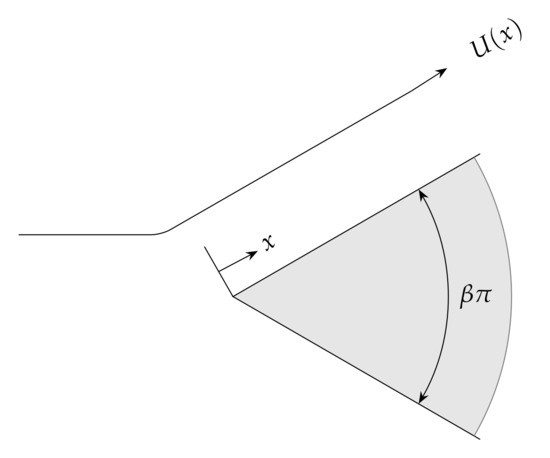
Figure 1.
Boundary layer flow past a wedge.
The case corresponds to the flow past a flat plate and leads to the well-known Blasius equation [3], and the case corresponds to what is known as the stagnation-point flow or the Hiemenz flow [4]. The similarity analysis begins with the continuity and the momentum equations that are described by
subject to the boundary conditions
In (1)–(3), u and v are the velocity components in the x and y directions of the fluid flow; is the viscosity; and is the velocity at the end of the boundary layer. A stream function is defined so that the continuity Equation (1) is automatically satisfied. Accordingly, it must be true that
Falkner and Skan [1] proposed the transformations
With the assumption that satisfies the power law for some constant c and , under the transformations (4), the momentum Equation (2) becomes
subject to the boundary conditions
derived from the corresponding transformation of (3). In (5) and (6), the primes denote differentiation with respect to . The nonlinear, third-order, ordinary differential Equation (5) is known as the Falkner–Skan equation. Together, (5) and (6) will be referred to as the Falkner–Skan boundary-value problem. Solutions of (5) and (6) are characterized by the numerical value .
Many industrial processes such as the drawing of plastic films, metal spinning, cooling of a metallic plate, and aerodynamic extrusion of plastic sheets require the solution of the Falkner–Skan equation and several of its variants applied to different geometries and corresponding boundary conditions [5]. Thus, there has been a considerable research interest in solving the Falkner–Skan equation during the past few decades. Analytical investigations of this problem have been aimed at providing existence and uniqueness results, finding exact, nearly-exact, or approximate analytical solutions. Computational approaches include a spectrum of methods ranging from the traditional finite-difference and finite-element methods to applying neural networks. The purpose of this review article is to provide a succinct summary of these various approaches that have been used for solving this important nonlinear boundary-value problem.
2. Materials and Methods
For the purpose of this review, we will be specifically investigating the problem as posed by (5) and (6). As this is a review article focused on the existing literature, this section will be devoted to describing the methods and/or approaches used by previous researchers. Accordingly, this section will include two main subsections, the first one reviewing analytical treatments, and the second exploring the computational approaches documented thus far in the literature. The discussion of analytical treatments will include existence and uniqueness results, exact or nearly-exact analytical solutions, and approximate analytical solutions. The discussion of computational approaches will include the description of the different classes of methods currently available.
2.1. Analytical Treatments
The first result on the existence and uniqueness of a solution to (5) and (6), with the additional assumption of , is due to Weyl [6] and this result was proved using a fixed-point theorem. Later, Coppel [7] assumed , considered three-dimensional trajectories in the phase-space, and established the existence and uniqueness result of Weyl [6], along with many more details on the asymptotic behavior of the solutions with for various scenarios related to in (5). In addition, Coppel [7] also showed that is an increasing function of . Tam [8] removed Coppel’s assumption of and established the existence and uniqueness result using a shooting argument. Craven et al. [9] proved the existence and uniqueness of solutions for by arguing that in this range, the condition is satisfied. Solutions of (5) and (6) which have for represent what are known as reverse flows. Stewartson [10] was the first to obtain reverse flows for . The existence and uniqueness of the reverse flows obtained by Stewartson was proved by Hastings [11]. In related work, Craven et al. [12] carried out numerical experiments that suggested the existence of reverse flows for . Other works on existence and uniqueness of solutions to (5) and (6) may also be found in Rosenhead et al. [13] and Hartman [14]. Veldman and Van der Vooren [15] have extended Coppel’s work for . The work of Oskam et al. [16] is also focused on the study of (5) for . In place of the boundary conditions in (6), Oskam et al. [16] consider two scenarios, one corresponding to , and one corresponding to , which are closely related as . Moreover, for , these two scenarios allow multiple solutions which are characterized and distinguished using the number of zeros of . Additionally, for , this work provides a periodic solution as well, and a more general treatment of periodic solutions is presented by Botta et al. [17]. Rajagopal et al. [18] have established non-similar solutions for the boundary layer flow of a homogeneous incompressible fluid of second grade past a wedge placed symmetrically with respect to the flow direction and discussed the variation of the skin-friction with respect to the non-Newtonian parameters. In particular, by expressing the solution as a power series in terms of a parameter that scales velocities with the square root of the Reynolds number, they obtain the zeroth-order and first-order solutions. Their zeroth-order solution coincides with the classical Falkner–Skan flow which we have explored in this review. They have numerically computed the second-order solution and analyzed it more in-depth as it relates to variations in the parameter . Massoudi et al. [19] have investigated the effects of the non-Newtonian nature of a fluid on the shear stress at the wall as well as the velocity profiles for different injection and suction rates and different values of the wedge angle . Additional existence and uniqueness results for the solution of the Falkner–Skan equations are also given by Padé [20].
More generally, with (5) written in the form
subject to the boundary conditions (6), several instances corresponding to specific choices of values for and have been explored analytically.
2.1.1. The Pohlhausen Flow
For , (7) leads to what is known as the Pohlhausen flow [21]. This instance, described by
has the exact solution given by
It is sometimes used to validate numerical methods [22].
2.1.2. The Blasius Flow
With (7) takes the form
and leads to the well-known Blasius probem [3]. While a closed-form solution is not available for (10), it has been subject to extensive analytical treatment as well as numerical investigation. We briefly describe some selected analytical treatments here and postpone the discussion of the numerical investigations to a later section.
For the case of (10), Blasius [3] proposed the power series solution
with
and . This solution requires knowledge of and, several works [23,24] have pointed out that the above series is valid only for small values of . As the search for an approximate analytical solution of (10) continued, Ahmad and Al-Barakati [25] modified the [4/3] Padé approximant for the derivative to satisfy its asymptotic behavior and obtained the solution
2.1.3. The Crocco–Wang Transformation
Another interesting line of investigation of the Falkner–Skan and Blasius flows has evolved due to the suggestion of the transformation
that originally appeared in Crocco [28], and later independently used by Wang [29]. Under the transformation (15), the third-order boundary-value problem (10) along with the boundary conditions (6) on the semi-infinite domain takes the form
which is a second-order boundary-value problem on a finite interval. Note that in (16) the primes denote differentiation with respect to the variable x. In this form, the quantity corresponds to that characterizes the solution of the Blasius problem. Brighi et al. [30] provides a historical review of the research on the Blasius problem. Several analytical approaches to analyzing and solving (16) are currently available. The work of Varin [31], where is referred to as the Blasius constant, examines the Crocco Equation (16) and provides the following results: (1) The non-existence of singularities other than the in (16) (which represents in (6)); (2) an explicit expression for the Blasius constant as a sum of a series of rational numbers; (3) a recursive formula for the coefficients of the series; and (4) a numerical procedure for computing the Blasius constant to high accuracy.
Under the Crocco–Wang transformation (15), the Falkner–Skan problem (5) and (6) becomes
in which the primes denote differentiation with respect to the variable x. Note that corresponds to also for the transformed Falkner–Skan equation as it did for the Blasius equation. The existence of a unique positive solution to a variant of the instance of (17) corresponding to the Homann [32] flow, or , has been demonstrated in Shin [33].
2.1.4. Other More General Analytical Approaches
Adomian Decomposition Method (ADM). Rewriting (5) as where and , ADM proceeds to obtain as an infinite series of the form . First, in the infinite series expansion is obtained as the solution of the homogeneous equation , which yields
In order to obtain , the ADM defines the Adomian polynomials as
and sets
According to Alizadeh et al. [34], the ADM is more realistic compared to other methods that may use linearization in some form or another, or assume some weak nonlinearity, or simplify the physical problem. On the other hand, the ADM involves a considerable amount of symbolic manipulation in order to obtain more terms in the infinite series expansion. For the Falkner–Skan problem, the results reported in [34] indicate that ADM required from 2 to 30 terms in the infinite series expansion as the wedge angle was varied from (flat plate) to (stagnation flow).
Homotopy Methods. A variety of methods, known by the names of Homotopy Asymptotic Method (HAM) [35], Optimal Homotopy Asymptotic Method (OAHM) [36,37,38], and Homotopy Perturbation Method (HPM) [39,40] have also been used to obtain approximate analytical solutions to the Falkner–Skan problem (5) and (6). These methods express the problem in the form
where L is an easily invertible linear part of the operator representing the Falkner–Skan problem, N the entire nonlinear operator that represents the Falkner–Skan equation, and p a parameter that varies from 0 to 1. The form (20) is set up such that the solution corresponding to can be easily obtained by inverting the linear operator, and the solution corresponding to is the desired solution of the Falkner–Skan problem, both satisfying the boundary conditions (6). In order to advance the solution from to , the desired solution is assumed to be of the form
Beginning with obtained as the solution of subject to the boundary conditions (6), plugging the form (21) into (20), differentiating with respect to p as many times as desired and setting yields a succession of equations to solve for . An efficient implementation of HAM by the name Spectral HAM (SHAM) [41] has also been proposed, and this method obtains the initial solution using collocation at Chebyshev points after suitably transforming the semi-infinite domain into the interval . It is customary to call p the embedding parameter. In addition to p, the HAM approach allows for the use of another parameter h known as the convergence control parameter.
As evident from the above discussion, most studies focused on the analytical treatment of (5) and (6) or its variants have demonstrated a solution’s existence and uniqueness, developed semi-analytic, asymptotic solutions for special cases, or discovered ranges of validity for the boundary-layer parameters and similarity variables [5,6,8,13,14,20,42]. However, a general closed-form solution is still unavailable for this two-point boundary-value problem in spite of the efforts dedicated to its investigation. Therefore, approaching its solution numerically has been the most common and valuable route.
2.2. Numerical Treatments
Several different numerical approaches have been used to investigating the Falkner -Skan problem (5) and (6), and they are in the categories of shooting, finite-differences, collocation, and other methods. The first computational treatment reported in the literature is due to Hartree [43]. While the details of the numerical approach are not provided in this work, Hartree [43] showed that physically relevant solutions of (5) and (6) exist only in the range . Smith [44], Cebeci and Keller [45], and Na [46] have used shooting and invariant imbedding to solve the Falkner–Skan problem directly on the semi-infinite domain. The methods that came about after these early treatments mainly focused on making the computational methods more efficient and/or skillfully dealing with the boundary condition at infinity. Various special cases of (5) and (6) have been used to validate the effectiveness of the methods developed.
Coordinate transformations and appropriate change of variables have been used for the purpose of mapping the physical domain to a computational domain like or . It is also common practice to truncate the physical domain where by a finite value which is determined as part of the solution, and impose the boundary condition as at the truncated boundary . Once transformed to a suitable computational form, methods vary depending on the specific way in which numerical computations are carried out. Among the different techniques used for this purpose are, shooting; finite-differences; and collocation methods. Along with these fundamental differences in the approach, the methods also vary based on the specific techniques used for the computational problems that result. In this section, we will review these approaches and the associated computational techniques.
2.2.1. Shooting
The term shooting in numerical analysis refers to the idea of solving a two-point boundary-value problem iteratively by repeatedly solving an initial-value problem aimed at obtaining the value
such that the boundary condition as is satisfied. With an initial guess for , the shooting process involves marching the solution from to , and adjusting or improving the guess for the value of appropriately so that the boundary condition at is satisfied. There are several ways in which the methods that employ the shooting approach may differ. These include the initial guess for , the choice of the method that advances the solution from to , and the manner in which the guess for is adjusted.
As mentioned earlier, the semi-infinite physical domain is first mapped to a finite computational domain like using an appropriate coordinate transformation. For this purpose, a finite boundary is first introduced and the value of will be determined as part of the solution. It is customary to introduce the “asymptotic condition” as to help determine the additional unknown . Thus, with the truncated domain , the conditions
will be imposed. Next, we observe that under the coordinate transformation [47], the problem (5) and (6) becomes
subject to the boundary conditions
At this point, applying the the change of variables
transforms the single third-order differential equation to (24) to the system of three first-order differential equations
while the boundary conditions (25), (26) and (22) become
Additionally, the conditions (23) now take the form
Note that (29) and (30) together represent an initial value problem. With the correct value of , the initial value problem (29) and (30) should produce u and v that satisfy the conditions (31). Conversely, in order to obtain the correct value for , the initial value problem (29) and (30) is first solved with an initial guess for in (29), the values of the u and v at based on this solution are used to improve upon the guess for . This process is repeated until the conditions (31) are satisfied. The following is a listing of the works that have used the shooting approach along with a description of how they differed from the others using the same approach:
- Cebeci and Keller [45] also employ the idea of parallel shooting to obtain the solution. This approach involves dividing the domain into several subintervals and applying shooting in each subinterval. The motivation for this approach comes from the desire to avoid any instabilities that may be caused while marching the solution using an initial-value method. The authors report successfully obtaining three significant digits in two iterations when shooting was carried out over three subintervals.
- Asaithambi [47] uses the classical, fourth-order Runge-Kutta method to march the solution from to and the secant method to iteratively obtain improved values for . Two initial approximations for were needed.
- Salama [48] uses a single-step method of order 5 to march the solution from to , coupled with a third-order rootfinding method called the Halley’s method [49] to compute and the secant method to compute . It is also important to note that the solutions of (5) and (6) are obtained for values as large as 40.
- In another work, Asaithambi [22] uses recursive evaluation of Taylor coefficients to march the solution from to and the secant method to iteratively obtain improved values for . Two initial approximations for were needed, and higher orders of accuracy, as high as 7, were achieved with ease. Moreover, this work explores (5) and (6) for values as large as 40 as well and compares the results obtained previously by Salama [48].
- Zhang and Chen [50] used the Runge-Kutta (4,5) formula to march the solution from to , and the Newton’s method to improve the guess for , and hence required only one initial guess to get started.
- Sher and Yakhot [51] shoot from the end corresponding to instead of from . They choose an arbitrary value for as , a value close to 1 for as and estimate as using a simple analysis of the asymptotic behavior of the solution.
2.2.2. Finite Differences
The finite-difference approach is often used as a more efficient alternative to the shooting approach, as the use of finite differences does not warrant the repeated solution of initial-value problems as does the shooting approach. The following is a listing of the works that have used finite differences, along with a description of how they differed from the others using the same approach:
- Asaithambi [52] truncates the infinite domain at , uses the transformation as done previously, and sets , to transform the problem (5) and (6) on the physical domain to the systemon the computational domain , subject to the conditionsIn order to discretize (32)–(35), the interval is subdivided into N subintervals for at with . Letting and denote the approximations to and respectively, Equation (32) is discretized asand Equation (33) is discretized asNewton’s method is used for the iterative solution of the nonlinear system (37), Equation (36) is used to update the values of , and (39) is used to update . The solution of the nonlinear system by Newton’s method involves the repeated solution of a linear system with a tridiagonal coefficient matrix. In related work, Asaithambi [53] uses the transformation to map the physical domain to the computational domain and discretizes the transformed equations and boundary conditions using second-order finite differences. This approach does not truncate the physical domain but still requires the iterative solution of a nonlinear system that involves the solution of a tridiagonal linear system during each iteration.
- Salama and Mansour [54] develop an unconditionally stable, fourth order finite difference method that involves only four grid points and apply it to the nonlinear Falkner–Skan problem (5) and (6). Their development uses the method of undetermined coefficients involving the unknown function values at points to derive the discretization for the third derivative by setting the local truncation errors of orders 0, 1, 2, and 3 to zero. The details of the derivation are too technical to be included here and the reader is referred to the original publication [54]. In related work, Salama and Mansour [55] develop a finite difference method of order 6 for solving steady and unsteady two-dimensional laminar boundary-layer equations. This method is also unconditionally stable. The authors illustrate the effectiveness of this method by solving the unsteady separated stagnation point flow, the Falkner–Skan equation and Blasius equation.
- Duque-Daza et al. [56] express (24) asand use subintervals with and for . With , , and denoting , , , and respectively, the authors use the fourth-order difference formulasfor the first and second derivatives of f and the third-order formulafor the third derivative. Plugging (41)–(43) into (40) yields a nonlinear system of algebraic equations in the unknowns . The boundary conditionsare discretized usingThen the Equation (40) itself is evaluated at to obtain , which is discretized asFinally, the condition is used to solve for . For this purpose, the second-order derivative is discretized asand the secant method is used to obtain updated values of from one iteration to the next. In the same article [56], the authors also report the use of a higher order compact finite difference method to solve (5) and (6).
2.2.3. Collocation Methods
The collocation approach for solving a boundary-value problem consists of selecting a solution from a finite dimensional space of candidate solutions by requiring that such a solution satisfy the governing differential equation(s) at a select set of points in the domain called collocation points. More specifically, the desired solution from the finite dimensional space is expressed as a linear combination of a set of basis functions with undetermined coefficients. Requiring this solution to satisfy the differential equation and the boundary conditions together reduces the boundary-value problem to the problem of solving a system of algebraic equations in the undetermined coefficients. While most collocation methods for solving the Falkner–Skan problem (5) and (6) attempt to obtain polynomial forms for the solution, they differ based on the choice of basis functions and the techniques they employ in order to translate the given boundary-value problem to the system of algebraic equations. We review a few such methods here.
- Parand et al. [57] consider (5) subject to the boundary conditionsin which is different from the corresponding condition in (6). The authors use rational Legendre functions as their basis functions, and the correspondingly transformed Gauss-Legendre points as the collocation points. It is important to emphasize here that their approach does not require the problem to be transformed to a suitable form on a finite domain.The rational Legendre functions are defined byin which are the well-known Legendre polynomials. While form a family of polynomials orthogonal on the interval with respect to the weight function , form a family of rational functions that are orthogonal on with respect to the weight functionMoreover, in (52) and (53), L is a constant known as the map parameter. While setting is most common, guidelines for the choice of value for L are given for rational Chebyshev functions in [58] that apply also to the Legendre family. The rational Legendre functions satisfy the relationfor . By setting with , the boundary conditions for are translated to corresponding conditions on . In particular, as now becomes as . Now, a solution of the formis sought by settingat for , where are the zeros of the Legendre polynomial of degree (also known as the Gauss-Legendre nodes). Along with the conditions and , (56) leads to a system of nonlinear algebraic equations in the expansion coefficients in (55).
- Kajani et al. [59] truncate the infinite domain to for a “large enough” L and use what they call shifted Chebyshev polynomials to solve (5) and (6). The shifted Chebyshev polynomials are defined byin which are the well-known Chebyshev polynomials. While the Chebyshev polynomials are orthogonal on with respect to the weight function , the shifted Chebyshev polynomials are orthogonal on the interval with respect to the weight function . The authors seek a solution of the formThey use (58) to obtainin which the coefficients and may be easily expressed in terms of the coefficients by evaluating the integrals needed to go from to and . The solution to (5) and (6) is obtained by settingat , for , where the collocation points are the zeros of , and settingcorresponding to the boundary condition as . Note that the boundary conditions at are automatically satisfied through the definitions of and as given in (59).
2.2.4. Other Methods
In this subsection, we will review a couple of methods that do not fall under the categories discussed previously in this paper.
- Using a truncated domain at and imposing the asymptotic condition as , Asaithambi [60] solves (5) and (6) by formulating the problem in weak Galerkin form and with piecewise linear functions as basis functions and provides a finite-element solution. For this purpose, Asaithambi [60] rewrites (5) and (6) in the formin which the primes denote differentiation with respect to the variable , , and is the truncated boundary which needs to be determined as part of the solution. Note that the semi-infinite domain is now mapped to the finite domain . Subdividing the interval into N subintervals at with and , the basis functions defined byAsaithambi [60] constructs the solution in the formby requiringThus, the method uses both finite-elements and finite-differences to obtain a nonlinear system of algebraic equations which is solved using Newton’s method. However, this system has to be iteratively solved to adjust the value of so that the asymptotic condition is satisfied. Asaithambi [60] handles this by using the secant method y settingand solving for . The superscript here denotes the approximation to the different quantities during the iteration. The approximation is obtained from and using
- Recently, Hajimohammadi et al. [61] have developed a numerical learning approach to solving the Falkner–Skan problem (5) and (6). They cite several works from the literature that have used machine learning methods for the purpose of handling nonlinear models in the continuous domain, and demonstrate that a combination of numerical methods and machine learning methods could deal with nonlinearities much more easily and produce accurate solutions. In their work on the Falkner–Skan problem, they employ a combination of collocation using Rational Gegenbauer (RG) functions and the Least Squares (LS) Support Vector Machines (SM) and present results of their RG_LS_SVM method that compare well with results obtained previously by other researchers. The details of their method are too many to cover in this review and the reader is referred to the original publication [61].
3. Results
As mentioned previously in this paper, while existence and uniqueness results as well as results related to the properties of solutions have been explored extensively from theoretical perspectives, there is a significant amount of interest in exploring computational approaches for the solution of the Falkner–Skan problem. The researchers pursuing computational approaches have considered several special cases of (5) and (6) and demonstrated the effectiveness of their own approaches by comparing with those of others based on characteristics such as accuracy achieved, computational effort required, and ease of implementation. The flows described in Table 1 are most frequently studied in particular, and they correspond to the pairs of values in (7). The value of for each flow is also included in the table for reference.

Table 1.
Some standard Falkner–Skan solutions.
With , most works [22,48,50] have reported results for both positive and negative values of in the interval . These results are summarized in Table 2.
Table 2.
Falkner–Skan solutions ( for selected values of .
Table 3 summarizes the results of previous works in which the authors have reported results for select values of , with .
Table 3.
Falkner–Skan solutions ( for select values of .
4. Discussion
This article has provided a review of existing research on the analytical, semi-analytical, and computational methods for the solution of the nonlinear, third-order, two-point boundary-value problem known as the Falkner–Skan problem, as given by (5) and (6). The review includes brief descriptions of the approaches without going into the technical details. For analytical treatments, the extent of the analyses and the nature of the final results of the works considered have been presented. For numerical treatments, methods were discussed under three broad categories of shooting, finite-differences, collocation, and other (hybrid) methods. The results presented are representative of the most frequently reported results. The methods that have been described in some detail are intended to show the variety of approaches used to solve the Falkner–Skan problem. There are several other approaches to solving the Falkner–Skan problem that are closely related to those discussed in this review. Such approaches include differential transformation [62], variational iteration [63], iterative transformation [64] and other semi-analytical approaches [65] leading to series solutions.
Funding
This research received no external funding.
Data Availability Statement
The data supporting the results reported in this article can be found in the references cited.
Conflicts of Interest
The author declares no conflict of interest.
References
- Falkner, V.; Skan, S.W. LXXXV. Solutions of the boundary-layer equations. Lond. Edinb. Dublin Philos. Mag. J. Sci. 1931, 12, 865–896. [Google Scholar] [CrossRef]
- Schlichting, H.; Gersten, K. Boundary-Layer Theory; Springer: Berlin, Germany, 2016. [Google Scholar]
- Blasius, H. Grenzschicluen in Flüssigkeiten mit kleiner Reibung. Z. Angew. Maihemalik Phys. 1908, 56, 1–37. [Google Scholar]
- Hiemenz, K. Die Grenzschicht an einem in den gleichformigen Flussigkeitsstrom eingetauchten geraden Kreiszylinder. Dinglers Polytech. J. 1911, 326, 321–324. [Google Scholar]
- Magyari, E.; Keller, B. Exact solutions for self-similar boundary-layer flows induced by permeable stretching walls. Eur. J. Mech. B Fluids 2000, 19, 109–122. [Google Scholar] [CrossRef]
- Weyl, H. On the differential equations of the simplest boundary-layer problems. Ann. Math. 1942, 42, 381–407. [Google Scholar] [CrossRef]
- Coppel, W.A. On a differential equation of boundary-layer theory. Philos. Trans. R. Soc. Lond. Ser. A Math. Phys. Sci. 1960, 253, 101–136. [Google Scholar]
- Tam, K.K. A note on the existence of a solution of the Falkner–Skan equation. Can. Math. Bull. 1970, 13, 125–127. [Google Scholar] [CrossRef]
- Craven, A.; Peletier, L. On the uniqueness of solutions of the Falkner–Skan equation. Mathematika 1972, 19, 129–133. [Google Scholar] [CrossRef]
- Stewartson, K. Further solutions of the Falkner–Skan equation. In Mathematical Proceedings of the Cambridge Philosophical Society; Cambridge University Press: Cambridge, UK, 1954; Volume 50, pp. 454–465. [Google Scholar]
- Hastings, S. Reversed flow solutions of the Falkner–Skan equation. SIAM J. Appl. Math. 1972, 22, 329–334. [Google Scholar] [CrossRef]
- Craven, A.; Peletier, L. Reverse flow solutions of the Falkner–Skan equation for λ> 1. Mathematika 1972, 19, 135–138. [Google Scholar] [CrossRef]
- Lighthill, M.; Rosenhead, L. Laminar Boundary Layers; Clarendon Press: Oxford, UK, 1963. [Google Scholar]
- Hartman, P. On the existence of similar solutions of some boundary layer problems. SIAM J. Math. Anal. 1972, 3, 120–147. [Google Scholar] [CrossRef]
- Veldman, A.; Van de Vooren, A. On a generalized Falkner–Skan equation. J. Math. Anal. Appl. 1980, 75, 102–111. [Google Scholar] [CrossRef]
- Oskam, B.; Veldman, A. Branching of the Falkner–Skan solutions for λ< 0. J. Eng. Math. 1982, 16, 295–308. [Google Scholar]
- Botta, E.F.F.; Hut, F.; Veldman, A.E.P. The role of periodic solutions in the Falkner–Skan problem for λ> 0. J. Eng. Math. 1986, 20, 81–93. [Google Scholar] [CrossRef]
- Rajagopal, K.R.; Gupta, A.; Na, T.Y. A note on the Falkner–Skan flows of a non-Newtonian fluid. Int. J. Non-Linear Mech. 1983, 18, 313–320. [Google Scholar] [CrossRef]
- Massoudi, M.; Ramezan, M. Effect of injection or suction on the Falkner–Skan flows of second grade fluids. Int. J. Non-Linear Mech. 1989, 24, 221–227. [Google Scholar] [CrossRef]
- Padé, O. On the solution of Falkner–Skan equations. J. Math. Anal. Appl. 2003, 285, 264–274. [Google Scholar] [CrossRef][Green Version]
- Pohlhausen, K. Zur näherungsweisen integration der differentialgleichung der iaminaren grenzschicht. ZAMM J. Appl. Math. Mech./Z. Angew. Math. Mech. 1921, 1, 252–290. [Google Scholar] [CrossRef]
- Asaithambi, A. Solution of the Falkner–Skan equation by recursive evaluation of Taylor coefficients. J. Comput. Appl. Math. 2005, 176, 203–214. [Google Scholar] [CrossRef]
- Boyd, J.P. The Blasius function: Computations before computers, the value of tricks, undergraduate projects, and open research problems. SIAM Rev. 2008, 50, 791–804. [Google Scholar] [CrossRef]
- Yun, B.I. New Approximate Analytical Solutions of the Falkner–Skan Equation. J. Appl. Math. 2012, 2012, 1–12. [Google Scholar] [CrossRef]
- Ahmad, F.; Al-Barakati, W.H. An approximate analytic solution of the Blasius problem. Commun. Non-Linear Sci. Numer. Simul. 2009, 14, 1021–1024. [Google Scholar] [CrossRef]
- Bougoffa, L.; Wazwaz, A.M. New approximate solutions of the Blasius equation. Int. J. Numer. Methods Heat Fluid Flow 2015, 25, 1590–1599. [Google Scholar] [CrossRef]
- Belden, E.R.; Dickman, Z.A.; Weinstein, S.J.; Archibee, A.D.; Burroughs, E.; Barlow, N.S. Asymptotic approximant for the Falkner–Skan boundary layer equation. Q. J. Mech. Appl. Math. 2020, 73, 36–50. [Google Scholar] [CrossRef]
- Crocco, L. Sullo strato limite laminare nei gas lungo una lamina plana. Rend. Math. Appl. Ser. 1941, 5, 138–152. [Google Scholar]
- Wang, L. A new algorithm for solving classical Blasius equation. Appl. Math. Comput. 2004, 157, 1–9. [Google Scholar] [CrossRef]
- Brighi, B.; Fruchard, A.; Sari, T. On the Blasius problem. Adv. Differ. Equ. 2008, 13, 509–600. [Google Scholar]
- Varin, V.P. A solution of the Blasius problem. Comput. Math. Math. Phys. 2014, 54, 1025–1036. [Google Scholar] [CrossRef]
- Homann, F. Der Einfluss grosser Zähigkeit bei der Strömung um den Zylinder und um die Kugel. ZAMM J. Appl. Math. Mech./Z. Angew. Math. Mech. 1936, 16, 153–164. [Google Scholar] [CrossRef]
- Shin, J.Y. A singular nonlinear differential equation arising in the Homann flow. J. Math. Anal. Appl. 1997, 212, 443–451. [Google Scholar] [CrossRef]
- Alizadeh, E.; Farhadi, M.; Sedighi, K.; Ebrahimi-Kebria, H.; Ghafourian, A. Solution of the Falkner–Skan equation for wedge by Adomian Decomposition Method. Commun. Non-Linear Sci. Numer. Simul. 2009, 14, 724–733. [Google Scholar] [CrossRef]
- Abbasbandy, S.; Hayat, T. Solution of the MHD Falkner–Skan flow by homotopy analysis method. Commun. Non-Linear Sci. Numer. Simul. 2009, 14, 3591–3598. [Google Scholar] [CrossRef]
- Marinca, V.; Ene, R.D.; Marinca, B. Analytic approximate solution for Falkner–Skan equation. Sci. World J. 2014, 2014, 1–22. [Google Scholar] [CrossRef]
- Marinca, V.; Herişanu, N. The optimal homotopy asymptotic method for solving Blasius equation. Appl. Math. Comput. 2014, 231, 134–139. [Google Scholar] [CrossRef]
- Madaki, A.; Abdulhameed, M.; Ali, M.; Roslan, R. Solution of the Falkner–Skan wedge flow by a revised optimal homotopy asymptotic method. SpringerPlus 2016, 5, 1–8. [Google Scholar] [CrossRef]
- Ariel, P.D. Homotopy perturbation method and the stagnation point flow. Appl. Appl. Math. 2010, 1, 154–166. [Google Scholar]
- Bararnia, H.; Ghasemi, E.; Soleimani, S.; Ghotbi, A.R.; Ganji, D.D. Solution of the Falkner–Skan wedge flow by HPM–Pade’method. Adv. Eng. Softw. 2012, 43, 44–52. [Google Scholar] [CrossRef]
- Motsa, S.; Sibanda, P. An efficient numerical method for solving Falkner–Skan boundary layer flows. Int. J. Numer. Methods Fluids 2012, 69, 499–508. [Google Scholar] [CrossRef]
- Fang, T.; Zhang, J. An exact analytical solution of the Falkner–Skan equation with mass transfer and wall stretching. Int. J. Non-Linear Mech. 2008, 43, 1000–1006. [Google Scholar] [CrossRef]
- Hartree, D.R. On an equation occurring in Falkner and Skan’s approximate treatment of the equations of the boundary layer. In Mathematical Proceedings of the Cambridge Philosophical Society; Cambridge University Press: Cambridge, UK, 1937; Volume 33, pp. 223–239. [Google Scholar]
- Smith, A. Improved Solutions of the Falkner and Skan Boundary-Layer Equation; Institute of Aeronautical Sciences Fund Paper FF-115; Institute of the Aeronautical Sciences: Reston, VA, USA, 1954. [Google Scholar]
- Cebeci, T.; Keller, H.B. Shooting and parallel shooting methods for solving the Falkner–Skan boundary-layer equation. J. Comput. Phys. 1971, 7, 289–300. [Google Scholar] [CrossRef]
- Na, T.Y. Computational Methods in Engineering Boundary Value Problems; Academic Press: Cambridge, MA, USA, 1980. [Google Scholar]
- Asaithambi, N. A numerical method for the solution of the Falkner–Skan equation. Appl. Math. Comput. 1997, 81, 259–264. [Google Scholar] [CrossRef]
- Salama, A. Higher-order method for solving free boundary-value problems. Numer. Heat Transf. Part B Fundam. 2004, 45, 385–394. [Google Scholar] [CrossRef]
- Scavo, T.; Thoo, J. On the geometry of Halley’s method. Am. Math. Mon. 1995, 102, 417–426. [Google Scholar] [CrossRef]
- Zhang, J.; Chen, B. An iterative method for solving the Falkner–Skan equation. Appl. Math. Comput. 2009, 210, 215–222. [Google Scholar] [CrossRef]
- Sher, I.; Yakhot, A. New approach to solution of the Falkner–Skan equation. AIAA J. 2001, 39, 965–967. [Google Scholar] [CrossRef]
- Asaithambi, A. A finite-difference method for the Falkner–Skan equation. Appl. Math. Comput. 1998, 92, 135–141. [Google Scholar] [CrossRef]
- Asaithambi, A. A second-order finite-difference method for the Falkner–Skan equation. Appl. Math. Comput. 2004, 156, 779–786. [Google Scholar] [CrossRef]
- Salama, A.; Mansour, A. Fourth-order finite-difference method for third-order boundary-value problems. Numer. Heat Transf. Part B 2005, 47, 383–401. [Google Scholar] [CrossRef]
- Salama, A.; Mansour, A. Finite-difference method of order six for the two-dimensional steady and unsteady boundary-layer equations. Int. J. Mod. Phys. C 2005, 16, 757–780. [Google Scholar] [CrossRef]
- Duque-Daza, C.; Lockerby, D.; Galeano, C. Numerical solution of the Falkner–Skan equation using third-order and high-order-compact finite difference schemes. J. Braz. Soc. Mech. Sci. Eng. 2011, 33, 381–392. [Google Scholar] [CrossRef]
- Parand, K.; Pakniat, N.; Delafkar, Z. Numerical solution of the Falkner–Skan equation with stretching boundary by collocation method. Int. J. Non-Linear Sci. 2011, 11, 275–283. [Google Scholar]
- Boyd, J.P. The optimization of convergence for Chebyshev polynomial methods in an unbounded domain. J. Comput. Phys. 1982, 45, 43–79. [Google Scholar] [CrossRef]
- Kajani, M.T.; Maleki, M.; Allame, M. A numerical solution of Falkner–Skan equation via a shifted Chebyshev collocation method. AIP Conf. Proc. 2014, 1629, 381–386. [Google Scholar]
- Asaithambi, A. Numerical solution of the Falkner–Skan equation using piecewise linear functions. Appl. Math. Comput. 2004, 159, 267–273. [Google Scholar] [CrossRef]
- Hajimohammadi, Z.; Baharifard, F.; Parand, K. A new numerical learning approach to solve general Falkner–Skan model. Eng. Comput. 2020, 2020, 1–17. [Google Scholar] [CrossRef]
- Kuo, B.L. Application of the differential transformation method to the solutions of Falkner–Skan wedge flow. Acta Mech. 2003, 164, 161–174. [Google Scholar] [CrossRef]
- Dehghan, M.; Tatari, M.; Azizi, A. The solution of the Falkner–Skan equation arising in the modelling of boundary-layer problems via variational iteration method. Int. J. Numer. Methods Heat Fluid Flow 2011, 21, 136–149. [Google Scholar] [CrossRef]
- Fazio, R. The iterative transformation method. Int. J. Non-Linear Mech. 2019, 116, 181–194. [Google Scholar] [CrossRef]
- Ahmed, K. A note on the solution of general Falkner–Skan problem by two novel semi-analytical techniques. Propuls. Power Res. 2015, 4, 212–220. [Google Scholar]
Publisher’s Note: MDPI stays neutral with regard to jurisdictional claims in published maps and institutional affiliations. |
© 2021 by the author. Licensee MDPI, Basel, Switzerland. This article is an open access article distributed under the terms and conditions of the Creative Commons Attribution (CC BY) license (https://creativecommons.org/licenses/by/4.0/).