


Abstract
Currently, there are 158 valid species of triatomines, all of which are potential vectors of Trypanosoma cruzi, the etiological agent of Chagas disease. The correct taxonomic identification of triatomines is essential since each species hos a different epidemiological importance. The aim of the study is to compare five species of South American Triatoma. Here we present a comparative study of terminal abdominal segments in females by scanning electron microscopy (SEM) of the species Triatoma delpontei, T. jurbergi, T. infestans var. melanosoma, T. platensis, and T. vandae. The results showed diagnostic characters for the studied species. The dorsal view featured more valuable characters, with seven informative characters. Similarities were observed among T. delpontei, T. infestans var. melanosoma, and T. platensis, and between T. jurbergi and T. vandae, correlating with previous studies. Thus, female genital characters proved to be reliable and useful in the diagnosis of the Triatoma species studied here; additional studies, along with other sets of behavioral, morphological, and molecular data, helped to reinforce the hypotheses found here.
1. Introduction
Chagas disease (CD) is one of the most important and neglected diseases in the world [1]. Currently, this disease affects almost seven million people per year in endemic areas and has caused epidemic outbreaks in 21 countries in Latin America [2]. The insects of the subfamily Triatominae (Hemiptera: Reduviidae) are potential vectors of the protozoan Tryponosoma cruzi (Chagas, 1909) (Kinetoplastea: Trypanosomatidae), the etiologic agent of CD.
The subfamily comprises 158 valid species, distributed in 18 valid genera and five tribes [3,4,5,6]. Triatoma Laporte is the most diverse genus, including 82 species, most of which are epidemiologically important, mainly due to their synanthropic habits and capacity for domiciliation [7].
Triatoma is divided into nine specific complexes based on phenotypic similarity, geographic distribution, phylogeny, epidemiological importance [7], and cytogenetic aspects [8,9]. However, there is still no consensus regarding the characteristics that define these complexes, and new studies are needed to corroborate or refute these groupings [10,11].
Within complexes, characteristics commonly used to distinguish Triatoma species include the color patterns of the connexivum, pronotum, and legs and the morphological features of the head, pronotum, and female and male genitalia [12,13,14].
Previous studies have compared terminal segments of the abdomen of females belonging to the Triatomini and Rhodniini tribes based on scanning electron microscopy (SEM) images and highlighted diagnostic characters at the species level [13,14,15,16,17,18,19]. Currently, there are 47 species of Triatoma with described female genitalia [3,13,19,20]. According to Rodrigues et al. [13], the female genitalia present a useful set of characters for the specific identification of Triatominae. Subsequently, Belintani et al. [14] highlighted, through morphometric analysis, that the female genitalia have conformations that allow the differentiation of the species and genera Panstrongylus Berg, Psammolestes Bergroth, Rhodnius Stål, and Triatoma. However, exclusive morphological characters have not yet been observed in the female genitalia that allow differentiating Triatoma from another genus [13].
Triatoma is divided into eight complexes, with the infestans complex being the most diverse and having species with different epidemiological importance [1,7]. The infestans Complex groups together 37 cis-Andean species from South America based on the morphological similarity of the species and geographic distribution [3,7]. Although previous studies indicate some taxonomic issues, there are generally no difficulties in separating species from the infestans complex [1,3,5]. The present study aims to describe the terminal abdominal segments of females of five species of Triatoma infestans complex using SEM, distinguishing the species through comparative analysis.
2. Materials and Methods
Specimens examined were obtained from the colonies kept at the insectary of the Laboratório Nacional e Internacional de Referência em Taxonomia de Triatomíneos of the Instituto Oswaldo Cruz (LNIRTT) IOC/Fiocruz, Rio de Janeiro, Brazil (Table 1). All samples were compared with type specimens found in the Triatomine Collection of the Instituto Oswaldo Cruz, also located at LNIRTT.

Table 1.
Species, individuals examined, colony number, and origin of the triatomines used in this study.
We studied five species of Triatominae: Triatoma delpontei Romaña and Abalos, 1947; Triatoma infestans var. melanosoma Martinez, Olmedo, and Carcavallo, 1987; Triatoma jurbergi Carcavallo, Galvão, and Lent, 1998; Triatoma platensis Neiva, 1930; and Triatoma vandae Carcavallo, Jurberg, Rocha, Galvão, Noireau, and Lent, 2002 (Table 1). Each specimen was identified based on the original description and identification keys, observing and excluding morphological variations [12,21,22,23,24,25].
Three specimens of each species from the colonies were used for scanning electron microscopy (SEM). The methodology for this purpose was similar to that described by Rosa et al. [17] and Rodrigues et al. [13]. The genitalia were metallized, and micrographics were taken in the Rudolf Barth—Scanning Electron Microscopy Platform/IOC.
3. Results
Our study performed a detailed morphological analysis of the external female genitalia. We highlighted 17 characters (Table 2 and Table 3). In the dorsal view, three characters were described for the first time: (1) tergite VIII, length in relation to tergite IX; (2) apex of connexivum, length relative to the posterior margin of tergite VIII; in ventral view; and (3) shape of gonopophyses VIII. However, female genitalia in dorsal view were more valuable since they had seven informative characters.
Table 2.
Variable features of the female external genitalia in five species of Triatominae (dorsal view).
Table 3.
Variable features of the female external genitalia in five species of Triatominae (ventral view).
3.1. Dorsal View (Figure 1A,D,G,J,M; Table 2)
Tergite VII is clearly separated from VIII but has three different shapes (Figure 1A,B,G,J,M; Table 2). The following variations were observed: a pair of lateral depressions and an almost straight median portion (T. delpontei and T. platensis); W-shaped, with a pair of lateral depressions and elevation in the median region (T. infestans var. melanosoma); and slightly concave (T. jurbergi and T. vandae). The length of tergite VIII relative to tergite IX is shorter, except for T. delpontei and T. platensis, in which it is as long or longer, respectively (compare Figure 1A,J). The combination of segments IX and X has a semi-oval shape, but with the following differences in the shape of the posterolateral angles of segment IX: expanded (T. delpontei, T. platensis, and T. vandae); greatly expanded (T. jurbergi); and rounded and greatly expanded (T. infestans var. melanosoma). The Tergite IX lateral margin is strongly expanded, except for T. platensis, which is weakly expanded. Other characters and their states are defined in Table 2.
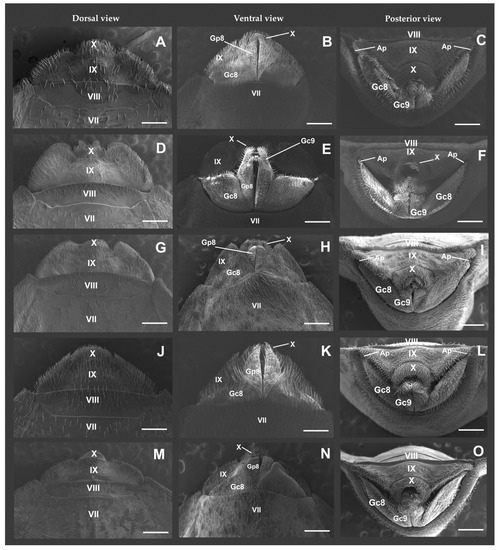
Figure 1.
Female external genitalia examined by scanning electron microscopy: (A–C) Triatoma delpontei; (D–F) Triatoma infestans var. melanosoma; (G–I) Triatoma jurbergi; (J–L) Triatoma platensis; and (M–O) Triatoma vandae. [Gc8, gonocoxite VIII; Gc9, gonocoxite IX; Gp8, gonapophysis VIII; Gp9, gonapophysis IX; VII, sternite; IX and X, segments]. Scale bars = 500 μm.
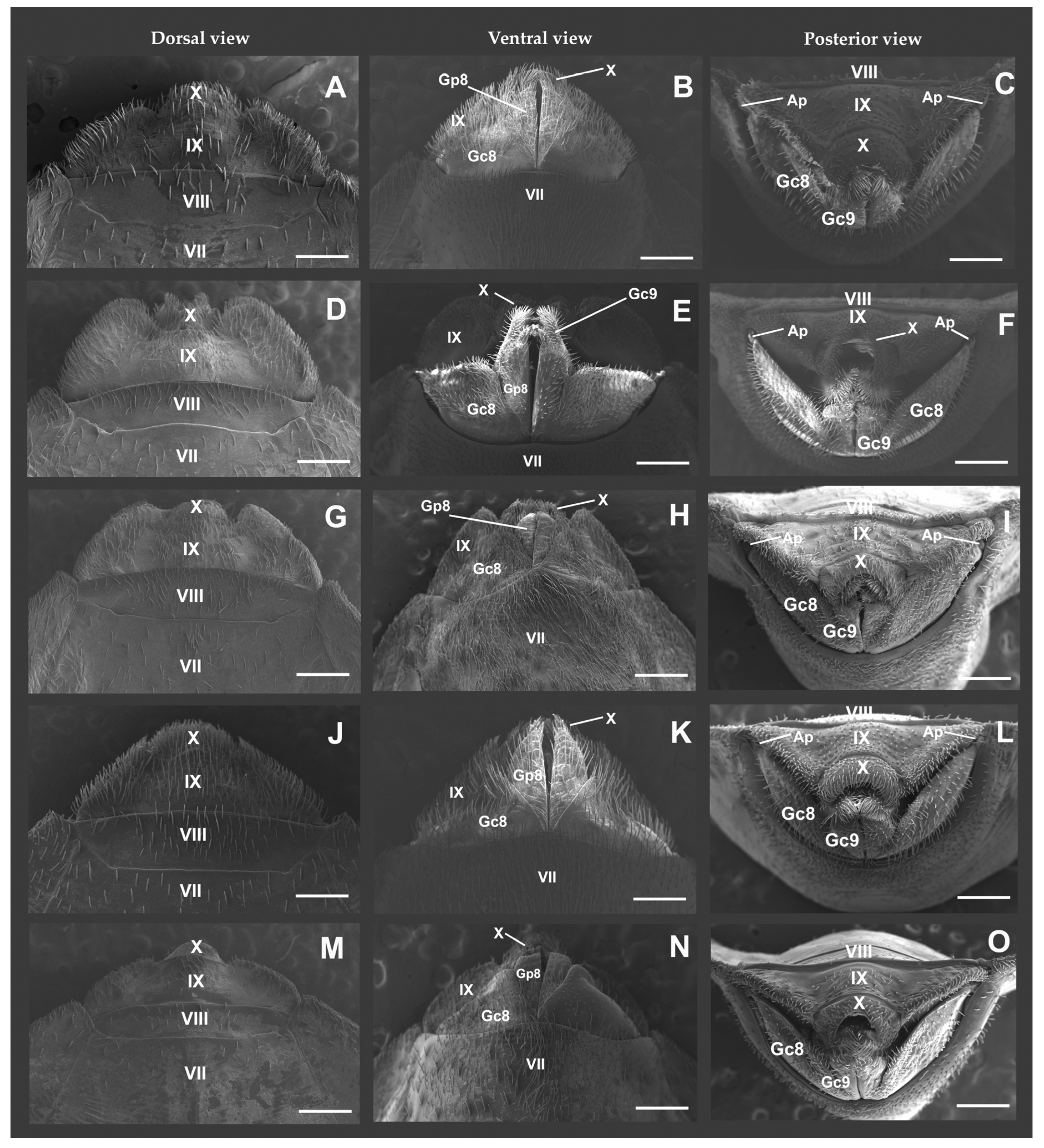
Figure 1.
Female external genitalia examined by scanning electron microscopy: (A–C) Triatoma delpontei; (D–F) Triatoma infestans var. melanosoma; (G–I) Triatoma jurbergi; (J–L) Triatoma platensis; and (M–O) Triatoma vandae. [Gc8, gonocoxite VIII; Gc9, gonocoxite IX; Gp8, gonapophysis VIII; Gp9, gonapophysis IX; VII, sternite; IX and X, segments]. Scale bars = 500 μm.
3.2. Ventral View (Figure 1B,E,H,K,N; Table 3)
The posterior margin of sternite VII is variably sinuous, excluding T. infestans var. melanosoma, in which it is strongly concave (Figure 1E). Gonocoxites VIII and Sternite IX showed transverse forms with posterior margins that were straight and strongly expanded, respectively, for T. infestans var. melanosoma (Figure 1E; Table 3). These two characteristics were different from those of the other species studied here (see Figure 1B,H,K–N; Table 3).
3.3. Posterior View (Figure 1C,F,I,L,O; Table 4)
Appendices correspond to lateral sclerites and are visible in all studied species except T. vandae (Figure 1O). The other characteristics observed are similar for the other species (Figure 1C,F,I,L; Table 4).
Table 4.
Variable features of the female external genitalia in five species of Triatominae (posterior view).
Table 4.
Variable features of the female external genitalia in five species of Triatominae (posterior view).
| Species | Appendices | Gonocoxites VIII | Abdominal Segments IX and X | Tergite IX Posterior Margin |
|---|---|---|---|---|
| Triatoma delpontei | Visible | Elongated, slightly wider | Slightly turned down, more wide than long | Clearly separated from tergite X |
| Triatoma infestans var. melanosoma | Visible | Elongated, slightly wider | Slightly turned down, more wide than long | Clearly separated from tergite X |
| Triatoma jurbergi | Visible | Elongated, slightly wider | Slightly turned down, more wide than long | Clearly separated from tergite X |
| Triatoma platensis | Visible | Elongated, slightly wider | Slightly turned down, more wide than long | Clearly separated from tergite X |
| Triatoma vandae | Not visible | Elongated, slightly wider | Slightly turned down, more wide than long | Clearly separated from tergite X |
4. Discussion
The set of recorded characteristics corroborates the important taxonomic value of these characters to differentiate Triatoma species [13,14,26]. In the posterior view, the appendices characters are confusingly detailed in Rodrigues et al. [13], as the authors did not detail the criteria between “present and visible” or “not visible”, leading the character to be observed in a non-comprehensive way. Here such a character was described as “visible” or “not visible”, and accordingly, its presence or absence was noted.
Our results make it possible to highlight diagnostic characters to differentiate species that were part of the former Triatoma matogrossensis subcomplex [8,27,28,29]. Triatoma jurbergi and T. vandae are distinguished by the following structures: the combined IX and X segments; the posterior margin of tergite IX; the gonapophysis VIII; and the appendices (Table 2, Table 3 and Table 4). Triatoma vandae is closely related to Triatoma matogrossensis Leite and Barbosa; proposed hypotheses indicate that these two species belong to the Triatoma sordida subcomplex [8,27,28,29,30]. We can distinguish T. matogrossensis and T. vandae only by characters found in dorsal view: tergite VIII posterior margin; combined abdominal segments IX and X; tergite IX posterior margin; and tergite IX lateral margin.
Triatoma delpontei, T. infestans var. melanosoma, and T. platensis are part of the Triatoma infestans subcomplex, which is considered a monophyletic group based on morphological and molecular similarities. In dorsal view, we found the following diagnostic characteristics for these species: (1) tergite VII posterior margin with a pair of lateral depressions and sub-rectilinear in the median region for T. delpontei and T. platensis, and W-shaped with a pair of lateral depressions and elevation in the median region for T. infestans var. melanosoma; (2) tergite VIII posterior margin with straight, slightly convex depressions for T. delpontei and T. platensis, and strongly convex for T. infestans var. melanosoma; and (3) tergite IX lateral margin with strongly expanded depressions for T. delpontei and T. infestans var. melanosoma, and weakly expanded depressions for T. platensis. In view of the results found, there are more morphological similarities between T. delpontei and T. platensis than with T. infestans var. melanosoma, corroborating previous morphological and molecular studies [12,22].
Triatoma infestans Klug sensu stricto and T. infestans var. melanosoma. These taxa are distinguished by a set of variations (Table 5 and Table 6; T. infestans sensu stricto characters follow Rodrigues et al. [13]).
Table 5.
Diagnostic characteristics of Triatoma infestans sensu stricto and T. infestans var. melanosoma (dorsal view).
Table 6.
Diagnostic characteristics of Triatoma infestans and T. infestans var. melanosoma (ventral view).
Martinez et al. [22] observed a variation in the chromatic pattern in the completely black connective of T. infestans from Argentina and named it T. infestans melanosoma. This subspecies was later revalidated as T. melanosoma based on studies of male external genitalia, hybridization, and crosses [23].
Posteriorly, through morphological analysis of adults and morphometry, T. melanosoma was classified as a synonym of T. infestans sensu stricto, thus becoming T. infestans var. melanosoma [23,24,25,26,27,28,29,30,31]. Here we present diagnostic characters to differentiate the two taxa; no intraspecific polymorphism was observed between the analyzed specimens. We suggest further analyses, mainly on a molecular basis, to assess the taxonomic status of these two species.
5. Conclusions
Female genitalia have proved useful in diagnosing the Triatoma species studied here. However, additional studies using behavioral, sexual hybridization, morphological, and/or molecular data are preferred to acquire more evidence and reinforce the hypotheses found here.
Author Contributions
Conceptualization, J.P.S.O.-C., H.R.G.-S. and C.G.; methodology, J.P.S.O.-C., J.R.d.S.-M. and C.G.; formal analysis, J.P.S.O.-C., J.R.d.S.-M. and C.G.; investigation, J.P.S.O.-C., H.R.G.-S., J.R.d.S.-M. and C.G.; writing—original draft preparation, J.P.S.O.-C.; writing—review and editing, J.P.S.O.-C., J.R.d.S.-M. and C.G.; funding acquisition, C.G. All authors have read and agreed to the published version of the manuscript.
Funding
This study was funded by the Coordenação de Aperfeiçoamento de Pessoal de Nível Superior—Brazil (CAPES)—Grant code 001 and the Conselho Nacional de Desenvolvimento Científico e Tecnológico—Brazil (CNPq)—Grant code 305182/2019-6.
Institutional Review Board Statement
Not applicable.
Informed Consent Statement
Not applicable.
Data Availability Statement
Not applicable.
Acknowledgments
We thank Airton Jarbas and Fernanda Firmino for technical support in the Triatomine Collection of the Instituto Oswaldo Cruz.
Conflicts of Interest
The authors declare no conflict of interest.
References
- Costa, J.; Dale, C.; Galvão, C.; Almeida, E.; Dujardin, J.P. Do the new triatomine species pose new challenges or strategies for monitoring Chagas disease? An overview from 1979–2021. Mem. Inst. Oswaldo Cruz 2021, 116, 1–10. [Google Scholar] [CrossRef] [PubMed]
- World Health Organization. Available online: https://www.who.int/news-room/fact-sheets/detail/chagas-disease-(american-trypanosomiasis) (accessed on 31 January 2023).
- Galvão, C. Taxonomy. In Triatominae—The Biology of Chagas Disease Vectors; Guarneri, A., Lorenzo, M., Eds.; Entomology in Focus 5; Springer: Berlin/Heidelberg, Germany, 2021. [Google Scholar]
- Gil-Santana, H.R.; Chavez, T.; Pita, S.; Panzera, F.; Galvão, C. Panstrongylus noireaui, a remarkable new species of Triatominae (Hemiptera, Reduviidae) from Bolivia. Zookeys 2022, 1114, 203–225. [Google Scholar] [CrossRef] [PubMed]
- Oliveira-Correia, J.P.S.; Gil-Santana, H.R.; Dale, C.; Galvão, C. Triatoma guazu Lent and Wygodzinsky is a junior synonym of Triatoma williami Galvão, Souza and Lima. Insects 2022, 13, 591. [Google Scholar] [CrossRef] [PubMed]
- Téllez-Rendón, J.; Esteban, L.; Rengifo-Correa, L.; Díaz-Albiter, H.; Huerta, H.; Dale, C. Triatoma yelapensis sp. Nov (Hemiptera: Reduvidae) from Mexico, with a key of Triatoma Species Recorded in Mexico. Insects 2023, 14, 331. [Google Scholar] [CrossRef]
- Schofield, C.J.; Galvão, C. Classification, evolution, and species groups within the Triatominae. Acta Trop. 2009, 110, 88–100. [Google Scholar] [CrossRef]
- Pita, S.; Lorite, P.; Nattero, J.; Galvão, C.; Alevi, K.C.C.; Teves, S.C.; Azeredo-Oliveira, M.T.V.; Panzera, F. New arrangements on several species subcomplexes of Triatoma genus based on the chromosomal position of ribosomal genes (Hemiptera–Triatominae). Infect. Genet. Evol. 2016, 43, 225–231. [Google Scholar] [CrossRef]
- Imperador, C.H.L.; Moreira, F.F.F.; Azeredo-Oliveira, M.T.V.; Alevi, K.C.C. Cytotaxonomy of the maculata subcomplex (Hemiptera, Triatominae). Braz. J. Biol. 2017, 77, 887–889. [Google Scholar] [CrossRef]
- Obara, M.; Barata, J.M.; Rosa, J.A.; Júnior, W.C.; Almeida, P.; Gonçalves, G.M.D.A.; Dale, C.; Gurgel-Golçalves, R. Description of the female and new records of Triatoma baratai Carcavallo & Jurberg, 2000 (Hemiptera: Heteroptera: Reduviidae: Triatominae) from Mato Grosso do Sul, Brazil, with a key to the species of the Triatoma matogrossensis subcomplex. Zootaxa 2012, 3151, 63–68. [Google Scholar]
- Oliveira, J.; Azeredo-Oliveira, M.T.V.; Rosa, J.A. Triatoma vitticeps subcomplex (Hemiptera, Reduviidae, Triatominae): A new grouping of chagas disease vectors from South America. Parasites Vectors 2017, 10, 176–180. [Google Scholar]
- Lent, H.; Wygodzinsky, P. Revision of the Triatominae (Hemiptera, Reduviidae) and Their Significance as Vectors of Chagas’ Disease, 1st ed.; American Museum of Natural History: New York, NY, USA, 1979; pp. 1–408. [Google Scholar]
- Rodrigues, J.M.S.; Rosa, J.A.; Morreira, F.F.F.; Galvão, C. Morphology of the terminal abdominal segments in females of Triatominae (Insecta: Hemiptera: Reduviidae). Acta Trop. 2018, 185, 86–97. [Google Scholar] [CrossRef]
- Belintani, T.; Paiva, V.F.; Oliveira, J.; Rosa, J.A. New in morphometry: Geometric morphometry of the external female genitalia of Triatominae (Hemiptera: Reduviidae). Acta Trop. 2022, 229, 106383. [Google Scholar] [CrossRef] [PubMed]
- Rosa, J.A.; Mendonça, V.J.; Rocha, C.S.; Gardim, S.; Cilense, M. Characterization of the external female genitalia of six species of Triatominae (Hemiptera: Reduviidade) by scanning electron microscopy. Mem. Inst. Oswaldo Cruz 2010, 105, 286–292. [Google Scholar] [CrossRef] [PubMed]
- Rosa, J.A.; Rocha, C.S.; Gardim, S.; Pinto, M.C.; Mendonça, V.J.; Ferreira Filho, J.C.R.; Carvalho, E.O.C.; Camargo, L.M.A.; Oliveira, J.; Nascimento, J.D.; et al. Description of Rhodnius montenegrensis n.sp. (Hemiptera: Reduviidae: Triatominae) from the state of Rondônia, Brazil. Zootaxa 2012, 3478, 62–76. [Google Scholar] [CrossRef]
- Rosa, J.A.; Mendonça, V.J.; Gardim, S.; Carvalho, D.B.; Oliveira, J.; Nascimento, J.D.; Pinotti, H.; Pinto, M.C.; Cilense, M.; Galvão, C.; et al. Study of the external female genitalia of 14 Rhodnius species (Hemiptera, Reduviidae, Triatominae) using scanning electron microscopy. Parasites Vectors 2014, 7, 17. [Google Scholar] [CrossRef]
- Rosa, J.A.; Justino, H.H.G.; Nascimento, J.D.; Mendonça, V.J.; Rocha, C.S.; Carvalho, D.B.; Falcone, R.; Azeredo-Oliveira, M.T.V.; Alevi, K.C.C.; Oliveira, J. A new species of Rhodnius from Brazil (Hemiptera, Reduviidae, Triatominae). ZooKeys 2017, 675, 1–25. [Google Scholar] [CrossRef]
- Rivas, N.; Sánchez-Cordero, V.; Camacho, A.D.; Alejandre-Aguilar, R. External female genitalia of six species of the genus Meccus (Hemiptera: Reduviidae: Triatominae). J. Vector Ecol. 2017, 42, 271–278. [Google Scholar] [CrossRef]
- Oliveira, J.; Alevi, K.C.C.; Almeida, C.E.; Mendonça, V.J.; Costa, J.; Rosa, J.A. Triatoma brasiliensis species complex: Characterization of the external female genitalia. J. Vector Ecol. 2020, 45, 57–68. [Google Scholar] [CrossRef]
- Romaña, C.; Abalos, J. Triatoma delpontei n. sp. (Hemiptera, Reduviidae). An. Inst. Med. Reg. 1947, 2, 79–93. [Google Scholar]
- Martinez, A.; Olmedo, R.A.; Carcavallo, R.U. Una nueva subespecie argentina de Triatoma infestans. Chagas 1987, 4, 479–480. [Google Scholar]
- Lent, H.; Jurberg, J.; Galvão, C.; Carcavallo, R.U. Triatoma melanosoma, Novo Status para Triatoma infestans melanosoma Martinez, Olmedo &Carcavallo, 1987 (Hemiptera: Reduviidae). Mem. Inst. Oswaldo Cruz 1994, 89, 353–358. [Google Scholar]
- Carcavallo, R.U.; Galvão, C.; Lent, P. Triatoma jurbergi n. sp. do Norte do Estado do Mato Grosso, Brasil (Hemiptera, Reduviidae, Triatominae) com uma atualização das sinonímias e outros táxons. Mem. Inst. Oswaldo Cruz 1998, 93, 459–464. [Google Scholar] [CrossRef] [PubMed]
- Neiva, A. Algunos datos sobre hemípteros hematófagos de la América del Sur, com la descripción de uma nueva espécie. An. Mus. Nac. Hist. Nat. 1913, 24, 195–198. [Google Scholar]
- Carcavallo, R.U.; Jurberg, J.; Rocha, D.; Galvão, C.; Noireau, F.; Lent, H. Triatoma vandae n. sp. do complexo oliveirai encontrada no Estado de Mato Grosso, Brasil (Hemiptera: Reduviidae: Triatominae). Mem. Inst. Oswaldo Cruz 2002, 97, 649–654. [Google Scholar] [CrossRef] [PubMed]
- Teves, S.C.; Gonçalves, T.C.M.; Freitas, S.P.C.; Lopes, C.M.; Carbajal-de-la-Fuente, A.L.; Santos-Mallet, J.R. External female genitalia of Triatoma jatai, Triatoma costalimai and Triatoma williami (Hemiptera: Reduviidae: Triatominae). Parasites Vectores 2020, 13, 538–544. [Google Scholar] [CrossRef] [PubMed]
- Gardim, S.; Rocha, C.S.; Almeida, C.E.; Takiya, D.M.; Silva, M.T.A.; Ambrósio, D.L.; Cicarelli, R.M.B.; Rosa, J.A. Evolutionary relationships of the Triatoma matogrossensis subcomplex, the endemic Triatoma in Central-Western Brazil, based on mitochondrial DNA sequences. Am. J. Trop. Med. Hyg. 2013, 89, 766–774. [Google Scholar] [CrossRef]
- Justi, S.A.; Russo, C.A.; Mallet, J.R.; Obara, M.T.; Galvão, C. Molecular phylogeny of Triatomini (Hemiptera: Reduviidae: Triatominae). Parasites Vectors 2014, 7, 137–149. [Google Scholar] [CrossRef]
- Kieran, T.J.; Gordon, E.R.L.; Zaldívar-Riverón, A.; Ibara-Cerdeña, C.N.; Glenn, T.C.; Weirauch, C. Ultraconserved elements reconstruct the evolution of Chagas disease-vectoring kissing bugs (Reduviidae: Triatominae). Syst. Entomol. 2021, 46, 725–740. [Google Scholar] [CrossRef]
- Gumiel, M.; Catalá, S.; Noireau, F.; Rojas de Arias, A.; García, A.; Dujardin, P. Wing geometry in Triatoma infestans (Klug) and T. melanosoma Martinez, Olmedo & Carcavallo (Hemiptera: Reduviidae). Syst. Entomol. 2003, 28, 173–179. [Google Scholar]
Disclaimer/Publisher’s Note: The statements, opinions and data contained in all publications are solely those of the individual author(s) and contributor(s) and not of MDPI and/or the editor(s). MDPI and/or the editor(s) disclaim responsibility for any injury to people or property resulting from any ideas, methods, instructions or products referred to in the content. |
© 2023 by the authors. Licensee MDPI, Basel, Switzerland. This article is an open access article distributed under the terms and conditions of the Creative Commons Attribution (CC BY) license (https://creativecommons.org/licenses/by/4.0/).