Synthesis of Small Organic Molecule Based on Malononitrile Group toward Green Energy Performance in Organic Photovoltaic Solar Cells †



Abstract
:1. Introduction
2. Experimental
2.1. General
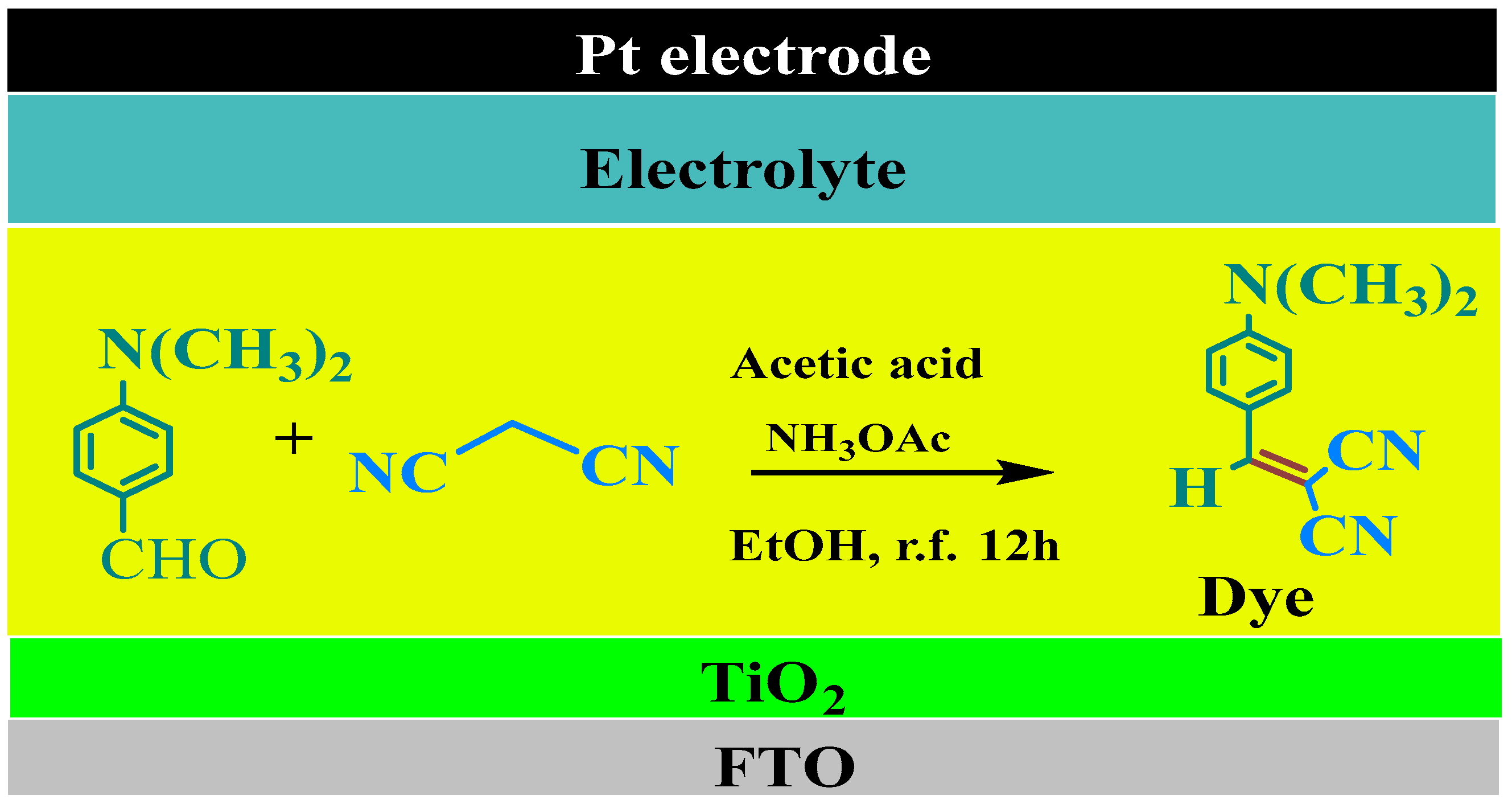
2.2. Synthesis of 2-(4-(dimethylamino) benzylidene)malononitrile
2.3. Fabrication of Organic Photovoltaic Solar Cell Devices
3. Results and Discussion
4. Conclusions
Acknowledgments
References
- Wang, C.L.; Chen, C.Y. Fast and controllable sensitization of dye-sensitized solar cells by microwave irradiation. Solar Energy 2018, 169, 249–254. [Google Scholar] [CrossRef]
- Jiao, Y.; Mao, L.; Liu, S.; Tan, T.; Wang, D.; Cao, D.; Huang, W. Effects of meta or para connected organic dyes for dye-sensitized solar cell. Dyes Pigments 2018, 158, 165–174. [Google Scholar] [CrossRef]
- Bari, D.; Wrachien, N.; Penna, R.S.; Brown, T.M.; Reale, A.; di Carlo, A.; Meneghesso, G.; Cester, A. Thermal stress effects on dye-sensitized solar cells (DSSCs). Microelect. Reliabil. 2011, 51, 1762–1766. [Google Scholar] [CrossRef]
- Baxter, J.B.; Richter, C.; Schmuttenmaer, C.A. Ultrafast Carrier Dynamics in Nanostructures for Solar Fuels. Rev. Phys. Chem. 2014, 67, 423–447. [Google Scholar] [CrossRef] [PubMed]
- Lei, Z.; Jacqueline, M.C. Anchoring Groups for Dye-Sensitized Solar Cells. ACS Appl. Mater. Interfaces 2015, 6, 3427–3455. [Google Scholar]
- Maleki, A. Fe3O4/SiO2 nanoparticles: An efficient and magnetically recoverable nanocatalyst for the one-pot multicomponent synthesis of diazepines. Tetrahedron 2012, 68, 7827–7833. [Google Scholar] [CrossRef]
- Maleki, A. One-pot multicomponent synthesis of diazepine derivatives using terminal alkynes in the presence of silica-supported superparamagnetic iron oxide nanoparticles. Tetrahedron Lett. 2013, 54, 2055–2059. [Google Scholar] [CrossRef]
- Maleki, A. One-pot three-component synthesis of pyrido[2′,1′:2,3]imidazo[4,5-c]isoquinolines using Fe3O4@SiO2–OSO3H as an efficient heterogeneous nanocatalyst. RSC Adv. 2014, 4, 64169–64173. [Google Scholar] [CrossRef]
- Maleki, A. Green oxidation protocol: Selective conversions of alcohols and alkenes to aldehydes, ketones and epoxides by using a new multiwall carbon nanotube-based hybrid nanocatalyst via ultrasound irradiation. Ultrason. Sonochem. 2018, 40, 460–464. [Google Scholar] [CrossRef] [PubMed]
- Maleki, A.; Ghassemi, M.; Firouzi-Haji, R. Green multicomponent synthesis of four different classes of six-membered N-containing and O-containing heterocycles catalyzed by an efficient chitosan-based magnetic bionanocomposite. Pure Appl. Chem. 2018, 90, 387–394. [Google Scholar] [CrossRef]


| Cell structure | Voc (V) | Jsc (mA.cm−2) | FF | Efficiency (%) |
|---|---|---|---|---|
| FTO/TiO2/dye/molecules/electrolyte/Pt electrode | 0.233 | 0.029 | 0.3194 | 0.002 |
Publisher’s Note: MDPI stays neutral with regard to jurisdictional claims in published maps and institutional affiliations. |
© 2018 by the authors. Licensee MDPI, Basel, Switzerland. This article is an open access article distributed under the terms and conditions of the Creative Commons Attribution (CC BY) license (https://creativecommons.org/licenses/by/4.0/).
Share and Cite
Maleki, A.; Valadi, K. Synthesis of Small Organic Molecule Based on Malononitrile Group toward Green Energy Performance in Organic Photovoltaic Solar Cells. Proceedings 2019, 9, 16. https://doi.org/10.3390/ecsoc-22-05653
Maleki A, Valadi K. Synthesis of Small Organic Molecule Based on Malononitrile Group toward Green Energy Performance in Organic Photovoltaic Solar Cells. Proceedings. 2019; 9(1):16. https://doi.org/10.3390/ecsoc-22-05653
Chicago/Turabian StyleMaleki, Ali, and Kobra Valadi. 2019. "Synthesis of Small Organic Molecule Based on Malononitrile Group toward Green Energy Performance in Organic Photovoltaic Solar Cells" Proceedings 9, no. 1: 16. https://doi.org/10.3390/ecsoc-22-05653
APA StyleMaleki, A., & Valadi, K. (2019). Synthesis of Small Organic Molecule Based on Malononitrile Group toward Green Energy Performance in Organic Photovoltaic Solar Cells. Proceedings, 9(1), 16. https://doi.org/10.3390/ecsoc-22-05653