
Skip to Content
ProceedingsProceedings
  • Abstract
  • Open Access

2 April 2024

Increasing Safe Water Availability via a Multisensor System for Water Monitoring and Filtration †
,
,
,
and
1
Research Unit of Computer Systems and Bioinformatics, Department of Engineering, Campus Bio-Medico University of Rome, Via Alvaro del Portillo 21, 00128 Rome, Italy
2
Research Unit of Electronics for Sensor Systems, Department of Engineering, Campus Bio-Medico University of Rome, Via Alvaro del Portillo 21, 00128 Rome, Italy
3
Research Unit of Electronics for Sensor Systems, Department of Science and Technology for Sustainable Development and One Health, Campus Bio-Medico University of Rome, Via Alvaro del Portillo 21, 00128 Rome, Italy
*
Author to whom correspondence should be addressed.
This article belongs to the Proceedings XXXV EUROSENSORS Conference

Abstract

The availability and quality of water have become major concerns worldwide due to the impact of climate change and pollution. To ensure safe water consumption, a monitoring and filtration system comprising a Miniwell Filter 360 passive filter, a multisensorial system with an electrochemical sensor and spectrophotometer, was designed. Water samples were collected in two locations on the north coast of Rome, and analyses were conducted before and after filtration. Multivariate statistical analyses were performed to assess the instruments’ ability. The results indicate that the implemented system can increase the availability of safe water.

1. Introduction

Water is essential for life and its availability is crucial for the sustenance of all living beings. With the increasing impact of climate change and the growing issue of pollution, the availability and quality of water have become a critical point worldwide. This challenge is one of the 17 goals of the United Nations Sustainable Development Goals [1]. The need for clean and safe water has never been more urgent, and governments around the world have implemented various measures to mitigate and monitor the quality of water. The Italian Legislative Decree 31/2001 sets limits on the concentrations of microorganisms, organic and inorganic pollutants present in water [2] based on scientific evidence of the potentially harmful effects on human health. This study presents a monitoring and filtration system designed to ensure that water is safe for consumption before it is accessed. By implementing this system, the quantity of safe water that can be reached could significantly increase, because a compact system able to automatically filter-analyze could be used in-line, enabling the utilization of more water sources.

2. Materials and Methods

The system is composed of a passive filter stage (Miniwell Filter 360) [3], a multisensorial system comprising an electrochemical sensor [4], and a spectrophotometer, an automatic optical reading incubator, and the MBS-HACCP&ACQUE test to verify the number of bacteria present in the filtered and unfiltered solution [5]. Water samples were collected in two locations on the north coast of Rome. The analysis was performed before and after the water filtration. Bacteria concentration in unfiltered samples ranged in the order of magnitude from 102 to 104 CFU/cm3, reduced under 10 CFU/cm3, after filtration. Electrochemical analyses were performed on a diluted sample in distilled water with a dilution factor of 1:5.

3. Results and Discussion

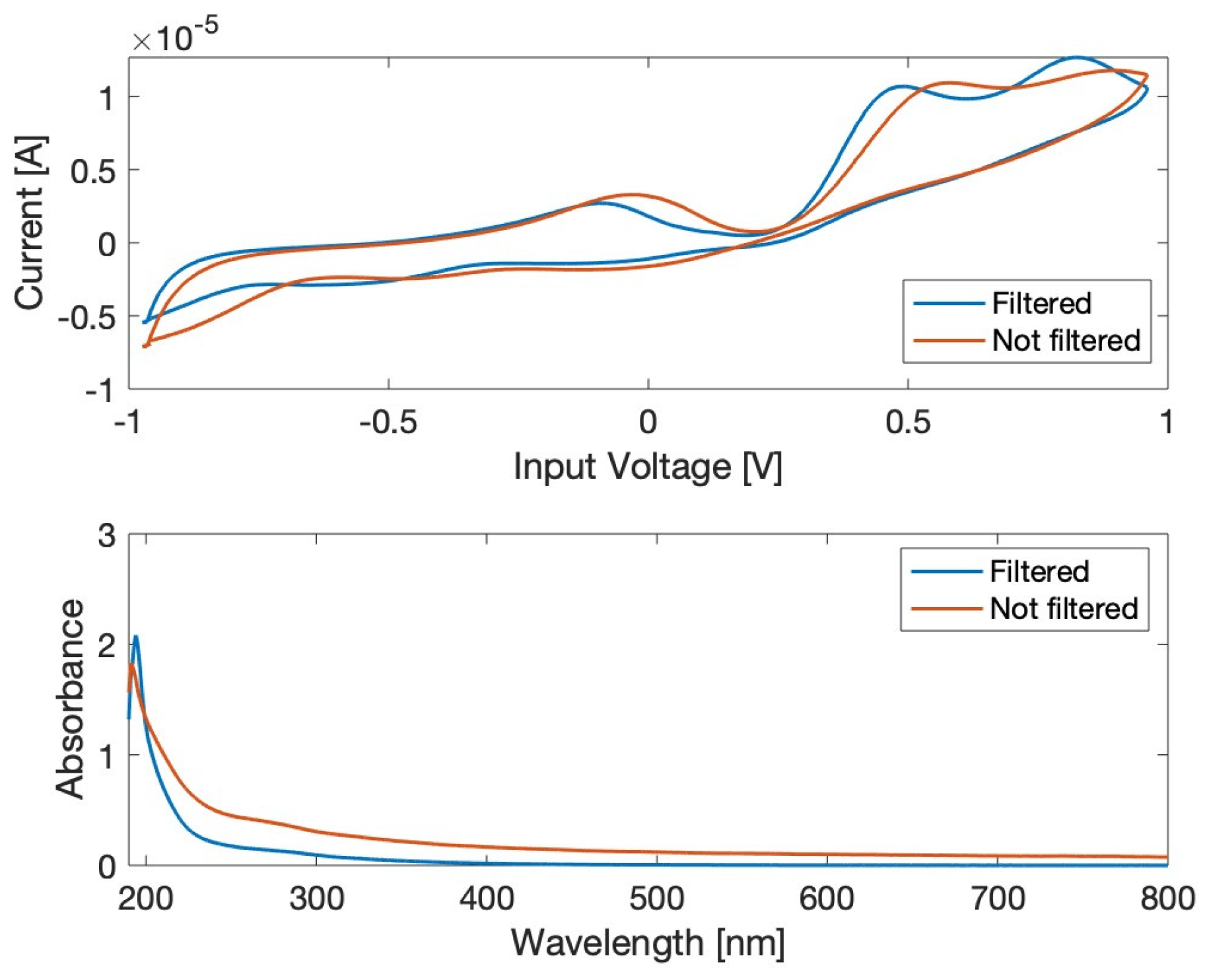
A multivariate statistical analysis, both unsupervised (PCA) and supervised (PLS), tested instruments’ ability to assess water quality, meaning the need for filtration and the effectiveness of the filter action. The model with the best performance in terms of % error over the entire range of bacteria concentration was obtained via data fusion from BIONOTE-L and spectrophotometer outputs, with an RMSECV of 25%. Figure 1 shows the different sensor responses for water samples pre and post-filter.
Figure 1. BIONOTE-L responses (upper panel) and the spectrophotometer responses (lower panel) to a pre-filter (red) and post-filter (blue) water sample.

4. Conclusions and Future Development

It is evident that the chosen passive filtering system must be accompanied by sensors, specifically optical and electrochemical sensors, which guarantee a measure of water quality. It could seem an unsatisfactory result in terms of RMSECV, but the idea is to use this compact device as a node of a network assessing the availability of alternative water sources in a large area, give feedback, and receive a decision on the opportunity to filter and pre-filtering on site, as a pipe-line check gate, sending water to a successive filtration plant.

Author Contributions

Conceptualization, A.S. and G.P.; methodology, S.G.; software, A.S.; validation, A.Z., S.G. and M.S.; formal analysis, M.S.; investigation, M.S.; resources, A.S.; data curation, A.S. and S.G.; writing—original draft preparation, A.S.; writing—review and editing G.P. All authors have read and agreed to the published version of the manuscript.

Funding

This research received no external funding. Anna Sabatini is funded by PON “Ricerca e Innovazione” 2014-2020.

Institutional Review Board Statement

Not applicable.

Data Availability Statement

The data presented in this study are available on request from the corresponding author.

Conflicts of Interest

The authors declare no conflicts of interest.

References

  1. Available online: https://www.undp.org/sustainable-development-goals/clean-water-and-sanitation (accessed on 15 March 2023).
  2. Italian Legislative Decree 31/2001; Implementation of Directive 98/83/EC on the Quality of Water Intended for Human Consumption. Official Gazette of the Italian Republic: Rome, Italy, 2001; No. 174.
  3. Available online: https://www.miniwellfilters.com (accessed on 15 March 2023).
  4. Sabatini, A.; Zompanti, A.; Grasso, S.; Vollero, L.; Pennazza, G.; Santonico, M. Proof of concept study of an electrochemical sensor for inland water monitoring with a network approach. Remote Sens. 2021, 13, 4026. [Google Scholar] [CrossRef]
  5. Available online: https://www.emmebiesse.net (accessed on 15 March 2023).
Disclaimer/Publisher’s Note: The statements, opinions and data contained in all publications are solely those of the individual author(s) and contributor(s) and not of MDPI and/or the editor(s). MDPI and/or the editor(s) disclaim responsibility for any injury to people or property resulting from any ideas, methods, instructions or products referred to in the content.

Article Metrics

Citations

Article Access Statistics

Multiple requests from the same IP address are counted as one view.