1. Introduction
In the change from classical to quantum mechanics, the position
r was promoted to the operator
, conjugated with momentum
p by the non-trivial commutator relation
that leads to uncertainty in their values [
1,
2]. As such,
appears as
acting on wavefunctions coordinated by
p, with crucial consequences whether
is explicitly evaluated (e.g., for transport) or if
is trivially constant (e.g., with an atomic Hamiltonian) but energies/eigenstates are to be solved [
1].
The familiar
is the form of
in wave mechanics, while the matrix form of
is rarely seen. This disproportionate observation is due to the lack of convergence of the
r-matrix: the diagonals diverge in plane waves, Bloch bases, etc. [
3,
4,
5,
6,
7,
8]. Given the autonomy of matrix mechanics and its equivalence with wave mechanics [
2] (Chapter 3), it is weird that the diagonals of a physical operator (i.e., their expectation values) all diverge. This undermines preservation of the spectrum of the matrix, obstructs obtaining an equivalent
r-matrix by basis transformation, and even casts doubt on the off-diagonal convergence, given the holistic nature of a matrix. We elaborate on the misbehavior of the
r-matrix in
Section 2.
In contrast, the spin matrix can readily be found by solving
. Pauli matrices provide the simplest solutions, and many others exist, either reducible or irreducible. Formally, representations of Lie algebras are involved [
9]. In physics, we consider
as it stands for spin. Generally, systematic construction and classification of Lie algebras have been achieved for finite (Cartan matrices [
9,
10]) and infinite dimensions (e.g., Kac-Moody algebras [
10]). It is tempting to try the same for the
r-matrix by solving
: the operator on the right is now replaced by a complex number, leading to Weyl algebras [
10,
11]. Unfortunately, this is doomed to fail, because Weyl algebras admit no matrix representations (
Section 2). Does this mean that an
r-matrix cannot exist? Given that
cannot be solved with matrices, could any matrix be assigned to
?
A major goal of this work is to derive convergent
r-matrices (CRM) in arbitrary finite dimensions by introducing the
N-th Weyl algebra
(
Section 2). It can be viewed as a procedure for encoding
, an infinite dimensional operator of continuous spectrum, using matrices of finite dimension. Theoretically, it is convenient to have such a formal conversion for dimensions, and such a matrix description of a differential operator [
12]. However, we stress that the
r-matrices do not yield representations. In particular, we must carefully distinguish the terminologies “matrix” and “matrix representation.” In fact, the known
r-matrices [
3,
4,
5,
8], called
divergent r-matrices (DRM) in this context, do not yield representations either, a fact which has somehow been concealed by the divergence. The DRMs derive from the first Weyl algebra
(just the familiar substitution
); we analyze the divergence and find that expanding
to
can fix it. Here,
N depends on the dimension of the Bloch space. Although
is the special case of
with
, the DRMs are
not 1-D CRMs. In fact, the CRMs converge for arbitrary dimensions, and are thus distinct from the DRMs, rather than including them as a special case (
Section 4).
Why are
r-matrices important? A short answer is that they are involved in both transport [
4,
5,
6,
7,
8,
13,
14,
15,
16,
17,
18] and topology [
19,
20,
21,
22,
23,
24,
25,
26,
27] in crystals (e.g., under Bloch bases). For example, when band electrons are exposed to light [
28,
29,
30,
31,
32,
33,
34] and undergo resonant inter-band transition [
4,
5,
7,
8,
13,
18], the charge center changes, leading to a
shift current [
8,
18]. The
are hopping rates, and
is the position shift associated with
:
Here,
is the
shift vector, obtained by subtracting diagonals between bands
m,
n; while
is a complementary term (involving the imaginary part of off-diagonals
) to ensure gauge invariance [
4,
5,
18]. As such,
r-matrices enter through the distance shifted during hopping.
The
r-matrices make another entrance in connection with the hopping rates
. The light field is usually modelled with [
4].
The modification of quantum states is encoded in the matrix
, which forms the basic building unit for
nth-order perturbation [
4,
5,
8]. For instance, consider the linear response
which is known as Fermi Golden Rule derived via time-dependent perturbation. The
reflects energy conservation, and
is the energy difference as defined below.
Combined with Equation (
1), the DC component of the second-order
response to the external driving with frequency
is found to be [
8]
where
is the Fermi distribution (energy) difference between two bands:
Compared with
, we recognize
for
. Clearly, the hopping rate
relies on the
r-matrix. When higher-order perturbations are counted,
should involve higher-order products of
r-matrices:
, etc. [
4,
5,
8,
26].
Simply speaking, the matrix components
originate from band labels
m,
n. The
r-matrix is linked to observables in various forms [
15,
16,
35,
36,
37,
38,
39,
40,
41]. In view of these consequences of the
r-matrix, the dichotomy between wave and matrix mechanics and their mutual replaceability deserves second thought. We should not naively attribute the
r-matrix solely to matrix mechanics, since evaluation and transformation of the
r-matrix inevitably involve the nature of
as a differential operator, sometimes in implicit ways. Nor should we think that using the differential form
makes the
r-matrix redundant. Matrices and differential operators are extensively discussed in
Section 5.
We surpress Cartesian indices in Equations (
1)–(
6). In general, optical conductivities are tensors. Nevertheless, the simple fact is that the
r-matrix appears in optical responses. More importantly, its role is clear: since the
r-matrix takes the form of a connection, a differential-geometric notion, it opens the door to quantum geometry [
35,
36,
37,
38,
39,
40,
41,
42]. A notable success is the linkage of the Berry connection with the Wannier center [
23,
27], leading to quantization of adiabatic charge pumping [
22] and the Berry phase theory of polarization [
27]. In this vein, given appropriate coupling forms or scenarios (potentially ignoring certain degrees of freedom [
38]), more geometric interpretations appear, such as curvature [
19], a quantum metric (as a distance defined between quantum states) [
36], and tangent space [
38]. It is fascinating that these geometric notions enter into diverse phenomena which are seemingly irrelevant.
Although substantial advances have been made in the geometrical interpretation of optical transitions [
17,
18,
35,
36,
37,
38,
39,
40,
41], we have not yet dealt with the issue of divergence. The
r-matrix is still based on DRMs, the divergence arising from the diagonal
terms. The issue was raised by Blount in the 1950s [
3]. Since then, no essential progress has been made on resolving the divergence, or on its origin and significance. Thus, the diagonal terms
,
in Equation (
1) are not evaluated with Bloch functions but with periodic functions
,
. In arguing for such a substitution, resort is made to a heuristic: “The Bloch wave does not work, so something else should be used.” However, it remains unaddressed whether
is the only possible choice, and whether using
can be attributed to a certain general principle. Moreover, the implications of employing
and integrating it over
k to yield
are disturbing because of when observables are no longer taken from diagonals of a physical operator, not the orthodoxy of matrix mechanics [
2]. There has not yet been any comprehensive justification of this procedure, which seems quite remarkable given the maturity of quantum mechanics [
2].
One can ensure that the diagonal entries
appear in quarantined form, just like cutting off the rotten parts of an apple, while it is unclear whether converging entries in a diverging matrix are still meaningful, at the very least in the absence of a renormalization protocol. Another concern is that geometry often relies on perturbation series [
4,
38,
40], which incurs risks: strong interaction or gap closing might undermine the perturbation treatment; the geometric interpretation could be sensitive to the orders of truncation; it is hard to recognize a geometric effect when it is confounded with other effects [
40]. Any of these possibilities could diminish the fundamentality and elegance of a geometric formula. Additionally, hopping, which should be a continuous process, is usually interpreted in terms of a pair of states (initial and final), while the geometric interpretation requires the number of intermediate states to be accounted for [
38,
40]. In short, the present situation is not satisfactory, and worry arises from the logic gap: the
r-matrix does not stand on a solid foundation, and observable extraction is clearly incompatible with the basic rules for matrices, while observables based on DRMs are continually being proposed [
8,
17,
18,
35,
36,
37,
38,
39,
40,
41].
Our aim in this work is two-fold. At the conceptual level, we resolve the vagueness in using
or
by introducing the “
r-matrix”
and the “reduced
r-matrix”
. Here,
is evaluated with
, and
is evaluated with
. Both are defined in
convergent fashion, regarded as different facets of the CRM, and their relations are deduced. The vector space spanned by
is recognized, whose dimension and relation with the Bloch space (spanned by
) are clarified. With CRM, the difficulty in using either diagonals or off-diagonals disappears. Moreover, we recall the non-existence of a matrix representation for a Weyl algebra, and show that Bloch waves are incomplete for
. As a consequence, the principles for deducing the
r-matrix must be different from, for instance, those for the spin operator. For spin, a complete “total space” serves as a Hilbert space which affords a Lie algebra representation. For
and the Weyl algebra, it is a quotient space of a total space (or fiber space of a bundle space in bundle theory [
43,
44]) which serves as a Hilbert space. The algebraic procedure for this expands
to
.
At the application level, our main focus is on transport, which, by definition, means position change in charge carriers. Thus, it ultimately concerns the expectation value of
. The analysis of diverse transport mechanisms, such as injection currents [
8,
28], shift currents [
8,
18], and adiabatic currents [
22,
27], currently involves vagueness or arbitrariness in extraction of the observable
. We leave the development of a unified transport theory based on CRM for the future. Here, we concentrate on the issue of observable extraction. Since the definition of the
r-matrix is subject to different principles, distinct transformation behaviors and gauge issues emerge. The methods for extracting expectation values also vary. All these phenomena suggest that
is not the same type of operator as spin. To unify the differeing concepts, we introduce the notion of a
ribbon. Another focus is on
designation systems, and we point out the risks in using the bra/ket notation when differential operators are involved. The organization, major results, and innovative features of the paper are summarized in
Table 1.
2. Position Operators and Weyl Algebras
We introduce three important vector spaces involved. The first is the space
spanned by the eigenstates of the position operator
(or of
p | the two sets of eigenstates are equivalent bases linked by Fourier transformation). The second vector space is the Bloch space
by bases
. Bloch space
is isomorphic to the space
spanned by the Wannier functions [
27]. The third vector space
is defined shortly, as a quotient space of
(i.e.,
can be expressed as
, where
E is another vector space). We show how to bring
down from
, on which it is originally defined, to a matrix defined on a finite-dimensional quotient space
.
Let us first introduce
. In general, the identity of a vector space is characterized by the dimension and the inner product. If and only if both aspects are the same, two vector spaces are considered identical. For finite dimensional spaces, if there exists an invertible (one-to-one) map between two spaces and the inner product remains unchanged after the map (formally, such a map is called an inner-product-preserving or structure-preserving map), the two spaces are said isomorphic [
45].
The dimension of is evidently infinite as eigenvalue r takes all possible . To be more accurate, the dimension is uncountable infinite, as detailed shortly. The inner product defined for a vector space (often said “equipped on the space”) is formally a map , which means the inputs (one the left of →) are two elements (vectors) in space and the output is a complex number .
On top of inner products, one could say the space
is complete (such that it is qualified for a Hilbert space), referring to the following fact:
Each
r corresponds to a distinct eigenstate; thus, these eigenstates are as numerous as real numbers. With more rigor, the
cardinality (a term characterizing the population of an infinite set) of the eigenstates is equal to that of
. The set
is known as “uncountably infinite”, meaning it is unable to list the entries in a one-to-one correspondence with the set of natural numbers
, which is called countable infinite. In other words,
is “more” than
, although both are infinite. Therefore, if there is another space whose dimension is countably infinite, it is smaller than
, and thus cannot be isomorphic to
[
46].
When dimensions rise to infinity, some fundamental changes take place. For example, it is possible to write a finite-dimensional operator
M in matrix form. With respect to eigenstates forming a basis, the matrix
M is diagonal.
It might tempting to think that
could be such a diagonal matrix, if
r,
may be regarded as row/column labels
, except that now the matrix becomes infinitely big (
) to host the infinite number of elements. However, this is incorrect. Firstly, the row/column labels take values in the set of (positive) natural numbers
N, which is countably infinite. This procedure does not apply to uncountably infinite sets such as
. Intuitively speaking, the matrix with countably infinite many rows/columns is still “not big enough.” Secondly, the matrix formalism stipulates that contraction of
i should sum over all its possible values:
. When this is extended to
r, it becomes an uncountably infinite sum
, which in general diverges [
47].
Another issue regarding the infinite dimension is the lack of converging norms. The norm means the “length” of a vector, which should be positive definite, and physically gives the probability density of a particular eigenstate. If we simply apply the normalization for finite-dimensional vectors to eigenstates of
, we should find the norm is infinite. Roughly speaking, this divergence is reflected by the “infinite spike” of the
-function. The diverging norm makes derivatives of states ill-defined and thus, in this space, a Berry connection
is also ill-defined. This is understandable, since an arbitrarily small deviation
makes Equation (
7) jump from infinity to zero (i.e.,
,
, and
,
), evidently not differentiable. In fact, the following aspects are interrelated: (1) the norm of a space; (2) the dimension of a space; (3) differentiability and derivative of vector states; (4) geometric notions, such as Berry connection and curvatures. To define notions such as Berry curvatures, we must reduce the dimension of the space, and the four aspects above need to be modified in parallel.
In addition, the average position of an extensive state, e.g., plane waves, also diverges. This is not a concern for scattering problems, where normalization is not required, and just the relative amplitudes of incoming/outgoing beams are adequate; or again when only localized states are involved and the average position is constantly fixed, such as for atomic Hamiltonians or harmonic oscillators [
1]. However, for transport (e.g., shift currents [
8,
18]), a diverging position could be fatal, destroying any attempt at a meaningful definition of transport.
In the space
, the operator
is needed in the commutation relation
but never stands alone. It is always paired with its conjugate, the momentum
p [
1,
2]. By linearity, one may adsorb
i into the operator to obtain the alternative convention
. With Equation (
10) as the generator, one obtains an infinite set of operators forming a ring. A
ring is an algebra equipped with two operations: addition and multiplication [
48] (division is not required). Addition must be Abelian and invertible; multiplication is not required to be commutative or invertible.
A most familiar ring is the set of integer . Apparently, one has addition and multiplication defined among integers; most importantly, addition and multiplication of two integers gives another integer—this requirement is known as closure. Thus, in this case, the ring is the set of integer numbers combined with operations defined on them (or said equipped on them); thus, it is more than just a set.
In general, the elements in a ring could be anything. Here, we are concerned with a ring composed of polynomials and derivatives as below:
using the Einstein convention, where
is a polynomial serving as the “coefficients” of partial derivatives. One is at liberty to select either
r or
p as the variable. The ring generated by Equation (
11) is called a
Weyl algebra [
10,
11]. In fact, we encounter many Weyl algebras in quantum mechanics. Consider the formalism
for yielding the expectation value of momentum. It involves the multiplication of
and
, where generic functions
and
can be approximated by Taylor expansion with polynomials
serving the role of coefficients. The integration over
r arises from the addition operation equipped on the ring. Hence, defining the position operator, which is a major goal in this work, boils down to its mathematical role in constructing generators of Weyl algebras (
Appendix F).
In quantum mechanism, we tend to interpret
as a derivative “acting” on a function of
r. In other words,
is operation, and
is a function for
to act on;
and
are not on the equal status. In the ring framework, this is equivalently interpreted as an abstract multiplication of
with
. The
is interpreted with
, and
is interpreted as
, such that the two are on the equal status as elements in a ring. For example, if
, the result of multiplication is
, which corresponds in Equation (
11) to
and
. In abstract algebra, such a mutliplication is no different than a “normal” multiplication like
, as long as closure (definition) of the multiplication is respected. The closure determines the range of the ring. Note that the conjugate pair
and
p are Weyl algebra generators; the full Weyl algebra contains all possible orders of polynomials for multiplication closure.
It is instructive to compare the Weyl algebra with Lie algebra; the latter is a vector space
V (
,
,
serve as bases), over
or
(real or complex numbers as coefficients to be multiplied with bases
), equipped with Lie brackets [
44], which is just the commutator “
”. Consider spin operators
with
. In intuitive language, the bracket makes two operators (ones plugged in brackets) become a single operator on the right. Formally, the bracket is a binary map:
. Finding spin representation is just looking for mathematical objects (matrices or any other well-defined terms) that reproduce the relation described by the brackets. For a Weyl algebra, a crucial difference is Equation (
10) replacing the operator on the right by a complex number, as a map
, where
is a complex number.
This subtle difference leads to significant consequences: finite-dimension matrix representations of Weyl algebras do not exist. In other words, Weyl algebras cannot be represented by matrices. If they could, we would have
where the only solution would be with trivial zero-dimensional matrices |
.
This is why Equations (
11) and (
12) take the form of polynomials and differential operators rather than matrices. In general, they belong to a Weyl algebra (
Appendix F). The representation is
yielding the first Weyl algebra
. Lie algebras (such as
) can be realized as subalgebras of
[
11]. We can also consider multiple pairs of variables
, yielding
Nth Weyl algebra
. Consequently, the polynomials may involve multiple variables:
Nth Weyl algebra
(Equation (
15)) is used to construct an
r-matrix in
Section 4 (also see
Appendix F).
3. Structure of Bloch Space and Its Quotients
In this section, we introduce the other two spaces: Bloch space
and its quotient space
(in some literature, quotient space is also called
factor space). We first point out some “bad features” of
. Then, we construct a product space
, which is isomorphic to
(the definition of isomorphic is given in
Section 2). The space
is well behaved, and the
r-matrix is defined on the product space instead of on
. Since
, the space
is also a quotient space of
.
Some features of
are unsuitable for serving as a Hilbert space. We give two examples. Firstly, Hilbert space should be a Banach space (a complete normed vector space) [
2,
44]. The “normed” means a vector could be normalized to unity, such that a physical probability could be recognized. The norm is defined as
(with
) is required to be finite. In physics, Equation (
16) is comprehended as the total probability (or the total number of particles) in the space should be finite. In the above, we use Bloch’s Theorem
|
is a periodic function of the lattice constant
a. Evidently, the norm for
diverges, i.e., the integration Equation (
16) diverges. (It suffices to consider the special case where
is a constant function.)
The norm can be induced from the inner product: the self-product of a vector yields its norm. Thus, defining the norm boils down to defining inner products with continuous indices. Definitions like Equation (
16) arise from the analog
where continuous
r assumes the role of the discrete values
j, the sum over
j becoming an integration over infinity. Equation (
18) is an obvious transition from the discrete to the continuous case, but it is not the only one, and may not be the proper one. It is modified later (
Section 4), as a key step to casting
onto discrete bases.
As a convention, discrete variables are denoted in subscripts; if
,
. For continuous variables, we denote them in brackets; if
,
. With Equation (
19), the self-product
,
produces an infinitely “long” vector, meaning an infinite probability. In addition, it also makes the derivative
diverge, a similar problem to that inherent in Equation (
9).
As the second example of bad behavior, we observe that
is incomplete for
, which is a serious concern since transport arises from position change. The matrix of the position operator is expressed as
which unfortunately diverges. This is easily seen from translating the diagonal terms
where
is the translation operator by
a (here
a is the lattice constant and
). Plugging Equation (
20) into
, we obtain the contradiction
Here, we apply
The periodic function is a function of crystal momentum
k and band
n, transcribed from
. Now
is obtained by translating
by
a in the negative direction, thus
in Equation (
21) is shifted by
.
The inconsistency between Equations (
21) and (
22) indicates that the integration in Equation (
20) cannot converge, for otherwise the contradiction
would be obtained. This divergence is genuine and inevitable. It arises from the fact that it is impossible to pin down the “center” of an infinitely extensive wave function. One may attribute this divergence to the infinite dimension of
(the infinite dimension arising from the infinite number of possible values for (
n,
k), where
k might be either discretely infinite or continuous), since a sum over a finite numbers of terms should never diverge. Note that each distinct (
n,
k) corresponds to a linearly independent basis. Note the ambiguous meanings of “bases”: the bases span
, rather than the vector label
k. It is very possible that
, but
.
To resolve these problems, we next construct a well-behaved product space related to
with isomorphism; CRM is established on the well-behaved space. We begin by introducing a well-defined inner product, on the basis of which procedures associated with vectors, operators, etc., may be defined [
44]. We adopt the following procedure to force convergence of Equation (
20):
For simplicity, consider a 1D atomic chain of
N sites with lattice constant
a. Set
and
(
). The sum over
is independent of
r, and thus can be factored out: the infinite integration is reduced to a finite integration. We have
If
k and
are restricted to the first Brillouin zone (BZ) by convention, the above sum can be reduced to a single
-function. For the other term, in-cell integration, we require
for the case where
. On the other hand, for
, even if
, Equation (
26) may not necessarily vanish, because it is Equation (
25) which governs the orthogonality for distinct
k-values. In that case, Equation (
26) plays a role of a normalization factor, as discussed in connection with Remark 3 below.
We express the inner product Equation (
24) as a product of two
-functions. This leads one to think that
can be isomorphic to a tensor product space. We invoke
from Equation (
25) to generate one quotient space
E of dimension
N (the number of possible values of
k), and invoke
to generate a second quotient space
of dimension
(the number of bands), yielding the isomorphism
with
and
. Here, both “→” and “↦” indicate a map. The difference is “→” connects two sets: from map’s domain to co-domain; ↦ connects elements belonging to the two sets. Thus, “→” and “↦” in Equation (
27) stand for two conventions for denoting a map. These map denotations are frequently used in this paper, especially in
Section 5 and
Section 6.
Isomorphism means a linear map which preserves the inner product (inner product value is invariant with map)
for
. Intuitively speaking, we seek a replacement vector
for the original
, such that after the replacement the inner product value remains unchanged as indicated by Equation (
28).
To facilitate analysis, we introduce maps
where
is the basis
of
which contains
elements.
Since each basic Bloch vector is characterized by band
n and crystal momentum
k, one can write these maps in terms of
In particular,
can be expressed as
The existence of these maps
is constrained by
as discussed in
Appendix E. The maps
,
are then defined as
with
as the corresponding inner product rules. Since
the conjectured map
preserve inner products.
Theoretically, the projection maps formalize the idea “the geometry quantities, such as Berry connection defined on the periodic part of a Bloch function” into these being defined in an abstract quotient space—the projection maps bridge the Hilbert space to its quotient. Consequently, one can use it in broader physical scenarios: not limited to single-particle (orbital) Bloch waves, but also the spin degrees freedom, correlated systems without translation symmetry, etc.
Physically speaking, and are closely related to two physical processes. The projects to the quotient space , which involves different bands, thus is for (elastic) inter-band transitions. The involves distinct , thus it is for the inelastic k-transport.
Remark 1. Recall the main goal of this section: building a well-behaved isomorphic space to substitute for . The goal is realized by Π map constructed with Equations (27)–(36). The map Π readsto circumvent integration over r, facilitating the evaluation of the r-matrix and other expressions (Section 4). Remark 2. Roughly speaking, Π creates a new basis equivalent to by switching the representation from to . But in fact, Π does not map vectors to vectors. In the ad hoc terminology introduced in Section 5, it maps vectors to ribbon bands
or ribbons
. Within the framework of bundle theory [43,44], a ribbon is a feature of the bundle space , where K is the Brillouin zone and Bloch space is the fiber space (see Section 5). Precisely speaking, Π is to map N mutually orthogonal vectors () to a ribbon (Section 5), on which the vectors at comprise a set of basis vectors isomorphic with the original set . In plain but less accurate words, this means that the components of the vectors (Equation (37)) should be functions of k (e.g., ) instead of constant values. For example, the following map also defines an isomorphism on but does not work:The crucial difference is that in Equation (37) we have when the ’s are viewed as variables. For maps like Equation (38), however, we have , since the components in Equation (38) are constants. If the k-independent Equation (38) interacts with partial derivatives, the r-matrix will vanish. Thus, Π cannot be chosen with an arbitrary isomorphism defined from . Remark 3. How should we visuaize the map Π? The wave functions are the eigenstates of the translations . Thus, we seek representations of the translation group on and its quotients. It is conceivable that one part of space affords a trivial repesentation, while the rest affords a non-trivial one characterized by k. Spaces can be described by orthogonal bases: the k-independent in Equation (26) seem appropriate for the trivial representation, with the for the non-trivial part. Thus, we introduce to project to vectors whose inner product is meant to reproduce , while projects to the other quotient space. Constructing a function space requires more than just expressing the functions: the inner product must also be specified. Thus, we simultaneously move from Equations (24)–(36). We can rewrite the image of
under
from Equation (
37) in a single Kronecker product column as
so that the inner product Equation (
36) returns to its familiar row–times–column form with rows and columns of length
. In the conjugate transpose row of the column from Equation (
39), element
is the component for the
nth Bloch wave at the point
k projecting to band
i and local site
j. There are two pairs of conjugated variables:
, and
. Note that
k is not conjugated with
r, since
r merely provides the normalization factor of Equation (
26). The translation group acts trivially on the quotient space
, i.e., translation does not change vectors
. This is why
is only involved in the quotient space
E.
Bearing in mind that components in the column vector of Equation (
39) must correlate to certain inner products
, then what basis vectors
are chosen for
to be projected onto? We consider the map
as exhibited in terms of basis vectors by Equation (
36) of Remark 1. The basis elements can be regarded as generalized Wannier functions
If
, we recover the normal definition of Wannier functions:
. While Equation (
40) is not the standard Fourier transformation, it is still invertible. The space spanned by the generalized Wannier functions
is denoted by
. Evidently,
and
are isomorphic.
The isomorphism (Equation (
37)) is a major result of this work, which allows us to switch from
to
and avoid the continuous coordinate
r that appears in
and
. Inner products like Equations (
34) and (35) sum over discrete indices, without referring to the integral
within a unit cell volume. The pre-factor
arising from the integration is also avoided.
We should be cautious about designations such as
These denotations are often seen in literatures but not perfectly accurate. Since
,
, and
(later we show
). Rigorously speaking, inner products are illegal to be defined between vectors in different spaces, such as
and
. Given Equation (
41) is accepted, one obtains
If
is taken away from the left and only ket is kept, we have the following expressions:
Equation (
43) is about using a unitary operator
to link two vectors
and
. In general, a unitary operator is invertible and may only connect spaces of the same dimension. Remember
and
are belonging to spaces
and
, which are of different dimensions. The concern is that
promotes a lower-dimension vector
to a higher-dimension one
; its inverse
degrades
to
. Having the same dimension is the sufficient and necessary condition for two vector spaces being isomorphic.
(or
) would suggest
. However,
is merely a quotient space of
. Similarly, expression like
seen in the literature (e.g., Equation (2) of [
49]) deserves special attention. The dimensions of operators (
,
, etc.) are summarized in
Section 7.
Another point, as we should be aware of, is that the below orthogonality is false (whether
k can be either discrete or continuous)
Otherwise, if equality in Equation (
44) holds,
is complete for
. The set of functions
can expand arbitrary functions. However, this is false. To demonstrate the incompleteness, we construct counter examples in
Appendix B, i.e., functions unachievable by superposition of
.
In band contexts, is the Hilbert space, thus should be complete—this idea has been taken for granted. However, although is complete for operators defined within , is incomplete for operators defined beyond , such as . Evidence includes:
- (1)
Space spanned by Bloch waves has a lower dimension than space spanned by eigenstates of position operator; that is, the population (cardinality) of elements in the two basis sets and are unequal.
- (2)
Matrix of position operator (shortly seen in
Section 4) is diverging.
- (3)
is false (Equation (
44)), and functions that cannot be achieved by superposition of Bloch waves
are constructed (
Appendix B).
A conviction is that different quantum bases are equivalent. Thus, one vaguely believes and are equivalent; continuous functions (e.g., ) and discrete bases are equivalent, fancying that these bases could be linked by unitary transformations. However, on a second thought, how can a continuously infinite bases possibly be linked to discrete bases? In fact, these bases are not equivalent.
We conclude this section by emphasizing some important points:
- (1)
The space is complete for operators defined within , while is incomplete for the operator, as is defined in .
- (2)
The sets and are bases of different dimensions (different cardinality); they cannot be linked by a unitary transformation, and one cannot be obtained from the other by a change-of-basis transformation.
- (3)
The respective spaces spanned by and are not isomorphic.
Nevertheless, the map
(Equation (
27)) is a precise tool for introducing the
Nth Weyl algebra (
Section 4) and obtaining convergent matrices for the position operator. Moreover, geometrical quantities, such as Berry connections and curvatures, are defined unambiguously as operators on the quotient space
of
.
4. Matrices of the Position Operator
In this section, we identify converging
r-matrices (CRMs). We start by examining
r-matrices in
as they have appeared in previous work [
3]. These matrices inevitably contain divergent terms. The matrix elements are defined by integration of the Bloch function
over an infinite range. For reasons discussed in
Section 5, we avoid basis-free designations for the position operator, such as
. For the moment, we consider the matrix element
given by the original integration. Making the substitution
in Bloch’s Theorem (Equation (
17)), we obtain
The matrix elements then take the form
on plugging Equation (
46) back into Equation (
45). Note that the first term in Equation (
47) becomes
. Recall that for the continuous
-function, arguments appear in brackets | e.g.,
, and
. On the other hand, for the discrete
-function, the arguments are in the subscripts | e.g.,
, and
. The second term in Equation (
47) is
For a general function
, we have
Thus, Equation (
48) becomes
We define
yielding
Except for a sign difference in the first term, our derivation is consistent with previous work [
3], the second term differing by a normalization convention. Due to the appearence of
, the diagonal terms evidently diverge. Thus, the matrix elements defined by Equation (
52) are merely formal.
Now, instead of working directly with
, we construct a Weyl algebra on its isomorphic copy
, obtaining a non-singular matrix which converges at both the diagonal and off-diagonal entries. The basic rule for the differential operator is the coproduct
in the tensor algebra [
44,
48]. The partial derivative acts on each of the two tensor factors
and
E. Thus,
For momentum and position, we have
The commutator becomes
To satisfy Equation (
56), we may choose the position operator
The operator of Equation (
57) is the generator of the first Weyl algebra
, as there is a single variable
k.
4.1. The Nth Weyl Algebra
The choice
made in Equation (
57) is not the only solution of the commutator Equation (
56). Instead, we may consider
N variables
, thereby obtaining the
Nth Weyl algebra [
10]. In this algebra, take the new position operator
in place of Equation (
57). The commutator Equation (
56) is then solved as
We set the number of variables involved in the Weyl algebra equal to the dimension
N of the quotient space
E. It is absolutely essential for
N to be finite, to ensure that the partial derivatives are well defined without recourse to any infinite limits. Note that Equation (
59) is a concrete realization of Equation (
15) in
Section 2. The state vector is parameterized by
, assuming the role of
in Equation (
15) (
Appendix F).
Remark 4. At this stage of the construction, we do not endow or with any physical significance, like taking the as quantum numbers of “one-particle” or “many particle’” states. Thus, is not yet interpreted as the crystal momentum. Currently, we are working at the purely algebraic level, just making the substitutions and .
Remark 5. Equation (59) is at the same fundamental level as Equation (57): both model the Weyl algebra relation of Equation (56). Remark 6. It is tempting to think that the variable k appearing in must be continuous, because otherwise the derivative would not be defined. This misconception is based on the narrow calculus definition of a derivative as . This definition requires extraneous apparatus, such as a division operation, a limit process, and so on. In fact, it suffices to work with the formal definition by , which only requires multiplication and addition (mathematically, a ring structure [48]). Using power series, one can extend the action of ’s to generic analytic functions . As an example, taken from [50], we havewhere c and are fermion operators with , the function f is analytic, and is the vacuum state, i.e., . Equation (60) is an example of a derivative appearing in an operator acting on a term which is not required to be a continuous numerical function. We now interpret the action of the
Nth Weyl algebra
on the space
as it appears in basis form in Equation (
37), obtaining the matrix of the position operator
with respect to the Bloch basis. We have
The second term can be expressed as
with
as the average position
of the
N-site chain. This constant, independent of
k, is the mass center of the crystal. The term
depends on the particular forms of
, and we shortly evaluate
in a concrete two-band model. In general,
cannot be reduced to a
-function in terms of either
and
, or
m and
n. Recall that
N must be finite to have the
Nth Weyl algebra defined. Thus, CRMs are
always based on finite
N. On the other hand, if we consider
, will the CRMs approach the DRM? Or, if we let
N be finite, will the DRM become a CRM? The answer is no! The CRMs are fundamentally distinct from the DRM, and one cannot relate them. A more detailed comparison appears later.
Evidently, the matrix
of Equation (
61) is well defined, with both diagonal and off-diagonal terms converging. Note
if
. We call
the
convergent r-matrix (CRM). It is an
-dimensional square matrix. To emphasize this point, we can write the matrix as
. In this context, we call the matrix of Equation (
52) a
divergent r-matrix (DRM). Although DRMs frequently appear in the literature, their dimensions have not explicitly been stated [
3,
27].
4.2. Geometry Defined on the Quotient Space
The first term in Equation (
61) is the Berry connection, which naturally emerges when
and
. Comparing with Equation (
52), we obtain the correspondence
This is a map
Equation (
64) indicates that the
map injectively to vectors
in the quotient space
. In precise language, the inner product space spanned by the
is isomorphic to
. In other words, there exists a map between the two spaces which preserves the inner product. Note that
is an
-dimensional vector, and
is its
jth component.
Remark 7. Equation (64) builds a vector space associated with the functions . Rigorously speaking, the do not yet provide a function space. For that purpose, we should have δ-functions as extra structure (just like a norm or Lie brackets on vector spaces). The answer to the question “what is the dimension of the space containing the ” is indeterminate [51]. Thus, we cannot set . Consider the false implicationWhile the hypothesis of ⇒ is correct, the conclusion is not. Unfortunately, and are often used indisciminately [4,5,27]. It is tempting to interpret and as basis elements, and then convert these basis elements from functions into bra/ket forms. But that is incorrect. Equating and may lead to vagueness and misconceptions. For example, if we (mistakenly) infer from the Bloch Theorem, we might be led to thinking that there would be a linear relation between and , and further that every Bloch basis element corresponds linearly to a basis element , such that their two spans have the same dimension. In addition, we would have difficulty with the boundary conditions. Bloch waves should be continuous over the B.Z., i.e., . Given the (mistaken) assumption that , there is no way to make continuous, since for .
In fact, there is no phase correlation between
and
, because when
is first introduced, the definition (Equation (
64)) merely considers inner products, allowing the freedom to adjust phases. Perhaps it might be more accurate to adopt a different vector notation (e.g.,
) for
to avoid confusion between
and
. (Note that
is a function of
r, while
is not labeled with
r.) However, given the wide use of
in the literature, we adopt this notation.
It is often stated that the Berry connection is defined on the periodic part of the wave function
, instead of on the Bloch functions
[
27]. Now we have the accurate statement that the Berry connection is defined on the
, and the map Equation (
64) establishes the identity of the
-space as the quotient space
of
.
We may ask why the Berry connection is defined in terms of the
, rather than in terms of the
. This is commonly explained by showing that
does not work. Consider a discrete formalism for the Berry phase
| the system goes through a series of discrete states
[
27]. Then
If we plug in Bloch waves
, orthogonality will force
. Thus,
make
trivially zero for arbitrary band structures. But this only precludes
from appearing in
, and does not show that
must be the case.
Consideration of the DRM does at least show that the Berry connection
is contained in the matrix [
3,
4]. However, there are at least three shortcomings. Firstly, the DRM itself is ill defined. In particular, the divergence on the diagonals directly influences displacement and transport. Secondly, the substitution
is not well justified. Naively, one may argue that
is the fundamental form of
, as quantum mechanics suggests. However, the quantum oracle merely suggests the commutation
, and
is not the unique solution. The operator
might also take the form of Equation (
59), for instance. In fact, both Equations (
57) and (
59) can serve as appropriate forms for the operator
. Thirdly, the Berry connection matrix
belongs to the space spanned by
, but the dimension of this space is left uncertain. One is led to (mistakenly) consider the continuous parameter
r as the index for the basis elements, under the vague impression that “the space is infinite-dimensional,” which hinders a comparison with
.
With the CRM and Nth Weyl algebra, we obtain all Berry connection signatures contained in r-matrix as indicated by DRM and first Weyl algebra; moreover, the divergence disappears, and the matrix is well defined. The constant term is precisely cancelled by subtraction, establishing a rigorous link between diagonal terms and transport. In the absence of a well-defined renormalization protocol, one cannot just drop or cancel two diverging terms in the DRM. We stress that the DRM cannot connect to the CRMs by a limiting process. Secondly, compared with the DRM, construction of the CRM took two steps:
- (1)
Express with the Nth Weyl algebra in ;
- (2)
Reduce it to the first Weyl algebra established on the lower-dimensional quotient space ,
as summarized in
Table 2. It is risky to directly replace
with
, without referring to the hosting space. Thirdly, the dimension of the space spanned by the
is specified, identifying it as the quotient space
of
. However, this issue has been concealed by the vague idea that both spaces are infinite-dimensional, which also hides the method to make the Berry phase
non-zero. Now, we understand the procedure of obtaining
by “folding”
into a product space, and defining the Berry connection (and other geometric objects) on the quotient space
, instead of on
. The dimension of
is finite (and the norm can be defined). Usually, it is equal to the number
of bands, which might either be given when
is first introduced, or obtained by a truncation.
4.3. How Is the Convergence Achieved?
Let us revisit the divergent expressions
Here, the divergence arises from the use of either of the unbounded coordinates
r or
p. Since they are conjugate variables, use of one is no better than the other. Recall that
is different from
, because
k is the quantum number for Bloch vectors, while
p is the real momentum. Contrasting the conjugate pairs,
is conjugate with
p, while it is
which is conjugate with
k according to Equation (
25).
Convergence has now been achieved thanks to two modifications:
- (i)
The choice of the operator in the Weyl algebra ;
- (ii)
Application of the isomorphism
i.e.,
is replaced by tensor product space
.
Rethinking both the operator
and the wave functions
reflects that the Weyl algebra
, as a ring, involves not only the differential operators, but also the functions
on which they act, as seen in the definition of Equation (
11). Physically, the functions correspond to the wave functions. Intuitively speaking, after making the replacement (i), one still needs the replacement (ii) to specify the arguments on which these differential operators act, in order to complete the representation of the Weyl algebra.
From a different perspective, we are specifying a new pair of conjugate variables. The position variable r is paired with the crystal momentum k, rather than with real momentum p. Although (i) and (ii) do not have the explicit form of a declaration of conjugate variables, the declaration is implicit within them. It would not be enough merely to state that (or ) is the expression of , since that would only invoke modification (i), not (ii).
It is incomplete and misleading to assert that
is “equal to”
. For example, it is easily seen that
One may encounter attempts in the literature to use
to suggest a form like
for the
r-matrix. However, in other situations, if we replace
by
r, we may obtain the contradiction
suggesting that
would be an eigenstate of
.
4.4. Can the DRM Be a Limit of CRMs?
We now show that letting
does not produce the DRM as a limit of the CRMs. Recall that
and
are conjugate variables. Thus, increasing the population
N of
-values corresponds to making the
-values denser, bringing us to the limit where
k is continuous. The first term of Equation (
61) approaches
coinciding with the Berry connection
in Equation (
52). However, the second terms cannot match. The CRM does not invoke
when
, in contradiction to the separation of the factor
in Equation (
52).
This can be seen on a concrete example with
| a two-band model. In this case, the quotient space
is two-dimensional, spanned by two basis elements
and
(following the notation of Equation (
33)). We take
where
and
are functions of
k. Given Equation (
69), we find
The off-diagonals are
In general,
is non-vanishing. Equation (
71) shows that the
r-matrix does not vanish when
. The entries non-diagonal with
k identify a clear distinction from the DRM.
In practice, the Hamiltonian
mainly focuses on the diagonal terms
. In terms of observables, we are interested in a subset of the elements of the
r-matrix, but this does not mean that the
r-matrix is block diagonal in
k. We have
Recall that
and
are functions of
k. In a particular model of graphene, for instance, they take the specific forms
where the
are the position vectors of the three nearest neighbor (NN) carbon atoms, arg denotes argument of a complex number, and
a is the carbon bond length [
52]. The two components physically represent the two bands due to the mutual independence of the
atoms in a primitive cell of graphene. How can we interpret that
is independent of
? The conduction band and valence band are formed with
bonding with equal weights from the
orbitals, which requires
to make the magnitudes of the two components equal.
We may summarize the logic of our process as follows:
- (1)
Employ the Weyl algebra to define and p;
- (2)
Based on these physical operators, extract bases to build a vector space to serve as Hilbert space;
- (3)
The first (unsuccessful) attempt (left arrow below) built the space with - (or p-) eigenstates as bases; however, the eigenvalues of (or p) cover all of , whose cardinality is uncountably infinite, leading to a diverging norm, unsuitable for a Hilbert space;
- (4)
The second (successful) attempt (right arrow below) recognizes the bases differently.
We add index
m to label the bases, and
r serves as a “parameter”; different from the first attempt (the left arrow in Equation (
74)), for which
r was taken as the label of bases and was discretized into finite intervals. In the second attempt with CRM, the dimension of vector space depends on label
m instead of
r. Therefore, CRM represents a modified means (compared with DRM) of assigning a vector space to Weyl algebra, such that the constructed vector space is equipped with a converged norm. This addresses the question raised by Equation (
18) in
Section 3, representing a different route for discrete crossover to continuous situations. DRM also arises from Weyl algebra; however, the resultant space has diverging norm, unsuitable for Hilbert space.
From a math point of view, Weyl algebra is defined as a ring (an algebra equipped with addition and multiplication). A vector space, in terms of ring’s definition, is not an intrinsic notion; thus, it is an art to associate a vector space to the ring. If this is improperly performed, one ends up with a space of diverging norm (e.g., a space of infinite dimensions), which hinders evaluating , a fatal issue for transport. Our scheme is that the dimension of vector space should not be characterized by r (eigenvalues of ) nor its conjugated variable p, but by -dimensional vector space, on which Nth Weyl algebra acts on, resulting -dimensional r-matrix (ind .) Since is arbitrary, this approach represents a generic approach of projecting to arbitrary finite dimensions. In previous deriving of r-matrix, the implicit belief that the notion continuity of k is indispensable for partial derivative has prevented the extension to Nth Weyl algebra .
-matrix , reduced -matrix and Berry connection matrix . CRM represents a way of mapping to a finite-dimensional Hermitian matrix (but the matrix does not form a representation of Weyl algebra). Next, we sharpen terminology “matrix”.
The
r-matrix is originally introduced on Bloch bases; thus, its dimension is equal to the dimension of Bloch waves:
.
We further introduce “reduced
r-matrix”
(or
for short), i.e., project
dimensional
to quotient space
of dimension
by setting
:
where
is Berry connection matrix of
dimension. Noteworthy is that
in the diagonal term of
(also the reduced
) has a clear physical meaning: the mass center of the crystal, which is a
k-independent constant. That means term
for different bands are exactly the same, which will be cancelled (in evaluating displacement, one will take the difference of two diagonal terms and
will be exactly cancelled). This converts a problem defined in
to its quotient space
.
Accurately speaking,
(also
) is not a single matrix, but “a continuous series of matrices” for variable
k. Formally, it is a map,
where
represents Hermitian matrices on quotient space
(not
). Berry connection matrix
is also such a map. Equation (
72) gives an example of
with
. It is not that CRM reduces an operator of infinite dimension to one of two dimensions, which immediately raises the concern how the information can be encoded into such a small matrix? Instead, it is a single matrix of higher dimensions to be mapped to a series of lower-dimensional matrices. Formally speaking, the higher-dimensional matrix is mapped to a map whose codomain elements are two-dimensional matrices.
In terms of bundle theory [
43,
44], one may interpret that the reduced
r-matrix
transforms the problem originally defined in high-dimension vector space
to a bundle whose fiber space is a lower dimensional space
. It is incorrect to regard
as an
-dimensional matrix, neither as the lower dimensional counterpart of DRM.
CRM does not form representation of Weyl algebra (i.e.,
). We point out CRM does not satisfy commutation, whether
N is finite or
. (In fact, DRM does not satisfy neither, which is concealed by its divergence.) The matrix for
k can be found in a similar fashion as Equation (
72).
Project it to quotient space, we have
The commutation yields
The commutation does not yield the expected
i. Thus, the
r-matrix together with the
k-matrix does not form the generator of Weyl algebra. This is different from spin’s matrices, which are meant to preserve the Lie-algebra (Lie brackets). Therefore, it involves new principles to define
r-matrix, for which we give more discussions in
Section 7. The way of defining matrices is hinged to the way of extracting observables. In addition, when we work with Berry connection in the quotient space, one vector is not one-to-one corresponding to a physical state if a vector in
represents a physical state.
Remark 8. We stress a few points about CRM and DRM:
- (1)
1D CRM is still convergent, different from DRM; thus, DRM is not the 1D special case of CRM.
- (2)
The continuous limit of CRM does not approach DRM.
- (3)
CRM is not an inferior or approximate form of , it is not achieved by representing in a subspace of .
- (4)
The matrix does not reproduce the commutator; cannot serve as the principle in defining the form of r-matrix.
5. Properties of the Position Operator and r-Matrix
In
Section 5 and
Section 6, the language of maps is used to illustrate concepts, especially the
map built earlier, and the paper is organized with a few progressive definitions. This may cause some discomfort, but we try to keep it at the minimum level. In addition, in view of the mistakes made by authors themselves, it seems necessary to underscore certain algebraic rules. Although these parts of discussions might appear not quite “physical”, they are needed to make the raised concepts and algebraic derivation unambiguous.
One is familiar with the bases to represent a spin (Lie algebra) and such notions as basis transformations. It is natural to wonder about the counterparts for (Weyl algebra). Because DRM contains divergence, these issues are left open, since one cannot perform any calculation in the presence of “∞”. With CRM, we find the notion “ribbon band”, on which r-matrix is defined, is in analog with “bases” on which spin is defined. Physically, the ribbon band is related to the description of electronic states in crystals.
On top of ribbons, is handled like a matrix when it interplays with ribbons or other matrix operators without reference to its origin. Procedures associated with , such as effectual range, one-sided acting on the right, are incarnated in matrix multiplication. Intuitively speaking, we disguise a differential operator like a matrix as much as possible; however, a differential operator may never really become a matrix due to the distinctions in their bottom algebras. Therefore, the cost one must pay is the differential operator’s matrix follows distinctive rules for transformation, exactly where the gauge transformation makes entrance as articulated in the next section. In this context, terms “differential operator” and “the matrix of the differential operator” should be discriminated.
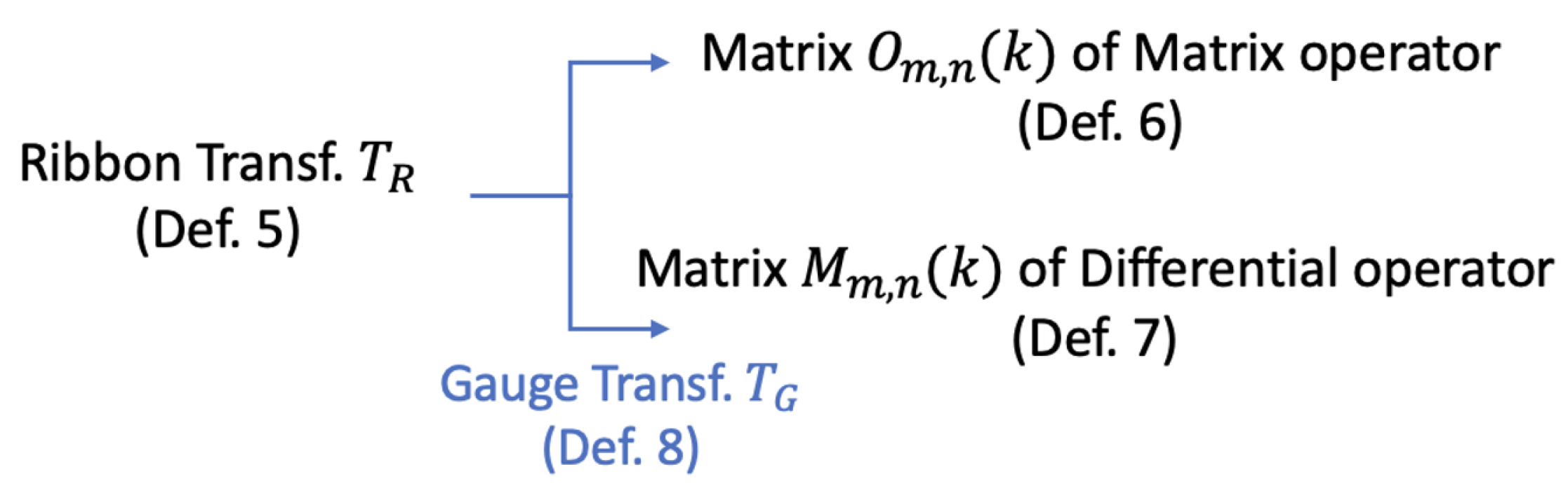
Next, we follow the logic line of introducing bases to introduce ribbon bands (Definition 1) and associated concepts like inner product of ribbons (Definition 2), orthogonal ribbons (Definition 3), components of ribbons (Definition 4), ribbon transformation (Definition 5), etc.
Definition 1. A ribbon band (or “ribbon” for short) over smooth manifold K to vector space V is a mapIn band context, K is the B.Z., topologically an n-dimensional torus ; V is a vector space, e.g., quotient space of . The rank is defined as the dimension of V. If continuity is globally satisfied for map , it is called continuous ribbon band; otherwise, we say the ribbon band is discontinuous at point . For example, if degeneracy exists, eigenstate of specifies a ribbon, which is discontinuous at the degenerate k. A ribbon band could be induced by
maps (Equation (
37)). For example
and
Equation (
82) is a ribbon
of rank
; Equation (
83) is another ribbon
of rank
. These ribbons defined for either the product space or the quotient space. From Equations (
82) and (
83), we notice that given
or
maps,
branches of ribbon bands are induced (for there are
-fold eigenstates).
Definition 2. Inner product between ribbons is defined as a linear binary mapwhere f is a mapFor two arbitrary ribbons and , commonly defined over K to vector space V, the inner product of two ribbons can be induced by the inner product for vectors in V Definition 3. Orthogonal ribbons are two ribbons whose inner products (Definition 2) are constantly zero. Consider a set of ribbons with the number of elements equal to the ranks of these ribbons. If ribbons in are mutually orthogonal, is a set of ribbon bases.Just like a vector is characterized by the dimension and can be represented by a set of bases of the same dimension, a ribbon can be characterized by its rank and represented by a set of orthogonal ribbons. We may denote a general ribbon over K as, for example, with an extra parameter , in analog of a general vector . We use , , etc., to denote different elements in the same set of ribbon bases , i.e., the , elements in . When different ribbon bases are involved, we add primes .
Definition 4. In analog to arbitrary vectors being expressed in components on a set of orthogonal bases, we define the components of a ribbon projected to ribbon bases as and are with respect to a set of ribbons, instead of a set of bases of V. Thus,where is a set of bases for V, which could also be viewed as k-independent ribbon bases. is likely to be different from . Thus, the k label should not be discarded. Definition 5. In an analog of basis transformation, one may introduce ribbon transformationwhere stands for a ribbon space that consists of ribbon bands . transforms a ribbon space just like basis transformation transforms a vector space. turns a ribbon band into another , which can be realized by a rotation of vector space V at a local k.where is the component of a ribbon. Thus, ribbon transformation can be written in an equivalent formwhere stands for automphism group. Automorphisms refer to inversible self-maps () that preserve the inner product . In other contexts, may preserve other structures equipped on V than inner products. This requires U to be a unitary transformation. Then the information of is fully encoded in a unitary matrix indexed by . Definition 6. The matrix of a matrix operator (e.g., spin) defined on ribbon space , spanned by orthogonal ribbons is a matrix function of k that commits to the following ribbon transformations: Definition 7. The matrix of a differential operator on ribbon space spanned by ribbon bases is defined as a matrix function of k subject to the following ribbon transformation:Note that in the last term, the effectual range of is limited to and does not act all the way to the right. For the rules about , refer to Appendix D. In this work, we adopt a convention: the matrix of matrix operator is denoted with or ; the matrix of differential operator is . Remark 9. Matrix is the denotation of an operator on a specific space. Equation (93) generalizes such a denotation for a matrix operator: from vector space V to ribbon space . Such generalization is equivalent to introducing independent replicas (labelled by k) of the operator. Transformation at different k is separate, in principle, not requiring to be continuous or smooth with k. On the other hand, Equation (94) defines a matrix denotation for differential operator. Transformation of at different k is not irrelevant but requires neighborhood knowledge of k (due to the term ), such that the global topology begins to enter. Remark 10. Differential operator is the motivation to introduce the ribbon band (such generalization is trivial for matrix operators). Nonetheless, ribbon allows the two types of operators to be examined on a common ground. It is not that the ribbon band is solely associated to differential operators, nor “bases” are solely associated with matrix operators.
Remark 11. Regarding linear maps. is a linear map at a k point because and . Although is often referred to as a linear operation because of and , it is not a linear map at a local k. In other words, it is a linear map: ( is the first space introduced in Section 2), but not for vector space V. This could be seen from acting on vector .producing an extra term , where c is a function of k. In addition, we see the matrix of is subject to a different transformation rule Equations (94) and (95) [53].
Next, we underscore a fortuitous finding during our clarifying the fundamentals about CRM and the ribbon space. The fact that position is Hermitian, in matrix context, indicates ; in the operator context, this is denoted as — the two are usually considered identical. However, has two implicit connotations which turn out stronger arguments: (1) is associative, i.e., two-sided action; (2) being free of index indicates its basis invariance.
Our argument is that position is a Hermitian operator and
r-matrix is a Hermitian matrix, while this fact cannot be expressed with associative operator in basis-independent forms, because (1)
is not associative, (2) basis-free denotation should not be taken for granted due to the distinct transformation properties of
r-matrix. This idea could be be compactly expressed as
Noteworthy,
is a property about a matrix, which involves a particular set of bases, while
is basis-free designation, which is usually applied to bra/ket.
Basis-free designation means “it works for arbitrary bases”; therefore, it is implicitly conditioned by invariance under basis (or ribbon) transformation. For example, a ket state works for arbitrary bases , , etc. Thus, we erase the subscripts and denote it as . The same idea works for , which has no subscripts associated with particular bases. Note that basis-free designation is not always justified. It is true for matrix operators, although it might lead to mistakes for differential operators.
Matrix operator
is an example of a ribbon-invariant map. Accordingly, one develops the notion that elements in the domain or co-domain sets are objects whose identities are independent of bases, endowed by the following invariance under ribbon transformation:
A unitary matrix leads to
Thus, it is invariant with
In Equation (
97),
is used to replace the vector and the operator with their counterparts under the updated ribbon bases, which are given by Definitions 5 and 6. The idea is the components of vector and operators are alterable, but the inner product Equation (
99) is invariant. For this, one can introduce a denotation as below, ignoring the indices associated with specific ribbons
In above, the basis-free designation such as
,
, etc. (belonging to Dirac’s ket/bra symbolism), is not subject to specific ribbons nor attached with subindices
m,
n, etc. One can interpret
is not representing a single vector but a class of equivalent vectors that are linked by the ribbon transformation Equation (
100). Since the equivalence class covers all possible choices of orthogonal ribbons, the class becomes “ribbon independent”. Then, one may designate it without explicitly referring to the choice of ribbon bases. This gimmick is commonly used in defining coordinate-independent fiber bundle, origin-free space (affine space), etc. [
43].
On the other hand, if the invariance fails, as in the case of differential operator below, basis-free designations should
not be taken for granted.
In performing ribbon transformation Equation (
101), we substitute
with
in Equation (
99) and apply the transformation rule of differential operator Equation (
94). The basis-free designations could be problematic. Obviously, there is an extra term, and invariance is lost. That is why in Equation (
94) we define the operator with a form of pure matrix components, without referring to basis-free designations, such as bra or ket.
We give an example of bra/ket notations causing problems in handling complex conjugation. For matrix operator
, i.e.,
stands for a matrix as a whole, just like
O, and † is not acting on a specific matrix elements such like
,
This is true for generic matrix operator, without requiring
to be Hermitian. If
is a Hermitian operator, we further have
Since a matrix operator is invariant under ribbon/basis transformation, one may employ basis-independent notation
Then, we evaluate the expectation value of Hermitian
When taking the complex conjugation, we employ formulas in
Appendix D.
Equation (
105) is true for matrix operator
, but not for differential operator
. If we plug in
and replace
, we achieve a celebrated result (Chapter 4 of [
27])
The derivative of displacement is linked to the Berry curvature defined in the
space, which is the kernel for developing Berry phase formalism of electric polarization. Equation (
106) is also essential for path-independent formulation of polarization field
P.
Noteworthy is the fact that the validity of elegant Equation (
106) [
27] relies on implicit preconditions. Compare it with a second way of handling it: make the replacement
in the first place.
In order to yield a consistent result as Equation (
106), the following equality must be true:
Plugging in Equation (
108) to Equation (
107), we get the Berry curvature results Equation (
106). However, the deriving is based on “
” in Equation (
108) is an equality, which is only conditionally true if
It is straightforward to show Equation (
109) does not hold
locally in general. Thus, we discriminate
. Such equivalence is true for matrix operators.
As a consequence, the equality in Equation (
106) does not hold for local
k. Only if one integrates the left and right sides of Equation (
106) on a closed manifold, such as B.Z., the total integral will be equal although each local
k might make different contributions. As such, the celebrated Berry curvature formula for adiabatic currents relies on a closed topology.
It appears the adiabatic current is infinitely fragile to missing (or adding) even a single particle that will break a closed topology. Since thermal excitation is existing even at low temperature, it seems necessary to extensively examine the stability of Equation (
106) with the presence of excitation, although the purpose of Equation (
106) is for adiabatic limit. This will be given in a separate work. Nonetheless, the finding of this work shows the substitution as Equation (
106) is false in a local sense.
In short, position operator is a Hermitian (differential) operator (all its eigenvalues are
) and
r-matrix is a Hermitian matrix (the left side of Equation (
96)); but the fact of the position being a Hermitian operator does not guarantee the position operator should exhibit behaviors like a two-sided associative operator as the basis-free designation
alludes to. Given the formal invariance Equation (
99) is absent, Equation (
96) is an example of a mistake caused by basis-free notations.
To elude the problem, one may either replace the ket/bra designation system with matrix component formalism, as Weinberg does [
54], or keep using it but with special attention paid when
is involved.
The difference is clear:
has effectual range (in this case, confined to
) and is acting on one side (right);
is interpreted as associative (acting on both sides) without an effectual range. It is never an equivalent replacement
. Thus, we do not directly inherit the designation designed for matrix operator and apply it to
. Recall that in expressing
r-matrix element in
Section 4, we adopt the original integration Equation (
45) instead of using
. Equation (
110) is exactly the reason.
Next, we summarize the algebraic rules (a)–(e) for matrix of differential operator in comparison with the matrix of matrix operator.
(a) Matrix elements.
operator is directly defined by matrix elements.
In contrast, a matrix operator has
A matrix operator may use basis-free designation
in the midst of
, while for the reason listed above, we should avoid using
. Additionally,
may intrinsically depend on
k, not just due to ribbons being
k-dependent; thus, the
k label in
should
not be ignored.
(b) Complex conjugation.
where
For the matrix operator,
Note that
cannot take the position of
, and “†” should not be attached to
since
is ill defined. Given
co-exists with
, the algebra rule is, for instance,
The following could be used to express the fact that
is a Hermitian operator (i.e.,
r-matrix is a Hermitian matrix)
However,
For matrix operators,
The difference between Equations (
118) and (
119) is due to differential operators lacking the basis-free designation. For
acting on generic vectors,
For matrix operators,
A mistaken expression is
which leads to mistakes
Obviously, Equation (
123) is against the correct result of Equation (
113).
(c) Dimensions and Effectual range. Differential operator does not have a fixed dimension of matrix. It can be seen that might act on both and on . On the other hand, a matrix operator is associated with a determined dimension when first introduced.
Another feature of
is effectual range.
should always be specified with its effectual range, which is denoted by
. For example,
Thus, we distinguish
from
because
has
’s effect restricted to
;
, and it affects every term all the way to the right (
Appendix D).
(d) Inner product. For a differential operator (Einstein convention)
That is,
In contrast, a matrix operator has
That is,
Compared with Equation (
128), the inner product of a differential operator features an inhomogeneous term. Only with the
k-independent ribbons, Equation (
126) reduces to the same form as the matrix operator.
(e) Ribbon band transformations. The transformation rules for matrix and differential operators are specified by Definitions 6 and 7. The unitary matrix is stipulated as
where
.
and
are two sets of orthogonal ribbon bases, and
and
. (
and
mean the
elements in sets
and
, respectively.)
Note that the rule for differential operators (Definition 7) is specified in matrix forms; unfortunately, the rule is virtually incompatible with the basis-independent designation. Neither of the following is proper:
These two expressions are motivated by an analog with
, i.e.,
takes the position of
in the middle and transformation takes a similarity form. The difference is merely about the effectual range. In the first line of Equation (
130),
acts all the way to the right. Consider an inner product with two arbitrary ribbons under ribbon transformations
That is,
is invariant under the ribbon transformation (due to
canceling with
). Such invariance is against the ribbon transformation defined with matrix forms (Definition 7, Equation (
94)), which gives an extra term
. The invariance of Equation (
131) is also against the common knowledge that Berry-connection-like quantity should be variant under transformation.
On the other hand, such a designation is not a total failure, as
may correctly deduce matrix forms of ribbon transformation when
is “isolated”, i.e., it does not act upon other ribbons (detailed in
Section 7). That is why denotation like
has been adopted in some literatures. However, one may encounter difficulty when the two parts “work some interplay” demonstrated by Equation (
131). Such a designation cannot constantly stay harmonic with itself, nor yield consistent results with matrix forms (unfortunately, these issues often elude people’s notices).
How about using , restricting the effectual range to ? In that case, becomes a pure matrix operator (one may just regard as a matrix, and becomes a product of two matrices, which yield another matrix). Then, a differential operator decays into a matrix operator, which is obviously incorrect.
Ribbon transformation is defined on the matrix of the differential operator rather than the differential operator. The fundamental mistake for Equation (
130) is that we try to find a denotation that directly expressed with the differential operator; instead, we shall first introduce the matrix of
, and define transformation on the matrix elements. In other words, it implicates that the analog between
and
is improper, although people tend to call both of them operators. Thus, we see a second example for the deep incompatibility between a differential operator and basis-free designations, adding to the earlier issue on complex conjugation (Equation (
118)).
We compare the two designations in
Table 3, showing that basis-free designation encounters problems occasionally; seemingly, matrix designation is advantageous. That is why Definitions 6 and 7 and those afterward are given in matrix forms, rather than basis-free forms. Algebraic rules about incorporating differential operators with ket/bra designations are summarized in
Appendix D.
6. Gauge Transformation, Ribbon Transformation, and Basis Transformation
Although gauge invariance is common in constructing transport theory [
8,
18,
27], there is still vagueness in concepts and the relationship between different proposals. Here, we particularly focus on gauge transformation’s relation with CRM and differential operators. We address in which cases one should concern gauge issues. We define gauge transformation unambiguously (Definition 8) as the frame to characterize various gauge transformations. We emphasize the gauge invariant could have quite different meaniungs in different contexts [
8,
18,
27]. This will shed light on understanding different transport theories [
8,
18,
22,
27,
28].
In the classical case, gauge transformation arises from modifying vector potential
but preserving magnetic field
B (
B is considered as physical reality). The generic expression is to add a curl-less field
[
57]
The only notion involved is the (differential) vector field. In quantum (especially in the context of geometric phases), however, (Abelian) gauge transformation refers to “phase shift” of eigenstate
[
15,
24],
It is more like a convention change, not involving preservation of physical quantities. Moreover, Equation (
133) relies on notions absent in the classical Equation (
132), such as eigenstates and complex phase
, which require a vector space established on
; in contrast, the classical
and
are built on
.
Why are Equations (
132) and (
133) both referred to as gauge transformations despite these distinctions? In this section, we define gauge transformation and clarify its relations with ribbon and basis transformations, as well as its physical implications.
Definition 8. Gauge transformation associated with manifold K is defined as a matrix map of a particular formwhere is a matrix and its elements are indexed by m, n. and , and . is unitary matrix with k being a shorthand for coordinates . can be denoted with a generic formwhere , i.e., direct sum a series of operator space , and the number of sums depends on . , i.e., elements in are matrices. Remark 12. Consider a concrete case (3D B.Z.) and where and is defined on . In that case, and . Thus, . Thus, at a local k, is equivalent to transforming a 3D vector transformation. Matrix reduces to a real number and is commutative, and unitary matrices become complex phases and bypass and cancel its conjugation. Manifold K refers to the space that hosts , thus , 3D real space. This is exactly the situation of Equation (132): the classical gauge transformation corresponds to Abelian . Note that is merely a means to specify map f, not indispensable for gauge definition. Remark 13. Consider non-Abelian case (1D B.Z.). In a band model, , i.e., the dimension of matrices in is equal to the dimension of quotient space of Bloch space (the band number). In fact, gauge transformation is exactly the transformation rule of reduced r-matrices under ribbon transformation.Thus, the Abelian Equation (133) is a special case of . Remark 14. can be viewed as a modified form of matrix rotation, which should have obeyed a similarity formEvidently, has an extra term with ; while , reduces to the transformation behavior of matrix operator. Remark 15. is not an arbitrary transformation from K to f, but one that conforms to a particular form specified by Equation (134). Why is this form chosen? Because it is the transformation of r-matrix, or more generally, it is the transformation response of matrices of differential operators. That means that gauge transformation is closely relevant to a differential operator, i.e., the transformation form is determined from differential operator’s matrix behaviors. On the other hand, if the differential operator is not involved, for example, for spin operators (or other matrix operators), gauge transformation is trivial, as it is identical to many independent versions of basis transformation. Remark 16. is not for a single point but defined for (thus, it is associated with K). In band scenarios, K is B.Z. In terms of topological space, B.Z. is a torus .
Remark 17. The map Equation (134) is directly defined with matrices without involving the matrices’ identities or natures. An matrix can denote a linear operator (or map) in an n-dimensional vector space V, but only until its response under the basis rotation is specified. Intuitively speaking, an operator is a matrix that is hinged with basis transformation: for an operator, its matrix might have to change to a different “version”, say , under new bases, while a pure matrix is just “free” when it is not associated with vector spaces or bases, but just a set of numbers arranged in a rectangular box. In the level of defining , the target is just a pure matrix, without worrying whether the entries in the domain form linear operators or not. (In fact, these matrices are not linear operators, as the non-linear terms in violates the linearity.) Remark 18. Note that is not a linear transformation, as , . On the other hand, it has a property, .
Remark 19. There are multiple spaces involved in ’s definitions; thus, there are multiple dimensions associated with . The first one is the dimension of the manifold K that corresponds to B.Z. in this context. Next is the dimension of matrix M which, in band models, is set equal to , i.e., equal to the band number. Then, the component of , whose dimension is equal to .
Remark 20. is defined as an abstract map, not associated with classical or quantum physics nor with Hilbert space.
Relation between gauge transformation and ribbon transformation . Ribbon transformation
(Equation (
92)) is associated with vector space
V and manifold
K; gauge transformation
(Equation (
135)) is only defined with
K, not involving any vector space.
is used to transform a ribbon (which is a map) while
is employed to transform a matrix—distinct transformation targets. In other words, the domains (also the co-domains) of the two transformations are different: the domain of
is ribbon space
, while
’s domain is a matrix set. Additionally,
is a linear map, while
is not linear.
Despite these conceptual distinctions,
and
are closely related: they are both established on manifold
K; moreover, the entire information about
is encoded in unitary matrix
. This is easily seen from Equation (
134) given the unitary matrix
; output
is determined, which is exactly the matrix designation for a ribbon transformation. Therefore,
can induce
. In other words, a correspondence exists between
via
matrix.
Additionally, both
and
can be classified by unitary group U(
N), where
N refers to the highest dimension of the group’s irreducible representation (IR) on
V. Thus, we may utilize a superscript “
N” in
(or
) to denote U(
N) gauge (ribbon) transformations. The dimension of U(
N) could be different from the dimension of matrices. (The dimension of a group is a property about a set of matrices [
44], while the dimension of a matrix is about a single matrix.) For example, consider
on two bands, i.e.,
(
). Aut(
V) takes a form of
diagonal matrix as below:
The matrix above is not representing a single one, but a set of matrices parameterized by
k that forms 2D reducible representation of U(1) group, in which the highest IR is 1D, i.e.,
. Thus,
is 1D, while the matrix (or the vector space) is 2D.
Back to the question raised earlier: why are Equations (
132) and (
133) both regarded as gauge transformations? Accurately speaking, based on Definition 8 (Equation (
135)), only Equation (
132) is
, while Equation (
133) is transforming a ribbon with a unitary matrix
. Equation (
133) being considered a gauge transformation requires an additional step: the correspondence
, i.e.,
in Equation (
133) contains all the information to deduce the gauge transformation. Forgetting that might lead to conceptual vagueness and confusion. For example, one may mistakenly believe
is established on the notion of eigenstate and complex phase shift. In fact,
can be defined as an abstract map, without referring to eigenvectors.
Next, we extend the familiar notion “basis invariance” to another concept, “gauge invariance”. Basis invariance is associated with a specific function of a matrix operator. For example,
The basis invariance refers to
The basis transformation
means that we need to find the updated components for the vector
,
and for matrix operator
Then,
Then, function
F is said to be invariant under basis transformation
. This invariance is associated with vector space
V and function
F.
In the same vein, we try to define invariance for ribbon transformation. In this case, function
F needs to be replaced by a functional
about matrix
. A functional can be viewed as a generalized function whose variable is a map.
is the map
(from manifold
K to matrix (operator) space
) that serves as the functional’s variable; thus, the functional is denoted as
. Additionally, we need to replace
by
.
for which
is given by Definitions 6 and 7. That means
relies on whether matrix
belongs to matrix or differential operators: the two are subject to distinct behaviors under
. The ribbon band is a common platform for both of the two types of operators, but only when it is defined for the matrix operator
may effectively reduce to the
since transformations at different
k are independent.
On the other hand,
applies non-trivially to the matrix of differential operators. Consider an example of
belonging to a differential operator:
Plug in Equation (
145) with Equation (
94):
Using that Tr and ∮ may exchange the sequence and similarity transformation preserves trace. Equation (
146) becomes
A generic fact for unitary matrices
where
H is a Hermitian matrix.
Combined with Equation (
147), we have
The last term in Equation (
150) is vanishing for continuity of
on torus. Thus,
is invariant under ribbon transformation, i.e.,
. On the other hand, if the integration is not for closed manifold or the trace Tr is absent, ribbon invariance fails.
Since gauge transformation is induced by ribbon transformation , we may introduce the notion of gauge invariance and gauge symmetry in a similar line as ribbon invariance.
Definition 9. Gauge invariance is the following property associated with functional or :for which holds. is given by Definition 8. If Equation (151) is fulfilled, functional about matrix is said to be invariant under U(N) gauge transformation, or has U(N) gauge symmetry. Obviously, if U(N) is the gauge symmetry of , the subgroups of U(N) is also the gauge symmetry of . Remark 21. for functional generalizes for matrix (Definition 8). Then, gauge invariance is a notion established on for . Since transformation of is “fixed” (by Definition 8), whether it is gauge invariant entirely depends on the form of .
Remark 22. Since (Definition 8) is defined for , transformation of the matrix of differential operator (Definition 7) follows; thus, gauge invariance is more pertinent to the matrix of differential operators (e.g., ). Ribbon invariance is a more generalized notion in this context, which works for both differential and matrix operators.
Remark 23. Gauge invariance is a notation subject to functional and matrix . It is also implicitly subject to the manifold K and vector space V, which are ingredients for the definition of matrix , since is a map:, where it is a linear self-map .
Remark 24. For the correspondence , gauge invariance and gauge symmetry can be characterized by the U(N) group.
Remark 25. “Gauge invariance” might vary slightly in its meanings and emphasis in different contexts, thus showing different facets. These distinctions can all be attributed to specific constructions of functional .
Consider an
without gauge invariance.
and
In fact,
is no more than a functional construction for Berry connection; it is not gauge invariant, as is well known. Note that all the above invariances are defined with matrices and matrix transformation behavior, without reference to whether these matrices arise from differential operator or bra/ket. In other words, one does not need to refer to
, but only the matrix transformation.
Consider an
respecting gauge invariance.
It can be shown that
The inhomogeneous term
is vanishing. Equation (
155) is invariant when
commutes with
; however, in general, Equation (
155) is not invariant. Thus, such a construction of
has U(1) gauge symmetry but not U(
N).
In short, gauge transformation reflects the response of the matrix of a differential operator under ribbon transformation . Thus, can be induced by . Both of them can be characterized by the unitary group U(N) involved in the ribbon transformation. In certain cases, the two may be exchangeable. But their definitions in terms of the map are not the same.
Relation between gauge transformation and basis transformation . Basis is a notion associated with a vector space
V. Basis transformation
affects vectors and operators defined in space
V. It is expressed as a map:
Conceptually, one can interpret
change components
of a vector under the updated bases but does not alter the vector; alternatively, one may interpret
does alter the vector, sending it to another vector. The two interpretations only differ by the “reference”, actually equivalent.
and
are notions associated with product space
(technically,
can be called a bundle space with
K being base space and
V being fiber space;
is locally like a tensor product of spaces, but not necessary globally [
43]). Roughly speaking,
and
are defined for a “bigger” space. Then, could we view
and
as “basis transformation” for the bigger space? This view could be mistaken, since
may not form a vector space (e.g., when
K is B.Z.), but only a topological space.
and
are different maps from
as summarized in
Table 4.
and
affect ribbons and operators defined in
, just like
modifies vectors and operators in
V. Quantum operators are originally defined in Hilbert space, which is a vector space; in treating transport, as mentioned in
Section 2, we encounter diverging norms and transcribe operators into non-vector spaces, wherein
and
are defined. In the band context,
V is quotient space
of
, and
is a map
. Thus, one can practically understand
is a “single”
-dimensional matrix at
k, while
(also
) involves
and thus it is a matrix field.
It is inaccurate to regard just as “phase shifts”, as can also produce that, for example, a 2D vector space spanned by ,(). Consider a of a phase shift, . Is this phase shifting a ? No. Because it does not involve manifold K, i.e., is not a field about k. If is a “special case” of , since a general allows mixing of bases, e.g., , constrains and . This view is inaccurate for the same reason: is not a field about k. On the other hand, at a local k, can be viewed as a constrained ; if one relaxes the constraint and mixing of orthogonal bases is allowed, is achieved. Thus, one may use the dimension of local to classify and .
We see that invariance is an important criterion for constructing observables. One may wonder whether invariance of should be tested, too. Fortunately, associative operators (i.e., matrix operators) defined in vector space are automatically endowed with U(1) symmetry. Thus, gauge invariance is only pertinent to differential operators, such as position operators, Berry connection, etc.
In other words, if an observable involves
, etc., one should test whether this quantity is invariant under
; if gauge invariance is true, in principle, the quantity could be detectable. On the other hand, for matrix operator serving as observables (e.g., spin), there is not such an issue of gauge invariance. For operators other than observables, e.g., propagation operator, should we worry about basis or gauge transformation? Fortunately, the answer is no, again. But for a different reason. Consider an evolution operator (
is time-ordered):
We notice that the evolution operator is composed of a product of matrix operators and their sums (expansion of exponential functions under time ordering), which again form a matrix operator. Therefore, when we evaluate a spin operator and its evolution, we do not face a gauge issue.
At last, we remark
or
are not only “transforming” the ribbon but also affect the matrix defined in the ribbon space, just like basis transformation also affects operators defined in the vector space. Thus, ribbon transformation is defined as map of ribbons while, as shown by Equation (
92), the operators are also affected.
Extracting observables. From
Figure 1, we realize
is a general transformation applicable to both matrix and differential operators. When it is applied to a differential operator, it induces gauge transformation
; gauge invariance is a special case of
invariance, as
is applied to differential operators.
By reviewing the observable of a matrix operator, we find it features U(1) symmetry, i.e., invariant under
. It corresponds to a function
F, namely
observable function, that links an observable with the diagonal terms of matrix
.
Function
F is invariant under U(1) ribbon transformation
a property not shared by off-diagonal terms (thus, the observable is linked to diagonals rather than off-diagonals). In the case of
, we generally have
, i.e.,
F does not enjoy U(
N) symmetry. U(1) symmetry is believed indispensable for observables. In band scenarios, the ground state has a fixed occupancy (all states below Fermi level), but phase is flexible due to dynamic evolution
. That means that even without disturbance each quasi-particle keeps evolving, and the ground state is composed by a collection of quasi-particles with random phases. Thus, robustness to phase fluctuations, i.e., U(1) symmetry, ensures a quantity to be stable over time (given occupancy is unchanged) and thus detectable during a measurement. Since our “vision” depends on measurement conditions, time/spatial scales, etc., the meaning and criteria for observables might vary with cases. In non-Abelian gauge theory, observables might have higher symmetries. Nonetheless, U(1) symmetry should be of outstanding importance.
We try to extend the gauge symmetry principle for observables to differential operators. Evidently, for the matrix of differential operators,
is not invariant under
(i.e.,
).
That means function
F is unsuitable for observables associated with differential operators. Thus, we reconstruct a form that ensures U(1) symmetry. Consider the following:
which is a satisfaction that gives
F minimum modification (and thus maximum elegance).
still involves the diagonal terms
but adds an integrand over
k. This form has emerged in different fields of physics [
15,
16,
24,
27] and is privileged with U(1) symmetry.
and
represent two distinct ways of obtaining observables. The dichotomy seems weird: one has to follow separate principles. Now, we argue the two are linked by a common principle: U(1) symmetry, subject to a common physical origin of “stability to dynamical phases”. If U(1) symmetry is the principle for observables (at least in condensed matter scenarios), subject to which the distinct ways of yielding observables,
and
, can be unified.
Conventionally, observables are evaluated by inner products with the observable’s operator, i.e., diagonal terms of
(or their supposition), expressed by
, which is a necessary result if the following are true: (i) every observable has a corresponding (Hermitian) operator; (ii) the corresponding operator is an associative operator (i.e., a matrix operator), which ensures U(1) symmetry. However, counterexamples are now known for both (i) and (ii). In non-relativistic quantum mechanics, time does not have such a corresponding operator; in relativistic scope, boson lacks its position operator [
54]. Thus, observable–operator correspondence is not guaranteed. Moreover, when the corresponding operator exists (e.g.,
as discussed throughout
Section 3), it might not be associative; that is why we see the divergence in DRM and incompleteness of vector space for
, which has motivated our seeking CRM with
Nth Weyl algebra
, leading to distinct transformation behaviors for the
r-matrix. In history, based on mistaken presumptions (i) and (ii), Von Neumann “proved” hidden local variables in quantum mechanics [
2].
The traditional view is that
F is the generic form of generating observables, subject to which
should belong to the frame of
F. However, the difficulty is that there is not a counterpart for integration over
k in
F. In other words,
F is for local
k, while
is for global
K: employing
to determine the value of observable, one must come into knowledge about
all over B.Z., while
F is only about a vector at a single
k. This issue was noticed in Vanderbilt’s book (Chapter 4) [
27]. The essential argument is that electric polarization cannot be expressed as the expectation value of a quantum operators as the case of most quantum operators; instead, it is related to Berry phases which are defined by global means.
For the new principle, we first establish matrix and differential operators on a common ground: ribbon space; on top of it, U(
N) symmetry is to classify both of them. Then, we argue
is no more fundamental than
. Instead, we take the U(1) symmetry as the major principle and seek the robust forms for each type of operator (
Figure 2).
Recall that an important reason for
to be an observable is its U(1) symmetry; off-diagonal terms are unqualified for observables in view of the absence of U(1). In a similar fashion, if we find another U(1) invariance form
, which works for differential operators,
should be treated with equity as
. That is,
is not subject to
F, nor deduced by
F. U(1) could be extended to U(
N) invariance form, such as Equation (
145), by including trace.
We call for attention on the following hinged aspects:
- (1)
Differential operators are not associative, fundamentally distinct from matrix operators;
- (2)
Distinct transformation rules for matrices of the two types of operators;
- (3)
Different meanings of U(1) symmetry;
- (4)
Means of extracting observables.
A differential operator is not associative but “one-sided”, never equivalent to matrix operators. Consequently, the matrix of differential operators features a distinct transition rule with an extra term (Equation (
94)). The inhomogeneous transformation renders a different meaning of U(1) invariance since it is a notion (Definition 9) associated with specific functionals. Although both matrix and differential operators have U(1) symmetry, their functionals are different, and the meaning of U(1) is not the same. An observable is about constructing U(1) gauge; since the functionals are different, the two operators have different ways of extracting observables.
Thus,
is implicitly linked to behaviors of
and its transformation symmetries, and the way of extracting observable Equation (
161) is a generic consequence for differential operators, not limited to
.
7. Discussion and Outlook
The spaces related to the -matrix. In this work, we transcribe
, originally defined as an linear infinite-dimensional operator in space
, to a ribbon space
, in which
presents as a finite-dimensional matrix, namely CRM. In the course, several spaces are involved as summarized in
Table 5.
CRM arises from
, while it is not a representation of Weyl algebra (
Section 2) and thus not a representation of generator
. CRM should be viewed as a matrix incarnation of
that encodes the information to evaluate
. CRM is hosted by a “ribbon space” spanned by ribbon bases
(Definition 3) just as a vector is hosted by a vector space spanned by vector bases. The ribbon basis is a product space
(which may or may not form a vector space relying on whether
K is a vector space). In
, notions such as ribbon
and gauge transformations
emerge.
CRM is an array of matrices parameterized with continuous k. Formally speaking, it is map , which involves two spaces K and . Thus, there are two dimension-like quantities associated with CRM: its dimension dim(K) and its rank . Accordingly, Hamiltonian H (originally defined in ) is incarnated by defined in the ribbon space. Rigorously speaking, is not a representation of H, since spaces and are not of the same dimension.
Although
is a linear map in
, its incarnation CRM in
loses linearity, reflected by CRM’s transformation featuring an inhomogeneous term (Definition 7). That is, the transcribing does not maintain linearity, exactly because the transcribing procedure is different from a basis transformation. Representations of linear operators under different bases are linked by reversible transformations, which should preserve the dimension of spaces. However, the dimension is decreasing from
∞ in
to
in
, and finally to dim(
K)
in
. Consider two bands in a 1D B.Z. A vector in
is denoted with
components
, while in
, a point is denoted by
, which is three-dimensional. Continuity is crucial in reducing the dimension from
to dim(
K)
(
Appendix E). One cannot simultaneously maintain linearity and achieve convergence. Whether DRM or CRM is adopted, it does not form a representation of Weyl algebra for its non-existence mentioned in
Section 2.
The principles of defining the -matrix. Matrices are usually defined as representations of operators for which the interchangeable terms “matrix” and “operator” are often acceptable. To be representations, matrices should reproduce the defining algebra. For example, Pauli matrices are representations of spin (matrix operator) that satisfy Lie algebra. Formally speaking, we seek maps from operators to matrices that preserve Lie brackets. Such a structure-preserving map is named an isomorphism [
44], which is the principle in defining the matrix for operators (
Table 6).
Another well-known matrix isomorphism is group representation, which describes abstract groups in terms of bijective linear transformations of a vector space to itself (i.e., vector space automorphisms); in particular, they can be used to represent group elements as invertible matrices so that the group operation can be represented by matrix multiplication.
However, a matrix for
(differential operator) invokes distinct defining principles since matrix isomorphism does not exist for Weyl algebra (
Section 2). We still build a map from
to Hermitian matrices, and this map is not meant to preserve the algebra (that is why we find
in Equation (
80), while Weyl algebra has
); however, this does not prevent the operator’s information being encoded in the matrix. That is, via the matrix, one can deduce the observable, except for when the means of extracting the observable is different from matrix operators, since the encoding way is changed.
For the
r-matrix, the transformation rule is inhomogeneous (Equation (
94)), which is impossible to preserve the commutator
. In other words, the commutator is not invariant under
. This is a significant difference between Lie algebra and Weyl algebra. Despite the lack of matrix isomorphism, we may still define a matrix for differential operators, and it interacts with ribbons in a similar fashion to a “genuine” matrix.
Two types of operators. We discriminate two types of operators: matrix operators (e.g., spin) and differential operators (e.g.,
). Their properties and designations are compared in
Section 5. The two operators are expressed by matrices that are equipped with distinct transformation rules (see Definitions 6 and 7). Differential operators “appear like a matrix” until ribbon transformation is performed; just like coefficients of a vector are no more than “a column of numbers” until basis transformation is performed when covariance and contravariance manifest. Thus, an operator is not just about its matrix elements but also their transformation rules.
Then why the two matrices follow the rules specified by Definitions 6 and 7? Why are these particular forms of transformation chosen? This arises from the basic algebras for the two operators. The matrix operator is associative, i.e.,
. One is at liberty to act
B on the left or the right first and ends up with the same outcome. Then, the matrix elements are
This is exactly the expression for Equation (
93) in Definition 6. The form of Equation (
93) is interpreted as the transformation rule is the operator’s matrix against the updated bases.
However, we do not take the above procedure for granted. It is only true when
is associative. Otherwise, e.g.,
, which acts on only one side (conventionally on the right), when we try to repeat the procedure as Equation (
163), we encounter a different situation.
Obviously, there is an extra term on the right side, which arises from being non-associative and obeying , namely Leibniz rule. If we write the above terms in matrix forms, it is exactly Definition 7. As such, the algebra differences in associative property are incarnated by the matrix’s transformation. In terms of abstract algebra, the particular form of transformation introduced by Definition 7 stems from the Leibniz rule imposed on .
One may wonder: What if we can define a generalized differential operator that may act on both sides, such that the associative rule will be recovered for
? Unfortunately, this is unachievable due to the intrinsic properties of
. Consider two-sided actions:
acting on the right and
acting on the left. Clearly,
where
c is a
k-independent constant. That means
acting on left or right sides first leads to distinct results, and thus the associative rule is violated. Thus, the differential operator is incompatible with the matrix operator in its bottom algebra. It is impossible to turn a differential operator into a matrix. Therefore, one should distinguish the terms “operators” and “matrices of operators”. This distinction is trivial when only matrix operators are involved.
Basis-free designation vs matrix designation. The bra/ket designation could be entirely substituted by matrix designation such as
,
, etc. Gauge transformation
is directly defined with Equation (
134) on the matrix, without reference to first multiplying
with a phase
(or a unitary operator) and then deducing
’s form. Thus, Definitions 5–9 are directly established on matrices, not referring to “matrix definition” in terms of bra/ket.
The bra/ket may lead to mistakes when differential operators are present (
Section 5). Differential operators commonly exist in transport problems, relativistic quantum mechanics, gauge field theory, etc., wherein matrix could be a better designation [
54]. However, bra/ket designation is elegant for matrix operators and broadly used. Thus, in
Section 5. we list the “translation”: matrix “definition” in terms of bra/ket inner product. However, it is never suggested that one must refer to the “internal structures” of matrices (definition begins with matrix elements, no need to refer to the “origin” of these matrices). Gauge transformation, basis transformation, and extracting observables can all be handled with pure matrix designations.
Thus, we switch to matrices for a common denotation for both the matrix operator and the differential operator. Accordingly, the matrix is established on ribbon bases in the ribbon space (or the bundle space) as a generalization of bases of vector space. Because of the fundamental algebraic distinctions, the matrices of the two types of operators follow different rules of transformation under different ribbons.
Inelastic process. While the non-conserved k is inferior in chance, a valid formulation should be able to handle it (at least in principle). It serves as an indicator of how promising the method is.
Formulating inelastic processes involves two tiers. The first is the following: as the main topic of this work, CRM or observable given input of generic ribbon band is evaluated—this tier does not distinguish elastic, inelastic, or other modes. The second tier is about how a particular state (described by a ribbon) is achieved—this involves the specific form of an inelastic evolution operator.
The generic evolution of a state in
can be expressed as
where
and
are unitary operators defined in quotient spaces
and
E. That is,
In the elastic case (
k is preserved), we adopt
as the identity. Physically, that means the evolution does not “mix” different
states. In this condition, the fiber space can be reduced to lower dimensions: from
to
.
In the inelastic case,
, and this increases the dimensions of fiber space. In terms of observable
, we find that the evolution operator behaves like a ribbon transformation. Based on Equation (
94), the displacement may contain extra terms
due to inelastic
.
Thus, the transitions of inter-band and inelastic
k are understood commonly by the “twist” of ribbons, except for in two distinct quotient spaces
and
E.
At this point, it seems that the formulation has ports to build in the inelastic transport; on the other hand, the full theory of the inelastic transport, as well as the comparison with existing theory and experiment, is beyond the scope of one paper.
Application and Outlook. Why can the fundamentals about the
r-matrix give insights for a transport theory? We give two examples, each deserving extensive discussions in separate work. The first is regarding two arguments established earlier: (i) isomorphism
(just the
map in
Section 3); (ii) one-to-one correspondence between
and vectors in the quotient space
of
(space spanned by
in
Section 4). Argument (i) links
with
as its quotient space, and argument (ii) relates space spanned by
with
by isomorphism such that the vector space spanned by
can be transcribed to the original physical space
. Although such linkage does not influence the evaluation of, for instance, Berry connection or curvature, it provides counting for vectors in
and
spaces to shed light on the essence of the phenomenon.
To be concrete, consider the adiabatic current
evaluated by integration of Berry connection [
23,
27]
What is the input needed for evaluating
? Equation (
169) relies on
over the entire B.Z. Remember
is the reduced
r-matrix evaluated with
in quotient space
. Thus, to understand what
physically represents, one ought to apply
inversely (called
map temporally) to yield their pre-images in the original physical space
. It can be proved that
always corresponds to
N mutually orthogonal vectors in
(even when
is constant with
k). Since the dimension of subspace in
corresponds to particle numbers (orthogonality is due to exclusion principle)
it indicates that the adiabatic current
is an
N-particle phenomenon. Because of that, given full knowledge of a single-particle wave function
, it is still insufficient to determine
with Equation (
169). In previous formulation,
is evaluated with wavefunction
coordinated by
r. Thus, one tends to (mistakenly) attribute
to a single-particle effect, since
can be extracted from a single-particle Bloch wave
. As such, the many-body feature in
is concealed.
Note that counting the physical states must be established on vector space (regarding the dimensions of a subspace). It is ill-defined to ask how many particles are involved for functions . That is why arguments (i) and (ii) that provide counting for vectors are important. In the adiabatic limit, the corresponding of to N vectors has a simple interpretation: just the N particles occupied by a band (N is the unit cell numbers). In general, the correspondence to N orthogonal states may apply to non-equilibrium, whether inter-band hopping is involved or whether k is preserved. As such, we realize that the N particles form a bounded “unit”, even when some of them are excited to a different band or different k. This N-particle picture gives insight into the description of electronic states in crystals.
Moreover, arguments (i) and (ii) concern the stability for adiabatic currents, as
loses gauge invariance even with a single particle missing. In other words, gauge invariance is fragile with particle number variation, e.g.,
. Then, an intriguing allusion is yielded: the
N-particle
is correlated, although these
N particles are non-interacting; that is, correlation still exists given interaction is all removed. In contrast, the traditional wisdom is that correlation exclusively arises from interaction, and a free particle is uncorrelated. It is known that the Berry phase theory of polarization [
23] links
and its transported charges with global topology. Now with arguments (i) and (ii), we reveal that the physical meaning of global topology is the
N-body correlated effects.
As the second example, we show why the variable extraction from the
r-matrix (functional
in
Section 6) is linked to transport theory. One is often overwhelmed by the diverse transport mechanisms: shift current [
4,
8,
18], injection current [
4,
8,
28], adiabatic current [
22]; and has to resort to a case study to recognize which mechanism is in effect. Such situation owns its origin to lacking an unambiguous way of determining current as an observable. In contrast, spin’s expectation value is
which is independent of whether
changes slowly or fast. However, such a generic definition is lacking for the current because the divergence of the
r-matrix makes
ill-defined. Thus, the divergence of the
r-matrix leads to vagueness in extracting the observable for
, leading to ill-defined
J with
, then leading to the diverse transport mechanisms that involve different approximations or physical intuitions (e.g., electronic hoping is fast or slow, inter-band or intra-band), then leading to the inconsistency among different mechanisms from the point of view of being a single-particle effect or an
N-particle one, being correlated or not. Thus, finding the converging matrix to recover the original definition
is crucial for developing a unified transport theory.
To be concrete, consider adiabatic current
and shift current
. We realize there is a “gulf”. For
, it is evaluated by Equation (
4), in which the domain of integration ∫ is arbitrary, because gauge invariance of
remains whether the integration domain is closed or not, connected or not, even on a single
k point. In other words,
only depends on the initial and final states of hopping, which are two discrete points along the evolution wave function
, such that information of
, within the
formulation, is fully encoded in
and thus is a single-particle phenomenon. On the other hand,
requires stringently closed ∮ and presents as an
N-particle phenomenon, as preceeding discussion suggests, fundamentally different from
.
Remember there is only “one” current in crystals. Adiabatic current
, shift current
, etc., are merely artificial classifications.
and
are to handle the slow- and fast-changing Hamiltonians, respectively, characterized by external driving frequencies
. By tuning
, the current should gradually switch from one formulation to the other. But how can a single-particle
cross the gulf to continuously connect with an
N-particle
? Note that both
and
are non-interacting, irrelevant to interaction causing emergent collective states for electrons. Namely, the gulf is that at high
, information of the current is encoded in the wavefunction of a single particle, while at low
one has to know the states of all
N particles (without missing any of them) to determine the current—no known mechanism can realize this. Moreover, it is hard to imagine the transition regime when
is intermediate. The current situation is reminiscent of the inconsistency between quantum and relativity theories in terms of the fundamental description of the space and events: whether local or non-local laws are paramount in universe. The central question is how to reconcile a non-local theory at quantum scales with a local theory at larger scales that describe the same universe. Here, we consider a much more modest question: how to reconcile the two transport theories that describe the same non-interacting current, while one is about a single particle and the other is about
N particles. Therefore, removing divergence of the
r-matrix and finding the way of extracting observables from CRM will help judge which picture is correct. Our theoretical framework is poised to enhance understanding of the photocurrent and phonon responses exhibited by topological materials, which are currently the focus of active exploration in THz and ultrafast experiments [
58].
A physical prediction in a superconductor scenario is detailed in a separate work [
21] using this formulation. With the application of
Nth Weyl algebra, charge position and movement in superconductor and insulator (two extremes of conductivity) can be unified by one formula [
21]. It improves our knowledge by discovering a missing current component (termed as
) entirely due to the correlation change of Cooper pairs, carrying velocity but no momentum. Simulation and experimental verification are outlined by Figure 2 of [
21].
In short, we should not be just content for an evaluable formulation for currents but also examine (a) whether the formulation is generic and unique, (b) whether formulations for different limiting situations are compatible and can crossover to each other, and (c) whether the formulation is stable. For example, requires ∮, depending on whether the formulation is robust against particle missing in B.Z. Addressing these issues boils down to understanding the r-matrix, the relations between different involved spaces, and also the way of extracting observables.
8. Summary and Conclusions
This work surveys the definitions of the operator and the r-matrix, addressing why although no matrix may satisfy the commutation , a matrix can still be assigned to . This involves a fundamental question: what is the defining principle of the r-matrix? Subject to that principle, we further wonder whether one could find CRM to substitute for the well-known diverging DRM, motivated by a belief: the matrix of a physical operator should not diverge. In the CRM to be derived, every element should be finite; the dimensions of CRM are finite and arbitrary.
In
Section 2, we first introduce the math involved in defining
: Weyl algebra, which is characterized by the number of conjugated variable pairs, denoted as
. Then, we demonstrate that DRM does not satisfy
; indeed, no matrix can satisfy the commutation equation. Thus, a different principle for defining
r-matrix is needed.
In
Section 3, we first show that first Weyl algebra
(the familiar substitution
) inevitably leads to divergence in the
r-matrix. Then, we show that the divergence could be resolved by
Nth Weyl algebra
to substitute for
. A key modification is (Equation (
59))
Note that
is merely substituting generators of Weyl algebra, not the entire modification, since the space for generators to act upon must adjust, too (
Appendix F). For that, we introduce three spaces
,
, and
, on top of which a space
(
ribbon space as declared latter) for
to act on is constructed before we derive CRM. The constructing is essentially about
map
, with which we are able to show, rigorously, that some often used denotations such as
,
are not accurate, because
,
,
and inner products cannot be defined between vectors belonging to different vector spaces.
In
Section 4, by acting
Nth Weyl algebra on the product space
, we obtain the explicit forms of CRM as Equation (
61). As two facets of CRM, the “
r-matrix” and the “reduced
r-matrix” are discriminately introduced linked to Bloch space
and its quotient space
, respectively (Equations (
75) and (
76)). A corollary is achieved that geometric quantities (e.g., Berry connection) are associated with the quotient space
instead of Bloch space
. CRM and DRM are discussed in aspects of what causes the divergence, how the divergence is resolved, DRM not being a special case of CRM, etc.
In
Section 5, we show that matrices defined for position and spin operators display different properties in transformation and other aspects. As a consequence, two types of operators are recognized: a matrix operator (Definition 6) and a differential operator (Definition 7), which can be unified under a platform “ribbon space”. The unifying leads to fortuitous discoveries. For example, we show
, which subtly affects the well-known Berry curvature formula for polarization (Equations (
96) and (
109)). A designation system must adjust to suit the different transformation properties. We find the ket/bra designations (perfectly workable for matrix operator) might encounter ambiguity for differential operators in certain situations (
Table 3).
In
Section 6, we extensively discuss the space that hosts CRM: ribbon space, in which ribbon transformation
is introduced in analog with basis transformation
in a vector space. Particularly, we show how gauge transformation
and gauge symmetry make entrance as a natural consequence of
. We give a formal definition for
(Definition 8) associated with a manifold
K and gauge symmetry U(
N). Noteworthy is the fact that although labeled with “gauge invariance”, formulations can vary significantly in meanings depending on distinct
K and associated gauge symmetries. We further show that
owes its origin to differential operators; on the other hand,
is only trivially defined for a matrix operator. We explain the relationships among ribbon transformation
, gauge transformation
, and basis transformation
. We address why U(1) gauge symmetry is necessary for an observable, and whether U(
N) gauge symmetry is necessary, too.
In
Section 7, we review the journey: from definitions of the position operator, to the various spaces involved, to the principles of defining CRM on these spaces, to the designation and symbolism, to observable extraction. Remarkably, setting out from the basic definition of
, a series of concepts (involving geometry, transport, gauge, etc.) emerge and become intertwined. We reveal two pathways with hinged aspects:
Accepting one pathway probably means one must accept the related aspects. Accurately speaking, we are not denying the diverging nature of DRM in the original space
but discover a potentially unique way of resoling the ambiguity (arising from this divergence) in defining the
r-matrix and in obtaining observable
r. This approach aligns harmoniously with existing arguments regarding the Berry connection, Wannier centers, and other related concepts; and will provide more.
Last but never least, we look at how the CRM, seemingly an abstract notion, is related to concrete applications in transport. The divergence of the r-matrix necessitates alternative ways of yielding based on different approximations, which unfortunately turn out non-unique, leading to diverse transport formalisms. On the other hand, resolving the divergence in the r-matrix gives a logically unique way of yielding and thus a unique direction in building transport theory. We stress that this does not indicate the existing transport formalism is incorrect in view of the success each has achieved. However, they might correspond to different expansion limits of a certain unified theory. Moreover, understanding how one transport formalism crosses over to another should bring deeper physical insights such as the description of electronic states in crystals.