1. Introduction
Coastal zones are simultaneously climate front lines and high-value natural infrastructure: they concentrate people and assets while buffering against storms, flooding, and shoreline change. Recent syntheses emphasize that climate-driven sea-level rise, warming oceans, and intensification of coastal hazards are already altering exposure and risk, and that adaptation outcomes depend on place-based evidence that is comparable across time [
1,
2]. In this context, coastal wetlands have moved from being treated as “local conservation priorities” to being recognized as globally material components of climate strategies, because they can reduce risk while contributing to mitigation when managed to avoid emissions from degradation [
3].
Within coastal wetlands, mangroves occupy a particularly strategic position for climate mitigation because of their high carbon densities and the large share of carbon stored belowground in organic-rich soils [
4,
5]. Whole-ecosystem measurements repeatedly show that mangroves can store very large carbon stocks per unit area, with substantial variability across geomorphic settings, productivity regimes, and disturbance histories [
6]. This scientific basis has been translated into greenhouse-gas accounting guidance that explicitly includes coastal wetlands and mangrove systems, enabling countries and projects to estimate emissions and removals using tiered approaches [
7,
8].
Despite their mitigation potential, mangroves remain exposed to persistent pressures, including conversion, hydrological disruption, pollution, and climate-related impacts that can accelerate erosion and mortality [
9]. Global assessments indicate that human-driven losses have declined in some regions over the past two decades, but natural drivers and climate-linked stressors are becoming increasingly prominent, reinforcing the need for monitoring systems that can separate real change from classification noise and detect emerging vulnerabilities. Because mangroves sit at the land–sea interface, even modest land-use shifts can trigger large emissions when soil carbon is oxidized or exported [
1,
10].
At the same time, the policy landscape has evolved: blue-carbon interventions are now routinely discussed as nature-based solutions that can mobilize climate finance, but their credibility hinges on measurement, reporting, and verification (MRV) that is transparent, conservative, and repeatable [
11]. Carbon markets, compliance and voluntary, have expanded the demand for defensible baselines, additionality arguments, and monitoring plans, while also increasing scrutiny of uncertainty and permanence. For coastal ecosystems, MRV must reconcile ecological complexity with auditability, making approaches that integrate accepted inventory guidance with spatially explicit monitoring especially attractive [
12,
13].
Remote sensing provides the practical backbone for that integration by enabling consistent land-cover and habitat accounting over large areas and multiple years, including in regions where field access is limited. Global products such as Copernicus CGLS-LC100 and ESA WorldCover offer standardized land-cover classifications with documented accuracy assessments, and they can be combined with local masks and protected-area boundaries to focus analyses on mangrove landscapes [
14,
15]. In parallel, global mangrove datasets and long-running satellite archives have demonstrated that repeatable change detection is feasible at policy-relevant scales, supporting both conservation planning and climate reporting [
16,
17].
Ecuador’s mangroves provide coastal protection and livelihoods in a highly dynamic estuarine setting, yet they have historically faced strong conversion pressure linked to coastal development and aquaculture [
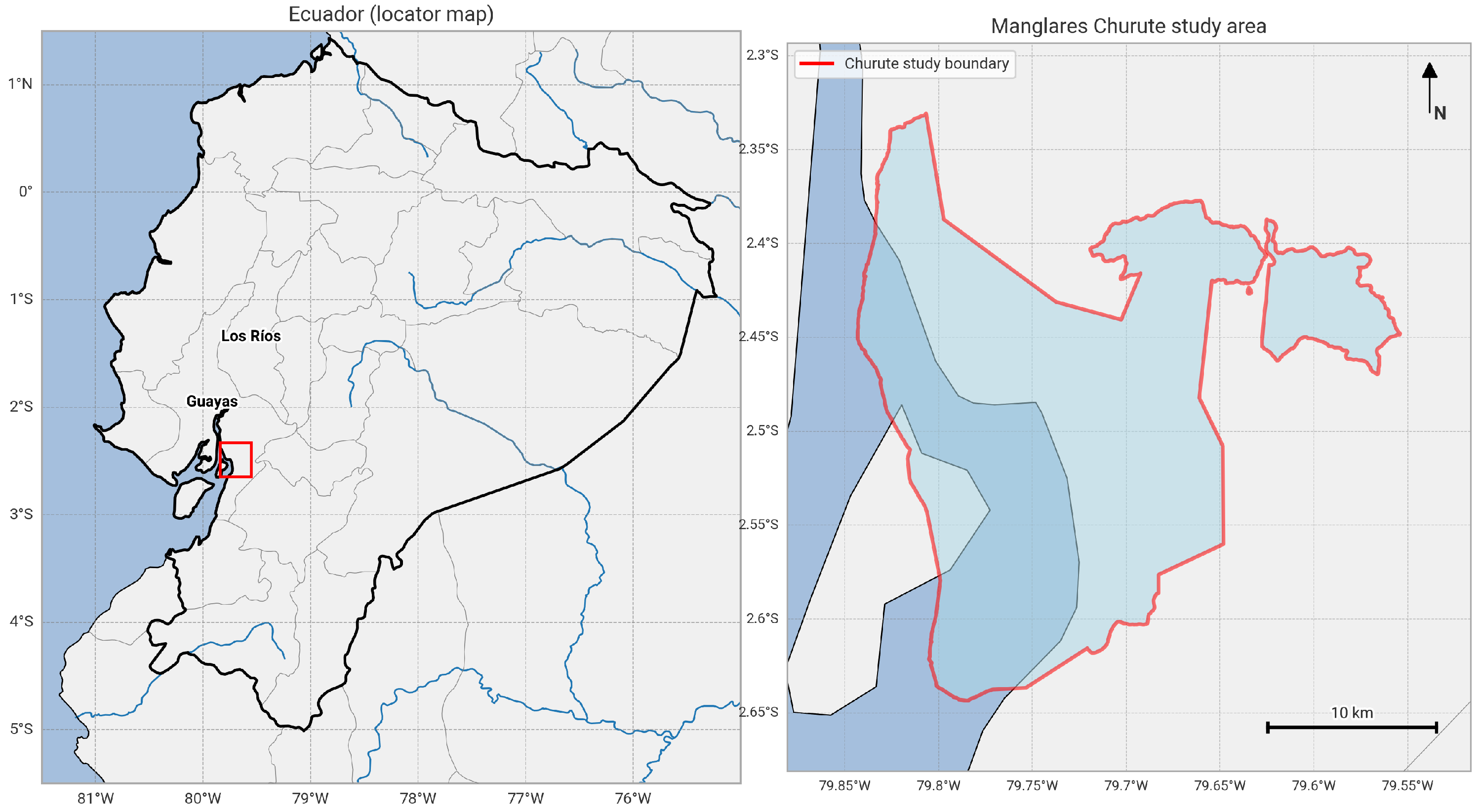
18,
19]. The Manglares Churute Ecological Reserve, located within the Gulf of Guayaquil region, provides a policy-relevant setting to connect blue-carbon science with the operational requirements of climate finance. In this study, we quantify carbon-stock dynamics and derive a carbon-market valuation indicator for the Churute mangrove system over 2015–2021 using remote-sensing land-cover products and the accounting logic of the ECOSER ecosystem-services framework [
20,
21], explicitly positioning the outputs for MRV-aligned decision support.
3. Results
3.1. Land-Cover Mapping Outputs and Area Accounting (2015–2021)
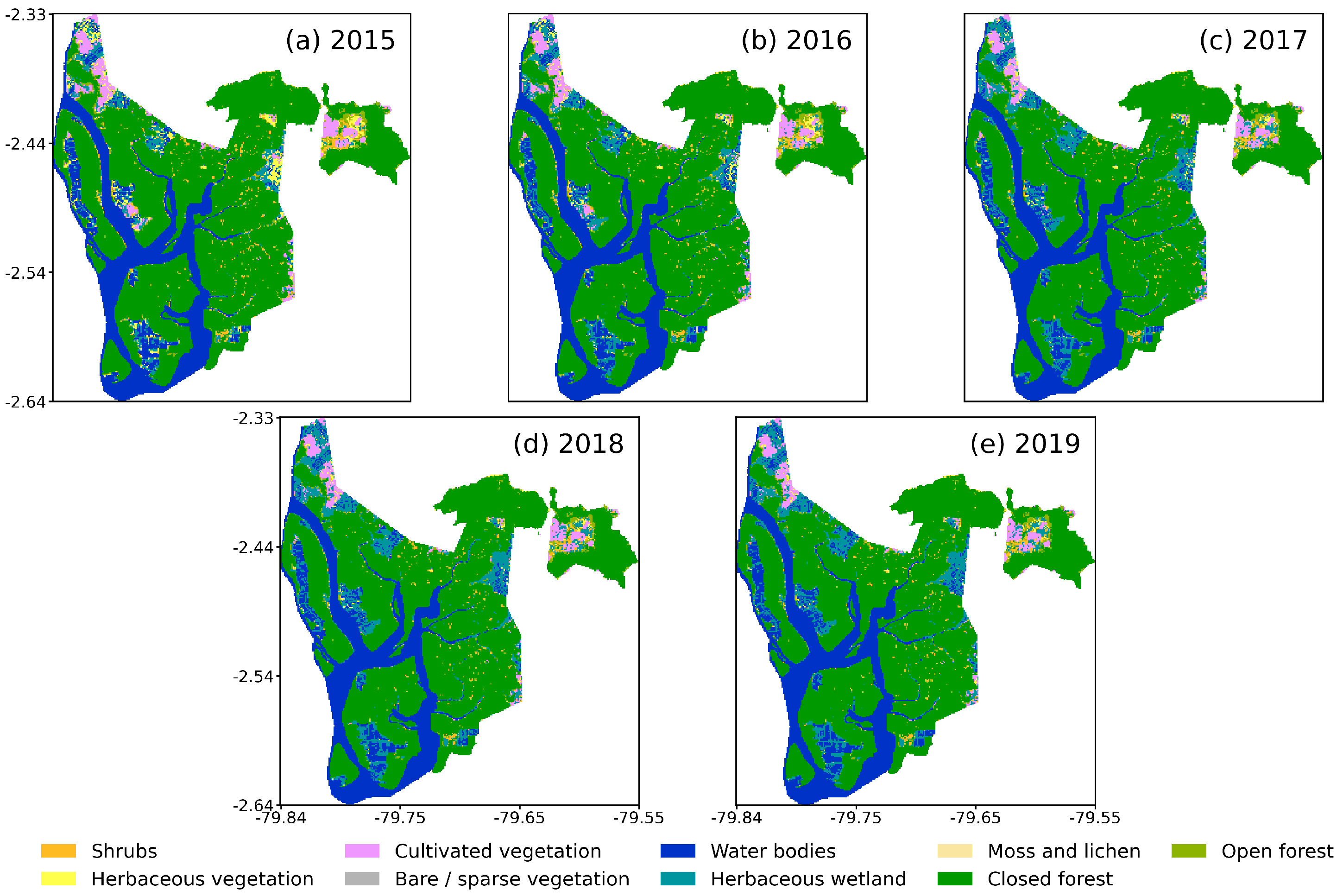
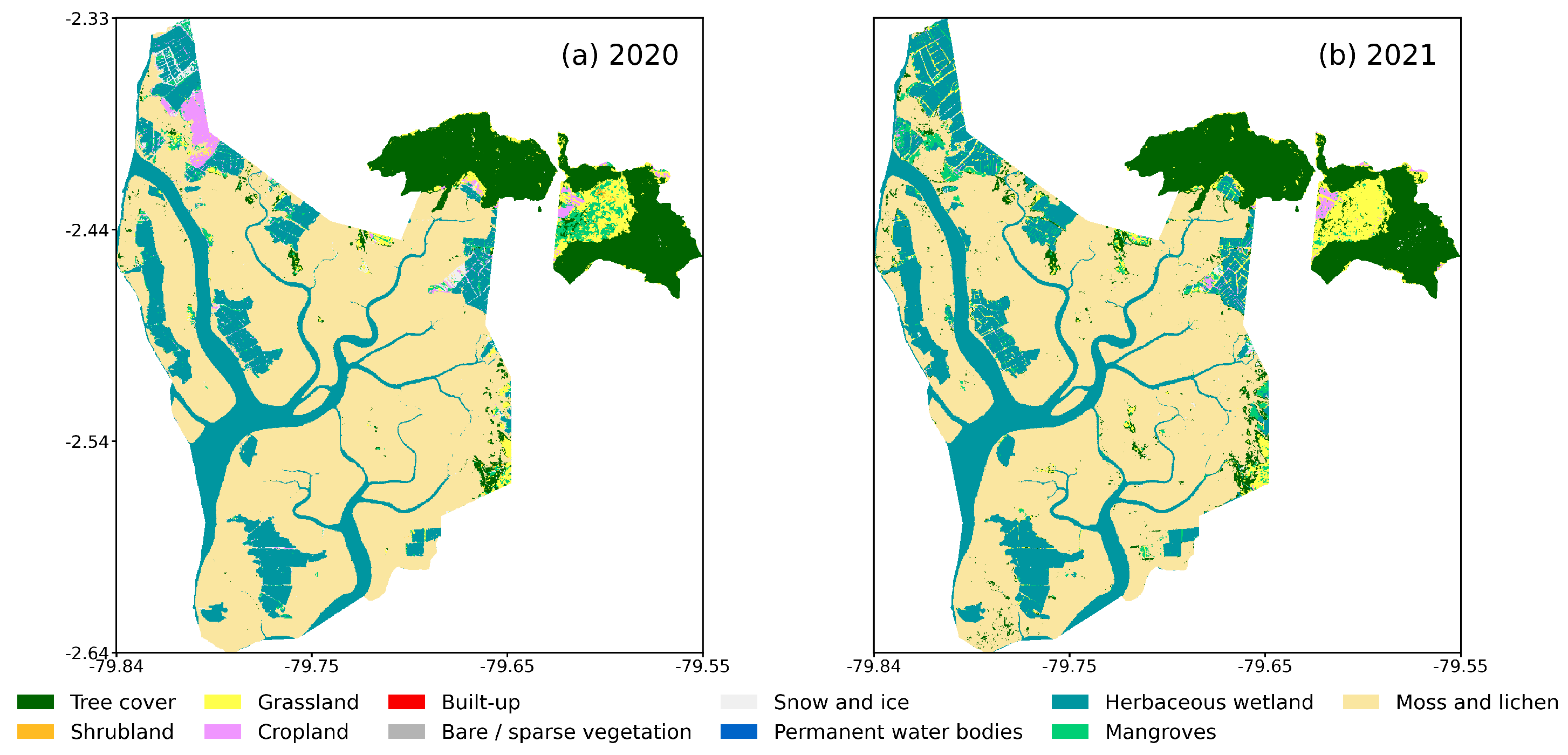
Land-cover mapping provides the activity data underpinning all subsequent carbon-stock and valuation calculations for the Churute mangrove ecological reserve. Two global products were used to cover the full 2015–2021 period: Copernicus Global Land Service LC100 yearly maps for 2015–2019 and ESA WorldCover maps for 2020–2021. The mapped outputs clipped to the protected-area boundary are shown in
Figure 3 and
Figure 4, and they illustrate both the spatial structure of the reserve and the product-to-product differences that emerge when the data source, sensor inputs, and classification system change.
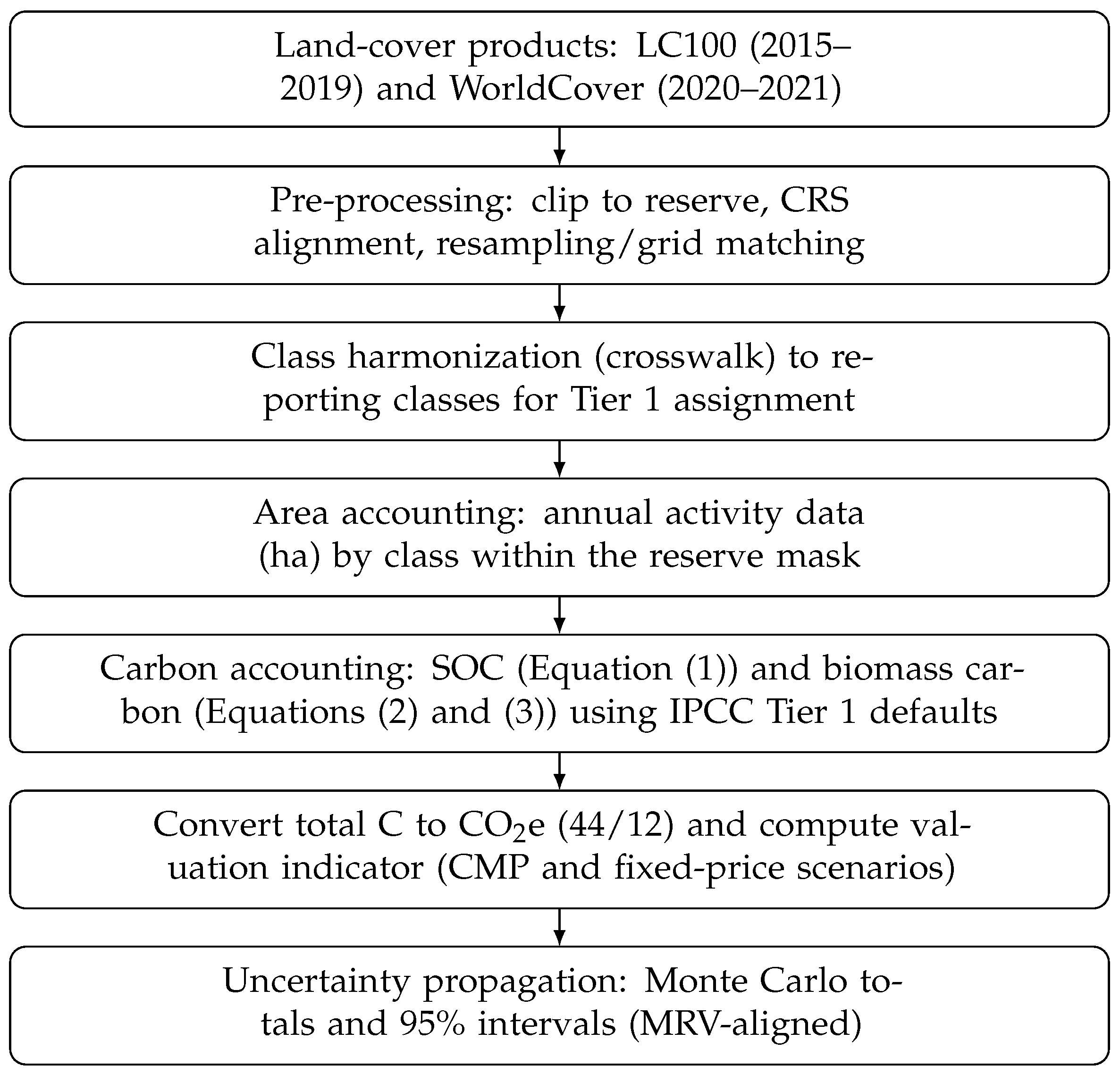
Because the Copernicus LC100 and ESA WorldCover legends use different class identifiers and naming conventions, the original land-cover categories were first consolidated into a harmonized reporting scheme before area accounting and carbon estimation. This contraction step ensures that the final tabulated outputs represent like-for-like classes across the two datasets, allowing class areas (and the carbon coefficients tied to those classes) to be compared consistently within a single accounting framework. In practical terms, multiple forest-related categories present in the original products were merged into a single Forest reporting class, while the remaining land-cover types were aggregated into the set reported in
Table 4.
Table 4 summarizes land-cover areas (ha) inside the reserve for each mapped year after harmonization (total mapped area ∼50,057 ha for 2015–2019 and ∼50,082 ha for 2020–2021 under the protected-area mask). Across 2015–2019 (LC100), Forest is consistently the dominant class, varying narrowly from 33,439.2 ha (2015) to 32,711.7 ha (2019), while Herbaceous wetland increases from 2235.5 ha (2015) to 4566.7 ha (2018) before a decrease to 4376.7 ha (2019). Over the same period, Shrub and Herbaceous vegetation both decline (1003.4 ha to 551.9 ha, and 1214.0 ha to 251.8 ha, respectively), whereas Water shows a net increase (10,450.9 ha to 10,936.3 ha). Sparse vegetation remains negligible throughout 2015–2019 (1.2–3.6 ha).
For 2020–2021 (WorldCover), the mapped pattern continues to reflect a forest-dominated reserve, with Forest totals of 36,111.7 ha (2020) and 35,424.7 ha (2021), and substantial mapped Water (10,376.4 ha in 2020; 11,318.1 ha in 2021). Other classes occupy comparatively smaller areas, including Herbaceous vegetation (1290.1 ha in 2020; 1912.7 ha in 2021), Herbaceous wetland (1017.2 ha in 2020; 932.7 ha in 2021), and Cropland (685.4 ha in 2020; 259.5 ha in 2021), while Urban remains negligible (≤14.6 ha). However, absolute areas in 2020–2021 are not directly comparable to 2015–2019 without caution: the two periods rely on different land-cover products and processing chains, and even within WorldCover, the 2020 and 2021 releases are associated with different algorithm versions. Accordingly, the 2020–2021 values are interpreted here primarily as internally consistent area accounting for the carbon calculations, rather than as definitive evidence of a structural shift relative to the 2015–2019 LC100-derived totals.
3.2. Total Carbon Storage: Spatial Patterns and Interannual Dynamics (2015–2021)
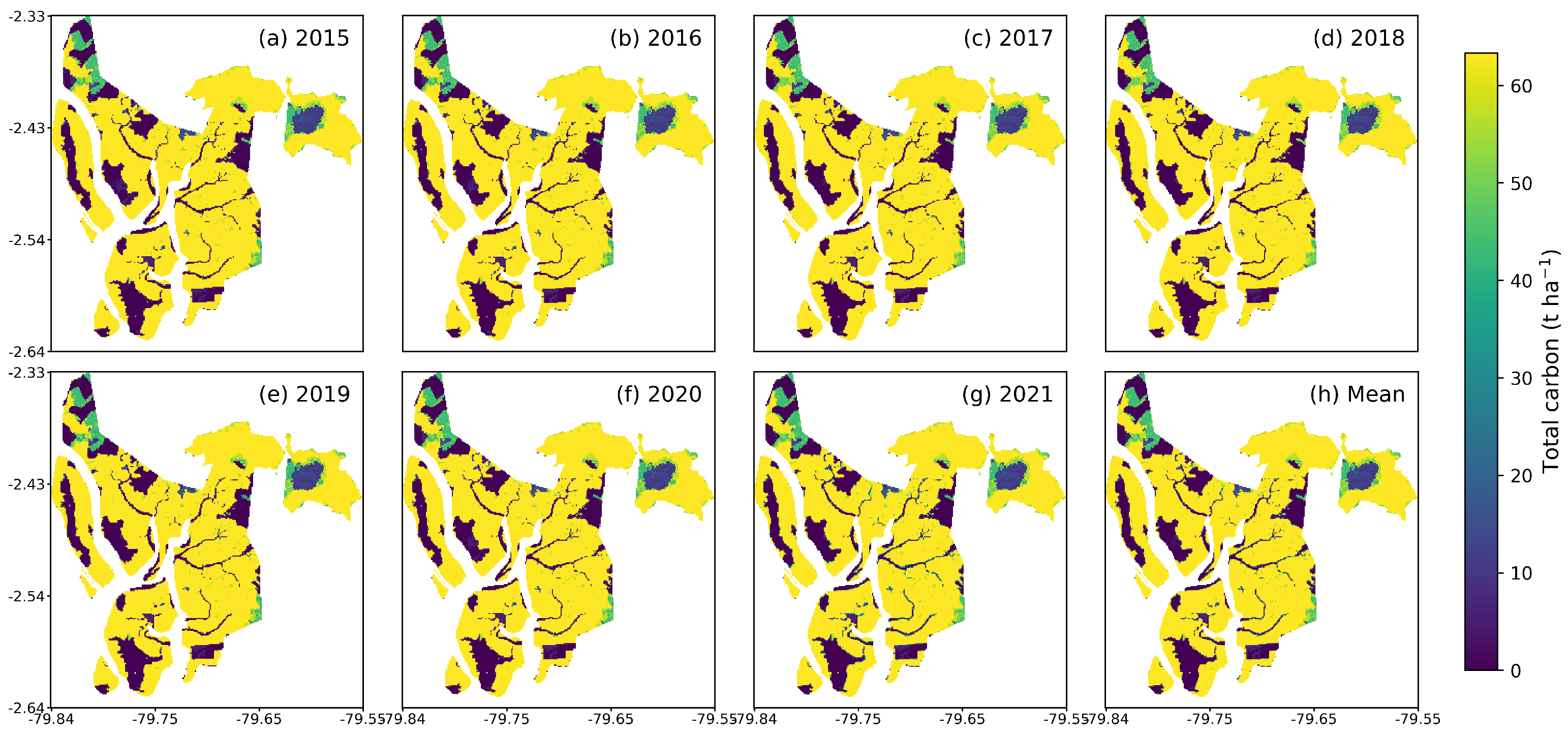
Figure 5 shows the spatial distribution of total carbon stock across the reserve for each year (2015–2021), together with the multi-year mean. High-carbon values consistently align with the forest-dominated portions of the protected area, while lower values occur in water bodies and other non-forest classes in the harmonized land-cover scheme. The maps provide a spatial check on the accounting outputs by linking (i) the land-cover activity data, (ii) the Tier 1 coefficients and SOC factors applied by class, and (iii) the annual totals reported for the reserve. Interannual departures are spatially structured (i.e., concentrated in particular zones where mapped class composition varies), rather than appearing as random pixel-level noise.
Annual totals of total carbon stock (t C) are summarized in
Table 5. Across 2015–2021, the mean total carbon stock is 1,877,774.97 t C. Carbon stocks remain high and relatively stable during the internally consistent LC100 period (2015–2019; 1,859,892.86–1,881,335.75 t C), followed by a higher value in 2020 (1,907,479.59 t C) and a decrease in 2021 (1,865,235.78 t C). Year-to-year change is reported directly in the table as both an absolute difference (
) and a percent difference (
) relative to the preceding year, facilitating interpretation alongside land-cover area accounting (
Table 4) and the change in land-cover product source between 2019 and 2020.
Within the internally consistent LC100 period (2015–2019), the Mann–Kendall test indicated a negative but non-significant monotonic trend in total carbon (Kendall’s = , two-sided p = ), and the associated Theil–Sen estimator yielded a slope of t C yr−1. The negative sign reflects the net decrease observed across the LC100-based totals by 2019, but the magnitude remains small relative to the multi-year mean and is not statistically distinguishable from zero at the 5% level, given the short annual series. The 2019–2020 difference coincides with the transition from LC100 (100 m) to ESA WorldCover (10 m) and is therefore treated as a breakpoint in the activity-data source rather than as a standalone indicator of ecosystem change; separating these periods avoids overinterpreting differences that may be driven by the classification system and resolution effects instead of land-cover dynamics. Given (2015–2019), the Mann–Kendall/Theil–Sen results are reported as descriptive diagnostics with limited power, and we avoid any cross-product (2015–2021) trend inference.
3.3. Carbon-Market Valuation Indicator (CO2e and Annual Value)
To contextualize the estimated carbon stocks in terms of climate-finance relevance, annual totals were converted to CO
2-equivalent using the molecular-weight ratio 44/12 (=3.67) and then multiplied by an annual carbon price indicator (CMP) compiled from publicly reported carbon-pricing instruments [
38]. Following the Carbon Pricing Dashboard conventions, prices represent nominal values for the relevant year (reported as of April 1 or the latest available prior to April 1), and they are not strictly comparable across instruments because coverage and design differ. Accordingly, the resulting value is used here as a transparent indicator of magnitude rather than a project-level revenue forecast.
Table 6 reports the annual CO
2e totals, CMP, and the resulting value estimate. Over 2015–2021, the mean value estimate is
$64,336,915.2, with a maximum in 2015 (
$148,311,968.7) and a minimum in 2016 (
$19,280,544.9). CO
2e totals vary within a narrow band (6.82–6.99 million t CO
2e), whereas CMP exhibits substantially larger relative variability (2.8–21.5), explaining why interannual valuation differences are driven primarily by the carbon-price assumption rather than by changes in the underlying carbon stock.
Using the annual CO
2e totals in
Table 6, fixed-price scenarios yield values of USD 34.10–34.97 million (5 USD tCO
2e
−1), 68.20–69.94 million (10 USD tCO
2e
−1), and 136.39–139.88 million (20 USD tCO
2e
−1). Across all three scenarios, minima occur in 2019 and maxima in 2020, confirming that valuation scales linearly with price while CO
2e totals remain relatively stable.
The carbon price series used to derive CMP is reported in
Table 7. This table is retained to document the underlying inputs and the annual aggregation used to compute CMP. Because not all instruments report prices in all years, CMP (“MEDIA”) was calculated as the arithmetic mean of the non-zero instrument values available for each year; entries of 0.0 indicate that a price was not reported (or not applicable) for that instrument in that year and were excluded from the annual mean.
4. Discussion
A first-order interpretation of the mapped interannual differences must explicitly account for the change in land-cover activity data from LC100 (100 m) to WorldCover (10 m) [
15]. Differences in spatial resolution, class definitions, and production/validation pipelines can systematically alter mapped class areas, particularly for narrow linear features (channels), mixed pixels along ecotones, and small anthropogenic patches, thereby shifting the activity data that drive carbon totals even when the boundary mask is identical [
39]. While Tier 1 parameters support transparent, conservative MRV-style accounting, they may underestimate mangrove biomass carbon relative to mangrove-specific literature values; we therefore interpret totals as conservative baselines.
The approach used here (global land-cover activity data + IPCC Tier 1 defaults) is best suited for transparent, conservative screening, protected-area baselines [
40], and inventory-style reporting where reproducibility is prioritized over site-specific precision. Its applicability is limited to crediting-grade MRV (e.g., additionality, leakage, permanence, and disturbance attribution) and for detecting subtle interannual change when activity data are not homogeneous across time or when mangrove classes are not explicitly separated from other forests [
41]. Finally, carbon-only MRV does not capture broader ecosystem conditions; complementary ecological indicators (e.g., sediment biodiversity baselines reported for Churute [
42]) can help contextualize integrity beyond carbon stocks.
This is consistent with recent comparative assessments of high-resolution global land-cover products, which highlight inconsistencies arising from resolution changes, classification systems, and regional validation challenges when combining datasets for trend analysis [
43,
44]. Accordingly, we interpret 2015–2019 and 2020–2021 as separate, internally consistent accounting periods, and do not interpret differences across the 2019–2020 product transition as temporal trends.
Second, the magnitude and persistence of the total carbon stock estimated here are consistent with the broader evidence base that mangrove ecosystems are among the most carbon-rich forests globally, with large contributions from belowground pools and strong site-to-site variability driven by geomorphology, hydrology, and disturbance history [
45,
46]. Whole-ecosystem syntheses show that carbon density can be very high, and that even modest mapped shifts among forest/wetland classes can translate into meaningful differences in accounted stocks when Tier 1 coefficients are applied at scale [
47,
48].
Third, the stability of LC100-based totals across 2016–2019 aligns with the growing consensus that regional mangrove trajectories can be dominated by localized conversion and hydrological stress rather than monotonic, reserve-wide declines, and that the attribution of change requires attention to both human and natural drivers [
10,
16]. Global analyses using consistent, long-term datasets indicate that the rate and spatial pattern of mangrove loss depend on the balance between anthropogenic pressures (e.g., aquaculture expansion) and climate-related drivers, reinforcing the need to treat mapped differences cautiously when the underlying land-cover product changes [
47,
49].
Fourth, positioning the results for MRV-relevant use benefits from explicitly separating (i) the internally consistent period where trend statistics are meaningful (here, LC100 2015–2019) from (ii) cross-product transitions that can create artificial step changes in activity data [
50]. This logic is consistent with recent work on coastal-wetland greenhouse-gas accounting that highlights both the feasibility of scalable, transparent estimation and the practical requirement to avoid overinterpretation when activity data are not methodologically homogeneous over time [
51].
Finally, the valuation indicator illustrates that interannual variation in “value” can be driven more by the carbon-price assumption than by changes in the underlying carbon stock, particularly when using globally aggregated price benchmarks across heterogeneous instruments [
52,
53]. The broader carbon-pricing literature shows substantial cross-jurisdiction variability in price formation and drivers, implying that market-based valuation is best interpreted as an order-of-magnitude contextualization and should be accompanied by sensitivity/uncertainty framing rather than treated as a project-grade revenue estimate [
38,
54]. We emphasize that this valuation is not a tradable revenue estimate: eligibility under voluntary carbon markets (VCM) or REDD+/blue-carbon methodologies would require additionality, leakage assessment, permanence/crediting rules, baselines, and verified MRV consistent with the selected standard and national accounting. CMP is therefore presented only as a reference-value contextualization.
5. Conclusions
This study demonstrates that the Churute Mangrove Ecological Reserve maintains substantial and relatively stable total carbon stocks over the 2015–2021 period, averaging approximately 1.67 million t C, with values aligning closely with global syntheses confirming mangroves as among the most carbon-dense ecosystems worldwide. Within the consistent LC100-derived period (2015–2019), interannual variability was minimal and non-significant, supporting evidence that regional mangrove dynamics are often characterized by localized stressors rather than widespread decline.
The abrupt shift observed in 2020–2021 primarily reflects methodological discontinuities between the 100 m Copernicus LC100 and 10 m ESA WorldCover products, underscoring the importance of homogeneous activity data for robust trend detection in monitoring, reporting, and verification (MRV) frameworks. The carbon-market valuation indicator highlights the reserve’s potential climate-finance relevance, with annual equivalents ranging from roughly 5.6 to 6.4 million t CO2e, and illustrative values fluctuating markedly due to carbon-price volatility rather than stock changes.
This scalable, transparent approach, combining remote-sensing-derived activity data with Tier 1 coefficients, offers a practical baseline for protected-area accounting and illustrates how even protected mangroves can contribute meaningfully to national blue-carbon inventories. Nevertheless, several limitations temper the interpretations presented here. Differences in resolution, class legends, and validation pipelines between land-cover products can introduce artificial step changes that confound ecological signals, particularly for narrow or fragmented features typical of mangrove landscapes. Reliance on generic IPCC Tier 1 emission factors overlooks site-specific variability in carbon densities driven by geomorphology, species composition, and disturbance history, while soil organic carbon estimates remain conservative by focusing on upper layers.
Finally, the valuation relies on aggregated nominal prices from heterogeneous instruments, providing only order-of-magnitude context rather than precise revenue projections, and does not account for transaction costs, additionality, or leakage risks inherent to market-based mechanisms. Future work integrating higher-tier, field-calibrated coefficients and consistent high-resolution time series would enhance accuracy for operational MRV and policy applications.




 ,
,