Maritime Piracy as a Threat to Energy Security in Global Supply Chains †


Abstract
1. Introduction
2. Conceptual and Legal Framework of Energy Security and Maritime Piracy
2.1. Energy Security
2.2. Definition of Maritime Piracy
3. Maritime Piracy and Energy Transport Routes
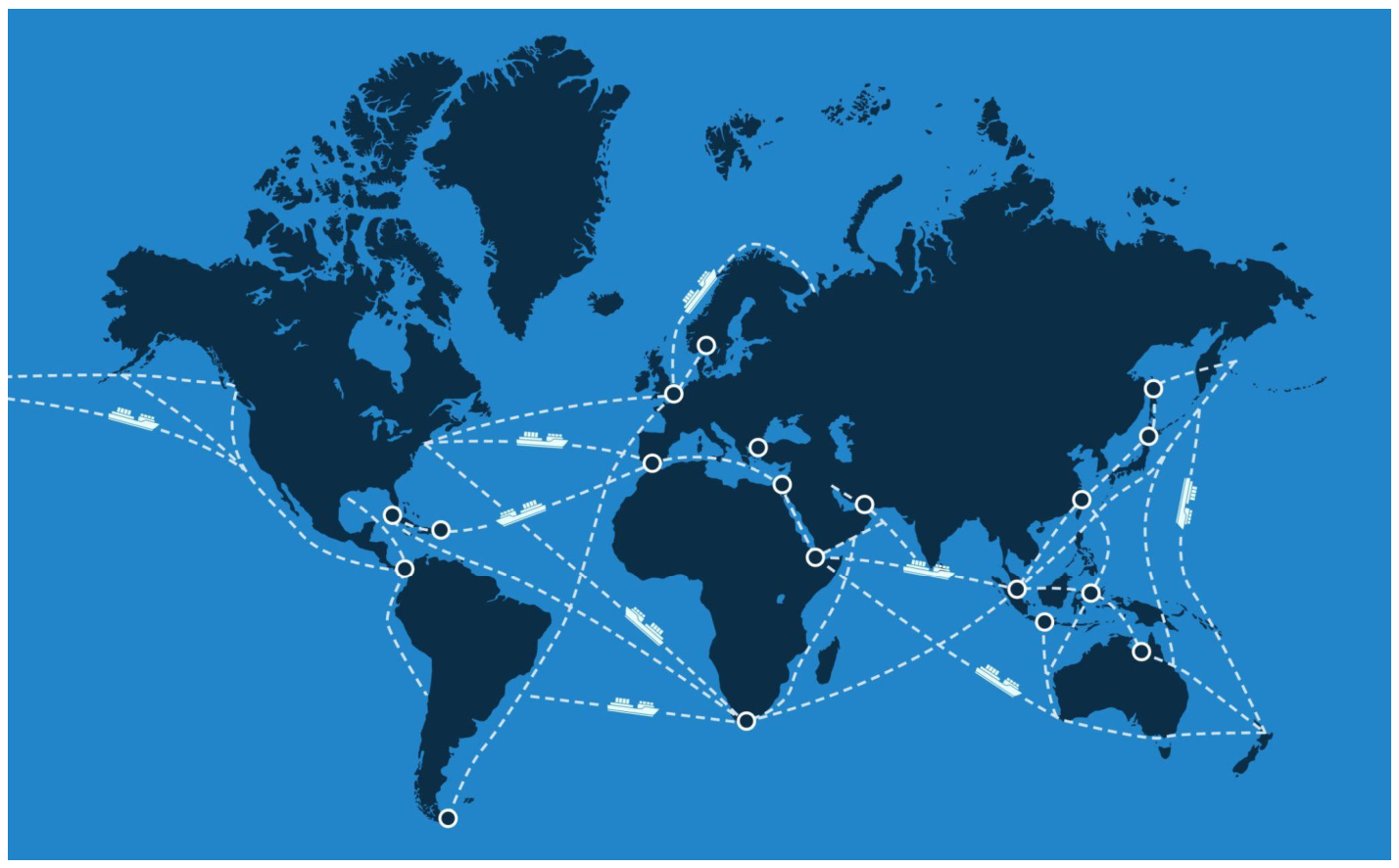
3.1. Oil and LNG Tanker Routes
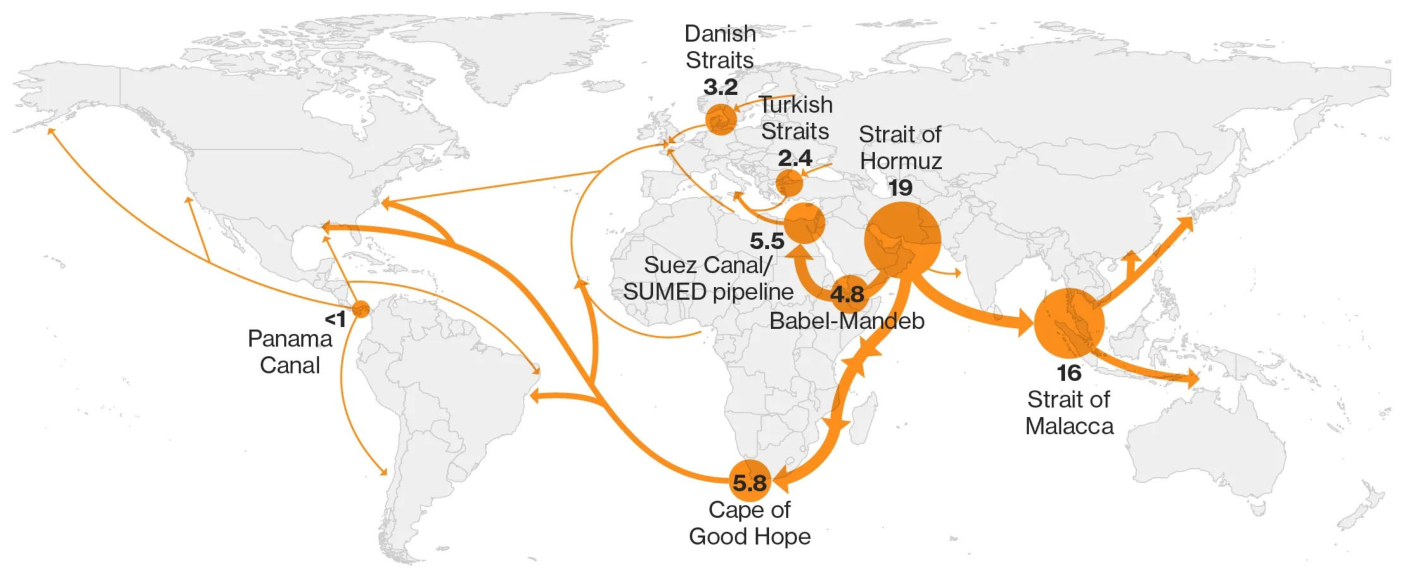
3.2. Strategic Maritime Chokepoints
3.3. Vulnerability of Tankers
3.4. Costs of Delays and Disruptions
3.5. Risks to Offshore Energy Infrastructure
4. Economic and Strategic Impacts
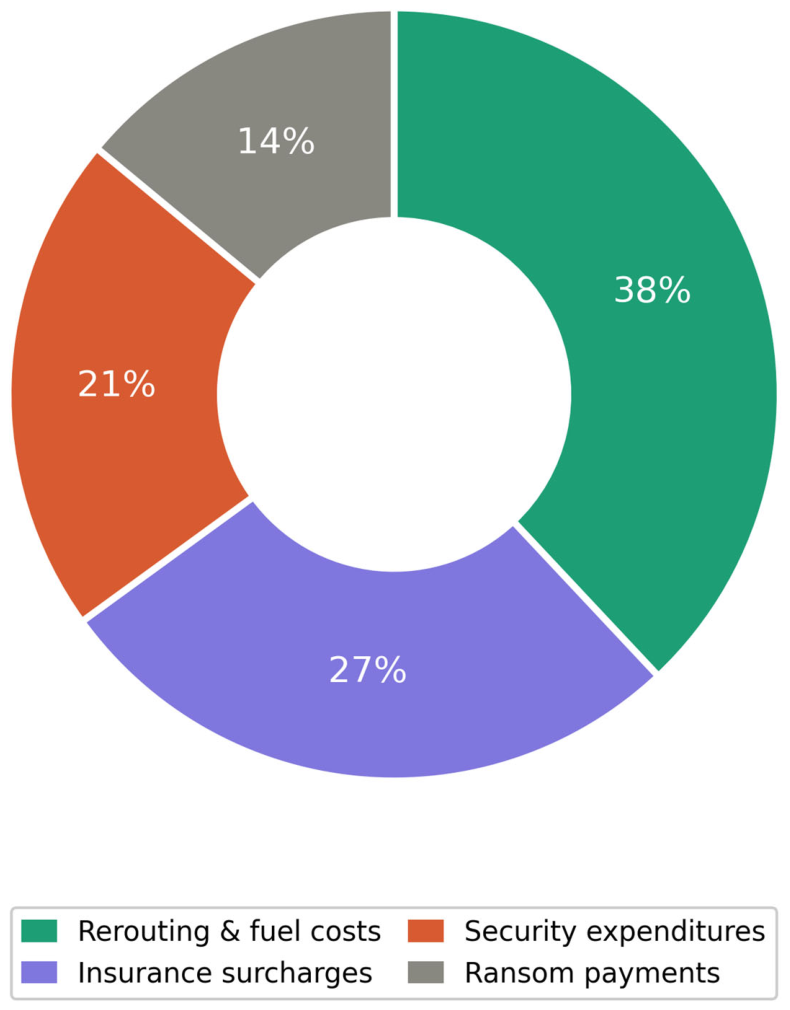
4.1. Direct Economic Costs
4.2. Market Volatility
4.3. Geopolitical Consequences
5. Research Methodology
6. Case Studies
6.1. Case 1: Somali Piracy (2023–2025)
6.2. Case 2: Gulf of Guinea (2020–2025)
6.3. Case 3: Red Sea Corridor (2023–2024): Geopolitical Disruption and Its Supply Chain Equivalence to Piracy
6.4. Case 4: Strait of Malacca (2020–2025)
7. Discussion
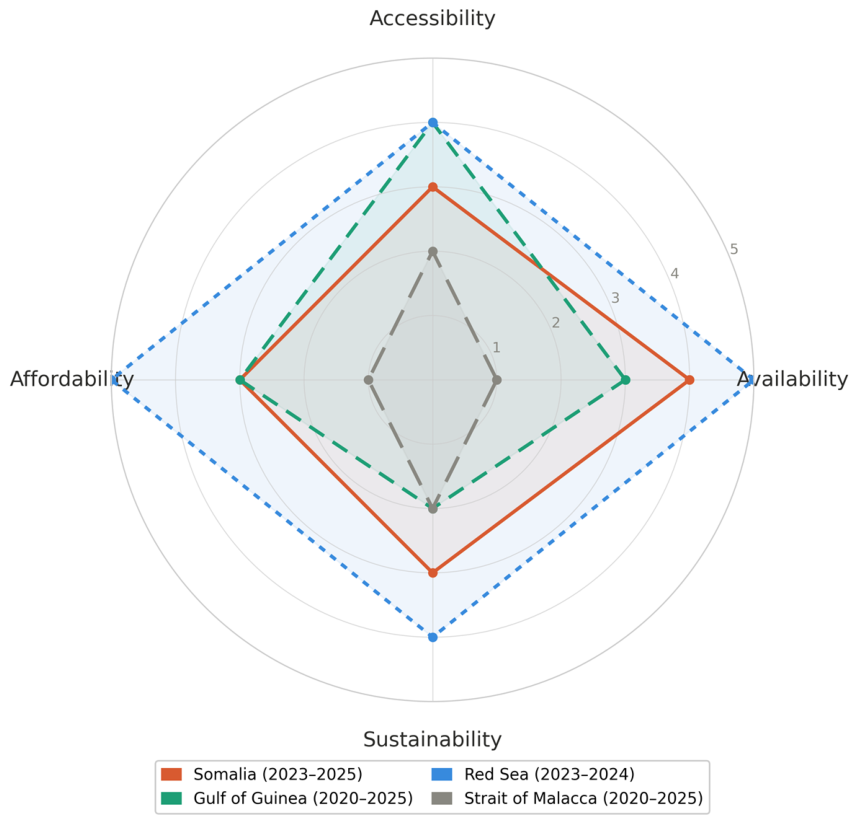
7.1. Application of the Four-Pillar Energy Security Framework
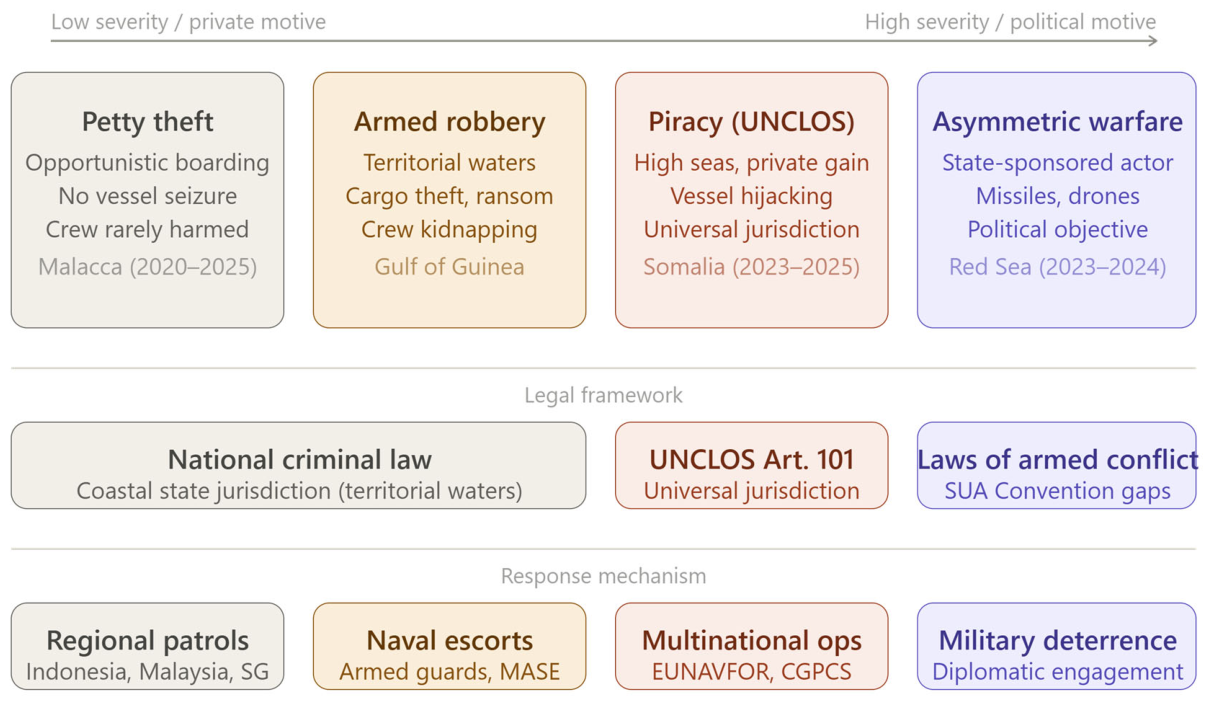
7.2. Typology of Maritime Piracy Risk for Energy Supply Chains
8. Conclusions
Funding
Institutional Review Board Statement
Informed Consent Statement
Data Availability Statement
Conflicts of Interest
Abbreviations
| AIS | Automatic Identification System |
| ASEAN | Association of Southeast Asian Nations |
| BRICS | Brazil, Russia, India, China, South Africa |
| CGPCS | Contact Group on Piracy off the Coast of Somalia |
| EIA | Energy Information Administration |
| EU | European Union |
| EUNAVFOR | European Union Naval Force |
| GISIS | Global Integrated Shipping Information System |
| IEA | International Energy Agency |
| IMB | ICC International Maritime Bureau |
| IMO | International Maritime Organization |
| LNG | Liquefied Natural Gas |
| MASE | Maritime Security Programme |
| MDA | Maritime Domain Awareness |
| NATO | North Atlantic Treaty Organization |
| ReCAAP | Regional Cooperation Agreement on Combating Piracy and Armed Robbery against Ships in Asia |
| SCO | Shanghai Cooperation Organisation |
| SUA | Convention for the Suppression of Unlawful Acts Against the Safety of Maritime Navigation |
| UN | United Nations |
| UNCLOS | United Nations Convention on the Law of the Sea |
References
- Strojny, J.; Krakowiak-Bal, A.; Knaga, J.; Kacorzyk, P. Energy Security: A Conceptual Overview. Energies 2023, 16, 5042. [Google Scholar] [CrossRef]
- Smailis, G.; Paravantis, D.J. The Geopolitics of Global Maritime Energy Transportation: Chokepoints, Markets, Risks and Security. Master’s Thesis, University of Piraeus, Athens, Greece, 2025. [Google Scholar]
- Verschuur, J.; Koks, E.E.; Hall, J.W. Ports’ Criticality in International Trade and Global Supply-Chains. Nat. Commun. 2022, 13, 4351. [Google Scholar] [CrossRef] [PubMed]
- Menzel, A.; Otto, L. Connecting the Dots: Implications of the Intertwined Global Challenges to Maritime Security. In Global Challenges in Maritime Security; Otto, L., Ed.; Advanced Sciences and Technologies for Security Applications; Springer International Publishing: Cham, Switzerland, 2020; pp. 229–243. [Google Scholar]
- Martins, V.M. Influence of Maritime Logistics on International Relations. Katonai Logiszt. 2025, 33, 70–85. [Google Scholar] [CrossRef]
- Luft, G.; Korin, A. Energy Security Challenges for the 21st Century: A Reference Handbook; Bloomsbury Publishing: New York, NY, USA, 2009. [Google Scholar]
- Gesami, B. A Brief Guide to Africa’s Maritime Security. SSRN Electron. J. 2023. [Google Scholar] [CrossRef]
- Dabova, E.L. Non-Traditional Security Threats in the Border Areas: Terrorism, Piracy, Environmental Degradation in Southeast Asian Maritime Domain. Int. Arch. Photogramm. Remote Sens. Spat. Inf. Sci. 2013, XL-4/W3, 51–56. [Google Scholar] [CrossRef]
- Mehmood, Z.H. AI, Information and Maritime Security: Implications for Global Trade and Geopolitical Competition. In AI, Information, and Global Dynamics; Roumate, F., Ed.; Contributions to International Relations; Springer Nature: Cham, Switzerland, 2026; pp. 137–156. [Google Scholar]
- Schmitz, R.; Flachsbarth, F.; Plaga, L.S.; Braun, M.; Härtel, P. Energy Security and Resilience: Revisiting Concepts and Advancing Planning Perspectives for Transforming Integrated Energy Systems. Energy Policy 2025, 207, 114796. [Google Scholar] [CrossRef]
- Karlsson-Vinkhuyzen, S.I. The UN, Energy and the Sustainable Development Goals. In The Palgrave Handbook of the International Political Economy of Energy; Van De Graaf, T., Sovacool, B.K., Ghosh, A., Kern, F., Klare, M.T., Eds.; Palgrave Macmillan: London, UK, 2016; pp. 115–138. [Google Scholar]
- Li, Q.; Song, Z. Research on Energy Security in the EU from a Trade Perspective: A Historical Analysis from 1991 to 2021. Energies 2025, 18, 3801. [Google Scholar] [CrossRef]
- Gökgöz, F.; Güvercin, M.T. Energy Security and Renewable Energy Efficiency in EU. Renew. Sustain. Energy Rev. 2018, 96, 226–239. [Google Scholar] [CrossRef]
- United Nations. United Nations Convention on the Law of the Sea (UNCLOS); United Nations Office of Legal Affairs: New York, NY, USA, 1982. [Google Scholar]
- Satkauskas, R. Piracy at Sea and the Limits of International Law. Aegean Rev. Law Sea Marit. Law 2011, 1, 217–235. [Google Scholar] [CrossRef]
- Sainchyn, O.; Hromova, M.; Gushchyn, O.; Legkikh, K. Specifics of the Legal Regulation of the Prevention of the Taking and Killing of Hostages in the Context of Terrorist Threats. Secur. J. 2022, 35, 1087–1101. [Google Scholar] [CrossRef]
- Adesanya, O.P. Maritime Crimes and the Gulf of Guinea. Cogent Soc. Sci. 2023, 9, 2241263. [Google Scholar] [CrossRef]
- Guo, F.; Huang, C.; Wu, X. Strategic Analysis on the Construction of New Energy Corridor China–Pakistan–Iran–Turkey. Energy Rep. 2019, 5, 828–841. [Google Scholar] [CrossRef]
- Akar, Ç. The Development of Piracy in the Horn of Africa. J. Mar. Eng. Technol. (JOINMET) 2022, 2, 31–39. [Google Scholar] [CrossRef]
- Rodriguez-Diaz, E.; Alcaide, J.I.; Garcia-Llave, R. Challenges and Security Risks in the Red Sea: Impact of Houthi Attacks on Maritime Traffic. J. Mar. Sci. Eng. 2024, 12, 1900. [Google Scholar] [CrossRef]
- Parker, S. Matching in the Oil Tanker Industry: Implications for Energy Efficiency. Ph.D. Thesis, University College London (UCL), London, UK, 2014. [Google Scholar]
- Jin, M.; Shi, W.; Lin, K.-C.; Li, K.X. Marine Piracy Prediction and Prevention: Policy Implications. Mar. Policy 2019, 108, 103528. [Google Scholar] [CrossRef]
- Briouig, M. Risk Management in Liquefied Natural Gas Ports and Marine Terminals Supply Chains. Ph.D. Thesis, University of Plymouth, Plymouth, UK, 2014. [Google Scholar] [CrossRef] [PubMed]
- Omale, O. Seaborne Trade of Liquified Natural Gas; Preprint; Cardiff University: Cardiff, UK, 2021. [Google Scholar] [CrossRef]
- Badea, M.; Bucovețchi, O.; Gheorghe, A.V.; Hnatiuc, M.; Raicu, G. Maritime Industry Cybersecurity Threats in 2025: Advanced Persistent Threats (APTs), Hacktivism and Vulnerabilities. Logistics 2025, 9, 178. [Google Scholar] [CrossRef]
- Shawe, R. The Crucial Role of Safeguarding Critical Infrastructure in Ensuring the Stability and Security of the U.S. Supply Chain. Am. J. Ind. Bus. Manag. 2025, 15, 1055–1071. [Google Scholar] [CrossRef]
- Tympakianakis, P. Global Shipping Is Facing New Challenges 5 Years After COVID Disruption. 2025. Available online: https://www.linkedin.com/pulse/global-shipping-facing-new-challenges-5-years-after-tympakianakis-uvjrf (accessed on 1 July 2026).
- Ulrichsen, K.C.; Krane, J. Maritime Chokepoints and Risks to Global Shipping and Energy Security. 2026. Available online: https://www.bakerinstitute.org/research/maritime-chokepoints-and-risks-global-shipping-and-energy-security (accessed on 1 July 2026).
- Sharif, N.; Rönnqvist, M.; Cordeau, J.-F.; Audy, J.-F.; Warya, G.; Ngo, T. Multi-Objective Vessel Routing Problems with Safety Considerations: A Review. Marit. Transp. Res. 2024, 7, 100122. [Google Scholar] [CrossRef]
- Xiao, Z.; Xu, L. A Study on Global Piracy Attacks’ Trends and Characteristics Based on Data Analysis. Int. J. Secur. Appl. 2017, 11, 233–244. [Google Scholar]
- Ewuola, A. Marine Security Risk Management in High-Risk Zones: Lessons from West African LNG Terminals. Int. J. Adv. Multidiscip. Res. Stud. 2023, 3, 1770–1779. [Google Scholar] [CrossRef]
- Kalinichenko, Y.; Vasalatii, N.; Rossomakha, O.; Koliesnik, O.; Sagaydak, O.; Santana, L.O.; Zaiets, A.; Tomchakovsky, G.; Dolynska, N.; Holovan, A. Some Issues of Increasing the Energy Efficiency of Ships by Improving Navigation Methods: Monograph; Scientific Route OÜ: Tallinn, Estonia, 2025. [Google Scholar]
- Ferrari, E.; Christidis, P.; Bolsi, P. The Impact of Rising Maritime Transport Costs on International Trade: Estimation Using a Multi-Region General Equilibrium Model. Transp. Res. Interdiscip. Perspect. 2023, 22, 100985. [Google Scholar] [CrossRef]
- Jiang, B.; Rigobon, D.; Rigobon, R. From Just-in-Time, to Just-in-Case, to Just-in-Worst-Case: Simple Models of a Global Supply Chain under Uncertain Aggregate Shocks. IMF Econ. Rev. 2022, 70, 141–184. [Google Scholar] [CrossRef]
- Lin, C.-W.R.; Lai, Y.S.; Jeng, S.-Y.; Nguyen, T.T.V.; Lim, M.K. Supply Chain Disruption Indicators: Vulnerability and Resilience in the Garment Industry in Vietnam. Clean. Responsible Consum. 2025, 16, 100251. [Google Scholar] [CrossRef]
- Wanzala, R.W.; Obokoh, L.O. Sustainability Implications of Commodity Price Shocks and Commodity Dependence in Selected Sub-Saharan Countries. Sustainability 2024, 16, 8928. [Google Scholar] [CrossRef]
- Asariotis, R.; Benamara, H.; Lavelle, J.; Premti, A. Maritime piracy: Part I: An overview of trends, costs and trade-related implications. In Proceedings of the United Nations Conference on Trade and Development, Geneva, Switzerland, 23 September 2014. [Google Scholar]
- Bueger, C.; Stockbruegger, J. Oceans, Objects, and Infrastructures: Making Modern Piracy. Glob. Stud. Q. 2024, 4, ksae063. [Google Scholar] [CrossRef]
- Bueger, C.; Liebetrau, T. Critical Maritime Infrastructure Protection: What’s the Trouble? Mar. Policy 2023, 155, 105772. [Google Scholar] [CrossRef]
- Mbekeani, K.K.; Ncube, M. Economic Impact of Maritime Piracy. Afr. Econ. Brief 2011, 2, 1–8. [Google Scholar]
- Financial Action Task Force (FATF). Organised Maritime Piracy and Related Kidnapping for Ransom; FATF: Paris, France, 2011. [Google Scholar]
- Fotini, P. The Asymmetric Cost Behavior of Operating Expenses in Shipping Companies. Master’s Thesis, University of Piraeus, Piraeus, Greece, 2024. [Google Scholar]
- Bendekovic, J.; Vuletic, D. Piracy Influence on the Shipowners and Insurance Companies. In DAAAM International Scientific Book; Katalinic, B., Tekic, Z., Eds.; DAAAM International: Vienna, Austria, 2013; Volume 12, pp. 711–718. [Google Scholar]
- Sambu, E. Maritime Safety and Security: The Potential Role of Private Security Companies. J. Marit. Sci. Technol. 2025, 1, 1–9. [Google Scholar] [CrossRef]
- Zis, T.P.V. The Enhanced Role of Canals and Route Choice Due to Disruptions in Maritime Operations. Marit. Bus. Rev. 2024, 9, 98–112. [Google Scholar] [CrossRef]
- Morão, H. The Economic Effects of Tensions in Energy Transportation. Res. Transp. Econ. 2025, 112, 101598. [Google Scholar] [CrossRef]
- He, Z.; Wang, C.; Gao, J.; Xie, Y. Assessment of Global Shipping Risk Caused by Maritime Piracy. Heliyon 2023, 9, e20988. [Google Scholar] [CrossRef] [PubMed]
- Jin, J.; Techera, E. Strengthening Universal Jurisdiction for Maritime Piracy Trials to Enhance a Sustainable Anti-Piracy Legal System for Community Interests. Sustainability 2021, 13, 7268. [Google Scholar] [CrossRef]
- Wang, X.; Du, D.; Peng, Y. Assessing the Importance of the Marine Chokepoint: Evidence from Tracking the Global Marine Traffic. Sustainability 2023, 16, 384. [Google Scholar] [CrossRef]
- Ofosu-Boateng, N.R.L. Piracy in the Gulf of Guinea: Impacts to Maritime Transportation and Maritime Security. J. Asian Dev. 2018, 4, 1. [Google Scholar] [CrossRef]
- Bradford, J.; Manicom, J.; Simon, S.W.; Quartaro, N.A. Maritime Security in Southeast Asia: U.S., Japanese, Regional, and Industry Strategies; NBR Special Report; The National Bureau of Asian Research: Seattle, WA, USA, 2010. [Google Scholar]
- Chen, Q.; Zhang, H.; Lau, Y.; Liu, K.; Ng, A.K.Y.; Chen, W.; Liao, Q.; Dulebenets, M.A. A Geographic Information System (GIS)-Based Investigation of Spatiotemporal Characteristics of Pirate Attacks in the Maritime Industry. J. Mar. Sci. Eng. 2023, 11, 2295. [Google Scholar] [CrossRef]
- ICC International Maritime Bureau (IMB). Piracy and Armed Robbery Against Ships; Annual Report; IMB: London, UK, 2023. [Google Scholar]
- ICC International Maritime Bureau (IMB). Annual Report 2024; IMB: London, UK, 2024. [Google Scholar]
- ICC International Maritime Bureau (IMB). Quarterly Piracy and Armed Robbery Reports 2024–2025; IMB: London, UK, 2024. [Google Scholar]
- International Maritime Organization. Red Sea Incidents Report for Member States; International Maritime Organization: London, UK, 2024. [Google Scholar]
- International Monetary Fund. Red Sea Attacks Disrupt Global Trade. 2024. Available online: https://www.imf.org/en/blogs/articles/2024/03/07/red-sea-attacks-disrupt-global-trade (accessed on 1 July 2026).
- U.S. Energy Information Administration. Red Sea Attacks Disrupt Energy Markets and Shipping. 2024. Available online: https://www.eia.gov/todayinenergy/detail.php?id=61363 (accessed on 1 July 2026).
- JP Morgan Chase & Co. Red Sea Shipping Insights: Impact on Global Supply Chains; J.P. Morgan Global Research: New York, NY, USA, 2024. [Google Scholar]




| Category | Indicator | Value/Evidence (2023–2025) | Relevance for Energy Security |
|---|---|---|---|
| Activity resurgence | First successful hijacking since decline period | December 2023—first confirmed commercial hijacking off Somalia since 2017 | Signals reactivation of piracy networks in a key energy corridor |
| Incident frequency | Reported Somali-related incidents | ~8 incidents in 2024; ~5 incidents in early 2025 | Demonstrates sustained operational capability of pirate groups |
| Hijackings | Confirmed vessel hijackings | 4 hijackings recorded between December 2023–mid 2024 | Direct threat to tankers transiting Gulf of Aden |
| Operational range | Distance from Somali coast | Attacks reported up to ~900–1000 nautical miles offshore | Expands risk zone for energy shipping routes |
| Crew impact | Seafarers taken hostage | ~25–30 crew members affected in early 2025 incidents | Raises insurance and security costs for tanker operators |
| Affected corridor | Strategic location | Gulf of Aden/Western Indian Ocean energy transit route | Middle East oil exports and Europe/Asia |
| Industry response | Routing and onboard security | Increased armed guards and route adjustments | Higher operational costs for energy transport |
| Insurance impact | War-risk premiums | Reclassification of Somali waters as elevated-risk zones | Increased transport costs reflected in energy prices |
| International response | Naval operations | Intensified patrols by multinational forces (e.g., EUNAVFOR) | Demonstrates geopolitical importance of corridor stability |
| Category | Indicator | Value/Evidence (2020–2025) | Relevance for Energy Security |
|---|---|---|---|
| Regional status | Global hotspot ranking | Gulf of Guinea accounted for the majority of global crew kidnappings in 2020–2022 | Concentrates risk in a major oil export region |
| Incident frequency | Reported regional incidents | Dozens of piracy/armed robbery incidents annually, with gradual decline after 2021 but persistent activity through 2025 | Sustained operational risk for tankers and offshore vessels |
| Attack type | Kidnapping for ransom | Crew abductions remain a defining feature of regional piracy | Raises insurance and security costs for energy operators |
| Target profile | Affected vessel types | Tankers and offshore support vessels frequently targeted | Direct exposure of oil export logistics |
| Geographic scope | Operational area | Coastal waters of Nigeria and neighboring states, including offshore oil zones | Threat to terminals and offshore infrastructure |
| Crew impact | Hostage incidents | Repeated multi-crew kidnappings reported during the period | Increases human and financial risk in energy transport |
| Industry response | Security measures | Expanded use of armed escorts and private maritime security | Higher operating costs for exporters |
| Insurance impact | Risk premiums | Persistently elevated war-risk classifications for the region | Cost pass-through to global energy markets |
| Regional response | Cooperative patrols | Strengthened regional maritime security frameworks and joint operations | Reflects strategic importance of stabilizing exports |
| Category | Indicator | Value/Evidence (2023–2024) | Relevance for Energy Security |
|---|---|---|---|
| Incident environment | Recorded incidents affecting shipping | 67 incidents recorded by IMO Secretariat | Confirms sustained threat conditions in a major energy corridor |
| Trade disruption | Suez Canal trade change | ~50% drop in the first two months of 2024 vs. a year earlier | Indicates system-wide rerouting and reduced corridor reliability |
| Energy flow impact | Bab el-Mandeb oil flows | 4.0 million b/d (2024 through Aug) vs. 8.7 million b/d (full-year 2023) | Demonstrates reduced oil transit through a critical chokepoint |
| Logistics response | Rerouting effect on transit time | Rerouting around Cape of Good Hope ≈ ~30% longer transit times (key lanes) | Higher freight costs, inventory strain, and delivery uncertainty |
| Cost transmission | Market & contract exposure | Higher insurance risk perception + longer voyages | Supports pass-through to energy prices and increased volatility (mechanism) |
| Category | Indicator | Value/Evidence (2020–2025) | Relevance for Energy Security |
|---|---|---|---|
| Incident profile | Frequency vs. severity | High frequency of low-severity armed robbery incidents | Limited disruption to major energy shipments |
| Attack characteristics | Typical incident type | Opportunistic boarding and petty theft | Minimal interruption of tanker operations |
| Target vessels | Affected ship categories | Predominantly small commercial vessels | Large energy carriers rarely hijacked |
| Governance framework | Regional cooperation | Coordinated patrols by Indonesia, Malaysia, and Singapore | Stabilizes a critical energy chokepoint |
| Industry response | Preventive practices | Routine vigilance and onboard security measures | Maintains corridor reliability |
| Insurance perception | Risk classification | Moderate caution zone rather than extreme high risk | Controls escalation of transport costs |
| System outcome | Operational continuity | No sustained large-scale rerouting observed | Supports stable energy supply flows |
| Risk Type | Region | Threat Characteristics | Primary Impact Mechanism | Economic Consequences | Response Model |
|---|---|---|---|---|---|
| Resurgence risk | Somalia | Episodic reactivation of suppressed piracy networks | Route uncertainty, increased naval costs | Higher insurance premiums, rerouting costs | Multinational naval patrols, capacity-building |
| Chronic structural insecurity | Gulf of Guinea | Persistent, embedded criminal networks near offshore infrastructure | Continuous cost pressure, crew risk | Sustained war-risk premiums, security expenditures | Regional cooperative frameworks, armed escorts |
| Acute geopolitical disruption | Red Sea | State-sponsored asymmetric maritime warfare | Large-scale route avoidance, chokepoint closure | Sharp freight cost spikes, energy price volatility | Diplomatic engagement, naval deterrence |
| Managed low-intensity risk | Strait of Malacca | Frequent low-severity opportunistic incidents | Minimal direct disruption to major energy carriers | Moderate insurance classifications, routine security costs | Regional governance, coordinated patrols |
Disclaimer/Publisher’s Note: The statements, opinions and data contained in all publications are solely those of the individual author(s) and contributor(s) and not of MDPI and/or the editor(s). MDPI and/or the editor(s) disclaim responsibility for any injury to people or property resulting from any ideas, methods, instructions or products referred to in the content. |
© 2026 by the author. Licensee MDPI, Basel, Switzerland. This article is an open access article distributed under the terms and conditions of the Creative Commons Attribution (CC BY) license.
Share and Cite
Rozbiewska, S. Maritime Piracy as a Threat to Energy Security in Global Supply Chains. Eng. Proc. 2026, 147, 5. https://doi.org/10.3390/engproc2026147005
Rozbiewska S. Maritime Piracy as a Threat to Energy Security in Global Supply Chains. Engineering Proceedings. 2026; 147(1):5. https://doi.org/10.3390/engproc2026147005
Chicago/Turabian StyleRozbiewska, Sonia. 2026. "Maritime Piracy as a Threat to Energy Security in Global Supply Chains" Engineering Proceedings 147, no. 1: 5. https://doi.org/10.3390/engproc2026147005
APA StyleRozbiewska, S. (2026). Maritime Piracy as a Threat to Energy Security in Global Supply Chains. Engineering Proceedings, 147(1), 5. https://doi.org/10.3390/engproc2026147005