
Abstract
This paper proposes a novel methodology for identifying a subset of critical isolation valves in water distribution networks (WDNs), the guaranteed operability of which significantly mitigates the risk associated with potential failures of other valves. The methodology employs a modularity-based clustering algorithm based on the dual segment/valve topology network to define strategic boundary valves between clusters that must be kept operable. A general framework for assessing the efficiency of the identification strategy, which takes into account the uncertainties about location of failed valves and valve failure rates, is also proposed. The results show that the proposed strategy significantly outperforms an identification scenario based on engineering judgment.
1. Introduction
Isolation valves play a critical role in water distribution networks (WDNs) by enabling the separation of a network segment for repair purposes and preventing system-wide service disruptions due to a single pipe burst [1]. However, valves can become inoperable without regular maintenance. On the other hand, performing routine maintenance on all valves in a WDN is often unfeasible, especially under limited economic resources. Consequently, in an emergency scenario, the failure of certain valves to close may require isolating a broader section of the WDN [2], in some cases leading to catastrophic service disruptions.
Motivated by the issues mentioned above, this study aims to propose a novel method for identifying a subset of strategic valves that can minimize the risk of failure of other valves if they undergo maintenance for always being fully operable. Additionally, a new framework for assessing the impact of valve failures and maintenance strategy efficiency is defined.
2. Materials and Methods
2.1. Clustering for the Identification of Valves to Maintain
To identify critical valves required to remain operable, a modularity-based clustering algorithm was applied to the dual WDN segment/valve topology, and the boundary valves were selected as the strategic ones for maintenance. Notably, clustering the dual segment/valve topology guarantees the presence of isolation valves on all the boundary links between the clusters [3]. The fast greedy algorithm (FGA) was used for clustering based on maximizing the segment-based modularity formulation [4] expressed as follows:
where Hi is the modularity contributions related to hydraulic/geometric WDN features (namely, boundary links (H1), uniformity of a property across (H2) and inside (H3) clusters) and coefficient acts as the weighting factor for favoring/dampening the impact of parameter Hi on the overall modularity. Notably, in this study, only two contributions were considered: H1, equal to the ratio of number of boundary valves to the total number of valves in the WDN; and H2, which is related to the water demand uniformity across clusters, calculated as follows:
where Ui is the demand of the i-th cluster and Utot is the total demand of the WDN.
The maximization of the modularity for a certain number of clusters results in a clustering configuration with fewer boundary valves or better total demand uniformity among the clusters, by minimizing H1 or H2, respectively. Accordingly, the small number of selected valves results in lower maintenance costs, and no single cluster becomes disproportionately critical compared to others in terms of demand.
2.2. Maintenance Strategy Assessment Framework
The effectiveness of the proposed valve maintenance strategy was evaluated based on its impact on the system’s reliability drop against potential valve failure scenarios. The reliability drop was assessed based on the value of the weighted average demand shortfall caused by the isolation of segments, which is expressed as follows [5]:
where Ns is the number of segments with at least one pipe, Di and Li are the demand shortfall and the total pipe length associated with the i-th segment, respectively, and Ltot is the WDN total pipe length.
To appropriately capture the uncertainty regarding the failure of the valves and the valve failure rates, nine potential valve failure rates were assumed, from 10 to 90%. Then, 1000 random multiple valve failure scenarios were generated for each failure rate. If a valve was selected for maintenance strategy, its failure was overruled in randomly generated scenarios and kept operable in all of them. Finally, demand shortfalls were evaluated for all scenarios, and the minimum, mean, and maximum values of for each failure rate were calculated. The values of were calculated for a benchmark scenario where no valve maintenance is considered.
3. Results
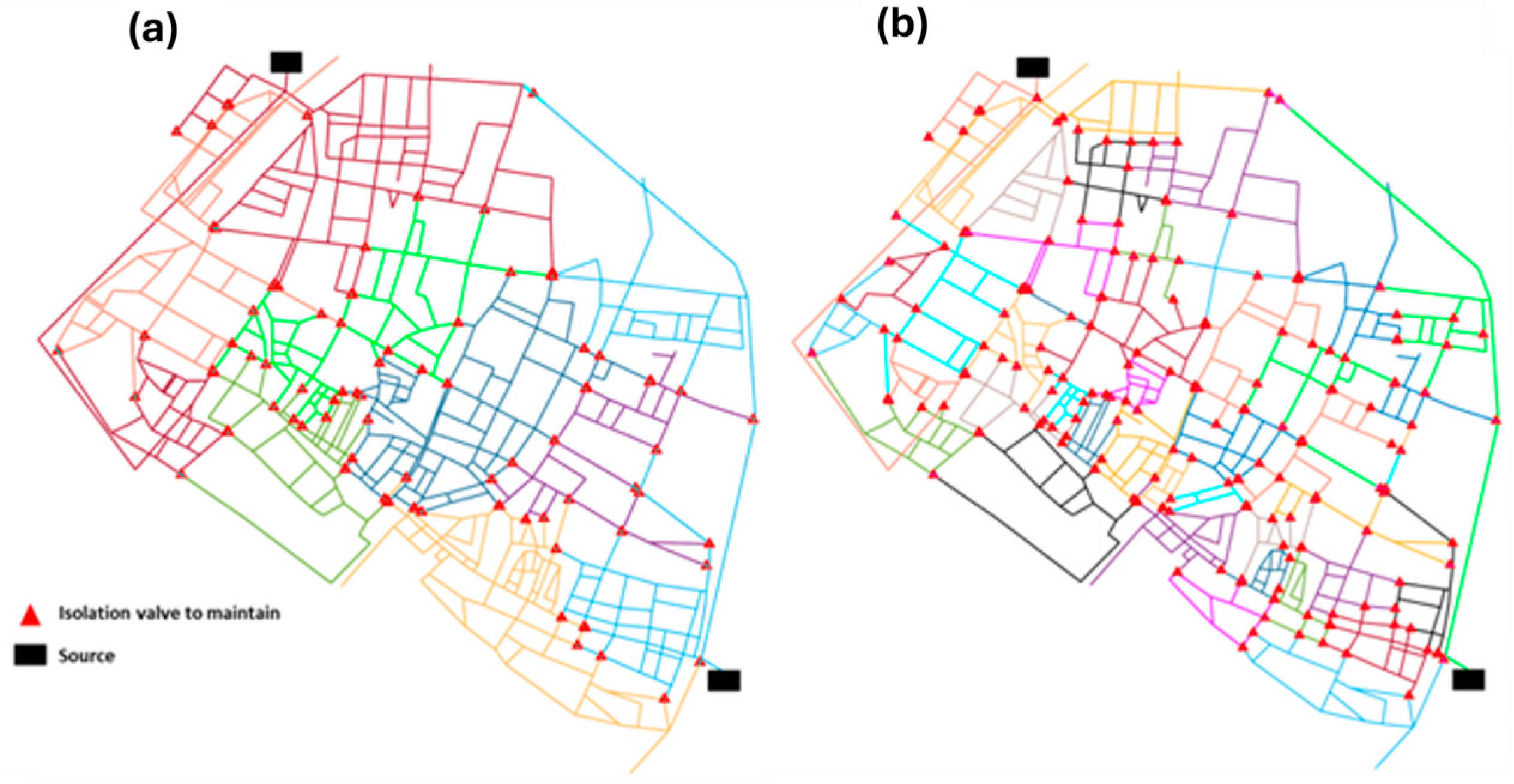
The described method was applied to a real WDN in northern Italy [6], comprising 538 nodes (including two reservoirs), 825 pipes, and 971 isolation valves (Figure 1). The total user demand of the network at the peak is about 293 L/s. The weight coefficients α1 = 0.1 and α2 = 1.9 were used for modularity components H1 and H2, respectively. Assuming the water utility’s budget constraints, two cases of valve maintenance strategies were selected for evaluation: (i) Case 1, with 98 isolation valves from the 8-cluster configuration, and (ii) Case 2, with 188 isolation valves from the 46-cluster configuration.
Figure 1.
Selected valves (red triangles) to be maintained according to the proposed clustering-based maintenance strategy (clusters are color-coded) for: (a) Case 1 (98 valves to maintain) and (b) Case 2 (188 valves to maintain).
Additionally, a valve maintenance method based on engineering judgments was assessed to compare against the suggested maintenance strategy. This method prioritizes the maintenance of isolation valves at the edges of segments, including main pipelines with large diameters (over 200 mm), identifying these critical valves for maintenance. For the selected case study, this approach resulted in the selection of 188 valves for maintenance.
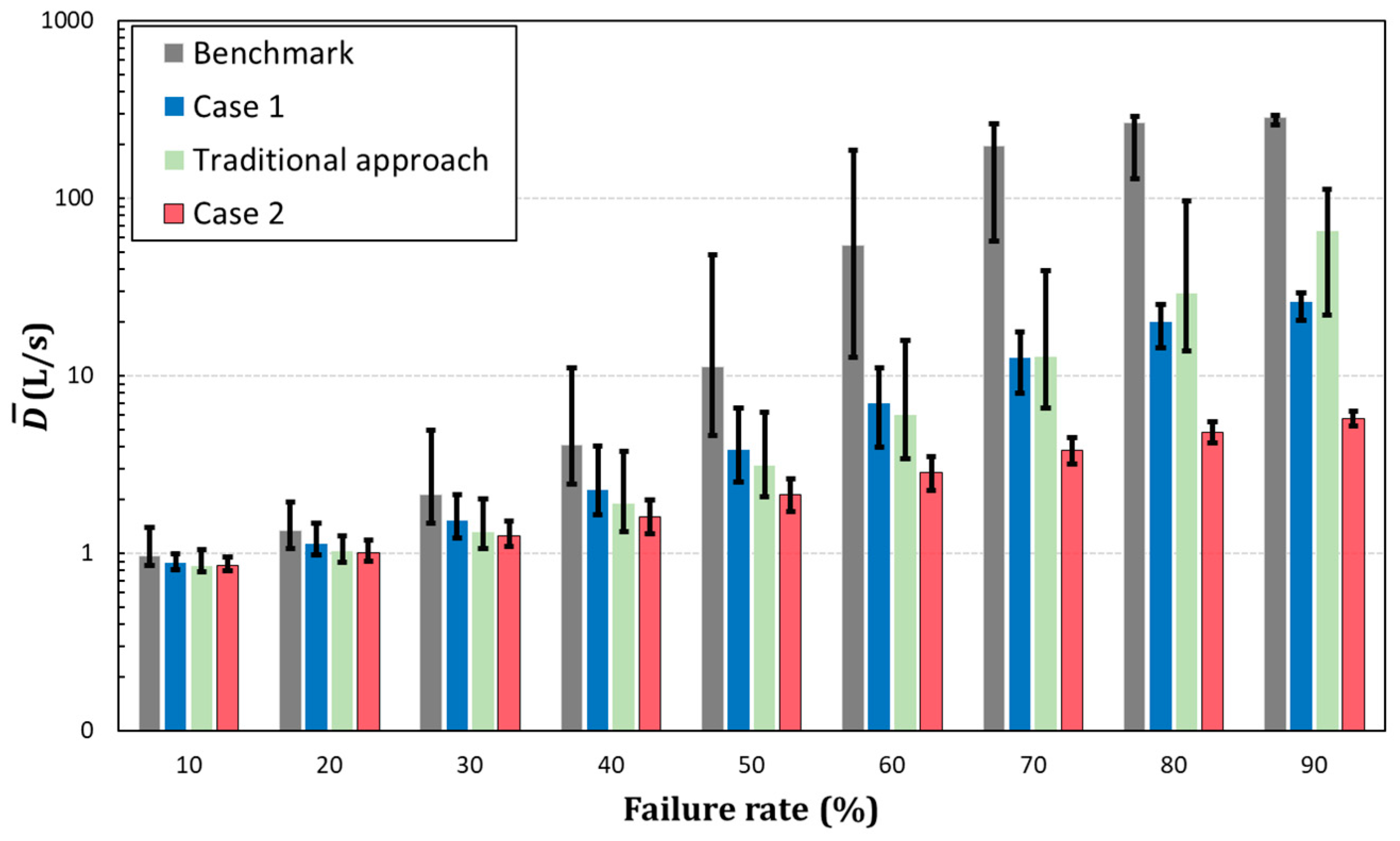
Figure 2 depicts the range of values—minimum, mean, and maximum—for each failure rate under both cases of novel strategy, the benchmark scenario, and the traditional engineering judgment-based strategy. Notably, the mean invariably rises with increased valve failure rates.
Figure 2.
Mean (bars), minimum and maximum (whiskers) values of weighted average demand shortfalls in the 1000 multiple random valve failure scenarios for each failure rates from 10% to 90% on log plane, for benchmark (grey bars), engineering judgment-based maintenance approach (green bars), and Case 1 (blue bars) and Case 2 (red bars) of the proposed maintenance strategy.
Furthermore, the impact of performing maintenance on valves becomes significantly more crucial at elevated failure rates. In scenarios where the failure rates are below 20%, the maintenance of critical valves shows a lower impact since most of the valves selected for maintenance are functional in random scenarios of lower failure rates.
Overall, Case 2 of the novel maintenance strategy significantly outperforms the traditional maintenance approach and Case 1, especially for failure rates higher than 20%. On the other hand, although the number of maintained valves is roughly half of the two other cases, Case 1 performs better than the engineering judgment-based approach for high failure rates (above 60%) and only slightly worse in lower failure rates.
4. Discussion
The proposed maintenance strategy proved to be capable of significantly reducing the impact of valve failures on the reliability of WDN only with the maintenance of a small subset of the total valves, outperforming the traditional maintenance strategy, based on engineering judgments. In addition, the cases of novel maintenance strategy significantly reduced the range between the maximum and minimum values of , which means they are less affected by variation in the inoperable valve combinations under different valve failure scenarios. A more detailed description of the methods and deeper analysis of findings can be found in the full journal version [7].
Author Contributions
Conceptualization, E.C.; methodology, A.M. and C.G.; formal analysis, A.M.; writing—original draft preparation, A.M.; writing—review and editing, C.G., B.B. and E.C.; supervision, E.C. All authors have read and agreed to the published version of the manuscript.
Funding
This research received no external funding.
Institutional Review Board Statement
Not applicable.
Informed Consent Statement
Not applicable.
Data Availability Statement
The data reported in this paper can be made available upon reasonable request to the corresponding author.
Acknowledgments
Support from the Italian MIUR and the University of Pavia are acknowledged within the program Dipartimenti di Eccellenza 2023–2027.
Conflicts of Interest
The authors declare no conflicts of interest.
References
- Walski, T.M. Water Distribution Valve Topology for Reliability Analysis. Reliab. Eng. Syst. Saf. 1993, 42, 21–27. [Google Scholar] [CrossRef]
- Jun, H.; Loganathan, G.V.; Kim, J.H.; Park, S. Identifying Pipes and Valves of High Importance for Efficient Operation and Maintenance of Water Distribution Systems. Water Resour. Manag. 2008, 22, 719–736. [Google Scholar] [CrossRef]
- Santonastaso, G.F.; Di Nardo, A.; Creaco, E. Dual Topology for Partitioning of Water Distribution Networks Considering Actual Valve Locations. Urban. Water J. 2019, 16, 469–479. [Google Scholar] [CrossRef]
- Creaco, E.; Giudicianni, C.; Mottahedin, A. Improved Community Detection for WDN Partitioning in the Dual Topology Based on Segments and Valves. J. Hydroinformatics 2023, 25, 1341–1357. [Google Scholar] [CrossRef]
- Creaco, E.; Franchini, M.; Alvisi, S. Optimal Placement of Isolation Valves in Water Distribution Systems Based on Valve Cost and Weighted Average Demand Shortfall. Water Resour. Manag. 2010, 24, 4317–4338. [Google Scholar] [CrossRef]
- Alvisi, S.; Creaco, E.; Franchini, M. Segment Identification in Water Distribution Systems. Urban. Water J. 2011, 8, 203–217. [Google Scholar] [CrossRef]
- Mottahedin, A.; Giudicianni, C.; Brentan, B.; Creaco, E. Clustering-based Maintenance Strategy of Isolation Valves in Water Distribution Networks. J. ACS EST Water 2024, 4, 1798–1807. [Google Scholar] [CrossRef]
Disclaimer/Publisher’s Note: The statements, opinions and data contained in all publications are solely those of the individual author(s) and contributor(s) and not of MDPI and/or the editor(s). MDPI and/or the editor(s) disclaim responsibility for any injury to people or property resulting from any ideas, methods, instructions or products referred to in the content. |
© 2024 by the authors. Licensee MDPI, Basel, Switzerland. This article is an open access article distributed under the terms and conditions of the Creative Commons Attribution (CC BY) license (https://creativecommons.org/licenses/by/4.0/).