
Brief Report

Insights into the Impact of Extreme Flood Events on Aflatoxin Contamination in Maize from Thessaly, Greece

by
Athanasios Manouras
1,
Michalis Koureas
2,
Ermioni Meleti
3,
Ioannis Maisoglou
1,
Vasileios Manouras
3 and
Eleni Malissiova
3,*
1
Laboratory of Chemistry, Biochemistry and Technology of Food, Nutrition and Dietetics Department, University of Thessaly, 41232 Trikala, Greece
2
Laboratory of Hygiene and Epidemiology, Faculty of Medicine, University of Thessaly, 41222 Larissa, Greece
3
Food of Animal Origin Laboratory, Animal Science Department, University of Thessaly, 41500 Larissa, Greece
*
Author to whom correspondence should be addressed.
Pollutants 2026, 6(1), 17; https://doi.org/10.3390/pollutants6010017
Submission received: 24 November 2025 / Revised: 26 January 2026 / Accepted: 2 March 2026 / Published: 4 March 2026

Abstract

Maize is highly vulnerable to aflatoxin contamination, constituting a serious food safety and public health concern. This study explored the relationship of extreme flood events in September 2020 (Storm Ianos) and September 2023 (Storm Daniel) in the Thessaly region, Greece, which occurred post-harvest, and aflatoxin contamination patterns in maize harvests of both the flood years and the following years (2021 and 2024). A total of 573 maize samples collected between 2019 and 2024 were analyzed using an enzyme-linked immunosorbent assay (ELISA). A 10 μg/kg cutoff was used (the ELISA upper limit of quantification); results > 10 ppb were classified as elevated concentrations. Overall, aflatoxins were detected in 47.8% of samples, with 14.0% having concentrations exceeding 10 μg/kg. The 2021 harvest year exhibited an exceedance rate of 28.75% (23/80), while the 2024 harvest showed a rate of 14.68%, 37/252. Exceedance rates during flood years were comparatively low; however, the maize harvested in the years following the flood events demonstrated a two-fold increase in the detection rate (60.2% vs. 30.7%) and a significant increase in exceedance percentages (18.07% vs. 8.30%) relative to non-flood years in the preceding period. While drought and heat remain the primary field risk factors for aflatoxin production, the correlational findings suggest that extreme floods may indirectly influence aflatoxin risk by increasing kernel damage, prolonging grain moisture, and disrupting post-harvest handling and storage, underscoring the need for continuous monitoring and robust mitigation strategies in flood-prone agricultural regions.

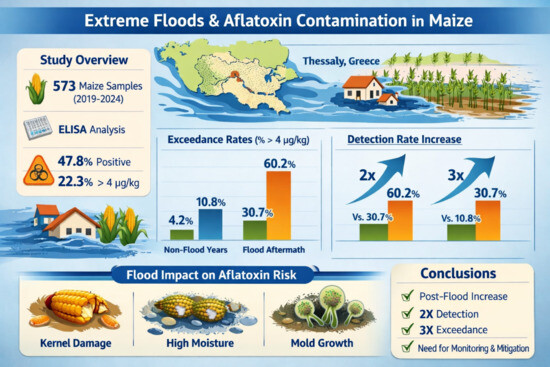
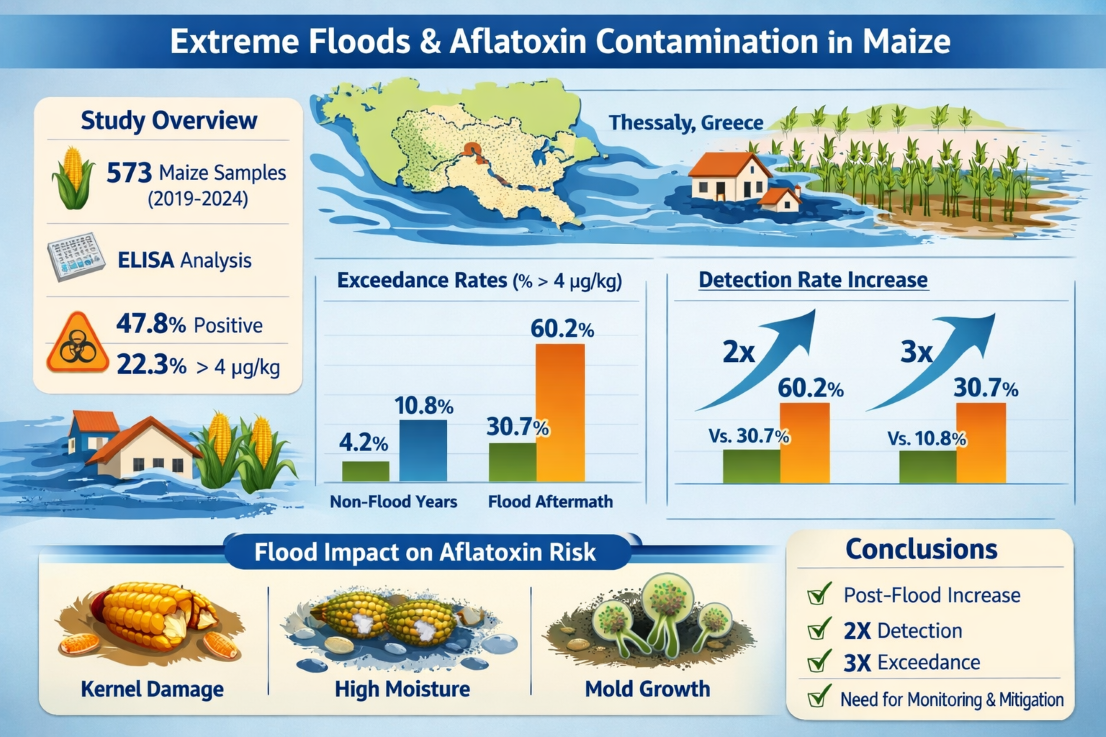
Graphical Abstract

1. Introduction

In many areas where maize (Zea mays L.) is cultivated, aflatoxins—natural mycotoxins produced by the fungus Aspergillus flavus and Aspergillus parasiticus—are frequently observed [1] and may appear from the field as well as throughout the entire maize value chain [2]. They exist in several forms, with Aflatoxin B1 (AFB1), Aflatoxin B2 (AFB2), Aflatoxin G1 (AFG1) and Aflatoxin G2 (AFG2) representing the most significant types [3]. Aflatoxin M1 (AFM1) and AFM2 are metabolites formed in the liver of the dairy animals that consumed feed contaminated with AFB1 and AFB2, respectively, and can be present in milk and dairy products [2,3]. Aflatoxin consumption in low doses over extended periods of time can result in liver cancer, immune system suppression, a rise in both the severity and frequency of infectious diseases, poor absorption of nutrients, and stunted child growth and development by promoting malnutrition [1].
Initial estimates from the Food and Agriculture Organization (FAO) indicated that mycotoxin contamination affected 25% of global crops, but more recent data suggests this figure could reach up to 60–80% [4]. There have been set regulations across the world in order to set the maximum levels of contaminants, including aflatoxins, in food and feed. However, the regulatory levels differ between the different regions of the world. For aflatoxins in maize, the limit set by European Union (Commission Regulation (EU) 2023/915) is 2 μg/kg for AFB1 and 4 μg/kg for total AFB1, AFB2, AFG1 and AFG2 [5], for human consumption. For feed, the limit set by EU directive is 20 μg/kg for Aflatoxin B1 (AFB1) in feed materials, 10 μg/kg in compound feeds, and 5 μg/kg in compound feed for dairy cattle and calves, dairy sheep and lambs, dairy goats and kids [6].
Maize is consumed by humans, but it is also used as feed for productive animals such as cattle, sheep, pigs, chickens, turkeys and fish. The effects of aflatoxins in humans and animals, highlights the necessity to study and identify the factors and the conditions affecting their presence in crops. It is previously known that contamination occurs during the crop’s growth in the field and keeps occurring after crop maturity and storage, particularly if the crop product is exposed to conditions that encourage the growth and development of fungi [7]. Environmental stressors, notably extreme weather events, exacerbate the risk of aflatoxin contamination. Climate change, marked by increased temperatures, erratic rainfall, and flooding, has been associated with increased aflatoxin production in maize [8]. These conditions not only favor fungal colonization but also disrupt traditional pre-harvest and storage practices, thereby amplifying contamination risks [9]. Recent studies underline the interplay between climatic extremes and aflatoxin prevalence, demonstrating the vulnerability of maize to fungal infestation under stressed agro-ecological conditions [3,10,11].
During the past 5 years, the region of Thessaly (Greece) experienced two distinct devastating flood events caused by the storms Ianos (September 2020) and Daniel (September 2023). These September events occurred after the maize harvest period (August–October), thus not directly affecting field crops that year but potentially influencing soil conditions, crop residues, and storage practices for the subsequent seasons. The severe floods led to significant crop destruction and altered the agricultural landscape of the region. It is estimated that the total area that was flooded or overrun by flood waters after Ianos storm was 475.5 km2 [12] while after the Daniel storm the total extent of flooded areas exceeded 1150 km2 [13]. In Greece, maize is planted from March to April and harvested from August to October. As such disasters disrupt crop development and interfere with post-harvest practices, these events provide a unique case for studying the effects of extreme weather on aflatoxin levels in maize may have occurred before harvest or during silage. Accordingly, the present study tests the hypothesis that extreme flood events may be followed by increased aflatoxin contamination in maize in the subsequent harvest seasons, rather than during the flood year itself. A further hypothesis is that this pattern reflects indirect, delayed effects of flooding on soil fungal reservoirs and post-harvest handling conditions, which interact with later heat and drought stress to elevate aflatoxin risk.
While aflatoxin contamination following flooding is recognized as a risk factor globally, few studies have examined multi-year temporal patterns in flood-prone regions, particularly distinguishing between contamination during flood harvest years in comparison to subsequent seasons. The Thessaly floods of 2020 and 2023 represent unprecedented events in Greece, affecting the agricultural land and providing a unique opportunity to investigate delayed post-flood aflatoxin dynamics in a Mediterranean context where such extreme weather is increasing. This study, to the best of our knowledge, provides the first longitudinal analysis of aflatoxin surveillance data spanning before and after the flood periods in this high-risk region. The study aims to explore associations between extreme weather conditions and mycotoxin risks, generating hypotheses to guide future mechanistic and longitudinal research in vulnerable agricultural systems.

2. Materials and Methods

2.1. Sampling

The study was carried out in the region of Thessaly, central Greece, that is a predominantly rural area with substantial live-stock population and feed production. Maize samples represented farm-stored maize intended primarily for animal feed (silage and/or grain), collected from dairy farms supplying the local industry. Information on specific maize varieties or precise silage conditions were not recorded, representing a limitation of this farm-level surveillance approach. The inclusion criteria for the farms were: supplying their milk to the local dairy industry, having a livestock population of at least 50 animals for cattle and 150 for sheep and goat farms, and finally, receiving their feed exclusively from local producers existing in the area. Samples were collected (1000 g each) annually from December 2019 to 2024, according to the European Feed Sampling Regulations [14], with sample sizes varying due to differences in farm participation and surveillance scope: n = 27 (2019), n = 21 (2020), n = 80 (2021), n = 42 (2022), n = 151 (2023), and n = 252 (2024). Sampling intensity increased substantially in 2023–2024 following the unprecedented Storm Daniel flood, as additional collaborating dairy farms joined the regional surveillance effort in response to repeated extreme weather events and heightened food safety concerns. Maize grown in Thessaly, Greece was harvested within the same calendar year. The growing season lasts roughly 3 to 5.5 months, from planting in March–May to harvest in August–September. Over five consecutive seasons the harvested and stored maize was randomly sampled, just before the start of the new lactation period (December). Every sample was collected from a different single unit during each year’s sampling. The samples were finely ground at high speed until they achieved a particle size similar to fine instant coffee and were then stored in a cool, dry place until analysis. The total quantity of each sample was finely ground at high speed (maximum speed scale 4 out of 4), using a blender (Silvercrest SKM 550 B1, 550 W, 1.5 L capacity; Lidl Stiftung & Co. KG, Neckarsulm, Germany) until they achieved a particle size similar to fine instant coffee and were then stored in a cool, dry place until analysis. ELISA analysis was performed during January of the next year.

2.2. Quantitative Determination of Total Aflatoxins by Enzyme Linked Immunosorbent Assay

To measure total aflatoxin in maize samples, Enzyme Immunoassay kits containing 96 wells (Bio-Shield Extra Sensitive, B2348/B2396, ProGnosis Biotech S.A., Larissa, Greece) were utilized. All ELISA analyses included kit-provided standards (0–10 μg/kg range) run in duplicate on each plate to generate calibration curves (R2 > 0.98 required for acceptance). Positive and negative controls were included per manufacturer recommendations, with acceptance criteria of 80–120% recovery for spiked controls. The method’s limit of detection (LOD) is 0.2 μg/kg, while the limit of quantification (LOQ) is 0.6 μg/kg. Ground samples, weighing 20 g each, where aflatoxins were extracted using 100 mL of a solvent mixture composed of 70% methanol and 30% distilled water (99.8%, Reag. Ph. Eur., PanReac AppliChem, ITW Reagents, Darmstadt, Germany). The sample and solvent mixture was blended for 2 min using the same speed and the same instrument used for the grounding of the maize kernels. Subsequently, 5–10 mL of the extracts were filtered through Whatman No.1 filter paper. The pH of the extracts ranged from 6.2 to 7.5. Samples and standards were diluted with Matrix Diluent, transferred to antibody-coated microwells incubated and washed four times. Following, the detection solution was added and incubated for 5 min. After this, TMB substrate, was added and incubated for 5 min in the dark, followed by stop solution addition. All reagents were equilibrated to room temperature (19–24 °C) before analysis, following the manufacturer’s protocol. Absorbance was measured at 450 nm using a Microplate Photometer (Multiskan™ FC, Thermo Fisher Scientific Inc., Waltham, MA, USA). The analysis presented in this section is based on whether samples exceeded the aflatoxin limit, rather than using precise quantitative measurements. This approach was chosen because a substantial number of samples fell outside the calibration range, either below the limit of detection or above 10 μg/kg, making the use of numeric values less effective.

2.3. Statistical Analysis

All statistical analyses were conducted exclusively using R programming language (version 4.3.2; R Foundation for Statistical Computing, Vienna, Austria; https://www.r-project.org/).For each harvest season, maize was harvested in August–September and stored until sampling in November–December of that same year. Although the laboratory assays (e.g., competitive ELISA) were often completed in the following calendar year (e.g., March 2021 for the 2020 harvest), each measured aflatoxin concentration was assigned back to its harvest year. This study applied an exceedance cutoff of 10 μg/kg, because the ELISA kit quantifies total aflatoxins (AFB1 + AFB2 + AFG1 + AFG2) rather than AFB1 alone, and its validated calibration range is 0–10 μg/kg. Values above this level cannot be reliably quantified with the assay and were therefore recorded as >10 μg/kg (above the upper limit of quantification), enabling a consistent classification of exceedances across years within the method’s quantifiable range.
Annual rates for aflatoxin levels exceeding 10 μg/kg, along with detection positivity rates, were calculated based on the year that maize was harvested. Confidence intervals (95%) for these estimates were computed using the Wilson score interval method. A global association between harvest year and the proportion of samples exceeding 10 μg/kg was assessed using Pearson’s chi-squared test on a year-by-exceedance contingency table. Data were visually summarized through graphical representations depicting temporal trends with confidence intervals. The analysis presented is based on whether samples were detected or exceeded the concentration of 10 μg/kg, rather than using precise quantitative measurements. This approach was chosen because a substantial number of samples fell outside the calibration range, either below the limit of quantitation or above 10 μg/kg, making the use of numeric values less effective for statistical analysis. Accordingly, the reported exceedance rates should be interpreted as indicators of relatively elevated contamination within the dataset, allowing comparisons across years, rather than as measures of feed safety or regulatory non-compliance.

3. Results and Discussion

A total of 573 maize samples were analyzed to detect the presence of aflatoxin. Among these, 299 samples were below the quantitation limit (<0.6 μg/kg) of the ELISA method, while aflatoxin was detected in 274 samples, resulting in a positivity rate of 47.81%. Overall, 80 out of 573 samples (13.96%) exceeded 10 μg/kg.
The high detection and exceedance rates of aflatoxin in Greece align with its frequent presence in Mediterranean dairy products. Greece’s warm, humid climate fosters Aspergillus fungi growth, increasing aflatoxin contamination in maize and animal feed, which subsequently raises AFM1 levels in milk [15]. Given these factors, our findings support the claim that Greece is a high-risk country for aflatoxin contamination, requiring stringent monitoring and control measures to mitigate public health risks and ensure compliance with EU safety standards. Our findings on aflatoxin contamination in maize also align with previous studies from Europe. Indicatively, a study from Serbia that analyzed 180 maize samples with HPL0043-FLD reported a detection rate of 57.2% for AFB1, although significant spatial variation is recorded [16], while a French study found 6% of field and 15% of silo samples contaminated [17]. Additionally, an Italian study identified aflatoxins in 15 out of 48 samples using LC/ESI-MS/MS [18].
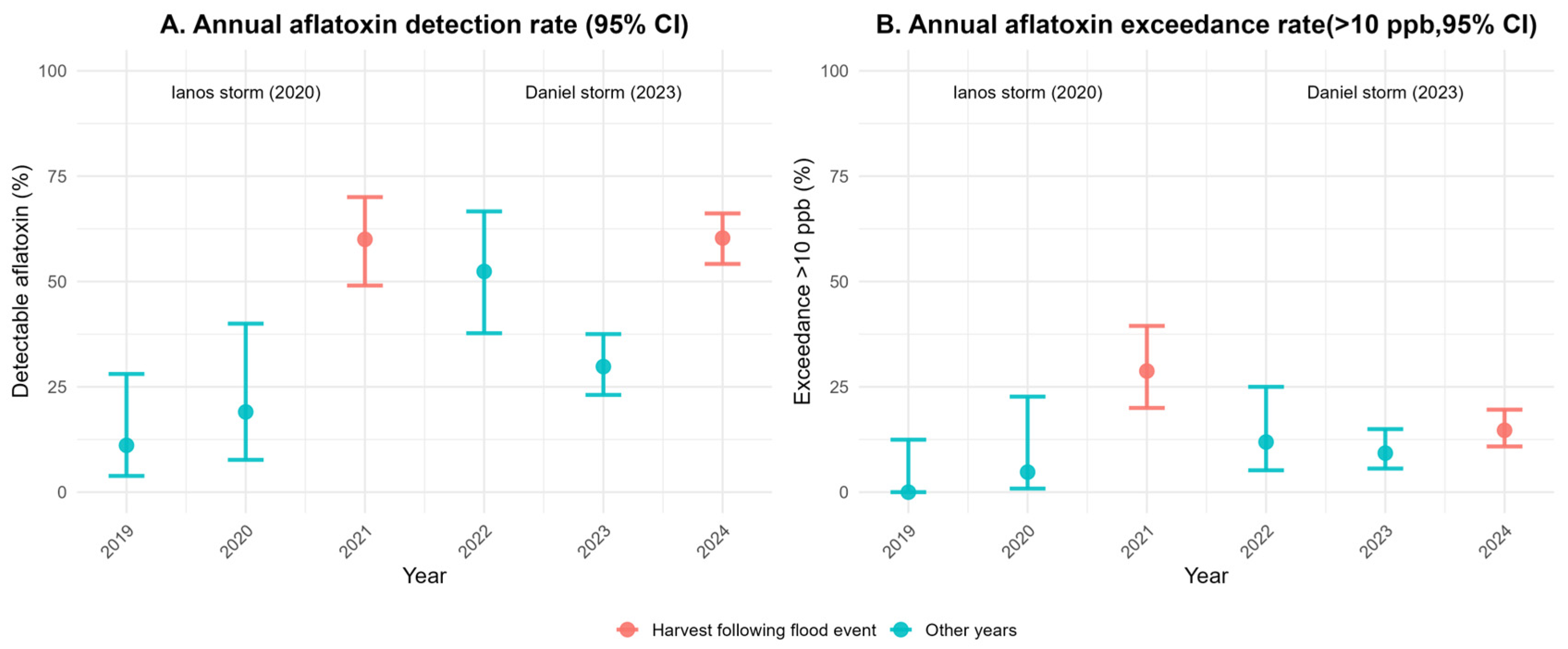
Annual aflatoxin detection rates (i.e., proportion of samples with detectable aflatoxins) varied substantially across the study period (2019–2024). In the early years, detection was relatively low: three of 27 samples were positive in 2019 (11.1%; 95% CI: 3.85–28.1) and four of 21 in 2020 (19.0%; 95% CI: 7.67–40.0). Detection increased markedly in 2021, when 48 of 80 samples were positive (60.0%; 95% CI: 49.0–70.0), and remained elevated in 2022 (22/42; 52.4%; 95% CI: 37.7–66.6). In 2023, detection declined to 29.8% (45/151; 95% CI: 23.1–37.5). In 2024, detection increased again to 60.3% (152/252; 95% CI: 54.2–66.2). Overall, these results indicate pronounced inter-annual variability in the frequency of detectable aflatoxin, with peaks in 2021 and 2024 and a trough in 2019–2020 and 2023. In 2019 (n = 27), no samples exceeded 10 ppb (0.0%; 95% CI: 0.0–12.4). In 2020 (n = 21), one exceedance was observed (4.76%; 95% CI: 0.85–22.6). The highest exceedance frequency occurred in 2021, with 23 of 80 samples exceeding 10 ppb (28.75%; 95% CI: 19.99–39.0). Exceedance then declined in 2022 to 11.91% (5/42; 95% CI: 5.19–25.0) and remained comparatively low in 2023 (14/151; 9.27%; 95% CI: 5.60–14.9). In 2024, exceedance increased again to 14.68% (37/252; 95% CI: 10.84–19.0). Overall, these data indicate pronounced inter-annual variability, with a peak in high-level contamination in 2021 and lower exceedance frequencies in 2019–2020 and 2022–2023, followed by a moderate increase in 2024. Overall, a global comparison confirmed significant heterogeneity in exceedance frequency across years (p < 0.001).
A closer examination of the data suggests that the years following major flooding events in the region (2021 and 2024) are associated with substantially higher contamination and exceedance rates compared to previous years. The statistical significance of these differences, supported by non-overlapping 95% confidence intervals, indicates a strong association between preceding floods and contamination risk, without establishing causality.
Figure 1 presents the yearly trends in aflatoxin detection and exceedance rates from 2019 to 2024, along with their corresponding 95% confidence intervals (CI). The data indicate that extreme flood events did not result in an increase in aflatoxin presence in maize during the respective harvest years. On the contrary, aflatoxin contamination frequency in maize appeared lower compared to non-flood years. A straightforward interpretation would be that wetter conditions suppress aflatoxin production. This aligns with a wide body of literature demonstrating that drought stress, elevated temperatures, and dry spells are the principal conditions driving aflatoxin [9,10,19,20,21,22]. During stressful high air temperature and drought conditions, the fungi already existing in the soil become competitive with other fungi species, the mycotoxin-producing strain activates and aflatoxin is produced [11,23,24].
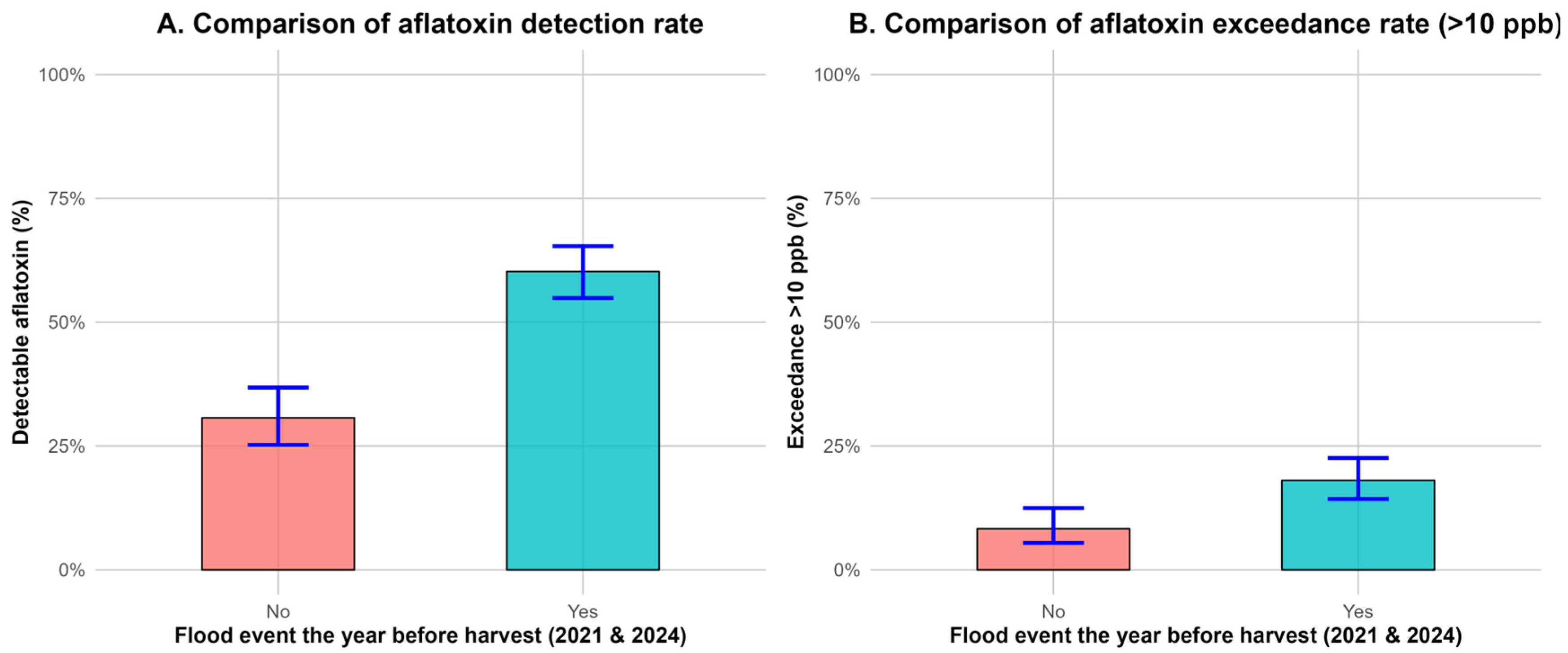
On the other hand, flooding may have delayed effects, with higher contamination rates observed in the years following the flood events. As shown in Figure 2, the aflatoxin positivity rates in maize samples are approximately two times higher in the years following extreme flood events (2024 and 2021) compared to other years, suggesting an association between preceding floods and subsequent contamination. Out of 332 maize samples from 2024 and 2021, a total of 200 were positive, resulting in a percentage of 60.24% (CI: 54.73–65.50%). For all other years, 74 samples were positive out of 241, yielding a positive percentage of 30.70% (CI: 25.02–37.00%). The exceedance percentages were more than two times higher in years after the flood event (18.07% vs. 8.30%). Floods may indirectly influence risk in subsequent years. Flooding could lead to prolonged wet conditions [25,26] that may favor the proliferation of Aspergillus species, which could later become active under heat and drought stress. For example, in regions where rice is cultivated under flooded irrigation, the high moisture levels create favorable conditions for these species, and consequently increased aflatoxin contamination [27]. Aflatoxin-producing Aspergillus species [28] can remain dormant in soil and crop residues, becoming active under favorable conditions and contaminating maize [29]. As soil serves as a reservoir to aflatoxin-producing fungi [30], the favorable humid, nutrient-rich conditions associated with flood events may contribute to higher contamination in the next harvest period as soils dry and crops grow under heat and drought stress, although this mechanism is speculative and cannot be confirmed by the present observational data. Maize kernels are susceptible to extensive damage from flooding causing them to crack, swell, or sprout, making them more vulnerable to fungal invasion because the damaged pericarp (seed coat) gives the fungi easy entry points [31]. Additionally, flood damage may disrupt storage practices, further elevating contamination risks. These devastating flood events may have led to poor post-harvest management, which can lead to significant aflatoxin contamination in stored grains. These hypotheses align with known fungal ecology but remain speculative without targeted data on post-flood soil inoculum, kernel integrity, storage conditions, or insect populations. Future studies should test these pathways directly. Studies have shown that poor storage conditions of maize can lead to significant aflatoxin contamination [32]. Warm and high air humid were the post-flooding conditions, after these extreme weather events. As a result, these conditions were transferred in poorly equipped storage units where hot and humid storage environments were observed. Aspergillus thrives in this condition combination, worsened by the fact that maize was heaped in most cases without proper aeration [33,34].
Another factor seemingly affecting the contamination due to flood events is the delayed sun drying and the high moisture during storage. Maize kernels before storage need to be dried to below 13–14% moisture in order to prevent mold growth [35,36]. After flooding, kernels often retain excess water and dry in a slower rate, creating a favorable environment for Aspergillus species. If drying facilities are limited, as the situation is in Greece, maize may be stored wet, resulting in rapid fungal growth. Finally, the interaction with Insects and other Fungi species is a crucial factor in the kernels’ contamination. Flooding events often leave fields with higher insect infestation (weevils, borers), which easily wound the already wet kernels pre- and post-harvest both, creating easy access for Aspergillus, and, under optimal conditions, the production of toxins [37,38]. Furthermore, while several hypotheses are proposed to explain the post-flood increase in aflatoxin contamination, no direct data (e.g., soil fungal counts, kernel damage assessments, or storage moisture records) were collected in this study. These mechanisms therefore require validation through prospective, mechanistic investigations. This interpretation remains preliminary and warrants targeted investigation of post-flood inoculum dynamics and storage management.
This study provides valuable insights into aflatoxin contamination in maize, but certain limitations must be mentioned. The use of ELISA for aflatoxin detection, while effective, could be complemented by High-Performance Liquid Chromatography (HPLC) or LC-MS for more precise quantification. In addition, the observational design of this study limits causal inference, and all reported relationships should be interpreted as associations rather than definitive cause and effect links. A larger sample size, covering more years and locations, would improve the representativeness of the findings and provide a clearer picture of long-term trends. Additionally, the study does not fully account for variations in agricultural practices and storage conditions, which are critical factors influencing aflatoxin contamination. More detailed data on post-harvest handling would strengthen our findings. Our results suggest that establishing an aflatoxin-monitoring observatory could enhance long-term surveillance of aflatoxin contamination, particularly after extreme weather events like floods.
It is important to note that the exceedance threshold used in this study (10 μg/kg total aflatoxins) does not correspond to the regulatory maximum level established for AFB1 in maize intended for animal feed (20 μg/kg). Because the analytical method quantifies total aflatoxins rather than AFB1 alone, and because values above 10 μg/kg exceed the assay’s validated range, the exceedance rates reported here should not be interpreted as indicators of regulatory non-compliance. Instead, they serve as relative indicators of elevated aflatoxin burden and temporal variability across harvest years. The findings should not be interpreted within the framework of animal nutrition or feed suitability but rather as surveillance-level evidence of temporal patterns and relative changes in aflatoxin occurrence.
Several plausible hypotheses may explain these observed associations, though direct evidence is lacking and requires future investigation. This study provides valuable insights into aflatoxin contamination patterns in maize but has several limitations. The use of ELISA for total aflatoxin detection, while effective for surveillance, lacks the resolution of LC-MS/MS to quantify individual congeners (AFB1, AFB2). Confirmatory testing with higher precision methods would strengthen future interpretations. This represents an exploratory observational dataset focused on temporal trends and extreme weather associations rather than precise quantification. Key limitations of this observational study include the inability to establish causality between flood events and aflatoxin contamination patterns. All reported associations should be interpreted as correlational rather than causal. Notably, no climate data were available for the high-contamination years 2021 and 2024, preventing adjustment for potential confounders such as heat stress or drought conditions known to drive aflatoxin production. Additionally, the moisture content of samples at the time of farm storage and sampling was not systematically recorded, representing a critical limitation for interpreting mycotoxin risk factors. While hypothesized moisture effects are plausible based on known Aspergillus ecology, these cannot be directly demonstrated or quantified in this dataset.

4. Conclusions

This observational study describes temporal patterns suggesting that extreme flooding events in Thessaly, Greece, were followed by higher aflatoxin contamination in subsequent harvest years. In the years where flood events occurred the contamination raters were lower but higher contamination and exceedance rates were observed in the years following major floods, especially in 2021 and 2024. This pattern may indicate that floods are indirectly associated with longer-term risk, for example through potential disruption of post-harvest handling or alteration of soil conditions that later interact with heat and drought stress, although these mechanisms cannot be confirmed within this observational framework. While this secondary interpretation remains preliminary, it highlights the need for targeted studies of post-flood fungal ecology and storage practices. Climate change, with its increasing weather extremes, is likely to be an important contextual factor associated with these trends. With over 22% of samples exceeding EU aflatoxin limits, it is clear that this is both a public health and food safety concern. Greece’s climate makes it particularly vulnerable, reinforcing the need for ongoing monitoring. Establishing a dedicated surveillance system for aflatoxins would help track and respond to risks more effectively. While proposed mechanisms linking floods to delayed aflatoxin risk are plausible, they remain untested hypotheses warranting targeted follow-up research on fungal ecology, kernel integrity, and storage practices post-flood. Future studies should include larger sample sizes, more locations, and even more precise testing methods. Addressing these gaps will be key to protecting food quality and safety in the region.

Author Contributions

Conceptualization, A.M., E.M. (Eleni Malissiova) and M.K.; methodology, A.M., M.K., E.M. (Ermioni Meleti), I.M., V.M. and E.M. (Eleni Malissiova); software, M.K.; validation, E.M. (Ermioni Meleti); formal analysis, E.M. (Ermioni Meleti) and I.M.; investigation, A.M., M.K., I.M., V.M. and E.M. (Eleni Malissiova); resources, A.M. and E.M. (Eleni Malissiova); data curation, M.K.; writing—original draft preparation, A.M., M.K. and V.M.; writing—review and editing, A.M., M.K. and E.M. (Eleni Malissiova); visualization, M.K.; supervision, A.M. and E.M. (Eleni Malissiova). All authors have read and agreed to the published version of the manuscript.

Funding

This research received no external funding.

Data Availability Statement

The raw data supporting the conclusions of this article will be made available by the authors on request.

Conflicts of Interest

The authors declare no conflicts of interest.

References

  1. Mahuku, G.; Nzioki, H.S.; Mutegi, C.; Kanampiu, F.; Narrod, C.; Makumbi, D. Pre-harvest management is a critical practice for minimizing aflatoxin contamination of maize. Food Control 2019, 96, 219–226. [Google Scholar] [CrossRef]
  2. Massomo, S.M.S. Aspergillus flavus and aflatoxin contamination in the maize value chain and what needs to be done in Tanzania. Sci. Afr. 2020, 10, e00606. [Google Scholar] [CrossRef]
  3. Kos, J.; Radić, B.; Radović, R.; Šarić, B.; Jovanov, P.; Šarić, L. Aflatoxins in maize, milk and dairy products from Serbia. Food Addit. Contam. Part B 2024, 17, 296–307. [Google Scholar] [CrossRef] [PubMed]
  4. Eskola, M.; Kos, G.; Elliott, C.T.; Hajšlová, J.; Mayar, S.; Krska, R. Worldwide contamination of food-crops with mycotoxins: Validity of the widely cited ‘FAO estimate’ of 25%. Crit. Rev. Food Sci. Nutr. 2020, 60, 2773–2789. [Google Scholar] [CrossRef] [PubMed]
  5. Commission Regulation (EU) 2023/915 of 25 April 2023 on Maximum Levels for Certain Contaminants in Food and Repealing Regulation (EC) No 1881/2006 (Text with EEA Relevance), 119 OJ L. 2023. Available online: http://data.europa.eu/eli/reg/2023/915/oj (accessed on 25 March 2025).
  6. Commission Regulation (EU) No 574/2011 of 16 June 2011 Amending Annex I to Directive 2002/32/EC of the European Parliament and of the Council as Regards Maximum Levels for Nitrite, Melamine, Ambrosia spp. and Carry-over of Certain Coccidiostats and Histomonostats and Consolidating Annexes I and II Thereto Text with EEA Relevance, 159 OJ L. 2011. Available online: http://data.europa.eu/eli/reg/2011/574/oj (accessed on 25 March 2025).
  7. Probst, C.; Bandyopadhyay, R.; Cotty, P.J. Diversity of aflatoxin-producing fungi and their impact on food safety in sub-Saharan Africa. Int. J. Food Microbiol. 2014, 174, 113–122. [Google Scholar] [CrossRef] [PubMed]
  8. Kos, J.; Anić, M.; Radić, B.; Zadravec, M.; Janić Hajnal, E.; Pleadin, J. Climate Change—A Global Threat Resulting in Increasing Mycotoxin Occurrence. Foods 2023, 12, 2704. [Google Scholar] [CrossRef]
  9. Battilani, P.; Toscano, P.; Van der Fels-Klerx, H.J.; Moretti, A.; Camardo Leggieri, M.; Brera, C.; Rortais, A.; Goumperis, T.; Robinson, T. Aflatoxin B1 contamination in maize in Europe increases due to climate change. Sci. Rep. 2016, 6, 24328. [Google Scholar] [CrossRef] [PubMed]
  10. Ng’ambi, J.T.; Atehnkeng, J.; Monjerezi, M.; Ngongondo, C.; Vunain, E.; Ching’anda, C.; Ortega-Beltran, A.; Cotty, P.J.; Matumba, L.; Bandyopadhyay, R. Micro-climatic variations across Malawi have a greater influence on contamination of maize with aflatoxins than with fumonisins. Mycotoxin Res. 2023, 39, 33–44. [Google Scholar] [CrossRef] [PubMed]
  11. Nji, Q.N.; Babalola, O.O.; Mwanza, M. Climatic effects on aflatoxin contamination of maize. Toxicol. Rep. 2024, 13, 101711. [Google Scholar] [CrossRef] [PubMed]
  12. Zalachoris, G. The September 18–20 2020 Medicane Ionos Impact on Greece; GEER Association: Ledyard, CT, USA, 2020; Available online: https://geerassociation.org/?view=geerreports&id=95&layout=default (accessed on 25 March 2025).
  13. He, K.; Yang, Q.; Shen, X.; Dimitriou, E.; Mentzafou, A.; Papadaki, C.; Stoumboudi, M.; Anagnostou, E.N. Brief communication: Storm Daniel flood impact in Greece in 2023: Mapping crop and livestock exposure from synthetic-aperture radar (SAR). Nat. Hazards Earth Syst. Sci. 2024, 24, 2375–2382. [Google Scholar] [CrossRef]
  14. Commission Regulation (EC) No 152/2009 of 27 January 2009 Laying Down the Methods of Sampling and Analysis for the Official Control of Feed (Text with EEA Relevance). 2025. Available online: http://data.europa.eu/eli/reg/2009/152/2025-05-14 (accessed on 25 March 2025).
  15. Malissiova, E.; Meleti, E.; Samara, A.; Alexandraki, M.; Manouras, A. The traditional Greek cheese Tsalafouti: History, technology, nutrition and gastronomy. J. Ethn. Foods 2023, 10, 18. [Google Scholar] [CrossRef]
  16. Janić Hajnal, E.; Kos, J.; Krulj, J.; Krstović, S.; Jajić, I.; Pezo, L.; Šarić, B.; Nedeljković, N. Aflatoxins contamination of maize in Serbia: The impact of weather conditions in 2015. Food Addit. Contam. Part A 2017, 34, 1999–2010. [Google Scholar] [CrossRef] [PubMed]
  17. Bailly, S.; Mahgubi, A.E.; Carvajal-Campos, A.; Lorber, S.; Puel, O.; Oswald, I.P.; Bailly, J.-D.; Orlando, B. Occurrence and Identification of Aspergillus Section Flavi in the Context of the Emergence of Aflatoxins in French Maize. Toxins 2018, 10, 525. [Google Scholar] [CrossRef]
  18. Cavaliere, C.; Foglia, P.; Guarino, C.; Nazzari, M.; Samperi, R.; Laganà, A. A sensitive confirmatory method for aflatoxins in maize based on liquid chromatography/electrospray ionization tandem mass spectrometry. Rapid Commun. Mass Spectrom. 2007, 21, 550–556. [Google Scholar] [CrossRef] [PubMed]
  19. Medina, A.; Rodriguez, A.; Magan, N. Effect of climate change on Aspergillus flavus and aflatoxin B1 production. Front. Microbiol. 2014, 5, 348. [Google Scholar] [CrossRef]
  20. Damianidis, D.; Ortiz, B.V.; Windham, G.L.; Bowen, K.L.; Hoogenboom, G.; Scully, B.T.; Hagan, A.; Knappenberger, T.; Woli, P.; Williams, W.P. Evaluating a generic drought index as a predictive tool for aflatoxin contamination of corn: From plot to regional level. Crop Prot. 2018, 113, 64–74. [Google Scholar] [CrossRef]
  21. Katati, B.; Schoenmakers, P.; Njapau, H.; Kachapulula, P.W.; Zwaan, B.J.; Van Diepeningen, A.D.; Schoustra, S.E. Preharvest Maize Fungal Microbiome and Mycotoxin Contamination: Case of Zambia’s Different Rainfall Patterns. Appl. Environ. Microbiol. 2023, 89, e00078-23. [Google Scholar] [CrossRef]
  22. Molnár, K.; Rácz, C.; Dövényi-Nagy, T.; Bakó, K.; Pusztahelyi, T.; Kovács, S.; Adácsi, C.; Pócsi, I.; Dobos, A. The Effect of Environmental Factors on Mould Counts and AFB1 Toxin Production by Aspergillus flavus in Maize. Toxins 2023, 15, 227. [Google Scholar] [CrossRef] [PubMed]
  23. Shabeer, S.; Asad, S.; Jamal, A.; Ali, A. Aflatoxin Contamination, Its Impact and Management Strategies: An Updated Review. Toxins 2022, 14, 307. [Google Scholar] [CrossRef] [PubMed]
  24. Daou, R.; Joubrane, K.; Maroun, R.G.; Khabbaz, L.R.; Ismail, A.; Khoury, A.E.; Daou, R.; Joubrane, K.; Maroun, R.G.; Khabbaz, L.R.; et al. Mycotoxins: Factors influencing production and control strategies. AIMS Agric. Food 2021, 6, 416–447. [Google Scholar] [CrossRef]
  25. Sona, B.K.; Akhila, M.; Deeraj, A.D. Flood-induced Changes in Soil Properties—A Review. In Proceedings of the 7th Biennial International Conference On Emerging Trends in Engineering, Science &Technology (ICETEST 2023); SSRN: Rochester, NY, USA, 2023. [Google Scholar] [CrossRef]
  26. Pucciariello, C.; Voesenek, L.A.C.J.; Perata, P.; Sasidharan, R. Plant responses to flooding. Front. Plant Sci. 2014, 5, 226. [Google Scholar] [CrossRef] [PubMed]
  27. Akbar, Q.U.A.; Arif, S.; Sahar, N.; Khurshid, S.; Iqbal, M.; Iqbal, S.; Khurshid, H.; Iqbal, H.; Masood, S.S. Investigating the effects of grain quality, processing and environmental conditions on aflatoxin contamination in rice. J. Food Compos. Anal. 2024, 127, 105982. [Google Scholar] [CrossRef]
  28. Frisvad, J.C.; Hubka, V.; Ezekiel, C.N.; Hong, S.-B.; Nováková, A.; Chen, A.J.; Arzanlou, M.; Larsen, T.O.; Sklenář, F.; Mahakarnchanakul, W.; et al. Taxonomy of Aspergillus section Flavi and their production of aflatoxins, ochratoxins and other mycotoxins. Stud. Mycol. 2019, 93, 1–63. [Google Scholar] [CrossRef] [PubMed]
  29. Abbas, H.; Wilkinson, J.; Zablotowicz, R.; Accinelli, C.; Abel, C.; Bruns, H.; Weaver, M. Ecology of Aspergillus flavus, regulation of aflatoxin production, and management strategies to reduce aflatoxin contamination of corn. Toxin Rev. 2009, 28, 142–153. [Google Scholar] [CrossRef]
  30. Horn, B.W. Ecology and Population Biology of Aflatoxigenic Fungi in Soil. J. Toxicol. Toxin Rev. 2003, 22, 351–379. [Google Scholar] [CrossRef]
  31. Aminou, M.M.; Falalou, H.; Abdou, H.; Mendu, V. Aflatoxin B1 Contamination Association with the Seed Coat Biochemical Marker Polyphenol in Peanuts Under Intermittent Drought. J. Fungi 2024, 10, 850. [Google Scholar] [CrossRef] [PubMed]
  32. Garcia-Cela, E.; Kiaitsi, E.; Sulyok, M.; Krska, R.; Medina, A.; Petit Damico, I.; Magan, N. Influence of storage environment on maize grain: CO2 production, dry matter losses and aflatoxins contamination. Food Addit. Contam. Part A 2019, 36, 175–185. [Google Scholar] [CrossRef] [PubMed]
  33. Molina-Herrera, F.I.; Jiménez-Islas, H.; Sandoval-Hernández, M.A.; Maldonado-Sierra, N.E.; Domínguez Campos, C.; Jarquín Enríquez, L.; Mondragón Rojas, F.J.; Flores-Martínez, N.L. Modeling of Temperature and Moisture Dynamics in Corn Storage Silos with and Without Aeration Periods in Three Dimensions. ChemEngineering 2025, 9, 89. [Google Scholar] [CrossRef]
  34. Suleiman, R.; Rosentrater, K.; Bern, C. Effects of deterioration parameters on storage of maize. In American Society of Agricultural and Biological Engineers Annual International Meeting; ASABE: St. Joseph, MI, USA, 2013; Volume 2. [Google Scholar] [CrossRef]
  35. Mills, J.T.; Abramson, D. Microflora and condition of flood-damaged grains in Manitoba, Canada. Mycopathologia 1981, 73, 143–152. [Google Scholar] [CrossRef]
  36. Codex Alimentarius Commission (Ed.) Prevention and Reduction of Food and Feed Contamination, 1st ed.; FAO: Rome, Italy, 2012. [Google Scholar]
  37. Riungu, G.M.; Muthomi, J.; Wagacha, M.; Buechs, W.; Philip, E.S.; Meiners, T. The Effect of Cropping Systems on the Dispersal of Mycotoxigenic Fungi by Insects in Pre-Harvest Maize in Kenya. Insects 2024, 15, 995. [Google Scholar] [CrossRef] [PubMed]
  38. Ni, X.; Wilson, J.P.; Buntin, G.D.; Guo, B.; Krakowsky, M.D.; Lee, R.D.; Cottrell, T.E.; Scully, B.T.; Huffaker, A.; Schmelz, E.A. Spatial Patterns of Aflatoxin Levels in Relation to Ear-Feeding Insect Damage in Pre-Harvest Corn. Toxins 2011, 3, 920–931. [Google Scholar] [CrossRef] [PubMed]
Figure 1. Annual aflatoxin detection and exceedance rates. (A) Proportion of samples with detectable aflatoxin by year with 95% confidence intervals. (B) Proportion of samples exceeding >10 ppb by year with 95% confidence intervals. Storm events (Ianos, 2020; Daniel, 2023) are annotated.
Pollutants 06 00017 g001
Figure 2. Aflatoxin detection percentages (A) and percentages exceeding 10 μg/kg (B), in the years following extreme flood events (2024 and 2021) compared to other years.
Pollutants 06 00017 g002
Disclaimer/Publisher’s Note: The statements, opinions and data contained in all publications are solely those of the individual author(s) and contributor(s) and not of MDPI and/or the editor(s). MDPI and/or the editor(s) disclaim responsibility for any injury to people or property resulting from any ideas, methods, instructions or products referred to in the content.