
Rice Crop Yield Prediction from Sentinel-2 Imagery Using Phenological Metric †




Abstract
1. Introduction
2. Materials and Methods
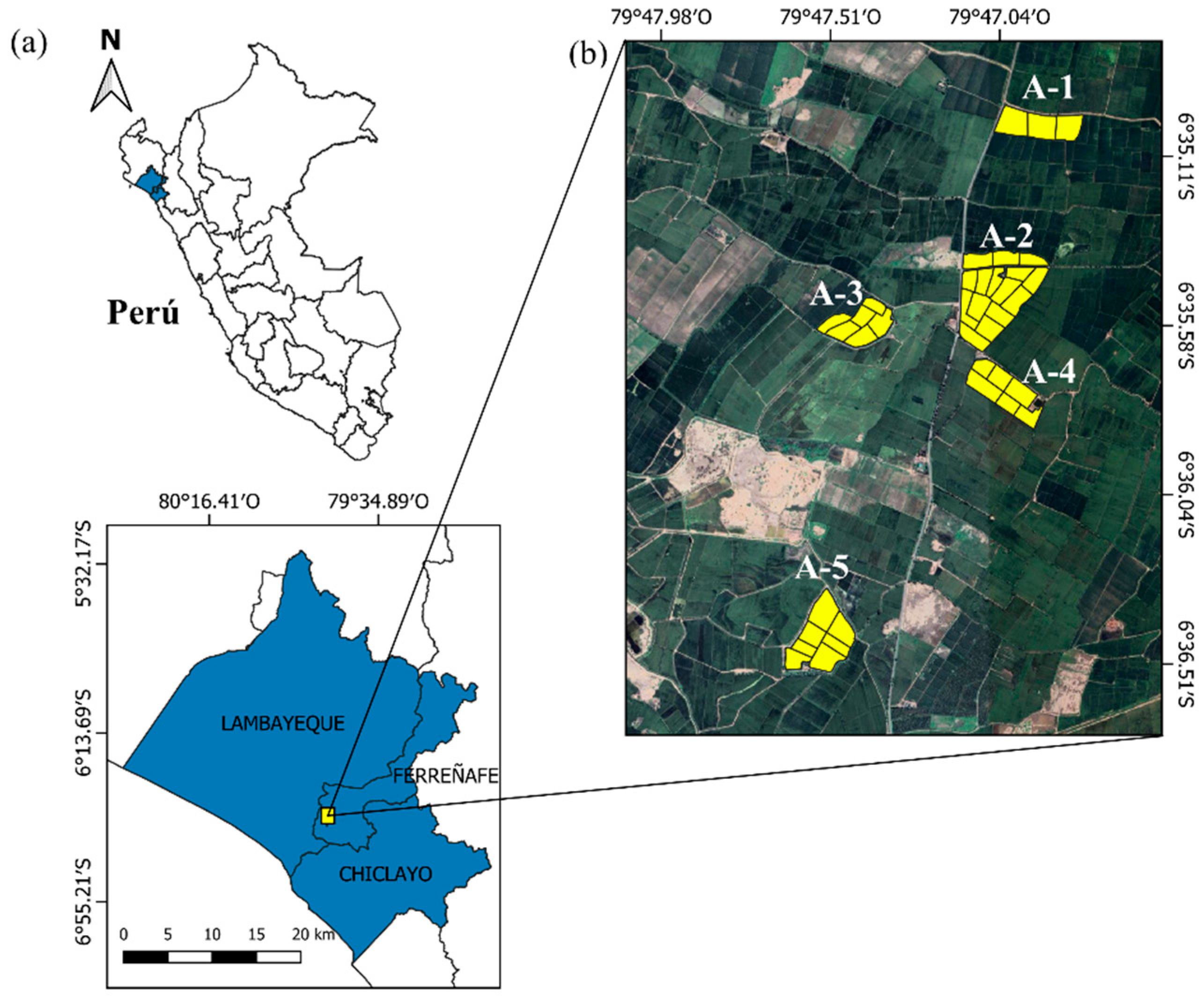
2.1. Study Area
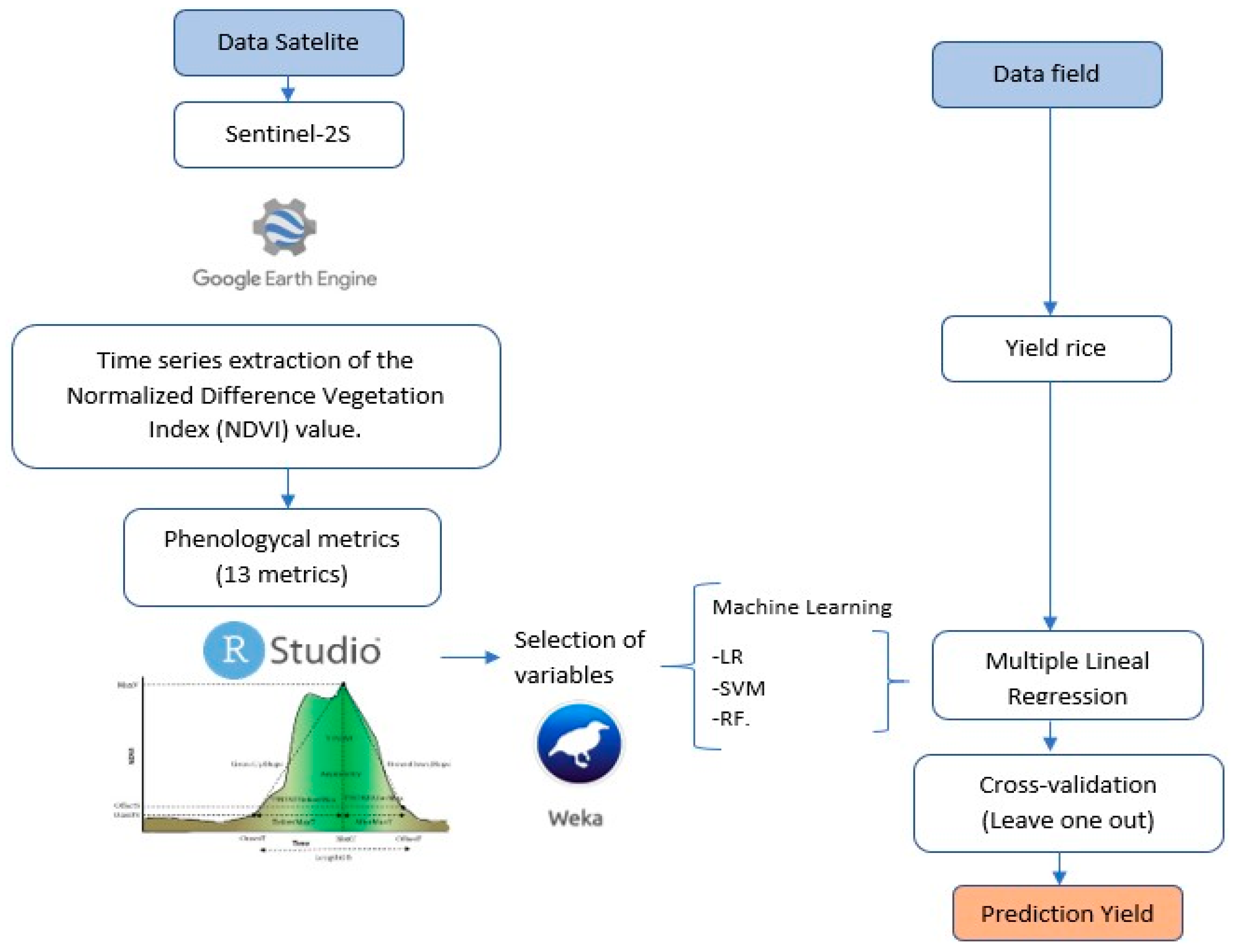
2.2. Data Processing
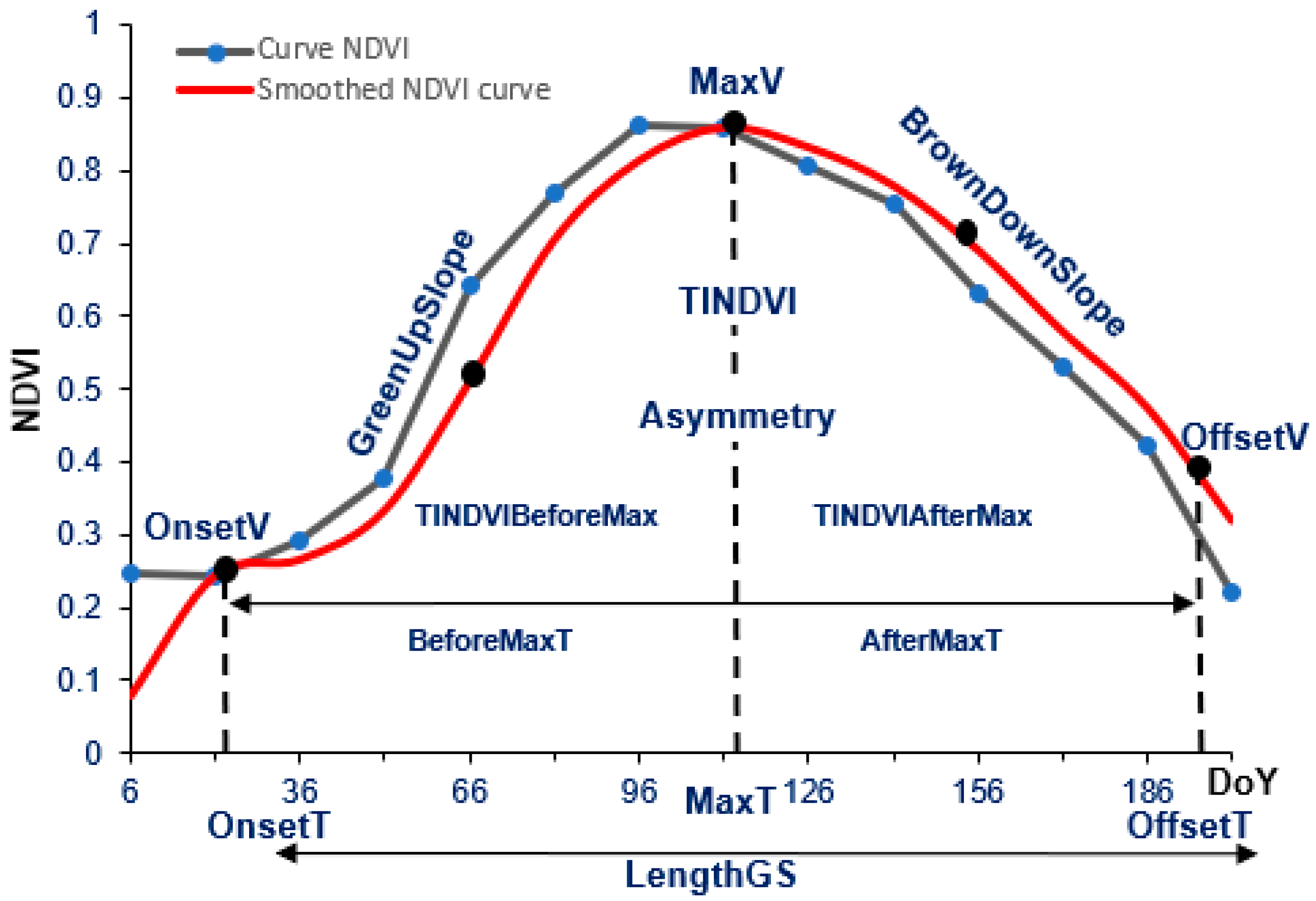
2.3. Phenological Metrics
2.4. Statistical Analysis
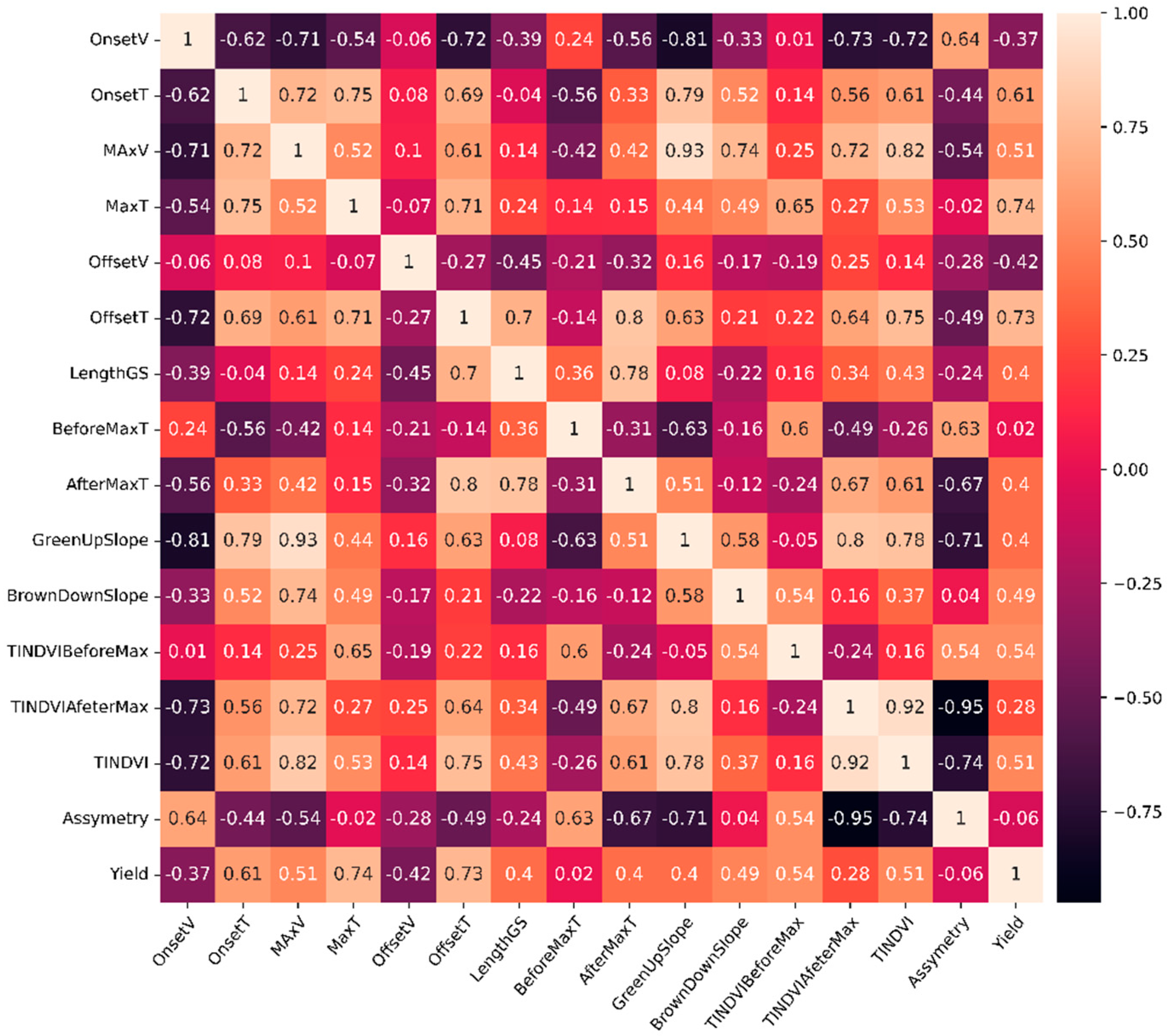
3. Results and Discussion
4. Conclusions
Author Contributions
Funding
Institutional Review Board Statement
Informed Consent Statement
Data Availability Statement
Conflicts of Interest
References
- Rahman, M.M.; Hasan, S.; Ahmed, R.; Adham, A.K.M. Recycling deep percolated water in continuously flooding irrigated rice fields to mitigate water scarcity. Paddy Water Environ. 2022, 20, 449–466. [Google Scholar] [CrossRef]
- Jiang, Y.; Carrijo, D.; Huang, S.; Chen, J.; Balaine, N.; Zhang, W.; van Groenigen, K.J.; Linquist, B. Water management to mitigate the global warming potential of rice systems: A global meta-analysis. Field Crop. Res. 2019, 234, 47–54. [Google Scholar] [CrossRef]
- Tornos, L.; Domínguez, J.A.; Moyano, M.C.; Recuero, L.; Cicuéndez, V.; García-García, M.J.; Palacios-Orueta, A. Assessment of the SASI Spectral Shape Index Time Series for Mapping Rice Ecosystems in the Mediterranean Region. Agronomy 2021, 11, 1365. [Google Scholar] [CrossRef]
- López-Andreu, F.J.; Erena, M.; Dominguez-Gómez, J.A.; López-Morales, J.A. Sentinel-2 Images and Machine Learning as Tool for Monitoring of the Common Agricultural Policy: Calasparra Rice as a Case Study. Agronomy 2021, 11, 621. [Google Scholar] [CrossRef]
- Aguilar, E.H.; Pando, L.G.; Sosa, G. Utilización de los índices de selección en la identificación de genotipos de arroz (Oryza sativa L.) tolerantes a sequía. Producción Agropecuaria y Desarrollo Sostenible 2017, 2, 11–31. [Google Scholar] [CrossRef]
- Porras-Jorge, R.; Ramos-Fernández, L.; Ojeda-Bustamante, W.; Ontiveros-Capurata, R. Performance assessment of the AquaCrop model to estimate rice yields under alternate wetting and drying irrigation in the coast of Peru. Sci. Agropecu. 2020, 11, 309–321. [Google Scholar] [CrossRef]
- Kucuk, C.; Taskin, G.; Erten, E. Paddy-Rice Phenology Classification Based on Machine-Learning Methods Using Multitemporal Co-Polar X-Band SAR Images. IEEE J. Sel. Top. Appl. Earth Obs. Remote. Sens. 2016, 9, 2509–2519. [Google Scholar] [CrossRef]
- Araya, S.; Ostendorf, B.; Lyle, G.; Lewis, M. CropPhenology: An R package for extracting crop phenology from time series remotely sensed vegetation index imagery. Ecol. Informatics 2018, 46, 45–56. [Google Scholar] [CrossRef]
- Hall, M.; Frank, E.; Holmes, G.; Pfahringer, B.; Reutemann, P.; Witten, I.H. The WEKA data mining software: An update. SIGKDD Explor. Newsl. 2009, 11, 10–18. [Google Scholar] [CrossRef]
- Stone, M. Cross-Validatory Choice and Assessment of Statistical Predictions. J. R. Stat. Soc. Ser. B (Methodol.) 1974, 36, 111–133. [Google Scholar] [CrossRef]



| A-1 | A-2 | A-3 | A-4 | A-5 | |||||
|---|---|---|---|---|---|---|---|---|---|
| Area (Ha) | Yield (t ha−1) | Area (Ha) | Yield (t ha−1) | Area (Ha) | Yield (t ha−1) | Area (Ha) | Yield (t ha−1) | Area (Ha) | Yield (t ha−1) |
| 1.98 | 10.41 | 1.11 | 10.45 | 0.64 | 11.63 | 0.77 | 11.91 | 1.99 | 8.81 |
| 1.74 | 9.66 | 0.96 | 10.51 | 1.14 | 8.11 | 0.99 | 13.26 | 1.42 | 7.36 |
| 1.58 | 9.72 | 0.76 | 10.90 | 1.11 | 10.00 | 1.38 | 14.31 | 1.11 | 7.87 |
| 0.75 | 10.75 | 1.03 | 12.04 | 1.49 | 12.29 | 0.80 | 6.28 | ||
| 1.16 | 9.91 | 0.85 | 10.21 | 0.95 | 13.88 | 1.58 | 4.98 | ||
| 1.13 | 11.06 | 0.66 | 5.06 | ||||||
| 0.90 | 10.18 | 0.99 | 7.57 | ||||||
| 0.78 | 11.53 | ||||||||
| 1.13 | 10.71 | ||||||||
| 1.03 | 10.81 | ||||||||
| 1.02 | 10.61 | ||||||||
| 1.15 | 8.69 | ||||||||
| Method of Selection | Models | R2 | RMSE (t ha−1) | MAE | N-Value | |
|---|---|---|---|---|---|---|
| LR | Multiple Linear Regression | 2.3369 × OffsetT + 8.6715 × TINDVIBeforeMax − 21.0089 | 0.61 | 1.38 | 1.10 | 32 |
| SVM | 36.4304 × OnsetV + 1.4759 × MaxT + 3.0196 × OffsetT + 74.65 × BrownDownSlope − 34.6315 | 0.69 | 1.23 | 1.01 | 32 | |
| RF | 2.8828 × MaxT − 4.9856 × TINDVIAfeterMax + 7.2392 × TINDVI − 15.0098 | 0.44 | 1.66 | 1.23 | 32 |
Disclaimer/Publisher’s Note: The statements, opinions and data contained in all publications are solely those of the individual author(s) and contributor(s) and not of MDPI and/or the editor(s). MDPI and/or the editor(s) disclaim responsibility for any injury to people or property resulting from any ideas, methods, instructions or products referred to in the content. |
© 2024 by the authors. Licensee MDPI, Basel, Switzerland. This article is an open access article distributed under the terms and conditions of the Creative Commons Attribution (CC BY) license (https://creativecommons.org/licenses/by/4.0/).
Share and Cite
Quille-Mamani, J.A.; Ruiz, L.A.; Ramos-Fernández, L. Rice Crop Yield Prediction from Sentinel-2 Imagery Using Phenological Metric. Environ. Sci. Proc. 2023, 28, 16. https://doi.org/10.3390/environsciproc2023028016
Quille-Mamani JA, Ruiz LA, Ramos-Fernández L. Rice Crop Yield Prediction from Sentinel-2 Imagery Using Phenological Metric. Environmental Sciences Proceedings. 2023; 28(1):16. https://doi.org/10.3390/environsciproc2023028016
Chicago/Turabian StyleQuille-Mamani, Javier A., Luis A. Ruiz, and Lía Ramos-Fernández. 2023. "Rice Crop Yield Prediction from Sentinel-2 Imagery Using Phenological Metric" Environmental Sciences Proceedings 28, no. 1: 16. https://doi.org/10.3390/environsciproc2023028016
APA StyleQuille-Mamani, J. A., Ruiz, L. A., & Ramos-Fernández, L. (2023). Rice Crop Yield Prediction from Sentinel-2 Imagery Using Phenological Metric. Environmental Sciences Proceedings, 28(1), 16. https://doi.org/10.3390/environsciproc2023028016