3.1. Topical Metformin in Tissue Regeneration and Photoaging
Skin aging is a multifactorial process characterized by the progressive reduction in keratinocyte proliferative capacity, decreased fibroblast activity, mitochondrial dysfunction, impairment of the skin barrier, degradation of the extracellular matrix, and accumulation of senescent cells [
28]. Epidermal senescence does not occur homogeneously but rather involves specific subpopulations of cells that exhibit metabolic alterations, loss of self-renewal capacity, and activation of the senescence-associated secretory phenotype (SASP). This phenotype is marked by the release of inflammatory cytokines, chemokines, and matrix metalloproteinases, which directly contribute to collagen fiber fragmentation and tissue disorganization. In this context, photoaging resulting from chronic exposure to ultraviolet radiation further amplifies intrinsic aging mechanisms by sustaining oxidative stress, activating inflammatory signaling pathways, inducing nuclear and mitochondrial DNA damage, impairing autophagic flux, and accelerating fibroblast and keratinocyte senescence [
28,
29].
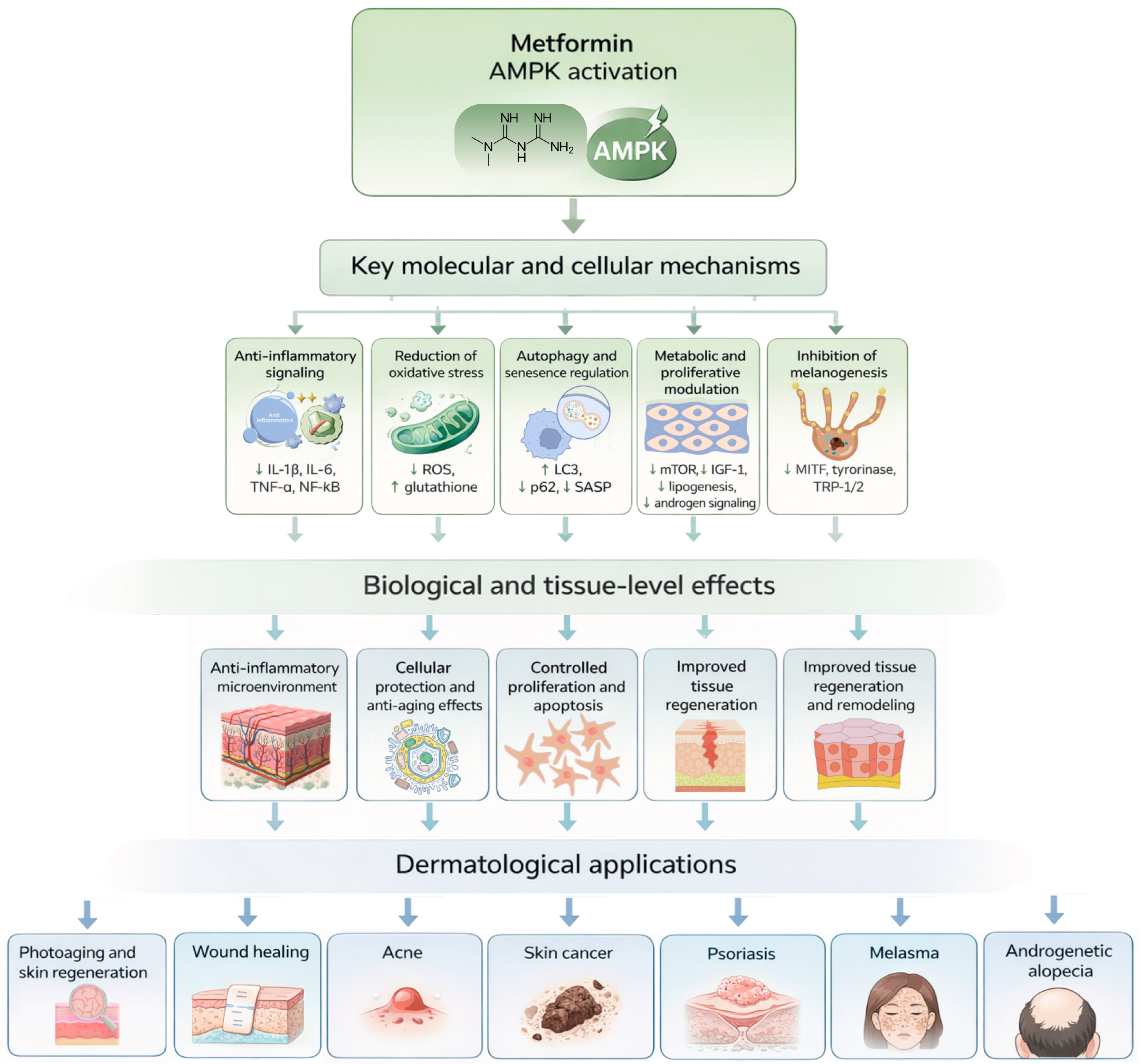
Thus, the loss of cellular renewal, accumulation of senescent cells, and disorganization of the extracellular matrix represent central structural and functional events in both intrinsic aging and photoaging of the skin. Accordingly, therapeutic strategies aimed at restoring cellular homeostasis, modulating inflammatory and senescence pathways, and preserving mitochondrial and metabolic activity in skin cells have become priority targets for anti-aging interventions [
28,
29]. In this scenario, metformin emerges as a relevant candidate due to its pleiotropic actions on energy metabolism, oxidative stress, inflammation, autophagy, and cellular senescence, as demonstrated across recent experimental models [
4,
5,
6].
The repositioning of metformin as a topical agent for dermatological applications has been progressively explored, with experimental evidence indicating beneficial effects on skin regeneration and photodamage attenuation. Collectively, these studies describe mechanisms that include stimulation of cell proliferation, remodeling of the extracellular matrix, enhancement of angiogenesis, reduction in oxidative stress, modulation of inflammatory responses, restoration of autophagic activity, and attenuation of cellular senescence. Importantly, preclinical models demonstrate that metformin exerts protective and regenerative effects in both acute and chronic UV-induced skin injury, supporting its biological plausibility as a therapeutic agent for photoaging-associated skin damage [
4,
5,
6,
7,
8].
Among the experimental studies analyzed, different strategies were employed to enable topical delivery of metformin and to evaluate its effects on skin regeneration and photoaging. In an in vivo model of mechanically induced skin expansion, Xiong et al. (2022) applied metformin in aqueous solution at a concentration of 300 mM throughout the tissue expansion period [
8]. This intervention resulted in increased epidermal and dermal thickness, higher dermal collagen volume fraction, enhanced microvascular density, and elevated global cellular proliferative activity. Activation of epidermal and hair follicle bulge stem cells was evidenced by increased expression of CK14, CK15, PCNA, Ki67, Aurora B, and phosphorylated histone H3, as well as augmented synthesis of collagen types I and III. Although not conducted under UV exposure, this model highlights the intrinsic regenerative capacity of metformin on key skin compartments [
8].
In contrast, studies specifically addressing UV-induced damage provide complementary mechanistic insights. Xiao et al. (2021) investigated the anti-inflammatory and cytoprotective effects of metformin in both in vitro and in vivo models of UVB-induced acute skin injury [
6]. In UVB-irradiated keratinocytes, metformin significantly reduced the transcription and secretion of pro-inflammatory cytokines, particularly IL-1β, TNF-α, and FGF-2, through inhibition of the transcription factor C/EBPβ and its nuclear translocation. Additionally, metformin attenuated UVB-induced keratinocyte cell death, not only by direct cytoprotection but also by suppressing paracrine inflammatory signaling. In vivo, topical application of a 0.6% metformin cream in UVB-irradiated mice alleviated epidermal damage, reduced inflammatory cell infiltration, decreased epidermal thickness associated with acute injury, and limited keratinocyte death. These findings reinforce the anti-inflammatory and cytoprotective role of metformin in acute photodamage, complementing regenerative observations reported in non-UV models [
6].
Similarly, Mostafa et al. (2022) evaluated topical metformin formulations (5% and 10%) in a murine model of UVA-induced photoaging [
5]. The 10% formulation demonstrated superior efficacy, leading to reduced clinical aging scores, preservation of collagen fiber organization, attenuation of epidermal atrophy, and improvement in skin elasticity. At the molecular level, metformin reduced malondialdehyde levels, increased reduced glutathione, downregulated IL-6 and MMP-1 expression, restored autophagy markers (LC3, p62, and cathepsin D), and decreased caspase-3 expression [
5]. Compared to the acute UVB injury model described by Xiao et al. (2021), this study highlights metformin’s capacity to modulate chronic oxidative, inflammatory, autophagic, and apoptotic pathways that underlie photoaging progression [
6].
At the cellular level, Nayeri Rad et al. (2020) demonstrated that the efficacy of topical metformin is strongly influenced by the delivery system [
4]. Using solid lipid particles to enhance skin penetration, metformin significantly reduced senescence-associated β-galactosidase activity and downregulated p16, p21, and p53 expression in UVB-irradiated human dermal fibroblasts [
4]. These findings align with the anti-senescence and cytoprotective effects reported by Xiao et al. (2021), while emphasizing that optimized pharmaceutical formulations are critical for achieving consistent biological effects [
6].
The narrative review by Monte-Serrano et al. (2022) further consolidates evidence supporting topical metformin across multiple dermatological indications, including inflammatory dermatoses, wound healing, keratinocyte hyperproliferation, pigmentary disorders, and anti-aging applications [
7]. The authors report substantial heterogeneity in formulations and concentrations, ranging from 1% to 10%, and highlight AMPK activation as a central mechanism underlying metformin’s anti-inflammatory, antioxidant, antiproliferative, and senescence-modulating effects [
7].
Despite the growing body of evidence, important limitations persist. The available literature remains predominantly preclinical, with few randomized clinical trials specifically addressing skin aging or photoaging. Heterogeneity in formulations, lack of concentration standardization, variability in outcome measures, small sample sizes, and short follow-up periods limit definitive conclusions regarding long-term efficacy and safety. While studies such as Xiao et al. (2021) provide robust mechanistic and translational support for topical metformin in UV-induced skin injury, further clinical validation is required [
6].
Taken together, preclinical evidence derived primarily from in vitro and in vivo experimental models indicates that topical metformin may influence skin regeneration and attenuate molecular and cellular features associated with photoaging through mechanisms involving cell proliferation, collagen synthesis and organization, modulation of oxidative stress and inflammatory pathways, regulation of autophagy-related processes, cytoprotection, and pathways associated with cellular senescence. From a critical perspective, it is possible to envision promising prospects for the use of topical metformin in the contexts of skin regeneration and photoaging, supported by consistent findings in in vivo and in vitro models. However, the current body of evidence remains predominantly preclinical, with important limitations related to the extrapolation of findings to clinical practice. Therefore, although metformin presents itself as a relevant candidate within the scenario of pharmacological repositioning in dermatology, its effective incorporation as an anti-aging therapeutic agent depends on the conduction of randomized, controlled clinical studies with long-term follow-up.
3.2. Topical Metformin in Wound Healing
Another widely studied application of topical metformin is in wound healing. Wounds result from disruption of the skin’s cellular integrity, which compromises the natural barrier function and predisposes the tissue to infection and chronicity [
9]. Interruptions in the healing cascade, such as persistent inflammation, excessive production of reactive oxygen species, and environmental factors, can delay tissue repair and exacerbate tissue damage [
30]. In this context, topical metformin has emerged as a therapeutic strategy, as AMPK activation is associated with improved vascular endothelial function and modulation of key repair, including angiogenesis, re-epithelialization, and collagen deposition [
10].
Studies by Tombulturk, Soydas, and Kanigur-Sultuybek (2025) and by Turhan et al. (2025) investigated the topical application of metformin in diabetic rat models, a condition in which the wound-healing cascade is markedly impaired [
10,
11]. In these experimental settings, metformin was shown to act as a modulator of autophagy and hypoxia-related responses, promoting a microenvironment favorable to tissue repair. The observed effects were associated with the activation of the AMPK–HIF-1α signaling axis, which plays a central role in angiogenesis, fibroblast activity, and cellular adaptation to hypoxic conditions. Together, these experimental findings suggest that topical metformin may enhance wound healing in diabetic animal models by coordinating metabolic and hypoxia-responsive pathways that are critical for tissue regeneration [
10,
11].
Turhan and colleagues comparatively evaluated the topical efficacy of
Hypericum perforatum (HP) and metformin in wound healing [
10]. Topical metformin has been studied for its effects to activate AMPK, which improves endothelial function in wound healing. The authors conducted a comparative evaluation of the application of metformin gel and HP in diabetic rat models. The results showed that the local application of HP promoted superior healing rates in rats with uncontrolled diabetes mellitus compared to the non-diabetic control group. While metformin induced statistically significant improvements in wound healing in the diabetic group, the outcomes were comparable to those observed in the control group. In conclusion, both treatments enhanced wound repair, although the effects were more pronounced with HP [
10].
An in vitro, in vivo and clinical study was conducted by Tawfeek et al. (2019) to evaluate a topical metformin hydrochloride hydrogel [
9]. The study included formulation development followed by evaluation in rat wound models and a non-randomized clinical study involving 30 patients with traumatic wounds or lower-limb ulcers. The hydrogel was applied twice daily for up to one month. In rats, metformin significantly reduced wound contraction after 7 days, and in the clinical setting, the formulation was well tolerated and associated with improved wound healing outcomes. Histopathological and immunohistochemical analyses demonstrated enhanced re-epithelialization and increased TGF-β1 expression, suggesting activation of tissue repair pathways [
9].
In contrast, Zhang et al. (2024) evaluated a topical metformin lotion in a rat wound model with the specific aim of modulating fibrotic responses [
12]. Given the association between excessive TGF-β1 expression and scar formation, the authors investigated whether metformin could promote tissue regeneration while limiting fibrosis. Immunohistochemical analysis showed that wounds treated with 6% metformin lotion exhibited 11.2% TGF-β1–positive cells, compared to 70% in untreated controls, indicating a marked reduction in profibrotic signaling. These differences relative to other studies likely reflect variations in formulation, concentration, and experimental design rather than true biological inconsistency [
12].
Another mechanism studied by Qing et al. (2019) regarding the effects of topical metformin is the induction of M2 macrophage polarization and regulation of the AMPK/mTOR/NLRP3 inflammasome signaling pathway [
13]. This study evaluated the healing of excisional wounds using a metformin gel, finding, in the final assessment, that metformin accelerated wound healing and angiogenesis, induced M2 macrophage polarization in the wound, and inhibited NLRP3 inflammasome activation by regulating the AMPK/mTOR signaling pathway, which, ultimately, corroborates previous studies on this topic of the review [
13].
Increased skin regenerative capacity has also been reported following the use of topical metformin in skin expanded by mechanical stretching, comparing it to what occurs in tissue defects from plastic and reconstructive surgeries. The study conducted by Xiong et al. (2022) investigated the use of topical metformin for this purpose through the proliferative activity of skin-derived stem cells [
8]. In this study, the findings after inducing mechanical stretching in the scalp of rats involved an increase in epidermal and dermal thickness, the number of blood vessels, the dermal collagen fraction, and the number of PCNA+, Aurora B+, and pH3+ cells in rats treated with metformin, indicating an increase in skin regeneration. Furthermore, an increase in the number of proliferative stem cells in hair follicle bulbs and epidermal stem cells was observed. These findings led the authors to conclude that topical application of metformin increased the regenerative capacity of mechanically stretched skin [
8].
Given that skin wound healing becomes more difficult with aging, Zhao et al. (2017) evaluated the topical effects of metformin, resveratrol, and rapamycin in an aged rat model [
14]. In this preclinical context, metformin prevented AMPK pathway suppression and was associated with improved wound healing and skin integrity [
14]. However, the evidence remains limited to animal studies, and the translational readiness of topical metformin is low, due to the lack of robust clinical trials, the absence of standardized formulations, and methodological heterogeneity across studies. Therefore, these findings support mechanistic insights rather than clinical applicability, highlighting the need for well-designed and standardized clinical investigations.
3.3. Topical Metformin in Skin Cancer
Skin cancer is currently the most prevalent malignant neoplasm in humans worldwide. Although genetic variables influence susceptibility, most cases result from ultraviolet (UV) radiation, whose mutagenic and carcinogenic effects stem from DNA damage and impaired repair mechanisms. When tumors become large or metastatic, treatments such as chemotherapy, immunotherapy, radiation, or targeted therapy are required. Although effective, these treatments are frequently associated with significant side effects due to their non-selective cytotoxicity and systemic exposure, and resistance has been reported in several tumor types [
31].
The strategy of repurposing approved drugs has great potential in oncology, and topical metformin has shown promise as a strategy for melanoma and squamous cell carcinoma (SCC). Its antitumor activity has been reported through both AMPK-dependent and AMPK-independent mechanisms. Metformin promotes AMPK activation and subsequent inhibition of the mammalian target of rapamycin (mTOR), responsible for suppressing tumor growth and proliferation. Furthermore, it also induces apoptosis and autophagy by modulating immune pathways through p53 activation [
31,
32].
Several studies report inhibition of MAPK/ERK pathways with upregulation of the tumor suppressor NF-1, increased Bax:Bcl
2 ratio, and reduced vascular endothelial growth factor (VEGF), corroborating the pro-apoptotic and antiangiogenic effects of metformin. In SCC, it also suppresses nuclear factor kappa-beta (NF-κB) and enhances the response to chemotherapy. In melanoma, it reduces invasiveness and metastasis progression by activating AMPK and p53. Although it may promote VEGF expression in BRAFV600E-mutant melanoma, the use of combination therapy with VEGF inhibitors can reverse this undesirable effect [
32].
However, due to its high aqueous solubility and low permeability, metformin has significant limitations in overcoming the stratum corneum barrier and optimizing local bioavailability when applied in conventional formulations. Consequently, advances in delivery systems such as ethosomes, nanoparticles, and hydrogels have improved skin penetration and retention, enhanced local antitumor activity, and minimized systemic effects [
15,
16,
17,
18,
19,
20]. In this review, only eight of the 28 articles included addressed the use of topical metformin for skin cancer. Only six of them were experimental studies, with each suggesting pharmacological innovations based on various drug delivery technologies.
Some studies have addressed the application of nanoformulations in experimental models of skin cancer. Mousa et al. (2022) demonstrated that ethosomal gels loaded with metformin, optimized for high encapsulation efficiency and enhanced permeation, produced marked inhibition of tumor growth in chemically induced skin cancer in mice [
15]. Compared with free metformin, the ethosomal gel achieved greater tumor regression, stronger apoptotic responses, and superior antitumor activity, largely attributed to the ability of the vesicles to efficiently transport metformin to deeper viable skin layers and enhance modulation of the AMPK/mTOR pathway [
15].
Elkady et al. (2025) reported that virus-like mesoporous silica nanoparticles loaded with metformin and incorporated into a thermosensitive gel achieved superior antitumor efficacy, including increased expression of caspase-3 and NF-1 and significant suppression of angiogenesis markers (VEGF, NRAS) [
20]. Similarly, Yu et al. (2019) demonstrated that cubic phases loaded with metformin achieved greater skin permeation, leading to substantial reductions in tumor volume and increased apoptosis in mice bearing B16 melanoma [
19].
In vitro results also confirmed that nanoencapsulation significantly enhances the anticancer performance of metformin. Ebrahimnejad et al. (2023) showed that chitosan/gelatin nanoparticles coated with hyaluronic acid increased activity against A375 melanoma cells, achieving a 2-fold lower IC50 and promoting greater apoptosis, better skin deposition, and sustained release with a targeting agent [
18].
Comparatively, Eke et al. (2024) produced a chitosan gel containing metformin-loaded PCL nanoparticles with prolonged release of up to 72 h, high encapsulation efficiency, permeation, and cytotoxic activity (B16F10 cells) of the nanoencapsulated metformin incorporated into the gel formulation [
17]. On the other hand, Donadon et al. (2023) opted for the combined therapy of methylene blue with metformin encapsulated in monoolein-based nanodispersions for the treatment of squamous cell carcinoma. This approach resulted in A431 cell cytotoxicity 24 times greater than the control, which was further enhanced by photodynamic activation (36 times) [
16].
Currently, the literature still lacks large-scale clinical trials, long-term safety evaluations, and, most importantly, direct comparisons with established treatments. In this context, the evidence compiled in this review is restricted to in vitro and animal models and should be interpreted with caution.
The evidence compiled indicates that topical metformin, when evaluated in experimental settings, acts through several complementary tumor-suppression mechanisms in vitro and in animal models, supporting its biological plausibility as a candidate for further investigation rather than establishing clinical efficacy, particularly when incorporated into advanced nanocarrier systems. Importantly, no human clinical studies evaluating topical metformin for skin cancer were identified.
Metformin’s multitargeted action, established systemic safety profile, and low cost support its consideration as a compound of interest; however, progression toward clinical application remains premature. The evidence currently available on topical metformin for skin cancer is derived exclusively from in vitro and animal studies, and no human clinical trials have evaluated its safety, pharmacokinetics, or therapeutic efficacy in melanoma or squamous cell carcinoma. Therefore, the findings summarized here should be interpreted as preliminary and exploratory, reflecting biological plausibility rather than clinical effectiveness. Further studies are required to elucidate pharmacokinetic and pharmacodynamic profiles, assess formulation-specific safety, and determine whether nanocarrier-based delivery offers measurable advantages over existing therapies before clinical translation can be justified.
3.4. Topical Metformin in Melasma
Melasma is a chronic and recurrent hyperpigmentation disorder, multifactorial in origin, characterized by melanocytic hyperactivity and structural alterations involving the epidermis, basement membrane, and upper dermis. Factors such as ultraviolet radiation and visible light, genetic predisposition, hormones, and inflammation contribute to the persistent hypermelanogenic phenotype. Management is challenging due to the tendency for recurrence and the variable response to conventional treatments, such as hydroquinone and triple combination creams (TCC), known as Kligman’s formula, considered the gold standard [
21,
33,
34,
35].
The TCC formula combines depigmenting, keratolytic, and anti-inflammatory actions of its active ingredients (hydroquinone 2–4%, tretinoin 0.025–0.05%, and fluocinolone acetonide 0.01%). Despite its robust efficacy, adverse effects associated with prolonged use, such as irritation, risk of exogenous ochronosis, and the need for intermittent regimens, motivate the search for safer alternatives. In this scenario, topical metformin has emerged as a promising approach, driven by experimental evidence demonstrating its ability to modulate cellular pathways related to melanogenesis, inflammation, and oxidative stress [
35,
36,
37].
Metformin in melasma acts by activating the AMPK pathway in human melanocytes, which results in a marked reduction in melanogenesis through inhibition of the ACC pathway and downregulation of MITF and melanogenic enzymes, including tyrosinase. Preclinical studies indicate that metformin also decreases proinflammatory mediators and interferes with the oxidative stress mechanisms involved in hyperpigmentation, supporting its investigation as a topical therapeutic alternative [
1,
2,
33].
The randomized clinical trial conducted by AboAlsoud et al. (2022) included 40 patients and compared topical metformin (30%) with TCC therapy [
21]. Treatment efficacy was assessed using the Melasma Area and Severity Index (MASI), which evaluates the extent, darkness, and homogeneity of pigmentation. After eight weeks of treatment, both groups showed a significant reduction in MASI scores, with no statistically significant difference between the interventions. Notably, topical metformin achieved a mean MASI reduction of 55.9%, indicating a clinical improvement comparable to that of gold standard therapy. Importantly, topical metformin was associated with better tolerability and fewer adverse effects, supporting its potential role as an effective and safer alternative for the treatment of melasma [
21].
Afshar et al. (2024) evaluated five clinical studies investigating topical metformin for melasma in their review [
3]. Across all studies, metformin was compared with control groups receiving either a triple-combination cream (two studies), 4% hydroquinone (one study), or placebo (two studies). Results from two studies indicated that although topical metformin may not be significantly more effective than TCC for melasma treatment, it appears to have fewer side effects. One study showed significant differences in favor of metformin of over 4% hydroquinone. There was an inconsistency in results comparing metformin to placebo in one study; however, this was the only trial using a lower concentration (15%), while the others used 30% metformin, suggesting that drug concentration may represent a critical determinant of clinical efficacy [
3].
Although promising, the evidence still derives from a few studies, with small sample sizes and methodological heterogeneity. Topical metformin has been shown to be safe and well-tolerated, as none of the reviewed studies reported serious adverse events or significant irritation [
21,
38]. This advantage may be particularly relevant for long-term treatments or for patients with hypersensitivity to hydroquinone [
35,
37].
The literature demonstrates efficacy for hydroquinone, azelaic acid, tranexamic acid, cysteamine, and other topical agents. However, metformin presents a distinct mechanism of action, with a strong anti-inflammatory and metabolic modulation profile, potentially superior tolerability compared to irritative therapies, such as hydroquinone and cysteamine. Accordingly, it may represent a useful option in rotational or maintenance regimens, reducing the risk of intolerance or rebound [
35,
37].
The available data suggest that topical metformin may be associated with reductions in melasma-related hyperpigmentation, with outcomes reported as comparable to those of the triple combination in small, controlled settings. Existing studies describe a generally favorable local tolerability profile and propose molecular mechanisms consistent with melasma pathophysiology, including modulation of inflammatory pathways, oxidative stress, and melanocytic activity. However, the evidence base remains limited by the small number of studies, reduced sample sizes, and heterogeneity in formulations and study designs, which substantially restricts the strength and generalizability of these findings. Consequently, the translational readiness of topical metformin for melasma remains low, and its clinical role can only be clarified through larger, well-designed randomized controlled trials with standardized protocols and outcome measures.
3.5. Topical Metformin in Psoriasis
Psoriasis, a chronic inflammatory and immune-mediated disease, predominantly affects the skin and joints and is characterized by keratinocyte hyperproliferation, infiltration of inflammatory cells, and excessive release of pro-inflammatory cytokines such as TNF-α, IL-17, and IL-22. Its complex pathogenesis involves interactions among genetic, immunological, and metabolic factors, resulting in systemic inflammation and impairment of the skin barrier. In addition to cutaneous manifestations, psoriasis is frequently associated with metabolic syndrome, insulin resistance, and cardiovascular diseases, reinforcing its systemic and multifactorial nature [
22,
23].
Regarding the management of psoriasis, the studies reviewed in this work highlight the therapeutic potential of metformin, either as a single agent or co-encapsulated with bioactive compounds. Its efficacy arises both from its immunomodulatory effects and its ability to restore the cutaneous barrier and reduce inflammatory biomarkers.
The study conducted by Jenabikordi et al. (2021) demonstrated that the co-encapsulation of metformin and ginger into liposomes yielded stable formulations for up to 12 weeks, with minimal particle size increase and high encapsulation efficiency (EE > 50%) [
22]. Differential scanning calorimetry (DSC) results confirmed complete encapsulation and the absence of adverse interactions between the drugs, demonstrating that the co-encapsulation of metformin and ginger is both feasible and effective. Ex vivo permeation assays revealed a significant increase in skin penetration of both compounds, particularly in psoriatic skin, corroborating the in vivo findings in which the formulation promoted evident epidermal regeneration in histopathological analyses, indicating a synergistic and sustained effect between the agents [
22].
Furthermore, in in vivo models, the co-encapsulated formulation markedly reduced the PASI score and visibly decreased the lesioned area, with reductions in erythema, thickness, and scaling, indicating a significant clinical improvement of cutaneous inflammation. Finally, IL-22 and TNF-α levels showed a marked decrease compared to control groups, approaching the values observed in healthy skin, reinforcing the anti-inflammatory and reparative potential of the formulated liposomal combination [
22].
Similar results were reported by Rodrigues et al. (2025), who also investigated liposomes containing metformin and ginger prepared by the thin-film hydration method [
23]. The formulations exhibited an average particle size between 217 and 242 nm and controlled drug release for up to 48 h, a behavior attributed to the presence of Carbomer
® 934, which enhanced formulation stability and provided a sustained-release profile. Ex vivo permeation studies demonstrated increased flux and higher epidermal concentrations of both compounds, particularly in imiquimod-treated skin. In animal models, the formulation also led to a significant reduction in PASI score and in IL-22 and TNF-α levels, accompanied by histological improvement of psoriatic lesions, including decreased epidermal thickness and reduced inflammatory infiltration. These findings reinforce the synergistic capacity and potential of the liposomal system as a prolonged-action topical delivery vehicle [
23].
Such results are consistent with the findings of Monte-Serrano et al. (2022), who determined that metformin use in dermatological diseases exerts anti-inflammatory and antioxidant effects mediated by AMPK activation, which modulates the activity of dendritic cells, T lymphocytes, and macrophages, thereby reducing the release of pro-inflammatory cytokines [
7]. The study further demonstrated that the clinical benefits of metformin are more pronounced in patients with psoriasis associated with metabolic disorders such as type 2 diabetes and insulin resistance, suggesting that its dermatological effects are intrinsically linked to systemic metabolic regulation [
7].
In line with these findings, Hassan et al. (2025) demonstrated that using a murine model of psoriasis associated with type 2 diabetes, metformin administered either systemically or topically significantly increased AMPK activity, thereby inhibiting the NF-κB inflammatory pathway and reducing excessive keratinocyte proliferation [
24]. Concomitantly, there was a reduction in the expression of keratinocyte growth factor (KGF) and STAT3, both directly related to epidermal thickness and inflammation maintenance. In addition, metformin modulated the IL-17RA/RC pathway, reducing receptor expression in keratinocytes, which attenuates the Th17-mediated inflammatory response [
24].
These results further support the hypothesis that metformin acts in an integrated manner on metabolic and immunological pathways, contributing to cutaneous homeostasis and, consequently, to the improvement of psoriatic lesions. Collectively, the analyzed studies highlight the remarkable therapeutic potential of metformin in psoriasis management, acting through multifactorial mechanisms involving the modulation of key inflammatory and metabolic pathways implicated in the disease pathogenesis. Furthermore, they demonstrate that its association with bioactive compounds and controlled-release systems enhances the drug’s anti-inflammatory and reparative effects, promoting synergistic and sustained action on epidermal regeneration processes.
3.6. Topical Metformin in Acne
Metformin plays a relevant role in the pathophysiology of acne by modulating biochemical pathways associated with hyperandrogenism and insulin-like growth factor 1 (IGF-1). Acne is directly related to increased IGF-1–induced sebaceous lipogenesis, with high IGF-1 expression in sebocytes and suprabasal cells and widespread distribution of IGF-1 receptors (IGF-1R) throughout the sebaceous gland, thereby promoting sebum production and inflammation. Within these pathways, metformin acts by reducing insulin resistance and circulating levels of IGF-1 and androgens, indirectly interfering with sebaceous gland activity [
25,
32].
Clinical evidence further substantiates the metabolic role of metformin in improving acne, particularly in contexts associated with hyperandrogenism. A study that treated women with polycystic ovary syndrome with metformin at doses of 500–1000 mg administered twice daily for six months, observing a significant reduction in acne severity concomitant with normalization of metabolic parameters. Similarly, a reported clinical improvement in acne with the combined use of low-dose metformin, pioglitazone, and flutamide, reinforcing the influence of metformin on IGF-1–related metabolic pathways and hyperandrogenism [
32].
In the context of topical use, El-Komy et al. (2023) conducted a split-face study in which a 30% metformin gel was applied daily for 12 weeks [
25]. The authors observed a significant reduction in comedonal, papular, and nodular lesions compared with placebo. Although the study did not explore local molecular mechanisms in detail, the findings suggest that metformin may modulate relevant intracellular processes, such as reduction in cyclic AMP (cAMP), inactivation of protein kinase A (PKA), and interference with MITF-regulated pathway mechanisms previously described in other biochemical contexts of metformin and potentially involved in cutaneous inflammation and sebocyte differentiation. Additionally, the absence of relevant adverse events reinforces the safety of topical metformin at the concentration evaluated [
25].
Overall, metformin shows potential in acne management through systemic and topical modulation of metabolic and inflammatory pathways. However, the evidence is limited by the small number of studies, heterogeneous methodologies, short follow-up periods, and lack of standardized formulations, highlighting the need for well-designed randomized clinical trials to establish its efficacy and safety.
3.7. Topical Metformin and Hair Growth
Androgenetic alopecia (AGA) is a condition characterized by hair loss driven by aging, genetic and hormonal factors, and other triggers. It results in a reduction in hair follicle (HF) and the apoptosis of dermal papilla cells. So far, only minoxidil (MXD) and finasteride have been approved for the treatment of AGA. However, both have serious side effects, including hypersensitivity and sexual dysfunction, making new agents for AGA necessary [
26].
The study conducted by Mai et al. (2025) demonstrates that it is possible to use two-dimensional black phosphorus nanosheets (BP NPs) as drug carriers due to their low cytotoxicity, good biocompatibility, and strong antioxidant capacity [
26]. However, since they are unstable, prone to degradation, and inadequate for transdermal drug administration, a procedure called PEGylation can be performed, such as the addition of polyethylene glycol (PEG), thus improving their stability. They are subsequently loaded with metformin to generate a transdermal system (BP-PEG-Met) for the treatment of androgenetic alopecia (AGA) [
26].
This study shows that compared to topical MXD, BP-PEG-Met significantly promoted hair regeneration, inducing fewer side effects. BP-PEG-Met eliminated the excess reactive oxygen species in skin cells, reducing oxidative stress around hair follicles. Furthermore, it increased the expression of vascular endothelial growth factor (VEGF) and platelet-endothelial cell adhesion molecule-1 (CD31) in dermal papillae, inducing angiogenesis around hair follicles and accelerating the hair cycle toward the anagen phase. This transdermal release system BP-PEG-Met, has demonstrated significant clinical potential as a multifunctional tool for the treatment of alopecia and, possibly, for the management of other skin conditions [
26].
Similar findings were reported by Sun et al. (2022), using an experimental model based on three-dimensional (3D) dermal–epidermal cell aggregates followed by grafting into recipient mice [
27]. In this setting, metformin treatment was shown to preserve the trichogenic capacity of dermal cells, enhancing their ability to induce hair follicle formation and sustain follicular regeneration. These effects were associated with the maintenance of key molecular markers involved in follicular inductive activity and cellular differentiation, as well as improved survival and functional integration of reconstituted hair follicles. Together, these observations indicate that metformin may contribute to hair regeneration by stabilizing the biological properties of dermal cells that are essential for follicular induction in experimental models [
27].
It was also observed that metformin increases the expression of CD133 in dermal cells, maintaining their trichogenic capacity, which would normally be lost after successive subcultures. These results suggest that metformin may promote hair regeneration in vitro through the positive regulation of the hair-inducing capacity of dermal cells, justifying further evaluation for its possible clinical use, particularly in male and female androgenetic alopecia [
27].
Recent evidence derived predominantly from in vitro and animal models indicates that metformin may exert effects associated with hair regeneration, acting at multiple levels of follicular physiology. The use of innovative strategies, such as the BP-PEG-Met system, has been shown in experimental models to address some formulation-related limitations of the drug and to demonstrate enhanced performance when compared to minoxidil under preclinical conditions, without allowing direct inference regarding comparative clinical efficacy or safety. Moreover, cell-based studies suggest that metformin can increase markers associated with the trichogenic capacity of dermal cells, maintain the expression of key follicular induction markers, and modulate microenvironmental conditions associated with hair follicle growth. Taken together, these findings support the biological plausibility of metformin, particularly when combined with nanotechnology-based delivery systems, as a candidate for further investigation in the context of androgenetic alopecia. However, the absence of human clinical data precludes conclusions regarding its safety or therapeutic effectiveness, highlighting the need for well-designed clinical studies to evaluate its translational relevance in humans.
3.8. Topical Formulation, Safety and Practical Considerations
A major limitation in the current literature is the wide range of concentrations (0.6–30%) and vehicles used for topical metformin, which complicates comparisons across studies. Metformin is a hydrophilic, zwitterionic molecule with low passive skin permeability, so both the drug concentration and the formulation influence dermal bioavailability [
9]. Experimental data show that penetration is highly formulation-dependent. In a comparative permeation study, lotions containing 6% metformin with glycerol or propylene glycol (PG) achieved low cumulative permeation in human skin. Meanwhile, a 10% metformin lotion with PG and Transcutol
® markedly increased drug permeation, indicating that porcine skin models may overestimate human permeability and highlighting the need for appropriate experimental systems [
39]. Advanced delivery systems, such as hydrogels, nanofibres, and ethosomes, can achieve therapeutic effects with lower concentrations (0.6–5%) by enhancing epidermal retention and controlled release [
40].
The relationship between dose and clinical response is not linear. In photoaging models, a 10% gel was more effective than a 5% gel in preserving collagen and restoring autophagy [
5], while in melasma, a 30% cream reduced the Melasma Area and Severity Index (MASI) by 55.9% and was better tolerated than standard triple-combination therapy [
21]. For acne, a 30% gel significantly reduced comedonal and inflammatory lesions without notable adverse effects [
15], whereas in alopecia areata, both 10% and 20% gels improved hair growth, with only one case of mild irritation at 20% [
25]. These findings suggest that the vehicle and permeation enhancers may influence efficacy more than concentration alone, and that concentrations up to 30% remain well tolerated.
Given this variability,
Table 2 summarizes formulations, concentrations, and key outcomes across conditions. We also stress the need for standardized pharmacokinetic evaluations and dose–response studies to identify optimal topical concentrations and vehicles. Future clinical trials should report concentrations, vehicles, permeation enhancers, and outcomes in a consistent manner, and should correlate skin metformin levels with clinical endpoints to permit meaningful comparisons.
Although metformin has a well-established systemic safety profile, evidence for its topical use in dermatology remains limited. Available preclinical and early clinical data indicate good local tolerability, with only mild and transient adverse effects reported, such as transient erythema, pruritus, or irritation. Systemic absorption is expected to be minimal, though formal pharmacokinetic data are scarce, particularly in conditions with impaired skin barrier function.
Practical challenges include heterogeneity in formulations, vehicles, and concentrations, which may influence stability, penetration, and tolerability, thereby limiting cross-study comparability. Overall, while preliminary findings support a favorable safety profile, well-designed clinical trials are required to define optimal formulations, dosing, and long-term safety.




 ,
,