
Article

Do Different Home-Based Resistance Training Programs Affect Running Economy and Plantarflexor Function in Middle-Aged Runners? An Exploratory Study

by
Zoey C. Kearns
1,
Rebecca L. Krupenevich
2,
Jason R. Franz
2,
Douglas W. Powell
1 and
Max R. Paquette
1,*
1
College of Health Sciences, University of Memphis, Memphis, TN 38152, USA
2
Joint Department of Biomedical Engineering, University of North Carolina at Chapel Hill and North Carolina State University, Chapel Hill, NC 27599, USA
*
Author to whom correspondence should be addressed.
Biomechanics 2026, 6(1), 18; https://doi.org/10.3390/biomechanics6010018
Submission received: 10 April 2025 / Revised: 12 January 2026 / Accepted: 22 January 2026 / Published: 4 February 2026
(This article belongs to the Special Issue Biomechanics in Sport, Exercise and Performance)

Abstract

Endurance running exposure alone may not be sufficient to slow the age-related decline in plantarflexor function, which is also thought to contribute to the decline in running economy. Strength training has been shown to improve running performance, but specific programs have not been evaluated for their assistance in maintaining plantarflexor function and “youthful” metabolic costs in aging runners. The purpose of this study was to assess the relative influence of three types of resistance training interventions on running economy (RE), plantarflexor function, and Achilles tendon (AT) stiffness in middle-aged runners. Methods: Twenty-six middle-aged runners (51 ± 5 yrs) participated in one of three 10-week resistance training interventions: (1) heavy resistance training, (2) heavy resistance training + plyometrics, and (3) endurance resistance training + plyometrics. Laboratory testing for RE, biomechanical variables, peak plantarflexor torque, and AT stiffness during isometric contractions occurred before and after the interventions. A mixed-design repeated measures ANOVA was used to address our research question, while paired and independent t-tests were used to compare time and group effects, respectively. Results: Relative (to V ˙ O 2 m a x ) RE (−2.4%, p = 0.016), AT stiffness (+26.1%, p = 0.002), and peak isometric plantarflexor torque (+26.4%, p = 0.001) improved with resistance training, with no interaction or group effects. No significant interaction, time, or group effects were observed for V ˙ O 2 m a x and peak plantarflexor torque, peak positive ankle power, or positive and negative ankle work while running. Conclusions: We present novel but exploratory findings that resistance training, regardless of modality, may moderately improve RE and Achilles tendon stiffness in middle-aged recreational runners. However, sagittal plane lower joint kinematics, extensor torques, powers, and work were unaffected by resistance training in middle-aged runners.

1. Introduction

Exercise helps slow the decline in function due to advancing age and decreases the risk of developing cardiovascular disease, cancer, and neurological conditions [1]. Running has a low barrier to entry and participation in adults over 35 years has risen dramatically in the past 20 years [2]. Among many health benefits, runners tend to have lower resting heart rates and higher V ˙ O 2 m a x than non-runners. Research on Masters athletes (over 40 years) suggest vigorous exercisers, like marathon competitors, exhibit different rates of biological aging than sedentary adults [3]. Age-related factors may contribute to higher relative metabolic costs, resulting in higher perceived running effort and less enjoyment, but it has been well-established that running alone improves running economy, regardless of age [4,5]. Dedicated runners are constantly searching for new options that can help them improve and maintain their running performance.
Relatedly, resistance training is a popular modality employed by many runners to supplement their training programs. Resistance training could play a role in mitigating age-related changes in running biomechanics, muscle and tendon characteristics, and joint kinetics that contribute to declining performance with age [5,6,7,8,9]. Biomechanical hallmarks of middle-aged and older runners are considered to be a reduction in ankle plantarflexor function including smaller peak plantarflexor torque, less positive work, and less peak positive power than young runners [6,8,10]. These biomechanical changes are thought to result from some combination of an age-related decrease in muscle mass [11], plantarflexor strength [12], and Achilles tendon (AT) stiffness [10,13]. Lower AT stiffness may require more plantarflexor force (increasing energetic demands) and a higher rate of muscle force production to power the muscle–tendon unit during propulsion. These age-related factors may contribute to higher relative metabolic costs, resulting in higher perceived running effort and less enjoyment, thus increasing the likelihood that athletes seek additional training modalities, such as resistance training, to help reduce these metabolic costs and improve running enjoyment.
Resistance training interventions, including complex multi-joint movements with free weights and heavier loads, may provide greater improvements in running economy (RE) in young distance runners [14]. Heavy resistance training (HRT) generally consists of loads greater than 75% of the one-repetition maximum (1RM) [15,16,17], while endurance resistance training typically employs loads between 40 and 70% of the 1RM [16,17]. HRT alone and in combination with plyometrics exercises are effective training strategies to improve performance and RE in young, trained runners [16,18], perhaps due to improved maximal strength, explosiveness, and velocity at V ˙ O 2 m a x [18]. Furthermore, HRT increases tendon stiffness [19], likely related to greater plantarflexor strength tending to be concomitant with increased AT stiffness [20]. Although plyometric training may not improve the plantarflexor morphology (increased plantarflexor muscle cross-sectional area and pennation angle or longer muscle fascicle length) associated with maximal plantarflexor force production, it can increase AT stiffness in young adults [21]. To date, the effects of resistance training on running performance and tendon stiffness in middle-aged runners have not been fully elucidated. Endurance resistance training is less effective than HRT for improving muscle strength [17,22] and may only lead to small increases in tendon stiffness. Thus, HRT in combination with plyometric training may be most effective to mitigate age-related decreases in plantarflexor strength [12] and AT stiffness [10,13]. These changes in the muscle–tendon unit function could ultimately contribute to improved RE in middle-aged runners, but the effects of focused resistance training on RE and the underlying mechanisms have not been well-established in middle-aged adults. It is important to better understand the training effect magnitudes of different types of resistance training on running economy to (1) better design future randomized control trials on this topic and (2) better design resistance training programs for aging runners.
The primary purpose of this exploratory study was to assess the relative influence of three types of resistance training interventions on RE, plantarflexor function, and AT stiffness in middle-aged runners. We hypothesized that heavy resistance with plyometrics would yield the largest improvements in economy, ankle plantarflexor function, and AT stiffness, followed by heavy resistance and endurance resistance with plyometrics training. The secondary purpose was to determine if changes in ankle plantarflexor function and AT stiffness as a result of resistance training were associated with changes in RE. We hypothesized that improvements in ankle plantarflexor function and AT stiffness would be positively associated with improved RE in middle-aged runners.

2. Materials and Methods

2.1. Participants

Thirty-three runners (45–60 years) were recruited, and twenty-six completed both testing sessions and at least 80% of the resistance training sessions. Runners were able to participate if they had been running at least three times per week for an average of at least 75 min per week over the previous year and had not engaged in any planned lower limb resistance training more than once per week over the previous year. Participants were excluded if they had lower extremity surgery in the previous two years or had suffered a running-related injury requiring them to stop training for more than a week in the previous 6 months. Each participant was informed of all procedures, potential risks, and benefits associated with the study in both verbal and written forms in accordance with the procedures approved by the University Institutional Review Board for Human Participants Research.

2.2. Experimental Design

Participants attended a testing session during which training information and biometric data were collected (Week 1). During this session, the pre-training RE, plantarflexor strength, AT stiffness, and spatiotemporal, ankle joint kinematic and kinetic variables during running were assessed. Participants were then assigned to one of three resistance training groups. Groups were stratified first by age, then gender, weekly training duration, and lastly, AT stiffness to ensure group homogeneity before the 10-week intervention (Table 1). Participants took part in the 10-week intervention (Weeks 2–11) in one of three resistance training interventions: (1) heavy resistance training (HRT), (2) heavy resistance and plyometrics training (HRPT), and (3) endurance resistance and plyometrics training (ERPT). Following the 10th week of the resistance training intervention (Week 12), participants returned for the post-training testing session.

2.3. Experimental Procedures

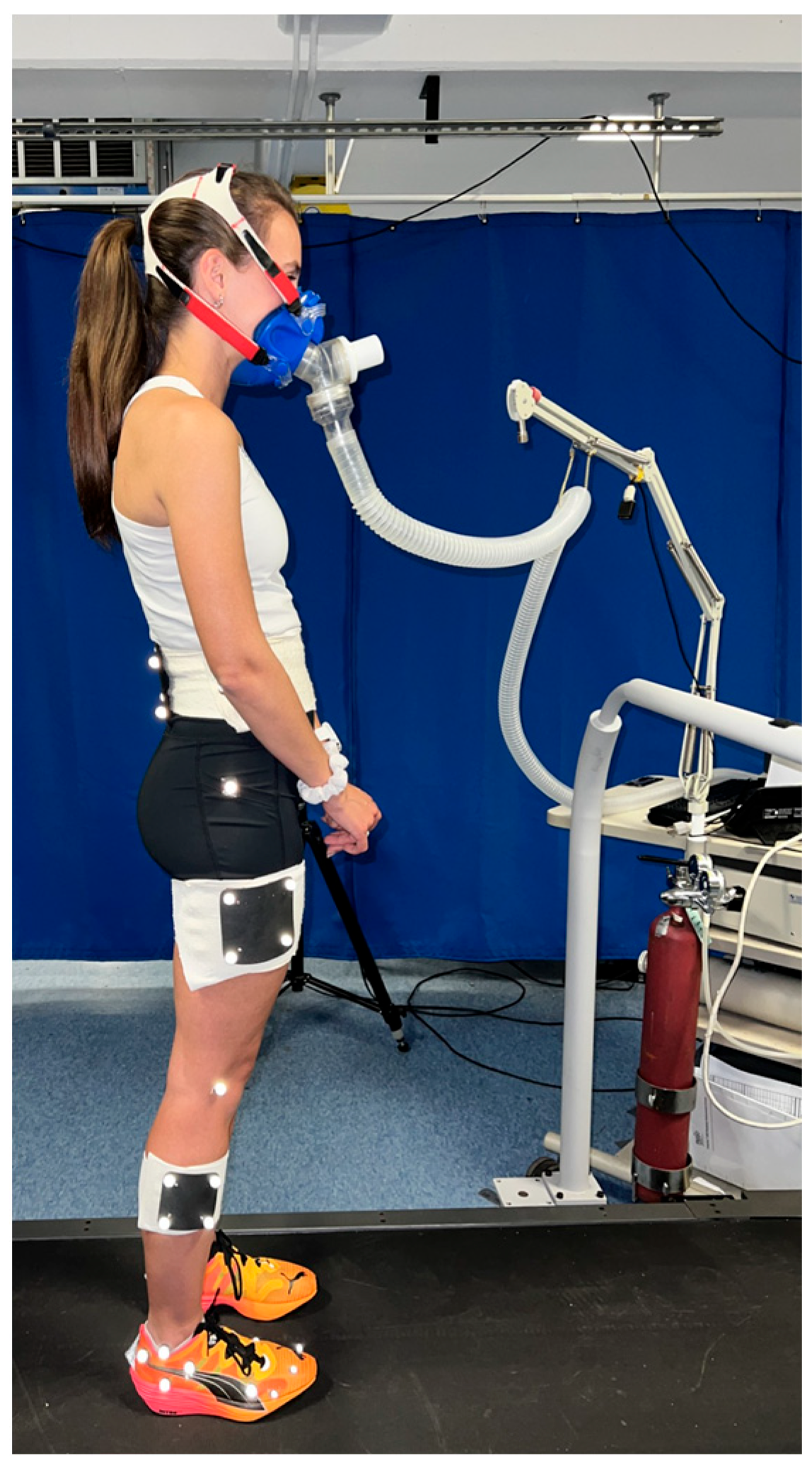
Both testing sessions followed identical testing procedures under the same laboratory conditions. Participants performed all testing procedures wearing standardized footwear (NB1080, New Balance, Boston, MA, USA). A 10-camera, three-dimensional (3D) motion capture system (240 Hz, Qualysis AB, Goteburg, Sweden) and instrumented force treadmill (1200 Hz, Bertec, Columbus, OH, USA) were used to simultaneously collect kinematic and GRF data during running trials, respectively. Additionally, a metabolic system (TrueOne 2400; ParvoMedics, Murray, UT, USA) was used to collect expired gases while running. Before testing, clusters of reflective markers mounted non-collinearly on thermoplastic shells were secured on the right thigh, shank, and posterior rearfoot (Figure 1). Participants then performed a five-minute running warm-up on the treadmill at their preferred easy-run pace (Table 1). Anatomical reflective markers were placed on the right femoral epicondyles, malleoli, and head of the first and fifth metatarsals and bilaterally on the greater trochanter of the femur and the iliac crest to define the right leg and right foot, as described in previous work [23]. A standing calibration trial was taken with all reflective markers to establish segment dimensions and local coordinate systems. Participants completed two 2 min running bouts at (1) their preferred speed (PS) and (2) preferred speed plus 5% (PS5). The 5% change increased the running demands while also keeping testing safe for this population. Participants were given two-minute rest breaks between each bout to limit potential fatigue effects. During running bouts, 3D kinematic and 3D GRF data were collected for 15 s starting at 90 s.
Participants were then fitted with a rubber facemask connected to the metabolic cart via a plastic breathing tube. Participants completed a V ˙ O 2 m a x test on the testing treadmill using two-minute stages with increasing speed, beginning with participants’ preferred speed and increasing by 5% every two minutes until volitional failure, confirmed with a plateau in V ˙ O 2 m a x for two consecutive stages. V ˙ O 2 was collected continuously during the entire test.
Following at least ten minutes of recovery, we assessed maximal plantarflexor isometric torque and AT characteristics. To measure maximum plantarflexor isometric torque (strength), participants lay prone in an isokinetic dynamometer with the knee slightly flexed and ankle at 90°. The foot was strapped to the pedal to minimize movement at the ankle joint. A diagnostic ultrasound probe (MSK probe, L12-4MHz Philips, Lumify, frame rate 24 Hz, depth 3.5 cm, and width 3.5 cm), supported by a rigid custom 3D-printed orthotic secured around the shank, was centered over the gastrocnemius medialis muscle–tendon junction (MTJ). Heel displacement was not measured but assumed to be negligible based on visual confirmation. Following standardized familiarization trials [13], participants completed three trials of maximal voluntary isometric contraction (MVIC) for three seconds, separated by one-minute rest periods [13,24,25]. During each MVIC, longitudinal displacement of the most distal point of the gastrocnemius medialis MTJ was tracked using the diagnostic ultrasound probe.

2.4. Home-Based Resistance Training Interventions

The focus of all three home-based resistance training programs was on lower body movements involving the plantarflexors (Appendix A). All interventions included two virtual (Zoom) sessions per week with an ACSM certified personal trainer, with participants’ weight provided by the researchers. The load (combination of sets and repetitions for each exercise) of each training group was matched based on AT loading index, a summation of scaled and normalized peak loading, loading impulse, and loading rate [26]. For heavy resistance exercises, participants performed 4 sets with 5–8 repetitions and were instructed to “choose a weight that would make it challenging to achieve the goal number of repetitions”. At least one-minute rest periods were allowed between sets [15,16,17], and participants could adjust their weight to ensure reaching the goal number of repetitions would be challenging. For plyometric exercises, participants performed 1–2 sets with 4–8 repetitions, with rest periods of at least one-minute between sets. Finally, for endurance exercises, participants performed 1–2 sets with 10–20 repetitions and were instructed to choose a weight for which failure was expected before achieving the goal number of repetitions, with rest periods of at least one-minute between sets [16,17]. All training interventions began with two weeks of training on techniques and movement skills in preparation for more challenging demands of heavy resistance and plyometrics training in the following eight weeks. The eight weeks consisted of two four-week training cycles, three weeks of progressive loading, and one week of reduced load, reducing the previous week’s lifting load by approximately 50% [18]. Participants were instructed to maintain their typical running training during the intervention, and researchers monitored running duration.

2.5. Data Analyses

Visual3D software (v2023.05.3, C-Motion, Germantown, MD, USA) was used to process and analyze all kinematic and kinetic data. Kinematic data were interpolated using a least-squared fit of a 3rd order polynomial, with three-data point fitting and maximum gap of 10 frames. Kinematic and GRF data were filtered using a fourth-order Butterworth low-pass filer with cut-off frequencies of 8 and 40 Hz. A right-hand rule with a Cardan rotational sequence (x-y-z) was used for 3D angular computations, where x represented the sagittal plane, y represented the frontal plane, and z represented the transverse plane. A vertical GRF threshold of 20 N defined the start and end of stance phase while running. Primary dependent variables included RE, peak plantarflexor torque, peak positive ankle power, positive ankle mechanical work, plantarflexor strength, and AT stiffness.
Relative running economy was calculated as the average V ˙ O 2 (mL·kg−1·min−1) during the last 30 s of each running bout when steady-state at each speed was confirmed [27,28] as a percentage of V ˙ O 2 m a x at each speed. The peak torque generated across the three plantarflexor MVICs was used to assess plantarflexor strength [12,13,25,29]. Ankle joint angular kinematic and kinetic variables were expressed in the shank coordinate system. Newtonian inverse dynamics were used to calculate net internal joint moments normalized to body mass (Nm·kg−1) during the stance phase. Joint angular powers were computed as the scalar product of joint angular velocities and joint moments during the stance phase (W·kg−1). Stance phase negative and positive joint work (J·kg−1) was calculated using trapezoidal integration of angular power with respect to time using a custom program in MATLAB (R2018a, Mathworks, Natick, MA, USA). The distal-to-proximal shift in joint kinetics (biomechanical plasticity) was quantified as the ratio of hip-to-ankle positive joint work (larger magnitude signifies more reliance on hip joints).
AT force was calculated by multiplying the plantarflexor MVIC torque with the externally measured lever arm of the AT [13,29]. The lever arm was measured as the distance from the right medial malleolus to the posterior aspect of the AT. The MTJ displacement was used to assess tendon elongation using an open source software (version 2.2, DeepLabCut). This software allows for the training of a deep neural network that was used in the current study to recognize the MTJ and track its movements throughout the contraction using 2764 labeled frames from 26 participants. We used a MobileNetV2-1-based neural network pre-trained on ImageNet with default parameters for 500,000 training iterations [30]. These procedures have been described in detail in previous work [31] and are validated as a reliable method to track the AT MTJ [32]. AT stiffness was calculated as the slope of the AT force and the AT elongation between 10% and 80% of MVIC torque output [13]. The average of ten steps for each running variable, the average and peak of three trials for plantarflexor MVIC torque, the AT stiffness of one ramped MVIC trial, and RE during the pre- and post-testing sessions were used in statistical analyses.

2.6. Statistical Analyses

A 2 × 3 mixed design ANOVA (SPSS 24.0, IBM) was used to address the primary purpose. Time served as the within-subject factor, while intervention group served as the between-subject factor. Data normality was assessed using Kolmogorov–Smirnov tests. If data were not normally distributed, a Mann–Whitney non-parametric test was used to compare group mean differences. A one-way ANOVA was used to compare the pre- and post-intervention difference in body mass. To decipher interaction effects, paired t-tests were used to compare time points and independent t-tests to compare groups. The 95% confidence intervals for mean differences were reported and Cohen’s d effect sizes calculated to assess effect magnitudes using the interpretation of Hopkins (small: d < 0.6, moderate: 0.6 ≥ d < 1.2, and large: d ≥ 1.2) [33]. Pearson’s correlation coefficient was used to assess the secondary purpose to assess the correlation between plantarflexion function with RE (% V ˙ O 2 m a x ). Significance level was set at an alpha level of ≤0.05.

3. Results

3.1. Participant Characteristics, Intervention Adherence, and Running Training

Participant and training characteristics are shown in Table 1. Twenty-six participants completed both testing sessions and attended at least 80% of the resistance training sessions. Due to instrumentation malfunction or dropouts, the sample size varied among dependent variables. All details regarding participant dropouts are provided in Appendix B. There were no significant group differences for physical or training characteristics during the intervention (Table 1). The pre–post difference in body mass was not different among HRT (+0.6 ± 1.0 kg), HRPT (−0.5 ± 1.8 kg), and ERPT (−0.4 ± 1.8 kg) groups (p = 0.25). Participants maintained their pre-intervention weekly running duration (p = 0.30) during the intervention. The intervention’s weekly running duration compared to pre-intervention was slightly lower for HRT (−17.8%, d = 0.5) but unchanged for the HRPT (−1.4%, d = 0.1) and ERPT (−3.2%, d = 0.0). Weekly running duration during the intervention was not different between groups (p = 0.59). All but four runners were consistently training for specific races, indicating that our population included mostly competitive runners.

3.2. V ˙ O 2 m a x and Running Economy

There were no significant group or interaction effects for V ˙ O 2 m a x or relative RE at either speed (Table 2). Relative RE improved moderately post- (82 ± 7% V ˙ O 2 m a x ), compared to pre- (84 ± 6% V ˙ O 2 m a x ), intervention (~2.4%; d = 0.3) at the preferred speed when interventions were pooled, with 68% of runners improving (14% unchanged, 18% declined). No time effect was observed for relative RE at the preferred +5% speed.

3.3. Achilles Tendon Stiffness and Isometric Plantarflexion Torque

Time effects but no interaction or group effects were observed for AT stiffness and isometric plantarflexor strength (Table 2). AT stiffness was greater post- (116.3 ± 47.9 N·mm−1) than pre- (92.3 ± 44.3 N·mm−1) intervention (26.1%, d = 0.5), with 70% of runners improving (15% unchanged, 15% declined). Average (28.2%, d = 0.6) and peak (26.4%, d = 0.6) plantarflexor strengths were larger post- (average: 90.0 ± 37.1; peak: 97.6 ± 37.9 N·m), compared to pre- (average: 70.2 ± 30.5; peak 77.2 ± 32.3 N·m), intervention, with 73% of runners improving (19% unchanged, 8% declined).

3.4. Running Biomechanics

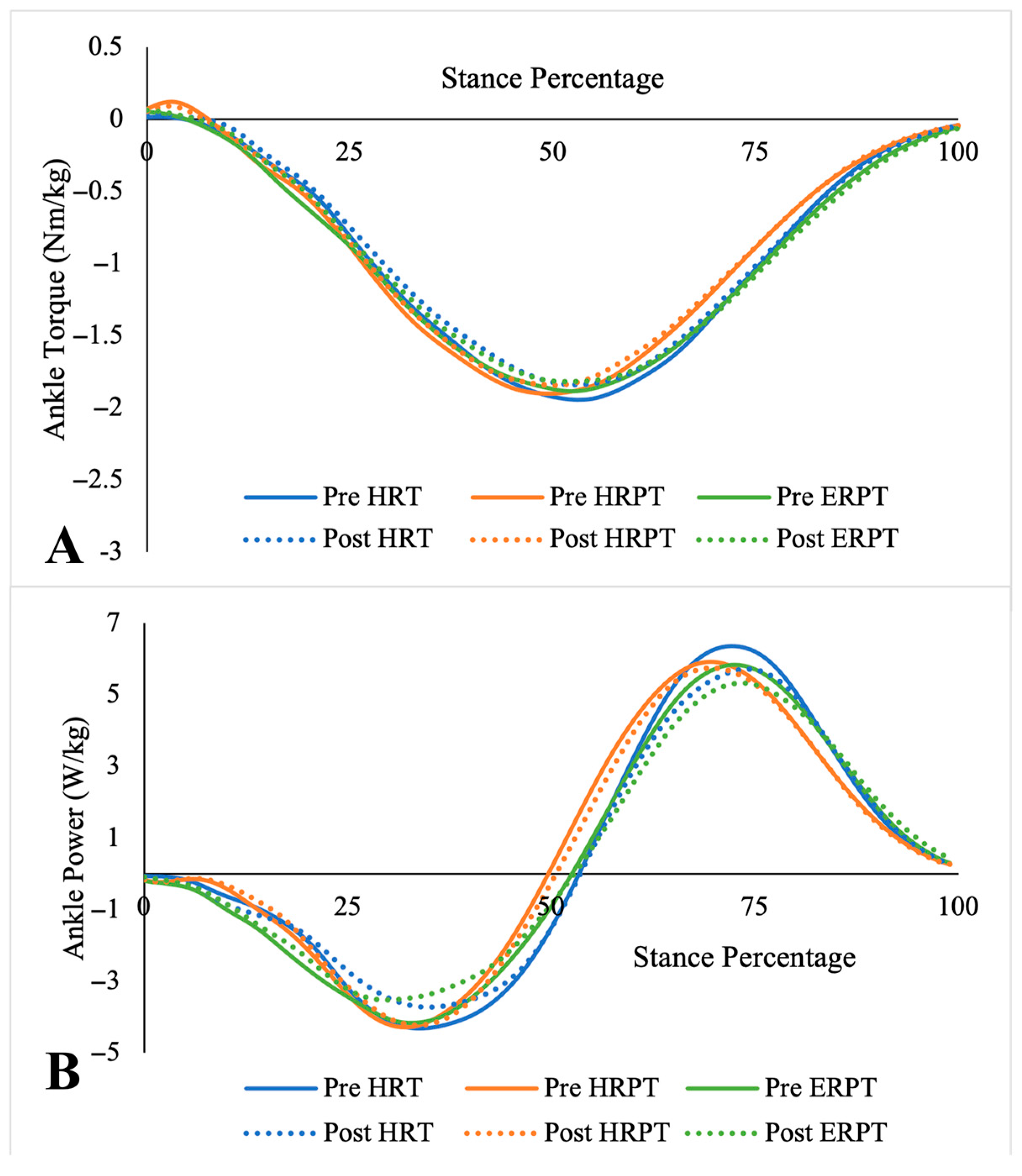
There were no group or interaction effects for any joint kinetic variables (Figure 2, Table 3 and Table 4). Time effects were observed at PS for peak knee extensor torque, peak knee negative power, and peak knee negative work. Peak knee extensor torque (1.67 ± 0.44 Nm·kg−1, p = 0.02, and d = 0.2), peak knee negative power (−5.99 ± 1.70 W·kg−1, p = 0.01, and d = 0.5), and knee negative work (−0.30 ± 0.09 J·kg−1, p = 0.04, and d = 0.3) were reduced pre- to post-intervention (1.56 ± 0.47 Nm·kg−1, −5.17 ± 1.71 W·kg−1, and −0.27 ± 0.09 J·kg−1 changes, respectively).
Time effects were observed at PS5 for peak knee extensor torque, peak knee negative power, peak knee negative work, peak negative hip power, and peak negative hip work (Table 4). Peak knee extensor torque (1.69 ± 0.44 Nm·kg−1, p = 0.02, and d = 0.2), peak knee negative power (−6.33 ± 1.61 W·kg−1, p = 0.02, and d = 0.4), and knee negative work (−0.31 ± 0.09 J·kg−1, p = 0.05, and d = 0.3) were reduced pre- to post-intervention (1.59 ± 0.49 Nm·kg−1, −5.60 ± 1.86 W·kg−1, and −0.28 ± 0.10 J·kg−1). Peak negative hip power (−1.43 ± 0.70 W·kg−1, p = 0.02, and d = 0.5) and negative hip work (−0.10 ± 0.04 J·kg−1, p = 0.04, and d = 0.5) were increased pre- to post-intervention (−1.93 ± 1.29 W·kg−1, −0.13 ± 0.07 J·kg−1).

3.5. Association Between Change in Ankle Mechanics and AT Stiffness with RE

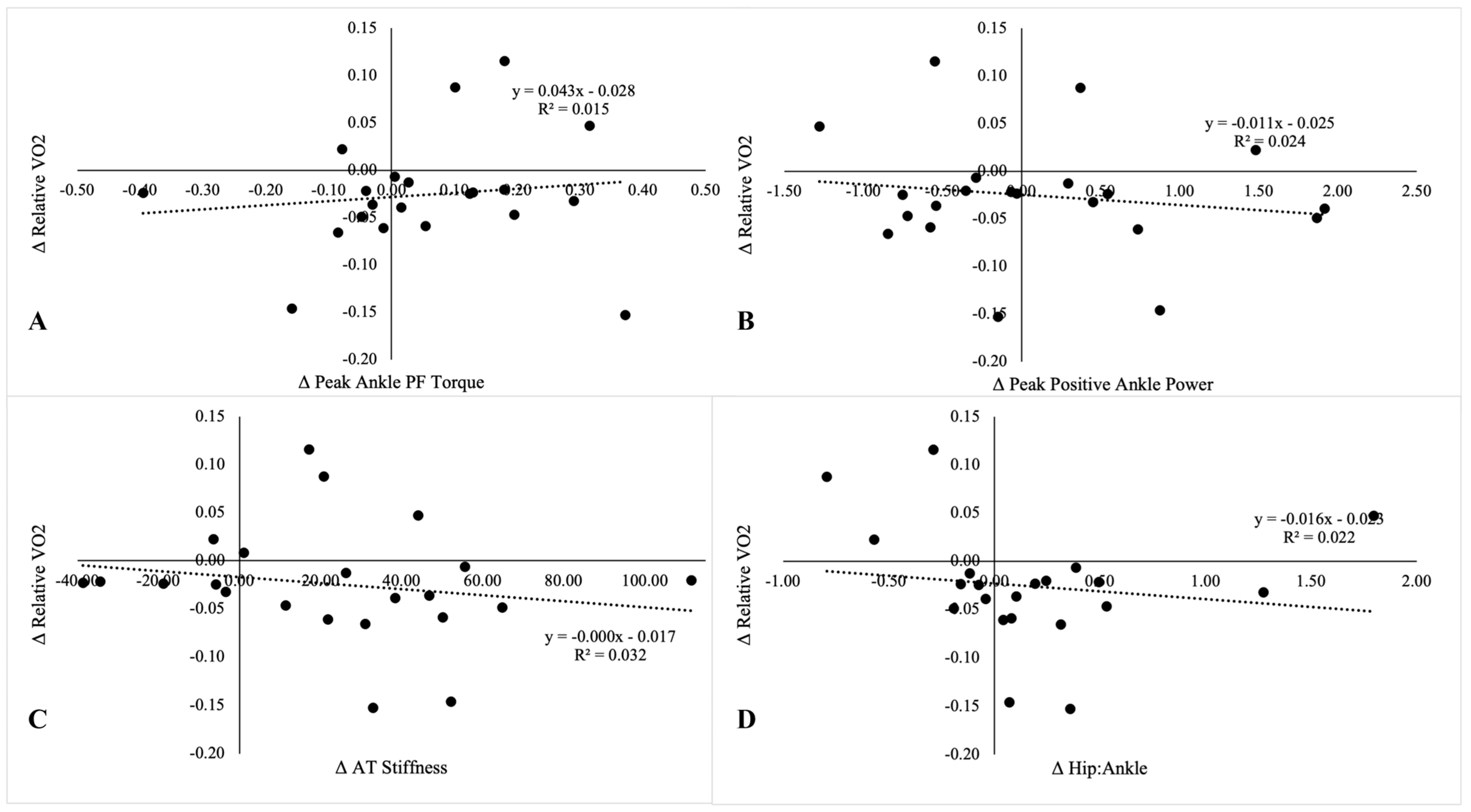
No associations (Pearson Correlation Coefficients) were observed between the change in RE and change in AT stiffness (PS: −0.20, p = 0.38; PS5: −0.07, p = 0.86), peak ankle plantarflexor torque (PS: 0.13, p = 0.56; PS5: 0.21, p = 0.36), peak ankle positive power (PS: −0.16, p = 0.49; PS5: −0.16, p = 0.50), positive ankle work (PS: −0.09, p = 0.70; PS5: −0.04, p = 0.85), and hip-to-ankle positive work ratio (PS: −0.14, p = 0.54; PS5: −0.20, p = 0.38). Linear regression showed the total variance explained (R2) as the change in relative running economy by the change in AT stiffness (3.2%), peak ankle plantarflexor torque (1.5%), peak ankle positive power (2.4%) and hip-to-ankle positive work ratio (2.2%) was minimal (Figure 3).

4. Discussion

The purpose of this exploratory study was to determine the relative influence of different resistance training interventions to improve RE, ankle plantarflexor function, and AT stiffness in middle-aged runners. Contrary to our hypotheses, we observed no interaction effects but observed a moderately improved relative RE at the preferred speed and greater average and peak isometric plantarflexor strength and increased AT stiffness for all three types of resistance training. Contrary to our hypothesis, the ankle and hip running biomechanics variables included in this study were unchanged following resistance training. These exploratory findings suggest that resistance training focused on ankle plantarflexors, regardless of the type of training, moderately reduces oxygen consumption (~2.4% improvements) as a percentage of V ˙ O 2 m a x and increases isometric plantarflexor strength and AT stiffness with no change in sagittal ankle and hip kinetics in middle-aged runners.
Despite the main effects of training, we observed no differences in pre–post intervention for RE, maximal isometric plantarflexion strength, or AT stiffness among the different resistance training groups. Our findings are partly supported by a previous study reporting 6.2% improvements in RE following heavy resistance training in middle-aged runners 44 ± 5 years of age [17]. RE only improved at the participants’ preferred speed, which was slightly slower in our protocol (2.7 ± 0.3 m·s−1) compared to 3.0 ± 1.3 m·s−1 in Piacentini et al. [17] However, they reported no improvements in RE following endurance resistance training. Importantly, they only performed paired t-tests within groups and did not use a mixed-design analysis and, therefore, did not statistically assess group differences for training effects. Furthermore, within their endurance resistance training group, they did not include plyometric exercises [17]. The lack of improvement in RE after endurance resistance training is therefore not surprising given that it omits plyometric training, which better emulates the muscle–tendon unit demand of faster running and the heavier loads needed to develop strength. It is important, however, that we only observed a 0.7% improvement in RE within our ERPT group, which is the smallest improvement of the three groups. Improvements were observed in 75% and 83% of participants in the HRT and the HRPT groups, respectively, whereas improvements were only observed for 50% of the ERPT group. Thus, despite no meaningful differences between the training groups, these descriptive group improvement data provide some preliminary evidence to justify future studies on resistance training in this population.
Relatedly, and in agreement with our current findings in middle-aged runners, heavy resistance training and heavy resistance training with plyometrics are consistently shown to improve RE in studies with primarily young runner cohorts [16,17,18,34,35,36,37]. No investigation has implemented a program combining endurance resistance training with plyometrics, and future studies on this modality would be useful. The only investigation of resistance training in middle-aged runners found no improvements in RE at 2.4 and 2.8 m·s−1 despite the 60 min resistance training sessions twice per week for eight weeks [15]. However, that study did not explicitly recruit middle-aged runners, and the cohort had an average age of 40 ± 11 years, suggesting that many participants were younger than 40 years of age and, therefore, not what may be considered middle-aged. It must be noted that the definition of chronological middle-age varies, and a definition of physiological middle-age is not universally agreed upon. Additionally, despite convincing evidence that resistance training improves RE in young runners, the training exercises used by Ferrauti et al. [15] may not have had sufficient specificity for the mechanical demands of running. Their participants completed single-joint movements using machines, movements which may not be as specific for runners. A goal in developing our programs was incorporating functional, multi-joint movements focused on the lower extremity joints that are most important for generating power during running. They were designed to be practical for runners to perform on their own, at home, or in a gym, with minimal equipment or supervision.
Our finding of increased AT stiffness following resistance training is partially supported by previous studies. However, no study has measured AT stiffness following resistance training in middle-aged runners. Despite no change in AT stiffness or RE after eight weeks of isometric plantarflexor training for young men [38], improvements in AT stiffness (+15.8% and d = 0.9) and RE (−4.2% and d = 0.8) have been reported after 14 weeks of isometric plantarflexor training in young participants of an unspecified gender [34]. Changes in RE (−5.73% and d = 0.4) and AT stiffness (+12.9% and d = 0.7) were observed in young men after only six weeks of plyometric training [37], potentially suggesting that the length of intervention necessary to elicit changes in AT stiffness and RE may be dependent on modality. A meta-analysis that assessed the findings of two investigations found that concurrent resistance and endurance training did not increase AT stiffness in young male runners, though the change in AT stiffness did approach significance, and the authors suggested that further investigation was warranted [39]. It must be noted that no previous investigation has measured changes in AT stiffness as an outcome after training in middle-aged runners. Ultimately, we contend that this is an area worthy of further study despite the apparent lack of association between RE and AT stiffness improvements.
Contrary to our hypothesis, although we observed an improvement in RE, we observed no changes in ankle kinetics during running following the interventions, complicating our search for mechanisms explaining the improvement. A potential explanation for this discrepancy is the use of a set speed on a treadmill before and after the intervention for each participant. Even though isometric plantarflexor strength may have improved after training, the set testing speeds may have inadvertently constrained the necessary plantarflexor mechanical demands for propulsion to a similar level both before and after training. Middle-aged and older runners tend to exhibit a distal-to-proximal shift in joint kinetics compared to younger runners [6,9]. We therefore expected that greater plantarflexor strength and improved ankle plantarflexor function while running would lead to greater utilization of ankle plantarflexors compared to hip extensors. However, the hip-to-ankle positive angular work ratio was unchanged after training. This could potentially be due to our cohort already having high plantarflexor function. Compared to published data in younger runners (average 28 ± 7 years) at a similar speed to that tested here (2.66 m·s−1 vs. 2.70 m·s−1), our pre-intervention middle-aged peak plantarflexor torque was lower (−1.94 ± 0.49 Nm·kg−1 vs. 2.36 ± 0.32 Nm·kg−1), as was the peak positive ankle power (6.23 ± 1.94 W·kg−1 vs. 8.39 ± 2.02 W·kg−1) [10,11]. This comparison to young runners at the same running speed suggests that our cohort had a gap in plantarflexor function with room for improvement from resistance training. Thus, further research is warranted to better elucidate what drives the distal-to-proximal shift in joint kinetics, particularly in middle-aged runners with lower plantarflexor function, to develop better interventions to address it.
Our sample population included 15 women and 11 men, which make the findings generalizable across genders. Previous investigations have recruited a participant population that is exclusively or predominantly male [15,16,17,18,36,40,41]. Lower AT stiffness, peak AT stress and force, AT thickness, and AT cross-sectional area are observed in women compared to men in a sedentary population [42], as well as in well-trained runners [43]. While no gender-based differences in overall patellar tendon stiffness have been observed after heavy resistance training, patellar tendon stiffness increases more in young men than women at lower MVIC intensities, while it increases more in women than men at higher MVIC intensities [44]. No gender-based investigations of the AT response to training have been conducted, but the findings at the patellar tendon suggest that there may be a similar response to training for AT stiffness between genders. Since our cohort included more women than men, gender differences in tendon characteristics and responses to training suggest that our findings may be different than previous investigations because of the predominance of women in our cohort. However, there is a lack of resistance training studies with concurrent endurance training that investigate gender differences in endurance performance and adaptations. Resistance training is beneficial to RE, but these benefits may be different between genders [35], indicating that there may be gender-based adaptations affecting real-world performance outside of RE.
Finally, we expected improvements in RE to be, at least partly, the result of greater utilization of ankle plantarflexors and increased AT stiffness following resistance training. With no association between changes in AT stiffness or ankle kinetics and RE across resistance training groups, another underlying mechanism must explain the improved RE. With similar ankle joint kinetics, indicating that ankle plantarflexor function was unchanged following training, two potential mechanisms may explain the improved RE following training. First, the stronger plantarflexors (albeit isometrically) suggest that plantarflexors are now able to operate at lower relative demands and thus require lesser active muscle volume for the same requisite torque demand following training. Indeed, it has been well-established that lower levels of muscle fiber recruitment are associated with a lower energy cost of transport [45]. Secondly, the stiffer AT possibly improves plantarflexor tension transfer to more efficiently (fewer recruited muscle fibers) maintain plantarflexor kinetics following training [46]. In fact, a relationship between better RE and more leg stiffness (various measures) has been widely reported [34,37,38,40,47], although this relationship was not observed within this cohort.
The greatest limitation of this investigation is the lack of a control group performing only running training for an equivalent amount of additional training time as the resistance training groups. It is well-established that maintaining running training (no increase in training volume) does not provide a sufficient stimulus to increase AT stiffness [48], and multiple studies have found that RE is unchanged in a control group that continues with their previous running training [18,34]. This suggests that the control groups do not develop the same adaptations to resistance training that improve running performance or increase tendon stiffness. Additionally, the purpose of this investigation was not to determine if resistance training was effective compared to running training alone but to understand if some modalities of resistance training were more effective than others given that most runners now partake in some form of resistance training. Future randomized control studies are needed to further understand the role of resistance training in different populations of distance runners. A second limitation is the small sample size, with 22 (groups of 8, 6, and 8) participants available for metabolic analyses, 24 (groups of 8, 9, and 7) for the running biomechanics analyses, and 26 (groups of 9, 9, and 8) for isometric plantarflexor torque and AT stiffness analyses. Small participant cohorts are common in studies evaluating AT stiffness changes after an intervention, with six and eight participants, respectively, in Fletcher et al. [40] and Spurrs et al. [37], while Albracht and Arampatzis [34] were able to retain thirteen participants. These comparably sized cohorts indicate that, although our cohort is small, it provides a novel data set of various resistance training interventions in a cohort of middle-aged runners to guide the design of future interventions. Additionally, participants were assigned to the groups rather than blindly allocated based on characteristics (age, gender, weekly training volume, and AT stiffness) affecting their ability to adapt to the training. Random assignments could have resulted in some groups having less room for improvement (greater baseline average AT stiffness or other dependent variables) during the training, potentially showing group differences that would result from participant characteristics rather than resistance training. A final limitation of this investigation is the self-selecting of weight for each exercise by the participants. Our participants were not trained in resistance training programming and may not have had the experience to sufficiently challenge themselves. Participants were encouraged to increase their weight, particularly if they appeared to be performing the goal number of repetitions without much effort. Ultimately, we felt that runners who had been competently controlling the intensity of their endurance training for years would be capable of sufficiently challenging themselves with resistance training as well.

5. Conclusions

In this exploratory study, we present novel findings that (1) different types of resistance training focused on plantarflexor exercises may moderately improve running economy and Achilles tendon stiffness without changes in running ankle biomechanics and (2) the modality of resistance training does not influence running economy, Achilles tendon stiffness, and ankle plantarflexion function differently in middle-aged recreational runners. Future randomized control trials on the influence of resistance training on performance and biomechanical function will help to better understand the effectiveness of resistance training in middle-aged runners.

Author Contributions

Conceptualization, Z.C.K., R.L.K., J.R.F., D.W.P. and M.R.P.; methodology, Z.C.K. and M.R.P.; software, Z.C.K. and R.L.K.; validation, Z.C.K. and R.L.K.; formal analysis, Z.C.K.; investigation, Z.C.K.; resources, M.R.P.; data curation, Z.C.K.; writing—original draft preparation, Z.C.K.; writing—review and editing, Z.C.K., R.L.K., J.R.F. and M.R.P.; visualization, Z.C.K.; supervision, M.R.P.; project administration, Z.C.K. All authors have read and agreed to the published version of the manuscript.

Funding

This research received no external funding.

Institutional Review Board Statement

The study was conducted in accordance with the Declaration of Helsinki, and approved by the Institutional Review Board of the University of Memphis (protocol code PRO-FY2021-296, approved 1 April 2021).

Informed Consent Statement

Informed consent was obtained from all subjects involved in the study.

Data Availability Statement

Research data will be available via Google Drive.

Acknowledgments

The authors would like to thank Adriana Miltko, Eduardo Martinez III, Garrett Hess, Ben Hazelwood, and Antonio Boyd for their help with data collections and all volunteers for participating in the study.

Conflicts of Interest

The authors declare no conflicts of interest.

Author Statement

This article was prepared while Rebecca L. Krupenevich was employed at University of North Carolina at Chapel Hill. The opinions expressed in this article are the author’s own and do not reflect the view of the National Institute on Aging, the National Institutes of Health, the Department of Health and Human Services, or the United States government.

Abbreviations

The following abbreviations are used in this manuscript:
RERunning Economy
ATAchilles Tendon
HRTHeavy Resistance Training
1RMOne Repetition Maximum
HRPTHeavy Resistance and Plyometric Training
ERPTEndurance Resistance and Plyometric Training
MTJMuscle Tendon Junction
MVICMaximum Voluntary Isometric Contraction

Appendix A. Overview of the Three Resistance Training Interventions

Intervention GroupsExercises
Heavy Resistance Training (HRT)
4 sets of 5–8 repetitions
Front squat
Seated heel raise
Straight leg heel raises
Bent leg heel raises
Lunge
Step ups
Heavy Resistance Training + Plyometrics (HRPT)
4 sets of 5–8 repetitions
For plyometrics:
1–2 sets of 10–20 repetitions
Front squat
Box jump
Seated heel raise
Straight leg heel raises
Bent leg heel raises
Forward hop
Lunge
Countermovement jump
Step ups
Alternate leg bounds
Endurance Resistance Training + Plyometrics (ERPT)
1–2 sets of 10–20 repetitions
Front squat
Box jump
Seated heel raise
Straight leg heel raises
Bent leg heel raises
Forward hop
Lunge
Countermovement jump
Step ups
Alternate leg bounds
Notes: All participants were instructed to “choose a weight that would make it challenging to achieve the goal number of repetitions”. At least one-minute rest periods were allowed between sets [16,17,18], and participants could adjust their weight to ensure reaching the goal number of repetitions would be challenging. All training interventions began with two weeks of training on techniques and movement skills in preparation for heavy resistance and plyometrics training in the following eight weeks. The eight weeks consisted of two four-week training cycles, three weeks of progressive loading, and one week of reduced load, reducing the previous week’s lifting load by approximately 50% [19].

Appendix B

From the HRT group, one participant (man) suffered an injury before the intervention began (unrelated to the experimental training), one (woman) withdrew because of muscle soreness following the first session, and one (man) withdrew after week three due to lack of time. Finally, data from one participant (man) was excluded from metabolic and biomechanical analyses due to the lack of a flight phase in testing (i.e., walking). Thus, data for eight total participants (five women) were available for analyses of the biomechanical and V ˙ O 2 m a x data for HRT and nine participants (five women) for analysis of isometric ankle data. There were no dropouts from the HRPT group; however, due to instrumentation malfunctions, metabolic data were unusable for three participants (one woman) during one of the two testing sessions. Thus, data from nine participants (five women) were available for analysis of biomechanical and isometric ankle data and six (four women) for analysis of V ˙ O 2 m a x data for HRPT. From the ERPT group, one participant (man) withdrew after week three due to illness and two participants (one woman) after weeks four and eight, respectively, due to a torn knee ligament and Achilles’ tendinopathy. One participant (woman) completed the intervention but was unavailable to attend the final laboratory testing session within two weeks of the intervention ending. Due to instrument errors during a testing session, one participant (woman) was excluded from biomechanical analyses (n = 7), leaving data for seven participants (four women) for the biomechanical analyses and data for eight participants (five women) for V ˙ O 2 and isometric ankle measurement data analyses for the ERPT.

References

  1. Lee, D.-C.; Brellenthin, A.G.; Thompson, P.D.; Sui, X.; Lee, I.M.; Lavie, C.J. Running as a Key Lifestyle Medicine for Longevity. Prog. Cardiovasc. Dis. 2017, 60, 45–55. [Google Scholar] [CrossRef]
  2. Zingg, M.; Rüst, C.A.; Lepers, R.; Rosemann, T.; Knechtle, B. Master Runners Dominate 24-h Ultramarathons Worldwide-a Retrospective Data Analysis from 1998 to 2011. Extreme Physiol. Med. 2013, 2, 21. [Google Scholar] [CrossRef]
  3. Lazarus, N.R.; Harridge, S.D.R. Exercise, Physiological Function, and the Selection of Participants for Aging Research. J. Gerontol.—Ser. Biol. Sci. Med. Sci. 2010, 65, 854–857. [Google Scholar] [CrossRef]
  4. Seals, D.R.; Hagberg, J.M.; Hurley, B.F.; Ehsani, A.A.; Holloszy, J.O. Endurance Training in Older Men and Women. I. Cardiovascular Responses to Exercise. J. Appl. Physiol. 1984, 57, 1024–1029. [Google Scholar] [CrossRef]
  5. Willy, R.W.; Paquette, M.R. The Physiology and Biomechanics of the Master Runner. Sports Med. Arthrosc. Rev. 2019, 27, 15–21. [Google Scholar] [CrossRef] [PubMed]
  6. DeVita, P.; Fellin, R.E.; Seay, J.F.; Ip, E.; Stavro, N.; Messier, S.P. The Relationships between Age and Running Biomechanics. Med. Sci. Sports Exerc. 2016, 48, 98–106. [Google Scholar] [CrossRef] [PubMed]
  7. Karamanidis, K.; Arampatzis, A.; Brüggemann, G.P. Adaptational Phenomena and Mechanical Responses during Running: Effect of Surface, Aging and Task Experience. Eur. J. Appl. Physiol. 2006, 98, 284–298. [Google Scholar] [CrossRef]
  8. Paquette, M.R.; DeVita, P.; Williams, D.S.B. Biomechanical Implications of Training Volume and Intensity in Aging Runners. Med. Sci. Sports Exerc. 2018, 50, 510–515. [Google Scholar] [CrossRef]
  9. Paquette, M.R.; Powell, D.W.; DeVita, P. Age and Training Volume Influence Joint Kinetics during Running. Scand. J. Med. Sci. Sports 2021, 31, 380–387. [Google Scholar] [CrossRef] [PubMed]
  10. Karamanidis, K.; Arampatzis, A. Mechanical and Morphological Properties of Different Muscle-Tendon Units in the Lower Extremity and Running Mechanics: Effect of Aging and Physical Activity. J. Exp. Biol. 2005, 208, 3907–3923. [Google Scholar] [CrossRef]
  11. Schneider, A.L.; Nikolaidis, P.T.; Knechtle, B. Improved Performance in Master Runners Competing in the European Championships Between 1978 and 2014. J. Strength Cond. Res. 2019, 33, 2559–2569. [Google Scholar] [CrossRef] [PubMed]
  12. Stenroth, L.; Sipilä, S.; Finni, T.; Cronin, N.J. Slower Walking Speed in Older Men Improves Triceps Surae Force Generation Ability. Med. Sci. Sports Exerc. 2017, 49, 158–166. [Google Scholar] [CrossRef]
  13. Stenroth, L.; Peltonen, J.; Cronin, N.J.; Sipilã, S.; Finni, T. Age-Related Differences in Achilles Tendon Properties and Triceps Surae Muscle Architecture In Vivo. J. Appl. Physiol. 2012, 113, 1537–1544. [Google Scholar] [CrossRef]
  14. Blagrove, R.C.; Howe, L.P.; Cushion, E.J.; Spence, A.; Howatson, G.; Pedlar, C.R.; Hayes, P.R. Effects of Strength Training on Postpubertal Adolescent Distance Runners. Med. Sci. Sports Exerc. 2018, 50, 1224–1232. [Google Scholar] [CrossRef]
  15. Ferrauti, A.; Bergermann, M.; Fernandez-Fernandez, J. Effects of a Concurrent Strength and Endurance Training on Running Performance and Running Economy in Recreational Marathon Runners. J. Strength Cond. Res. 2010, 24, 2770–2778. [Google Scholar] [CrossRef]
  16. Li, F.; Wang, R.; Newton, R.U.; Sutton, D.; Shi, Y.; Ding, H. Effects of Complex Training versus Heavy Resistance Training on Neuromuscular Adaptation, Running Economy and 5-Km Performance in Well-Trained Distance Runners. PeerJ 2019, 7, e6787. [Google Scholar] [CrossRef]
  17. Piacentini, M.F.; De Ioannon, G.; Comotto, S.; Spedicato, A.; Vernillo, G.; La Torre, A. Concurrent Strength and Endurance Training Effects on Running Economy in Master Endurance Runners. J. Strength Cond. Res. 2013, 27, 2295–2303. [Google Scholar] [CrossRef]
  18. Beattie, K.; Carson, B.P.; Lyons, M.; Rossiter, A.; Kenny, I.C. The Effect of Strength Training on Performance Indicators in Distance Runners. J. Strength Cond. Res. 2017, 31, 9–23. [Google Scholar] [CrossRef] [PubMed]
  19. Kubo, K.; Morimoto, M.; Komuro, T.; Yata, H.; Tsunoda, N.; Kanehisa, H.; Fukunaga, T. Effects of Plyometric and Weight Training on Muscle-Tendon Complex and Jump Performance. Med. Sci. Sports Exerc. 2007, 39, 1801–1810. [Google Scholar] [CrossRef] [PubMed]
  20. Arampatzis, A.; Karamanidis, K.; Morey-Klapsing, G.; De Monte, G.; Stafilidis, S. Mechanical Properties of the Triceps Surae Tendon and Aponeurosis in Relation to Intensity of Sport Activity. J. Biomech. 2007, 40, 1946–1952. [Google Scholar] [CrossRef]
  21. Fouré, A.; Nordez, A.; McNair, P.; Cornu, C. Effects of Plyometric Training on Both Active and Passive Parts of the Plantarflexors Series Elastic Component Stiffness of Muscle-Tendon Complex. Eur. J. Appl. Physiol. 2011, 111, 539–548. [Google Scholar] [CrossRef]
  22. Schoenfeld, B.J.; Peterson, M.D.; Ogborn, D.; Contreras, B.; Sonmez, G.T. Effects of Low- vs. High-Load Resistance Training on Muscle Strength and Hypertrophy in Well-Trained Men. J. Strength Cond. Res. 2015, 29, 2954–2963. [Google Scholar] [CrossRef]
  23. Kuhman, D.; Melcher, D.; Paquette, M.R. Ankle and Knee Kinetics between Strike Patterns at Common Training Speeds in Competitive Male Runners. Eur. J. Sport Sci. 2016, 16, 433–440. [Google Scholar] [CrossRef]
  24. Stenroth, L.; Cronin, N.J.; Peltonen, J.; Korhonen, M.T.; Sipilä, S.; Finni, T. Triceps Surae Muscle-Tendon Properties in Older Endurance- and Sprint-Trained Athletes. J. Appl. Physiol. 2016, 1, 63–69. [Google Scholar] [CrossRef]
  25. Stenroth, L.; Thelen, D.; Franz, J.R. Biplanar Ultrasound Investigation of in Vivo Achilles Tendon Displacement Non-Uniformity. Transl. Sports Med. 2019, 2, 73–81. [Google Scholar] [CrossRef]
  26. Baxter, J.R.; Corrigan, P.; Hullfish, T.J.; O’Rourke, P.; Silbernagel, K.G. Exercise Progression to Incrementally Load the Achilles Tendon. Med. Sci. Sports Exerc. 2021, 53, 124–130. [Google Scholar] [CrossRef] [PubMed]
  27. Kuipers, H.; Rietjens, G.; Verstappen, F.; Schoenmakers, H.; Hofman, G. Effects of Stage Duration in Incremental Running Tests on Physiological Variables. Int. J. Sports Med. 2003, 24, 486–491. [Google Scholar] [CrossRef]
  28. Riboli, A.; Cè, E.; Rampichini, S.; Venturelli, M.; Alberti, G.; Limonta, E.; Veicsteinas, A.; Esposito, F. Comparison between Continuous and Discontinuous Incremental Treadmill Test to Assess Velocity at V̇O2max. J. Sports Med. Phys. Fitness 2017, 57, 1119–1125. [Google Scholar] [CrossRef] [PubMed]
  29. Franz, J.R.; Khanchandani, A.; Mckenny, H.; Clark, W.H. Ankle Rotation and Muscle Loading Effects on the Calcaneal Tendon Moment Arm: An in Vivo Imaging and Modeling Study. Ann. Biomed. Eng. 2019, 47, 590–600. [Google Scholar] [CrossRef]
  30. Mathis, A.; Biasi, T.; Schneider, S.; Yüksekgönül, M.; Rogers, B.; Bethge, M.; Mathis, M.W. Pretraining Boosts Out-of-Domain Robustness for Pose Estimation. In Proceedings of the IEEE/CVF Winter Conference on Applications of Computer Vision (WACV), Virtual, 5–9 January 2021. [Google Scholar]
  31. Mathis, A.; Mamidanna, P.; Cury, K.M.; Abe, T.; Murthy, V.N.; Mathis, M.W.; Bethge, M. DeepLabCut: Markerless Pose Estimation of User-Defined Body Parts with Deep Learning. Nat. Neurosci. 2018, 21, 1281–1289. [Google Scholar] [CrossRef] [PubMed]
  32. Krupenevich, R.L.; Funk, C.J.; Franz, J.R. Automated Analysis of Medial Gastrocnemius Muscle-Tendon Junction Displacements in Heathy Young Adults during Isolated Contractions and Walking Using Deep Neural Networks. Comput. Methods Programs Biomed. 2021, 206, 106120. [Google Scholar] [CrossRef]
  33. Hopkins, W.G.; Marshall, S.W.; Batterham, A.M.; Hanin, J. Progressive Statistics for Studies in Sports Medicine and Exercise Science. Med. Sci. Sports Exerc. 2009, 41, 3–12. [Google Scholar] [CrossRef]
  34. Albracht, K.; Arampatzis, A. Exercise-Induced Changes in Triceps Surae Tendon Stiffness and Muscle Strength Affect Running Economy in Humans. Eur. J. Appl. Physiol. 2013, 113, 1605–1615. [Google Scholar] [CrossRef] [PubMed]
  35. Barnes, K.R.; Hopkins, W.G.; Mcguigan, M.R.; Northuis, M.E.; Kilding, A.E. Effects of Resistance Training on Running Economy and Cross-Country Performance. Med. Sci. Sports Exerc. 2013, 45, 2322–2331. [Google Scholar] [CrossRef] [PubMed]
  36. Li, F.; Nassis, G.P.; Shi, Y.; Han, G.; Zhang, X.; Gao, B.; Ding, H. Concurrent Complex and Endurance Training for Recreational Marathon Runners: Effects on Neuromuscular and Running Performance. Eur. J. Sport Sci. 2021, 21, 1243–1253. [Google Scholar] [CrossRef]
  37. Spurrs, R.; Murphy, A.; Watsford, M. The Effect of Plyometric Training on Distance Running Performance. Eur. J. Appl. Physiol. 2003, 89, 1–7. [Google Scholar] [CrossRef]
  38. Fletcher, J.R.; Pfister, T.; Macintosh, B. Energy Cost of Running and Achilles Tendon Stiffness in Man and Woman Trained Runners. Physiol. Rep. 2013, 1, e00178. [Google Scholar] [CrossRef]
  39. Trowell, D.; Vicenzino, B.; Saunders, N.; Fox, A.; Bonacci, J. Effect of Strength Training on Biomechanical and Neuromuscular Variables in Distance Runners: A Systematic Review and Meta-Analysis. Sports Med. 2020, 50, 133–150. [Google Scholar] [CrossRef]
  40. Fletcher, J.R.; Esau, S.; MacIntosh, B. Changes in Tendon Stiffness and Running Economy in Highly Trained Distance Runners. Eur. J. Appl. Physiol. 2010, 110, 1037–1046. [Google Scholar] [CrossRef]
  41. Trowell, D.; Fox, A.; Saunders, N.; Vicenzino, B.; Bonacci, J. Effect of Concurrent Strength and Endurance Training on Run Performance and Biomechanics: A Randomised Controlled Trial. Scand. J. Med. Sci. Sports 2021, 32, 543–558. [Google Scholar] [CrossRef]
  42. Zhang, X.; Deng, L.; Xiao, S.; Li, L.; Fu, W. Sex Differences in the Morphological and Mechanical Properties of the Achilles Tendon. Int. J. Environ. Res. Public Health 2021, 18, 8974. [Google Scholar] [CrossRef]
  43. Westh, E.; Kongsgaard, M.; Bojsen-Moller, J.; Aagaard, P.; Hansen, M.; Kjaer, M.; Magnusson, S.P. Effect of Habitual Exercise on the Structural and Mechanical Properties of Human Tendon, in Vivo, in Men and Women. Scand. J. Med. Sci. Sports 2008, 18, 23–30. [Google Scholar] [CrossRef]
  44. McMahon, G.; Morse, C.I.; Winwood, K.; Burden, A.; Onambéle, G.L. Gender Associated Muscle-Tendon Adaptations to Resistance Training. PLoS ONE 2018, 13, e0197852. [Google Scholar] [CrossRef]
  45. Biewener, A.A.; Farley, C.T.; Roberts, T.J.; Temaner, M. Muscle Mechanical Advantage of Human Walking and Running: Implications for Energy Cost. J. Appl. Physiol. 2004, 97, 2266–2274. [Google Scholar] [CrossRef]
  46. Hirayama, K.; Iwanuma, S.; Ikeda, N.; Yoshikawa, A.; Ema, R.; Kawakami, Y. Plyometric Training Favors Optimizing Muscle-Tendon Behavior during Depth Jumping. Front. Physiol. 2017, 8, 16. [Google Scholar] [CrossRef]
  47. Arampatzis, A.; De Monte, G.; Karamanidis, K.; Morey-Klapsing, G.; Stafilidis, S.; Brüggemann, G.P. Influence of the Muscle-Tendon Unit’s Mechanical and Morphological Properties on Running Economy. J. Exp. Biol. 2006, 209, 3345–3357. [Google Scholar] [CrossRef] [PubMed]
  48. Hansen, P.; Aagaard, P.; Kjaer, M.; Larsson, B.; Magnusson, S.P. Effect of Habitual Running on Human Achilles Tendon Load-Deformation Properties and Cross-Sectional Area. J. Appl. Physiol. (1985) 2003, 95, 2375–2380. [Google Scholar] [CrossRef]
Figure 1. Participant setup with anatomical and tracking clusters while metabolic data is collected.
Biomechanics 06 00018 g001
Figure 2. Ensemble average of all stance phases for all runners in heavy resistance training (HRT; blue), heavy resistance with plyometrics (HRPT; orange), and endurance resistance with plyometric (ERPT, green) for pre- (solid lines) and post- (dotted lines) intervention for net ankle sagittal plane torque ((A), plantarflexor (−) and dorsiflexor (+)) and ankle sagittal plane power (B).
Biomechanics 06 00018 g002
Figure 3. Scatter plots with linear regression equations for changes in relative running economy and changes in peak ankle plantarflexor torque (A), peak ankle positive power (B), change in AT stiffness (C), and hip-to-ankle positive work ratio (D). The R2 values indicate that the variance in the change in relative running economy is poorly explained by the change in the four variables.
Biomechanics 06 00018 g003
Table 1. Pre-training participant characteristics and training details and 10-week intervention training details for the heavy resistance and plyometric (HRPT) group, heavy resistance (HRT) group, and the endurance resistance and plyometric (ERPT) group (mean ± SD).
Training Group
HRTHRPTERPTp-Value
Sample Size (women/men N) *9 (5W/4M)9 (5W/4M)8 (5W/3M)-
Age (years)50 ± 552 ± 451 ± 50.65
Mass (kg)75.8 ± 20.670.7 ± 10.772.2 ± 14.90.78
Height (m)1.71 ± 0.111.70 ± 0.091.69 ± 0.10.98
Running Experience (years)16 ± 814 ± 713 ± 100.73
Preferred Speed (m·s−1)2.7 ± 0.32.7 ± 0.32.5 ± 0.40.47
Pre-Training Weekly Running Duration (min)207 ± 98214 ± 100183 ± 850.78
Intervention Period Weekly Running
Duration (min)
171 ± 70211 ± 102177 ± 970.59
Intervention Adherence (% attended)92.2 ± 7.191.1 ±6.588.8 ± 8.30.62
Notes: N: sample size; W: women; M: men; *: sample size varies for running economy (see Results section for details), AT stiffness, and running biomechanics variables; and Bold: p-value ≤ 0.05.
Table 2. V ˙ O 2 max and relative (% of V ˙ O 2 max) running economy (RE; submaximal V ˙ O 2 ) for preferred speed (PS) and PS + 5% (PS5), and maximum and average isometric plantarflexion torque and Achilles tendon (AT) stiffness during three maximal isometric ankle plantarflexion trials in an isokinetic dynamometer for the heavy resistance and plyometric (HRPT) group, heavy resistance (HRT) group, and the endurance resistance and plyometric (ERPT) group (mean ± SD).
HRTHRPTERPTp-Values
PrePostPrePostPrePostTimeGroupInter.
V ˙ O 2 max (mL·kg−1·min−1)35.1 ± 5.436.4 ± 5.840.0 ± 5.939.5 ± 7.235.7 ± 4.935.5 ± 4.30.730.310.22
PS Relative RE84.8 ± 5.182.5 ± 8.984.5 ± 6.380.7 ± 7.283.3 ± 6.082.6 ± 6.50.050.950.51
PS5 Relative RE89.3 ± 4.487.8 ± 9.388.7 ± 5.987.3 ± 7.688.1 ± 6.286.3 ± 5.80.110.390.10
Maximum Torque (N·m)88.6 ± 29.598.2 ± 23.474.9 ± 28.2103.6 ± 49.667.2 ± 37.590.4 ± 39.80.0010.670.17
Average Torque (N·m)83.6 ± 29.591.0 ± 22.964.7 ± 28.295.1 ± 48.061.4 ± 34.983.1 ± 39.90.0010.640.09
AT Stiffness (N·mm−1)91.3 ± 44.3111.5 ± 42.591.3 ± 45.2125.4 ± 44.794.5 ± 49.3111.5 ± 42.50.0020.940.57
Notes: Bold: p-value ≤ 0.05.
Table 3. Peak joint torques (Nm·kg−1), peak angular joint powers (W·kg−1), and joint angular work (J·kg−1) for pre- and post-intervention for heavy resistance and plyometric (HRPT) group, heavy resistance (HRT) group, and the endurance resistance and plyometric (ERPT) group (mean ± SD) at preferred speed.
HRTHRPTERPTp-Values
PrePostPrePostPrePostTimeGroupInter.
Peak Hip Flexor Torque 0.78 ± 0.13 0.77 ± 0.19 0.70 ± 0.22 0.75 ± 0.27 0.73 ± 0.22 0.72 ± 0.250.640.870.44
Peak Hip Extensor Torque−1.66 ± 0.37−1.80 ± 0.54−1.82 ± 0.51−1.89 ± 0.49−1.65 ± 0.50−1.69 ± 0.510.100.730.69
Peak Positive Hip Power 3.60 ± 1.52 4.10 ± 1.67 3.62 ± 1.97 4.23 ± 1.90 3.40 ± 1.69 3.32 ± 1.500.310.740.68
Peak Negative Hip Power−1.48 ± 0.94−1.44 ± 1.58−1.25 ± 0.43−1.50 ± 0.82−1.28 ± 0.75−1.61 ± 0.900.260.980.60
Positive Hip Work 0.30 ± 0.13 0.39 ± 0.15 0.34 ± 0.17 0.38 ± 0.20 0.33 ± 0.22 0.32 ± 0.210.360.890.62
Negative Hip Work−0.10 ± 0.04−0.10 ± 0.08−0.08 ± 0.04−0.11 ± 0.06−0.10 ± 0.04−0.12 ± 0.060.210.910.30
Peak Knee Extensor Torque 1.58 ± 0.44 1.46 ± 0.55 1.61 ± 0.31 1.47 ± 0.28 1.84 ± 0.59 1.80 ± 0.540.020.360.60
Peak Positive Knee Power 3.01 ± 0.62 2.92 ± 0.83 2.99 ± 1.21 2.93 ± 0.88 3.31 ± 1.60 3.09 ± 1.460.450.860.92
Peak Negative Knee Power−5.94 ± 2.15−4.79 ± 2.06−5.89 ± 1.68−5.17 ± 1.68−6.17 ± 1.35−5.62 ± 1.430.010.810.70
Positive Knee Work 0.21 ± 0.05 0.20 ± 0.10 0.20 ± 0.07 0.20 ± 0.06 0.24 ± 0.10 0.24 ± 0.060.810.460.79
Negative Knee Work−0.28 ± 0.09−0.25 ± 0.09−0.28 ± 0.09−0.25 ± 0.07−0.34 ± 0.09−0.31 ± 0.090.040.260.94
Peak Ankle PF Torque−1.97 ± 0.53−1.88 ± 0.44−1.95 ± 0.32−1.88 ± 0.25−1.91 ± 0.67−1.87 ± 0.650.120.990.87
Peak Ankle Positive Power 6.49 ± 1.83 6.41 ± 1.63 6.20 ± 1.65 6.17 ± 1.41 5.97 ± 2.59 6.27 ± 2.530.750.930.69
Peak Ankle Negative Power−4.55 ± 1.09−4.53 ± 1.23−4.43 ± 1.47−4.39 ± 1.07−4.40 ± 2.64−4.56 ± 2.340.880.990.91
Ankle Positive Work 0.47 ± 0.16 0.44 ± 0.16 0.47 ± 0.11 0.46 ± 0.10 0.46 ± 0.18 0.48 ± 0.150.600.980.55
Ankle Negative Work−0.36 ± 0.09−0.34 ± 0.10−0.31 ± 0.10−0.31 ± 0.07−0.38 ± 0.23−0.37 ± 0.210.370.690.90
Total Positive Work 1.08 ± 0.17 1.17 ± 0.34 1.20 ± 0.42 1.17 ± 0.26 1.09 ± 0.39 1.18 ± 0.230.450.870.72
Total Negative Work−0.92 ± 0.17−0.86 ± 0.19−0.91 ± 0.20−0.85 ± 0.18−0.98 ± 0.24−0.96 ± 0.260.270.580.92
Hip–Ankle Positive Work (%) 1.08 ± 0.171.17 ± 0.34 1.20 ± 0.42 1.17 ± 0.26 1.09 ± 0.39 1.18 ± 0.230.450.870.72
Notes: Hip–Ankle: ratio of positive hip and ankle work; and Bold: p-value < 0.05).
Table 4. Peak joint torques (Nm·kg−1), peak angular joint powers (W·kg−1), and joint angular work (J·kg−1) for pre and post-intervention for heavy resistance and plyometric (HRPT) group, heavy resistance (HRT) group, and the endurance resistance and plyometric (ERPT) group (mean ± SD) at preferred speed +5%.
HRTHRPTERPTp-Values
PrePostPrePostPrePostTimeGroupInter.
Peak Hip Flexor Torque0.77 ± 0.170.80 ± 0.170.75 ± 0.290.80 ± 0.270.72 ± 0.220.75 ± 0.230.170.910.93
Peak Hip Extensor Torque−1.75 ± 0.39−1.87 ± 0.56−2.02 ± 0.59−1.99 ± 0.52−1.76 ± 0.56−1.75 ± 0.580.640.600.46
Peak Positive Hip Power3.80 ± 1.644.44 ± 1.814.22 ± 1.914.77 ± 1.813.70 ± 1.733.51 ± 1.780.370.540.61
Peak Negative Hip Power−1.58 ± 0.84−1.69 ± 1.51−1.29 ± 0.48−2.16 ± 1.22−1.45 ± 0.84−1.89 ± 1.260.020.980.28
Positive Hip Work0.31 ± 0.130.38 ± 0.130.36 ± 0.200.42 ± 0.190.36 ± 0.240.33 ± 0.210.400.550.78
Negative Hip Work−0.12 ± 0.04−0.12 ± 0.08−0.09 ± 0.04−0.13 ± 0.06−0.11 ± 0.04−0.14 ± 0.070.040.910.18
Peak Knee Extensor Torque1.60 ± 0.431.46 ± 0.501.62 ± 0.321.49 ± 0.301.90 ± 0.571.87 ± 0.610.020.250.53
Peak Positive Knee Power3.22 ± 0.683.13 ± 0.883.10 ± 1.153.02 ± 0.853.45 ± 1.473.22 ± 1.050.360.850.90
Peak Negative Knee Power−6.25 ± 2.23−4.95 ± 1.73−6.31 ± 1.25−5.85 ± 2.05−6.44 ± 1.41−6.04 ± 1.810.020.730.40
Positive Knee Work0.23 ± 0.060.21 ± 0.090.21 ± 0.070.21 ± 0.040.25 ± 0.090.25 ± 0.050.540.460.84
Negative Knee Work−0.30 ± 0.10−0.25 ± 0.07−0.28 ± 0.08−0.27 ± 0.09−0.36 ± 0.10−0.34 ± 0.120.050.230.58
Peak Ankle PF Torque−1.96 ± 0.50−1.88 ± 0.43−1.94 ± 0.33−1.92 ± 0.26−1.97 ± 0.69−1.90 ± 0.680.170.990.81
Peak Ankle Positive Power6.79 ± 1.976.39 ± 2.026.41 ± 1.756.42 ± 1.556.52 ± 2.976.57 ± 2.860.560.980.58
Peak Ankle Negative Power−4.80 ± 1.21−4.43 ± 1.37−4.74 ± 1.47−4.66 ± 1.06−4.66 ± 2.76−4.70 ± 2.630.490.990.68
Ankle Positive Work0.47 ± 0.160.44 ± 0.140.47 ± 0.110.47 ± 0.110.48 ± 0.180.48 ± 0.160.560.940.65
Ankle Negative Work−0.37 ± 0.09−0.34 ± 0.11−0.33 ± 0.10−0.32 ± 0.06−0.40 ± 0.24−0.38 ± 0.230.100.690.82
Total Positive Work1.00 ± 0.241.03 ± 0.271.05 ± 0.301.09 ± 0.251.09 ± 0.451.06 ± 0.250.740.900.84
Total Negative Work−0.78 ± 0.18−0.71 ± 0.17−0.70 ± 0.17−0.73 ± 0.16−0.87 ± 0.32−0.85 ± 0.340.230.440.11
Hip–Ankle Positive Work (%)69.3 ± 30.591.6 ± 40.275.2 ± 28.897.0 ± 72.077.8 ± 40.077.5 ± 53.20.190.910.65
Notes: Hip–Ankle: ratio of positive hip and ankle work; and Bold: p-value < 0.05).
Disclaimer/Publisher’s Note: The statements, opinions and data contained in all publications are solely those of the individual author(s) and contributor(s) and not of MDPI and/or the editor(s). MDPI and/or the editor(s) disclaim responsibility for any injury to people or property resulting from any ideas, methods, instructions or products referred to in the content.