Article

The Nonlinear Effects of Walking Speed on Calf Muscle Activation During the Ankle Power Generation Phase


1
Department of Rehabilitation Sciences, The Hong Kong Polytechnic University, 11 Yuk Choi Rd, Hung Hom, Kowloon, Hong Kong 999077, China
2
Rehabilitation Research Institute of Singapore, Nanyang Technological University, 1 Mandalay Rd, #14-03 Clinical Science Building, Singapore 699010, Singapore
*
Author to whom correspondence should be addressed.
Biomechanics 2026, 6(1), 20; https://doi.org/10.3390/biomechanics6010020
Submission received: 2 December 2025 / Revised: 23 January 2026 / Accepted: 27 January 2026 / Published: 6 February 2026
(This article belongs to the Section Gait and Posture Biomechanics)

Abstract

Background/Objectives: The calf muscles are vital for generating propulsive force during walking. This power is produced from calf muscle contractions and elastic strain energy release. However, the impact of walking speed on these power-generation mechanisms is understudied. This study aimed to investigate how different walking speeds affect calf muscle activation and ankle power generation. Methods: In this study, we analyzed electromyography (EMG) signals from the gastrocnemius (GAS) and soleus (SOL) muscles of 55 healthy individuals walking at various speeds. C1: household ambulators (0–0.4 m·s−1), C2: limited community ambulators (0.4–0.8 m·s−1), C3: community ambulators (0.8–1.2 m·s−1), C4: self-selected usual speed, and C5: self-selected fast speed. Results: Deviating from a participant’s self-chosen pace led to increased cumulative muscle activity and prolonged plantar flexor activation. Optimal muscle activation was observed at speeds between 0.8–1.2 m·s−1. A second-degree polynomial mixed model best captured the relationship between muscle activation duration and integrated EMG in the ankle power generation phase in late stance, demonstrating the nonlinear relationship between walking speed and calf muscle activation in this phase. Statistically significant models (p < 0.001) explained over 50% of the variability in GAS activation duration (R2 = 0.55) and integrated EMG (R2 = 0.56), as well as SOL activation duration (R2 = 0.52) and integrated EMG (R2 = 0.72). Conclusions: The nonlinear relationship between walking speed and calf muscle activation indicates that normal walking speed optimizes the utilization of elastic strain energy in the ankle power generation phase.

1. Introduction

Previous studies [1,2,3] have demonstrated that the ankle plantar flexors play a primary role in generating propulsive force during human locomotion in the late stance phase. In this phase, the power generated by the ankle plantar flexors contributes to both vertical and horizontal acceleration of the center of mass. Vertical acceleration of the center of mass assists in maintaining an upright posture. Horizontal acceleration of the center of mass promotes forward progression of the trunk [4,5,6]. The ankle power-generation phase represents the period during which the plantar flexors contribute most to propulsion. Outside this phase, muscle activity mostly helps stabilize or absorb energy, rather than directly pushing us ahead. Focusing on this phase allows us to isolate the concentric contribution of the plantar flexors to push-off and to clarify how this role changes across different walking speeds.
Previous studies [7,8,9] have shown that walking speed alters both the timing and the magnitude of positive ankle power during this critical phase. This emphasizes the importance of examining how the ankle musculotendon system responds to speed modulation. By focusing on the power-generation phase, this study reduces confounding from other gait phases and allows meaningful comparisons across participants and walking speeds, even when gait cycle durations differ. Expressing activation duration as a percentage of the power-generation phase accounts for speed-related differences in gait cycle length and enables more robust comparisons. This approach provides insight into efficient muscle utilization and can help inform gait training and rehabilitation strategies.
Power is generated by the ankle plantar flexors primarily through two mechanisms: (1) active contraction of the ankle plantar flexors and (2) passive tendon elastic strain energy.
During the mid-stance, the plantar flexors undergo eccentric contraction as the tibia moves forward over the foot [10,11]. Achilles tendon is gradually stretched under passive ankle dorsiflexion. This stores elastic strain energy within the tendon. From late stance to pre-swing, the stretched tendon recoils rapidly, releasing the stored elastic energy to produce forward propulsion [6,12,13,14]. This passive recoil reduces the amount of concentric muscle activity required to generate the push-off force, making tendon elasticity an important energy-saving mechanism during gait [15,16,17]. In addition to tendon contributions, the plantar flexors also generate power through active concentric contraction, especially during the late stance phase. Evidence shows that between 40–60% of the gait cycle, the plantar flexors produce high peak power output to assist with push-off and forward progression [18].
The relationship between walking speed and ankle movement considerably influences overall gait performance. A systematic review [18] demonstrated that a decrease in walking speed leads to reductions in cadence, stride length, step length, and stance phase duration. Slow walking speed has a strong influence on power generated by the ankle plantar flexors because the reduced ankle dorsiflexion angle during the mid-stance phase limits the storage of elastic strain energy [10].
Conversely, an increase in gait speed is positively associated with peak ankle plantarflexion angles and peak ankle dorsiflexion, particularly in children and young adults [10]. Moreover, higher walking speed is correlated with higher ankle plantarflexion moments, particularly in the late stance phase [6]. To accelerate locomotion, individuals can increase their stride length, cadence, or both. Neptune [6] suggested that higher walking speed results in greater concentric work and eccentric work by the ankle plantar flexors.
We hypothesized that plantar flexor activation decreases at self-selected walking speeds in the power generation phase, reflecting an optimization in the usage of elastic strain energy. Conversely, plantar flexor active contraction was expected to increase at both high and low walking speeds.
Most studies have focused on the impact of change in locomotion speed on kinematics, kinetics and the overall muscle activation involved in human locomotion. However, the specific influences of walking speed on the activation patterns and biomechanical roles of the plantar flexor muscles in the ankle power generation phase have not been studied systematically. Understanding these patterns has clinical relevance: it can improve the assessment and training of walking at different speeds, guide rehabilitation strategies for patients with gait impairments (e.g., stroke, knee osteoarthritis), and support the design of individualized programs that target specific walking speeds and selectively strengthen concentric and eccentric plantar flexor activity, ultimately optimizing gait efficiency, energy use, and functional mobility. Therefore, the objective of this study was to analyze the activation patterns of the plantar flexor muscles, specifically the GAS and SOL, in the power generation phase of ankle joints for various walking speeds. By doing so, this study addresses the gap in knowledge regarding the role of the calf muscles in generating power for various walking speeds in healthy individuals.

2. Materials and Methods

2.1. Study Population and Sampling

A secondary analysis was performed using a publicly available dataset [11]. This dataset comprises data from 50 healthy adult participants (24 women and 26 men), 37.0  ±  13.6 years, 1.74  ±  0.09 m, 71.0  ±  12.3 kg, who were recruited voluntarily. Ethics approval for the dataset has been obtained, with details available in the original study [11].
Participants were eligible for inclusion in the present study if they met the following criteria: (1) they were asymptomatic, had no recent injury, and had been in good health in both the upper and lower extremities in the preceding 6 months; (2) they had not undergone surgery on either upper or lower extremities in the preceding 2 months; and (3) their leg length difference was less than 1.5% of their corresponding height.

2.2. Procedure

Data were collected during a single 2 h session, and all sessions were overseen by the same experienced operator. A static post record was acquired while the participant maintained a stationary upright posture. Subsequently, the participants performed multiple walking trials on a 10 m linear walkway, during which they were instructed to walk naturally at various speeds.
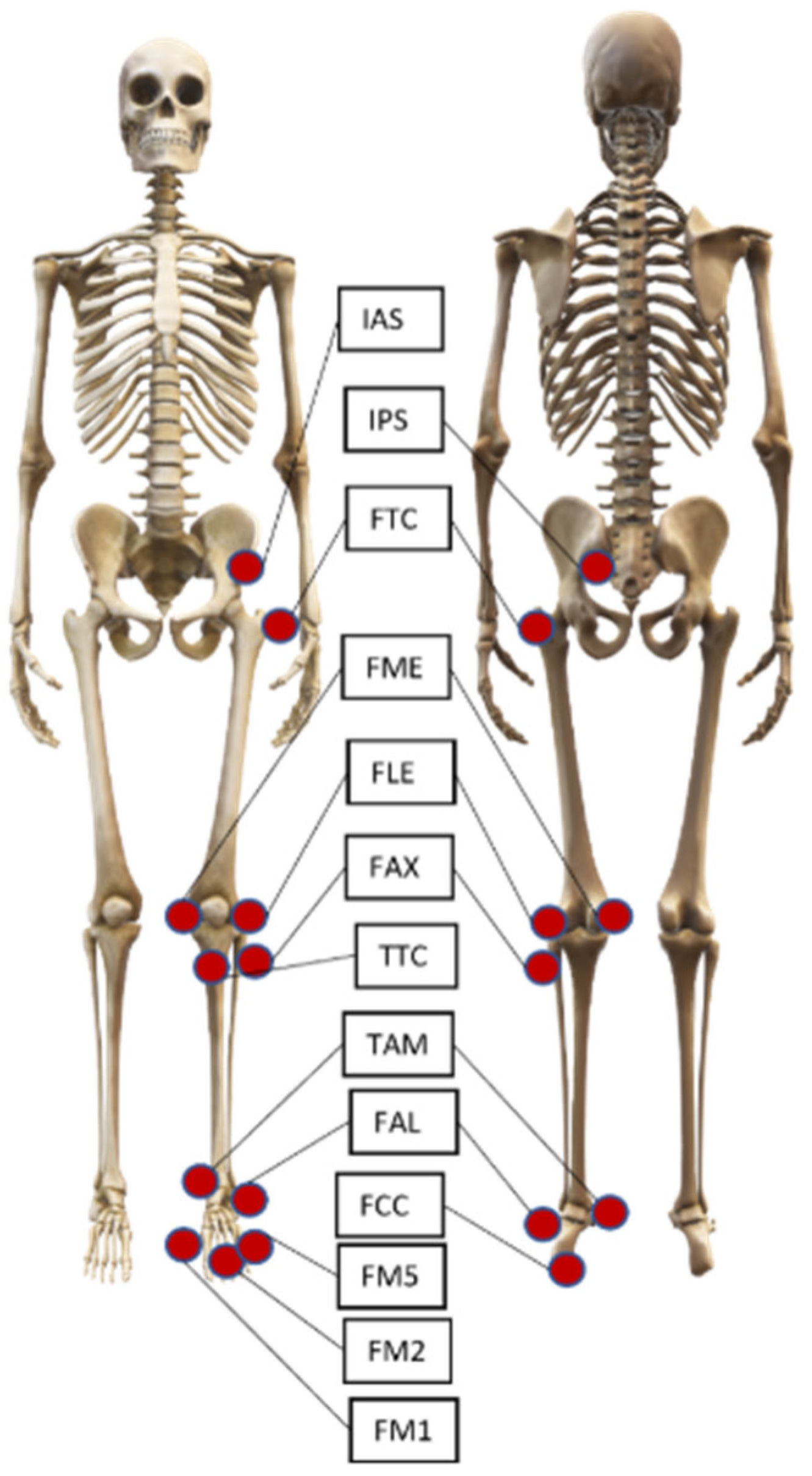
For data collection, a 10-camera optoelectronic system sampled at 100 Hz (OQUS4, Qualisys, Gothenburg, Sweden) was used to track the movement of 19 reflective markers (Figure 1) in three-dimensional space. An experienced physiotherapist conducted both the anatomical palpation and placement of motion-capture markers for all participants. Ground reaction forces and moments were recorded using two force plates (OR6-5, AMTI, Watertown, MA, USA) at a rate of 1500 Hz. In this study, data retrieved from the markers placed on the lower extremities were analyzed [12]. Electromyography (EMG) signals from the GAS and SOL muscles were captured wirelessly at a rate of 1500 Hz by using an EMG system (Desktop DTS, Noraxon, Scottsdale, AZ, USA) and surface electrodes (Ambu Neuroline 720, Ambu, Ballerup, Denmark). All systems were synchronized using Qualisys Track Manager software (QTM 2.8.1065, Qualisys, Gothenburg, Sweden) [11].
Preparation of the participant: Participants changed into tight-fitting clothing or underwear, removed shoes and socks, and tied up their hair if necessary. Anthropometric and demographic data were recorded, and participants were then fitted with EMG electrodes and cutaneous reflective markers.
Static record: Participants stood upright with arms outstretched and palms forward, head facing forward. A 5 s motionless trial was recorded and verified by the operator; trials were repeated if markers were missing or movements disturbed the recording.
Walking trials: Participants completed a minimum of three barefoot walking trials for each of the five walking speed conditions along a 10 m flat level walkway during a single assessment session. The five walking speeds were labeled C1–C5. C1 (0–0.4 m·s−1), C2 (0.4–0.8 m·s−1), and C3 (0.8–1.2 m·s−1): These were predefined speed ranges induced by a metronome, corresponding to household, limited community, and community walking, respectively. Participants were instructed to synchronize their steps with the metronome at very slow (C1), slow (C2), or moderate (C3) speed, and were given time to adapt different condition. The speed of the first trial in each condition was checked to ensure it fell within the target range. C4 (self-selected spontaneous speed): Participants were instructed to walk “as usual,” choosing a comfortable pace without external cues. C5 (self-selected fast speed): Participants were instructed to walk “as fast as possible without running,” allowing them to select a brisk, but safe, walking speed. Overall, the dataset [11] comprised 1143 walking trials. This protocol ensured that participants were familiarized with each condition, and that walking speeds were reliably controlled or self-selected according to the study design.

2.3. Outcome Measure

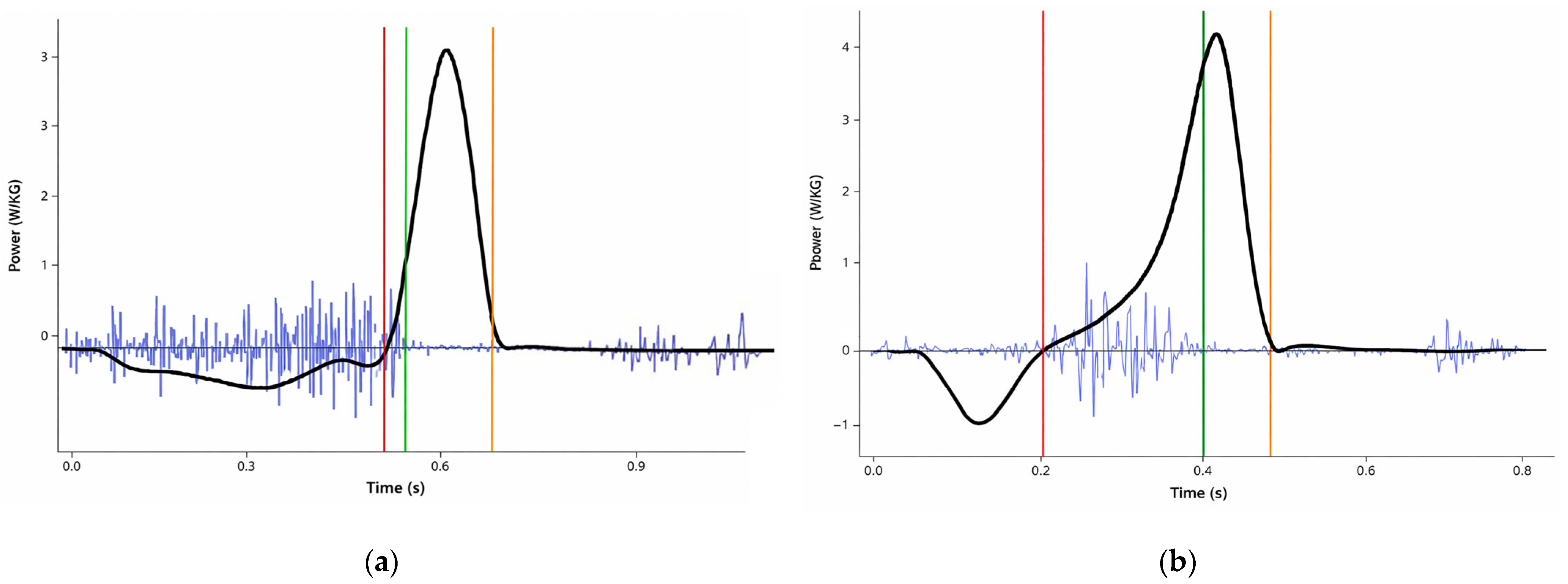
The primary outcome measure of this study was the percentage of the ankle power generation from the ankle plantar flexor muscles (SOL or GAS) during terminal stance. This metric quantifies the relative duration of concentric contraction of the ankle plantar flexors required to generate positive power. The power generation phase (Tp) was defined as the continuous interval during which ankle joint power was positive (Figure 2). Specifically, the onset of Tp was identified as the first time point at which ankle joint power transitioned from negative to positive (i.e., exceeded zero) following the preceding negative power phase. The end of Tp was defined as the subsequent time point at which ankle joint power returned to zero or below. No additional thresholds or analytical functions were applied for phase identification. The duration of ankle plantar flexor muscle activation (Ta) is defined as the time interval between the red and green lines in Figure 2b. The percentage of the ankle plantar flexor muscle activation duration during the power generation phase is thus calculated as Ta/Tp × 100%.
The cumulative muscle activity of the ankle plantar flexors, which contributes to power generation at various walking speeds, was designated as the secondary outcome measure. The processed EMG signal was integrated to quantify the amplitude of muscle activation of the ankle plantar flexors [13].

2.4. Data Processing

Marker trajectories were low-pass filtered using a fourth-order Butterworth filter with a cutoff frequency of 6 Hz. Additionally, ground reaction forces and moments were smoothed using a second-order Butterworth low-pass filter with a cutoff frequency of 15 Hz. All forces and moments were set to zero when the vertical ground reaction force fell below 5 N. EMG signals were band-pass filtered between 20 and 450 Hz [13] by using a fourth-order Butterworth filter to reduce artifacts caused by motion and electromagnetic interference. The filtered EMG data were then full-wave rectified, smoothed, and low-pass filtered to formulate the EMG envelope and integrated for analysis. The Visual3D processing pipeline was attached in Supplementary Materials (Table S2) for information. The EMG onset was defined as the point when the signal exceeded three standard deviations above the baseline noise level. Baseline noise was calculated during the swing phase, where plantar flexor muscles exhibit low activation. The offset occurred when the signal dropped below this threshold.
Datasets were obtained from Schreiber and Moissenet, which is publicly available (https://doi.org/10.6084/m9.figshare.7734767, accessed on 20 May 2025) [11], and the c3d files were loaded into Visual 3D Professional (v2021.04.01; C-Motion, Inc., Germantown, MD, USA) for the processing of all dynamic trial data. The center of the ankle joint was defined as the midpoint between the medial and lateral malleoli, whereas the center of the knee joint was defined as the midpoint between the medial and lateral epicondyles. The pelvis segment was defined using the CODA model. An eight-segment model was employed, which comprised the pelvis, trunk, bilateral thighs, shanks, and feet.
Kinematics were analyzed in accordance with the recommendations of the International Society of Biomechanics [14]. Three-dimensional joint angles were calculated using the Cardan/Euler rotation sequence [15]. The local coordinate system for each segment was established through an N-pose static trial, in which the X, Y, and Z axes corresponded to the right, forward, and upward directions, respectively. Temporospatial parameters were computed using the “Temporal and Distance Metrics” function in Visual3D (Version 7.0).
Ankle joint power was calculated using inverse dynamics in Visual3D, as the product of the ankle joint moment and angular velocity, based on synchronized kinematic and ground reaction force data. This procedure followed the ISB recommendations for lower-limb joint kinematics and kinetics computation [16].

2.5. Statistical Analysis

The demographic characteristics of the participants were summarized using descriptive statistics. The Shapiro–Wilk test was employed to assess the normality of the temporospatial variables, with statistical significance set at 0.05. Statistical analyses were conducted using R (version 4.0.4; R Foundation for Statistical Computing, Vienna, Austria) in conjunction with R Studio (version 1.4.1106; RStudio, PBC, Boston, MA, USA).
Polynomial mixed models (first-degree and second-degree) were used to quantify the relationships between walking speed and (1) the percentage of SOL or GAS activation and (2) iEMG amplitudes for all individuals, with random intercept and random coefficients. To identify the best-fitting model, we compared the Akaike information criterion (AIC) and Bayesian information criterion (BIC) values for the various models.
Each participant walked at only five predefined speeds (C1–C5). To capture the population-level trend, we fitted mixed-effects models using all 1143 trials rather than modeling each participant separately. Random intercepts and slopes accounted for differences between participants. As a result, the linear and quadratic terms reflect the relationship between walking speed and muscle activation for the whole group. This approach allows the model to capture the nonlinear trend in the full dataset, despite the limited number of speed conditions per participant.
In order to validate the model and data processing procedure, we have collected data from 5 participants with the method described in Schreiber and Moissenet [11] study.

3. Results

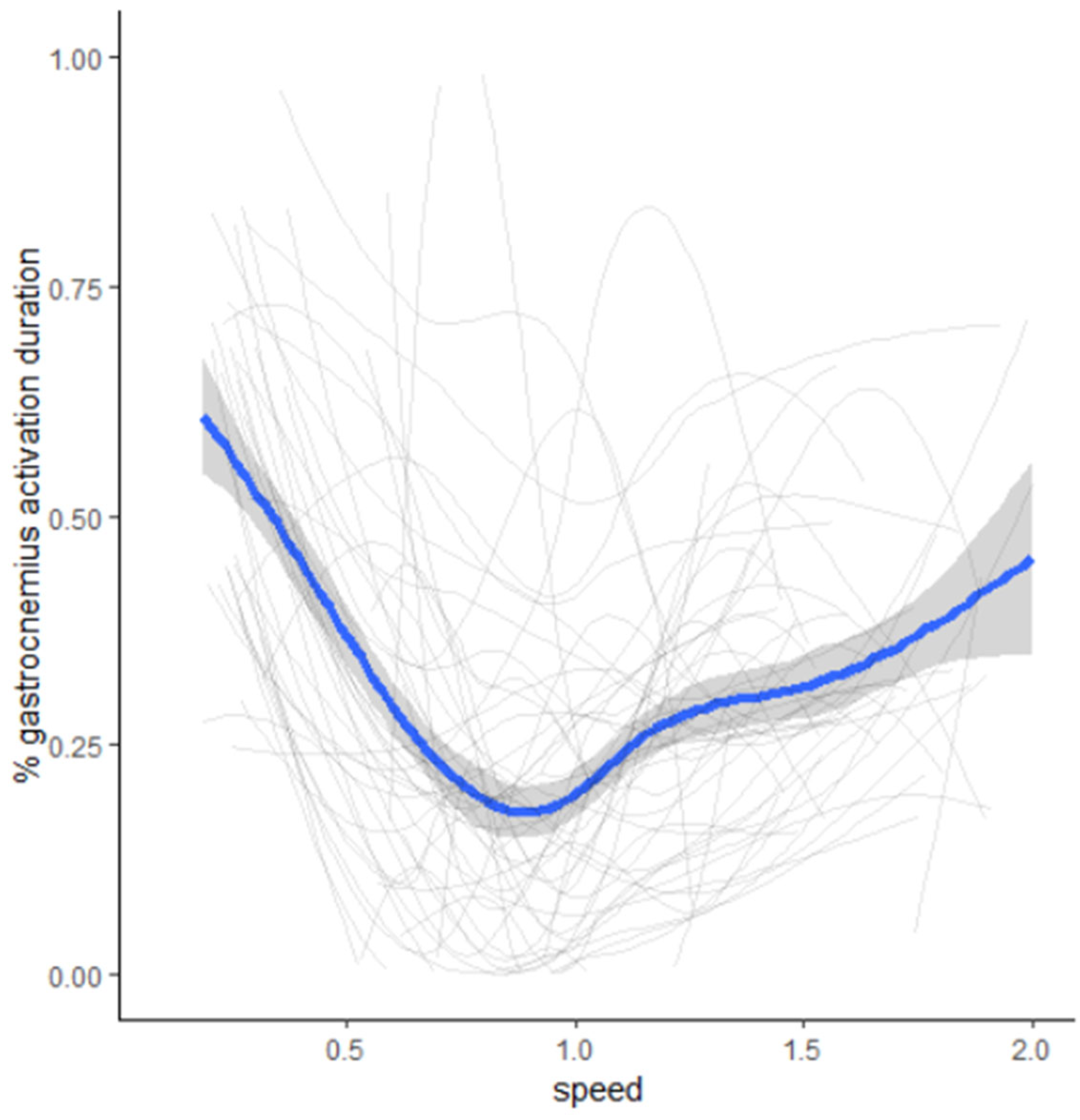
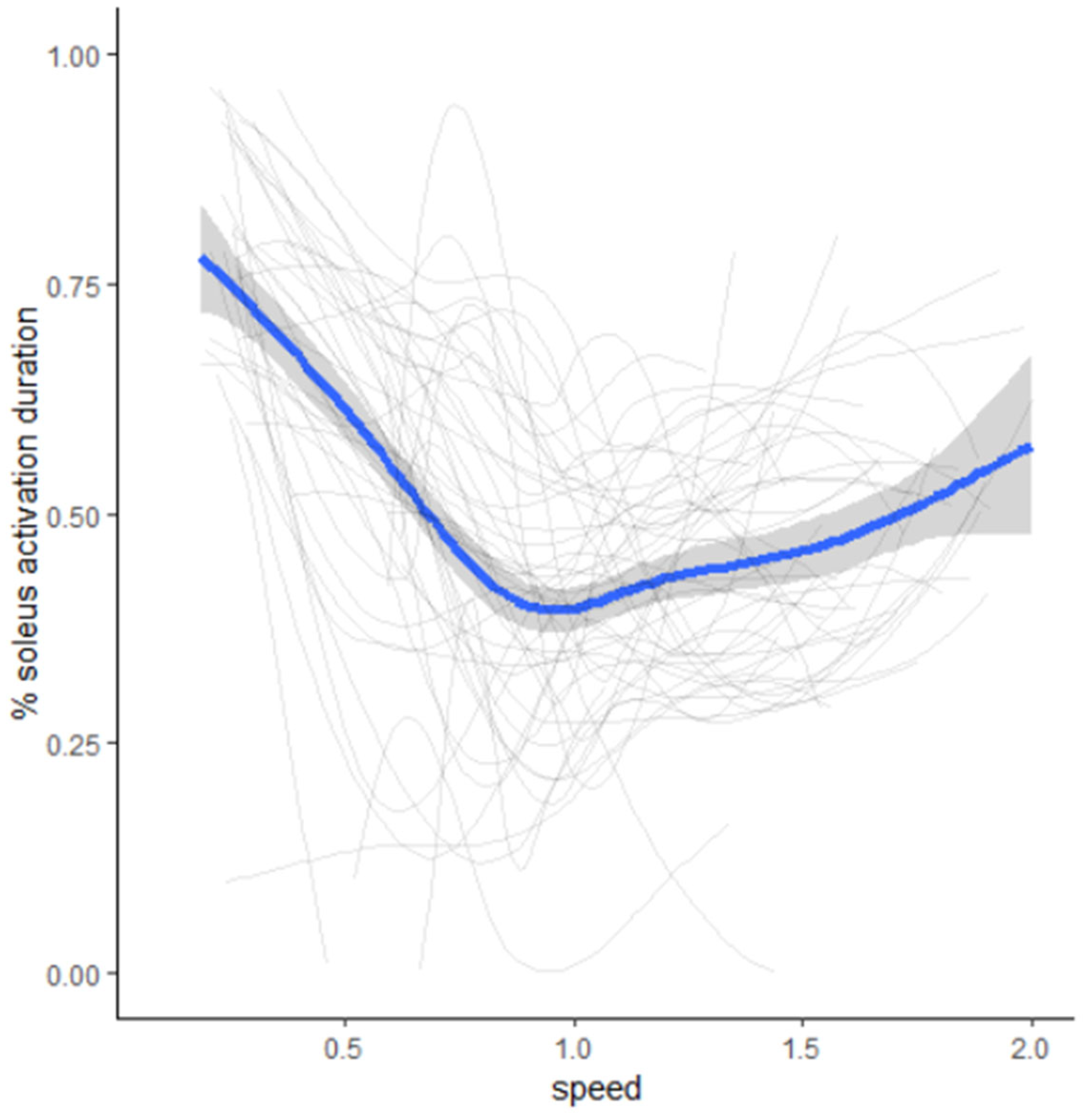
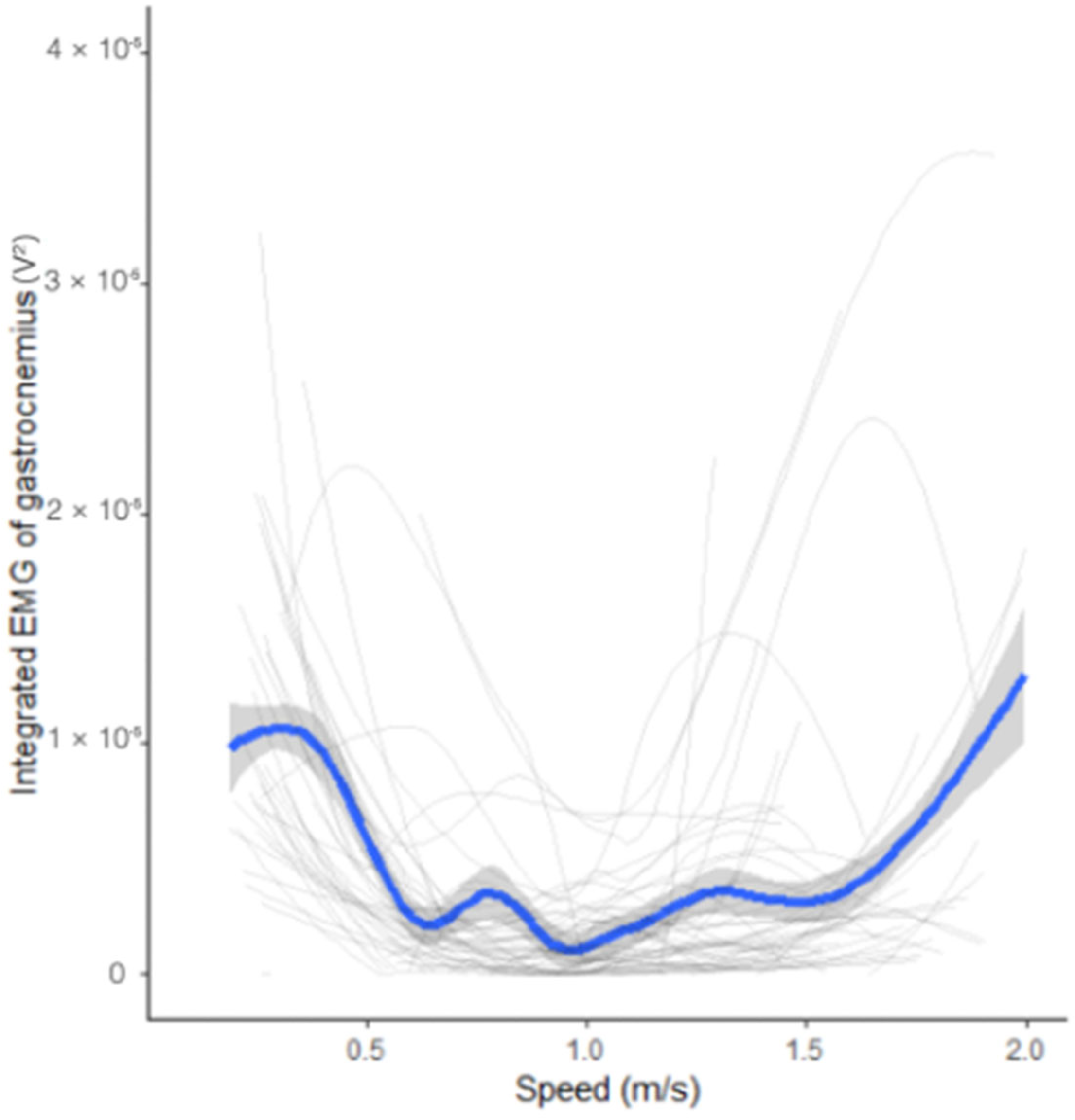
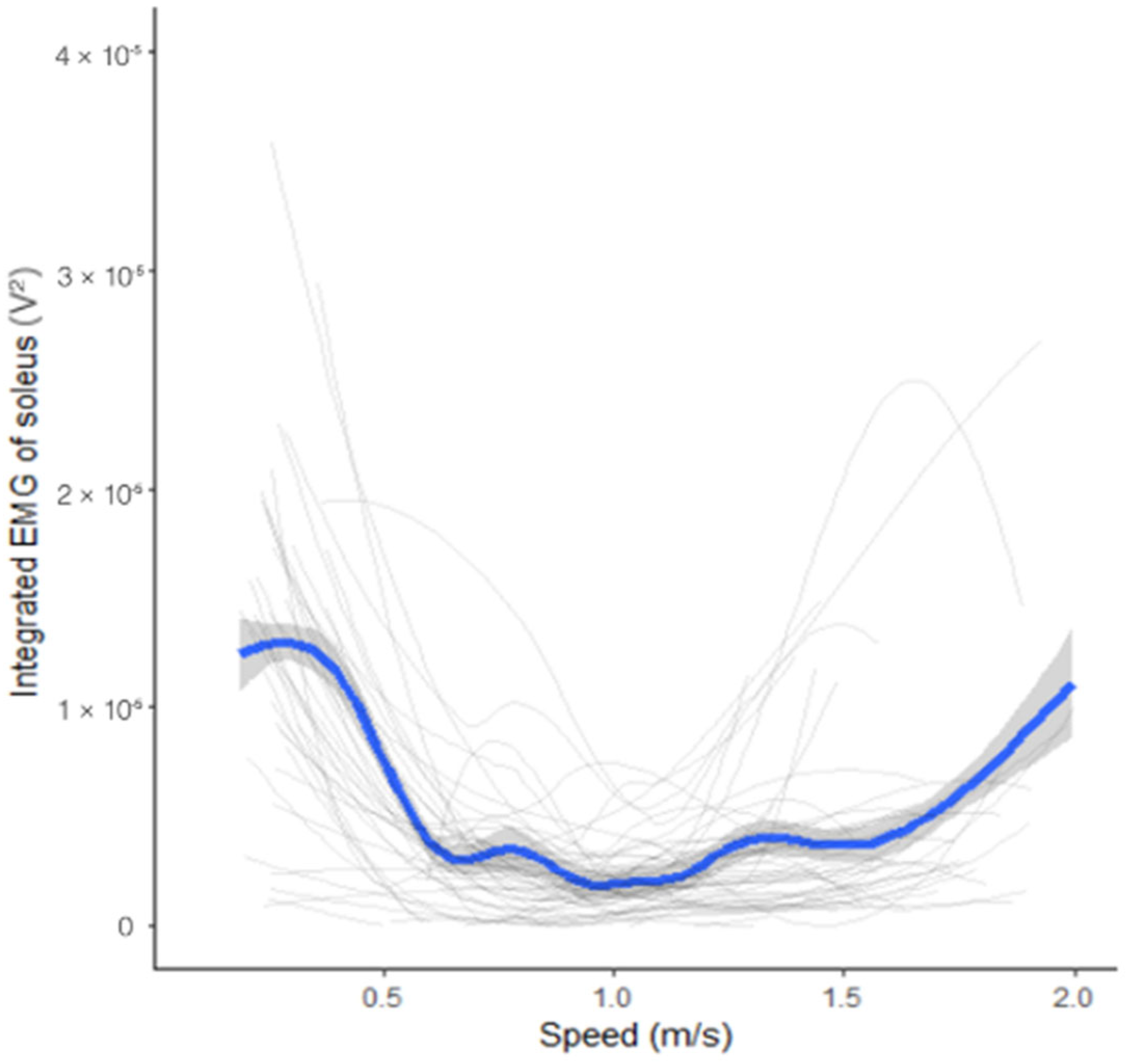
The percentage of the GAS and SOL activation duration during the ankle power generation phase varied with the walking speed (Table 1). The lowest percentage of plantar flexor activation was observed for walking speeds between 0.8 and 1.2 m·s−1. When the walking speed was outside this range, the percentage of plantar flexor activation was higher. Notably, the activation percentage was considerably higher at the lowest walking speed (C1: 0–0.4 m·s−1) than at the next lowest walking speed (C2: 0.4–0.8 m·s−1). Additionally, the activation duration percentage was higher at the participants’ self-selected high speed (C5) than at their self-selected spontaneous speed (C4). A similar pattern was observed in the iEMG, with the iEMG values increasing as the walking speed deviated from the range 0.8–1.2 m·s−1.
The results of the polynomial mixed models are presented in Table 2. Both the linear and quadratic models were statistically significant. However, the quadratic mixed model had better fit across all four variables, as indicated by its higher R2 values and lower AIC and BIC scores compared with those of the linear mixed model (Figure 3, Figure 4, Figure 5 and Figure 6).
The mean walking speeds for each condition (C1–C5), together with their standard deviations and ranges, are summarized in Table 3. For the predefined speed ranges C1–C3 (0–0.4, 0.4–0.8, 0.8–1.2 m·s−1), which were induced by a metronome to represent household (C1), limited community (C2), and community walking (C3), the mean speeds were 0.28 ± 0.06 m·s−1 (range: 0.19–0.40), 0.61 ± 0.08 m·s−1 (0.47–0.78), and 0.98 ± 0.11 m·s−1 (0.81–1.17), respectively. The self-selected spontaneous speed (C4) averaged 1.14 ± 0.18 m·s−1 (0.79–1.40), all participants’ C3 walking speeds fell within the range of C4, while individual C4 speeds also extended beyond the upper limit of C3. The self-selected fast speed (C5) reached 1.61 ± 0.24 m·s−1 (1.12–2.28). These results confirm that participants walked across a broad range of speeds, from very slow to fast, allowing assessment of muscle activation under both instructed and self-selected conditions.
Data from the additional five participants showed trends consistent with those reported above (Figure S1). Furthermore, the quadratic mixed-effects model fitted to the pooled dataset demonstrated reduced AIC and BIC values (Table S1), indicating improved model fit with the inclusion of the additional data.

4. Discussion

The results support our hypothesis of nonlinear relationships of walking speed with calf muscle activation duration and cumulative muscle activity. Specifically, the duration of GAS and SOL activation in the ankle power generation phase was lower when the participants walked at a self-selected speed than when they walked at a different speed. A similar trend was observed for the iEMG.
The findings indicate the relative duration of SOL and GAS concentric contraction and that the cumulative muscle activity in the ankle power generation phase is minimized when the walking speed is close to the normal range (~0.8 to 1.2 m·s−1). This aligns with previous studies that have suggested self-selected walking speed to be associated with the lowest energy expenditure during walking [14,17,19]. One potential contributing factor is the maximization of elastic energy storage and release in the musculotendon complex of the ankle plantar flexors at the self-selected walking speed [6].
Another study suggested that the intrinsic muscle properties of the ankle plantar flexors, specifically the force-length and force-velocity relationships, are most efficient for force generation at the spontaneous walking speed [20]. At self-selected walking speeds, GAS and SOL operate under mechanically favorable force–length and force–velocity conditions that support efficient force generation. With respect to the force–length relationship [21,22,23,24,25], SOL fascicles slight shortening from the optimal length (approximately 0.95–1 L0) to the upper end of the ascending (about 0.8–0.9 L0) during late stance, maintaining near-ideal sarcomere overlap and thus preserving a high length-dependent force-generating capacity [24,26,27,28]. In contrast, GAS fascicles rapidly shorten from the plateau zone to the short end of the steep ascending branch (0.6 L0), with excessive overlap of sarcomere, and the length-related maximum force decreases by 40% [28,29].
When walking speed exceeds the self-selected range, reductions in force-generating capacity of the GAS and SOL are driven predominantly by unfavorable force–velocity [30,31,32] rather than force–length conditions. Experimental evidence [29,33,34] indicates that GAS operates on the high-force region of its force–velocity curve at self-selected walking speeds, but as speed increases, fascicle shortening velocity rises substantially. Farris reported that medial GAS fascicle shortening velocity at peak force increases as walking speed rises from 1.25 to 2.0 m·s−1, resulting in an approximately 20% reduction in peak force due to the hyperbolic force–velocity relationship [33,34]. Consistent with this finding, Monte et al. demonstrated that both force–length and force–velocity potentials of GAS exhibit a parabolic relationship with walking speed, peaking near ~1.11 m·s−1 and declining at both slower and faster speeds [29]. Importantly, GAS fascicle length changes were consistent across walking speeds, so force reductions at fast walking were not due to length changes but force–velocity properties [34].
SOL showed even more stable fascicle excursions across speeds [26]. Lai reported that as walking speed increased from 0.7 to 2.0 m·s−1, soleus fascicle shortening velocity at peak ankle torque rose from near-isometric (0 L0/s) to 1.04 ± 0.38 L0/s, progressively shifting the muscle’s operating point rightward along the force–velocity curve into lower-force regions [26,34]. This velocity-dependent reduction in force-generating capacity likely contributes to the increased EMG demand observed at faster walking speeds. Nevertheless, at self-selected walking speeds (1.25 m·s−1), SOL fascicles display small length changes and relatively low (0.15 L0/s), steady shortening velocities across stance, indicating operation predominantly within the high-force region of the force–velocity curve and enabling stable force production [35].
It should be noted that the tibialis anterior (TA) acts as an antagonist to the SOL and GAS during the ankle plantar flexion phase. Antagonist co-contraction can influence net joint moments and potentially increase muscle activation or metabolic cost. Wang showed in a muscle-actuated simulation of normal walking that when dorsiflexor–plantar-flexor co-contraction at the ankle was artificially increased, synergistic ankle plantar flexors compensated: Specifically, elevated TA–GAS co-contraction increased SOL activation, whereas elevated TA–SOL co-contraction recruited GAS [36].
Speed-dependent changes in co-contraction further support our interpretation. Recent EMG-driven modeling work shows that ankle co-contraction is higher at very slow and very fast walking speeds than at speeds near the preferred walking speed (m·s−1), and that greater co-contraction is associated with higher plantar flexor moments and metabolic cost [37]. Together with the simulations of Wang [36] this suggests that at slow and fast speeds, SOL and GAS must generate additional force to counteract increased TA activity and maintain ankle mechanics, whereas at self-selected speeds the required compensation is minimal. This provides a mechanistic explanation for why we observed the lowest cumulative SOL and GAS iEMG near 0.8–1.2 m·s−1. Therefore, the U-shaped relationship between walking speed and plantar-flexor cumulative activity in our data is more likely driven by intrinsic contractile and tendon mechanics than by changes in TA–plantar-flexor co-activation.
Walking at speeds lower than 0.8–1.2 m·s−1 results in higher cumulative muscle activity and a higher percentage of activation in the SOL and GAS. This may be attributable to the reduction in ankle dorsiflexion in the stance phase, which may affect the elastic energy storage in the ankle plantar flexors. A short stride length has been reported to affect joint kinematics, leading to a reduction in the maximum ankle dorsiflexion range during the gait cycle. It is reasonable to speculate that a reduction in the ankle dorsiflexion angle in the stance phase may impair the storage of elastic energy in the ankle plantar flexors. Several studies have demonstrated that a reduced ankle dorsiflexion range diminishes the capacity of the calf muscles to store energy, thereby reducing power generation as well as jump height and hopping performance [38,39]. Furthermore, lower walking speeds are associated with greater lateral body sway in the frontal plane, which necessitates greater muscular activity to maintain frontal plane stability during walking [40,41]. Consistent evidence has associated lower walking speed in adults with shorter stride length [42,43]. It should be noted that perceptions of walking speed can vary among participants. For example, a speed of 0.4 m·s−1 may be considered slow for some individuals but close to normal for others, depending on their habitual walking pace or leg length. Taller participants may naturally have longer stride lengths, which could influence ankle dorsiflexion, stride kinematics, and plantar flexor activation patterns. In the present study, predefined speed ranges (C1–C3) were induced using a metronome, ensuring that all participants walked within comparable speed ranges on the force plates rather than at a single absolute speed. While some participants may have needed to intentionally slow down or speed up relative to their habitual pace, this approach allowed us to systematically examine speed-dependent changes in calf muscle activation and ankle power generation under controlled conditions, with height-related differences in stride length largely accommodated by adjustments in cadence. Consequently, although individual differences in perceived or habitual walking speed may contribute to inter-individual variability in muscle activation, the effect of participant height on plantar flexor activation is likely minimal. We note that differences in individual speed perception represent an inherent limitation of using predefined speed categories; however, the inclusion of C4–C5, in which participants walked at self-selected speeds, may help to partially mitigate this limitation.
This study also demonstrated that a walking speed higher than the self-selected spontaneous walking speed (~0.8–1.2 m·s−1) results in greater concentric activation of the SOL and GAS. These findings are consistent with other studies, which have consistently demonstrated that higher walking speed is associated with higher activation of the ankle plantar flexors [6,44,45]. Additionally, our findings indicate that the percentage of muscle activation increases when walking speed is higher. According to the simple walking model [17,46], greater stride length, cadence, step length, and walking speed result in a higher metabolic cost of transport in locomotion. One study demonstrated that higher walking speed results in higher muscular activity likely to provide greater forward propulsion and vertical support [6,16,47,48]. The GAS is particularly responsible for delivering positive power to initiate leg swing, whereas the SOL transfers energy mainly to the trunk for vertical support [6,16]. This evidence suggests that fast walking leads to higher energy expenditure and prolonged ankle plantar flexor activation. It also explains why fast gait speed has been recommended in clinical testing to better challenge pre-frail older adults, as it more closely reflects skeletal muscle function than usual self-selected walking speed [49].
The contribution of elastic energy storage and release to ankle power generation is likely altered in older adults and clinical populations with gait impairments, such as stroke and knee osteoarthritis. These conditions are often associated with reduced ankle dorsiflexion, impaired eccentric plantar flexor control, and altered muscle–tendon properties, which may limit Achilles tendon elastic energy storage during stance and increase reliance on active concentric contraction for propulsion.
In this study, higher cumulative plantar flexor activity at slower walking speeds was observed, which is consistent with a reduced contribution of passive elastic recoil when ankle dorsiflexion during stance is limited. Although direct correlations between ankle dorsiflexion range and iEMG were not examined, the observed activation patterns support the hypothesis that efficient elastic energy utilization plays a key role in minimizing muscular demand during walking. These findings indicate that gait rehabilitation should not only target walking speed but also prioritize restoring ankle dorsiflexion mobility and eccentric plantar flexor function to reduce muscular demand and improve gait efficiency. Future studies incorporating joint kinematics, tendon behavior, and muscle activation measures are warranted to further elucidate these mechanisms and optimize speed-specific gait rehabilitation strategies.
Training the plantar flexors—particularly the GAS and SOL—is essential for individuals with impaired gait, especially during the early stages of rehabilitation [50]. The current data showed that the duration and cumulative activity of the plantar flexors were minimized when walking speed was close to the self-selected spontaneous speed (0.8–1.2 m/s). However, both lower and higher walking speeds led to greater concentric activation of the GAS and SOL. This suggests that normal walking speeds reduce the mechanical demand for concentric contraction, allowing more efficient muscle utilization. Therefore, once patients walking speed approaches the normal range, the relative importance of concentric strengthening may decline. At this stage, focusing on eccentric control and increasing ankle dorsiflexion range of motion may more beneficial, as eccentric contractions improve energy efficiency during gait. Hence, rehabilitation programs combining concentric and eccentric training is recommended throughout recovery.
This study has several limitations that should be noted. The participants were on average 37 years old (±13.6 years; range: 19–67 years), and age-specific analyses were not performed; therefore, caution is warranted when generalizing the findings to younger or older populations. All gait trials were conducted barefoot, as in the original dataset [11], and the results primarily reflect barefoot gait mechanics; future studies should examine whether similar activation patterns are observed under shod walking conditions.
In addition, the present findings were derived from healthy adults, whose gait biomechanics differ from those of individuals with neuromuscular or musculoskeletal impairments [51]. Thus, the results may not be directly applicable to pathological populations, such as older adults or individuals with gait disorders. Future research should extend this work to clinical populations to determine how walking speed–dependent plantar flexor activation and elastic energy utilization are altered in pathological gait.
Furthermore, walking propulsion emerges from coordinated activation across multiple muscle groups and joints [52]. Although the present study focused on ankle plantar flexor activation during the power-generation phase, the contributions of proximal muscles, such as the hip extensors, to speed-dependent propulsion were not examined. Future studies integrating ankle and proximal muscle activation patterns are warranted to provide a more comprehensive understanding of intermuscular coordination underlying walking at different speeds.
Although metronome was used to standardize walking speeds in predefined conditions, it may influence natural gait patterns. However, the inclusion of fully self-selected walking conditions partially mitigates this limitation. Future studies using entirely unconstrained speed modulation across all conditions may further enhance ecological validity.

5. Conclusions

The findings of this study indicate that the relative activation duration and cumulative muscle activity of the plantar flexor muscles are low within the walking speed range 0.8–1.2 m·s−1. This suggests that the proportion of ankle power generated through concentric contraction of the calf muscles is lower than that generated when walking at a higher or lower speed. This phenomenon may be attributable to the optimization of elastic strain energy utilization in the power generation phase. Therefore, calf muscle strengthening should be incorporated into gait training programs for individuals with ambulation impairments during their initial stages of recovery. Future research should focus on quantifying eccentric contraction in the power generation phase across walking speeds and exploring the role of the plantar flexors in ambulation-impaired populations at various walking speeds.

Supplementary Materials

The following supporting information can be downloaded at: https://www.mdpi.com/article/10.3390/biomechanics6010020/s1, Figure S1: iEMG of the gastrocnemius (upper left), EMG of soleus (upper right), Percentage activation of the gastrocnemius (lower left), Percentage activation of the SOL (lower right) in relation to walking speed; Table S1: Comparison of model fitting of the quadratic mixed models with Schreiber and Moissenet data and combined data by using the Akaike information criterion (AIC) and Bayesian information criterion (BIC); Table S2: The Visual3D data processing pipeline.

Author Contributions

Conceptualization, S.J. and P.W.-H.K.; methodology, S.J. and P.W.-H.K.; software, O.R.; validation, T.M., J.C. and T.H.; formal analysis, S.J.; investigation, T.-H.C.; resources, P.W.-H.K.; data curation, T.M.; writing—original draft preparation, S.J. and T.M.; writing—review and editing, T.-H.C. and P.W.-H.K.; visualization, O.R.; supervision, P.W.-H.K.; project administration, P.W.-H.K.; funding acquisition, P.W.-H.K. All authors have read and agreed to the published version of the manuscript.

Funding

This research was funded by The Hong Kong Polytechnic University, grant number: P0036617.

Institutional Review Board Statement

The study was conducted in accordance with the Declaration of Helsinki, and ethical approval for the original dataset was obtained by the institutional medical ethics committee of the Rehazenter (protocol details reported in Schreiber & Moissenet [11]). All participants provided informed consent prior to participation.

Informed Consent Statement

Informed consent was obtained from all participants involved in the original study from which the dataset was derived (Schreiber & Moissenet [11]).

Data Availability Statement

The data generated or analyzed during this study are not publicly available due to privacy and ethical restrictions but are available from the corresponding author upon reasonable request.

Acknowledgments

The authors thank an external professional editor for assistance with English-language editing.

Conflicts of Interest

The authors declare no conflicts of interest.

Abbreviations

The following abbreviations are used in this manuscript:
AICAkaike Information Criterion
BICBayesian Information Criterion
CODAConventional Orthopedic-based Approach
EMGElectromyography
iEMGIntegrated Electromyography
GASGastrocnemius
ISBInternational Society of Biomechanics
QTMQualisys Track Manager
SOLSoleus
SDStandard Deviation
TaDuration of ankle plantar flexor muscle activation
TpPower generation phase
C1household walking speed conditions
C2limited community walking speed conditions
C3community walking speed conditions
C4self-selected spontaneous speed
C5self-selected fast speed

Appendix A

Table A1. Locations of the reflective markers.
Marker Labels Location
IAS Anterior-superior iliac spine
IPS Posterior-superior iliac spine
FTC Greater trochanter
FME Medial femoral epicondyle
FLE Lateral femoral epicondyle
FAX Fibula head
TTC Tibial tuberosity
TAM Medial tibial malleolus
FAL Lateral tibial malleolus
FCC Posterior calcaneus
FM5 5th metatarsal head
FM2 2nd metatarsal head
FM1 1st metatarsal head

References

  1. Anderson, F.C.; Pandy, M.G. Dynamic optimization of human walking. J. Biomech. Eng. 2001, 123, 381–390. [Google Scholar] [CrossRef] [PubMed]
  2. Gottschall, J.S.; Kram, R. Energy cost and muscular activity required for propulsion during walking. J. Appl. Physiol. 2003, 94, 1766–1772. [Google Scholar] [CrossRef]
  3. Ishikawa, M.; Komi, P.V.; Grey, M.J.; Lepola, V.; Bruggemann, G.P. Muscle-tendon interaction and elastic energy usage in human walking. J. Appl. Physiol. 2005, 99, 603–608. [Google Scholar] [CrossRef] [PubMed]
  4. Kepple, T.M.; Sommer, H.J., III; Siegel, K.L.; Stanhope, S.J. A three-dimensional musculoskeletal database for the lower extremities. J. Biomech. 1997, 31, 77–80. [Google Scholar] [CrossRef]
  5. Liu, M.Q.; Anderson, F.C.; Pandy, M.G.; Delp, S.L. Muscles that support the body also modulate forward progression during walking. J. Biomech. 2006, 39, 2623–2630. [Google Scholar] [CrossRef]
  6. Neptune, R.R.; Sasaki, K.; Kautz, S.A. The effect of walking speed on muscle function and mechanical energetics. Gait Posture 2008, 28, 135–143. [Google Scholar] [CrossRef] [PubMed]
  7. Hof, A.L.; Elzinga, H.; Grimmius, W.; Halbertsma, J.P. Speed dependence of averaged EMG profiles in walking. Gait Posture 2002, 16, 78–86. [Google Scholar] [CrossRef]
  8. Santuz, A.; Ekizos, A.; Kunimasa, Y.; Kijima, K.; Ishikawa, M.; Arampatzis, A. Lower complexity of motor primitives ensures robust control of high-speed human locomotion. Heliyon 2020, 6, e05377. [Google Scholar] [CrossRef]
  9. Kharazi, M.; Theodorakis, C.; Mersmann, F.; Bohm, S.; Arampatzis, A. Contractile Work of the Soleus and Biarticular Mechanisms of the Gastrocnemii Muscles Increase the Net Ankle Mechanical Work at High Walking Speeds. Biology 2023, 12, 872. [Google Scholar] [CrossRef]
  10. den Otter, A.R.; Geurts, A.C.; Mulder, T.; Duysens, J. Speed related changes in muscle activity from normal to very slow walking speeds. Gait Posture 2004, 19, 270–278. [Google Scholar] [CrossRef]
  11. Schreiber, C.; Moissenet, F. A multimodal dataset of human gait at different walking speeds established on injury-free adult participants. Sci. Data 2019, 6, 111. [Google Scholar] [CrossRef]
  12. Hermens, H.J.; Freriks, B.; Disselhorst-Klug, C.; Rau, G. Development of recommendations for SEMG sensors and sensor placement procedures. J. Electromyogr. Kinesiol. 2000, 10, 361–374. [Google Scholar] [CrossRef]
  13. De Luca, C.J.; Gilmore, L.D.; Kuznetsov, M.; Roy, S.H. Filtering the surface EMG signal: Movement artifact and baseline noise contamination. J. Biomech. 2010, 43, 1573–1579. [Google Scholar] [CrossRef]
  14. Wu, G.; Cavanagh, P.R. ISB recommendations for standardization in the reporting of kinematic data. J. Biomech. 1995, 28, 1257–1261. [Google Scholar] [CrossRef]
  15. Cole, G.K.; Nigg, B.M.; Ronsky, J.L.; Yeadon, M.R. Application of the joint coordinate system to three-dimensional joint attitude and movement representation: A standardization proposal. J. Biomech. Eng. 1993, 115, 344–349. [Google Scholar] [CrossRef]
  16. Winter, D.A. Mechanical Work, Energy, and Power. In Biomechanics and Motor Control of Human Movement; Wiley: Hoboken, NJ, USA, 2009; pp. 139–175. [Google Scholar]
  17. Carlisle, R.E.; Kuo, A.D. Optimization of energy and time predicts dynamic speeds for human walking. eLife 2023, 12, e81939. [Google Scholar] [CrossRef]
  18. Fukuchi, C.A.; Fukuchi, R.K.; Duarte, M. Effects of walking speed on gait biomechanics in healthy participants: A systematic review and meta-analysis. Syst. Rev. 2019, 8, 153. [Google Scholar] [CrossRef] [PubMed]
  19. Masani, K.; Kouzaki, M.; Fukunaga, T. Variability of ground reaction forces during treadmill walking. J. Appl. Physiol. 2002, 92, 1885–1890. [Google Scholar] [CrossRef] [PubMed]
  20. Neptune, R.R.; Sasaki, K. Ankle plantar flexor force production is an important determinant of the preferred walk-to-run transition speed. J. Exp. Biol. 2005, 208, 799–808. [Google Scholar] [CrossRef] [PubMed]
  21. Gordon, A.M.; Huxley, A.F.; Julian, F.J. The variation in isometric tension with sarcomere length in vertebrate muscle fibres. J. Physiol. 1966, 184, 170–192. [Google Scholar] [CrossRef]
  22. Rassier, D.E.; MacIntosh, B.R.; Herzog, W. Length dependence of active force production in skeletal muscle. J. Appl. Physiol. 1999, 86, 1445–1457. [Google Scholar] [CrossRef]
  23. MacIntosh, B.R.; MacNaughton, M.B. The length dependence of muscle active force: Considerations for parallel elastic properties. J. Appl. Physiol. 2005, 98, 1666–1673. [Google Scholar] [CrossRef]
  24. Maganaris, C.N. Force-length characteristics of in vivo human skeletal muscle. Acta Physiol. Scand. 2001, 172, 279–285. [Google Scholar] [CrossRef]
  25. Maganaris, C.N. Force-length characteristics of the in vivo human gastrocnemius muscle. Clin. Anat. 2003, 16, 215–223. [Google Scholar] [CrossRef]
  26. Lai, A.; Lichtwark, G.A.; Schache, A.G.; Lin, Y.C.; Brown, N.A.; Pandy, M.G. In vivo behavior of the human soleus muscle with increasing walking and running speeds. J. Appl. Physiol. 2015, 118, 1266–1275. [Google Scholar] [CrossRef] [PubMed]
  27. Panizzolo, F.A.; Green, D.J.; Lloyd, D.G.; Maiorana, A.J.; Rubenson, J. Soleus fascicle length changes are conserved between young and old adults at their preferred walking speed. Gait Posture 2013, 38, 764–769. [Google Scholar] [CrossRef] [PubMed]
  28. Arnold, E.M.; Delp, S.L. Fibre operating lengths of human lower limb muscles during walking. Philos. Trans. R. Soc. B Biol. Sci. 2011, 366, 1530–1539. [Google Scholar] [CrossRef] [PubMed]
  29. Monte, A.; Tecchio, P.; Nardello, F.; Bachero-Mena, B.; Ardigò, L.P.; Zamparo, P. The interplay between gastrocnemius medialis force-length and force-velocity potentials, cumulative EMG activity and energy cost at speeds above and below the walk to run transition speed. Exp. Physiol. 2023, 108, 90–102. [Google Scholar] [CrossRef]
  30. Hill, A.V. The maximum work and mechanical efficiency of human muscles, and their most economical speed. J. Physiol. 1922, 56, 19. [Google Scholar] [CrossRef]
  31. Seow, C.Y. Hill’s equation of muscle performance and its hidden insight on molecular mechanisms. J. Gen. Physiol. 2013, 142, 561–573. [Google Scholar] [CrossRef]
  32. Alcazar, J.; Csapo, R.; Ara, I.; Alegre, L.M. On the Shape of the Force-Velocity Relationship in Skeletal Muscles: The Linear, the Hyperbolic, and the Double-Hyperbolic. Front. Physiol. 2019, 10, 769. [Google Scholar] [CrossRef] [PubMed]
  33. Farris, D.J.; Sawicki, G.S. The mechanics and energetics of human walking and running: A joint level perspective. J. R. Soc. Interface 2012, 9, 110–118. [Google Scholar] [CrossRef]
  34. Farris, D.J.; Sawicki, G.S. Human medial gastrocnemius force–velocity behavior shifts with locomotion speed and gait. Proc. Natl. Acad. Sci. USA 2012, 109, 977–982. [Google Scholar] [CrossRef] [PubMed]
  35. Cronin, N.J.; Avela, J.; Finni, T.; Peltonen, J. Differences in contractile behaviour between the soleus and medial gastrocnemius muscles during human walking. J. Exp. Biol. 2013, 216, 909–914. [Google Scholar] [CrossRef]
  36. Wang, R.; Gutierrez-Farewik, E.M. Compensatory strategies during walking in response to excessive muscle co-contraction at the ankle joint. Gait Posture 2014, 39, 926–932. [Google Scholar] [CrossRef] [PubMed]
  37. Lemineur, C.; Blain, G.M.; Piche, E.; Gerus, P. Relationship between metabolic cost, muscle moments and co-contraction during walking and running. Gait Posture 2024, 113, 345–351. [Google Scholar] [CrossRef]
  38. Almansoof, H.S.; Nuhmani, S.; Muaidi, Q. Correlation of ankle dorsiflexion range of motion with lower-limb kinetic chain function and hop test performance in healthy male recreational athletes. PeerJ 2023, 11, e14877. [Google Scholar] [CrossRef]
  39. Yun, S.J.; Kim, M.H.; Weon, J.H.; Kim, Y.; Jung, S.H.; Kwon, O.Y. Correlation between toe flexor strength and ankle dorsiflexion ROM during the countermovement jump. J. Phys. Ther. Sci. 2016, 28, 2241–2244. [Google Scholar] [CrossRef]
  40. Bauby, C.E.; Kuo, A.D. Active control of lateral balance in human walking. J. Biomech. 2000, 33, 1433–1440. [Google Scholar] [CrossRef]
  41. Wu, A.R.; Simpson, C.S.; van Asseldonk, E.H.F.; van der Kooij, H.; Ijspeert, A.J. Mechanics of very slow human walking. Sci. Rep. 2019, 9, 18079. [Google Scholar] [CrossRef]
  42. Jerome, G.J.; Ko, S.U.; Kauffman, D.; Studenski, S.A.; Ferrucci, L.; Simonsick, E.M. Gait characteristics associated with walking speed decline in older adults: Results from the Baltimore Longitudinal Study of Aging. Arch. Gerontol. Geriatr. 2015, 60, 239–243. [Google Scholar] [CrossRef]
  43. Morio, Y.; Izawa, K.P.; Omori, Y.; Katata, H.; Ishiyama, D.; Koyama, S.; Yamano, Y. The Relationship between Walking Speed and Step Length in Older Aged Patients. Diseases 2019, 7, 17. [Google Scholar] [CrossRef]
  44. Bovi, G.; Rabuffetti, M.; Mazzoleni, P.; Ferrarin, M. A multiple-task gait analysis approach: Kinematic, kinetic and EMG reference data for healthy young and adult subjects. Gait Posture 2011, 33, 6–13. [Google Scholar] [CrossRef]
  45. Meinders, M.; Gitter, A.; Czerniecki, J.M. The role of ankle plantar flexor muscle work during walking. Scand. J. Rehabil. Med. 1998, 30, 39–46. [Google Scholar] [CrossRef]
  46. Kuo, A.D. Stabilization of Lateral Motion in Passive Dynamic Walking. Int. J. Robot. Res. 1999, 18, 917–930. [Google Scholar] [CrossRef]
  47. Neptune, R.R.; Kautz, S.A.; Zajac, F.E. Contributions of the individual ankle plantar flexors to support, forward progression and swing initiation during walking. J. Biomech. 2001, 34, 1387–1398. [Google Scholar] [CrossRef] [PubMed]
  48. Orendurff, M.S.; Segal, A.D.; Klute, G.K.; Berge, J.S.; Rohr, E.S.; Kadel, N.J. The effect of walking speed on center of mass displacement. J. Rehabil. Res. Dev. 2004, 41, 829–834. [Google Scholar] [CrossRef]
  49. Mehdipour, A.; Malouka, S.; Beauchamp, M.; Richardson, J.; Kuspinar, A. Measurement properties of the usual and fast gait speed tests in community-dwelling older adults: A COSMIN-based systematic review. Age Ageing 2024, 53, afae055. [Google Scholar] [CrossRef] [PubMed]
  50. Cho, K.-H.; Park, S.-J. Effects of joint mobilization and stretching on the range of motion for ankle joint and spatiotemporal gait variables in stroke patients. J. Stroke Cerebrovasc. Dis. 2020, 29, 104933. [Google Scholar] [CrossRef] [PubMed]
  51. Flux, E.; Mooijekind, B.; Bar-On, L.; van Asseldonk, E.H.F.; Buizer, A.I.; van der Krogt, M.M. Relation between stretch and activation of the medial gastrocnemius muscle during gait in children with cerebral palsy compared to typically developing children. J. Electromyogr. Kinesiol. 2024, 79, 102921. [Google Scholar] [CrossRef]
  52. Cesar, G.M.; Buster, T.W.; Mohammadzadeh Gonabadi, A.; Burnfield, J.M. Muscle demand and kinematic similarities between pediatric-modified motor-assisted elliptical training at fast speed and fast overground walking: Real-world implications for pediatric gait rehabilitation. J. Electromyogr. Kinesiol. 2022, 63, 102639. [Google Scholar] [CrossRef] [PubMed]
Figure 1. Locations of reflective markers on the participants. Only left side markers have been illustrated for the lower limbs. The anatomical description and full name of each marker are given in Appendix A.
Biomechanics 06 00020 g001
Figure 2. Illustration of the power generated by the ankle plantar flexors (black line) over a gait cycle under two conditions: walking at (a) 1 and (b) 2 m/s. The red line denotes the onset of the power generation phase, defined as the transition of ankle joint power from negative to positive, and the orange line indicates its termination when power returns to zero or below. The green line indicates the time point at which the EMG offset is detected. The blue line represents the concurrently captured EMG pattern of the gastrocnemius.
Biomechanics 06 00020 g002
Figure 3. Percentage activation of the GAS in relation to walking speed. The blue line represents the predicted values of each metric, with the shaded area indicating the standard error of the mean. The gray lines depict the changes in the metrics for each individual.
Biomechanics 06 00020 g003
Figure 4. Percentage activation of the SOL in relation to walking speed. The blue line represents the predicted values of each metric, with the shaded area indicating the standard error of the mean. The gray lines depict the changes in the metrics for each individual.
Biomechanics 06 00020 g004
Figure 5. iEMG of the GAS in relation to walking speed. The blue line represents the predicted values of each metric, with the shaded area indicating the standard error of the mean. The gray lines depict the changes in the metrics for each individual.
Biomechanics 06 00020 g005
Figure 6. iEMG of the SOL in relation to walking speed. The blue line represents the predicted values of each metric, with the shaded area indicating the standard error of the mean. The gray lines depict the changes in the metrics for each individual.
Biomechanics 06 00020 g006
Table 1. Percentage of duration in which the GAS and SOL were activated in the power generation phase and iEMG of GAS and SOL for various walking speeds.
Walking Speed% GAS Activation Duration ± SD% SOL Activation Duration ± SDiEMG of GAS (mV) ± SDiEMG of SOL ± SD
C10.56 ± 0.230.73 ± 0.19 0.012 ± 0.010 0.013 ± 0.007
C20.28 ± 0.23 0.54 ± 0.21 0.003 ± 0.004 0.004 ± 0.003
C30.20 ± 0.19 0.39 ± 0.200.002 ± 0.0020.002 ± 0.002
C40.24 ± 0.18 0.42 ± 0.190.002 ± 0.0050.003 ± 0.003
C50.35 ± 0.17 0.48 ± 0.15 0.007 ± 0.014 0.006 ± 0.006
Table 2. Comparison of linear and quadratic mixed models for GAS and SOL by using the Akaike information criterion (AIC) and Bayesian information criterion (BIC).
VariableModelAICBICR2p-Value
GAS percentage of activation duration Linear mixed model −569.29 −545.31 0.46 <0.001*
Quadratic mixed model −675.85 −627.8 0.55 <0.001*
SOL percentage of activation duration Linear mixed model −651.33 −627.33 0.48 <0.001*
Quadratic mixed model −736.13 −688 0.52 <0.001*
GAS iEMG Linear mixed model −19,037 −19,013 0.56 <0.001*
Quadratic mixed model −19,606 −19,558 0.67 <0.001*
SOL iEMG Linear mixed model −19,809 −19,785 0.58 <0.001*
Quadratic mixed model −20,187 −20,139 0.72 <0.001*
* p ≤ 0.05.
Table 3. The mean walking speeds for each condition (C1–C5) along with their standard deviations and ranges are presented.
ConditionWalking Speed
± SD (m/s)
Range (m/s)Predefined Speed Ranges
C1 0.28 ± 0.06 0.19–0.40 household walking speed conditions: 0–0.4
C2 0.61 ± 0.08 0.47–0.78 limited community walking speed conditions: 0.4–0.8
C3 0.98 ± 0.11 0.81–1.17 community walking speed conditions: 0.8–1.2
C4 1.14 ± 0.18 0.79–1.40 self-selected spontaneous speed
C5 1.61 ± 0.24 1.12–2.28 self-selected fast speed
Disclaimer/Publisher’s Note: The statements, opinions and data contained in all publications are solely those of the individual author(s) and contributor(s) and not of MDPI and/or the editor(s). MDPI and/or the editor(s) disclaim responsibility for any injury to people or property resulting from any ideas, methods, instructions or products referred to in the content.