1. Introduction
Across the globe, forest tenure systems significantly influence land management strategies, ecosystem resilience, and wildfire risk dynamics [
1,
2]. However, many regions continue to face limitations due to unclear tenure arrangements, overlapping claims, and fragmented cadastral systems, particularly in rural and mountainous territories [
3]. While considerable research has addressed these issues in the context of developing countries [
4,
5], relatively little attention has been given to tenure-related governance challenges in high-income nations [
6], especially in Europe [
7,
8]. These challenges manifest acutely in Mediterranean landscapes, which are increasingly threatened by rural depopulation, land abandonment, and highly fragmented land tenure patterns [
9]. In these regions, socio-territorial transformations have led to the accumulation of unmanaged biomass, erosion of traditional land uses, and a rise in large-scale wildfires. The Mediterranean Basin, with its long history of human–environment interactions, presents a complex setting in which modern governance frameworks often struggle to integrate historical land-use practices into contemporary fire prevention and forest management strategies [
10].
Portugal exemplifies these tensions. The country is home to extensive areas of community land known as
baldios, legally recognized commons, held by a defined community of commoners (
compartes). In most cases, these communities correspond to the officially registered residents of a single village. When a village holds a
baldio, all residents formally registered in that village are considered commoners and share collective rights to its use and benefits, which are expected to refer to community purposes and to the management of the community land. Although a village usually has a single
baldio, it may consist of several spatially separate parcels. Community governance is exercised through
the Assembleia de Compartes (assembly of commoners), where decisions regarding the management of the land and its natural resources are taken collectively and which represents the community in its relations with public authorities and other institutions. Predominantly located in mountainous regions, these lands embody the socio-ecological legacy of community land use, such as pastoralism and the traditional use of fire, while simultaneously facing modern governance challenges. Their land use and land cover are mostly dominated by forests and shrublands, both strongly associated with fire-prone fuel-type [
11].
Baldios offer a valuable lens for examining the interplay between land tenure, forest governance, and wildfire risk in Mediterranean Europe [
12,
13,
14]. Despite their constitutional recognition as a distinct form of property with potential for sustainable management,
baldios remain characterized by ambiguous and poorly registered spatial boundaries [
11].
Baldios therefore offer a valuable lens for examining the interplay between land tenure, forest governance, and wildfire risk in Mediterranean Europe [
12,
13,
14]. Despite their constitutional recognition as a distinct form of property with potential for sustainable management,
baldios remain characterized by ambiguous and poorly registered spatial boundaries. The lack of accurate, georeferenced information contributes to overlaps with other landownership types, creating conflicts, inconsistencies in planning instruments, and, ultimately, the erosion of community control over their own territories [
14]. These governance and cadastral uncertainties are not exclusive to Portugal, being shared by community forests across other Mediterranean countries [
15,
16,
17].
In Portugal, the institutional opacity is rooted in the historical trajectory of
baldios and their entanglement with the national forest policy. Beginning in the late 19th century and intensified during the
Estado Novo regime (1933–1974), the Portuguese State implemented a large-scale afforestation program to combat erosion, regulate hydrological systems, and increase timber production [
11]. Under Law No. 1971 of 5 June 1938, large portions of
baldios were brought under State control through the Forest Regime law, which enabled the State Forest Service to occupy and manage these lands, often afforesting them with maritime pine (
Pinus pinaster) and restricting traditional community uses including the widespread suppression of grazing and fire use and the collection of key goods such as firewood and stone, which effectively removed communities from day-to-day usufruct and management [
18].
While this process contributed to expanding Portugal’s forests and developing key infrastructure for forest protection [
11,
19], it also led to the marginalization of local communities and the increasing bureaucratization of land management [
20]. In many cases, afforestation did not replace natural forests but rather degraded open landscapes previously subjected to intensive grazing and biomass extraction, where soils were often shallow and eroded. Under these conditions, maritime pine (
Pinus pinaster) was widely selected due to its rapid growth and ability to establish in poor skeletal soils. As a result, many afforested
baldios were converted into large, contiguous monospecific forest perimeters dominated by
Pinus pinaster which, under current climatic conditions, are particularly susceptible to large-scale wildfires [
14].
The post-revolutionary period marked an attempt to reverse this dynamic. Decree-Law No. 39 of 1976, enacted after the 1974 Democratic Revolution, formally restored tenure and management rights to communities. However, lands that remained under the Forest Regime continued to be subject to restrictions and State oversight. This duality persists today and continues to shape the degree of autonomy of local associations of commoners, creating complex governance arrangements in areas under the Forest Regime [
20,
21].
In recent years, the strategic importance of
baldios has grown, especially in wildfire risk reduction. These lands are often located in areas with steep terrain, dense vegetation, and limited infrastructure, which amplify the severity of fire behaviour. Moreover, many
baldios are located within or adjacent to protected areas, including national parks and Natura 2000 sites, where land use is heavily regulated [
22,
23]. This overlap creates tensions between conservation priorities and community needs, particularly when it hinders traditional land-based activities or eligibility for public funding under the Common Agricultural Policy (CAP) [
22].
To address management of land fragmentation and improve coordination, several clusters of
baldios (
Agrupamentos dos Baldios) have been established since 2019. This aimed to facilitate technical support and enable more effective, large-scale strategies for fire prevention and management at the landscape level [
22]. At the same time, a growing body of scientific and policy literature recognizes the contribution of community-based management of natural resources to promote biodiversity conservation, the safeguarding of cultural landscapes, and increased climate resilience [
24,
25].
Studies such as Baptista [
20], Sandim et al. [
13], or Skulska et al. [
26] have examined the socio-legal evolution of
baldios, highlighting their potential to contribute to sustainable rural development. However, important information gaps remain, particularly regarding the spatial location of these lands. There was no unified, georeferenced dataset that accurately maps the current boundaries of
baldios. Instead, information on these lands is scattered across multiple institutions, and a common database was never built. This institutional fragmentation, combined with legal uncertainty and data gaps, hampers effective governance and contributes to conflicts among landowners, conservation authorities, and local communities.
High-resolution maps are essential for early identification of high-fire-risk areas. Although research has highlighted the growing vulnerability of community lands to fire, planning efforts remain constrained by the lack of integrated spatial data to support risk assessment, guide interventions, and coordinate response strategies [
27,
28]. The few existing datasets, managed by State agencies, communal land federations, or local co-operatives, differ in resolution, coverage, and update frequency. This fragmentation results in inconsistent estimates of the total area of
baldios, ranging from 392 thousand to over 550 thousand hectares, limiting decision-makers’ capacity to develop spatially informed strategies [
29,
30].
Balancing conservation objectives with the economic needs of local communities remains a persistent challenge, highlighting the need for participatory governance approaches that reconcile competing priorities through inclusive planning and shared management frameworks [
31,
32].
Considering these challenges, there was a pressing need for tools that could accurately define the boundaries of community-owned lands, assess their legal and ecological status, and map the overlapping governance regimes that shape their management. This paper offers the first harmonized spatial assessment of baldios in mainland Portugal, addressing key knowledge gaps related to their legal classification, forest regime coverage, overlaps with National and European protection and conservation networks, and wildfire hazard.
Literature still lacks a systematic, spatially explicit assessment of baldio boundaries and of how cadastral uncertainty affects governance and wildfire risk. By addressing this gap, this study provides the first national-scale evidence on the territorial foundations of community-based forest governance in Portugal.
This study is based on the hypothesis that community lands under a partial Forest Regime are more exposed to wildfire hazard than those outside the forest regime, mainly because of their physical geographic characteristics and, to a lesser extent, because of land-use restrictions. To address this hypothesis, the research pursued three objectives: (1) to define and harmonize the spatial boundaries of baldios, using data from institutional and community sources; (2) to quantify the extent of baldios under the Forest Regime law; (3) to classify baldios according to wildfire hazard, based on slope and fuel model data.
This governance logic aligns with Ostrom’s principle that clearly defined boundaries are a precondition for effective collective action [
33]. Without knowing precisely where community lands begin and end, or how they overlap with high-risk areas, it is impossible to plan, prioritize, or coordinate fire prevention efforts fairly and effectively. This study addresses that gap by producing a harmonized spatial assessment of
baldios in mainland Portugal, enabling tenure-specific risk analysis and more targeted governance responses.
The baldios of the autonomous regions of Madeira and Açores, while interesting and regionally important, were not included in this study.
2. Materials and Methods
This paper analyzes baldio areas in mainland Portugal and their wildfire hazard using three main approaches: (1) compiling and harmonizing georeferenced information from various sources to define as accurate as possible the boundaries of baldios; (2) comparing and evaluating the total baldio area identified across different datasets, analysing discrepancies and proposing harmonized boundaries; (3) reclassifying slope and fuel model maps to produce a wildfire hazard map, categorizing baldio areas into hazard classes.
To ensure conceptual clarity and avoid ambiguity,
Table 1 presents the conceptual framework adopted in this study. It summarizes key terms related to land tenure, forest governance, and community-managed areas in Portugal, which are central in this analysis.
2.1. Spatial Datasets Used
To define the boundaries of baldio areas, data were requested from public and private institutions responsible for forest management and funding for rural areas, either through direct contact or using freely available online data. From these sources, relevant information on the boundaries of baldios was extracted.
(i) The National Federation of Baldios (BALADI) provided spatial data (georeferenced vector layers ) for baldio lands associated with its clusters of Baldios (Cabril Alvão, Mondim de Basto, Vale do Tâmega, Marão and Meia Via, Estrela Norte, Estrela Sul, Cabeceiras de Basto, Serra do Açor, Serra do Gerês, and Terras de Aguiar). These clusters correspond to the first generation of baldio clusters created by BALADI, covering approximately 55,000 ha, or around 10% of the total area of baldios in mainland Portugal. Additional clusters of baldios are currently being established by BALADI and other organizations, and this process is expected to significantly increase the total area managed under cluster-based arrangements in the coming years.
(ii) Co-operatives or managers that manage baldios areas, namely the Agro-Rural Co-operative of Boticas (CAPOLIB), the Barroso Agricultural Co-operative (CoopBarroso), and the Vila Pouca de Aguiar manager, provided spatial data (georeferenced vector layers) from their clusters. CAPOLIB provided data from the Boticas cluster, CoopBarroso provided data from the Barroso and Alto Barroso clusters, and the Vila Pouca de Aguiar manager provided data from the baldios cluster of Vila Pouca de Aguiar.
(iii) The Institute for Nature Conservation and Forests (ICNF) has spatial information on land in mainland Portugal subject to the Forest Regime, regardless of the managing entity, as well as land under ICNF jurisdiction or management that is not formally included in the Forest Regime. All are freely available through the ICNF online catalogue (REFLOA). Though REFLOA (georeferenced vector layer) is not a dataset of baldios, it contains an attribute field identifying baldio lands, which allows for the extraction of their boundaries to isolate all baldios currently under the Forest Regime.
(iv) The Institute for Financing Agriculture and Fisheries (IFAP) made available spatial information on the annual subsidies assigned by IFAP to baldio lands under the CAP since 2022. In its parcel identification system, georeferenced polygons are stored in a dedicated baldios georeferenced vector layer, which may include multipart geometries. This information has been recently made freely available online via the IFAP server using a WMS connection. The spatial delimitation of each baldio is accompanied by the identification of users, including commoners, and the allocation of pasture rights, ensuring consistency between current land use and CAP eligibility criteria.
(v) The Portuguese simplified cadastral system (BUPi) made all parcel limits (georeferenced vector layers) available on its platform, registered as baldios.
(vi) The Centre for Applied Ecology of the School of Agriculture, University of Lisbon (CEABN) provided the
Baldio Land Use Plans (PUB) that were retrieved from ICNF and BALADI and harmonized for a PhD thesis in 2020 by Skulska [
34]. The PUB is a mandatory planning instrument approved by the assembly of commoners that defines the uses and activities to be carried out on the
baldio, including a georeferenced vector layer map of the community’s area boundaries.
In addition to baldio-specific data, other spatial layers were obtained to support the territorial analysis, including LULC data and protection and conservation networks.
(i) From the SNIG-DGT online platform, we obtained the most up-to-date Land Use Land Cover map (LULC2018) shapefile and the Built-up Areas Map of 2018.
(ii) From the ICNF open data webpage, we obtained two shapefiles that were used for the protection and conservation networks: Natura 2000 and the national protection and conservation network. The first, the Natura 2000 dataset (2013–2018 reporting period), is a European ecological network established under the Birds Directive (79/409/EEC) [
35] and the Habitats Directive (92/43/EEC) [
36], covering both terrestrial and marine environments. It comprises Special Protection Areas, designed to safeguard bird species and their habitats, and
Special Areas of Conservation, created to protect threatened natural habitats and species of flora and fauna of community interest. Within these areas, human activities must be compatible with biodiversity conservation objectives, promoting ecologically, economically, and socially sustainable management. The second, the national protection and conservation network, comprises terrestrial, inland aquatic, and marine areas classified under Decree-Law No. 142/2008. These areas are designated for their biodiversity or other natural features of scientific, ecological, social, or scenic value, and require specific conservation and management measures to protect natural resources and cultural heritage. The classification process, coordinated by the ICNF, provides legal protection to preserve biodiversity, ecosystem services, geological heritage, and landscape values. The main national categories include National Parks, Natural Parks, Nature Reserves, Protected Landscapes, and Natural Monuments.
2.2. Mapping Method of the Baldio Areas in Mainland Portugal
All spatial data collected on the boundaries of baldios underwent a harmonization process. In cases of overlap, the outermost boundaries were adopted to ensure consistency and prevent gaps or duplications in the final map. The most precise boundaries (obtained through GPS surveys and carefully validated by the baldio managers) were prioritized, particularly those provided by BALADI, CAPOLIB, CoopBarroso, and Vila Pouca de Aguiar, even though they were still subject to legal disputes. Subsequently, data from IFAP were incorporated, drawing on various sources, including GPS surveys, delimitations traced on military maps, declarative boundary indications on aerial photographs supplied by land managers, and other relevant information deemed useful for this purpose, such as parcel limits available through the BUPi platform. Finally, the ICNF dataset (i.e., REFLOA compiled using cartographic information with an approximate scale of 1:50,000, was used where more accurate spatial data were unavailable.
Before harmonization, REFLOA was assessed and validated due to its coarser resolution. This step was essential to ensure that only LULC categories legally compatible with the Forest Regime were included, avoiding misclassification of ineligible areas. In particular, the LULC data within areas under the Forest Regime were refined, as legal criteria clearly define which categories are admissible.
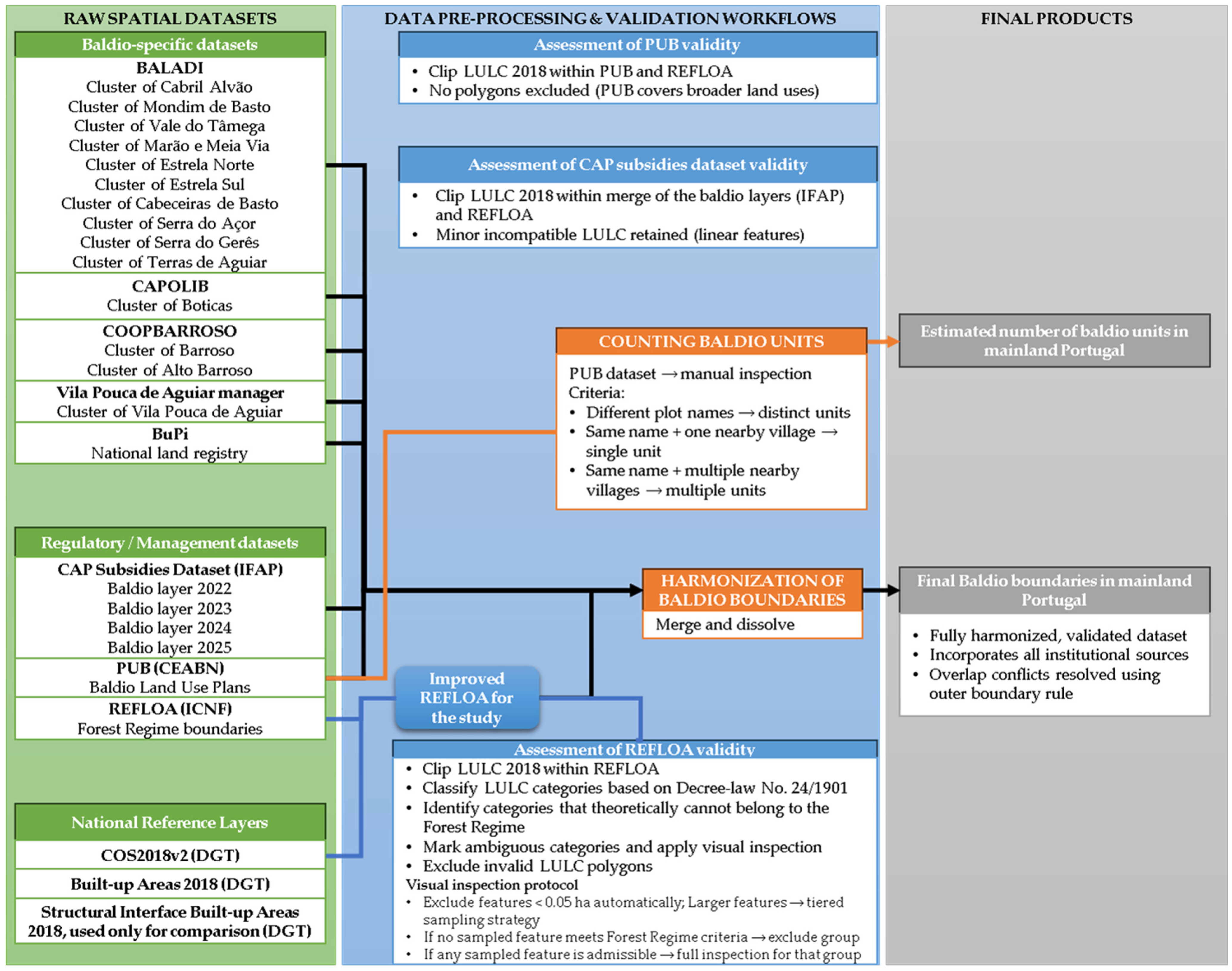
To support this refinement, a spatial overlay analysis was conducted using two national datasets: LULC2018 and REFLOA. The goal was to identify which LULC classes are present within the REFLOA boundaries, while accounting for the known limitations in the spatial accuracy of the REFLOA shapefile. The procedure was carried out in ArcGIS Pro (ESRI, Redlands, CA, USA, version 3.6.2), using the Clip geoprocessing tool, with LULC2018 as the input layer and REFLOA as the clipping boundary (
Figure 1).
We exported the resulting layer attribute table to Excel for detailed inspection. First, we classified each LULC category as to whether it should be included in the Forest Regime, according to the established criteria outlined in Decree-law No. 24, 1901. Some of them were dubious and thus were subjected to visual inspection. The criteria for proceeding or not to visual inspection were defined and validated by an expert panel comprising members from Academia (CEABN) and technicians directly involved in
baldios management (BALADI) (
Table 2).
Subsequently, a cross-validation step was carried out using the attribute table of the clipped dataset. Entries marked as ‘No’ (i.e., should not be included as a LULC category under the Forest Regime) were filtered for visual inspection. We obtained around 26,000 features to inspect. Individual plots (identified by their unique plot IDs) were assessed in ArcGIS Pro using satellite imagery as the basemap. At this point, we defined different methodologies according to their extent:
(1) Features smaller than 0.05 hectares were automatically excluded without further analysis;
(2) A tiered sampling strategy was employed to ensure that larger groups of features were adequately represented, while maintaining a feasible validation process given the large dataset. Features bigger than 0.05 hectares were included in a sampling protocol. This was the case exclusively for four LULC subcategories of built-up areas and the LULC category of temporary crops under both rainfed and irrigated regimes. For each of the referred categories, a statistically valid sample size was determined, and a finite population correction was applied, with adjustments based on the total number of features per category. To generate the sample, a step-by-step procedure was applied using Excel. First, each feature was assigned a random value. The total number of features in each LULC category was then calculated. Based on this count, the appropriate sample size was determined using finite population correction. The number of features reviewed per category followed a tiered sampling strategy, with sample sizes adjusted based on the total number of features in each LULC category. For groups with 30 or fewer features, all features were reviewed. For groups containing between 31 and 100 features, approximately 50 to 60 were selected. Groups with 101 to 500 polygons had a sample size of around 70 to 90 features, while groups exceeding 500 features had a sample size limited to approximately 96 to 100 features. Within each LULC category, features were ranked according to their random values, and those selected for visual inspection were flagged. If none of the sampled features in a group showed characteristics that should be included in the Forest Regime, the group was excluded entirely without further validation. Conversely, if at least one feature within the group showed Forest Regime-relevant characteristics, each feature in that group was assessed individually. Polygons were then marked for exclusion based on their specific ID, using the same review criteria applied previously.
The validation process identified 3569 polygons for exclusion from the REFLOA initial dataset, which had 523,807 hectares at the start of this process. The Forest Regime shapefile we used in this paper, corrected based on LULC 2018, was generated using the Erase tool in ArcGIS Pro, which removed 9093 hectares, about 2% of the initial area, mainly of temporary rainfed and irrigated crops, and discontinuous built-up areas. 90,5% of the erased area was under the partial Forest Regime, 87% of which were baldio areas. This correction was necessary to improve the dataset’s spatial accuracy, ensuring that only legally eligible areas were included in subsequent analyses.
Finally, we assessed the PUB’s boundaries both within and outside the Forest Regime. In this case, no polygons were excluded, as this dataset does not refer solely to the forest regime but rather encompasses a broader range of land that uses land covers.
To generate the final shapefile of subsidized
baldio lands, we merged the four available IFAP shapefiles from 2022 to 2025. As this is the only period of data currently available online, it represents the most complete spatial reference for CAP-eligible
baldio areas. The resulting layer was dissolved, and we assessed which LULC categories were located within the
baldios that overlapped with the Forest Regime (using the previously generated Forest Regime shapefile). Some of them should not belong to the Forest Regime, namely roadways, water, and social areas, totaling around 7 hectares. However, they are mainly linear structures, and we decided not to erase them from the dataset. The flowchart of this methodology is shown in
Figure 1.
2.3. Counting Method of the Baldio Units in Mainland Portugal
A baldio unit is a group of community-owned land parcels, community-owned and managed by commoners (compartes) and functioning as common property for purposes such as grazing, firewood collection, or forestry, in accordance with traditional practices and legal provisions. None of the datasets used specifically refers to the number of baldio units in Portugal. However, the smallest unit in both the PUB and IFAP datasets is the plot. The IFAP dataset does not differentiate between plot names. Considering this, we used the PUB dataset to manually inspect every plot and classify them as single or joint plots, to estimate the total number of baldio units in mainland Portugal. When plots have different names, each corresponds to a distinct baldio unit. When contiguous plots share the same name and are associated with only one nearby village, they are considered to form a single baldio unit. Conversely, when contiguous plots share the same name but have several villages in the vicinity, they correspond to more than one baldio unit. This criterion is based on the fact that baldios historically belonged to and were intended to serve a specific village; therefore, when there is only one village nearby, the baldio is likely to belong to that community.
2.4. Fire Hazard Mapping in the Baldio Areas of Mainland Portugal
The development of the fire hazard map for
baldio lands partially followed the methodology defined by the CEABN−ISA team in Sequeira et al. [
37]. According to this methodology, hazard is considered a function of terrain slope and the characteristics of available fuels. The reclassification of slope and fuel models followed established methods to ensure that the resulting hazard map reflects realistic fire behaviour patterns in mountainous landscapes, where most
baldio areas are located. To implement this, the slope map was reclassified based on data from a 50 m resolution digital terrain model produced from the National Cartographic Series at 1:50,000 scale, available through the SNIG-DGT platform. Additionally, the fuel model map developed by Sá et al. [
38] for mainland Portugal in 2022 was also reclassified.
The reclassification of slope classes was based on literature references concerning fire selection indices by slope category in northern Portugal [
39], using 95% confidence intervals, as most
baldio lands are in this region. Similarly, the reclassification of fuel models was informed by an assessment of fire selection indices for the period 2020–2023, based on the 2019 version of the fuel model map, which is the most recent available at the time.
Both reclassified layers, slope and fuel model, were clipped using the previously defined
baldio boundaries and then multiplied together. The resulting map was subsequently reclassified into five fire hazard classes using the quintile approach, as recommended in the technical guidelines for developing Municipal Forest Defence Plans in Portugal [
40]. The final output expresses fire hazard across
baldio areas using the following five categories: 1—Very low; 2—Low; 3—Moderate; 4—High; and 5—Very high.
3. Results
3.1. Harmonization of Baldio Boundaries
We created a Forest Regime shapefile for Portugal by editing the REFLOA. According to this Forest Regime shapefile developed and used in this study, there are 514,720 hectares under the Forest Regime in Portugal, of which 90% correspond to partial Forest Regime areas. Baldios are included within this category. In fact, only about 5% of the areas under partial Forest Regime are not baldios, and these are mainly private properties belonging to municipalities or the State. Overall, the ICNF dataset indicates that there are 438,077 hectares of baldios under the Forest Regime in mainland Portugal, of which the vast majority (83%) are co-managed by the ICNF.
Regarding the IFAP data, around 400,700 hectares of baldio received subsidies in 2025. This number corresponds to 67% of known baldios based on our results. These subsidies are typically granted to the Assembly of Commoners or to another entity formally delegated to manage the baldio (e.g., local associations or parish councils). The supported activities include afforestation and reforestation, maintenance of forest stands already established, wildfire prevention, resin tapping, valorisation of non-wood forest products, agroforestry and silvopastoral systems (particularly when they assist in fuel reduction), and the preparation and implementation of forest management plans, which are mandatory to access other measures. The practical work is generally carried out by subcontracted forest worker teams or contracted forestry technicians.
According to the IFAP data, 35% of that total area of baldio is permanent grassland and pasture, 30% is forests, 15% is shrubland, and another 15% is non-productive land. The remaining 5% corresponds to other land use land covers, such as temporary crops or wildfire management networks. It is important to note that IFAP data primarily reflect the scope of agricultural and agri-environmental support schemes and therefore does not reflect the full land-use composition of baldios, particularly those predominantly or exclusively forested.
As of the baldio boundaries retrieved from the various clusters and co-operatives, the total area accounts for around 79,865 hectares. National cadastral work is still ongoing across several clusters and co-operatives and is gradually being integrated into the BUPi dataset, which currently accounts for around 87,000 hectares of baldios in total. As both processes remain under development, these sources are expected to progressively improve the accuracy and completeness of baldio boundary information in the coming years.
As expected, significant discrepancies were observed among the datasets analysed due to resolution issues. For this reason, it was not possible to obtain precise boundaries for all baldio units, and the approach of using the outermost boundaries to harmonize all datasets used in this study was considered as the best possible option. By adopting the outermost boundaries, a total baldio area of 595,321.18 hectares was obtained for mainland Portugal. Based on the validation carried out across the different datasets, the potential overestimation associated with this approach is not expected to exceed approximately 9%.
3.2. Assessing the Extent of Forest Regime and Baldios in Mainland Portugal
Since baldios are never subject to the total Forest Regime, there should be no spatial overlap between national forests and baldio areas. Nonetheless, the analysis revealed that portions of two public forests are simultaneously classified as baldio lands in IFAP’s dataset, i.e., for subsidy purposes. These are the cases of part of the public forests of Covilhã (330 hectares) and Gerês (3600 hectares).
Concerning baldio lands under the partial Forest Regime, the results show a total of 438,077.1 hectares. However, we identified two additional baldio areas under the Forest Regime in the Algarve (Faro District), namely in Vila do Bispo and Conceição de Tavira, totalling about 1057 and 108 hectares, respectively. We were able to identify these areas because ICNF’s dataset includes a few polygons classified as being owned by municipalities but managed by local communities. This combination is unusual, and we therefore contacted the respective municipalities, which confirmed that these areas are in fact baldios without legally formed commoners’ associations and are currently being managed by ICNF or the municipality. During the analysis, inconsistencies identified were reported to the respective institutions and are now under review.
Including these two areas means that 73.8% of
baldios in mainland Portugal is currently subject to the Forest Regime, while about 85% of the Forest Regime area comprises
baldios. Compared with the 360,000 hectares of
baldios submitted to the Forest Regime between 1940 and 1960 reported by Devy-Vareta [
11], our estimate suggests a substantial increase in the mapped extent of community land under this legal framework. In turn, in 2004, Germano [
19] reported 556,400 hectares under the partial Forest Regime, a value higher than the 438,077 ha currently identified, indicating a possible contraction of up to about 21.3% in the total area under the partial Forest Regime over the last two decades.
3.3. Forest Regime and Protected Areas: Impacts on Baldio Management
743,215 hectares of mainland Portugal fall within the overlay of the protection and conservation networks. Of this total, 171,904.6 hectares (or 23.13%) corresponds to baldios. Within the new baldio boundaries we calculated, 17 different protection and conservation areas are represented, each with its own decree-law and regulations to manage the area, and with several jurisdictions (municipal, ICNF, or private). The top three most representative are the Peneda-Gerês National Park (about 66 thousand hectares of baldios), the Serra da Estrela Natural Park (45 thousand hectares of baldios), and the Montesinho Natural Park (33 thousand hectares of baldios).
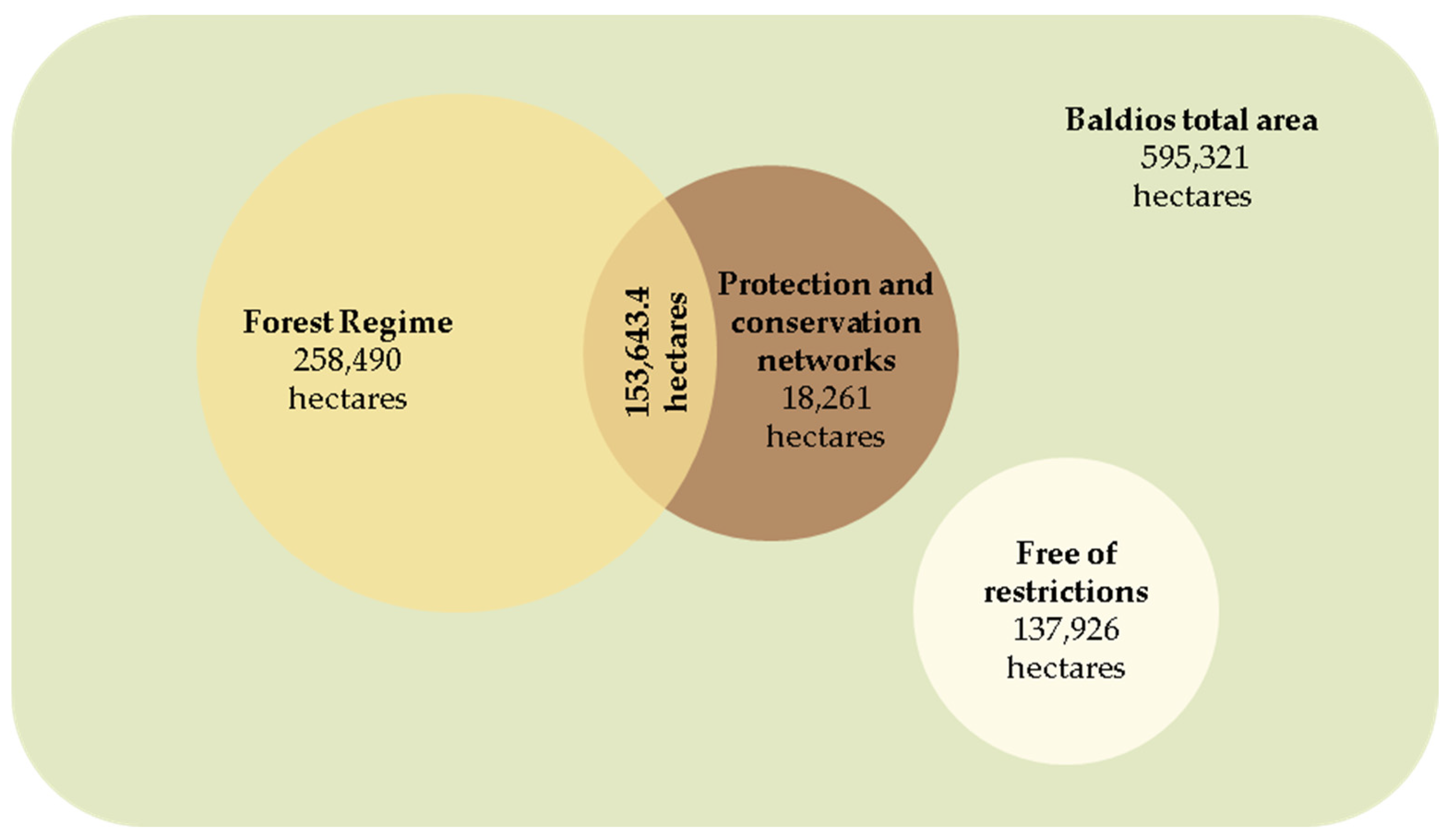
Finally, there are currently 153,643 hectares of
baldios under both the Forest Regime and the protection and conservation networks, meaning 25.8% of
baldio areas must be managed in accordance with both legislation and regulations (
Figure 2).
Overall, it is possible to understand that only about 23.2% of the total baldio areas are not subject to any regulation under the Forest Regime, nor are they protected or conserved in European or national networks. In those cases, baldio managers can rule them without special restrictions. In other words, only about one quarter of baldios can currently be managed without overlapping legal constraints, leaving most territories subject to multi-layered and often conflicting regulations.
3.4. Fire Hazard in Baldio Areas and New Governance Approaches
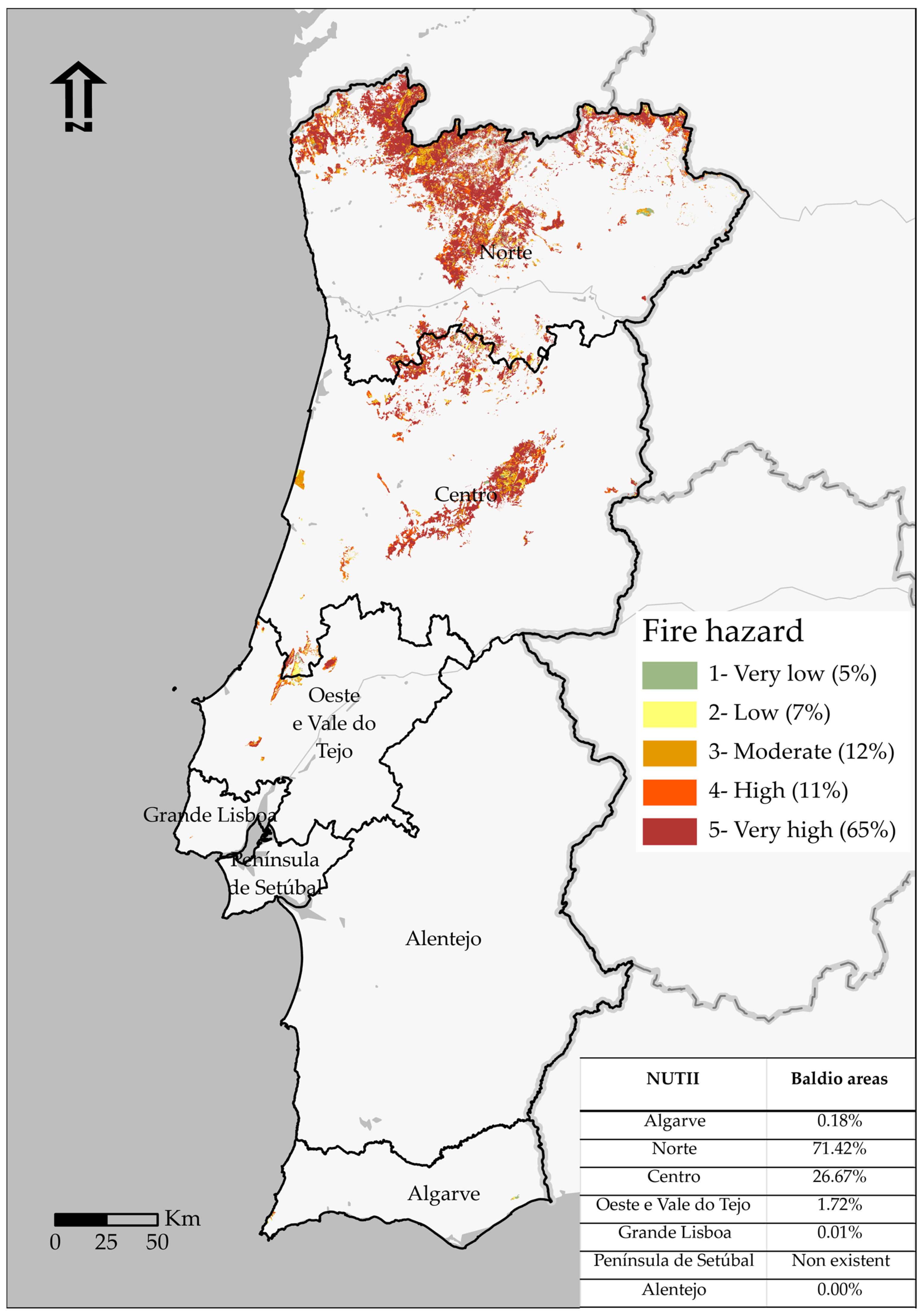
The wildfire hazard analysis conducted for the 595,321 hectares of
baldio land in mainland Portugal shows that approximately 76% of the total area falls into the high or very high hazard classes, while only about 12% is classified as having low or very low hazard (
Figure 3). This means that three out of every four hectares of Portuguese community land are structurally exposed to high or very high wildfire hazard.
In what concerns
baldios under the partial Forest Regime, a higher concentration of high and very high wildfire hazard classes (76.5%) is observed compared to those outside the Forest Regime (73.6%). In particular, the share of areas classified as very high hazard is higher inside the Forest Regime boundaries (66.2% versus 60.8%) (
Table 3).
5. Conclusions
This study represents one of the first systematic, georeferenced assessments of community land (baldios) boundaries at a national scale, revealing a level of spatial inconsistency and institutional fragmentation that has not previously been demonstrated with such a degree of empirical detail. While previous studies have discussed the legal uncertainty and governance challenges associated with baldios, our results specifically demonstrate how boundary ambiguity persists across different datasets and administrative levels, potentially undermining coordinated spatial planning and community control. By identifying these spatial inconsistencies, the study expands existing knowledge on the territorial foundations of community forest management in Portugal and highlights the need to incorporate cadastral clarity into forest fire prevention and rural development strategies.
The results show that the partial Forest Regime remains the dominant institutional framework affecting baldios, while their spatial representation varies substantially across official datasets due to the distinct mandates of the institutions involved. ICNF primarily supports forest management, IFAP focuses on silvopastoral and agri-environmental subsidies, and BUPi is dedicated to rural cadastral registration and georeferenced boundary definitions. Beyond these functional differences, this study also identified specific data inconsistencies, suggesting that inter-institutional collaboration on baldio data management is still in its early stages. Although the number of baldio units currently registered is much lower than the more than 7 thousand units recognised in 1939, the total mapped area is now larger than historical estimations, indicating that Portugal has improved its spatial knowledge of baldio extent but still lacks a comprehensive understanding of their full territorial distribution and current management structures. Strengthening institutional coordination on data sharing emerges as a key condition for improving territorial planning and wildfire risk governance.
Fire hazard analysis confirms that wildfire risk is a structural vulnerability of these territories, with nearly three-quarters of baldio territories exposed to high or very high risk. While wildfire hazard in baldios has been examined in local case studies, no previous work has assessed this risk systematically at the mainland Portugal scale. The recent emergence of clusters of baldios illustrates how governance innovations can help overcome fragmentation, improve coordination, and support integrated fuel management to increase territorial fire resilience.
Beyond the Portuguese case, this study illustrates how fragmented cadastral systems and overlapping legal regimes can constrain wildfire governance in community-based landscapes. The methodological framework developed here offers a transferable approach that can support similar assessments in other regions facing land fragmentation, rural abandonment, and increasing wildfire risk. Strengthening cadastral integration, participatory governance, and landscape-level coordination is emerging as a shared institutional priority for increasing wildfire resilience in the face of climate change.
A more accurate knowledge of property boundaries, as achieved for baldios at the national scale, is key to improving territorial planning, strengthening risk assessment, and enhancing the overall resilience of these landscapes to natural hazards. Ongoing efforts to consolidate new clusters of baldios and to continuously integrate updated boundary information, including from Madeira and the Azores, are expected to refine the national dataset in future research. Without a functional cadastral system for baldios, wildfire governance in mainland Portugal will remain structurally reactive rather than preventive.



 ,
,