Communication

Valorization of Hop (Humulus lupulus L.) Brewing Residue as a Natural Photoprotective Adjuvant


by
Ana Gabriela Urbanin Batista de Lima
1,
Claudinéia Aparecida Sales de Oliveira Pinto
1,
Thalita Marcílio Cândido
1,
Fabiana Vieira Lima Solino Pessoa
2,
Maria Valéria Robles Velasco
1,
Daniel Pecoraro Demarque
1,*,† and
André Rolim Baby
1,*,†
1
Department of Pharmacy, Faculty of Pharmaceutical Sciences, University of São Paulo, São Paulo 05508-000, SP, Brazil
2
Department of Health Sciences, Federal University of Espírito Santo, São Mateus 29932-540, ES, Brazil
*
Authors to whom correspondence should be addressed.
These authors contributed equally to this work.
Photochem 2026, 6(1), 8; https://doi.org/10.3390/photochem6010008
Submission received: 6 December 2025 / Revised: 15 January 2026 / Accepted: 20 January 2026 / Published: 2 February 2026

Abstract

The transition to more sustainable models of production and consumption has encouraged the scientific community to seek innovative solutions that promote environmental responsibility and reduce waste. The cosmetic industry, in particular, has increasingly invested in natural and eco-friendly ingredients as alternatives to synthetic and environmentally harmful components. In this context, plant-derived bioactive compounds with antioxidant and anti-inflammatory potential have gained attention for their ability to enhance photoprotection and reduce the concentration of conventional ultraviolet (UV) filters in sunscreens. Humulus lupulus L. (hop), a plant traditionally used in the brewing industry, generates large amounts of organic waste after the beer production process, especially through the dry-hopping technique. Despite often being discarded, this residual biomass retains important secondary metabolites with high biological value. Our investigation researched the sustainable valorization of hop brewing residues as a source of bioactive compounds for the development of more natural photoprotective products. We performed HLPC-MS/MS analysis and confirmed the presence of α-acids in both pure and reused hop material extracts, while a xanthohumol-like prenylated flavonoid was tentatively detected exclusively in the extract obtained from reused hop extract. In vitro tests demonstrated that sunscreens containing extract obtained from reused material significantly increased the sun protection factor (SPF) without negatively altering the critical wavelength when water was used as the solvent. None of the samples developed higher UVAPF values compared to the control. Our investigation, to the best of our knowledge, constitutes the first successful proof of concept demonstrating the use of both pure (non-reused) and reused hop material extracts as functional photoprotective adjuvants in sunscreen formulations evaluated by a robust, standardized in vitro methodology. This work highlights the dual benefit of reducing industrial waste and developing more sustainable, consumer-friendly cosmetic products.

1. Introduction

Industrialization marked a global turning point, transforming social and family habits. With increasing urbanization and changes in work routines, people began to spend more time outdoors or in environments that intensified exposure to solar radiation. This increased exposure led to the emergence and worsening of skin alterations, particularly sunburns. In response, the scientific community has been conducting in-depth studies to understand the harmful effects of solar radiation on the skin. These efforts culminated in the development of sunscreens, which helped raise public awareness about the importance of skin protection. It is now well established that unprotected and excessive exposure to solar radiation can lead to serious health problems, including skin cancer. As a biological response, the human body has evolved intrinsic protective mechanisms against ultraviolet (UV) radiation to reduce the risk of cellular mutations and genetic damage [1].
Recent scientific interest in sun protection has extended beyond the search for new formulations, turning toward the development of sunscreens that incorporate natural products derived from plants. This innovation aligns with growing environmental concerns and the need for more sustainable alternatives. By replacing or reducing synthetic organic and inorganic UV filters with plant-based ingredients, it is possible to decrease the ecological impact of sunscreen products, particularly the damage they can cause to marine ecosystems and the risks they pose to human health. These advances also promote the development of eco-conscious cosmetics, in line with circular economy principles. Moreover, the use of renewable or reused raw materials offers an economically viable path to innovation, helping industries lower production costs and create added value from waste streams [2,3,4].
Humulus lupulus L. (hop), widely known for its role in brewing, is a rich source of bioactive compounds, such as bitter acids, polyphenols, and essential oils [5,6]. Among these, polyphenols have drawn attention for their strong antioxidant properties and potential to protect against UV-induced lipid peroxidation in the skin [7,8]. Despite the large volume of biomass generated as waste after brewing, particularly during the dry-hopping process, this material remains underutilized.
Our study aimed to compare the phytochemical profiles and photoprotective adjuvant effects of hop extracts obtained from both fresh (herein named “pure”) and reused plant material. Using high-performance liquid chromatography coupled with mass spectrometry (HPLC-MS), we qualitatively characterized the chemical constituents of both extracts and evaluated, preliminarily, their in vitro antioxidant activity. Furthermore, we assessed the in vitro photoprotective efficacy of emulsions containing UVA and UVB filters, with and without the addition of hop extracts. Overall, our findings indicated that our hop extracts, especially the one derived from brewery waste (reused hop sample), to the best of our knowledge, hold considerable potential as sustainable raw material to enhance the performance of sunscreens established by diffuse reflectance spectrophotometry with an integrating sphere, reinforcing the feasibility of revalorizing agro-industrial residues as functional ingredients in environmentally responsible cosmetic formulations.

2. Materials and Methods

2.1. Experimental Overview

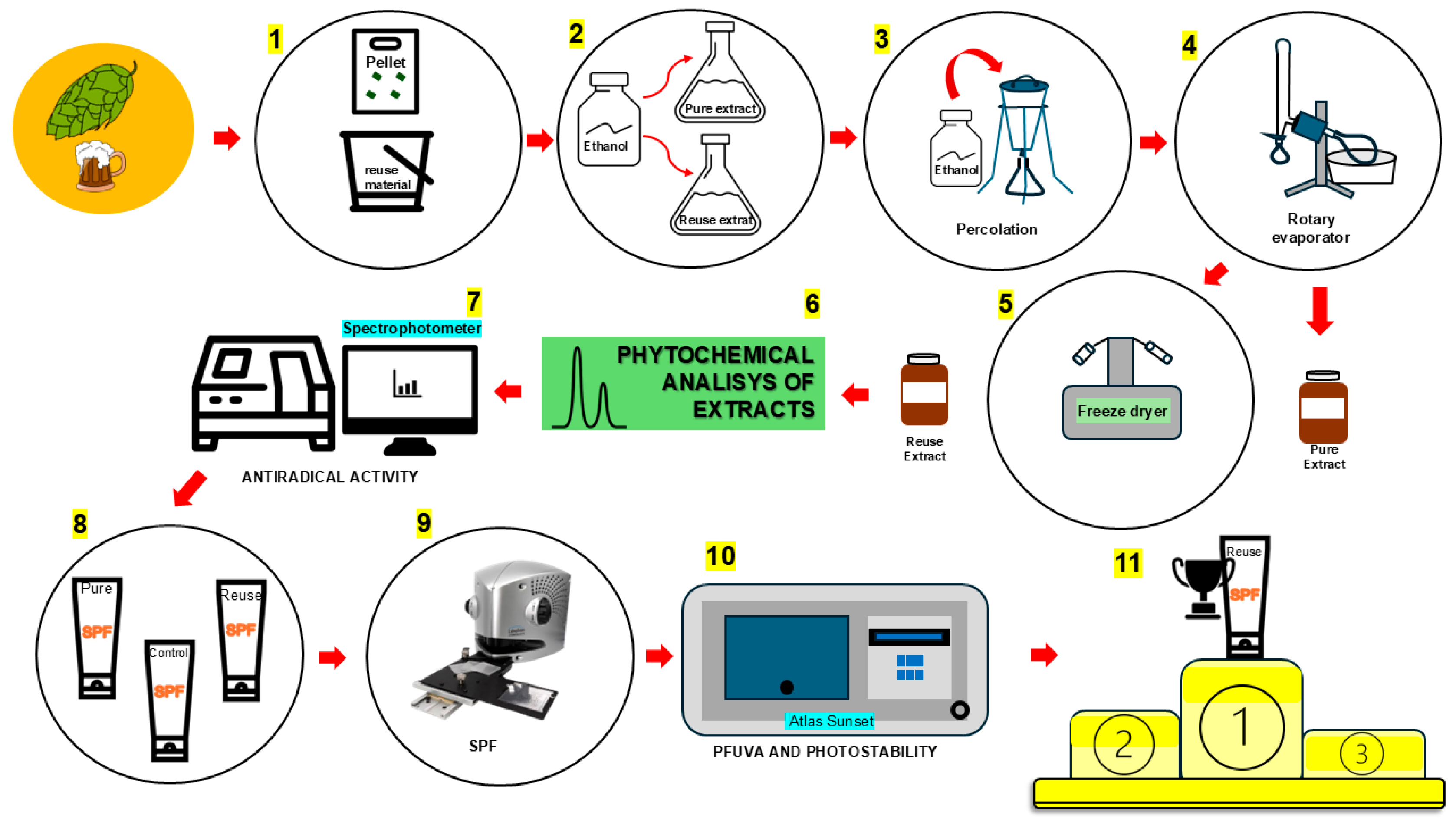
The experimental trajectory of this investigation began with obtaining hop raw materials in their pure and reused form. Subsequently, the extraction of the compounds of interest was performed via maceration and percolation. Following the extraction process, the materials were subjected to the drying step. Next, phytochemical analyses were carried out concurrently with the screening of in vitro antiradical activity. Finally, the extracts were incorporated into emulsions containing UVA and UVB filters to evaluate their in vitro photoprotective efficacy by a robust analytical assay, as illustrated in Figure 1.

2.2. Obtaining Samples

The materials used in this study included pure T90 hop pellets from the 2021 harvest, which were commercially acquired (NUGGET—HAAS/BarthHass, Bento Gonçalves, RS, Brazil). These were stored under refrigeration, maintained at a temperature between 0–5 °C. Each 50 g sample of pure hops had an approximate composition of 13.6% α-acids and 1.8 mL/100 g of essential oil. Additionally, reused hop raw material was obtained from the craft beer production process, specifically through the dry-hopping method.

2.3. Extraction

The extraction process for both pure and reused hop material consisted of two sequential steps: maceration followed by percolation, culminating in the drying of the extract. For this, 50 g of pellets or residue material were added to 300 mL of absolute ethanol and left to macerate overnight for 18 h. After this period, percolation was performed with an additional 2000 mL of absolute ethanol until the complete exhaustion of the plant sample. The extracts were dried in a rotary evaporator at a temperature of 40 °C (pure sample, the pellets) or in a lyophilizer (reused hop material). After the drying process, both extracts were stored under refrigeration until their use.

2.4. Analysis HPLC-MS

For phytochemical analysis, the pure and reused hop material extracts were prepared at a concentration of 10 mg of extract per 1.0 mL of HPLC-grade methanol. Samples were then analyzed by HPLC (Shimadzu, Barueri, SP, Brazil) coupled to an ESI-qTOF mass spectrometer (Bruker, Atibaia, SP, Brazil). Chromatographic separation was performed on a C18 reversed-phase column (15 cm × 4.6 mm, 5 μm particle size, Phenomenex Gemini, Torrance, CA, USA). The mobile phase flow rate was maintained at 1.0 mL/min, and the injection volume for each sample was 20 μL. The mobile phase consisted of water and methanol, both acidified with 0.1% formic acid. The exploratory method employed a methanol gradient, starting at 10% and reaching 100% in 30 min, at a constant flow rate of 1.0 mL/min. After the run, 16 min were dedicated to column washing and stabilization. Ionization in the mass spectrometer was performed in positive mode, with fragmentation of the five most intense ions, allowing for detailed analysis of the metabolites present in the extracts.

2.5. Preliminary Free Radical Scavenging Test (DPPH)

To discern the in vitro antioxidant capacity of the extracts from the pure and reused hop material, the DPPH (2,2-diphenyl-1-picrylhydrazyl) free radical scavenging method was employed [9]. Briefly, 100 mg of each extract was dissolved in 10 mL of water (10 mg/mL stock solution). To each sample aliquot of 0.5 mL, 2.5 mL of a methanolic DPPH solution (100 μM) was added. The resulting mixture was then subjected to a 30-min incubation period at room temperature, protected from light. All samples were analyzed in triplicate. After incubation, the absorbance was measured at 517 nm using a Thermo Scientific Evolution 600 UV-Vis spectrophotometer (Waltham, MA, USA), and the values obtained in percentage were compared with a negative control and quercetin (1.0 mg/mL) for the determination of antioxidant activity, which was expressed as the percentage of DPPH inhibition (Equation (1)).
%   Antioxidant   activity   =   Control   Absorbance     Sample   Absorbance Control   Absorbance   ×   100
Equation (1) Antioxidant activity expressed as percentage of DPPH inhibition.

2.6. Photoprotective Sample and Proof of Concept

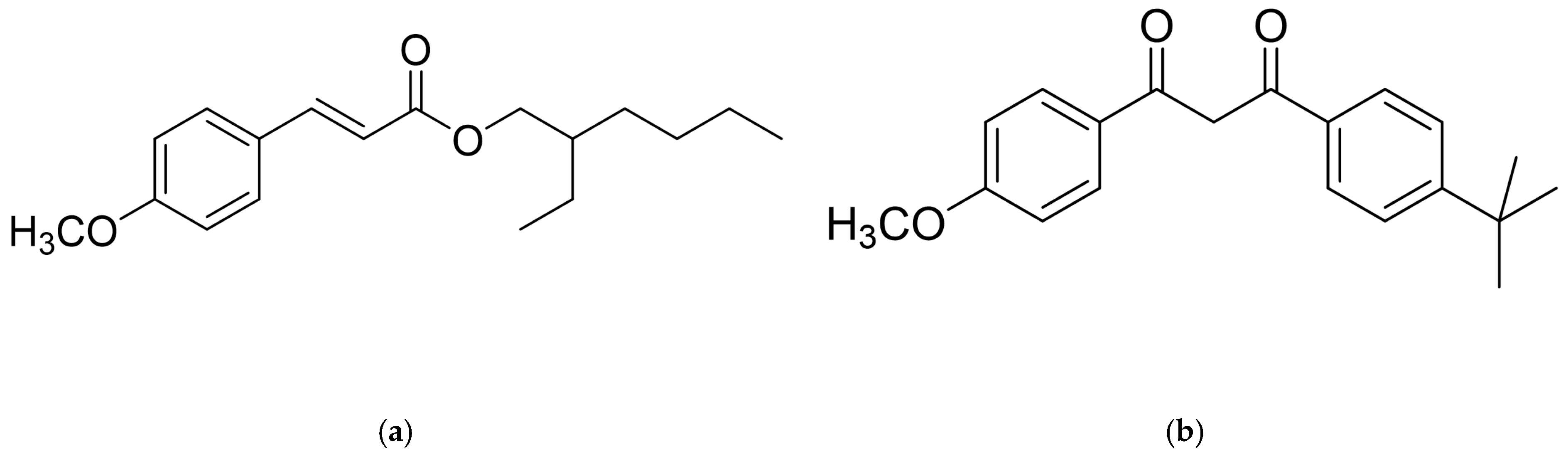
Oil-in-water (O/W) emulsified systems were meticulously prepared. These formulations incorporated UV filters, widely recognized for their safety and efficacy [2]. The innovation resided in the inclusion of H. lupulus extracts, both in their pure form and in their reused material, which were previously solubilized in different solvents for optimization of the proof of concept. The samples designated for photoprotection evaluation were composed of ethylhexyl p-methoxycinnamate (UVB filter) and avobenzone (UVA filter), whose molecular structures are illustrated in Figure 2. The qualitative and quantitative composition (% w/w) of the samples is detailed in Table 1.

2.7. In Vitro Photoprotective Efficacy

The in vitro photoprotective efficacy of the samples was established by measuring the sun protection factor (SPF) and the critical wavelength (nm). For this purpose, a Labsphere UV2000S Ultraviolet Transmittance Analyzer (Labsphere, Inc., North Sutton, NH, USA) was used. For the execution and evaluation of the test, a precise quantity of 1.3 mg/cm2 of each sample (n = 3) was applied uniformly onto the surface of 25 cm2 polymethyl methacrylate (PMMA, Helioplate HD 6-Helioscreen, North Sutton, NH, USA) plates (n = 3). After a drying period of the plates, spectrophotometric readings were performed. A minimum of five transmittance readings were taken per plate evaluated, with the obtained results processed using the UV-2000 software, covering a wavelength range from 290 to 400 nm [10,11]. The spectrophotometric data were subsequently converted into in vitro values for the SPF and critical wavelength (λcrit, nm), which characterize the photoprotective efficacy of the formulations [12,13,14,15,16]. The blank was the PMMA with glycerin. For the determination of the UVA Protection Factor (UVAPF), it was necessary to adapt the experiment, using the in vitro SPF value to determine the irradiation time and dose for each sample. This process was conducted using a solar simulator (Suntest CPS+, Atlas, Votorantim, SP, Brazil) equipped with a xenon lamp, which is complemented by two crucial filters: the first, a UV blocking filter whose primary purpose is to prevent any undesirable thermal effects on the samples; and the second, an optical filter, designed to reduce wavelengths below 290 nm, ensuring that the irradiation is restricted to the spectrum relevant for photoprotective evaluation [16].

2.8. Statistical Analysis

Minitab program, version 19, was used to treat the results. A one-way ANOVA was conducted at a 95% confidence level to assess the significant difference among the means (n = 3; p ≤ 0.05). Following the ANOVA, a Tukey test was performed.

3. Results and Discussion

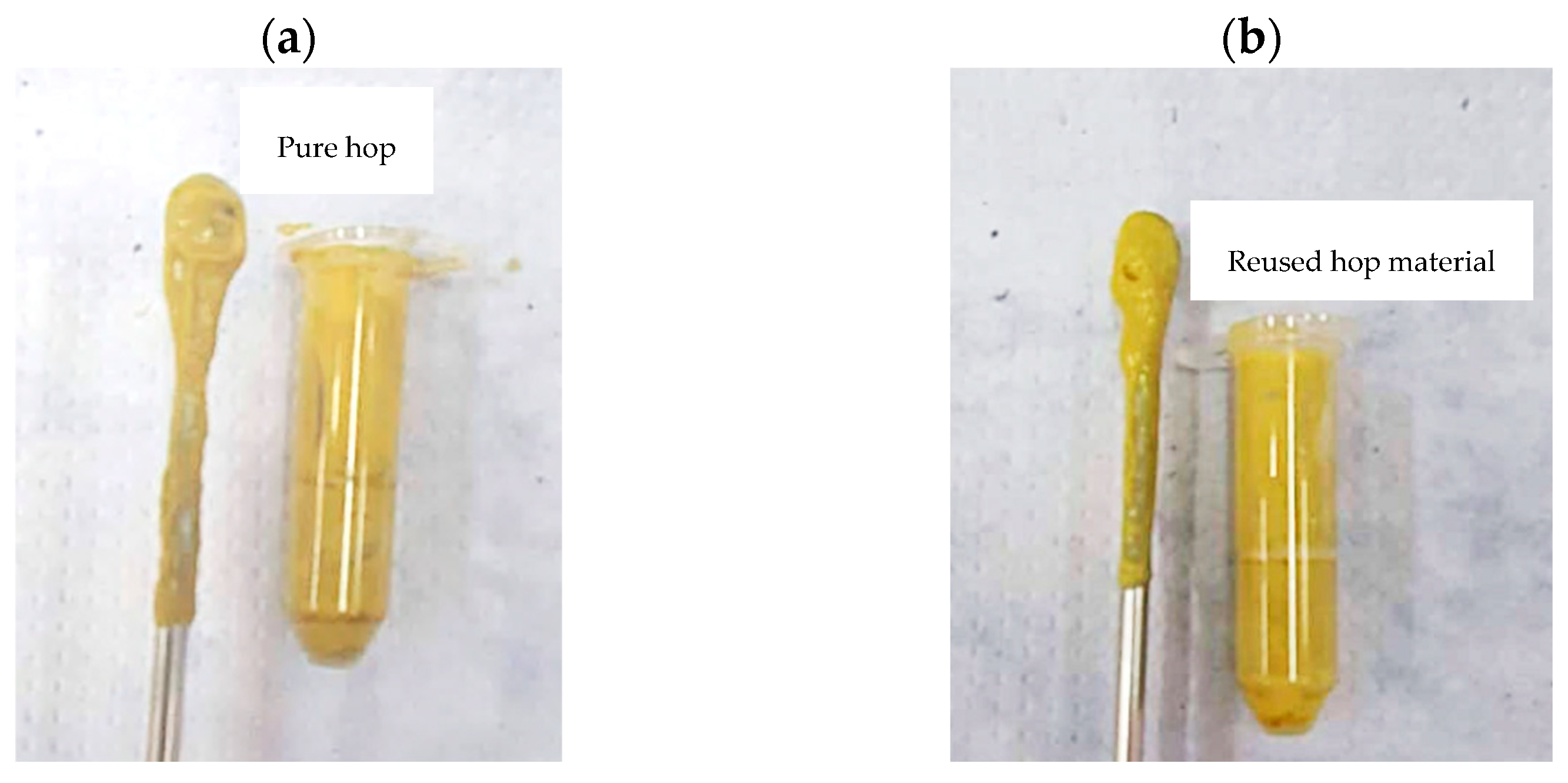
Given the wide range of bioactive compounds present in hops, various technologies have been studied to optimize the performance of hop-derived products. Therefore, the selection and use of solvents represent a fundamental pillar in the isolation process of these compounds [17]. Many conventional solvents, such as ethanol, continue to be widely used. As a polar substance, ethanol has the capacity to dissolve a myriad of hop components, being particularly suitable for the extraction of polyphenols, organic acids, and carbohydrates. Given the preceding considerations, the selection of ethanol proved to be the most coherent choice, due to its versatility as a solvent for the substances present in the samples. It is imperative, however, to consider that the concentration of polyphenols synthesized by hops is intrinsically linked to factors such as cultivation, geographical location, environmental conditions, and the extraction method employed. Such variables must be meticulously considered in any future investigations [5,18,19]. The extracts are illustrated in Figure 3. Although extracts obtained from both pure and reused hop material exhibited comparable organoleptic properties, the reused sample required an additional drying step, as described in Section 2.3., likely due to its higher residual water content resulting from the brewing process.
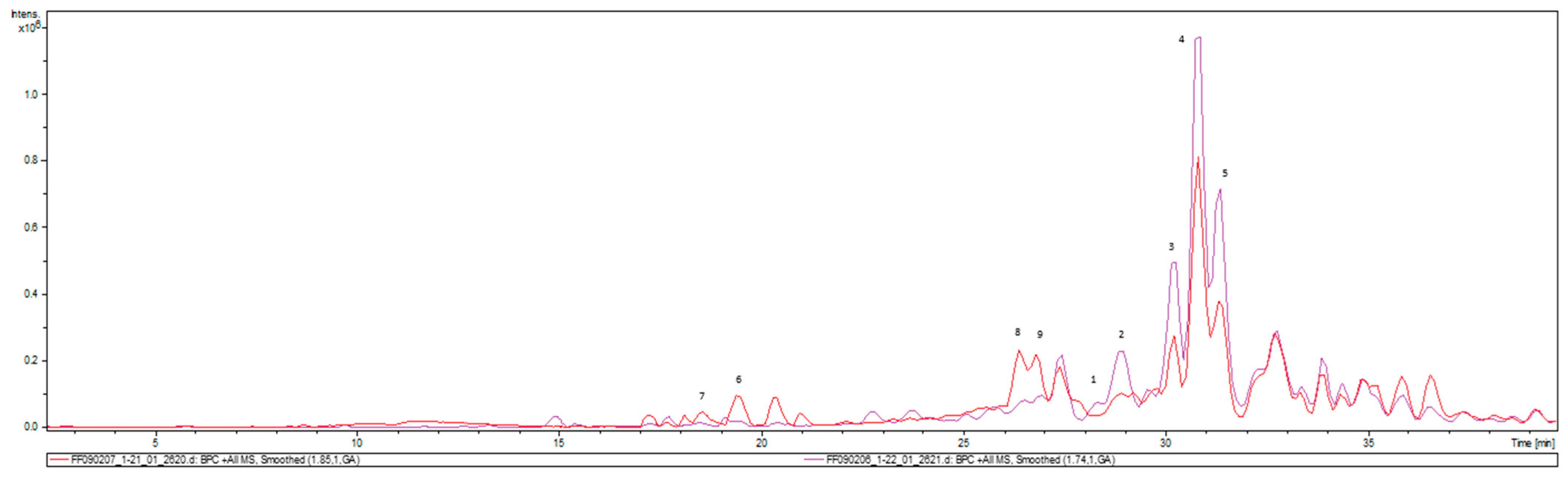
Hop extracts are unequivocally rich in a vast array of bioactive compounds, among which polyphenols stand out, including kaempferol, quercetin, tyrosol, ferulic acid, and xanthohumol. Furthermore, these extracts contain α-acids, exemplified by humulone, and β-acids, such as lupulone. This multifaceted phytochemical composition is the basis for the myriad of beneficial effects on human health that hop extracts can provide, including a potential adjuvant photoprotection action [20]. The present study proceeded with the analysis of the separation and identification of the bioactive compounds present in both the pure and reused hop extracts. For this purpose, an HPLC system coupled to an ESI-qTOF mass spectrometer was employed. The detailed results of both analyses are illustrated in Figure 4 and Table 2.
More intense peaks of compounds present in the pure extract were detected in the following regions: TR 28.5 min, m/z 385.1974, compatible with the formula C21H30O5 + Na+ (error 4.4 ppm), derived from humulone; TR 28.9 min, m/z 383.1823, compatible with the formula C21H28O5 + Na+ (error 3.0 ppm), where an annotation was not possible; TR 30.1 min, m/z 371.1821, compatible with the formula C20H28O5 + Na+ (error 3.6 ppm), derived from cohumulone; TR 30.8 min, m/z 385.1987, compatible with the formula C21H30O5 + Na+ (error 1.0 ppm), derived from humulone; TR 31.3 min, m/z 291.1591, compatible with the formula C17H23O4+ (error 1.0 ppm), derived from cohumulone. The reused material extract, on the other hand, showed a greater quantity of the following compounds in these regions: TR 19.4 min, m/z 389.1929, compatible with the formula C20H30O6 + Na+ (error 2.8 ppm), derived from cohumulone; TR 18.5 min, m/z 393.1300, compatible with the formula C21H22O6 + Na+ (error 3.6 ppm), derived from xanthohumol; TR 26.4 and 26.9 min showed m/z 401.1925, compatible with the formula C21H30O6 + Na+ (error 3.7 ppm), derived from humulinone.
Both analyzed extracts revealed the presence of α-acids; however, xanthohumol was detected exclusively in the extract obtained from reused hop material. Previous studies have demonstrated that xanthohumol exhibits results in attenuating inflammation and oxidative stress in wound healing processes in rat skin, in addition to its ability to reduce elastase and metalloproteinase activity, while simultaneously increasing the expression of elastin and collagen in dermal fibroblasts. In light of these beneficial effects, it is plausible to infer that xanthohumol may also contribute to the enhancement of photoprotection, positively influencing the SPF, since the delay of erythema development can be attributed to a topical anti-inflammatory activity. This prenylflavonoid, recognized for its antioxidant properties, constitutes approximately 0.1 to 1.0% of the dry weight of hops in female inflorescences. It is distinguished by its predominantly lipophilic characteristics compared to other polyphenols, and its extraction is relatively low. During the brewing process, the xanthohumol present can undergo thermal isomerization and transform into isoxanthohumol [21]. This compound, in turn, was not found in the extract obtained from reused hop material, as this discarded raw material was derived from “dry-hopping”.
In the dry-hopping method, hops are incorporated into the beer after fermentation and cooling, intensifying the beverage’s aroma and flavor while contributing to the preservation of the bioactive compounds present in the hops. It is estimated that approximately 85% of the bioactive compounds remain in the residual hops, which are frequently discarded, leading to a missed opportunity to utilize them as a potent raw material in various industries [22]. The presence of xanthohumol in reused material extract after the beer production process using the dry-hopping technique is, therefore, justified. However, its non-detection in the extract obtained from pure (non-reused) hop extract warrants further investigation, considering that xanthohumol is present in the lupulin glands [23], albeit in small quantities. Its absence in the pure extract can, for now, be attributed to the presence of other secondary metabolites that masked it or even its low concentration. However, during the beer production process, these metabolites were consumed more intensely, highlighting the subsequent appearance of this flavonoid in a more concentrated form. It is believed that this phenomenon accentuates the appearance of xanthohumol in the reused material extract, underscoring the importance of thoroughly exploring the dynamics of its compounds at different stages of production.
The DPPH assay stands out as one of the most established and widely used methods for determining free radical scavenging capacity. This technique has been extensively employed in model systems to comparatively investigate the free radical scavenging activities of a wide range of compounds, from natural to synthetic, isolated or in mixtures, as extracts. This includes isolated natural compounds, such as polyphenols, and its versatility makes it an interesting tool in research on antioxidant capacity [24,25]. Our study proceeded with the comparison of DPPH radical scavenging activity by hop extracts, in both their pure and reused material forms. We utilized this in vitro assay to provide a preliminary assessment of the samples’ mechanism of action within the sunscreen system. Samples were compared against a negative control and against quercetin (1.0 mg/mL), which served as the positive control.
The extract obtained from pure hop showed a superior antioxidant profile (36.4% DPPH inhibition); however, the positive control developed the best performance (83.7% DPPH inhibition). The extract from reused hop material did not exhibit detectable antioxidant activity under the DPPH assay conditions employed in our study (0% DPPH inhibition). Even though the reused hop sample estimated the recovery of interesting phytocompounds, the in vitro antioxidant property of this extract was not identified. As the primary objective of this work was to demonstrate a proof of concept for the valorization of a brewing by-product in a photoprotective formulation, antioxidant activity was initially assessed using the DPPH assay as a screening method for the H. lupulus extracts. Although xanthohumol, a compound-like only detected in the reused hop material extract, is reported as a potent antioxidant in biological systems, its reactivity toward DPPH can be limited. Kontek et al. showed that even pure xanthohumol scavenges less than 20% of DPPH radicals at concentrations above 1.0 mg/mL, reflecting poor efficiency toward this radical species. Accordingly, the absence of measurable DPPH activity in the reused hop material extract, despite the detection of xanthohumol-like compounds, is consistent with both the mechanistic limitations of the DPPH assay and solvent-dependent effects rather than indicating a lack of intrinsic antioxidant potential [26].
UV filters are subject to various limitations, such as loss of efficacy due to photodegradation or even potential skin penetration, which can lead to some level of adverse effects [27]. In this context, the search for more natural products, with special attention to polyphenols, has proven to be a promising alternative. However, it is important to consider that the absorbance spectrum of these compounds does not fully cover the UVA and UVB ranges and may not robustly absorb UV radiation to avoid cutaneous damage, making the presence of traditional filters mandatory in sunscreen samples to reach enough skin protection against solar radiation exposure. This limitation sometimes necessitates their combination with other protective agents to ensure complete and multifunctional effective sun defense [28].
A photoprotective emulsion constitutes a mixture of two or more immiscible liquids, whose consistency can vary. On a macroscopic scale, all analyzed samples demonstrated uniformity [29]. We emphasize that all formulations were prepared and used on the same day, ensuring the consistency and validity of the results. The control employed was formulated with the inclusion of UVA and UVB filters only. The in vitro efficacy evaluation via SPF revealed that samples F1, F2, F4, F5, F6, and F8 exhibited an efficacy consistent with expectations. In contrast, samples F3 and F7 showed reduced efficiency when compared to the control sample. Although samples F3 to F8 exhibited distinct SPF values, they were considered equivalent, with no discernible superiority among them. Among the samples with the best photoprotective performance, it was noted that they comprised formulations containing both reused material and pure extracts, suggesting a positive and synergistic interaction with the intrinsic protective system. However, formulation F1, which contained 10.0% (w/w) extract obtained from pure (non-reused) hop material in water, and F2, with 10.0% (w/w) reused hop material extract in water, demonstrated a significant increase in SPF, reaching 117.48 ± 13.28 and 178.0 ± 21.5, respectively, relative to the control, as described in Table 3. Samples F1 and F2 emerged as isolated groups in terms of performance, but sample F2 showed superior efficacy. Additionally, the use of water as a solvent in the formulations reinforced their superiority, not only due to performance but also for crucial attributes such as non-aggressiveness to the skin.
Interestingly, formulations F4 (isopropyl myristate) and F8 (capric–caprylic acid triglyceride), both containing the reused hop material extract, exhibited intermediate photoprotective performance and clustered with F1 (reused extract in distilled water), suggesting the superior contribution of the reused hop material extract to SPF enhancement.
From the perspective of the SPF, once it reaches a value of ≥6, formulations in question can be designated as sunscreens [30]. For all investigated samples, the critical wavelength was consistently established at approximately 380 nm. This parameter represents the spectral section that covers 90% of the area under the integrated optical density curve in the UV spectrum, delimited between 290 and 400 nm [31].
All the investigated samples presented SPF greater than 15 and were classified as broad-spectrum sunscreens, from an in vitro assay perspective. In this context, an expectation was met regarding the performance of the samples containing the extract obtained from reused hop material. Despite the significant increase in the in vitro SPF for the F2, there were minimal improvements in the sample’s critical wavelength. This result possibly stems from the higher interaction of the extract in the UVB range in the presence of the UV filter system [30].
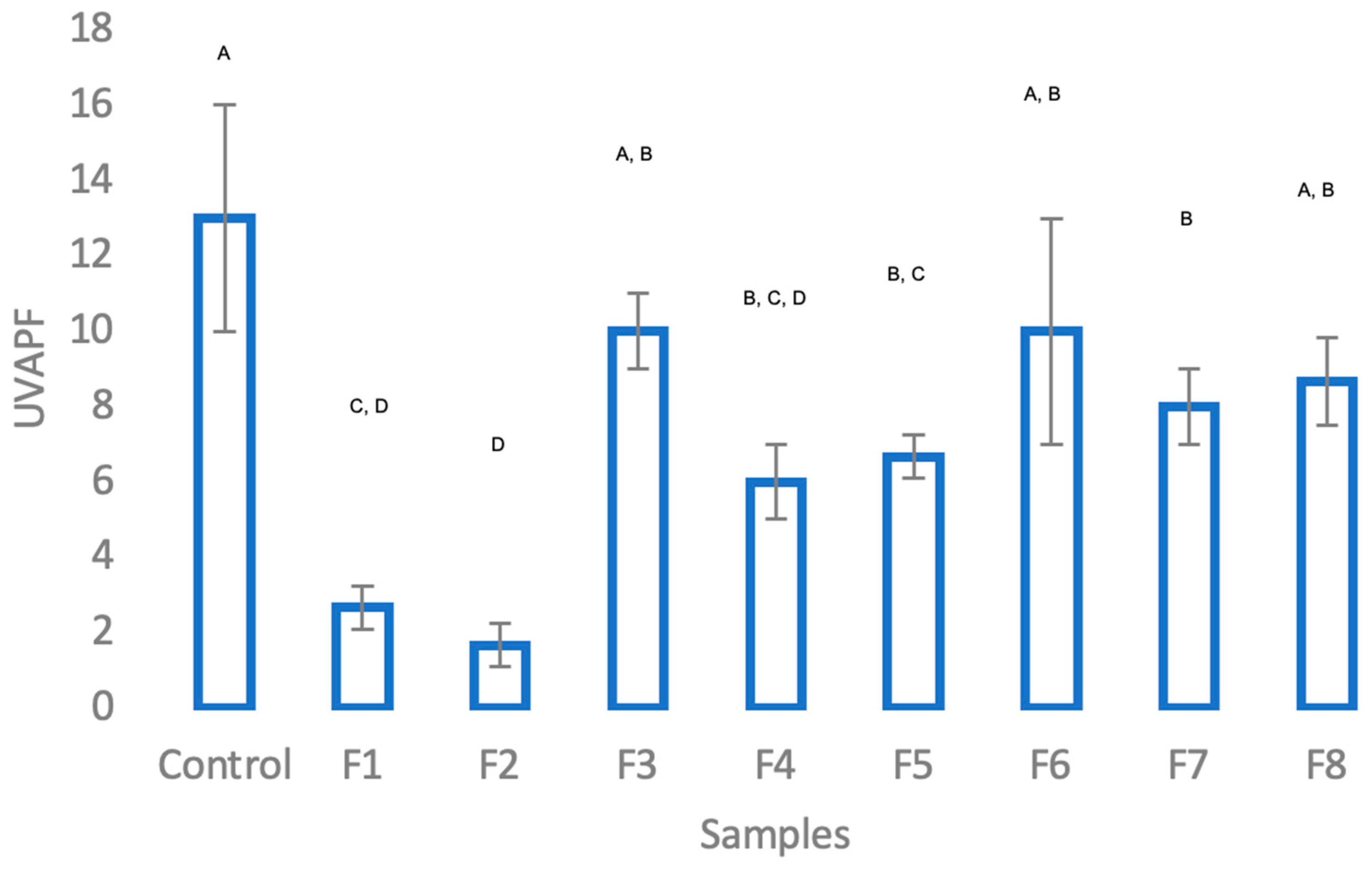
Analysis of the photoprotective performance revealed that, although samples F1 and F2 stood out for the best SPF, their action was predominantly concentrated on UVB protection, with a less expressive contribution to UVA protection. Given the results obtained, it is reasonable to assume that, in some way, the extracts decreased UVA protection after irradiation when compared to the control (Figure 5). Another plausible interpretation concerning the UVA performance of the samples may be attributed to the film-formation property of the systems. The lipophilic solvents (isopropyl palmitate, isopropyl myristate, and capric-caprylic acid triglyceride) tended to only increase the UVAPF of our sunscreens when compared to the samples F1 and F2, in which emollients were not used. No robust improvements were observed for the UVAPF values, with the best results just comparable with the control.
This investigation presents several important strengths, foremost among them that, to the best of our knowledge, it constitutes the first successful proof of concept demonstrating the use of both non-reused and brewing-reused hop extracts as functional photoprotective adjuvants in sunscreen formulations evaluated by a robust, standardized in vitro methodology. The application of the Labsphere UV2000S enabled a reproducible and regulatory-relevant assessment of in vitro SPF, UVAPF, and critical wavelength, allowing a direct and meaningful comparison of the photoprotective efficacy of formulations containing extracts from pure and reused hop material. The integration of detailed phytochemical profiling (HPLC–MS) with formulation-level photoprotection testing further strengthens the translational relevance of this work and supports the feasibility of valorizing brewing residues within a circular-economy framework. Nevertheless, the study remains limited to in vitro evaluations and does not address in vivo SPF. In addition, antioxidant activity was assessed only by the DPPH assay. Finally, the lack of quantitative standardization of xanthohumol-like compounds and extraction yields limits more mechanistic interpretation.

4. Conclusions

We demonstrated that hop (H. lupulus L.) residue, a by-product commonly discarded after the beer production process, can be revalorized as an active component in photoprotective formulations. Both extracts revealed the presence of α-acids; however, xanthohumol was detected only in the reused hop material extract. Pure and reused hop material extracts showed photoprotective potential and expressive elevation of the SPF in vitro, especially the reused one with distilled water, likely resulting from multifactorial formulation and optical/biological effects rather than classical antioxidant mechanisms alone, even though no antioxidant activity was detected by an in vitro assay for the reused sample. The use of brewing residues could not only add value to agro-industrial waste but also align with circular economy principles by reducing environmental impact and promoting resource efficiency. This approach supports the development of greener cosmetic products that meet both consumer expectations and regulatory trends toward sustainability. These findings underscore the importance of interdisciplinary strategies in developing innovative, eco-friendly, and effective sun care solutions.

Author Contributions

Conceptualization, A.G.U.B.d.L., A.R.B. and D.P.D.; methodology, A.G.U.B.d.L., C.A.S.d.O.P., T.M.C., M.V.R.V. and F.V.L.S.P.; formal analysis, A.R.B. and D.P.D.; investigation, A.G.U.B.d.L., C.A.S.d.O.P., M.V.R.V., F.V.L.S.P., A.R.B. and D.P.D.; resources, A.R.B., M.V.R.V. and D.P.D.; data curation, A.R.B. and D.P.D.; writing—original draft preparation, A.G.U.B.d.L., T.M.C., A.R.B. and D.P.D.; writing—review and editing, T.M.C., A.R.B. and D.P.D.; visualization, A.R.B. and D.P.D.; supervision, A.R.B. and D.P.D.; project administration, A.R.B. and D.P.D.; funding acquisition, A.R.B. and D.P.D. All authors have read and agreed to the published version of the manuscript.

Funding

This research was funded by Conselho Nacional de Desenvolvimento Científico e Tecnológico CNPq (grant number 303862/2022-0); Coordenação de Aperfeiçoamento de Pessoal de Nível Superior-Brasil (CAPES), grant number 001; Fundação de Amparo à Pesquisa do Estado de São Paulo (FAPESP) (grant numbers 2024/01920-0, 2022/08191-9).

Institutional Review Board Statement

Not applicable.

Informed Consent Statement

Not applicable.

Data Availability Statement

Dataset available on request from the authors.

Acknowledgments

A.R.B. is grateful to CNPq, for the Research Productivity Grant and to FAPESP.

Conflicts of Interest

The authors declare no conflicts of interest.

References

  1. Stiefel, C.; Schwack, W. Photoprotection in Changing Times-UV Filter Efficacy and Safety, Sensitization Processes and Regulatory Aspects. Int. J. Cosmet. Sci. 2015, 37, 2–30. [Google Scholar] [CrossRef]
  2. de Oliveira Bispo, M.; Morocho-Jácome, A.L.; Escudeiro, C.C.; Martinez, R.M.; de Oliveira Pinto, C.A.S.; Rosado, C.; Velasco, M.V.R.; Baby, A.R. Photoprotective Efficacy of the Association of Rosmarinic Acid 0.1% with Ethylhexyl Methoxycinnamate and Avobenzone. Cosmetics 2023, 10, 11. [Google Scholar] [CrossRef]
  3. Guan, L.L.; Lim, H.W.; Mohammad, T.F. Sunscreens and Photoaging: A Review of Current Literature. Am. J. Clin. Dermatol. 2021, 22, 819–828. [Google Scholar] [CrossRef] [PubMed]
  4. Li, L.; Chong, L.; Huang, T.; Ma, Y.; Li, Y.; Ding, H. Natural Products and Extracts from Plants as Natural UV Filters for Sunscreens: A Review. Animal Model Exp. Med. 2023, 6, 183–195. [Google Scholar] [CrossRef]
  5. Knez Hrnčič, M.; Španinger, E.; Košir, I.J.; Knez, Ž.; Bren, U. Hop Compounds: Extraction Techniques, Chemical Analyses, Antioxidative, Antimicrobial, and Anticarcinogenic Effects. Nutrients 2019, 11, 257. [Google Scholar] [CrossRef] [PubMed]
  6. Kowalska, G.; Bouchentouf, S.; Kowalski, R.; Wyrostek, J.; Pankiewicz, U.; Mazurek, A.; Sujka, M.; Włodarczyk-Stasiak, M. The Hop Cones (Humulus lupulus L.): Chemical Composition, Antioxidant Properties and Molecular Docking Simulations. J. Herb. Med. 2022, 33, 100566. [Google Scholar] [CrossRef]
  7. Ruscinc, N.; Massarico Serafim, R.A.; Almeida, C.; Rosado, C.; Baby, A.R. Challenging the Safety and Efficacy of Topically Applied Chlorogenic Acid, Apigenin, Kaempferol, and Naringenin by HET-CAM, HPLC-TBARS-EVSC, and Laser Doppler Flowmetry. Front. Chem. 2024, 12, 1400881. [Google Scholar] [CrossRef]
  8. Lin, M.; Xiang, D.; Chen, X.; Huo, H. Role of Characteristic Components of Humulus Lupulus in Promoting Human Health. J. Agric. Food Chem. 2019, 67, 8291–8302. [Google Scholar] [CrossRef]
  9. Szabo, M.; Idiţoiu, C.; Chambre, D.; Lupea, A. Improved DPPH Determination for Antioxidant Activity Spectrophotometric Assay. Chem. Pap. 2007, 61, 214–216. [Google Scholar] [CrossRef]
  10. Agência Nacional de Vigilância Sanitária. Diretoria Colegiada. Resolução—RDC Nº 629, de 10 de março de 2022. 2022. Available online: https://anvisalegis.datalegis.net/action/ActionDatalegis.php?acao=abrirTextoAto&tipo=RDC&numeroAto=00000629&seqAto=000&valorAno=2022&orgao=RDC/DC/ANVISA/MS&codTipo=&desItem=&desItemFim=&cod_menu=1696&cod_modulo=134&pesquisa=true (accessed on 5 June 2024).
  11. Choquenet, B.; Couteau, C.; Paparis, E.; Coiffard, L.J.M. Flavonoids and Polyphenols, Molecular Families with Sunscreen Potential: Determining Effectiveness with an in Vitro Method. Nat. Prod. Commun. 2009, 4, 1934578X0900400212. [Google Scholar] [CrossRef]
  12. Colipa; Cosmetic, Toiletry & Fragrance Association of South Africa (CTFA); Japan Chemical Industry Association (JCIA); Certified Trust and Fiduciary Advisor (CTFA). Colipa Guidelines: International Sun Protection Factor (SPF) Test Method; Colipa: Brussels, Belgium, 2006. [Google Scholar]
  13. In Vitro Method for the Determination of the UVA Protection Factor and “Critical Wavelength” Values of Sunscreen Products. 2011. Available online: https://www.ceceditore.com/wp-content/uploads/2022/10/Colipa-UVA-In-Vitro-Method-March-2011-Final.pdf?utm_source=chatgpt.com (accessed on 13 May 2023).
  14. Food and Drug Administration. Department of Health and Human Services Labeling and Effectiveness Testing; Sunscreen Drug Products for Over-the-Conter Human Use. Final Rule. 2011. Available online: https://www.federalregister.gov/documents/2011/06/17/2011-14766/labeling-and-effectiveness-testing-sunscreen-drug-products-for-over-the-counter-human-use (accessed on 13 May 2023).
  15. Diffey, B.L.; Tanner, P.R.; Matts, P.J.; Nash, J.F. In Vitro Assessment of the Broad-Spectrum Ultraviolet Protection of Sunscreen Products. J. Am. Acad. Dermatol. 2000, 43, 1024–1035. [Google Scholar] [CrossRef] [PubMed]
  16. Scalia, S.; Mezzena, M. Photostabilization Effect of Quercetin on the UV Filter Combination, Butyl Methoxydibenzoylmethane-Octyl Methoxycinnamate. Photochem. Photobiol. 2010, 86, 273–278. [Google Scholar] [CrossRef]
  17. Kurzawa, M.; Wilczyńska, E.; Brudzyńska, P.; Sionkowska, A. Total Phenolic Content, Antioxidant Capacity and UV Radiation Protection Properties of Marigold (Calendula officinalis), Carrot (Daucus carota), Tomato (Solanum lycopersicum) and Hop (Humulus lupulus) Extracts. Cosmetics 2022, 9, 134. [Google Scholar] [CrossRef]
  18. Sabbatini, G.; Mari, E.; Ortore, M.G.; Di Gregorio, A.; Fattorini, D.; Di Carlo, M.; Galeazzi, R.; Vignaroli, C.; Simoni, S.; Giorgini, G.; et al. Hop Leaves: From Waste to a Valuable Source of Bioactive Compounds—A Multidisciplinary Approach to Investigating Poten-Tial Applications. Heliyon 2024, 10, e37593. [Google Scholar] [CrossRef]
  19. Magalhães, P.J.; Carvalho, D.O.; Cruz, J.M.; Guido, L.F.; Barros, A.A. Fundamentals and Health Benefits of Xanthohumol, a Natural Product Derived from Hops and Beer. Nat. Prod. Commun. 2009, 4, 1934578X0900400501. [Google Scholar] [CrossRef]
  20. Chen, W.; Becker, T.; Qian, F.; Ring, J. Beer and Beer Compounds: Physiological Effects on Skin Health. J. Eur. Acad. Dermatol. Venereol. 2014, 28, 142–150. [Google Scholar] [CrossRef]
  21. Dabrowski, W.; Pfortmueller, C.A.; Kotfis, K.; Jaroszynski, A.; Gagos, M.; Plotek, W.; Malbrain, M.L.N.G. Is There a Place for Natural Agents with Anti-Inflammatory and Antioxidative Properties in Critically Ill Patients? Potential Usefulness of Xanthohumol. Pharmacol. Ther. 2025, 266, 108766. [Google Scholar] [CrossRef]
  22. Oliveira, A.M.B.; Meirelles, A.A.D.; Barrales, F.M.; Dias, A.L.B.; Fasolin, L.H.; Viganó, J.; Martínez, J. Rapid Extraction of Xanthohumol, α- and β-Acids from Spent Hops Using Pressurized Liquids and Supercritical Fluids. J. Supercrit. Fluids 2025, 223, 106609. [Google Scholar] [CrossRef]
  23. Stevens, J.F.; Page, J.E. Xanthohumol and Related Prenylflavonoids from Hops and Beer: To Your Good Health! Phytochemistry 2004, 65, 1317–1330. [Google Scholar] [CrossRef]
  24. Sánchez-Moreno, C.; Larrauri, J.A.; Saura-Calixto, F. A Procedure to Measure the Antiradical Efficiency of Polyphenols. J. Sci. Food Agric. 1998, 76, 270–276. [Google Scholar] [CrossRef]
  25. Bondet, V.; Brand-Williams, W.; Berset, C. Kinetics and Mechanisms of Antioxidant Activity Using the DPPH Free Radical Method. LWT-Food Sci. Technol. 1997, 30, 609–615. [Google Scholar] [CrossRef]
  26. Kontek, B.; Jedrejek, D.; Oleszek, W.; Olas, B. Antiradical and Antioxidant Activity in Vitro of Hops-Derived Extracts Rich in Bitter Acids and Xanthohumol. Ind. Crops. Prod. 2021, 161, 113208. [Google Scholar] [CrossRef]
  27. Kockler, J.; Oelgemöller, M.; Robertson, S.; Glass, B.D. Photostability of Sunscreens. J. Photochem. Photobiol. C Photochem. Rev. 2012, 13, 91–110. [Google Scholar] [CrossRef]
  28. Wang, T.; Zhao, J.; Yang, Z.; Xiong, L.; Li, L.; Gu, Z.; Li, Y. Polyphenolic Sunscreens for Photoprotection. Green Chem. 2022, 24, 3605–3622. [Google Scholar] [CrossRef]
  29. Estanqueiro, M.; Conceição, J.; Amaral, M.H.; Santos, D.; Silva, J.B.; Lobo, J.M.S. Characterization and Stability Studies of Emulsion Systems Containing Pumice. Braz. J. Pharm. Sci. 2014, 50, 361–369. [Google Scholar] [CrossRef]
  30. Agência Nacional de Vigilância Sanitária. Resolução RDC Número 30 de 01 de Junho de 2012. 2012. Available online: https://bvsms.saude.gov.br/bvs/saudelegis/anvisa/2012/rdc0030_01_06_2012.html (accessed on 13 May 2023).
  31. Springsteen, A.; Yurek, R.; Frazier, M.; Carr, K.F. In Vitro Measurement of Sun Protection Factor of Sunscreens by Diffuse Transmittance. Anal. Chim. Acta 1999, 380, 155–164. [Google Scholar] [CrossRef]
Figure 1. Experimental design: 1—hop production; 2–5: extraction steps (maceration, percolation, solvent removal, drying); 6: phytochemical analysis; 7: in vitro antioxidant activity evaluation; 8—emulsion preparation; 9—in vitro sun protection factor (SPF) analysis; 10—UVA protection factor; and 11—result.
Photochem 06 00008 g001
Figure 2. Chemical structures of ethylhexyl p-methoxycinnamate (a) and avobenzone (b).
Photochem 06 00008 g002
Figure 3. Resulted aspect of pure (a) and reused hop material (b) extracts.
Photochem 06 00008 g003
Figure 4. Chromatogram for pure extract (purple) and extract obtained from reused hop material (red). Peaks 1, 2, 3, 4, and 5 are compounds found in pure hops, and peaks 6, 7, 8, and 9 are those found in reused hops.
Photochem 06 00008 g004
Figure 5. UVA protection factor (UVAPF) of the sunscreens. Bars sharing a letter are statistically equal (p ≤ 0.05).
Photochem 06 00008 g005
Table 1. Qualitative and quantitative (% w/w) composition of photoprotective formulations.
IngredientsProportions (%)
F1F2F3F4F5F6F7F8
Crodafos® CES
(cetearyl alcohol (and) dicetyl phosphate (and) ceteth-10 phosphate)
44444444
Avobenzone
(butyl methoxydibenzoylmethane)
55555555
Ethylhexyl p-methoxycinnamate1010101010101010
Triglycerides of capric-caprylic acid 55555555
Aristoflex® AVC
(ammonium acryloyldimethyltaurate/vp copolymer)
11111111
Pure Extract of H. lupulus L.10-10-10-10-
Reused Material Extract of H. lupulus L.-10-10-10-10
Distilled water (solvent)2020------
Isopropyl myristate --2020----
Isopropyl palmitate ----2020--
Capric-caprylic acid triglyceride ------2020
Purified water (enough to)100100100100100100100100
Table 2. Detected compounds in pure and reused hop extracts by HPLC coupled to a mass spectrometer.
Peak NumberCompoundTR (min)MS (m/z)Formula
Pure Hops1Humulone derivative28.5385.1974C21H30O5 + Na+
2Not detected28.9383.1823C21H28O5 + Na+
3Cohumulone derivative30.1371.1821C20H28O5 + Na+
4Humulone derivative30.8385.1987C21H30O5 + Na+
5Cohumulone derivative31.3291.1591C17H22O4 + H+
Reused Hops6Cohumulone derivative19.4389.1929C20H30O6 + Na+
7Xanthohumol derivative18.5393.1300C21H22O6 + Na+
8Humulinone derivative26.4401.1925C21H30O6 + Na+
9Humulinone derivative26.9401.1925C21H30O6 + Na+
Table 3. In vitro sun protection factor (SPF) values and critical wavelength (nm) of the sunscreens (F1 to F8).
SamplesSFP In VitroCritical Wavelength (nm)
Control53.68 ± 9.63 C382.467 ± 0.306 A
F1117.48 ± 13.28 B382.067 ± 0.306 AB
F2178 ± 21.5 A382 ± 0.400 AB
F340.43 ± 7.23 C381.733 ± 0.462 ABC
F476.1 ± 9.10 BC381.333 ± 0.416 BC
F567.23 ± 10.79 C381.267 ± 0.462 BC
F671.28 ± 14.98 C381 ± 0.416 C
F748.84 ± 5.70 C380.867 ± 0.0 BC
F878.1 ± 30.6 BC380.733 ± 0.462 C
Samples sharing a letter are statistically equal for each column (p < 0.05).
Disclaimer/Publisher’s Note: The statements, opinions and data contained in all publications are solely those of the individual author(s) and contributor(s) and not of MDPI and/or the editor(s). MDPI and/or the editor(s) disclaim responsibility for any injury to people or property resulting from any ideas, methods, instructions or products referred to in the content.