Abstract
The dynamical equations of the susceptible-infected-recovered/removed (SIR) epidemics model play an important role in predicting and/or analyzing the temporal evolution of epidemic outbreaks. Crucial input quantities are the time-dependent infection () and recovery () rates regulating the transitions between the compartments and , respectively. Accurate analytical approximations for the temporal dependence of the rate of new infections and the corresponding cumulative fraction of new infections are available in the literature for either stationary infection and recovery rates or for a stationary value of the ratio . Here, a new and original accurate analytical approximation is derived for general, arbitrary, and different temporal dependencies of the infection and recovery rates, which is valid for not-too-late times after the start of the infection when the cumulative fraction is much less than unity. The comparison of the analytical approximation with the exact numerical solution of the SIR equations for different illustrative examples proves the accuracy of the analytical approach.
1. Introduction
The susceptible-infected-recovered/removed (SIR) epidemics model, originally developed by Kermack and McKendrick [1] and refined by Kendall [2], is the simplest realistic and, therefore, often-applied description of the temporal evolution of epidemics [3,4,5,6,7,8,9,10,11,12,13,14,15,16,17,18,19,20,21,22,23,24,25,26,27,28,29,30,31,32,33,34,35,36,37,38,39,40,41,42,43,44,45,46,47]. Here, persons from the considered population are assigned to the three compartment fractions S (susceptible), I (infectious), and R (recovered/removed). The time-dependent infection () and recovery () rates regulate the transitions between the compartments and , respectively. For a review, see [48].
In general, the time dependencies of these two rates will be different and determined by different factors: the dedicated medication of infected persons will increase the recovery rate from its initial value at the start of an epidemic outbreak, while nonpharmaceutical interventions, such as social distancing, quarantining, and mask obligations, effectively reduce the infection rate from its initial value. As a consequence, the ratio of the two rates is a time-dependent function, thereby increasing at early times from its initial value and decreasing at later times when some of the nonpharmaceutical interventions are lifted. Such a behavior of the ratio has indeed been established recently from the analyis of past COVID-19 mutants [49], as the ratio can be expressed in terms of the well-monitored rate of new infections and its corresponding cumulative fraction . In order to improve the forecast of future epidemic outbreaks using the nonstationary ratio , it is, therefore, highly desirable to derive analytical solutions or accurate approximations of these solutions of the SIR model equations for arbitrary but given time dependencies of the infection and recovery rates and their ratios defined by . This is the purpose of the present manuscript.
In the literature, very often the SIR model equations have been solved numerically with adopted stationary infection () and recovery () rates so that their ratio is also stationary, although an analytical solution in terms of an inverse integral in this case is available [3]. Additionally, analytical solutions for arbitrary but given time dependencies of the infection rate have been derived for the infinite [4] and semitime [5] time domains for the case of a stationary ratio , thereby implying that the recovery rate has exactly the same time dependence as the infection rate. Analytical approximations have been developed [50] for slowly varying ratios of in comparison with the typical time characteristics of the epidemic wave. Below, we will derive approximate analytical solutions of the SIR model equations for the limit of not-too-late times, where the cumulative number of new infections J is much smaller than unity. For completeness, we investigate the alternative, but less interesting, case at late times, when the fraction of susceptible persons is much smaller than unity (Appendix B).
2. SIR Model
The original SIR equations for the three-compartment fractions , , and at given time-dependent infection and recovery rates read as follows [1,3,48]:
where obeying the sum constraint yields
at all semitimes after the start of the wave at time , which are subject to the initial conditions [5]
where is positive and usually very small such that . In terms of the reduced time, we have the following:
so that at , and the ratio is defined as follows:
Thus, the SIR set of equations in (1) for , , and read as follows [4]:
Recently, it has been demonstrated [49] that the reduced SIR set of equations in (6) is equivalent to
where
denotes the cumulative number of new infections, and
denotes the rate of new infections. Using Equation (8), we can also write Equation (7) as
where we used Equation (9) as well for the revision. In the following, we will derive approximate analytical solutions of the two nonlinear differential Equations (7) and (10) in the two limits of small and large , respectively.
The first limit holds at early reduced times of the epidemic outbreak and corresponds to values of S that are smaller but very close to . Provided it is reached, which depends on the reduced time dependence of the ratio , the second limit holds at the late reduced time . As a rule of thumb [51], any pandemic wave ends when 70% of the total population are infected, i.e., , if nothing is done to reduce the number of infections. We investigate the early time limit next. For completeness, we study the less interesting late time limit in Appendix B.
3. Approximate Analytical Solutions
3.1. Solution in the Limit of Small
Initially at a reduced time , the cumulative number of new infections is extremely small, where . In the limit and at later times where , we use the approximations and to obtain the ratio derived from (7):
which immediately integrates to
where we make use of the initial condition . A further integration of (12) provides
In Appendix A, the integral of (13) in the case of general variations in is evaluated with the method of steepest descent in terms of error functions as
where denotes . In terms of the real time in this early time limit, one has
3.2. Properties of the Approximate Solution (12)
The approximate solution (12) is predominantly determined by the reduced time variation of the ratio . For the first and second time derivatives of the solution (12), we obtain
Consequently, the extrema of the rate of new infections occur at reduced times , which are determined by
Then,
thus meaning that the extrema are maxima for an increasing reduced time variation, with , and are minima for a decreasing reduced time variation, with . The extreme values of the rate of new infections are given by
4. Special Cases
4.1. Constant Ratio
We first consider the special case of a stationary ratio const. for which very accurate analytical approximations have been derived [5,52]. In this case, the approximations (12)–(15) reduce to
and determining Equation (A15) becomes
or, equivalently,
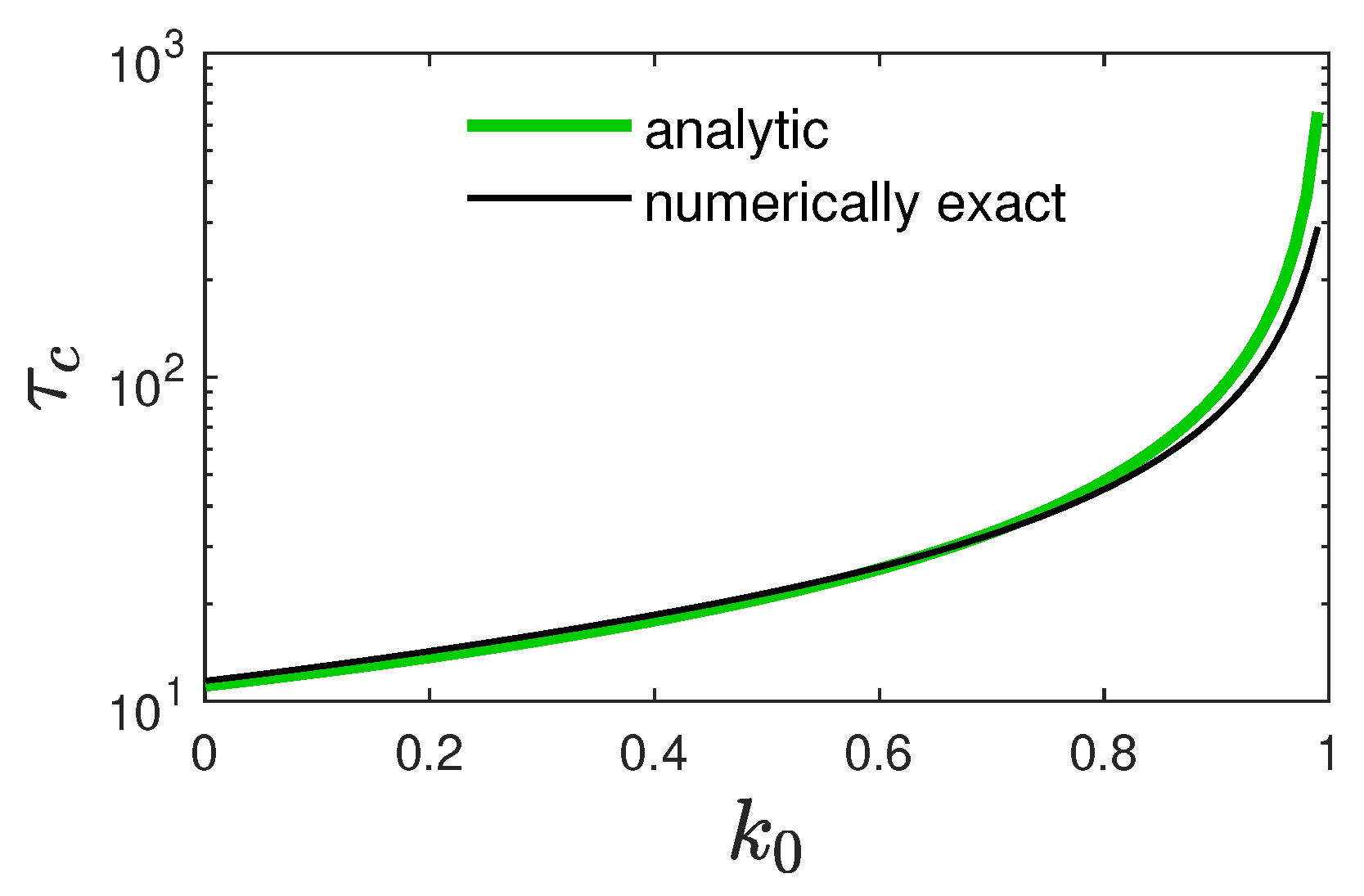
which agrees favorably well with the exact numerical result for the time at which has reached half of its final valu . (see Figure 1).
Figure 1.
Performance of the analytic approximation (23) for the crossover versus at . The numerical result is obtained from .
4.2. Linearly Increasing Ratio
We note that for a linearly increasing ratio , the analytical approximation (12) is given by the Gaussian distribution
which, for a constant infection rate yielding , leads to a Gaussian distribution in real time. Such Gaussian distributions have been successfully used to predict the temporal evolution of earlier COVID-19 waves [51,53,54,55,56].
5. Illustrative Examples
In order to illustrate the usefulness of our approximate solution (12), we consider two illustrative examples for the reduced time variation of the ratio . The first one is monotonically rising and therefore well suited to represent a single wave of a pandemic outburst. The second one varies periodically in reduced time and is therefore well suited to represent a series of repeating pandemic outbursts. In both cases, we compare the exact numerical solution of the SIR set of equations in (6) with the approximative solution (12). We consider both examples in turn.
5.1. Monotonically Rising Ratio
Here, we choose
with the two positive constants being B and C. The ratio (25) increases monotonically from zero at to its maximum value B at large reduced times of . According to Equation (18), a single extremum of the rate of new infections occurs at the time and is given by
which can only be solved for values of with
Because the first derivative of the ratio (25) is given by
one finds
thus meaning that the extremum is a maximum. For values of , the rate of new infections monotonically increases with reduced time. With the choice of (25), the rate of new infections of (12) can be reduced to
We note the two asymptotic exponential behaviors and .
Only for values of , a single maximum rate
occurs at , provided that , or for in the case where , we have
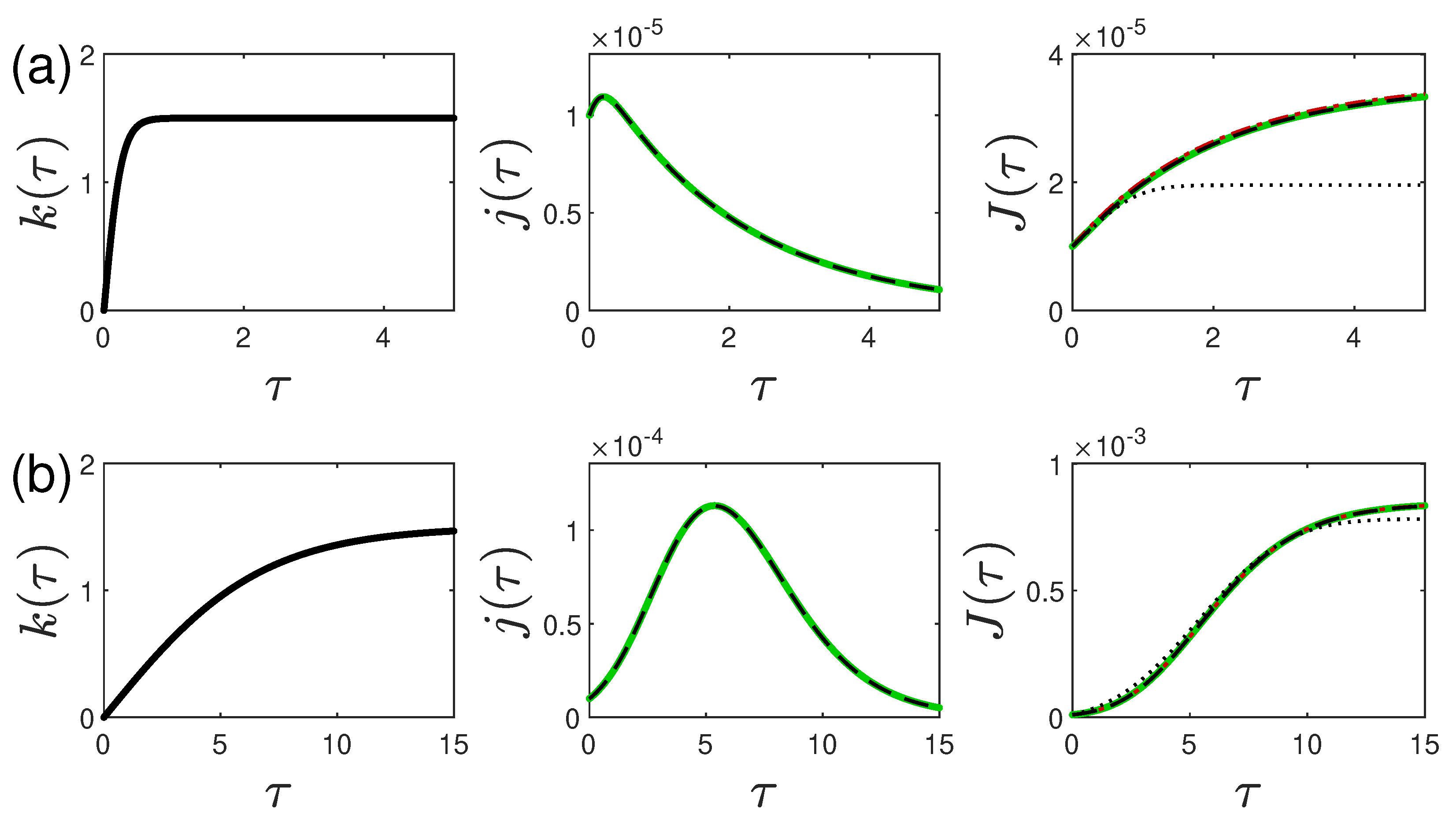
In Figure 2 (center panels), we compare the approximative analytical rate of new infections of (30) as a function of the reduced time for this choice of the ratio with the exact numerical solution of the SIR set of equations in (6). The agreement is almost perfect, thereby proving the accuracy of our analytical approximation.
Figure 2.
Left: Plot of the monotonically rising ratio (25) for (a) and (b) , with and , respectively. Middle: Corresponding rate of new infections as a function of the reduced time for these choices of the ratio . Right: Corresponding cumulative rate of new infections . Shown are the numerical (black dashed curve) solutions of the SIR set of equations in (6) in comparison with the analytical approximations (green curve) according to Equations (12) and (30). The agreement is almost perfect. The maximum relative deviations are smaller than (a) 0.5% and (b) 2.5%. In addition, we show (hardly visible red dot–dash curve) the approximant (39) in panel (a) for and Equation (36) in panel (b) for . The agreement is against almost perfect. The black dotted lines were obtained for comparison using the method of steepest descent, Equation (45), which provides a lower limit to the cumulative fraction, because all other contributions far from the maximum are not adequately accounted for (Appendix A).
The corresponding cumulative number of infections is given by
By substituting , which corresponds to , the integral (34) becomes
which can be expressed as the difference of two hypergeometric functions by using integral 3.194 of [57]. One then obtains
For , the first terms of the series expansion are , which are derived in Appendix C.
For , an approximant can be derived by substituting in Equation (34). This yields
Since y is greater than unity, we approximate to yield
Consequently, the cumulative fraction of infections of (33) becomes
We first note that the absolute level of the cumulative fraction is proportional to . If the parameter C is small, one obtains a much higher amplification of the cumulative fraction at later times compared to its initial value than in cases where C is large. This is clearly evident from the last panels of Figure 2.
Moreover, we notice that for values of , the cumulative fraction (39) approaches the finite value , which is much smaller than , since . In this case, the early time solutions of (30) and (39) are valid for all times. This is easy to understand, because for values of , the ratio (25) becomes greater than unity after finite times so that then the recovery rate is greater than the infection rate; therefore, the rate of new infections is decreasing with time in agreement with the right side of Figure 2. In this case, not many new infections add to the cumulative fraction.
The opposite behavior holds for values of . In this case, at all times, the ratio (25) is less than or equal to unity so that the infection rate is never smaller than the recovery rate. Consequently, the cumulative fraction (39) increases exponentially with time for and linearly with time for . In this case, the early time solutions of (30) and (39) can only be used for times less than , which are provided according to Equation (A15), and we work with the following equation:
Using Equation (39), we obtain
For , the rate of new infections (A12) at late times becomes
where we determined from equating the two rates of (30) and (42) at , whose value is given explicitly by Equation (41).
For the interesting case of values , we calculate the cumulative fraction of (33) with the integral of using the method of steepest descent according to Equation (14). Here, a single maximum in occurs at
which is given by Equation (27) and , which is inferred from Equation (29). Moreover,
Consequently, the cumulative number of infections of (14) in this case becomes
In Figure 2 on the right, we compare the approximation of (45) with the exactly integrated cumulative fractions of (33)–(39) in this case. The good agreement indicates that the method of steepest descent is indeed appropriate to calculate cumulative fractions for and . For values of , this method is correct within a factor of 1.8, as indicated by Figure 2a (right). The reason that the method of steepest descent works better for small values of C is due to the inverse dependence of the exponents in Equation (31) for the maximum rate and in Equation (27) for the time of maximum. Consequently, the smaller the value of C, the later the time that the maximum appears and with a larger amplitude as compared to the case of large values of C. In the case of a large amplitude maximum, the dominating contribution to the cumulative fraction stems from the maximum.
5.2. Oscillating Ratio
Here we choose
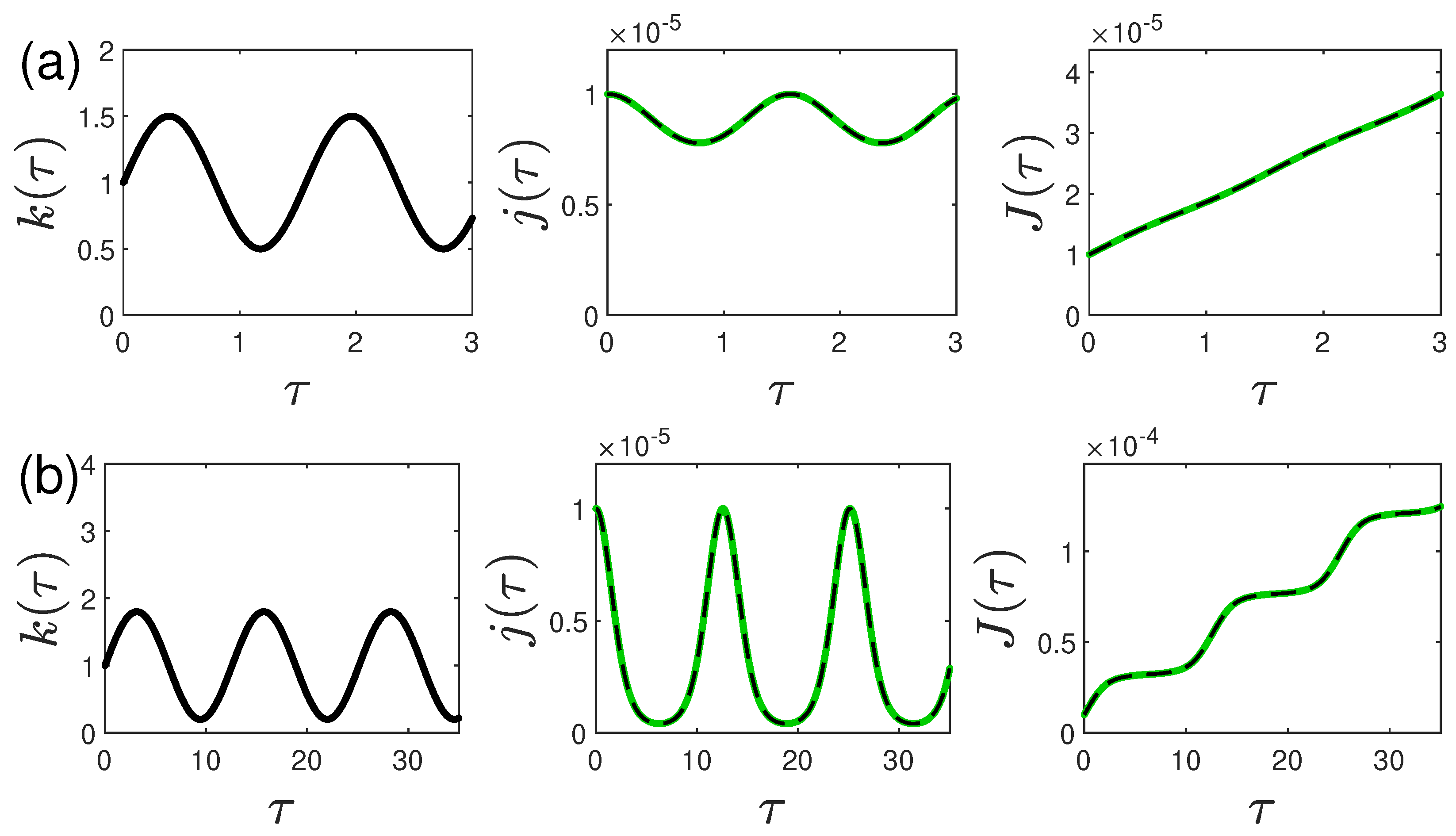
with the two positive constants and . The ratio (46) oscillates periodically around its intial value of one (see Figure 3a). It is therefore well suited to represent a series of repeating pandemic outbursts. For values of k that are greater than unity, the recovery rate is greater than the infection rate; so, the rate of infections decreases. When the ratio k is smaller than unity, the infection rate is greater than the recovery rate, and the rate of infections increases with time.
Figure 3.
Left panels: Plot of the oscillating ratio of according to Equation (46) for (a) , , and (b) , . Centered panels: The corresponding rates of new infections of as a function of reduced time using . Right panels: Cumulative fraction of . Shown are the numerical (black dashed curve) solutions of the SIR set of equations in (6) in comparison with the analytical approximations (green curve) according to Equations (47) and (48). Because for case (a), only the first term of expansion (48) had to be used, while the first three terms of Equation (48) were used in (b) in accord with Figure 4. The agreement is almost perfect. The maximum relative deviations are smaller than 0.2% for all cases.
With the choice of (46) and using the rate of new infections of (12) at early times, we have
The approximative analytical rate of new infections (47) as a function of the reduced time for the oscillating ratio (46) is compared with the exact numerical solution of the SIR set of equations in (6) in Figure 3. The agreement is almost perfect, thereby proving the accuracy of our analytical approximation using Equation (12).
Integrating the rate of (47) over reduced time provides us with the corresponding cumulative fraction,
where we have used and the series expansion (Equation 9.6.34 of ref. [58])
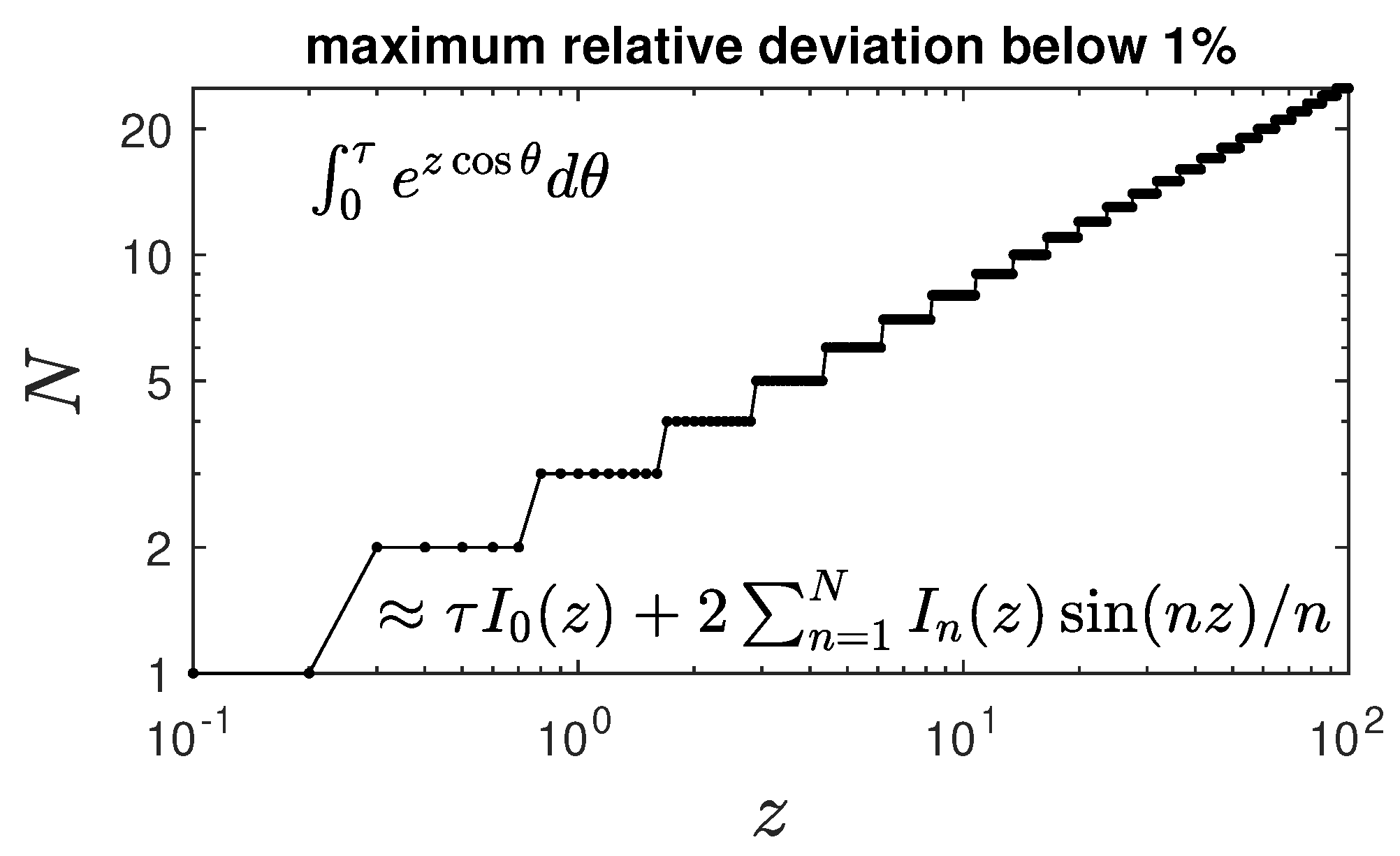
in terms of the modified Bessel function of the first kind . In order to obtain deviations of less than one percent from the series (49) at a finite summation index n, one has to choose N according to Figure 4. For the example provided in Figure 3a, , just the first term of the expansion, , is sufficient to capture the behavior of for this case. Instead, is used to calculate in Figure 3b, which is in accord with the value of in Figure 4.
Figure 4.
The integral is approximated for all within precision by the integrated Equation (49), thus resulting in the expression shown inside the figure if the z-dependent order of the summation, N, is chosen as depicted. The required order grows as .
The third panel of Figure 3 and Equation (48) show that the cumulative fractions predominantly increase linearly with reduced time so that at some finite time , the cumulative fractions approach . There, the validity of the early time approximation ends and , as is discussed in Appendix B. The value of and the variation in the corresponding late-time spontaneous rate can be calculated according to Equations (A15) and (A20), respectively.
From the part of Equation (48) that is proportional to , one can read off the characteristic time using , which translates to
6. Summary and Conclusions
The dynamical equations of the SIR epidemics model play an important role in predicting and/or analyzing the temporal evolution of epidemic outbreaks. Crucial input quantities are the time-dependent infection () and recovery () rates, which regulate the transitions between the compartments and , respectively. Accurate analytical approximations for the temporal dependence of the rate of new infections and the corresponding cumulative fraction of infections are available in the literature for either stationary infection and recovery rates or for a stationary value of the ratio . Here apparently for the first time, a new accurate analytical approximation has been derived for arbitrary and different temporal dependencies of the infection and recovery rates, which is valid for not-too-late times after the start of the infection when the cumulative fraction is much less than unity. Equations (12) and (15) provide analytical expressions for the rate of new infections as a function of real time and reduced time , with the reduced time . Likewise, Equation (14) gives the corresponding cumulative fraction .
The comparison of the analytical approximation with the exact numerical solution of the SIR equations for different illustrative examples proves the accuray of the analytical approach. These examples include the cases of a monotonically rising ratio, as well as an oscillating ratio as a function of reduced time. The former one is well suited to represent a single wave of a pandemic outburst, where, during the outburst, the recovery rate becomes greater than the infection rate due to the combined effects of nonpharmaceutical interventions and/or the dedicated medication or vaccination of infected people or noninfected persons, respectively. The case of an oscillating ratio is well suited to represent a series of repeating epidemic outbursts over a longer time span. The future predictions or analyses of epidemics on the basis of the SIR model equations will certainly benefit from the newly derived analytical solutions.
Author Contributions
Conceptualization, R.S.; methodology, R.S. and M.K.; software, M.K., writing—review and editing, R.S. and M.K. All authors have read and agreed to the published version of the manuscript.
Funding
This research received no external funding.
Institutional Review Board Statement
Not applicable.
Informed Consent Statement
Not applicable.
Data Availability Statement
The data are contained within the article.
Conflicts of Interest
The authors declare no conflict of interest.
Appendix A. Cumulative Fraction for General Reduced Time Dependencies k(τ)
In the examples discussed in Section 4 and Section 5, the cumulative fractions have been calculated by integrating the respective rates of new infections. If such exact integrations are not possible for general reduced time dependencies of the ratio , we suggest to use the method of steepest descent [59,60]. Here, we write the cumulative fraction (13) as
with
We expand the function to the second order near its minima values at , which are given by
We emphasize that, depending on the choosen variation of the ratio , there may be several minima, as in the case of the oscillating ratio discussed above in Section 5.2. Then, we have
For a minimum to occur, the ratio has to have an increasing reduced time variation with . With the approximation (A4), the integral (A2) can be evaluated in terms of error functions, thus providing
Consequently, the cumulative number of infections (A1) becomes Equation (14). In principle, calculating the cumulative fraction by the method of steepest descent is essentially identical to approximating the corresponding rate of new infections using a sum of Gaussian distributions centered at their maxima. If there is only one maximum, as in the case discussed in Section 5.1, the method of steepest descent provides a lower limit to the cumulative fraction, because all other contributions far from the maximum are not adequately accounted for.
Appendix B. Solution at Late Times
Appendix B.1. Limit J≃J ∞ =0.7
In this limit, , , , and . For values of , we approximate Equation (10) as
Equation (A6) integrates to
with the integration constant being . The approximation (A7) is in agreement with the final value of . Integrating Equation (6c) with Equation (A8) inserted then readily provides
with the further integration constant being , which has to be set to so that
thereby implying that
In terms of the real time in this late-time limit, we have
Due to our approximation of the exact SIR equations, the solutions (A10) and (A12), as well as (A13) and (A14), no longer fulfill the properties and . We regard this inconsistency as minor and therefore tolerable, because the exponentially decaying rates of (A12) and (A14) of new infections contribute little to the corresponding cumulative fractions. The constant appearing in the approximate solutions of (A7), (A9), (A12), and (A14) is determined by the continuity conditions of the rate of new infections and the cumulative fraction at , with the approximate solutions for (12)–(13) existing at small values of .
Appendix B.2. Continuity Conditions
Appendix C. Expansion of H(τ) at Small Times
References
- Kermack, W.O.; McKendrick, A.G. A contribution to the mathematical theory of epidemics. Proc. R. Soc. A 1927, 115, 700. [Google Scholar] [CrossRef]
- Kendall, D.G. Deterministic and stochastic epidemics in closed populations. In Proceedings of the Third Berkeley Symposium on Mathematical Statistics and Probability; University of California: Berkeley, CA, USA, 1956; Volume 4, p. 149. [Google Scholar] [CrossRef]
- Harko, T.; Lobo, F.S.N.; Mak, M.K. Exact analytical solutions of the susceptible-infected-recovered (SIR) epidemic model and of the SIR model with equal death and birth rates. Appl. Math. Comput. 2014, 236, 184–194. [Google Scholar] [CrossRef]
- Kröger, M.; Schlickeiser, R. Analytical solution of the SIR-model for the temporal evolution of epidemics. Part A: Time-independent reproduction factor. J. Phys. A 2020, 53, 505601. [Google Scholar] [CrossRef]
- Schlickeiser, R.; Kröger, M. Analytical solution of the SIR-model for the temporal evolution of epidemics: Part B. Semi-time case. J. Phys. A 2021, 54, 175601. [Google Scholar] [CrossRef]
- Cooper, I.; Mondal, A.; Antonopoulos, C.G. A SIR model assumption for the spread of COVID-19 in different communities. Chaos Solitons Fract. 2020, 139, 110057. [Google Scholar] [CrossRef] [PubMed]
- Katul, G.G.; Mrad, A.; Bonetti, S.; Manoli, G.; Parolari, A.J. Global convergence of COVID-19 basic reproduction number and estimation from early-time SIR dynamics. PLoS ONE 2020, 15, e0239800. [Google Scholar] [CrossRef] [PubMed]
- Liu, M.; Thomadsen, R.; Yao, S. Forecasting the spread of COVID-19 under different reopening strategies. Sci. Rep. 2020, 10, 20367. [Google Scholar] [CrossRef]
- Bagal, D.K.; Rath, A.; Barua, A.; Patnaik, D. Estimating the parameters of susceptible-infected-recovered model of COVID-19 cases in India during lockdown periods. Chaos Solitons Fract. 2020, 140, 110154. [Google Scholar] [CrossRef]
- Munoz-Fernandez, G.A.; Seoane, J.M.; Seoane-Sepulveda, J.B. A SIR-type model describing the successive waves of COVID-19. Chaos Solitons Fract. 2021, 144, 110682. [Google Scholar] [CrossRef]
- Liao, Z.; Lan, P.; Liao, Z.; Zhang, Y.; Liu, S. TW-SIR: Time-window based SIR for COVID-19 forecasts. Sci. Rep. 2020, 10, 22454. [Google Scholar] [CrossRef]
- Law, K.B.; Peariasamy, K.M.; Gill, B.S.; Singh, S.; Sundram, B.M.; Rajendran, K.; Dass, S.C.; Lee, Y.L.; Goh, P.P.; Ibrahim, H.; et al. Tracking the early depleting transmission dynamics of COVID-19 with a time-varying SIR model. Sci. Rep. 2020, 10, 21721. [Google Scholar] [CrossRef] [PubMed]
- Sharov, K.S. Creating and applying SIR modified compartmental model for calculation of COVID-19 lockdown efficiency. Chaos Solitons Fract. 2020, 141, 110295. [Google Scholar] [CrossRef] [PubMed]
- Dell’Anna, L. Solvable delay model for epidemic spreading: The case of COVID-19 in Italy. Sci. Rep. 2020, 10, 15763. [Google Scholar] [CrossRef] [PubMed]
- Quaranta, G.; Formica, G.; Machado, J.T.; Lacarbonara, W.; Masri, S.F. Understanding COVID-19 nonlinear multi-scale dynamic spreading in Italy. Nonlin. Dyn. 2020, 101, 1583–1619. [Google Scholar] [CrossRef] [PubMed]
- Nguemdjo, U.; Meno, F.; Dongfack, A.; Ventelou, B. Simulating the progression of the COVID-19 disease in Cameroon using SIR models. PLoS ONE 2020, 15, e0237832. [Google Scholar] [CrossRef] [PubMed]
- Cadoni, M. How to reduce epidemic peaks keeping under control the time-span of the epidemic. Chaos Solitons Fract. 2020, 138, 109940. [Google Scholar] [CrossRef]
- Ko, G.S.; Yoon, T. Short-Term Prediction Methodology of COVID-19 Infection in South Korea. COVID 2021, 1, 416–422. [Google Scholar] [CrossRef]
- Kaxiras, E.; Neofotistos, G.; Angelaki, E. The first 100 days: Modeling the evolution of the COVID-19 pandemic. Chaos Solitons Fract. 2020, 138, 110114. [Google Scholar] [CrossRef]
- Rao, I.J.; Brandeau, M.L. Optimal allocation of limited vaccine to control an infectious disease: Simple analytical conditions. Math. Biosci. 2021, 337, 108621. [Google Scholar] [CrossRef]
- Gatto, N.M.; Schellhorn, H. Optimal control of the SIR model in the presence of transmission and treatment uncertainty. Math. Biosci. 2021, 333, 108539. [Google Scholar] [CrossRef]
- Peng, T.; Liu, X.; Ni, H.; Cui, Z.; Du, L. City lockdown and nationwide intensive community screening are effective in controlling the COVID-19 epidemic: Analysis based on a modified SIR model. PLoS ONE 2020, 15, e0238411. [Google Scholar] [CrossRef] [PubMed]
- Shimul, S.N.; Alradie-Mohamed, A.; Kabir, R.; Al-Mohaimeed, A.; Mahmud, I. Effect of easing lockdown and restriction measures on COVID-19 epidemic projection: A case study of Saudi Arabia. PLoS ONE 2021, 16, e0256958. [Google Scholar] [CrossRef] [PubMed]
- Cabrera, M.; Cordova-Lepe, F.; Pablo Gutierrez-Jara, J.; Vogt-Geisse, K. An SIR-type epidemiological model that integrates social distancing as a dynamic law based on point prevalence and socio-behavioral factors. Sci. Rep. 2021, 11, 10170. [Google Scholar] [CrossRef] [PubMed]
- Yang, Q.; Zhang, X.; Jiang, D. Asymptotic behavior of a stochastic SIR model with general incidence rate and nonlinear Levy jumps. Nonlin. Dyn. 2022, 107, 2975–2993. [Google Scholar] [CrossRef] [PubMed]
- Srivastava, H.M.; Area, I.; Nieto, J.J. Power-series solution of compartmental epidemiological models. Math. Biosci. Eng. 2021, 18, 3274–3290. [Google Scholar] [CrossRef] [PubMed]
- Djenina, N.; Ouannas, A.; Batiha, I.M.; Grassi, G.; Oussaeif, T.E.; Momani, S. A Novel Fractional-Order Discrete SIR Model for Predicting COVID-19 Behavior. Mathematics 2022, 10, 2224. [Google Scholar] [CrossRef]
- Ghosh, K.; Ghosh, A.K. Study of COVID-19 epidemiological evolution in India with a multi-wave SIR model. Nonlin. Dyn. 2022, 109, 47–55. [Google Scholar] [CrossRef]
- Marinov, T.T.; Marinova, R.S. Adaptive SIR model with vaccination: Simultaneous identification of rates and functions illustrated with COVID-19. Sci. Rep. 2022, 12, 15688. [Google Scholar] [CrossRef]
- Kuhn, M.J.; Abele, D.; Mitra, T.; Koslow, W.; Abedi, M.; Rack, K.; Siggel, M.; Khailaie, S.; Klitz, M.; Binder, S.; et al. Assessment of effective mitigation and prediction of the spread of SARS-CoV-2 in Germany using demographic information and spatial resolution. Math. Biosci. 2021, 339, 108648. [Google Scholar] [CrossRef]
- Avram, F.; Adenane, R.; Ketcheson, D.I. A Review of Matrix SIR Arino Epidemic Models. Mathematics 2021, 9, 1513. [Google Scholar] [CrossRef]
- Zanella, M.; Bardelli, C.; Azzi, M.; Deandrea, S.; Perotti, P.; Silva, S.; Cadum, E.; Figini, S.; Toscani, G. Social contacts, epidemic spreading and health system. Mathematical modeling and applications to COVID-19 infection. Math. Biosci. Eng. 2021, 18, 3384–3403. [Google Scholar] [CrossRef] [PubMed]
- Chang, Y.C.; Liu, C.T. A Stochastic Multi-Strain SIR Model with Two-Dose Vaccination Rate. Mathematics 2022, 10, 1804. [Google Scholar] [CrossRef]
- Paoluzzi, M.; Gnan, N.; Grassi, F.; Salvetti, M.; Vanacore, N.; Crisanti, A. A single-agent extension of the SIR model describes the impact of mobility restrictions on the COVID-19 epidemic. Sci. Rep. 2021, 11, 24467. [Google Scholar] [CrossRef] [PubMed]
- Sadurni, E.; Luna-Acosta, G. Exactly solvable SIR models, their extensions and their application to sensitive pandemic forecasting. Nonlin. Dyn. 2021, 103, 2955–2971. [Google Scholar] [CrossRef] [PubMed]
- Osborn, J.; Berman, S.; Bender-Bier, S.; D’Souza, G.; Myers, M. Retrospective analysis of interventions to epidemics using dynamic simulation of population behavior. Math. Biosci. 2021, 341, 108712. [Google Scholar] [CrossRef] [PubMed]
- Beneduci, R.; Bilotta, E.; Pantano, P. A unifying nonlinear probabilistic epidemic model in space and time. Sci. Rep. 2021, 11, 13860. [Google Scholar] [CrossRef] [PubMed]
- Nakamura, G.; Grammaticos, B.; Deroulers, C.; Badoual, M. Effective epidemic model for COVID-19 using accumulated deaths. Chaos Solitons Fract. 2021, 144, 110667. [Google Scholar] [CrossRef] [PubMed]
- Martinez-Fernandez, P.; Fernandez-Muniz, Z.; Cernea, A.; Fernandez-Martinez, J.L.; Kloczkowski, A. Three Mathematical Models for COVID-19 Prediction. Mathematics 2023, 11, 506. [Google Scholar] [CrossRef]
- Ahumada, M.; Ledesma-Araujo, A.; Gordillo, L.; Marin, J.F. Mutation and SARS-CoV-2 strain competition under vaccination in a modified SIR model. Chaos Solitons Fract. 2023, 166, 112964. [Google Scholar] [CrossRef]
- Gunaratne, C.; Reyes, R.; Hemberg, E.; O’reilly, U.M. Evaluating efficacy of indoor non-pharmaceutical interventions against COVID-19 outbreaks with a coupled spatial-SIR agent-based simulation framework. Sci. Rep. 2022, 12, 6202. [Google Scholar] [CrossRef]
- Cooper, I.; Mondal, A.; Antonopoulos, C.G.; Mishra, A. Dynamical analysis of the infection status in diverse communities due to COVID-19 using a modified SIR model. Nonlin. Dyn. 2022, 109, 19–32. [Google Scholar] [CrossRef]
- Yuzbasi, S.; Yildirim, G. A Pell-Lucas Collocation Approach for an SIR Model on the Spread of the Novel Coronavirus (SARS CoV-2) Pandemic: The Case of Turkey. Mathematics 2023, 11, 697. [Google Scholar] [CrossRef]
- Prodanov, D. Computational aspects of the approximate analytic solutions of the SIR model: Applications to modelling of COVID-19 outbreaks. Nonlin. Dyn. 2023, 111, 15613–15631. [Google Scholar] [CrossRef]
- Liu, T.; Huang, J.; He, Z.; Zhang, Y.; Yan, N.; Zhang, C.J.P.; Ming, W.K. A real-world data validation of the value of early-stage SIR modelling to public health. Sci. Rep. 2023, 13, 9164. [Google Scholar] [CrossRef] [PubMed]
- Odagaki, T. New compartment model for COVID-19. Sci. Rep. 2023, 13, 5409. [Google Scholar] [CrossRef] [PubMed]
- Calafiore, G.C.; Novara, C.; Possieri, C. A time-varying SIRD model for the COVID-19 contagion in Italy. Annu. Rev. Control. 2020, 50, 361–372. [Google Scholar] [CrossRef] [PubMed]
- Rahimi, I.; Chen, F.; Gandomi, A.H. A review on COVID-19 forecasting models. Neural Comput. Appl. 2023, 35, 23671–23681. [Google Scholar] [CrossRef]
- Schlickeiser, R.; Kröger, M. Determination of a key pandemic parameter of the SIR-epidemic model from past COVID-19 mutant waves and its variation for the validity of the Gaussian evolution. Physics 2023, 5, 205–214. [Google Scholar] [CrossRef]
- Kröger, M.; Schlickeiser, R. SIR-solution for slowly time-dependent ratio between recovery and infection rates. Physics 2022, 4, 504–524. [Google Scholar] [CrossRef]
- Schlickeiser, R.; Schlickeiser, F. A gaussian model for the time development of the Sars-Cov-2 corona pandemic disease. Predictions for Germany made on March 30. Physics 2020, 2, 164–170. [Google Scholar] [CrossRef]
- Kröger, M.; Schlickeiser, R. Verification of the accuracy of the SIR model in forecasting based on the improved SIR model with a constant ratio of recovery to infection rate by comparing with monitored second wave data. R. Soc. Open Sci. 2021, 8, 211379. [Google Scholar] [CrossRef] [PubMed]
- Lixiang, L.; Yang, Z.; Deng, Z.; Meng, C.; Huang, J.; Meng, H.; Wang, D.; Chen, G.; Zhang, J.; Peng, J. Propagation analysis and prediction of the Covid-19. Infect. Dis. Model. 2020, 5, 282. [Google Scholar] [CrossRef]
- Ciufolini, I.; Paolozzi, A. Mathematical prediction of the time evolution of the COVID-19 pandemic in Italy by a Gauss error function and Monte Carlo simulations. Eur. Phys. J. Plus 2020, 135, 355. [Google Scholar] [CrossRef] [PubMed]
- Schüttler, J.; Schlickeiser, R.; Schlickeiser, F.; Kröger, M. COVID-19 predictions using a Gauss model, based on data from April 2. Physics 2020, 2, 197–212. [Google Scholar] [CrossRef]
- Singhal, A.; Singh, P.; Lall, B.; Joshi, S.D. Modeling and prediction of COVID-19 pandemic using Gaussian mixture model. Chaos Solitons Fract. 2020, 138, 110023. [Google Scholar] [CrossRef]
- Gradshteyn, I.S.; Ryzhik, I.M. Tables of Integrals, Series, and Products; Academic Press: New York, NY, USA, 1980. [Google Scholar] [CrossRef]
- Abramowitz, M.; Stegun, I.A. Handbook of Mathematical Functions; Dover Publications: New York, NY, USA, 1970. [Google Scholar]
- Morse, P.M.; Feshbach, H. Methods of Theoretical Physics, Part I; McGraw-Hill: New York, NY, USA, 1953. [Google Scholar]
- Mathews, J.; Walker, R.L. Mathematical Methods in Physics, 2nd ed.; Benjamin: Menlo Park, CA, USA, 1970. [Google Scholar]
Disclaimer/Publisher’s Note: The statements, opinions and data contained in all publications are solely those of the individual author(s) and contributor(s) and not of MDPI and/or the editor(s). MDPI and/or the editor(s) disclaim responsibility for any injury to people or property resulting from any ideas, methods, instructions or products referred to in the content. |
© 2023 by the authors. Licensee MDPI, Basel, Switzerland. This article is an open access article distributed under the terms and conditions of the Creative Commons Attribution (CC BY) license (https://creativecommons.org/licenses/by/4.0/).