Skip Content
You are currently on the new version of our website. Access the old version .

COVID

COVID is an international, peer-reviewed, open access journal on the study of coronaviruses, coronavirus-related diseases and global impact, published monthly online by MDPI.

All Articles (691)

The COVID-19 pandemic (2020–2023) profoundly disrupted healthcare systems and imposed sustained psychological burdens on healthcare professionals and trainees. Reliable instruments are essential for assessing these impacts. This study evaluated the construct validity and reliability of the Fear of COVID-19 Scale (FCV-19S) in a convenience sample of 1761 healthcare professionals, trainees, and academic staff at a single U.S. academic health sciences center (the University of Oklahoma Health Campus). Participants completed the FCV-19S; confirmatory factor analysis (CFA) examined its dimensional structure; and internal consistency was assessed using Cronbach’s α and McDonald’s ω. The one-factor model demonstrated good internal consistency (α = 0.89; ω = 0.89) but exhibited sub-optimal model fit (CFI = 0.89; TLI = 0.83; SRMR = 0.06; RMSEA = 0.18). The two-factor model, distinguishing emotional and somatic fear, showed substantially improved fit (CFI = 0.97; TLI = 0.96; SRMR = 0.03; RMSEA = 0.09) and acceptable internal consistency for both factors (α = 0.85 and 0.86; ω = 0.85 and 0.87), although RMSEA remained above conventional thresholds for close fit. Overall, findings support a two-factor structure as a comparatively superior and more nuanced representation of fear responses among an academic health workforce. The validated FCV-19S offers a reliable tool for assessing COVID-19-related distress in clinical and educational health settings, informing targeted interventions to strengthen workforce resilience.

4 February 2026
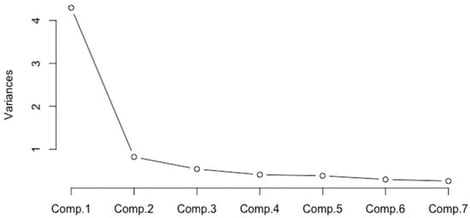
Scree plot to visualize variance of Fear of COVID-19 Scale. The Scree plot displays the eigenvalues of the components on the y-axis (labeled “Variances”) and the components themselves on the x-axis (labeled “Comp.1” through “Comp.7”). The eigenvalues are the amounts of variance accounted for by each component; a higher value indicates that a component accounts for more variance in the data. The plot shows that a one-factor solution explained 61.4% of the variance in responses. The presence of a second component with an eigenvalue close to 1 suggests that a two-factor solution should also be considered.

Background: Endocrine disturbances are increasingly recognized as components of long COVID, yet long-term data remain limited. This study evaluated the prevalence of dysglycemia and thyroid autoimmunity four years after SARS-CoV-2 infection in adults without previously known endocrine disease. Methods: We conducted a retrospective longitudinal 4-year evaluation of adults hospitalized for COVID-19 between 2020 and 2021. Of 1009 eligible patients without prior diabetes or thyroid disease, 96 completed a standardized 4-year post-infection evaluation. Acute-phase data included COVID-19 severity, admission glucose, inflammatory markers, imaging findings, and treatments. The 4-year evaluation comprised fasting plasma glucose, thyroid function tests, anti-thyroid antibodies (anti-TPO, anti-Tg), and thyroid ultrasonography. Baseline HbA1c, thyroid autoantibodies, and thyroid imaging were not available. Results: At four years post-infection, 27.1% of patients exhibited dysglycemia compatible with type 2 diabetes mellitus, 41.6% showed thyroid autoimmunity, and 15.6% presented with both conditions. Overall, 47.9% developed at least one endocrine alteration. Admission hyperglycemia strongly predicted long-term dysglycemia (OR 6.67; 95% CI: 1.45–30.58), and diabetes prevalence increased with acute disease severity. Thyroid autoimmunity was frequent but not associated with initial COVID-19 severity. Conclusions: Four years after SARS-CoV-2 infection, a substantial proportion of patients exhibited persistent metabolic and autoimmune alterations, supporting a long COVID immunometabolic phenotype. In the absence of baseline endocrine data, the reported findings reflect long-term endocrine alterations identified at the 4-year evaluation, with a potential role of SARS-CoV-2 infection. These findings highlight the importance of baseline metabolic and thyroid assessment—including HbA1c and thyroid autoantibodies—in hospitalized COVID-19 patients and underscore the need for structured long-term endocrine monitoring.

31 January 2026

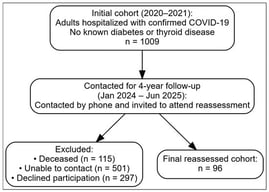
Patient Selection Flow Diagram (PRISMA-like). The diagram illustrates the selection process for the 4-year post-infection evaluation cohort. From 1009 adults hospitalized with confirmed COVID-19 between 2020 and 2021 and without previously known diabetes or thyroid disease, patients were contacted between January 2024 and June 2025. A total of 913 individuals were excluded due to death (n = 115), inability to contact (n = 501), or refusal to participate (n = 297). The final reassessed cohort consisted of 96 patients who completed standardized metabolic and thyroid evaluation four years after SARS-CoV-2 infection.
  • Communication
  • Open Access

Although self-administered antigen tests are widely available, anatomical knowledge of nasal anatomy in the general population is limited. Cerebrospinal fluid leakage has been reported in multiple cases following damage to the roof of the nasal cavity due to accidental penetration of the cribriform plate of the ethmoid bone. Methods: Images of anatomical prosections used for teaching in the Dissection Room of the Faculty of Medicine of the University of Barcelona were obtained to illustrate the viable pathway to the nasopharynx through the inferior meatus, below the inferior turbinate. Screenshots from publicly available videos produced by the author demonstrating perpendicular swab insertion were analyzed, and multiethnic illustrative images were taken from staff volunteers. Publicly available instructions for patients included in the first eight nasal antigen tests for self-diagnosis authorized in Spain in 2021 were reviewed. Results: Most of the initially authorized antigen tests (all but one) still recommended in 2025 a vertical swab insertion. However, successful insertion into the inferior meatus towards the nasopharynx can be achieved with a perpendicular approach. A schematic illustration for free use is provided. Conclusion: Swab instructions should indicate an insertion perpendicular to the face to access the inferior meatus safely and reduce the risk of injury to the ethmoidal cells.

23 January 2026

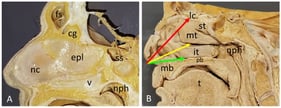
(A) Lateral view of the nasal septum is shown, comprising the nasal cartilage (nc), the vomer bone (v), and the perpendicular plate of the ethmoid bone (epl). Superiorly, the crista galli (cg) process is visible posterior to the frontal sinus (fs). The posterior boundary of the nasal cavity is formed by the sphenoidal sinus (ss) and the nasopharynx (nph). (B) Lateral wall of the nasal cavity. The floor of the nasal cavity is formed by the maxillary bone (mb) and the horizontal plate of the palatine bone (pb). The tongue (t) occupies the oral cavity inferiorly. The nasal septum has been removed to reveal the nasal mucosa covering the inferior, middle, and superior turbinates (it, mt, and st, respectively). Potential swab trajectories are illustrated. Only the green pathway follows the inferior meatus, the narrow passage beneath the inferior turbinate, which leads to the nasopharynx (nph). Alternative trajectories contact the middle turbinate (yellow) or risk impinging upon the ethmoidal air cells (red), towards the fragile lamina cribrosa (lc), resulting in greater patient discomfort and a lower likelihood of obtaining a sample with a high viral load.

One of the challenges post-COVID-19 is reducing the negative impacts on quality of life, performance, and independence in activities of daily living. Assessing functional dependence in adults one year after acute infection can help to understand the long-term consequences, evaluate the impact on quality of life, plan rehabilitation and healthcare, identify the most vulnerable groups, measure the socioeconomic impact, and support public policies and clinical decisions. Objectives: The objectives of this study are as follows: (a) to assess the prevalence of functional dependence in Brazilian adults with COVID-19; (b) to analyze the association between the study variables; and (c) to determine the factors associated with functional dependence. Methods: This was an observational, cross-sectional study with 987 adults (18 to 59 years old) living in the State of Paraná (Brazil) hospitalized for COVID-19 between March and December 2020. Data were collected by telephone 12 months after the acute infection using an instrument to retrieve sociodemographic and health information, and a functional dependence scale to assess dependence before COVID-19 retrospectively (using participant recall information) and at the time of the interview. Data were analyzed using penalized logistic regression after imputing missing data. Data were analyzed using penalized logistic regression after imputing missing data. Results: Functional dependence after COVID-19 was 5.0% and was associated with low levels of education, not having a partner, living with someone, not owning a home, experiencing job changes, requiring care, obesity, smoking, multimorbidity, ICU admission in the acute phase, use of invasive ventilation, or having Long COVID. Individuals who required care or used invasive ventilation support were, respectively, 9.3 and 6.5 times more likely to develop dependence after COVID-19. Despite adjustment for multiple factors, the magnitude of the observed effects warrants cautious interpretation, as unmeasured or residual confounding effects may still be present. Sample recall bias due to collection after 12 months and the presence of the alpha variant without COVID-19 vaccination coverage may limit data generalization. Conclusions: The results highlight the need to emphasize the public health implications of identifying functional dependence. In this vein, it is necessary to implement preventive measures, identify and monitor more vulnerable groups, plan rehabilitation programs, and develop public health policies.

20 January 2026

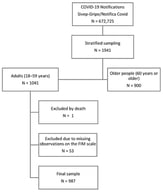
Flowchart of study design.

News & Conferences

Issues

Open for Submission

Editor's Choice

Get Alerted

Add your email address to receive forthcoming issues of this journal.

XFacebookLinkedIn
COVID - ISSN 2673-8112