


Abstract
Gamification is widely used to enhance student motivation, yet many educational design proposals remain conceptual and provide limited operational guidance for digital learning environments. This paper introduces APAR (Activities, Points, Achievements and Rewards), a content-independent structural framework for designing and implementing educational gamification in learning platforms. Grounded in motivation theories (including Self-Determination Theory and Relatedness–Autonomy–Mastery–Purpose) and reward taxonomies (Status, Access, Power and Stuff), APAR distinguishes high-level design constructs from concrete game elements (e.g., points, badges and leaderboards) and provides a systematic design loop linking learning activities, feedback, intermediate goals and reinforcement. The contribution includes (i) a mapping table relating each APAR construct to motivation models, supported dynamics and typical learning-platform implementations; (ii) an actionable design guide; and (iii) an empirical illustration implemented in Moodle in a higher-education Computer Networks course. In this setting, the proportion of enrolled students taking the final exam increased from 58% to 72% in the first year, and the proportion of enrolled students passing increased from 17% to 38%; in 2022–2023 these values were 70% and 39%, respectively (56% of exam takers passed). While the use case relies on quantitative course-level indicators and is observational, the findings support the potential of structural gamification as an integrated methodological tool and motivate further mixed-method validations.
1. Introduction
One of the persistent challenges in education is achieving sufficient levels of student motivation and engagement to foster improved academic performance. Numerous studies have demonstrated that gamification—commonly defined as the application of game thinking, mechanics, and dynamics in non-game contexts—has the potential to enhance learning experiences by making them more engaging, motivating, and rewarding [1,2,3]. Ultimately, its aim is to improve students’ academic performance [4,5] and final outcomes [6]. Supporting this view, a recent meta-analysis of 32 studies [7] compared students exposed to gamified learning with those in traditional settings, concluding that the experimental groups consistently achieved significantly better academic results.
Despite this potential, the majority of gamification initiatives in education have been implemented without a rigorous methodological foundation. Game elements are often incorporated without justification, clear criteria for selection, or consideration of how they interrelate. In higher education, this lack of structure has, in some cases, resulted in negligible improvements or even adverse effects on learning [8]. These findings highlight the risks of poorly designed interventions and underscore the importance of adopting formalized design processes that align with pedagogical goals. Doing so can provide valuable guidance for educators, instructional designers, and researchers seeking to apply gamification effectively.
At the same time, designing and implementing gamification strategies demands considerable effort [9]. Educators frequently encounter challenges such as high costs, substantial time commitments, and complex technical or organizational requirements, which can outweigh the anticipated benefits [10].
The literature includes several gamification design frameworks and approaches in the field of education. The most important proposals have been collected and analysed in several recent systematic reviews [11,12,13,14]. In addition, each of these review papers highlights some facts that we consider relevant in proposing a design framework or approach for gamification in education:
- Mora et al. [11] highlight the need for a formalisation to guide and support the processes of gamification design.
- Rauschenberger et al. [12] present a systematic literature review of ten gamification frameworks applied to learning environments. The authors highlight the heterogeneous use of game elements and emphasize that, while emotional and progression-related elements are preferred, there is still no reliable standard for designing gamified educational environments.
- Saggah et al. [13] focus on learning theories and state that integrating gamification into education without establishing a solid foundation in learning theories could result in an unsatisfactory experience and fail to accomplish educational objectives.
- Khaldi et al. [14] emphasize that the appropriate selection and combination of game components continue to be a challenge for gamification designers and practitioners, primarily because proven design methodologies are lacking, and there is not a universally effective approach that can be applied regardless of the gamification scenario.
Most existing design proposals emphasize structural gamification rather than content gamification [14,15]. Following the distinction introduced by Kapp et al. [16], structural gamification applies game elements, mechanics, or dynamics (e.g., points, badges, goals, rewards, progression, status, challenges, feedback) around an existing learning pathway or didactic sequence, without necessarily altering the instructional content itself. By contrast, content gamification integrates gameful design into specific learning objectives or subject content, making it more context-dependent and potentially reducing its transferability or reusability across different educational scenarios [16].
Saggah et al. [13], and later Khaldi et al. [14], classify gamification design frameworks into three categories, according to the level of detail:
- High-level approaches offer a broad outline of the design procedure, acting as a general directive at a high level that outlines the global stages, without specifying particular game components or implementation details.
- Gamification element guidance refers to design frameworks that focus on the gamification elements that can be used, generally including implementation guidance.
- Scenario-based approaches describe the application of game elements through real empirical studies in real learning environments.
According to Khaldi et al., scenario-based approaches are highly specific and, therefore, difficult to replicate across different contexts. By contrast, high-level approaches provide broad design guidelines but require significant adaptation to suit each learning environment. Frameworks categorized under gamification element guidance strike a balance, as they offer practical sets of game elements that can be readily integrated into learning environments. Since our goal is to propose a general framework not limited to a particular scenario, we focus on this latter category to move as close as possible to design a practical implementation within Learning Management Systems (LMS), which are widely employed in MOOCs, secondary, and higher education.
Our analysis of the frameworks within this category, as identified in previous reviews, reveals that most remain quite close to high-level approaches. They typically emphasize general stages of instructional design, such as analysis, planning, development, implementation, and evaluation [17,18]. Additionally, some proposals consist of simple taxonomies of commonly used game elements [19], yet these often lack concrete usage guidelines or fail to establish connections to learning or motivational theories.
To sum up, it is clear that there arises a pressing necessity for a structural approach with a basis in motivational theory to steer and simplify the gamification design process, and to provide support and guidelines for educators in integrating gamification as a pedagogical tool in a digital learning environment. To fill this gap, we propose APAR, a design framework with the following characteristics:
- APAR stands for Activities, Points, Achievements and Rewards, the four core constructs of the proposed framework. These constructs are intended to capture the essential building blocks for designing gamification in education, and they are distinct from specific game elements or mechanics (e.g., badges and leaderboards).
- APAR is positioned primarily as a structural gamification design and implementation framework according to Kapp et al. [16], providing a systematic loop to structure activities/progression, define feedback (points), formalise intermediate goals (achievements), and map them to rewards in a learning platform. Content gamification may complement APAR, but it is outside the main scope of this work.
- According to the level of detail, the approach lies under the category of gamification element guidance, but at the lower level, that is, very close to the implementation in digital learning platforms. Although LMSs were designed for learning, and not specifically for gamification, they are increasingly incorporating gamification elements and constructs in their latest versions, with Moodle being the LMS that has made the strongest effort.
- The design framework will consider motivation theories.
The structure of this paper is as follows. Section 2 discusses intrinsic and extrinsic motivation, highlighting the main theoretical foundations of gamification in education. Section 3 introduces APAR, our proposed structural design framework for gamification. Section 4 outlines practical guidelines for implementing the framework within a Learning Management System (LMS), which are then illustrated through a use case in Section 5. Finally, Section 6 summarizes the key findings and presents concluding remarks and future work.
2. Gamification and Motivation
Gamification has been defined in multiple ways in the literature. In this manuscript, we adopt Kapp’s widely used definition of gamification as “using game-based mechanics, aesthetics and game thinking to engage people, motivate action, promote learning, and solve problems” [20]. This framing highlights motivation and engagement as means to support learning outcomes, rather than the mere addition of isolated reward mechanics.
From an educational technology standpoint, the open question is not only what motivational drivers to target, but also how to operationalise them through concrete gamification constructs that can be implemented and managed in learning platforms. For instance, the systematic review in [21] provides a taxonomy of 56 game motivators and 54 educational game design principles, explicitly linking them to motivational theories. Consequently, designing an effective gamified classroom requires a deep understanding of human motivation. Broadly, motivation can be classified into intrinsic motivation, which arises internally and drives individuals to act for personal satisfaction, and extrinsic motivation, which is triggered by external rewards and incentives.
Intrinsic motivation refers to engaging in activities for the inherent pleasure or personal fulfillment they bring, without the need for external reinforcement. Several theoretical models addressing intrinsic motivation have been widely applied in the gamification literature, and these form the foundation of the framework proposed in this study.
According to Locke’s Goal-Setting Theory (GST) [22], goals that are immediate, specific, and moderately challenging are more effective at stimulating motivation than those that are distant, vague, trivial, or excessively difficult. Providing learners with immediate feedback is therefore essential, as it enables them to monitor their progress, make timely adjustments, and maintain commitment to their objectives.
Bandura’s Self-Efficacy Theory (SET) [23] defines self-efficacy as an individual’s confidence in their ability to accomplish desired goals or outcomes. In education, self-efficacy increases when students succeed in completing progressive tasks that allow them to perceive continuous improvement. A gamification framework should therefore include mechanisms that make progress visible and provide direct feedback on performance.
Festinger’s Social Comparison Theory (SCT) [24] posits that individuals evaluate their own opinions and abilities by comparing themselves with others. In educational contexts, numerous studies have shown that upward comparison—measuring oneself against higher-performing peers—can positively influence engagement and persistence in learning.
Skinner’s Operant Conditioning Theory (OCT) [25] highlights that behaviors are reinforced by their consequences. In this respect, extrinsic rewards and incentives can play a valuable role in reinforcing and sustaining intrinsic motivation within gamified environments.
Finally, Ryan and Deci’s Self-Determination Theory (SDT) [26] is considered one of the most influential frameworks for understanding human motivation. It is based on the premise that individuals are driven by three innate psychological needs: Competence, the need to develop mastery and skills; Relatedness, the need to connect with others; and Autonomy, the need to make one’s own choices. A sub-theory, Cognitive Evaluation Theory (CET), explores how external factors—such as rewards, deadlines, and evaluations—can either support or undermine these needs. The impact depends on how learners perceive such factors: as supportive and autonomy-enhancing, or as controlling and restrictive.
Marczewski [27] extends the Self-Determination Theory (SDT) by proposing a model of intrinsic motivation for gamification that incorporates an additional element: Purpose. This dimension, originally emphasized by Pink [28], reflects the human need to find meaning in one’s actions and is closely associated with values such as altruism, helping others, charity, and social commitment. Based on this addition, Marczewski formulates the RAMP model, which encompasses Relationship, Autonomy, Mastery, and Purpose. An important added value of Marczewski’s work was to relate these four motivators to the types of users (or behaviours) that can be found in a gamified system:
- Philanthropists, especially motivated by Purpose.
- Achievers, mainly motivated by Mastery.
- Socializers, especially motivated by Relatedness.
- Free Spirits, mainly motivated by Autonomy.
It is important to note that, in practice, every student exhibits a mix of the user types identified in the RAMP model, although typically one behaviour tends to predominate. This model has become a valuable tool for designing gamified systems. As Bai et al. [7] point out, the improved academic performance observed in groups exposed to gamification can be explained through the lens of intrinsic motivation theories. Gamification encourages goal-setting, which drives learners toward better outcomes. At the same time, it fulfills the need for recognition, highlighted in both Social Comparison Theory and Self-Determination Theory (SDT) through the need for relatedness. Moreover, Operant Conditioning Theory emphasizes that social recognition functions as a powerful external reinforcement. Gamification also offers continuous feedback, directly supporting the SDT dimension of mastery by helping students track and improve their performance.
Since Skinner’s studies on operant conditioning demonstrate that extrinsic rewards can strengthen intrinsic motivation, careful consideration of extrinsic motivators is essential. Zichermann and Cunningham [29] classify these incentives into four categories, ranked according to the value typically attributed to them by individuals:
- Status: People place the highest value on being able to achieve a position of privilege and recognition above all others.
- Access: On a second level, we value having restricted or exclusive access to advantages, spaces, information, resources, activities, etc., to which others do not have access.
- Power: Next, we value the ability to exercise some kind of power, rank, command, etc., over others.
- Stuff: Finally, it is curious to note that “things”, i.e., tangible or material rewards, occupy the last position in terms of preference.
This order of preference is also due to the fact that it is common for each level of the pyramid to involve the availability of items from the level immediately below it. Status usually implies access, but not the other way around. Access usually implies power, and power is usually accompanied by the possibility of having things. Using the initial letters of these four categories, Zichermann and Cunningham’s model is called SAPS.
Zichermann and Cunningham [29] also highlight the interplay between intrinsic and extrinsic motivation. While intrinsic motivation is essential for sustaining engagement in the medium and long term, it is not always sufficient or even consciously recognized. For instance, an individual may be aware of an intrinsic drive but find it insufficient; in such cases, extrinsic rewards can serve as a catalyst—such as when trying to lose weight or quit smoking. Conversely, intrinsic motivation may remain latent or unnoticed, and extrinsic incentives can help reveal and activate it, as in the case of reading or playing chess. More recently, the work in Limantara et al. [30] highlights the importance of aligning extrinsic and intrinsic motivators and adapting strategies to different learner types.
While motivation theories provide explanatory constructs (e.g., intrinsic vs. extrinsic motivation), established gamification frameworks offer a practical lens to translate these constructs into design decisions. In particular, Chou’s Octalysis framework describes eight motivational “Core Drives”: (1) Epic Meaning & Calling, (2) Development & Accomplishment, (3) Empowerment of Creativity & Feedback, (4) Ownership & Possession, (5) Social Influence & Relatedness, (6) Scarcity & Impatience, (7) Unpredictability & Curiosity, and (8) Loss & Avoidance [31,32]. A common critique of PBL implementations is that they tend to overemphasise Development & Accomplishment, potentially neglecting other drives that can be relevant for engaging in meaningful learning experiences [32].
In this manuscript, Octalysis is not presented as an alternative to APAR but as a complementary analysis tool: Octalysis can be used as a motivational coverage checklist (i.e., which drivers are being targeted), whereas APAR remains a structural design and implementation loop (Activities–Points–Achievements–Rewards) that specifies how to operationalise the selected design choices in a learning platform. This complementarity is summarised in Table 1 and later revisited in the design guidance (Section 4).
Table 1.
Mapping Octalysis Core Drives to APAR constructs (illustrative examples).
In the next section we describe our design framework, that takes all these theories into account, mainly the Self-Determination Theory and the models for intrinsic and extrinsic motivation, that is, RAMP and SAPS models.
3. APAR Design Framework: Activities, Points, Achievements and Rewards
As outlined in the Introduction, the primary aim of this work is to present a structural gamification design framework based on motivational theories and sufficiently general to be applied in any Learning Management System (LMS). The framework identifies the essential gamification constructs and their interrelationships, providing a foundation for designing gamified virtual classrooms that enhance learner motivation, engagement, and satisfaction, ultimately leading to improved academic performance.
Although several recent systematic reviews [14,33,34,35] report that points, badges, and leaderboards (PBL) are among the most frequently used mechanics in educational gamification [33,34,36], PBL-centric designs have been criticised for promoting a relatively shallow form of gamification when implemented without richer dynamics and experience design [20]. Therefore, while PBL can be a useful starting point, it is advisable to incorporate additional game elements and dynamics that better support engagement and motivation [14,37,38]. In this context, APAR aims to contribute by providing a structural design and implementation loop that helps designers move beyond PBL-only instantiations towards richer combinations of dynamics and reinforcement strategies in learning platforms.
The proposed design framework is the result of many years of experience of the first author in successfully applying gamification, both as a teacher in higher education and as a teacher trainer and consultant at all education levels. The remaining authors contributed to the implementation of gamification in LMSs, including the customization of some plugins for Moodle and the development of software for our platform SocialWire [39]. In addition, they are currently collaborating on the development of the tool https://www.eprofun.es/ (accessed on 26 December 2025), for the improvement of English pronunciation for children, where this design framework has been extensively used.
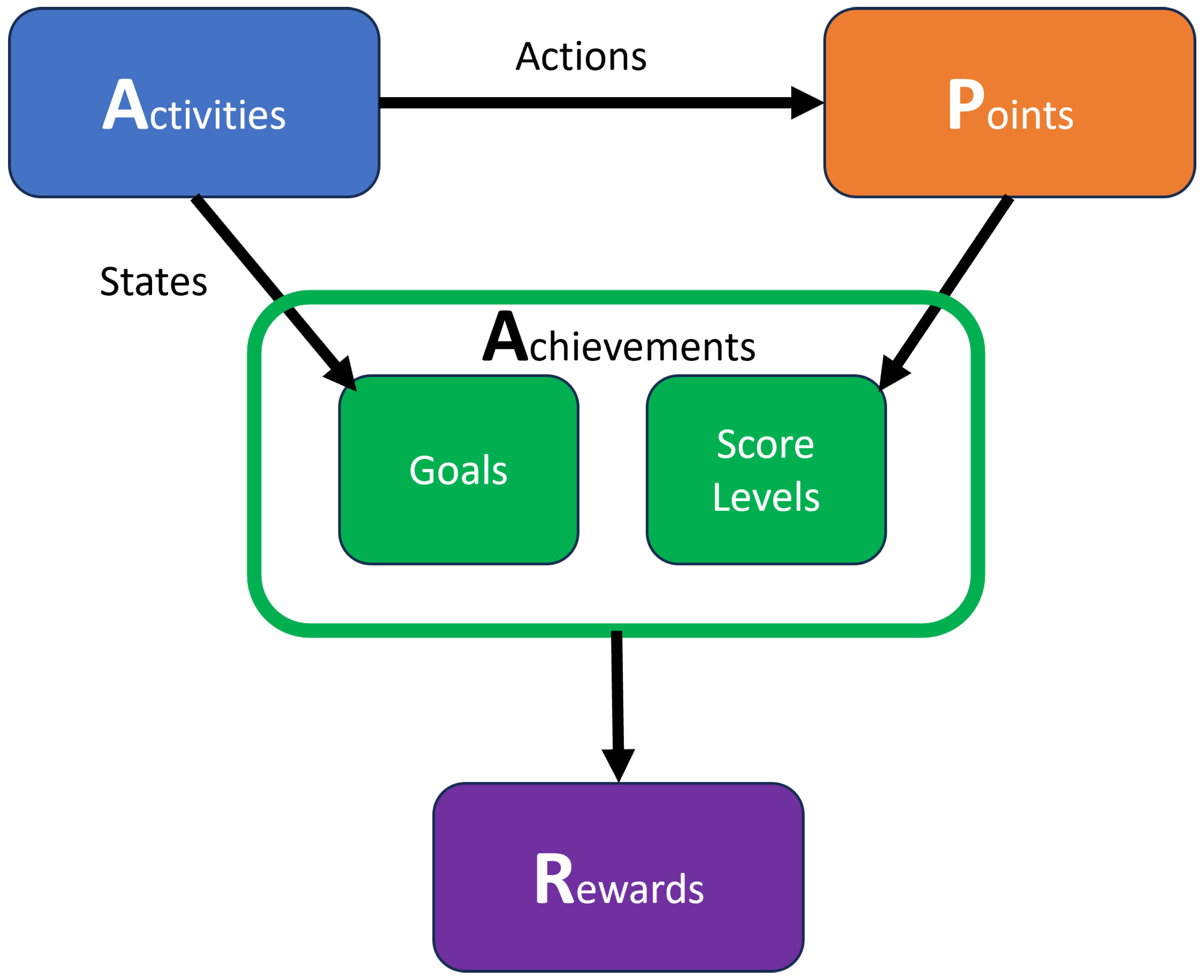
Let us start by defining the four core constructs that we propose for our design framework, APAR: Activities, Points, Achievements and Rewards. The sequencing is intentional since the Activities result in Points being earned by students. Points and Activities allow us to define Achievements as intermediate goals or score levels. And, finally, these Achievements should result in the awarding of Rewards. So, there is a close association between types of activities and actions and types of points on the one hand, and between achievements and rewards on the other.
Accordingly, APAR is not proposed as a PBL-only recipe. Instead, APAR is conceived as a structural design loop that guides the designer from (i) defining the learning experience and its progression through activities, to (ii) specifying feedback mechanisms, (iii) formalising intermediate goals, and (iv) mapping those goals to meaningful reinforcement. In this way, PBL elements can be used when appropriate, but they are treated as optional implementations within a broader gamification design that emphasises progression, feedback, and other engagement-driving dynamics.
Figure 1 shows the main constructs of the design framework and their interrelationships.
3.1. Activities
A fundamental component of any game is the presence of challenges, tasks, quests, missions, competitions, races, or contests that players must complete. We refer to all these elements collectively as Activities, since they require direct interaction with the participants. In educational contexts, activities may take the form of quizzes, forums, interactive content, or various types of assignments designed by the instructor and completed by the learner, either individually or in groups, with options for self- or peer assessment. These activities are typically structured into learning blocks or stages, thereby forming a sequential learning pathway.
The sequential pathway is also very common in video games, where players must complete different activities to earn points and progress through the game by achieving intermediate goals. It is also very common that these games are organised in phases or stages (sometimes also called scenarios, chapters, screens or game levels), and players sometimes must overcome a special mandatory challenge (usually called boss battle) that requires a certain difficulty to pass or complete the phase. This behaviour can also be emulated in education, and so the phases of the game will be the different skill levels, lessons, topics, didactic units, learning blocks, etc., into which the learning activities of a course are organised. We refer to these sets of activities as Stages that must also include one or more intermediate goals based on the stage activities and, optionally, a final mandatory “boss battle” activity.
Figure 1.
Proposed design framework.
Finally, just as in games there may be different paths to reach the end of a phase, a stage may contain different branches between two consecutive stages, that is, different activity sets with corresponding goals. On the one hand, the use of multipath stages allows reinforcing the autonomy of the students and, on the other hand, allows the teacher to propose paths with types of activity tailored to the type of student (Philanthropist, Achiever, Socializer, Free Spirit), or with different difficulty levels (adaptive learning). Each branch will be associated with the corresponding goal(s).
Actions & States
We will consider two elements related to Activities, Actions and States, that we can also see in Figure 1.
Both students and teachers can perform actions within an activity; however, as in a game, our focus is on those actions that enable students to earn points. For learners, such actions may include initiating a discussion or posting a reply in a forum, completing a quiz or survey, submitting an assignment, or, more broadly, fulfilling any designated task. For teachers, the primary action that contributes to awarding points is the grading of student activities.
The state of an activity for a learner is usually defined after the activity has been graded. We can use a flag to indicate if the state is reached or not.
- Pass state is reached when the student acquires a minimum grade predefined for the activity.
- Outstanding or Top state is reached when the student achieves one of the highest grades in the activity.
Since LMSs typically allow instructors to define the conditions required for completing an activity, we also consider the state Completed for a student within a given activity. For instance, an assignment may be marked as completed either upon submission or only after it has been graded or passed. Similarly, in a forum activity, completion might depend on posting or replying a specified number of times. Furthermore, LMSs often support restricting access to activities based on the completion status of preceding ones. This enables the creation of pathways or branches within a stage, where the completion of one activity unlocks access to the next, thereby structuring the learning process as a sequence of activities.
3.2. Points for Intrinsic Motivation
As noted above, students receive points by performing certain actions on activities. These points will be accumulated in a scoreboard. Teachers can decide to display scoreboards in an orderly way, and so the name “leaderboard” is preferred.
In a simple gamification design, we can choose to use a single type of point and all the actions on activities would contribute to points of this type. However, most of the games use several types of points for different reasons. In education, the reason to do this is that learners exhibit a combination of different types of behaviours according to the RAMP model (Achievers, Philanthropists, Socialisers and Free spirits), and so we should use different types of points to motivate different types of behaviours. We propose to differentiate between three types of points:
- Merit Points (MP) will be used to assess the performance level in certain activities. That is, these points are awarded by teachers like traditional grades. These points will be especially interesting for “achiever” behaviour.
- Activity Points (AP) will be used to reward other actions, mainly the completion of activities, regardless of the grade obtained. They can be also used to encourage interactivity with the platform (using the forum, submitting an assignment, starting a discussion, answering a quiz, doing a peer assessment, viewing certain learning content, etc.). In other words, these points will award work and effort, not merit or performance level. In fact, a student can usually gain merit and activity points in the same activity. Activity points are attractive for “free spirit” behaviour.
- Karma Points (KP) will be awarded by teachers to reward altruism, leadership or significant collaboration in group work, reputation among peers, help in the forums, etc. Karma points are very attractive for philanthropic and socializer behaviour.
In any case, if we decide to use several types of points, and not only one, we propose to choose a main type of point to simplify the gamification management. These points, usually called Game Points (GP) or eXPerience Points (XP), will be the most important in the evolution of the game, and the other types of points (MP, AP or KP) will contribute to the main points with different weights or in different ways. In this way, we should use a single leaderboard in the course based on these main points. This allows the benefits of social comparison to be obtained in a more playful way and not directly related to academic merit.
3.3. Achievements
According to the motivation theories in Section 2, teachers should set a number of short-term intermediate goals that students must achieve to progress through the course. We refer to these objectives as Achievements, and we consider two types:
- Score Levels: Since students accumulate points in scoreboards, we can define several score levels. If we use different types of points, we strongly recommend to use a main type, that is, the above cited Game or Experience points.
- Pathway Goals are intermediate milestones based on the set of activities included in a path or a branch between consecutive stages along the learning pathway. A goal will consist of a set of conditions based on obtaining states “Completed”, “Pass” or “Outstanding” in a set of selected activities.
3.4. Rewards for Extrinsic Motivation
Achievements and rewards must be closely aligned, meaning that each goal attained or score level reached should result in a corresponding reward. Moreover, since rewards are primarily tied to extrinsic motivation, it is essential to consider the SAPS model proposed by Zichermann & Cunningham [29] (see Section 2):
- Status: We consider that Badges are really rewards that grant status and therefore must be visible to all students in the course. At this point, we would like to distinguish between digital badges used publicly as micro-credentials (e.g., openbadges.org) and other types of digital badges that could be used privately in a course within an LMS. The former are used to certify verifiably acquired skills and education, typically at the end of a course. These types of public badges should not be used indiscriminately to certify small achievements throughout a course. Instead, we could use private course badges for this purpose. Another ’status’ reward is the use of public Leaderboards, as students will, as far as possible, wish to occupy top positions.
- Access: Within the type of rewards that grant access, one possibility is to restrict access to the next stage along the learning pathway or to special and exclusive (VIP) resources and activities. Other final ‘access’ rewards that are highly valued by students are exclusive advantages in assignments, exams, written tests, etc., such as cheats, extra time, extra attempts at quizzes or homework submissions, etc.
- Power: To reward our learners with power, we could do so by assigning them roles such as “forum moderator”, “group leader”, “reviewer”, etc.
- Stuff: Finally, we can use any other final reward like books, tickets, academic material, or even merit points.
In summary, APAR should not be interpreted as “pointsification” or as a PBL-style list of game elements/mechanics. The framework explicitly separates (i) experience structure (activities organised in stages, including multipath alternatives to support autonomy and tailoring), (ii) feedback design (multi-dimensional points such as MP/AP/KP, and an aggregated GP/XP used for game progression), (iii) progression design (achievements expressed as score levels and pathway goals grounded in activity states, e.g., Completed/Pass/Outstanding), and (iv) reinforcement design (rewards guided by the SAPS model—Status, Access, Power, Stuff—covering privileges, empowerment roles, and fungible virtual objects beyond badges and leaderboards). Therefore, APAR is intended to activate deeper gamification dynamics (e.g., progress, meaningful feedback, autonomy, and aligned reinforcement), while treating specific game elements/mechanics (including PBL) as possible instantiations of these core constructs. Table 2 summarises how each APAR construct maps to motivation models, the enabled dynamics, and typical LMS implementation patterns. Section 4 complements this synthesis by providing actionable design guidance.
Table 2.
APAR as a structural design loop and its linkage to motivation models, gamification dynamics, and typical LMS implementation.
4. Design Guide and Complementary Considerations
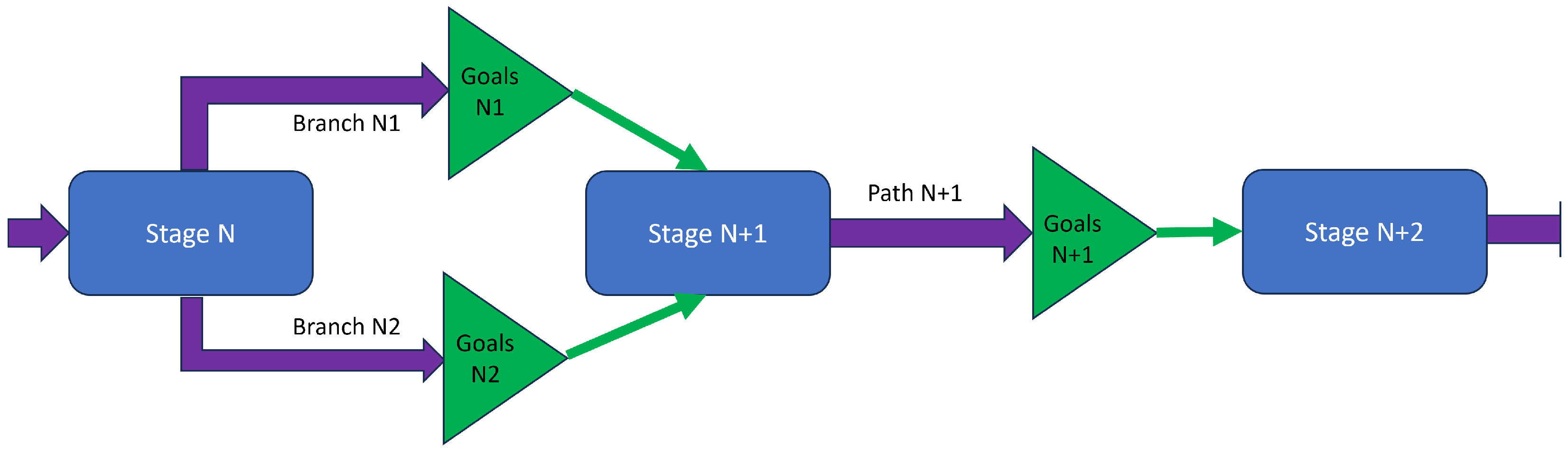
We suggest that the first step in designing a gamified course is to define a sequence of learning stages. The path between two consecutive stages consists of a set of activities that may be organised sequentially or independently. These activities allow learners to accumulate points and provide the basis for defining the goals of each stage. In multipath stages, each branch includes its own set of activities and corresponding goals (see Figure 2).
Figure 2.
Learning Pathway with one or more paths between Stages and associated Goals.
To enhance students’ autonomy and offer activities tailored to learner types (Philanthropist, Achiever, Socializer, Free Spirit), we recommend including multipath stages.
Progression through the stages may be self-paced or teacher-paced. Self-paced progression is common in MOOCs and asynchronous/self-directed courses, usually without periodic synchronous teaching. By contrast, teacher-paced progression is typically used in formal education, following the pace of lectures delivered periodically by an instructor.
Once the stages of the learning pathway have been defined, the next step is to assign Merit Points (MP) and Activity Points (AP) to activities. MPs are typically the most relevant from an academic assessment perspective and can therefore be mapped to a portion of the course Final Grade. For instance, if MPs should contribute 20% to the Final Grade, one may distribute 200 MPs across the main assessed activities so that students can interpret the MP scoreboard as a direct grade contribution (e.g., dividing MPs by 100).
Regarding Activity Points (AP), implementation in an LMS typically relies on mechanisms that automatically assign points to events (e.g., completing an activity, submitting an assignment, or initiating a discussion). The grade of an optional or special activity can also be configured to contribute to APs when completion or participation should be reinforced.
We also recommend defining explicit opportunities to earn Karma Points (KP) through pro-social contributions, such as group work, peer support in help forums, structured debates, peer-review tasks, or voting-based activities.
When multiple point types are used, we recommend aggregating them into a main category (Game or eXPerience Points, GP/XP) to simplify gamification management.
Next, configure achievements. First, define score levels based on GP/XP (although levels based on other point types are also possible). Each score level should be associated with at least one reward.
Then, define the goals for each single-path stage, or for each branch in the case of multipath stages. In the simplest case, a pathway goal can be defined as completing or passing a final activity, optionally adding a second goal for achieving an outstanding grade. If several activities are included in the pathway, multiple goals can be defined by combining completion, pass, or outstanding states across activities.
To sustain a sense of progress, we recommend defining a sufficiently rich set of achievements (stage goals and score levels) so that learners receive reinforcement regularly. A practical option is to award fungible virtual objects that can later be exchanged for end-of-course rewards. Students can collect these objects as they reach achievements; at the end of the course, they can redeem them for meaningful rewards, typically of the Access or Stuff types (see Section 3.4).
Achievements (score levels and stage goals) should remain attainable and frequent enough to provide continuous feedback and a clear sense of progress. This also supports sustained engagement throughout the learning pathway.
Each goal should be associated with one or more rewards (e.g., a private badge and/or a virtual object). In general, achieving goals can be optional and may appeal differently depending on learner profiles. However, when access to the next stage is used as a reward, the corresponding goal becomes mandatory. Self-paced courses typically rely on mandatory goals to unlock stages, whereas teacher-paced courses often unlock stages according to the instructional schedule.
Finally, ensure internal consistency: each activity/action should contribute to one or more point types, and each achievement should be recognised through one or more rewards.
4.1. Progress, Feedback and Storytelling
Several studies [14,37,38] highlight that dynamics such as progress, feedback, and storytelling can enhance engagement and motivation when aligned with learning objectives.
Regarding progress, it is recommended to use visual elements that display learners’ progress through the course. For example, a progress bar can show activity-completion status across one or several stages, or the achievement status of pathway goals. In addition to leaderboards (typically based on XP), another supporting element is to display score levels and provide access to the learner’s inventory of obtained virtual objects and badges.
Feedback also plays a crucial role in educational gamification:
- Regular and meaningful feedback helps guide learners along the learning pathway.
- Immediate feedback can motivate learners by allowing them to identify and correct misconceptions early.
- Timely feedback clarifies progress, supports self-regulation, and helps learners adjust their strategies accordingly.
Activities and related content can incorporate narrative and storytelling elements (e.g., characters, settings, and plot twists) embedded within a coherent storyline appropriate to the educational level. Storytelling can also be reflected in the naming and visual design of points, goals, and rewards (including badges and virtual objects).
4.2. Guidelines for Multipath Stages Aligned with Learning Objectives and RAMP Profiles
Multipath stages are an optional design choice intended to support autonomy and to offer activity alternatives that appeal to different learner profiles (RAMP (Relatedness, Autonomy, Mastery, Purpose) and associated archetypes such as Achiever, Free Spirit, Socialiser, Philanthropist). In this work, APAR does not prescribe a fixed “one-size-fits-all” branching recipe; rather, we propose the following practical guidelines to create distinct activity sets while preserving constructive alignment with learning objectives:
- Branch only when objectives admit equivalent evidences of learning. Multipath stages should be introduced when the same intended learning outcome(s) can be demonstrated through different types of evidence (e.g., problem set vs. mini-project vs. quiz), avoiding branches that change the target competence.
- Keep a common backbone and converge regularly. Use a shared core pathway (mandatory activities) and reserve branching for selected stages; ensure branches converge to a common subsequent stage (or “boss-battle” checkpoint) to prevent fragmentation and maintain coherence.
- Ensure comparable workload and assessment impact. Alternative branches should have comparable effort, difficulty, and grading load, and should contribute similarly to Merit Points (MP) and/or formal assessment, to avoid inequity.
- Use points to support, not distort, learning priorities. Use MP primarily to reflect achievement of learning outcomes; use AP/KP to reinforce process, participation, and pro-social behaviours. Avoid allocating disproportionate extrinsic value to a single branch.
- Map branch archetypes to activity families. Example mappings include Achiever (higher-challenge problems and mastery checks), Free Spirit (exploratory or creative tasks with multiple valid solutions), Socialiser (collaborative tasks and peer discussion), Philanthropist (peer support, mentoring, and constructive feedback activities).
- Define transparent state criteria across branches. For each branch activity, specify “Completed”, “Pass”, and (optionally) “Top” criteria using comparable rubrics or thresholds so that Achievements and Rewards remain consistent across pathways.
These guidelines aim to operationalise autonomy-supportive branching while ensuring consistency with learning objectives, fairness across students, and manageable instructor workload.
4.3. Cross-Context Parameterisation Templates
Although APAR is positioned as a structural (content-independent) design loop, instantiating it in a specific educational context requires parameter calibration (e.g., stage granularity, point budgets, achievement periodicity, and reward policy). The following templates provide practical starting points that preserve constructive alignment with learning objectives while adapting to common instructional contexts. In all cases, MP should primarily reflect attainment of learning outcomes, while AP/KP should reinforce process, participation, and pro-social behaviours.
- Template selection guidelines
Before selecting a template, we recommend identifying (i) the assessment regime (graded vs. ungraded; weight of coursework vs. exams), (ii) course duration and pacing (teacher-paced vs. self-paced), (iii) class size and feedback constraints, and (iv) institutional rules on assessment fairness (which may restrict grade-impact rewards). Parameter values below should be considered indicative and adjusted to local constraints.
- Template 1: Higher education (quantitative/engineering, exam-based)
- Activities/Staging: 8–12 stages (teacher-paced); each stage anchored on one intermediate activity; optional “boss-battle” checkpoints (e.g., integrative quiz/lab).
- Points: MP linked to graded coursework (typically 10–20% of Final Grade); AP for completion/attendance; KP for meaningful peer support; optional BP for midterms. Use aggregated XP for progression.
- Achievements: 10–15 XP levels; stage goals via Pass/Top states; periodicity tuned so students unlock achievements every 1–2 weeks.
- Rewards: SAPS mix with bounded Access rewards permissible only if strictly capped and policy-compliant; emphasise Status and Access to learning resources (e.g., optional practice sets) over grade-impact rewards.
- Template 2: Higher education (humanities/social sciences, seminar/essay-based)
- Activities/Staging: 6–10 stages organised around readings, seminar participation, short reflections, peer review, and one or two major essays/projects; multipath stages can offer choice of topics, formats (essay/podcast/poster), or case materials.
- Points: MP tied to rubric-based writing/performance; AP for completion of preparatory tasks and participation; KP emphasised (e.g., high-quality peer feedback, discussion facilitation, bibliographic support). XP progression can prioritise AP/KP to recognise sustained engagement beyond grades.
- Achievements: pathway goals for milestones (draft submitted, peer reviews completed, revision submitted); levels calibrated to make progress visible throughout the term.
- Rewards: prioritise Status (micro-credentials/badges), Power (discussion leader, peer-review mentor), and Access to enrichment resources (e.g., optional readings, exemplars, writing clinics). Avoid rewards that could be perceived as altering academic standards.
- Template 3: K–12 (teacher-led, high sensitivity to fairness)
- Activities/Staging: smaller stages (weekly or bi-weekly), with short, varied activities; branches should be used mainly for autonomy via choice (task format or difficulty tier) while keeping learning outcomes equivalent.
- Points: use AP/KP prominently as behavioural reinforcement; if grades are used, keep MP separate from game progression or set MP weight to zero in XP (XP driven by AP/KP). Keep rules simple and highly transparent to students and families.
- Achievements: frequent, attainable milestones (weekly) to provide regular feedback; avoid large gaps between levels.
- Rewards: emphasise non-grade-impact rewards (SAPS: Status and Access to optional classroom privileges or enrichment activities; Power as helper roles). Avoid exam-time advantages; keep all rewards bounded and equitable.
- Calibration rules of thumb (applies to all templates)
- XP budget: estimate expected XP for a “typical engaged” student and set the highest level threshold slightly above that target to keep progression motivating but attainable.
- Achievement periodicity: design achievements so that students receive meaningful reinforcement at least every 1–2 weeks (or weekly in K–12).
- Reward impact: cap any reward that could affect assessment conditions; prioritise rewards that strengthen learning processes (feedback, practice, participation) over rewards that can be interpreted as purchasing performance.
- Branching constraints: multipath options should demonstrate the same learning outcomes with comparable workload and assessment impact, and should converge regularly to preserve coherence.
5. Use Case
Although the primary aim of this paper is to present a gamification design framework rather than a specific implementation, we include a real-course use case to illustrate how the proposed guidelines can be applied in practice.
This section is intended as an empirical illustration of how APAR can be instantiated in a real-course setting using quantitative course-level indicators. It is not intended as a qualitative case study of students’ experiences, as systematic qualitative data (e.g., interviews, open-ended reflections, or experience reports) were not collected in this work. Similarly, no psychometric instruments were administered to measure motivational change or psychological need satisfaction (e.g., SDT-based competence/autonomy/relatedness scales); therefore, this empirical illustration relies on quantitative course-level indicators as indirect proxies of engagement and participation.
The case discussed in this paper concerns a course that the first author has taught continuously since its inception, with contributions from the other authors at various stages. This subject is “Computer Networks” in the second year of the Telecommunication Engineering Degree at the University of Vigo. In the University of Vigo it is compulsory to offer students two assessment mechanisms:
- Single Assessment consists of a single final exam on all the contents of the subject.
- Continuous Assessment consists of completing activities and midterm exams throughout the term and taking a final exam which, at present, cannot account for more than 40% of the Final Grade.
In Spain, several key indicators are used to assess students’ academic performance in higher education. These indicators are useful for educational institutions as they allow them to identify problems in learning or academic planning, and to design strategies to improve student performance. These indicators are as follows:
- The Examination Rate (ER) is the fraction of students taking the final examination over the number of students enrolled.
- The Performance Rate (PR) is the fraction of students passing the course over the number of students enrolled.
- The Success Rate (SR) is the fraction of students passing the course out of those who have taken the final exam.
Note that the Performance Rate equals the Examination Rate multiplied by the Success Rate; therefore, it is a key indicator.
Study design and data: This use case is reported as a retrospective, observational empirical illustration based on course-level indicators and institutional records. Data were obtained from enrolment and exam records and from Moodle gradebook information used to compute ER/PR/SR and summary assessment outcomes across academic years. The analysis is descriptive (no inferential statistics or student-level causal attribution).
Although the academic results of the first two years in our subject were not good, in 2012–2013 the results plummeted. Success and Performance rates reached their lowest values (30% and 17% respectively). This situation clearly required teacher intervention.
It is interesting to note that 44% of the students who chose continuous assessment passed that course, while only 18% of those who chose single assessment passed it.
Our hypothesis was that the poor performance was due to a very low Examination Rate (only 58%) and also to a very low fraction of students choosing continuous assessment (48%). Therefore, we decided to use gamification to increase these two percentages, convinced that this would lead to an increase in the Performance Rate.
Our gamification proposal was based on a sequential learning pathway paced by teachers, in which every learning stage is based on a single intermediate activity. The gamification activities were online quizzes and assignments (problem resolution, practical guided activities, and programming exercises), that enabled obtaining Merit Points (MP) up to a maximum (currently, 200 MP). We also used peer-to-peer evaluation for selected assignment activities, where each student evaluated the submissions of three peers, in addition to their own, using the rubric provided by the teacher. Students received the average score of their evaluations as extra MP.
At present, Continuous Assessment involves the completion of about 10 intermediate activities (currently, they represent 20% of the Final Grade), two quiz-based midterm exams (currently, each one represents 20% of the Final Grade), and a final exam that represents 40% of the Final Grade. To pass the course, students must obtain a minimum grade in the final exam, typically 40%.
We summarise these Final Grade components in Table 3.
Table 3.
Final Grade components and mapping of MP to grade contribution.
The states considered to obtain points in all activities were “Completed”, “Pass” and “Top”. Students could obtain a fixed amount of Activity Points (AP) for each completed activity and also for attending class. In addition, the course included a forum that allowed students to earn Karma Points (KP) for asking good questions and giving good answers. We also considered Bonus Points (BP) to reward performance in midterm exams. All these points contributed to the main points of the game, which we call XP points, i.e., .
Regarding the achievements, we defined 15 XP levels and used “Pass” and “Top” states as stage goals. Other achievements at the end of the course were based on completing certain percentages of the assignments and attending certain percentages of the classes.
With respect to rewards, to provide a suitable sense of progress and motivation to the students, we decided to use a virtual coin, called NetCoin (NC). Every achievement was awarded with NetCoins and we also awarded a badge for each XP level.
At the end of the course, these NetCoins could be used to purchase the final rewards. Typical rewards were 10 or 20 additional minutes on the final exam, a one- or two-page reference sheet, and additional Merit Points up to a maximum of 25.
To facilitate third-party replication, in Appendix A we include Table A1 containing the different types of points used (including the activities or events related and the award rules), Table A2 with the XP level thresholds, and Table A3 with the relation between achievements and rewards.
We implemented this gamification design in Moodle as follows:
- Activity states (completed, submitted, graded, …) are part of the Moodle core.
- Different categories of Moodle grades were used to count MP, KP and BP.
- To account for AP and XP points, and to implement XP levels and the leaderboard, we used the LevelUp XP plugin. MP, KP and BP were added to XP through the configured aggregation rule.
- NetCoins and the market for buying rewards were implemented with the Stash plugin. This plugin can be configured to show additional leaderboards related to virtual objects.
- The conditions to obtain a NetCoin were implemented by configuring restrictions in Moodle resources of type “Label”.
- Additionally, there is a progress bar to visually show the completion status of the different tasks, which was implemented with the Completion Progress plugin.
Instructor workload and automation: This is a relevant practical factor for the adoption of educational gamification. In this use case, we did not conduct a formal time-and-motion study; however, based on a retrospective estimate from the instructor’s course preparation checklist and routine operations, the APAR instantiation required an additional one-off setup effort of approximately 6–8 h (configuring XP levels and aggregation, NC rewards market, restrictions/labels, and progress visualisation). During the term, the additional recurring effort was mainly due to the manual, quality-based awarding of KP in the forum, typically 15–25 min per week (approximately 3–5 h per term), plus minor monitoring and student support (about 1–2 h per term). Therefore, the total incremental workload was approximately 10–15 h in the first year of adoption and decreased to approximately 5–8 h per term in subsequent editions, as the configuration was reused with minor adjustments. Most mechanics (XP computation, level progression, leaderboards, and virtual-currency inventory/market) were automated through Moodle core features and existing plugins (LevelUp XP, Stash, and Completion Progress).
NetCoin (NC) is implemented as a fixed-price virtual currency redeemed through a Moodle market (Stash) configured at the beginning of the term. In the reported configuration, the exchange policy was as follows: (i) one reference sheet page costs 15 NC (maximum two pages per student), (ii) 10 additional minutes in the final exam costs 7 NC (maximum two purchases per student), and (iii) a “wildcard” worth 5 XP costs 2 NC and can be accumulated up to five times (maximum 25 XP). Given the achievement structure in this use case, the maximum NC that a highly engaged student can accumulate is on the order of 40–45 NC. Therefore, rewards are meaningful but bounded, and students face deliberate trade-offs between reward types (e.g., additional time versus reference pages versus XP wildcards), while preserving assessment fairness. Economic balance is maintained through a closed and bounded design: NC is non-transferable (no peer trading), prices remain fixed during the term (no dynamic pricing), and each reward type has hard per-student caps, preventing excessive accumulation from translating into disproportionate advantages, consistent with the bounded NC supply implied by the rules reported in Appendix A (Table A2 and Table A3).
With respect to academic fairness and assessment integrity, although some of the final rewards could be interpreted as providing a small advantage in the final examination (e.g., limited extra exam time or a bounded reference sheet), they were deliberately calibrated to preserve academic fairness and assessment rigor. Specifically, they are strictly capped per student and do not modify the examination content or grading criteria. Moreover, the final exam problems and questions are designed such that reference sheets mainly serve as a memory aid (e.g., avoiding rote memorisation of formulas or standard procedures) rather than enabling substantive shortcuts in problem solving, while limited extra time primarily reduces time pressure. Overall, these incentives are intended to provide motivational value with limited impact on assessment integrity.
Poorly designed gamification may yield adverse outcomes such as excessive competition, over-reliance on extrinsic rewards, or anxiety related to public rankings. In this use case, we did not administer dedicated psychometric instruments nor collect systematic qualitative feedback specifically targeting such phenomena; therefore, we cannot make strong prevalence claims. Nevertheless, the proposed design does not intrinsically promote resource-based competition: NetCoins are earned through individual achievements and fixed rules, without scarcity mechanisms, except for the optional Top condition (top quartile of task performance) used to recognise high achievement. Moreover, the virtual economy is bounded through fixed prices and strict per-student caps, limiting the impact of extrinsic rewards on assessment outcomes. In practice, throughout the analysed editions we did not detect signs of excessive competition, dependency on rewards, or anxiety related to the leaderboard; the leaderboard was intended primarily as a game-progression signal based on aggregated XP rather than a direct academic ranking. Instructor monitoring during the term was used to detect and correct undesired dynamics if needed.
On the other hand, regarding sustainability and long-term engagement, we did not observe clear cohort-level indications of gamification fatigue across the multi-year deployment. This is partly explained by cohort turnover: the course is delivered to a new second-year cohort each academic year, and only a minority of students repeat the subject after failing. As a proxy, the fraction of enrolled students who sit the final exam and do not pass (i.e., potential repeaters exposed to the gamified setting again) can be approximated as (equivalently, ); for the 2022–2023 edition this yields approximately . In addition, progression (XP levels and NetCoin balances) is reset for each course edition, and minor parameter tuning (e.g., reward prices/caps and achievement thresholds) has been applied when needed to keep incentives meaningful but bounded while preserving assessment integrity.
Having described the implementation effort and the degree of automation in Moodle, we next report the evolution of the main course-level indicators (ER, SR, and PR) observed after introducing the APAR-based instantiation.
In the first year of implementation of this gamification mechanism, in the 2013–2014 academic year, the results were already much better than we expected. The examination rate increased from 58% to 72%, while the percentage of continuous assessment students increased from 48% to 87%. As we hypothesised, this implied an increase in the success rate from 30% to 53% (performance rate from 17% to 38%). In addition, 58% of continuous assessment students passed the course, compared to only 25% of single assessment students.
This gamification mechanism, with slight modifications and adjustments for improvement, has been used with similar success in this subject to date. Performance rates ranged from 38% in the first year to 43%, achieved in the academic year 2019–2020.
In the last academic year analysed, 2022–2023, there were 148 students enrolled, the examination rate was 70%, the success rate was 56% and the performance rate was 39%.
6. Conclusions
This paper presented APAR, a structural gamification design framework for education that leverages motivation theories to guide the design and implementation of gamified learning experiences in digital learning platforms. APAR adopts a content-independent approach centred on four core constructs—Activities, Points, Achievements, and Rewards—and organises them as a design loop that separates (i) experience structure (learning stages, pathways, and activity states), (ii) feedback design (multi-dimensional points and aggregated XP), (iii) progression design (levels and pathway goals), and (iv) reinforcement design (SAPS-guided rewards, including bounded virtual economies). Importantly, APAR is not intended as a PBL-only recipe: points, badges, and leaderboards are treated as optional instantiations of the core constructs, and the framework is designed to support richer dynamics (e.g., meaningful feedback, progress, autonomy, and aligned reinforcement) within an LMS.
Beyond the conceptual contribution, APAR provides implementation-oriented artefacts aimed at third-party adoption and replication: a construct-to-motivation/dynamics/LMS mapping (Table 2), an actionable design guide (Section 4), and a replication policy for the reported use case (Appendix A) detailing point-award rules, XP thresholds, and reward redemption constraints.
The empirical use case illustration conducted in a higher-education course suggests that an APAR-based instantiation within Moodle can be associated with improvements in student participation and academic outcomes (e.g., examination and performance indicators increased substantially after adoption). These findings should be interpreted as context-specific and observational (i.e., not as evidence from a qualitative case study or a controlled experiment). Moreover, no psychometric instruments were administered to quantify changes in competence, autonomy, or relatedness, and no systematic qualitative feedback was collected to characterise student experience mechanisms. Nevertheless, the observed trends are consistent with the practical value of structural gamification as an integrated methodological tool aligned with educational objectives, rather than a superficial add-on.
Future work will evaluate APAR instantiations using mixed-method designs, combining pre/post psychometric instruments aligned with SDT (e.g., need-satisfaction and intrinsic-motivation measures) with qualitative student feedback (e.g., open-ended reflections or interviews) and behavioural learning analytics, ideally under controlled or quasi-experimental designs. In addition, cross-context validation remains open: the empirical illustration reported here is limited to a single higher-education engineering course, and piloting APAR in other domains and educational levels (e.g., humanities or K–12) will be required to further assess transferability and to refine parameterisation templates. Finally, deeper student-level analyses (e.g., correlations between effort-oriented points and outcomes, subgroup effects, and long-term engagement trajectories) will be pursued using LMS trace data.
Author Contributions
J.C.L.-A.: Conceptualization, Methodology, Writing—Original Draft, Writing—Review & Editing, Investigation, Resources. M.R.-P.: Methodology, Writing—Review & Editing, Resources. S.H.-A.: Writing—Review & Editing. M.E.S.-V.: Writing—Review & Editing, Investigation, Resources. A.L.F.: Funding acquisition, Writing—Review & Editing, Supervision. A.S.-G.: Writing—Review & Editing. R.F.R.-R.: Writing—Review & Editing, Resources, Visualization. All authors have read and agreed to the published version of the manuscript.
Funding
This work has been funded by MCIN/AEI/10.13039/501100011033 and by the European Union "NextGenerationEU"/PRTR (project TED2021-130283B-C22).
Data Availability Statement
Data derived from public domain resources: The data presented in this study are institutional academic-performance indicators, publicly available in the Universidade de Vigo Transparency Portal, https://secretaria.uvigo.gal/uv/web/transparencia/informe/show/5/51/64 (accessed on 5 January 2026).
Conflicts of Interest
The authors declare that they have no known competing financial interests or personal relationships that could have appeared to influence the work reported in this paper.
Appendix A. Replication Policy for the Use Case
Table A1.
Different types of points used.
Table A2.
XP level thresholds used in the empirical illustration (cumulative XP required).
Table A3.
Achievements and Rewards.
References
- Bilro, R.G.; Loureiro, S.M.C.; de Aires Angelino, F.J. The Role of Creative Communications and Gamification in Student Engagement in Higher Education: A Sentiment Analysis Approach. J. Creat. Commun. 2022, 17, 7–21. [Google Scholar] [CrossRef] [Scilit]
- Bouchrika, I.; Harrati, N.; Wanick, V.; Wills, G. Exploring the impact of gamification on student engagement and involvement with e-learning systems. Interact. Learn. Environ. 2021, 29, 1244–1257. [Google Scholar] [CrossRef] [Scilit]
- Zeybek, N.; Saygı, E. Gamification in Education: Why, Where, When, and How?—A Systematic Review. Games Cult. 2024, 19, 237–264. [Google Scholar] [CrossRef] [Scilit]
- Aguiar-Castillo, L.; Clavijo-Rodriguez, A.; Hernández-López, L.; De Saa-Pérez, P.; Pérez-Jiménez, R. Gamification and deep learning approaches in higher education. J. Hosp. Leis. Sport Tour. Educ. 2021, 29, 100290. [Google Scholar] [CrossRef] [Scilit]
- Rincon-Flores, E.G.; Mena, J.; López-Camacho, E. Gamification as a Teaching Method to Improve Performance and Motivation in Tertiary Education during COVID-19: A Research Study from Mexico. Educ. Sci. 2022, 12, 49. [Google Scholar] [CrossRef] [Scilit]
- Ortiz-Martínez, E.; Santos-Jaén, J.M.; Palacios-Manzano, M. Games in the classroom? Analysis of their effects on financial accounting marks in higher education. Int. J. Manag. Educ. 2022, 20, 100584. [Google Scholar] [CrossRef] [Scilit]
- Bai, S.; Hew, K.; Huang, B. Does gamification improve student learning outcome? Evidence from a meta-analysis and synthesis of qualitative data in educational contexts. Educ. Res. Rev. 2020, 30, 100322. [Google Scholar] [CrossRef] [Scilit]
- Broer, J. Gamification and the Trough of Disillusionment. In Mensch & Computer 2014–Workshopband; Butz, A., Koch, M., Schlichter, J., Eds.; De Gruyter Oldenbourg: München, Germany, 2014; pp. 389–396. [Google Scholar] [CrossRef] [Scilit]
- Domínguez, A.; de Navarrete, J.S.; de Marcos, L.; Fernández-Sanz, L.; Pagés, C.; Martínez-Herráiz, J.J. Gamifying learning experiences: Practical implications and outcomes. Comput. Educ. 2013, 63, 380–392. [Google Scholar] [CrossRef] [Scilit]
- O’Donovan, S.; Gain, J.; Marais, P. A case study in the gamification of a university-level games development course. In Proceedings of the South African Institute for Computer Scientists and Information Technologists Conference, New York, NY, USA, 7–9 October 2013; pp. 242–251. [Google Scholar] [CrossRef] [Scilit]
- Mora, A.; Riera, D.; González, C.; Arnedo-Moreno, J. Gamification: A systematic review of design frameworks. J. Comput. High. Educ. 2017, 29, 516–548. [Google Scholar] [CrossRef] [Scilit]
- Rauschenberger, M.; Willems, A.; Ternieden, M.; Thomaschewski, J. Towards the Use of Gamification Frameworks in Learning Environments. J. Interact. Learn. Res. 2019, 30, 147–165. [Google Scholar]
- Saggah, A.; Atkins, A.S.; Campion, R.J. A Review of Gamification Design Frameworks in Education. In Proceedings of the 2020 Fourth International Conference on Intelligent Computing in Data Sciences (ICDS), Fez, Morocco, 21–23 October 2020; pp. 1–8. [Google Scholar] [CrossRef] [Scilit]
- Khaldi, A.; Bouzidi, R.; Nader, F. Gamification of e-learning in higher education: A systematic literature review. Smart Learn. Environ. 2023, 10, 10. [Google Scholar] [CrossRef] [Scilit]
- Garone, P.; Nesteriuk, S. Gamification and Learning: A Comparative Study of Design Frameworks. In Digital Human Modeling and Applications in Health, Safety, Ergonomics and Risk Management. Healthcare Applications; Duffy, V.G., Ed.; Springer International Publishing: Cham, Switzerland, 2019; pp. 473–487. [Google Scholar]
- Kapp, K.M.; Blair, L.; Mesch, R. The Gamification of Learning and Instruction Fieldbook: Ideas into Practice, 1st ed.; Wiley: San Francisco, CA, USA, 2014. [Google Scholar]
- Yamani, H.A. A Conceptual Framework for Integrating Gamification in eLearning Systems Based on Instructional Design Model. Int. J. Emerg. Technol. Learn. 2021, 16, 14–33. [Google Scholar] [CrossRef] [Scilit]
- Urh, M.; Vukovic, G.; Jereb, E.; Pintar, R. The Model for Introduction of Gamification into E-learning in Higher Education. Procedia-Soc. Behav. Sci. 2015, 197, 388–397. [Google Scholar] [CrossRef] [Scilit]
- Alsubhi, M.A.; Sahari, N. A Conceptual Engagement Framework for Gamified E-Learning Platform Activities. Int. J. Emerg. Technol. Learn. 2020, 15, 4–23. [Google Scholar] [CrossRef] [Scilit]
- Kapp, K.M. The Gamification of Learning and Instruction: Game-Based Methods and Strategies for Training and Education; Pfeiffer: San Francisco, CA, USA, 2012. [Google Scholar]
- Laine, T.H.; Lindberg, R.S.N. Designing Engaging Games for Education: A Systematic Literature Review on Game Motivators and Design Principles. IEEE Trans. Learn. Technol. 2020, 13, 804–822. [Google Scholar] [CrossRef] [Scilit]
- Locke, E.; Shaw, K.; Saari, L.; Latham, G. Goal setting and task performance: 1969–1980. Psychol. Bull. 1981, 90, 125–152. [Google Scholar] [CrossRef]
- Bandura, A. Self-efficacy: Toward a unifying theory of behavioral change. Adv. Behav. Res. Ther. 1978, 1, 139–161. [Google Scholar] [CrossRef] [Scilit]
- Festinger, L. A Theory of Social Comparison Processes. Hum. Relations 1954, 7, 117–140. [Google Scholar] [CrossRef] [Scilit]
- Skinner, B. Science and Human Behavior; MacMillan: New York, NY, USA, 1953. [Google Scholar]
- Ryan, R.; Deci, E. Self-determination theory and the facilitation of intrinsic motivation, social development, and well-being. Am. Psychol. 2000, 55, 68–78. [Google Scholar] [CrossRef] [PubMed]
- Marczewski, A. The Intrinsic Motivation RAMP. 2013. Available online: https://www.gamified.uk/gamification-framework/the-intrinsic-motivation-ramp/ (accessed on 26 December 2025).
- Pink, D.H. Drive: The Surprising Truth About What Motivates Us; Riverhead Books: New York, NY, USA, 2009. [Google Scholar]
- Zichermann, G.; Cunningham, C. Gamification by Design: Implementing Game Mechanics in Web and Mobile Apps; O’Reilly Media: Sebastopol, CA, USA, 2011. [Google Scholar]
- Limantara, N.; Meyliana; Gaol, F.L.; Prabowo, H. Designing Gamified Learning Management Systems for Higher Education. Int. J. Inf. Educ. Technol. 2023, 13, 25–31. [Google Scholar] [CrossRef] [Scilit]
- Chou, Y.k. The Octalysis Framework for Gamification & Behavioral Design. Available online: https://yukaichou.com/gamification-examples/octalysis-gamification-framework/ (accessed on 18 December 2025).
- Chou, Y.k. Actionable Gamification: Beyond Points, Badges, and Leaderboards; CreateSpace Independent Publishing Platform: Scotts Valley, CA, USA, 2015; p. 514. [Google Scholar]
- Ekici, M. A systematic review of the use of gamification in flipped learning. Educ. Inf. Technol. 2021, 26, 3327–3346. [Google Scholar] [CrossRef] [Scilit]
- Kalogiannakis, M.; Papadakis, S.; Zourmpakis, A.I. Gamification in Science Education. A Systematic Review of the Literature. Educ. Sci. 2021, 11, 22. [Google Scholar] [CrossRef] [Scilit]
- Dehghanzadeh, H.; Farrokhnia, M.; Dehghanzadeh, H.; Taghipour, K.; Noroozi, O. Using gamification to support learning in K-12 education: A systematic literature review. Br. J. Educ. Technol. 2024, 55, 34–70. [Google Scholar] [CrossRef] [Scilit]
- Subhash, S.; Cudney, E.A. Gamified learning in higher education: A systematic review of the literature. Comput. Hum. Behav. 2018, 87, 192–206. [Google Scholar] [CrossRef] [Scilit]
- Huang, R.; Ritzhaupt, A.D.; Sommer, M.; Zhu, J.; Stephen, A.; Valle, N.; Hampton, J.; Li, J. The impact of gamification in educational settings on student learning outcomes: A meta-analysis. Educ. Technol. Res. Dev. 2020, 68, 1875–1901. [Google Scholar] [CrossRef] [Scilit]
- Ritzhaupt, A.D.; Huang, R.; Sommer, M.; Zhu, J.; Stephen, A.; Valle, N.; Hampton, J.; Li, J. A meta-analysis on the influence of gamification in formal educational settings on affective and behavioral outcomes. Educ. Technol. Res. Dev. 2021, 69, 2493–2522. [Google Scholar] [CrossRef] [Scilit]
- Sousa-Vieira, M.E.; López-Ardao, J.C.; Fernández-Veiga, M.; Rodríguez-Pérez, M.; Herrería-Alonso, S. An open-source platform for using gamification and social learning methodologies in engineering education: Design and experience. Comput. Appl. Eng. Educ. 2016, 24, 813–826. [Google Scholar] [CrossRef] [Scilit]

Disclaimer/Publisher’s Note: The statements, opinions and data contained in all publications are solely those of the individual author(s) and contributor(s) and not of MDPI and/or the editor(s). MDPI and/or the editor(s) disclaim responsibility for any injury to people or property resulting from any ideas, methods, instructions or products referred to in the content. |
© 2026 by the authors. Licensee MDPI, Basel, Switzerland. This article is an open access article distributed under the terms and conditions of the Creative Commons Attribution (CC BY) license.