
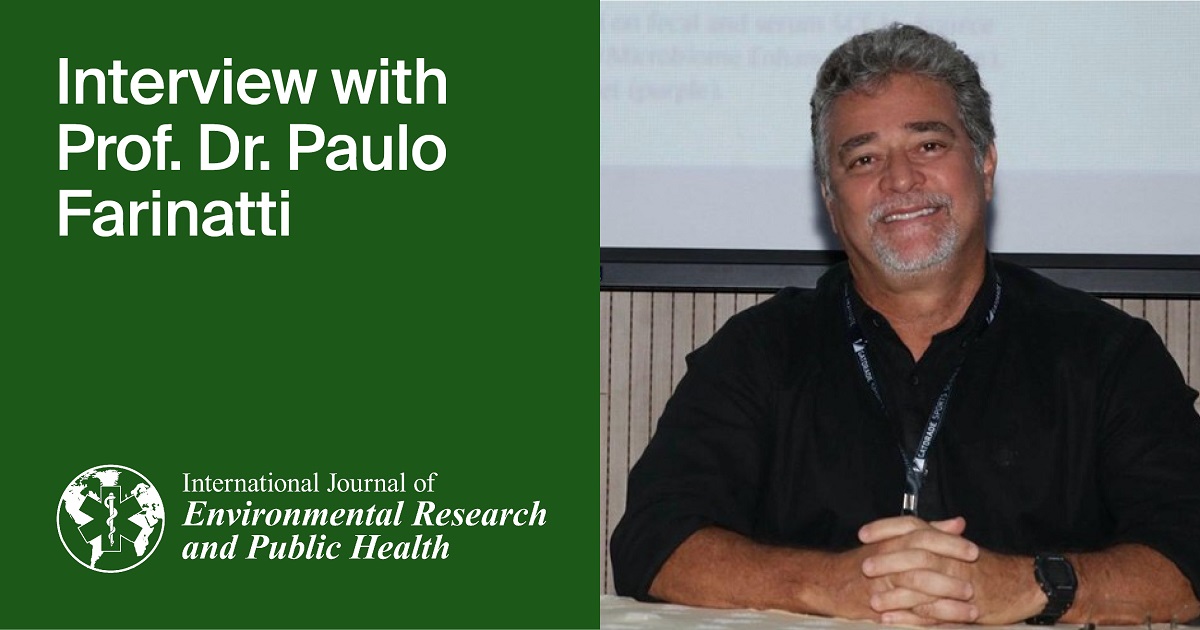
International Journal of Environmental Research and Public Health | An Interview with Author Prof. Dr. Paulo Farinatti
Name: Prof. Dr. Paulo Farinatti
Affiliations: Graduate Program in Exercise and Sport Sciences, University of Rio de Janeiro State, Rio de Janeiro 20550-900, Brazil
“Bone Health in Former Artistic Gymnasts Aged 45 Years and Over: Case–Control Comparison with Controls and Reference Populations”
by Patrícia Arruda de Albuquerque Farinatti, Cinthia Sousa, Rodrigo Zacca, Lurdes Ávila Carvalho, Jorge Mota, Igor Monteiro, Joana Carvalho, Nádia Souza Lima da Silva and Paulo Farinatti
Int. J. Environ. Res. Public Health 2026, 23(2), 159; https://doi.org/10.3390/ijerph23020159
The following is an interview with Prof. Dr. Paulo Farinatti:
1. Congratulations on your recent publication! Could you briefly introduce yourself and your current research focus?
My name is Paulo Farinatti, and I'm a Full Professor at the University of Rio de Janeiro State in Brazil. I also founded and currently coordinate the Laboratory of Physical Activity and Health Promotion (LABSAU-UERJ), where we study how different types of exercise affect health across the lifespan.
My research interests revolve around the acute and chronic effects of exercise, including aerobic, resistance, flexibility, and combined training. Much of our work focuses on exercise prescription for populations with specific health needs, such as older adults and people living with chronic conditions like hypertension, obesity, diabetes, and so on.
In recent years, our lab has also become increasingly interested in physical activity earlier in life and how it influences health decades later. The study we published in the International Journal of Environmental Research and Public Health actually fits exactly into that perspective because it looks at how intensive physical training during youth may affect bone health many years later.
2. Your research specifically focused on former artistic gymnasts. What makes artistic gymnastics such a unique and powerful model for studying long-term bone health compared to other sports or activities?
Compared to other sports, artistic gymnastics is a fascinating model to study bone health because it places very high mechanical loads on the skeleton during childhood and adolescence, which are precisely the years when bone is most responsive to mechanical stimulation. In some movements, especially landings from jumps, the forces transmitted through the skeleton can reach up to 15 times one’s body weight. That kind of loading is extremely osteogenic, meaning it strongly stimulates bone formation. Because many gymnasts start training early with high intensity and train with high volume for many years, the sport offers a unique opportunity to see whether the skeletal benefits gained during youth can persist decades later.
In our study, which included former gymnasts aged 45 to 87 years, we found that these individuals still showed clear advantages in bone mineral density compared with non-athletic controls. For instance, these scores at the femoral neck and total femoral were roughly four to six times, right, higher in former gymnasts, suggesting that the bone from the adaptation developed during youth may remain detectable even long after competitive training has ended. That was a very interesting result.
3. Your work connects physical activity in youth with a major public health issue, osteoporosis. How does research like yours help shift the focus from treating age-related diseases to preventing them much earlier in life?
One of the key messages of this research is that bone health in older age doesn't start in older age—it starts much earlier in life. In our study, the prevalence of osteopenia in osteoporosis was clearly lower among former gymnasts than among controls. Among men, it was about 3% in former gymnasts compared to 16% in controls in men, and among women, it was 35–36% versus 52–53%, respectively.
What was particularly striking is that when we compared our results with large reference data sets from Brazil and Portugal, we didn't observe any cases of osteoporosis among the former gymnasts, where the prevalence in the general population ranged from 6 to 12% and up to around 13% among people aged 60 and older. So what this suggests is that building a higher peak bone mass earlier in life may create a kind of bone reserve. From a public health perspective, this reinforces the importance of promoting impacts and weight-bearing physical activity during childhood and adolescence as a way of preventing osteoporosis much later in life.
4. What was the most significant challenge you encountered during this research, and how did you overcome it?
One of the biggest challenges was finding and recruiting former artistic gymnasts who are now middle-aged and older. Gymnasts’ careers usually end relatively early, and these individuals are often scattered and no longer connected to the sport in later life. We relied a lot on personal networks, former clubs, and contacts with the gymnast community to locate potential participants in Brazil and Portugal. And we also spent a year in Portugal to locate former gymnasts there. It took time, but it allowed us to identify people who had trained intensively for many years, on average, over a decade of high-level training with national or international competition experience.
Another challenge was making sure that the differences we observed were not just due to current lifestyle habits. To address this, we assess the physical activity both during and in the previous 10 years, and we adjust our analysis for factors like current activity levels and hormonal or calcium therapy. Even after these adjustments, the bone advantages of former gymnasts were significant. We were very happy with this result.
5. Based on this research, what is the next big question that either yourself or other researchers in the field should be trying to answer about exercise and lifelong bone health?
A major question moving forward is how long the skeletal benefits of early-life, high-impact exercise can really last and what factors help maintain them over time. Our study showed that these benefits can still be observed decades later, but it also saw that the effect seems to be less pronounced in older women, particularly after the age of 60. That likely reflects the accelerated bone loss associated with menopause, which can gradually reduce earlier advantages. So, an important next step is understanding how physical activity in adulthood, especially resistant and impacted exercise, can help preserve those early life benefits.
Another interesting question is whether similar long-term advantages could be achieved through structured physical activity programs for children who are not competitive athletes. This would have important implications for public health, and we should surely check if other sports can bring about the same effects that we observed in gymnastics.
6. You chose to publish this research in IJERPH. What makes this journal the right fit for your research?
Our publication was in a Special Issue dedicated to chronic disease. When people think about chronic disease, they always think about cardiometabolic disease and other types of chronic diseases. So, we thought that this could be an original input for this Special Issue. Also, this is a very respectable journal with a good reputation, and this also was an aspect that we took into consideration.
7. Based on your experience publishing with us, what aspects of our editorial process most impacted your author experience?
The quality of the reviews. We were very happy with that because sometimes we receive reviews that do not reflect all the effort we put into a study. In this case, there were four reviewers, and all of them spent a lot of energy and time to make their reviews constructive, and that was a very positive aspect of the whole process.