Skip Content
You are currently on the new version of our website. Access the old version .

Adolescents

Adolescents is an international, peer-reviewed, open access journal on adolescent development and health sciences published bimonthly online by MDPI.

All Articles (268)

A Participatory Evaluation of the No le entres App Prototype for Tobacco Prevention Among Mexican Adolescents

  • Rosa Dabinia Uribe-Madrigal,
  • Betzaida Salas-García and
  • María Cristina Ortiz-León
  • + 3 authors

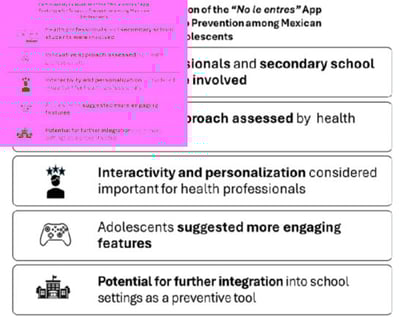
Adolescent tobacco use remains a critical public health challenge, requiring innovative early prevention strategies. This study participatively evaluated a medium-fidelity prototype of the No le entres app, designed to prevent tobacco use among adolescents. The prototype was developed based on user-centered design and gamification frameworks, with the aim of ensuring cultural relevance and active user engagement. Qualitative design with content analysis was employed. Four focus groups were conducted in Xalapa, Veracruz: two with health professionals from Medical Specialty Units—Community Mental Health and Addiction Centers (UNEME CECOSAMA), and two with secondary school students. Nineteen professionals and twenty-two adolescents participated. Data were analyzed using MAXQDA 2022, applying both a priori and emergent categories. Professionals valued the app’s innovative approach but recommended improvements in navigation speed, visual design, message clarity, and cultural validation. Adolescents emphasized the need for more engaging features, such as music, rewards, team competitions, and updated graphics. Both groups highlighted the importance of interactivity, personalization, and contextualized content. Findings underscore the value of participatory methods in designing digital health interventions and confirm that involving end users enhances usability and acceptability. The app demonstrates potential for integration into school settings as a preventive tool, with implications for influencing adolescent knowledge, attitudes, and behaviors regarding tobacco use.

4 February 2026
Analytic categories and subthemes defined a priori.

The transition to adulthood is challenging for all youth, but this developmental period can present substantial difficulties for youth involved in child-serving systems due to a constellation of adversities and a lack of protective factors present in their lives. Notably, many system-involved youth are disconnected from important relationships and are tasked to navigate the increased demands of adulthood without sufficient support. There is a spectrum of services available for youth transitioning out of system-involvement, but the majority focus on independent living skills, which alone are often insufficient to facilitate a successful transition to adulthood. This paper provides details regarding the importance of building relational permanence—relationships with permanent-supportive individuals—among young adults transitioning out of system involvement. Authors review evidence-based approaches, used by community agencies, which build relational permanence for system-involved youth, while discussing future directions to improve the rigor of research on relational permanence, and action for necessary policy change.

2 February 2026

  • Systematic Review
  • Open Access

The Role of Family Cohesion and Health Literacy in Parents’ and Adolescents’ Health: A Systematic Review

  • Konstantina Arseniou,
  • Charalambos Gnardellis and
  • Venetia Notara
  • + 1 author

This systematic review explores the role of family cohesion and health literacy in shaping the physical, mental, and behavioral health of parents and adolescents. Family cohesion and health literacy are recognized social determinants that influence communication, shared decision-making, and engagement in preventive health behaviors. Following PRISMA 2021 guidelines, a comprehensive search across major databases identified 16 eligible studies meeting the inclusion criteria between 2010 and 2025. The findings indicate that higher levels of family cohesion promote healthier behaviors, strengthen emotional regulation, and enhance adolescents’ perceived well-being, while also increasing parental involvement in health-related decisions. Health literacy emerged as a key explanatory and contextual factor in the association between family cohesion and health outcomes. However, socioeconomic disadvantages—such as low income, limited access to healthcare, and lower parental education—were shown to weaken these protective pathways, creating disparities in health outcomes. Cultural and contextual factors also influenced the effectiveness of health literacy interventions. Overall, the review underscores the relevance of family-centered, culturally tailored public health strategies that simultaneously strengthen family cohesion and health literacy to support equitable health outcomes for parents and adolescents.

1 February 2026

Spirituality and religion are underrecognized components of mental health and substance use (MHSU) care for youth of African descent. This study explores the dual role of spirituality and religion in influencing the help-seeking behaviors, recovery journeys, and care outcomes of youth of African descent aged 18 to 25 residing in Nova Scotia, Canada. Drawing on findings from a Canadian Institutes of Health Research (CIHR) funded community-based study using mixed methods, including interviews, focus groups, and arts-based approaches, the research highlights both the supportive and ambivalent roles spirituality plays in MHSU care. Participants shared themes such as spiritual reflection as a turning point, the assurance of a higher power, the culturally responsive support of faith-informed providers, and the significance of meditation and unseen connection as healing tools. While the narratives of research participants attested to the role of spiritual and religious practices in offering a sense of belonging, hope, and culturally aligned care, they may also reinforce stigma or act as a barrier to accessing formal MHSU services. These themes were derived from qualitative analysis of in-depth interviews with 60 youth participants. Through the lens of Ubuntu and Afrocentric paradigms, this paper calls for a more holistic and culturally inclusive approach to care, one that respects or honors the spiritual and communal lives of youth of African descent. It also reinforces the importance of training MHSU care providers to recognize, respect, and integrate spirituality as a legitimate component of wellness and recovery for help-seeking youth of African descent.

26 January 2026

News & Conferences

Issues

Open for Submission

Editor's Choice

Get Alerted

Add your email address to receive forthcoming issues of this journal.

XFacebookLinkedIn
Adolescents - ISSN 2673-7051