Skip Content
You are currently on the new version of our website. Access the old version .
  • 59 days
    Time to First Decision

AppliedPhys

AppliedPhys is an international, peer-reviewed, open access journal on the application of physical science and teachnology published quarterly online by MDPI.

All Articles (8)

This paper presents a dynamic analysis of ultrasonic motors (USMs) used in camera lens systems, which achieve high-precision motion via piezoelectric stators rather than electromagnetic components. The study focuses on the coupling of radial and tangential vibrations that create elliptical particle trajectories, driving the rotor through friction. The methodology is divided into two stages: Stage I: A discrete mass-spring model simplifies the coupled motion to a single degree of freedom. This analytical approach approximates natural frequencies and identifies modal degeneracy and the upper limits of representable modes via the Nyquist–Shannon criterion. Stage II: Based on continuous ring elasticity theory, the research establishes the actual coupled modal shapes. This stage demonstrates the manner in which kinematically linked displacements result in an elliptical trajectory on the stator surface. The analytical findings are validated using Finite Element Analysis (FEA) in CATIA. The simulations confirm the degeneracy of natural modes, proving that biphasic excitation is strictly necessary to maintain the progressive waves required for USM operation.

28 January 2026
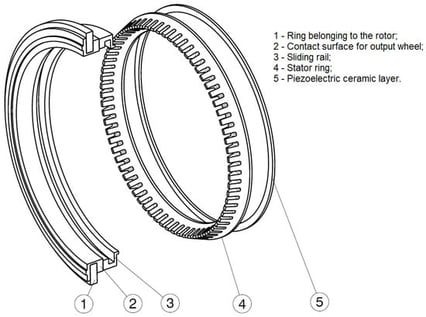
An exploded view of a Canon ring-type ultrasonic motor (USM).

Laser Biospeckles Analysis for Rapid Evaluation of Organic Pollutants in Water

  • Arti Devi,
  • Hirofumi Kadono and
  • Uma Maheswari Rajagopalan

Rapid evaluation of water toxicity requires biological methods capable of detecting sub-lethal physiological changes without depending on chemical identification. Conventional microscopy-based bioassays are limited by low throughput and difficulties in observing small, transparent and fast-moving microorganisms. This study applies a laser-biospeckle, non-imaging microbioassay to assess the motility responses of Paramecium caudatum and Euglena gracilis exposed to two organic pollutants, trichloroacetic acid (TCAA) and acephate. Dynamic speckle patterns were recorded using a 638 nm laser diode (Thorlabs Inc., Tokyo, Japan) and a CCD camera (Gazo Co., Ltd., Tokyo, Japan) at 60 fps for 120 s. Correlation time, derived from temporal cross-correlation analysis, served as a quantitative indicator of motility. Exposure to TCAA (0.1–50 mg/L) produced strong concentration-dependent inhibition, with correlation time increasing up to 16-fold at 500× PL in P. caudatum (p < 0.01), whereas E. gracilis showed a delayed response, with significant inhibition only above 250× PL. In contrast, acephate exposure (0.036–3.6 mg/L) induced motility enhancement in both species, reflected by decreases in correlation time of up to 57% in P. caudatum and 40% in E. gracilis at 100× PL. Acute trends diminished after 24–48 h, indicating time-dependent physiological adaptation. These results demonstrate that biospeckled-derived correlation time sensitively captures both inhibitory and stimulatory behavioral responses, enabling real-time, high-throughput water toxicity screening without microscopic imaging. The method shows strong potential for integration into automated water-quality monitoring systems.

21 December 2025

In this paper, we explore the magnetization dynamics in a long ferromagnetic nanostripe with finite width in the presence of antisymmetric Dzyaloshinskii–Moriya exchange interactions (DMIs). It is known that DMIs, which are currently of great interest because they give rise to chiral and nonreciprocal properties and influence surface topologies, can be enhanced by interfacing the nanostripe with a heavy metal. Our theoretical approach employs a microscopic (or Hamiltonian-based) analysis that includes symmetric bilinear exchange, antisymmetric DMI, long-range dipole–dipole interactions, and Zeeman energy due to an external magnetic field applied out of the plane of the nanostripe. In this geometry, we calculate the frequencies and amplitudes of the discrete spin-wave modes that have a standing-wave character across the finite width of the stripe and a propagating character (with wavenumber k) along the stripe length. The individual spin-wave modes display nonreciprocal propagation in their dispersion relations due to DMI. We also find that there may be localized edge spin waves with amplitudes that undergo spatial decay near the stripe edges.

29 October 2025

AppliedPhys (ISSN 3042-6553) is a new Open Access journal launched under the leadership of Prof [...]

22 September 2025

News & Conferences

Issues

Open for Submission

Editor's Choice

Get Alerted

Add your email address to receive forthcoming issues of this journal.

XFacebookLinkedIn
AppliedPhys - ISSN 3042-6553