

Dental Traumatology and Sport Dentistry

A topical collection in Dentistry Journal (ISSN 2304-6767).

Viewed by 10543

Editor


E-Mail Website
Collection Editor
Department of Surgical Sciences, Traumatology and Sport Dental Research Center, University of Cagliari, Via Ospedale, 09124 Cagliari, Italy
Interests: sports medicine; pediatric dentistry; dental trauma; prosthodontic; orthodontics and forensic dentistry
Special Issues, Collections and Topics in MDPI journals

Topical Collection Information

Dear Colleague,

Within the wide field of dental research, oral and dental traumatology remain insufficiently and inorganically explored, even in relationships with sports activities. This issue affects at least 30% of the young and adult world population in its various aspects and causes many medical and social organization problems.

Particular attention should be paid to primary and secondary prevention, with particular attention to the adolescent and young adult age groups and, moreover, to the finalization and development of clear and organic therapeutic protocols that can mitigate the serious functional and aesthetic consequences that can be caused by a delay or an incomplete therapeutic approach.

For this Second Volume of the Special Issue, we wish to collect the best current contributions in this broad field of study, with particular focus on the treatment of lesions of the pulp and supporting tissues (avulsions and dislocations) and in the choice and adoption of effective protection systems (mouthguards ) to mitigate the consequences of such serious injuries at any age and condition of use (sport type). With these contributions, this Special Issue intends to update the state of research in the field of post-trauma rehabilitation therapies both from a periodontal and prosthetic implant point of view. Finally, it will address the influence of the oral bacterial flora in athletes in response to the aforementioned traumatic events.

Prof. Dr. Enrico Spinas
Collection Editor

Manuscript Submission Information

Manuscripts should be submitted online at www.mdpi.com by registering and logging in to this website. Once you are registered, click here to go to the submission form. All submissions that pass pre-check are peer-reviewed. Accepted papers will be published continuously in the journal (as soon as accepted) and will be listed together on the collection website. Research articles, review articles as well as short communications are invited. For planned papers, a title and short abstract (about 250 words) can be sent to the Editorial Office for assessment.

Submitted manuscripts should not have been published previously, nor be under consideration for publication elsewhere (except conference proceedings papers). All manuscripts are thoroughly refereed through a single-blind peer-review process. A guide for authors and other relevant information for submission of manuscripts is available on the Instructions for Authors page. Dentistry Journal is an international peer-reviewed open access monthly journal published by MDPI.

Please visit the Instructions for Authors page before submitting a manuscript. The Article Processing Charge (APC) for publication in this open access journal is 2000 CHF (Swiss Francs). Submitted papers should be well formatted and use good English. Authors may use MDPI's English editing service prior to publication or during author revisions.

Keywords

  • dental trauma
  • mouth guard
  • pulp injuries
  • luxation injuries
  • orthodontic splint

Published Papers (2 papers)

2026

Jump to: 2022

13 pages, 863 KB  
Article
Knowledge, Attitude, and Awareness of Adolescents on the Emergency Management of Traumatic Dental Injuries
by Neetha Shenoy, Supreet Kaur, Sandya Kini K, Neeta Shetty and Vani Lakshmi R
Dent. J. 2026, 14(3), 182; https://doi.org/10.3390/dj14030182 - 19 Mar 2026
Viewed by 313
Abstract
Background/Objectives: Traumatic dental injuries (TDIs), particularly avulsion, require immediate and appropriate first aid to ensure favorable outcomes. Adolescents are often the first responders during school or sports activities, yet their preparedness remains unclear. This study aimed to assess the knowledge, attitude, and [...] Read more.
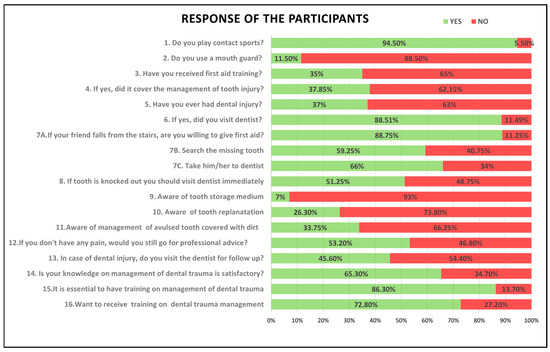
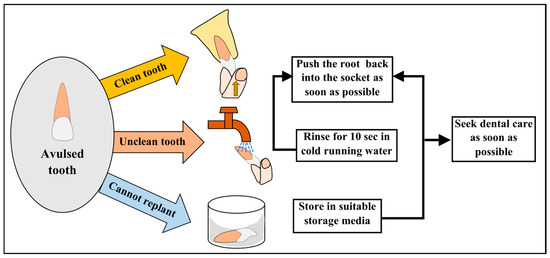
Background/Objectives: Traumatic dental injuries (TDIs), particularly avulsion, require immediate and appropriate first aid to ensure favorable outcomes. Adolescents are often the first responders during school or sports activities, yet their preparedness remains unclear. This study aimed to assess the knowledge, attitude, and awareness of adolescents regarding the emergency management of TDIs. Methods: A descriptive cross-sectional survey was conducted among 400 adolescents aged 15 to 18 years from four randomly selected colleges in Mangaluru, Karnataka. A structured, validated 16-item questionnaire assessed demographic characteristics and domains of knowledge (6 items), attitude (6 items), and awareness (6 items). Data was analyzed using descriptive statistics, chi-square tests, and one-way ANOVA. Results: The mean knowledge score was 2.50 ± 1.04 (95% CI: 2.40–2.60), indicating limited knowledge of dental trauma management; only 26.3% of participants recognized that avulsed permanent teeth can be replanted and 7% identified an appropriate storage medium. The mean attitude score was comparatively high (4.38 ± 1.12; 95% CI: 4.27–4.49), with 88.8% of students willing to assist an injured peer, reflecting a large attitude–knowledge discrepancy (Cohen’s d = 1.47). The mean awareness score was 2.24 ± 1.24 (95% CI: 2.12–2.36), indicating limited awareness of preventive practices, including low mouthguard use (11.5%). Shapiro–Wilk testing confirmed non-normal distribution of KAA scores (p < 0.05); accordingly, non-parametric analyses showed no significant differences across schools, academic streams, gender, or education level (Kruskal–Wallis and Mann–Whitney U tests; p > 0.05). Conclusions: Despite favorable attitudes toward assisting peers, adolescents demonstrated limited knowledge and awareness regarding the emergency management and prevention of traumatic dental injuries, particularly in tooth replantation, appropriate storage media, and mouthguard use, highlighting the need for targeted, school-based dental first-aid education programs. Full article
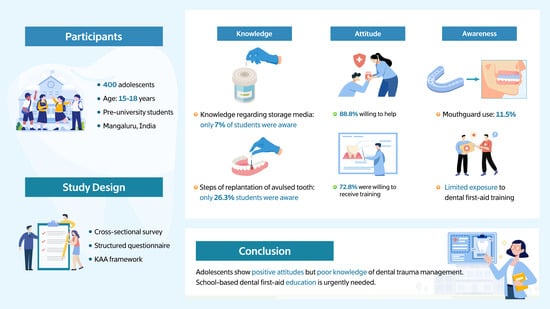
Show Figures

Graphical abstract

2022

Jump to: 2026

13 pages, 5039 KB  
Review
Root Fractures in the Primary Teeth and Their Management: A Scoping Review
by Enrico Spinas, Gianni Di Giorgio, Martina Salvatorina Murgia, Valentino Garau, Mara Pinna and Nicoletta Zerman
Dent. J. 2022, 10(5), 74; https://doi.org/10.3390/dj10050074 - 1 May 2022
Cited by 15 | Viewed by 7702
Abstract
(1) Background: Traumatic dental injuries constitute a major global health problem. Primary deciduous teeth of the upper frontal group are frequently affected by trauma, especially at an early age. It is important to treat primary traumatic injuries because early tooth loss can lead [...] Read more.
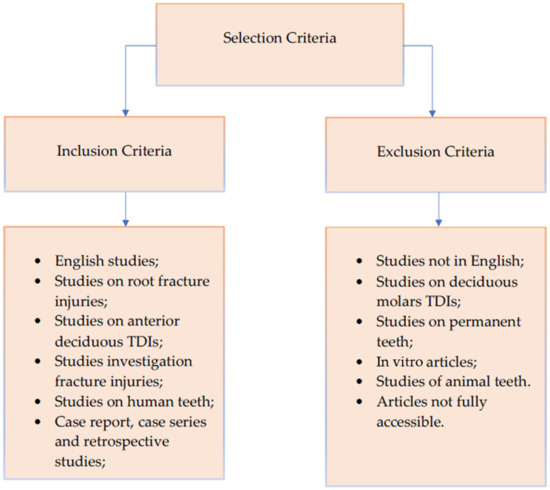
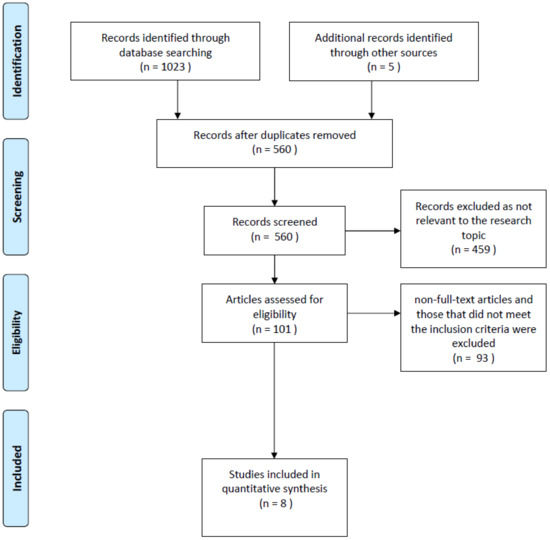
(1) Background: Traumatic dental injuries constitute a major global health problem. Primary deciduous teeth of the upper frontal group are frequently affected by trauma, especially at an early age. It is important to treat primary traumatic injuries because early tooth loss can lead to aesthetic and functional alterations. The most common injuries are extrusion, lateral luxation, and intrusion. Root fracture is a less common complication that can lead to tooth extraction if not properly diagnosed and managed. However, there are a lack of data regarding primary root fracture treatment. The literature was reviewed to study the current knowledge on the treatment of these injuries, and to propose an operative protocol based on the results obtained. (2) Methods: A literature search was performed on Web of Science, PubMed/MEDLINE, and SCOPUS. The research focused on the following features: age of the patient; localization of the root fracture and type of displacement suffered (intrusive, extrusive, or lateral); type of emergency treatment or diagnostic test performed and their compliance with IADT guidelines; follow-up duration. (2) Results: Only 8 articles fully met the inclusion criteria, with a total of 46 patients and 62 root fractures. Out of a total of 62 root fractures, regarding only upper incisors, the most common treatment was splinting (n = 39) for a period ranging from 3 weeks to 3 months (with an average of six weeks). No treatment was performed for 23 of the root fractures. The splinting performed in most of the included cases was semi-rigid, with the splint held in place using a composite resin material. An orthodontic splint using brackets and 0.5 mm stainless steel wire was used in only in one study. (4) Conclusions: We deduced that the root fracture of primary teeth is a rare traumatic dental injury that can cause numerous complications, such as eruptive problems in the permanent teeth. Correct radiological diagnosis, immediate repositioning and semi-rigid splinting could be conservative methods to prevent premature tooth loss in very young patients. Full article
Show Figures

Figure 1

Back to TopTop