Journal Description
International Journal of Topology
is an international, peer-reviewed, open access journal published quarterly online by MDPI. It focuses on all aspects of topology, including differential topology, algebraic topology, manifolds, and related applications. Its purpose is to provide a platform for the dissemination of research on the various subfields of topology, expand topology to a wider range of applications and, consequently, promote the development of the field.
- Open Access— free for readers, with article processing charges (APC) paid by authors or their institutions.
- Rapid Publication: first decisions in 18 days; acceptance to publication in 7 days (median values for MDPI journals in the first half of 2026).
- Recognition of Reviewers: Reviewers whose reports are timely and of high quality receive an APC discount voucher for a future publication in an MDPI journal. Become a reviewer.
- International Journal of Topology is a companion journal of Mathematics.
- Journal Cluster of Mathematics and Its Applications: AppliedMath, Axioms, Computation, Fractal and Fractional, Geometry, International Journal of Topology, Logics, Mathematics and Symmetry.
Latest Articles
Topological and Fractal Aspects of Particle States: A 4D Hydrodynamic KIFS Framework as an Effective Model for Point Particles
Int. J. Topol. 2026, 3(3), 20; https://doi.org/10.3390/ijt3030020 - 8 Sep 2026
Abstract
►
Show Figures
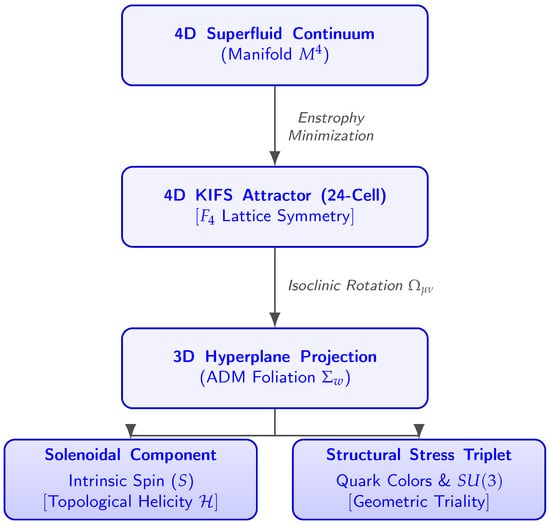
The Standard Model of particle physics has achieved unprecedented success in describing fundamental interactions through the formalism of Quantum Field Theory (QFT), where particles are treated as point-like excitations of underlying fields. In this paper, we introduce an alternative, highly elegant mathematical hypothesis:
[...] Read more.
The Standard Model of particle physics has achieved unprecedented success in describing fundamental interactions through the formalism of Quantum Field Theory (QFT), where particles are treated as point-like excitations of underlying fields. In this paper, we introduce an alternative, highly elegant mathematical hypothesis: an effective model that describes particle properties not as fundamental points but as 3D projections of complex topological defects originating in a 4D manifold. By applying the geometry of Kaleidoscopic Iterated Function Systems (KIFS) to a zero-viscosity hydrodynamic framework, we demonstrate a formal isomorphism between standard quantum numbers and 4D fractal attractors. This approach seeks not to replace established phenomenological interactions but rather to offer a complementary geometric lens—a “topological translation”—through which mass generation, spin, and localization can be visualized as emergent properties of higher-dimensional fluid mechanics.
Full article
Open AccessArticle
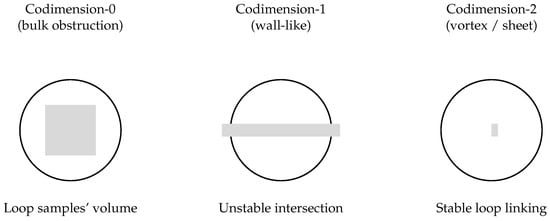
Primary Meridian Obstructions Under Admissible Reconstruction: A Local-to-Global Topological Framework for Codimension, Holonomy, and Persistence
by
Bin Li
Int. J. Topol. 2026, 3(3), 19; https://doi.org/10.3390/ijt3030019 - 27 Aug 2026
Abstract
►▼
Show Figures
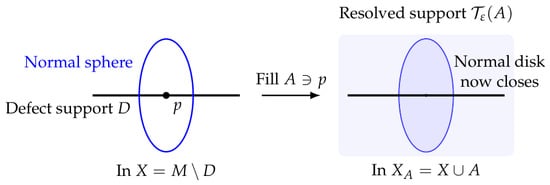
This paper organizes classical tools from complement topology into a local-to-global framework for primary meridian obstructions under admissible reconstruction. Let be a closed properly embedded submanifold of pure codimension c, and put .
[...] Read more.
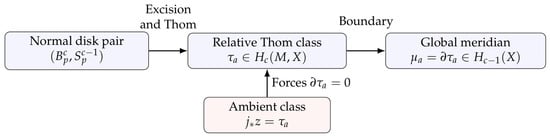
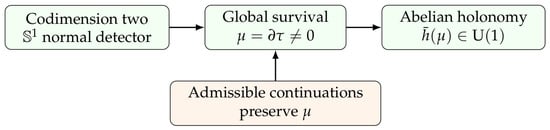
This paper organizes classical tools from complement topology into a local-to-global framework for primary meridian obstructions under admissible reconstruction. Let be a closed properly embedded submanifold of pure codimension c, and put . With coefficients for which the normal bundle is oriented, excision and the Thom isomorphism identify a relative fiber class for each component . The connecting morphism sends this class to the global meridian . Thus, the familiar sphere or loop in a local normal slice survives globally precisely when is not supplied by an ambient c-cycle. Nonvanishing implies that the normal linking sphere is not null-homotopic and gives the primary degree–codimension relation . Basepoint, orientation, disconnected-support, and nonorientable-normal-bundle issues are treated explicitly. A fixed-resolution tubular filling shows how a meridian can be killed when restoration of the defect center is admissible; under uniform tubular geometry, its support is controlled by the -volume of the affected support. In codimension two, the surviving class lies in , the abelianization of the fundamental group, and is therefore the topological input available to a homotopy-invariant phase read-out. Compatible characters retain their meridian value under admissible continuation maps. The aim is not to introduce a new complement invariant or general classification theorem, but to provide a rigorous, reusable synthesis that keeps local detection, global survival, character evaluation, and continuation hypotheses logically distinct.
Full article

Figure 1
Open AccessFeature PaperArticle
A Measure-Theoretic Sheaf Framework for Shape Analysis
by
Ainkaran Santhirasekaram
Int. J. Topol. 2026, 3(3), 18; https://doi.org/10.3390/ijt3030018 - 21 Aug 2026
Abstract
►▼
Show Figures
We develop a sheaf-theoretic framework for shape analysis of covered shapes, where measure is introduced only after the underlying local-to-global topological structure has been established. Starting from a finite cubical complex together with a finite admissible cover, we build a finite topological model
[...] Read more.
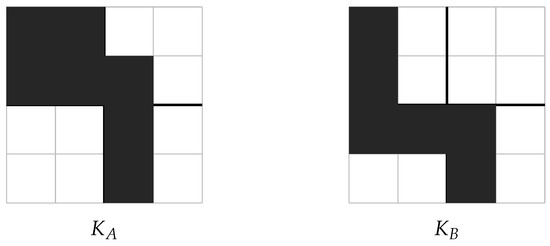
We develop a sheaf-theoretic framework for shape analysis of covered shapes, where measure is introduced only after the underlying local-to-global topological structure has been established. Starting from a finite cubical complex together with a finite admissible cover, we build a finite topological model from the overlap structure of the cover and define a component sheaf on this model. The local data of the sheaf records the connected pieces visible on individual patches, while the maps between them describe how these pieces fit together across overlaps. The resulting degree-zero sheaf cohomology recovers the connected components of the full shape by the standard descent of locally constant functions. We show that the isomorphism class of this sheaf is an invariant of covered shapes, that it strictly refines for a fixed labeled cover and can distinguish some shapes with identical full Betti vectors, although it does not determine higher Betti numbers in general, and that it behaves functorially under symmetries preserving the cover. For dyadic covers, we distinguish the overlapping closed cover used by the sheaf from a paired half-open measurable partition, investigate measurable refinements, introduce monotone notions of local complexity under corrected refinement hypotheses, construct canonical sheaf-induced measures on both the index set and the ambient domain, and establish convergence and localization results for regular closed sets under pixel refinement. The sheaf-theoretic axiomatization therefore offers two complementary benefits: topologically, it provides a finite-space and cohomological invariant of covered shapes; measure-theoretically, it gives a principled hierarchy of quantitative summaries built only after the local gluing structure has been preserved.
Full article

Figure 1
Open AccessArticle
Finite-Horizon Persistence Under Declared Constraints: Survival Domains and a Canonical Order-Theoretic Representation
by
Patrick Bini
Int. J. Topol. 2026, 3(3), 17; https://doi.org/10.3390/ijt3030017 - 12 Aug 2026
Abstract
Many natural and engineered systems evolve under constraints that restrict the set of admissible states. Classical frameworks study invariant sets, viability regions, survival probabilities, and exit-time events, while the explicit treatment of threshold-defined admissible subsets induced by sampled finite-horizon persistence is not usually
[...] Read more.
Many natural and engineered systems evolve under constraints that restrict the set of admissible states. Classical frameworks study invariant sets, viability regions, survival probabilities, and exit-time events, while the explicit treatment of threshold-defined admissible subsets induced by sampled finite-horizon persistence is not usually isolated as a primary state-space object. This paper formulates a finite-horizon framework for Persistence Under Declared Constraints (PSUC). For a fixed constraint set, sampling step, persistence horizon, and tolerance level, the associated survival domain is the set of initial conditions whose sampled trajectories remain inside the declared constraint set with probability of at least . Under explicit regularity assumptions, survival domains are closed superlevel sets of the persistence field and form a nested filtration as the persistence horizon increases. This filtration admits a canonical intrinsic representation through a maximal admissible sampled-horizon field whose sampled superlevel sets recover it exactly. The same field also induces a canonical admissibility preorder; after quotienting by horizon-indistinguishability, this yields a partial order and its associated Alexandrov topology, in which the sampled survival filtration is represented as an upper-set filtration. The Alexandrov construction itself is classical; the contribution lies in the canonical order induced by the sampled admissibility-depth field and in the resulting canonical order-theoretic representation of the filtration. A secondary scalar ordering is also obtained for any lower-bounded auxiliary scalar function. Under an additional continuity assumption, the framework further yields boundary localization at the threshold level and an inheritance relation for connected components along the filtration. Finally, the paper shows that sampled survival domains need not coincide with continuous-time survival sets, thereby clarifying the intrinsically protocol-dependent nature of the object studied. The contribution is therefore a restricted but explicit analysis of threshold-defined admissible-state filtrations induced by sampled finite-horizon persistence, together with a canonical order-theoretic representation of the same filtration, formulated in a way that remains compatible with existing work on viability, stochastic survival, and exit-time analysis.
Full article
Open AccessArticle
Metrization of Polygonal b-Metric Spaces and Some Fixed Point in Extended Polygonal b-Metric Spaces with Applications
by
Zahir Mouhoubi, Souheib Merad, Faycel Merghadi and Chaabane Benatmane
Int. J. Topol. 2026, 3(3), 16; https://doi.org/10.3390/ijt3030016 - 23 Jul 2026
Abstract
We establish a metrization result for some -metric spaces, extending a result recently established for rectangular b-metric spaces. Furthermore, we introduce the notion of an extended polygonal b-metric space (or -metric space),
[...] Read more.
We establish a metrization result for some -metric spaces, extending a result recently established for rectangular b-metric spaces. Furthermore, we introduce the notion of an extended polygonal b-metric space (or -metric space), which unifies and generalizes several classes of spaces, including metric spaces, rectangular metric spaces, b-metric spaces, rectangular b-metric spaces, polygonal metric spaces, and -metric spaces. Some fixed-point results in -metric spaces are established under the weak orbital completeness condition in the framework of the Banach contraction principle and for generalized expansive Hardy-Rogers-type mappings. An a priori error estimate for the iterative process is obtained in both -metric and -metric spaces. We also establish the Ulam-Hyers stability of fixed-point equations in both -metric and -metric spaces. Several examples are provided, and applications to certain types of integral equations and initial value problems are presented, illustrating the applicability and effectiveness of the obtained results.
Full article
Open AccessFeature PaperArticle
Stability and Elasticity of Topologically Expanded Schwarzite P-Surface Nets
by
Alexey V. Ignatchenko, Degraj Suberi and Charlie L. Illingworth
Int. J. Topol. 2026, 3(3), 15; https://doi.org/10.3390/ijt3030015 - 17 Jul 2026
Abstract
►▼
Show Figures
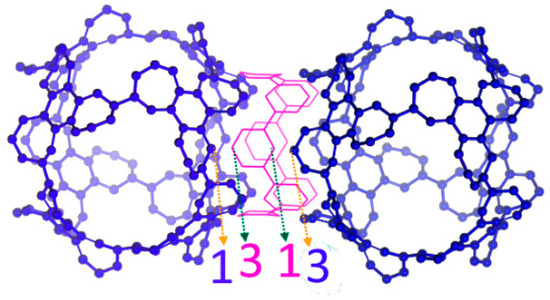
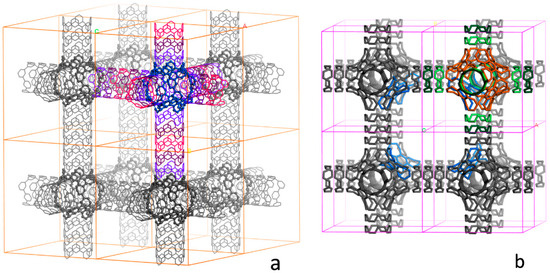
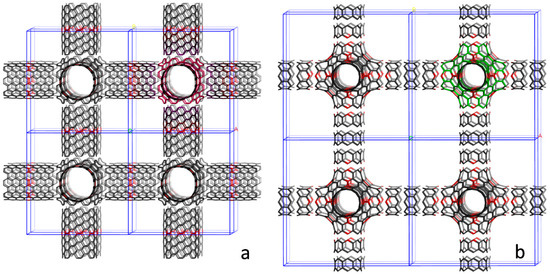
Schwarzites are negatively curved sp2-carbon frameworks that can be described as realizations of triply periodic minimal surface (TPMS) nets. This work examines topologically expanded Schwarzite networks derived from P-surface tilings by isolated heptagons, in which neighboring cages are connected via inserted
[...] Read more.
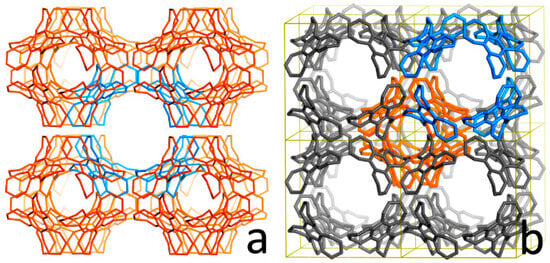
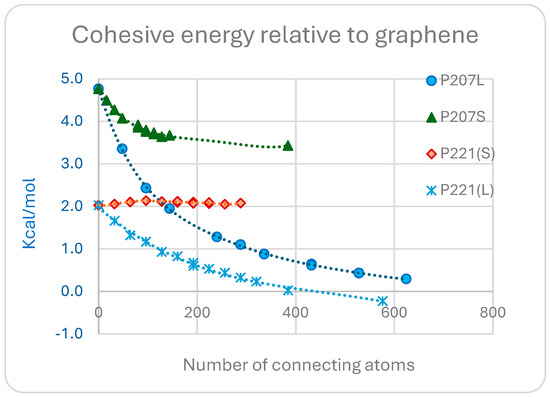
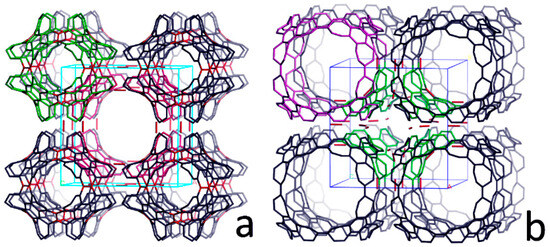
Schwarzites are negatively curved sp2-carbon frameworks that can be described as realizations of triply periodic minimal surface (TPMS) nets. This work examines topologically expanded Schwarzite networks derived from P-surface tilings by isolated heptagons, in which neighboring cages are connected via inserted carbon nanotubes rather than through direct links present in the parent Schwarzite. The study focuses on how such topological modifications influence network stability, density, and mechanical response. Density functional theory calculations show that nanotube-mediated expansion systematically reduces framework density while redistributing curvature within the network. A key topological distinction arises between structures formed by separating large cages and those formed by separating small cages. Separation of large cages is equivalent to inserting nanotube segments into adjacent small cages, increasing their effective size and relieving curvature-induced strain, thereby enhancing energetic stability. In contrast, separation of small cages preserves their topology and provides only limited strain relief. Cohesive energy trends correlate with the hexagon-to-heptagon ratio, approaching the graphene limit as topological expansion increases. Mechanical properties follow the same hierarchy, with strain-relieved networks displaying reduced stiffness and greater compliance. These findings indicate that the properties of Schwarzites are governed primarily by topological connectivity and curvature distribution rather than geometric scaling alone, establishing general principles for tuning stability and elasticity in negatively curved carbon networks through controlled topological expansion.
Full article

Figure 1
Open AccessArticle
Switching Topological States via Uniaxial Strain in 2D Materials
by
Joshua J. Sanchez, Raagya Arora, Daniel Bennett, Daniel T. Larson, Efthimios Kaxiras and Riccardo Comin
Int. J. Topol. 2026, 3(3), 14; https://doi.org/10.3390/ijt3030014 - 1 Jul 2026
Abstract
►▼
Show Figures
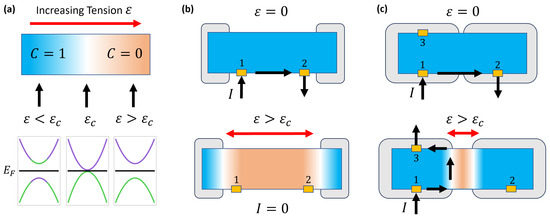
In topological materials, dissipationless edge currents are protected against local defect scattering by the bulk inverted band structure and band gap. We propose that large uniaxial strain can effectively switch a 2D Chern insulator to a topologically trivial state. Further, we suggest that
[...] Read more.
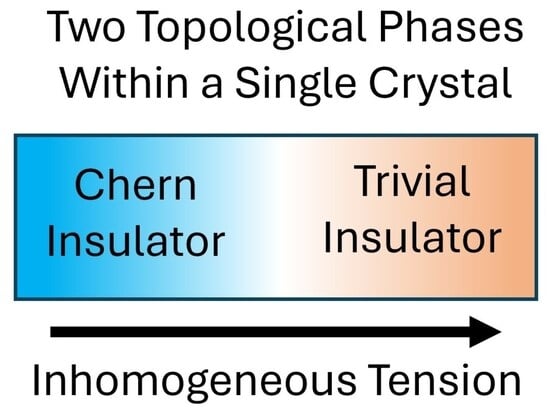
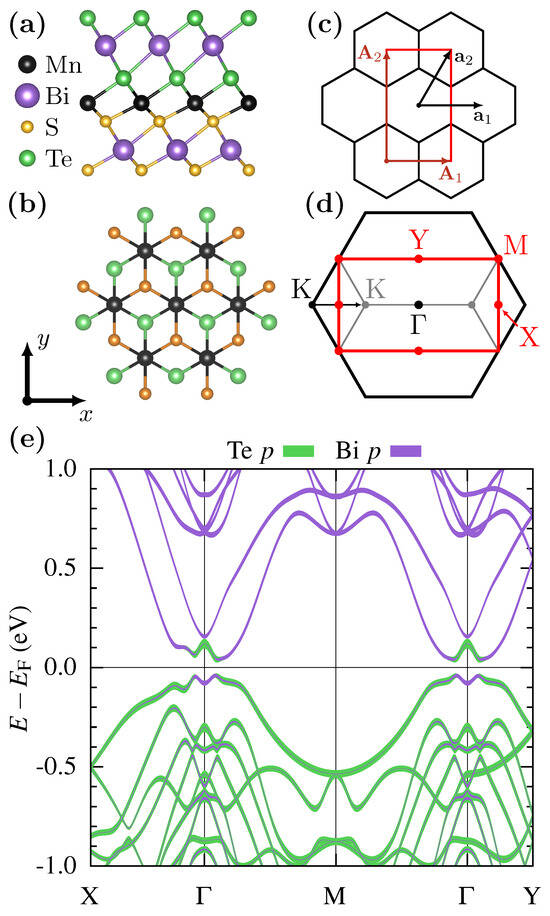
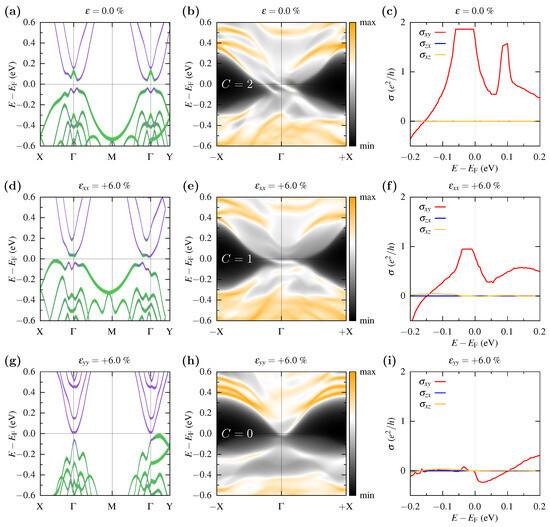
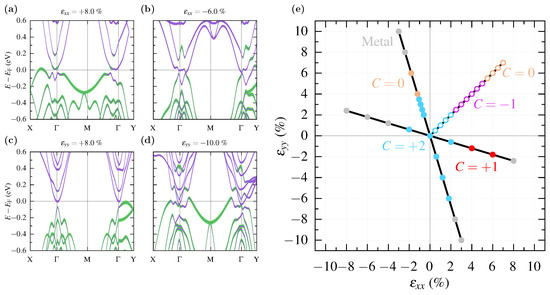
In topological materials, dissipationless edge currents are protected against local defect scattering by the bulk inverted band structure and band gap. We propose that large uniaxial strain can effectively switch a 2D Chern insulator to a topologically trivial state. Further, we suggest that the boundary between strained and unstrained regions of a sample can act as a new edge for dissipationless current flow. Using density functional theory (DFT) calculations we demonstrate the strain-tunability of the monolayer band structure and the switching of the Chern number. We combine uniaxial and biaxial strain results to map out the strain-tuned topological phase diagram.
Full article

Graphical abstract
Open AccessFeature PaperArticle
Informational Holonomy Curvature and Its Discrete-to-Continuous Convergence
by
David Gutierrez Ule
Int. J. Topol. 2026, 3(2), 13; https://doi.org/10.3390/ijt3020013 - 18 Jun 2026
Abstract
We introduce a notion of curvature based on informational holonomy. Let be a smooth Riemannian manifold and let be a bundle of state spaces equipped fibrewise with a smooth divergence
[...] Read more.
We introduce a notion of curvature based on informational holonomy. Let be a smooth Riemannian manifold and let be a bundle of state spaces equipped fibrewise with a smooth divergence inducing an information metric . Assuming a connection on compatible with this fibrewise information geometry, we measure the deviation of holonomy around small geodesic triangles by transporting a reference state and comparing it to its image via the induced informational distance . Normalizing the resulting distance defect by the geometric area yields a continuous informational holonomy (sectional) curvature . We prove that this limit exists for all and equals the norm of a vector depending linearly on the curvature of the connection along . In geometric models induced from the Levi–Civita connection via an isometric representation, becomes a scalar invariant of and, on spaces of constant sectional curvature, reduces to a constant multiple of . On the discrete side, we consider quasi-uniform sampling graphs whose edges carry channels approximating parallel transport. Discrete triangle holonomies define a curvature estimator, and under explicit sampling, area-approximation, and channel-consistency assumptions, we establish a discrete-to-continuum convergence theorem with a quantitative error bound controlled by the sampling scale.
Full article
Open AccessFeature PaperArticle
Fiber Bundle Learning: A Topological Framework for Classification Using Homology and Discrete Connections
by
Arturo Tozzi
Int. J. Topol. 2026, 3(2), 12; https://doi.org/10.3390/ijt3020012 - 17 Jun 2026
Abstract
►▼
Show Figures
Many machine-learning tasks involve structured data whose geometry, local feature distributions, and global organization interact in ways that are not well captured by existing methods based on vectorization, graph metrics, or homological signatures. We introduce Fiber Bundle Learning (FBL), a topological framework that
[...] Read more.
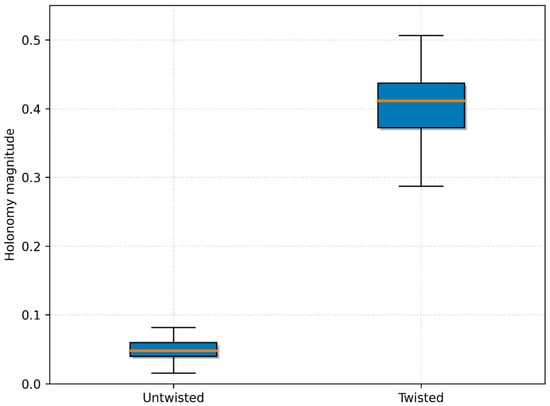
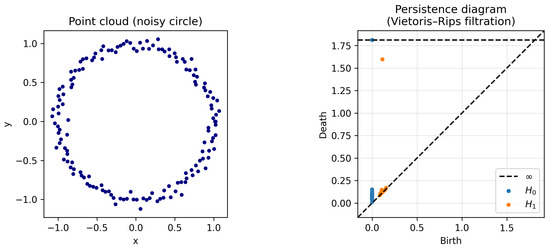
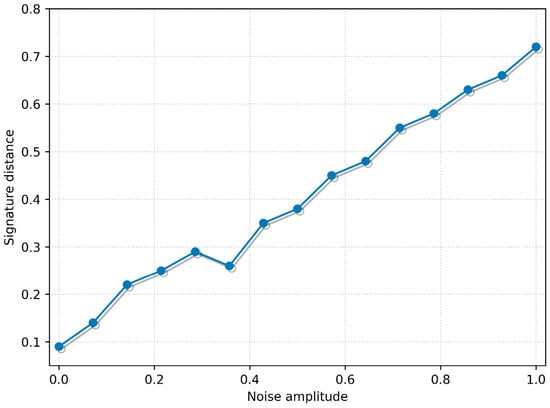
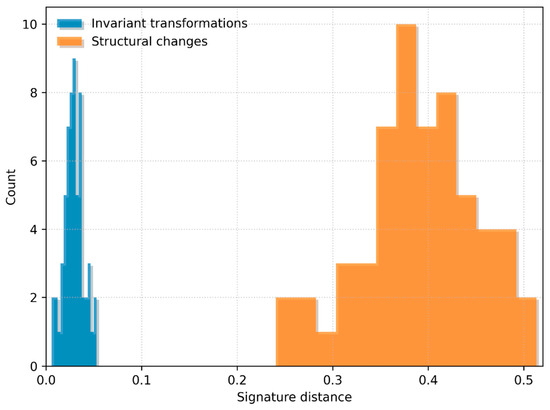
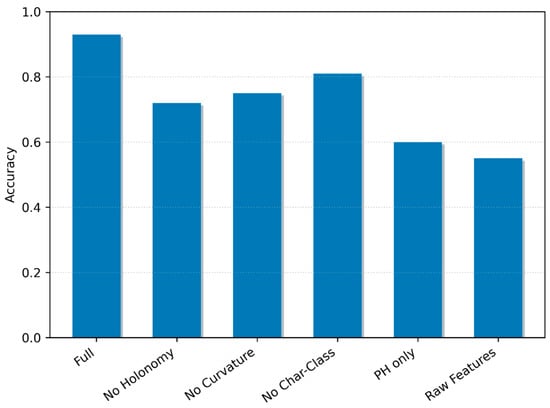
Many machine-learning tasks involve structured data whose geometry, local feature distributions, and global organization interact in ways that are not well captured by existing methods based on vectorization, graph metrics, or homological signatures. We introduce Fiber Bundle Learning (FBL), a topological framework that represents each data sample as a discrete fiber bundle and extracts a classification signature combining persistent homology, local feature geometry, and gluing structure. FBL builds a base space from the coarse geometry of each object, models local feature patches as fibers, and estimates transition maps between neighboring fibers to construct a discrete connection. From this representation, FBL computes a set of invariants: persistent homology of the base, fibers, and total space; holonomy obtained by transporting fiber states along cycles; curvature-like quantities measuring transition inconsistency; and discrete analogues of characteristic classes. These components are assembled into a fixed-length feature vector that can be used with any standard classifier. We show that FBL yields a signature with three desirable theoretical properties: stability under perturbations of geometry and local features, invariance under isometries and global fiber reparameterizations, and robustness to sampling noise. Our synthetic experiments show that FBL distinguishes twisted from untwisted bundles with identical homology, a distinction classical topological methods fail to capture. Additional tests quantify the system’s resistance to noise, its invariance to geometric transformations, and the contribution of each signature component. Taken together, our results indicate that representing data through fiber bundle structure may provide an effective tool for classifying complex, multi-level objects.
Full article

Figure 1

Open AccessFeature PaperArticle
Topological Analysis of Composite Ageing via Dual Anisotropic Filtrations and Persistent Homology
by
Hélène Canot, Philippe Durand, Emmanuel Frénod, Camille Gillet and Valérie Nassiet
Int. J. Topol. 2026, 3(2), 11; https://doi.org/10.3390/ijt3020011 - 3 Jun 2026
Abstract
►▼
Show Figures
We propose a topological data analysis framework for the study of damage evolution in anisotropic composite materials based on scalar filtrations defined on cubical complexes. Two complementary anisotropic filtrations are constructed from the structure tensor: a fibre-oriented filtration f1, capturing directional coherence, and
[...] Read more.
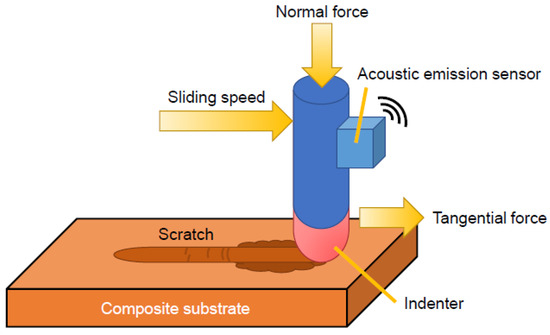
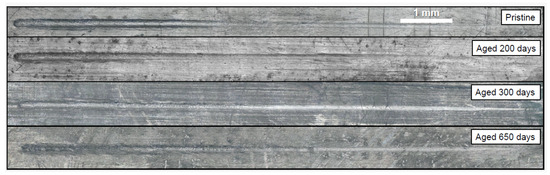
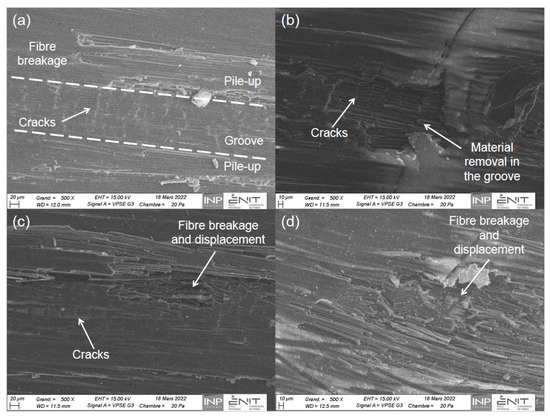
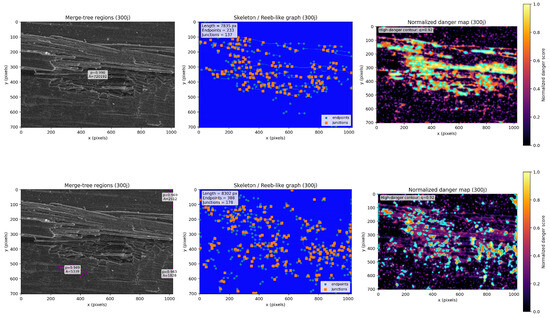
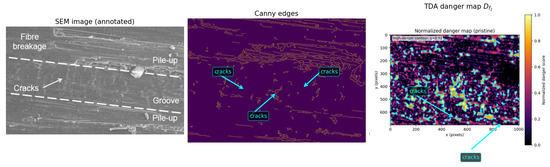
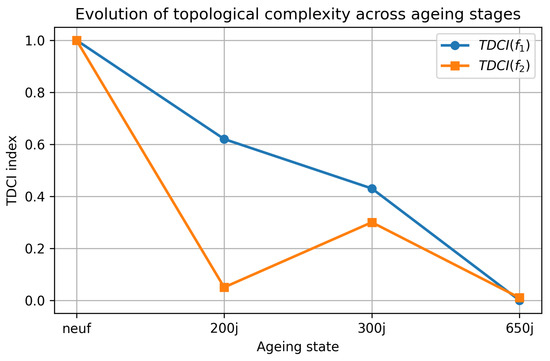
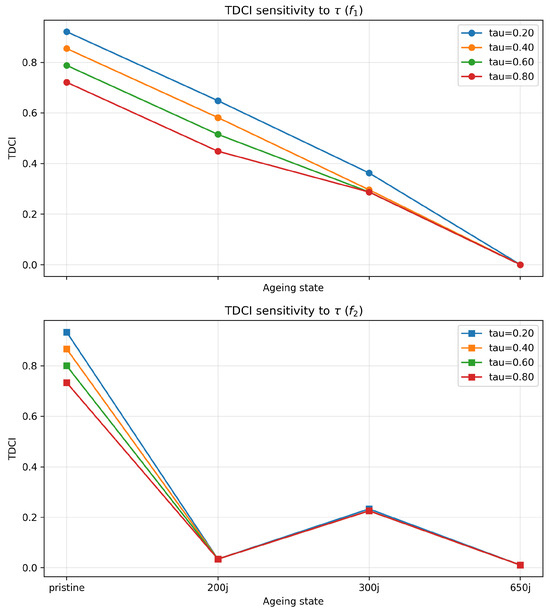
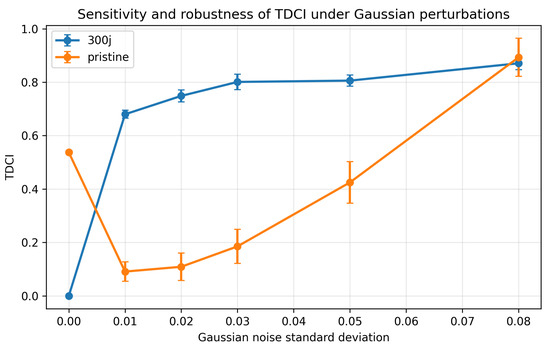
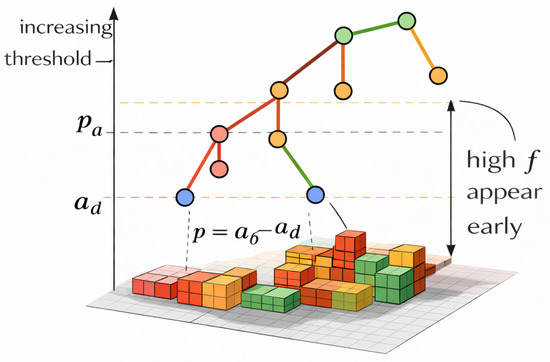
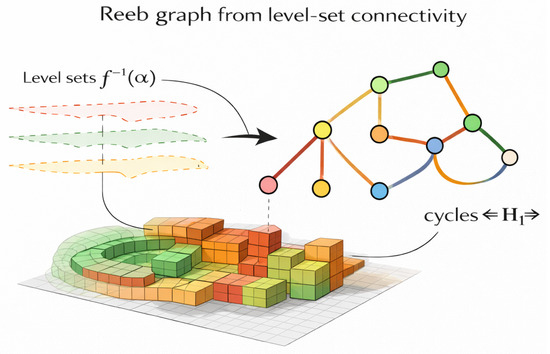
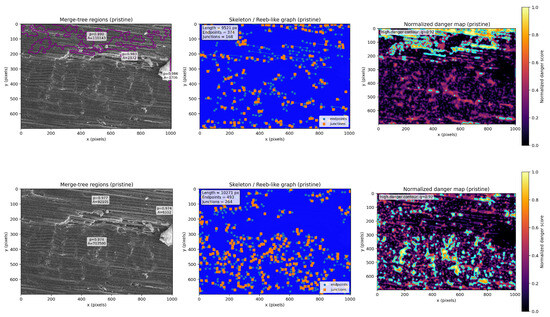
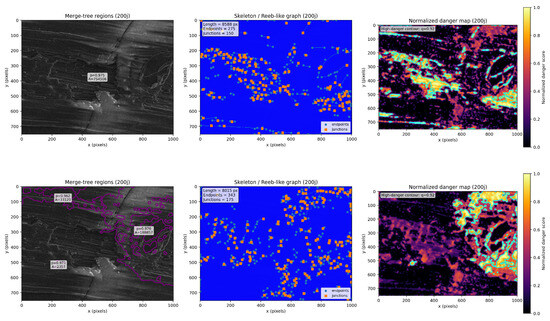
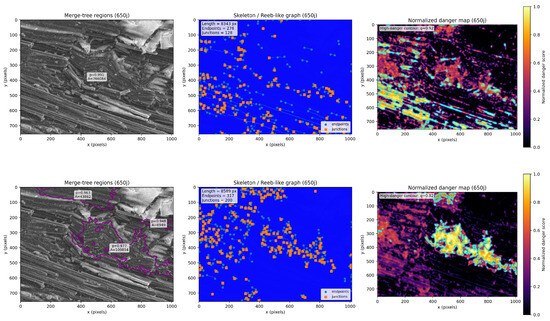
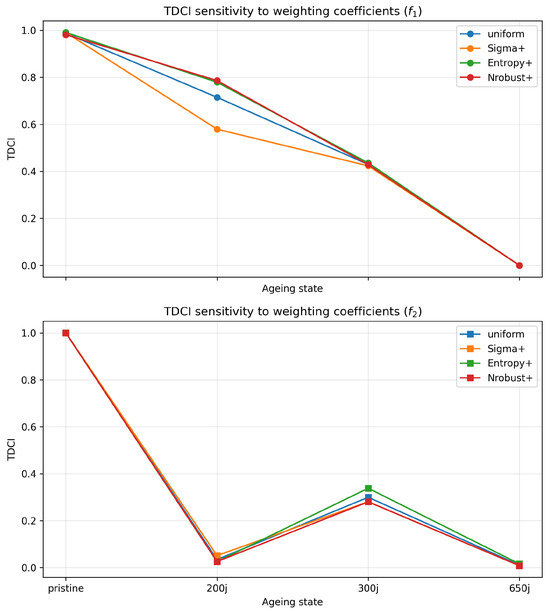
We propose a topological data analysis framework for the study of damage evolution in anisotropic composite materials based on scalar filtrations defined on cubical complexes. Two complementary anisotropic filtrations are constructed from the structure tensor: a fibre-oriented filtration f1, capturing directional coherence, and a crack-oriented filtration f2, sensitive to isotropic and weakly oriented structures. Zero-dimensional persistent homology is analysed through merge trees built from the superlevel-set filtration via the transformation , providing a hierarchical representation of connected components. Higher-order connectivity is described using skeleton-based Reeb-like graphs. From these constructions, we derive spatial and global descriptors, including a topological danger map and a Topological Damage Complexity Index (TDCI) based on one-dimensional persistent homology. The behaviour of the TDCI is examined with respect to variations in its parameters and to image perturbations, showing consistent trends across the considered configurations. The results highlight complementary structural behaviours captured by the two filtrations and show a coherent correspondence with observed patterns. Overall, the proposed framework provides a mathematically grounded description of structural organisation. It is intended as an exploratory approach, and further work is needed to clarify its relationship with the underlying physical damage mechanisms.
Full article

Figure 1
Open AccessFeature PaperArticle
Minimizing Interruptions in Flow Redirection to Mitigate Link Flooding Attacks in SDN-Based Datacenters
by
Rajorshi Biswas, Jie Wu, Yang Chen and Madhurima Ray
Int. J. Topol. 2026, 3(2), 10; https://doi.org/10.3390/ijt3020010 - 23 May 2026
Abstract
►▼
Show Figures
Link congestion resulting from routine traffic patterns or malicious link flooding attacks (LFAs) poses a significant challenge in datacenter environments. The growing adoption of software-defined networking (SDN) offers a flexible framework for dynamic network reconfiguration, making it a promising approach for mitigating LFAs.
[...] Read more.
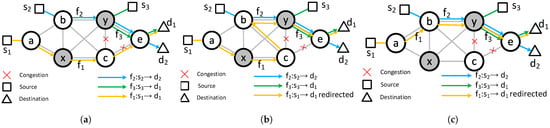
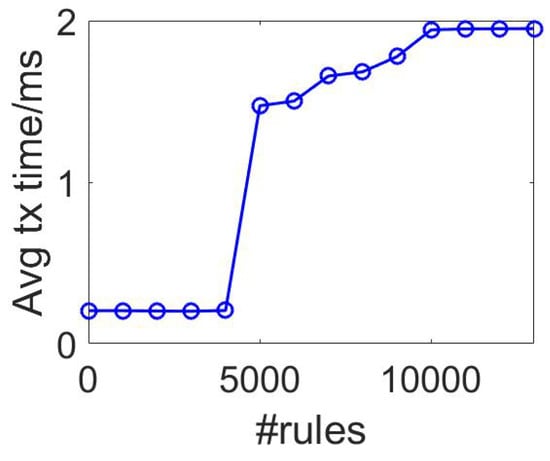
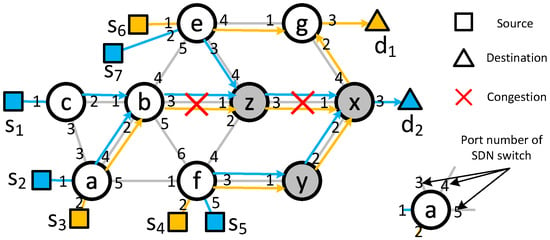
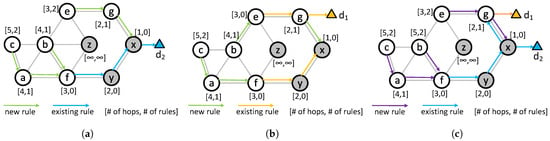
Link congestion resulting from routine traffic patterns or malicious link flooding attacks (LFAs) poses a significant challenge in datacenter environments. The growing adoption of software-defined networking (SDN) offers a flexible framework for dynamic network reconfiguration, making it a promising approach for mitigating LFAs. Traffic redirection in SDN can follow either the shortest alternative path or a path that minimizes the number of rule modifications. The shortest alternative path sometimes yields a high number of changes in rules. As SDN switches are constrained by limited rule storage, a high number of rules may result in slow processing of the packet forwarding. Excessive rule updates can also degrade performance and introduce interruptions while the rules are being updated. This study focuses on minimizing rule changes when rerouting traffic away from congested links. We formulate two optimization problems aimed at reducing rule modifications during redirection. The first addresses a congested link and a specific flow, for which we propose solutions based on Dijkstra’s algorithm. The second extends to scenarios involving multiple congested links, introducing flow grouping and enhanced rule-merging strategies. To validate our approach, we conduct comprehensive simulations and real-world experiments within a datacenter setting.
Full article

Figure 1

Open AccessFeature PaperArticle
Ontology Neural Network and ORTSF: A Framework for Topological Reasoning and Delay-Robust Control
by
Jaehong Oh
Int. J. Topol. 2026, 3(2), 9; https://doi.org/10.3390/ijt3020009 - 12 May 2026
Abstract
The advancement of autonomous robotic systems has led to significant capabilities in perception, localization, mapping, and control, yet a critical challenge remains in representing and preserving relational semantics, contextual reasoning, and cognitive transparency essential for collaboration in dynamic, human-centric environments. This paper introduces
[...] Read more.
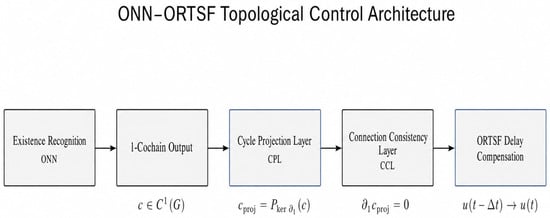
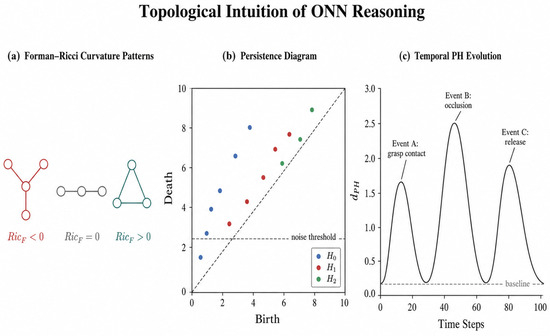
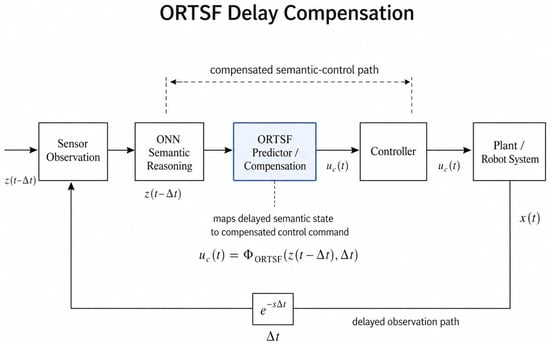
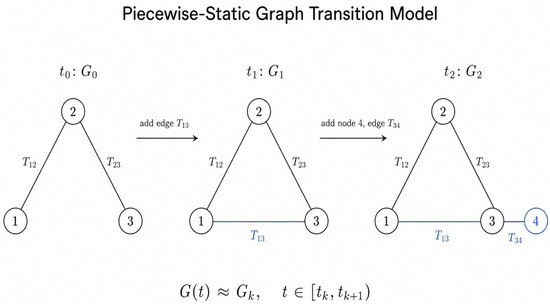
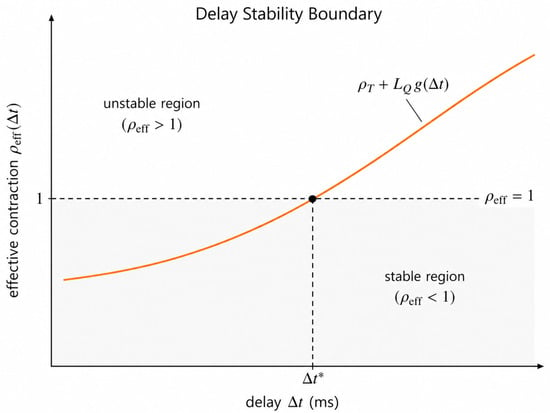
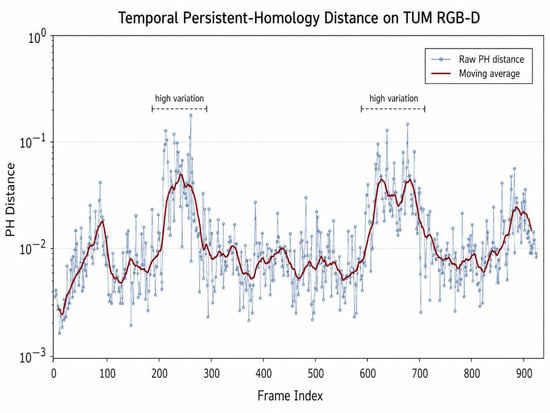
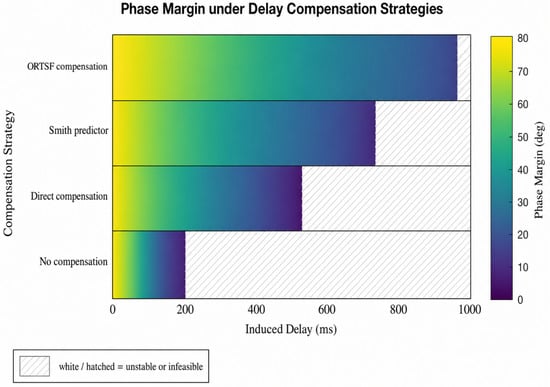
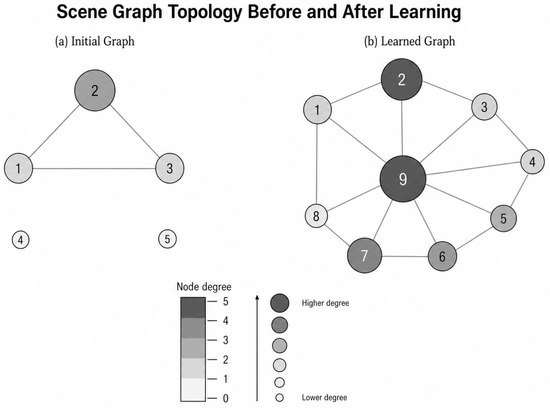
The advancement of autonomous robotic systems has led to significant capabilities in perception, localization, mapping, and control, yet a critical challenge remains in representing and preserving relational semantics, contextual reasoning, and cognitive transparency essential for collaboration in dynamic, human-centric environments. This paper introduces a unified architecture comprising the Ontology Neural Network (ONN) and the Ontological Real-Time Semantic Fabric (ORTSF) to address this challenge. The ONN formalizes relational semantic reasoning as a dynamic topological process by embedding Forman–Ricci curvature, persistent homology, and semantic tensor structures within a unified loss formulation, aiming to maintain relational integrity as scenes evolve. Building upon ONN, the ORTSF transforms reasoning traces into actionable control commands while compensating for system delays through predictive operators designed to preserve phase margins. Theoretical analysis and extensive simulations demonstrate that ORTSF maintains designed phase margins, offering advantages over classical delay compensation methods. Empirical studies indicate the framework’s effectiveness in unifying semantic cognition and robust control, providing a mathematically principled solution for cognitive robotics.
Full article
(This article belongs to the Topic Topological, Quantum, and Molecular Information Approaches to Computation and Intelligence)
►▼
Show Figures

Figure 1
Open AccessArticle
Topological Classification of Admissible Reconstruction Operations
by
Bin Li
Int. J. Topol. 2026, 3(2), 8; https://doi.org/10.3390/ijt3020008 - 21 Apr 2026
Abstract
►▼
Show Figures
We develop a topological classification of admissible reconstruction operations in generative systems where extended structure is built through repeated local extension subject to compatibility constraints. Reconstruction is formalized as a feasibility-governed process rather than a dynamical or metric one, with admissibility determined by
[...] Read more.
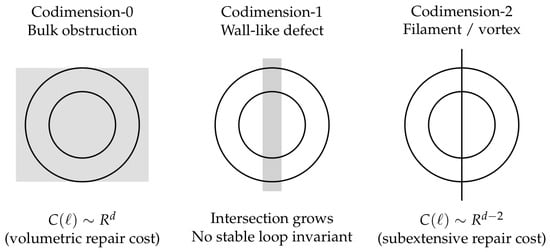
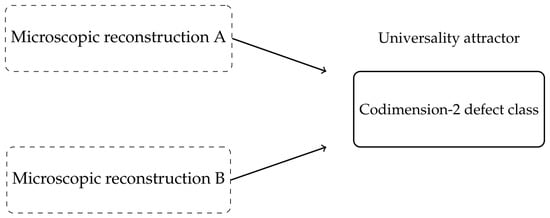
We develop a topological classification of admissible reconstruction operations in generative systems where extended structure is built through repeated local extension subject to compatibility constraints. Reconstruction is formalized as a feasibility-governed process rather than a dynamical or metric one, with admissibility determined by the accumulation of obstruction under composition. Using loop diagnostics, we identify global incompatibilities that are invisible to local extension rules but become unavoidable under closed composition. Under mild and realization-independent assumptions, including indefinite continuation and finite interface capacity, we show that persistent nontrivial obstruction is possible only when it is supported on codimension-2 subsets of the reconstructed domain. This result induces a small number of topological universality classes distinguished by the existence and stability of loop-detectable obstruction. The framework is model-agnostic and applies equally to discrete, combinatorial, and continuum reconstructions, providing a topological explanation for the ubiquity of codimension-2 defects in generative systems.
Full article

Figure 1
Open AccessFeature PaperArticle
Best Proximity Points for Geraghty-Type Non-Self Mappings
by
Fatemeh Fogh and Sara Behnamian
Int. J. Topol. 2026, 3(2), 7; https://doi.org/10.3390/ijt3020007 - 1 Apr 2026
Cited by 1
Abstract
We study Geraghty-type non-self mappings within the framework of best proximity point theory. By introducing auxiliary functions with subsequential convergence, we establish general conditions ensuring the existence and uniqueness of best proximity points. Our results extend and unify earlier work on proximal and
[...] Read more.
We study Geraghty-type non-self mappings within the framework of best proximity point theory. By introducing auxiliary functions with subsequential convergence, we establish general conditions ensuring the existence and uniqueness of best proximity points. Our results extend and unify earlier work on proximal and Kannan-type contractions under a Geraghty setting, and provide counterexamples showing that the auxiliary assumptions are essential. As an illustration, we construct an explicit non-self alignment mapping on subsets of for which all hypotheses can be verified and the unique best proximity point, as well as the convergence of the associated proximal iteration, can be computed in closed form.
Full article
Open AccessFeature PaperArticle
Anisotropic Shear Metrics for Persistent Homology and Their Application to Convective Systems
by
Hélène Canot, Philippe Durand and Emmanuel Frenod
Int. J. Topol. 2026, 3(1), 6; https://doi.org/10.3390/ijt3010006 - 6 Mar 2026
Cited by 1
Abstract
►▼
Show Figures
Vertical wind shear plays a crucial role in the organization and persistence of mesoscale convective systems, yet its geometrical and topological effects remain challenging to quantify. In this study, we introduce a shear-induced anisotropic metric, denoted , which embeds the direction
[...] Read more.
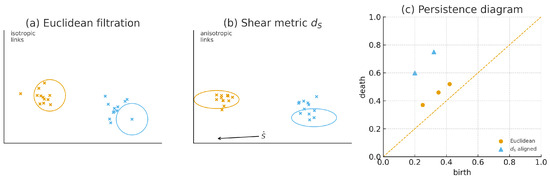
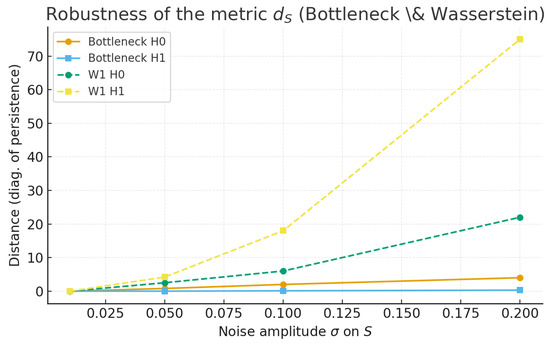
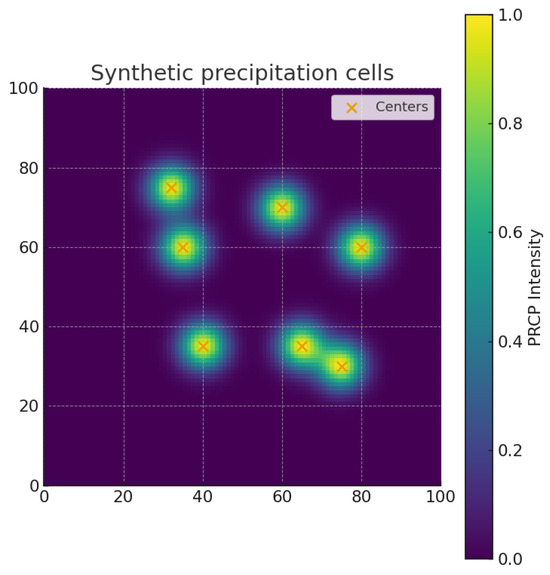
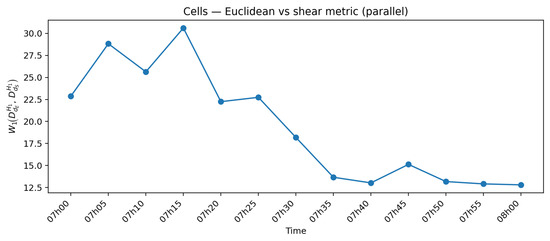
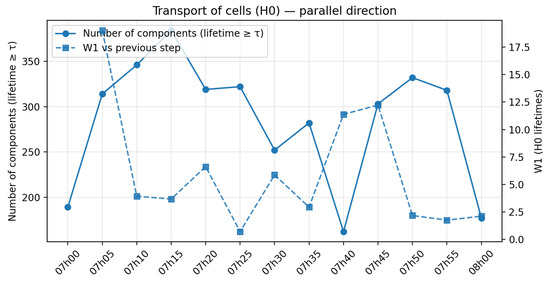
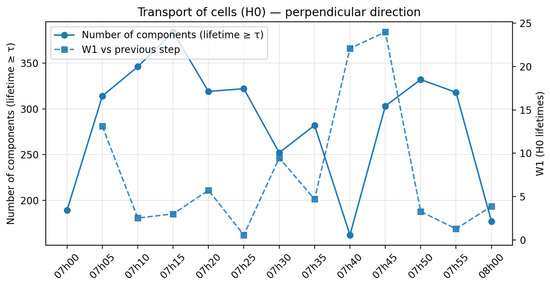
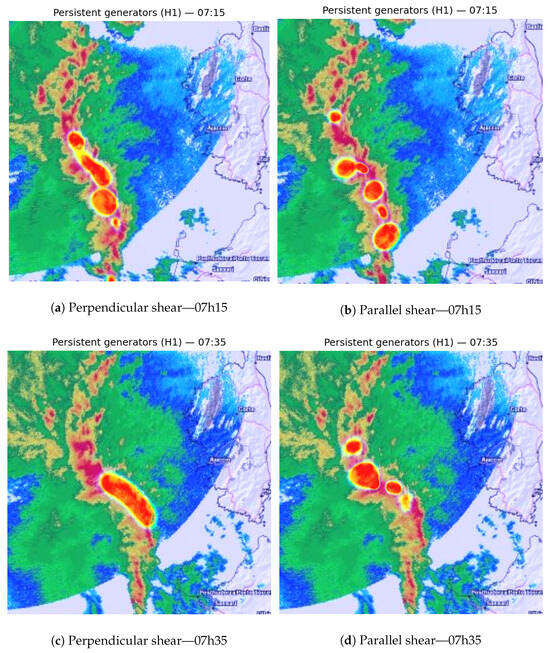
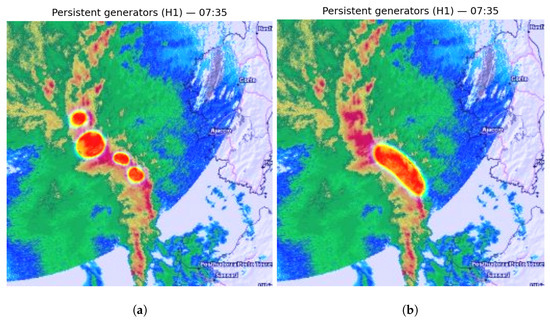
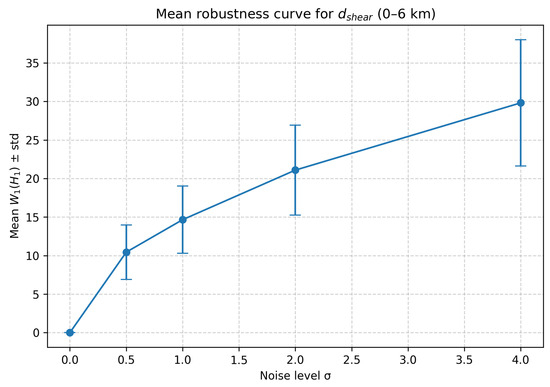
Vertical wind shear plays a crucial role in the organization and persistence of mesoscale convective systems, yet its geometrical and topological effects remain challenging to quantify. In this study, we introduce a shear-induced anisotropic metric, denoted , which embeds the direction and magnitude of environmental wind shear directly into the framework of persistent homology. The metric deforms the ambient geometry by weighting distances differently along and across the shear direction, enabling topological descriptors to respond dynamically to the flow environment. We establish the analytical properties of , and demonstrate its compatibility with Vietoris–Rips filtrations. The method is applied to the Corsican bow–echo event of 18 August 2022, where shear vectors are derived from ERA5 reanalysis data. Two complementary topological analyses are performed: a transport analysis on using Wasserstein distances, and a structural analysis on persistent generators under parallel and perpendicular shear metrics. The results reveal distinct topological evolutions associated with different shear orientations, highlighting the sensitivity of persistent homology to shear-induced deformation. Overall, the framework provides a mathematically consistent bridge between dynamical meteorology and topological data analysis, extending persistent homology to anisotropic metric spaces.
Full article

Figure 1

Open AccessArticle
The Realization of 3D Topological Spaces Branched over Graphs
by
Christopher L. Duston
Int. J. Topol. 2026, 3(1), 5; https://doi.org/10.3390/ijt3010005 - 4 Mar 2026
Abstract
►▼
Show Figures
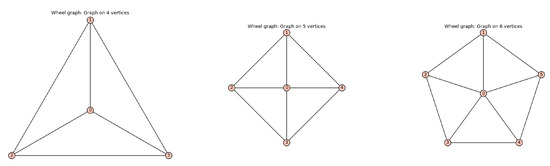
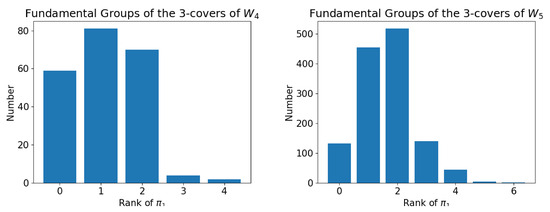
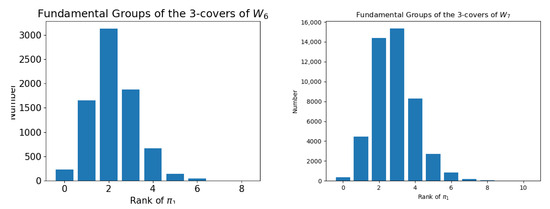
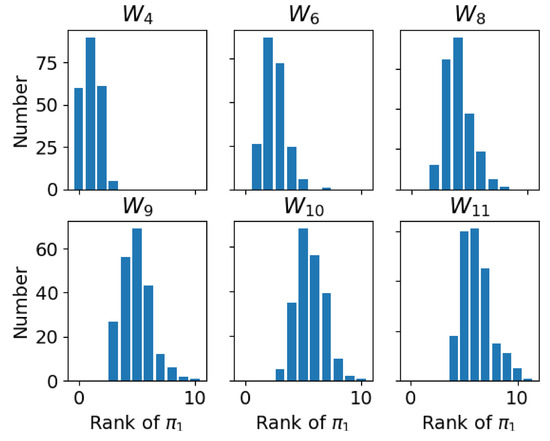
In this paper we present an implementation of a computer algorithm that automatically determines the topological structure of spacetime, using a branched covering space representation. This algorithm is applied to a few simple examples in dimension 3, and a complete set of the
[...] Read more.
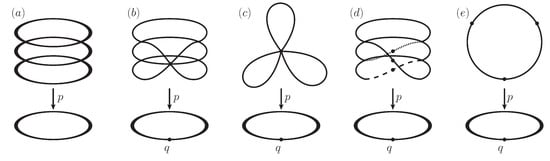
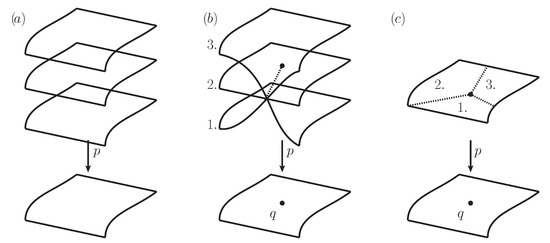
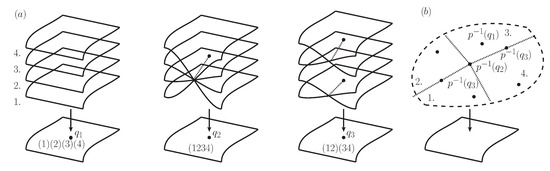
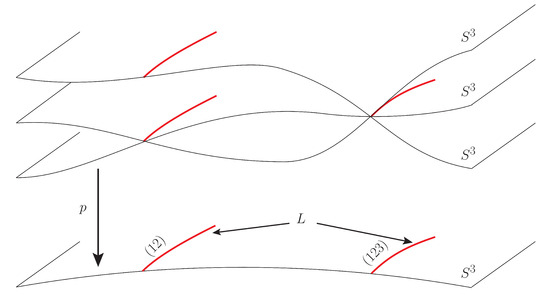
In this paper we present an implementation of a computer algorithm that automatically determines the topological structure of spacetime, using a branched covering space representation. This algorithm is applied to a few simple examples in dimension 3, and a complete set of the fundamental groups realized over several graphs is found. We also include some new visualizations of the branched covering construction, in order to aid and clarify the understanding of how these structures can be used in quantum gravity to realize the topological nature of the spacetime foam.
Full article

Figure 1
Open AccessFeature PaperArticle
A Formula for the Euler Characteristic of the Fiber Product of Morse Functions
by
Yasuhiko Kamiyama
Int. J. Topol. 2026, 3(1), 4; https://doi.org/10.3390/ijt3010004 - 9 Feb 2026
Cited by 1
Abstract
Let be a Morse function on a connected closed manifold X. We denote by the fiber product of two copies of . For Morse functions and
[...] Read more.
Let be a Morse function on a connected closed manifold X. We denote by the fiber product of two copies of . For Morse functions and , we define the function by . The purpose of this paper is twofold: Firstly, we study the sufficient condition for which holds, where denotes the Euler characteristic. Secondly, for the case that f is the well-known Morse function on , we determine .
Full article
Open AccessArticle
Topological Contextuality and Quantum Representations
by
Tzu-Miao Chou
Int. J. Topol. 2026, 3(1), 3; https://doi.org/10.3390/ijt3010003 - 2 Feb 2026
Abstract
►▼
Show Figures
This paper investigates quantum contextuality, a central nonclassical aspect of quantum mechanics, by employing the algebraic and topological structures of modular tensor categories. The analysis establishes that braid group representations constructed from modular categories, including the and
[...] Read more.
This paper investigates quantum contextuality, a central nonclassical aspect of quantum mechanics, by employing the algebraic and topological structures of modular tensor categories. The analysis establishes that braid group representations constructed from modular categories, including the and Fibonacci anyon models, inherently produce state-dependent contextuality, as revealed by measurable violations of noncontextuality inequalities. The explicit construction of unitary representations on fusion spaces allows this paper to identify a direct structural correspondence between braiding operations and logical contextuality frameworks. The results offer a comprehensive topological framework to classify and quantify contextuality in low-dimensional quantum systems, thereby elucidating its role as a resource in topological quantum computation and advancing the interface between quantum algebra, topology, and quantum foundations.
Full article

Figure 1
Open AccessFeature PaperArticle
Interface-Bound States and Majorana Zero Modes in Lateral Heterostructures of Bi2Se3 and Sb2Te3 with Proximity-Induced Superconductivity
by
Yoonkang Kim
Int. J. Topol. 2026, 3(1), 2; https://doi.org/10.3390/ijt3010002 - 23 Jan 2026
Abstract
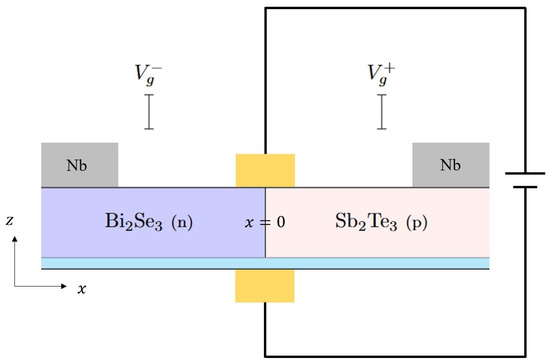
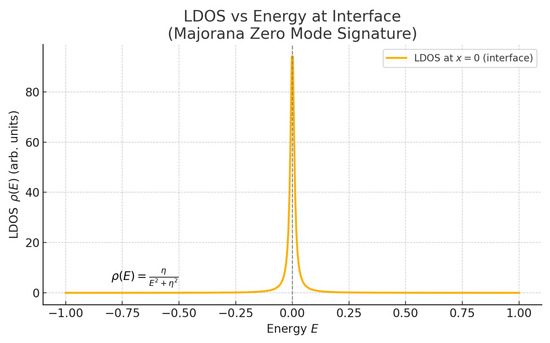
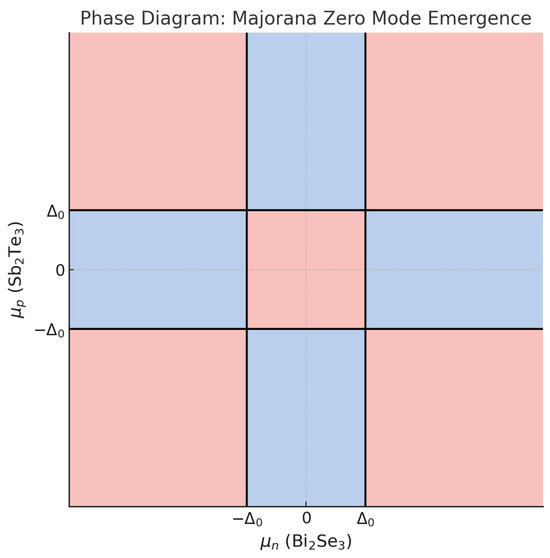
We present a comprehensive investigation into the emergence of interface-bound states, particularly Majorana zero modes (MZMs), in a lateral heterostructure composed of two three-dimensional topological insulators (TIs), Bi2Se3 and Sb2Te3, under the influence of proximity-induced superconductivity
[...] Read more.
We present a comprehensive investigation into the emergence of interface-bound states, particularly Majorana zero modes (MZMs), in a lateral heterostructure composed of two three-dimensional topological insulators (TIs), Bi2Se3 and Sb2Te3, under the influence of proximity-induced superconductivity from niobium (Nb) contacts. We develop an advanced two-dimensional Dirac model for the topological surface states (TSS), incorporating spatially varying chemical potentials and s-wave superconducting pairing. Using the Bogoliubov–de Gennes (BdG) formalism, we derive analytical solutions for the bound states and compute the local density of states (LDOS) at the interface, revealing zero-energy modes characteristic of MZMs. The topological nature of these states is rigorously analyzed through winding numbers and Pfaffian invariants, and their robustness is explored under various physical perturbations, including gating effects. Our findings highlight the potential of this heterostructure as a platform for topological quantum computing, with detailed predictions for experimental signatures via tunneling spectroscopy.
Full article
(This article belongs to the Special Issue Feature Papers in Topology and Its Applications)
►▼
Show Figures

Figure 1
Open AccessFeature PaperArticle
Parametric Resonance, Arithmetic Geometry, and Adelic Topology of Microtubules: A Bridge to Orch OR Theory
by
Michel Planat
Int. J. Topol. 2026, 3(1), 1; https://doi.org/10.3390/ijt3010001 - 7 Jan 2026
Cited by 2
Abstract
►▼
Show Figures
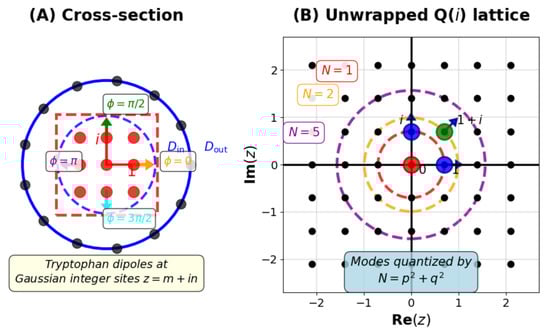
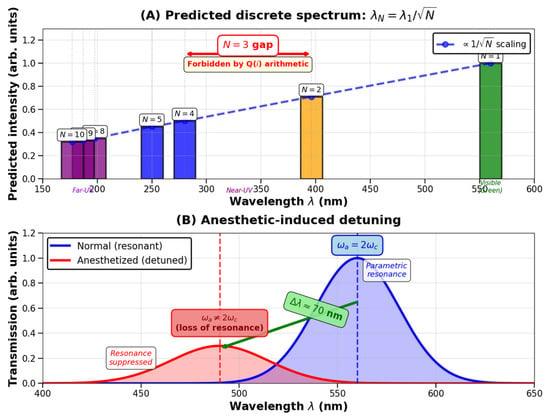
Microtubules are cylindrical protein polymers that organize the cytoskeleton and play essential roles in intracellular transport, cell division, and possibly cognition. Their highly ordered, quasi-crystalline lattice of tubulin dimers, notably tryptophan residues, endows them with a rich topological and arithmetic structure, making them
[...] Read more.
Microtubules are cylindrical protein polymers that organize the cytoskeleton and play essential roles in intracellular transport, cell division, and possibly cognition. Their highly ordered, quasi-crystalline lattice of tubulin dimers, notably tryptophan residues, endows them with a rich topological and arithmetic structure, making them natural candidates for supporting coherent excitations at optical and terahertz frequencies. The Penrose–Hameroff Orch OR theory proposes that such coherences could couple to gravitationally induced state reduction, forming the quantum substrate of conscious events. Although controversial, recent analyses of dipolar coupling, stochastic resonance, and structured noise in biological media suggest that microtubular assemblies may indeed host transient quantum correlations that persist over biologically relevant timescales. In this work, we build upon two complementary approaches: the parametric resonance model of Nishiyama et al. and our arithmetic–geometric framework, both recently developed in Quantum Reports. We unify these perspectives by describing microtubules as rectangular lattices governed by the imaginary quadratic field , within which nonlinear dipolar oscillations undergo stochastic parametric amplification. Quantization of the resonant modes follows Gaussian norms , linking the optical and geometric properties of microtubules to the arithmetic structure of . We further connect these discrete resonances to the derivative of the elliptic L-function, , which acts as an arithmetic free energy and defines the scaling between modular invariants and measurable biological ratios. In the appended adelic extension, this framework is shown to merge naturally with the Bost–Connes and Connes–Marcolli systems, where the norm character on the ideles couples to the Hecke character of an elliptic curve to form a unified adelic partition function. The resulting arithmetic–elliptic resonance model provides a coherent bridge between number theory, topological quantum phases, and biological structure, suggesting that consciousness, as envisioned in the Orch OR theory, may emerge from resonant processes organized by deep arithmetic symmetries of space, time, and matter.
Full article

Figure 1
Highly Accessed Articles
Latest Books
E-Mail Alert
News
Topics
Topic in
Entropy, IJMS, International Journal of Topology, MAKE, Mathematics, Quantum Reports, Symmetry
Topological, Quantum, and Molecular Information Approaches to Computation and Intelligence
Topic Editors: Michel Planat, Edward A. RietmanDeadline: 31 December 2026
Special Issues
Special Issue in
International Journal of Topology
Different Sets and Topologies, Manifolds, and Their Applications
Guest Editor: Saeid JafariDeadline: 31 March 2027
Special Issue in
International Journal of Topology
Feature Papers in Topology and Its Applications, 2nd Edition
Guest Editor: Michel PlanatDeadline: 31 December 2027