Feature Review Papers in Mental Health Nursing Section
Share This Topical Collection
Editors
 Prof. Dr. Daniel Bressington
Prof. Dr. Daniel Bressington
E-Mail
Website
Collection Editor
1. Faculty of Nursing, Chiang Mai University, Chiang Mai 50200, Thailand
2. School of Nursing and Midwifery, La Trobe University, Melbourne, VIC 3004, Australia
3. School of Nursing and Midwifery, University of Southern Queensland, Toowoomba, QLD 4350, Australia
Interests: multi-morbidity; psychosocial interventions; systematic reviews; psychosis; medication management; mental health literacy
 Prof. Dr. Martin Jones
Prof. Dr. Martin Jones
E-Mail
Website
Collection Editor
School of Nursing and Midwifery, Edith Cowell University, Bunbury, WA 6230, Australia
Interests: serious mental illness; common mental health problems; co-existing physical and mental health problems; workforce development
 Dr. Allison Wang
Dr. Allison Wang
E-Mail
Website
Collection Editor
School of Nursing and Midwifery, University of Southern Queensland, Ipswich, QLD 4350, Australia
Interests: mental health; psycho-oncology; evidence-based practice; primary health care
 Dr. Worku Animaw Temesgen
Dr. Worku Animaw Temesgen
E-Mail
Website
Collection Editor
Department of Adult Health Nursing, College of Medicine and Health Sciences, Bahir Dar University, Bahir Dar, Ethiopia
Interests: mental Health; NCD; chronic Illness; nursing leadership; nursing education
Topical Collection Information
Dear Colleagues,
By launching this Topical Collection, we celebrate and promote high-quality mental health nursing-related reviews that have been conducted systematically. We are particularly interested in systematic reviews of intervention studies that follow recognised systematic review guidelines, such as Cochrane and JBI. Other review types will be considered, along with reviews of systematic reviews, if they are robust and make a useful contribution to the mental health nursing evidence base.
We look forward to receiving your review papers. Please feel free to contact the Collection Editors if you have any doubts that your review would be appropriate for this Topical Collection.
Prof. Dr. Daniel Bressington
Prof. Dr. Martin Jones
Dr. Alison Wang
Dr. Daisy Dexing Zhang
Dr. Worku Animaw Temesgen
Collection Editors
Manuscript Submission Information
Manuscripts should be submitted online at www.mdpi.com by registering and logging in to this website. Once you are registered, click here to go to the submission form. All submissions that pass pre-check are peer-reviewed. Accepted papers will be published continuously in the journal (as soon as accepted) and will be listed together on the collection website. Research articles, review articles as well as short communications are invited. For planned papers, a title and short abstract (about 250 words) can be sent to the Editorial Office for assessment.
Submitted manuscripts should not have been published previously, nor be under consideration for publication elsewhere (except conference proceedings papers). All manuscripts are thoroughly refereed through a single-blind peer-review process. A guide for authors and other relevant information for submission of manuscripts is available on the Instructions for Authors page. Nursing Reports is an international peer-reviewed open access monthly journal published by MDPI.
Please visit the Instructions for Authors page before submitting a manuscript.
The Article Processing Charge (APC) for publication in this open access journal is 1800 CHF (Swiss Francs).
Submitted papers should be well formatted and use good English. Authors may use MDPI's
English editing service prior to publication or during author revisions.
Keywords
- systematic reviews
- mental health nursing
- randomized controlled trials (RCTs)
- mental health interventions
- meta-analysis
Published Papers (1 paper)
2026
Open AccessReview
Stigma Among Nurses Toward Individuals with Mental Health Conditions: An Integrative Review of Qualitative and Quantitative Studies
by
Ruth-Auxiliadora Díaz-Melián, Jesús-Manuel Quintero-Febles and Alfonso-Miguel García-Hernández
Viewed by 1779
Abstract
Background: Individuals with mental health conditions frequently experience stigmatization and discrimination. Among the primary objectives in the fight against stigma is to examine groups that play a crucial role in addressing it, such as healthcare professionals. Although research has examined stigma among healthcare
[...] Read more.
Background: Individuals with mental health conditions frequently experience stigmatization and discrimination. Among the primary objectives in the fight against stigma is to examine groups that play a crucial role in addressing it, such as healthcare professionals. Although research has examined stigma among healthcare professionals, few studies have specifically addressed how nurses perceive and contribute to the stigmatization of individuals with mental health conditions.
Objective: The aim of this review was to compile and compare the scientific literature addressing nurses’ stigma toward individuals with mental health conditions.
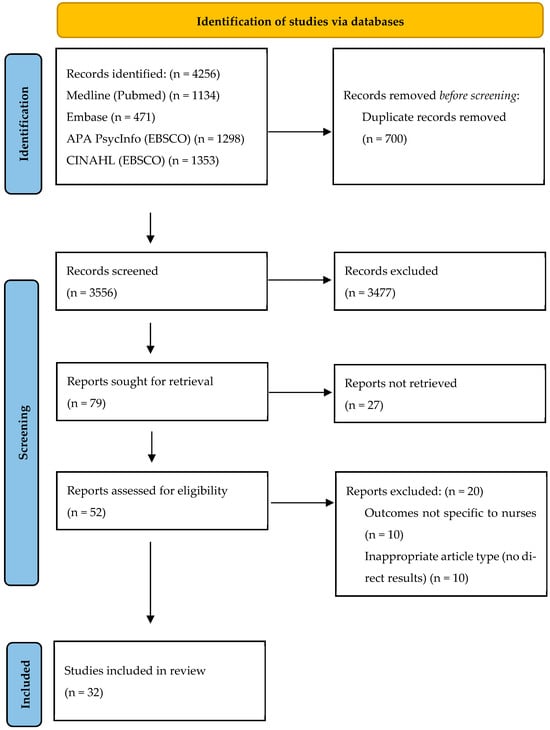
Methods: Following the methodological guidelines of the Joanna Briggs Institute and in accordance with the PRISMA 2020 guidelines, an integrative review was conducted of MEDLINE (PubMed), EMBASE, APA PsycInfo (EBSCO), and CINAHL Complete (EBSCO). Database-specific indexing terms were combined with the Boolean operators AND/OR. Studies with quantitative or qualitative methodologies, published in Spanish or English and without restrictions by year of publication, were included. Two independent reviewers selected the studies and performed the critical appraisal.
Results: The search retrieved 4256 records, of which 32 articles were finally included. A content analysis of the selected studies was conducted. Most studies used validated questionnaires to assess stigma and its associations with various variables, while only a limited number employed qualitative designs. Across the 32 studies (n = 6283 nurses from 29 countries), stigma was observed across settings but tended to be lower among mental health specialists. Insufficient training and limited contact were consistently associated with higher levels of stigma, whereas specialization and positive contact were linked to lower levels. Associative stigma emerged as a recurrent theme with implications for psychiatric nursing identity.
Conclusions: Nurses working in mental health settings generally demonstrate more positive attitudes toward individuals with mental health conditions compared with those in other clinical areas; however, stigma persists across all settings. Associative stigma may be influencing the development and advancement of psychiatric nursing. Specific academic training, capacity building, and specialization in mental health are essential to counteract stigma. Further qualitative research is required to achieve a deeper understanding of this phenomenon.
Full article
►▼
Show Figures