
Journal Description
Particles
Particles
is an international, open access, peer-reviewed journal covering all aspects of nuclear physics, particle physics and astrophysics science, and is published quarterly online by MDPI.
- Open Access— free for readers, with article processing charges (APC) paid by authors or their institutions.
- High Visibility: indexed within Scopus, ESCI (Web of Science), Inspec, CAPlus / SciFinder, and other databases.
- Journal Rank: JCR - Q2 (Astronomy and Astrophysics) / CiteScore - Q2 (Physics and Astronomy (miscellaneous))
- Rapid Publication: manuscripts are peer-reviewed and a first decision is provided to authors approximately 22 days after submission; acceptance to publication is undertaken in 3.6 days (median values for papers published in this journal in the second half of 2025).
- Recognition of Reviewers: reviewers who provide timely, thorough peer-review reports receive vouchers entitling them to a discount on the APC of their next publication in any MDPI journal, in appreciation of the work done.
- Journal Cluster of Gravitation, Cosmology and Astrophysics: Universe, Galaxies, Particles and Astronomy.
Impact Factor:
2.3 (2024);
5-Year Impact Factor:
1.8 (2024)
Latest Articles
Quark Deconfinement Phase Transition in Hot Neutron-Star Matter: Effects of Neutrino Trapping
Particles 2026, 9(2), 64; https://doi.org/10.3390/particles9020064 - 8 Jun 2026
Abstract
We study the effect of trapped neutrinos on the properties of the deconfinement phase transition from hot -equilibrated, electrically neutral hadronic matter to quark matter. To describe the thermodynamic properties of hot hadronic matter, an extended relativistic mean field (RMF) theory is
[...] Read more.
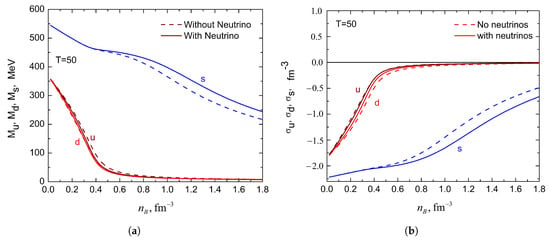
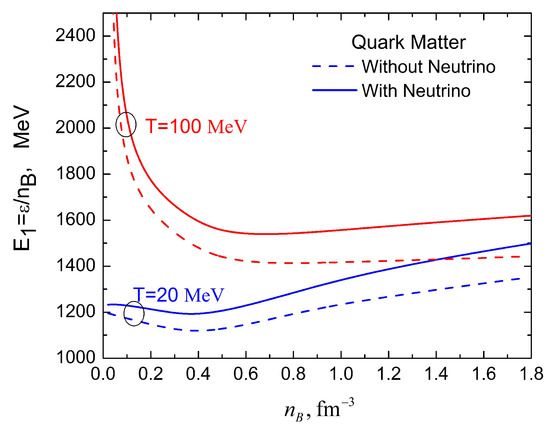
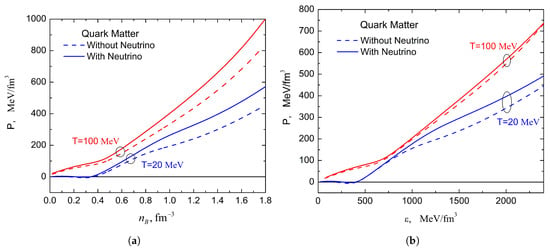
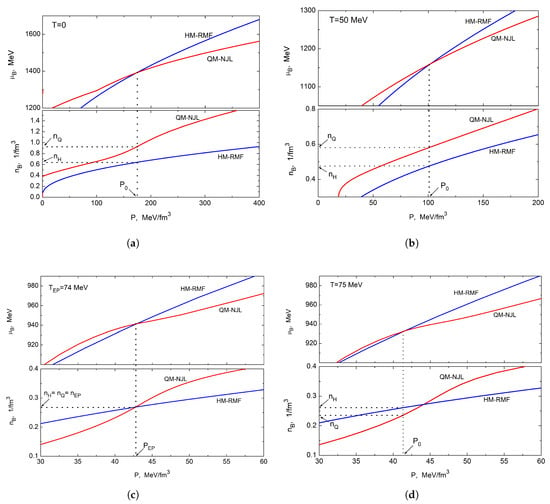
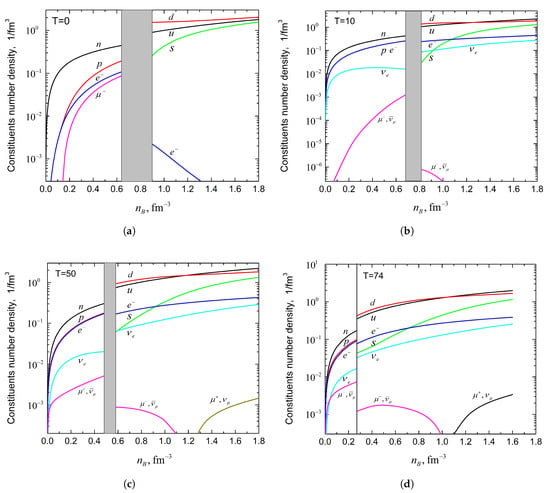
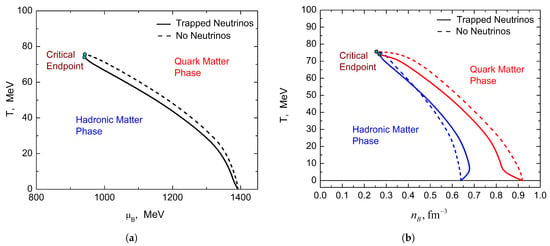
We study the effect of trapped neutrinos on the properties of the deconfinement phase transition from hot -equilibrated, electrically neutral hadronic matter to quark matter. To describe the thermodynamic properties of hot hadronic matter, an extended relativistic mean field (RMF) theory is used, which also incorporates the isovector–Lorentz-scalar -meson effective field. The three-flavor quark phase is described within the framework of the local Nambu–Jona-Lasinio (NJL) model. It was assumed that the surface tension at the quark-hadron interface is so strong that the phase transition occurs according to Maxwell’s construction. The thermodynamic properties of the quark and hadronic phases were calculated for both neutrino-trapped and neutrino-transparent regimes at various temperatures ranging from 0 to 100 MeV and baryon number densities from 0 to 1.8 . The impact of trapped neutrinos on the thermodynamic properties of the coexistence state has been investigated. It has been demonstrated that the baryon chemical potential in the coexistence state decreases as temperature increases. The critical endpoint parameters in the plane of the phase diagram were obtained for the case of trapped neutrinos (74 MeV; 0.269 ) and for the case of the absence of neutrinos (75.6 MeV; 0.255 ).
Full article
(This article belongs to the Special Issue Selected Papers from “The Modern Physics of Compact Stars and Relativistic Gravity 2025”)
►
Show Figures
Open AccessArticle
Ionization Potential Depression in Degenerate Plasmas and Pauli Blocking of Multi-Electron Ions
by
Gerd Röpke
Particles 2026, 9(2), 63; https://doi.org/10.3390/particles9020063 - 1 Jun 2026
Abstract
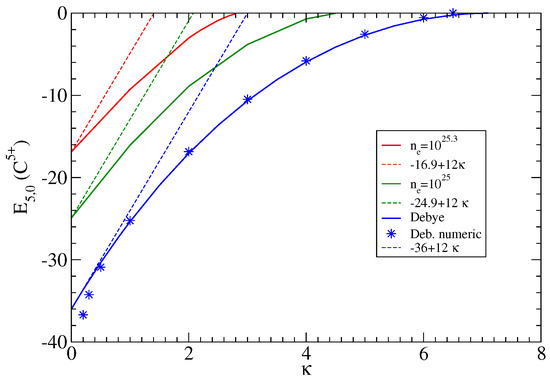
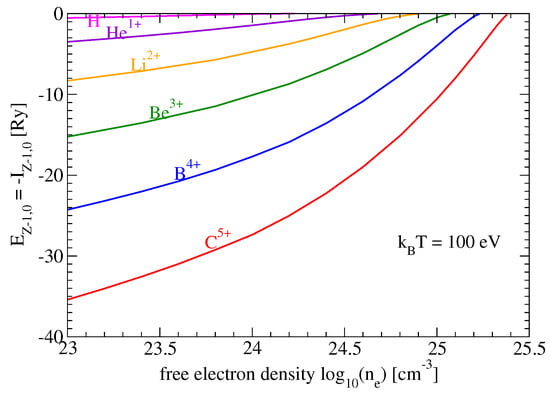
The composition of partially ionised plasmas is investigated for densities and temperatures at which the free electrons are degenerate. Based on a quantum statistical approach, the effect of Pauli blocking is addressed. Specifically, one- and two-electron ions are studied. Approximations for deriving an
[...] Read more.
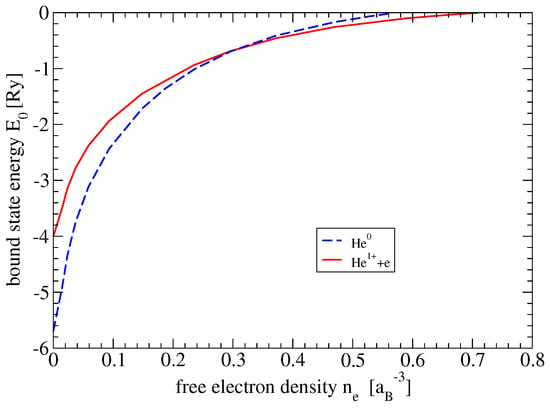
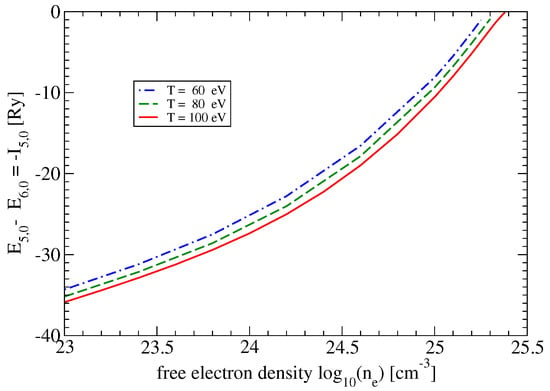
The composition of partially ionised plasmas is investigated for densities and temperatures at which the free electrons are degenerate. Based on a quantum statistical approach, the effect of Pauli blocking is addressed. Specifically, one- and two-electron ions are studied. Approximations for deriving an in-medium Schrödinger equation for the ionization potential are indicated. New results regarding the degree of ionisation and the Mott effect are presented. Standard codes for plasma properties do not take Pauli blocking effects into account and are therefore unable to explain the experiments in the high-density regime, where the electrons are degenerate.
Full article
(This article belongs to the Special Issue Particles and Plasmas in Strong Fields)
►▼
Show Figures

Figure 1
Open AccessArticle
Some Predictions on Behavior of the Nuclear Matter in Nuclear Collisions at FAIR-GSI Energies
by
Nicolae George Țuțuraș, Alexandru Jipa, Dănuț Argintaru, Oana Ristea, Marius Călin, Cătălin Ristea, Ionel Lazanu, Tiberiu Eșanu, Adam Jinaru and Murat Ablai
Particles 2026, 9(2), 62; https://doi.org/10.3390/particles9020062 - 26 May 2026
Abstract
In order to describe the heavy ion collision dynamics which implies the formation of hot and very dense nuclear matter in the overlapping region of the two colliding nuclei, we used simulated numerical calculations for FAIR available energies. We used the anti-
[...] Read more.
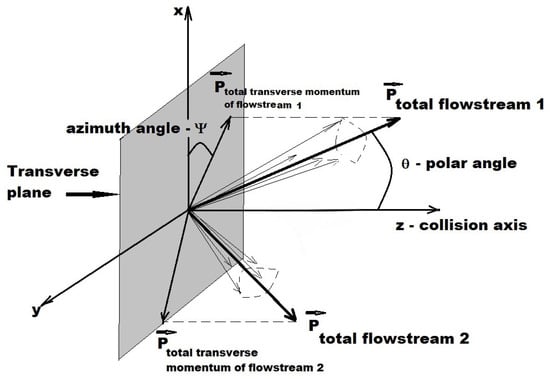
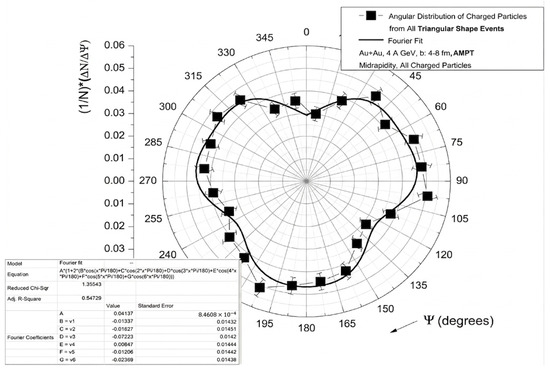
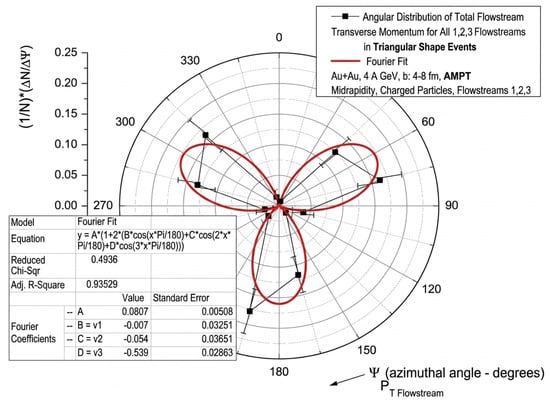
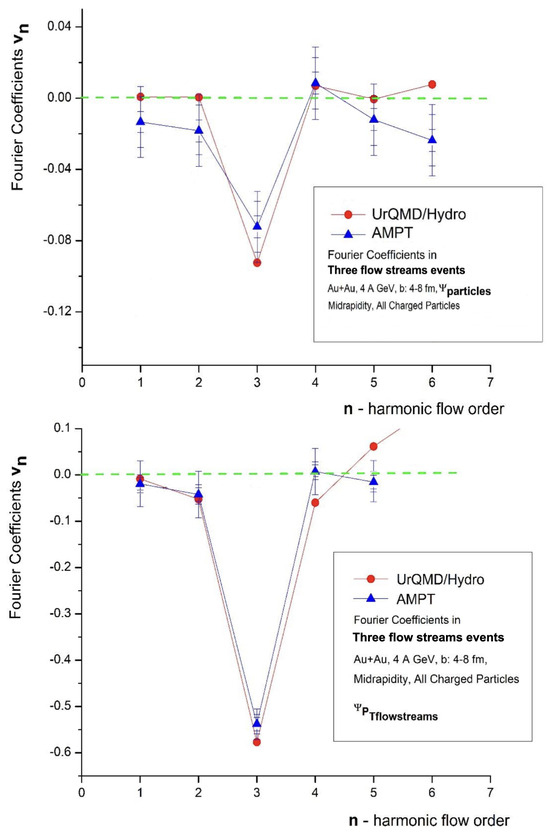
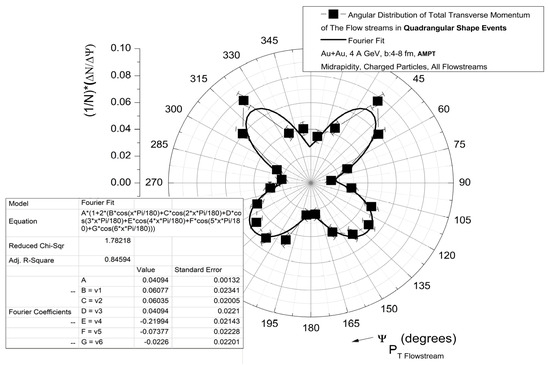
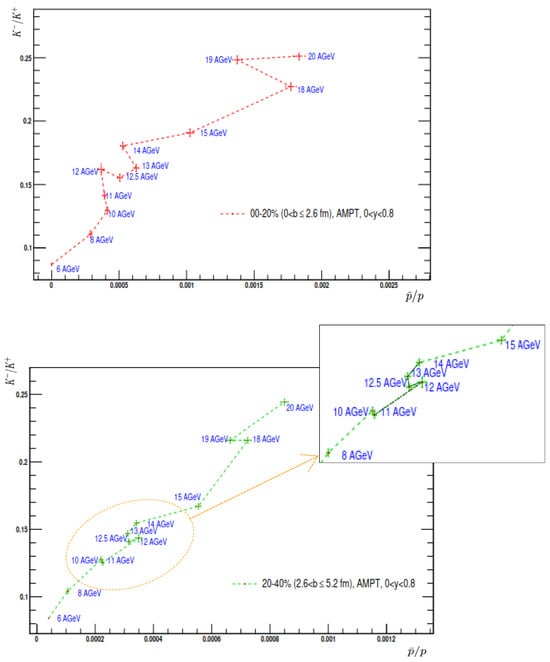
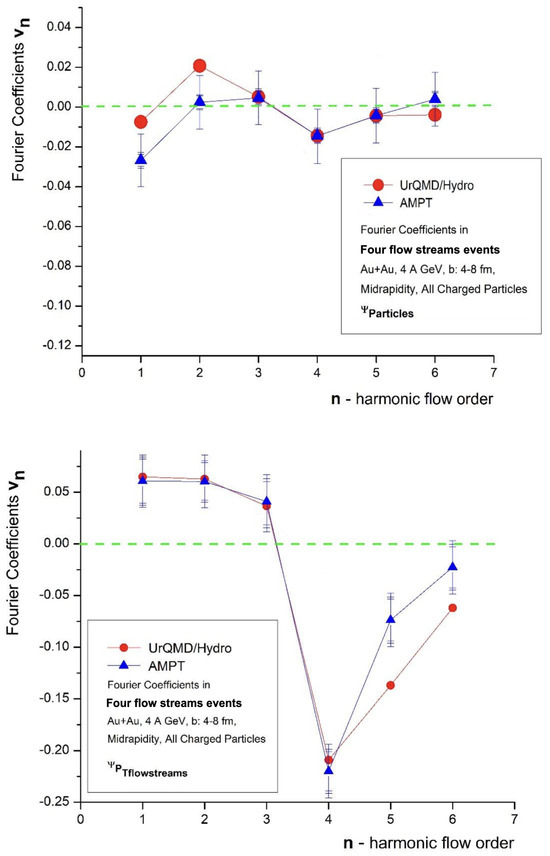
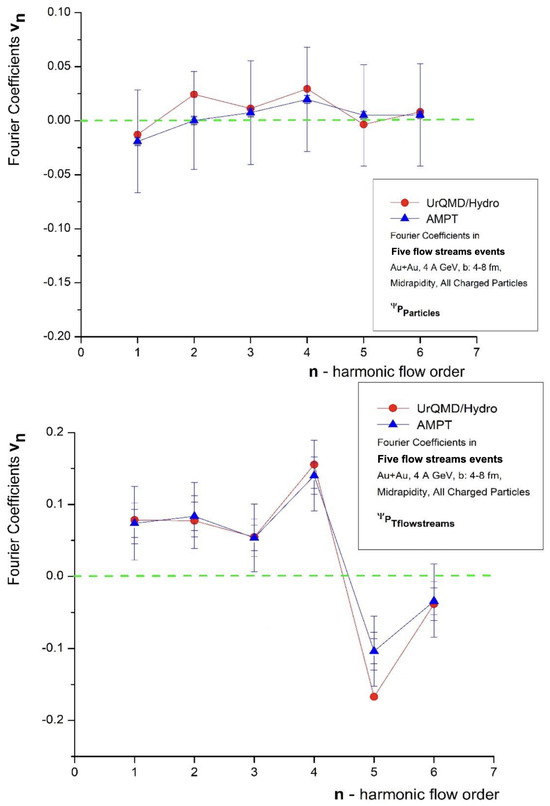
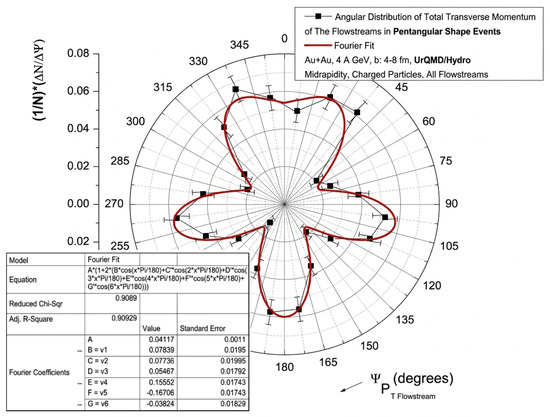
In order to describe the heavy ion collision dynamics which implies the formation of hot and very dense nuclear matter in the overlapping region of the two colliding nuclei, we used simulated numerical calculations for FAIR available energies. We used the anti- jet-detection algorithm for highlighting the main directions of flow in Au-Au collisions at CBM energies, thus obtaining structures of the events depending on the number of flow streams. The jet-finder algorithm identified domains in the y- (rapidity-azimuthal angle) plane, where the number of charged particles, momenta and energy take higher values compared to other areas of this plane. The anisotropic flow coefficients may offer information about the pressure gradients in the early stages of the collision and about the high-density nuclear matter properties. The observation of mesons in heavy ion collisions is of interest since mesons, due to their strangeness, have a mean free path that exceeds the dimensions of the “fireball”. In the numerical calculations the interval of rapidity is highlighted, for which the fluctuations of the antiparticle to particle ratio excitation functions show non-monotonic behavior in the 10–13 A GeV energy interval.
Full article
(This article belongs to the Section Nuclear and Hadronic Theory)
►▼
Show Figures

Figure 1
Open AccessArticle
Isentropic Hybrid Stars in the Nambu–Jona-Lasinio Model: Effects of Neutrino Trapping
by
Andrea Sabatucci and Armen Sedrakian
Particles 2026, 9(2), 61; https://doi.org/10.3390/particles9020061 - 26 May 2026
Abstract
Binary neutron star mergers and proto-neutron stars provide unique environments where dense matter is hot, lepton-rich, and potentially undergoes a transition from hadronic to deconfined quark matter. We investigate the thermodynamics and stellar properties of hybrid matter under such conditions. The hadronic phase
[...] Read more.
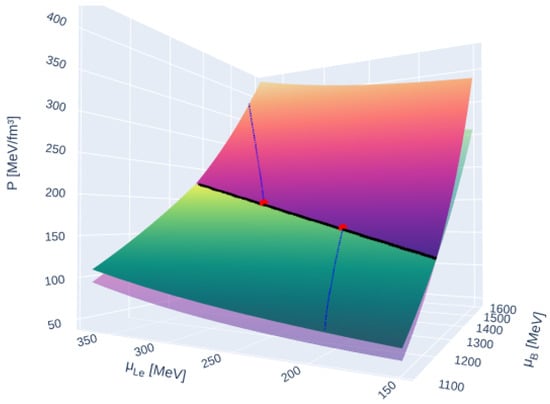
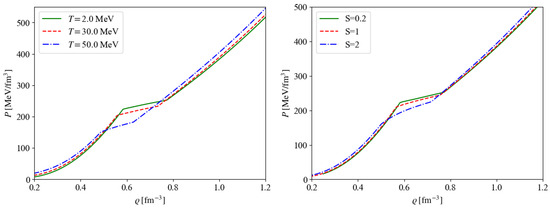
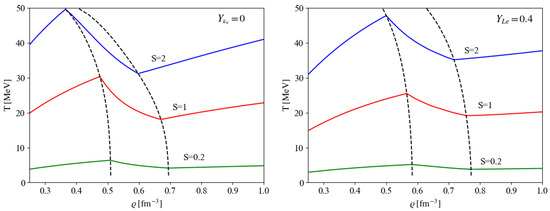
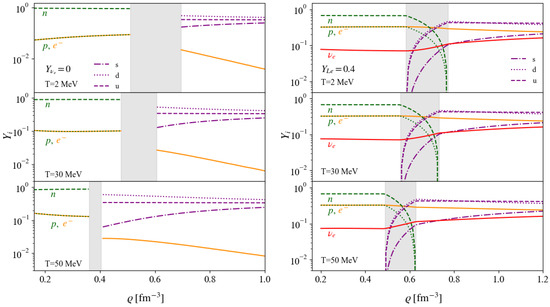
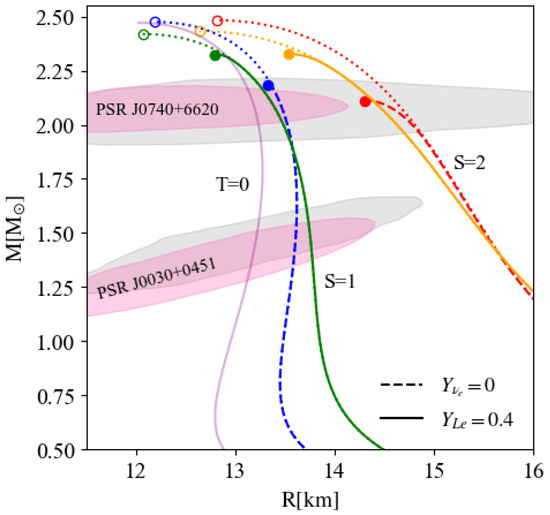
Binary neutron star mergers and proto-neutron stars provide unique environments where dense matter is hot, lepton-rich, and potentially undergoes a transition from hadronic to deconfined quark matter. We investigate the thermodynamics and stellar properties of hybrid matter under such conditions. The hadronic phase is described within a covariant density functional framework, while the quark phase is modeled using a Nambu–Jona-Lasinio (NJL) model that includes repulsive vector interactions, the axial -breaking ’t Hooft determinant interaction, and two-flavor color-superconducting (2SC) pairing. The phase transition between hadronic and quark matter is constructed using a mixed-phase prescription that enforces baryon and lepton number conservation, allowing us to follow thermodynamic trajectories at fixed entropy per baryon and a fixed lepton fraction. We analyze the phase structure of dense matter at a finite temperature and study the composition of the hadronic, mixed, and quark phases in both neutrino-trapped and neutrino-free regimes. Our results show that neutrino trapping significantly modifies the particle composition and shifts the onset of deconfinement to higher densities. The mixed phase exhibits a density-dependent pressure due to the presence of multiple conserved charges. Using the resulting equations of state, we compute static stellar configurations and examine the influence of the temperature and lepton content on the mass–radius relation in hybrid stars. Hot, neutrino-rich configurations are found to have larger radii and slightly higher maximum masses than their cold counterparts. As the star cools and deleptonizes, its radius contracts at an approximately constant baryonic mass, potentially triggering changes in the internal phase structure. These results highlight the roles of color superconductivity, lepton trapping, and thermal effects in shaping the structure and evolution of hybrid stars in transient astrophysical environments.
Full article
(This article belongs to the Special Issue Selected Papers from “The Modern Physics of Compact Stars and Relativistic Gravity 2025”)
►▼
Show Figures

Figure 1

Open AccessReview
One-Neutron Halo Nuclei in the Mass Region of 15 ≲ A ≲ 50 from Microscopic Structure to Reaction Observables
by
Shisheng Zhang, Jialin An, Qi Lu and Kaiyuan Zhang
Particles 2026, 9(2), 60; https://doi.org/10.3390/particles9020060 - 20 May 2026
Abstract
We briefly review our recent theoretical progress on one-neutron ( ) halo nuclei in the mass region of 15 ≲ A ≲ 50 from microscopic structure to reaction observables, by combining the deformed relativistic Hartree–Bogoliubov theory in continuum (DRHBc) and its
[...] Read more.
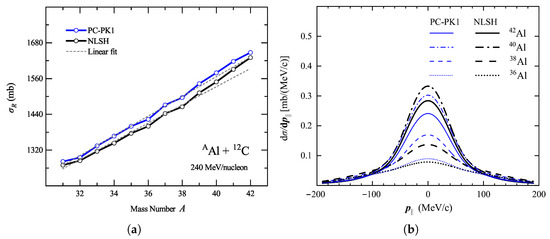
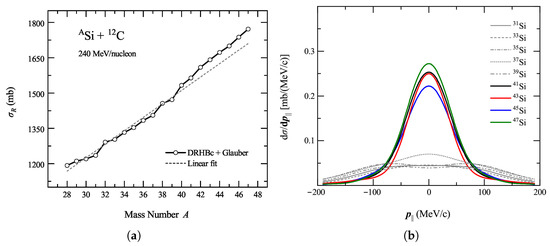
We briefly review our recent theoretical progress on one-neutron ( ) halo nuclei in the mass region of 15 ≲ A ≲ 50 from microscopic structure to reaction observables, by combining the deformed relativistic Hartree–Bogoliubov theory in continuum (DRHBc) and its triaxial extension (TRHBc) with the Glauber reaction model. In such an effective scheme, we first succeed in reproducing the enhanced reaction cross sections and narrow longitudinal momentum distributions of both the heaviest p-wave halo nucleus 37Mg and the heavier 31Ne on a carbon target, which are loosely bound and well-deformed systems with dominant p-wave configurations of the valence neutron. To test its capability for the lighter halo cases, we select neutron-rich carbon isotopes as examples. It turns out that the DRHBc + Glauber approaches are still valid for the s-wave halo in 15C, while a better description of the ground state for 19C requires the inclusion of exchange terms and tensor forces via the deformed relativistic Hartree–Fock–Bogoliubov (D-RHFB) model.Finally, these approaches are applied to search for heavier halo candidates. It was suggested that 40,42Al are promising candidates as p-wave triaxial halo nuclei and 43,45Si as p-wave axial halo nuclei with prominent shape decoupling from the oblate core. Our studies cast a new light on future experimental measurements for new halo nuclei.
Full article
(This article belongs to the Special Issue Selected Papers from the International Symposium Commemorating the 40th Anniversary of Halo Nuclei)
►▼
Show Figures

Figure 1

Open AccessArticle
Gauge Symmetry Beyond Perturbation Theory: BRST and Anti-BRST Structure, Background Fields, and Infrared Dynamics of Yang–Mills Theory
by
Daniele Binosi
Particles 2026, 9(2), 59; https://doi.org/10.3390/particles9020059 - 19 May 2026
Abstract
We present a pedagogical and self-contained account of the functional formulation of non-Abelian gauge theories, aimed at the construction of a process-independent effective charge for Yang–Mills theory. Starting from the path integral quantization of gauge fields, we review gauge fixing and the emergence
[...] Read more.
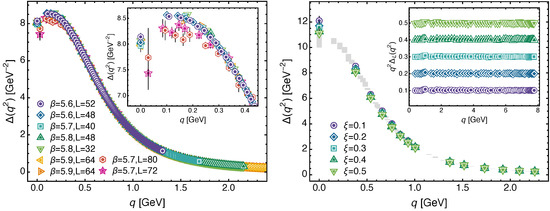
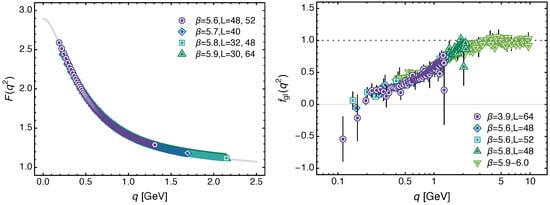
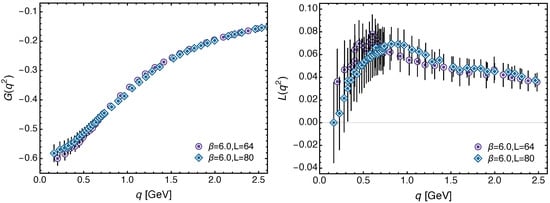
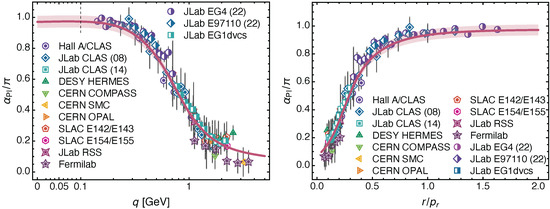
We present a pedagogical and self-contained account of the functional formulation of non-Abelian gauge theories, aimed at the construction of a process-independent effective charge for Yang–Mills theory. Starting from the path integral quantization of gauge fields, we review gauge fixing and the emergence of Faddeev–Popov ghosts, illustrating how gauge invariance is preserved at the quantum level through Becchi–Rouet–Stora–Tyutin (BRST) symmetry. We then develop the BRST and anti-BRST formalisms and show how their simultaneous implementation leads to powerful functional identities that severely constrain the ghost and gluon sectors. Background field gauges are introduced as a natural framework in which these symmetries manifest themselves through Abelian-like Ward identities, allowing for a transparent separation between quantum and background degrees of freedom. This structure makes it possible to define renormalization group-invariant combinations of Green functions that generalize the QED effective charge to the non-Abelian case. The resulting effective charge is shown to be unique, gauge-invariant, and process-independent, providing a unified description of the theory from the ultraviolet down to the infrared. The interplay between functional identities, Dyson–Schwinger equations, and lattice results is discussed in detail, highlighting how dynamical mass generation and infrared saturation naturally emerge within this framework.
Full article
(This article belongs to the Special Issue Strong QCD and Hadron Structure)
►▼
Show Figures

Figure 1
Open AccessArticle
Quantum Theory of a Single Photon in an Arbitrary Medium
by
Ashot S. Gevorkyan, Aleksandr V. Bogdanov and Vladimir V. Mareev
Particles 2026, 9(2), 58; https://doi.org/10.3390/particles9020058 - 18 May 2026
Abstract
The quantum motion of a photon in an arbitrary medium was considered within the framework of the gauge symmetry group using the Yang–Mills (Y-M) equations for Abelian fields. A system of second-order partial
[...] Read more.
The quantum motion of a photon in an arbitrary medium was considered within the framework of the gauge symmetry group using the Yang–Mills (Y-M) equations for Abelian fields. A system of second-order partial differential equations (PDEs) for the vector wave function of a photon is derived using the first-order Y-M equations as identities. The full wave function of a photon was defined as the arithmetic mean of the components of the wave function. In a particular case, an equation is obtained for its full wave function, taking into account the structure of space-time in a plane perpendicular to the direction of propagation of the photon. The quantum state of a photon in a nanowaveguide was investigated, and it is shown that under certain conditions, it is reduced to the problem of two coupled 1D quantum harmonic oscillators (QHO) with variable frequencies. An explicit expression is obtained for the wave function of a photon, which is characterized by two vibrational quantum numbers. A quantum theory of a photon for a dissipative medium has been developed taking into account the processes of absorption and emission of photons. The mathematical expectation (ME) of the photon wave function is constructed as the product of two 2D integral representations in which the integrand is the solution of a system of two coupled second-order PDEs. The ME of the probability amplitude of the transition of a single-photon state into one of the two-photon entangled Bell states is constructed. Finally, it was proven that, in addition to frequency, spin, momentum and polarization, the photon also has a spatial structure responsible for the cross sections of processes in which this massless fundamental particle participates.
Full article
(This article belongs to the Special Issue Selected Papers from “The Modern Physics of Compact Stars and Relativistic Gravity 2025”)
►▼
Show Figures

Figure 1

Open AccessArticle
Halo Nuclei from Ab Initio Nuclear Theory
by
Petr Navrátil, Sofia Quaglioni, Guillaume Hupin, Michael Gennari and Kostas Kravvaris
Particles 2026, 9(2), 57; https://doi.org/10.3390/particles9020057 - 14 May 2026
Abstract
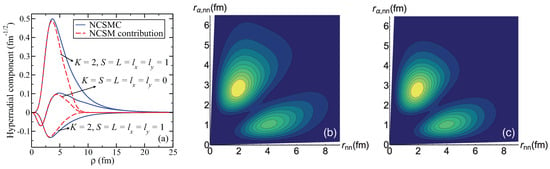
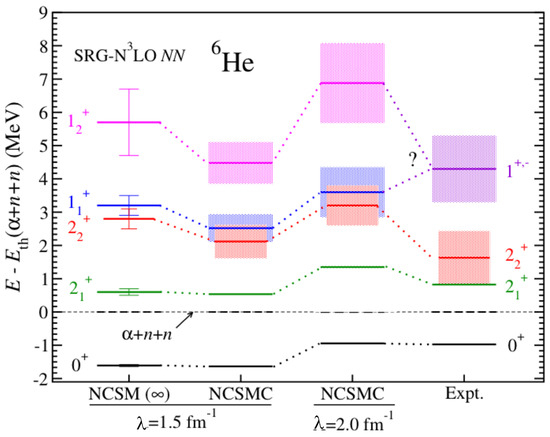
A realistic description of halo nuclei, characterized by low-lying breakup thresholds, requires a proper treatment of continuum effects. We have developed an ab initio approach, the No-Core Shell Model with Continuum (NCSMC), capable of describing both bound and unbound states in light nuclei
[...] Read more.
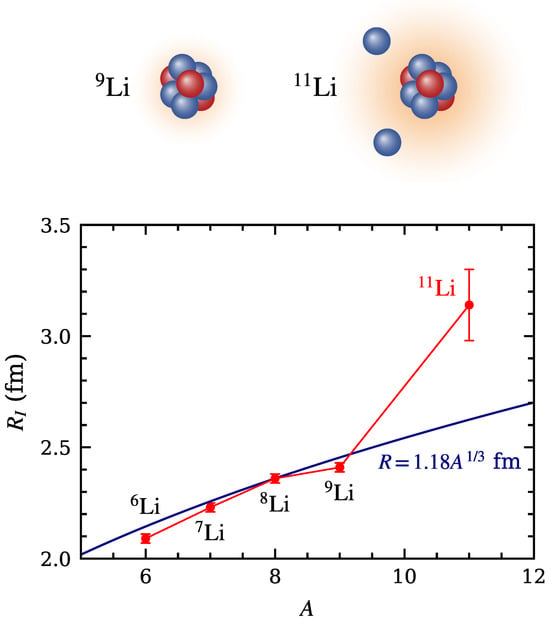
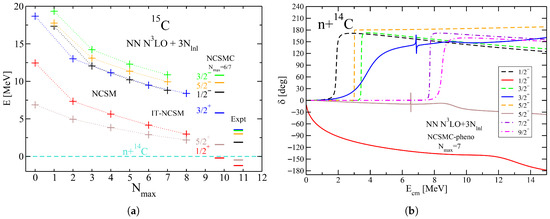
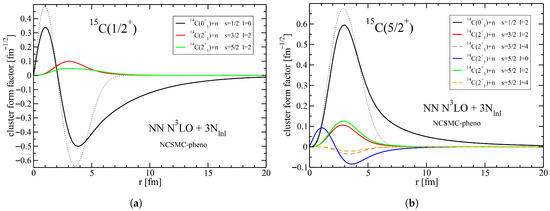
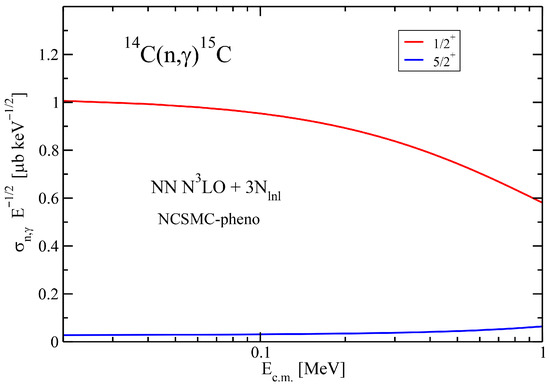
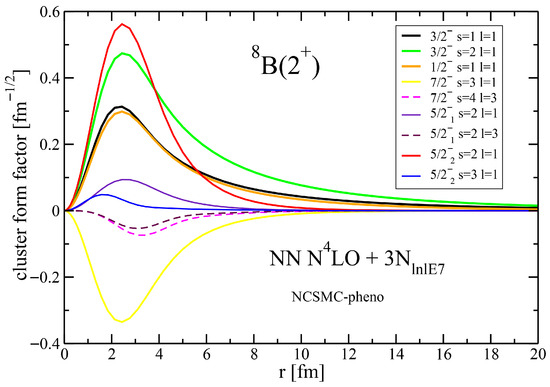
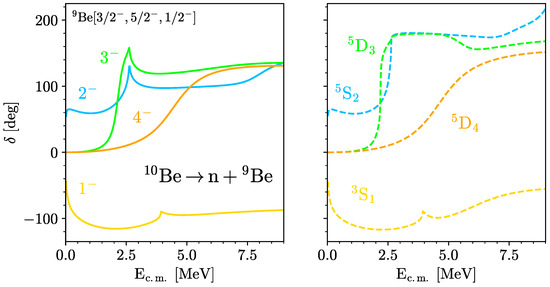
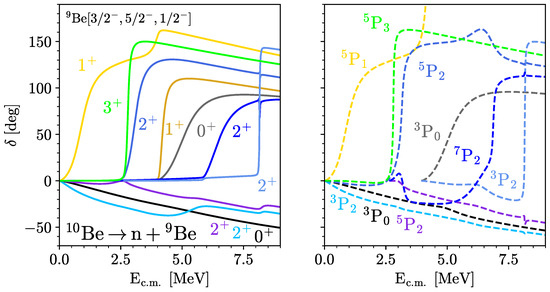
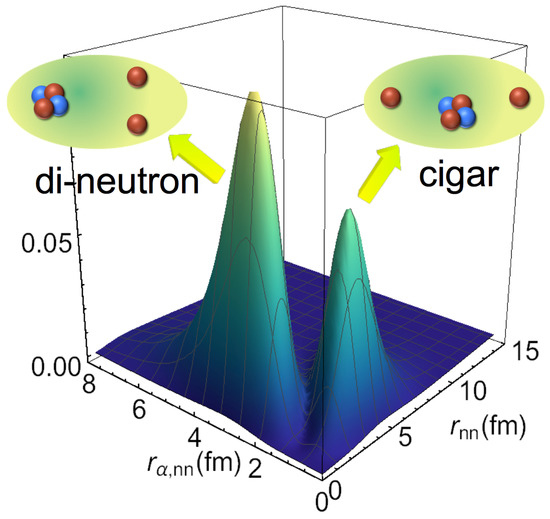
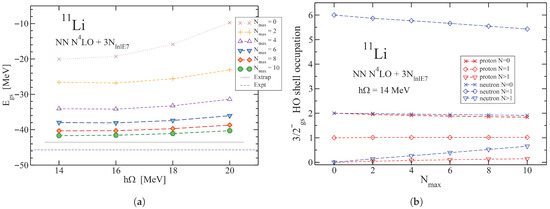
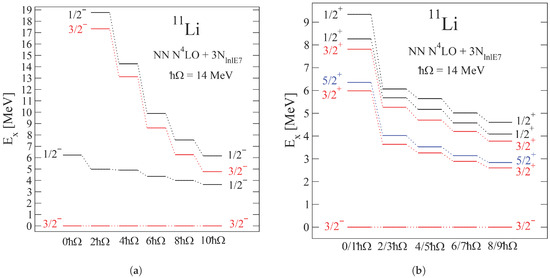
A realistic description of halo nuclei, characterized by low-lying breakup thresholds, requires a proper treatment of continuum effects. We have developed an ab initio approach, the No-Core Shell Model with Continuum (NCSMC), capable of describing both bound and unbound states in light nuclei in a unified way. With chiral two- and three-nucleon interactions as the only input, we can predict the structure and dynamics of halo and other light nuclei and, by comparing to available experimental data, test the quality of chiral nuclear forces. We review NCSMC calculations of weakly bound states and resonances of the exotic halo nuclei 6He, 8B, 11Be, and 15C. For the latter, we discuss its production in the capture reaction 14C(n, )15C. We highlight the challenges of a description of 6He as a Borromean n-n-4He system. Finally, we present our calculations of excited states in 10Be exhibiting a one-neutron halo structure and a large scale No-Core Shell Model investigation of 11Li as a precursor of a full n-n-9Li NCSMC study.
Full article
(This article belongs to the Special Issue Selected Papers from the International Symposium Commemorating the 40th Anniversary of Halo Nuclei)
►▼
Show Figures

Figure 1

Open AccessArticle
Generalized Beth–Uhlenbeck Approach to the (2+1)-Dimensional Gross–Neveu Model
by
Biplab Mahato and David Blaschke
Particles 2026, 9(2), 56; https://doi.org/10.3390/particles9020056 - 14 May 2026
Abstract
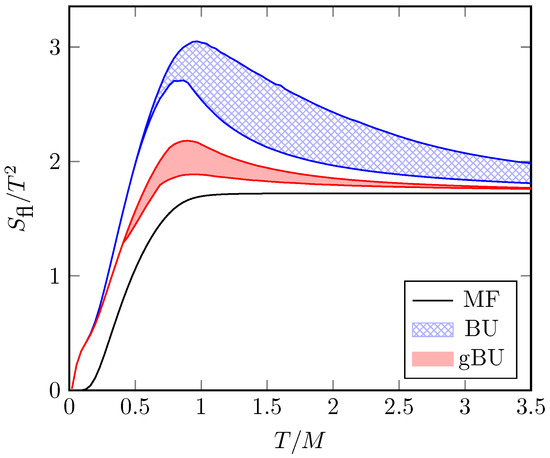
We study the thermodynamics of the (2+1)-dimensional Gross–Neveu model inspired from graphene. We focus on the entropy density of the Gaussian fluctuation beyond the mean field. The full in-medium, momentum-dependent evaluation reveals that the fluctuations give a substantial contribution, even comparable to that
[...] Read more.
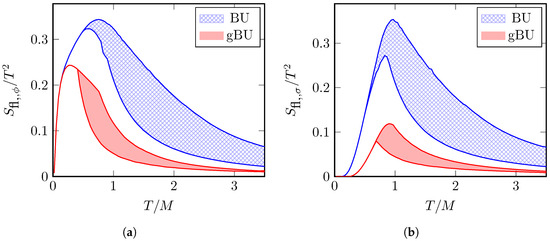
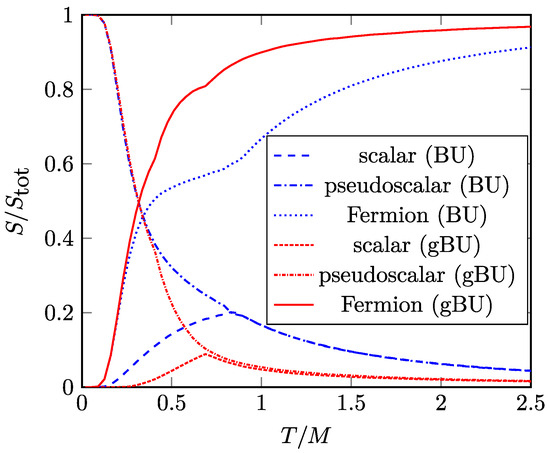
We study the thermodynamics of the (2+1)-dimensional Gross–Neveu model inspired from graphene. We focus on the entropy density of the Gaussian fluctuation beyond the mean field. The full in-medium, momentum-dependent evaluation reveals that the fluctuations give a substantial contribution, even comparable to that of the mean field. We argue that the back-reaction from the fluctuations to the mean field should be included, which reduces the contribution mainly coming from the Landau-damping region. To treat this self-consistently, we use the generalized version of the Beth–Uhlenbeck approach for the entropy density. Compared with the standard Beth–Uhlenbeck formulation, the generalized version suppresses the low-energy contributions while preserving the bound-state effects. To illustrate this, we consider the respective contributions of the bound excitons and unbound fermions to the total entropy. This shows a sharper crossover between the degrees of freedom compared to the standard Beth–Uhlenbeck approach. This behavior is consistent with Mott-transition physics in two-dimensional materials.
Full article
(This article belongs to the Special Issue Particles and Plasmas in Strong Fields)
►▼
Show Figures

Figure 1

Open AccessArticle
A Meson Binding State Model in Two-Dimensional Space
by
Yasushi Muraki and Shoichi Shibata
Particles 2026, 9(2), 55; https://doi.org/10.3390/particles9020055 - 13 May 2026
Abstract
►▼
Show Figures
In this paper, we first show that the four masses of the Upsilon binding states—namely, through —composed of bottom quarks and anti-bottom quarks follow logarithmic spacing. The correlation coefficient R between the experimental
[...] Read more.
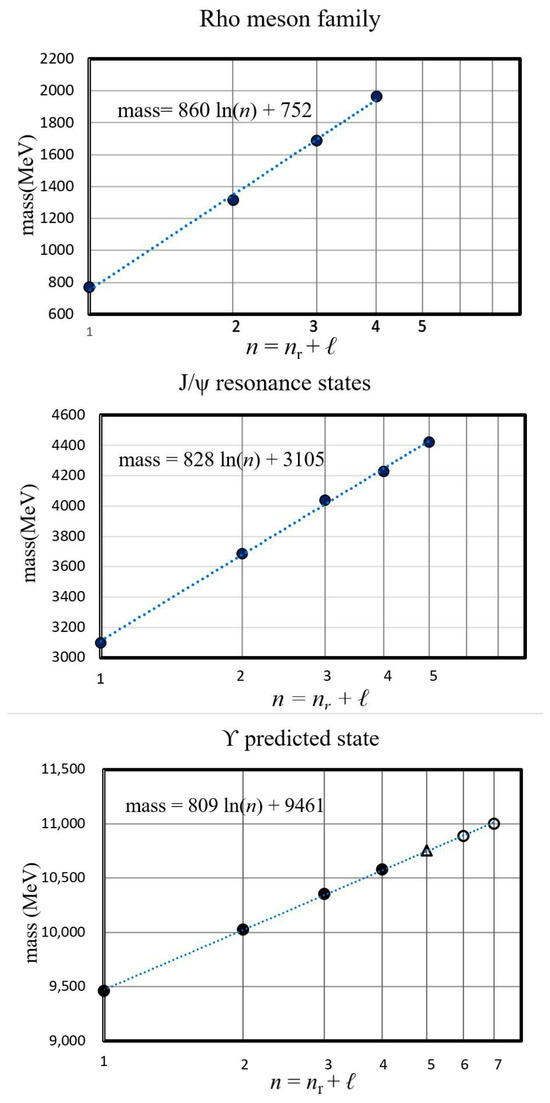
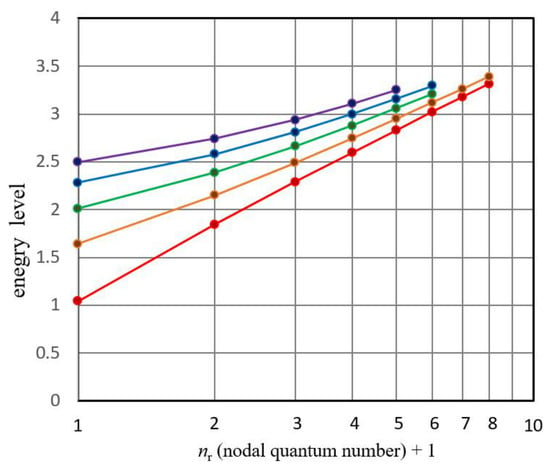
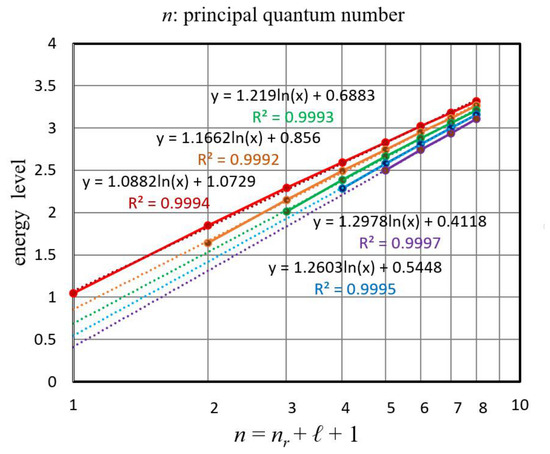
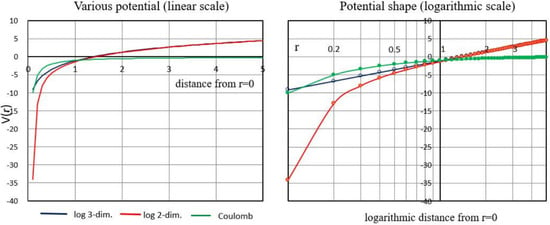
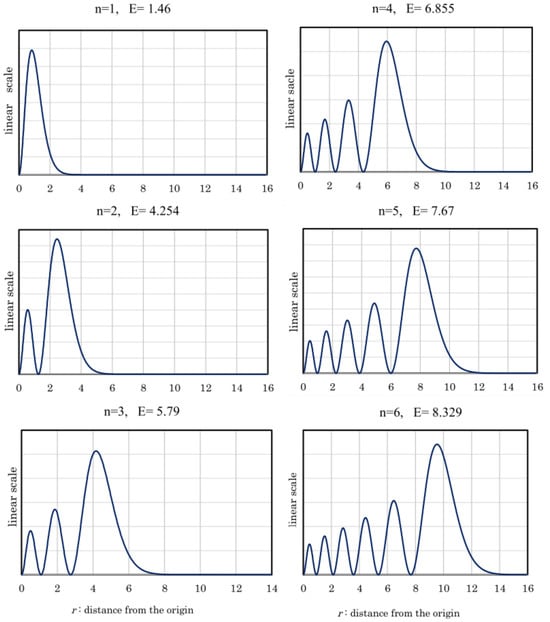
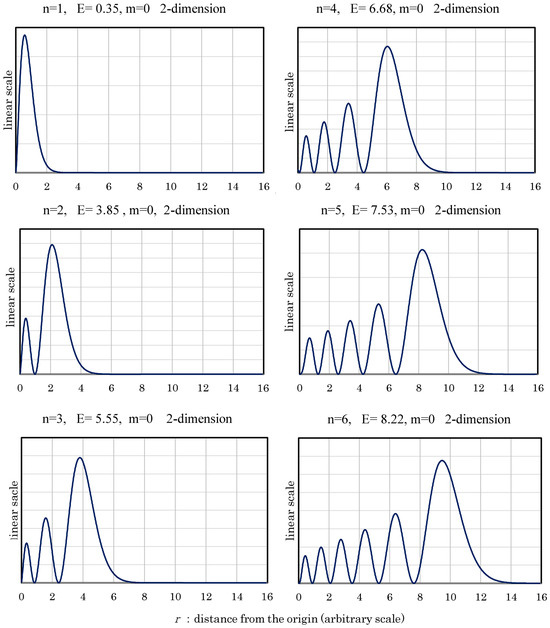
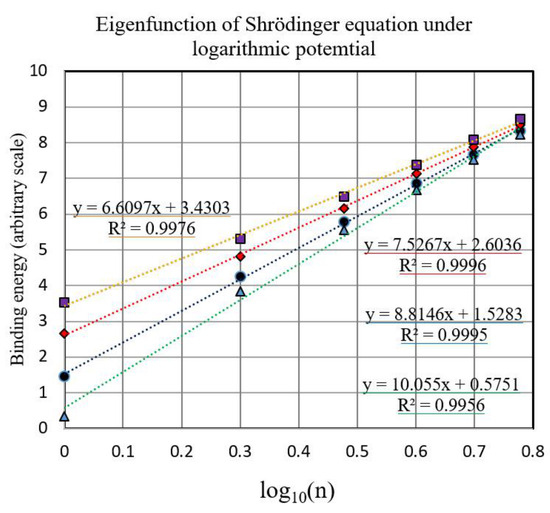
In this paper, we first show that the four masses of the Upsilon binding states—namely, through —composed of bottom quarks and anti-bottom quarks follow logarithmic spacing. The correlation coefficient R between the experimental values and the straight line is 0.99997, indicating an extremely good fit. When the three peaks— , , and , considered higher Upsilon binding states, as indicated in the recent Belle experiment—are added and plotted on the line of logarithmic spacing, the correlation coefficient R between the straight line and the experimental values for these seven “binding state levels” is 0.9998. If this line is extended to higher masses, an eighth peak in the cross-section is expected at a mass of (11,119 ± 10) MeV. In other words, it is predicted that the peak in the cross-section created by will be found in the Belle experiment in the future. Next, we consider why meson binding states are represented by a line with logarithmic spacing. An example is the electric field generated by a charge on a two-dimensional plane; the electric field created by a charge placed on the plane is expressed as , and the potential energy is expressed as . Therefore, we solve the two-dimensional Schrödinger equation numerically under and compare the results with the three-dimensional solution. We find that differences appear in the energy levels of the meson. Specifically, it is shown that the mass of the meson is closer to the value obtained by solving the two-dimensional Schrödinger equation. Based on this meson series, we predict the existence of a new meson with a mass of 3955 MeV.
Full article

Figure 1
Open AccessArticle
Effects of Isovector Spin–Orbit Interaction on the Charge-Weak Form Factor Difference in 48Ca, 208Pb, 90Zr and 62Ni
by
Tong-Gang Yue, Zhen Zhang and Lie-Wen Chen
Particles 2026, 9(2), 54; https://doi.org/10.3390/particles9020054 - 12 May 2026
Abstract
The nucleon spin–orbit interaction is a cornerstone of nuclear structure theory, yet its isospin dependence remains insufficiently constrained within modern nuclear energy density functional (EDF) theory. It was recently shown that, within the framework of extended Skyrme EDFs, the charge-weak form factor difference
[...] Read more.
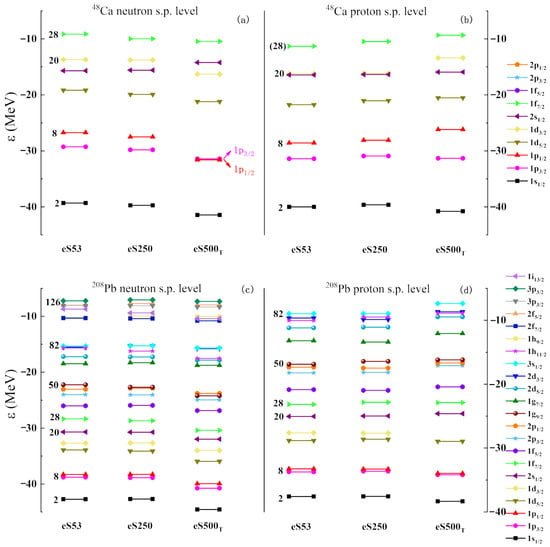
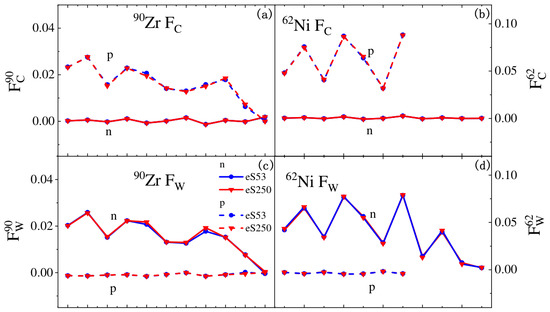
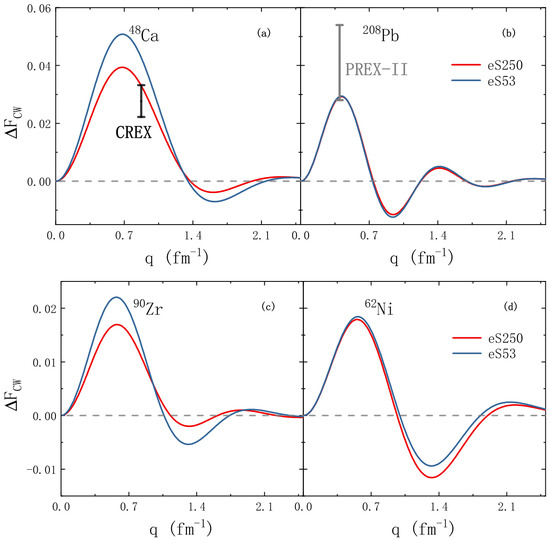
The nucleon spin–orbit interaction is a cornerstone of nuclear structure theory, yet its isospin dependence remains insufficiently constrained within modern nuclear energy density functional (EDF) theory. It was recently shown that, within the framework of extended Skyrme EDFs, the charge-weak form factor difference in 48Ca exhibits remarkable sensitivity to the effective isovector spin–orbit (IVSO) interaction, whereas in 208Pb is much less sensitive to this channel. Extending this analysis to other nuclei, we find that 90Zr, with its ten spin–orbit unpaired neutrons, displays a sensitivity to the IVSO strength similar to that of 48Ca, arising from modifications to the central mean-field potential rather than the one-body spin–orbit potential. In contrast, 62Ni, like 208Pb, remains largely insensitive to the IVSO interaction. This structure-driven distinction suggests an experimental strategy: future parity-violating electron scattering measurements, e.g., the MREX experiment at the MESA facility, on 48Ca and 90Zr would help constrain the effective IVSO strength, while measurements on 208Pb and 62Ni can provide a cleaner probe of the density dependence of the symmetry energy with reduced IVSO sensitivity.
Full article
(This article belongs to the Special Issue Selected Papers from the International Symposium Commemorating the 40th Anniversary of Halo Nuclei)
►▼
Show Figures

Figure 1
Open AccessArticle
The Absolute Stability and Mass Constraints of Strange Stars in the MIT Bag Model
by
Hasmik Shahinyan, Tigran Sargsyan and Arsen Babajanyan
Particles 2026, 9(2), 53; https://doi.org/10.3390/particles9020053 - 12 May 2026
Abstract
The primary objective of this study is a comprehensive investigation of the self-bound properties of strange quark matter (SQM), which is hypothesized to represent the absolute ground state of superdense strongly interacting matter. An analysis is performed within the framework of the MIT
[...] Read more.
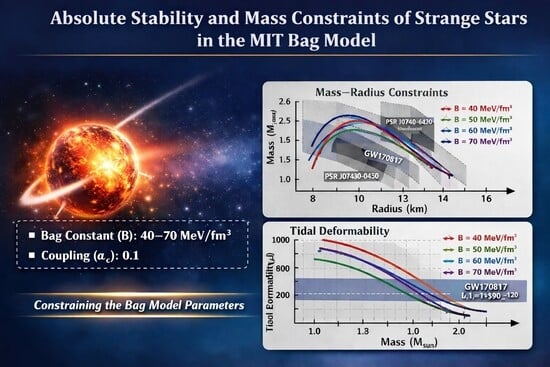
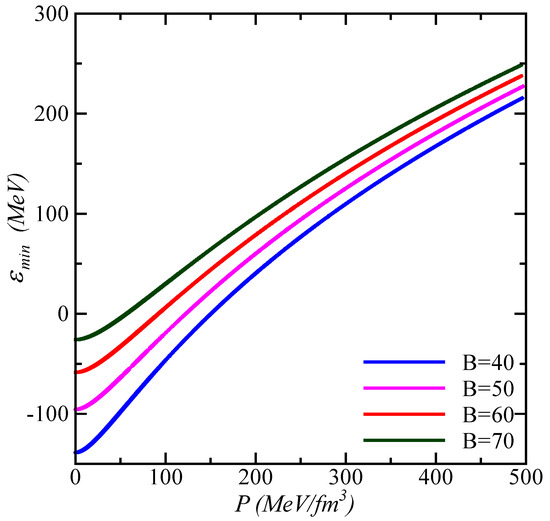
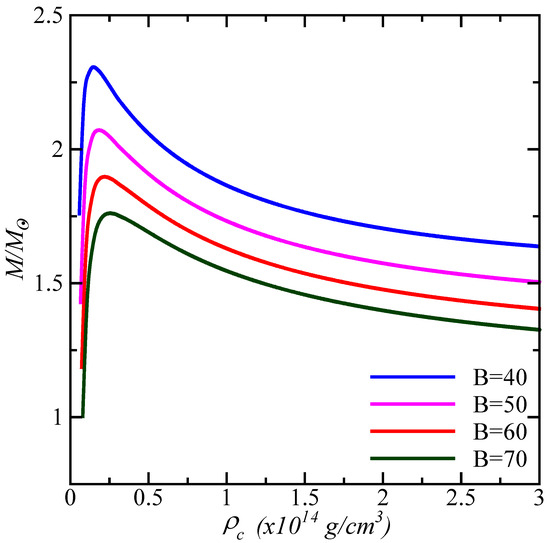
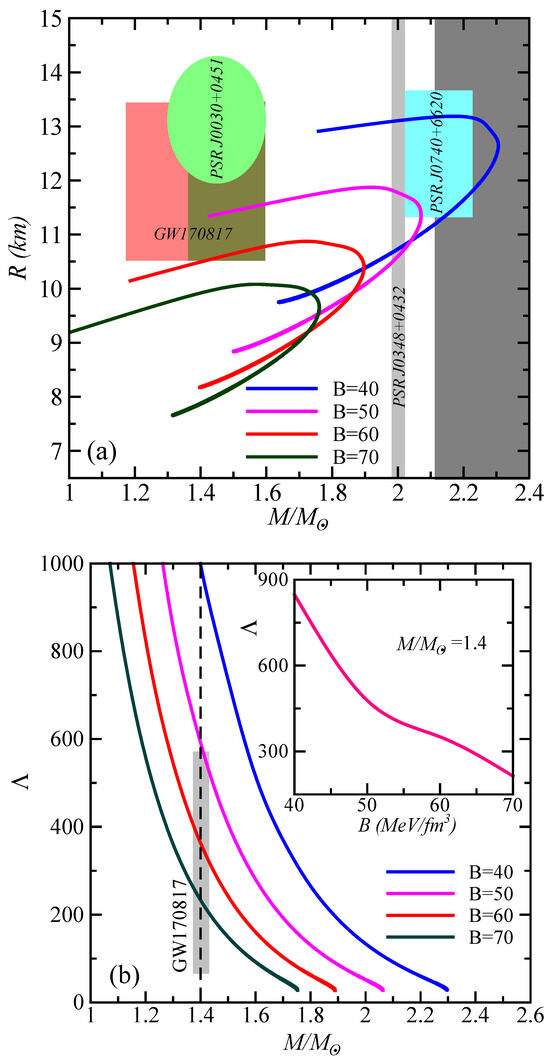
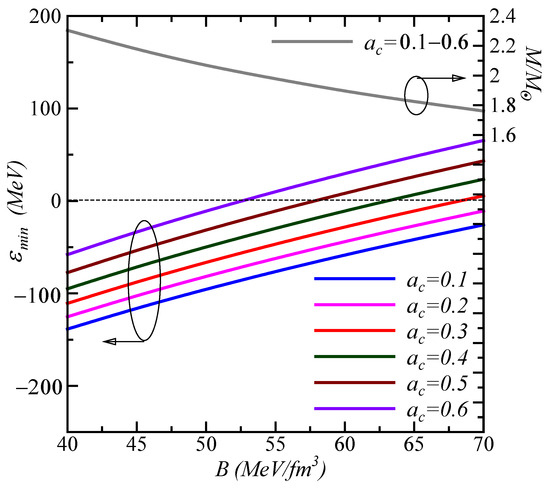
The primary objective of this study is a comprehensive investigation of the self-bound properties of strange quark matter (SQM), which is hypothesized to represent the absolute ground state of superdense strongly interacting matter. An analysis is performed within the framework of the MIT bag model, including first-order perturbative QCD corrections and the finite strange quark mass. By systematically varying the vacuum pressure (bag constant, ) and the strong coupling constant ( ) over a broad parameter space, while assuming a finite strange quark mass ( ), we explicitly compute the thermodynamic characteristics of the system including pressure, energy density, baryon number density, and the chemical potentials of quarks and charge-neutralizing electrons under conditions of -equilibrium and global charge neutrality. Particular emphasis is placed on determining the minimum energy per baryon, which serves as the criterion for absolute stability. For parameter sets satisfying the self-binding condition, the integral properties of strange stars are derived via the numerical integration of the Tolman–Oppenheimer–Volkoff equations. The resulting mass–radius and mass–central density relations are analyzed, yielding the maximum stellar masses in the range . This study identifies the regions in the space of phenomenological parameters that allow for pure self-bound strange stars and demonstrates the sensitivity of stability and stellar properties to the underlying bag model parameters.
Full article
(This article belongs to the Special Issue Selected Papers from “The Modern Physics of Compact Stars and Relativistic Gravity 2025”)
►▼
Show Figures

Graphical abstract
Open AccessArticle
Getting a Handle on Correlation Functions
by
Gernot Eichmann
Particles 2026, 9(2), 52; https://doi.org/10.3390/particles9020052 - 12 May 2026
Abstract
The central objects in a quantum field theory are its n-point correlation functions and matrix elements. Their structure is determined by Lorentz invariance and leads to tensor decompositions, the Lorentz-invariant coefficient functions of which encode the physics of the process. For growing
[...] Read more.
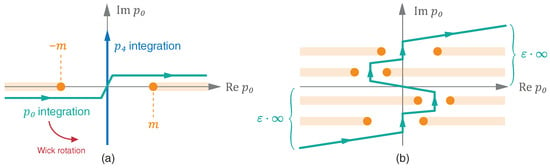
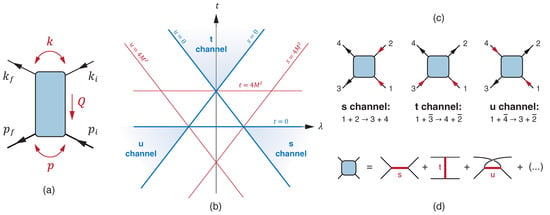
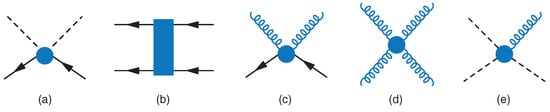
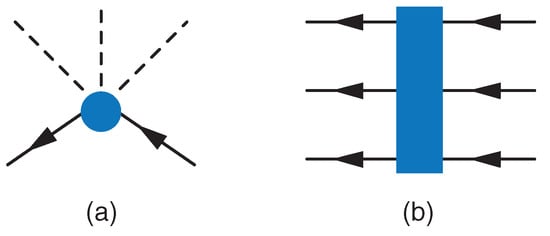
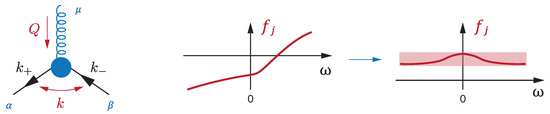
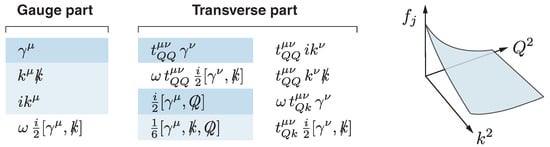
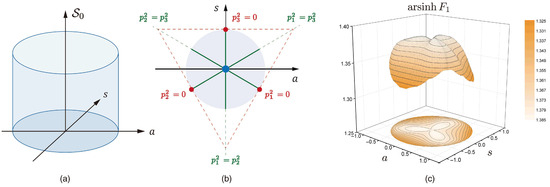
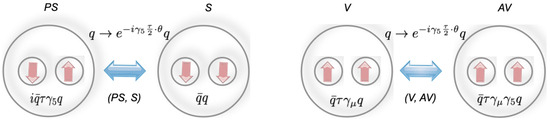
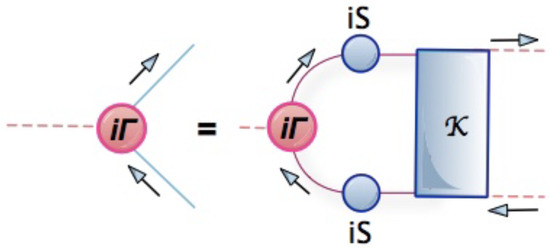
The central objects in a quantum field theory are its n-point correlation functions and matrix elements. Their structure is determined by Lorentz invariance and leads to tensor decompositions, the Lorentz-invariant coefficient functions of which encode the physics of the process. For growing n, the complexity of these objects may increase considerably and make it challenging to deal with them. Here, we give a pedagogical introduction to the topic and provide some tools to manage this complexity, and we will show how symmetries can be used as organizing principles.
Full article
(This article belongs to the Special Issue Strong QCD and Hadron Structure)
►▼
Show Figures

Figure 1

Open AccessArticle
Controlling Proton Acceleration with Advanced Gold Nanoantennas in a Kinetic Plasma Environment
by
Konstantin Zsukovszki and Istvan Papp
Particles 2026, 9(2), 51; https://doi.org/10.3390/particles9020051 - 11 May 2026
Abstract
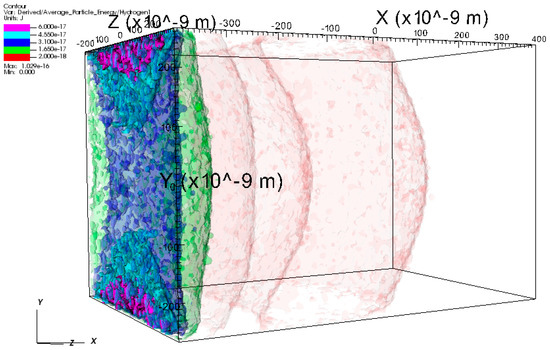
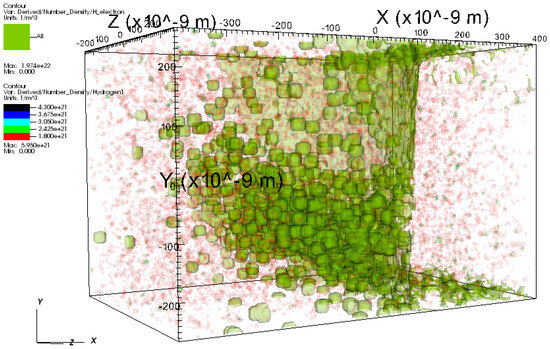
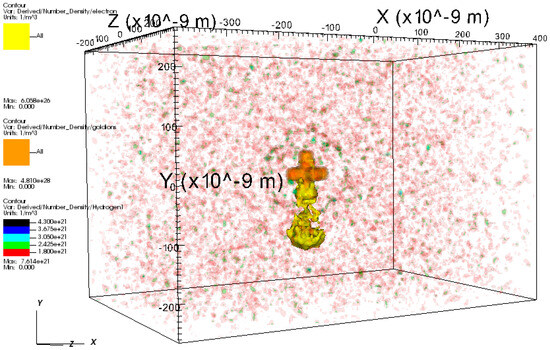
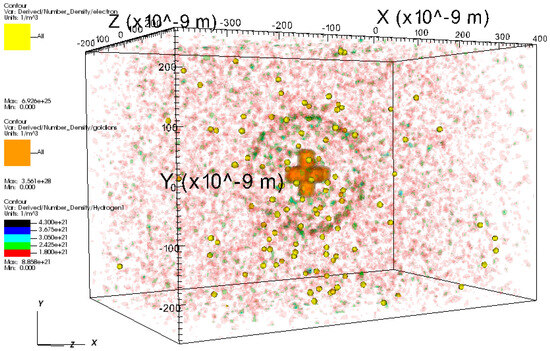
Metallic nanoantennas are promising structures for enhancing energy transfer in high-intensity laser–matter interactions, especially in nanoplasmonic-assisted fusion. Under ultrashort laser pulses, they generate strong localized fields, modify ionization dynamics, and significantly affect charge acceleration in dense media. In this work, we present a
[...] Read more.
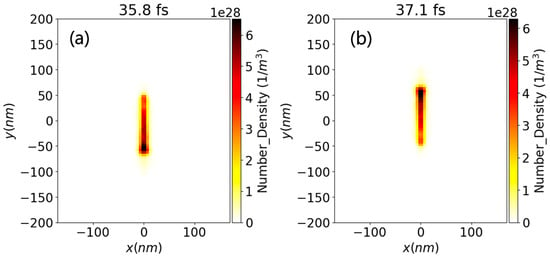
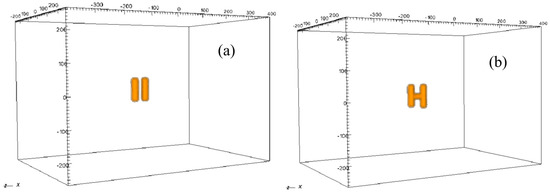
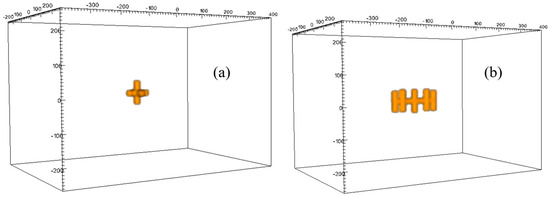
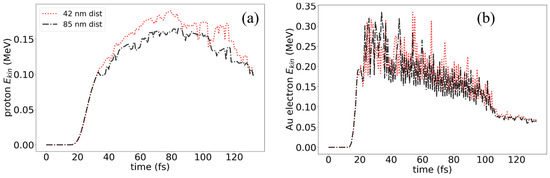
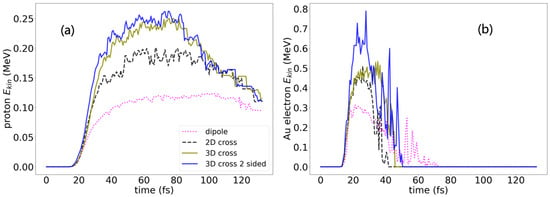
Metallic nanoantennas are promising structures for enhancing energy transfer in high-intensity laser–matter interactions, especially in nanoplasmonic-assisted fusion. Under ultrashort laser pulses, they generate strong localized fields, modify ionization dynamics, and significantly affect charge acceleration in dense media. In this work, we present a comprehensive particle-in-cell (PIC) study of gold nanoantennas of various geometries—dipoles, planar crosses, three-dimensional crosses, and Yagi-inspired planar structures—irradiated by near-infrared femtosecond pulses at intensities at a range of ~4 × 10¹⁷–4 × 10¹⁸ W/cm2. The antenna structures are embedded in a dense hydrogen-rich medium, allowing us to follow electron emission, gold ionization, and proton acceleration self-consistently. Crossed and Yagi-type geometries exhibit more robust resonant behavior than dipoles, with higher field localization and greatly reduced sensitivity to incident polarization. The proton energies increase to ~200 keV at 4 × 10¹⁷ W/cm2, and saturate around ~300 keV at a higher intensity >~4 × 10¹⁸ W/cm2, dependent on the geometry. This happens largely due to a rapid loss of conduction electrons from the gold structures. Our results highlight Yagi-based and cross-based nanoantennas as promising resonant dopes for laser-driven energy coupling and point toward optimized multi-arm architectures for future nanofusion-target engineering applications.
Full article
(This article belongs to the Special Issue Particles and Plasmas in Strong Fields)
►▼
Show Figures

Figure 1
Open AccessReview
A Halo: Triggering a New Era of Nuclear Correlations
by
Hiroyuki Sagawa, Xiao Lu and Shan-Gui Zhou
Particles 2026, 9(2), 50; https://doi.org/10.3390/particles9020050 - 9 May 2026
Abstract
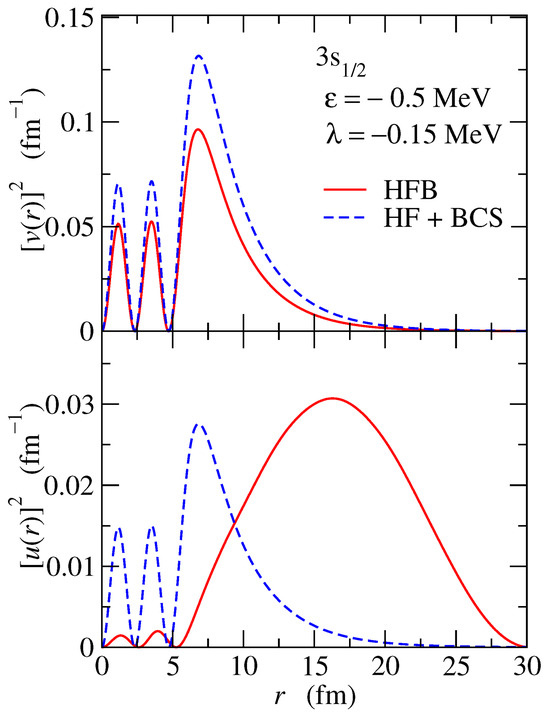
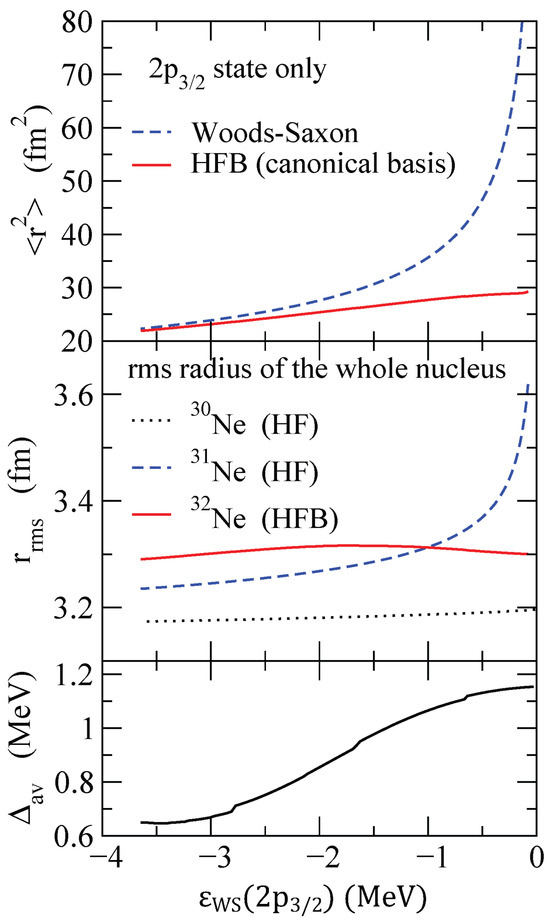
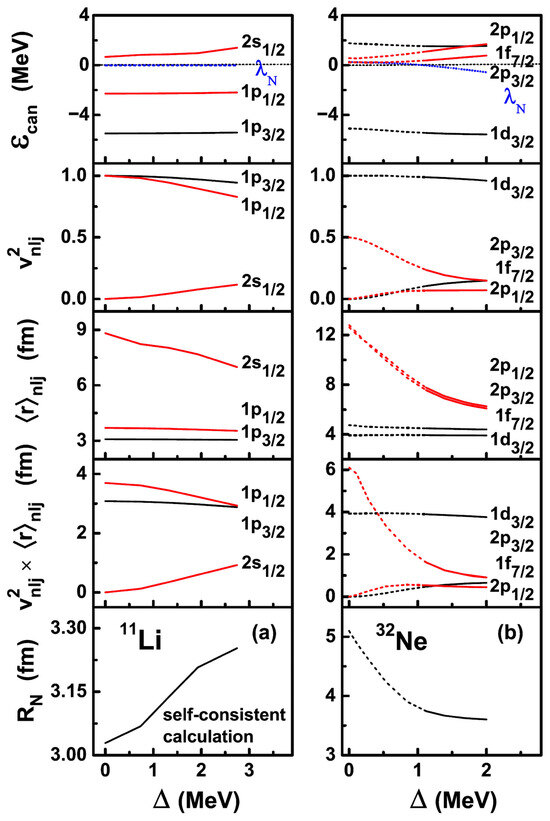
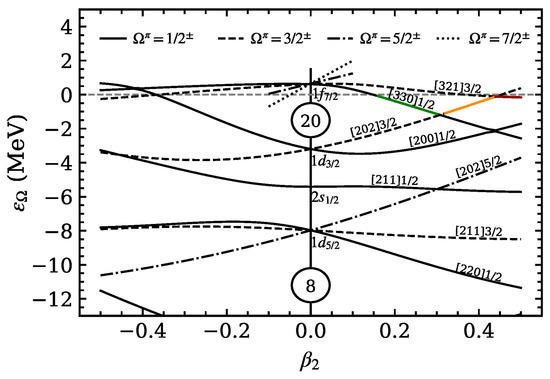
In this contribution to the Halo-40 Proceedings, we discuss two topics regarding halo phenomena. The first is the pairing anti-halo effect on the neutron radius of halo nuclei and the restoration of the halo due to the cancellation between the anti-halo effect and
[...] Read more.
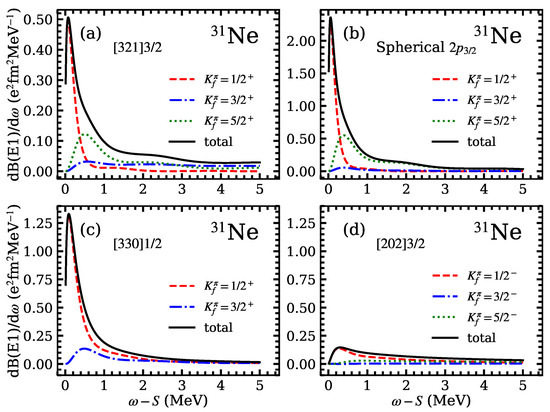
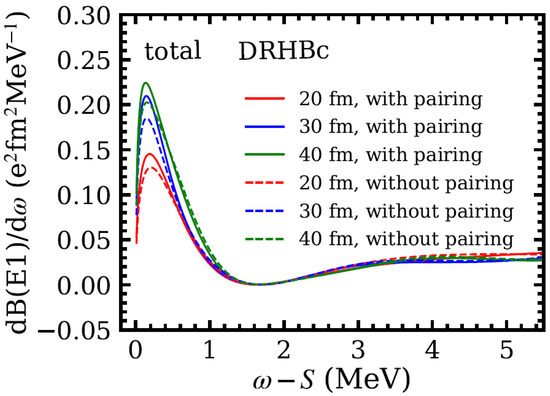
In this contribution to the Halo-40 Proceedings, we discuss two topics regarding halo phenomena. The first is the pairing anti-halo effect on the neutron radius of halo nuclei and the restoration of the halo due to the cancellation between the anti-halo effect and the continuum coupling; the second is the soft dipole excitation of deformed halo nuclei. We demonstrate the importance of Hartree–Fock–Bogoliubov and relativistic Hartree–Bogoliubov theory in a continuum for properly taking into account the halo nature of extended wave functions in the calculations of neutron radii as well as the soft dipole excitations of halo nuclei. It is shown that the anti-halo effect is very sensitive to the continuum coupling induced by Bogoliubov-type quasi-particles, which largely cancels the anti-halo effect on the neutron radius. The soft dipole excitations of deformed halo nuclei 31Ne and 37Mg are discussed within the deformed Woods–Saxon model. We point out that the sharp peak just above the threshold in the dipole response is created by the halo effect, and its strength can be used to identify the magnitude of deformation and the halo configuration in the Nilsson-level scheme.
Full article
(This article belongs to the Special Issue Selected Papers from the International Symposium Commemorating the 40th Anniversary of Halo Nuclei)
►▼
Show Figures

Figure 1
Open AccessArticle
Beaming of Polarized Radiation in Subcritical X-Ray Pulsars
by
Ivan D. Markozov, Alexander Y. Potekhin, Alexander D. Kaminker and Alexander A. Mushtukov
Particles 2026, 9(2), 49; https://doi.org/10.3390/particles9020049 - 5 May 2026
Abstract
Radiation of X-ray pulsars is powered by accretion on the neutron star surface from a binary companion under the influence of a strong magnetic field. We study the beaming of this radiation in the case of subcritical X-ray pulsars, where it is formed
[...] Read more.
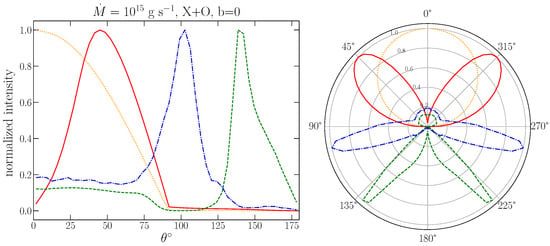
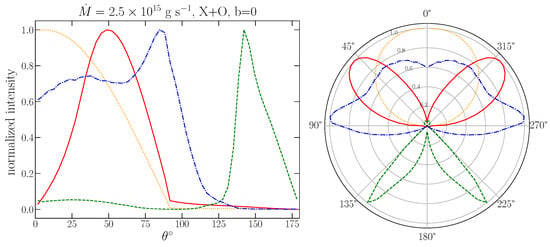
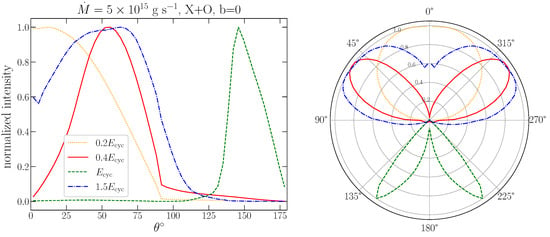
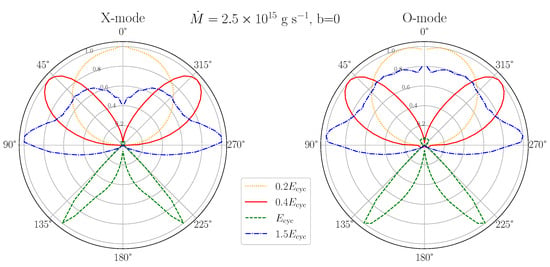
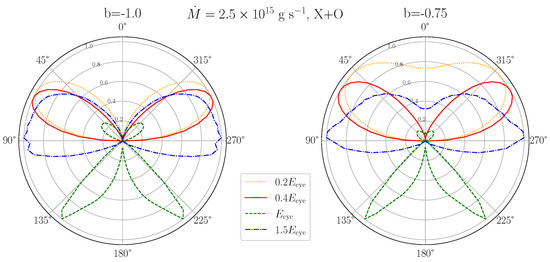
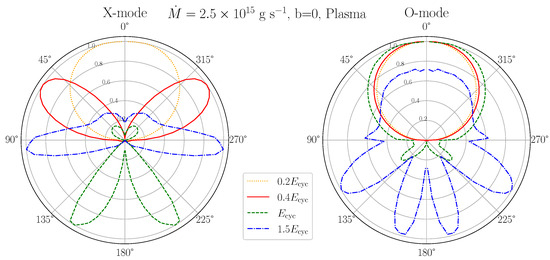
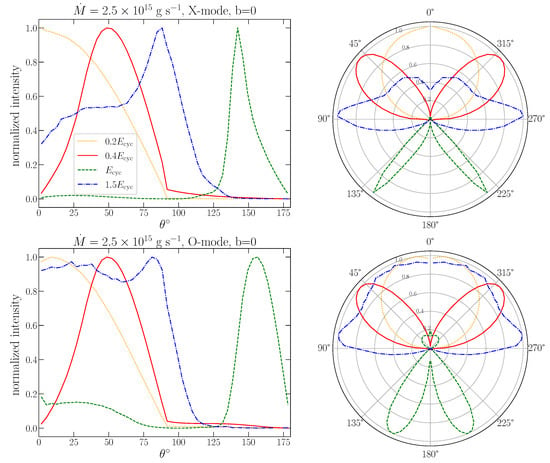
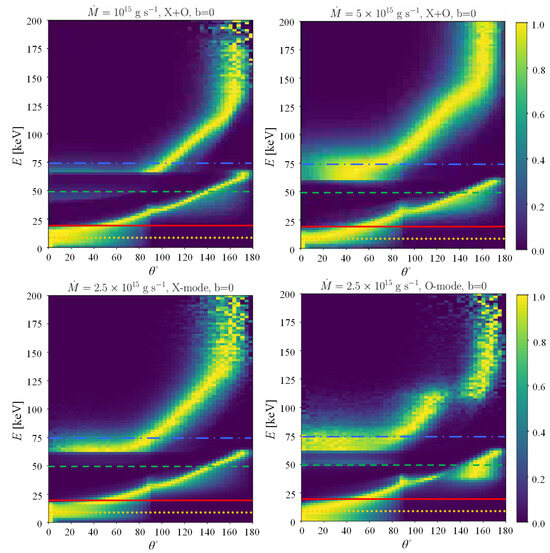
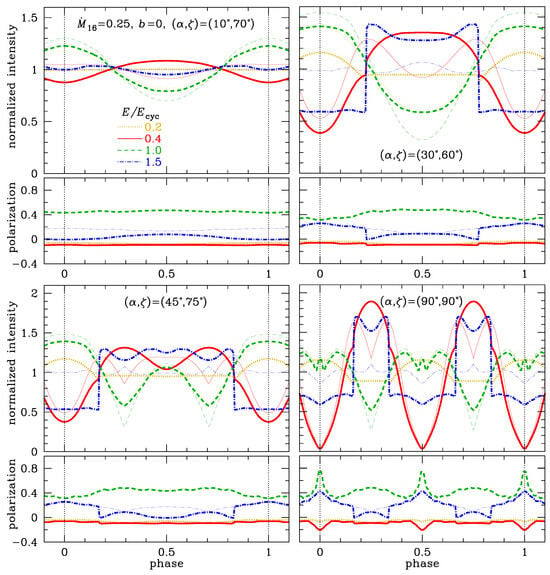
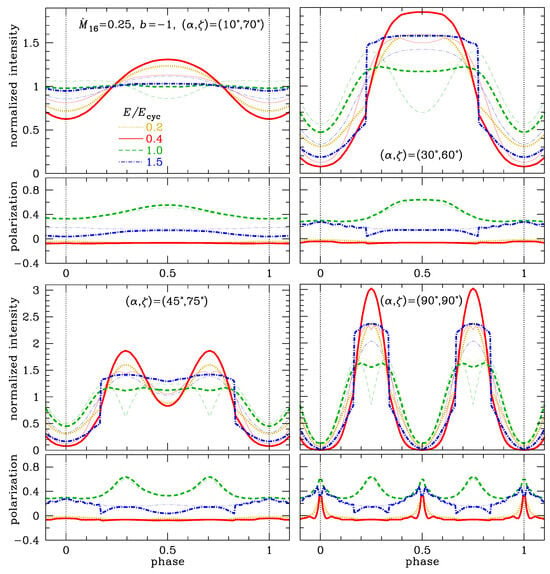
Radiation of X-ray pulsars is powered by accretion on the neutron star surface from a binary companion under the influence of a strong magnetic field. We study the beaming of this radiation in the case of subcritical X-ray pulsars, where it is formed in the accretion channel close to the neutron star surface. We solve equations of the hydrodynamics and radiative transfer of two coupled polarization modes in the accretion channel numerically, taking into account resonant Compton scattering and vacuum polarization. The beaming patterns are obtained for different accretion rates, photon energies, and polarizations, as well as for different models of the neutron star surface radiation. The calculated beaming patterns are converted into light curves for both the intensity and polarization, taking into account the effects of General Relativity. These beaming patterns and light curves are found to be strongly affected by the resonant Compton scattering for photon energies comparable with the electron cyclotron energy. In particular, the angular redistribution of radiation near the cyclotron resonance may reduce the light-curve modulation amplitude, which is consistent with observational indications of a suppressed pulsed fraction at these energies.
Full article
(This article belongs to the Special Issue Selected Papers from “The Modern Physics of Compact Stars and Relativistic Gravity 2025”)
►▼
Show Figures

Figure 1
Open AccessReview
Nuclear Exotic Structures, Exotic Decays and Near-Barrier Reactions
by
Cheng Yin, Chengjian Lin, Lei Yang, Feng Yang, Huiming Jia, Nanru Ma, Peiwei Wen and Tianpeng Luo
Particles 2026, 9(2), 48; https://doi.org/10.3390/particles9020048 - 1 May 2026
Abstract
The reaction dynamics of weakly-bound nuclear systems at near-barrier energies is a compelling topic in nuclear physics. This review summarizes decades of experimental work by the Nuclear Reaction Group at the China Institute of Atomic Energy. Using transfer reactions with the distorted wave
[...] Read more.
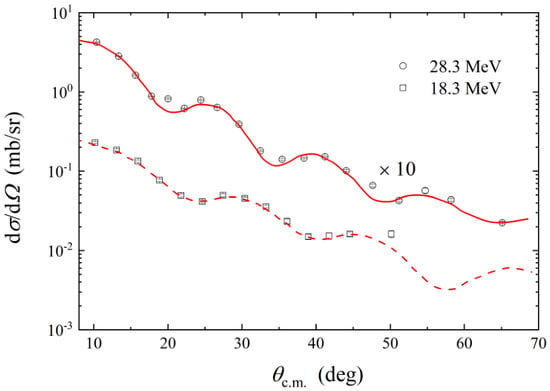
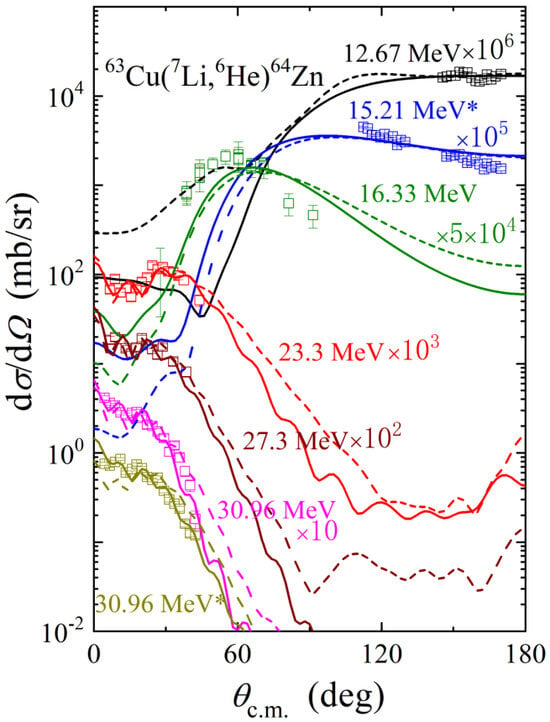
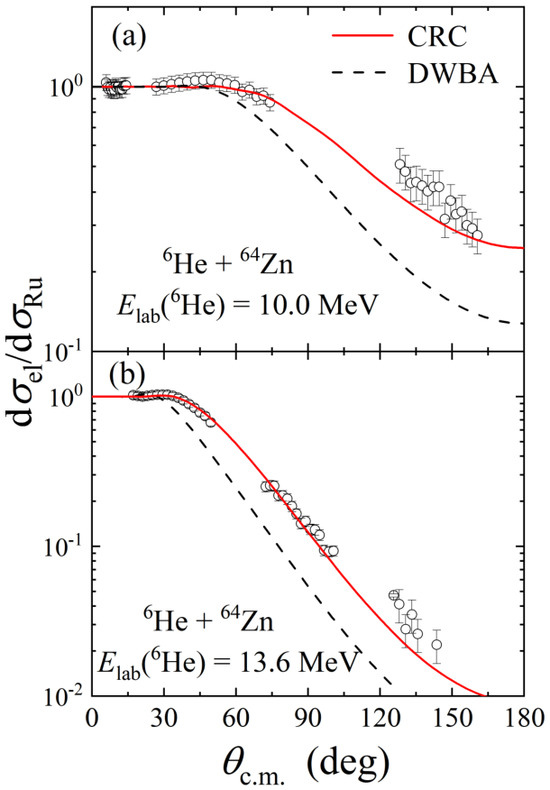
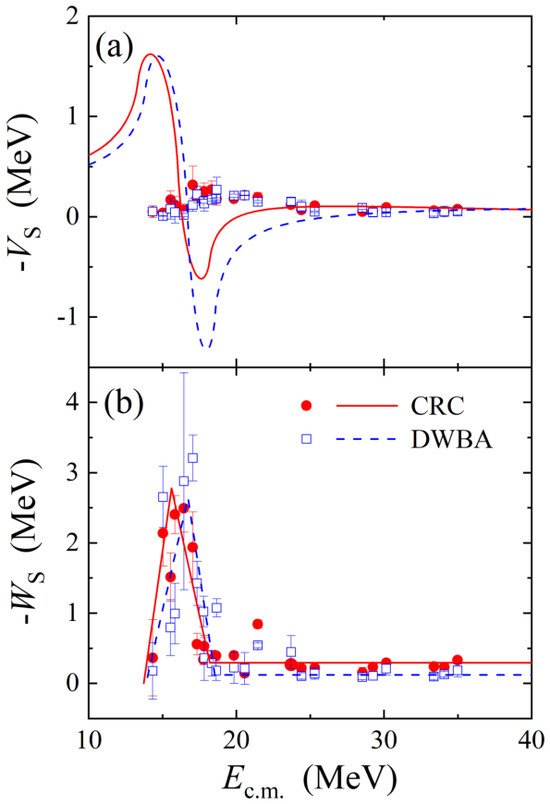
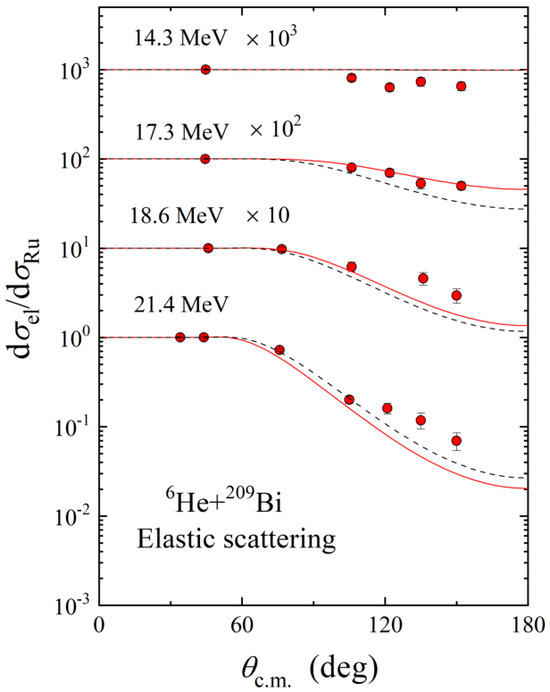
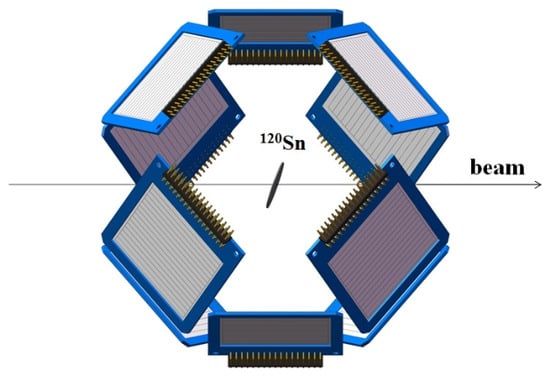
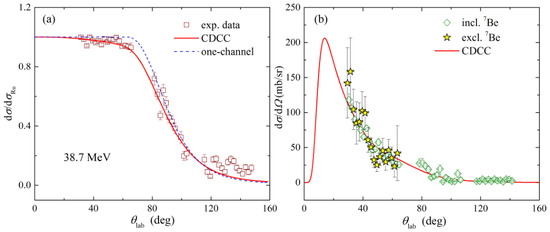
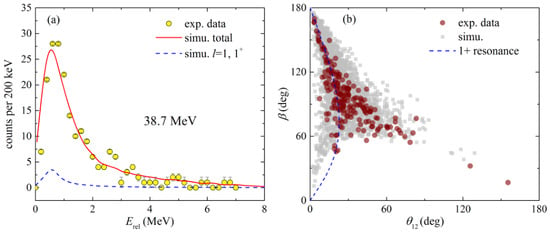
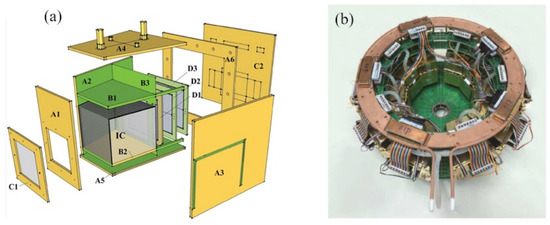
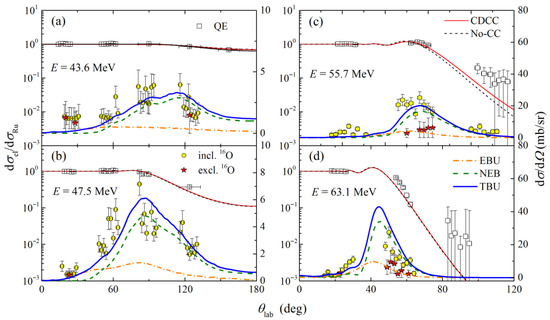
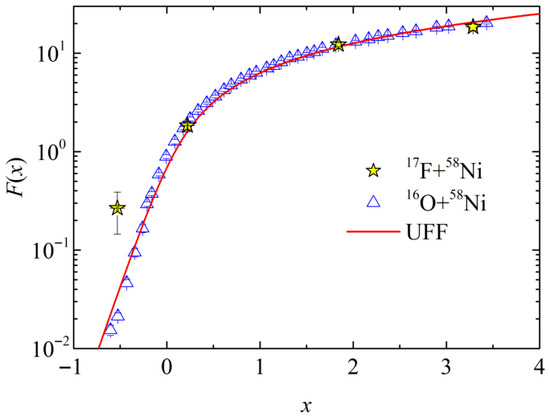
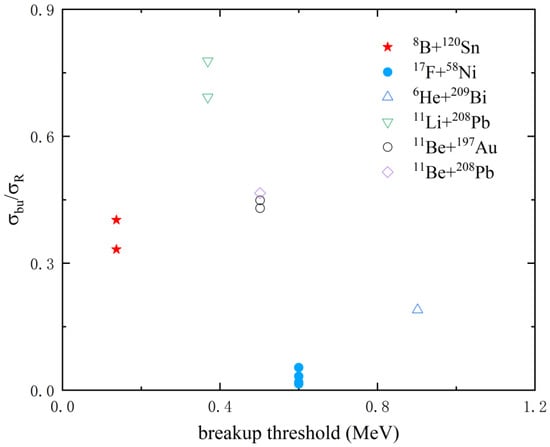
The reaction dynamics of weakly-bound nuclear systems at near-barrier energies is a compelling topic in nuclear physics. This review summarizes decades of experimental work by the Nuclear Reaction Group at the China Institute of Atomic Energy. Using transfer reactions with the distorted wave born approximation and asymptotic normalization coefficient analyses, we confirm the first excited neutron halo (13C) on the -stability line and identified new halo states in 12B. Total reaction cross-section measurements revealed proton halo nuclei and , with core enlargement observed in and . We established conditions for halo formation and delineated the proton halo existence region. In two-proton emission studies, we observed cluster emission from highly excited and , with being the second such case internationally. In -delayed decay, we discovered 2p emission in and determined its mass, observing isospin-symmetry breaking in , , and . Decay schemes for and addressed the abundance problem. For nuclear interactions, we investigated the optical potential, finding the dispersion relation inapplicable for + , and developed notch and Bayesian methods to constrain uncertainties. For unstable nuclei, the proton drip-line systems 8B and 17F have been intensively studied via complete kinematics measurements of the 8B + 120Sn and 17F + 58Ni reactions, respectively. The results show that elastic breakup dominates for proton-halo , while inelastic breakup prevails for , with proton-rich nuclei exhibiting lower breakup probabilities than neutron-halo nuclei due to Coulomb effects. Fusion studies revealed sub-barrier enhancement in + from continuum couplings. We propose direct fusion–evaporation measurements with deflection systems integrated with breakup detection to disentangle complete and incomplete fusion channels.
Full article
(This article belongs to the Special Issue Selected Papers from the International Symposium Commemorating the 40th Anniversary of Halo Nuclei)
►▼
Show Figures

Figure 1
Open AccessArticle
Lifetime Measurements—A Powerful Tool to Study Nuclear Structure
by
Dimitar Tonev, Galina D. Dimitrova, Anguel Demerdjiev, Giovanni De Gregorio, Giacomo de Angelis, Elena Geleva, Nikolay Goutev, Nikolay N. Petrov, Ivaylo Pantaleev and Lilianna Panteleev-Simeonova
Particles 2026, 9(2), 47; https://doi.org/10.3390/particles9020047 - 1 May 2026
Abstract
Advanced Doppler-shift methods for the calculation of the γ-ray lineshape registered in recoil-distance Doppler-shift and Doppler-shift attenuation methods are presented, emphasizing the case using a gate set on the shifted part of a direct feeding transition. For the precise description of the γ-ray
[...] Read more.
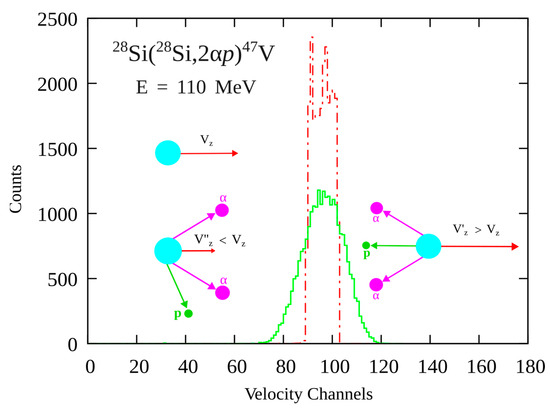
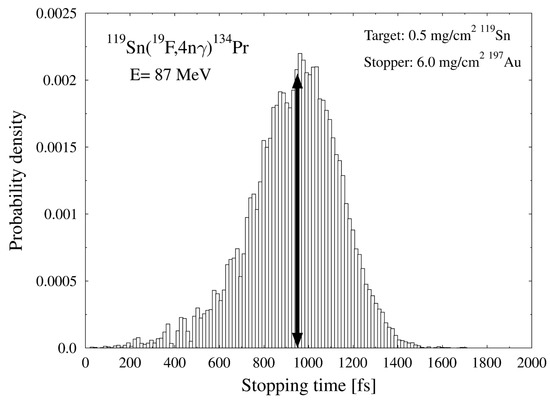
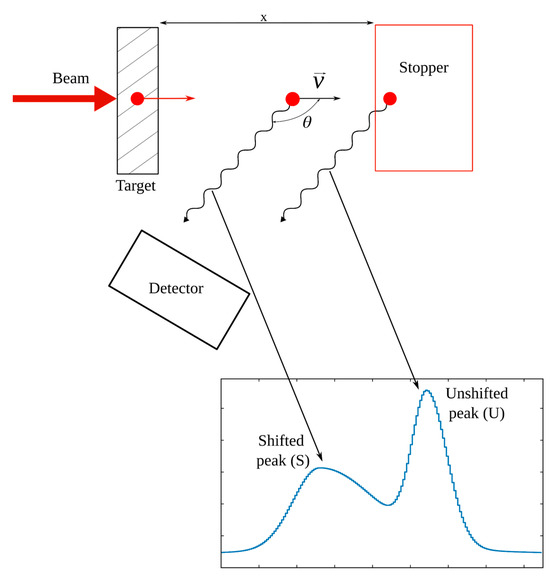
Advanced Doppler-shift methods for the calculation of the γ-ray lineshape registered in recoil-distance Doppler-shift and Doppler-shift attenuation methods are presented, emphasizing the case using a gate set on the shifted part of a direct feeding transition. For the precise description of the γ-ray lineshape, the process of evaporation of light particles from the compound nucleus has to be taken into account in the case of heavy ion-induced fusion-evaporation reactions. In addition, the impact of different approaches for calculating stopping powers is investigated in the process of the lifetime determinations. In the RDDS experiments, the γ-emission during the slowing down in the stopper is discussed in detail. Applications of the new procedures are demonstrated in two experiments: the first one is a plunger experiment performed in order to check for chirality in the 134Pr nucleus and the second one is a DSAM experiment conducted to test the isospin symmetry in 31P and 31S mirror nuclei.
Full article
(This article belongs to the Special Issue Selected Papers from the International Symposium Commemorating the 40th Anniversary of Halo Nuclei)
►▼
Show Figures

Figure 1
Open AccessReview
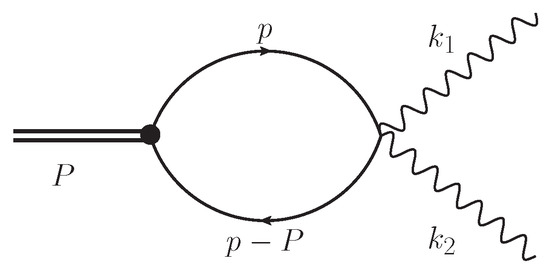
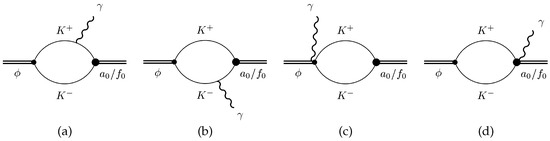
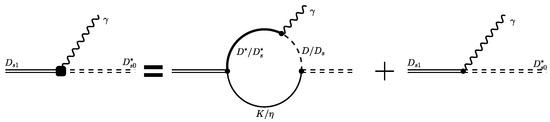
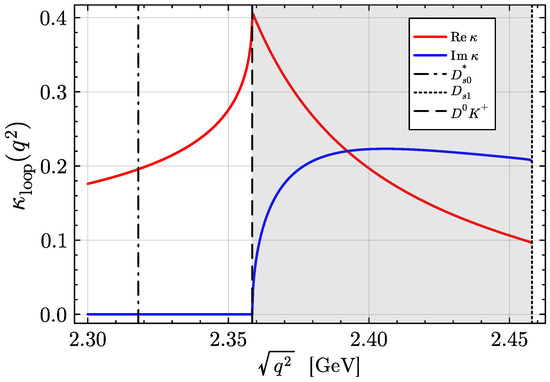
Radiative Decays of Hadronic Molecules: From Confusion to Inspiration
by
Feng-Kun Guo, Christoph Hanhart and Alexey Nefediev
Particles 2026, 9(2), 46; https://doi.org/10.3390/particles9020046 - 28 Apr 2026
Abstract
Radiative decays of hadronic states provide an essential source of information that can facilitate deciphering their nature and properties. However, a lot of confusion concerning radiative decays of hadronic molecules and their interpretation can be found in the literature. In this paper, we
[...] Read more.
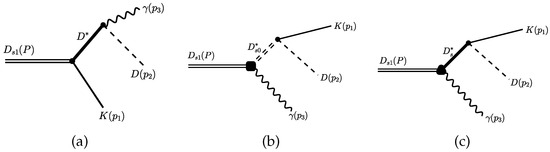
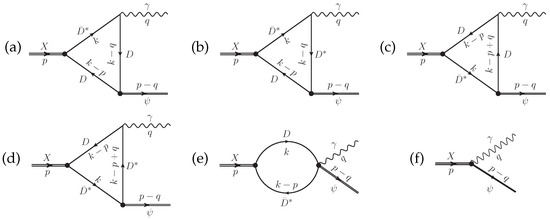
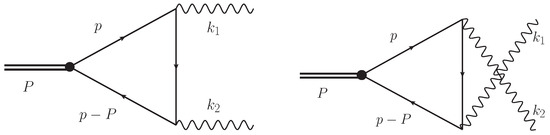
Radiative decays of hadronic states provide an essential source of information that can facilitate deciphering their nature and properties. However, a lot of confusion concerning radiative decays of hadronic molecules and their interpretation can be found in the literature. In this paper, we briefly review several types of such decays and pinpoint similarities and essential differences between them. In particular, we emphasise the crucial role played by the hierarchy of the scales relevant to the studied system and the resulting necessity of employing an approach that considers them appropriately. We illustrate the situation with several instructive examples.
Full article
(This article belongs to the Special Issue Strong QCD and Hadron Structure)
►▼
Show Figures

Figure 1
Open AccessReview
Symmetry- Preserving Contact Interaction Approaches: An Overview of Meson and Diquark Form Factors
by
Laura Xiomara Gutiérrez-Guerrero and Roger José Hernández-Pinto
Particles 2026, 9(2), 45; https://doi.org/10.3390/particles9020045 - 24 Apr 2026
Abstract
We present an updated overview of the symmetry-preserving contact interaction model in hadronic physics, which was developed a little over a decade ago to describe the mass spectrum and internal structure of mesons and diquarks composed of light and heavy quarks. Over the
[...] Read more.
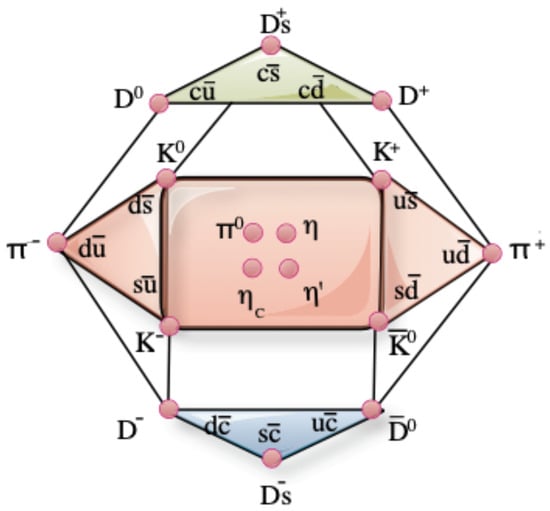
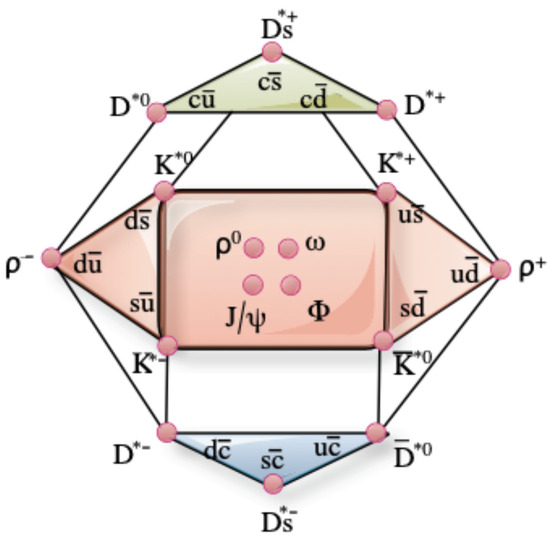
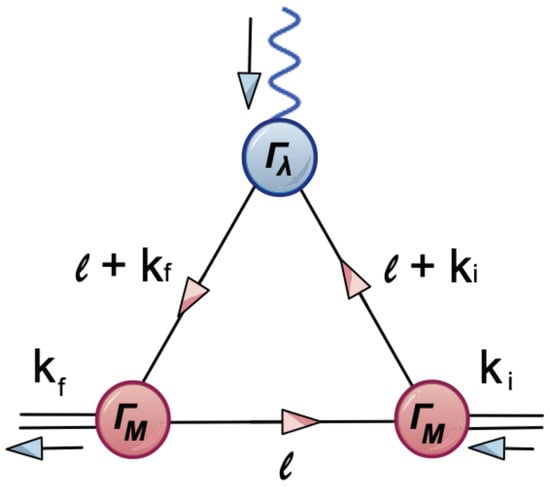
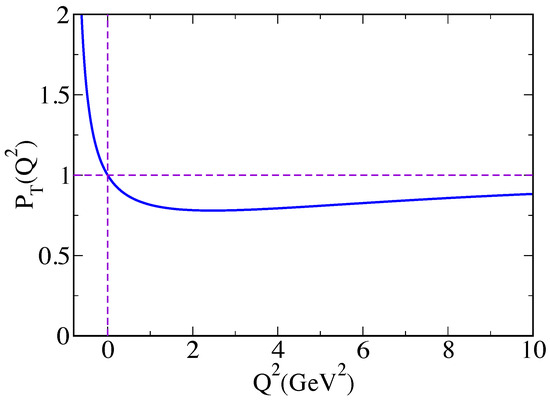
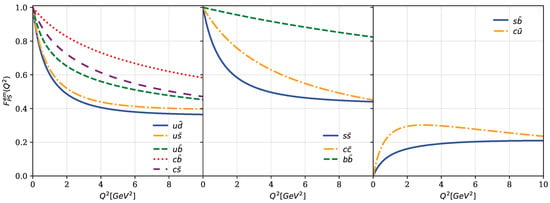
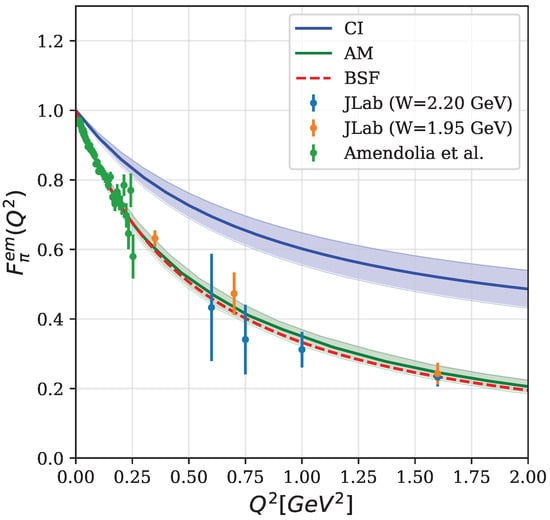
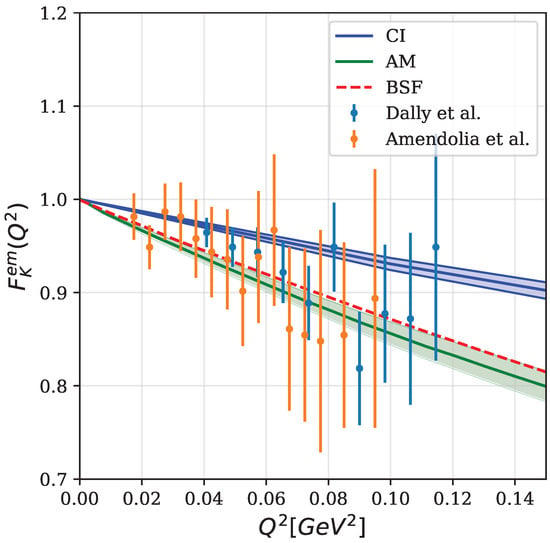
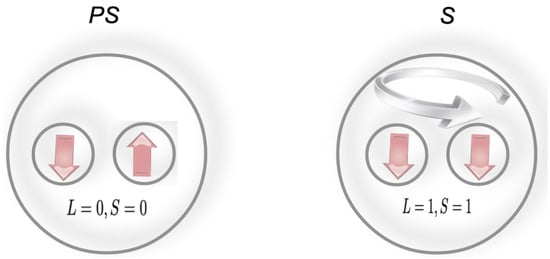
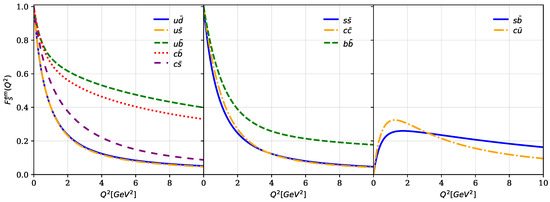
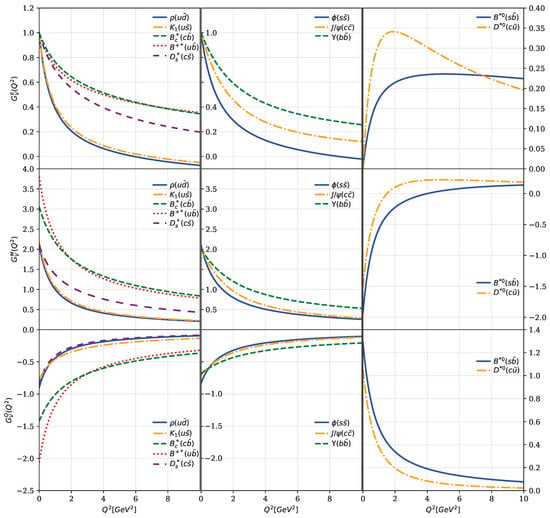
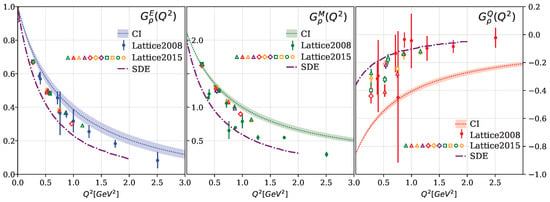
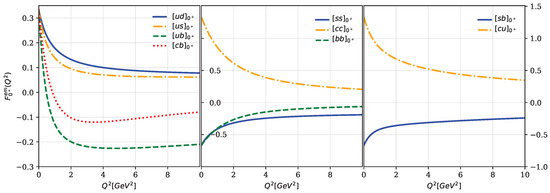
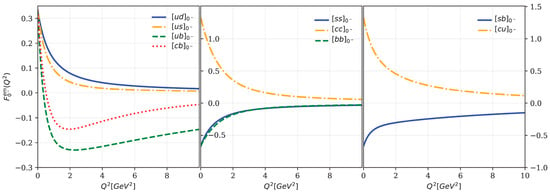
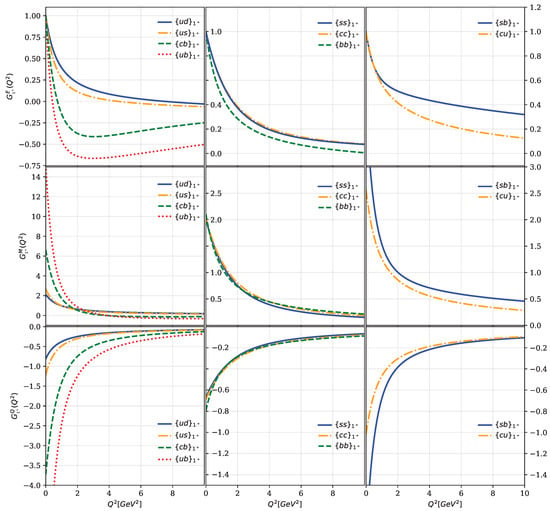
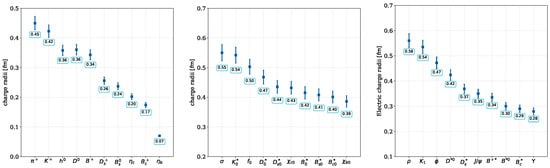
We present an updated overview of the symmetry-preserving contact interaction model in hadronic physics, which was developed a little over a decade ago to describe the mass spectrum and internal structure of mesons and diquarks composed of light and heavy quarks. Over the years, the contact interaction model has evolved into a framework capable of treating both ground and excited states, providing a simple yet consistent approach to nonperturbative QCD. In this review, we examine the mass spectrum and elastic form factors of forty mesons with different spins and parities, together with their corresponding diquark partners. Importantly, we update the comparison of contact interaction predictions using recent results from the literature, offering a fresh perspective on the model’s performance, strengths, and limitations. The analysis presented here refines previous conclusions and supports the contact interaction model as a practical tool for hadron structure studies, with potential applications to baryons and multiquark states. We also present comparisons with other theoretical models and approaches, including lattice quantum chromodynamics, and comment on future prospects in view of ongoing and planned experimental programs regarding hadron structure. In particular, forthcoming measurements at FAIR together with future studies at Jefferson Lab and the Electron Ion Collider are expected to provide key insights into hadron structure, with FAIR offering indirect constraints via hadron spectroscopy, hadronic interactions, and in-medium properties; high-precision data on meson structure and form factors from Jefferson Lab and the Electron Ion Collider will provide valuable benchmarks with which to confront predictions based on the contact interaction model.
Full article
(This article belongs to the Special Issue Strong QCD and Hadron Structure)
►▼
Show Figures

Figure 1
Highly Accessed Articles
Latest Books
E-Mail Alert
News
Topics
Topic in
Symmetry, Galaxies, Universe, Particles, Astronomy
Dark Matter, Dark Energy and Cosmological Anisotropy
Topic Editors: Kazuharu Bamba, Panayiotis Stavrinos, Ivan De MartinoDeadline: 31 December 2026
Special Issues
Special Issue in
Particles
Strong QCD and Hadron Structure
Guest Editors: Zhu-Fang Cui, Craig RobertsDeadline: 30 June 2026
Special Issue in
Particles
Selected Papers from XXVIII Workshop “What Comes Beyond the Standard Models?”: New Trends in Particle Cosmology
Guest Editor: Maxim Y. KhlopovDeadline: 30 June 2026
Special Issue in
Particles
AI and Machine Learning in Dark Matter Searches: From Anomaly Detection to Detector Optimization
Guest Editors: Ankush Reddy Kanuganti, Ashik Ikbal SheikhDeadline: 30 June 2026
Topical Collections
Topical Collection in
Particles
Dark Matter and New Physics of Hidden Particles
Collection Editors: Valery E. Lyubovitskij, Dmitry V. Kirpichnikov, Alexey S. Zhevlakov