


Journal Menu
► ▼ Journal Menu-
- Polymers Home
- Aims & Scope
- Editorial Board
- Reviewer Board
- Topical Advisory Panel
- Instructions for Authors
- Special Issues
- Topics
- Sections & Collections
- Article Processing Charge
- Indexing & Archiving
- Editor’s Choice Articles
- Most Cited & Viewed
- Journal Statistics
- Journal History
- Journal Awards
- Society Collaborations
- Conferences
- Editorial Office
Journal Browser
► ▼ Journal BrowserNeed Help?
Announcements
22 January 2026
“Do Not Be Afraid of New Things”: Prof. Michele Parrinello on Scientific Curiosity and the Importance of Fundamental Research

In atomic and molecular simulation, researchers have long-needed efficient ways to predict material properties in order to focus on the most promising real laboratory tests instead of redundant work. Addressing this challenge, Prof. Michele Parrinello introduced two transformative methods that have redefined the field: the Car–Parrinello method, which serves as a “virtual lab” for studying reactions and electronic properties, and the Parrinello–Rahman method, a cornerstone for crystal phase transition studies. His work has reshaped the way that we study atomic systems, earning him the status of one of the most cited scholars in his field.
To honor his enduring legacy and continued impact, MDPI has established the Michele Parrinello Award. This award celebrates innovation and recognizes senior scientists who have made outstanding contributions to computational physical sciences, spanning the fields of physics, chemistry, and materials science.
We had the great honor of speaking with Prof. Parrinello in an exclusive interview, where he shared his perspectives on his current research focus, personal scientific experiences, support for basic research, and his advice for global researchers.
Access the full interview to hear his insights in this conversation.
4 December 2025
Meet Us at the Polymers 2026: Trends, Innovation and Future Conference, 25–28 June 2026, Nanjing, China

We are pleased to announce that the Polymers 2026: Trends, Innovation and Future conference will be held in Nanjing, China, from 25 to 28 June 2026. This conference is organized by MDPI’s open access journal Polymers (IF 4.9, CiteScore 9.7). After the great success of Polymers 2018 in Barcelona, Polymers 2022 in Turin, and Polymers 2024 in Athens, Polymers 2026 is set to raise the bar once again—bringing together global experts to explore the latest breakthroughs and future directions in polymer science.
Conference Chairs:
- Prof. Dr. Sixun Zheng, Shanghai Jiao Tong University, China;
- Prof. Dr. Xuming Xie, Tsinghua University, China;
- Prof. Dr. Dimitrios Bikiaris, Aristotle University of Thessaloniki, Greece.
This conference brings together global experts in polymer science, engineering, and technology to explore cutting-edge innovations—from green and sustainable chemistry to AI-powered material design.
Session topics of interest:
S1. Polymer Synthesis;
S2. Green Sustainable Polymers;
S3. Polymer Processing;
S4. Polymer Networks and Gels;
S5. Polymer Composites;
S6. Polymer Applications;
S7. Polymers and the Environment;
S8. Artificial Intelligence in Polymer Science.
Important dates:
Deadline for abstract submission: 26 February 2026;
Notification of acceptance: 26 March 2026;
Deadline for Early Bird registration: 2 April 2026;
Deadline for covering author registration: 9 April 2026;
Deadline for registration: 25 May 2026.
Guide for authors:
To submit your abstract, please click on the following link: https://sciforum.net/user/submission/create/1478.
To register for the event, please click on the following link: https://sciforum.net/event/polymers2026?section=#registration.
For details regarding Abstract Submission, Poster and Slide Submission, and Publication Opportunities, you may refer to the “Instructions for Authors” section: https://sciforum.net/event/polymers2026?section=#instructions.
Do not miss this unique opportunity to be at the forefront of the Polymers transformation.
For any enquiries regarding the event, please contact polymers2026@mdpi.com.
6 November 2025
MDPI Launches the Michele Parrinello Award for Pioneering Contributions in Computational Physical Science
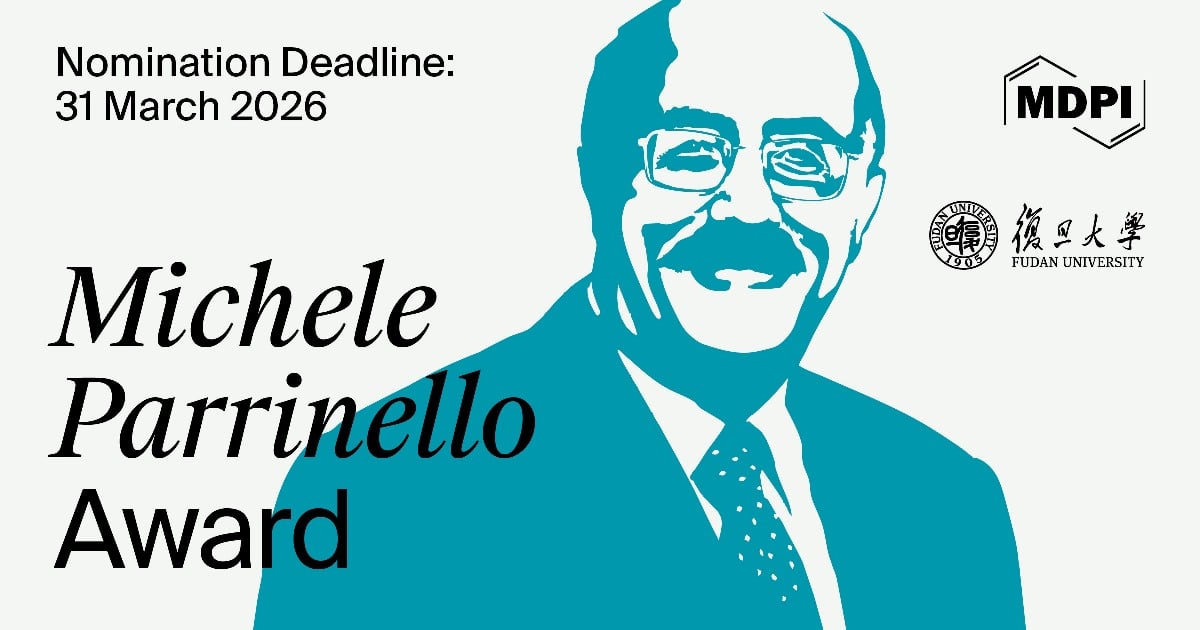
MDPI is delighted to announce the establishment of the Michele Parrinello Award. Named in honor of Professor Michele Parrinello, the award celebrates his exceptional contributions and his profound impact on the field of computational physical science research.
The award will be presented biennially to distinguished scientists who have made outstanding achievements and contributions in the field of computational physical science—spanning physics, chemistry, and materials science.
About Professor Michele Parrinello
"Do not be afraid of new things. I see it many times when we discuss a new thing that young people are scared to go against the mainstream a little bit, thinking what is going to happen to me and so on. Be confident that what you do is meaningful, and do not be afraid, do not listen too much to what other people have to say.”
——Professor Michele Parrinello
 |
Born in Messina in 1945, he received his degree from the University of Bologna and is currently affiliated with the Italian Institute of Technology. Professor Parrinello is known for his many technical innovations in the field of atomistic simulations and for a wealth of interdisciplinary applications ranging from materials science to chemistry and biology. Together with Roberto Car, he introduced ab initio molecular dynamics, also known as the Car–Parrinello method, marking the beginning of a new era both in the area of electronic structure calculations and in molecular dynamics simulations. He is also known for the Parrinello–Rahman method, which allows crystalline phase transitions to be studied by molecular dynamics. More recently, he has introduced metadynamics for the study of rare events and the calculation of free energies. |
For his work, he has been awarded many prizes and honorary degrees. He is a member of numerous academies and learned societies, including the German Berlin-Brandenburgische Akademie der Wissenschaften, the British Royal Society, and the Italian Accademia Nazionale dei Lincei, which is the major academy in his home country of Italy.
Award Committee
 |
The award committee will be chaired by Professor Xin-Gao Gong, a computational condensed matter physicist, academician of the Chinese Academy of Sciences, and professor at the Department of Physics, Fudan University. Professor Xin-Gao Gong will lead a panel of several senior experts in the field to oversee the evaluation and selection process. The Institute for Computational Physical Sciences at Fudan University (Shanghai, China), led by Professor Xin-Gao Gong, will serve as the supporting institute for the award. |
"We hope the Michele Parrinello Award will recognize scientists who have made significant contributions to the field of computational condensed matter physics and at the same time set a benchmark for the younger generation, providing clear direction for their pursuit—this is precisely the original intention behind establishing the award."
——Professor Xin-Gao Gong
The first edition of the award was officially launched on 1 November 2025. Nominations will be accepted before the end of March 2026. For further details, please visit mparrinelloaward.org.
About the MDPI Sustainability Foundation and MDPI Awards 
The Michele Parrinello Award is part of the MDPI Sustainability Foundation, which is dedicated to advancing sustainable development through scientific progress and global collaboration. The foundation also oversees the World Sustainability Award, the Emerging Sustainability Leader Award, and the Tu Youyou Award. The establishment of the Michele Parrinello Award will further enrich the existing award portfolio, providing continued and diversified financial support to outstanding professionals across various fields.
In addition to these foundation-level awards, MDPI journals also recognize outstanding contributions through a range of honors, including Best Paper Awards, Outstanding Reviewer Awards, Young Investigator Awards, Travel Awards, Best PhD Thesis Awards, Editor of Distinction Awards, and others. These initiatives aim to recognize excellence across disciplines and career stages, contributing to the long-term vitality and sustainability of scientific research.
Find more information on awards here.
5 February 2026
Acknowledgment to the Reviewers of Polymers in 2025

The editorial office of Polymers would like to extend its sincere gratitude to all reviewers who contributed to the improvement of the journal quality by providing their expert opinion and evaluation of the submitted research.
We appreciate that thorough peer review demands considerable time and intellectual investment from our reviewers. In 2025, Polymers received 15716 review reports from contributors across 87 countries and territories, demonstrating the breadth of international expertise and scholarly engagement that has strengthened our publication standards.
The reviewers who agreed to have their names published this year are listed below in alphabetical order by first name. The editorial team acknowledges with gratitude all reviewers, named and anonymous alike, for their vital role in maintaining the scholarly standards of Polymers.
| A. B. M. A. Kaish | Hitesh Chopra | Parthiban Kathirvel |
| A. Raja Annamalai | Hong Lei | Patrícia Santiago de Oliveira Patrício |
| Aase Reyes | Hongfeng Xie | Patrycja Bałdowska-Witos |
| Abdelnasser Abidli | Hongxing Kang | Patrycja Zakrzewska |
| Abdul Ghaffar | Hongxuan Chen | Paul Wai Kei Tsang |
| Abdulmoseen Segun Giwa | Hongyu Wang | Paula Berton |
| Abdulnaser M. Alshoaibi | Hongyu Xing | Paulina Parcheta-Szwindowska |
| Abdulsalam Alhalmi | Hossam Nabwey | Paulo Ortega |
| Abhishek Ghosh | Hossein Abdollahi | Paulo Santos |
| Abimbola Oluwatayo Orisawayi | Hsu-Cheng Chiang | Pavel Ivchenko |
| Abir Saha | Huanhuan Wu | Pavel Nikishau |
| Abraham Samuel Finny | Huanyu Lei | Pavel Sergeevich Gerasimenko |
| Achanai Buasri | Huaping Wang | Pavel Yudaev |
| Adam Ekielski | Huixin Chen | Pavle M. Spasojevic |
| Adam Wosatko | Hynek Balcar | Pavlos Efthymiopoulos |
| Adela Melcrova | Hyun Duck Kwak | Paweł Sajkiewicz |
| Adela-Eliza Dumitrascu | Ian Wyman | Pedaballi Sireesha |
| Adi Pax Pandzic | Ianatul Khoiroh | Pedro Campos Lopes |
| Aditya Chivate | Ibrahim Alsohaimi | Pedro D. Vaz |
| Adrian Bonilla-Petriciolet | Ibrahim Mohamed | Pedro Veiga Rodrigues |
| Adrian Lewandowski | Ícaro Thiago Andrade Moreira | Peiguo Zhou |
| Adriana Kenđel | Idris Arslan | Peijiang Liu |
| Agata Wawrzyńczak | Ifeyinwa Ijeoma Obianyo | Peirong Zhang |
| Agnieszka Gładysz-Płaska | Igal Meir Shohet | Peiying Zhang |
| Ahmad Adlie Shamsuri | Ignacio Rintoul | Pellegrino La Manna |
| Ahmad Kueh | Igor Dmitrievich Zlotnikov | Pelosi Claudia |
| Ahmed El-Fiqi | Igor Eremenko | Peng Jia |
| Ahmed El-Harairy | Igor Makarov | Peng Wang |
| Ahmed Elkilani | Igor V. Bezsudnov | Peng Zhang |
| Ahmed Fatimi | Igor V. Shishkovsky | Pengfei Wu |
| Ahmed Galal Ibrahim | Ilfir Ramazanov | Pengfei Zhao |
| Ahmed Maamoun | Ilia Sergeevich Martakov | Percy Festus Alao |
| Ahmed Mourtada Elseman | Ilmutdin M. Abdulagatov | Petar Antov |
| Ahmed S. El-Ashwah | Ilsiya Davletbaeva | Peter Rusinov |
| Ahsan Sarwar Rana | Ilya A. Zavidovskiy | Petr M. Korusenko |
| Ajay Jayswal | Imad Antypas | Petr S. Sokolov |
| Ajay Kumar Sahi | In Woo Cheong | Petr Smolka |
| Ajay Singh | Ioan Petean | Petros Mourouzis |
| Ajit Kumar Katiyar | Ioana Chiulan | Philip R. Barnett |
| Ajoy Kanti Mondal | Ioannis Tsivintzelis | Pier Nicola Sergi |
| Akash Kumar | Ion Cosmin Calina | Ping Xiang |
| Akeem Adeyemi Oladipo | Ion Razvan Radulescu | Ping Zhu |
| Akhmad Irhas Robby | Ionut Luchian | Piotr Izak |
| Akinori Kuzuya | Ionut-Iulian Lungu | Piotr M. Zieliński |
| Akshayakumar Kompa | Iouliana Chrysafi | Piotr Owczarz |
| Alaa Younis | Irena Žmak | Piotr Przybysz |
| Alan Beteta | Irina Le-Deygen | Polona Dobnik Dubrovski |
| Alberto García-Peñas | Isabel Lado Touriño | Ponnusami Venkatachalam |
| Alberto Giubilini | Islam M. Nabil | Pornsatit Sookchoo |
| Albina Ziganshina | Ismat Ali | Powei Huang |
| Aldo Tamburrino | Ivaldo Itabaiana Jr. | Prabhu Sethuramalingam |
| Alejandro Chamizo Ampudia | Ivalina Avramova Avramova | Pradeep Kumar Panda |
| Alejandro J. Alvarez | Ivan Nikolaevich Erdakov | Pradyuman Kumar |
| Aleksandr Kazachenko | Ivan Ristić | Pranjyan Dash |
| Aleksandr L. Kim | Ivan Ružiak | Prasad Lokhande |
| Aleksandra B. Nastasović | Ivan S. Stefanović | Pratap Kollu |
| Aleksandra Mikhailidi | Ivan Shatskyi | Pratchaya Tipduangta |
| Aleksei A. Titov | Ivan Yu. Skvortsov | Praveen Naik |
| Aleksei Dubrovskii | Ivana Bolanča Mirković | Predrag Dašić |
| Aleksei Vozniakovskii | Ivaylo Dimitrov | Preeta Sharan |
| Aleksey Shapagin | Ivelina Tsacheva | Preeti Kush |
| Alessandro Dal Pozzo | Izabela Irska | Přemysl Lubal |
| Alex Palma-Cando | Jacek Iwko | Priyanka Biswas |
| Alex Valadez-Gonzalez | Jacek Krawczyk | Priyaranjan Samal |
| Alexander A. Paletsky | Jacek Lukasz Wilk-Jakubowski | Przemysław Dorożyński |
| Alexander Bannov | Jacek Nowaczyk | Przemysław Górnaś |
| Alexander Chirkunov | Jagoda Kurowiak | Qian Xu |
| Alexander Churyumov | Jamiu Mosebolatan Jabar | Qiang Jiang |
| Alexander I. Titkov | Jan Macutkevic | Qiang Wei |
| Alexander Khomich | Janaína Oliveira Gonçalves | Qiang Xue |
| Alexander Korolev | Janitha Jeewantha | Qing Lu |
| Alexander L. Kwiatkowski | Janusz Musiał | Qing Wang |
| Alexander M. Volodin | Jasmina Jovan Popovic | Qingfeng Yang |
| Alexander Protsenko | Jasvir Singh | Qingheng Lai |
| Alexander Ryzhkov | Javad Esmaeili | Qinghua Wang |
| Alexander Sidorenko | Jaymin Vrajlal Sanchaniya | Qing-Ping Ding |
| Alexander Syuy | Jean-Marc Tulliani | Qingsheng Wang |
| Alexandra Daniela Rotaru-Zavaleanu | Jean-Pierre Habas | Qiong Li |
| Alexej Bubnov | Jefferson Ricardo Pereira | Quandong Huang |
| Alexey Beskopylny | Jegadeeshwaran Rakkiyannan | Quanjin Ma |
| Alexey Nickolaevich Masliy | Jerzy Bochnia | Rabia Ayub |
| Alfredo Juan | Jesús Manuel Rodríguez-Rego | Radu Ioachim Comaneci |
| Ali Delibas | Jesús Mengual | Rafael Shehu |
| Ali Ercetin | Jia Woei Wong | Rafał Bielas |
| Ali Fallah | Jian Yang | Rafal Krzywon |
| Ali Habeeb Askar | Jianchao Zou | Rafal Malinowski |
| Ali Maged | Jiang Gong | Raffaele Longo |
| Ali Mardani | Jiangang Yu | Ragaa A. Hamouda |
| Ali Mohammed Babalghaith | Jianguang Liu | Raheem Al-Sabur |
| Ali Nawaz | Jianguo Li | Rahela Kulčar |
| Aliaa N. Elmeshad | Jianjun Cheng | Rahul Kumar Gupta |
| Alina Aleksandrovna Borisenkova | Jianwen Shao | Rahulkumar Sunil Singh |
| Alina Crina Muresan | Jiao Liu | Raj Kumar Arya |
| Alina Elena Coman | Jiaotong Sun | Rajamani Ranjithkumar |
| Alin-Daniel Rizea | Jiawei Wan | Rajat Subhra Karmakar |
| Alireza Ostadrahimi | Jie Gao | Rajeev Kumar |
| Aliya Safiulina | Jie Li | Rajeshkumar Lakshminarasimhan |
| Ambikapathi Nivetha | Jie Zheng | Rajkishor Kumar |
| Amir Hatamie | Jihhuai Tan | Rakesh A. Afre |
| Amir Khan | Jin Wang | Rakesh Rajaboina |
| Amir R. Masoodi | Jin-Gang Liu | Ram Krishna Upadhyay |
| Amir Rostami | Jingwei Tian | Ram Yegappan |
| Amir Tabakovic | Jingyu Cai | Ramalingam Malathy |
| Amit Kumar Goyal | Jinhua Li | Ramalingam Senthil |
| Amlana Panda | Jinsu Kim | Raman Kumar |
| Ammar Melaibari | Jitendra Kumar Katiyar | Ramani Sujatha |
| Amol Dilip Gholap | Jithin Vishnu | Ramaswamy Sandeep Perala |
| Amr Henni | Jiying Liu | Ramendra Pati Pandey |
| Amrita Kundu | Joanna Brzeska | Ramu Murugan |
| Amroune Salah | Joanna Jaworska | Ran Chen |
| Ana Beatriz Morales Cepeda | Joanna Mystkowska | Ran Huang |
| Ana-María Díaz-Díaz | Jochen Vogt | Randall C. Boehm |
| Ana-Maria Manea-Saghin | Jojo P. Joseph | Raphael Kanyire Seidu |
| Anand Prakash Jaiswal | Jolanta Janutėnienė | Rashid Dallaev |
| Anandharaj Marimuthu | Jonas Jose Perez Bravo | Ravi Maharjan |
| Anant Kurhade | Jonas Stiller | Ravichandran Manickam |
| Anastasia Ivanova | Jordi-Roger Riba | Rawil Fakhrullin |
| Anastasia Zubareva | Jorge Alfonso Belgodere | Reem Shomal |
| Anastasiia Krivoruchko | Jose Alves Dias | Regina M. Islamova |
| Anastasiya Solovieva | Jose D. Badia-Valiente | Rehan Bhatti |
| Anatoli I. Popov | Jose Ferreira | Reinier Akkermans |
| Anca Florina Bonciu | José Luis Olivares-Romero | Renuka Patil |
| Andrea Mescola | Jose Luis Rivera | Reymark Maalihan |
| Andrea Pucci | Jose Luis Rivera-Armenta | Reza Bazargan-Lari |
| Andreas Koster | José Luis Rivera-Armenta | Reza Salehiyan |
| Andreea D. Ona | Juana M. Pérez | Riaz Muhammad |
| Andrei Chernil'nik | Jugal Kishore Kumawat | Ricardo Chagas |
| Andrei Marius Mihalache | Jun Feng | Richard Hrčka |
| Andrei Okhokhonin | Jun Liu | Richard Thompson |
| Andrei Sarbu | Jun Sheng Yang | Rijo John |
| Andrey Ashotovich Nagdalian | Junaid Mohammad Khan | Rishabh Debraj Guha |
| Andrey E. Krauklis | Junjie Jiang | Rishi Ranjan Kumar |
| Andrey Kuskov | Junyan Yi | Ritesh Kant Gupta |
| Andrey Mereshchenko | Junying Li | Riwei Xu |
| Andrey Minakov | Jüri Liiv | Robert Luo |
| Andrey Petrovich Vasilev | Justina Šeštokė | Roddel Remy |
| Andrey Shcherbakov | K. A. Martin Xavier | Rodrigo Pessoa |
| Andrey Smagin | Kadhim K. Resan | Roger M. Rowell |
| Andrey Tikhonov | Kai Song | Roman Irgashev |
| Andrey Vasilev | Kai Wang | Roman Popielarz |
| Andrey Veniaminov | Kaiyu Wang | Roman V. Chernozem |
| Andrey Viktorovich Basko | Kalaimani Markandan | Rosangela Mastrangelo |
| Andrey Zhuikov | Kalavathy Rajan | Rosie Yagmur Yegin |
| Andrzej Jarosław Panas | Kalman Imre | Rossella Arrigo |
| Andrzej Łukaszewicz | Kamel Mouloudj | Rubaiyet Haque |
| Angel Guillermo Bracamonte | Kamel Touileb | Rudolf Holze |
| Anik Karan | Karen Esquivel | Rudolf Pfaendner |
| Anilkumar Thaghalli Shivanna | Karingamanna Jayanarayanan | Rufina Zilberg |
| Anindhya Sundar Das | Karol Kamil Kłosiński | Rui Feng |
| Aniruddha Nag | Karolina Rolińska | Rui Han |
| Anjan Motamarry | Karthik Kannan | Rui Miranda Guedes |
| Anjani Devi Chintagunta | Karthik Krishnasamy | Rui Vilao |
| Anka Trajkovska Petkoska | Karthikeyan Prakasham | Rui Zhang |
| Anna Kamenskikh | Kasama Jarukumjorn | Ruiyuan Huang |
| Anna Kulminskaya | Kashif Javed | Rumyana Stanimirova |
| Anna Magiera | Katarzyna Cieslak | Ruogu Tang |
| Anna Shipovskaya | Katarzyna Tandecka | Ruoxing Wang |
| Anna Sienkiewicz | Katarzyna Wilpiszewska | Ruslan R. Kayumov |
| Anton Belogorlov | Kavirajaa Pandian Sambasevam | Rustam A. Gumerov |
| Anton Georgievich Kalmykov | Kawate Tomoko | Sanjeev Ramchandra Shukla |
| Anton Krivosheev | Keitaro Sou | S. Shams Es-haghi |
| Anton Kuzmin | Khongsak Srikaeo | Sabah Javaid |
| Anton Mostovoy | Khuram Maqsood | Sabrina Palanti |
| Antoneta Tomljenović | Kiadtisak Saenboonruang | Sadaqat Khan |
| Antonio del Bosque | Kinga Korniejenko | Sadeq Abdullah Abdo Alkhadher |
| Antonio Gaspar-Cunha | Kira E. Vostrikova | Saeideh Pahlavan |
| Antonio Pollicino | Kirill A. Lozovoy | Sagar Salave |
| Antonios Stamopoulos | Kit-Leong Cheong | Sagar Umesh Patil |
| An-Yi Chang | Kiyokazu Yasuda | Sagar Vishnudas Kanhere |
| Apostolos Korlos | Kong Yue | Said A. Hassan |
| Arafa Hassen | Konrad Andrzej Szychowski | Saikat Sinha Ray |
| Arif Ali Baig Moghal | Konstantin Rodygin | Saishuai Wen |
| Ariffin Ahmad Hamdan | Konstantin V. Deriabin | Salvatore Impemba |
| Arkadiusz Zarski | Konstantin V. Khishchenko | Sam Sung Ting |
| Arman Moini Jazani | Konstantina Tsikrika | Saman Ghahri |
| Arsalan Ahmed | Konstantinos Beltsios | Sami Ghnimi |
| Artem Bakirov | Konstantinos Ninikas | Saminathan Mani |
| Artem Belesov | Koray Açıcı | Samir Basha Basha Eskander |
| Artem Okulov | Koumei Baba | Sammar F. Elhabal |
| Arun Kumar Shukla | Kozhunova Elena | Sandeep Kumar Singh |
| Arun Kumar Singh | Krishnan Rangan | Sandip S. Shinde |
| Arvind Negi | Krzysztof Adam Ostrowski | Sandor Kristyan |
| Ashish Kumar Nayak | Krzysztof Maciejewski | Sanja J. Armakovic |
| Ashish Soni | Krzysztof Skrzypkowski | Sanjay Kumar |
| Ashutosh Kumar | Krzysztof Wilczyński | Sanjay Kumar Singh Patel |
| Asif Iqbal | Kubilay Kaptan | Sanjit Acharya |
| Asif Khan | Kumar K. R. | Santhosh Nagaraja |
| Asim Laeeq Khan | Kumara Bommanahalli Nagaraju | Santiago Ferrandiz |
| Asimakopoulos Ioannis | Kumaravel Kaliaperumal | Santiago Lain |
| Askar K. Gatiatulin | Kun Wang | Santidan Biswas |
| Ataf Ali Altaf | Kürşat Gültekin | Santosh Kumar Sahu |
| Athanasios Tiliakos | Lacoste Clément | Sappasith Klomklao |
| Athina Maniadi | Lara Rebaioli | Saqlain Zaman |
| Atif Khurshid Wani | Lars Järnström | Sara Alfano |
| Attila Bata | Laura Barsanti | Sarah Briceño |
| Atul Kumar | Laura Moretti | Saravanan Somasundaram |
| Aurel Diacon | Laxman Raju Thoutam | Sarmad Al-Anssari |
| Awadesh Kumar Mallik | Lázaro Adrián González Fernández | Sasikumar Mayarambakam |
| Awal Noor | Lei Huang | Sateesh Kumar Vemula |
| Awani Kumar Singh | Leo Gutierrez | Sathish Kumar Palaniappan |
| Ayça Aydoğdu | Leonard Bauer | Sathyashankara Sharma |
| Ayomikun Bello | Leonard Ionut Atanase | Satyapaul A. Singh |
| Ayşe Gül Gürek | Leonardo Vivarelli | Saurabh Gupta |
| Aysenur Ates | Leonid Agureev | Saurabh Khuje |
| Azamat Aslanovich Zhansitov | Leonid Moiseevich Gurevich | Sayantan Guha |
| Badawi Anis | Levent Yurdaer Aydemir | Sean Najmi |
| Badr M. Thamer | Liang Gao | Sébastien Alix |
| Bagrat A. Shainyan | Liang Yang | Selahattin Bardak |
| Bahgat Fayed | Lihua Lou | Selcan Karakuş |
| Baki Hazer | Lilian Celeste Alarcon-Segovia | Selestin Raja Iruthaya Pandi |
| Balaji Dhandapani | Lin Tang | Semen Goreninskii |
| Balamurali Kanagaraj | Lingqi Huang | Senthil Kumar Boopathi |
| Baljinder Singh | Lingqiao Li | Senthilkumar Krishnasamy |
| Balzhima Shagdarova | Lingxin Chen | Seppo Karrila |
| Bamidele Ayodele | Lingyue Ma | Serbülent Türk |
| Baoqiang Liao | Liubov Vakhitova | Seren Acarer Arat |
| Bappaditya Goswami | Liying Cao | Sergei L'Vovich Shmakov |
| Bappaditya Naskar | Ljiljana Kljajevic | Sergei V. Kostjuk |
| Barid Baran Lahiri | Loganathan Mk | Sergei Yu. Savin |
| Basak Tuna | Loganathan Veeramuthu | Sergey A. Milenin |
| Bassiouny Saleh | Lohan Nicoleta-Monica | Sergey Gutnikov |
| Becky Talyn | Longchao Zhuo | Sergey Kidalov |
| Beom-Gon Cho | Longwei Jiang | Sergey Moiseev |
| Berkay Ergene | Loredana Incarnato | Sergey Nekipelov |
| Bertan Beylergil | Lotfi Ben Said | Sergey O. Ilyin |
| Bharathi Devaraj | Lotfi Boudjema | Sergey Sedykh |
| Bhargav Sai Chava | Luca Casula | Sergey Tokarev |
| Bhuvaneswari Marimuthu | Luca Forti | Sergey V. Panin |
| Bibin Chidambaranathan | Luca Giorleo | Sergio Alfonso Pérez-García |
| Biljana Šljukić | Luca Grigolato | Sergio Horta Muñoz |
| Biltu Mahato | Luca Liviu Rus | Serhat Koçyiğit |
| Bindu Mangla | Luca Raimondi | Serhii Varvarenko |
| Bing Wang | Lucía Téllez-Jurado | Serhiy Pyshyev |
| Bingfei Nan | Luciano da Silva | Sethu Kalidhasan |
| Binhui Ma | Luciano Ombres | Sevgi Polat |
| Bo Wang | Ludmila Dulebová | Sevim Köse |
| Bo Yin | Luís Alves | Seyed Ehsan Hadi |
| Bogdan Yanovich Karlinskii | Luis Rodriguez-Lorenzo | Shaban Ismael Albrka Ali Zangena |
| Bogdan-Marian Tofanica | Luiz Antonio Alcântara Pereira | Shafahat Ali |
| Bojana Vasiljevic | Luka Šimunović | Shakti Nagpal |
| Bolin Xiao | Lukas Jasiunas | Shamsuddeen Haladu |
| Bozena Pietrzyk | Łukasz Pawłowski | Shantanu Nikam |
| Bruno Miguel Marques Godinho | Łukasz Szeleszczuk | Shantao Han |
| Çağlar Yalçınkaya | Lukka Thuyavan Yogarathinam | Shanthi Priya Samudrala |
| Çağrı Olgun | Luqman Jameel Rather | Shaoling Lin |
| Camelia Cosereanu | Lykourgos C. Kontaxis | Sharanabasava V. Ganachari |
| Carina Mehanna | M. Mansoor Ahammed | Sharanjit Singh |
| Carla Moura | Maciej Łukasz Dębowski | Sharif Md. Abuzar |
| Carlos A. Ligarda-Samanez | Madhav Btp | Sharon Hilarydoss |
| Carlos Alberto Ávila-Orta | Magdalena Bosomoiu | Shashi Prakash |
| Carlos Andres Medina | Magdalena Gierszewska | Shedeh Jodeh |
| Carlos Bruno Barreto Luna | Magdalena Zdanowicz | Shengdong Xiao |
| Carlos Cuevas-Suárez | Magdy A. M. Ibrahim | Shengfeng Cheng |
| Carlos Javier Pelegrín Perete | Maharaja Pounsamy | Shengyu Cong |
| Carlos T. B. Paula | Maharshi Dey | Shinya Inazumi |
| Catalin Daniel Galatanu | Mahmoud A. M. El-Nouby | Shreya Vemuganti |
| Celal Duran | Mahmoud Abdelwahab Fathy Sayed | Shuai Bi |
| César Leyva-Porras | Mahmoud Ebrahimi | Shuai Chen |
| Chandra Mohan Chandrasekar | Mahmoud Essam Abd El-Aziz | Sibel Buyuktiryaki |
| Chandrasekaran Selvam | Mahmoud H. Abu Elella | Siddhartha Saggar |
| Chang-An Xu | Mahuya Das | Silvana Alfei |
| Changfang Zhao | Mahyar Rezvani | Silvana Nisgoski |
| Changlong Zou | Maja Somogyi Škoc | Silvestre Bongiovanni Abel |
| Changmin Shi | Maja Strižić Jakovljević | Sinan Fidan |
| Changyu Meng | Majdi Benamara | Sinan Melih Nigdeli |
| Chao Chen | Majid Ali | Sirui Ge |
| Chao Liu (Jiangxi University of Science and Technology) | Majid Monajjemi | Sıtkı Akıncıoğlu |
| Chao Liu (Shaanxi University of Science and Technology) | Makoto Yamaguchi | Sixun Zheng |
| Chaofan Sun | Malinee Sriariyanun | Siyamak Safapour |
| Chaohang Xu | Malleswara Rao Peram | Slađana Davidović |
| Chao-Tsai Huang | Manar Abdel-Raouf | Snehasis Bhakta |
| Chellapandian Maheswaran | Manh Hoang Tran | Sofia Morozova |
| Chen Li | Manickam Minakshi | Soibam Ngasotter |
| Chen Meng | Manickam Ramesh | Soliman El-Hout |
| Chen Zhao | Manikandan Sivan | Somayeh Sadighian |
| Cheng Chen | Manjunath Shettar | Somenath Das |
| Cheng-Chien Wang | Mannix Balanay | Song Xu |
| Cheng-Fei Cao | Manoj Kumar Singh | Sorb Yesudhas |
| Chengfei Yue | Manuel Álvarez | Soubhagya Tripathy |
| Chengjun Zeng | Manuel J. Díaz Villanueva | Spiliotis Xenofon |
| Chengying Bai | Manuel Lis | Sriteja Mantha |
| Chenhui Yang | Manuel Vázquez Sulleiro | Sruthy Baburaj |
| Chenrun Feng | Manuela Proença | Stanislav Trubachev |
| Chhavi Sharma | Marcel Krzan | Stanisław Różański |
| Chiara Alessandra Carmen Rutigliano | Marcela Pagano | Stefan Hardon |
| Chi-Ching Lee | Marcelo Dapino | Stefano Cicchi |
| Chih-Hao Lee | Marcin Włoch | Stefano Marchesi |
| Chin Fhong Soon | Márcio Vargas-Ramella | Stefano Vecchio Ciprioti |
| Ching-Feng Yu | Margo Staruch | Subba Reddy Alla |
| Chong Liu | Maria Alejandra Vidales Barriguete | Subhankar Maity |
| Christie Ying Kei Lung | Maria Inês Guimarães | Subhendu Bhandari |
| Christoffel Petrus Stephanus Badenhorst | Maria João Calheiros-Lobo | Subramanian Natesan |
| Christoph Schick | Maria Kuyukina | Subrata Chandra Das |
| Chuan Li | Maria Lazaridou | Sudip Kumar Das |
| Chuanyu Sun | Maria Mironova | Su-En Wu |
| Chun Kit Kit Choi | Maria Pia Falaschetti | Suguna Perumal |
| Chun Lv | Maria S. Lavlinskaya | Sukhvinder Singh |
| Chunfeng Hu | Maria Staszczak | Sulakshana Shenoy |
| Claudia Cirillo | Maria-Letizia Raffa | Sumbul Hafeez |
| Claudio Terraza | Marianna Triantou | Sumbul Sumbul |
| Cong Wang | Marichelvam Mariappan Kadarkarainadar | Sumeng Hu |
| Congjie Wei | Mariia E. Dmitrenko | Sumit Pramanik |
| Cormac Mcgarrigle | Marimuthu Govindarajan | Sung-Ching Chen |
| Cornel Cobianu | Marin Lupoae | Suprit Dilip Saoji |
| Cornelia Bandas | Marin Micutz | Surajudeen Olalekan Sikiru |
| Cristian Peptu | Marin Simeonov | Surasak Kasetsirikul |
| Cristina Antonela Banciu | Marina A. Uvarova | Susana França de Sá |
| Cristina Elisabeta Pelin | Marina Holyavka | Sushil Sudhakar Changan |
| Cristina Gabriela Grigoraş | Marina Konuhova | Svetlana A. Fimina |
| Cristina Jimenez-Marcos | Marina L. Moretti | Svetlana Timofeeva |
| Csaba Kirchkeszner | Marina Viktorovna Gravit | Svyatoslav Gadomsky |
| Daibing Luo | Marina Vukoje Bezjak | Swarnalata Swain |
| Daksh Shelly | Marisol Güizado-Rodríguez | Swathi Naidu Vakamulla Raghu |
| Damian Gogolewski | Mariusz Fabijański | Tadeusz Szymczak |
| Damir Barbir | Mariusz Majchrzak | Taghi Isfahani |
| Dan Wang | Marko Petrič | Tahir Yusuf Noorani |
| Daniel Lachos Perez | Markus Gahleitner | Takashi Tsuno |
| Daniel Rauber | Martin Drieschner | Tamara Lazarevic-Pasti |
| Daniel T. Oyekunle | Martin Moneke | Tamer Saleh |
| Daniela Rusu | Martin Schmal | Tamerlan T. Magkoev |
| Daniil Kozlov | Martin Vašina | Tarek Dayyoub |
| Daniil Lukyanov | Martina Kocijan | Tarik Ainane |
| Danyu Yao | Marwa Elkady | Tarmo Tamm |
| Daodao Hu | Marwa H. Abdallah | Tatiana Akopova |
| Daoguang Teng | Masafumi Unno | Tatiana Pasko |
| Dapeng Gu | Masami Okamoto | Tatiana Popyrina |
| Daria Kulagina | Masataka Kubo | Tatiana Zhiltsova |
| Daria Niewolik | Mashiur Rahman | Tatyana Petrovna Dyachkova |
| Daria Szewczyk | Masoud Ahmadi | Tengling Ye |
| Darío Iker Téllez-Medina | Masoud Khaleghiabbasabadi | Tengzhou Ma |
| Darya Gurina | Mateusz Iwański | Teresa Basinska |
| Dave Mangindaan | Mateusz Olszewski | Thawatchai Phaechamud |
| David Chavez-Flores | Mateusz Wygoda | Theerayut Phengsaart |
| David Choque Quispe | Mathilde Champeau | Thenmozhi Rajarathinam |
| David Patrocinio | Matias Braun | Theodor Doll |
| Dawei Jiang | Matija Hoić | Theodore Azemtsop Manfo |
| Daxin Liang | Matteo Minelli | Thilini Madurangika Jayasinghe |
| Debabrata Konar | Mauricio J. Morel | Thumawadee Wongwirat |
| Debika Datta | Maxim Arsenyev | Tianqiong Ma |
| Denis Rychkov | Maxim Danilaev | Tifeng Jiao |
| Derval dos Santos Rosa | Maxim Kazantsev | Ting-Han Lee |
| Devarajan Balaji | Md. Mahfuzur Rahman | Tom Delmulle |
| Devesh U. Kapoor | Md. Mofasserul Alam | Tomasz Kubiak |
| Dhaval B. Shah | Md. Sofiqul Islam | Tung-Ping Wang |
| Dhiraj Bhatia | Md. Monir Hossain | Tze Chuen Yap |
| Di Chen | Md. Murshed Bhuyan | Tzu-Yu Peng |
| Diego Romano Perinelli | Megat Ahmad Kamal Megat Hanafiah | Uliana Nikulova |
| Digambar Kavitake | Mehmet Salih Mamiş | Ulisses Alberto Heredia Rivera |
| Dinesh | Meiying Kwan | Ulyana V. Kharchenko |
| Dinesh K. Patel | Michael Arkas | Urvashi Urvashi |
| Dinesh Nyavanandi | Michael Modigell | Utsav Kumar Dey |
| Dinesh Pandit | Michael Woeltje | Uwe Lappan |
| Ding Lou | Michal Barcikowski | Vadim Boyarskiy |
| Dingyao Liu | Michele Gammino | Vagelis Harmandaris |
| Dionysios Vroulias | Mihaela Carmen Eremia | Vagheesan Senthilkumar |
| Dipankar Barpuzary | Mihaela Iuliana Avǎdǎnei | Vahid Karamzadeh |
| Dmitrii Andreev | Mihalj Poŝa | Vahid Shafaie |
| Dmitrii Butylskii | Mikhail A. Tashkinov | Valentina Sergeevna Borovkova |
| Dmitrii Pankin | Mikhail Boiko | Valentyn Mohylyuk |
| Dmitrii Savelev | Mikhail Gavrilenko | Valeria Pettarin |
| Dmitriy Aleksandrovich Martyushev | Mikhail Lebedev | Valérie Maraval |
| Dmitriy Parkhomenko | Mikhail N. Efimov | Valerio D' Elia |
| Dmitry S. Sitnikov | Mikhail Nikolaevich Lyulyukin | Valério Monteiro-Neto |
| Donghong Wang | Mikhail S. Fedorov | Valery E. Tarabanko |
| Donghuan Qin | Milad Sheydaei | Van Doan Vu |
| Dongyang Li | Milad Tavassoli | Vancha Harish |
| Dongzhao Jin | Min Liu | Vasily I. Mikhaylov |
| Dorota Mirosława Dardas | Min Lou | Veerappan Sathish Kumar |
| Douglas Lamounier Faria | Mina Dokouhaki | Venkateswara Penugonda |
| Dragan Govedarica | Mina Namvari | Vicentiu Vlaia |
| Duc-Duy Ho | Mingze Chen | Victor G. Gisbert |
| Dumitru Popovici | Mirela-Fernanda Zaltariov | Victor John Sundar |
| Durgesh Kumar Jaiswal | Miroslav Slouf | Victor N. Khrustalev |
| Dzun Noraini Jimat | Mirosław Tupaj | Victor Tcherdyntsev |
| Edmar R. Oliveira-Filho | Misu Moscovici | Victoria Shipunova |
| Eduadr Tokar | Mithun Sarker | Vijay Raghunathan |
| Eduardo Alberto López-Maldonado | Moataz Farouk Elgezawi | Viktor I. Shapovalov |
| Eduardo Ferreira | Moayad Flaifel | Viktor Klimov |
| Edward Sachet | Mobinul Islam | Viktor Revin |
| Edyta Leyk | Mohamad Nurul Azman Bin Mohammad Taib | Viktorie Neubertová |
| Eggo Thoden Van Velzen | Mohamad Shahgholi | Vilma Ratautaite |
| Egor Verbitskiy | Mohamed Abdellatief | Vinay Kumar Sharma |
| Ekaterina Dinastiia | Mohamed Ahmed Ali | Viorel Chihaia |
| Ekaterina M. Zubanova | Mohamed Alngar | Vishal Madhukar Gavande |
| Ekaterina Markova | Mohamed Bakar | Vitaliy I. Solodilov |
| Ekaterina Naumenko | Mohamed Eltaher | Vitaliy Korendiy |
| Ekaterina Prikhozhdenko | Mohamed Gado | Vitaly A. Morozov |
| Ekaterina Safronova | Mohamed Hanfi | Vivek Saraswat |
| El-Amir M. Emam | Mohamed Hussein Hamdy Roby | Vladimir A. Basiuk |
| Elanthamilan Elaiyappillai | Mohamed Ibrahim | Vladimir A. Volkov |
| Elena Alekseeva | Mohamed M. El-Sayed Seleman | Vladimir Alekseevich Zhigarev |
| Elena Mileva | Mohamed Sh. Abdel-wahab | Vladimir Burmistrov |
| Elena O. Nasakina | Mohamed I. A. Habba | Vladimir E. Silant’ev |
| Elena Palmieri | Mohammad Afrazi | Vladimir Filipovic |
| Elena Pulidori | Mohammad Akrami | Vladimir Lebedev |
| Elena Svirshchevskaya | Mohammad Ali Mohtadi Bonab | Vladimir N. Kondratyev |
| Elena Torrieri | Mohammad Ali Nasiri | Vladimir Teplyakov |
| Elena-Luiza Epure | Mohammad Amir | Vladimir Tikhonov |
| Eleonora Ricci | Mohammad Ashfaq | Vladimir Yu. Osipov |
| Elina Marinho | Mohammad Ebrahimi | Vladimir Yusupov |
| Eliza Gruczyńska-Sękowska | Mohammad Farooq Wani | Vladislav V. Fomenko |
| Elke Prasad | Mohammad Hassan | Vladyslav V. Lisnyak |
| Elshad Allahyarov | Mohammad Javad Maleki | Vlasios Mavrantzas |
| Elvan Üstün | Mohammed Ahmed Shehab | Vlassis Likodimos |
| Elvin Aliyev | Mohammed Al-Shargabi | Vyacheslav Molchanov |
| Emilio Bucio | Mohammed Awad | Waleed A. El-Said |
| Emmanouil-Georgios Tzanakakis | Mohan Varkolu | Walid Mansour |
| Emmanuel Purlis | Mohd Nazri Ahmad | Wan Abd Al Qadr Imad Wan Mohtar |
| Emrah Çakmakçi | Mohd Sajid Lone | Waner He |
| Engin Derya Gezer | Mohd Usman Mohd Junaidi | Wei Chen |
| Enrico Gallo | Mohd Zamidi Ahmad | Wei Jiang |
| Enzhou Liu | Mohsin Hassan Saeed | Wei Zhang |
| Erhan Demirel | Moiz Abdul | Weidong Gu |
| Eri Yoshida | Mojgan Heshmat | Weiping Zhou |
| Erick Juarez-Arellano | Mojhdeh Baghbanbashi | Wen Wang |
| Ersin Demir | Mojtaba Koosha | Wenbo Peng |
| Ertug Aydin | Monami Dutta | Wencai Li |
| Esmaeil Salimi | Mondher Wali | Wenjun Zhang |
| Esther Pinilla Peñalver | Monica Stamate | Wenlong Zhang |
| Etelka Chung | Monica Trif | Wenluan Zhang |
| Eugenio Amendola | Monika Gwóźdź-Lasoń | Wentao Liu |
| Eurico Lima | Monika Lukomska-Szymanska | Wenxin Cao |
| Eva Martins | Monika Michalska | Wenxin Fan |
| Eva Pertile | Monohar Hossain Mondal | Wenzhi Wang |
| Evangelia Vouvoudi | Moraras Ciprian | Weraporn Pivsa-Art |
| Evgenia Korzhikova-Vlakh | Mridul Umesh | William Chong |
| Evgenii M. Shcherban' | Muhammad Adnan | Wirach Taweepreda |
| Evgenij Koptjaev | Muhammad Afzaal | Wojciech Oskar Owczarzak |
| Ewa Knapik | Muhammad Akhsin Muflikhun | Xavier Montané |
| Ewelina Cichoń | Muhammad Akram | Xiangyi Meng |
| Fabio Vischio | Muhammad Ali Sikandar | Xianhui Zhao |
| Fahmi Zairi | Muhammad Arfan | Xiao Qi |
| Faiz Redza Bin Ramli | Muhammad Faizan Nazar | Xiaobing Han |
| Fandong Meng | Muhammad Imran Khan | Xiaolei Li |
| Farhana Mohd Foudzi | Muhammad Iqbal | Xiaoxiao Jia |
| Farid El-Askary | Muhammad Kashif | Xiaoxiong Wang |
| Farnoosh Ebrahimi | Muhammad Naveed | Xiaoyu Li |
| Faseeulla Khan Mohammad | Muhammad Rizwan | Xiaoyu Liang |
| Fatemeh Mollaamin | Muhammad Shafi | Xiaoyu Lin |
| Fatih Doğan | Muhammad Umar Farooq | Xin Chen |
| Fatih Tornuk | Muhammed Yasin Durgun | Xin Tong |
| Fausto Calderas | Muhsin J. Jaber Jweeg | Xingjun Li |
| Fausto Tucci | Munir Hussain | Xinyan Dai |
| Fedor Grigoriev | Munise Didem Demirbaş | Xiong Xu |
| Fedor Vasilyev | Munshi Sahid Hossain | Xubo Luo |
| Fei Han | Murlidhar Patel | Xue Yong |
| Felipe López-Saucedo | Murugan Senthil Mani Rajan | Xuejia Ding |
| Felix Sahayaraj Arockiasamy | Musa Adamu | Yajun Yu |
| Feng Jiao | Musaed N. J. Alawad | Yalei Hu |
| Fernando Galembeck | Mustafa Günay | Yan Wang |
| Fernando Julian | Mustafa Özgür Bora | Yang Liu |
| Fiaz Hussain | Muthaiah Shellaiah | Yang Zhang |
| Filomena Sannino | Muthukumar Serva Peddha | Yangcheng Lu |
| Fouad Laoutid | N. Senthilkumar | Yangxin Yu |
| Francesca Aliberti | Nadezhda Bokach | Yanhuai Ding |
| Francesca Cirisano | Nadir Hussain | Yanning Chen |
| Francesca Lionetto | Naeem Akhtar | Yanqi Wu |
| Francisco José Ostos Marcos | Nagarjuna Narala | Yao Ni |
| Francisco Lahuerta Calahorra | Nalin de Seixas Borges | Yaping Zhang |
| Francisco Quereda | Naresh Duvva | Yasin Altin |
| František Kačík | Natalia Andreevna Shapagina | Yazhi Liu |
| Furu Kang | Natalia Kamanina | Yelyzaveta Rublova |
| G. C. Manjunath Patel | Natalia Kireeva | Yeshou Xu |
| Gabriel Pinto | Natalia Rosiak | Yevhenii M. Morozov |
| Galina Vitkina | Natalia V. Gogoleva | Yi Liu |
| Gamzenur Özsin | Nataliya Alfimova | Yifan Yin |
| Gan Cheng | Nataliya R. Kildeeva | Yi-Fen Lan |
| Ganesh Ravi Chate | Natallia Dubashynskaya | Yiheng Song |
| Gareth Ross | Nayef Ghasem | Yijiang Li |
| Gaukhar Toleutay | Nechita Petronela | Ying Li |
| Gebrail Bekdaş | Neelesh Mehra | Ying Pei Lim |
| Gennady V. Stepanov | Nejc Klopcic | Yinghong Chen |
| George A. Gamov | Nermin Orakdogen | Yizhuo Gu |
| George D. Verros | Nga Wun Li | Yoana Sotirova |
| Georgios Patias | Nguyen Duong Nguyen | Yogeesha Pai |
| Georgios Ν. Mathioudakis | Nihal Sarier | Yolanda Leticia López-Franco |
| Ghader Rezazadeh | Nikita Martyushev | Yong Liu |
| Giacomo Selleri | Nikita Vasilev | Yong Zhang |
| Gianluca Ciarleglio | Nikola Španić | Yonghua Huang |
| Gianluca Parodo | Nikolai I. Georgiev | Yongjun Li |
| Giorgio Tofani | Nikolaos Bikiaris | Yong-Lai Lu |
| Giuseppe Antinucci | Nikolaos Mountakis | Yoshiharu Kimura |
| Giuseppe Lovisi | Nikolay Gorshkov | Yottha Srithep |
| Giuseppina Carla Gini | Nils Kroell | Yu Chen |
| Gleb Yu. Yurkov | Nina Selyutina | Yu Kyoung Ryu |
| Gokhan Demircan | Ninel Alver | Yuriy V. Knyazev |
| Gokulkumar Sivanantham | Ning Wei | Yuanhui Xiang |
| Goshtasp Cheraghian | Ninganagouda R. Patil | Yuanyuan Zhu |
| Govindarajan Narayanan | Niranjan Patra | Yujia Liu |
| Graeme Moad | Nishantha Bandara | Yulia Gorshkova |
| Grazia Giuseppina Politano | Nițoi Dan | Yulia Kocharovskaya |
| Guangtao Zan | Nivetha Female Ravi | Yulia S. Kudyakova |
| Guangyan Du | Niyi Gideon Olaiya | Yulia Tertyshnaya |
| Guangyu Wu | Norimitsu Kishi | Yulia V. Ioni |
| Guanxi Yan | Norli Abdullah | Yuliya Petrova |
| Guanyu Chen | Norman Osa-Uwagboe | Yuliya V. Zhuikova |
| Guilhem Rival | Norul Hisham Hamid | Yuliya Yu. Titova |
| Guillermina Burillo | Noureddine Boumdouha | Yung-Kang Shen |
| Gullit Deffo | Nunzio Cancilla | Yunqing Gu |
| Günter Beyer | Nur Izyan Wan Azelee | Yurii Prysiazhnyi |
| Guo Jinyu | Nur Izzi Md. Yusoff | Yurij Stetsyshyn |
| Guo-Bin Ding | Nurhan Onar Camlibel | Yuriy Malyar |
| Guocai Tian | Obed Dodo | Yusuf Kepir |
| Gurumurthy Bm | Oğuz Doğan | Yusuf Selim Ocak |
| Gururaj Bolar | Oleg A. Shlyakhtin | Yutaka Ohsedo |
| Güzin Kaban | Oleg Batishchev | Yuxi Liu |
| H. Ebrahimnezhad-Khaljiri | Oleg Kononenko | Yuxiang Zhu |
| H. Eivaz Mohammadloo | Oleg Korepanov | Yvonne Zimmermann |
| Hadi Bahmani | Oleg Kozaderov | Zahoor Hussain |
| Hai Wang | Oleg N. Starovoytov | Zaihua Duan |
| Hailong Zhang | Oleg Sazonov | Zakia Belhadj |
| Haiyang Cheng | Oleg V. Gradov | Zbigniew Surma |
| Halil Durak | Olga Alexeeva | Zbyšek Posel |
| Hamdy F. M. Mohamed | Olga Arzhakova | Zdzisław Kinart |
| Hamdy Naguib | Olga Iakobson | Ze-Fan Yao |
| Hamed Peidayesh | Olga Kamanina | Želimir Jelčić |
| Hamid Shahsavari | Olga Kozaderova | Zenggang Zhao |
| Hamid Shaikh | Olga Philippova | Zenith Khashim |
| Hamza Kahri | Olga S. Zueva | Zerihun G. Workineh |
| Hande Demir | Olga Sedelnikova | Zhan Chen |
| Hanna Koshlak | Olga Zharkevich | Zhao Huang |
| Hantao Zhou | Oluwasanmi Olabode | Zhaobin Qiu |
| Hao Gu | Omid Sam-Daliri | Zhen Liu |
| Hao Wang | Önder Mehmet Pekcan | Zhenbo Liu |
| Haofan Sun | Ongard Thiabgoh | Zhenzeng Wu |
| Haonan Liu | Orhan Canpolat | Zhi Li |
| Haoru Yang | Osama Maklad | Zhifang Liu |
| Haoyue Li | Osman Ulkir | Zhigang Zhang |
| Harri Junaedi | Otto Todor-Boer | Zhipeng Li |
| Hasan Ulus | Ovais Shafiq Qadri | Zhiyang Zhao |
| Hasim Kelebek | Ovidiu-Cristian Oprea | Zhongtong Wang |
| Hassaan Ahmad Butt | Özgün Yücel | Zhuomin Zhang |
| Hassan Almoazen | P Muhamed Ashraf | Zichen Cai |
| Hayder Alalwan | P. M. Gopal | Zifeng Zhao |
| Hazlee Azil Illias | P. Manoj Kumar | Zihao Wang |
| Hebat-Allah S. Tohamy | P. A. Vivekanand | Zina Vuluga |
| Heitor Luiz Ornaghi Júnior | Pachaivannan Partheeban | Ziwei Chen |
| Hélio Wiebeck | Palani Elumalai | Zixiao Liu |
| Hem Joshi | Panjanathan Radha | Zoltan Adam Tamus |
| Hend Abdel Bar | Pantelitsa Georgiou | Zormy Nacary Correa Pacheco |
| Hengxi Chen | Panzheng Zhou | Zsolt Szakacs |
| Henrich Frielinghaus | Paolo Setti | Zubair Khalid Baig Moghal |
| Hernando S. Salapare Iii | Parthiban Devarajan | Zuzana Morávková |
| Hicham Es-soufi |
2 February 2026
MDPI INSIGHTS: The CEO's Letter #31 - MDPI 30 Years, 500 Journals, UK Summit, Z-Forum Conference, APE

Welcome to the MDPI Insights: The CEO's Letter.
In these monthly letters, I will showcase two key aspects of our work at MDPI: our commitment to empowering researchers and our determination to facilitating open scientific exchange.
Opening Thoughts

MDPI at 30: Three Decades of Open Science, Built Together
As we begin 2026, we approach a meaningful milestone in MDPI’s history: 30 years of advancing Open Science.
What began in 1996 as a small, researcher-driven initiative has grown into a global open-access publisher, supporting hundreds of journals, millions of researchers, and a shared belief that scientific knowledge should be openly available to all. Over these three decades, Open Access has moved from the margins to the mainstream, and MDPI has been proud to help shape that transformation.
To mark this anniversary year, we are pleased to share our MDPI 30th Anniversary logo.
The Anniversary logo is intentionally simple, confident, and enduring, designed to work across cultures, disciplines, and digital environments. It reflects both continuity and progress, honouring MDPI’s established identity while representing the company we are today. The green accent symbolizes our connection to the research communities we serve and the collaborative nature of Open Science itself.
Alongside the visual identity, we are also introducing our 30th Anniversary tagline:
30 Years of Open Science, Built Together.

This phrase captures what has always defined MDPI. Open Science is not the work of a single organization: it is a collective effort shaped by researchers, editors, reviewers, institutions, and the many teams who support the publishing process every day. MDPI’s role has been to provide the infrastructure and commitment that allow this collaboration to thrive.
Throughout 2026, we will mark this anniversary through regional events, global conversations, and editorial initiatives that reflect on MDPI’s evolution, its impact across disciplines, and the communities that make this work possible.
“Open Science is a collective effort”
Whether you have been part of MDPI’s journey for decades or are engaging with us for the first time this year, this milestone belongs to all of us. The past 30 years have shown what is possible when openness, trust, and collaboration are placed at the centre of scholarly communication.
As we look ahead, our focus remains clear: continuing to strengthen quality, integrity, and partnership – so that Open Science can keep moving forward, together.
Impactful Research

A Shared Milestone: MDPI’s Journal Portfolio Reaches 500 Titles
MDPI has reached an important milestone: our journal portfolio grew to more than 500 academic journals last year, spanning the fields of chemistry, engineering, biology, medicine, environmental sciences, the social sciences, and beyond.
The number itself is significant, but what matters more is what supports it: hundreds of scholarly communities that have chosen to collaborate, grow, and publish with MDPI.
From our beginnings nearly 30 years ago with a single Open Access journal (Molecules), MDPI has been guided by a simple aim: advancing Open Science. Reaching 500 journals is not an endpoint. It reflects the diversity of disciplines, ideas, and research cultures that now form part of our shared ecosystem.
Growth with Purpose
Every journal exists because a specific community believes there is a need for focus, visibility, and dialogue in a particular field. As our portfolio has expanded, so has our responsibility to ensure that scale is matched with strong editorial standards, robust research integrity practices, and meaningful academic leadership.
This milestone comes as we enter MDPI’s 30th anniversary year, a fitting moment to reflect on what scale in scholarly publishing truly requires: not only reach, but also dedicated long-term stewardship.
New Journals, New Communities
In December 2025 alone, MDPI welcomed eight newly launched journals and three journal transfers (details below), all of which published their inaugural issues by year-end.

Each of these journals is shaped by its Editors-in-Chief, Associate Editors, and Editorial Board Members, who define its scope, standards, and direction. We are grateful for the time, expertise, and commitment they bring to building these new communities.
Welcoming Transferred and Acquired Journals
We were pleased to publish the first MDPI issues of three recently transferred or acquired journals:
- Cardiovascular Medicine – advancing research on the prevention, diagnosis, and treatment of cardiovascular disease
- Germs – addressing infectious diseases through clinical, public health, and translational perspectives
- Romanian Journal of Preventive Medicine (RJPM) – supporting population health, early detection, and preventive care in collaboration with the Romanian Society of Preventive Medicine
Each of these journals brings an established identity and legacy. Our role is to support their continued development with the same editorial rigor, transparency, and Open Access principles that guide our broader portfolio.
A Collective Achievement
Reaching more than 500 journals is not the achievement of any single team or individual. It is the result of collaboration across the entire scholarly ecosystem. As such, I would like to thank our authors, reviewers, academic editors, and Editorial Board Members, as well as our colleagues across MDPI, who support these communities every day.
As we look ahead, we will continue to expand the breadth and depth of our publishing activities while remaining attentive to the evolving expectations of Open Science, research integrity, and responsible growth.
This milestone is a reminder that Open Access publishing is not only about making research available. It is about building platforms where knowledge can be shared, challenged, improved, and trusted, at scale, and with care.
Inside Research

MDPI UK Summit 2026 in Manchester (21–22 January)
On 21–22 January, we had the pleasure of hosting the MDPI UK Summit 2026 in Manchester. Over two days, we welcomed more than 20 Editors-in-Chief (EiC), Section Editors-in-Chief (SEiC), and Associate Editors for an open, in-depth conversations about how MDPI supports Open Science, editorial independence, and research standards across our journals.
What stood out most was not just the quality of the discussions, but the openness, curiosity, and mutual respect that shaped every session.
|
|
|
|
|
|
|
|


What We Covered
The programme was designed to give insight into how MDPI works behind the scenes and how different teams collaborate to support our journals and editors. Topics included:
- MDPI overview and the evolving Open Access market
- MDPI–UK collaboration and local engagement
- Editorial and peer-review processes
- Research integrity and publication ethics
- Institutional partnerships
- Indexing, journal development, and academic community engagement
Sessions were led by MDPI colleagues across editorial, research integrity, indexing, partnerships, and UK operations, showing how cross-functional our work truly is.
What We Heard
The feedback from editors was both encouraging and grounding:
- 92% rated the Summit Excellent (8% Good)
- 100% said their understanding of MDPI’s values, editorial processes, and local collaborations had significantly improved
- 69% attended primarily to stay informed about academic publishing and research integrity
- 85% felt fully heard and engaged
A few comments that stayed with me:
- “Today’s event truly gave me the opportunity to see the heart of MDPI UK.”
- “The summit was very informative – I really enjoyed seeing the behind-the-scenes operations.”
- “Keep being open to discussions and making editors feel part of the MDPI family.”
These reflections remind us that transparency, listening, and dialogue are not nice-to-haves: they are foundational to trust.
|
|
|
|


Looking Ahead
The UK Summit is one of more than 10 MDPI Summits we are organizing this year across North America, Europe, and APAC. Each one is an investment in relationships, shared understanding, and improvement.
Thank you to the MDPI UK team and supporting colleagues across departments who made this event possible. This was a positive step in strengthening our editorial engagement and kicking off a year of MDPI Summits.
Coming Together for Science

Recapping the Z-Forum 2026 Conference on Sustainability and Innovation (15–16 January 2026)
In January, MDPI supported and participated in the Z-Forum on Sustainability and Innovation, held across Zurich (ETH Zurich) and the city of Baden. With 96 participants and more than 30 speakers and panellists, the forum brought together leaders from government, academia, industry, and innovation ecosystems to explore how sustainability, Open Science, and innovation intersect in practice.
Why this mattered for MDPI
As a Swiss-based publisher with global reach, our investment in Z-Forum reflects a strategic intent: to anchor MDPI more deeply within Swiss research networks while contributing to national and international conversations on sustainability and innovation.
This was not only about visibility; it was also about relationship-building and long-term engagement with institutions shaping research policy and practice in Switzerland.
|
|
|
|
|
|
|
|
|
|


High-level participation and credibility
The forum was supported and sponsored by several key Swiss institutions, including:
- The Swiss National Science Foundation (SNSF) – Switzerland’s central research funding body
- ETH Zurich
- The University of Zurich
- The University of Basel
- Swiss Innovation Park Central
The sponsorship of SNSF lent the forum strong institutional credibility and signalled the relevance of the themes discussed, especially around sustainability, innovation frameworks, and responsible research practices.
|
|
|


Beyond the Room: Extending the Conversation
While attendance was intentionally focused to encourage dialogue, the forum’s reach extended well beyond the venue. Multiple LinkedIn posts before and during the event (e.g., Link 1, Link 2, Link 3, and more) built on the discussions and helped position MDPI as an active and credible contributor within Switzerland’s research and innovation landscape.
A Broader Strategic Signal
Z-Forum is part of a wider effort to:
- Build on MDPI’s Swiss institutional relationships
- Reinforce our leadership in Open Science and sustainability
- Engage proactively with funders, universities, and innovation bodies
- Ensure MDPI remains a visible and constructive partner in the ecosystems where research policy and practice are shaped
Thank you to our Conference team and everyone involved in supporting this event, both behind the scenes and on the ground. These moments of engagement may be small in scale, but they are foundational in impact.

Closing Thoughts

Reflections from the Academic Publishing in Europe Conference
During 13-14 January, I attended the Academic Publishing in Europe (APE) Conference in Berlin, a long-standing forum for discussing scholarly publishing and the deeper principles that support it.

MDPI was proud to be a Gold Sponsor of the 20th Anniversary of the APE conference, reflecting our continued commitment to supporting the scholarly community to engage in critical industry discussions.
This year’s program covered a range of topics, from AI and research integrity to policy, infrastructure, and trust, but one theme stood out clearly for me: academic freedom, and what it means to protect the conditions under which knowledge can be produced, evaluated, and shared responsibly.
Before turning to that, I would like to highlight the opening keynote by Carolin Sutton (CEO, STM), which helped set the tone for the conference.
An Independent Publishing Industry: The Case for Checks and Balances
In her opening remarks, Carolin focused on the importance of continually evolving systems of checks and balances, both operationally and at the marketplace level, to prevent any single actor from dominating knowledge production. Her framing emphasized shared responsibility across publishers, institutions, and research communities, rather than placing the burden on any one group.
As part of this, she revisited the work of sociologist Robert K. Merton, and his CUDOS norms of scientific ethos, first articulated in his 1942 work, The Normative Structure of Science.

Merton outlined four ideals that support healthy scientific systems:
- Communalism – knowledge as a public good
- Universalism – evaluation based on merit, not status or identity
- Disinterestedness – orientation toward truth over personal or financial gain
- Organized Skepticism – systematic, critical scrutiny of claims
While these are ideals, and not guarantees that are perfectly lived up to, they remain powerful reference points today for research systems and organizations as they aim to grow and scale.
It was interesting to see how closely these norms align with foundational principles of Open Access. For example, making research openly available supports communalism. Transparent peer review and editorial processes reinforce universalism and organized skepticism. Strong ethics frameworks and governance help counter conflicts of interest and support disinterestedness.
“Merton’s ideals remain powerful reference points today”
Safeguarding Research: Academic Freedom
Several of the conference sessions touched on the pressures faced by researchers, editors, and institutions: geopolitical tensions, online harassment, misinformation, reputational risk, shrinking resources, and politicized narratives around science.

“Integrity is not static. It must be actively maintained as systems grow.”
A particularly timely presentation came from Ilyas Saliba, who talked about academic freedom. His remarks resonated strongly and underlined the fact that safety in academia is not only physical or digital, but also intellectual.
Academic freedom means safeguarding the ability to ask difficult questions, challenge consensus, publish negative or unexpected results, and participate in scholarly debate without fear of undue personal, political, or commercial consequences. These discussions were a reminder that publishers play an important role in supporting the integrity, accessibility, and credibility of scholarly knowledge, particularly as researchers and institutions face mounting external pressures.
Looking Ahead
The discussions at APE reminded me that integrity is not static. It must be actively maintained as systems grow, expectations evolve, and pressures increase. This applies equally to research integrity, academic freedom, and the broader trust placed in scholarly communication.
I left APE encouraged by the openness of the dialogue and the willingness across publishers, institutions, and communities to engage with difficult questions rather than avoid them. Forums like this play a pivotal role in helping our industry pause, reflect, and recalibrate.
As MDPI continues to grow and as we enter our 30th anniversary, these conversations remind me of the core purpose of science: advancing knowledge for the benefit of society.
Chief Executive Officer
MDPI AG
28 January 2026
Meet Us at the TMS 2026 Annual Meeting & Exhibition, 15–19 March 2026, San Diego, California, USA
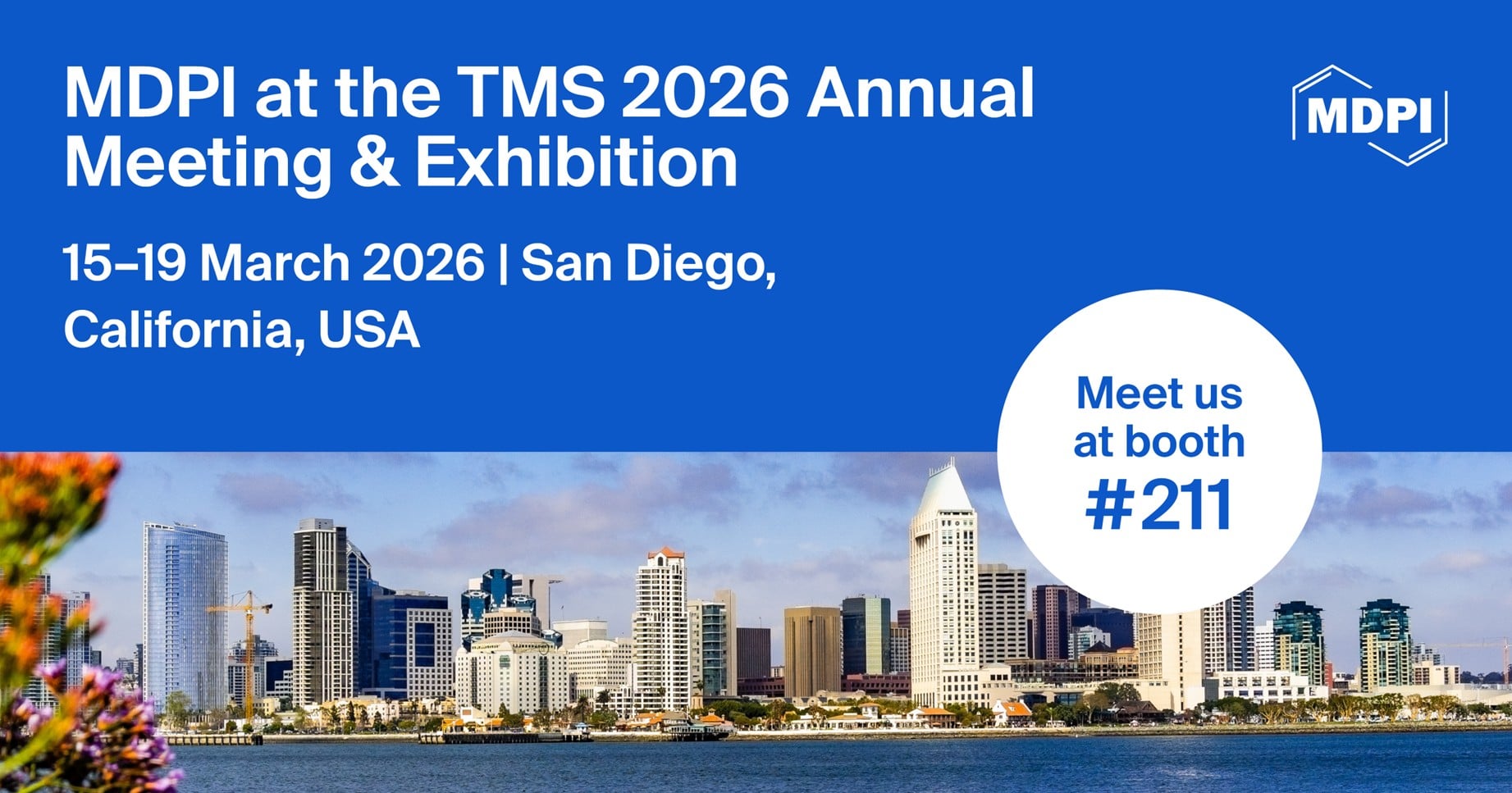
Conference: TMS 2026 Annual Meeting & Exhibition
Date: 15–19 March 2026
Location: San Diego, California, USA
The TMS Annual Meeting & Exhibition brings together more than 4,000 engineers, scientists, business leaders, and other professionals in the minerals, metals, and materials fields for a comprehensive, cross-disciplinary exchange of technical knowledge.
MDPI will be attending the TMS 2026 Annual Meeting & Exhibition as an exhibitor, welcoming researchers from diverse backgrounds to visit and share their latest ideas.
The following MDPI journals will be represented at the conference:
- Materials;
- Metals;
- Molecules;
- Polymers;
- Ceramics;
- Corrosion and Materials Degradation;
- Construction Materials;
- Crystals;
- Fibers;
- Gels;
- Journal of Composites Science;
- Minerals;
- Physchem;
- Processes;
- Solids;
- Textiles;
- Coatings;
- Alloys;
- Applied Nano.
If you will be attending this conference, please feel free to start a conversation with us. Our delegates look forward to meeting you in person and answering any questions that you may have.
For more information about the conference, please visit https://www.tms.org/TMS2026.
22 January 2026
Prof. Xin-Gao Gong Appointed Chair of the Michele Parrinello Award Committee
We are honored to announce that Prof. Xin-Gao Gong will serve as the Chair of the Michele Parrinello Award Committee.

Prof. Xin-Gao Gong is a distinguished computational condensed matter physicist and an Academician of the Chinese Academy of Sciences. He serves as a professor and doctoral advisor at Fudan University, where his groundbreaking research has profoundly advanced our understanding of material properties through computational methods. Widely recognized for his leadership in the field, Prof. Gong was elected a Fellow of the American Physical Society in 2009. He also directs the Key Laboratory of Computational Physical Sciences at Fudan University—a hub of innovation and discovery.
Under Prof. Gong’s leadership, the committee will focus on identifying innovative research in computational physical sciences, a multidisciplinary field that bridges physics, chemistry, and materials science. The committee will highlight fundamental advances with potential to drive progress across these domains, as the Michele Parrinello Award continues its mission to inspire excellence and recognize contributions that push scientific boundaries.
We recently had the honor of organizing an exclusive interview with Prof. Xin-Gao Gong. In this inspiring interview, Prof. Gong shares his academic journey from China to Italy, where he studied under the renowned Prof. Michele Parrinello and worked with one of the strongest research groups in condensed matter physics.
Prof. Gong also discusses the origins of the Michele Parrinello Award, which he proposed to honor excellence in computational physical sciences. Now chairing the award committee, he emphasizes its role in recognizing both senior researchers and inspiring young scientists to pursue innovation in fields like computational physics, chemistry, and materials science, especially in the age of AI-driven simulation.
Watch the full interview to hear his story and vision for the future of scientific excellence.
9 January 2026
MDPI’s Newly Launched Journals in December 2025
We have expanded our open access portfolio with eight new journals publishing their inaugural issues in December 2025, as well as three journal transfers. These additions span physical sciences, social sciences, arts and humanities, environmental and Earth sciences, medicine and pharmacology, and public health and healthcare. We extend our sincere thanks to the Editors-in-Chief, Associate Editors, and Editorial Board Members who are shaping these journals’ direction. All journals uphold strong editorial standards through a thorough peer review process, ensuring impactful open access scholarship.
Please feel free to browse and discover more about the new journals below.
|
New Journals |
Founding Editor-in-Chief(s) |
Journal Topics (Selected) |
|
|
Dr. Elisa Felicitas Arias, Université PSL, France |
atomic clocks; time and frequency metrology; GNSS systems; relativity and relativistic timekeeping; fundamental physics in space | |
|
|
Prof. Dr. José F.F. Mendes, University of Aveiro, Portugal |
complex systems; network science; nonlinear dynamics and chaotic behaviour; information theory and complexity; computational complexity | |
|
|
Prof. Dr. Roberto Morandotti, Institut National de la Recherche Scientifique—Énergie, Matériaux et Télécommunications (INRS), Canada |
light generation; light sources and applications; light control and measurement; human responses to light; lighting design | |
|
|
Prof. Dr. Savvas A. Chatzichristofis, Neapolis University Pafos, Cyprus |
generative AI and large language models in education; multimodal and embodied AI; personalization and adaptive systems; assessment, feedback, and academic integrity; learning analytics | |
|
|
Prof. Dr. Jon Andoni Duñabeitia, Universidad Nebrija, Spain |
cognitive psychology; cognitive neuroscience; psycholinguistics; applied linguistics; experimental psychology | |
|
|
Prof. Dr. Caiwu Fu, Wuhan University, China; Prof. Dr. Longxi Zhang, Peking University, China |
cultural practices; cultural theory; cultural policy; cultural heritage; transregional and transnational cultural flows| |
|
|
Dr. Ghassem R. Asrar, iCREST Environmental Education Foundation, USA |
biosphere interactions, processes, and sustainability; ecosystem science and dynamics; biodiversity conservation; global change and environmental adaptation; biogeochemical cycles | |
|
|
Dr. Giuseppe Mulè, University of Palermo, Italy |
cardiorenal syndromes; chronic heart failure and chronic kidney disease; cardiorenalmetabolic syndrome; hypertension and diabetes in relation to the abovementioned syndromes; diagnostic techniques | |








|
Transferred Journals |
Editor-in-Chief |
Journal Topics (Selected) |
|
|
Prof. Dr. Peter Matt, Lucerne Cantonal Hospital (LUKS), Switzerland |
cardiology; cardiovascular and aortic surgery; cardiovascular anatomy, physiology and pathophysiology; congenital heart disease and pediatric cardiology; cardiovascular regenerative and reparative medicine | |
|
|
Prof. Dr. Oana Săndulescu, Carol Davila University of Medicine and Pharmacy, Romania; National Institute for Infectious Diseases “Prof. Dr. Matei Bals”, Romania |
infectious diseases across clinical and public health domains; epidemiology of communicable diseases; clinical microbiology and applied virology; vaccinology and immunization; host–pathogen interactions and immunity | |
|
|
Dr. Roxana Elena Bohiltea, “Carol Davila” University of Medicine and Pharmacy, Romania |
public health; disease prevention; screening and early detection; lifestyle interventions and health education; digital and innovative prevention | |



We would like to thank everyone who has supported the development of open access publishing. If you would like to create more new journals, you are welcome to send an application here, or contact the New Journal Committee (newjournal-committee@mdpi.com).
31 December 2025
MDPI INSIGHTS: The CEO's Letter #30 - Scaling with Integrity, Highly Cited Researchers, KEMÖ Consortium, Michele Parrinello, and Best PhD Thesis Awards
Welcome to the MDPI Insights: The CEO's Letter.
In these monthly letters, I will showcase two key aspects of our work at MDPI: our commitment to empowering researchers and our determination to facilitating open scientific exchange.
Opening Thoughts

With colleagues at MDPI headquarters in Basel, representing the people behind our global growth and shared commitment to integrity.
Scaling with Integrity: A Year of Growth, Responsibility, and Trust
When I look back on 2025, one phrase seems to sum up the year: “Scaling with integrity.” That was our watchword for 2025, and it will remain so as we move forward in to 2026.
Our journal portfolio continued to grow in 2025, reflecting the trust of a widening proportion of the scholarly community.
Today, MDPI has 355 journals indexed in Scopus and 330 in Web of Science – a testimonial to the scale at which our journals meet established external quality criteria. During the year, 45 of our journals were newly accepted into Scopus and 29 into Web of Science (this excludes transferred journals to our portfolio that were already indexed), following rigorous, independent evaluation by the world’s leading indexing bodies
Meeting external quality benchmarks
These results underline the fact that scaling responsibly is not only about expanding our catalogue, but also about meeting external quality benchmarks consistently, transparently, and at scale. Our indexing performance remains one of the strongest independent validations of MDPI’s commitment to rigor, trust, and long-term sustainability.
Over the course of 2025, we made targeted investments to ensure that the integrity of our editorial process scaled to keep pace with our growth. We strengthened our editorial governance by doubling down on our dedicated Publication Ethics department, appointing a Head of Ethics, and expanding our research integrity team by the addition of new specialists plus the creation of embedded editorial ethics roles across key journals. We also introduced new internal ethics guidelines, pre-review integrity checks, and monitoring dashboards to help teams identify potential issues and apply consistent standards across our portfolio.
Besides investing in systems and tools, we of course also invested heavily in our people and culture, delivering organisation-wide training on topics such as image integrity, AI use in publishing, and ethical oversight, while actively engaging with the wider publishing community through COPE and STM forums.
All these efforts reflect a simple principle: growth only matters if it is matched by rigor, responsibility, and trust.
Technology and AI: Supporting the editorial decision-making process
At MDPI, AI is designed to assist, not replace, editorial decision-making. It is one element in a broader system that combines people, technology, and processes to support scale responsibly.
In 2025, we continued to invest heavily in technology that supports quality rather than shortcuts. Our AI team doubled in size, ensuring that increased automation goes hand-in-hand with expertise and oversight. Proprietary AI tools such as Scholar Finder have significantly improved the precision of reviewer matching, while Ethicality has been widely adopted across editorial workflows to identify contextual signals, such as scope alignment and citation behaviour, so that human judgment can be applied where it matters most.
Partnerships: Institutional Open Access Program (IOAP) agreements and Societies
Our recent growth is also reflected in the strength of our partnerships. In 2025, we entered into more than 150 new IOAP agreements, bringing our total to 975 active agreements worldwide. This activity included the signing of our first-ever consortium agreements in North America, renewals of all major national consortia in the UK, Switzerland, Sweden, Norway, Austria, and Croatia, and the conclusion of several flat-fee agreements. At the same time, we concluded a total of 30 agreements, encompassing 24 new Society affiliations, four strategic publishing partnerships, and two journal acquisitions.
In 2025, we opened MDPI USA in Philadelphia – our latest global office, which complements our Toronto office in representing North America. MDPI USA is responsible for accelerating Open Access in the US through ongoing support of our scholars and for expanding our institutional and society partnerships.
On the other side of the globe, meanwhile, we signed an IOAP agreement in India, allowing researchers discounted Article Processing Charges (APCs), streamlined APC management for universities, and visibility into submissions, supporting India’s push for wider Open Access by offering flexible models and helping institutions meet national mandates such as Plan S.
Sustainability, sponsorships and awards
We continued to expand our sustainability efforts during 2025, hosting the 11th World Sustainability Forum, awarding CHF 125,000 in sustainability-related funding, and launching the Z-Forum on Sustainability and Innovation conference, which will officially take place in January 2026.
We also saw a record year for conference sponsorships and awards (while establishing new awards such as the Michele Parrinello Award), recognising scholars across disciplines and reinforcing our commitment to supporting the global research community at every stage of the academic journey.
Deepening our relationships
In 2025, I had the opportunity to travel more widely than ever before on MDPI business, meeting many of our stakeholders face to face and relishing the opportunity to gain a deeper understanding of their science communication needs. It was also excellent to visit a large number of MDPI offices and witness the commitment and service orientation of so many of our colleagues around the world. I shall resume my itinerary in the new year, and I look forward to many more such interactions.
Looking ahead to 2026, we will be celebrating a very significant milestone: 30 years of MDPI. From our foundation as a single Open Access journal in 1996 to the global publishing organisation we are today, our mission has remained consistent: advancing Open Access through rigorous and trustworthy scientific communication.
I would like to take this opportunity to thank all our stakeholders – authors, Editors-in-Chief, Editorial Board members, and reviewers – who have placed their trust in us during 2025. On behalf of the entire MDPI team, I look forward to deepening our relationships yet further in 2026 and celebrating 30 Years of Open Science at MDPI, something we’ve built together.

Basel, Switzerland, where MDPI was founded in 1996.
Impactful Research

621 MDPI Editors Named Highly Cited Researchers in 2025
I am pleased to share an important milestone for our editorial community and for MDPI. In late November, Clarivate announced the 2025 Highly Cited Researchers, and 621 MDPI Editorial Board Members were included among the most influential scientific contributors over the past decade!
The 621 editors come from 33 countries, representing 21 scientific disciplines, and account for nearly one in every ten Highly Cited Researchers globally. This recognition speaks to the depth of expertise across our Editorial Boards and the strength of the scientific communities that choose to collaborate with MDPI. It is important to note that while citation metrics are not in themselves a proxy for quality, they do offer one lens on sustained scientific influence.
“Our strength comes from the scientific communities who choose to work with us”
Why this is important
Having more than 600 editors recognized on this list highlights:
- The high level of expertise guiding peer review across our journals
- The global and disciplinary diversity within our Editorial Boards
- Our commitment to maintaining strong, knowledgeable, and engaged editorial oversight
Impactful science is of course shaped by broad, diverse research communities, and no single metric captures the full picture of research quality. However, this recognition does serve as meaningful, independent affirmation of the calibre of many editors who contribute to MDPI’s work.
A closer look at the recognition
Clarivate’s methodology highlights researchers whose publications rank in the top one per cent by citation count, reflecting consistent influence over the past decade. The process includes:
- Evaluation of c. 200,000 highly cited papers
- Removal of retracted publications
- Filtering of papers with unusually large authorship groups to focus on clear contributions
That so many of our editors meet these thresholds reflects the impact of the communities behind our journals.
What this means going forward
This recognition underlines the fact that our strength comes from the scientific communities who choose to work with us.
For authors, partners, and readers, it confirms that:
- MDPI journals benefit from editorial guidance grounded in active, high-impact research
- Our Editorial boards include leaders who are helping shape the future direction of their fields
- MDPI continues to attract experts who value openness, efficiency, and scientific integrity
For our internal teams, it is a reminder that the work we do every day (supporting editors, refining workflows, and improving systems) directly contributes to the trust placed in MDPI by researchers worldwide.
Thank you to all our editorial teams, publishing staff, and journal relationship specialists, and to everyone who collaborates with our Editorial Boards. Achievements like this are only possible because of your ongoing hard work, dedication, and collaboration.

From our first annual MDPI UK Summit in Manchester, bringing together over 30 Chief Editors and Editorial Board Members to discuss MDPI’s mission, achievements, and collaborations in the UK.
Inside MDPI

MDPI Launches the Michele Parrinello Award for Computational Physical Science
In case you missed it, in November, we announced the launch of the Michele Parrinello Award. This new biennial international award will recognize pioneering contributions in computational physical science. The award honours Michele Parrinello, one of the most influential scientists of the past half-century in atomistic simulations and computational materials research.
This award reflects MDPI’s long-standing commitment to recognizing scientific excellence, supporting foundational research, and inspiring the next generation of scholars across disciplines.
“Be confident that what you do is meaningful”
Honouring a transformative scientific legacy
Professor Parrinello’s work has fundamentally reshaped how scientists model matter at the atomic scale. Together with Roberto Car, he introduced ab initio molecular dynamics, widely known as the Car–Parrinello method, opening new pathways in electronic structure calculations and molecular simulations. His subsequent contributions, including the Parrinello–Rahman method and metadynamics, have become core tools across physics, chemistry, materials science, and increasingly biology.

“Do not be afraid of new things. I see it many times when we discuss a new thing that young people are scared to go against the mainstream a little bit, thinking, ‘What is going to happen to me?’ and so on. Be confident that what you do is meaningful, and do not be afraid, do not listen too much to what other people have to say.”
– Professor Michele Parrinello
A global, community-led award

The award committee is chaired by Xin-Gao Gong, Professor of Physics at Fudan University and academician of the Chinese Academy of Sciences.
The Institute for Computational Physical Sciences at Fudan University will serve as the supporting institute, reinforcing the award’s international and cross-cultural foundation.
Nominations for the first edition of the Michele Parrinello Award opened on 1 November 2025, with submissions accepted until March 2026. The award will recognize scientists whose work has advanced computational physical science across physics, chemistry, and materials research – fields increasingly central to energy, sustainability, advanced manufacturing, and technological innovation.
Why this matters for MDPI
The Michele Parrinello Award is part of the MDPI Sustainability Foundation, which supports science as a driver of long-term societal progress.

Alongside other foundation-level honours, including the World Sustainability Award, the Emerging Sustainability Leader Award, and the Tu Youyou Award, this new prize builds on our role in supporting excellence across career stages and disciplines.
MDPI journals and programs continue to recognize researchers through Best Paper Awards, Young Investigator Awards, Travel Awards, Best PhD Thesis Awards, and Outstanding Reviewer Awards. Together, these initiatives reflect a simple belief: strong scientific communities are built through recognition, trust, and sustained support.
As MDPI approaches its 30th anniversary, the launch of the Michele Parrinello Award highlights our commitment not only to publishing research but also to helping shape the future of science by celebrating those who expand its boundaries.
Coming Together for Science

KEMÖ Consortium (Austria) Extends Open Access Agreement with MDPI until 2027
I’m pleased to share that MDPI has renewed its Institutional Open Access Program (IOAP) agreement with the Austrian library consortium KEMÖ, extending our partnership through 2027.
The renewed agreement now includes 23 Austrian institutions, with the Medical University of Vienna and the University of Natural Resources and Life Sciences (BOKU) joining the partnership. Participating institutions benefit from APC discounts across MDPI’s more than 495 journals, with centralized funding options further reducing the administrative burden for researchers and libraries.
“This renewal reflects shared commitment to advancing Open Access publishing in Europe”
Austria continues to be an important and engaged research community for MDPI, with 525+ Austrian Editorial Board Members, eight Editors-in-Chief, and 15 Section Editors-in-Chief contributing to our journals.
This renewal reflects long-term trust and shared commitment to advancing Open Access publishing in Europe, and improves MDPI’s collaboration with national OA infrastructures such as the Open Access Monitor Austria. Such long-term agreements show how MDPI’s growth is increasingly built on institutional trust, collaboration, and shared commitment to Open Access.
A big thank-you to the IOAP team and everyone involved in supporting this partnership.
Closing Thoughts

Celebrating the Next Generation of Scholars: MDPI’s 2024 Best PhD Thesis Awards
One of the privileges of working in scholarly publishing is supporting the beginning of new scientific journeys. We recently announced the recipients of MDPI’s 2024 Best PhD Thesis Awards, recognizing some of the most promising emerging researchers across disciplines.
These awards do more than celebrate academic excellence. They reflect something deeper about our mission: supporting the next generation of authors and the future of Open Science.
Recognition of Excellence
This year, we made awards to 55 early-career researchers across seven fields:
- Biology and Life Sciences
- Chemistry and Materials Science
- Computer Science and Mathematics
- Engineering
- Environmental and Earth Sciences
- Medicine and Pharmacology
- Interdisciplinary ‘Other’ fields
For those of you who have completed a PhD, you’ll know first-hand that behind each number is a story of perseverance, curiosity, and sustained effort. These researchers represent institutions around the world, with thesis topics spanning:
- Brain–machine interfaces and neural engineering
- Sustainable materials and next-generation batteries
- Cancer genomics, tumour microenvironments, and immunotherapy
- AI-driven image analysis, robotics, and computational models
- Climate change monitoring and environmental risk assessment
- Regenerative medicine, biomaterials, and drug development
These dissertations are early signs of the scientific directions that will shape the coming decade.
“Our mission is about building a global community of authors”
Why this is important
Every year, millions of scholars begin their research careers with limited visibility and few platforms for sharing their work. By recognizing outstanding PhD theses, we elevate authors early in their academic journeys, build MDPI’s connection to the global research community, reinforce our commitment to quality and rigor, and highlight the depth and breadth of scholarship published across our portfolio (from biology to materials science to mathematics).

A foretaste of the future
These 55 awardees represent the next generation of researchers whose work will influence science, policy, and society in the years ahead. What we support today helps shape the scientific ecosystem of tomorrow. Our mission goes beyond publishing papers. It is about building a global community of authors who will define the next era of scientific discovery.
To explore more about MDPI Awards, including current and upcoming Best PhD Thesis Awards, please click here.
Thank you to the editors, reviewers, and teams across MDPI who make these awards possible each year.
Everything we achieved this year was made possible by the collective effort of our global teams and the trust placed in us by the scholarly community. Thank you again, and here’s to the successful continuation of our collaboration in 2026!
Chief Executive Officer
MDPI AG
24 December 2025
Meet Us at the 41st International Conference of the Polymer Processing Society (PPS-41), 31 May–4 June 2026, Paestum, Italy

Conference: 41st International Conference of the Polymer Processing Society (PPS-41)
Date: 31 May–4 June 2026
Place: Salerno, Italy
We are excited to announce that MDPI journals will participate as exhibitors in the 41st International Conference of the Polymer Processing Society (PPS-41), in Paestum, Salerno, Italy, from 31 May to 4 June 2026.
As we gather for the 41st edition of this top-level international conference, PPS-41 will continue to explore the future of polymer processing, addressing cutting-edge advancements, sustainability, and the evolving role of polymers in a rapidly changing world.
PPS conferences provide a distinguished platform for academics, researchers, and industry professionals to engage in meaningful discussions, exchange ideas, and showcase pioneering technologies and innovative solutions.
The submitted contributions will be organized in parallel sessions in the following subjects:
- Additive manufacturing of polymers;
- Aeronautical and aerospace applications;
- Biomedical applications;
- Composites, blends and alloys;
- Extrusion, mixing and compounding;
- Fibers and films;
- Foams and membranes;
- Injection molding, micromolding and molds;
- Machine learning in polymer processing;
- Modeling and simulation;
- Morphology and structural development;
- Nanotechnology and nanocomposites;
- Rheology and characterization;
- Rubber, elastomers and thermosets;
- Smart polymers and special applications;
- Solid state processing and properties;
- Soft robotics;
- Surfaces and interfaces;
- Sustainability (recycling, LCA, environmental impact, biodegradable polymers);
- Special session: advances in polymer processing and digital manufacturing for prosthetic devices.
The following MDPI journals will be presenting at the conference:
- Polymers;
- Macromol;
- Materials;
- Colloids and Interfaces;
- J. Compos. Sci.;
- Chemistry;
- Physchem;
- Fibers;
- Nanomaterials;
- AI Chemistry;
- Surfaces;
- Aerospace;
- Coatings.
If you are planning to attend the conference, please feel free to start a conversation with us. Our delegates look forward to meeting you in person and answering any questions that you may have. For more information about the conference, please visit the following website: https://www.pps-41.org/.
