Skip to Content

Quantum Beam Science

Quantum Beam Science is an international, peer-reviewed, open access journal on research derived from beam line facilities and related techniques published quarterly online by MDPI.

Get Alerted

Add your email address to receive forthcoming issues of this journal.

All Articles (287)

Periodic Noise Reduction in Neutron Imaging

  • Shilin Wang,
  • Tianhao Wang and
  • Xin Tong
  • + 2 authors

Periodic structures that may exist within the neutron imaging detector can introduce periodic noise into the imaging results, directly degrading image quality and further affecting the performance of deconvolution. This periodic noise appears as four-pointed star-shaped peaks in the amplitude spectrum of the frequency domain. However, the distribution of honeycomb-like noise structures in neutron imaging results makes it difficult to detect using conventional thresholding methods. We propose a method that applies a dilation operation before threshold detection to enhance the contrast between peaks and the surrounding areas. Then, a notch filter is used to smooth the peaks containing noise information, thereby removing the periodic noise structure. This approach effectively eliminates honeycomb structures of approximately 40 micrometers and improves the image quality after deconvolution processing.

2 March 2026
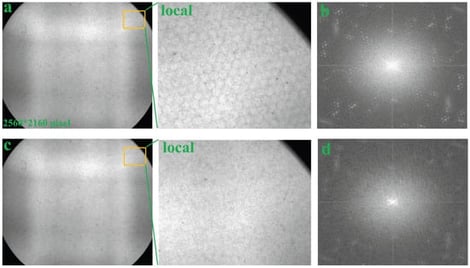
Experimental data and the results obtained using the proposed method for periodic noise removal. Here, (a–d) have the same dimensions (2560 × 2160 pixels), with a pixel size of 1.7 
  
    μ
    m
  
, and the dimensions of 2560 × 2160 pixels correspond to a physical size of 4352 
  
    μ
    m
  
 × 3672 
  
    μ
    m
  
. For supplementary data, please refer to Appendix A. (a) Original experimental data, where a clear honeycomb structure can be observed. (b) Image obtained by applying a Fourier transform to (a) followed by magnitude conversion (detailed calculations are provided in Section 2, Materials and Methods). (c) Result of applying the proposed method to (a), where the honeycomb structure is largely suppressed; the corresponding one-dimensional data are provided in Appendix A. (d) Magnitude image obtained from the Fourier transform of (c), using the same procedure as in (b).
  • Feature Paper
  • Article
  • Open Access

Simulating Neutron Diffraction from Deformed Mosaic Crystals in McStas

  • Daniel Lomholt Christensen,
  • Sandra Cabeza and
  • Jan Šaroun
  • + 2 authors

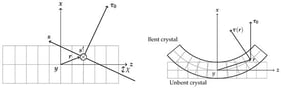
Monochromator and analyzer systems that rely on bent single crystals are in use throughout the neutron scattering community. An adequate component for the simulation of such crystals was missing in the widely used neutron simulation software package McStas. The newly developed component Monochromator_bent, which fills this gap, is introduced. It can serve as a model for crystal monochromators and analyzers of various kinds, including the bent perfect crystals, mosaic crystals, and crystals combining mosaicity with bending. The performance of the component is tested at several configurations and compared with the results of another simulation program, SIMRES. Validation is carried out using analytical calculations and the McStas NCrystal_sample component for the case of unbent crystals. Excellent agreement in all tests and good performance in terms of computing speed has been found. The component has been included in the present distribution of McStas 3.5.

4 February 2026

(Left) An unbent crystal. The reflecting lattice planes are cut at an angle 
  χ
 to the surface. (Right) The deformed crystal with 
  
    χ
    =
    0
  
. The reciprocal lattice vectors are shown with 
  
    τ
    0
  
 and 
  
    τ
    (
    r
    )
  
 being the unbent and bent reciprocal lattice vector, respectively.

In this paper, several optimized design results of the HTGR-based 10 MWth Reaktor Daya Eksperimental (RDE) (Experimental Power Reactor), so far conducted, are reviewed and compared from the neutronics, reactor types, refueling schemes, and fuel cycle points of view. The review covers the multipass and once-through-then-out (OTTO) pebble-bed cores, as well as block/prismatic type cores with several fuel shuffling options. As for the fuel cycle, uranium and thorium fuels are considered. The fuel burnup performance and power distribution are evaluated and compared among other important design parameters. Reactor physics codes, nuclear data libraries, and calculation models and procedures used for the design and analysis are reviewed, and challenges for future improvements are discussed.

2 February 2026

Radial (upper) and axial (lower) core layouts of block/prismatic type RDE. Adapted from ref [6]. Copyright Elsevier.
  • Feature Paper
  • Article
  • Open Access

This paper presents a thermal management solution for a Ka-band gyrotron traveling wave tube (gyro-TWT) with non-superconducting magnets. At present, the miniaturization and non-superconductivity of gyro-TWT have become a trend, but miniaturization leads to a significant increase in power density and a severe limitation in heat sink volume, which critically limits power capacity. To address this challenge, a joint microwave–thermal management evaluation model is used to investigate the heat transfer process and identify the crucial factors constraining the power capacity. A cylindrical heat sink with narrow rectangular grooves is introduced. Based on this, the cooling efficiency has been enhanced through structural optimization. The beam–wave interaction, electrothermal conversion, and heat conduction processes of the interaction circuit are analyzed. The compact heat sink achieves a 1.2-fold increase in coolant utilization and reduces the overall volume by 27.4%. Meanwhile, this heat sink improves the cooling performance and power capability of the gyro-TWT effectively. At 29 GHz, the gyro-TWT achieves a pulse power of 150 kW. Simulation results show that the maximum temperature is 348 °C at a 45% duty cycle, reduced by 159 °C. The power capacity of the Ka-band gyro-TWT increases by 40.6%.

22 January 2026

Schematic of the ka-band gyro-TWT with non-superconducting magnets. Adapted with permission from Ref. [9]. Copyright 2022 IEEE.

News & Conferences

Volumes

Latest Issues

Open for Submission

Editor's Choice

XFacebookLinkedIn
Quantum Beam Sci. - ISSN 2412-382X