Skip Content
You are currently on the new version of our website. Access the old version .
  • Tracked for
    Impact Factor
  • 2.8
    CiteScore
  • 25 days
    Time to First Decision

All Articles (187)

Direct seeded rice, being less water- and labor-intensive, can be an alternative approach to conventional rice planting methods. However, uneven and poor stand establishment caused by deep sowing in the field is one of the major hurdles in the adoption of direct seeding technology. Varieties with the potential to emerge from deeper layers of soil may have a positive impact on crop establishment. To evaluate the behavior of ten rice cultivars against their potential to emerge from different soil depths (0, 2.5, and 5.0 cm), a pot experiment was conducted under semi-controlled conditions at the PARC Rice Programme, Kala Shah Kaku, Lahore. Data on different seedling parameters were collected. The results showed that the highest mean seedling emergence percentage (95%) was achieved by the tested genotypes at a 2.5 cm seeding depth, while surface sowing and placement of seeds at a 5 cm depth demonstrated a similar mean emergence percentage (89%). Seeding depth, genotypes, and their interactions significantly affected mean emergence time, mesocotyl and coleoptile lengths, and root and shoot lengths. Sowing seeds at a 5 cm depth increased mean emergence time by 28%. However, increasing sowing depth increased the coleoptile length, mesocotyl length, first leaf sheath length, and shoot length of rice seedlings. Mesocotyls and coleoptile lengths showed a linear relationship with mean emergence time. Mesocotyl and coleoptile are key structures of the apical–basal axis in grasses that elongate to facilitate the emergence of germinating seeds under deep sowing. The longest coleoptiles (1.47 cm) and mesocotyls (3.27 cm) were measured from seedlings sown at a depth of 5 cm. Among genotypes, PK-1121 exhibited maximum coleoptile elongation (2.10 cm) under deep sowing (5 cm), while the longest mesocotyls were recorded from deep-sown (5 cm) seedlings of Chenab Basmati. Root length was found to be inversely proportional to sowing depth. PK-1121 aromatic, Kisan Basmati, Punjab Basmati, and Chenab Basmati produced longer shoots (22.61, 23.37, 23.32, and 21.05 cm, respectively) and took a relatively short time for emergence when sown deep. These varieties may have better potential to emerge from deeper soil layers, which may have a positive impact on even germination and better crop stand establishment.

2 February 2026
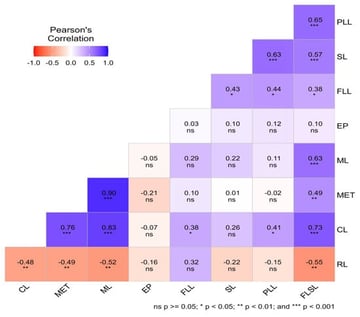
Correlation analysis among traits. Note: Rep = replication, SD = sowing depth, G = genotype, DF = degree of freedom, CL = coleoptile length cm, FLL = first leaf length cm, FLSL = first leaf sheath length cm, EP = emergence %, MET = mean emergence time days, ML = mesocotyl length cm, PLL = prophyll leaf length cm, RL = root length cm, SL = shoot length cm.

The Effects of Fire on California Sage Scrub Germination Assemblages

  • Bailey Parkhouse,
  • Hannah Chan and
  • Wallace Martin Meyer

California sage scrub is an endangered, shrub-dominated, southern California ecosystem threatened by increasing fire frequencies and type-conversion to non-native grasslands. Once non-native grasses become established, their presence promotes more frequent fires, perpetuating grass dominance. To better understand how fire influences soil seed bank assemblages, we examined soil seed banks in burned and adjacent unburned sage scrub at the Robert J. Bernard Field Station (BFS) in two areas that burned in September 2013 and May 2017. In contrast to a previous soil seed bank study in California sage scrub, we found that unburned soil seed banks in sage scrub at the BFS were primarily composed of native seeds (88% of sprouts in unburned areas were native), highlighting that soil seed bank dynamics differ among California sage scrub sites. Despite burned areas supporting elevated densities of non-native seeds (the majority of which included Festuca myuros, a non-native grass), soil seed banks in our burned areas retained native seeds (21% of sprouts in burned areas were native), including native shrub species, suggesting that not all sage scrub habitats are primed to transition to non-native grasslands following disturbances. However, elevated densities on non-native seedlings in burned areas highlight the vulnerability of sage scrub to fire disturbances and the subsequent establishment of non-native grasses.

28 January 2026

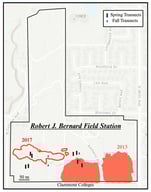
The Bernard Field station with the 2013 burn site (indicated by a filled red area) and the 2017 burn site (indicated with a red outline). Sampling transects are marked with thick black (Spring) or blue (Fall) lines.

Two well-known recessive mutations (a, conditioning white flowers and unpigmented testa; and r, conditioning wrinkled seeds) were found to be major contributors to the loss of germination percentage in garden pea (Pisum sativum L.) when seeds were maintained at cool temperatures (5 °C) for extended periods. After approximately 20 years in storage, seeds homozygous for the unpigmented mutation displayed an average germination rate about 20% lower than wildtype seeds, while wrinkled seeds displayed a rate about 25% less. Seeds homozygous for both the a and r mutations (a combination typical of many commercial cultivars) exhibited a reduction in germination percentage of about 50% over the storage period, indicating that the two mutations have an additive effect on the ageing process. Additional results involving a second mutation (a2) in the phenylpropanoid pathway, as well as information available from the literature that a second, independent mutation in starch synthesis (rb) also reduces seed longevity, suggest that an intact phenylpropanoid pathway and a normally functioning starch synthesis pathway are necessary for optimal storage life of pea seeds.

28 January 2026

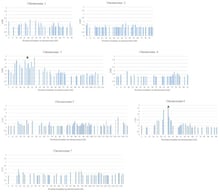
Correlation of loss of germination percentage with segregating markers on each of the seven chromosomes in the MxJ recombinant inbred population. The horizontal axis identifies the location (in cM) of the segregating marker. The vertical axis presents the negative log of the odds (LODs) for the joint segregation analysis of the marker and the germination evaluation. The position of the seed shape locus (R) is shown on chromosome 3 and that of the testa pigmentation locus (A) is shown on chromosome 6.

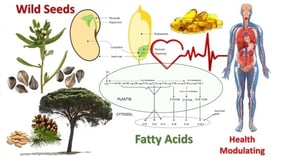
Wild seeds constitute a taxonomically diverse and underexplored reservoir of C18-series bioactive fatty acids (BFAs) with significant nutritional, biomedical, and industrial relevance. This review integrates current knowledge on their lipid composition, metabolic architecture, and potential applications. Numerous wild taxa accumulate high levels of oleic, linoleic, α-linolenic, γ-linolenic, and stearidonic acids, while others synthesise structurally specialised compounds such as punicic, petroselinic, and sciadonic acids. These FAs, together with tocopherols, phytosterols, and phenolics, underpin antioxidant, anti-inflammatory, immunomodulatory, and cardiometabolic effects supported by in vitro and in vivo evidence. The occurrence of these unusual lipids reflects lineage-specific modulation of plastidial and endoplasmic-reticulum pathways, including differential activities of SAD, FAD2/3, Δ6- and Δ5-desaturases, elongases, and acyl-editing enzymes that determine the final acyl-CoA and TAG pools. Wild seed oils show strong potential for translation into functional foods, targeted nutraceuticals, pharmacologically relevant lipid formulations, cosmetic ingredients, and bio-based materials. However, their exploitation is constrained by ecological sustainability, oxidative instability of PUFA-rich matrices, antinutritional constituents, and regulatory requirements for novel lipid sources. This review positions wild seeds as high-value, underused lipid resources with direct relevance to health and sustainability. It underscores their potential to enhance nutritional security and offer alternatives to conventional oil crops.

13 January 2026

Comparison of Dicot and Monocot Seed Structure. The figure illustrates the internal anatomy of a dicot seed (left) and a monocot seed (right). In the dicot seed, major structures such as the seed coat, cotyledon, hypocotyl, plumule, and radicle are shown. The monocot seed highlights the seed coat, large endosperm, cotyledon, hypocotyl, plumule, and radicle. The plumule and hypocotyl are depicted in green for clarity, while the seed shapes differ to reflect dicot (kidney-shaped) and monocot (elongated) morphology. This comparison emphasises the key anatomical differences between the two seed types.

News & Conferences

Issues

Open for Submission

Editor's Choice

Reprints of Collections

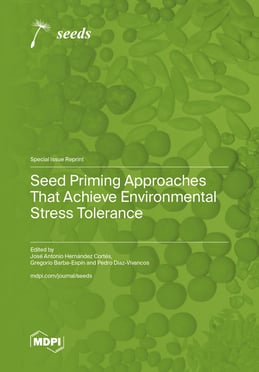
Seed Priming Approaches That Achieve Environmental Stress Tolerance
Reprint

Seed Priming Approaches That Achieve Environmental Stress Tolerance

Editors: Jose Antonio Hernández Cortés, Gregorio Barba-Espín, Pedro Diaz-Vivancos

Get Alerted

Add your email address to receive forthcoming issues of this journal.

XFacebookLinkedIn
Seeds - ISSN 2674-1024