

Need Help?
Announcements
6 November 2025
MDPI Launches the Michele Parrinello Award for Pioneering Contributions in Computational Physical Science

MDPI is delighted to announce the establishment of the Michele Parrinello Award. Named in honor of Professor Michele Parrinello, the award celebrates his exceptional contributions and his profound impact on the field of computational physical science research.
The award will be presented biennially to distinguished scientists who have made outstanding achievements and contributions in the field of computational physical science—spanning physics, chemistry, and materials science.
About Professor Michele Parrinello
"Do not be afraid of new things. I see it many times when we discuss a new thing that young people are scared to go against the mainstream a little bit, thinking what is going to happen to me and so on. Be confident that what you do is meaningful, and do not be afraid, do not listen too much to what other people have to say.”
——Professor Michele Parrinello
 |
Born in Messina in 1945, he received his degree from the University of Bologna and is currently affiliated with the Italian Institute of Technology. Professor Parrinello is known for his many technical innovations in the field of atomistic simulations and for a wealth of interdisciplinary applications ranging from materials science to chemistry and biology. Together with Roberto Car, he introduced ab initio molecular dynamics, also known as the Car–Parrinello method, marking the beginning of a new era both in the area of electronic structure calculations and in molecular dynamics simulations. He is also known for the Parrinello–Rahman method, which allows crystalline phase transitions to be studied by molecular dynamics. More recently, he has introduced metadynamics for the study of rare events and the calculation of free energies. |
For his work, he has been awarded many prizes and honorary degrees. He is a member of numerous academies and learned societies, including the German Berlin-Brandenburgische Akademie der Wissenschaften, the British Royal Society, and the Italian Accademia Nazionale dei Lincei, which is the major academy in his home country of Italy.
Award Committee
 |
The award committee will be chaired by Professor Xin-Gao Gong, a computational condensed matter physicist, academician of the Chinese Academy of Sciences, and professor at the Department of Physics, Fudan University. Professor Xin-Gao Gong will lead a panel of several senior experts in the field to oversee the evaluation and selection process. The Institute for Computational Physical Sciences at Fudan University (Shanghai, China), led by Professor Xin-Gao Gong, will serve as the supporting institute for the award. |
"We hope the Michele Parrinello Award will recognize scientists who have made significant contributions to the field of computational condensed matter physics and at the same time set a benchmark for the younger generation, providing clear direction for their pursuit—this is precisely the original intention behind establishing the award."
——Professor Xin-Gao Gong
The first edition of the award was officially launched on 1 November 2025. Nominations will be accepted before the end of March 2026. For further details, please visit mparrinelloaward.org.
About the MDPI Sustainability Foundation and MDPI Awards 
The Michele Parrinello Award is part of the MDPI Sustainability Foundation, which is dedicated to advancing sustainable development through scientific progress and global collaboration. The foundation also oversees the World Sustainability Award, the Emerging Sustainability Leader Award, and the Tu Youyou Award. The establishment of the Michele Parrinello Award will further enrich the existing award portfolio, providing continued and diversified financial support to outstanding professionals across various fields.
In addition to these foundation-level awards, MDPI journals also recognize outstanding contributions through a range of honors, including Best Paper Awards, Outstanding Reviewer Awards, Young Investigator Awards, Travel Awards, Best PhD Thesis Awards, Editor of Distinction Awards, and others. These initiatives aim to recognize excellence across disciplines and career stages, contributing to the long-term vitality and sustainability of scientific research.
Find more information on awards here.
20 February 2026
MDPI Virtual Academic Publishing Workshop (New Harvest), 25 February 2026
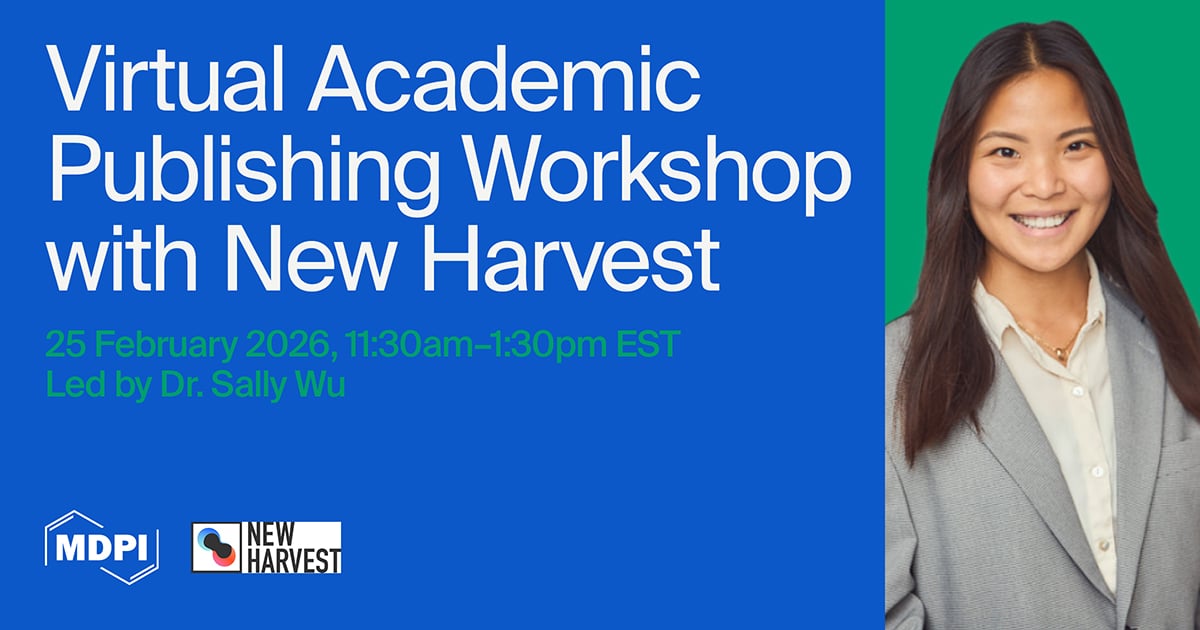
This Academic Publishing Workshop will be led by MDPI Regional Journal Relations Specialist, Dr. Sally Wu, on “Author Training”. Participants will receive practical advice on essential aspects of writing academic articles. Participants will leave with a clearer understanding of the academic publishing landscape and how to successfully contribute to it.
Date: 25 February 2026
Time: 11:30 a.m.–1:30 p.m. EST
Schedule:
|
Speaker |
Program |
Time in EST |
|
Dr. Sally Wu |
Introduction |
11:30–11:40 a.m. |
|
Dr. Sally Wu |
Tips for Writing Great Research Papers
|
11:40 a.m.–12:15 p.m. |
|
Dr. Sally Wu |
How to Respond to Peer Reviewers
|
12:15–12:50 p.m. |
|
Dr. Sally Wu |
AI in Publishing: Challenges and Opportunities
|
12:50–13:30 p.m. |
Speakers:
|
|
Dr. Sally Wu received a PhD in medical science from the University of Toronto in the fall of 2025. She joined MDPI in February 2025 as an Assistant Editor for Cells. She was recently promoted to Regional Journal Relations Specialist position in August. In this role, she works with many journals, liaising with authors, board members, and EiCs. She has attended several conferences across North America, hosted scholar visits, and taken part in other outreach events. |

18 February 2026
MDPI’s Open Access Program Reaches 1,000 Institutions Worldwide
MDPI has surpassed the milestone of 1,000 partners within the Institutional Open Access Program (IOAP). The agreements span 59 countries, covering North and South America, Europe, Asia, Africa, and Oceania.
Last year alone, more than 150 new libraries and academic institutions joined MDPI’s IOAP. With the expansion of an existing consortium deal in Sweden we welcomed a further 75 partners to the program in January 2026, enabling us to surpass the 1,000-partners milestone.
The IOAP supports affiliated researchers by streamlining submission processes, reducing administrative burdens, and offering discounted Article Processing Charges (APCs). Through IOAP membership, more than 61,300 research articles received APC discounts in 2025, driving greater visibility and accessibility for partner institutions and global research communities alike.
"This milestone marks a significant step towards expanding MDPI’s global impact," said Stefan Tochev, MDPI's CEO. "Reaching 1,000 IOAP partnerships is a true testament to the growing trust and collaboration we’ve built with universities, libraries, and research organizations worldwide. We are proud to lead the way in Open Access publishing, ensuring researchers have the support they need to reach global audiences." "The success of our program is reflected in the growing global demand for Open Science and quality publishing services," said Becky Castellon, MDPI institutional partnerships manager. "Equally, institutions are increasingly seeking Open Access publishing options that support funder and national mandates. Joining the IOAP makes compliance simple."
11 February 2026
Meet Us at the Population Association of America 2026 Annual Meeting, 6–9 May 2026, St. Louis, Missouri, USA

Conference: Population Association of America 2026 Annual Meeting
Organization: Population Association of America
Date: 6–9 May 2026
Place: Missouri America’s Center, St. Louis, Missouri, USA
MDPI journals will be attending the Population Association of America 2026 Annual Meeting as exhibitors. This meeting will be held at the Missouri America’s Center, St. Louis, Missouri, USA, from 6 to 9 May 2026.
The Population Association of America’s annual meeting is the premier conference of demographers and social and health scientists from the United States and abroad. Since PAA’s first conference in 1932, much important research has been presented on topics ranging from migration to reproductive health to race and gender issues.
The following MDPI journals will be represented:
- Populations;
- Societies;
- IJERPH;
- Youth;
- World;
- Social Sciences;
- Genealogy;
- Geographies;
- Sexes;
- Adolescents;
- Women;
- Humans;
- Econometrics.
If you will be attending this conference, please feel free to visit our booth. Our delegates look forward to meeting you in person and answering any questions that you may have.
2 February 2026
Acknowledgment to the Reviewers of Sexes in 2025

The editorial office of Sexes would like to extend its sincere gratitude to all reviewers who contributed to the improvement of the journal quality by providing their expert opinion and evaluation of the submitted research.
We appreciate that thorough peer review demands considerable time and intellectual investment from our reviewers. In 2025, Sexes received 322 review reports from contributors across 41 countries and territories, demonstrating the breadth of international expertise and scholarly engagement that has strengthened our publication standards.
The reviewers who agreed to have their names published this year are listed below in alphabetical order by first name. The editorial team acknowledges with gratitude all reviewers, named and anonymous alike, for their vital role in maintaining the scholarly standards of Sexes.
|
Agwu Agwu Ejem |
Jimmie Manning |
|
Albina Veltman |
John P. Bartkowski |
|
Andrew Herridge |
Manuel Catalán Águila |
|
April Murphy |
Maria Teresa Solís-Soto |
|
Beata Bieszk-Stolorz |
Mayank Kumar Singh |
|
Caleb Probst |
Miguel Reyna-Castillo |
|
Chang Su |
Mikhila N. Wildey |
|
Charalampos Thomas |
Nam Hoang Tran |
|
Cherra M. Mathis |
Nandita Banerjee Dhawan |
|
Cristiana Vale Pires |
Olena Budnyk |
|
Dag Heede |
Pedro Pereira |
|
Daniela Crocetti |
Piedad Gómez-Torres |
|
Daniele Mollaioli |
Rima Anggrena Dasrilsyah |
|
Dmitry Vorontsov |
Rodolfo Morrison |
|
Doris M. Kakuru |
Rossella Pulvirenti |
|
Elena Colonnello |
Rukman Awang Hamat |
|
Elena Toffol |
Sai Sailesh Kumar Goothy |
|
Emmanuele A. Jannini |
Samantha Majic |
|
Esra Sari |
Satarupa Dasgupta |
|
Felipe Alckmin Carvalho |
Sebastian Masel |
|
Gilbert Emond |
Sonia Barriuso Ortega |
|
Gonca Kurt |
Stefano Isolani |
|
Gracia González-Gijón |
Stéphanie J. Madill |
|
Hanna M. Mües |
Sujata Bhan |
|
Hayoung Wong |
Supaprawat Siripipatthanakul |
|
Hongjun Li |
Susan Chang Su |
|
Irina Rabinovich |
Theodoros Spinos |
|
Jairo Vanegas López |
Vicente Morell-Mengual |
|
Jennifer Byrne |
Walter R. Schumm |
|
Jennifer Lara Fagen |
2 February 2026
MDPI INSIGHTS: The CEO's Letter #31 - MDPI 30 Years, 500 Journals, UK Summit, Z-Forum Conference, APE

Welcome to the MDPI Insights: The CEO's Letter.
In these monthly letters, I will showcase two key aspects of our work at MDPI: our commitment to empowering researchers and our determination to facilitating open scientific exchange.
Opening Thoughts

MDPI at 30: Three Decades of Open Science, Built Together
As we begin 2026, we approach a meaningful milestone in MDPI’s history: 30 years of advancing Open Science.
What began in 1996 as a small, researcher-driven initiative has grown into a global open-access publisher, supporting hundreds of journals, millions of researchers, and a shared belief that scientific knowledge should be openly available to all. Over these three decades, Open Access has moved from the margins to the mainstream, and MDPI has been proud to help shape that transformation.
To mark this anniversary year, we are pleased to share our MDPI 30th Anniversary logo.
The Anniversary logo is intentionally simple, confident, and enduring, designed to work across cultures, disciplines, and digital environments. It reflects both continuity and progress, honouring MDPI’s established identity while representing the company we are today. The green accent symbolizes our connection to the research communities we serve and the collaborative nature of Open Science itself.
Alongside the visual identity, we are also introducing our 30th Anniversary tagline:
30 Years of Open Science, Built Together.

This phrase captures what has always defined MDPI. Open Science is not the work of a single organization: it is a collective effort shaped by researchers, editors, reviewers, institutions, and the many teams who support the publishing process every day. MDPI’s role has been to provide the infrastructure and commitment that allow this collaboration to thrive.
Throughout 2026, we will mark this anniversary through regional events, global conversations, and editorial initiatives that reflect on MDPI’s evolution, its impact across disciplines, and the communities that make this work possible.
“Open Science is a collective effort”
Whether you have been part of MDPI’s journey for decades or are engaging with us for the first time this year, this milestone belongs to all of us. The past 30 years have shown what is possible when openness, trust, and collaboration are placed at the centre of scholarly communication.
As we look ahead, our focus remains clear: continuing to strengthen quality, integrity, and partnership – so that Open Science can keep moving forward, together.
Impactful Research

A Shared Milestone: MDPI’s Journal Portfolio Reaches 500 Titles
MDPI has reached an important milestone: our journal portfolio grew to more than 500 academic journals last year, spanning the fields of chemistry, engineering, biology, medicine, environmental sciences, the social sciences, and beyond.
The number itself is significant, but what matters more is what supports it: hundreds of scholarly communities that have chosen to collaborate, grow, and publish with MDPI.
From our beginnings nearly 30 years ago with a single Open Access journal (Molecules), MDPI has been guided by a simple aim: advancing Open Science. Reaching 500 journals is not an endpoint. It reflects the diversity of disciplines, ideas, and research cultures that now form part of our shared ecosystem.
Growth with Purpose
Every journal exists because a specific community believes there is a need for focus, visibility, and dialogue in a particular field. As our portfolio has expanded, so has our responsibility to ensure that scale is matched with strong editorial standards, robust research integrity practices, and meaningful academic leadership.
This milestone comes as we enter MDPI’s 30th anniversary year, a fitting moment to reflect on what scale in scholarly publishing truly requires: not only reach, but also dedicated long-term stewardship.
New Journals, New Communities
In December 2025 alone, MDPI welcomed eight newly launched journals and three journal transfers (details below), all of which published their inaugural issues by year-end.

Each of these journals is shaped by its Editors-in-Chief, Associate Editors, and Editorial Board Members, who define its scope, standards, and direction. We are grateful for the time, expertise, and commitment they bring to building these new communities.
Welcoming Transferred and Acquired Journals
We were pleased to publish the first MDPI issues of three recently transferred or acquired journals:
- Cardiovascular Medicine – advancing research on the prevention, diagnosis, and treatment of cardiovascular disease
- Germs – addressing infectious diseases through clinical, public health, and translational perspectives
- Romanian Journal of Preventive Medicine (RJPM) – supporting population health, early detection, and preventive care in collaboration with the Romanian Society of Preventive Medicine
Each of these journals brings an established identity and legacy. Our role is to support their continued development with the same editorial rigor, transparency, and Open Access principles that guide our broader portfolio.
A Collective Achievement
Reaching more than 500 journals is not the achievement of any single team or individual. It is the result of collaboration across the entire scholarly ecosystem. As such, I would like to thank our authors, reviewers, academic editors, and Editorial Board Members, as well as our colleagues across MDPI, who support these communities every day.
As we look ahead, we will continue to expand the breadth and depth of our publishing activities while remaining attentive to the evolving expectations of Open Science, research integrity, and responsible growth.
This milestone is a reminder that Open Access publishing is not only about making research available. It is about building platforms where knowledge can be shared, challenged, improved, and trusted, at scale, and with care.
Inside Research

MDPI UK Summit 2026 in Manchester (21–22 January)
On 21–22 January, we had the pleasure of hosting the MDPI UK Summit 2026 in Manchester. Over two days, we welcomed more than 20 Editors-in-Chief (EiC), Section Editors-in-Chief (SEiC), and Associate Editors for an open, in-depth conversations about how MDPI supports Open Science, editorial independence, and research standards across our journals.
What stood out most was not just the quality of the discussions, but the openness, curiosity, and mutual respect that shaped every session.
|
|
|
|
|
|
|
|


What We Covered
The programme was designed to give insight into how MDPI works behind the scenes and how different teams collaborate to support our journals and editors. Topics included:
- MDPI overview and the evolving Open Access market
- MDPI–UK collaboration and local engagement
- Editorial and peer-review processes
- Research integrity and publication ethics
- Institutional partnerships
- Indexing, journal development, and academic community engagement
Sessions were led by MDPI colleagues across editorial, research integrity, indexing, partnerships, and UK operations, showing how cross-functional our work truly is.
What We Heard
The feedback from editors was both encouraging and grounding:
- 92% rated the Summit Excellent (8% Good)
- 100% said their understanding of MDPI’s values, editorial processes, and local collaborations had significantly improved
- 69% attended primarily to stay informed about academic publishing and research integrity
- 85% felt fully heard and engaged
A few comments that stayed with me:
- “Today’s event truly gave me the opportunity to see the heart of MDPI UK.”
- “The summit was very informative – I really enjoyed seeing the behind-the-scenes operations.”
- “Keep being open to discussions and making editors feel part of the MDPI family.”
These reflections remind us that transparency, listening, and dialogue are not nice-to-haves: they are foundational to trust.
|
|
|
|


Looking Ahead
The UK Summit is one of more than 10 MDPI Summits we are organizing this year across North America, Europe, and APAC. Each one is an investment in relationships, shared understanding, and improvement.
Thank you to the MDPI UK team and supporting colleagues across departments who made this event possible. This was a positive step in strengthening our editorial engagement and kicking off a year of MDPI Summits.
Coming Together for Science

Recapping the Z-Forum 2026 Conference on Sustainability and Innovation (15–16 January 2026)
In January, MDPI supported and participated in the Z-Forum on Sustainability and Innovation, held across Zurich (ETH Zurich) and the city of Baden. With 96 participants and more than 30 speakers and panellists, the forum brought together leaders from government, academia, industry, and innovation ecosystems to explore how sustainability, Open Science, and innovation intersect in practice.
Why this mattered for MDPI
As a Swiss-based publisher with global reach, our investment in Z-Forum reflects a strategic intent: to anchor MDPI more deeply within Swiss research networks while contributing to national and international conversations on sustainability and innovation.
This was not only about visibility; it was also about relationship-building and long-term engagement with institutions shaping research policy and practice in Switzerland.
|
|
|
|
|
|
|
|
|
|


High-level participation and credibility
The forum was supported and sponsored by several key Swiss institutions, including:
- The Swiss National Science Foundation (SNSF) – Switzerland’s central research funding body
- ETH Zurich
- The University of Zurich
- The University of Basel
- Swiss Innovation Park Central
The sponsorship of SNSF lent the forum strong institutional credibility and signalled the relevance of the themes discussed, especially around sustainability, innovation frameworks, and responsible research practices.
|
|
|


Beyond the Room: Extending the Conversation
While attendance was intentionally focused to encourage dialogue, the forum’s reach extended well beyond the venue. Multiple LinkedIn posts before and during the event (e.g., Link 1, Link 2, Link 3, and more) built on the discussions and helped position MDPI as an active and credible contributor within Switzerland’s research and innovation landscape.
A Broader Strategic Signal
Z-Forum is part of a wider effort to:
- Build on MDPI’s Swiss institutional relationships
- Reinforce our leadership in Open Science and sustainability
- Engage proactively with funders, universities, and innovation bodies
- Ensure MDPI remains a visible and constructive partner in the ecosystems where research policy and practice are shaped
Thank you to our Conference team and everyone involved in supporting this event, both behind the scenes and on the ground. These moments of engagement may be small in scale, but they are foundational in impact.

Closing Thoughts

Reflections from the Academic Publishing in Europe Conference
During 13-14 January, I attended the Academic Publishing in Europe (APE) Conference in Berlin, a long-standing forum for discussing scholarly publishing and the deeper principles that support it.

MDPI was proud to be a Gold Sponsor of the 20th Anniversary of the APE conference, reflecting our continued commitment to supporting the scholarly community to engage in critical industry discussions.
This year’s program covered a range of topics, from AI and research integrity to policy, infrastructure, and trust, but one theme stood out clearly for me: academic freedom, and what it means to protect the conditions under which knowledge can be produced, evaluated, and shared responsibly.
Before turning to that, I would like to highlight the opening keynote by Carolin Sutton (CEO, STM), which helped set the tone for the conference.
An Independent Publishing Industry: The Case for Checks and Balances
In her opening remarks, Carolin focused on the importance of continually evolving systems of checks and balances, both operationally and at the marketplace level, to prevent any single actor from dominating knowledge production. Her framing emphasized shared responsibility across publishers, institutions, and research communities, rather than placing the burden on any one group.
As part of this, she revisited the work of sociologist Robert K. Merton, and his CUDOS norms of scientific ethos, first articulated in his 1942 work, The Normative Structure of Science.

Merton outlined four ideals that support healthy scientific systems:
- Communalism – knowledge as a public good
- Universalism – evaluation based on merit, not status or identity
- Disinterestedness – orientation toward truth over personal or financial gain
- Organized Skepticism – systematic, critical scrutiny of claims
While these are ideals, and not guarantees that are perfectly lived up to, they remain powerful reference points today for research systems and organizations as they aim to grow and scale.
It was interesting to see how closely these norms align with foundational principles of Open Access. For example, making research openly available supports communalism. Transparent peer review and editorial processes reinforce universalism and organized skepticism. Strong ethics frameworks and governance help counter conflicts of interest and support disinterestedness.
“Merton’s ideals remain powerful reference points today”
Safeguarding Research: Academic Freedom
Several of the conference sessions touched on the pressures faced by researchers, editors, and institutions: geopolitical tensions, online harassment, misinformation, reputational risk, shrinking resources, and politicized narratives around science.

“Integrity is not static. It must be actively maintained as systems grow.”
A particularly timely presentation came from Ilyas Saliba, who talked about academic freedom. His remarks resonated strongly and underlined the fact that safety in academia is not only physical or digital, but also intellectual.
Academic freedom means safeguarding the ability to ask difficult questions, challenge consensus, publish negative or unexpected results, and participate in scholarly debate without fear of undue personal, political, or commercial consequences. These discussions were a reminder that publishers play an important role in supporting the integrity, accessibility, and credibility of scholarly knowledge, particularly as researchers and institutions face mounting external pressures.
Looking Ahead
The discussions at APE reminded me that integrity is not static. It must be actively maintained as systems grow, expectations evolve, and pressures increase. This applies equally to research integrity, academic freedom, and the broader trust placed in scholarly communication.
I left APE encouraged by the openness of the dialogue and the willingness across publishers, institutions, and communities to engage with difficult questions rather than avoid them. Forums like this play a pivotal role in helping our industry pause, reflect, and recalibrate.
As MDPI continues to grow and as we enter our 30th anniversary, these conversations remind me of the core purpose of science: advancing knowledge for the benefit of society.
Chief Executive Officer
MDPI AG
20 January 2026
International Day of Education, 24 January 2026

24 January marks the International Day of Education, a global observance highlighting the vital role of education in empowering young people and building inclusive, resilient, and sustainable societies. Closely aligned with Sustainable Development Goal 4 (SDG 4): Ensure inclusive and equitable quality education and promote lifelong learning opportunities for all, this year’s theme underscores the importance of engaging youth as active partners in reimagining how learning works. With young people comprising more than half of the global population, strengthening teaching and learning, supporting diverse learner needs, and embracing innovation are essential to equipping future generations with the skills and opportunities to shape the futures they aspire to.
Reflecting this mission, established MDPI journals in Social Sciences, Arts and Humanities serve as platforms for scholarly exchange and collaboration, advancing research on youth-centered learning, inclusive education, learner outcomes, emotional resilience, and the role of emerging technologies in modern education. Through these efforts, MDPI supports meaningful dialogue and research addressing both current and emerging challenges in education.

|
|
|
|
|
|
|
|
|
|
|
|
|
|
|













Invited speakers:
|
|
|
|
|
Dr. Sherif Abdelhamid, Virginia Military Institute, USA |
Prof. Dr. Albert Ziegler, University of Erlangen-Nuremberg, Germany |
Prof. Alison Kington, University of Worcester, UK |
|
|
|
|
|
Dr. Ben Looker, University of Worcester, UK |
Dr. Amy Been Bennett, University of Nebraska-Lincoln, USA |
Dr. Amira Elnokaly, University of Lincoln, Lincoln, UK |


Register for this webinar for free here!

We are pleased to share insights from our speakers as they reflect on education. They were invited to provide a short reflection on their presentation topic or respond to the question: “What is the biggest challenge or opportunity in education today?”
|
|
Name: Dr. Sherif E. Abdelhamid Affiliation: Computer and Information Sciences Department, Virginia Military Institute, USA “The future of education depends on our ability to design learning experiences that use technology to be more adaptive, immersive, and supportive of every student’s individual journey. By thoughtfully integrating technology into our classrooms and learning ecosystems, we can transform engagement into genuine empowerment—helping learners build confidence, resilience, and ownership over their success. In this presentation, I will share several learning platforms—including those I developed at VMI—that demonstrate how technology can humanize learning and expand opportunities for all”. |
|
|
Name: Dr. Amira Elnokaly Affiliation: School of Design and Architecture, University of Lincoln, Lincoln, UK “Education today must do more than inform; it must empower learners to navigate a rapidly changing global landscape with confidence, creativity, and purpose. My work focuses on creating internationally attuned, inclusive, and industry-connected learning environments that help students find their voice, identity, and place in the world. I believe the future of higher education lies in its ability to build meaningful bridges between knowledge, practice, and societal need”. |
|
|
Name: Prof. Dr. Albert Ziegler Affiliation: University of Erlangen-Nuremberg, Department of Psychology, Germany “The biggest challenge in education today is that our systems were built for a world that no longer exists. We still organise learning through rigid structures and narrow definitions of ability, even as technological, social, and economic conditions demand far more flexible and resource-rich environments. The task ahead is to redesign systems so that every learner can access the conditions that allow talent to grow”. |

|
~ Research Insight “Inclusive education has dismantled learning barriers, empowering students to fully engage academically and socially at universities.” |
~ Research Insight “In South Africa, English terminology in sexuality education is perceived as less vulgar than local language terms, shaping cultural acceptance of CSE.” |
~ Research Insight “ChatGPT can hallucinate false information, making AI-generated answers sound credible and leaving students struggling to detect errors in education.” |
|
~ Social Sciences |
~ Sexes |
“Using ChatGPT in Education: Human Reflection on ChatGPT’s Self-Reflection” ~ Societies |
|
|
|
|


“Educational Constructivism”
by Keith S. Taber
Encyclopedia 2024, 4(4), 1534-1552; https://doi.org/10.3390/encyclopedia4040100
“Student-Centered Active Learning Improves Performance in Solving Higher-Level Cognitive Questions in Health Sciences Education”
by Nieves Martín-Alguacil and Luis Avedillo
Int. Med. Educ. 2024, 3(3), 346-362; https://doi.org/10.3390/ime3030026
“Innovative FOCUS: A Program to Foster Creativity and Innovation in the Context of Education for Sustainability”
by Kurt Haim and Wolfgang Aschauer
Sustainability 2024, 16(6), 2257; https://doi.org/10.3390/su16062257
“Using ChatGPT in Education: Human Reflection on ChatGPT’s Self-Reflection”
by Eugène Loos, Johanna Gröpler and Marie-Louise Sophie Goudeau
Societies 2023, 13(8), 196; https://doi.org/10.3390/soc13080196
Call for Papers:
|
“Emerging Approaches, Innovation and Sustainability in Higher Education Teaching and Learning” Guest Editor: Dr. Abílio Afonso Lourenço Submission deadline: 31 May 2026 |
Guest Editors: Prof. Dr. Dina Tsagari and Prof. Dr. Karin Vogt Submission deadline: 30 September 2026 |
|
|
|


“Inclusive Education, Intellectual Disabilities and the Demise of Full Inclusion”
by Garry Hornby and James M. Kauffman
J. Intell. 2024, 12(2), 20; https://doi.org/10.3390/jintelligence12020020
“A Critical Systematic Literature Review of Global Inclusive Education Using an Affective, Intersectional, Discursive, Emotive and Material Lens”
by David Isaac Hernández-Saca, Catherine Kramarczuk Voulgarides and Susan Larson Etscheidt
Educ. Sci. 2023, 13(12), 1212; https://doi.org/10.3390/educsci13121212
“Enhancing Comprehensive Sexuality Education for Students with Disabilities: Insights from Ontario’s Educational Framework”
by Adam Davies, Justin Brass, Victoria Martins Mendonca, Samantha O’Leary, Malissa Bryan and Ruth Neustifter
Sexes 2023, 4(4), 522-535; https://doi.org/10.3390/sexes4040034
“Systematic Review on New Challenges of University Education Today: Innovation in the Educational Response and Teaching Perspective on Students with Disabilities”
by María Dolores Pérez-Esteban, Jose Juan Carrión-Martínez and Luis Ortiz Jiménez
Soc. Sci. 2023, 12(4), 245; https://doi.org/10.3390/socsci12040245
Call for Papers:
|
“Educational Innovation and Child Participation in Early Childhood Education” Guest Editors: Prof. Dr. Ana Castro Zubizarreta and Prof. Dr. Roberto Sanz Ponce Submission deadline: 30 June 2026 |
“Encyclopedia of Social Sciences” Collection Editors: Dr. Kum Fai Yuen, Dr. Xueqin Wang and Dr. Xue Li
|
|
|
|


“Mapping the Trajectory of Planetary Health Education—A Critical and Constructive Perspective from the Global South”
by Isaías Lescher Soto, Bernabé Vidal, Lorenzo Verger and Gustavo J. Nagy
Challenges 2025, 16(4), 50; https://doi.org/10.3390/challe16040050
“Emotional Exhaustion Scale (ECE): Psychometric Properties in a Sample of Portuguese University Students”
by Sílvia Ala, Francisco Ramos Campos and Inês Carvalho Relva
Eur. J. Investig. Health Psychol. Educ. 2024, 14(4), 1044-1054; https://doi.org/10.3390/ejihpe14040068
“The Collective Influence of Intolerance of Uncertainty, Cognitive Test Anxiety, and Academic Self-Handicapping on Learner Outcomes: Evidence for a Process Model”
by Jerrell C. Cassady, Addison Helsper and Quinton Quagliano
Behav. Sci. 2024, 14(2), 96; https://doi.org/10.3390/bs14020096
Call for Papers:
|
“Health Professions Education Advancements and Innovations—International Perspectives” Guest Editors: Dr. Douglas McHugh and Dr. Anthony Payne Submission deadline: 26 January 2026 |
Guest Editors: Dr. Pras Ramluggun and Prof. Dr. Tamara Power Submission deadline: 10 May 2026 |
|
|
|


14 January 2026
Meet Us at the 2026 APS Annual Convention, 28–30 May 2026, Barcelona, Spain

MDPI will be attending the 2026 Association for Psychological Science (APS) Annual Convention held in Barcelona, from 28 to 30 May 2026. The conference is being organized by the Association for Psychological Science, which is a scientific home to thousands of leading psychological science researchers, practitioners, teachers, and students from around the world dedicated to advancing scientific psychology across disciplinary and geographic borders.
This year’s program features six Integrative Science Symposia (ISS), each exploring complex scientific questions through research from multiple domains. Recognizing the transformative influence of artificial intelligence (AI) on our science and society, AI topics will be found throughout the program. Additionally, you can expect to find cutting-edge explorations of mental health, brain development, individual and collective cognition, language, culture, polarization, and threats to democracy.
The 2026 Annual Convention will also include an Industry Day—programming that explores psychological science in non-academic settings. This is an outstanding opportunity to see how psychological science is being applied in real-world settings as well as the kind of work that psychological scientists do in non-academic environments.
In addition to these new offerings, the APS Annual Convention is the international psychological science conference that features cutting-edge and integrative science symposia, posters, submitted talks, and flash talks from all areas of the field.
The following open access journals will be represented:
- Behavioral Sciences;
- Adolescents;
- Disabilities;
- International Journal of Environmental Research and Public Health (IJERPH);
- Journal of Intelligence;
- Psychology International;
- Sexes;
- Youth;
- Challenges;
- European Journal of Investigation in Health, Psychology and Education (EJIHPE);
- Education Sciences;
- Languages;
- Trends in Public Health.
12 January 2026
MDPI Webinar | International Day of Education, 23 January 2026

To commemorate the International Day of Education 2026, MDPI is honoured to host a special webinar dedicated to advancing the future of education in an ever-changing world. This global observance reminds us of the essential role that education plays in promoting peace, sustainable development, and empowering individuals to thrive in an increasingly digital and interconnected society.
As education continues to evolve, new approaches, tools, and perspectives are reshaping how we teach, learn, and engage. Through this webinar, we aim to contribute to the global dialogue by bringing together researchers, educators, and practitioners to explore innovative ideas, emerging trends, and transformative research shaping the education landscape.
Join us as we celebrate the International Day of Education 2026, a moment to reflect, exchange ideas, and envision a future where education empowers every learner and strengthens communities worldwide.
Session 1:
Keywords: education; learning; teaching; access; educational equity; EdTech; critical thinking
Date: 23 January 2026
Time: 11:00 a.m. CET | 9:00 p.m. AEST | 6:00 p.m. CST Asia
Webinar ID: 893 6942 9630
Website: https://sciforum.net/event/IDEW2026
Register now for free!

|
Speaker/Presentation |
Time in CET |
Time in CST Asia |
|
MDPI Introduction |
11:00–11.10 a.m. |
6:00–6:10 p.m. |
|
Dr. Sherif Abdelhamid |
11.10–11.30 a.m. |
6.10–6.30 p.m. |
|
Prof. Dr. Albert Ziegler |
11.30–11.50 a.m. |
6:30–6:50 p.m. |
|
Prof. Alison Kington |
11.50 a.m.– 12.10 p.m. |
6:50–7.10 p.m. |
|
Dr. Ben Looker |
12.10–12.30 p.m. |
7.10–7.30 p.m. |
|
Dr. Amy Been Bennett |
12.30–12.50 p.m. |
7:30–7:50 p.m. |
|
Dr. Amira Elnokaly |
12.50–1.10 p.m. |
7.50–8.10 p.m. |
|
Q&A Session |
1.10–1.30 p.m. |
8.10–8.30 p.m. |
|
Closing of Webinar |
1.30–1.40 p.m. |
8.30–8.40 p.m. |
After registering, you will receive a confirmation email with information on how to join the webinar. Registrations with academic institutional email addresses will be prioritized.
Unable to attend? Register anyway, and we will let you know when the recording is available for viewing.
Webinar Keynote Speakers:
- Dr. Sherif E. Abdelhamid, Computer and Information Sciences Department, Virginia Military Institute, USA;
- Prof. Dr. Albert Ziegler, University of Erlangen-Nuremberg, Department of Psychology, Germany;
- Prof. Alison Kington, University of Worcester, United Kingdom;
- Dr. Ben Looker, University of Worcester, United Kingdom;
- Dr. Amy Been Bennett, Center for Science, Mathematics, and Computer Education and the Department of Mathematics, University of Nebraska-Lincoln, USA;
- Dr. Amira Elnokaly, School of Design and Architecture, University of Lincoln, Lincoln, UK.
9 January 2026
MDPI’s Newly Launched Journals in December 2025

We have expanded our open access portfolio with eight new journals publishing their inaugural issues in December 2025, as well as three journal transfers. These additions span physical sciences, social sciences, arts and humanities, environmental and Earth sciences, medicine and pharmacology, and public health and healthcare. We extend our sincere thanks to the Editors-in-Chief, Associate Editors, and Editorial Board Members who are shaping these journals’ direction. All journals uphold strong editorial standards through a thorough peer review process, ensuring impactful open access scholarship.
Please feel free to browse and discover more about the new journals below.
|
New Journals |
Founding Editor-in-Chief(s) |
Journal Topics (Selected) |
|
|
Dr. Elisa Felicitas Arias, Université PSL, France |
atomic clocks; time and frequency metrology; GNSS systems; relativity and relativistic timekeeping; fundamental physics in space | |
|
|
Prof. Dr. José F.F. Mendes, University of Aveiro, Portugal |
complex systems; network science; nonlinear dynamics and chaotic behaviour; information theory and complexity; computational complexity | |
|
|
Prof. Dr. Roberto Morandotti, Institut National de la Recherche Scientifique—Énergie, Matériaux et Télécommunications (INRS), Canada |
light generation; light sources and applications; light control and measurement; human responses to light; lighting design | |
|
|
Prof. Dr. Savvas A. Chatzichristofis, Neapolis University Pafos, Cyprus |
generative AI and large language models in education; multimodal and embodied AI; personalization and adaptive systems; assessment, feedback, and academic integrity; learning analytics | |
|
|
Prof. Dr. Jon Andoni Duñabeitia, Universidad Nebrija, Spain |
cognitive psychology; cognitive neuroscience; psycholinguistics; applied linguistics; experimental psychology | |
|
|
Prof. Dr. Caiwu Fu, Wuhan University, China; Prof. Dr. Longxi Zhang, Peking University, China |
cultural practices; cultural theory; cultural policy; cultural heritage; transregional and transnational cultural flows| |
|
|
Dr. Ghassem R. Asrar, iCREST Environmental Education Foundation, USA |
biosphere interactions, processes, and sustainability; ecosystem science and dynamics; biodiversity conservation; global change and environmental adaptation; biogeochemical cycles | |
|
|
Dr. Giuseppe Mulè, University of Palermo, Italy |
cardiorenal syndromes; chronic heart failure and chronic kidney disease; cardiorenalmetabolic syndrome; hypertension and diabetes in relation to the abovementioned syndromes; diagnostic techniques | |








|
Transferred Journals |
Editor-in-Chief |
Journal Topics (Selected) |
|
|
Prof. Dr. Peter Matt, Lucerne Cantonal Hospital (LUKS), Switzerland |
cardiology; cardiovascular and aortic surgery; cardiovascular anatomy, physiology and pathophysiology; congenital heart disease and pediatric cardiology; cardiovascular regenerative and reparative medicine | |
|
|
Prof. Dr. Oana Săndulescu, Carol Davila University of Medicine and Pharmacy, Romania; National Institute for Infectious Diseases “Prof. Dr. Matei Bals”, Romania |
infectious diseases across clinical and public health domains; epidemiology of communicable diseases; clinical microbiology and applied virology; vaccinology and immunization; host–pathogen interactions and immunity | |
|
|
Dr. Roxana Elena Bohiltea, “Carol Davila” University of Medicine and Pharmacy, Romania |
public health; disease prevention; screening and early detection; lifestyle interventions and health education; digital and innovative prevention | |


We would like to thank everyone who has supported the development of open access publishing. If you would like to create more new journals, you are welcome to send an application here, or contact the New Journal Committee (newjournal-committee@mdpi.com).
