

Sustain. Chem. 2026, 7(3), 54; https://doi.org/10.3390/suschem7030054 - 15 Sep 2026
Abstract
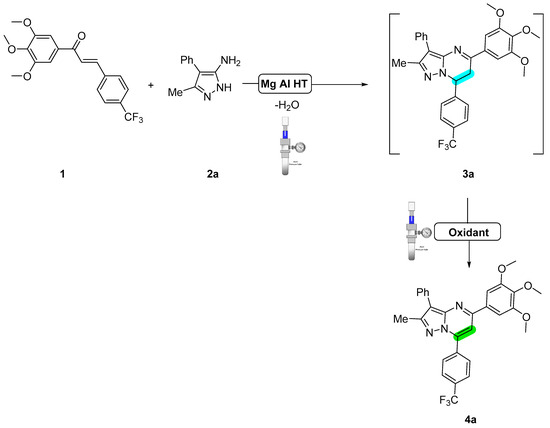
We report a sealed-tube-assisted one-pot oxidative aromatization of in situ-generated dihydropyrazolo[1,5-a]pyrimidine intermediates to afford polymethoxylated pyrazolo[1,5-a]pyrimidine derivatives using sodium persulfate in ethanol, utilizing the Mg-Al hydrotalcite (Mg-Al HT) as a solid base catalyst. Dihydropyrazolo[1,5-a]pyrimidine intermediates are firstly
[...] Read more.
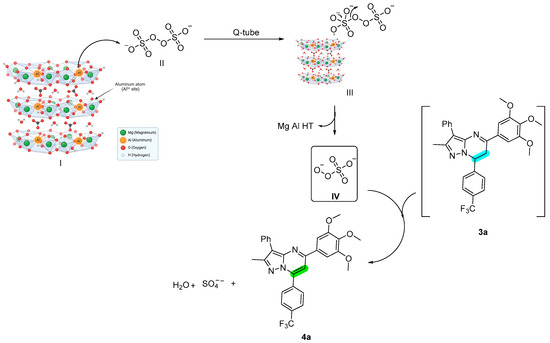
We report a sealed-tube-assisted one-pot oxidative aromatization of in situ-generated dihydropyrazolo[1,5-a]pyrimidine intermediates to afford polymethoxylated pyrazolo[1,5-a]pyrimidine derivatives using sodium persulfate in ethanol, utilizing the Mg-Al hydrotalcite (Mg-Al HT) as a solid base catalyst. Dihydropyrazolo[1,5-a]pyrimidine intermediates are firstly produced efficiently by an aza-Michael addition followed by a cyclocondensation sequence under sealed tube condition performed by Q-tube instrument and subsequently aromatized in situ utilizing sodium persulfate as a sustainable oxidant in a true one-pot fashion. Subsequent treatment of the catalyst-containing reaction mixture with sodium persulfate under sealed-tube heating afforded the corresponding aromatized products. Control experiments showed that the oxidation was enhanced under ambient-air conditions, while appreciable conversion was retained after nitrogen purging. This integrated operation is kinetically advantageous: direct addition of persulfate to the crude reaction mixture provides the target pyrazolo[1,5-a]pyrimidines in up to 91–92% isolated yield within 10 min, whereas oxidation of isolated intermediates under otherwise identical conditions requires longer reaction times. Optimized conditions utilize merely 3 mol% Na2S2O8, yielding the necessary pyrazolo[1,5-a]pyrimidines with an isolated yield of up to 91% within 10 min, demonstrating superior efficiency and environmental compatibility compared to N-bromosuccinimide and selenium dioxide. The approach accommodates various aminopyrazoles with polymethoxy chalcone, facilitating quick access to a limited collection of purine-mimetic heterocycles with possible therapeutic relevance. The methodology tolerates the recyclable Mg–Al hydrotalcite catalyst and the use of ethanol as a benign solvent, aligning the overall process with the principles of sustainable chemistry through reduced energy input, low oxidant loading, and minimized waste generation.
Full article
(This article belongs to the Special Issue Green Chemistry Research and Innovative Strategies for Environmental Sustainability)
►
Show Figures

Figure 1