Announcements

6 November 2025
MDPI Launches the Michele Parrinello Award for Pioneering Contributions in Computational Physical Science


MDPI is delighted to announce the establishment of the Michele Parrinello Award. Named in honor of Professor Michele Parrinello, the award celebrates his exceptional contributions and his profound impact on the field of computational physical science research.

The award will be presented biennially to distinguished scientists who have made outstanding achievements and contributions in the field of computational physical science—spanning physics, chemistry, and materials science.


About Professor Michele Parrinello

"Do not be afraid of new things. I see it many times when we discuss a new thing that young people are scared to go against the mainstream a little bit, thinking what is going to happen to me and so on. Be confident that what you do is meaningful, and do not be afraid, do not listen too much to what other people have to say.”

——Professor Michele Parrinello

Born in Messina in 1945, he received his degree from the University of Bologna and is currently affiliated with the Italian Institute of Technology. Professor Parrinello is known for his many technical innovations in the field of atomistic simulations and for a wealth of interdisciplinary applications ranging from materials science to chemistry and biology. Together with Roberto Car, he introduced ab initio molecular dynamics, also known as the Car–Parrinello method, marking the beginning of a new era both in the area of electronic structure calculations and in molecular dynamics simulations. He is also known for the Parrinello–Rahman method, which allows crystalline phase transitions to be studied by molecular dynamics. More recently, he has introduced metadynamics for the study of rare events and the calculation of free energies.

For his work, he has been awarded many prizes and honorary degrees. He is a member of numerous academies and learned societies, including the German Berlin-Brandenburgische Akademie der Wissenschaften, the British Royal Society, and the Italian Accademia Nazionale dei Lincei, which is the major academy in his home country of Italy.


Award Committee

The award committee will be chaired by Professor Xin-Gao Gong, a computational condensed matter physicist, academician of the Chinese Academy of Sciences, and professor at the Department of Physics, Fudan University. Professor Xin-Gao Gong will lead a panel of several senior experts in the field to oversee the evaluation and selection process.

The Institute for Computational Physical Sciences at Fudan University (Shanghai, China), led by Professor Xin-Gao Gong, will serve as the supporting institute for the award.

"We hope the Michele Parrinello Award will recognize scientists who have made significant contributions to the field of computational condensed matter physics and at the same time set a benchmark for the younger generation, providing clear direction for their pursuit—this is precisely the original intention behind establishing the award."

——Professor Xin-Gao Gong

The first edition of the award was officially launched on 1 November 2025. Nominations will be accepted before the end of March 2026. For further details, please visit mparrinelloaward.org.


About the MDPI Sustainability Foundation and MDPI Awards

The Michele Parrinello Award is part of the MDPI Sustainability Foundation, which is dedicated to advancing sustainable development through scientific progress and global collaboration. The foundation also oversees the World Sustainability Award, the Emerging Sustainability Leader Award, and the Tu Youyou Award. The establishment of the Michele Parrinello Award will further enrich the existing award portfolio, providing continued and diversified financial support to outstanding professionals across various fields. 

In addition to these foundation-level awards, MDPI journals also recognize outstanding contributions through a range of honors, including Best Paper Awards, Outstanding Reviewer Awards, Young Investigator Awards, Travel Awards, Best PhD Thesis Awards, Editor of Distinction Awards, and others. These initiatives aim to recognize excellence across disciplines and career stages, contributing to the long-term vitality and sustainability of scientific research.

Find more information on awards here.

9 October 2025
Meet Us at the 3rd International Conference on AI Sensors and Transducers, 2–7 August 2026, Jeju, South Korea


Following from our two previous successful editions, we invite you to submit your abstracts and participate in the 3rd International Conference on AI Sensors and Transducers, taking place from 2 to 7 August 2026 in Jeju, South Korea.

Organized by MDPI and the open access journals Sensors, Micromachines, AI Sensors, Micro and Remote Sensing, this in-person conference will once again bring together experts and participating researchers who will share insights and innovations in sensors, sensing technology, transducers and artificial intelligence.

Start preparing your abstracts:
Don’t miss this opportunity to showcase your work to peers and leading experts in AI-enhanced sensing systems and transducers. We will be announcing the session topics at AIS 2026 soon.

Find out more about the instructions for authors: https://sciforum.net/event/AIS2026?section=#instructions.

Find out more about the publication opportunities available for authors: https://sciforum.net/event/AIS2026?section=#Publicationopportunities.
Please feel free to share the information about this conference to your colleagues and students.

We look forward to welcoming you in Jeju!

The organizing committee of the 3rd International Conference on AI Sensors and Transducers (AIS 2026).

5 February 2026
Meet Us at the International Workshop on Antenna Technology 2026, 25–27 March 2026, Liverpool, UK


MDPI will be attending the International Workshop on Antenna Technology 2026 (iWAT 2026) in Liverpool, UK, which will take place from 25 to 27 March 2026. The IEEE International Workshop on Antenna Technology (iWAT) is an annual forum for the exchange of information on the research and development in innovative antenna technologies. It especially focuses on small antennas and applications of advanced and artificial materials to antenna design. At iWAT, all the oral presentations are delivered by invited prominent researchers and professors. iWAT has a particular focus on posters, through which authors have the opportunity to interact with leading researchers in their fields.

The following MDPI journals will be represented:

If you are attending the conference, please feel free to visit our booth. Our delegates look forward to meeting you in person and answering any questions that you may have. For more information about the conference, please visit the following link: https://attend.ieee.org/iwat-2026.

2 February 2026
MDPI INSIGHTS: The CEO's Letter #31 - MDPI 30 Years, 500 Journals, UK Summit, Z-Forum Conference, APE

Welcome to the MDPI Insights: The CEO's Letter.

In these monthly letters, I will showcase two key aspects of our work at MDPI: our commitment to empowering researchers and our determination to facilitating open scientific exchange.


Opening Thoughts

MDPI at 30: Three Decades of Open Science, Built Together

As we begin 2026, we approach a meaningful milestone in MDPI’s history: 30 years of advancing Open Science.

What began in 1996 as a small, researcher-driven initiative has grown into a global open-access publisher, supporting hundreds of journals, millions of researchers, and a shared belief that scientific knowledge should be openly available to all. Over these three decades, Open Access has moved from the margins to the mainstream, and MDPI has been proud to help shape that transformation.

To mark this anniversary year, we are pleased to share our MDPI 30th Anniversary logo.

The Anniversary logo is intentionally simple, confident, and enduring, designed to work across cultures, disciplines, and digital environments. It reflects both continuity and progress, honouring MDPI’s established identity while representing the company we are today. The green accent symbolizes our connection to the research communities we serve and the collaborative nature of Open Science itself.

Alongside the visual identity, we are also introducing our 30th Anniversary tagline:

30 Years of Open Science, Built Together.

This phrase captures what has always defined MDPI. Open Science is not the work of a single organization: it is a collective effort shaped by researchers, editors, reviewers, institutions, and the many teams who support the publishing process every day. MDPI’s role has been to provide the infrastructure and commitment that allow this collaboration to thrive.

Throughout 2026, we will mark this anniversary through regional events, global conversations, and editorial initiatives that reflect on MDPI’s evolution, its impact across disciplines, and the communities that make this work possible.

“Open Science is a collective effort”

Whether you have been part of MDPI’s journey for decades or are engaging with us for the first time this year, this milestone belongs to all of us. The past 30 years have shown what is possible when openness, trust, and collaboration are placed at the centre of scholarly communication.

As we look ahead, our focus remains clear: continuing to strengthen quality, integrity, and partnership – so that Open Science can keep moving forward, together.


Impactful Research

A Shared Milestone: MDPI’s Journal Portfolio Reaches 500 Titles

MDPI has reached an important milestone: our journal portfolio grew to more than 500 academic journals last year, spanning the fields of chemistry, engineering, biology, medicine, environmental sciences, the social sciences, and beyond.

The number itself is significant, but what matters more is what supports it: hundreds of scholarly communities that have chosen to collaborate, grow, and publish with MDPI.

From our beginnings nearly 30 years ago with a single Open Access journal (Molecules), MDPI has been guided by a simple aim: advancing Open Science. Reaching 500 journals is not an endpoint. It reflects the diversity of disciplines, ideas, and research cultures that now form part of our shared ecosystem. 

Growth with Purpose

Every journal exists because a specific community believes there is a need for focus, visibility, and dialogue in a particular field. As our portfolio has expanded, so has our responsibility to ensure that scale is matched with strong editorial standards, robust research integrity practices, and meaningful academic leadership.

This milestone comes as we enter MDPI’s 30th anniversary year, a fitting moment to reflect on what scale in scholarly publishing truly requires: not only reach, but also dedicated long-term stewardship.

New Journals, New Communities

In December 2025 alone, MDPI welcomed eight newly launched journals and three journal transfers (details below), all of which published their inaugural issues by year-end.

Each of these journals is shaped by its Editors-in-Chief, Associate Editors, and Editorial Board Members, who define its scope, standards, and direction. We are grateful for the time, expertise, and commitment they bring to building these new communities.

Welcoming Transferred and Acquired Journals

We were pleased to publish the first MDPI issues of three recently transferred or acquired journals:

  • Cardiovascular Medicine – advancing research on the prevention, diagnosis, and treatment of cardiovascular disease
  • Germs – addressing infectious diseases through clinical, public health, and translational perspectives
  • Romanian Journal of Preventive Medicine (RJPM) – supporting population health, early detection, and preventive care in collaboration with the Romanian Society of Preventive Medicine

Each of these journals brings an established identity and legacy. Our role is to support their continued development with the same editorial rigor, transparency, and Open Access principles that guide our broader portfolio.

A Collective Achievement

Reaching more than 500 journals is not the achievement of any single team or individual. It is the result of collaboration across the entire scholarly ecosystem. As such, I would like to thank our authors, reviewers, academic editors, and Editorial Board Members, as well as our colleagues across MDPI, who support these communities every day.

As we look ahead, we will continue to expand the breadth and depth of our publishing activities while remaining attentive to the evolving expectations of Open Science, research integrity, and responsible growth.

This milestone is a reminder that Open Access publishing is not only about making research available. It is about building platforms where knowledge can be shared, challenged, improved, and trusted, at scale, and with care.

Inside Research

MDPI UK Summit 2026 in Manchester (21–22 January)

On 21–22 January, we had the pleasure of hosting the MDPI UK Summit 2026 in Manchester. Over two days, we welcomed more than 20 Editors-in-Chief (EiC), Section Editors-in-Chief (SEiC), and Associate Editors for an open, in-depth conversations about how MDPI supports Open Science, editorial independence, and research standards across our journals. 

What stood out most was not just the quality of the discussions, but the openness, curiosity, and mutual respect that shaped every session.

What We Covered 

The programme was designed to give insight into how MDPI works behind the scenes and how different teams collaborate to support our journals and editors. Topics included:

  • MDPI overview and the evolving Open Access market
  • MDPI–UK collaboration and local engagement
  • Editorial and peer-review processes
  • Research integrity and publication ethics
  • Institutional partnerships
  • Indexing, journal development, and academic community engagement

Sessions were led by MDPI colleagues across editorial, research integrity, indexing, partnerships, and UK operations, showing how cross-functional our work truly is. 

What We Heard

The feedback from editors was both encouraging and grounding:

  • 92% rated the Summit Excellent (8% Good)
  • 100% said their understanding of MDPI’s values, editorial processes, and local collaborations had significantly improved
  • 69% attended primarily to stay informed about academic publishing and research integrity
  • 85% felt fully heard and engaged

A few comments that stayed with me:

  • “Today’s event truly gave me the opportunity to see the heart of MDPI UK.”
  • “The summit was very informative – I really enjoyed seeing the behind-the-scenes operations.”
  • “Keep being open to discussions and making editors feel part of the MDPI family.”

These reflections remind us that transparency, listening, and dialogue are not nice-to-haves: they are foundational to trust.

Looking Ahead

The UK Summit is one of more than 10 MDPI Summits we are organizing this year across North America, Europe, and APAC. Each one is an investment in relationships, shared understanding, and improvement.

Thank you to the MDPI UK team and supporting colleagues across departments who made this event possible. This was a positive step in strengthening our editorial engagement and kicking off a year of MDPI Summits.

Coming Together for Science

Recapping the Z-Forum 2026 Conference on Sustainability and Innovation (15–16 January 2026)

In January, MDPI supported and participated in the Z-Forum on Sustainability and Innovation, held across Zurich (ETH Zurich) and the city of Baden. With 96 participants and more than 30 speakers and panellists, the forum brought together leaders from government, academia, industry, and innovation ecosystems to explore how sustainability, Open Science, and innovation intersect in practice.

Why this mattered for MDPI

As a Swiss-based publisher with global reach, our investment in Z-Forum reflects a strategic intent: to anchor MDPI more deeply within Swiss research networks while contributing to national and international conversations on sustainability and innovation.

This was not only about visibility; it was also about relationship-building and long-term engagement with institutions shaping research policy and practice in Switzerland.

High-level participation and credibility

The forum was supported and sponsored by several key Swiss institutions, including:

  • The Swiss National Science Foundation (SNSF) – Switzerland’s central research funding body
  • ETH Zurich
  • The University of Zurich
  • The University of Basel
  • Swiss Innovation Park Central

The sponsorship of SNSF lent the forum strong institutional credibility and signalled the relevance of the themes discussed, especially around sustainability, innovation frameworks, and responsible research practices.

Beyond the Room: Extending the Conversation

While attendance was intentionally focused to encourage dialogue, the forum’s reach extended well beyond the venue. Multiple LinkedIn posts before and during  the event (e.g., Link 1, Link 2, Link 3, and more) built on the discussions and helped position MDPI as an active and credible contributor within Switzerland’s research and innovation landscape.

A Broader Strategic Signal

Z-Forum is part of a wider effort to:

  • Build on MDPI’s Swiss institutional relationships
  • Reinforce our leadership in Open Science and sustainability
  • Engage proactively with funders, universities, and innovation bodies
  • Ensure MDPI remains a visible and constructive partner in the ecosystems where research policy and practice are shaped

Thank you to our Conference team and everyone involved in supporting this event, both behind the scenes and on the ground. These moments of engagement may be small in scale, but they are foundational in impact.

Closing Thoughts

Reflections from the Academic Publishing in Europe Conference

During 13-14 January, I attended the Academic Publishing in Europe (APE) Conference in Berlin, a long-standing forum for discussing scholarly publishing and the deeper principles that support it.

MDPI was proud to be a Gold Sponsor of the 20th Anniversary of the APE conference, reflecting our continued commitment to supporting the scholarly community to engage in critical industry discussions.

This year’s program covered a range of topics, from AI and research integrity to policy, infrastructure, and trust, but one theme stood out clearly for me: academic freedom, and what it means to protect the conditions under which knowledge can be produced, evaluated, and shared responsibly.

Before turning to that, I would like to highlight the opening keynote by Carolin Sutton (CEO, STM), which helped set the tone for the conference.

An Independent Publishing Industry: The Case for Checks and Balances

In her opening remarks, Carolin focused on the importance of continually evolving systems of checks and balances, both operationally and at the marketplace level, to prevent any single actor from dominating knowledge production. Her framing emphasized shared responsibility across publishers, institutions, and research communities, rather than placing the burden on any one group.

As part of this, she revisited the work of sociologist Robert K. Merton, and his CUDOS norms of scientific ethos, first articulated in his 1942 work, The Normative Structure of Science.

Merton outlined four ideals that support healthy scientific systems:

  1. Communalism – knowledge as a public good
  2. Universalism – evaluation based on merit, not status or identity
  3. Disinterestedness – orientation toward truth over personal or financial gain
  4. Organized Skepticism – systematic, critical scrutiny of claims

While these are ideals, and not guarantees that are perfectly lived up to, they remain powerful reference points today for research systems and organizations as they aim to grow and scale.

It was interesting to see how closely these norms align with foundational principles of Open Access. For example, making research openly available supports communalism. Transparent peer review and editorial processes reinforce universalism and organized skepticism. Strong ethics frameworks and governance help counter conflicts of interest and support disinterestedness.

“Merton’s ideals remain powerful reference points today”

 Safeguarding Research: Academic Freedom

Several of the conference sessions touched on the pressures faced by researchers, editors, and institutions: geopolitical tensions, online harassment, misinformation, reputational risk, shrinking resources, and politicized narratives around science.

“Integrity is not static. It must be actively maintained as systems grow.”

A particularly timely presentation came from Ilyas Saliba, who talked about academic freedom. His remarks resonated strongly and underlined the fact that safety in academia is not only physical or digital, but also intellectual.

Academic freedom means safeguarding the ability to ask difficult questions, challenge consensus, publish negative or unexpected results, and participate in scholarly debate without fear of undue personal, political, or commercial consequences. These discussions were a reminder that publishers play an important role in supporting the integrity, accessibility, and credibility of scholarly knowledge, particularly as researchers and institutions face mounting external pressures.

Looking Ahead

The discussions at APE reminded me that integrity is not static. It must be actively maintained as systems grow, expectations evolve, and pressures increase. This applies equally to research integrity, academic freedom, and the broader trust placed in scholarly communication.

I left APE encouraged by the openness of the dialogue and the willingness across publishers, institutions, and communities to engage with difficult questions rather than avoid them. Forums like this play a pivotal role in helping our industry pause, reflect, and recalibrate.

As MDPI continues to grow and as we enter our 30th anniversary, these conversations remind me of the core purpose of science: advancing knowledge for the benefit of society.

Stefan Tochev
Chief Executive Officer
MDPI AG

2 February 2026
Acknowledgment to the Reviewers of Technologies in 2025


The editorial office of Technologies would like to extend its sincere gratitude to all reviewers who contributed to the improvement of the journal quality by providing their expert opinion and evaluation of the submitted research.

We appreciate that thorough peer review demands considerable time and intellectual investment from our reviewers. In 2025, Technologies received 3675 review reports from contributors across 79 countries and territories, demonstrating the breadth of international expertise and scholarly engagement that has strengthened our publication standards.

The reviewers who agreed to have their names published this year are listed below in alphabetical order by first name. The editorial team acknowledges with gratitude all reviewers, named and anonymous alike, for their vital role in maintaining the scholarly standards of Technologies.

Aase Reyes Guilhermina Lobato Miranda Nurul I. Sarkar
Abbas Yazdinejad Guosheng Huang Ognjen Arandjelovic
Abdel-Nasser Sharkawy Haihua Wang Oleg Sazonov
Abhishek Ghosh Haijun Gong Olga Pilipczuk
Abolfazl Baghbani Hailu Yang Paolo Crippa
Adam Idzkowski Haitham Abu Ghazaleh Paulius Skačkauskas
Adamantia Stamou Halyna Padalko Paulo M. S. T. de Castro
Adeb Ali Mohammed Salh Hamed Majidiyan Paulo Pereira
Adnan Shahid Khan Hamood Mohammed Al-Hattami Pavle Dakić
Adriana Aguayo-Arelis Hanna Bandarenka Paweł Sułkowicz
Adriano de Oliveira Andrade Hannaneh Hojaiji Pedro Caridade
Agbotiname Lucky Imoize Hanyuan Zhang Pedro Pedro Ortega-Gudiño
Agustín Leobardo Herrera-May Hao Wang Peiying Zhang
Ahmed Adnan Zaid Haoshu Cai Pengfei Jia
Akie Uehara Haozhi Wang Peppino Fazio
Alberto Olivares Hendrik Richter Peter A. Gloor
Alberto Sanchez Lite Henrique São Mamede Philippe A. Passeraub
Alejandro Medina Santiago Herminio Martínez-García Pier Luigi Gentili
Aleksandar Ašonja Heyong Xu Pinar Demircioglu
Alessandro A. Quarta Hong-Dar Lin Pinelopi Vlotinou
Alessandro Gabrielli Howard Schneider Ping Xiang
Alessandro Lorenzo Palma Hsing-Wen Wang  Pingfan Hu
Alessandro Vitale Hugo Ferreira Prasanthi Sreekumari
Alessio Staffini Hugues Renaudineau Przemysław Podulka
Alexander Robitzsch Idriss El-Thalji Pura Alfonso
Alexey Mikhailovich Vulfin Ievgen Zaitsev Qianxi He
Ali Esmaeel Nezhad Igor Litvinchev Radoslava Stankova Kraleva
Ali Nawaz Ilaria Cacciari Rajavel Krishnamoorthy
Alper Ozpinar Imran Tasadduq Ramgopal Kashyap
Aman Garg Insoo Lee Rashid Dallaev
Amaranta de Miguel-Rubio Ioannis Vardiambasis Rastislav Róka
Amirreza Kazemikhasragh Ionel Cristian Vladu Ravi Raj
Amjid Khan Ionut Nica Raza Hasan
Anas Mohammad Ramadan Alsobeh Irena Jekova Razi Iqbal
Andre Luiz Ferreira Costa Irena Žmak Rebecca Mauldin
Andrei Karatkevich Irina Georgescu Renata Puppin Zandonadi
Andrés Redchuk Irina Grigori'vna Shestakova Reuma Arav
Andrey Filippov Isabel Pestana Paixão Cansado Ridho Hendra Yoga Perdana
Andrey Romanenko Ishtiaq Ahmad Rimvydas Aleksiejūnas
Andrey Veniaminov Isidro Alvarez Rina Zviel-Girshin
Andrii V. Kondratiev Ivan Cibrario Bertolotti Rita Manuela Monteiro Pereira
Andrzej Chmiela Ivan Pavlenko Robert Beach
Andrzej Pacana Ivan Ružiak Rogerio Diogne de Souza E. Silva
Andrzej Perec Iwona Grobelna Roman Blazek
Aneliya Kostadinova Jacek Kusznier Roman Dychkovskyi
Aneta Prijić Jaime Moreira Ribeiro Roman Szewczyk
Angelo Lorusso Jakub Kufel Roman Trach
Aniruddha Bhattacharjya Jakub Swacha Romualdas Juknelevičius
Ansel Yoan Rodríguez González James Siegenthaler Rosario Giuseppe Garroppo
Anthony Pamart Jan Chudzikiewicz Rosario Sinatra
Anton Iliev Ján Dižo Rui Araújo
Anton Ivanovich Volkov Jan Krajczewski Ruicong Xu
Antonella Maria Loconsole Janusz Kluczynski Rui-Feng Wang
Antonia Pirrera Janusz Piechna Sabina Szymoniak
Antonio del Bosque Jayme Barbedo Sabino Maggi
Antonio Gaspar-Cunha Jian Tang Saeideh Pahlavan
Antonio Paz-Gonzalez Jianan Li Sahar Ebadinezhad
Antonis Peppas Jie Jin Sahin Yildirim
Arianna Trettel Jihoon Moon Said El Kafhali
Ariel Teles Jimin Lee Salman Saeidlou
Arif Gok Jinfeng Li Salman Yussof
Aristeidis Karras Jing Li Salvatore Falanga Bolognesi
Arkadiusz Biernacki Jinglong Guo Saman Fattahi
Arkadiusz Gardecki Jinhua Guo Samsul Huda
Armando Roman-Flores Jinlei Xing Sandra Morelli
Artem Perepelitsyn Joe Hasei Sanjay Kumar
Artur Zaporozhets Johan Borg Santosh Reddy Addula
Arunkumar Gollahalli Venkataronappa Johan Hm Frijns Saqib Qamar
Atif Naseer John Adebisi Sara Teixeira
Avdhoot Datar Jones Luís Schaefer Sarfraz Brohi
Avishek Das Jose Cornejo Satwinder Singh Marok
Aydin Eresen José Duarte Santos Sen Bing
Babak Safaei José Fernández-Cerero Sen Lin
Bader Alsharif José Gabriel Ríos Moreno Sergei G. Kruglik
Barbara Król José Ignacio Alvarez Serghej Prischepa
Basheer Wasef Shaheen Jose Jaime Taha-Tijerina Sergii Sagin
Bassey Isong Jose Maria Lopez Martinez Sergio M. Navarro
Berk Baris Ozmen José Trinidad Guillen Bonilla Serguei Stoukatch
Bielawski Radoslaw Jose-Francisco Gomez-Gonzalez Serhii Semenov
Bin Hu Joško Šoda Seshathiri Dhanasekaran
Bin Tang Juan Manuel Lázaro-Martínez Seyed Borhan Mousavi
Bin Yang Juan Pablo Pascual Shahab Edin Nodehi
Biswaranjan Senapati Julius Griskevicius Shan Liu
Błażej Cieślik Jun Liu Shaoping Xiao
Bohua Zhang Jyh-Miin Lin Shekhar Suman Borah
Bojan Žlahtič Jyotindra Narayan Shengqiang Wang
Boris Aberšek Kalle Tammemäe Shengyu Duan
Bożena Gajdzik Kalman Babkovic Sheryl Brahnam
Brett Bligh Karol Durczak Shih-Lin Lin
Calin Corciova Karthik Kannan Shoaib Ahmed
Calin-Adrian Comes Karthikeyan Velmurugan Siavash Rezaei
Canjia Zhai Kayode Oshinubi Simin Anvari
Carla Sousa Kennedy Chinedu Okafor Slavica Miladinovic
Carlos Delgado-Miguel Kenneth Okedu Spiros Nikolaidis
Carlos Eric Galván-Tejada Kenneth R. Foster Sriharsha Sudhindra
Carlos Perez-Ramirez Kenneth Y. T. Lim Stamatis Amanatiadis
Carson Leung Khalil Kassmi Stanisław Różański
Cesar Collazos Kijoon Lee Stefano Lazzari
Chao Chen Klemen Sredenšek Stelios Xinogalos
Chao Wang Kok Hoe Wong Stepan Savchuk
Chao Zhang Konrad Zajkowski Stoyan Kirilov
Chao Zheng Konstantinos Drosos Stylianos Mystakidis
Chen Junyu Krishna Kishore Mahalingan Suan Lee
Chen-Chiung Hsieh Krishnendu Sekhar Paul Subhankar Das
Cheng Fang Krzysztof Tokarz Subramanya G. Nayak
Cheng-Kai Yao Kubilay Bayramoğlu Suchao Xie
Chengliang Liu Kyoko Osaka Sujan Shrestha
Chia Hung Kao Lambert Spaanenburg Sumedha Nitin Prabhu
Chiang Liang Kok Lázaro Adrián González Fernández Surej Mouli
Chien-Hsien Yeh Lesley Farmer Tahir Cetin Akinci
Chih-Hsien Hsia Lesley S. J. Farmer Tai-Cheng Chen
Chitaranjan Mahapatra Letizia Lorusso Taiqiang Yan
Christian Natale Gencarelli Liam Butler Takashi Kusaka
Christian Tamantini Lida Kouhalvandi Tan Baohua
Chung-Huang Yeh Lihang Feng Tatjana Vilutienė
Chunjiong Zhang Ling Qin Teresa Barata
Chun-Wei Yang Liton Devanth Thanikanti Sudhakar Babu
Claire Gough Loganathan Veeramuthu Theocharis Tsoutsos
Constantin Daniel Oancea Long Meng Tian Zhao
Da He Luca Davoli Tim Man Ho Li
Damjan Strnad Lucija Brezočnik Tomasz K. Nowicki
Daniel Schneider Luigi de Napoli Tomasz Marciniak
Daniela Dragoman Luis Angel Iturralde Carrera Toyese Oyegoke
Daniela Firoiu Lujun Yu Tze Chuen Yap
Daniele Landi Luminita Ghervase Utkarsh Chadha
Dan-Marius Dobrea Macedon Moldovan Vacius Jusas
Dariusz Horla Madhusudan Kulkarni Vahid Hajihashemi
Darrell L. Robinette Magdalena Dobrzanska Vahid Najafi Moghaddam Gilani
Davis Montenegro Mahboobeh Jafari Vanessa Prajova
Dax Enshan Koh Maja Muftić Dedović Varun Gupta
Daxi Geng Majdi Benamara Vasile-Daniel Pavaloaia
Di Wu Majid Roohi Vasileios Cheimaras
Di Yuan Majid Vaseghi Vedran Jagodnik
Diego Arcos Avilés Maki K. Habib Velichka Traneva
Diego Gabriel Rossit Malaya Prasad Behera Victor-Alexandru Briciu
Difei Zhao Manjunath R. Kounte Virgil Stoica
Dimitrios Nikolopoulos Manny Sundaram Virginia Uralde
Dobromir Dotov Mansoor Hayat Vitaliy Korendiy
Domenico de Carlo Manuel de La Sen Vivek Kumar
Donghong Wang Manuel Emilio Milla Pino Vladimir Estivill-Castro
Dorota Formanowicz Manuele Cesare Vladimir Modrak
Dragan Marinkovic Maram Bani Younes Volkan Tunali
Easa Alalwany Marcel Kuruc Volodymyr O. Artemchuk
Eduardo Parra-Lopez Marcin Dreger Wei Liu
Elena Dilonardo Marcin Janicki Weimin Zhang
Eleni Boumpa Marcin Kołodziej Wenbin Jiang
Elio Padoano Marek Šolc Wenfeng Fan
Elochukwu Ukwandu Maria Malvoni Weronika Gieparda
Eloisa Salina Borello Marialuisa Menanno Wil Martens
Emi Yuda Marija M. Vuksanović Wilian Paul Arévalo Cordero
Emil Jatib Khatib Marios Sekadakis William Joel Marin-Rodriguez
Emilio Bucio Marius Valerian Paulet William Quitiaquez
Erick Reyes Vera Mariusz Adamski Wojciech Skarka
Erik Kučera Mariusz Giergiel Wolfgang Leister
Ersan Kabalci Markus Otto Köhli Wufei Wu
Evangelos Bitsikas Maros Jakubec Xaver Neumeyer
Fabian Andres Lara-Molina Martin Kenyeres Xianfeng Xu
Fabio Corti Marwan T. Mezher Xiangang Luo
Fabio Grandi Massimiliano Capezzali Xiangyu Meng
Fangyuan Li Massimiliano Donati Xianzhong Sun
Fangyuan Zheng Maurizio Filippo Acciarri Xiaoliang Chen
Faraz Ahmad Meir Teitel Xiaorui Dong
Fareed Ud Din Meng Ma Xin Tong
Fatih Ozaydin Mengfei Chen Xinming Zhang
Federico Minelli Michael Hitch Xinqiao Liu
Fei Han Michael Short Xueping Li
Felipe Jimenez Michael Spranger Yakui Shao
Fenghui Han Michelangelo Grosso Yanfei Liu
Fernando Almeida Michele Ianni Yang Luo
Fernando Luis-Ferreira Michele Rocca Yanhong Peng
Fernando Miguel Soares Mamede dos Santos Miguel Ángel Pardo Yanjie Song
Fernando Moreira Mihaela Cirlugea Yanzhou Li
Filipe Pereira Milan Toma Yao Ge
Fnu Neha Milos Seda Yasser Ismail
Francesca Ceccato Min Xia Yihe Zhang
Francesco Ardizzon Ming Wu Yijie Shen
Francesco Colace Modesto Pérez-Sánchez Yinlong Liu
Francesco Muzi Mohamed Chahine Ghanem Yirga Yayeh Munaye
Francisco Javier del Pino Suárez Mohammad Jahanbakht Yitao Chen
Francois Rault Mohammed Gamal Osman Abdelfadeel Yitao Li
Fridolin Wild Mojtaba Koosha Yiyang Chen
Frits van der Eerden Muayad Habashneh Yoshio Josue Rubio Higuera
Galya Georgieva-Tsaneva Muhammad Adnan Khan Yu Suo
Ganisher Davlyatov Muhammad Faizan Shah Yuan Chai
Gaulthier Rydzek Muhammad Farooq Siddique Yuan Shi
Geeta Sandeep Nadella Muhammad Ishfaq Yuansheng Ning
Genki Terashi Muhammad Nawaz Khan Yugang He
Geoffrey Ginoux Muhammad Safdar Yulian Cao
George Karabatsos Muhammet Baykara Yunhao Li
George S. Maraslidis Muharman Lubis Yuri Gordienko
Georgi Dyankov Murat Koklu Yushun Lian
Georgios Mavropoulos Musa Yilmaz Yuting Wu
Ghulam Abbas Ashraf Nadeem Javaid Zahoor Ahmed
Gia Khanh Tran Namal Rathnayake Zbigniew Piotrowski
Giacomo Bergami Nane Kratzke Zhe Wang
Giacomo Cabri Nicola Magnavita Zhen Liu
Giovanna Ricci Niels König Zhen Sun
Giulio Gabrieli Nikolaos Theodorakatos Zhen Zhang
Giuseppe Gallo Ning Li Zheng Hong-Xing
Gloria Cerasela Crisan Nitin Goyal Zhengwei Huang
Gorazd Bombek Nizar Faisal Alkayem Zhongjiang Yan
Grazia Giuseppina Politano Nuno Costa Zhongqiang Luo
Grigorios Kyriakopoulos Nuno Miguel Fonseca Ferreira Ziqiang He
Grzegorz Bogdan Nurcan Kilinc-Ata Zoltán Nyikes
Grzegorz Holdynski Nuria Rodríguez-López Zsolt Magyari-Saska
Grzegorz Jabłoński    

29 January 2026
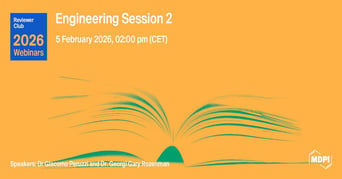
MDPI Reviewer Club Webinar 2026 | Engineering Session 2, 5 February 2026


At MDPI, we recognize that peer review is the foundation of scientific progress. The integrity, transparency, and quality of our journals depend on the careful evaluations provided by our reviewers. In 2024 alone, more than 215,000 reviewers contributed over 1.2 million reports to MDPI journals. This achievement reflects the strength of our community, and it is through the expertise and dedication of reviewers like you that scholarly communication continues to advance worldwide.


The MDPI Reviewer Club series was created to acknowledge this important role and to provide a vibrant forum for sharing experiences, exchanging best practices, and building meaningful connections across disciplines.

We are delighted to invite you to our upcoming webinar: “MDPI Reviewer Club Webinar 2026 |  Engineering Session 2”.

This session is designed as a dedicated space for reviewers in the Engineering discipline to connect, exchange insights, and celebrate the vital role they play in advancing scholarly publishing.

With the consent of our speakers, presentations will be recorded and shared on MDPI platforms, accompanied by introductions and discussion threads to continue the exchange long after the event.

If you are not yet part of our reviewer community, we warmly invite you to apply to join us as a reviewer. For further details about reviewing with MDPI, please also visit our page here, where you will find information on reviewer responsibilities, ethics, and the peer review process.

We warmly welcome you to join us for this inspiring exchange at the MDPI Reviewer Club 2026 | Engineering Session 2.

Keywords: peer review; reviewer guidelines; reviewer experience; ethics in peer review

Date: 5 February 2026 | 2:00 p.m. CET | 9:00 p.m. CST Asia | 7:00 a.m. EDT
Webinar ID: 814 6288 4944
Website: https://sciforum.net/event/MRC2026-ES2

Register now for free!

Speaker

Presentation Title

Time in CET

Time in CST (Asia)


Introduction

2:00–3:10 p.m.

9:00–11:10 a.m.

Dr. Giacomo Peruzzi

Peer Review Between Judgment and Automation - Keeping it Human in the Age of AI

5:10–5:30 p.m.

11:10–11:30 a.m.

Dr. Georgi Gary Rozenman


Rewiring Peer Review in the Age of Screenshots, Simulations, and AI Generated Synthetic Data

5:30–5:50 p.m.

11:30–11:50 a.m.


Q&A Session

6:10–6:30 p.m.

12:10–12:30 p.m.


Closing of Webinar

6:30–6:35 p.m.

12:30–12:35 p.m.

After registering, you will receive a confirmation email on how to join the webinar. Registrations with academic institutional email addresses will be prioritized.

Unable to attend? Register anyway, and we will let you know when the recording is available for viewing.

Webinar Speakers:

  • Dr. Giacomo Peruzzi, Department of Information Engineering, University of Padova, Italy;
  • Dr. Georgi Gary Rozenman, Department of Mathematics, Massachusetts Institute of Technology, USA.

23 January 2026
Recruiting Early Career Editorial Board Members for Technologies

In order to further enhance the international influence of the journal Technologies (ISSN: 2227-7080), promote the academic exchange of young scientists, and support the Editorial Board with additional expertise, Technologies is inviting interested and eligible early career researchers to apply for Early Career Editorial Board (ECEB) membership.

A total of 30 Early Career Editorial Board Members are planned to be recruited. Early Career Editorial Board (ECEB) members will hold the position for two years with the possibility of renewal for a second term.

Application eligibility:

  • Completed their doctorate/PhD degree in the past 10 years (considering exceptions for career interruptions, including medical and family leave);
  • Evidence of significant research achievements in the latest advancements in technologies;
  • Willingness to dedicate their time to the development of the journal with passion and enthusiasm;
  • Researchers that are active and engaged in their community (e.g., experienced at presenting at academic conferences or involved in professional organizations).

Benefits of an Early Career Editorial Board Member:

  • A certificate of appointment as an Early Career Editorial Board Member will be provided;
  • The achievements of Early Career Editorial Board Members are publicized on journal media platforms to improve academic visibility;
  • An opportunity to be promoted to Editorial Board Member based on contributions;
  • The journal will regularly acknowledge those who participated in the peer-review process on the journal website;
  • Opportunities to participate in or host annual meetings and online seminars organized by the Editor-in-Chief and the Editorial Board Members.

Responsibilities of an Early Career Editorial Board Member:

  • Publicizing and promoting the journal at academic conferences and among peers;
  • Selecting high-quality articles and preparing bilingual media content for promotion;
  • Reviewing at least four manuscripts per year;
  • Providing input on any new initiatives of journal development;
  • Inviting submissions from local and overseas world-leading scientists in respective research fields.

Applications:
Please fill in the application form here.

Please send the application form and your academic resume to technologies@mdpi.com with the subject of “Technologies Early Career Editorial Board Application + Name + Institute + Research Expertise”.

Application deadline: 30 September 2026.

Selection process and announcement:
The selection process: initial screening of application materials → selection by the Editor-in-Chief and Editorial Board Members → email notification → issuing a certificate of appointment.

The selection will be made within one month of the application deadline, and the results will be announced on the journal website.

20 January 2026
Meet Us Virtually at the 1st Online Conference on Technologies (IOCTe 2026), 11–13 November 2026


We invite you to attend this event organized by MDPI’s Technologies (ISSN: 2227-7080, Impact Factor 3.6, CiteScore: 8.5), in collaboration with our co-organizer, the Department of Mechanical Engineering, National University of Singapore (NUS). It will take place virtually from 11 to 13 November 2026, CET.

Conference Chair:
Prof. Dr. Manoj Gupta, National University of Singapore, Singapore.

Topics of interest:
S1. Information and Communication Technologies
Session Chair: Prof. Dr. Sotirios K. Goudos, Aristotle University of Thessaloniki, Greece;
S2. Assistive Technologies
Session Chair: Dr. Haipeng Liu, Coventry University, UK;
S3. Innovations in Materials Technologies
Session Chair: Prof. Dr. Manoj Gupta, National University of Singapore, Singapore;
S4. Manufacturing Technologies
Session Chair: Prof. Dr. Eugene Wong, Singapore Institute of Technology, Singapore;
S5. Environmental Technologies
Session Chair: Prof. Dr. Miklas Scholz, University of Johannesburg, South Africa;
S6. Electrical Technologies
Session Chair: Prof. Dr. Valeri Mladenov, Technical University of Sofia, Bulgaria.

Conference awards:
Best Oral Presentation Award and Best Poster Award
Number of winners: 6
Prizes: CHF 200 each

Guide for authors:
To submit your abstract, please click on the following link: https://sciforum.net/user/submission/create/1568.

To register for the event, please click on the following link: https://sciforum.net/event/IOCTe2026?section=#registration.

For details regarding abstract submission, poster and slide submission, and publication opportunities, you may refer to the “Instructions for Authors” section.

Important dates:
Deadline for abstract submission: 13 July 2026;
Notification of acceptance: 11 August 2026;
Deadline for registration: 5 November 2026.

For any enquiries regarding the event, please contact: iocte2026@mdpi.com.

For more information, you may refer to the following website: https://sciforum.net/event/IOCTe2026.

We look forward to seeing you at IOCTe 2026.

13 January 2026
Technologies | Selected Papers Published in 2024–2025 on Robotics

1. “Pneumatically Actuated Rehabilitation Equipment for the Sagittal and Frontal Plane Movements of the Neck Joint”
by Sarah Mareş, Andrea Deaconescu and Tudor Deaconescu
Technologies 2025, 13(1), 39; https://doi.org/10.3390/technologies13010039
Available online: https://www.mdpi.com/2227-7080/13/1/39

2. “Compliant Parallel Asymmetrical Gripper System”
by Andrea Deaconescu and Tudor Deaconescu
Technologies 2025, 13(2), 86; https://doi.org/10.3390/technologies13020086
Available online: https://www.mdpi.com/2227-7080/13/2/86

3. “Applications of 3D Reconstruction in Virtual Reality-Based Teleoperation: A Review in the Mining Industry”
by Alireza Kamran-Pishhesari, Amin Moniri-Morad and Javad Sattarvand
Technologies 2024, 12(3), 40; https://doi.org/10.3390/technologies12030040
Available online: https://www.mdpi.com/2227-7080/12/3/40

4. “Reinforcement Learning as an Approach to Train Multiplayer First-Person Shooter Game Agents”
by Pedro Almeida, Vítor Carvalho and Alberto Simões
Technologies 2024, 12(3), 34; https://doi.org/10.3390/technologies12030034
Available online: https://www.mdpi.com/2227-7080/12/3/34

5. “Reinforcement Learning for Fail-Operational Systems with Disentangled Dual-Skill Variables”
by Taewoo Kim and Shiho Kim
Technologies 2025, 13(4), 156; https://doi.org/10.3390/technologies13040156
Available online: https://www.mdpi.com/2227-7080/13/4/156

6. “Human–Machine Interaction: A Vision-Based Approach for Controlling a Robotic Hand Through Human Hand Movements”
by Gerardo García-Gil, Gabriela del Carmen López-Armas and José de Jesús Navarro Jr.
Technologies 2025, 13(5), 169; https://doi.org/10.3390/technologies13050169
Available online: https://www.mdpi.com/2227-7080/13/5/169

7. “The Impact of Real-World Interaction on the Perception of a Humanoid Social Robot in Care for Institutionalised Older Adults”
by Slawomir Tobis, Joanna Piasek-Skupna, Aleksandra Suwalska and Katarzyna Wieczorowska-Tobis
Technologies 2025, 13(5), 189; https://doi.org/10.3390/technologies13050189
Available online: https://www.mdpi.com/2227-7080/13/5/189

8. “MIRA: Multi-Joint Imitation with Recurrent Adaptation for Robot-Assisted Rehabilitation”
by Ali Ashary, Ruchik Mishra, Madan M. Rayguru and Dan O. Popa
Technologies 2024, 12(8), 135; https://doi.org/10.3390/technologies12080135
Available online: https://www.mdpi.com/2227-7080/12/8/135

9. “Modeling of Actuation Force, Pressure and Contraction of Fluidic Muscles Based on Machine Learning”
by Sandi Baressi Šegota, Mario Ključević, Dario Ogrizović and Zlatan Car
Technologies 2024, 12(9), 161; https://doi.org/10.3390/technologies12090161
Available online: https://www.mdpi.com/2227-7080/12/9/161

10. “An Innovative Vision-Guided Feeding System for Robotic Picking of Different-Shaped Industrial Components Randomly Arranged”
by Nicola Ivan Giannoccaro, Giuseppe Rausa, Roberta Rizzi, Paolo Visconti and Roberto De Fazio
Technologies 2024, 12(9), 153; https://doi.org/10.3390/technologies12090153
Available online: https://www.mdpi.com/2227-7080/12/9/153

9 January 2026
MDPI’s Newly Launched Journals in December 2025


We have expanded our open access portfolio with eight new journals publishing their inaugural issues in December 2025, as well as three journal transfers. These additions span physical sciences, social sciences, arts and humanities, environmental and Earth sciences, medicine and pharmacology, and public health and healthcare. We extend our sincere thanks to the Editors-in-Chief, Associate Editors, and Editorial Board Members who are shaping these journals’ direction. All journals uphold strong editorial standards through a thorough peer review process, ensuring impactful open access scholarship.

Please feel free to browse and discover more about the new journals below.

New Journals

Founding Editor-in-Chief(s)

Journal Topics (Selected)

Dr. Elisa Felicitas Arias,

Université PSL, France

Editorial | view inaugural issue

atomic clocks; time and frequency metrology; GNSS systems; relativity and relativistic timekeeping; fundamental physics in space |

view journal scope | submit an article

Prof. Dr. José F.F. Mendes,

University of Aveiro, Portugal

Editorial | view inaugural issue

complex systems; network science; nonlinear dynamics and chaotic behaviour; information theory and complexity; computational complexity |

view journal scope | submit an article

Prof. Dr. Roberto Morandotti,

Institut National de la Recherche Scientifique—Énergie, Matériaux et Télécommunications (INRS), Canada

Editorial | view inaugural issue

light generation; light sources and applications; light control and measurement; human responses to light; lighting design |

view journal scope | submit an article

Prof. Dr. Savvas A. Chatzichristofis,

Neapolis University Pafos, Cyprus

Editorial | view inaugural issue

generative AI and large language models in education; multimodal and embodied AI; personalization and adaptive systems; assessment, feedback, and academic integrity; learning analytics |

view journal scope | submit an article

Prof. Dr. Jon Andoni Duñabeitia,

Universidad Nebrija, Spain

Editorial | view inaugural issue

cognitive psychology; cognitive neuroscience; psycholinguistics; applied linguistics; experimental psychology |

view journal scope | submit an article

Prof. Dr. Caiwu Fu,

Wuhan University, China;

Prof. Dr. Longxi Zhang,

Peking University, China

Editorial | view inaugural issue

cultural practices; cultural theory; cultural policy; cultural heritage; transregional and transnational cultural flows|

view journal scope | submit an article

Dr. Ghassem R. Asrar,

iCREST Environmental Education Foundation, USA

Editorial | view inaugural issue

biosphere interactions, processes, and sustainability; ecosystem science and dynamics; biodiversity conservation; global change and environmental adaptation; biogeochemical cycles |

view journal scope | submit an article

Dr. Giuseppe Mulè,

University of Palermo, Italy

Editorial | view inaugural issue

cardiorenal syndromes; chronic heart failure and chronic kidney disease; cardiorenalmetabolic syndrome; hypertension and diabetes in relation to the abovementioned syndromes; diagnostic techniques |

view journal scope | submit an article

Transferred Journals

Editor-in-Chief

Journal Topics (Selected)

Prof. Dr. Peter Matt,

Lucerne Cantonal Hospital (LUKS), Switzerland

Editorial | view first issue

cardiology; cardiovascular and aortic surgery; cardiovascular anatomy, physiology and pathophysiology; congenital heart disease and pediatric cardiology;

cardiovascular regenerative and reparative medicine |

view journal scope | submit an article

Prof. Dr. Oana Săndulescu,

Carol Davila University of Medicine and Pharmacy, Romania;

National Institute for Infectious Diseases “Prof. Dr. Matei Bals”, Romania

Editorial | view first issue

infectious diseases across clinical and public health domains; epidemiology of communicable diseases; clinical microbiology and applied virology; vaccinology and immunization; host–pathogen interactions and immunity |

view journal scope | submit an article

Dr. Roxana Elena Bohiltea,

“Carol Davila” University of Medicine and Pharmacy, Romania

Editorial | view first issue

public health; disease prevention; screening and early detection; lifestyle interventions and health education; digital and innovative prevention |

view journal scope | submit an article

We would like to thank everyone who has supported the development of open access publishing. If you would like to create more new journals, you are welcome to send an application here, or contact the New Journal Committee (newjournal-committee@mdpi.com).

Back to TopTop