



Contemporary and Emerging Modalities of Kidney Assistance Therapy for Patients with Kidney Dysfunction Requiring Dialysis

A special issue of Toxins (ISSN 2072-6651). This special issue belongs to the section "Uremic Toxins".

Deadline for manuscript submissions: 30 June 2026 | Viewed by 13066
Special Issue Editors


E-Mail Website
Guest Editor
Department of Internal Medicine, Section on Nephrology, Wake Forest University School of Medicine, Winston-Salem, NC 27101, USA
Interests: extracorporeal kidney assistance therapy; individualized dialysis; individualized vascular access

E-Mail Website
Guest Editor
1. Nephrology, Department of Medicine, Medical University of South Carolina, Charleston, SC 29425, USA
2. Medical Services, Ralph H. Johnson VA Medical Center, Charleston, SC 29401, USA
Interests: dialysis; CRRT; electrolytes; transplant
Special Issues, Collections and Topics in MDPI journals

Special Issue Information

Dear Colleagues,

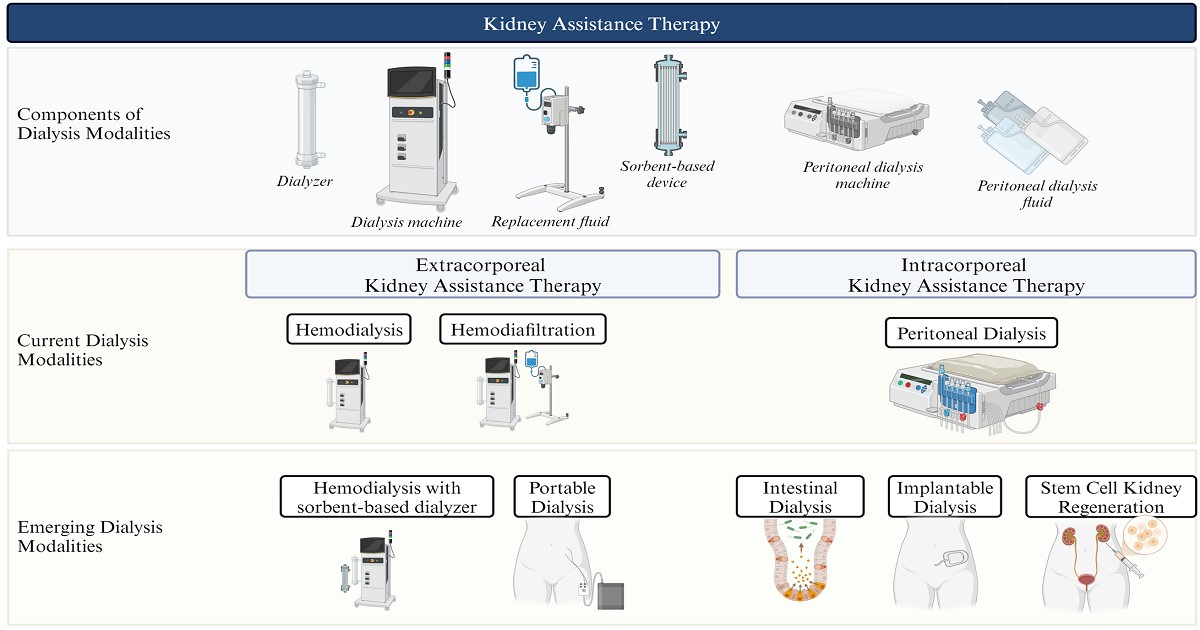
Kidney assistance therapy is the cornerstone of treatment for kidney dysfunction requiring dialysis (KDRD) and focuses on uremic toxin removal and fluid regulation. Broadly, kidney assistance therapy can be divided into two categories: extracorporeal and intracorporeal.

Extracorporeal therapy is the most prevalent form of kidney assistance with core components consisting of a dialyzer and dialysis machine. Adjunctive elements like replacement fluids or sorbent technologies may modulate its functionality. Based on the configuration of these components, extracorporeal therapy can be classified into two main modalities: hemodialysis and hemodiafiltration. Each modality provides varying levels of uremic toxin clearance and employs distinct fluid management strategies. Hemodialysis primarily relies on diffusion for solute removal, targeting small and medium-sized toxins. Hemodiafiltration combines diffusion and convection, enhancing the clearance of larger molecular weight toxins while improving fluid balance. Adjunctive technologies, such as sorbent-based devices, are tools that can optimize uremic toxin removal.

Intracorporeal therapy, currently represented by peritoneal dialysis, involves the utilization of the patient’s peritoneal membrane as a natural filter. Core components include a peritoneal dialysis machine and dialysate. The effectiveness of this modality hinges on individual peritoneal membrane characteristics, which influence solute clearance and fluid removal.

In addition to the established extracorporeal and intracorporeal kidney assistance therapies, innovations hold promise for transforming the management of kidney dysfunction by improving portability, accessibility, and patient outcomes. These innovations include portable extracorporeal kidney assistance devices, implantable intracorporeal artificial kidneys, and intestinal dialysis.

In this Toxins Special Issue, we welcome manuscripts focusing on the core and adjunctive components of extracorporeal and intracorporeal kidney assistance therapies utilized for the chronic treatment of patients with KDRD. They will explore how kidney assistance technologies differ in their ability to address uremic toxin levels and fluid imbalances, providing insights into selecting appropriate techniques for individualized care. Additionally, papers will cover emerging innovations in kidney assistance, including portable devices, intestinal dialysis, and implantable therapies, offering a glimpse into future possibilities. The goal of this Special Issue is to empower clinicians with a deeper understanding of current and emerging technologies in kidney assistance therapy, enabling them to tailor treatments that evolve alongside patients’ biological and clinical conditions.

Dr. Mariana Murea
Prof. Dr. Tibor Fülöp
Guest Editors

Manuscript Submission Information

Manuscripts should be submitted online at www.mdpi.com by registering and logging in to this website. Once you are registered, click here to go to the submission form. Manuscripts can be submitted until the deadline. All submissions that pass pre-check are peer-reviewed. Accepted papers will be published continuously in the journal (as soon as accepted) and will be listed together on the special issue website. Research articles, review articles as well as short communications are invited. For planned papers, a title and short abstract (about 250 words) can be sent to the Editorial Office for assessment.

Submitted manuscripts should not have been published previously, nor be under consideration for publication elsewhere (except conference proceedings papers). All manuscripts are thoroughly refereed through a double-blind peer-review process. A guide for authors and other relevant information for submission of manuscripts is available on the Instructions for Authors page. Toxins is an international peer-reviewed open access monthly journal published by MDPI.

Please visit the Instructions for Authors page before submitting a manuscript. The Article Processing Charge (APC) for publication in this open access journal is 2700 CHF (Swiss Francs). Submitted papers should be well formatted and use good English. Authors may use MDPI's English editing service prior to publication or during author revisions.

Keywords

  • uremic toxin
  • dialysis
  • dialyzer
  • filtration
  • intestinal
  • implantable
  • portable
  • sorbent

Benefits of Publishing in a Special Issue

  • Ease of navigation: Grouping papers by topic helps scholars navigate broad scope journals more efficiently.
  • Greater discoverability: Special Issues support the reach and impact of scientific research. Articles in Special Issues are more discoverable and cited more frequently.
  • Expansion of research network: Special Issues facilitate connections among authors, fostering scientific collaborations.
  • External promotion: Articles in Special Issues are often promoted through the journal's social media, increasing their visibility.
  • Reprint: MDPI Books provides the opportunity to republish successful Special Issues in book format, both online and in print.

Further information on MDPI's Special Issue policies can be found here.

Published Papers (7 papers)

Order results
Result details
Select all
Export citation of selected articles as:

Research

Jump to: Review

19 pages, 3640 KB  
Article
Chronic Kidney Disease-Associated Defect in Humoral Immune Response Is Driven by Inflammation
by Maxime Espi, Xavier Charmetant, Floriane Fusil, Cyrille Mathieu, Marie Legras, Caroline Pelletier, Griet Glorieux, Christophe Soulage, Laetitia Koppe and Olivier Thaunat
Toxins 2026, 18(2), 104; https://doi.org/10.3390/toxins18020104 - 19 Feb 2026
Viewed by 733
Abstract
Advanced chronic kidney disease (CKD) is associated with impaired humoral immunity, contributing to increased infection-related mortality and suboptimal vaccine responses, as notably observed during the COVID-19 pandemic. CKD is also marked by the accumulation of uremic toxins, but whether they directly influence T [...] Read more.
Advanced chronic kidney disease (CKD) is associated with impaired humoral immunity, contributing to increased infection-related mortality and suboptimal vaccine responses, as notably observed during the COVID-19 pandemic. CKD is also marked by the accumulation of uremic toxins, but whether they directly influence T and B cell functionality remains unclear. In this translational study, we integrated clinical and biological data from 106 CKD patients with mechanistic insights from in vitro and in vivo murine models to identify the mechanisms underlying CKD-associated defects in humoral responses against T cell-dependent antigens. Contrary to our initial hypothesis, indoxyl sulfate—despite its known ability to activate Aryl hydrocarbon Receptor signaling in monocytes—did not directly impair T–B cell cooperation in coculture assays. Similarly, plasma levels of ten major uremic toxins showed no correlations with vaccine-induced antibody titers in patients. Instead, systemic inflammation emerged as the primary driver of defective humoral immunity. Murine models further confirmed that inflammation, rather than uremia alone, induces lymphopenia, disrupts lymphoid architecture, and ultimately impairs antibody production. These findings indicate that CKD-associated inflammation, rather than a direct effect of uremic toxins on adaptive immune effectors, underlies humoral immune dysfunction in CKD. Targeting inflammation may, therefore, offer a promising strategy to improve vaccine efficacy and reduce infection-related complications in this vulnerable population. Full article
Show Figures

Figure 1

15 pages, 534 KB  
Article
Leptin and Adiponectin as Uremic Adipokines: Associations with Survival in a Prospective Hemodialysis Cohort
by Thuy-Anh V. Bui, Amy S. You, Sara S. Kalantar, Jihoon Yoon, Yoko Narasaki, John Sy, Ramy Hanna, Andrea Daza, Yalitzi Guerrero, Anyssa Dang, Ria Arora, Danh V. Nguyen, Kamyar Kalantar-Zadeh and Connie M. Rhee
Toxins 2025, 17(11), 525; https://doi.org/10.3390/toxins17110525 - 25 Oct 2025
Viewed by 1207
Abstract
Background: While experimental models show that leptin and adiponectin have inverse effects on the cardiovascular system, it has been suggested that the leptin-to-adiponectin (L/A) ratio may be an important predictor of cardiovascular disease and death. Higher circulating leptin and adiponectin levels are observed [...] Read more.
Background: While experimental models show that leptin and adiponectin have inverse effects on the cardiovascular system, it has been suggested that the leptin-to-adiponectin (L/A) ratio may be an important predictor of cardiovascular disease and death. Higher circulating leptin and adiponectin levels are observed in uremia due to decreased renal degradation and/or clearance and increased production. We sought to examine the association between the L/A ratio and mortality in a prospective hemodialysis cohort. Methods: Among a prospective cohort of 448 hemodialysis patients from the NIH “Malnutrition, Diet, and Racial Disparities in Chronic Kidney Disease (CKD) (MADRAD) study who underwent leptin and adiponectin measurements, we examined characteristics associated with high leptin and adiponectin (defined as the highest tertile) using logistic regression. We then examined the association of L/A ratio levels (categorized as tertiles) with all-cause mortality using Cox regression. Results: Multivariable logistic regression analyses showed female sex, diabetes, presence of an arteriovenous fistula/graft, and lower serum albumin, IL-6, and adiponectin were associated with high leptin, whereas female sex, longer vintage, Black race, higher IL-6, and lower leptin were associated with high adiponectin. When examining L/A ratios, the highest tertile was associated with lower mortality in case-mix Cox models (ref: lowest tertile): HR (95% CI) 0.14 (0.06–0.35). These associations were robust in analyses that additionally adjusted for laboratory covariates: (HR 95% CI) 0.18 (0.07–0.46). Conclusions: In a prospective cohort of hemodialysis patients, inflammation and malnutrition markers were associated with lower leptin and higher adiponectin levels. Additionally, high L/A ratio levels were associated with lower mortality. Further studies are needed to determine the mechanisms relating adipocytokines, inflammation and nutrition, and survival in this population. Full article
Show Figures

Figure 1

18 pages, 2349 KB  
Article
Comparing Computational Peritoneal Dialysis Models in Pigs and Patients
by Sangita Swapnasrita, Joost C. de Vries, Joanna Stachowska-Piętka, Carl M Öberg, Karin G. F. Gerritsen and Aurélie Carlier
Toxins 2025, 17(7), 329; https://doi.org/10.3390/toxins17070329 - 28 Jun 2025
Cited by 1 | Viewed by 1489
Abstract
Computational models of peritoneal dialysis (PD) are increasingly useful for optimizing treatment in patients with kidney disease requiring dialysis (KDRD). However, although several mathematical models have been developed in the past few decades, a direct comparison of the models’ accuracy with respect to [...] Read more.
Computational models of peritoneal dialysis (PD) are increasingly useful for optimizing treatment in patients with kidney disease requiring dialysis (KDRD). However, although several mathematical models have been developed in the past few decades, a direct comparison of the models’ accuracy with respect to predicting in vivo data is needed to further create robust personalized models. Here, we used a dataset obtained in a previous in vivo experimental model of PD in pigs (23 sessions of 4 h 2 L dwells in four pigs) and humans (20 sessions in 20 patients) to compare six computational models of PD: the Graff model (UGM), the three-pore model (TPM), the Garred model (GM), and the Waniewski model (WM), as well as two variations of these (UGM-18, SWM). We conducted this comparison to predict the dialysate concentrations of key uremic toxins and electrolytes (four in humans) throughout a 4 h dwell. The model predictions can provide insight into inter-individual differences in ultrafiltration, which are critical for tailoring PD regimens in KDRD. While TPM offered improved physiological reality, its computational cost suggests a trade-off between model complexity and clinical applicability for real-time or portable kidney support systems. In future applications, such models could provide adaptive PD regimens for tailored care based on patient-specific toxin kinetics and fluid dynamics. Full article
Show Figures

Figure 1

Review

Jump to: Research

19 pages, 751 KB  
Review
Quantifying the Contribution of Nondialytic Factors Affecting Predialysis Serum Phosphate Level When Comparing Hemodiafiltration with Hemodialysis
by John T. Daugirdas
Toxins 2026, 18(4), 179; https://doi.org/10.3390/toxins18040179 - 8 Apr 2026
Viewed by 371
Abstract
Hyperphosphatemia is a major complication in patients with kidney failure undergoing dialysis and is strongly associated with cardiovascular disease, vascular calcification, and increased mortality. Conventional management relies on dietary phosphate restriction, oral phosphate binders, and dialysis, yet persistent hyperphosphatemia affects a substantial proportion [...] Read more.
Hyperphosphatemia is a major complication in patients with kidney failure undergoing dialysis and is strongly associated with cardiovascular disease, vascular calcification, and increased mortality. Conventional management relies on dietary phosphate restriction, oral phosphate binders, and dialysis, yet persistent hyperphosphatemia affects a substantial proportion of patients. High-volume hemodiafiltration, combining diffusive and convective clearances, achieves greater phosphate removal than standard hemodialysis, with kinetic modeling predicting ~15–20% higher dialytic phosphate clearance (and ~0.5 mg/dL lower predialysis serum phosphate when nondialytic factors are constant). In this narrative review, we quantify the magnitude of improvement in dialytic clearance of phosphate with hemodiafiltration relative to hemodialysis and evaluate its effects on phosphate control measures. We also analyze phosphate balance in selected hemodiafiltration vs. hemodialysis comparisons and demonstrate why predialysis serum phosphate levels are sometimes only modestly lower or similar when hemodiafiltration is compared with hemodialysis. These findings are largely attributable to nondialytic factors—minor differences in phosphate binder equivalent dose, dietary phosphate ingestion, or residual kidney function—as predicted by phosphate kinetic modeling and supported by clinical trial data. Recognizing these confounders is essential for interpreting hemodiafiltration’s phosphate-lowering potential in real-world practice. Full article
Show Figures

Graphical abstract

28 pages, 2486 KB  
Review
Membrane-to-Patient Optimization: Individualized Dialyzer Selection for Extracorporeal Dialysis
by Mariana Murea, Alaa S. Awad, Vandana D. Niyyar, Tibor Fülöp, Akihiro C. Yamashita, Tadashi Tomo and Masanori Abe
Toxins 2026, 18(4), 156; https://doi.org/10.3390/toxins18040156 - 25 Mar 2026
Viewed by 672
Abstract
Extracorporeal dialysis for uremic toxin removal and fluid regulation relies on specialized dialyzers whose membranes differ markedly in polymer chemistry, pore architecture, adsorption capacity, surface bioactivity, and convective performance. These structural and material distinctions result in wide variation in the clearance of chemically [...] Read more.
Extracorporeal dialysis for uremic toxin removal and fluid regulation relies on specialized dialyzers whose membranes differ markedly in polymer chemistry, pore architecture, adsorption capacity, surface bioactivity, and convective performance. These structural and material distinctions result in wide variation in the clearance of chemically diverse uremic solutes. Despite the expanding range of dialyzer options, membrane selection in clinical practice remains largely non-individualized. In this review, we propose a phenotype-based model for dialyzer membrane selection. We outline how distinct membrane families achieve differential solute clearance and integrate these functional characteristics into a framework that considers residual kidney function, nutritional and inflammatory status, cardiovascular physiology, protein-bound toxin burden, and hemodynamic vulnerability. Because access to advanced membranes varies across regions and dialysis providers, implementation will require adaptation to local formulary constraints. Nevertheless, aligning membrane properties with patient-specific toxin profiles offers a promising strategy to optimize extracorporeal therapy and improve outcomes in chronic dialysis. Full article
Show Figures

Figure 1

17 pages, 939 KB  
Review
Intermittent Infusion Hemodiafiltration: A Narrative Review of an Emerging Dialysis Modality
by Xiaoxi Zhou, Jing Sun and Lining Miao
Toxins 2025, 17(9), 442; https://doi.org/10.3390/toxins17090442 - 3 Sep 2025
Cited by 1 | Viewed by 2676
Abstract
The number of patients with end-stage renal disease continues to grow worldwide, placing increasing demands on dialysis technologies. Conventional hemodialysis remains the dominant modality but is often limited by frequent intradialytic hypotension and the insufficient removal of medium-sized toxins. Intermittent infusion hemodiafiltration (I-HDF) [...] Read more.
The number of patients with end-stage renal disease continues to grow worldwide, placing increasing demands on dialysis technologies. Conventional hemodialysis remains the dominant modality but is often limited by frequent intradialytic hypotension and the insufficient removal of medium-sized toxins. Intermittent infusion hemodiafiltration (I-HDF) is an emerging, hybrid dialysis technique that combines standard hemodialysis with the cyclic backfiltration of ultrapure dialysate. This approach enables dynamic blood volume control and periodic backflushing of the dialyzer membrane. Recent clinical studies demonstrate that I-HDF can reduce intradialytic hypotension incidence, improve systemic and microcirculatory perfusion, and enhance the clearance of middle molecules such as β2-microglobulin, while minimizing albumin loss. These benefits are particularly relevant to toxin clearance and hemodynamic stabilization, key priorities in optimizing dialysis outcomes. Large-scale cohort data suggest that I-HDF may be linked to improved long-term survival in dialysis patients. Given its physiological advantages and operational flexibility, I-HDF may also offer a practical solution in healthcare systems with limited access to high-volume online hemodiafiltration or kidney transplantation. Further research is warranted to develop individualized infusion protocols and validate its broader applicability. Full article
Show Figures

Figure 1

20 pages, 335 KB  
Review
From Physicochemical Classification to Multidimensional Insights: A Comprehensive Review of Uremic Toxin Research
by Mario Cozzolino, Lorenza Magagnoli and Paola Ciceri
Toxins 2025, 17(6), 295; https://doi.org/10.3390/toxins17060295 - 10 Jun 2025
Cited by 13 | Viewed by 4895
Abstract
Chronic kidney disease (CKD) is a global health burden, with uremic toxins (UTs) playing a central role in its pathophysiology. In this review, we systematically examined the evolution of UT classification from the 2003 European Uremic Toxin Work Group (EUTox) system based on [...] Read more.
Chronic kidney disease (CKD) is a global health burden, with uremic toxins (UTs) playing a central role in its pathophysiology. In this review, we systematically examined the evolution of UT classification from the 2003 European Uremic Toxin Work Group (EUTox) system based on molecular weight and protein-binding properties to the 2023 multidimensional framework integrating clinical outcomes, clearance technologies, and artificial intelligence. We highlighted the toxicity mechanisms of UTs across the cardiovascular, immune, and nervous systems and evaluated traditional (e.g., low-/high-flux hemodialysis) and advanced (e.g., high-cutoff dialysis and hemoadsorption) clearance strategies. Despite progress, challenges persist in toxin detection, clearance efficiency, and personalized therapy. Future directions include multi-omics-based biomarker discovery, optimized dialysis membranes, advanced adsorption technology, and AI-driven treatment personalization. This synthesis aims to bridge translational gaps and guide precision medicine in nephrology. Full article
Show Figures

Figure 1

Back to TopTop