Skip Content
You are currently on the new version of our website. Access the old version .
  • Article
  • Open Access

5 March 2023

A Fuzzy Hybrid MCDM Approach for Assessing the Emergency Department Performance during the COVID-19 Outbreak


,
,
,
,
and
1
Department of Productivity and Innovation, Universidad de la Costa CUC, Barranquilla 081001, Colombia
2
School of Transportation and Logistics, Istanbul University, Istanbul 34320, Turkey
3
Department of Emergency Aid and Disaster Management, Munzur University, Tunceli 62000, Turkey
4
Department of Industrial Engineering, Institución Universitaria de Barranquilla IUB, Barranquilla 080002, Colombia

Abstract

The use of emergency departments (EDs) has increased during the COVID-19 outbreak, thereby evidencing the key role of these units in the overall response of healthcare systems to the current pandemic scenario. Nevertheless, several disruptions have emerged in the practical scenario including low throughput, overcrowding, and extended waiting times. Therefore, there is a need to develop strategies for upgrading the response of these units against the current pandemic. Given the above, this paper presents a hybrid fuzzy multicriteria decision-making model (MCDM) to evaluate the performance of EDs and create focused improvement interventions. First, the intuitionistic fuzzy analytic hierarchy process (IF-AHP) technique is used to estimate the relative priorities of criteria and sub-criteria considering uncertainty. Then, the intuitionistic fuzzy decision making trial and evaluation laboratory (IF-DEMATEL) is employed to calculate the interdependence and feedback between criteria and sub-criteria under uncertainty, Finally, the combined compromise solution (CoCoSo) is implemented to rank the EDs and detect their weaknesses to device suitable improvement plans. The aforementioned methodology was validated in three emergency centers in Turkey. The results revealed that the most important criterion in ED performance was ER facilities (14.4%), while Procedures and protocols evidenced the highest positive D + R value (18.239) among the dispatchers and is therefore deemed as the main generator within the performance network.

1. Introduction

EDs have essential services within the scope of public health. They provide 24-h emergency health care regardless of the economic competencies of the patients [1].
The ED system has common standards for human resources, medical devices, and procedures [2]. The patient flow is not always the same but follows the following order: triage, enrollment, clinical evaluation, treatment, and discharge [2,3]. The services provided by EDs within the scope of public health in ordinary and disaster times are of vital importance. Disasters have devastating effects on health, social, and economic dimensions. Especially developing countries are affected by disasters due to insufficient resources, infrastructure that cannot respond to disasters, and the absence of disaster preparedness systems [4]. There is an imbalance between the need for health services and the provision of health services during disaster periods. In addition, health facilities inevitably become unusable due to the disaster as medical equipment is damaged, logistics instruments cannot be used, and health personnel who serve in health services become unworkable, disrupting health services [5].
COVID-19, which first appeared in December 2019, affected a particular geography and caused devastating effects on the whole world (URL-1). COVID-19 stands out from other local and other high-profile disasters as its future course is difficult to predict [6]. In most countries, EDs have been the first resort to meet patients’ complaints with various symptoms of the disease. It has proven its essential role in public health, as they evaluated the symptoms and provided isolation when deemed necessary, thereby reducing the spread of infection in the community [7]. To respond to this unusual demand, especially to deal with patients with suspected acute respiratory failure, the need to reorganize EDs has arisen [8]. The performance indicators of EDs also need to be re-evaluated due to needs such as the differentiation of demand, the increase in the need, the fact that COVID-19 generally affects the respiratory tract, the necessity of combating the risk of infection while providing healthcare services, and the protection of uninfected patients during diagnosis.
The statistical data announced by the Turkish Ministry of Health between 4 April 2020–22 February 2022 are examined in Figure 1, where it is seen that the tests performed to identify COVID-19-positive people have increased in a short time since the beginning of the pandemic. The capacity to perform approximately 460,000 tests per day has been reached. In Turkey, the tests are carried out by the ED, which increases the workload and intensity of the ED considerably. Mortality rates appear in a waveform and have shown a downward trend recently. EDs play a key role in the fight against the pandemic. ED management needs to establish different strategies to respond to an unusual demand. Multi-criteria decision-making (MCDM) is one of the methods used in determining strategy and creating a decision support system [9]. MCDM offers two perspectives, managerial and engineering. The management perspective defines objectives and identifies and evaluates alternatives [10]. Measuring performance in sectors such as health services is challenging because there is a fine line between providing quality and effective service and efficient use of resources [11]. To determine these strategies and measure the performance of EDs, a model using an integrated intuitionistic fuzzy analytic hierarchy process (IF-AHP), intuitionistic fuzzy decision making trial and evaluation laboratory (IF-DEMATEL), and combined compromise solution (CoCoSo) approaches is proposed in this study.
Figure 1. Number of tests and deaths per day.
The model we propose was applied in three competing hospitals in eastern Turkey, which are close enough to be used as alternatives to each other. This model will guide decision-makers to evaluate the threats and opportunities of their hospitals. The fact that the hospitals are in the same region will also show the region’s position in the fight against the outbreak.
When the literature, which will be discussed in-depth in the following section, is examined, it is seen that many researchers and health-related decision-making institutions are working on preparing units such as hospitals and emergency services in the hospital in case of epidemic diseases such as COVID-19. In some of these, the criteria used to evaluate preparedness were determined and MCDM methods were used to determine their importance. However, in the current study, the use of IF-AHP and IF-DEMATEL was preferred, unlike their counterparts. The use of the AHP-DEMATEL pair in intuitionistic fuzzy set integration is due to its ability to reflect the uncertainty in the decision-makers’ evaluations in determining the criterion weights and then revealing the relationships between them. This is because with intuitionistic fuzzy numbers, decision-makers’ evaluations are reflected in both membership and non-membership degrees. This situation strengthens the sensitivity of reflecting the uncertainty compared to classical sets. Similarly, using the CoCoSo method as the third pillar of the integrated approach is suitable because the criteria for evaluating the emergency services’ pandemic preparedness are numerical data. In this case, such an integrated approach is considered problem-specific. In particular, the contributions and advantages of the model to those in the literature are as follows:
  • First, AHP, a pairwise comparison technique, was combined with intuitionistic fuzzy set theory, the advanced version of fuzzy set theory, to determine the relative importance levels of the criteria used to evaluate the COVID-19 performance of EDs. This is because AHP’s key features (hierarchical structure, pairwise comparison, consistency, etc.) include the degree of non-membership.
  • While conventional methods consider the criteria independent, IF-DEMATEL considers the cause-and-effect relationships between the criteria, which is more suitable for evaluating the criteria in EDs. With IF-DEMATEL, it also provided the opportunity to present cause–effect relationships and critical ones to decision-makers in a visual structure. Thus, it provides a framework for decision-makers about how future improvements can affect the whole system.
  • Finally, the CoCoSo method is adopted to determine the performance of emergency services in Turkey. Since this method is a combination of simple additive weighting (SAW), weighted aggregated product evaluation (WASPAS), and multiplicative exponential weighting (MEW) methods, it is stated in the literature that it gives more reliable results than these three methods [12]. As a result of CoCoSo being a holistic method, it allows a more robust model to be built and more accurate decisions to be made. Further, CoCoSo can handle complex problems more easily and efficiently [13].
  • The combination of IF-AHP, IF-DEMATEL, and CoCoSo can be easily applied not only for listing ED alternatives but also for handling real-world problems in different disciplines. Thanks to this combination, the alternatives are ranked and a projection can be obtained for decision-makers about potential improvements in which criteria will affect the ranking. In this way, a roadmap can be created.
The organization of the research is designed under five sections. The following section presents an in-depth overview of the related work on the topic. It handles the current knowledge from two aspects; while one is on the previous efforts of performance assessment of health facilities during outbreaks, the other is regarding outbreak readiness assessment by MCDM methods. The third section provides the mathematical background of the proposed methodology. The fourth section introduces the numerical results obtained from the case study application. The final section provides a general conclusion, limitations, and future research agenda.

3. Proposed Methodology

A six-step approach is proposed to evaluate the emergency department response during the COVID-19 outbreak, identify the intervention points, and design improvement plans to increase their response in the presence of COVID-19 (Figure 1). An explanation of the suggested methodology is provided below:
  • Step 1. Creation of an expert team: A set of decision-makers is selected considering their background in ED management. The experts are expected to provide information on which factors may affect the performance of these units throughout the current pandemic. Furthermore, they will be asked to carry out paired judgments to define both the importance and influence of the decision elements.
  • Step 2. Structuring the ED performance evaluation model: The decision model is then defined by including ED performance criteria and sub-criteria from the pertinent reported literature, legal healthcare framework, and decision-makers’ recommendations.
  • Step 3. Computation of criteria and sub-criteria relative priorities considering uncertainty: IF-AHP method is later applied to derive the relative weights of criteria and sub-criteria while modelling the uncertainty and vagueness of human thought when performing the paired judgments. The IF-AHP results will lay the groundwork for the proposal of short-term improvement interventions that is highly needed in a rapidly evolving pandemic.
  • Step 4. Appraisal of cause–effect interrelations among criteria and sub-criteria considering uncertainty: IF-DEMATEL is applied to detect significant interdependence and feedback among criteria/sub-criteria whilst representing the expected uncertainty of decision-makers when eliciting the influence comparisons in the model. IF-DEMATEL goes beyond measuring the strength of these interrelations, so that the main drivers of long-term plans can be easily defined.
  • Step 5. Calculation of the ED performance index and ranking derivation: In this phase, CoCoSo is employed for computing a performance index for each ED. Following this, the emergency care units are ranked from the highest to the lowest value of this index to discriminate those with high performance ( M i   0.75 )  as well as the EDs with an urgent need for improvement ( M i 0.25 ) .
  • Step 6. Identification of intervention points and creation of intervention plans per each ED: Detect the sub-criteria most contributing to a poor response by EDs against the COVID-19 outbreak and delineate focused improvement plans targeting upgraded performance.

3.1. Intuitionistic Fuzzy Analytic Hierarchy Process (IF-AHP)

The theory of fuzzy sets was first proposed by Zadeh [43] and allows us to introduce the uncertainty of a decision-maker based on precise concepts. Later, Atanassov [42] improved this work by considering the hesitancy degree, which denotes the proficiency of each expert in a particular decision-making context. This new approach is called the intuitionistic fuzzy set (IFS) theory and comprises the following foundations:
Concept of an intuitionistic fuzzy set: IFS is an extension of fuzzy sets (IF) where X represents a set in the universe of discourse. An intuitionistic set “A” is given by Equation (1) [50,51].
A = {   x ,   A   ( μ A ( x ) ,   v A ( x ) ) | x X   }
Here, μ A ( x ) : X   a   [ 0 , 1 ] denotes the degree of membership whilst v A ( x ) : X   a   [ 0 , 1 ] represents the degree of non-membership. The applicable mathematical properties for each x X are in Equations (2) and (3). Specifically, the hesitancy degree is given by Equation (3).
0 μ A ( x ) + v A ( x ) 1
π A ( x ) = 1 μ A ( x ) v A ( x ) ,   x X
Concept of defuzzification process in IFS: Defuzzification involves converting fuzzy quantities into crisp values for further estimation of the relative priorities and interdependencies of criteria and sub-criteria for the application described here. In this regard, Attanassov et al. [42] postulated a defuzzification for the IFS as stated in Equations (4) and (5). First, the defuzzification operator C φ (Equation (4)) allows converting an IFS into a classical fuzzy set (FS) followed by the evaluation of the FS via a defuzzification approach. Although different score functions can be utilized for transforming the IFS into crisp values [52], using the operator C φ has been proven to be more useful in practical scenarios due to its mathematical simplicity. Today’s healthcare administrators aim to employ robust and rigorous decision-making approaches involving single equations or few steps to follow as exemplified with C φ . For example, Aicevarya Devi et al. [53] proposed a converting intuitionistic fuzzy into a crisp score (CIFCS) algorithm to deal with the defuzzification activity, but its application is not recommended in this context given the significant mathematical effort involved in MCDM models with many decision elements. On a different tack, Büyüközkan et al. [54] employed the intuitionistic fuzzy entropy method but did not provide further mathematical validation supporting its implementation, which in turn was specified by Atanassov et al. [42] regarding C φ .
C φ ( A ) = { x , μ A ( x ) + φ π A ( x ) , v A ( x ) + ( 1 φ ) π A ( x ) , x ϵ X }   with   φ ϵ [ 0 , 1 ]
Here, C φ ( I ) is a classical fuzzy subset whose membership degree is defined by the equation:
μ φ ( x ) = μ A ( x ) + φ π A ( x )
The solution of the minimization problem for a Euclidean separation d, i.e., min φ ϵ [ 0 , 1 ] d ( C φ ( A ) ,   A ) , is achieved when φ = 0.5 . The fuzzy set C 0.5 ( A ) is now denoted by the membership expression μ ( x ) = 1 2 ( 1 + μ A ( x ) v A ( x ) ) . Finally, the center of gravity is suggested for supporting the defuzzification process [55].
After explaining the IFS logic underpinning the inclusion of uncertainty and hesitancy in the decision-making model, we can now introduce the IF-AHP method, which has been selected for weighting the criteria and sub-criteria defining the ED readiness during the COVID-19 pandemic [56]. The step-by-step IF-AHP procedure is presented as follows:
Phase 1—Identification of criteria and sub-criteria defining the ED readiness against the COVID-19 outbreak: In this phase, a decision-making group is formed to provide information on the aspects directly contributing to ED readiness during the current pandemic times. Moreover, applicable health regulations and pertinent scientific literature are consulted to extract other decision elements to be considered in the model.
Phase 2—Pairwise comparisons: The decision-making team is asked to perform paired judgments between criteria and sub-criteria considering the following intuitionistic fuzzy evaluation scale: much less relevant (0.27, 0.33, 0.40), less relevant (0.27, 0.13, 0.60), equally relevant (0.02, 0.18, 0.80), more relevant (0.13, 0.27, 0.60), and much more relevant (0.33, 0.27, 0.40).
Phase 3—Estimation of the importance weights per expert: The scale of Boran et al. [51] is used for determining the knowledge degree of experts. The higher the level of experience of the decision-maker, the higher the relative priority. The corresponding triangular intuitionistic fuzzy numbers considered in [43] are as follows: very irrelevant (0.10, 0.80, 0.10), irrelevant (0.25, 0.60, 0.15), moderately relevant (0.50, 0.40, 0.10), relevant (0.75, 0.20, 0.05), and very relevant (0.90, 0.05, 0.05). In this regard, D k = ( μ k , v k , π k ) has been denoted as an intuitionistic number for the fuzzy importance evaluation of a kth expert. The ω k indicates the relative priority of the kth expert (Equation (6)).
ω k = ( μ k + π k ( μ k / ( μ k + v k ) ) ) k = 1 t ( μ k + π k ( μ k / ( μ k + v k ) ) )
Phase 4—Derive the aggregated intuitionistic fuzzy decision-making matrix R ( k ) : Here, R ( k ) = ( r i j ( k ) ) m x n denotes an intuitionistic fuzzy decision matrix estimated based on the judgments of K decision-makers. Xu [57] and Ar et al. [58] employed a generalized intuitionistic fuzzy weighted average (IFWA) operator to facilitate the aggregation of the comparisons (Equations (7) and (8)).
r i j = I F W A ω = ( r i j ( 1 ) , r i j ( 2 ) , . , r i j ( t ) ) = ω 1 r i j ( 1 ) ω 2 r i j ( 2 ) ω t r i j ( t )
I F W A ω = ( 1 k = 1 t ( 1 μ i j ( k ) ) ω k , k = 1 t ( v i j ( k ) ) ω k , k = 1 t ( 1 μ i j ( k ) ) ω k k = 1 t ( v i j ( k ) ) ω k )
where r i j = ( μ i j , v i j , π i j ) .
Phase 5—Consistency assessment: The experts need to be consistent when making the comparisons, so that the resulting relative priorities of criteria and sub-criteria can be a reliable framework for hospital readiness evaluation. The consistency ratio (CR) (Equation (9)) proposed by Saaty [44] has been adopted for detecting discrepancies in the aggregated intuitionistic fuzzy decision matrixes.
C R = ( ( λ m a x n ) / ( n 1 ) ) R I
In Equation (9), n denotes the number of criteria and sub-criteria integrating the matrix. If the resulting CR is lower than 0.10, the matrix is considered consistent; otherwise, the experts should revise and update their judgments before further estimation of relative global and local priorities [59].
Phase 6—Computation of the intuitionistic fuzzy weights: Once consistency has been achieved in all the matrixes, we proceed with the calculation of intuitionistic fuzzy priorities for criteria and sub-criteria by applying Equations (10) and (11). The priorities should be standardized to ensure w i = 1 .
w = i = 1 n l n 2 ( μ i l n μ i + v i l n v i ( 1 π i ) ln ( 1 π i ) π i l n 2 )
w i = 1 w = i n i = 1 n w = i

3.2. Intuitionistic Fuzzy Decision-Making Trial and Evaluation Laboratory (IF-DEMATEL)

The DEMATEL method has been used in several decision-making problems for appraising the interdependence and feedback among the criteria/sub-criteria of a network [45,46,47]. Nonetheless, in some occasions, the crisp scale is inadequate to estimate the vague interrelations, thereby making the model less realistic and applicable to the practical context. A merge with IFS logic is then suggested to deal with this problem [60,61]. IFS concepts have been widely introduced in the previous section and underpin the IF-DEMATEL algorithm as illustrated below.
Phase 1—Paired comparisons: In IF-AHP, the decision-makers assess the linear dependency of criteria and sub-criteria with respect to their adjacent decision elements in the same hierarchy level. Nonetheless, the hospital’s daily routine and the related reported literature have also revealed the presence of significant interactions among healthcare services and indicators. Therefore, analyzing these interrelations can provide significant outputs on hospital disaster preparedness while laying the groundwork for the design of medium- and long-term intervention plans. In this respect, the IF-DEMATEL entails the following IFS evaluation scale: no influence [0.1, 0.9], low influence [0.35, 0.6], medium influence [0.5, 0.45], high influence [0.75, 0.2], and very high influence [0.9, 0.1]. The decision-makers are also required to perform the judgments pairwise in the search of elucidating the cause and effect groups. The degree of hesitation is calculated using Equation (3) and an initial intuitionistic fuzzy matrix Z k ˜ = [ z i j k ˜ ] n x n is formed with the comparisons.
Phase 2—Defuzzification: In this phase, the intuitionistic fuzzy matrixes are defuzzified by first transforming Z k ˜ into a classical fuzzy subset following the formula μ ( x ) = 1 2 ( 1 + μ I ( x ) v I ( x ) ) . Then, the resulting subsets are allocated to a triangular fuzzy number (TFN) by implementing the Equations (12) and (13) [48]. Here, μ ( x ˜ ) denotes the membership function value while x ˜ symbolizes the respective defuzzified value. Further, l, m, and u are the parameters of TFNs. A matrix Z k = [ z i j k ] n x n with the subsequent crisp numbers is derived accordingly, considering k (k = 1, 2, …, K) as the kth expert in the decision-making group.
μ ( x ˜ ) = ( x ˜ l ) / ( m l )
x ˜ = l + μ ( x ˜ ) ( m l )
Phase 3—Aggregated initial direct-relation matrices: In this step, the aggregated crisp matrix Z = [ z i j ] n x n is achieved by implementing Equation (14).
z i j = 1 l k = 1 l z i j k ,             i , j = 1 , 2 , , n
Phase 4—Convergence index computation: It is also important to validate the reliability of the results obtained from IF-DEMATEL to avoid possible errors in expert decision-making. Nevertheless, most DEMATEL applications ignore biases and accept that the information is trustworthy. Hence, we propose the use of the convergence index for assessing the internal consistency among paired judgments. This ratio allows us to define if the experts were accurate in making their comparisons. The integration matrix of n and n − 1 decision-makers is denoted by g c i j p and g c i j ( p 1 ) (Equation (15)). The participants are deemed consistent if this ratio is found to be less or equal to 0.05.
1 n ( n 1 ) i = 1 n j = 1 n | g c i j p g c i j ( p 1 ) | g c i j p
Phase 5—Normalization of the initial direct relation matrix (N): After verifying the consistency of the comparisons, the matrix N = [ N i j ] n x n   is obtained by normalizing the average matrix (Equations (16) and (17)). Here, s is the norm used for achieving N.
N = s 1 Z
s = m a x ( j = 1 n z i j   , i = 1 n z i j   )
Phase 6—Estimation of the total influence matrix (T): The T array, considering the normalized (N) and identity (I) matrixes (Equation (18)), reveals the direct and indirect effects of each criterion/sub-criterion, thereby supporting the identification of dispatchers and receivers. From this matrix, it is possible to calculate the “Prominence” (D + R) of each decision element, which denotes the strength of interdependencies emanating from and received by a specific criterion/sub-criterion. Thereby, decision-makers can elucidate how critical its role is regarding the network goal. In parallel, “Relation” (D − R), another parameter of importance in medium- and long-term decisions, denotes the nature of criteria/sub-criteria in ED disaster preparedness. Specifically, if d i r j > 0 , the decision element is then categorized as “dispatcher”; therefore, it is of influencing essence and can be prioritized for upgrading ED performance in the presence of the COVID-19 pandemic waves. Otherwise, if d i r j < 0 , the sub-criterion/criterion is a “receiver” and it is hence influenced by others in the network. It is good to highlight that di is the ith row sum of effects that a specific element exerts on the others (Equation (19)), whereas rj is the jth column sum of influences received by a criterion/sub-criterion in the ED disaster preparedness model (Equation (20)).
T = N ( I N ) 1
D = [ d i ] n x 1 = ( j = 1 n t i j ) n x 1 = ( t i ) n x 1
R = [ r j ] 1 x n = ( i = 1 n t i j ) 1 x n = ( t j ) 1 x n
Phase 7—Impact-Digraph Map (IDM): The dataset (D + R, D − R) is finally plotted to derive the significant interrelations among criteria/sub-criteria. At this point, it is necessary to calculate a threshold θ per matrix by using Equation (21). All the t i j over this reference value are considered significant and are then incorporated into the IDM.

3.3. Combined Compromise Solution (CoCoSo)

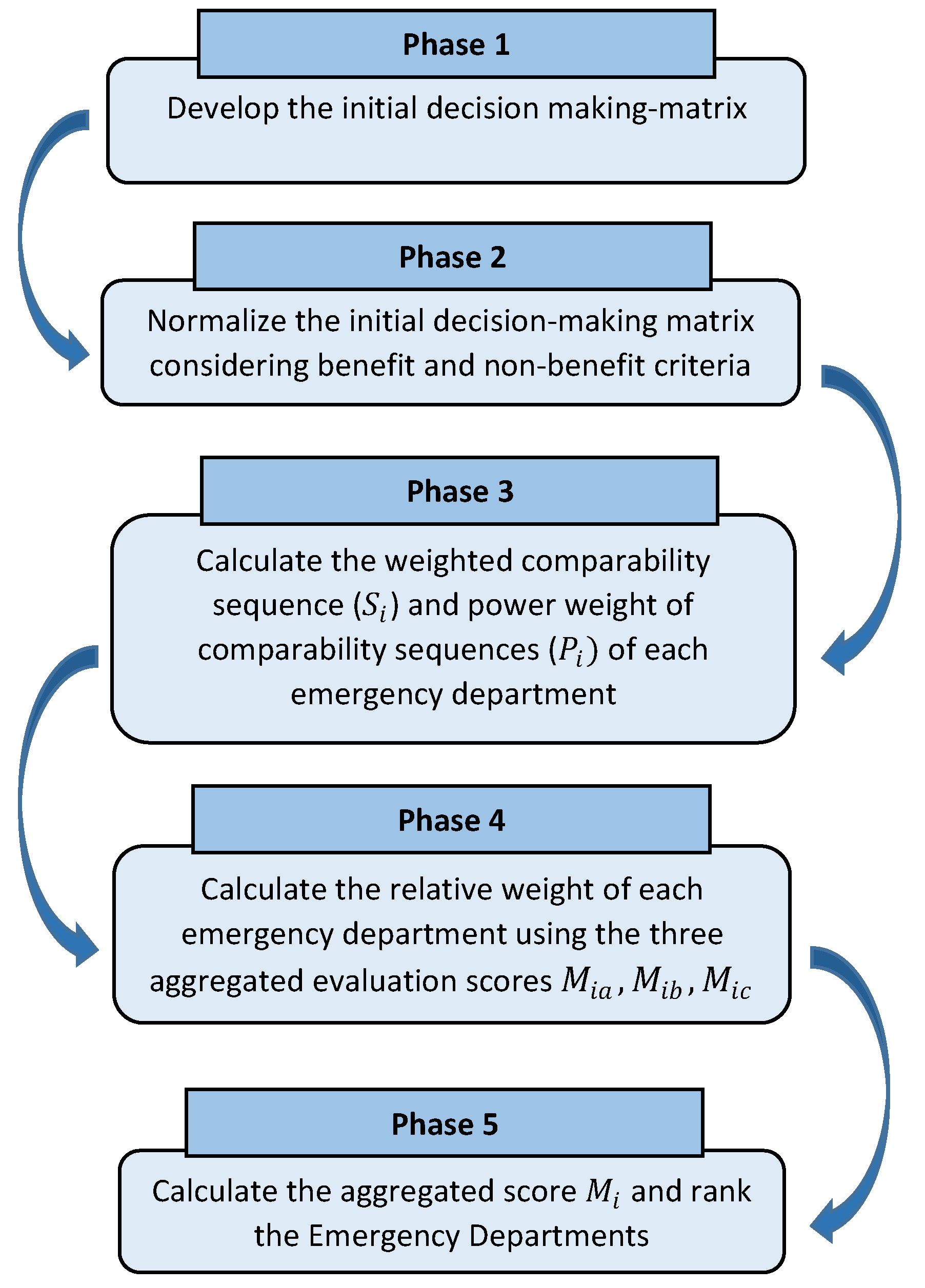
The CoCoSo (combined compromise solution) method is a novel multi-criteria method presented by Yazdani et al. [13]. It comprises three well-known MCDM methods and is based on compromise solutions such as TOPSIS and measurement alternatives and ranking according to compromise solution (MARCOS). Many MCDM methods have been proposed in the literature and are still being developed further. Here, the feature that brings CoCoSo to the forefront and triggers our application for the problem is that the method combines three different strategies and gives an aggregated ranking with the features of all three: simple additive weighting (SAW), multiplicative exponentially weighting (MEW), and weighted aggregate sum product assessment (WASPAS). In the literature, it has been stated that most combined methods or new approaches that include the features of several methods give good results [13]. It differentiates from MARCOS, which is based on utility functions on which decision preferences are defined. It has similar features to TOPSIS. While MARCOS is based on determining the relationship between alternatives and reference values (ideal and anti-ideal solutions), CoCoSo obtained a compromise solution by combining the utility values of each alternative using an aggregation function [62]. Rank reversal or ranking irregularities (that is, the ordering of alternatives may change if a new option is added to the presented set of options or an old option is deleted or changed from it) is undoubtedly one of the most important handicaps of many MCDM methods [63,64,65]. It has been evaluated in the literature to be a normal phenomenon [65]. Therefore, in this study, an MCDM technique such as CoCoSo was also preferred purely because of its benefits (outlined above) and ease of integration with other fuzzy-based MCDM methods (like IF-AHP and IF-DEMATEL). This method helps to calculate an aggregated score representing the ED disaster preparedness against COVID-19 while supporting decision-makers in elucidating the weakness and strengths of each emergency unit [12,49]. The CoCoSo procedure is illustrated in Figure 2.
Figure 2. The step-by-step procedure of the CoCoSo method.
Phase 1Establish the initial decision matrix: An indicator is first defined for each sub-criterion and then measured in each participant ED ( m i j ) . The collected data is finally arranged in matrix M (Equation (21)), where relative global priorities derived from the IF-AHP method are also incorporated. In Equation (21), I denotes the alternative ED, whilst j represents the sub-criterion.
M = [ m i j ]
Phase 2Normalization: Normalize M by applying Equations (22) and (23). The resulting matrix R = [ r i j ] compiles all the normalized values ( r i j ) , considering if the sub-criterion is of benefit (Equation (22)) or non-benefit (Equation (23)) nature.
r i j = m i j min i m i j max i m i j min i m i j   for   benefit   subcriteria
r i j = max i m i j m i j max i m i j min i m i j   for   non benefit   subcriteria
Phase 3Estimation of weighted comparability  ( S i )  and power-weighted comparability ( P i ) :  S i and P i are computed for each participant ED by applying the Equations (24) and (25). Here w j symbolizes the relative weight of the sub-criterion j.
S i = j = 1 n w j r i j
P i = j = 1 n r i j w j
Phase 4Computation of aggregated appraisal scores:  M i a ,   M i b , M i c  are estimated for each participant emergency care unit i via implementing Equations (26)–(28), respectively. These formulas are based on the S i and P i scores calculated for each alternative.
M i a = P i + S i i = 1 m ( P i + S i )
M i b = S i min i S i + P i min i P i
M i c = λ ( S i ) + ( 1 λ ) ( P i ) λ max i S i + ( 1 λ ) max i P i
Phase 5Ranking and design of improvement interventions: Order the participant EDs from the highest to the lowest M i value (Equation (29)). M i represents the emergency department performance index (EDPI), which will allow decision-makers to establish the overall response that these units may evidence in the presence of new COVID-19 waves and similar seasonal respiratory diseases. Then, define strategies on each weak sub-criterion, so that ED preparedness can be increased when addressing COVID-19 waves.
M i = ( M i a M i b M i c ) 3 + 1 3 ( M i a + M i b + M i c )

4. Results

The Turkish healthcare system has been fighting against the COVID-19 pandemic. As a result, the EDs have evidenced accessibility problems including overcrowding, lengthy waiting times, and a high percentage of no-shows [16]. In fact, in January 2022, the Ministry of Health counted 74,266 cases in one day, the highest infection rate in the country since the beginning of the pandemic [66]. One of the cities with the highest rate of hospitalization and bed occupancy in hospitals is Istanbul, which has motivated the adoption of more stringent measures. The described scenario is then an incentive to:
  • measure the performance of EDs and create strategies to increase their response to the ongoing sanitary crisis;
  • identify influential factors that can be prioritized by health authorities when designing the ED policies at a national level;
  • pinpoint the limitations of each ED and implement focused improvement plans.
The following subsections describe the implementation of the suggested MCDM hybrid approach to address the aforementioned considerations.

4.1. The Expert Team

Adequately selecting a team of decision-makers is important to determine the relevance and influence of the performance criteria/sub-criteria considered in the response of EDs against the COVID-19 emergency. The experts were selected considering three inclusion criteria: (i) professional background in emergency department management, (ii) more than 10 years of experience in the healthcare sector, and (iii) have participated in projects pursuing upgraded response of EDs during disastrous situations. The resulting sample size (n = 6 experts) was derived considering N = 6 experts satisfying the above-mentioned criteria, with p = 0.5, q = 0.5, confidence level = 95%, and E = 5%. Taking into account the above, the following experts were chosen:
  • Three ED supervisors (DM1, DM2, and DM3): They were linked to public sector hospitals and presented in-depth knowledge in the field of hospital emergency services. Moreover, they had a significant background represented by a trajectory of more than 15 years in the healthcare industry.
  • Two healthcare quality auditors (DM4 and DM5): The two experts were chosen for their roles as spokespersons involved in radical changes improving emergency care. Further, they were related to the implementation of healthcare government policies and can be thereby useful for devising improvement plans and contributing to the optimal development of emergency services in public hospitals.
  • One senior academician (DM6): She currently has a high level of experience in the application of multi-criteria decision-making techniques. Moreover, she had a constant enrollment in projects related to the health sector, thereby knowing the main weaknesses of the emergency care services in public hospitals.

4.2. The ED Performance Evaluation Model

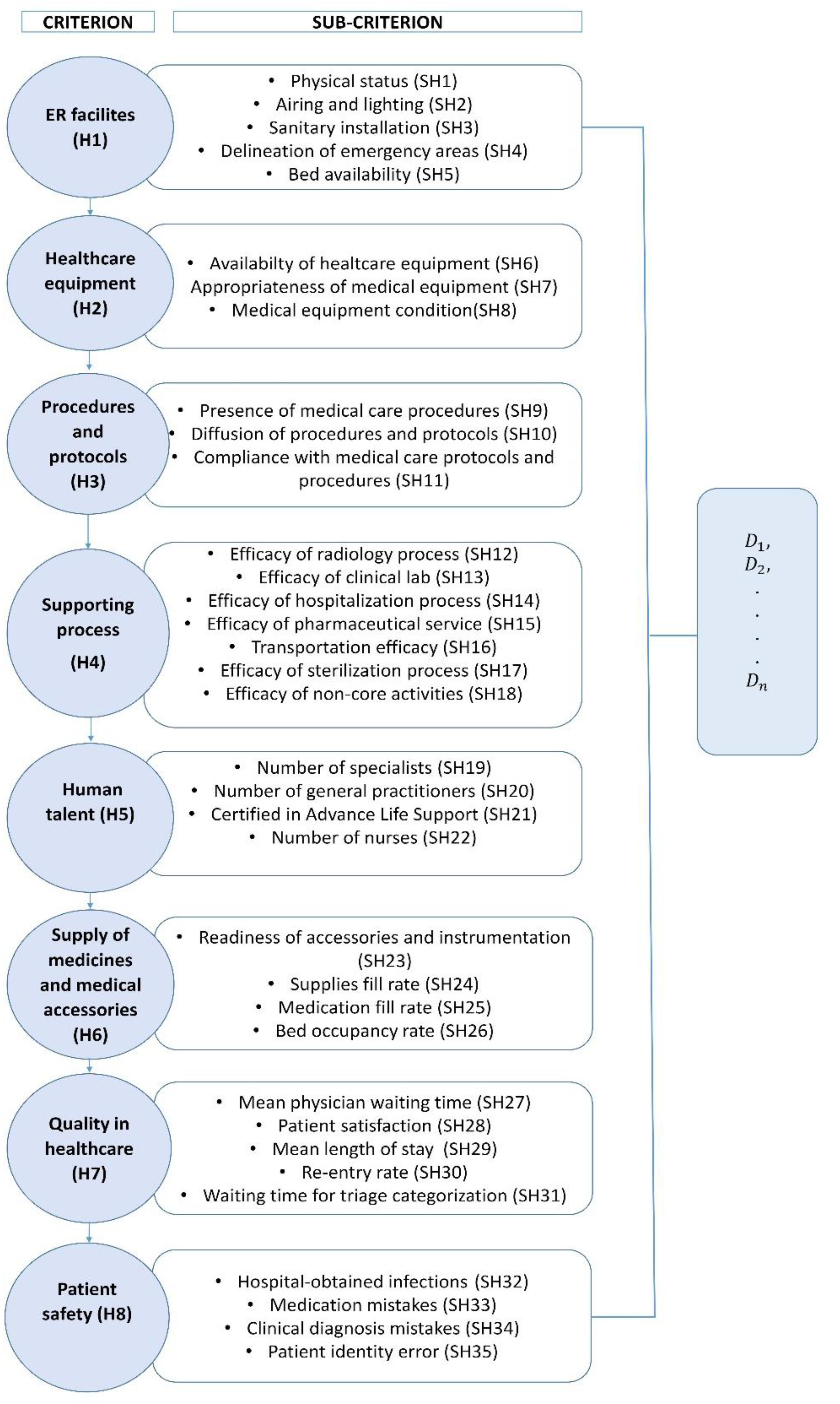
A total of 8 criteria and 35 sub-criteria were finally identified as performance drivers of emergency centers in Turkish public hospitals. This is the result of the interactions with experts’ feedback, the evidence from the scientific literature, and the pertinent healthcare regulations in the COVID-19 era. Specifically, phone calls were performed by the researchers to collect the criteria and sub-criteria that the experts recommended including in the performance evaluation model. Further, Scopus and Web of Science databases were consulted to extract the decision elements that similar studies had considered in previous applications. Likewise, “clause 5: provision of emergency health services in the national territory”, clause 9 “optimal functioning of emergency centers in hospitals”, and clause 15 “written duties and responsibilities of all trained personnel in the emergency center” were analyzed to identify the performance factors separately measured and supervised by the health authorities concerning the emergency care service. The legal framework was deemed in this study to validate the initial list of criteria and sub-criteria derived from the expert team and the reported literature. Thereby, it was possible to ensure that the resulting model is pertinent to the real healthcare scenario and the COVID-19 context. These information sources then provided a clear basis for the aspects to be deemed when implementing improvement plans that upgrade the response of emergency care services against new waves of COVID-19 and other similar respiratory epidemics/pandemics. The identified decision elements (sub-criteria) were then grouped into eight clusters (criteria) to obtain a final version of the ED performance evaluation model (Figure 3).
Figure 3. Decision network for performance evaluation of emergency care centers during the COVID-19 waves.
Complementary to the above, each decision element is further explained. The first criterion is “ER Facilities (H1)”, which is composed of five sub-criteria: Physical status (SH1), Airing and lighting (SH2), Sanitary installations (SH3), Delineation of emergency areas (SH4), and Bed availability (SH5). More specifically, the “Physical status” denotes the current status of the emergency department wards in terms of well-being, operability, and patient safety. Another important factor is the “Airing and lighting”, which evidences the compliance of air conditioning and lighting standards that are essential to provide emergency care during a pandemic. Undoubtedly, “Sanitary installations” is also a criterion to be considered by policymakers since it measures the availability of cleaning areas within the emergency wards. On the other hand, ”Delineation of emergency areas” examines whether the waiting areas, triage rooms, and observation lounges are delimited and demarcated to avoid patient flow problems. Likewise, “Bed availability” has gained increasing popularity during the COVID-19 outbreak given the multiple shortages reported by healthcare systems [67,68], and it should be therefore included in this analysis.
The second criterion in the network model is “Healthcare equipment (H2)”, which is relevant for diagnosis/treatment support while collecting patient data from admission time to discharge. In this regard, some aspects must be taken into account. Firstly, “Availability of healthcare equipment” denotes the proportion of medical devices that is ready for use within the daily emergency care routine. On a different note, “Appropriateness of medical equipment” evaluates if these devices accomplish the minimum operability standards established by the healthcare authorities and are pertinent to the emergency care context during a pandemic. Another important aspect in this decision cluster is the “Medical equipment condition”, which verifies the correct operability of these machines according to the design specifications including the characteristics of COVID-19 patients.
The third criterion “Procedures and protocols (H3)” denotes the healthcare guidelines to be followed by physicians, nurses, and administrative staff for supporting ED decision-making during the COVID-19 outbreak. Three elements should be taken into account: “Presence of medical care procedures”, “Compliance with medical care protocols and procedures”, and “Diffusion of procedures and protocols”. First, “Presence of medical care procedures” evaluates whether the hospital’s standard operating procedures have been included in the ED quality management system. The second sub-criterion “Diffusion of procedures and protocols” determines whether these standard operating procedures have been disseminated and explained to the ED workers before implementation. Finally, “Compliance with medical care protocols and procedures” establishes whether all the protocols and standards established in the QMS are being correctly applied in the ED’s daily operation.
Another factor considered within this decision framework is “Supporting processes (H4)”, which has been subdivided into seven aspects: “Efficacy of radiology process”, “Efficacy of clinical lab”, “Efficacy of hospitalization process”, “Efficacy of pharmaceutical service”, “Transportation efficacy”, “Efficacy of sterilization process”, and “Efficacy of non-core activities”. The first sub-criterion evaluates the time invested by the radiology department to provide diagnostic images of the patient admitted to the emergency center. The second sub-criterion analyzes the time used by the laboratory to derive the test results supporting the medical diagnoses and treatments associated with ED patients. Likewise, “Efficacy of hospitalization process” measures the average waiting time for a hospitalization bed, while “Efficacy of pharmaceutical service” denotes the time spent by pharmacies within the ED to deliver the medication required to treat the patients. The fifth sub-factor “Transportation effectiveness” determines whether the hospital has the minimum number of ambulances required by the government regulations to provide a timely emergency care service to users. It is also of interest to consider the role of the sterilization process, more important in pandemic times. In this respect, the inclusion of this decision element will allow ED managers to know if the ED has properly implemented the disinfection and sterilization processes requested to destroy pathogenic and non-pathogenic microorganisms with a high risk of damage and spread within the ED wards. Another aspect to include in this hierarchy is the “Efficacy of non-core activities”, which assesses how well the maintenance, cafeteria, laundry, and surveillance departments support the ED operations.
The performance of healthcare operations is also affected by the “Human talent (H5)” involved in each service unit [69]. In this case, this dimension has been represented by four sub-criteria. The two first pillars are the “Number of specialists” and “Number of general practitioners”, which evaluate whether the number of available specialists/general physicians is enough to respond to the ED demand during a COVID-19 peak. In parallel, “Certification in Advanced Life Support” denotes the proportion of medical staff trained in Advanced Life Support, which is highly required in the presence of a rapidly evolving virus. Ultimately, “Number of nurses” evaluates the balance between the number of nurses assisting in the ED against the demand in the peak periods of the COVID-19 pandemic.
In the meantime, logistic managers are interested in constantly monitoring the supply chain performance underpinning the ED operations during this outbreak, especially those related to the medication and accessories needed in pandemic environments and seasonal respiratory epidemics (H6). In particular, four sub-categories are taken into account; “Readiness of accessories and instrumentation” allows decision-makers to know the inventory fill rate associated with the instruments and medical accessories (e.g., high-flow cannulas) required by the medical staff to provide an effective treatment for COVID-19 patients. The decision-makers also have to carefully examine the “Supplies fill rate” to ensure the timely and correct provision of cover masks, oxygen, medical gloves, face shields, goggles, medical gowns, and aprons as recommended by the WHO [70], especially for patients and medical staff in the frontline. Further, “Medication fill rate” is considered given the necessity for ensuring the medication inventory levels required to assist the forecasted number of incoming COVID-19 patients. Finally, the “Bed occupancy rate” verifies whether the current ED bed configuration is sufficient to address the expected demand due to COVID-19 [71].
On a different tack, disaster managers are called to constantly evaluate the “Quality in healthcare (H7)” provided to COVID-19 patients, aiming to diminish the risk of mortality, potential COVID-19 infection sequelae, and cost overruns. In this regard, five aspects have been included to offer a wide overview of this dimension: “Mean physician waiting time”, “Patient satisfaction”, “Mean length of stay”,Re-entry rate”, and “Waiting time for triage categorization”. The “Mean physician waiting time” element measures the average waiting time experienced by COVID-19 patients before being treated in the ED. The second sub-criterion allows us to determine the patient’s perception regarding the ED care received during the pandemic, so that specific process inefficiency drivers can be further identified and tackled. In parallel, healthcare decision-makers are advised to monitor the “Mean length of stay” for lessening the exposition time to in-hospital microorganisms that may worsen the health status of admitted COVID-19 patients as well as to reduce the associated ED overcrowding [72]. The “Re-entry rate” is another performance indicator to be analyzed by hospital administrators since it is linked to the effectiveness of diagnosis, treatments, and post-discharge control during the COVID-19 pandemic. Likewise, continuously estimating the “Waiting time for triage categorization” will allow ED administrators to define how rapidly the triage configuration is responding to the admission rate in the presence of a fast-evolving virus [73].
Finally, this study included the “Patient safety” factor, an emerging healthcare dimension with increasing attention paid by the authorities, taking into account the reports evidencing gaps between the protocols and daily medical practice [74]. In this respect, four related aspects have arisen: (i) “Hospital-obtained infections” have caused the death of thousands of people per year worldwide, and these figures could augment during the COVID-19 outbreak if suitable measures are not taken timely within the ED wards. Another source of patient safety problems is associated with the (ii) “Medication mistakes”, which could trigger worsening health conditions for the COVID-19 patient. A third aspect of interest in this cluster is the (iii) “Clinical diagnosis mistakes”, which could represent a late medical intervention or an incorrect allocation of scarce resources. Ultimately, ED managers need to control the (iv) “Patient identification errors”, which may ramp up given the large volume of ED admissions expected in each COVID-19 wave. In this case, such mistakes could lead to incorrect treatment plans and medications endangering patients’ life.

4.3. Estimation of Intuitionistic Fuzzy Weights: The IF-AHP Method

This section presents how the IF-AHP method was applied to obtain the relative weights of criteria and sub-criteria concerning the ED performance during the COVID-19 outbreak. First, a questionnaire-based tool was designed to collect the paired judgments emanated from the experts according to phase 2 (see Section 3.1). Then, the degree of knowledge of the experts was determined using the scale described by Boran et al. [51] and in Equation (6) (Table 1). In this case, the decision-makers with higher levels of experience were DM1, DM2, DM3, DM4, and DM5 ( w = 0.1714 ), given their ample knowledge and expertise in the operability of emergency departments during pandemic situations. Afterward, the pairwise comparisons of the experts were aggregated via the IFWA operator (Equations (7) and (8)). An example of this step (matrix “Healthcare equipment—sub-criteria”) is described in Table 2. Table 3 shows the normalized priorities of the Healthcare equipment sub-factors. The resulting local weights (LW), overall weights (OW), and CRs are enlisted in Table 4.
Table 1. Relative priorities of decision-makers and their IFNs.
Table 2. Aggregated matrix—healthcare equipment sub-criteria.
Table 3. Intuitionistic and normalized weights—healthcare equipment sub-criteria.
Table 4. Local weights (LW), overall weights (OW), and consistency ratios (CR) in the ED performance evaluation model.
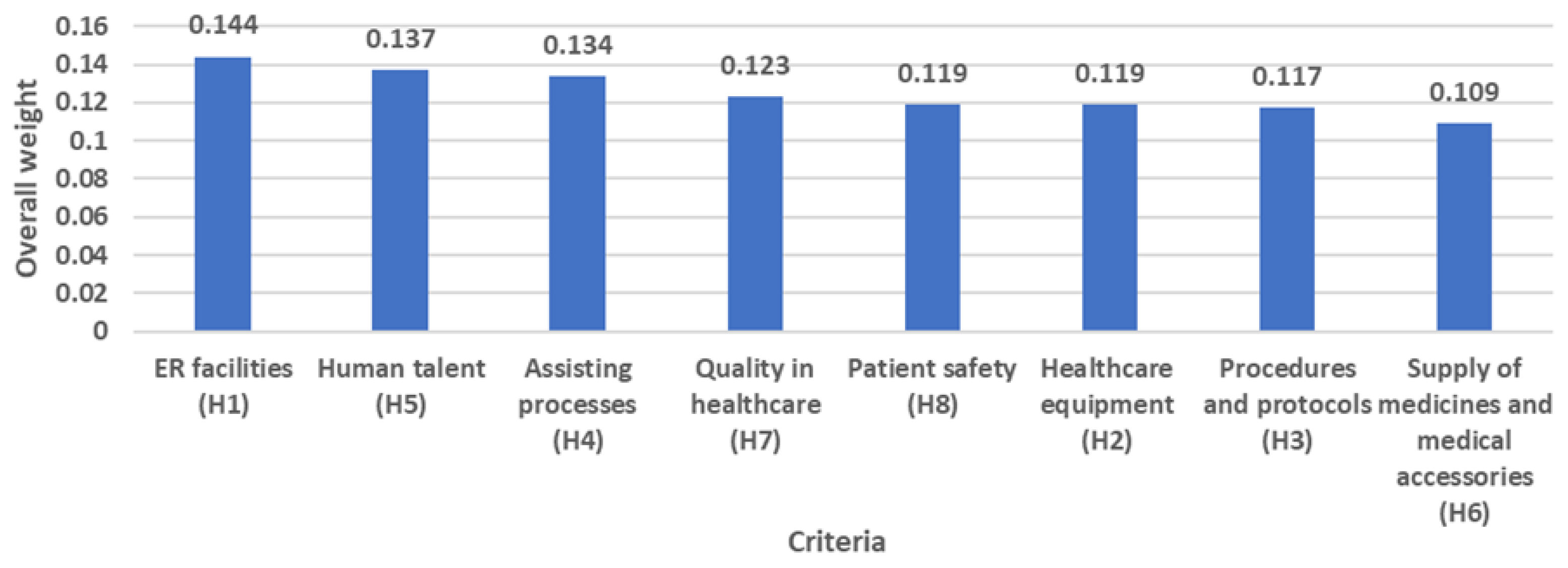
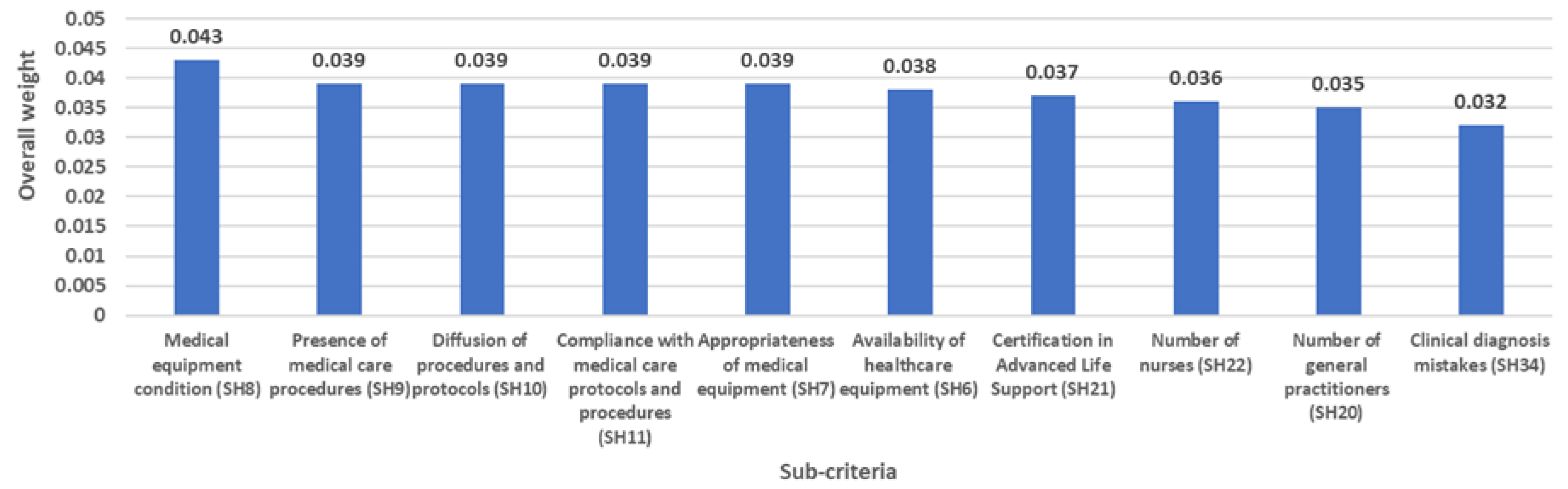
The ranking of criteria and top-ten classification of sub-criteria are presented in Figure 4 and Figure 5. In this regard, the IF-AHP outcomes revealed that the most significant decision elements in assessing the emergency department’s performance during the COVID-19 Outbreak were “ER facilities” (OW = 0.144), “Human talent” (OW = 0.137), and “Assisting processes” (OW = 0.134). However, there were no significant differences concerning the importance of the factors included in the performance evaluation model; in fact, the gap between “ER facilities” (first) and “Supply of medicines and medical accessories” (eighth) is only 0.035. This can be explained considering the multidimensional nature of emergency departments [75], the complexity of the social scenario imposed by the COVID-19 pandemic [76], as well as changes in the legal regulations and health guidelines designed to promptly respond to the new ED dynamics. Therefore, EDs must create a set of multifactorial strategies including all the criteria to increase their preparedness level against the current outbreak but also in the face of future pandemic events.
Figure 4. Ranking of criteria in the ED performance evaluation model.
Figure 5. Ranking of sub-criteria in the ED performance evaluation model.
It is also essential to delve into the reasons justifying the importance of the first three criteria. Concerning “ER facilities” (OW = 0.144), ED managers have been challenged to tackle the overcrowding problem, especially during the pandemic peaks, where emergency wards are forced to adapt the existing infrastructure to meet the growing volume of COVID-19 admissions [77]. Different studies highlighted the importance of addressing the design of hospitals in the face of future pandemics [78,79]. This is pivotal considering the importance of ensuring the person-to-person distance to minimize the COVID-19 infection rates within the EDs. On the other hand, the second place of “Human talent” (OW = 0.137) in the overall ED performance is justified by the necessity of acquiring competencies suitably responding to the pandemic complexity while ensuring the sufficient workforce volume to address both urgent and non-urgent COVID-19 admissions. Explicitly, the ED medical staff has become one of the main restrictions experienced by EDs, especially regarding the availability of distinct specialists required to provide complete emergency care. Besides, gaps in workforce adaptions and practices directly diminish the effectiveness of crisis management plans and the subsequent overall ED response to the pandemic, which ultimately compromises patient satisfaction, door-to-doctor waiting times, and financial sustainability. Likewise, it is of paramount importance to guarantee the effective coordination, integration, and interaction among the “Assisting processes” (OW = 0.134) pillaring the emergency care services. Mismatches in the health supply chains may signify a delayed diagnosis and treatment for a COVID-patient, thereby ramping up the mortality likelihood and the use of more complex services (i.e., hospitalization, surgery, intensive care) for addressing the complications derived from the virus progress.
It is also fundamental to analyze the top-ranked sub-criteria to specifically create and unfold rigorous multidimensional strategies scaling up the ED performance during the pandemic peaks. Medical equipment condition (OW = 0.043) was highlighted as the most prominent aspect to monitor during each COVID-19 wave. The pandemic imposes new technical, quality, and sanitary guidelines to efficaciously satisfy the needs of COVID-19 patients as established by Garzotto et al. [80]. Not being prepared with the appropriate technology may represent delays in the provision of supplemental oxygen therapy, mechanical ventilation, and drugs often necessitated in these patients. Medical equipment management is therefore vital to alleviate the demand pressure and becomes a constant challenge for policy-makers in the presence of resource allocation constraints. However, the outbreak complexity also demands appropriate medical equipment (OW = 0.039), in other words, the devices with the pertinent operational characteristics in a pandemic context of respiratory disease. In this respect, non-adherence to the COVID-19 clinical care management guidelines and interventions may lead to an incorrect definition of the medical devices required in each scenario and subsequent poor support for protection, triage, diagnostic, and clinical care processes. Likewise, the presence of medical care procedures (OW = 0.039), diffusion of procedures and protocols (OW = 0.039), and compliance with medical care protocols and procedures (OW = 0.039) have gained increasing relevance for ED administrators when seeking optimal operational performance during this crisis. Undoubtedly, the COVID-19 pandemic has generated changes in health systems worldwide, and the protocols for treating this virus and other pathologies in this context have not been the exception. Since the beginning of the pandemic, the World Health Organization and other international/national public health organizations have designed and recommended the implementation of biosafety protocols for health workers as well as service providers, patients, and their families. However, deficiencies are evident regarding the availability of safety protocols and diagnostic/therapeutic protocols to care for suspected and confirmed COVID-19 patients [81] or to avoid the risk of COVID-19 infection when managing other pathologies. Similarly, in a study by Eftekhar Ardebili et al. [82], one of the most significant difficulties detected was the frequent change in protocols, prevention, and treatment methods. The availability of healthcare equipment (OW = 0.038) is another challenging aspect given the numerous reports on the scarcity of these devices during the most demanding times of the pandemic [80,83,84]. A low inventory of these medical devices could lead to operating below normal standards of care, which reduces the support offered by the EDs during COVID-19 surges. Likewise, “Certification in Advanced Life Support” (OW = 0.037) deserves special attention due to the shortage of professionals with solid theoretical knowledge and practical experience in managing cardiopulmonary or cardiovascular emergencies, a situation that has worsened within the COVID-19 context given their direct consequences in both respiratory and circulatory systems [85,86]. In addition, based on the scientific evidence, it has been identified that poor preparation for ED care and low funding for staff training inhibits the improvement and development of emergency health capacities [87]. Other sub-factors to carefully monitor are related to the availability of medical personnel: “Number of nurses” (OW = 0.036) and “Number of general practitioners” (OW = 0.035). Shortage of medical staff is associated with a lower quality of care [88] and becomes a driver of poor health outcomes in infected patients. As the virus drives up the cases and the ensuing ED admissions, long-standing difficulties including worker burnout and turnover have worsened, thereby limiting the number of available nurses and physicians on the frontline.
A consistency evaluation was also carried out for the aggregated intuitionistic fuzzy decision matrixes based on Equation (9). In this case, all matrixes were found to be consistent (CR < 0.1) (Table 4), which evidences the high quality of the decision-making process geared towards the estimation of criteria and sub-criteria relative priorities. Therefore, the resulting weights can be employed for supporting the CoCoSo application, the subsequent ED ranking, and the identification of the interventions that need to be delineated for enhancing the preparedness and response of these units against the current outbreak. The biases were also minimized thanks to the correct selection of decision-makers, accompanied by training and support during the comparison process. This is also proved through the consistency results achieved in large-sized matrices (n > 5) where most discrepancies occur: criteria (CR = 0.058; 8 elements) and H4 sub-factors (CR = 0.046; 7 elements). Finally, it is important to note that some criteria and sub-criteria weights can be used in similar ED performance evaluation processes considering pandemic events and/or seasonal respiratory diseases.

4.4. Intuitionistic Interdependence and Feedback: The IF-DEMATEL Approach

IF-DEMATEL was later applied to analyze the interdependence and feedback among performance criteria/sub-criteria. A data-collection instrument was also utilized to gather the paired judgments supporting the assessment of interrelationships within the proposed MCDM model. The decision-makers used the evaluation scale stated in Section 3.2. Training and close follow-up were provided by leading researchers to minimize the inconsistencies in the evaluation process. As a result, an initial intuitionistic fuzzy matrix Z k ˜ containing the comparisons per each cluster-expert was achieved. Table 5 shows an example of this step using Expert 1 insights concerning the interdependence among human talent sub-factors. Then, these matrixes are defuzzified according to the two-stage approach outlined in Section 3.2. In this respect, the IFSs were first transformed into a standard fuzzy subset by employing the equation μ ( x ) = 1 2 ( 1 + μ I ( x ) v I ( x ) ) (see example in Table 6). Subsequently, a defuzzification function was applied to convert the ensuing subsets into a triangular fuzzy number (TFN) by using Equations (12) and (13). The resulting crisp direct-relation matrix Z 1   for the human talent sub-criteria (Expert 1) is presented in Table 7. Following this, the aggregated initial direct-relation matrices Z are produced after applying Equation (14) (see example in Table 8). We also calculated the convergence index (Equation (15)) for each matrix as follows: criteria (0.05), ER facilities (0.023), healthcare equipment (0.006), procedures and protocols (0.004), assisting processes (0.05), human talent (0.01), supply of medicines and medical accessories (0.017), quality in healthcare (0.032), and patient safety (0.022). In this case, none of these matrixes were found to be inconsistent (≤0.05), and the IF-DEMATEL results can be therefore deemed as reliable for supporting the cause–effect analysis within the ED performance model. Afterward, the normalized direct relation matrix N was derived via Equations (16) and (17) (see Table 9). The total influence matrix T was then estimated by using Equation (18) (see Table 10). Finally, Table 11 depicts the prominence (D + R) and relation (D—R) scores calculated via Equations (19) and (20) to identify which criteria or sub-criteria can be classified into the cause (dispatcher) and effect (receiver) groups. Thereby, the health authorities can be informed on which elements should be intervened with for enhancing the ED response in new COVID-19 waves and similar seasonal respiratory diseases.
Table 5. Initial intuitionistic fuzzy matrix—Expert 1 (human talent sub-criteria).
Table 6. Initial intuitionistic fuzzy matrix in standard fuzzy subsets—Expert 1 (human talent sub-criteria).
Table 7. Crisp direct-relation matrix Z 1 —human talent sub-criteria.
Table 8. Aggregated initial direct-relation matrices—human talent sub-criteria.
Table 9. Normalized direct relation matrix—human talent sub-criteria.
Table 10. Total influence matrix—human talent sub-criteria.
Table 11. Dispatchers and receivers in the ED performance evaluation model—COVID-19 context.
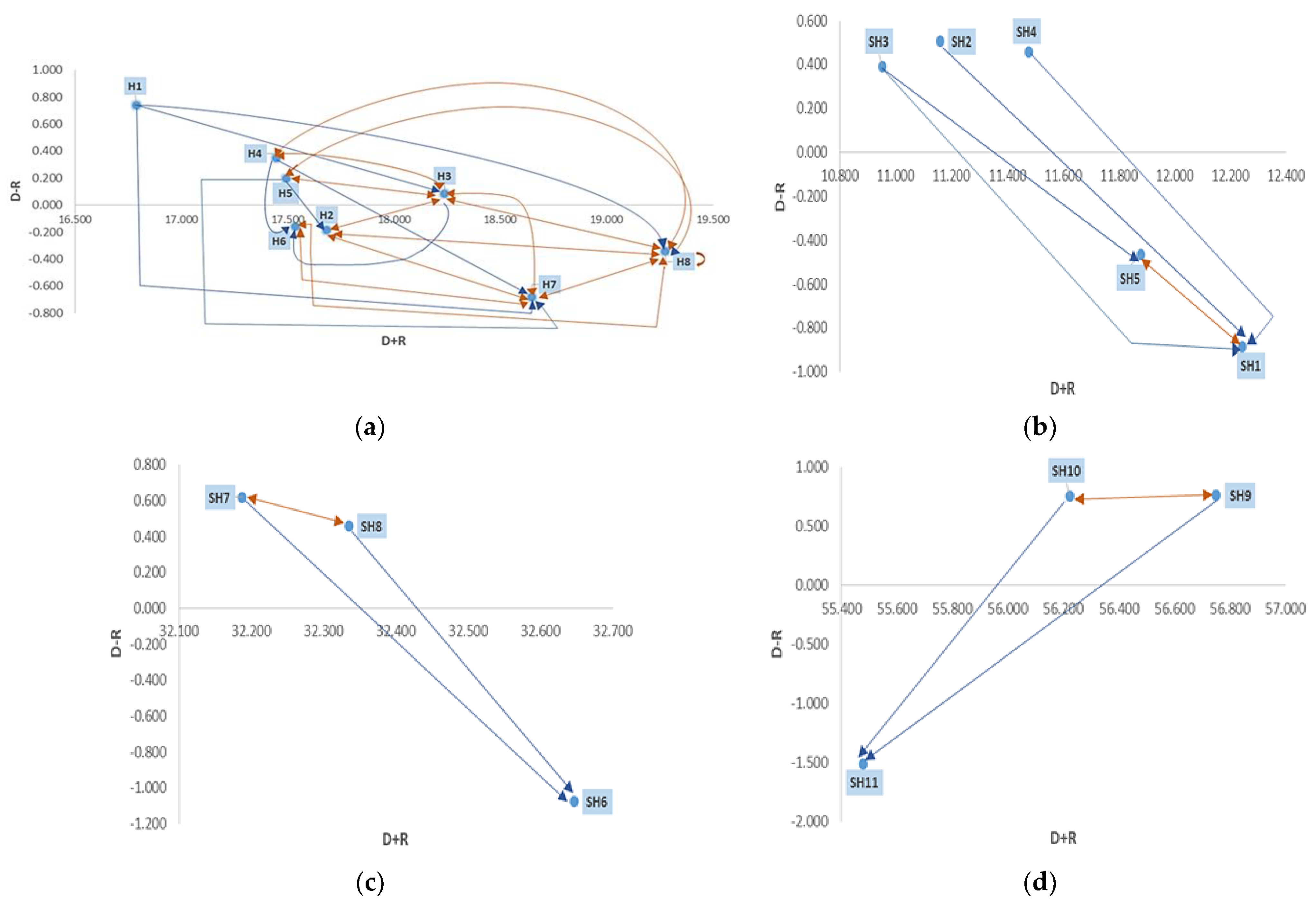
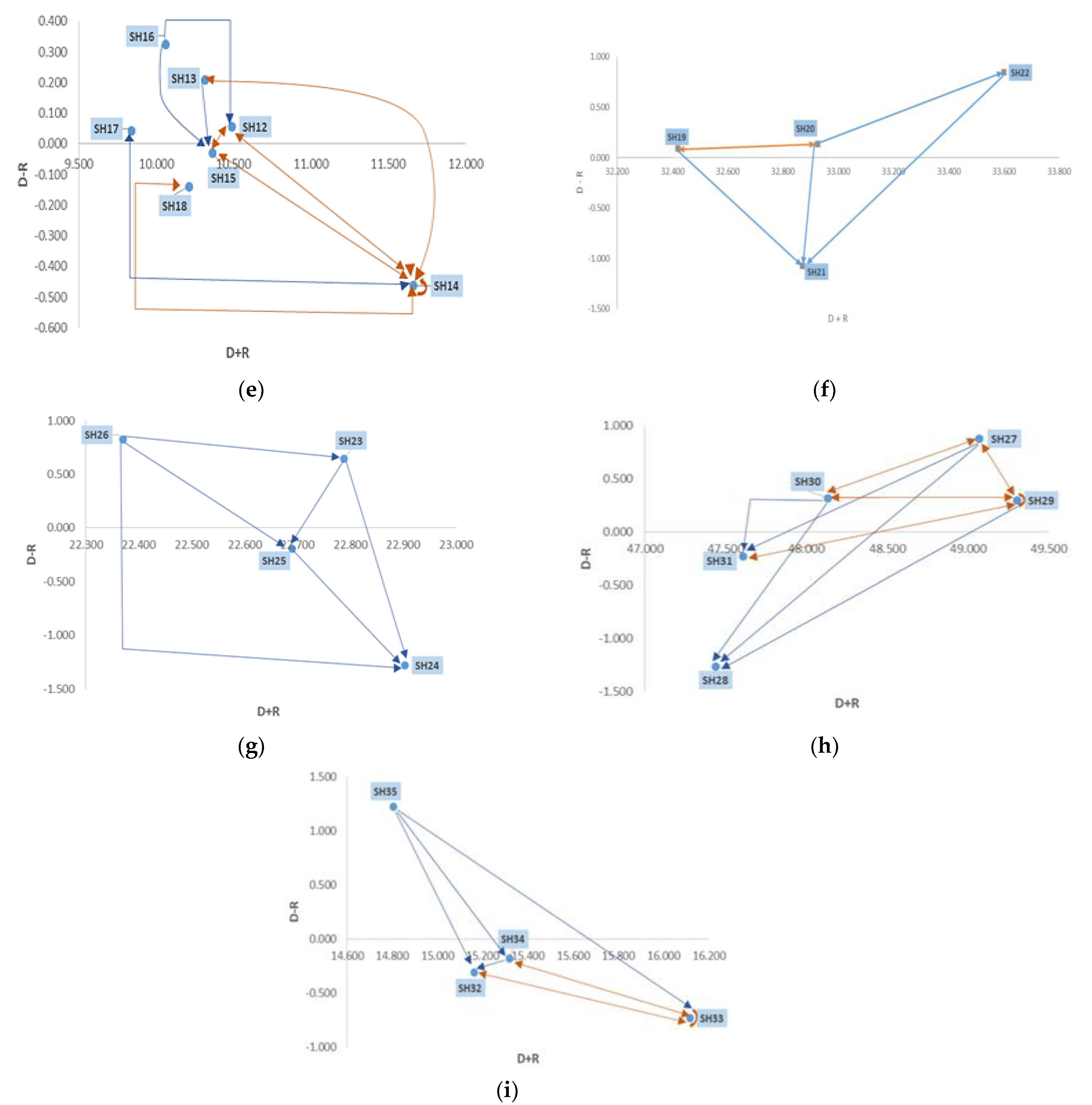
Finally, the threshold value θ was obtained per each matrix to derive the impact-digraph map (IRM) and consequently identify the significant interrelations among criteria and sub-criteria (see Figure 6a–i). For example, Figure 6a illustrates the cause–effect interrelations among criteria. In this case, the reference value was set as θ = 71.557 8 2 = 1.118 . The results endorse the dispatching roles of ER facilities (H1), Medical guidelines (H3), Assisting processes (H4), and Human Talent (H5) whilst underpinning the effect nature of Healthcare equipment (H2), Supply of medicines and medical accessories (H6), Quality in healthcare (H7), and Patient safety (H8). The ED administrators, sector managers, and health authorities then need to envisage intervention strategies focused on these factors to guarantee the adequate provision of emergency services during the pandemic. This is explicated by the fact that different healthcare organisms have recommended modifying structural aspects of H1, H3, H4, and H5 to efficiently respond to the pressure imposed by this outbreak. Besides, these factors compound the operational ED core, which implies that plans on H2, H6, H7, and H8 depend on what is defined by the dispatchers. It also became glaring that Procedures and Protocols has the highest prominence value (D + R = 18.239) among the dispatchers, thus being the most influential factor in ED performance during the COVID-19 outbreak. Since the pandemic onset, health services around the world have had to make adjustments to their procedures, protocols, and work guidelines to incorporate advances in triage, management, and treatment of the disease as well as other pathologies to avoid intra-hospital infections and accelerate the emergency care provision. This finding is consistent with that of Shrestha et al. [89], who highlighted that EDs are generally prepared to deal with mass casualties secondary to traffic accidents but lack preparation and experience for biological-type incidents. Hence, the rapid and efficient implementation of protocols is required to address the changing nature of the pandemic. Particular attention should be also paid to the high volume of bidirectional relationships (H4–H8, H5–H8, H7–H8, H2–H8, H3–H8, H6–H8, H6–H7, H2–H7, H3–H7, H2–H3, H3–H4, and H3–H5) within the ED performance model (see the orange arrows). Specifically, Patient safety (H8) was found to be the element with the major number of these interactions, thereby making it an important improvement point to consider in the contingency plans. For example, the interaction H5–H8 is justified by the fact that deficiencies in support programs for health personnel during the COVID-19 pandemic could potentially restrict organizational resilience and negatively affect patient safety [89]. Therefore, EDs must include programs not only directed towards the hard competencies but also those considering the emotional support needed by the staff to work in a safe, resilient, and flexible manner.
Figure 6. Influential-relation map for (a) criteria, (b) ER facilities, (c) healthcare equipment, (d) procedures and protocols (e) assisting processes, (f) human talent, (g) supply of medicines and medical accessories, (h) quality in healthcare, and (i) patient safety.
In addition to analyzing the interactions among criteria, it is essential to detail the interdependence within the clusters. The interrelations for the ER facilities dimension have been graphed in Figure 6b. In this dimension, the threshold value was defined as θ = 24.591 5 2 = 0.984 , thereby allowing us to state that Physical status (SH1) and Bed availability (SH5) are receivers while Airing and lighting (SH3), Sanitary installations (SH4), and Delineation of emergency areas (SH5) are ED performance drivers. Different studies have reported changes in the use of emergency medical facilities due to the COVID-19 pandemic [90,91]. Specifically, EDs have adapted their wards to attend to the growing demand of infected patients, which added to the regular volume of admissions related to other pathologies. In this sense, Airing and lighting (SH2), Sanitary installations (SH3), and Delineation of emergency areas (SH4) are essential to guarantee adequate, safe, and comfortable physical spaces for COVID-19 patients and their families. These factors must be taken into account when planning changes and expansions in the ED infrastructure, so that physical, sanitary, and comfort conditions can be ensured under the COVID-19 management guidelines. For instance, Łukasik and Porębska [77] proposed the conversion of one or more wards into pavilions for COVID-19 patients. Further, the use of simulation tools can provide different layout alternatives that allow ED administrators to plan the ED infrastructure against new COVID-19 waves and respiratory seasonal diseases. On the other hand, there is a double-sided arrow in between the receivers, which denotes that the installation of hospital beds must be accompanied by the adaptation of the ED physical status to provide effective care.
An influential-relation graph has been also outlined to reveal the inner effects among Healthcare equipment sub-criteria (Figure 6c). A t i j > θ   | | θ = 48.583 3 2 = 5.398 denoted the significant interdependencies in this cluster. In summary, the outcomes revealed that Availability of healthcare equipment (SH6) was identified as the only receiver whilst Appropriateness of medical equipment (SH7) and Medical equipment condition (SH8) were classified as dispatchers. Additionally, a feedback relationship between SH7 and SH8 was evidenced. It is also important to point out that SH8 was found both as the most critical sub-criterion (LW = 35.8%) and the most influential element (D + R = 32.335) in this cluster. Consequently, ED managers, healthcare cluster directors, Ministries of Health, Procurement departments, and regulatory agencies are advised to implement the following recommendations [92]:
  • ensure medical equipment consumables for a minimum 3 months;
  • provide training on the use of vital medical devices for physicians and nurses;
  • adapt the medical equipment to the healthcare workforce and infrastructure available in the ED;
  • design specialized maintenance plans to further enhance the functionality of critical devices during the pandemic;
  • test the conformity of the device with the minimum requirements established by the WHO.
A threshold value θ = 84.225 3 2 = 9.358 was defined to detect significant interrelations in the Procedures and protocols cluster. The impact digraph with this information is shown in Figure 6d. The graph uncovers that the Presence of medical care procedures (SH9) and Diffusion of procedures and protocols (SH10) are the main performance drivers in the H3 criterion, whereas Compliance with medical care protocols and procedures (SH11) was identified as the effect. It is also good to mention that the Presence of medical care procedures is the sub-criterion with the highest prominence value (D + R = 56.750). This finding confirms what was stated by Tanja et al. [93] regarding the need to establish clinical practice guidelines and recommendations to support therapeutic decisions considering the challenges imposed by the COVID-19 pandemic. In addition, there is a two-way relationship between SH9 and SH10 (D + R > 50). This means that an effective diffusion of these protocols partially depends upon whether the ED has incorporated these guidelines in its quality management system. Thereby, the ED can grant a long-term framework for planning, execution, verification, and improvement, considering the risk of future pandemic events. Not less important was the low adherence to COVID-19 procedures reported in some EDs and which was associated with poor dissemination and structuring problems in these protocols [94].
Interrelations within the Assisting processes were also mapped to identify intervention priority areas (Figure 6e). In this instance, the significance limit was calculated to be θ = 36.476 7 2 = 0.744 . As a result, Efficacy of radiology process (SH12), Efficacy of clinical lab (SH13), Transportation efficacy (SH16), and Efficacy of sterilization process (SH17) were categorized as dispatchers, whilst Efficacy of hospitalization process (SH14), Efficacy of pharmaceutical service (SH15), and Efficacy of non-core activities (SH18) were found to be receivers. In the cause group, Efficacy of radiology process (SH12) has the highest D + R value (10.489) and is then considered the most influencing subfactor when evaluating the assisting processes. This finding is supported by Santos et al. [95], who reported that workflows in radiology processes were inefficient when addressing ED patients with COVID-19 pneumonia, thereby producing increased lengths of stay and waiting times. On a different tack, the feedback relationship SH12–SH13 deserves special attention and encourages healthcare managers to adopt strategies reducing turnaround times and augmenting reliability in radiology and clinical laboratory processes. This is essential to ensure rapid medication administration depending on the radiology and laboratory results. On a different note, EDs are advised to have an optimal number of ambulances to provide emergency services to COVID-19 patients at a reasonable time. Complementary to these proposals, effective disinfection and sterilization processes of ED wards are necessitated to avoid intra-hospital infections and the ensuing health complications in those patients with baseline diseases.
The IF-DEMATEL outcomes additionally uncover the interrelations among Human talent sub-criteria. In this cluster, a reference value θ = 65.908 4 2 = 4.119   (Figure 6f) was defined by the decision-making group to identify the significant interactions. Consequently, Number of specialists (SH19), Number of general practitioners (SH20), and Number of nurses (SH22) were recognized as dispatchers, whereas Certification in Advanced life Support (SH21) was classified as a receiver. Likewise, Number of general practitioners was concluded to be the most influential sub-factor (D + R = 33.599). In this regard, Long et al. [85] and Cao et al. [86] declared that having essential medical personnel for COVID-19 patient management in emergency units helps to balance the response of the healthcare system with the demand, especially in epidemiological peaks where the available staff is subject to stress. It is thus imperative that ED administrators implement strategies focused on the provision of human talent according to demand, suitable personnel scheduling, and constant review of working/biosafety conditions. In addition to these considerations, the feedback interrelation between SH19 and SH20 demands support from health information technologies optimizing the workflows among physicians with different specialization levels during the pandemic. In this way, in-time and suitable diagnosis and treatment can take place as needed in the presence of a rapidly evolving virus.
Concerning the Supply of medicines and medical accessories cluster, the adopted threshold value was θ = 45.375 4 2 = 2.836   . Based on this insight, the impact-relation map (Figure 6g) was found to reveal the dispatching nature of Readiness of accessories and instrumentation (SH23) and Bed occupancy rate (SH26), while Supplies fill rate (SH24) and Medication fill rate (SH25) were categorized as receivers. In this respect, it is vital to permanently monitor the availability of beds, consumables, and accessories to underpin planning and management systems that raise alarms in response to high stockout probability. These systems can support input requirements, purchasing processes, and inventory models guaranteeing satisfactory fill rates whilst complying with quality and biosafety criteria. Such strategies are called to tackle the potential adverse events related to inadequate resource management during this global crisis [96].
An impact diagram was also established for the Quality in healthcare sub-factors (Figure 6h). The estimated reference value was set as θ = 120.775 5 2 = 4.831 . In this case, Mean physician waiting time (SH27), Mean length of stay (SH29), and Re-entry rate (SH30) were classified into the cause group, whereas Patient satisfaction (SH28) and Waiting time for triage categorization (SH31) were included in the effect group. Likewise, it was found that SH29 has a strong effect on the receivers (D + R = 49.301). In addition, the high prominence values (D + R > 40) show the existence of strong correlations among these sub-criteria. Considering the above, it is necessary to foster the use of simulation and lean six sigma methodologies to evaluate whether the current installed ED capacity is sufficient to satisfy the maximum waiting times and lengths of stay established by the regulatory agencies. It will be thus possible to pinpoint non-added-value activities that need to be removed through improvement operational strategies. If these dispatchers are intervened, the impact is significant on the emergency care quality provided to COVID-19 patients during this period. Therefore, interventions aimed at reducing quality errors can address low satisfaction levels and generate a useful body of knowledge for managing patient perception in future pandemics [97].
Ultimately, a digraph map was generated for the Patient safety cluster (Figure 6i). The threshold value was defined to be θ = 30.701 4 2 = 1.919 by the expert team. In this dimension, Patient identification errors (SH35) was detected to be the only dispatching sub-factor. On the other hand, Hospital-obtained infections (SH32), Medication mistakes (SH33), and Clinical diagnosis mistakes (SH34) were concluded to be receivers. The map also reveals feedback interrelations (SH32–SH33 and SH33–SH34) that should be analyzed by the decision-makers to propel better patient safety practices. ED managers are expected to implement comprehensive strategies for reducing patient identification errors and avoid more severe health complications and the use of upstream services accordingly. Incorrect patient data may lead to errors in medical diagnoses and medicine administration. Some strategies may include the implementation of central software supported by QR codes or electronic identifiers storing the patient data along the ED pathway. Moreover, it will be necessary to design patient data registration protocols underpinning the correct deployment of these technological solutions in the wild while performing audits evidencing the gaps in practice.

4.5. Calculation of ED Performance Index: The CoCoSo Method

The final step of this approach involves applying the CoCoSo method to fundamentally pursue three objectives:
  • calculate the ED performance index (EDPI) to rank the Turkish emergency centers (D1, D2, and D3);
  • detect weaknesses in each ED to improve their overall response against pandemic scenarios caused by COVID-19 and similar respiratory diseases;
  • establish individual improvement plans supporting interventions by ED administrators and healthcare authorities.
The CoCoSo implementation was initiated by defining a key performance index (KPI) per each sub-criterion. The list of KPIs and their mathematical formulas are shown in Table 12. The metrics were determined considering the healthcare regulations, pertinent scientific literature, and balanced scorecards established in the participant institutions. Each indicator was measured in each ED to construct the initial decision matrix M (Table 13). Table 13, derived from Equation (21), also compiles the overall sub-criteria weights emanating from the IF-AHP method, thereby tackling the weighting procedure weakness detected in most of the outranking techniques. Following this, the decision matrix M was normalized using Equations (22) and (23). As a next step, we estimated the sum of weighted comparability ( S i ) and the power-weighted comparability sequences ( P i ) for each ED using Equations (24) and (25) (see Table 14). Then, the three aggregated appraisal scores were computed ( M i a ,   M i b , M i c ) via Equations (26)–(28), considering λ = 0.5 (see Table 14). Finally, the aggregated M i score, now called EDPI (Equation (29)), was calculated for each emergency center (see Table 14).
Table 12. Key performance metrics supporting the CoCoSo method.
Table 13. Initial CoCoSo decision matrix M.
Table 14. The sum of weighted comparability S i , power-weighted comparability sequences P i , and aggregated appraisal scores (emergency department performance index—EDPI).
An essential element in analyzing the CoCoSo method results is the ED performance index (EDPI). In this case, the highest EDPI that an emergency department can reach was 3.359, which was the score achieved when the sub-criteria values are equal to the ideal response scenario. Therefore, if interventions are not implemented to tackle the deficient performance factors, it is expected that the EDPI will tend to decrease over time, with negative effects for both the emergency centers (i.e., adverse events, cost overruns, complaints, legal sanctions) as well as for patients (long-term sequelae, higher mortality risk due to COVID-19) and medical personnel (stress, work overload, risk of contagion). The results show significant gaps between the ED response against the pandemic and the desired performance (maximum EDPI), which is proven through a mean difference of -1.225 with a standard deviation of 0.3267. Regarding the ranking, D2 (Mi = 2.401; M2/Máx EDPI = 70.57%) turned out to be the emergency department with the best performance followed by D1 (Mi = 2.243; M2/Máx EDPI = 67.57%), while D3 was concluded to be the one with the lowest performance (Mi = 1.740; M2/Max EDPI = 52.42%). It is evident that there is much room for improvement in the Turkish EDs whose performance did not overpass 75% in any of the cases.
Given the above-mentioned, specific intervention plans are required to improve the overall response of these emergency departments against the pandemic. The weaknesses are those sub-criteria with normalized values equal to or close to 0. For example, D1 presented the lowest % of ED wards with suitable infrastructure status (80%), which is consistent with the findings detected by Winkelmann et al. [98] and Walton et al. [99]. They specifically highlighted the limitations created by the physical status of EDs, which trigger inadequate isolation zones, triage wards, and testing facilities, thereby restricting the COVID-19 patient flow within the ED. To overcome this unprecedented challenge, it is advised to:
  • repurpose non-health facilities inside (i.e., administrative offices) and outside (i.e., hotels, parking lots) the EDs to accommodate patients with mild COVID-19 and low risk of severe complications;
  • implement infrastructure adequation plans to rapidly set up ED areas with poor infrastructure condition;
  • transfer low-risk COVID-19 patients to other regions with spare capacity.
On the other hand, D1 reported the lowest bed availability (2200 beds) and is therefore an improvement area for this unit. In this regard, Remuzzi and Remuzzi [100] stated that bed capacity plays an essential role in managing the increasing volume of COVID-19 presentations in the ED. In this sense, it is recommended that those responsible for the emergency centers to:
  • design predictive models estimating the number of EDs required depending on social factors, the virus spread, and policies implemented by the government;
  • establish collaborative agreements with the bed supply chain actors where their production and logistics capabilities can be mostly destinated to the EDs with bed shortages;
  • develop MCDM models identifying which COVID-19 patient can be safely discharged home and who should be immediately attended to, supporting scarce resource allocation activities and minimizing the mortality rate.
A grave concern in this analysis is that none of the showcased EDs evidenced continuous monitoring of adverse events related to COVID-19 patients. This may be explained by the lack of sufficient healthcare quality professionals who were mostly focused on monitoring the timeliness and efficacy of the care provided to this population. Besides, the pandemic placed enormous pressure on the healthcare system and especially the EDs as the primary gate to the entire hospital structure, which led ED administrators to prioritize activities including resource management and the implementation of safety measures for the frontline medical staff. This finding was also declared by Sharp et al. [101], who additionally expressed that this task was impacted by the fear that physicians had of contracting COVID-19, the restricted volume of protective equipment, and the patient flow variations. In this respect, EDs are invited to:
  • develop practical artificial intelligence models predicting the occurrence of adverse events in COVID-19 patients;
  • assign staff from the quality departments to constantly control and investigate the adverse events related to this disease;
  • create resilience plans discriminating which activities should be rolled out by the ED depending on the risk of adverse events.
Likewise, implementing interventions to reduce the average waiting time for radiology results deserves special attention considering that D1 and D3 obtained times above the ideal scenario (>60 min), which is consistent with the findings outlined by Santos et al. [95] regarding the long waiting times in radiology units due to demand surges and the inefficient inflows of traditional care. It is also important to note that the Efficacy of the radiology process was identified as the most influential sub-factor in the performance model. Therefore, interventions focused on improving patient care flows are widely necessitated. For instance, Lean Six Sigma techniques can provide a way to reduce the turnaround time by removing non-value-added activities. Another recommended intervention is the use of information systems facilitating physicians’ access to radiology results. In addition, efforts should be also concentrated on the development of artificial intelligence models with high accuracy in predicting the X-ray outcomes based on easy-to-collect predictors. On a different note, one of the major shortcomings detected in D2 was the Efficacy of pharmaceutical service, where the average lead time for medication delivery was estimated to be 1 h. Medication shortage increases the risk of mortality in COVID-19 patients, who may need sedatives in case of intubation/mechanical ventilation and antimicrobials for therapy [102]. Some strategies may be implemented to address this problem:
  • create inventory models with high fill rates responding to the COVID-19 dynamic;
  • diminish the importation approval time to 24 h as some medication ingredients are mostly imported;
  • augment the domestic installed production capacity of the medicines with shortages supported by demand prediction models.
Another conclusion related to this dimension is the non-implementation of non-core activities (maintenance, cooking, laundry, and surveillance), which were largely restricted during COVID-19, but they are fundamental in improving patient outcomes, controlling inflow, increasing availability of healthcare equipment, and improving adherence to sanitation standards. Procedures and protocols must be then designed in conjunction with the WHO to secure the normal functioning of these processes even in a devastating biological disaster such as the one experienced with COVID-19.
Other remarkable discoveries of this study are associated with the Human talent domain. CoCoSo revealed that D1 and D3 had a deficit in the number of specialists (oscillating between six and eight) and general practitioners (30 and 36, respectively), while D1 and D2 required a substantial number of nurses (ranging from 23 to 26). Moreover, D1 presented the lowest percentage of medical staff certified in Advanced Life Support (60%). The preceding is consistent with findings of Leite [103], who considers health personnel as a critical resource in managing this outbreak. However, there is a staffing shortage due to burnout and departures motivated by the two grueling years of experiencing a high level of stress. The initial installed capacity was insufficient compared to the one required during the COVID-19 peaks. To combat this problem, it is suggested to:
  • tout retention bonuses for healthcare workers on the frontline of this pandemic;
  • identify barriers to lessening medicine and nursing graduation rates in the universities to design collaborative interventions;
  • train non-ALS-certified medical staff through courses designed by education authorities in conjunction with the Ministry of Health;
  • assign specialists that were put on hold to stem the virus spread to assist physicians in caring for COVID-19 patients;
  • form groups of physicians and nurses led by ICU clinicians to address patients with a higher risk of mortality;
  • deploy virtual hospitals to identify COVID-19 patients with an urgent need for care and consequently diminish the patient flow arriving at the EDs.
When analyzing the Supply of medicines and medical accessories aspect, the primary concern is the readiness of accessories and instrumentation where D2 and D3 obtained the highest levels in the number of medical consumables and instruments needed to cover the current demand (85 and 100, respectively). This is partially explained by the reduced import from China [104] and the lack of accurate models predicting their demand. Some hospitals have reported a sharp rise in the daily consumption of masks and gloves [105]. Due to the preceding and given the criticality of this indicator, the recommendations include:
  • establish agreements with the related supply chain actors for the purchase of medical consumables and instruments under the principles of quality, timeliness, flexibility, and scale economy;
  • the use of information technologies for the efficient and reliable management of medical supplies;
  • the development and implementation of protocols for the rational management of accessories and instrumentation;
  • the design of inventory models responding to the changing dynamics of the pandemic.
Ultimately, a common deficiency linked to the overwhelming ED wards is the prolonged stays, which were estimated to be equal to and/or over 2.5 days in all the participant departments. The escalating demand depleted the hospitalization beds and ticked up the queue size in the EDs [106]. This is added to the rapid health worsening experienced by some COVID-19 patients who needed extra support from the medical staff and the application of respiratory therapies that may take more time than planned. The road ahead must include strategies providing short- and medium-term relief to the emergency care landscape. In summation, ED managers are expected to:
  • implement machine learning models predicting the stay length of COVID-19 patients;
  • optimally increase the number of hospitalization beds to decrease overcrowding and waiting times in the ED;
  • identify the treatments that can be provided through homecare services so that the number of COVID-19 patients within the ED rooms can be substantially diminished;
  • reduce the diagnosis times by lessening the radiology and lab turnaround times as further explicated above.

5. Conclusions

The COVID-19 pandemic has posed a significant burden to the EDs which has evidenced performance gaps that need to be narrowed through a collaborative network involving local/international regulatory agencies, health authorities, healthcare sector leaders, ED administrators, and hospital managers. In the meantime, designing multidimensional interventions is pivotal to upgrade the response of these units against new epidemiological waves and a forecasted sharp rise in the volume of ED presentations expected with seasonal respiratory diseases.
Despite extraordinary efforts made by the healthcare structure, COVID-19 is still with us and therefore imposes a major challenge for EDs, which requires them to constantly monitor their performance to avoid substantial affectations on the population’s health. Ensuring high standards in patient safety, medical equipment, human talent, ER facilities, procedures/protocols, assisting processes, supply of medicines/accessories, and quality will propel a satisfactory reply against similar scenarios. Even as the world enters a less acute phase of the pandemic, the healthcare spectrum dictates the appearance of new epidemics where ED will be again stretched. In this regard, hospital administrators are expected to sharpen disaster management plans and create a resilient operational structure capable of reacting effectively in the face of pronounced healthcare demands and a challenging social context.
Given the above, this paper has proposed the implementation of a hybrid intuitionistic fuzzy approach to assessing ED performance during the COVID-19 outbreak. A real case study comprising three Turkish EDs was employed to validate the suggested framework. The IF-AHP results revealed that the most critical factors in ED performance are “ER facilities” (OW = 0.144), “Human talent” (OW = 0.137), and “Assisting processes” (OW = 0.134). On the other hand, the IF-DEMATEL application uncovered that “Procedures and protocols” (D + R = 18.239) is the most influential aspect in the development of medium- and long-term disaster management plans for EDs. Lately, the CoCoSo outcomes showed that D2 (Mi = 2.401; M2/Máx EDPI = 70.57%) turned out to be the emergency department with the best performance. Nonetheless, interventions in ER infrastructure, human talent, assisting processes, healthcare quality, and supply chain resilience are recommended to enhance the overall response of the emergency care service provided by these institutions.
Our study can help government leaders and Ministries of Health to devise specific intervention points and therefore focused strategies where scarce resources can be better allocated, while diminishing the risk of long-term sequelae and mortality rate for COVID-19 patients. Likewise, it acts as a warning system that can also guide decision-makers in the timely deployment of social and political interventions. Not less important is the close follow-up offered by this approach regarding the effectiveness of rolled-out strategies, which is widely requested in healthcare environments with limited resources and no room for major investments.
The hybrid approach used in this work has provided very good results and is shown to be robust. However, some limitations should be commented on. First, there are other MCDM techniques that can be used to check the similarity of results as well as their quality, such as the case of the fuzzy-analytical network process. In this case, such a test was considered but was discarded because of the enormous work involved for the expert team in answering multiple different questionnaires adapted to the methodology of this technique. Second, the opinions of the expert team are always controversial, and although our work was made up of highly experienced people, we cannot be sure that a different group would choose the same criteria and sub-criteria or would have different evaluations that would lead to a slight variation in the results. Third, by using IF-AHP, we improve the weighting of the decision-makers in the expert team by considering their experience. Although the CR is used to detect discrepancies in the judgments of the experts, this only ensures the consistency of the expert team, not the quality of that team, i.e., if the team is made up of people with low experience; compliance with the minimum value of CR does not ensure good results of the analysis, only that the team is consistent. This reflection applies in the same way when proceeding with step 4 of IF-DEMATEL (appraisal of cause–effect interrelations among criteria and sub-criteria considering uncertainty). Fourth, when we are carrying out step 5 of the methodology (calculation of the ED performance index and ranking derivation) using the CoCoSo model, it is necessary to keep in mind that the initial choice of the KPIs for each sub-criterion is crucial for the subsequent ranking and design of improvement interventions. A sub-criterion can be measured in different ways (KPIs), so the choice of these is important as they can influence the results. In this sense, each indicator is measured in each ED to construct the initial decision matrix M, before compiling the overall sub-criteria weights.
For future work, we plan to extend this application to other international contexts where ED performance may be affected by other factors that have not been considered in this study. Besides, we aim to include fuzziness in the outranking technique to perform a comparative analysis based on the EDPI indicator. Complementary to these research lines, the EDPI is intended to be included as a technical measure in a discrete-event simulation model representing the operability of EDs during the COVID-19 pandemic. Thereby, improvement scenarios augmenting the EDPI can be prioritized by modelers and policymakers when deciding what solutions to implement in the context of the COVID-19 pandemic and similar social landscapes.

Author Contributions

Conceptualization, M.O.-B., M.G., M.Y. and J.-J.A.-S.; methodology, M.O.-B., G.J.-D. and N.J.-R.; software, M.O.-B. and N.J.-R.; validation, M.O.-B. and N.J.-R.; formal analysis, M.O.-B., G.J.-D. and N.J.-R.; investigation, M.O.-B., M.G., M.Y., J.-J.A.-S., G.J.-D. and N.J.-R.; resources, M.O.-B. and N.J.-R.; data curation, M.O.-B., M.Y., G.J.-D. and N.J.-R.; writing—original draft preparation, M.O.-B., M.G., M.Y., G.J.-D. and N.J.-R.; writing—review and editing, M.O.-B.; visualization, M.O.-B., M.G., M.Y. and N.J.-R.; supervision, M.O.-B.; project administration, M.O.-B.; funding acquisition, M.O.-B. and J.-J.A.-S. All authors have read and agreed to the published version of the manuscript.

Funding

This research has received no funding.

Institutional Review Board Statement

Not applicable.

Data Availability Statement

The data presented in this study are available within the Results section.

Conflicts of Interest

The authors declare no conflict of interest.

References

  1. Hooker, E.A.; Mallow, P.J.; Oglesby, M.M. Characteristics and trends of emergency department visits in the United States (2010–2014). J. Emerg. Med. 2019, 56, 344–351. [Google Scholar] [CrossRef]
  2. Gul, M.; Guneri, A.F. A comprehensive review of emergency department simulation applications for normal and disaster conditions. Comput. Ind. Eng. 2015, 83, 327–344. [Google Scholar] [CrossRef]
  3. Paul, J.A.; Lin, L. Models for improving patient throughput and waiting at hospital emergency departments. J. Emerg. Med. 2012, 43, 1119–1126. [Google Scholar] [CrossRef] [PubMed]
  4. Sohrabizadeh, S.; Yousefian, S.; Bahramzadeh, A.; Vaziri, M.H. A systematic review of health sector responses to the coincidence of disasters and COVID-19. BMC Public Health 2021, 21, 1–9. [Google Scholar] [CrossRef]
  5. Lippi, G.; Favaloro, E.J.; Plebani, M. Laboratory medicine and natural disasters: Are we ready for the challenge? Clin. Chem. Lab. Med. 2010, 48, 573–575. [Google Scholar] [CrossRef] [PubMed]
  6. Lioutas, E.D.; Charatsari, C. Enhancing the ability of agriculture to cope with major crises or disasters: What the experience of COVID-19 teaches us. Agric. Syst. 2021, 187, 103023. [Google Scholar] [CrossRef]
  7. Quah, L.J.J.; Tan, B.K.K.; Fua, T.-P.; Wee, C.P.J.; Lim, C.S.; Nadarajan, G.; Zakaria, N.D.; Chan, S.-E.J.; Wan, P.W.; Teo, L.T.; et al. Reorganising the emergency department to manage the COVID-19 outbreak. Int. J. Emerg. Med. 2020, 13, 32. [Google Scholar] [CrossRef]
  8. Park, M.; Cook, A.R.; Lim, J.T.; Sun, Y.; Dickens, B.L. A systematic review of COVID-19 epidemiology based on current evidence. J. Clin. Med. 2020, 9, 967. [Google Scholar] [CrossRef]
  9. Bączkiewicz, A.; Kizielewicz, B.; Shekhovtsov, A.; Wątróbski, J.; Sałabun, W. Methodical Aspects of MCDM Based E-Commerce Recommender System. J. Theor. Appl. Electron. Commer. Res. 2021, 16, 2192–2229. [Google Scholar] [CrossRef]
  10. Opricovic, S.; Tzeng, G.H. Compromise solution by MCDM methods: A comparative analysis of VIKOR and TOPSIS. Eur. J. Oper. Res. 2004, 156, 445–455. [Google Scholar] [CrossRef]
  11. Fiallos, J.; Patrick, J.; Michalowski, W.; Farion, K. Using data envelopment analysis for assessing the performance of pediatric emergency department physicians. Health Care Manag. Sci. 2017, 20, 129–140. [Google Scholar] [CrossRef]
  12. Torkayesh, A.E.; Pamucar, D.; Ecer, F.; Chatterjee, P. An integrated BWM-LBWA-CoCoSo framework for evaluation of healthcare sectors in eastern europe. Socio-Econ. Plan. Sci. 2021, 78, 101052. [Google Scholar] [CrossRef]
  13. Yazdani, M.; Zarate, P.; Kazimieras Zavadskas, E.; Turskis, Z. A combined compromise solution (CoCoSo) method for multi-criteria decision-making problems. Manag. Decis. 2019, 57, 2501–2519. [Google Scholar] [CrossRef]
  14. Hulland, E.N.; Wiens, K.; Shirude, S.; Morgan, J.D.; Bertozzi-Villa, A.; Farag, T.H.; Fullman, N.; Kraemer, M.U.G.; Miller-Petrie, M.K.; Gupta, V.; et al. Travel time to health facilities in areas of outbreak potential: Maps for guiding local preparedness and response. BMC Med. 2019, 17, 232. [Google Scholar] [CrossRef] [PubMed]
  15. Seyedin, H.; Moslehi, S.; Sakhaei, F.; Dowlati, M. Developing a hospital preparedness checklist to assess the ability to respond to the COVID-19 pandemic. East Mediterr. Health J. 2021, 2, 131–141. [Google Scholar] [CrossRef] [PubMed]
  16. Gul, M.; Yucesan, M. Hospital preparedness assessment against COVID-19 pandemic: A case study in Turkish tertiary healthcare services. Math. Probl. Eng. 2021, 2021, 2931219. [Google Scholar] [CrossRef]
  17. Garcia-Lopez, J.; Delgadillo, J.; Vilarrodona, A.; Querol, S.; Ovejo, J.; Coll, R.; Millan, A.; Madrigal, A.; Soria, G.; Vidal, F.; et al. SARS-CoV-2/COVID-19 pandemic: First wave, impact, response and lessons learnt in a fully integrated Regional Blood and Tissue Bank. A narrative report. Blood Transfus. 2021, 19, 158. [Google Scholar] [CrossRef] [PubMed]
  18. Marques, L.C.; Lucca, D.C.; Alves, E.O.; Fernandes, G.C.M.; Nascimento, K.C.D. COVID-19: Nursing care for safety in the mobile pre-hospital service. Texto Contexto-Enferm. 2020, 29. [Google Scholar] [CrossRef]
  19. Marshall, D.L.; Bois, F.; Jensen, S.K.; Linde, S.A.; Higby, R.; Rémy-McCort, Y.; Murray, S.; Dieckelman, B.; Sudradjat, F.; Martin, G.G. Sentinel Coronavirus environmental monitoring can contribute to detecting asymptomatic SARS-CoV-2 virus spreaders and can verify effectiveness of workplace COVID-19 controls. Microb. Risk Anal. 2020, 16, 100137. [Google Scholar] [CrossRef]
  20. Jöbges, S.; Vinay, R.; Luyckx, V.A.; Biller-Andorno, N. Recommendations on COVID-19 triage: International comparison and ethical analysis. Bioethics 2020, 34, 948–959. [Google Scholar] [CrossRef]
  21. Singh, P.K.; Nandi, S.; Ghafoor, K.Z.; Ghosh, U.; Rawat, D.B. Preventing COVID-19 spread using information and communication technology. IEEE Consum. Electron. Mag. 2020, 10, 18–27. [Google Scholar] [CrossRef]
  22. Xiao, Y.; Torok, M.E. Taking the right measures to control COVID-19. Lancet Infect. Dis. 2020, 20, 523–524. [Google Scholar] [CrossRef]
  23. Carenzo, L.; Costantini, E.; Greco, M.; Barra, F.L.; Rendiniello, V.; Mainetti, M.; Bui, R.; Zanella, A.; Grasselli, G.; Lagioia, M.; et al. Hospital surge capacity in a tertiary emergency referral centre during the COVID-19 outbreak in Italy. Anaesthesia 2020, 75, 928–934. [Google Scholar] [CrossRef]
  24. Suleiman, A.; Bsisu, I.; Guzu, H.; Santarisi, A.; Alsatari, M.; Abbad, A.; Jaber, A.; Harb, T.; Abuhejleh, A.; Nadi, N.; et al. Preparedness of frontline doctors in Jordan healthcare facilities to COVID-19 outbreak. Int. J. Environ. Res. Public Health 2020, 17, 3181. [Google Scholar] [CrossRef]
  25. Islam, M.S.; Rahman, K.M.; Sun, Y.; Qureshi, M.O.; Abdi, I.; Chughtai, A.A.; Seale, H. Current knowledge of COVID-19 and infection prevention and control strategies in healthcare settings: A global analysis. Infect. Control. Hosp. Epidemiol. 2020, 41, 1196–1206. [Google Scholar] [CrossRef] [PubMed]
  26. Griffin, K.M.; Karas, M.G.; Ivascu, N.S.; Lief, L. Hospital preparedness for COVID-19: A practical guide from a critical care perspective. Am. J. Respir. Crit. Care Med. 2020, 201, 1337–1344. [Google Scholar] [CrossRef]
  27. Boufkhed, S.; Harding, R.; Kutluk, T.; Husseini, A.; Pourghazian, N.; Shamieh, O. What is the preparedness and capacity of palliative care services in Middle-Eastern and North African countries to respond to COVID-19? A rapid survey. J. Pain Symptom Manag. 2021, 61, e13–e50. [Google Scholar] [CrossRef] [PubMed]
  28. Mukhtar, S. Preparedness and proactive infection control measures of Pakistan during COVID-19 pandemic outbreak. Res. Soc. Adm. Pharm. 2021, 17, 2052. [Google Scholar] [CrossRef] [PubMed]
  29. Gupta, S.; Federman, D.G. Hospital preparedness for COVID-19 pandemic: Experience from department of medicine at Veterans Affairs Connecticut Healthcare System. Postgrad. Med. 2020, 132, 489–494. [Google Scholar] [CrossRef]
  30. AlTakarli, N.S. China’s response to the COVID-19 outbreak: A model for epidemic preparedness and management. Dubai Med. J. 2020, 3, 44–49. [Google Scholar] [CrossRef]
  31. Noh, J.Y.; Song, J.Y.; Yoon, J.G.; Seong, H.; Cheong, H.J.; Kim, W.J. Safe hospital preparedness in the era of COVID-19: The Swiss cheese model. Int. J. Infect. Dis. 2020, 98, 294–296. [Google Scholar] [CrossRef]
  32. Chang, T.W.; Pai, C.J.; Lo, H.W.; Hu, S.K. A hybrid decision-making model for sustainable supplier evaluation in electronics manufacturing. Comput. Ind. Eng. 2021, 156, 107283. [Google Scholar] [CrossRef]
  33. Ortiz-Barrios, M.; Borrego-Areyanes, A.A.; Gómez-Villar, I.D.; De Felice, F.; Petrillo, A.; Gul, M.; Yucesan, M. A multiple criteria decision-making approach for increasing the preparedness level of sales departments against COVID-19 and future pandemics: A real-world case. Int. J. Disaster Risk Reduct. 2021, 62, 102411. [Google Scholar] [CrossRef]
  34. Moheimani, A.; Sheikh, R.; Hosseini, S.M.H.; Sana, S.S. Assessing the preparedness of hospitals facing disasters using the rough set theory: Guidelines for more preparedness to cope with the COVID-19. Int. J. Syst. Sci. Oper. Logist. 2021, 9, 339–354. [Google Scholar] [CrossRef]
  35. Moheimani, A.; Sheikh, R.; Hosseini, S.M.H.; Sana, S.S. Assessing the agility of hospitals in disaster management: Application of interval type-2 fuzzy Flowsort inference system. Soft Comput. 2021, 25, 3955–3974. [Google Scholar] [CrossRef]
  36. Saner, H.S.; Yucesan, M.; Gul, M. A Bayesian BWM and VIKOR-based model for assessing hospital preparedness in the face of disasters. Nat. Hazards 2021, 111, 1603–1635. [Google Scholar] [CrossRef] [PubMed]
  37. Ortiz-Barrios, M.; Gul, M.; López-Meza, P.; Yucesan, M.; Navarro-Jiménez, E. Evaluation of hospital disaster preparedness by a multi-criteria decision making approach: The case of Turkish hospitals. Int. J. Disaster Risk Reduct. 2020, 49, 101748. [Google Scholar] [CrossRef] [PubMed]
  38. Hosseini, S.M.; Bahadori, M.; Raadabadi, M.; Ravangard, R. Ranking hospitals based on the disasters preparedness using the TOPSIS technique in western Iran. Hosp. Top. 2019, 97, 23–31. [Google Scholar] [CrossRef] [PubMed]
  39. Marzaleh, M.A.; Rezaee, R.; Rezaianzadeh, A.; Rakhshan, M.; Haddadi, G.; Peyravi, M. Developing a model for hospitals’ emergency department preparedness in radiation and nuclear incidents and nuclear terrorism in Iran. Bull. Emerg. Trauma 2019, 7, 300. [Google Scholar] [CrossRef]
  40. Ortiz-Barrios, M.; Gul, M.; Yucesan, M.; Alfaro-Sarmiento, I.; Navarro-Jiménez, E.; Jiménez-Delgado, G. A fuzzy hybrid decision-making framework for increasing the hospital disaster preparedness: The colombian case. Int. J. Disaster Risk Reduct. 2022, 72, 102831. [Google Scholar] [CrossRef]
  41. Hezam, I.M.; Nayeem, M.K.; Foul, A.; Alrasheedi, A.F. COVID-19 Vaccine: A neutrosophic MCDM approach for determining the priority groups. Results Phys. 2021, 20, 103654. [Google Scholar] [CrossRef] [PubMed]
  42. Atanassov, K.T. Intuitionistic Fuzzy Sets; Physica: Heidelberg, Germany, 1999. [Google Scholar] [CrossRef]
  43. Zadeh, L.A. Fuzzy Sets, Fuzzy Logic and Fuzzy Systems; World Scientific: Singapore, 1996. [Google Scholar] [CrossRef]
  44. Saaty, T.L. Decision-making with the AHP: Why is the principal eigenvector necessary. Eur. J. Oper. Res. 2003, 145, 85–91. [Google Scholar] [CrossRef]
  45. Si, S.-L.; You, X.-Y.; Liu, H.-C.; Zhang, P. DEMATEL technique: A systematic review of the state-of-the-art literature on methodologies and applications. Math. Probl. Eng. 2018, 2018, 3696457. [Google Scholar] [CrossRef]
  46. Ortiz-Barrios, M.; Silvera-Natera, E.; Petrillo, A.; Gul, M.; Yucesan, M. A multicriteria approach to integrating occupational safety health performance and industry systems productivity in the context of aging workforce: A case study. Saf. Sci. 2022, 152, 105764. [Google Scholar] [CrossRef]
  47. Juliet Orji, I.; Ojadi, F.; Kalu Okwara, U. The nexus between e-commerce adoption in a health pandemic and firm performance: The role of pandemic response strategies. J. Bus. Res. 2022, 145, 616–635. [Google Scholar] [CrossRef]
  48. Ocampo, L.; Yamagishi, K. Modeling the lockdown relaxation protocols of the philippine government in response to the COVID-19 pandemic: An intuitionistic fuzzy DEMATEL analysis. Socio-Econ. Plan. Sci. 2020, 72, 100911. [Google Scholar] [CrossRef]
  49. Peng, X.; Krishankumar, R.; Ravichandran, K.S. A novel interval-valued fuzzy soft decision-making method based on CoCoSo and CRITIC for intelligent healthcare management evaluation. Soft Comput. 2021, 25, 4213–4241. [Google Scholar] [CrossRef]
  50. Ocampo, L.A. Applying fuzzy AHP–TOPSIS technique in identifying the content strategy of sustainable manufacturing for food production. Environ. Dev. Sustain. 2019, 21, 2225–2251. [Google Scholar] [CrossRef]
  51. Boran, F.E.; Genç, S.; Kurt, M.; Akay, D. A multi-criteria intuitionistic fuzzy group decision making for supplier selection with TOPSIS method. Expert Syst. Appl. 2009, 36, 11363–11368. [Google Scholar] [CrossRef]
  52. Liu, Y.; Eckert, C.M.; Earl, C. A review of fuzzy AHP methods for decision-making with subjective judgements. Expert Syst. Appl. 2020, 161, 113738. [Google Scholar] [CrossRef]
  53. Aicevarya Devi, S.; Felix, A.; Narayanamoorthy, S.; Ahmadian, A.; Balaenu, D.; Kang, D. An intuitionistic fuzzy decision support system for COVID-19 lockdown relaxation protocols in india. Comput. Electr. Eng. 2022, 102, 108166. [Google Scholar] [CrossRef] [PubMed]
  54. Büyüközkan, G.; Göçer, F.; Karabulut, Y. A new group decision making approach with IF AHP and IF VIKOR for selecting hazardous waste carriers. Meas. J. Int. Meas. Confed. 2019, 134, 66–82. [Google Scholar] [CrossRef]
  55. Aliabadi, M.M. Human error analysis in furnace start-up operation using HEART under intuitionistic fuzzy environment. J. Loss Prev. Process Ind. 2021, 69, 104372. [Google Scholar] [CrossRef]
  56. Duleba, S.; Alkharabsheh, A.; Gündoğdu, F.K. Creating a common priority vector in intuitionistic fuzzy AHP: A comparison of entropy-based and distance-based models. Ann. Oper. Res. 2022, 318, 163–187. [Google Scholar] [CrossRef]
  57. Xu, Z. Intuitionistic Preference Modeling and Interactive Decision-Making; Springer: Berlin/Heidelberg, Germany, 2011. [Google Scholar] [CrossRef]
  58. Ar, I.M.; Erol, I.; Peker, I.; Ozdemir, A.I.; Medeni, T.D.; Medeni, I.T. Evaluating the feasibility of blockchain in logistics operations: A decision framework. Expert Syst. Appl. 2020, 158, 113543. [Google Scholar] [CrossRef]
  59. Lin, C.; Kou, G.; Peng, Y.; Alsaadi, F.E. Aggregation of the nearest consistency matrices with the acceptable consensus in AHP-GDM. Ann. Oper. Res. 2020, 316, 179–195. [Google Scholar] [CrossRef]
  60. Ortíz-Barrios, M.A.; Garcia-Constantino, M.; Nugent, C.; Alfaro-Sarmiento, I. A novel integration of IF-DEMATEL and TOPSIS for the classifier selection problem in assistive technology adoption for people with dementia. Int. J. Environ. Res. Public Health 2022, 19, 1133. [Google Scholar] [CrossRef]
  61. Orji, I.J.; Ojadi, F.; Okwara, U.K. Assessing the pre-conditions for the pedagogical use of digital tools in the nigerian higher education sector. Int. J. Manag. Educ. 2022, 20, 100626. [Google Scholar] [CrossRef]
  62. Stević, Ž.; Pamučar, D.; Puška, A.; Chatterjee, P. Sustainable supplier selection in healthcare industries using a new MCDM method: Measurement of alternatives and ranking according to COmpromise solution (MARCOS). Comput. Ind. Eng. 2020, 140, 106231. [Google Scholar] [CrossRef]
  63. Sałabun, W.; Karczmarczyk, A.; Wątróbski, J.; Jankowski, J. Handling data uncertainty in decision making with COMET. In 2018 IEEE Symposium Series on Computational Intelligence (SSCI); IEEE: Piscataway, NJ, USA, 2018; pp. 1478–1484. [Google Scholar] [CrossRef]
  64. Aires, R.F.D.F.; Ferreira, L. The rank reversal problem in multi-criteria decision making: A literature review. Pesqui. Oper. 2018, 38, 331–362. [Google Scholar] [CrossRef]
  65. Wang, Y.M.; Luo, Y. On rank reversal in decision analysis. Math. Comput. Model. 2009, 49, 1221–1229. [Google Scholar] [CrossRef]
  66. Gormeli Kurt, N.; Gunes, C. How has COVID-19 pandemic affected crowded emergency services? Int. J. Clin. Pract. 2020, 74, e13624. [Google Scholar] [CrossRef] [PubMed]
  67. Sen-Crowe, B.; Sutherland, M.; McKenney, M.; Elkbuli, A. A closer look into global hospital beds capacity and resource shortages during the COVID-19 pandemic. J. Surg. Res. 2021, 260, 56–63. [Google Scholar] [CrossRef]
  68. Peiffer-Smadja, N.; Lucet, J.-C.; Bendjelloul, G.; Bouadma, L.; Gerard, S.; Choquet, C.; Jacques, S.; Khalil, A.; Maisani, P.; Casalino, E.; et al. Challenges and issues about organizing a hospital to respond to the COVID-19 outbreak: Experience from a french reference centre. Clin. Microbiol. Infect. 2020, 26, 669–672. [Google Scholar] [CrossRef]
  69. AlQershi, N.A.; Thurasamy, R.; Ali, G.A.; Al-Rejal, H.A.; Al-Ganad, A.; Frhan, E. The effect of talent management and human capital on sustainable business performance: An empirical investigation in malaysian hospitals. Int. J. Ethics Syst. 2022, 38, 316–337. [Google Scholar] [CrossRef]
  70. World Health Organization. Shortage Personal Protective Equipment Endangering Health Workers Worlwide. 2021. Available online: https://www.who.int/news/item/03-03-2020-shortage-of-personal-protective-equipment-endangering-health-workers-worldwide (accessed on 30 November 2022).
  71. Lino, D.O.D.C.; Barreto, R.; Souza, F.D.D.; Lima, C.J.M.D.; Silva Junior, G.B.D. Impact of lockdown on bed occupancy rate in a referral hospital during the COVID-19 pandemic in northeast brazil. Braz. J. Infect. Dis. 2020, 24, 466–469. [Google Scholar] [CrossRef]
  72. Hosseininejad, S.M.; Aminiahidashti, H.; Pashaei, S.M.; Khatir, I.G.; Montazer, S.H.; Bozorgi, F.; Mahmoudi, F. Determinants of prolonged length of stay in the emergency department; a cross-sectional study. Arch. Acad. Emerg. Med. 2017, 5, e53. [Google Scholar]
  73. Alhaidari, F.; Almuhaideb, A.; Alsunaidi, S.; Ibrahim, N.; Aslam, N.; Khan, I.; Shaikh, F.; Alshahrani, M.; Alharthi, H.; Alsenbel, Y.; et al. E-triage systems for COVID-19 outbreak: Review and recommendations. Sensors 2021, 21, 2845. [Google Scholar] [CrossRef]
  74. Boserup, B.; McKenney, M.; Elkbuli, A. The impact of the COVID-19 pandemic on emergency department visits and patient safety in the united states. Am. J. Emerg. Med. 2020, 38, 1732–1736. [Google Scholar] [CrossRef]
  75. Ortíz-Barrios, M.A.; Alfaro-Saíz, J.-J. Methodological Approaches to Support Process Improvement in Emergency Departments: A Systematic Review. Int. J. Environ. Res. Public Health 2020, 17, 2664. [Google Scholar] [CrossRef]
  76. Aljahany, M.; Alassaf, W.; Alibrahim, A.A.; Kentab, O.; Alotaibi, A.; Alresseeni, A.; Algarni, A.; Algaeed, H.A.; Aljaber, M.I.; Alruwaili, B.; et al. Use of In Situ Simulation to Improve Emergency Department Readiness for the COVID-19 Pandemic. Prehospital Disaster Med. 2021, 36, 6–13. [Google Scholar] [CrossRef] [PubMed]
  77. Łukasik, M.; Porębska, A. Responsiveness and Adaptability of Healthcare Facilities in Emergency Scenarios: COVID-19 Experience. Int. J. Environ. Res. Public Health 2022, 19, 675. [Google Scholar] [CrossRef] [PubMed]
  78. WSP. Hospitals After COVID-19: How Do We Design for an Uncertain Future? Available online: https://www.wsp.com/en-GL/insights/hospitals-after-covid-19-how-do-we-design-for-an-uncertain-future (accessed on 18 June 2022).
  79. Marinelli, M. Emergency Healthcare Facilities: Managing Design in a Post COVID-19 World in IEEE Engineering Management Review. Fourthquarter 2020, 48, 65–71. [Google Scholar] [CrossRef]
  80. Garzotto, F.; Ceresola, E.; Panagiotakopoulou, S.; Spina, G.; Menotto, F.; Benozzi, M.; Casarotto, M.; Lanera, C.; Bonavina, M.G.; Gregori, D.; et al. COVID-19: Ensuring our medical equipment can meet the challenge. Expert Rev. Med. Devices 2020, 17, 483–489. [Google Scholar] [CrossRef]
  81. Delgado, D.; Wyss Quintana, F.; Perez, G.; Sosa Liprandi, A.; Ponte-Negretti, C.; Mendoza, I.; Baranchuk, A. Personal Safety during the COVID-19 Pandemic: Realities and Perspectives of Healthcare Workers in Latin America. Int. J. Environ. Res. Public Health 2020, 17, 2798. [Google Scholar] [CrossRef]
  82. Eftekhar Ardebili, M.; Naserbakht, M.; Bernstein, C.; Alazmani-Noodeh, F.; Hakimi, H.; Ranjbar, H. Healthcare providers experience of working during the COVID-19 pandemic: A qualitative study. Am. J. Infect. Control. 2021, 49, 547–554. [Google Scholar] [CrossRef]
  83. Solomon, M.Z.; Wynia, M.; Gostin, L.O. Scarcity in the COVID-19 pandemic. Hastings Cent. Rep. 2020, 50, 3. [Google Scholar] [CrossRef]
  84. Emanuel, E.J.; Persad, G.; Upshur, R.; Thome, B.; Parker, M.; Glickman, A.; Zhang, C.; Boyle, C.; Smith, M.; Phillips, J.P. Fair allocation of scarce medical resources in the time of COVID-19. New Engl. J. Med. 2020, 382, 2049–2055. [Google Scholar] [CrossRef]
  85. Long, C.; Tang, S.; Feng, D.; Zhou, W.; Fu, H.; Li, G. Development and improvement of public health physician system in China. Chin. J. Public Health Manag. 2019, 35, 937–940. [Google Scholar] [CrossRef]
  86. Cao, Y.; Shan, J.; Gong, Z.; Kuang, J.; Gao, Y. Status and Challenges of Public Health Emergency Management in China Related to COVID-19. Front. Public Health 2020, 8, 250. [Google Scholar] [CrossRef]
  87. Liu, C. Status and training mode of emergency personnel in public health emergencies. Hum. Resour. Manag. 2016, 6, 244–245. [Google Scholar] [CrossRef]
  88. Xu, H.; Intrator, O.; Bowblis, J.R. Shortages of staff in nursing homes during the COVID-19 pandemic: What are the driving factors? J. Am. Med. Dir. Assoc. 2020, 21, 1371–1377. [Google Scholar] [CrossRef]
  89. Shrestha, A.; Shrestha, A.; Sonnenberg, T.; Shrestha, R. COVID-19 Emergency Department Protocols: Experience of Protocol Implementation through in-situ Simulation. Open Access Emerg. Med. OAEM 2020, 12, 293–303. [Google Scholar] [CrossRef]
  90. Durmus, E.; Güneysu, F. Effect of COVID-19 on the admissions to the adult emergency. J. Contemp. Clin. Pract. 2020, 6, 58–63. [Google Scholar] [CrossRef]
  91. Comelli, I.; Scioscioli, F.; Cervellin, G. Impact of the COVID-19 epidemic on census, organization and activity of a large urban Emergency Department. Acta Biomed. 2020, 91, 45–49. [Google Scholar] [CrossRef]
  92. World Health Organization. Priority Medical Devices List for the COVID-19 Response and Associated Technical Specifications: Interim Guidance, 19 November 2020; No. WHO/2019-nCoV/MedDev/TS/O2T. V2; World Health Organization: Geneva, Switzerland, 2020; Available online: https://apps.who.int/iris/bitstream/handle/10665/336745/WHO-2019-nCoV-MedDev-TS-O2T.V2-eng.pdf?sequence=1&isAllowed=y (accessed on 28 December 2022).
  93. Stamm, T.A.; Andrews, M.R.; Mosor, E.; Ritschl, V.; Li, L.C.; Ma, J.K.; Campo-Arias, A.; Baker, S.; Burton, N.W.; Eghbali, M.; et al. The methodological quality is insufficient in clinical practice guidelines in the context of COVID-19: Systematic review. J. Clin. Epidemiol. 2021, 135, 125–135. [Google Scholar] [CrossRef]
  94. Lamhoot, T.; Ben Shoshan, N.; Eisenberg, H.; Fainberg, G.; Mhiliya, M.; Cohen, N.; Bisker-Kassif, O.; Barak, O.; Weiniger, C.; Capua, T. Emergency department impaired adherence to personal protective equipment donning and doffing protocols during the COVID-19 pandemic. Isr. J. Health Policy Res. 2021, 10, 1–6. [Google Scholar] [CrossRef]
  95. Santos, J.M.G.; Martínez, J.M.P.; Ortega, P.F.; Ros, M.L.; Ayala, M.C.S.; Hernández, G.P.; Martínez, P.M. Radiology departments as COVID-19 entry-door might improve healthcare efficacy and efficiency, and emergency department safety. Insights Imaging 2021, 12, 1. [Google Scholar] [CrossRef]
  96. Khot, N. Navigating Healthcare Supply Shortages During the COVID-19 Pandemic: A Cardiologist’s Perspective. Circ. Cardiovasc. Qual. Outcomes 2020, 13, 6. [Google Scholar] [CrossRef]
  97. Deriba, B.S.; Geleta, T.A.; Beyane, R.S.; Mohammed, A.; Tesema, M.; Jemal, K. Patient Satisfaction and Associated Factors During COVID-19 Pandemic in North Shoa Health Care Facilities. Patient Prefer. Adherence 2020, 14, 1923–1934. [Google Scholar] [CrossRef]
  98. Winkelmann, J.; Webb, E.; Williams, G.A.; Hernández-Quevedo, C.; Maier, C.B.; Panteli, D. European countries’ responses in ensuring sufficient physical infrastructure and workforce capacity during the first COVID-19 wave. Health Policy 2022, 126, 362–372. [Google Scholar] [CrossRef]
  99. Walton, H.; Navaratnam, A.V.; Ormond, M.; Gandhi, V.; Mann, C. Emergency medicine response to the COVID-19 pandemic in england: A phenomenological study. Emerg. Med. J. 2020, 37, 768–772. [Google Scholar] [CrossRef]
  100. Remuzzi, A.; Remuzzi, G. COVID-19 and italy: What next? Lancet 2020, 395, 1225–1228. [Google Scholar] [CrossRef]
  101. Sharp, A.L.; Huang, B.Z.; Broder, B.; Smith, M.; Yuen, G.; Subject, C.; Nau, C.; Creekmur, B.; Tartof, S.; Gould, M.K. Identifying patients with symptoms suspicious for COVID-19 at elevated risk of adverse events: The COVAS score. Am. J. Emerg. Med. 2021, 46, 489–494. [Google Scholar] [CrossRef]
  102. Choo, E.K.; Rajkumar, S.V. Medication shortages during the COVID-19 crisis: What we must do. Mayo Clin. Proc. 2020, 95, 1112–1115. [Google Scholar] [CrossRef]
  103. Leite, H.; Lindsay, C.; Kumar, M. COVID-19 outbreak: Implications on healthcare operations. TQM J. 2021, 33, 247–256. [Google Scholar] [CrossRef]
  104. Assistance Publique–Hôpitaux de paris’ response to the COVID-19 pandemic. Lancet 2020, 395, 1760–1761. [CrossRef]
  105. Shen, Y.; Cui, Y.; Li, N.; Tian, C.; Chen, M.; Zhang, Y.-W.; Huang, Y.-Z.; Chen, H.; Kong, Q.-F.; Zhang, Q.; et al. Emergency responses to COVID-19 outbreak: Experiences and lessons from a general hospital in nanjing, china. Cardiovasc. Interv. Radiol. 2020, 43, 810–819. [Google Scholar] [CrossRef] [PubMed]
  106. Etu, E.-E.; Monplaisir, L.; Arslanturk, S.; Masoud, S.; Aguwa, C.; Markevych, I.; Miller, J. Prediction of length of stay in the emergency department for COVID-19 patients: A machine learning approach. IEEE Access 2022, 10, 42229–42237. [Google Scholar] [CrossRef]
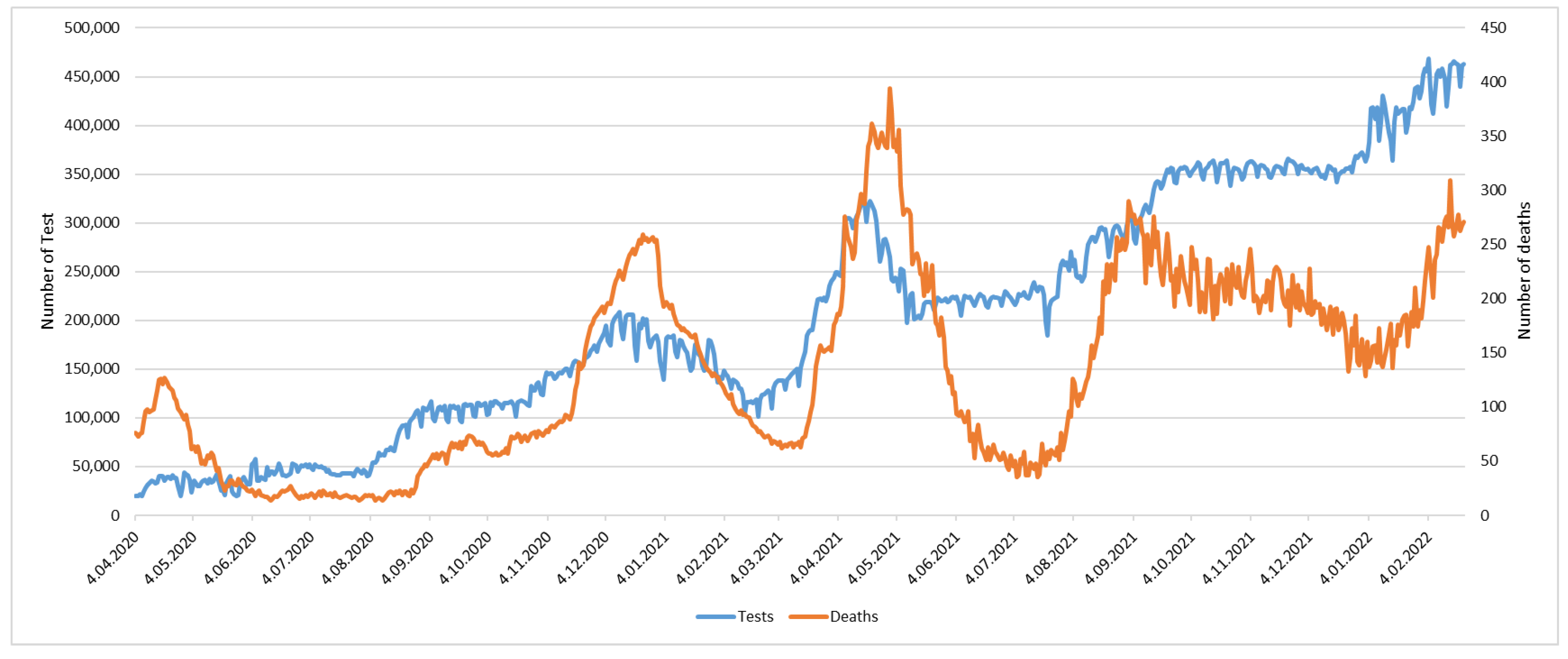
Disclaimer/Publisher’s Note: The statements, opinions and data contained in all publications are solely those of the individual author(s) and contributor(s) and not of MDPI and/or the editor(s). MDPI and/or the editor(s) disclaim responsibility for any injury to people or property resulting from any ideas, methods, instructions or products referred to in the content.

Article Metrics

Citations

Article Access Statistics

Multiple requests from the same IP address are counted as one view.