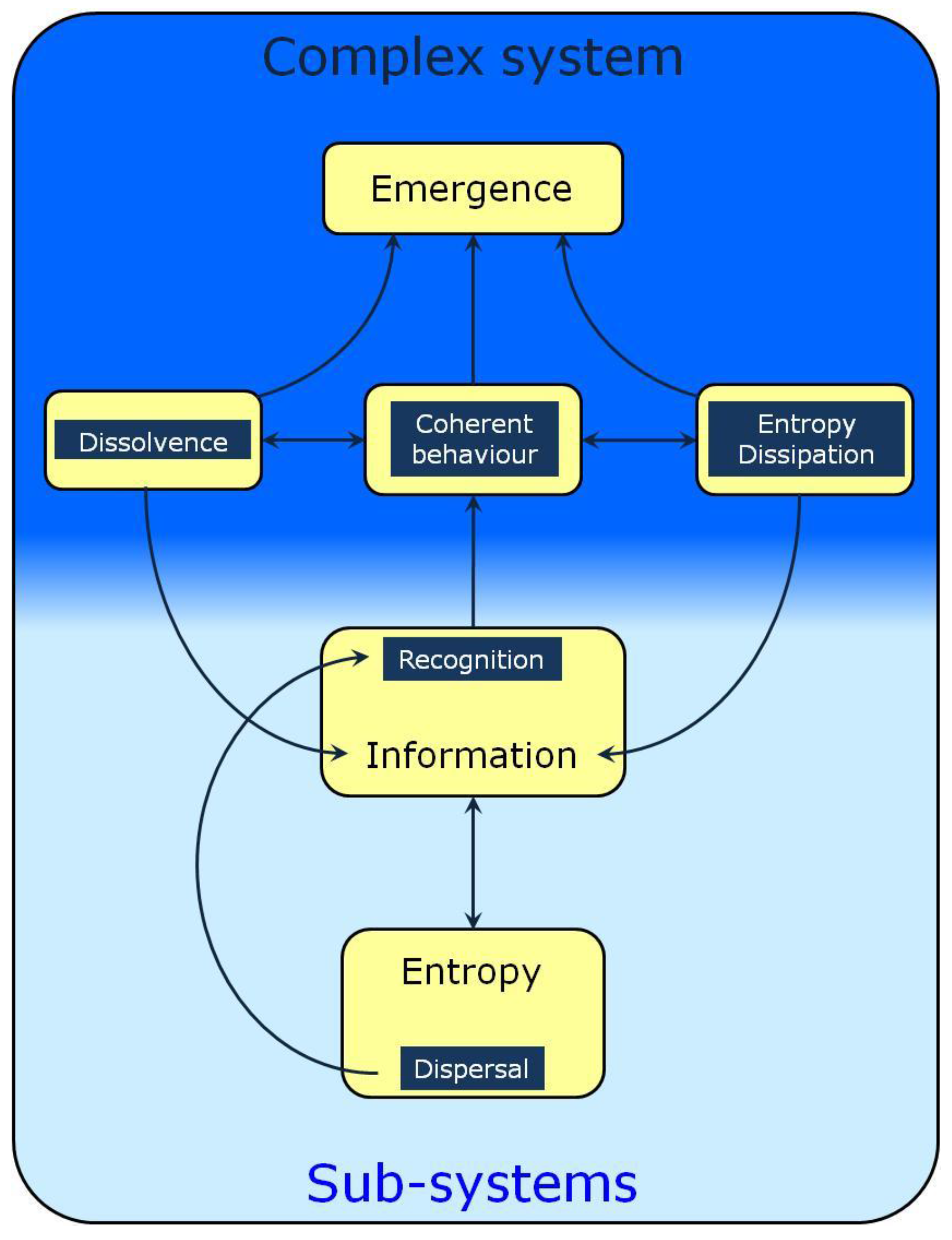

Dispersal (Entropy) and Recognition (Information) as Foundations of Emergence and Dissolvence

Abstract
1. Introduction

2. Entropy and Dispersal
3. Recognition and Information
4. Collective Behavior, Open Systems and Emergence
5. Dissolvence
6. Conclusions
References and Notes
- Atkins, P. Four Laws that Drive the Universe; Oxford University Press: Oxford, UK, 2007; pp. 49-50, 66-68, 103. [Google Scholar]
- Conrad, M. Adaptability—The Significance of Variability from Molecule to Ecosystem; Plenum Press: New York, NY, USA, 1983; pp. 11-20, 31-49. [Google Scholar]
- Cramer, F. Chaos and Order—The Complex Structure of Living Systems; VCH: Weinheim, Germany, 1993; pp. 12-16, 210-211. [Google Scholar]
- Danchin, A. The Delphic Boat—What Genomes Tell Us; Harvard University Press: Cambridge, MA, USA, 2002; pp. 156, 188-198, 205-206. [Google Scholar]
- Gell-Mann, M. The Quark and the Jaguar—Adventures in the Simple and the Complex; Abacus: London, UK, 1995; pp. 37-38, 223, 244-246. [Google Scholar]
- Kauffman, S. At Home in the Universe—The Search for Laws of Complexity; Penguin Books: London, UK, 1996; pp. 9, 184-188. [Google Scholar]
- Kauffman, S.A. Investigations; Oxford University Press: Oxford, UK, 2000; pp. 22, 48, 60. [Google Scholar]
- Kirschner, M.W.; Gerhart, J.C. The Plausibility of Life; Yale University Press: New Haven, CT, USA, 2005; p. 145. [Google Scholar]
- Laidler, K.J. Energy and the Unexpected; Oxford University Press: Oxford, UK, 2002; pp. 34–71. [Google Scholar]
- Morowitz, H.J. The Emergence of Everything—How the World Became Complex; Oxford University Press: New York, NY, USA, 2002; pp. 11, 176-177. [Google Scholar]
- Nicolis, G.; Prigogine, I. Exploring Complexity; Freeman: New York, NY, USA, 1989; pp. 148-153, 217-242. [Google Scholar]
- Ruelle, D. Chance and Chaos; Penguin Books: London, UK, 1993; pp. 103–108. [Google Scholar]
- Prigogine, I.; Stengers, I. Order out of Chaos; Fontana Paperbacks: London, UK, 1985; pp. 103-129, 171-176, 285-290. [Google Scholar]
- Brissaud, J.B. The meaning of entropy. Entropy 2005, 7, 68–96. [Google Scholar] [CrossRef]
- Kier, L.B. Science and Complexity for Life Science Students; Kendall/Hunt: Dubuque, IA, USA, 2007. [Google Scholar]
- Lockwood, M. The Labyrinth of Time; Oxford University Press: Oxford, UK, 2005; pp. 178-186, 221-232, 257-281. [Google Scholar]
- Kullback, S.; Leibler, R.A. On information and sufficiency. Ann. Math. Stat. 1951, 22, 79–86. [Google Scholar] [CrossRef]
- Kullback, S. Information Theory and Statistics; Wiley: New York, NY, USA, 1959. [Google Scholar]
- Shannon, C. A Mathematical Theory of Communication. Bell Syst. Tech. J. 1948, 27, 379-423, 623-656. [Google Scholar] [CrossRef]
- Mahner, M.; Bunge, M. Foundations of Biophilosophy; Springer: Berlin, Germany, 1997; pp. 15-17, 24-34, 139-169, 280-284. [Google Scholar]
- von Baeyer, H.C. Information. The New language of Science; Weidenfeld & Nicolson: London, UK, 2003; pp. 4, 18-34. [Google Scholar]
- Loewenstein, W.R. The Touchstone of Life; Penguin Books: London, UK, 2000; pp. 6-20, 55-61, 121-124. [Google Scholar]
- Carrupt, P.A.; El Tayar, N.; Karlén, A.; Testa, B. Value and limits of molecular electrostatic potentials for characterizing drug-biosystem interactions. Meth. Enzymol. 1991, 203, 638–677. [Google Scholar] [PubMed]
- Carrupt, P.A.; Testa, B.; Gaillard, P. Computational approaches to lipophilicity: Methods and applications. Revs. Comput. Chem. 1997, 11, 241–315. [Google Scholar]
- Menant, C. Information and meaning. Entropy 2003, 5, 193–204. [Google Scholar] [CrossRef]
- Propopenko, M.; Boschetti, F.; Eyan, A.J. An information-theoretic primer on complexity, self-organization, and emergence. Complexity 2009, 15, 11–28. [Google Scholar] [CrossRef]
- Goodwin, B. How the Leopard Changed its Spots; Orion Books: London, UK, 1995; pp. 40–55. [Google Scholar]
- Holland, J.H. Emergence. From Chaos to Order; Perseus Books: Reading, MA, USA, 1999; pp. 1-10, 101-109, 225-231. [Google Scholar]
- Ball, P. Critical Mass; Randon House: London, UK, 2005; pp. 107-115, 135-140, 145-192, 443-466. [Google Scholar]
- Barabási, A.L. Linked; Penguin Books: London, UK, 2003. [Google Scholar]
- Maturana, H.R.; Varela, F.J. The Tree of Knowledge; Shambhala: Boston, MA, USA, 1998; pp. 33-52, 198-199. [Google Scholar]
- Johnson, S. Emergence. The Connected Lives of Ants, Brains, Cities,and Software; Scribner: New York, NY, USA, 2001; pp. 73-90, 112-121, 139-162. [Google Scholar]
- Pagels, H.R. The Dreams of Reason; Bantam Book: New York, NY, USA, 1989; pp. 54-70, 205-240. [Google Scholar]
- Salthe, S.N. Evolving Hierarchical Sytems: Their Structure and Representation; Columbia University Press: New York, NY, USA, 1985. [Google Scholar]
- Salthe, S.N. Summary of the principles of hierarchy theory. Gen. Syst. Bull. 2002, 31, 13–17. [Google Scholar]
- Dawkins, R. The Extended Phenotype, revised ed.; Oxford University Press: Oxford, UK, 1999. [Google Scholar]
- Testa, B.; Raynaud, I.; Kier, L.B. What differenciates free amino acids and amino acyl residues? An exploration of conformational and lipophilicity spaces. Helv. Chim. Acta 1999, 82, 657–665. [Google Scholar] [CrossRef]
- Testa, B.; Kier, L.B. Emergence and dissolvence in the self-organization of complex systems. Entropy 2000, 2, 1–25. [Google Scholar] [CrossRef]
- Testa, B.; Kier, L.B.; Carrupt, P.A. A systems approach to molecular structure, intermolecular recognition, and emergence-dissolvence in medicinal research. Med. Res. Rev. 1997, 17, 303–326. [Google Scholar] [CrossRef]
- Bojarski, A.J.; Nowak, M.; Testa, B. Conformational constraints on side chains in protein residues increase their information content. Cell. Molec. Life Sci. 2003, 60, 2526–2531. [Google Scholar] [CrossRef] [PubMed]
- Bojarski, A.J.; Nowak, M.; Testa, B. Conformational fluctuations versus constraints in amino acid side chains: The evolution of information content from free amino acids to proteins. Chem. Biodivers. 2006, 3, 245–273. [Google Scholar] [CrossRef] [PubMed]
- Testa, B.; Kier, L.B.; Bojarski, A.J. Molecules and meaning: How do molecules become biochemical signals? S.E.E.D J. 2002, 2, 84–101. [Google Scholar]
- Janus. Wikipedia entry. Available online: http://en.wikipedia.org/wiki/Janus (accessed November 30, 2009).
- Toffler, A. Foreword to [13], pp xi-xxvi.
© 2009 by the authors; licensee Molecular Diversity Preservation International, Basel, Switzerland. This article is an open-access article distributed under the terms and conditions of the Creative Commons Attribution license (http://creativecommons.org/licenses/by/3.0/).
Share and Cite
Testa, B. Dispersal (Entropy) and Recognition (Information) as Foundations of Emergence and Dissolvence. Entropy 2009, 11, 993-1000. https://doi.org/10.3390/e11040993
Testa B. Dispersal (Entropy) and Recognition (Information) as Foundations of Emergence and Dissolvence. Entropy. 2009; 11(4):993-1000. https://doi.org/10.3390/e11040993
Chicago/Turabian StyleTesta, Bernard. 2009. "Dispersal (Entropy) and Recognition (Information) as Foundations of Emergence and Dissolvence" Entropy 11, no. 4: 993-1000. https://doi.org/10.3390/e11040993
APA StyleTesta, B. (2009). Dispersal (Entropy) and Recognition (Information) as Foundations of Emergence and Dissolvence. Entropy, 11(4), 993-1000. https://doi.org/10.3390/e11040993