Information Entropy-Based Metrics for Measuring Emergences in Artificial Societies

Abstract
1. Introduction
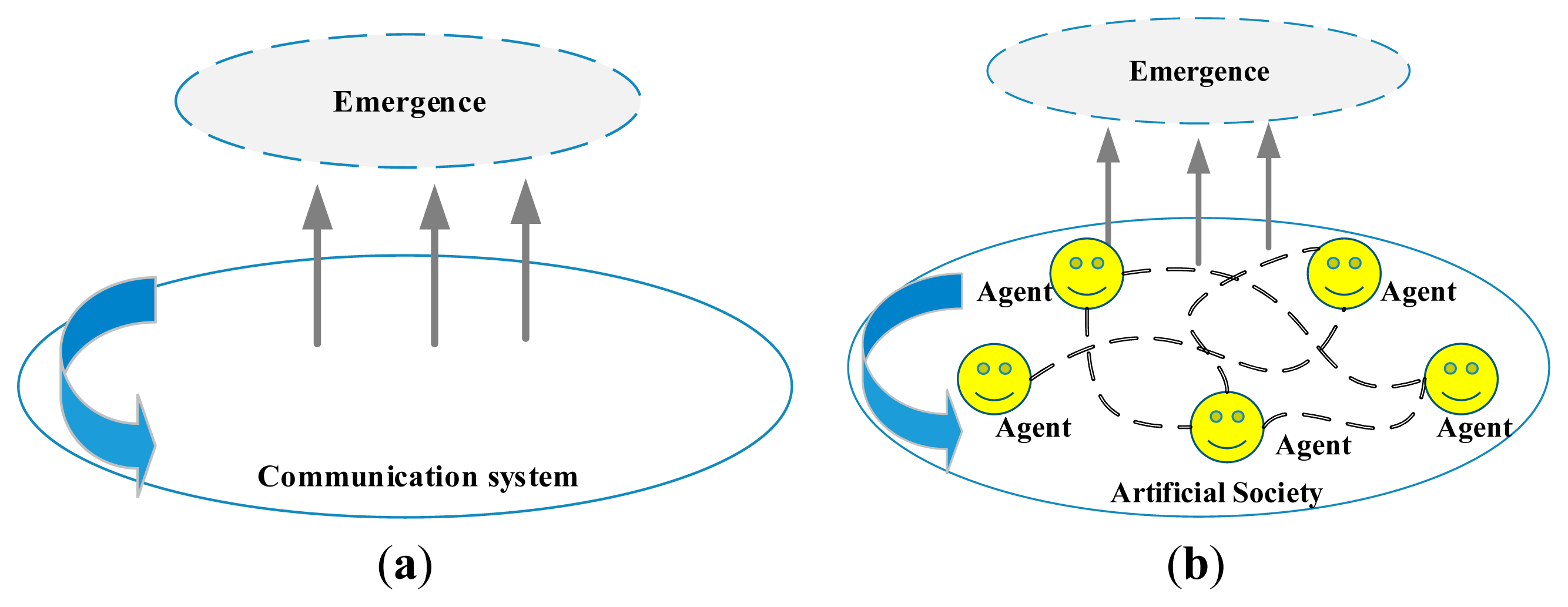
2. Method for Measuring Emergences
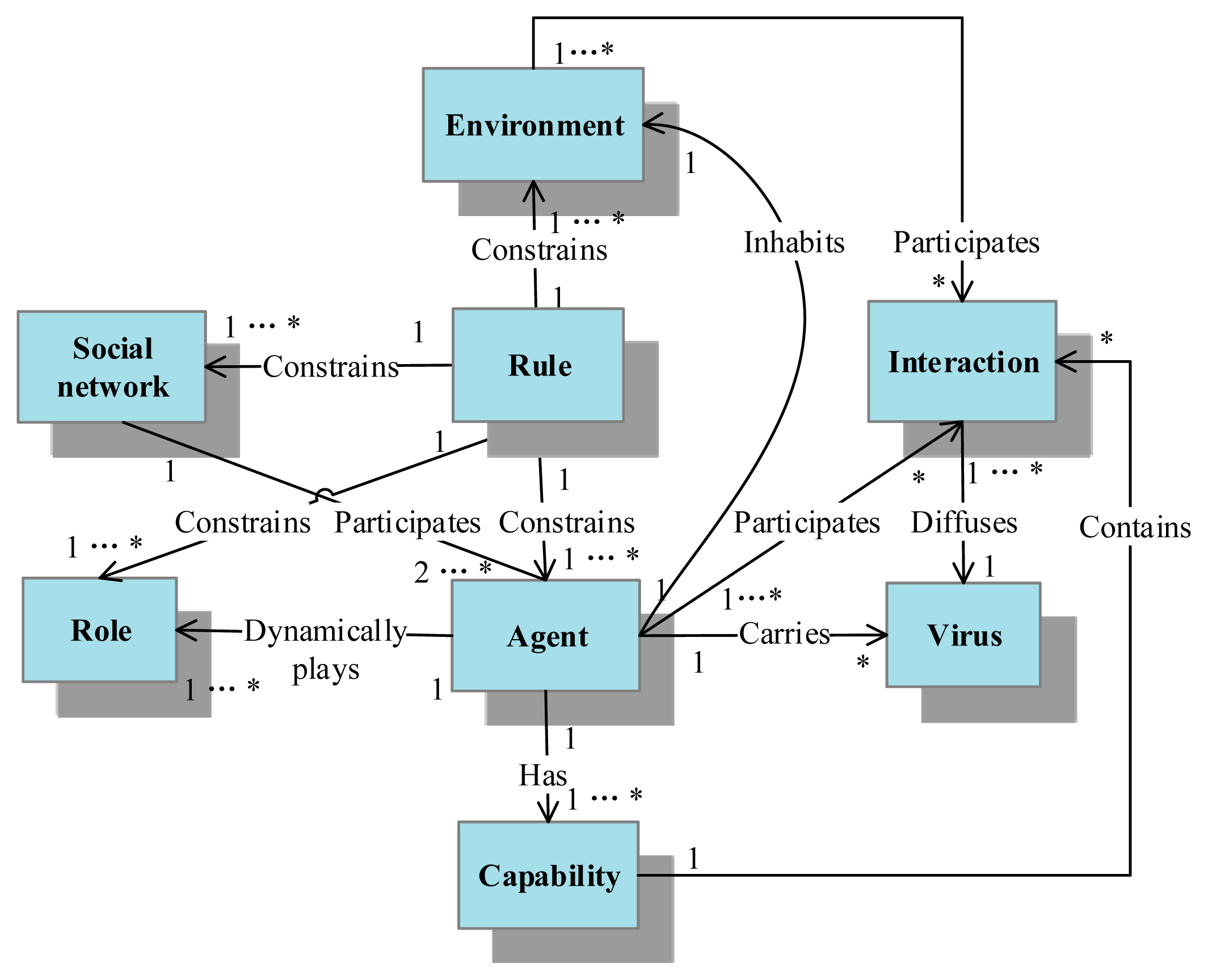
2.1. Prerequisite Knowledge
2.2. Metrics of Various Emergences
2.2.1. Emergence of Attribute and Behavior
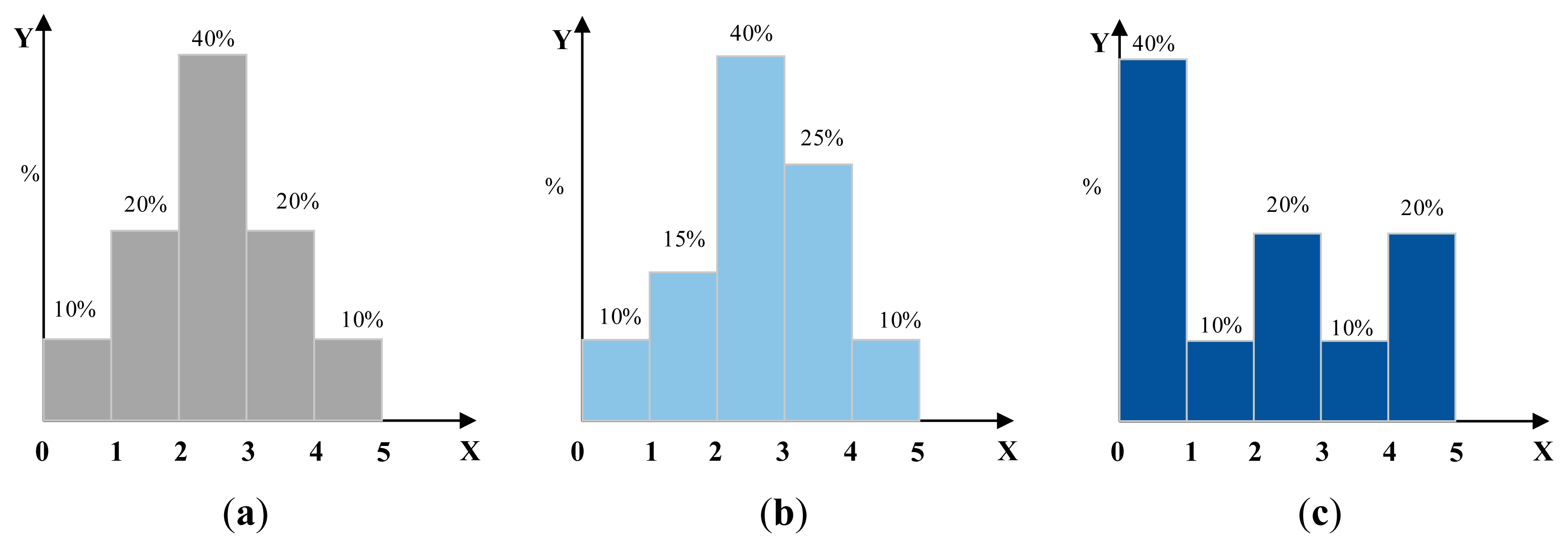
2.2.2. Emergence of Structure
3. Experiments
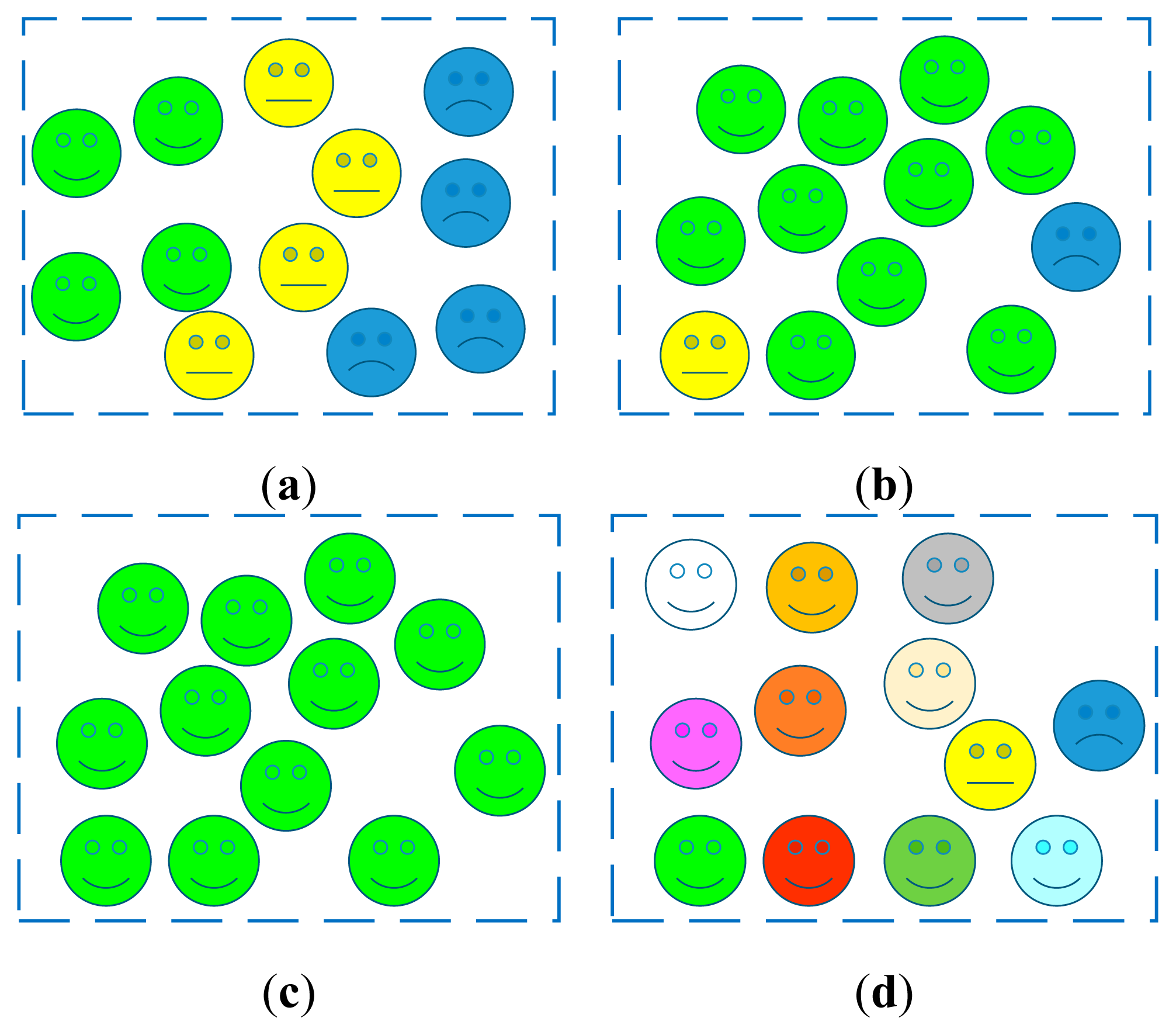
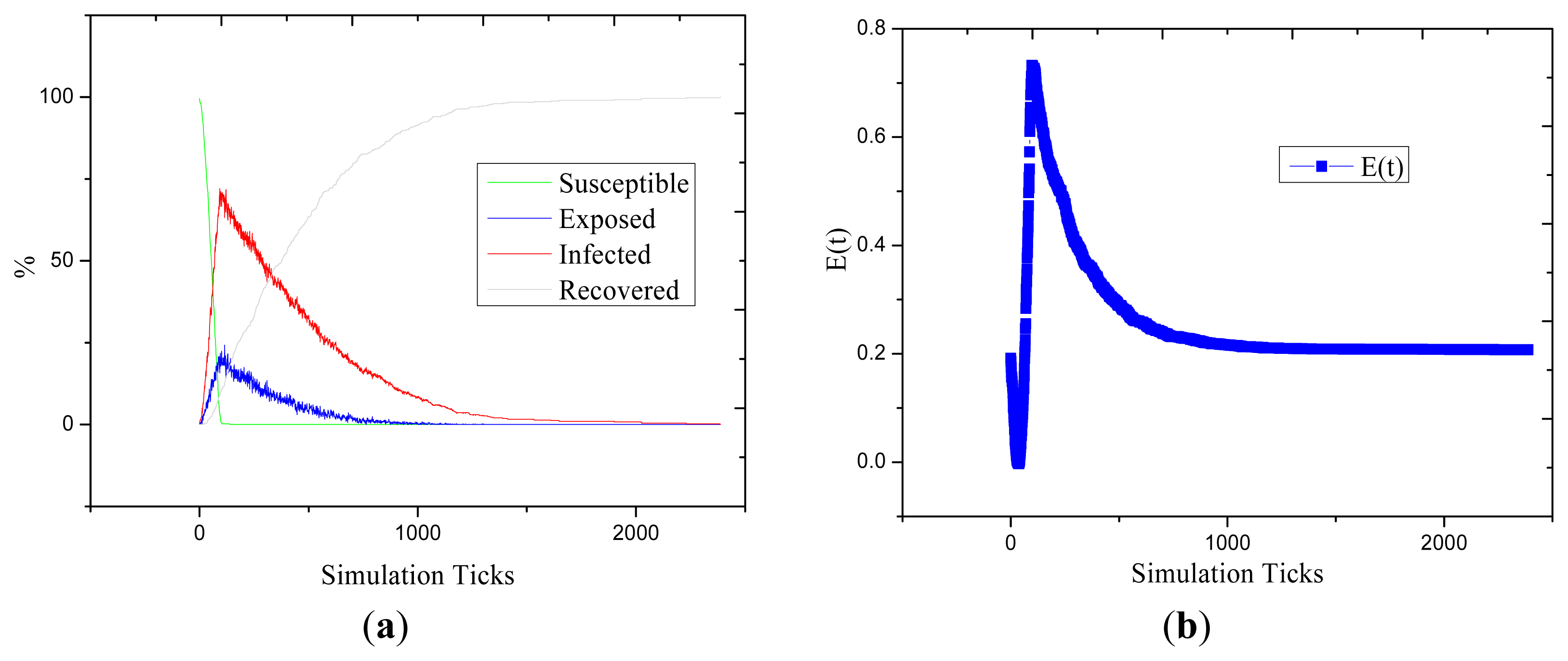
Case 1: The Spread of an Infectious Influenza
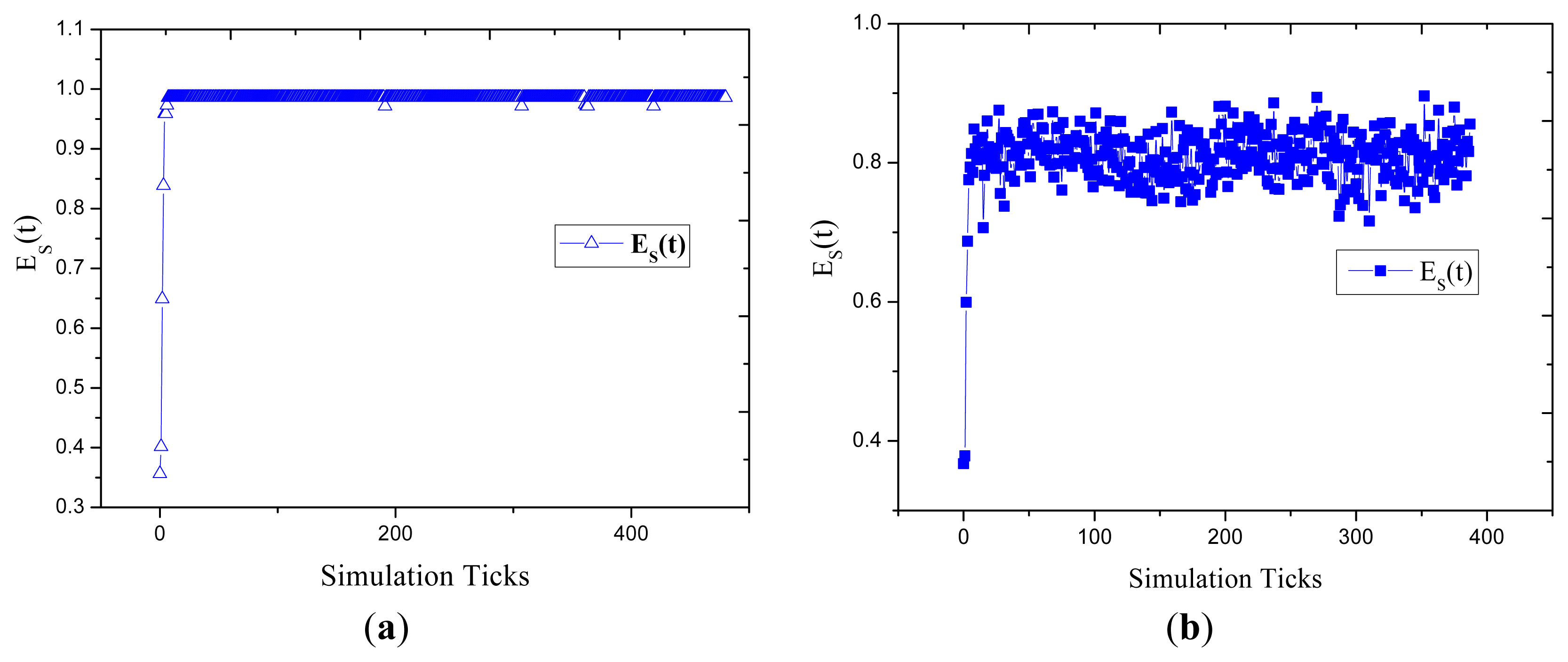
Case 2: A Dynamic Microblog Network
- (1)
- In each time, randomly select npr0 pairs of nodes. For each pair of nodes, randomly choose one of these two nodes signed as node i. If out-degree of node i is smaller than ownz*i→, then node i will connect to the other one.
- (2)
- In each time, randomly choose npr1 pairs of nodes. For each pair of nodes, if one of the chose nodes (node j) connects to the other (node i), and node i does not connect to node j and out-degree of the node i is less than ownz*i→, then node i will connect to node j.
- (3)
- In each time, randomly select npr2 pairs of nodes. For each pair of nodes, if one of the selected nodes (node i) with the smaller in-degree does not connect to the other node and out-degree of node i is less than ownz*i→, then node i will connect to the other node.
- (4)
- In each time, randomly choose nmr3 nodes ( ). For each node, randomly select one of nodes from its in-neighbor nodes (called node i), and randomly choose one of nodes from its out-neighbor nodes (signed as node j). If node i does not connect to node j and out-degree of node i is smaller than ownz*i→, and then node i will connect to node j.
- (5)
- In each time, randomly choose ne γ nodes (γ is a constant). For each node, randomly select one of its out-links and cancel this link.
Case 3: Flock of Birds (Flocking Birds)
- (1)
- Cohesion: If an agent is far away from its nearest neighbor, and then this agent will turn towards its nearest neighbor.
- (2)
- Separation: If an agent is too close to the nearest neighbor, and then this agent will turn away from the nearest neighbor.
- (3)
- Alignment: All agents keep the average direction of all agents.
4. Discussion
5. Conclusions
Acknowledgments
Author Contributions
Conflicts of Interest
References
- Goldstein, J. Emergence as a construct: History and issues. Emergence 1999, 1, 49–72. [Google Scholar]
- Wolf, T.D.; Holvoet, T. Emergence Versus Self-Organisation: Different Concepts but Promising When Combined. In Engineering Self-Organising Systems; Proceedings of Third International Workshop, ESOA 2005, Utrecht, The Netherlands, 25 July 2005, Brueckner, S.A., Serugendo, G.D.M., Karageorgos, A., Nagpal, R., Eds.; Lecture Notes in Computer Science, Volume 3464; Springer: Berlin/Heidelberg, Germany, 2005; pp. 1–15. [Google Scholar]
- Prokopenko, M.; Boschetti, F.; Ryan, A.J. An information-theoretic primer on complexity, self-organization, and emergence. Complexity 2009, 15, 11–28. [Google Scholar]
- Waugh, W.L.; Streib, G. Collaboration and leadership for effective emergency management. Public Adm. Rev 2006, 66, 131–140. [Google Scholar]
- Wang, F.Y. Toward a Paradigm Shift in Social Computing: The ACP Approach. IEEE Intell. Syst 2007, 22, 65–67. [Google Scholar]
- Denbigh, K.G. Note on entropy, disorder and disorganization. British J. Philos. Sci 1989, 40, 323–332. [Google Scholar]
- Kostic, M.M. The Elusive Nature of Entropy and Its Physical Meaning. Entropy 2014, 16, 953–967. [Google Scholar]
- Cengel, Y.A.; Boles, M.A.; Kanoglu, M. Thermodynamics: An engineering approach; McGraw-Hill: New York, NY, USA, 2011. [Google Scholar]
- Goldstein, S.; Lebowitz, J.L. On the (Boltzmann) entropy of non-equilibrium systems. Physica D 2004, 193, 53–66. [Google Scholar]
- Baldassarre, G. Self-organization as phase transition in decentralized groups of robots: A study based on Boltzmann entropy. In Advances in Applied Self-organizing Systems; Springer: London, UK, 2013; pp. 157–177. [Google Scholar]
- Swanson, G.A.; Bailey, K. Social Entropy Theory, Macro Accounting, and Entropy Related Measures. Proceedings of the Annual Meeting of the International Society for the Systems Sciences, Rohnert Park, CA, USA, 9–14 July 2006; Curran Associates Inc: New York, NY, USA, 2006; pp. 159–174. [Google Scholar]
- Balch, T. Hierarchic social entropy: An information theoretic measure of robot group diversity. Auton. Robots 2000, 8, 209–238. [Google Scholar]
- Vedral, V. The role of relative entropy in quantum information theory. Rev. Mod. Phys 2002, 74, 197–234. [Google Scholar]
- Machado, J.T. Fractional Order Generalized Information. Entropy 2014, 16, 2350–2361. [Google Scholar]
- Van Dyke Parunak, H.; Brueckner, S. Entropy and self-organization in multi-agent systems. Proceedings of the Fifth International Conference on Autonomous Agents, Montreal, Canada, 28 May–1 June 2001; ACM: New York, NY, USA, 2001; pp. 124–130. [Google Scholar]
- Mnif, M.; Müller-Schloer, C. Quantitative emergence. In Organic Computing—A Paradigm Shift for Complex Systems; Springer: Basel, Switzerland, 2011; pp. 39–52. [Google Scholar]
- Bedau, M.A.; Norman, H.P. Measurement of Evolutionary Activity, Teleology, and Life. In Artificial Life II; Christopher, G., Taylor, C.L., Farmer, D., Rasmussen, S., Eds.; SFI Studies in the Sciences of Complexity; Addison Wesley Longman: Boston, MA, USA, 1992; pp. 431–461. [Google Scholar]
- Hovda, P. Quantifying weak emergence. Minds Mach 2008, 18, 461–473. [Google Scholar]
- Chan, W.K.V. Interaction metric of emergent behaviors in agent-based simulation. Proceedings of the 2011 Winter Simulation Conference, Phoenix, AZ, USA, 11–14 December 2011; pp. 357–368.
- Fisch, D.; Janicke, M.; Sick, B.; Muller-Schloer, C. Quantitative Emergence-A Refined Approach Based on Divergence Measures. Proceedings of 4th IEEE International Conference on Self-Adaptive and Self-Organizing Systems (SASO), Budapest, Hungary, 27 September–1 October 2010; pp. 94–103.
- Bar-Yam, Y. A mathematical theory of strong emergence using multiscale variety. Complexity 2004, 9, 15–24. [Google Scholar]
- Laughlin, R.B. A Different Universe: Reinventing Physics from the Bottom Down; Basic Books: New York, NY, USA, 2006. [Google Scholar]
- Bedau, M.A. Weak emergence. Noûs 1997, 31, 375–399. [Google Scholar]
- Chalmers, D.J. Strong and weak emergence. In The Re-emergence of Emergence; Oxford University Press: Oxford, UK, 2006; pp. 244–256. [Google Scholar]
- Seth, A.K. Measuring emergence via nonlinear Granger causality. Proceedings of Artificial Life XI: Eleventh International Conference on the Simulation and Synthesis of Living Systems, Winchester, UK, 5–8 August 2008; pp. 545–553.
- Bedau, M. Downward causation and the autonomy of weak emergence. Principia 2003, 6, 5–50. [Google Scholar]
- Tang, M.; Mao, X.; Zhou, H. Zombie-city: A new artificial society model. J. Comput. Inf. Sys 2013, 9, 4989–4996. [Google Scholar]
- Gershenson, C.; Fernández, N. Complexity and information: Measuring emergence, self-organization, and homeostasis at multiple scales. Complexity 2012, 18, 29–44. [Google Scholar]
- Grabowski, A.; Kosiñski, R.A. Epidemic spreading in a hierarchical social network. Phys. Rev. E 2004, 70. [Google Scholar] [CrossRef]
- Tang, M.; Mao, X.; Yang, S.; Zhou, H. A Dynamic Microblog Network and Information Dissemination in “@” Mode. Math. Probl. Eng 2014, 2014. [Google Scholar] [CrossRef]
- Usherwood, J.R.; Stavrou, M.; Lowe, J.C.; Roskilly, K.; Wilson, A.M. Flying in a flock comes at a cost in pigeons. Nature 2011, 474, 494–497. [Google Scholar]
- Tang, M.; Mao, X.; Guessoum, Z. Research on an Infectious Disease Transmission by Flocking Birds. Sci. World J 2013, 2013. [Google Scholar] [CrossRef]
- Zhu, H.; Wang, F.; Wang, S. On the Convergence of Autonomous Agent Communities. J. Multiagent Grid Syst 2010, 6, 315–352. [Google Scholar]
- Randles, M.; Zhu, H.; Taleb-Bendiab, A. A Formal Approach to the Engineering of Emergence and its Recurrence. Proceedings of 2nd International Workshop on Engineering Emergence in Decentralised Autonomic Systems, Jacksonville, FL, USA, 11 June 2007.



| Classifications | Applications | Metrics | ||
|---|---|---|---|---|
| Weak emergence | Emergence of attribute | Outbreak of infectious disease | Relative entropy, e.g., E(t), ES(t), EC(t). | |
| Emergence of behavior | Emergence of interactions | |||
| Emergence of structure | Emergence of distribution | Matthew effect in the wealth distribution, power-law distribution | ||
| Emergence of cluster | Flocking birds, fish school | |||
| Strong emergence | emergence of consciousness like qualia from the neurobiological processes | Multi-scale variety [21] | ||

© 2014 by the authors; licensee MDPI, Basel, Switzerland This article is an open access article distributed under the terms and conditions of the Creative Commons Attribution license (http://creativecommons.org/licenses/by/3.0/).
Share and Cite
Tang, M.; Mao, X. Information Entropy-Based Metrics for Measuring Emergences in Artificial Societies. Entropy 2014, 16, 4583-4602. https://doi.org/10.3390/e16084583
Tang M, Mao X. Information Entropy-Based Metrics for Measuring Emergences in Artificial Societies. Entropy. 2014; 16(8):4583-4602. https://doi.org/10.3390/e16084583
Chicago/Turabian StyleTang, Mingsheng, and Xinjun Mao. 2014. "Information Entropy-Based Metrics for Measuring Emergences in Artificial Societies" Entropy 16, no. 8: 4583-4602. https://doi.org/10.3390/e16084583
APA StyleTang, M., & Mao, X. (2014). Information Entropy-Based Metrics for Measuring Emergences in Artificial Societies. Entropy, 16(8), 4583-4602. https://doi.org/10.3390/e16084583