
Molecular Targets for Components of Essential Oils in the Insect Nervous System—A Review





Abstract
1. Introduction
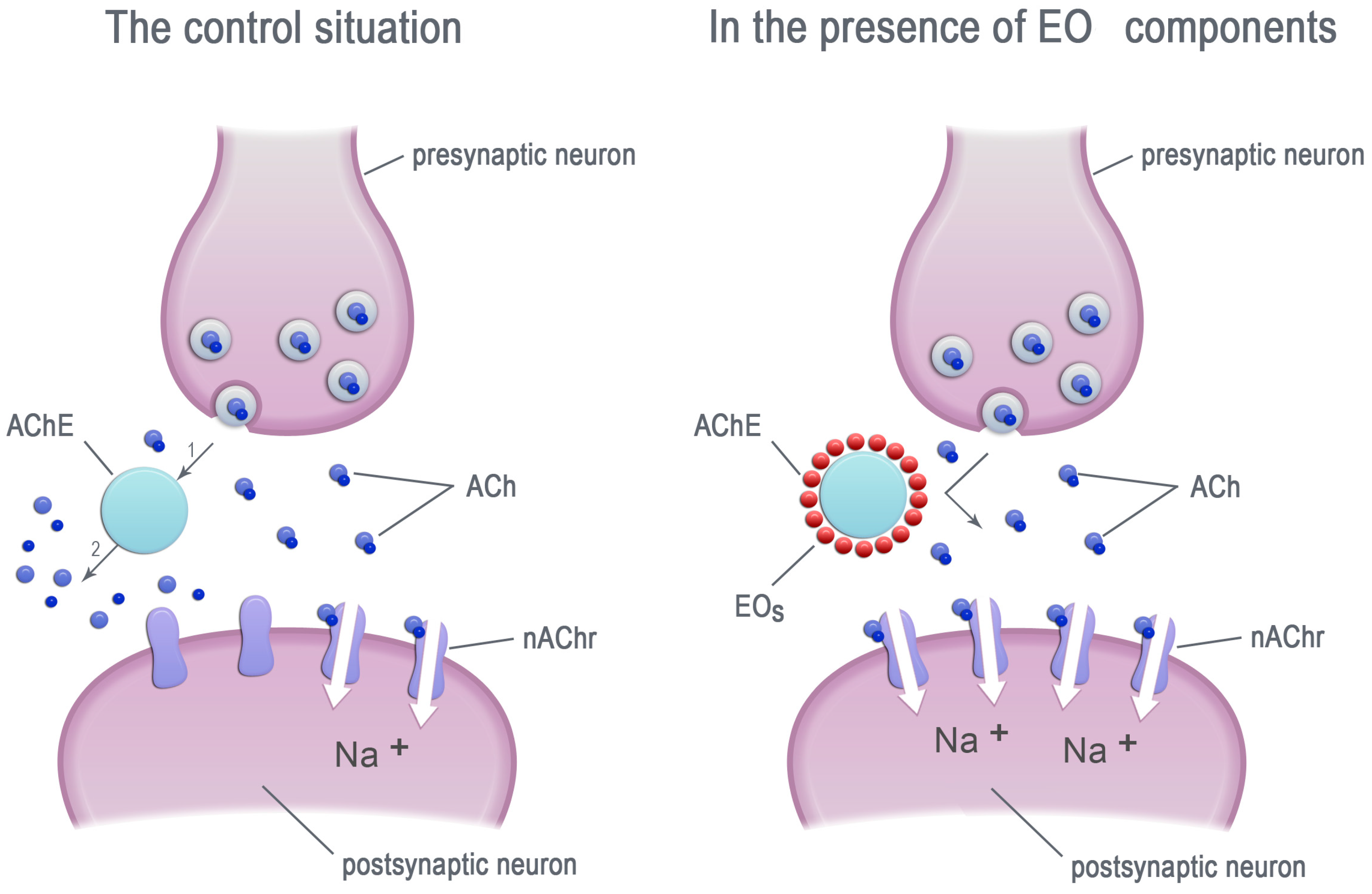
2. Essential Oils—Inhibitors of Acetylcholinesterase
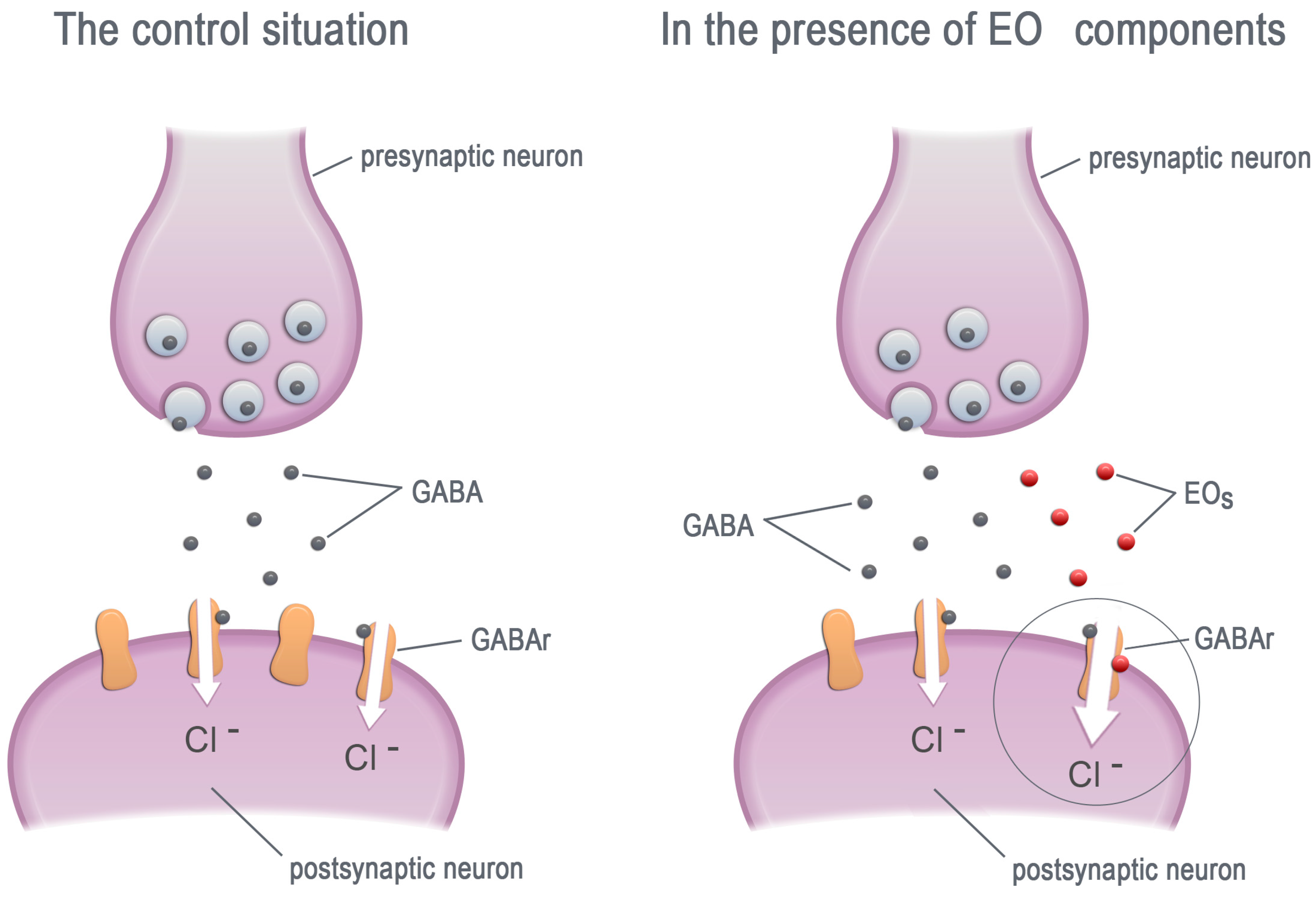
3. Essential Oils—Modifiers of GABA Receptors
3.1. Mammalian GABAA Receptors
3.2. Insect GABA Receptors
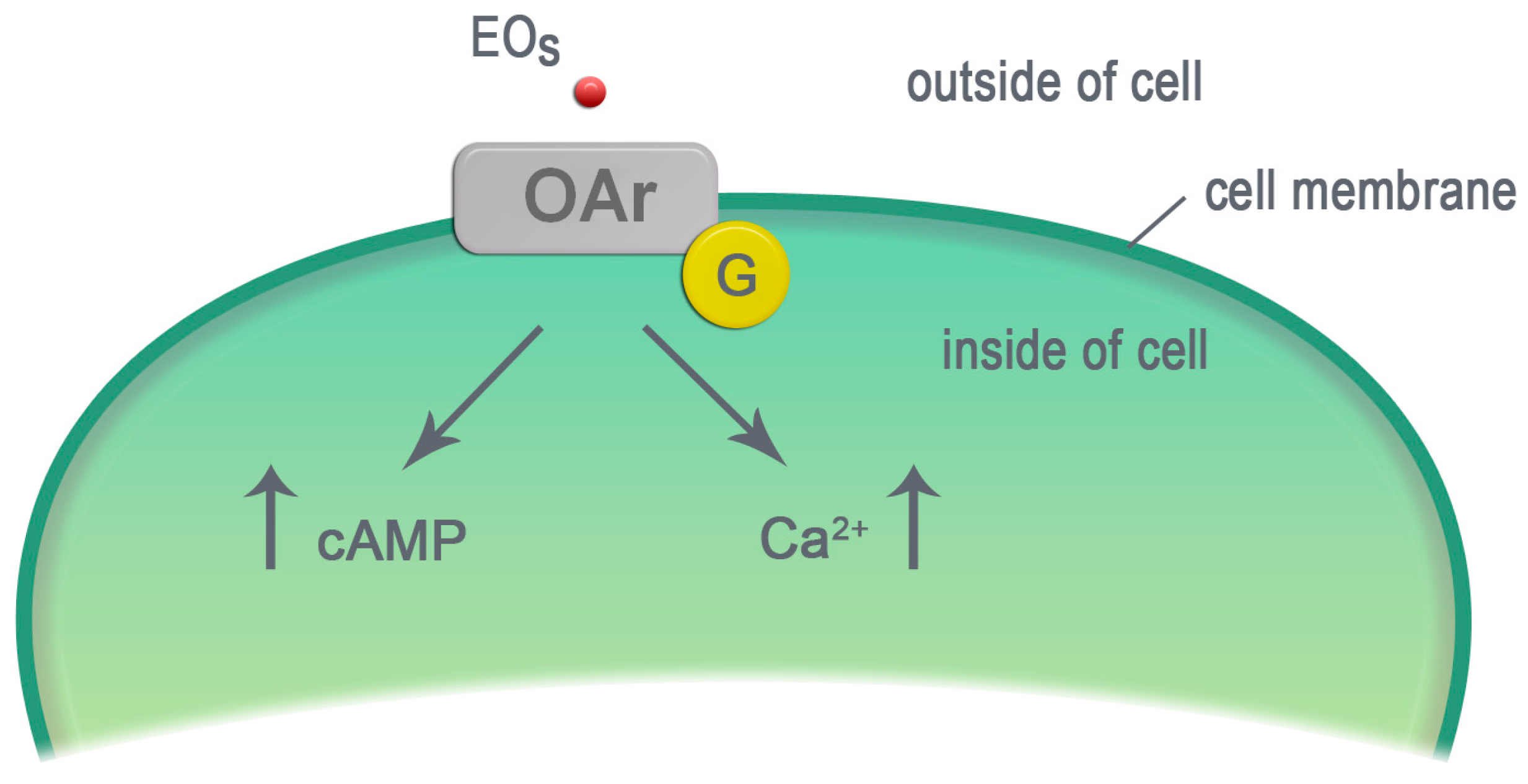
4. Essential Oils—Ligands of Octopamine Receptors
- α-adrenergic-like—the binding of OA to these receptors increases the level of the intracellular calcium; the secondary effect is an increase of the cAMP level;
- β-adrenergic-like—the binding of OA to these receptors increases the level of cAMP;
- octopamine/tyramine—the receptors are similar to α2—an adrenergic receptor in mammals. It is sensitive both to OA and TA. TA binding to this receptor causes a decrease in the cAMP level. In contrast, OA binding to the receptor causes an increase in the cAMP level;
5. Conclusions
Acknowledgments
Author Contributions
Conflicts of Interest
Appendix A

| No. | Essential Oil Components | AChE Source | IC50 (mM) | Ki (mM) | Reference |
|---|---|---|---|---|---|
| 1 | Anisaldehyde | Electric eel | N.A. | [122] | |
| 2 | Anisole | Human erythrocyte | N.A. | [123] | |
| 3 | Anethole | Electric eel | N.A. | [124] | |
| Electric eel | [67] | ||||
| Electric eel | 0.88 | [125] | |||
| Electric eel | 8.9 | [126] | |||
| Bovine erythrocyte | 0.2 | [127] | |||
| Electric eel | N.A. | [122] | |||
| Electric eel | N.A. | [128] | |||
| Electric eel | 0.87 | [126] | |||
| 4 | Borneol | Bovine erythrocyte | N.A. | [64] | |
| Human erythrocyte | N.A. | [68] | |||
| Bovine erythrocyte | N.A. | [63] | |||
| Electric eel | N.A. | [122] | |||
| Human erythrocyte | N.A. | [123] | |||
| Electric eel | N.A. | [124] | |||
| 5 | Bornyl acetate | Electric eel | 21.3 | [55] | |
| Human erythrocyte | N.A. | [68] | |||
| Bovine erythrocyte | N.A. | [63] | |||
| 6 | Camphene | Electric eel | N.A. | [122] | |
| 7 | Camphor | Electric eel | 0.05 | [67] | |
| Electric eel | N.A | [124] | |||
| Electric eel | 11.2 | [60] | |||
| Human erythrocyte | N.A. | [68] | |||
| Bovine erythrocyte | N.A. | [63] | |||
| Electric eel | N.A. | [122] | |||
| Human erythrocyte | N.A. | [123] | |||
| 8 | 2-Carene | Bovine erythrocyte | 0.9 | [58] | |
| 9 | 3-Carene | Human erythrocyte | 0.2 | [68] | |
| Bovine erythrocyte | 0.2 | [58] | |||
| Electric eel | 0.26 | [126] | |||
| 10 | Carvacrol | Electric eel | 0.41 | [65] | |
| Electric eel | 0.61 | [126] | |||
| Electric eel | 0.21 | [122] | |||
| Electric eel | 0.76 | [128] | |||
| 11 | Carvone | Electric eel | 0.3 | [67] | |
| Bovine erythrocyte | N.A. | [64] | |||
| Electric eel | N.A. | [122] | |||
| Electric eel | 5.5 | [60] | |||
| 12 | Caryophyllene (humulene) | Human erythrocyte | N.A. | [68] | |
| Bovine erythrocyte | 0.13 | [68] | |||
| Electric eel | N.A. | [124] | |||
| Human erythrocyte | N.A. | [68] | |||
| Electric eel | N.A. | [129] | |||
| 13 | Caryophyllene oxide | Human erythrocyte | N.A. | [68] | |
| Bovine erythrocyte | N.A. | [63] | |||
| 14 | 1,8-Cineole | Electric eel | 0.025 | [55] | |
| Electric eel | 0.1 | [124] | |||
| Electric eel | 0.71 | [126] | |||
| Bovine erythrocyte | 0.26 | [64] | |||
| Electric eel | 0.6 | [51] | |||
| Electric eel | 0.84 | [122] | |||
| Human erythrocyte | 0.4 | [68] | |||
| Electric eel | 0.04 | 0.03 | [57] | ||
| Bovine erythrocyte | 0.29 | 0.1 | [58] | ||
| Bovine erythrocyte | 0.39 | [63] | |||
| Human erythrocyte | 0.67 | [130] | |||
| 15 | Cinnamaldehyde | Electric eel | N.A. | [122] | |
| 16 | Cinnamyl alcohol | Electric eel | N.A. | [122] | |
| 17 | Citral | Electric eel | 7 | [55] | |
| Electric eel | N.A. | [124] | |||
| Electric eel | N.A. | [122] | |||
| 18 | Citronellal | Electric eel | N.A. | [122] | |
| 19 | Citronellol | Electric eel | N.A. | [122] | |
| 20 | Copaene | Human erythrocyte | N.A. | [68] | |
| 21 | Cymene | Bovine erythrocyte | N.A. | [58] | |
| 22 | Elemol | Bovine erythrocyte | 0.16 | [64] | |
| 23 | Estragole (Allylanisole) | Electric eel | 0.15 | [67] | |
| Electric eel | 12.6 | [60] | |||
| Electric eel | N.A. | [124] | |||
| Electric eel | N.A. | [122] | |||
| 24 | Eugenol | Electric eel | 2.9 | [124] | |
| Electric eel | N.A. | [122] | |||
| Human erythrocyte | N.A. | [123] | |||
| 25 | Fenchone | Electric eel | 0.4 | [67] | |
| Electric eel | 7 | [60] | |||
| 26 | Geraniol | Electric eel | 0.1 | [67] | |
| Electric eel | 15 | [60] | |||
| Electric eel | N.A. | [122] | |||
| 27 | Globulol | Human erythrocyte | N.A. | [68] | |
| 28 | Gossypol | Electric eel | 1.5 | [55] | |
| 29 | Guaiol | Human erythrocyte | N.A. | [68] | |
| 30 | Isoeugenol | Electric eel | N.A. | [122] | |
| 31 | Limonene | Electric eel | N.A. | [124] | |
| Human erythrocyte | N.A. | [68] | |||
| Electric eel | 1.61 | [125] | |||
| Electric eel | 4.33 | [126] | |||
| Electric eel | N.A. | [122] | |||
| Bovine erythrocyte | N.A. | [64] | |||
| 32 | Linalool | Electric eel | 0.3 | [67] | |
| Electric eel | 5.5 | [55] | |||
| Electric eel | N.A. | [124] | |||
| Electric eel | 15.6 | [60] | |||
| Electric eel | N.A. | [122] | |||
| Human erythrocyte | N.A. | [68] | |||
| Bovine erythrocyte | N.A. | [63] | |||
| Bovine erythrocyte | N.A. | [64] | |||
| 33 | Linalyl acetate | Bovine erythrocyte | N.A. | [64] | |
| Electric eel | N.A. | [129] | |||
| 34 | Manool | Human erythrocyte | N.A. | [68] | |
| 35 | Methylcinnamate | Electric eel | N.A. | [122] | |
| 36 | Methyleugenol | Electric eel | N.A. | [122] | |
| Electric eel | N.A. | [124] | |||
| 37 | Menthofuran | Bovine erythrocyte | N.A. | [64] | |
| 38 | Menthol | Bovine erythrocyte | N.A. | [64] | |
| 39 | Menthone | Bovine erythrocyte | N.A. | [64] | |
| Electric eel | N.A. | [122] | |||
| 40 | Methol | Human erythrocyte | N.A. | [123] | |
| 41 | Methoxycinnamaldehyde | Electric eel | N.A. | [124] | |
| 42 | Methyl acetate | Bovine erythrocyte | N.A. | [64] | |
| 43 | Myrcene | Electric eel | N.A. | [122] | |
| 44 | Myrtenal | Electric eel | 0.17 | [122] | |
| 45 | Nerol | Electric eel | N.A. | [122] | |
| 46 | Nerolidol | Electric eel | N.A. | [122] | |
| 47 | Neryl acetate | Human erythrocyte | N.A. | [68] | |
| 48 | Phellandrene | Electric eel | 0.88 | [129] | |
| 49 | Phenylethanol | Electric eel | N.A. | [122] | |
| 50 | α-Pinene | Electric eel | 0.16 | [124] | |
| Electric eel | 10.5 | [130] | |||
| Human erythrocyte | 0.7 | [68] | |||
| Human erythrocyte | 0.63 | [131] | |||
| Bovine erythrocytes | 0.66 | [63] | |||
| Electric eel | N.A. | [122] | |||
| Bovine erythrocytes | 0.4 | [58] | |||
| 51 | β-Pinene | Electric eel | N.A. | [124] | |
| Human erythrocyte | 1.5 | [68] | |||
| Bovine erythrocyte | 1.5 | [63] | |||
| Electric eel | N.A. | [122] | |||
| 52 | Piperitenone oxide | Bovine erythrocyte | 0.38 | [64] | |
| 53 | Piperitenone | Bovine erythrocyte | 0.72 | [64] | |
| Bovine erythrocyte | 0.83 | [64] | |||
| 54 | Pulegone | Electric eel | 0.85 | [55] | |
| Bovine erythrocyte | 0.89 | [64] | |||
| 55 | Sabinene | Human erythrocyte | N.A. | [68] | |
| Electric eel | 1.25 | [125] | |||
| 56 | Sclareol | Human erythrocyte | N.A. | [68] | |
| 57 | α-Terpinene | Bovine erythrocyte | N.A. | [58] | |
| 58 | γ-Terpinene | Electric eel | 0.2 | [67] | |
| Electric eel | N.A. | [124] | |||
| Electric eel | 5.8 | [60] | |||
| Bovine erythrocyte | N.A. | [58] | |||
| 59 | α-Terpineol | Electric eel | 8.43 | [124] | |
| Human erythrocyte | N.A. | [68] | |||
| 60 | Terpinen-4-ol | Electric eel | 20.7 | [124] | |
| Electric eel | 10.30 | 4.7 | [57] | ||
| Bovine erythrocyte | N.A. | 2 | [58] | ||
| Electric eel | N.A. | [129] | |||
| Electric eel | N.A. | [122] | |||
| 61 | Terpinolene | Electric eel | 1.1 | [129] | |
| 62 | α-Thujone | Human erythrocyte | N.A. | [68] | |
| Electric eel | N.A. | [122] | |||
| 63 | Thymohydroquinone | Electric eel | 0.24 | [65] | |
| 64 | Thymol | Electric eel | 4.9 | [65] | |
| Electric eel | 1.39 | [126] | |||
| Electric eel | N.A. | [122] | |||
| 65 | Thymoquinone | Electric eel | 0.85 | [65] | |
| 66 | Viridiflorol | Bovine erythrocyte | 0.11 | [64] | |
| 67 | Verbenone | Electric eel | 2.66 | [122] | |
| Electric eel | 0.73 | [128] |
References
- Bassolé, I.H.N.; Juliani, H.R. Essential oils in combination and their antimicrobial properties. Molecules 2012, 17, 3989–4006. [Google Scholar] [CrossRef] [Scilit] [PubMed]
- Pavela, R. History, presence and perspective of using plant extracts as commercial botanical insecticides and farm products for protection against insects—A review. Plant Protect. Sci. 2016, 52, 229–241. [Google Scholar]
- Pavela, R.; Benelli, G. Ethnobotanical knowledge on botanical repellents employed in the African region against mosquito vectors—A review. Exp. Parasitol. 2016, 167, 103–108. [Google Scholar] [CrossRef] [Scilit] [PubMed]
- Mihajilov-Krstev, T.; Jovanović, B.; Jović, J.; Ilić, B.; Miladinović, D.; Matejić, J.; Rajković, J.; Dorđević, L.; Cvetković, V.; Zlatković, B. Antimicrobial, antioxidative, and insect repellent effects of Artemisia absinthium essential oil. Planta Medica 2014, 80, 1698–1705. [Google Scholar] [CrossRef] [Scilit] [PubMed]
- Tisgratog, R.; Sanguanpong, U.; Grieco, J.P.; Ngoen-Kluan, R.; Chareonviriyaphap, T. Plants traditionally used as mosquito repellents and the implication for their use in vector control. Acta Trop. 2016, 157, 136–144. [Google Scholar] [CrossRef] [Scilit] [PubMed]
- Price, D.N.; Berry, M.S. Neurophysiological effects of naturally occurring defensive compounds on the freshwater snail Planorbis corneus: Comparison with effects in insects. J. Chem. Ecol. 2008, 34, 994–1004. [Google Scholar] [CrossRef] [Scilit] [PubMed]
- Cilek, J.E.; Hallmon, C.F.; Johnson, R. Limited efficacy of commercially formulated essential oils on vegetation against female Aedes albopictus and Culex quinquefasciatus. J. Agric. Urban Entomol. 2010, 27, 54–60. [Google Scholar] [CrossRef] [Scilit]
- Liu, Z.L.; Zhao, N.N.; Liu, C.M.; Zhou, L.; Du, S.S. Identification of insecticidal constituents of the essential oil of Curcuma wenyujin rhizomes active against Liposcelis bostrychophila Badonnel. Molecules 2012, 17, 12049–12060. [Google Scholar] [CrossRef] [Scilit] [PubMed]
- Liu, X.C.; Li, Y.P.; Li, H.Q.; Deng, Z.W.; Zhou, L.; Liu, Z.L.; Du, S.S. Identification of repellent and insecticidal constituents of the essential oil of Artemisia rupestris L. aerial parts against Liposcelis bostrychophila Badonnel. Molecules 2013, 18, 10733–10746. [Google Scholar] [PubMed]
- Liu, X.C.; Zhou, L.G.; Liu, Z.L.; Du, S.S. Identification of insecticidal constituents of the essential oil of Acorus calamus rhizomes against Liposcelis bostrychophila Badonnel. Molecules 2013, 18, 5684–5696. [Google Scholar] [CrossRef] [Scilit] [PubMed]
- Du, S.S.; Yang, K.; Wang, C.F. Chemical constituents and activities of the essential oil from Myristica fragrans against cigarette beetle Lasioderma serricorne. Chem. Biodivers. 2014, 11, 1449–1456. [Google Scholar] [CrossRef] [Scilit] [PubMed]
- Liu, X.C.; Liang, Y.; Shi, W.P.; Liu, Q.Z.; Zhou, L.; Liu, Z.L. Repellent and insecticidal effects of the essential oil of Kaempferia galanga rhizomes to Liposcelis bostrychophila (Psocoptera: Liposcelidae). J. Econ. Entomol. 2014, 107, 1706–1712. [Google Scholar] [CrossRef] [Scilit] [PubMed]
- Wang, Y.; You, C.X.; Wang, C.F.; Yang, K.; Chen, R.; Zhang, W.J.; Du, S.S.; Geng, Z.F.; Deng, Z.W. Chemical constituents and insecticidal activities of the essential oil from Amomum tsaoko against two stored-product insects. J. Oleo Sci. 2014, 63, 1019–1026. [Google Scholar] [CrossRef] [Scilit] [PubMed]
- Hu, Z.; Chen, Z.; Yin, Z. In vitro acaricidal activity of 1,8-cineole against Sarcoptes scabiei var cuniculi and regulating effects on enzyme activity. Parasitol. Res. 2015, 114, 2959–2967. [Google Scholar] [PubMed]
- Liu, X.C.; Liu, Z.L. Analysis of the essential oil of Illicium henryi Diels root bark and its insecticidal activity against Liposcelis bostrychophila Badonnel. J. Food Prot. 2015, 78, 772–777. [Google Scholar] [CrossRef] [Scilit] [PubMed]
- Wang, Y.; You, C.X.; Yang, K.; Wu, Y.; Chen, R.; Zhang, W.J.; Liu, Z.L.; Du, S.S.; Deng, Z.W.; Geng, Z.F.; et al. Bioactivity of essential oil of Zingiber purpureum Rhizomes and its main compounds against two stored product insects. J. Econ. Entomol. 2015, 108, 925–932. [Google Scholar] [CrossRef] [Scilit] [PubMed]
- Wu, Y.; Zhang, W.J.; Wang, P.J.; Yang, K.; Huang, D.Y.; Wei, J.Y.; Tian, Z.F.; Bai, J.F.; Du, S.S. Contact toxicity and repellency of the essential oil of Liriope muscari (DECN.) Bailey against three insect tobacco storage pests. Molecules 2015, 20, 1676–1685. [Google Scholar] [CrossRef] [Scilit] [PubMed]
- Zhang, W.J.; Yang, K.; You, C.X.; Wang, Y.; Wang, C.F.; Wu, Y.; Geng, Z.F.; Su, Y.; Du, S.S.; Deng, Z.W. Bioactivity of essential oil from Artemisia stolonifera (Maxim.) Komar. and its main compounds against two stored-product insects. J. Oleo Sci. 2015, 64, 299–307. [Google Scholar] [CrossRef] [Scilit] [PubMed]
- Santos, B.A.; Roman-Campos, D.; Carvalho, M.S.; Miranda, F.M.; Carneiro, D.C.; Cavalcante, P.H.; Cândido, E.A.; Filho, L.X.; Cruz, J.S.; Gondim, A.N. Cardiodepressive effect elicited by the essential oil of Alpinia speciosa is related to L-type Ca2+ current blockade. Phytomedicine 2011, 18, 539–543. [Google Scholar] [CrossRef] [Scilit] [PubMed]
- Albuquerque, E.L.D.; Lima, J.K.A.; Souza, F.H.O.; Silva, I.M.; Santos, A.A.; Araújo, A.P.; Blank, A.F.; Lima, R.N.; Alves, P.B.; Bacci, L. Insecticidal and repellence activity of the essential oil of Pogostemon cablin against urban ants species. Acta Trop. 2013, 127, 181–186. [Google Scholar] [CrossRef] [Scilit] [PubMed]
- Dutra, K.A.; de Oliveira, J.V.; Navarro, D.M.; Barbosa, D.A.; Santos, J.P. Control of Callosobruchus maculatus (FABR.) (Coleoptera: Chrysomelidae: Bruchinae) in Vigna unguiculata (L.) WALP. with essential oils from four Citrus spp. plants. J. Stored Prod. Res. 2016, 68, 25–32. [Google Scholar] [CrossRef] [Scilit]
- Nathan, S.S.; Hisham, A.; Jayakumar, G. Larvicidal and growth inhibition of the malaria vector Anopheles stephensi by triterpenes from Dysoxylum malabaricum and Dysoxylum beddomei. Fitoterapia 2008, 79, 106–111. [Google Scholar] [CrossRef] [Scilit] [PubMed]
- Cosimi, S.; Rossi, E.; Cioni, P.L.; Canale, A. Bioactivity and qualitative analysis of some essential oils from Mediterranean plants against stored-product pests: Evaluation of repellency against Sitophilus zeamais Motschulsky, Cryptolestes ferrugineus (Stephens) and Tenebrio molitor (L.). J. Stored Prod. Res. 2009, 45, 125–132. [Google Scholar] [CrossRef] [Scilit]
- Reegan, A.D.; Gandhi, M.R.; Paulraj, M.G.; Balakrishna, K.; Ignacimuthu, S. Effect of niloticin, a protolimonoid isolated from Limonia acidissima L. (Rutaceae) on the immature stages of dengue vector Aedes aegypti L. (Diptera: Culicidae). Acta Trop. 2014, 139, 67–76. [Google Scholar] [CrossRef] [Scilit] [PubMed]
- Govindarajan, M.; Benelli, G. α-Humulene and β-elemene from Syzygium zeylanicum (Myrtaceae) essential oil: Highly effective and eco-friendly larvicides against Anopheles subpictus, Aedes albopictus, and Culex tritaeniorhynchus (Diptera: Culicidae). Parasitol. Res. 2016, 115, 2771–2778. [Google Scholar] [CrossRef] [Scilit] [PubMed]
- Ruiz, M.J.; Juárez, M.L.; Alzogaray, R.A.; Arrighi, F.; Arroyo, L.; Gastaminza, G.; Willink, E.; Bardón, A.V.; Vera, T. Toxic effect of citrus peel constituents on Anastrepha fraterculus Wiedemann and Ceratitis capitata Wiedemann immature stages. J. Agric. Food Chem. 2014, 62, 10084–10091. [Google Scholar] [CrossRef] [Scilit] [PubMed]
- Govindarajan, M.; Sivakumar, R.; Rajeswary, M.; Veerakumar, K. Mosquito larvicidal activity of thymol from essential oil of Coleus aromaticus Benth. against Culex tritaeniorhynchus, Aedes albopictus, and Anopheles subpictus (Diptera: Culicidae). Parasitol. Res. 2013, 112, 3713–3721. [Google Scholar] [CrossRef] [Scilit] [PubMed]
- Price, D.N.; Berry, M.S. Comparison of effects of octopamine and insecticidal essential oils on activity in the nerve cord, foregut, and dorsal unpaired median neurons of cockroaches. J. Insect Physiol. 2006, 52, 309–319. [Google Scholar] [CrossRef] [Scilit] [PubMed]
- Pavela, R. Acute toxicity and synergistic and antagonistic effects of the aromatic compounds of some essential oils against Culex quinquefasciatus Say larvae. Parasitol. Res. 2015, 114, 3835–3853. [Google Scholar] [CrossRef] [Scilit] [PubMed]
- Pavela, R. Acute, synergistic and antagonistic effects of some aromatic compounds on the Spodoptera littoralis Boisd. (Lep., Noctuidae) larvae. Ind. Crop. Prod. 2014, 60, 247–258. [Google Scholar] [CrossRef] [Scilit]
- Novato, T.P.; Araújo, L.X.; de Monteiro, C.M.; Maturano, R.; Senra Tde, O.; da Silva Matos, R.; Gomes, G.A.; de Carvalho, M.G.; Daemon, E. Evaluation of the combined effect of thymol, carvacrol and (E)-cinnamaldehyde on Amblyomma sculptum (Acari: Ixodidae) and Dermacentor nitens (Acari: Ixodidae) larvae. Vet. Parasitol. 2015, 212, 331–335. [Google Scholar] [CrossRef] [Scilit] [PubMed]
- Ingkaninan, K.; Temkitthawon, P.; Chuenchom, K.; Yuyaem, T.; Thongnoi, W. Screening for acetylcholinesterase inhibitory activity in plants used in Thai traditional rejuvenating and neurotonic remedies. J. Ethnopharmacol. 2003, 89, 261–264. [Google Scholar] [CrossRef] [Scilit] [PubMed]
- Gnagey, A.L.; Forte, M.; Rosenberry, T.L. Isolation and characterization of acetylcholinesterase from Drosophila. J. Biol. Chem. 1987, 262, 13290–13298. [Google Scholar] [PubMed]
- Bourguet, D.; Roig, A.; Toutant, J.P.; Arpagaus, M. Analysis of molecular forms and pharmacological properties of acetylcholinesterase in several mosquito species. Neurochem. Int. 1997, 31, 65–72. [Google Scholar] [CrossRef] [Scilit]
- Marcel, V.; Palacios, L.G.; Pertuy, C.; Masson, P.; Fournier, D. Two invertebrate acetylcholinesterases show activation followed by inhibition with substrate concentration. Biochem. J. 1998, 329, 329–334. [Google Scholar] [CrossRef] [Scilit] [PubMed]
- Kim, J.I.; Jung, C.S.; Koh, Y.H.; Lee, S.H. Molecular, biochemical and histochemical characterization of two acetylcholinesterase cDNAs from the German cockroach Blattella germanica. Insect Biochem. Mol. Biol. 2006, 15, 513–522. [Google Scholar] [CrossRef] [Scilit] [PubMed]
- Pezzementi, L.; Rowland, M.; Wolfe, M.; Tsigelny, I. Inactivation of an invertebrate acetylcholinesterase by sulfhydryl reagents: The roles of two cysteines in the catalytic gorge of the enzyme. Invertebr. Neurosci. 2006, 6, 47–55. [Google Scholar] [CrossRef] [Scilit] [PubMed]
- Pang, Y.P.; Singh, S.K.; Gao, Y.; Lassiter, L.T.; Mishra, R.K.; Zhu, K.Y.; Brimijoin, S. Selective and irreversible inhibitors of aphid acetylcholinesterases: Steps toward human-safe insecticides. PLoS ONE 2009, 4, e4349. [Google Scholar] [CrossRef] [Scilit] [PubMed]
- Polsinelli, G.A.; Singh, S.K.; Mishra, R.K.; Suranyi, R.; Ragsdale, D.W.; Pang, Y.P.; Brimijoin, S. Insect-specific irreversible inhibitors of acetylcholinesterase in pests including the bed bug, the eastern yellowjacket, German and American cockroaches, and the confused flour beetle. Chem. Biol. Interact. 2010, 187, 142–147. [Google Scholar] [CrossRef] [Scilit] [PubMed]
- Pang, Y.P.; Brimijoin, S.; Ragsdale, D.W.; Zhu, K.Y.; Suranyi, R. Novel and viable acetylcholinesterase target site for developing effective and environmentally safe insecticides. Curr. Drug Targets 2012, 13, 471–482. [Google Scholar] [CrossRef] [Scilit] [PubMed]
- Seo, S.M.; Kim, J.; Kang, J.S.; Koh, S.H.; Ahn, Y.J.; Kang, K.S.; Park, I.K. Fumigant toxicity and acetylcholinesterase inhibitory activity of 4 Asteraceae plant essential oils and their constituents against Japanese termite (Reticulitermes speratus Kolbe). Pestic. Biochem. Physiol. 2014, 113, 55–61. [Google Scholar] [CrossRef] [Scilit] [PubMed]
- Orhan, I.E.; Şenol, F.S.; Gülpinar, A.R.; Kartal, M.; Sekeroglu, N.; Deveci, M.; Kan, Y.; Sener, B. Acetylcholinesterase inhibitory and antioxidant properties of Cyclotrichium niveum, Thymus praecox subsp. caucasicus var. caucasicus, Echinacea purpurea and E. pallida. Food Chem. Toxicol. 2009, 47, 1304–1310. [Google Scholar] [CrossRef] [Scilit] [PubMed]
- Tel, G.; Öztürk, M.; Duru, M.E.; Harmandar, M.; Topçu, G. Chemical composition of the essential oil and hexane extract of Salvia chionantha and their antioxidant and anticholinesterase activities. Food Chem. Toxicol. 2010, 48, 3189–3193. [Google Scholar] [CrossRef] [Scilit] [PubMed]
- Orhan, I.E.; Senol, F.S.; Ozturk, N.; Celik, S.A.; Pulur, A.; Kan, Y. Phytochemical contents and enzyme inhibitory and antioxidant properties of Anethum graveolens L. (dill) samples cultivated under organic and conventional agricultural conditions. Food Chem. Toxicol. 2013, 59, 96–103. [Google Scholar] [CrossRef] [Scilit] [PubMed]
- Perry, N.S.L.; Houghton, P.J.; Jenner, P.; Keith, A.; Perry, E.K. Salvia lavandulaefolia essential oil inhibits cholinesterase in vivo. Phytomedicine 2002, 9, 48–51. [Google Scholar] [CrossRef] [Scilit] [PubMed]
- Kang, J.S.; Kim, E.; Lee, S.H.; Park, I.K. Inhibition of acetylcholinesterases of the pinewood nematode, Bursaphelenchus xylophilus, by phytochemicals from plant essential oils. Pestic. Biochem. Physiol. 2013, 105, 50–56. [Google Scholar] [CrossRef] [Scilit] [PubMed]
- Yeom, H.J.; Jung, C.S.; Kang, J.S.; Kim, J.; Lee, J.H.; Kim, D.S.; Kim, H.S.; Park, P.S.; Kang, K.S.; Park, I.K. Insecticidal and acetylcholine esterase inhibition activity of Asteraceae plant essential oils and their constituents against adults of the German cockroach (Blattella germanica). J. Agric. Food Chem. 2015, 63, 2241–2248. [Google Scholar] [CrossRef] [Scilit] [PubMed]
- Anderson, J.A.; Coats, J.R. Acetylcholinesterase inhibition by nootkatone and carvacrol in arthropods. Pestic. Biochem. Physiol. 2012, 102, 124–128. [Google Scholar] [CrossRef] [Scilit]
- Park, C.G.; Jang, M.; Yoon, K.A.; Kim, J. Insecticidal and acetylcholinesterase inhibitory activities of Lamiaceae plant essential oils and their major components against Drosophila suzukii (Diptera: Drosophilidae). Ind. Crop. Prod. 2016, 89, 507–513. [Google Scholar] [CrossRef] [Scilit]
- Lee, S.E.; Lee, B.H.; Choi, W.S.; Park, B.S.; Kim, J.G.; Campbell, B.C. Fumigant toxicity of volatile natural products from Korean spices and medicinal plants towards the rice weevil, Sitophilus oryzae (L). Pest Manag. Sci. 2001, 57, 548–553. [Google Scholar] [CrossRef] [Scilit] [PubMed]
- Picollo, M.I.; Toloza, A.C.; Mougabure Cueto, G.; Zygadlo, J.; Zerba, E. Anticholinesterase and pediculicidal activities of monoterpenoids. Fitoterapia 2008, 79, 271–278. [Google Scholar] [CrossRef] [Scilit] [PubMed]
- Park, I.K. Fumigant toxicity of oriental sweetgum (Liquidambar orientalis) and valerian (Valeriana wallichii) essential oils and their components, including their acetylcholinesterase inhibitory activity, against Japanese Termites (Reticulitermes speratus). Molecules 2014, 19, 12547–12558. [Google Scholar] [CrossRef] [Scilit] [PubMed]
- Reegan, A.D.; Stalin, A.; Paulraj, M.G.; Balakrishna, K.; Ignacimuthu, S.; Al-Dhabi, N.A. In silico molecular docking of niloticin with acetylcholinesterase 1 (AChE1) of Aedes aegypti L. (Diptera: Culicidae): A promising molecular target. Med. Chem. Res. 2016, 25, 1411–1419. [Google Scholar] [CrossRef] [Scilit]
- Abdelgaleil, S.A.M.; Mohamed, M.I.E.; Badawy, M.E.I.; El-Arami, S.A.A. Fumigant and contact toxicities of monoterpenes to Sitophilus oryzae (L.) and Tribolium castaneum (herbst) and their inhibitory effects on acetylcholinesterase activity. J. Chem. Ecol. 2009, 35, 518–525. [Google Scholar] [CrossRef] [Scilit] [PubMed]
- Ryan, M.F.; Byrne, O. Plant-insect coevolution and inhibition of acetylcholinesterase. J. Chem. Ecol. 1988, 14, 1965–1975. [Google Scholar] [CrossRef] [Scilit] [PubMed]
- Park, T.J.; Seo, H.K.; Kang, B.J.; Kim, K.T. Noncompetitive inhibition by camphor of nicotinic acetylcholine receptors. Biochem. Pharmacol. 2001, 61, 787–793. [Google Scholar] [CrossRef] [Scilit]
- Mills, C.; Cleary, B.J.; Gilmer, J.F.; Walsh, J.J. Inhibition of acetylcholinesterase by tea tree oil. J. Pharm. Pharmacol. 2004, 56, 375–379. [Google Scholar] [CrossRef] [Scilit] [PubMed]
- Miyazawa, M.; Yamafuji, C. Inhibition of acetylcholinesterase activity by bicyclic monoterpenoids. J. Agric. Food Chem. 2005, 53, 1765–1768. [Google Scholar] [CrossRef] [Scilit] [PubMed]
- Miyazawa, M.; Yamafuji, C. Inhibition of acetylcholinesterase activity by tea tree oil and constituent terpenoids. Flavour Fragr. J. 2006, 21, 198–201. [Google Scholar] [CrossRef] [Scilit]
- López, M.D.; Campoy, F.J.; Pascual-Villalobos, M.J.; Muñoz-Delgado, E.; Vidal, C.J. Acetylcholinesterase activity of electric eel is increased or decreased by selected monoterpenoids and phenylpropanoids in a concentration-dependent manner. Chem. Biol. Interact. 2015, 229, 36–43. [Google Scholar] [CrossRef] [Scilit] [PubMed]
- Taylor, P.; Radić, Z. The cholinesterases: From genes to proteins. Annu. Rev. Pharmacol. Toxicol. 1994, 34, 281–320. [Google Scholar] [CrossRef] [PubMed]
- Muñoz-Ruiz, P.; Rubio, L.; García-Palomero, E.; Dorronsoro, I.; del Monte-Millán, M.; Valenzuela, R.; Usán, P.; de Austria, C.; Bartolini, M.; Andrisano, V.; et al. Design, synthesis, and biological evaluation of dual binding site acetylcholinesterase inhibitors: New disease-modifying agents for Alzheimer’s disease. J. Med. Chem. 2005, 48, 7223–7233. [Google Scholar] [CrossRef] [Scilit] [PubMed]
- Savelev, S.U.; Okello, E.; Perry, N.S.L.; Wilkins, R.M.; Perry, E.K. Synergistic and antagonistic interactions of anticholinesterase terpenoids in Salvia lavandulaefolia essential oil. Pharmacol. Biochem. Behav. 2003, 75, 661–668. [Google Scholar] [CrossRef] [Scilit]
- Miyazawa, M.; Watanabe, H.; Umemoto, K.; Kameoka, H. Inhibition of acetylcholinesterase activity by essential oils of mentha species. J. Agric. Food Chem. 1998, 46, 3431–3434. [Google Scholar] [CrossRef] [Scilit]
- Jukic, M.; Politeo, O.; Maksimovic, M.; Milos, M.; Milos, M. In vitro acetylcholinesterase inhibitory properties of thymol, carvacrol and their derivatives thymoquinone and thymohydroquinone. Phytother. Res. 2007, 21, 259–261. [Google Scholar] [CrossRef] [Scilit] [PubMed]
- Dambolena, J.S.; Zunino, M.P.; Herrera, J.M.; Pizzolitto, R.P.; Areco, V.A.; Zygadlo, J.A. Terpenes: Natural products for controlling insects of importance to human health—A structure-activity relationship study. Psyche 2016, 2016, 4595823. [Google Scholar] [CrossRef] [Scilit]
- López, M.D.; Pascual-Villalobos, M.J. Mode of inhibition of acetylcholinesterase by monoterpenoids and implications for pest control. Ind. Crop. Prod. 2010, 31, 284–288. [Google Scholar] [CrossRef] [Scilit]
- Savelev, S.U.; Okello, E.J.; Perry, E.K. Butyryl- and acetyl-cholinesterase inhibitory activities in essential oils of Salvia species and their constituents. Phytother. Res. 2004, 18, 315–324. [Google Scholar] [CrossRef] [Scilit] [PubMed]
- Sattelle, D.B. GABA receptors of insects. Adv. Insect Physiol. 1990, 22, 1–113. [Google Scholar]
- Ben-Ari, Y.; Khalilov, I.; Kahle, K.T.; Cherubini, E. The GABA excitatory/inhibitory shift in brain maturation and neurological disorders. Neuroscientist 2012, 18, 467–486. [Google Scholar] [CrossRef] [Scilit] [PubMed]
- Kandel, E.R. Principles of Neural Science, 5th ed.; Schwartz, J.H., Jessell, T.M., Siegelbaum, S., Hudspeth, A.J., Eds.; McGraw-Hill: New York, NY, USA, 2013. [Google Scholar]
- Sigel, E.; Steinmann, M.E. Structure, function, and modulation of GABAA receptors. J. Biol. Chem. 2012, 287, 40224–40231. [Google Scholar] [CrossRef] [Scilit] [PubMed]
- Bloomquist, J.R. Chloride channels as tools for developing selective insecticides. Arch. Insect Biochem. Physiol. 2003, 54, 145–156. [Google Scholar] [CrossRef] [Scilit] [PubMed]
- Olsen, R.W.; Sieghart, W. GABA A receptors: Subtypes provide diversity of function and pharmacology. Neuropharmacology 2009, 56, 141–148. [Google Scholar] [CrossRef] [Scilit] [PubMed]
- Priestley, C.M.; Williamson, E.M.; Wafford, K.A.; Sattelle, D.B. Thymol, a constituent of thyme essential oil, is a positive allosteric modulator of human GABAA receptors and a homo-oligomeric GABA receptor from Drosophila melanogaster. Br. J. Pharmacol. 2003, 140, 1363–1372. [Google Scholar] [CrossRef] [Scilit] [PubMed]
- Hall, A.C.; Turcotte, C.M.; Betts, B.A.; Yeung, W.Y.; Agyeman, A.S.; Burk, L.A. Modulation of human GABAA and glycine receptor currents by menthol and related monoterpenoids. Eur. J. Pharmacol. 2004, 506, 9–16. [Google Scholar] [CrossRef] [Scilit] [PubMed]
- García, D.A.; Bujons, J.; Vale, C.; Suñol, C. Allosteric positive interaction of thymol with the GABAA receptor in primary cultures of mouse cortical neurons. Neuropharmacology 2006, 50, 25–35. [Google Scholar] [CrossRef] [Scilit] [PubMed]
- Watt, E.E.; Betts, B.A.; Kotey, F.O.; Humbert, D.J.; Griffith, T.N.; Kelly, E.W.; Veneskey, K.C.; Gill, N.; Rowan, K.C.; Jenkins, A.; et al. Menthol shares general anesthetic activity and sites of action on the GABA(A) receptor with the intravenous agent, propofol. Eur. J. Pharmacol. 2008, 590, 120–126. [Google Scholar] [CrossRef] [Scilit] [PubMed]
- Hossain, S.J.; Aoshima, H.; Koda, H.; Kiso, Y. Fragrances in oolong tea that enhance the response of GABAA receptors. Biosci. Biotechnol. Biochem. 2004, 68, 1842–1848. [Google Scholar] [CrossRef] [Scilit] [PubMed]
- Ding, J.; Huang, C.; Peng, Z.; Xie, Y.; Deng, S.; Nie, Y.Z.; Xu, T.L.; Ge, W.H.; Li, W.G.; Li, F. Electrophysiological characterization of methyleugenol: A novel agonist of GABA(A) receptors. ACS Chem. Neurosci. 2014, 5, 803–811. [Google Scholar] [CrossRef] [Scilit] [PubMed]
- Höld, K.M.; Sirisoma, N.S.; Ikeda, T.; Narahashi, T.; Casida, J.E. α-Thujone (the active component of absinthe): γ-aminobutyric acid type A receptor modulation and metabolic detoxification. Proc. Natl. Acad. Sci. USA 2000, 97, 3826–3831. [Google Scholar]
- Aoshima, H.; Hamamoto, K. Potentiation of GABAA receptors expressed in Xenopus oocytes by perfume and phytoncid. Biosci. Biotechnol. Biochem. 1999, 63, 743–748. [Google Scholar] [CrossRef] [Scilit] [PubMed]
- Tong, F.; Coats, J.R. Effects of monoterpenoid insecticides on [3H]-TBOB binding in house fly GABA receptor and 36Cl− uptake in American cockroach ventral nerve cord. Pestic. Biochem. Physiol. 2010, 98, 317–324. [Google Scholar] [CrossRef] [Scilit]
- Granger, R.E.; Campbell, E.L.; Johnston, G.A.R. (+)- And (−)-borneol: Efficacious positive modulators of GABA action at human recombinant α1β2γ2L GABAA receptors. Biochem. Pharmacol. 2005, 69, 1101–1111. [Google Scholar] [CrossRef] [Scilit] [PubMed]
- Hossain, S.J.; Hamamoto, K.; Aoshima, H.; Hara, Y. Effects of tea components on the response of GABA A receptors expressed in Xenopus oocytes. J. Agric. Food Chem. 2002, 50, 3954–3960. [Google Scholar] [CrossRef] [Scilit] [PubMed]
- Bakkali, F.; Averbeck, S.; Averbeck, D.; Idaomar, M. Biological effects of essential oils—A review. Food Chem. Toxicol. 2008, 46, 446–475. [Google Scholar] [CrossRef] [Scilit] [PubMed]
- Sánchez-Borzone, M.; Delgado-Marín, L.; García, D.A. Inhibitory effects of carvone isomers on the GABAA receptor in primary cultures of rat cortical neurons. Chirality 2014, 26, 368–372. [Google Scholar] [CrossRef] [Scilit] [PubMed]
- Yip, G.M.S.; Chen, Z.W.; Edge, C.J.; Smith, E.H.; Dickinson, R.; Hohenester, E.; Townsend, R.R.; Fuchs, K.; Sieghart, W.; Evers, A.S.; et al. A propofol binding site on mammalian GABAA receptors identified by photolabeling. Nat. Chem. Biol. 2013, 9, 715–720. [Google Scholar] [CrossRef] [Scilit] [PubMed]
- Jayakar, S.S.; Zhou, X.; Chiara, D.C. Multiple propofol-binding sites in a γ-aminobutyric acid type A receptor (GABAAR) identified using a photoreactive propofol analog. J. Biol. Chem. 2014, 289, 27456–27468. [Google Scholar] [CrossRef] [Scilit] [PubMed]
- Olsen, R.W. Allosteric ligands and their binding sites define γ-aminobutyric acid (GABA) type A receptor subtypes. Adv. Pharmacol. 2015, 73, 167–202. [Google Scholar] [PubMed]
- Ascari, J.; Sens, S.L.; Nunes, D.S.; Wisniewski, A., Jr.; Arbo, M.D.; Linck, V.M.; Lunardi, P.; Leal, M.B.; Elisabetsky, E. Sedative effects of essential oils obtained from Baccharis uncinella. Pharm. Biol. 2012, 50, 113–119. [Google Scholar] [CrossRef] [Scilit] [PubMed]
- Silva, L.L.; Garlet, Q.I.; Benovit, S.C.; Dolci, G.; Mallmann, C.A.; Bürger, M.E.; Baldisserotto, B.; Longhi, S.J.; Heinzmann, B.M. Sedative and anesthetic activities of the essential oils of Hyptis mutabilis (Rich.) Briq. and their isolated components in silver catfish (Rhamdia quelen). Braz. J. Med. Biol. Res. 2013, 46, 771–779. [Google Scholar] [CrossRef] [Scilit] [PubMed]
- Henderson, J.E.; Soderlund, D.M.; Knipple, D.C. Characterization of a putative γ-aminobutyric-acid (GABA) receptor β-subunit gene from Drosophila melanogaster. Biochem. Biophys. Res. Commun. 1993, 193, 474–482. [Google Scholar] [CrossRef] [Scilit] [PubMed]
- Aronstein, K.; Auld, V.; Ffrench-Constant, R. Distribution of two GABA receptor-like subunits in the Drosophila CNS. Invertebr. Neurosci. 1996, 2, 115–120. [Google Scholar] [CrossRef] [Scilit]
- Dupuis, J.P.; Bazelot, M.; Barbara, G.S.; Paute, S.; Gauthier, M.; Raymond-Delpech, V. Homomeric RDL and heteromeric RDL/LCCH3 GABA receptors in the honeybee antennal lobes: Two candidates for inhibitory transmission in olfactory processing. J. Neurophysiol. 2010, 103, 458–468. [Google Scholar] [CrossRef] [Scilit] [PubMed]
- McGonigle, I.; Lummis, S.C.R. Molecular characterization of agonists that bind to an insect GABA receptor. Biochemistry 2010, 49, 2897–2902. [Google Scholar] [CrossRef] [Scilit] [PubMed]
- Ashby, J.A.; McGonigle, I.V.; Price, K.L.; Cohen, N.; Comitani, F.; Dougherty, D.A.; Molteni, C.; Lummis, S.C. GABA binding to an insect GABA receptor: A molecular dynamics and mutagenesis study. Biophys. J. 2012, 103, 2071–2081. [Google Scholar] [CrossRef] [Scilit] [PubMed]
- Ffrench-Constant, R.H.; Mortlock, D.P.; Shaffer, C.D.; MacIntyre, R.J.; Roush, R.T. Molecular cloning and transformation of cyclodiene resistance in Drosophila: An invertebrate gamma-aminobutyric acid subtype A receptor locus. Proc. Natl. Acad. Sci. USA 1991, 88, 7209–7213. [Google Scholar] [CrossRef] [Scilit] [PubMed]
- Belelli, D.; Callachan, H.; Hill-Venning, C.; Peters, J.A.; Lambert, J.J. Interaction of positive allosteric modulators with human and Drosophila recombinant GABA receptors expressed in Xenopus laevis oocytes. Br. J. Pharmacol. 1996, 118, 563–576. [Google Scholar] [CrossRef] [Scilit] [PubMed]
- Hosie, A.M.; Aronstein, K.; Sattelle, D.B.; Ffrench-Constant, R.H. Molecular biology of insect neuronal GABA receptors. Trends Neurosci. 1997, 20, 578–583. [Google Scholar] [CrossRef] [Scilit]
- Carvalho, K.S.; Silva, S.L.; de Souza, I.A.; Gualberto, S.A.; da Cruz, R.C.; Dos Santos, F.R.; de Carvalho, M.G. Toxicological evaluation of essential oil from the leaves of Croton tetradenius (Euphorbiaceae) on Aedes aegypti and Mus musculus. Parasitol. Res. 2016, 115, 3441–3448. [Google Scholar] [CrossRef] [Scilit] [PubMed]
- Mehmood, F.; Khan, Z.U.; Manzoor, F.; Jamil, M. Analysis of Insect toxicity and repellent activity of Phytochemicals from “Skimmia laureola, Nair” against “Black garden ant, Lasius niger” of Pakistan. Pak. J. Pharm. Sci. 2016, 29, 789–793. [Google Scholar] [PubMed]
- Turchen, L.M.; Piton, L.P.; Dall’Oglio, E.L.; Butnariu, A.R.; Pereira, M.J. Toxicity of Piper aduncum (Piperaceae) Essential Oil Against Euschistus heros (F.) (Hemiptera: Pentatomidae) and Non-Effect on Egg Parasitoids. Neotrop. Entomol. 2016, 45, 604–611. [Google Scholar] [CrossRef] [Scilit] [PubMed]
- Waliwitiya, R.; Belton, P.; Nicholson, R.A.; Lowenberger, C.A. Effects of the essential oil constituent thymol and other neuroactive chemicals on flight motor activity and wing beat frequency in the blowfly Phaenicia sericata. Pest Manag. Sci. 2010, 66, 277–289. [Google Scholar] [CrossRef] [Scilit] [PubMed]
- Nathanson, J.A. Octopamine receptors, adenosine 3′,5′-monophosphate, and neural control of firefly flashing. Science 1979, 203, 65–68. [Google Scholar] [CrossRef] [Scilit] [PubMed]
- Orchard, I.; Carlisle, J.A.; Loughton, B.G.; Gole, J.W.; Downer, R.G. In vitro studies on the effects of octopamine on locust fat body. Gen. Comp. Endocrinol. 1982, 48, 7–13. [Google Scholar] [CrossRef] [Scilit]
- Lange, A.B.; Orchard, I. Identified octopaminergic neurons modulate contractions of locust visceral muscle via adenosine 3′,5′-monophosphate (cyclic AMP). Brain Res. 1986, 363, 340–349. [Google Scholar] [CrossRef] [Scilit]
- Perić-Mataruga, V.; Nenadovic, V.; Ivanovic, J. Neurohormones in insect stress: A review. Arch. Biol. Sci. 2006, 58, 1–12. [Google Scholar] [CrossRef] [Scilit]
- Davenport, A.P.; Evans, P.D. Stress-induced changes in the octopamine levels of insect haemolymph. Insect Biochem. 1984, 14, 135–143. [Google Scholar] [CrossRef] [Scilit]
- Kozanek, M.; Jurani, M.; Somogyiova, E. Influence of social stress on monoamine concentration in the central nervous system of the cockroach Nauphoeta cinerea (Blattodea). Acta Entomol. Bohemoslov. 1986, 83, 171–178. [Google Scholar]
- Zhou, C.; Rao, Y.; Rao, Y. A subset of octopaminergic neurons are important for Drosophila aggression. Nat. Neurosci. 2008, 11, 1059–1067. [Google Scholar] [CrossRef] [Scilit] [PubMed]
- Farooqui, T. Review of octopamine in insect nervous systems. Insect Physiol. 2012, 4, 1–17. [Google Scholar] [CrossRef] [Scilit]
- Evans, P.D.; Maqueira, B. Insect octopamine receptors: A new classification scheme based on studies of cloned Drosophila G-protein coupled receptors. Invertebr. Neurosci. 2005, 5, 111–118. [Google Scholar] [CrossRef] [Scilit] [PubMed]
- Wu, S.F.; Yao, Y.; Huang, J.; Ye, G.Y. Characterization of a β-adrenergic-like octopamine receptor from the rice stem borer (Chilo suppressalis). J. Exp. Biol. 2012, 215, 2646–2652. [Google Scholar] [CrossRef] [Scilit] [PubMed]
- Cazzamali, G.; Klaerke, D.A.; Grimmelikhuijzen, C.J.P. A new family of insect tyramine receptors. Biochem. Biophys. Res. Commun. 2005, 338, 1189–1196. [Google Scholar] [CrossRef] [Scilit] [PubMed]
- Bayliss, A.; Roselli, G.; Evans, P.D. A comparison of the signaling properties of two tyramine receptors from Drosophila. J. Neurochem. 2013, 125, 37–48. [Google Scholar] [CrossRef] [Scilit] [PubMed]
- Enan, E.E. Insecticidal activity of essenial oils: Octopaminergic sites of action. Comp. Biochem. Physiol. Part C Toxicol. Pharmacol. 2001, 130, 325–337. [Google Scholar] [CrossRef] [Scilit]
- Pan, C.; Li, W.; Wang, Y.; Jiang, S. Octopamine levels in Blattella germanica L. tissues by capillary gas chromatography with electron capture detection. Int. J. Mol. Sci. 2005, 6, 188–197. [Google Scholar]
- Kostyukovsky, M.; Rafaeli, A.; Gileadi, C.; Demchenko, N.; Shaaya, E. Activation of octopaminergic receptors by essential oil constituents isolated from aromatic plants: Possible mode of action against insect pests. Pest Manag. Sci. 2002, 58, 1101–1106. [Google Scholar] [CrossRef] [Scilit] [PubMed]
- Enan, E.E. Molecular response of Drosophila melanogaster tyramine receptor cascade to plant essential oils. Insect Biochem. Mol. Biol. 2005, 35, 309–321. [Google Scholar] [CrossRef] [Scilit] [PubMed]
- Grifman, M.; Arbel, A.; Ginzberg, D.; Glick, D.; Elgavish, S.; Shaanan, B.; Soreq, H. In vitro phosphorylation of acetylcholinesterase at non-consensus protein kinase A sites enhances the rate of acetylcholine hydrolysis. Brain Res. Mol. Brain Res. 1997, 51, 179–187. [Google Scholar] [CrossRef] [Scilit]
- Kaufmann, D.; Dogra, A.K.; Wink, M. Myrtenal inhibits acetylcholinesterase, a known Alzheimer target. J. Pharm. Pharmacol. 2011, 63, 1368–1371. [Google Scholar] [CrossRef] [Scilit] [PubMed]
- Fujiwara, M.; Yagi, N.; Miyazawa, M. Acetylcholinesterase inhibitory activity of volatile oil from Peltophorum dasyrachis Kurz ex Bakar (Yellow Batai) and bisabolane-type sesquiterpenoids. J. Agric. Food Chem. 2010, 58, 2824–2829. [Google Scholar] [CrossRef] [Scilit] [PubMed]
- Dohi, S.; Terasaki, M.; Makino, M. Acetylcholinesterase inhibitory activity and chemical composition of commercial essential oils. J. Agric. Food Chem. 2009, 57, 4313–4318. [Google Scholar] [CrossRef] [Scilit] [PubMed]
- Menichini, F.; Tundis, R.; Loizzo, M.R.; Bonesi, M.; Marrelli, M.; Statti, G.A.; Menichini, F.; Conforti, F. Acetylcholinesterase and butyrylcholinesterase inhibition of ethanolic extract and monoterpenes from Pimpinella anisoides V Brig. (Apiaceae). Fitoterapia 2009, 80, 297–300. [Google Scholar] [CrossRef] [Scilit] [PubMed]
- Aazza, S.; Lyoussi, B.; Miguel, M.G. Antioxidant and antiacetylcholinesterase activities of some commercial essential oils and their major compounds. Molecules 2011, 16, 7672–7690. [Google Scholar] [CrossRef] [Scilit] [PubMed]
- Bhadra, S.; Mukherjee, P.K.; Kumar, N.S.; Bandyopadhyay, A. Anticholinesterase activity of standardized extract of Illicium verum Hook. f. fruits. Fitoterapia 2011, 82, 342–346. [Google Scholar] [CrossRef] [Scilit] [PubMed]
- Mata, A.T.; Proença, C.; Ferreira, A.R.; Serralheiro, M.L.M.; Nogueira, J.M.F.; Araújo, M.E.M. Antioxidant and antiacetylcholinesterase activities of five plants used as Portuguese food spices. Food Chem. 2007, 103, 778–786. [Google Scholar] [CrossRef] [Scilit]
- Bonesi, M.; Menichini, F.; Tundis, R. Acetylcholinesterase and butyrylcholinesterase inhibitory activity of Pinus species essential oils and their constituents. J. Enzym. Inhib. Med. Chem. 2010, 25, 622–628. [Google Scholar] [CrossRef] [Scilit] [PubMed]
- Arruda, M.; Viana, H.; Rainha, N.; Neng, N.R.; Rosa, J.S.; Nogueira, J.M.; Barreto Mdo, C. Anti-acetylcholinesterase and antioxidant activity of essential oils from Hedychium gardnerianum Sheppard ex Ker-Gawl. Molecules 2012, 17, 3082–3092. [Google Scholar] [CrossRef] [Scilit] [PubMed]
- Perry, N.S.; Houghton, P.J.; Theobald, A.; Jenner, P.; Perry, E.K. In vitro inhibition of human erythrocyte acetylcholinesterase by Salvia lavandulaefolia essential oil and constituent terpenes. J. Pharm. Pharmacol. 2000, 52, 895–902. [Google Scholar] [CrossRef] [Scilit] [PubMed]


| No. | Essential Oils Components | AChE Source | IC50 (mM) | Ki (mM) | Reference |
|---|---|---|---|---|---|
| 1 | Anisaldehyde | BxACE-1 from Bursaphelenchus xylophilus | 4.95 | [46] | |
| BxACE-2 from Bursaphelenchus xylophilus | 8.53 | [46] | |||
| BxACE-3 from Bursaphelenchus xylophilus | >50 | [46] | |||
| 2 | Camphene | Blatella germanica | N.A. | [47] | |
| 3 | Camphor | Blatella germanica | N.A. | [47] | |
| 4 | 3-Carene | BxACE-1 from Bursaphelenchus xylophilus | 0.37 | [46] | |
| BxACE-2 from Bursaphelenchus xylophilus | 8.18 | [46] | |||
| BxACE-3 from Bursaphelenchus xylophilus | >50 | [46] | |||
| 5 | Carvacrol | Musca domestica | 0.0012 | [48] | |
| Dermacentor variabilis | 0.0018 | [48] | |||
| Periplaneta americana | 0.0004 | [48] | |||
| Aedes aegypti | 0.0012 | [48] | |||
| Drosophila suzukii | N.A. | [49] | |||
| Sitophilus oryzae | 0.05 | [50] | |||
| 6 | Caryophyllene (humulene) | Blatella germanica | N.A. | [47] | |
| 7 | 1,8-Cineole | Pediculus humanus capitis | 77 | [51] | |
| Sitophilus oryzae | 0.084 | [50] | |||
| 8 | Coniferyl alcohol | BxACE-1 from Bursaphelenchus xylophilus | 1.06 | [46] | |
| BxACE-2 from Bursaphelenchus xylophilus | 1.41 | [46] | |||
| BxACE-3 from Bursaphelenchus xylophilus | 1.13 | [46] | |||
| 9 | Cymene | Sitophilus oryzae | 0.05 | [50] | |
| Drosophila suzukii | N.A. | [49] | |||
| 10 | Estragole (Allylanisole) | Blatella germanica | N.A. | [47] | |
| 11 | Eugenol | Sitophilus oryzae | 0.096 | [50] | |
| 12 | Isoeugenol | Sitophilus oryzae | 0.11 | [50] | |
| 13 | Isosafrole | Sitophilus oryzae | 0.71 | [50] | |
| 14 | Limonene | Sitophilus oryzae | 0.73 | [50] | |
| Reticulitermes speratus Kolbe | 0.95 | [41] | |||
| 15 | Linalool | Sitophilus oryzae | N.A. | [50] | |
| 16 | Methyleugenol | Sitophilus oryzae | 0.051 | [50] | |
| 17 | Menthol | Sitophilus oryzae | 0.048 | [50] | |
| Drosophila suzukii | N.A. | [49] | |||
| 18 | Menthone | Sitophilus oryzae | 0.39 | [50] | |
| Drosophila suzukii | N.A. | [49] | |||
| 19 | Nerolidol | BxACE-1 from Bursaphelenchus xylophilus | 9.98 | [46] | |
| BxACE-2 from Bursaphelenchus xylophilus | 15.28 | [46] | |||
| BxACE-3 from Bursaphelenchus xylophilus | 19.06 | [46] | |||
| 20 | Nootkatone | Musca domestica | >30 | [48] | |
| Dermacentor variabilis | >30 | [48] | |||
| Periplaneta americana | >30 | [48] | |||
| Aedes aegypti | >30 | [48] | |||
| 21 | Ocimene | Japanese termite | 0.96 | [52] | |
| Blatella germanica | N.A. | [47] | |||
| 22 | Perilla aldehyde | Drosophila suzukii | 3.06 | [49] | |
| 23 | Phellandrene | Reticulitermes speratus Kolbe | 4.92 | [41] | |
| Blatella germanica | 2.2 | [47] | |||
| 24 | α-Pinene | Sitophilus oryzae | 0.44 | [50] | |
| BxACE-1 from Bursaphelenchus xylophilus | 0.24 | [46] | |||
| BxACE-2 from Bursaphelenchus xylophilus | 0.64 | [46] | |||
| BxACE-3 from Bursaphelenchus xylophilus | 0.68 | [46] | |||
| Reticulitermes speratus Kolbe | 3 | [41] | |||
| 25 | β-Pinene | BxACE-1 from Bursaphelenchus xylophilus | 3.39 | [46] | |
| BxACE-2 from Bursaphelenchus xylophilus | 18.03 | [46] | |||
| BxACE-3 from Bursaphelenchus xylophilus | >50 | [46] | |||
| Reticulitermes speratus Kolbe | 3.08 | [41] | |||
| Sitophilus oryzae | 0.0028 | [50] | |||
| 26 | α-Terpinene | Sitophilus oryzae | 0.14 | [50] | |
| 27 | α-Terpineol | Sitophilus oryzae | 3.94 | [50] | |
| 28 | β-Thujone | Blatella germanica | N.A. | [47] | |
| 29 | Thymol | Sitophilus oryzae | 0.57 | [50] | |
| Drosophila suzukii | 4.26 | [49] |
| Competitive AChE Inhibitors | Reference | Noncompetitive AChE Inhibitors | Reference |
|---|---|---|---|
| Pulegon | [55] | Gossypol | [55] |
| Citral | [55] | Carvone | [60] |
| Linalool | [55] | Camphor | [60] |
| (−)-Bornyl acetate | [55] | ||
| 1,8-Cineol | [55,57,58] | ||
| Terpinen-4-ol | [57] | ||
| Fenchone | [60] | ||
| γ-Terpinene | [60] | ||
| Menthone | [50] | ||
| Menthol | [50] |
| EO Components | Concentration of EOs Component (mM) | Change of GABA Current | Type of Receptor or Source of Receptor | Literature |
|---|---|---|---|---|
| (−)-Borneol | 0.3 | 350% | α1β2γ2s GABAA | [76] |
| Camphor | 0.3 | 40% (inhibition) | α1β2γ2s GABAA | [76] |
| Carvone | 0.3 | 115% | α1β2γ2s GABAA | [76] |
| cis-Jasmone | 1 | 250% | Bovine GABAA | [79] |
| Geraniol | 1 | 500% | α1β1GABAA | [79] |
| (+)-Isomenthol | 1 | 327% | α1β2γ2s GABAA | [78] |
| (+)-Isopulegol | 0.3 | 380% | α1β2γ2s GABAA | [78] |
| Linalool | 1 | 350% | α1β1GABAA | [79] |
| Nerolidol | 1 | 150% | α1β1GABAA | [79] |
| Menthol | 0.32 | 200% | α1β2γ2s GABAA | [78] |
| (+)-Menthol | 0.1 | 596% | α1β2γ2s GABAA | [76] |
| (−)-Menthol | 0.3 | 600% | α1β2γ2s GABAA | [76] |
| (−)-Menthone | 0.3 | 150% | α1β2γ2s GABAA | [76] |
| Methyleugenol | 0.03 | 280% | hippocampal neurons | [80] |
| Methyl jasmonate | 1 | 230% | Bovine GABAA | [79] |
| α-Terpineol | 1 | 299% | α1β2γ2s GABAA | [78] |
| α/β-Thujone | 0.3 | 40% (inhibition) | α1β2γ2s GABAA | [76] |
| 0.1 | 715% | Drosophila melanogaster homomeric RDLac GABAr | [76] | |
| α-Thujone | 0.00066 | 208% | Rat GABAA | [81] |
| 0.003 | 70% (inhibition) | rat dorsal root ganglion neurons | [82] | |
| Thymol | 0.1 | 416% | α1β3γ2s GABAA | [75] |
| 0.01 | 150% | α1β1γ2s GABAA | [75] |
© 2017 by the authors. Licensee MDPI, Basel, Switzerland. This article is an open access article distributed under the terms and conditions of the Creative Commons Attribution (CC BY) license (http://creativecommons.org/licenses/by/4.0/).
Share and Cite
Jankowska, M.; Rogalska, J.; Wyszkowska, J.; Stankiewicz, M. Molecular Targets for Components of Essential Oils in the Insect Nervous System—A Review. Molecules 2018, 23, 34. https://doi.org/10.3390/molecules23010034
Jankowska M, Rogalska J, Wyszkowska J, Stankiewicz M. Molecular Targets for Components of Essential Oils in the Insect Nervous System—A Review. Molecules. 2018; 23(1):34. https://doi.org/10.3390/molecules23010034
Chicago/Turabian StyleJankowska, Milena, Justyna Rogalska, Joanna Wyszkowska, and Maria Stankiewicz. 2018. "Molecular Targets for Components of Essential Oils in the Insect Nervous System—A Review" Molecules 23, no. 1: 34. https://doi.org/10.3390/molecules23010034
APA StyleJankowska, M., Rogalska, J., Wyszkowska, J., & Stankiewicz, M. (2018). Molecular Targets for Components of Essential Oils in the Insect Nervous System—A Review. Molecules, 23(1), 34. https://doi.org/10.3390/molecules23010034