


Abstract
Enhancer of zeste homolog 2 (EZH2), a histone methyltransferase, catalyzes tri-methylation of histone H3 at Lys 27 (H3K27me3) to regulate gene expression through epigenetic machinery. EZH2 functions as a double-facet molecule in regulation of gene expression via repression or activation mechanisms, depending on the different cellular contexts. EZH2 interacts with both histone and non-histone proteins to modulate diverse physiological functions including cancer progression and malignancy. In this review article, we focused on the updated information regarding microRNAs (miRNAs) and long non coding RNAs (lncRNAs) in regulation of EZH2, the oncogenic and tumor suppressive roles of EZH2 in cancer progression and malignancy, as well as current pre-clinical and clinical trials of EZH2 inhibitors.
1. Introduction
Polycomb group (PcG) proteins in mammals play important roles in cell growth and differentiation by regulating expression of downstream genes [1]. PcG proteins contain two core complexes, including polycomb repressive complex 1 and 2 (PRC1 and PRC2). PRC1 has been known to mono-ubiquitinate the histone H2A at Lys 119 by RING1A and RING1B ubiquitin ligases. PRC2 has been considered to catalyze the mono-, di-, and tri-methylation of histone H3 at Lys 27.
Enhancer of zeste homolog 2 (EZH2), a histone methyltransferase served as a catalytic subunit of PRC2, has been known to catalyze tri-methylation of histone H3 at Lys 27 (H3K27me3) by its SET (Su(var)3-9, Enhancer-of-zeste and Trithorax) domain in C-terminus, leading to silencing its target genes involved in cell cycle regulation, cell proliferation, cell differentiation, and cancer progression [2]. EZH2 is an evolutionary conserved gene, which has been identified in many species and contains similar structural motifs and domains among different species including Drosophila, frog, mouse, and human. The structural motifs of EZH2 in these species contain conserved SANT (switching-defective protein 3 (Swi3), adaptor 2 (Ada2), nuclear receptor corepressor (NCoR), transcription factor (TF) IIIB) and SET domains. The SANT domain of EZH2 responses to its subcellular localization in the nucleus and is important for chromatin remodeling by promoting binding to histone-tail. It not only regulates chromatin–fiber function, but also provides non-histone protein binding site for other cellular functions [3]. The SET domain of EZH2 provides the enzymatic activity of methyltransferase to regulate expression of downstream genes [4]. The homology of SANT domain is 47%, 47% and 46% in frog, mouse, and human, respectively, comparing to that in Drosophila, and SET domain is highly conserved by 93% homology in all species [5].
Mutations and high expression of EZH2 have been observed in a variety of cancer malignancies, and is correlative with the poor prognosis in different human cancers, indicating the involvement of EZH2 in the development and progression of cancers. Several studies demonstrated that EZH2 expression can be down-regulated by a variety of microRNAs (miRNAs), which are a class of small non coding RNA, via post-transcriptional gene silencing. In addition, EZH2 protein can be guided by the long non-coding RNAs (lncRNAs) to its target genes via protein-lncRNAs interaction. Due to the potential roles of EZH2 in cancer progression and malignancy, EZH2 has been considered as a relevant therapeutic target for cancers. Accumulated studies indicated that inhibition of EZH2 by the small molecular inhibitors or gene knockdown results in reducing cancer cell growth and tumor formation.
In this review article, we summarized and updated the researches related to miRNAs and lncRNAs in regulation of EZH2, oncogenic and tumor suppressive roles of EZH2 in cancer progression, as well as current pre-clinical and clinical trials of EZH2 inhibitors in cancer therapy.
2. Physiological Functions of EZH2
EZH2-mediated histone H3K27me3 in the nucleus is important for PcG proteins to silence chromatin. It has been known that EZH2 participates in embryonic development through regulation of homeobox (Hox) genes. Mutations of PcG genes lead to physical defects in Drosophila [6]. Moreover, EZH2 also functions in the cytosol to methylate non-histone proteins. For example, cytosolic EZH2 controls actin polymerization and its related processes, including antigen receptor signaling in T cells and circular dorsal ruffle formation in fibroblasts [7]. EZH2 is involved in regulation of cell division [8], chromatin remodeling [9], DNA replication [10], cell cycle progression [11], and cell senescence [12]. EZH2 also contributes to maintain the properties of pluripotency, self-renewal, proliferation, and regulate differentiation in human embryonic stem cells (ESCs) [13,14]. In mice, depletion of EZH2 causes embryonic death because of anemia caused by the insufficient expansion of hematopoietic stem cells (HSCs) and defective erythropoiesis in fetal liver [15]. In addition, EZH2 not only controls proliferation of plasmablasts and cycling B and T lymphocytes [16,17], but also regulates early B and T cell development [18]. Other studies have shown that EZH2 is required for mammal circadian rhythm [19].
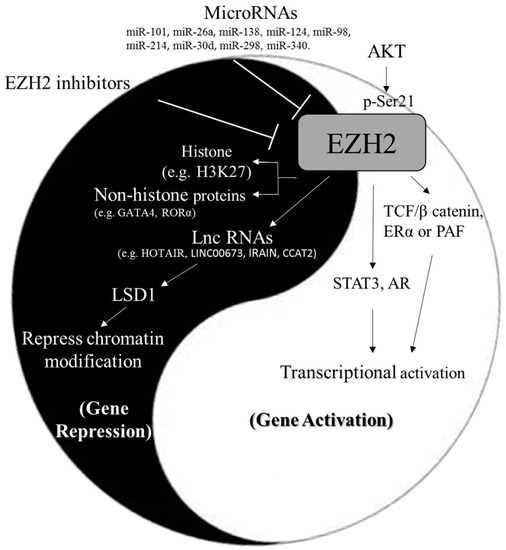
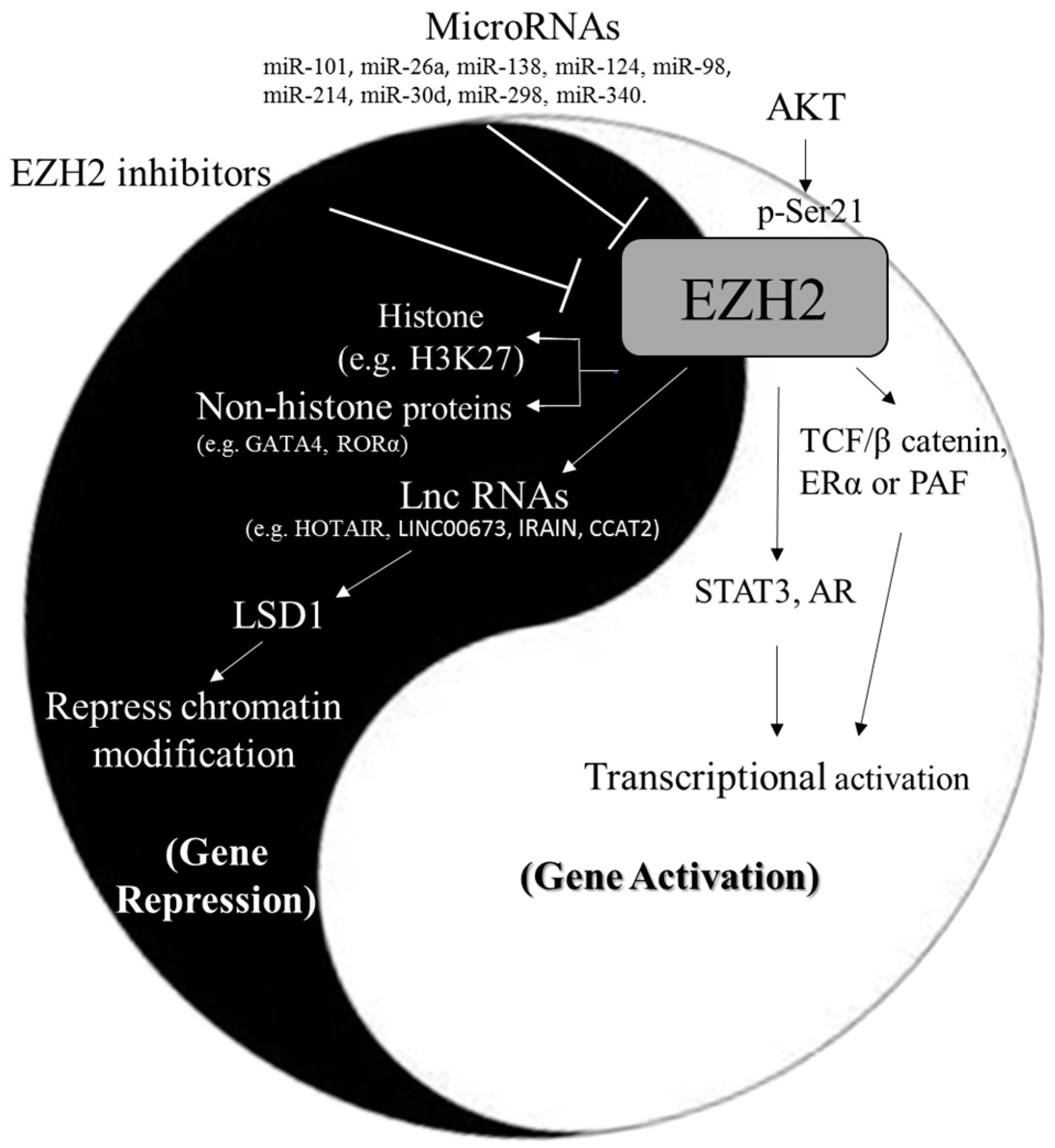
In addition to histone H3K27me3-mediated epigenetic gene silence, EZH2 methylates non-histone proteins, such as GATA-binding protein 4 (GATA4) at Lys 299 for repression of its transcriptional activity [20]. EZH2 also generates a methyl degron on RAR-related orphan receptor alpha (RORα) to regulate its protein stability via methylation-dependent ubiquitination machinery [21]. In contrast, two N-terminal domains of EZH2 interacts directly with β-catenin and estrogen receptor alpha (ERα), and thus links the Wnt and estrogen signaling pathways, leading to gene transactivation and cell cycle progression in breast cancer cells [22]. EZH2 has been shown to interact with PCNA-associated factor (PAF) to the β-catenin complex, and thereby promoting transcriptional activation of Wnt target genes, which is independent of methyltransferase activity of EZH2, in colon cancer cells [23]. In addition, AKT phosphorylates EZH2 at Ser 21. The phosphorylated EZH2 act as a co-activator for critical transcription factors, such as androgen receptor (AR) in prostate cancer cells [24], signal transducer and activator of transcription 3 (STAT3) in glioblastoma stem-like cells [25], and RelA/RelB in estrogen receptors (ER)-negative basal-like breast cancer cells [26], to promote the expression of the target genes of AR, STAT3, and nuclear factor-kappa B (NF-κB), respectively. Therefore, EZH2 functions as a double-facet molecule in regulation of gene expression via repression or activation mechanisms, depending on the different cellular contexts. The targets of EZH2 protein and their roles in regulation of gene expression are listed in Table 1.
Table 1.
EZH2 targets and their roles in gene expression.
3. Molecular Regulations of EZH2
3.1. MicroRNAs
MicroRNAs (miRNAs), endogenous small non‑coding RNAs, consist of 21–25 nucleotides, which regulate many physiological effects, including fat metabolism, cell proliferation, and cell death [27]. Several miRNAs have been demonstrated to modulate the level of EZH2 through post-transcriptional mechanisms, in which these specific miRNAs are able to bound to EZH2 RNA transcript and regulate its stability, integrity, as well as translation, leading to directly affecting the protein expression of EZH2 [28]. Negative-modulation of these miRNAs promotes EZH2 level and may have implications in cancer progression. Some reports have demonstrated that repression of EZH2 level by miRNAs results in inhibition of cancer metastasis. For example, miR-101 decreases the abilities of invasion and migration in several tumor types containing osteosarcoma in vitro [29], gastric cancer [30], prostate cancer [31], and glioblastoma [32] in vitro and in vivo, through post-transcriptional down-regulation of EZH2. Moreover, miR-26a [33,34], miR-138 [35,36,37], miR-124 [38,39,40], miR-98 [41,42], miR-214 [42], miR-30d [43], miR-298 [44], and miR-340 [45] also participate in the post-transcriptional regulation of EZH2 in different kinds of cancer cells. For example, miR-26a inhibits epithelial–mesenchymal transition (EMT) function and up-regulates tumor suppressor genes, DAB2IP and RUNX3, through post-transcriptional repression of EZH2 in human hepatocellular carcinoma and lung carcinoma cells in vitro [33]. In addition to the function of miRNAs as tumor suppressors against EZH2; however, some miRNAs co-expressed with EZH2 activates oncogenic pathways. The studies by Bao et al. showed that hypoxia-inducible factor (HIF)-induced co-expression of miR-21, miR-210, and EZH2 promote aggressiveness of cancer prostate in vitro [46] and pancreatic cancer cells in vitro and in vivo [47] under the hypoxic condition. The above miRNAs related to EZH2 and their effects on cancer progression are listed in Table 2.
Table 2.
The microRNAs related to EZH2 and their functions.
3.2. Long Non Coding RNAs
In addition to miRNAs, the long non-coding RNAs (lncRNAs) play important roles in epigenetic regulation. The lengths of lncRNAs are more than 200 nucleotides and their functions are responsible for chromatin modification, transcriptional regulation and post-transcriptional regulation [48]. Emerging evidences indicated that lncRNAs also regulate the functions of EZH2, and their effects were summarized in Table 3. For instance, the Hox transcript antisense RNA (HOTAIR) located in the homeobox C (HOXC) locus interacts with EZH2 protein of PRC2 and lysine specific demethylase 1 (LSD1) complexes. HOTAIR functions as a bridge, which binds to PRC2 with its 5′ domain and LSD1 with its 3′ domain to regulate histone H3K27 tri-methylation and H3K4 de-methylation on repressive chromatin, respectively. Thence, HOTAIR guides these chromatin modifiers to affect the expression of multiple genes involved in a variety of cellular functions [49]. Dysregulation of HOTAIR causes alterations of epigenetic modifications, and thereby promoting cancer progression and malignancy [50]. Metastasis associated lung adenocarcinoma transcript 1 (MALAT-1) locates in the nuclear speckles of mammalian cells, and it takes part in regulating differentiation and proliferation of hematopoiesis [51]. However, MALAT1 can bind to EZH2 and then induces cancer malignant development in aggressive renal cell carcinoma cells [52], esophageal squamous cell carcinoma cells [53] and gastric cancer cells [54] in vitro and in tumor tissue samples. Wang’s study suggested that MALAT1 over-expression increases the proliferation of mantle cell lymphoma (MCL) cells by activating EZH2 and inhibiting p21 and p27 genes in vitro [55]. LncRNA LINC00628 mainly in the nucleus interacts with EZH2 to modulate H3K27me3 level on cell cycle related genes, leading to suppression of proliferation and colony formation of gastric cancer cells in vitro, and tumor size in mouse xenograft models, and thus functions as cancer suppressor in gastric cancer [56]. It also inhibits growth and metastasis via regulation of Bcl-2/Bax/Caspase-3 signal pathway in breast cancer cells in vitro and in tumor tissue samples [57]. Additionally, gastric cancer progression is associated with the lncRNA LINC00673 through the interaction with LSD1 and EZH2, leading to inhibition of KLF2 and LATS2 expression to exert oncogenic functions in vitro and in vivo [58]. LncRNA HOXA11-AS associates with PRC2, LSD1, and DNMT1 to promote cell proliferation, cell cycle progression, and metastasis in gastric cancer [59,60]. LncRNA LINC00511 functions as a scaffold associated with EZH2/PRC2 complexes and regulates their localization to suppress expression of p57 in non-small-cell lung cancer (NSCLC) cells [61]. Similarly, lncRNA LINC00152 and lncRNA CCAT2 interact with EZH2 and guides it to suppress gene expression of p15 and p21 [62] and E-cadherin and LATS2 in gastric cancer cells [63] to promote cancer proliferation in vitro and in vivo. Moreover, lncRNA H19 is important for embryonic development in mammal [64]. The work by Luo et al. indicated that the up-regulation of lncRNA H19 enhances bladder cancer metastasis through the association with EZH2 to activate Wnt/β-catenin and subsequently inhibiting E-cadherin level in vitro and in vivo [65]. In contrast, the lncRNA, which attenuates the functions of EZH2 has also been identified. For example, lncRNA ANCR functions as a scaffold to modulate protein-protein interactions and regulate cell growth, differentiation and metastasis. In the colorectal and breast cancer models, the lncRNA ANCR suppresses invasion and migration properties by down-regulation of EZH2 via ANCR-mediated CDK1-EZH2 interaction and phosphorylation at Thr 345 and Thr 487 on EZH2, facilitating its ubiquitination and degradation [66,67]. The lncRNAs associated with EZH2 and their effects on cancer progression are listed in Table 3.
Table 3.
The lncRNAs associated with EZH2 and their functions.
4. Tumor Suppressive Roles of EZH2 in Cancer Progression
Although EZH2 play oncogenic roles in many cancer types, suppression of EZH2 promotes cancer progression in some cancer types, suggesting the tumor suppressive roles of EZH2. The T-cell 1acute lymphoblastic leukemia (T-ALL) is mainly driven by oncogenic activation of NOTCH1 signaling. Activation of NOTCH1 decreases the activity of PRC2 and the histone H3K27me3 repressive mark in T-ALL cells. The study revealed that loss of function of EZH2 by NOTCH1 activation promotes cancer progression of T-ALL [72]. Loss of PRC2-mediated histone H3K27me3 activates hypoxia-inducible transcription factors (HIF)-driven expression of chemokine (C-X-C motif) receptor 4 (CXCR4), leading to metastasis of clear cell renal carcinoma (ccRCC) cells [73]. Moreover, inactivation of EZH2 by phosphorylation at its Ser 21 results in induction of anti-apoptotic genes, IGF1, BCL2, and HIF1A, and increases cell adhesion-mediated drug resistance in multiple myeloma cells [74]. Loss of EZH2 function impairs pancreatic regeneration and facilitates K-Ras (G12D)-driven neoplastic progression in pancreas in vivo, suggesting that EZH2 restrict cancer progression via homeostatic control of pancreatic regeneration [75].
5. Oncogenic Roles of EZH2 in Cancer Progression
Although some studies have shown that EZH2 could inhibit cancer progression, the oncogenic roles of EZH2 in tumor progression, malignancy, and poor prognosis still constitute to be mainly accumulated. The amount of EZH2 has been shown to be higher in colorectal cancer (CRC) tumor tissues comparing to that in paired normal tissue. Inhibition of EZH2 by gene knockdown or its inhibitor, DZNep, induces autophagy and apoptosis in CRC cells in vitro [76]. Furthermore, EZH2 could increase cancer proliferation and metastasis in many cancer types, including CRC [77], melanoma [78], oral squamous cell carcinoma (OSCC) [79], and breast cancer [80]. HIF-1α switches the contradictory roles of EZH2/PRC2 via hypoxia state. In HIF-1α inactive state, PRC2 inhibits expression of matrix metalloproteinase genes (MMPs) to suppress invasion. Upon hypoxia, active HIF-1α results in inactivation of PRC2 and release of EZH2, leading to functional switch to EZH2/Forkhead box M1 (FoxM1) complex-induced expression of MMPs and invasion in triple-negative breast cancer. The results demonstrate a oncogenic function of EZH2 independent of PRC2 [80].
EZH2 is also involved in regulation of cell cycle progression and dysregulation of EZH2 accelerates cell proliferation, resulting in cancer development. Knockdown of EZH2 in cholangiocarcinoma cells increases apoptosis and arrests cells in the G1 phase in accordance with elevated levels of p16 and p21 [81]. Suppression of EZH2 by use of EZH2 short hairpin RNA up-regulates the pro-apoptotic proteins, Puma and Bad, and enhances p21 protein expression in both non-small-cell and small-cell lung cancers in vitro [82]. Additionally, EZH2 facilitates tumorigenesis through promoting angiogenesis. Inhibition of EZH2 function by small interfering RNA causes reduction of vascular endothelial growth factor (VEGF) level and cell proliferation, as well as induction of apoptosis in 786-O ccRCC cells. On the contrary, EZH2 over-expression reverses these effects on VEGF level, cell proliferation, and apoptosis in vitro and in vivo [83].
EHZ2 is related to drug resistance and is overexpressed in drug-resistant cancer cell lines. Zhou et al. demonstrated that the protein and mRNA expression of EZH2 is markedly increased in human cisplatin-resistant NSCLC and gastric cancer cells. Silencing EZH2 improves drug resistance to cisplatin, arrests cell cycle in the G0/G1 phase, induces caspase 3/8 activation, as well as up-regulates p15, p21, and p27 expression in vitro [84]. Nuclear accumulation of EZH2 has been demonstrated in pancreatic adenocarcinomas, especially in poorly differentiated one. Genetic depletion of EZH2 sensitizes pancreatic cancer cells to doxorubicin and gemcitabine, leading to induction of apoptosis. In addition, depletion of EZH2 induces expression of p27 and decreases cell proliferation in pancreatic cancer cells [85]. Another report also indicated that silencing EZH2 sensitizes glioblastoma cells to chemotherapeutic drug, TMZ, leading to significant induction of apoptosis and G1/S phase arrest in vitro [86]. According to these studies, the oncogenic and tumor suppressive roles of EZH2 in cancer progression depend on its associated targets, post-translational modifications such as phosphorylation and methylation, and the cancer microenvironment such as hypoxia status. The roles of EZH2 in cancer progression are summarized in Table 4.
Table 4.
Roles of EZH2 in cancer progression.
Mutations of EZH2 have been identified in many cancer types. We surveyed the cancer genomic data of EZH2 in The Cancer Genome Atlas (TCGA) data base by using the cBioPortal platform [87,88]. The results showed that a variety of genetic alterations including missense mutation, nonsense mutation, frameshift deletion (FS del), and frameshift insertion (FS ins) occur in many cancer types (Table 5). It is well-known that the SET domain in C-terminus of EZH2 is the enzymatic domain for methyltransferase activity and the other region in N-terminus may contribute to the regulatory function of EZH2 (non-SET region) [3,4]. To further predict the potential functional impact of these mutations on EZH2 protein, the predicted functional impact score (FIS) was evaluated. The FIS is classified into four categories, in which neutral and low FIS indicate predicted non-functional protein, whereas medium and high FIS indicate predicted functional protein [89]. Mutations on the SET domain seem to probably have lower FIS, whereas mutations on the non-SET region probably obtain higher FIS, but not all. The characteristics of EZH2 mutations in different cancer types are summarized in Table 5.
Table 5.
The characteristics of EZH2 mutations in different cancer types.
6. Current Development and Trials of EZH2 Inhibitors
EZH2 regulates expression of the downstream genes, and then affects several physiological functions, including cancer progression, malignancy, and drugs resistance. Therefore, EZH2 is a potential target for cancer therapy and a variety of inhibitors have been developed and their effects on cancers are going to be widely examined. The principles of EZH2 inhibitors and their pre-clinical and clinical trials were described below.
6.1. Pre-Clinical Studies
Overexpression EZH2 is important for cancer progression in several cancer types. Accumulated EZH2 inhibitors have been pre-clinically tested, including 3-deazaneplanocin A (DZNep), GSK926, GSK-343, EPZ-005687, EPZ-011989, EI1, UNC-1999 and CPI-169 etc. DZNep is frequently used in many anti-tumor studies, it binds to S-adenosyl-l-homocysteine (SAH) hydrolase inhibitor as a competitive inhibitor of EZH2 to suppress cells angiogenesis and invasion in brain and prostate cancers [133], and to decrease viability in the putative cancer stem cells of biliary tract cancer (BTC) [134,135]. Other PRC inhibitors, such as PTC209 against BMI1 of PRC1, also reduce cell growth in BTC cells [136]. GSK926 [137] and GSK-343 [138] inhibit EZH2 activity to suppress histone H3K27me3 level in breast and prostate cancer cells. In addition, EPZ-005687 and EPZ-011989 decrease histone H3K27me3 mark and kills lymphoma cells with heterozygous mutant EZH2 (Tyr 641 and Ala 677) [139] and inhibits tumor growth of human B cell lymphoma cells [140]. Moreover, in Tyr 641 mutations diffused large B-cell lymphomas cells, EI1 inhibits cell proliferation and induces apoptosis; UNC-1999 inhibits methyltransferase activity of both EZH1 and EZH2 [141,142]. CPI-169 represses EZH2 activity by reducing histone H3K27me3 to suppress cancer progression in germinal center B-cell-like diffuse large B cell lymphoma (GCB-DLBCL) [143]. In addition to the competitive inhibitors of EZH2, a novel strategy to suppress EZH2 by protein degradation has been developed. They recently demonstrated that a gambogenic acid (GNA) derivative, GNA022, covalently binds to Cys 668 at the SET domain of EZH2 and subsequently triggers COOH terminus of Hsp70-interacting protein (CHIP)-mediated ubiquitination of EZH2, leading to promoting EZH2 degradation and inhibiting tumor growth [144]. The aforementioned inhibitors related to EZH2 are performed in the pre-clinical studies in cells or animals and need to be further evaluated in the clinical trials.
6.2. Clinical Trials
The S-adenosyl-methionine (SAM)-competitive inhibitors of EZH2, including tazemetostat (EPZ-6438, E7438) [145], (R)-N-((4-Methoxy-6-methyl-2-oxo-1,2-dihydropyridin-3-yl)methyl)-2-methyl-1-(1-(1-(2,2,2-trifluoroethyl)piperidin-4-yl)ethyl)-1H-indole-3-carboxamide (CPI-1205) [146], GSK2816126, are effective and selective small molecular against EZH2. Tazemetostat, CPI-1205, and GSK2816126, are currently performed in the clinical trials in different cancer types, including lymphomas, kidney tumors, synovial sarcoma, epitheliod sarcoma, mesothelioma, advanced solid tumors, and ovarian cancer. The detail statuses of clinical trials can be surveyed from the database of ClinicalTrials (available online: https://clinicaltrials.gov/). The pre-clinical and clinical trials of drugs against EZH2 were summarized in Table 6.
Table 6.
Pre-and clinical trials of drugs related to EZH2.
7. Discussion and Conclusions
EZH2 plays important roles in embryonic development, lymphocytes and hematopoietic cell growth, as well as cancer development. A lot of small molecules have been developed as EZH2 inhibitors and their effects on cancers have been examined in vitro and in vivo. The clinical trials of selected EZH2 inhibitors are currently on-going in several types of cancer patients (Table 6). Most EZH2 inhibitors were designed as competitive inhibitors against SAM, the methyl donor of methyltransferases including EZH2. These inhibitors prevent SAM-dependent methyltransferase activity of EZH2 and thus inhibit its enzymatic functions [147]. Besides, a novel strategy to inhibit EZH2 by ubiquitination-mediated degradation has been developed, such as GNA022 [144]. Antibodies against specific protein have been developed, such as Herceptin (trastuzumab) against HER2, a receptor tyrosine kinase (RTK) in the clinical target therapy of cancer patients [148]. However, EZH2 is mainly located in the nucleus and it is difficult for antibodies to penetrate cell membrane into the nucleus and target to EZH2. Thus, antibody-based strategy may not benefit to target nuclear protein. Antisense or RNA interference (RNAi) strategy is commonly used to inhibit specific gene expression in vitro. The main restrictions of antisense- or RNAi-based strategy in clinical trials are delivery system, stability in circulation, and health risk in cancer patients.
Recent study showed that the short-term inhibition of EZH2 can repress tumor cells growth, but long-term inhibition of EZH2 promotes cells proliferation, tumor progression, and increasing DNA damage repair in the xenograft mouse model of glioblastoma [149]. Therefore, the dosage and treatment time of EZH2 inhibitor for cancer therapy should be carefully considered. Moreover, not only oncogenic role but also tumor suppressive role of EZH2 has been demonstrated through distinct mechanisms in different cancer types and conditions (Table 4). Thus, the cancer types need to be selected, and molecular determination of EZH2 status and specific EZH2-associated biomarkers should be performed before targeting EZH2 for cancer therapy.
In conclusion, miRNAs (Table 2) and lncRNAs (Table 3) regulate expression and protein functions of EZH2 via post-transcriptional mechanisms or RNA-protein interactions to regulate expression of its targeted genes. EZH2 functions as a double-facet molecule in regulation of gene expression via repression or activation mechanisms, depending on the different cellular contexts (Table 1 and Figure 1). Both oncogenic and tumor suppressive effects of EZH2 (Table 4) have been demonstrated in different cancer types according to distinct molecular actions of EZH2. Furthermore, genetic alterations including missense mutation, nonsense mutation, frameshift deletion, and frameshift insertion occur in many cancer types (Table 5), which may contribute to cancer progression. Therefore, targeting EZH2 is potential therapeutic strategy in cancers (Table 6).
Figure 1.
The molecular mechanisms of dual functions of EZH2 in regulation of gene expression. The expression and activity of EZH2 are modulated by miRNAs, lncRNAs, or inhibitors. EZH2 methylates both histone (e.g., H3K27) and non-histone proteins (e.g., GATA4 and RORα) to repress gene expression. In contrast, EZH2 also interacts with transcription fators/co-factors (e.g., STAT3, β-catenin, AR, and ERα) to activate gene expression.
Acknowledgments
We thank for the final supported by the grants from Wan Fang Hospital (grant No.: 105swf08) and from Ministry of Science and Technology (grant No.: MOST 105-2320-B-039-059-MY3 and MOST 105-2634-F-039-001).
Conflicts of Interest
The authors declare no conflict of interest.
References
- Li, L.Y. EZH2: Novel therapeutic target for human cancer. Biomedicine 2014, 4, 1. [Google Scholar] [CrossRef] [Scilit] [PubMed]
- Gall Troselj, K.; Novak Kujundzic, R.; Ugarkovic, D. Polycomb repressive complex’s evolutionary conserved function: The role of EZH2 status and cellular background. Clin. Epigenet. 2016, 8, 55. [Google Scholar] [CrossRef] [Scilit] [PubMed]
- Boyer, L.A.; Latek, R.R.; Peterson, C.L. The sant domain: A unique histone-tail-binding module? Nat. Rev. Mol. Cell Biol. 2004, 5, 158–163. [Google Scholar] [CrossRef] [Scilit] [PubMed]
- Joshi, P.; Carrington, E.A.; Wang, L.; Ketel, C.S.; Miller, E.L.; Jones, R.S.; Simon, J.A. Dominant alleles identify set domain residues required for histone methyltransferase of polycomb repressive complex 2. J. Biol. Chem. 2008, 283, 27757–27766. [Google Scholar] [CrossRef] [Scilit] [PubMed]
- Whitcomb, S.J.; Basu, A.; Allis, C.D.; Bernstein, E. Polycomb group proteins: An evolutionary perspective. Trends Genet. 2007, 23, 494–502. [Google Scholar] [CrossRef] [Scilit] [PubMed]
- Simon, J.A.; Kingston, R.E. Mechanisms of polycomb gene silencing: Knowns and unknowns. Nat. Rev. Mol. Cell Biol. 2009, 10, 697–708. [Google Scholar] [CrossRef] [Scilit] [PubMed]
- Su, I.H.; Dobenecker, M.W.; Dickinson, E.; Oser, M.; Basavaraj, A.; Marqueron, R.; Viale, A.; Reinberg, D.; Wulfing, C.; Tarakhovsky, A. Polycomb group protein EZH2 controls actin polymerization and cell signaling. Cell 2005, 121, 425–436. [Google Scholar] [CrossRef] [Scilit] [PubMed]
- Margueron, R.; Li, G.; Sarma, K.; Blais, A.; Zavadil, J.; Woodcock, C.L.; Dynlacht, B.D.; Reinberg, D. Ezh1 and EZH2 maintain repressive chromatin through different mechanisms. Mol. Cell 2008, 32, 503–518. [Google Scholar] [CrossRef] [Scilit] [PubMed]
- Bachmann, I.M.; Halvorsen, O.J.; Collett, K.; Stefansson, I.M.; Straume, O.; Haukaas, S.A.; Salvesen, H.B.; Otte, A.P.; Akslen, L.A. EZH2 expression is associated with high proliferation rate and aggressive tumor subgroups in cutaneous melanoma and cancers of the endometrium, prostate, and breast. J. Clin. Oncol. 2006, 24, 268–273. [Google Scholar] [CrossRef] [Scilit] [PubMed]
- Schuettengruber, B.; Cavalli, G. Recruitment of polycomb group complexes and their role in the dynamic regulation of cell fate choice. Development 2009, 136, 3531–3542. [Google Scholar] [CrossRef] [Scilit] [PubMed]
- Aoto, T.; Saitoh, N.; Sakamoto, Y.; Watanabe, S.; Nakao, M. Polycomb group protein-associated chromatin is reproduced in post-mitotic G1 phase and is required for s phase progression. J. Biol. Chem. 2008, 283, 18905–18915. [Google Scholar] [CrossRef] [Scilit] [PubMed]
- Bracken, A.P.; Kleine-Kohlbrecher, D.; Dietrich, N.; Pasini, D.; Gargiulo, G.; Beekman, C.; Theilgaard-Monch, K.; Minucci, S.; Porse, B.T.; Marine, J.C.; et al. The polycomb group proteins bind throughout the INK4A-ARF locus and are disassociated in senescent cells. Genes Dev. 2007, 21, 525–530. [Google Scholar] [CrossRef] [Scilit] [PubMed]
- Collinson, A.; Collier, A.J.; Morgan, N.P.; Sienerth, A.R.; Chandra, T.; Andrews, S.; Rugg-Gunn, P.J. Deletion of the polycomb-group protein EZH2 leads to compromised self-renewal and differentiation defects in human embryonic stem cells. Cell Rep. 2016, 17, 2700–2714. [Google Scholar] [CrossRef] [Scilit] [PubMed]
- Lee, T.I.; Jenner, R.G.; Boyer, L.A.; Guenther, M.G.; Levine, S.S.; Kumar, R.M.; Chevalier, B.; Johnstone, S.E.; Cole, M.F.; Isono, K.; et al. Control of developmental regulators by polycomb in human embryonic stem cells. Cell 2006, 125, 301–313. [Google Scholar] [CrossRef] [Scilit] [PubMed]
- Mochizuki-Kashio, M.; Mishima, Y.; Miyagi, S.; Negishi, M.; Saraya, A.; Konuma, T.; Shinga, J.; Koseki, H.; Iwama, A. Dependency on the polycomb gene EZH2 distinguishes fetal from adult hematopoietic stem cells. Blood 2011, 118, 6553–6561. [Google Scholar] [CrossRef] [Scilit] [PubMed]
- Herviou, L.; Cavalli, G.; Cartron, G.; Klein, B.; Moreaux, J. EZH2 in normal hematopoiesis and hematological malignancies. Oncotarget 2016, 7, 2284–2296. [Google Scholar] [PubMed]
- Yang, X.P.; Jiang, K.; Hirahara, K.; Vahedi, G.; Afzali, B.; Sciume, G.; Bonelli, M.; Sun, H.W.; Jankovic, D.; Kanno, Y.; et al. EZH2 is crucial for both differentiation of regulatory T cells and t effector cell expansion. Sci. Rep. 2015, 5, 10643. [Google Scholar] [CrossRef] [Scilit] [PubMed]
- Su, I.H.; Basavaraj, A.; Krutchinsky, A.N.; Hobert, O.; Ullrich, A.; Chait, B.T.; Tarakhovsky, A. EZH2 controls b cell development through histone H3 methylation and IGH rearrangement. Nat. Immunol. 2003, 4, 124–131. [Google Scholar] [CrossRef] [Scilit] [PubMed]
- Etchegaray, J.P.; Yang, X.; DeBruyne, J.P.; Peters, A.H.; Weaver, D.R.; Jenuwein, T.; Reppert, S.M. The polycomb group protein EZH2 is required for mammalian circadian clock function. J. Biol. Chem. 2006, 281, 21209–21215. [Google Scholar] [CrossRef] [Scilit] [PubMed]
- He, A.; Shen, X.; Ma, Q.; Cao, J.; von Gise, A.; Zhou, P.; Wang, G.; Marquez, V.E.; Orkin, S.H.; Pu, W.T. Prc2 directly methylates GATA4 and represses its transcriptional activity. Genes Dev. 2012, 26, 37–42. [Google Scholar] [CrossRef] [Scilit] [PubMed]
- Lee, J.M.; Lee, J.S.; Kim, H.; Kim, K.; Park, H.; Kim, J.Y.; Lee, S.H.; Kim, I.S.; Kim, J.; Lee, M.; et al. Ezh2 generates a methyl degron that is recognized by the DCAF1/DDB1/CUL4 E3 ubiquitin ligase complex. Mol. Cell 2012, 48, 572–586. [Google Scholar] [CrossRef] [Scilit] [PubMed]
- Shi, B.; Liang, J.; Yang, X.; Wang, Y.; Zhao, Y.; Wu, H.; Sun, L.; Zhang, Y.; Chen, Y.; Li, R.; et al. Integration of estrogen and wnt signaling circuits by the polycomb group protein EZH2 in breast cancer cells. Mol. Cell Biol. 2007, 27, 5105–5119. [Google Scholar] [CrossRef] [Scilit] [PubMed]
- Jung, H.Y.; Jun, S.; Lee, M.; Kim, H.C.; Wang, X.; Ji, H.; McCrea, P.D.; Park, J.I. Paf and EZH2 induce wnt/β-catenin signaling hyperactivation. Mol. Cell 2013, 52, 193–205. [Google Scholar] [CrossRef] [Scilit] [PubMed]
- Xu, K.; Wu, Z.J.; Groner, A.C.; He, H.H.; Cai, C.; Lis, R.T.; Wu, X.; Stack, E.C.; Loda, M.; Liu, T.; et al. Ezh2 oncogenic activity in castration-resistant prostate cancer cells is polycomb-independent. Science 2012, 338, 1465–1469. [Google Scholar] [CrossRef] [Scilit] [PubMed]
- Kim, E.; Kim, M.; Woo, D.H.; Shin, Y.; Shin, J.; Chang, N.; Oh, Y.T.; Kim, H.; Rheey, J.; Nakano, I.; et al. Phosphorylation of EZH2 activates STAT3 signaling via STAT3 methylation and promotes tumorigenicity of glioblastoma stem-like cells. Cancer Cell 2013, 23, 839–852. [Google Scholar] [CrossRef] [Scilit] [PubMed]
- Lee, S.T.; Li, Z.; Wu, Z.; Aau, M.; Guan, P.; Karuturi, R.K.; Liou, Y.C.; Yu, Q. Context-specific regulation of NF-κB target gene expression by EZH2 in breast cancers. Mol. Cell 2011, 43, 798–810. [Google Scholar] [CrossRef] [Scilit] [PubMed]
- Wahid, F.; Shehzad, A.; Khan, T.; Kim, Y.Y. Micrornas: Synthesis, mechanism, function, and recent clinical trials. Biochim. Biophys. Acta 2010, 1803, 1231–1243. [Google Scholar] [CrossRef] [Scilit] [PubMed]
- Benetatos, L.; Voulgaris, E.; Vartholomatos, G.; Hatzimichael, E. Non-coding rnas and ezh2 interactions in cancer: Long and short tales from the transcriptome. Int. J. Cancer 2013, 133, 267–274. [Google Scholar] [CrossRef] [Scilit] [PubMed]
- Zhang, K.; Zhang, Y.; Ren, K.; Zhao, G.; Yan, K.; Ma, B. Microrna-101 inhibits the metastasis of osteosarcoma cells by downregulation of EZH2 expression. Oncol. Rep. 2014, 32, 2143–2149. [Google Scholar] [CrossRef] [Scilit] [PubMed]
- Wang, H.J.; Ruan, H.J.; He, X.J.; Ma, Y.Y.; Jiang, X.T.; Xia, Y.J.; Ye, Z.Y.; Tao, H.Q. MicroRNA-101 is down-regulated in gastric cancer and involved in cell migration and invasion. Eur. J. Cancer 2010, 46, 2295–2303. [Google Scholar] [CrossRef] [Scilit] [PubMed]
- Varambally, S.; Cao, Q.; Mani, R.S.; Shankar, S.; Wang, X.; Ateeq, B.; Laxman, B.; Cao, X.; Jing, X.; Ramnarayanan, K.; et al. Genomic loss of microRNA-101 leads to overexpression of histone methyltransferase EZH2 in cancer. Science 2008, 322, 1695–1699. [Google Scholar] [CrossRef] [Scilit] [PubMed]
- Smits, M.; Nilsson, J.; Mir, S.E.; van der Stoop, P.M.; Hulleman, E.; Niers, J.M.; de Witt Hamer, P.C.; Marquez, V.E.; Cloos, J.; Krichevsky, A.M.; et al. miR-101 is down-regulated in glioblastoma resulting in EZH2-induced proliferation, migration, and angiogenesis. Oncotarget 2010, 1, 710–720. [Google Scholar] [CrossRef] [Scilit] [PubMed]
- Dang, X.; Ma, A.; Yang, L.; Hu, H.; Zhu, B.; Shang, D.; Chen, T.; Luo, Y. MicroRNA-26a regulates tumorigenic properties of EZH2 in human lung carcinoma cells. Cancer Genet. 2012, 205, 113–123. [Google Scholar] [CrossRef] [Scilit] [PubMed]
- Song, Q.C.; Shi, Z.B.; Zhang, Y.T.; Ji, L.; Wang, K.Z.; Duan, D.P.; Dang, X.Q. Downregulation of microRNA-26a is associated with metastatic potential and the poor prognosis of osteosarcoma patients. Oncol. Rep. 2014, 31, 1263–1270. [Google Scholar] [PubMed]
- Zhang, H.; Zhang, H.; Zhao, M.; Lv, Z.; Zhang, X.; Qin, X.; Wang, H.; Wang, S.; Su, J.; Lv, X.; et al. Mir-138 inhibits tumor growth through repression of EZH2 in non-small cell lung cancer. Cell. Physiol. Biochem. 2013, 31, 56–65. [Google Scholar] [CrossRef] [Scilit] [PubMed]
- Liang, J.; Zhang, Y.; Jiang, G.; Liu, Z.; Xiang, W.; Chen, X.; Chen, Z.; Zhao, J. miR-138 induces renal carcinoma cell senescence by targeting EZH2 and is downregulated in human clear cell renal cell carcinoma. Oncol. Res. 2013, 21, 83–91. [Google Scholar] [CrossRef] [Scilit] [PubMed]
- Liu, X.; Wang, C.; Chen, Z.; Jin, Y.; Wang, Y.; Kolokythas, A.; Dai, Y.; Zhou, X. MicroRNA-138 suppresses epithelial-mesenchymal transition in squamous cell carcinoma cell lines. Biochem. J. 2011, 440, 23–31. [Google Scholar] [CrossRef] [Scilit] [PubMed]
- Li, W.; Zang, W.; Liu, P.; Wang, Y.; Du, Y.; Chen, X.; Deng, M.; Sun, W.; Wang, L.; Zhao, G.; et al. MicroRNA-124 inhibits cellular proliferation and invasion by targeting ETS-1 in breast cancer. Tumour Biol. 2014, 35, 10897–10904. [Google Scholar] [CrossRef] [Scilit] [PubMed]
- Xie, L.; Zhang, Z.; Tan, Z.; He, R.; Zeng, X.; Xie, Y.; Li, S.; Tang, G.; Tang, H.; He, X. MicroRNA-124 inhibits proliferation and induces apoptosis by directly repressing EZH2 in gastric cancer. Mol. Cell. Biochem. 2014, 392, 153–159. [Google Scholar] [CrossRef] [Scilit] [PubMed]
- Zheng, F.; Liao, Y.J.; Cai, M.Y.; Liu, Y.H.; Liu, T.H.; Chen, S.P.; Bian, X.W.; Guan, X.Y.; Lin, M.C.; Zeng, Y.X.; et al. The putative tumour suppressor microRNA-124 modulates hepatocellular carcinoma cell aggressiveness by repressing ROCK2 and EZH2. Gut 2012, 61, 278–289. [Google Scholar] [CrossRef] [Scilit] [PubMed]
- Zhang, J.J.; Chen, J.T.; Hua, L.; Yao, K.H.; Wang, C.Y. Mir-98 inhibits hepatocellular carcinoma cell proliferation via targeting EZH2 and suppressing wnt/β-catenin signaling pathway. Biomed. Pharmacother. 2017, 85, 472–478. [Google Scholar] [CrossRef] [Scilit] [PubMed]
- Huang, S.D.; Yuan, Y.; Zhuang, C.W.; Li, B.L.; Gong, D.J.; Wang, S.G.; Zeng, Z.Y.; Cheng, H.Z. Microrna-98 and microrna-214 post-transcriptionally regulate enhancer of zeste homolog 2 and inhibit migration and invasion in human esophageal squamous cell carcinoma. Mol. Cancer 2012, 11, 51. [Google Scholar] [CrossRef] [Scilit] [PubMed]
- Xie, R.; Wu, S.N.; Gao, C.C.; Yang, X.Z.; Wang, H.G.; Zhang, J.L.; Yan, W.; Ma, T.H. Microrna-30d inhibits the migration and invasion of human esophageal squamous cell carcinoma cells via the posttranscriptional regulation of enhancer of zeste homolog 2. Oncol. Rep. 2017, 37, 1682–1690. [Google Scholar] [PubMed]
- Zhou, F.; Chen, J.; Wang, H. MicroRNA-298 inhibits malignant phenotypes of epithelial ovarian cancer by regulating the expression of EZH2. Oncol. Lett. 2016, 12, 3926–3932. [Google Scholar] [CrossRef] [Scilit] [PubMed]
- Yu, W.; Zhang, G.; Lu, B.; Li, J.; Wu, Z.; Ma, H.; Wang, H.; Lian, R. miR-340 impedes the progression of laryngeal squamous cell carcinoma by targeting EZH2. Gene 2016, 577, 193–201. [Google Scholar] [CrossRef] [Scilit] [PubMed]
- Bao, B.; Ahmad, A.; Kong, D.; Ali, S.; Azmi, A.S.; Li, Y.; Banerjee, S.; Padhye, S.; Sarkar, F.H. Hypoxia induced aggressiveness of prostate cancer cells is linked with deregulated expression of VEGF, IL-6 and mirnas that are attenuated by CDF. PLoS ONE 2012, 7, e43726. [Google Scholar] [CrossRef] [Scilit] [PubMed]
- Bao, B.; Ali, S.; Ahmad, A.; Azmi, A.S.; Li, Y.; Banerjee, S.; Kong, D.; Sethi, S.; Aboukameel, A.; Padhye, S.B.; et al. Hypoxia-induced aggressiveness of pancreatic cancer cells is due to increased expression of VEGF, IL-6 and miR-21, which can be attenuated by CDF treatment. PLoS ONE 2012, 7, e50165. [Google Scholar] [CrossRef] [Scilit] [PubMed]
- Mercer, T.R.; Dinger, M.E.; Mattick, J.S. Long non-coding rnas: Insights into functions. Nat. Rev. Genet. 2009, 10, 155–159. [Google Scholar] [CrossRef] [Scilit] [PubMed]
- Hajjari, M.; Salavaty, A. Hotair: An oncogenic long non-coding rna in different cancers. Cancer Biol. Med. 2015, 12, 1–9. [Google Scholar] [PubMed]
- Gupta, R.A.; Shah, N.; Wang, K.C.; Kim, J.; Horlings, H.M.; Wong, D.J.; Tsai, M.C.; Hung, T.; Argani, P.; Rinn, J.L.; et al. Long non-coding RNA hotair reprograms chromatin state to promote cancer metastasis. Nature 2010, 464, 1071–1076. [Google Scholar] [CrossRef] [Scilit] [PubMed]
- Ma, X.Y.; Wang, J.H.; Wang, J.L.; Ma, C.X.; Wang, X.C.; Liu, F.S. Malat1 as an evolutionarily conserved lncrna, plays a positive role in regulating proliferation and maintaining undifferentiated status of early-stage hematopoietic cells. BMC Genom. 2015, 16, 676. [Google Scholar] [CrossRef] [Scilit] [PubMed]
- Hirata, H.; Hinoda, Y.; Shahryari, V.; Deng, G.; Nakajima, K.; Tabatabai, Z.L.; Ishii, N.; Dahiya, R. Long noncoding RNA MALAT1 promotes aggressive renal cell carcinoma through EZH2 and interacts with miR-205. Cancer Res. 2015, 75, 1322–1331. [Google Scholar] [CrossRef] [Scilit] [PubMed]
- Wang, W.; Zhu, Y.; Li, S.; Chen, X.; Jiang, G.; Shen, Z.; Qiao, Y.; Wang, L.; Zheng, P.; Zhang, Y. Long noncoding RNA MALAT1 promotes malignant development of esophageal squamous cell carcinoma by targeting β-catenin via EZH2. Oncotarget 2016, 7, 25668–25682. [Google Scholar] [CrossRef] [Scilit] [PubMed]
- Qi, Y.; Ooi, H.S.; Wu, J.; Chen, J.; Zhang, X.; Tan, S.; Yu, Q.; Li, Y.Y.; Kang, Y.; Li, H.; et al. Malat1 long ncRNA promotes gastric cancer metastasis by suppressing PCDH10. Oncotarget 2016, 7, 12693–12703. [Google Scholar] [PubMed]
- Wang, X.; Sehgal, L.; Jain, N.; Khashab, T.; Mathur, R.; Samaniego, F. lncRNA malat1 promotes development of mantle cell lymphoma by associating with EZH2. J. Transl. Med. 2016, 14, 346. [Google Scholar] [CrossRef] [Scilit] [PubMed]
- Zhang, Z.Z.; Zhao, G.; Zhuang, C.; Shen, Y.Y.; Zhao, W.Y.; Xu, J.; Wang, M.; Wang, C.J.; Tu, L.; Cao, H.; et al. Long non-coding RNA linc00628 functions as a gastric cancer suppressor via long-range modulating the expression of cell cycle related genes. Sci. Rep. 2016, 6, 27435. [Google Scholar] [CrossRef] [Scilit] [PubMed]
- Chen, D.Q.; Zheng, X.D.; Cao, Y.; He, X.D.; Nian, W.Q.; Zeng, X.H.; Liu, X.Y. Long non-coding RNA linc00628 suppresses the growth and metastasis and promotes cell apoptosis in breast cancer. Eur. Rev. Med. Pharmacol. Sci. 2017, 21, 275–283. [Google Scholar] [PubMed]
- Huang, M.; Hou, J.; Wang, Y.; Xie, M.; Wei, C.; Nie, F.; Wang, Z.; Sun, M. Long noncoding rna linc00673 is activated by SP1 and exerts oncogenic properties by interacting with LSD1 and EZH2 in gastric cancer. Mol. Ther. 2017, 25, 1014–1026. [Google Scholar] [CrossRef] [Scilit] [PubMed]
- Sun, M.; Nie, F.; Wang, Y.; Zhang, Z.; Hou, J.; He, D.; Xie, M.; Xu, L.; De, W.; Wang, Z.; et al. LncRNA hoxa11-as promotes proliferation and invasion of gastric cancer by scaffolding the chromatin modification factors PRC2, LSD1, and DNMT1. Cancer Res. 2016, 76, 6299–6310. [Google Scholar] [CrossRef] [Scilit] [PubMed]
- Liu, Z.; Chen, Z.; Fan, R.; Jiang, B.; Chen, X.; Chen, Q.; Nie, F.; Lu, K.; Sun, M. Over-expressed long noncoding RNA HOXA11-as promotes cell cycle progression and metastasis in gastric cancer. Mol. Cancer 2017, 16, 82. [Google Scholar] [CrossRef] [Scilit] [PubMed]
- Sun, C.C.; Li, S.J.; Li, G.; Hua, R.X.; Zhou, X.H.; Li, D.J. Long intergenic noncoding RNA 00511 acts as an oncogene in non-small-cell lung cancer by binding to EZH2 and suppressing p57. Mol. Ther. Nucleic Acids 2016, 5, e385. [Google Scholar] [CrossRef] [Scilit] [PubMed]
- Chen, W.M.; Huang, M.D.; Sun, D.P.; Kong, R.; Xu, T.P.; Xia, R.; Zhang, E.B.; Shu, Y.Q. Long intergenic non-coding RNA 00152 promotes tumor cell cycle progression by binding to EZH2 and repressing P15 and P21 in gastric cancer. Oncotarget 2016, 7, 9773–9787. [Google Scholar] [PubMed]
- Wang, Y.J.; Liu, J.Z.; Lv, P.; Dang, Y.; Gao, J.Y.; Wang, Y. Long non-coding RNA CCAT2 promotes gastric cancer proliferation and invasion by regulating the e-cadherin and LATS2. Am. J. Cancer Res. 2016, 6, 2651–2660. [Google Scholar] [PubMed]
- Gabory, A.; Jammes, H.; Dandolo, L. The H19 locus: Role of an imprinted non-coding RNA in growth and development. Bioessays 2010, 32, 473–480. [Google Scholar] [CrossRef] [Scilit] [PubMed]
- Luo, M.; Li, Z.; Wang, W.; Zeng, Y.; Liu, Z.; Qiu, J. Long non-coding RNA h19 increases bladder cancer metastasis by associating with EZH2 and inhibiting e-cadherin expression. Cancer Lett. 2013, 333, 213–221. [Google Scholar] [CrossRef] [Scilit] [PubMed]
- Yang, Z.Y.; Yang, F.; Zhang, Y.L.; Liu, B.; Wang, M.; Hong, X.; Yu, Y.; Zhou, Y.H.; Zeng, H. LncRNA-ancr down-regulation suppresses invasion and migration of colorectal cancer cells by regulating EZH2 expression. Cancer Biomark. 2017, 18, 95–104. [Google Scholar] [CrossRef] [Scilit] [PubMed]
- Li, Z.; Hou, P.; Fan, D.; Dong, M.; Ma, M.; Li, H.; Yao, R.; Li, Y.; Wang, G.; Geng, P.; et al. The degradation of EZH2 mediated by lncRNA ancr attenuated the invasion and metastasis of breast cancer. Cell. Death Differ. 2017, 24, 59–71. [Google Scholar] [CrossRef] [Scilit] [PubMed]
- Tripathi, V.; Ellis, J.D.; Shen, Z.; Song, D.Y.; Pan, Q.; Watt, A.T.; Freier, S.M.; Bennett, C.F.; Sharma, A.; Bubulya, P.A.; et al. The nuclear-retained noncoding RNA malat1 regulates alternative splicing by modulating sr splicing factor phosphorylation. Mol. Cell 2010, 39, 925–938. [Google Scholar] [CrossRef] [Scilit] [PubMed]
- Yoshimoto, R.; Mayeda, A.; Yoshida, M.; Nakagawa, S. Malat1 long non-coding RNA in cancer. Biochim. Biophys. Acta 2016, 1859, 192–199. [Google Scholar] [CrossRef] [Scilit] [PubMed]
- Lian, Y.; Wang, J.; Feng, J.; Ding, J.; Ma, Z.; Li, J.; Peng, P.; De, W.; Wang, K. Long non-coding RNA irain suppresses apoptosis and promotes proliferation by binding to LSD1 and EZH2 in pancreatic cancer. Tumour Biol. 2016, 37, 14929–14937. [Google Scholar] [CrossRef] [Scilit] [PubMed]
- Li, X.; Lin, Y.; Yang, X.; Wu, X.; He, X. Long noncoding RNA H19 regulates EZH2 expression by interacting with miR-630 and promotes cell invasion in nasopharyngeal carcinoma. Biochem. Biophys. Res. Commun. 2016, 473, 913–919. [Google Scholar] [CrossRef] [Scilit] [PubMed]
- Ntziachristos, P.; Tsirigos, A.; Van Vlierberghe, P.; Nedjic, J.; Trimarchi, T.; Flaherty, M.S.; Ferres-Marco, D.; da Ros, V.; Tang, Z.; Siegle, J.; et al. Genetic inactivation of the polycomb repressive complex 2 in T cell acute lymphoblastic leukemia. Nat. Med. 2012, 18, 298–301. [Google Scholar] [CrossRef] [Scilit] [PubMed]
- Vanharanta, S.; Shu, W.; Brenet, F.; Hakimi, A.A.; Heguy, A.; Viale, A.; Reuter, V.E.; Hsieh, J.J.; Scandura, J.M.; Massague, J. Epigenetic expansion of VHL-HIF signal output drives multiorgan metastasis in renal cancer. Nat. Med. 2013, 19, 50–56. [Google Scholar] [CrossRef] [Scilit] [PubMed]
- Kikuchi, J.; Koyama, D.; Wada, T.; Izumi, T.; Hofgaard, P.O.; Bogen, B.; Furukawa, Y. Phosphorylation-mediated EZH2 inactivation promotes drug resistance in multiple myeloma. J. Clin. Investig. 2015, 125, 4375–4390. [Google Scholar] [CrossRef] [Scilit] [PubMed]
- Mallen-St Clair, J.; Soydaner-Azeloglu, R.; Lee, K.E.; Taylor, L.; Livanos, A.; Pylayeva-Gupta, Y.; Miller, G.; Margueron, R.; Reinberg, D.; Bar-Sagi, D. EZH2 couples pancreatic regeneration to neoplastic progression. Genes Dev. 2012, 26, 439–444. [Google Scholar] [CrossRef] [Scilit] [PubMed]
- Yao, Y.; Hu, H.; Yang, Y.; Zhou, G.; Shang, Z.; Yang, X.; Sun, K.; Zhan, S.; Yu, Z.; Li, P.; et al. Downregulation of enhancer of zeste homolog 2 (EZH2) is essential for the induction of autophagy and apoptosis in colorectal cancer cells. Genes 2016, 7, 83. [Google Scholar] [CrossRef] [Scilit] [PubMed]
- Song-Bing, H.; Hao, Z.; Jian, Z.; Guo-Qiang, Z.; Tuo, H.; Dai-Wei, W.; Wen, G.; Lin, G.; Yi, Z.; Xiao-Feng, X.; et al. Inhibition of EZH2 expression is associated with the proliferation, apoptosis and migration of SW620 colorectal cancer cells in vitro. Exp. Biol. Med. 2015, 240, 546–555. [Google Scholar]
- Zingg, D.; Debbache, J.; Schaefer, S.M.; Tuncer, E.; Frommel, S.C.; Cheng, P.; Arenas-Ramirez, N.; Haeusel, J.; Zhang, Y.; Bonalli, M.; et al. The epigenetic modifier EZH2 controls melanoma growth and metastasis through silencing of distinct tumour suppressors. Nat. Commun. 2015, 6, 6051. [Google Scholar] [CrossRef] [Scilit] [PubMed]
- Zhao, L.; Yu, Y.; Wu, J.; Bai, J.; Zhao, Y.; Li, C.; Sun, W.; Wang, X. Role of EZH2 in oral squamous cell carcinoma carcinogenesis. Gene 2014, 537, 197–202. [Google Scholar] [CrossRef] [Scilit] [PubMed]
- Mahara, S.; Lee, P.L.; Feng, M.; Tergaonkar, V.; Chng, W.J.; Yu, Q. Hifi-alpha activation underlies a functional switch in the paradoxical role of EZH2/PRC2 in breast cancer. Proc. Natl. Acad. Sci. USA 2016, 113, E3735–E3744. [Google Scholar] [CrossRef] [Scilit] [PubMed]
- Nakagawa, S.; Okabe, H.; Sakamoto, Y.; Hayashi, H.; Hashimoto, D.; Yokoyama, N.; Sakamoto, K.; Kuroki, H.; Mima, K.; Nitta, H.; et al. Enhancer of zeste homolog 2 (EZH2) promotes progression of cholangiocarcinoma cells by regulating cell cycle and apoptosis. Ann. Surg. Oncol. 2013, 20 (Suppl. S3), S667–S675. [Google Scholar] [CrossRef] [Scilit] [PubMed]
- Hubaux, R.; Thu, K.L.; Coe, B.P.; MacAulay, C.; Lam, S.; Lam, W.L. EZH2 promotes E2F-driven sclc tumorigenesis through modulation of apoptosis and cell-cycle regulation. J. Thorac. Oncol. 2013, 8, 1102–1106. [Google Scholar] [CrossRef] [Scilit] [PubMed]
- Xu, Z.Q.; Zhang, L.; Gao, B.S.; Wan, Y.G.; Zhang, X.H.; Chen, B.; Wang, Y.T.; Sun, N.; Fu, Y.W. EZH2 promotes tumor progression by increasing vegf expression in clear cell renal cell carcinoma. Clin. Transl. Oncol. 2015, 17, 41–49. [Google Scholar] [CrossRef] [Scilit] [PubMed]
- Zhou, W.; Wang, J.; Man, W.Y.; Zhang, Q.W.; Xu, W.G. SiRNA silencing EZH2 reverses cisplatin-resistance of human non-small cell lung and gastric cancer cells. Asian Pac. J. Cancer Prev. 2015, 16, 2425–2430. [Google Scholar] [CrossRef] [Scilit] [PubMed]
- Ougolkov, A.V.; Bilim, V.N.; Billadeau, D.D. Regulation of pancreatic tumor cell proliferation and chemoresistance by the histone methyltransferase enhancer of zeste homologue 2. Clin. Cancer Res. 2008, 14, 6790–6796. [Google Scholar] [CrossRef] [Scilit] [PubMed]
- Fan, T.Y.; Wang, H.; Xiang, P.; Liu, Y.W.; Li, H.Z.; Lei, B.X.; Yu, M.; Qi, S.T. Inhibition of EZH2 reverses chemotherapeutic drug tmz chemosensitivity in glioblastoma. Int. J. Clin. Exp. Pathol. 2014, 7, 6662–6670. [Google Scholar] [PubMed]
- Gao, J.; Aksoy, B.A.; Dogrusoz, U.; Dresdner, G.; Gross, B.; Sumer, S.O.; Sun, Y.; Jacobsen, A.; Sinha, R.; Larsson, E.; et al. Integrative analysis of complex cancer genomics and clinical profiles using the cbioportal. Sci. Signal. 2013, 6, pl1. [Google Scholar] [CrossRef] [Scilit] [PubMed]
- Cerami, E.; Gao, J.; Dogrusoz, U.; Gross, B.E.; Sumer, S.O.; Aksoy, B.A.; Jacobsen, A.; Byrne, C.J.; Heuer, M.L.; Larsson, E.; et al. The cbio cancer genomics portal: An open platform for exploring multidimensional cancer genomics data. Cancer Discov. 2012, 2, 401–404. [Google Scholar] [CrossRef] [Scilit] [PubMed]
- Reva, B.; Antipin, Y.; Sander, C. Predicting the functional impact of protein mutations: Application to cancer genomics. Nucleic Acids Res. 2011, 39, e118. [Google Scholar] [CrossRef] [Scilit] [PubMed]
- Imielinski, M.; Berger, A.H.; Hammerman, P.S.; Hernandez, B.; Pugh, T.J.; Hodis, E.; Cho, J.; Suh, J.; Capelletti, M.; Sivachenko, A.; et al. Mapping the hallmarks of lung adenocarcinoma with massively parallel sequencing. Cell 2012, 150, 1107–1120. [Google Scholar] [CrossRef] [Scilit] [PubMed]
- Cancer Genome Atlas Research Network. Comprehensive molecular profiling of lung adenocarcinoma. Nature 2014, 511, 543–550. [Google Scholar]
- Cancer Genome Atlas Research Network. Comprehensive genomic characterization of squamous cell lung cancers. Nature 2012, 489, 519–525. [Google Scholar]
- George, J.; Lim, J.S.; Jang, S.J.; Cun, Y.; Ozretic, L.; Kong, G.; Leenders, F.; Lu, X.; Fernandez-Cuesta, L.; Bosco, G.; et al. Comprehensive genomic profiles of small cell lung cancer. Nature 2015, 524, 47–53. [Google Scholar] [CrossRef] [Scilit] [PubMed]
- Rudin, C.M.; Durinck, S.; Stawiski, E.W.; Poirier, J.T.; Modrusan, Z.; Shames, D.S.; Bergbower, E.A.; Guan, Y.; Shin, J.; Guillory, J.; et al. Comprehensive genomic analysis identifies SOX2 as a frequently amplified gene in small-cell lung cancer. Nat. Genet. 2012, 44, 1111–1116. [Google Scholar] [CrossRef] [Scilit] [PubMed]
- Campbell, J.D.; Alexandrov, A.; Kim, J.; Wala, J.; Berger, A.H.; Pedamallu, C.S.; Shukla, S.A.; Guo, G.; Brooks, A.N.; Murray, B.A.; et al. Distinct patterns of somatic genome alterations in lung adenocarcinomas and squamous cell carcinomas. Nat. Genet. 2016, 48, 607–616. [Google Scholar] [CrossRef] [Scilit] [PubMed]
- Cancer Genome Atlas Network. Comprehensive molecular portraits of human breast tumours. Nature 2012, 490, 61–70. [Google Scholar]
- Ciriello, G.; Gatza, M.L.; Beck, A.H.; Wilkerson, M.D.; Rhie, S.K.; Pastore, A.; Zhang, H.; McLellan, M.; Yau, C.; Kandoth, C.; et al. Comprehensive molecular portraits of invasive lobular breast cancer. Cell 2015, 163, 506–519. [Google Scholar] [CrossRef] [Scilit] [PubMed]
- Lefebvre, C.; Bachelot, T.; Filleron, T.; Pedrero, M.; Campone, M.; Soria, J.C.; Massard, C.; Levy, C.; Arnedos, M.; Lacroix-Triki, M.; et al. Mutational profile of metastatic breast cancers: A retrospective analysis. PLoS Med. 2016, 13, e1002201. [Google Scholar] [CrossRef] [Scilit] [PubMed]
- Ahn, S.M.; Jang, S.J.; Shim, J.H.; Kim, D.; Hong, S.M.; Sung, C.O.; Baek, D.; Haq, F.; Ansari, A.A.; Lee, S.Y.; et al. Genomic portrait of resectable hepatocellular carcinomas: Implications of RB1 and FGF19 aberrations for patient stratification. Hepatology 2014, 60, 1972–1982. [Google Scholar] [CrossRef] [Scilit] [PubMed]
- Crompton, B.D.; Stewart, C.; Taylor-Weiner, A.; Alexe, G.; Kurek, K.C.; Calicchio, M.L.; Kiezun, A.; Carter, S.L.; Shukla, S.A.; Mehta, S.S.; et al. The genomic landscape of pediatric ewing sarcoma. Cancer Discov. 2014, 4, 1326–1341. [Google Scholar] [CrossRef] [Scilit] [PubMed]
- Tirode, F.; Surdez, D.; Ma, X.; Parker, M.; Le Deley, M.C.; Bahrami, A.; Zhang, Z.; Lapouble, E.; Grossetete-Lalami, S.; Rusch, M.; et al. Genomic landscape of ewing sarcoma defines an aggressive subtype with co-association of STAG2 and TP53 mutations. Cancer Discov. 2014, 4, 1342–1353. [Google Scholar] [CrossRef] [Scilit] [PubMed]
- Cancer Genome Atlas Research Network. Comprehensive molecular characterization of clear cell renal cell carcinoma. Nature 2013, 499, 43–49. [Google Scholar]
- Ceccarelli, M.; Barthel, F.P.; Malta, T.M.; Sabedot, T.S.; Salama, S.R.; Murray, B.A.; Morozova, O.; Newton, Y.; Radenbaugh, A.; Pagnotta, S.M.; et al. Molecular profiling reveals biologically discrete subsets and pathways of progression in diffuse glioma. Cell 2016, 164, 550–563. [Google Scholar] [CrossRef] [Scilit] [PubMed]
- Brennan, C.W.; Verhaak, R.G.; McKenna, A.; Campos, B.; Noushmehr, H.; Salama, S.R.; Zheng, S.; Chakravarty, D.; Sanborn, J.Z.; Berman, S.H.; et al. The somatic genomic landscape of glioblastoma. Cell 2013, 155, 462–477. [Google Scholar] [CrossRef] [Scilit] [PubMed]
- Johnson, B.E.; Mazor, T.; Hong, C.; Barnes, M.; Aihara, K.; McLean, C.Y.; Fouse, S.D.; Yamamoto, S.; Ueda, H.; Tatsuno, K.; et al. Mutational analysis reveals the origin and therapy-driven evolution of recurrent glioma. Science 2014, 343, 189–193. [Google Scholar] [CrossRef] [Scilit] [PubMed]
- Morrissy, A.S.; Garzia, L.; Shih, D.J.; Zuyderduyn, S.; Huang, X.; Skowron, P.; Remke, M.; Cavalli, F.M.; Ramaswamy, V.; Lindsay, P.E.; et al. Divergent clonal selection dominates medulloblastoma at recurrence. Nature 2016, 529, 351–357. [Google Scholar] [CrossRef] [Scilit] [PubMed]
- Cancer Genome Atlas, N. Comprehensive molecular characterization of human colon and rectal cancer. Nature 2012, 487, 330–337. [Google Scholar]
- Giannakis, M.; Mu, X.J.; Shukla, S.A.; Qian, Z.R.; Cohen, O.; Nishihara, R.; Bahl, S.; Cao, Y.; Amin-Mansour, A.; Yamauchi, M.; et al. Genomic correlates of immune-cell infiltrates in colorectal carcinoma. Cell Rep. 2016, 15, 857–865. [Google Scholar] [CrossRef] [Scilit] [PubMed]
- Seshagiri, S.; Stawiski, E.W.; Durinck, S.; Modrusan, Z.; Storm, E.E.; Conboy, C.B.; Chaudhuri, S.; Guan, Y.; Janakiraman, V.; Jaiswal, B.S.; et al. Recurrent R-spondin fusions in colon cancer. Nature 2012, 488, 660–664. [Google Scholar] [CrossRef] [Scilit] [PubMed]
- Van Allen, E.M.; Mouw, K.W.; Kim, P.; Iyer, G.; Wagle, N.; Al-Ahmadie, H.; Zhu, C.; Ostrovnaya, I.; Kryukov, G.V.; O'Connor, K.W.; et al. Somatic ERCC2 mutations correlate with cisplatin sensitivity in muscle-invasive urothelial carcinoma. Cancer Discov. 2014, 4, 1140–1153. [Google Scholar] [CrossRef] [Scilit] [PubMed]
- Cancer Genome Atlas Research Network. Comprehensive molecular characterization of urothelial bladder carcinoma. Nature 2014, 507, 315–322. [Google Scholar]
- Kim, P.H.; Cha, E.K.; Sfakianos, J.P.; Iyer, G.; Zabor, E.C.; Scott, S.N.; Ostrovnaya, I.; Ramirez, R.; Sun, A.; Shah, R.; et al. Genomic predictors of survival in patients with high-grade urothelial carcinoma of the bladder. Eur. Urol. 2015, 67, 198–201. [Google Scholar] [CrossRef] [Scilit] [PubMed]
- Al-Ahmadie, H.A.; Iyer, G.; Lee, B.H.; Scott, S.N.; Mehra, R.; Bagrodia, A.; Jordan, E.J.; Gao, S.P.; Ramirez, R.; Cha, E.K.; et al. Frequent somatic CDH1 loss-of-function mutations in plasmacytoid variant bladder cancer. Nat. Genet. 2016, 48, 356–358. [Google Scholar] [CrossRef] [Scilit] [PubMed]
- Song, Y.; Li, L.; Ou, Y.; Gao, Z.; Li, E.; Li, X.; Zhang, W.; Wang, J.; Xu, L.; Zhou, Y.; et al. Identification of genomic alterations in oesophageal squamous cell cancer. Nature 2014, 509, 91–95. [Google Scholar] [CrossRef] [Scilit] [PubMed]
- Dulak, A.M.; Stojanov, P.; Peng, S.; Lawrence, M.S.; Fox, C.; Stewart, C.; Bandla, S.; Imamura, Y.; Schumacher, S.E.; Shefler, E.; et al. Exome and whole-genome sequencing of esophageal adenocarcinoma identifies recurrent driver events and mutational complexity. Nat. Genet. 2013, 45, 478–486. [Google Scholar] [CrossRef] [Scilit] [PubMed]
- Cancer Genome Atlas Research Network; Analysis Working Group: Asan University; BC Cancer Agency; Brigham and Women’s Hospital; Broad Institute; Brown University; Case Western Reserve University; Dana-Farber Cancer Institute; Duke University; Greater Poland Cancer Center; et al. Integrated genomic characterization of oesophageal carcinoma. Nature 2017, 541, 169–175. [Google Scholar]
- Cancer Genome Atlas Research Network. Comprehensive molecular characterization of gastric adenocarcinoma. Nature 2014, 513, 202–209. [Google Scholar]
- Cancer Genome Atlas Network. Comprehensive genomic characterization of head and neck squamous cell carcinomas. Nature 2015, 517, 576–582. [Google Scholar]
- Stransky, N.; Egloff, A.M.; Tward, A.D.; Kostic, A.D.; Cibulskis, K.; Sivachenko, A.; Kryukov, G.V.; Lawrence, M.S.; Sougnez, C.; McKenna, A.; et al. The mutational landscape of head and neck squamous cell carcinoma. Science 2011, 333, 1157–1160. [Google Scholar] [CrossRef] [Scilit] [PubMed]
- Krauthammer, M.; Kong, Y.; Ha, B.H.; Evans, P.; Bacchiocchi, A.; McCusker, J.P.; Cheng, E.; Davis, M.J.; Goh, G.; Choi, M.; et al. Exome sequencing identifies recurrent somatic RAC1 mutations in melanoma. Nat. Genet. 2012, 44, 1006–1014. [Google Scholar] [CrossRef] [Scilit] [PubMed]
- Hodis, E.; Watson, I.R.; Kryukov, G.V.; Arold, S.T.; Imielinski, M.; Theurillat, J.P.; Nickerson, E.; Auclair, D.; Li, L.; Place, C.; et al. A landscape of driver mutations in melanoma. Cell 2012, 150, 251–263. [Google Scholar] [CrossRef] [Scilit] [PubMed]
- Li, Y.Y.; Hanna, G.J.; Laga, A.C.; Haddad, R.I.; Lorch, J.H.; Hammerman, P.S. Genomic analysis of metastatic cutaneous squamous cell carcinoma. Clin. Cancer Res. 2015, 21, 1447–1456. [Google Scholar] [CrossRef] [Scilit] [PubMed]
- Shain, A.H.; Garrido, M.; Botton, T.; Talevich, E.; Yeh, I.; Sanborn, J.Z.; Chung, J.; Wang, N.J.; Kakavand, H.; Mann, G.J.; et al. Exome sequencing of desmoplastic melanoma identifies recurrent nfkbie promoter mutations and diverse activating mutations in the mapk pathway. Nat. Genet. 2015, 47, 1194–1199. [Google Scholar] [CrossRef] [Scilit] [PubMed]
- Schulze, K.; Imbeaud, S.; Letouze, E.; Alexandrov, L.B.; Calderaro, J.; Rebouissou, S.; Couchy, G.; Meiller, C.; Shinde, J.; Soysouvanh, F.; et al. Exome sequencing of hepatocellular carcinomas identifies new mutational signatures and potential therapeutic targets. Nat. Genet. 2015, 47, 505–511. [Google Scholar] [CrossRef] [Scilit] [PubMed]
- Gingras, M.C.; Covington, K.R.; Chang, D.K.; Donehower, L.A.; Gill, A.J.; Ittmann, M.M.; Creighton, C.J.; Johns, A.L.; Shinbrot, E.; Dewal, N.; et al. Ampullary cancers harbor ELF3 tumor suppressor gene mutations and exhibit frequent wnt dysregulation. Cell. Rep. 2016, 14, 907–919. [Google Scholar] [CrossRef] [Scilit] [PubMed]
- Reinhold, W.C.; Sunshine, M.; Liu, H.; Varma, S.; Kohn, K.W.; Morris, J.; Doroshow, J.; Pommier, Y. Cellminer: A web-based suite of genomic and pharmacologic tools to explore transcript and drug patterns in the nci-60 cell line set. Cancer Res. 2012, 72, 3499–3511. [Google Scholar] [CrossRef] [Scilit] [PubMed]
- Cancer Genome Atlas Research Network; Ley, T.J.; Miller, C.; Ding, L.; Raphael, B.J.; Mungall, A.J.; Robertson, A.; Hoadley, K.; Triche, T.J., Jr.; Laird, P.W.; et al. Genomic and epigenomic landscapes of adult de novo acute myeloid leukemia. N. Engl. J. Med. 2013, 368, 2059–2074. [Google Scholar]
- Holmfeldt, L.; Wei, L.; Diaz-Flores, E.; Walsh, M.; Zhang, J.; Ding, L.; Payne-Turner, D.; Churchman, M.; Andersson, A.; Chen, S.C.; et al. The genomic landscape of hypodiploid acute lymphoblastic leukemia. Nat. Genet. 2013, 45, 242–252. [Google Scholar] [CrossRef] [Scilit] [PubMed]
- Lohr, J.G.; Stojanov, P.; Lawrence, M.S.; Auclair, D.; Chapuy, B.; Sougnez, C.; Cruz-Gordillo, P.; Knoechel, B.; Asmann, Y.W.; Slager, S.L.; et al. Discovery and prioritization of somatic mutations in diffuse large B-cell lymphoma (DLBCL) by whole-exome sequencing. Proc. Natl. Acad. Sci. USA 2012, 109, 3879–3884. [Google Scholar] [CrossRef] [Scilit] [PubMed]
- Yoshida, K.; Sanada, M.; Shiraishi, Y.; Nowak, D.; Nagata, Y.; Yamamoto, R.; Sato, Y.; Sato-Otsubo, A.; Kon, A.; Nagasaki, M.; et al. Frequent pathway mutations of splicing machinery in myelodysplasia. Nature 2011, 478, 64–69. [Google Scholar] [CrossRef] [Scilit] [PubMed]
- Jones, S.; Stransky, N.; McCord, C.L.; Cerami, E.; Lagowski, J.; Kelly, D.; Angiuoli, S.V.; Sausen, M.; Kann, L.; Shukla, M.; et al. Genomic analyses of gynaecologic carcinosarcomas reveal frequent mutations in chromatin remodelling genes. Nat. Commun. 2014, 5, 5006. [Google Scholar] [CrossRef] [Scilit] [PubMed]
- Cancer Genome Atlas Research Network; Kandoth, C.; Schultz, N.; Cherniack, A.D.; Akbani, R.; Liu, Y.; Shen, H.; Robertson, A.G.; Pashtan, I.; Shen, R.; et al. Integrated genomic characterization of endometrial carcinoma. Nature 2013, 497, 67–73. [Google Scholar]
- Crea, F.; Fornaro, L.; Bocci, G.; Sun, L.; Farrar, W.L.; Falcone, A.; Danesi, R. EZH2 inhibition: Targeting the crossroad of tumor invasion and angiogenesis. Cancer Metastasis Rev. 2012, 31, 753–761. [Google Scholar] [CrossRef] [Scilit] [PubMed]
- Mayr, C.; Neureiter, D.; Wagner, A.; Pichler, M.; Kiesslich, T. The role of polycomb repressive complexes in biliary tract cancer. Expert Opin. Ther. Targets 2015, 19, 363–375. [Google Scholar] [CrossRef] [Scilit] [PubMed]
- Mayr, C.; Wagner, A.; Stoecklinger, A.; Jakab, M.; Illig, R.; Berr, F.; Pichler, M.; Di Fazio, P.; Ocker, M.; Neureiter, D.; et al. 3-Deazaneplanocin a may directly target putative cancer stem cells in biliary tract cancer. Anticancer Res. 2015, 35, 4697–4705. [Google Scholar] [PubMed]
- Mayr, C.; Wagner, A.; Loeffelberger, M.; Bruckner, D.; Jakab, M.; Berr, F.; Di Fazio, P.; Ocker, M.; Neureiter, D.; Pichler, M.; et al. The BMI1 inhibitor ptc-209 is a potential compound to halt cellular growth in biliary tract cancer cells. Oncotarget 2016, 7, 745–758. [Google Scholar] [CrossRef] [Scilit] [PubMed]
- Amatangelo, M.D.; Garipov, A.; Li, H.; Conejo-Garcia, J.R.; Speicher, D.W.; Zhang, R. Three-dimensional culture sensitizes epithelial ovarian cancer cells to EZH2 methyltransferase inhibition. Cell. Cycle 2013, 12, 2113–2119. [Google Scholar] [CrossRef] [Scilit] [PubMed]
- Verma, S.K.; Tian, X.; LaFrance, L.V.; Duquenne, C.; Suarez, D.P.; Newlander, K.A.; Romeril, S.P.; Burgess, J.L.; Grant, S.W.; Brackley, J.A.; et al. Identification of potent, selective, cell-active inhibitors of the histone lysine methyltransferase EZH2. ACS Med. Chem. Lett. 2012, 3, 1091–1096. [Google Scholar] [CrossRef] [Scilit] [PubMed]
- Knutson, S.K.; Wigle, T.J.; Warholic, N.M.; Sneeringer, C.J.; Allain, C.J.; Klaus, C.R.; Sacks, J.D.; Raimondi, A.; Majer, C.R.; Song, J.; et al. A selective inhibitor of EZH2 blocks H3K27 methylation and kills mutant lymphoma cells. Nat. Chem. Biol. 2012, 8, 890–896. [Google Scholar] [CrossRef] [Scilit] [PubMed]
- Campbell, J.E.; Kuntz, K.W.; Knutson, S.K.; Warholic, N.M.; Keilhack, H.; Wigle, T.J.; Raimondi, A.; Klaus, C.R.; Rioux, N.; Yokoi, A.; et al. Epz011989, a potent, orally-available EZH2 inhibitor with robust in vivo activity. ACS Med. Chem. Lett. 2015, 6, 491–495. [Google Scholar] [CrossRef] [Scilit] [PubMed]
- Qi, W.; Chan, H.; Teng, L.; Li, L.; Chuai, S.; Zhang, R.; Zeng, J.; Li, M.; Fan, H.; Lin, Y.; et al. Selective inhibition of EZH2 by a small molecule inhibitor blocks tumor cells proliferation. Proc. Natl. Acad. Sci. USA 2012, 109, 21360–21365. [Google Scholar] [CrossRef] [Scilit] [PubMed]
- Konze, K.D.; Ma, A.; Li, F.; Barsyte-Lovejoy, D.; Parton, T.; Macnevin, C.J.; Liu, F.; Gao, C.; Huang, X.P.; Kuznetsova, E.; et al. An orally bioavailable chemical probe of the lysine methyltransferases EZH2 and EZH1. ACS Chem. Biol. 2013, 8, 1324–1334. [Google Scholar] [CrossRef] [Scilit] [PubMed]
- Bradley, W.D.; Arora, S.; Busby, J.; Balasubramanian, S.; Gehling, V.S.; Nasveschuk, C.G.; Vaswani, R.G.; Yuan, C.C.; Hatton, C.; Zhao, F.; et al. EZH2 inhibitor efficacy in non-hodgkin’s lymphoma does not require suppression of H3K27 monomethylation. Chem. Biol. 2014, 21, 1463–1475. [Google Scholar] [CrossRef] [Scilit] [PubMed]
- Wang, X.; Cao, W.; Zhang, J.; Yan, M.; Xu, Q.; Wu, X.; Wan, L.; Zhang, Z.; Zhang, C.; Qin, X.; et al. A covalently bound inhibitor triggers EZH2 degradation through chip-mediated ubiquitination. EMBO J. 2017, 36, 1243–1260. [Google Scholar] [CrossRef] [Scilit] [PubMed]
- Knutson, S.K.; Kawano, S.; Minoshima, Y.; Warholic, N.M.; Huang, K.C.; Xiao, Y.; Kadowaki, T.; Uesugi, M.; Kuznetsov, G.; Kumar, N.; et al. Selective inhibition of EZH2 by EPZ-6438 leads to potent antitumor activity in EZH2-mutant non-hodgkin lymphoma. Mol. Cancer Ther. 2014, 13, 842–854. [Google Scholar] [CrossRef] [Scilit] [PubMed]
- Vaswani, R.G.; Gehling, V.S.; Dakin, L.A.; Cook, A.S.; Nasveschuk, C.G.; Duplessis, M.; Iyer, P.; Balasubramanian, S.; Zhao, F.; Good, A.C.; et al. Identification of (R)-N-((4-methoxy-6-methyl-2-oxo-1,2-dihydropyridin-3-yl)methyl)-2-methyl-1-(1-(1-(2,2,2-trifluoroethyl)piperidin-4-yl)ethyl)-1h-indole-3-carboxamide (cpi-1205), a potent and selective inhibitor of histone methyltransferase EZH2, suitable for phase i clinical trials for B-cell lymphomas. J. Med. Chem. 2016, 59, 9928–9941. [Google Scholar] [PubMed]
- Zhang, J.; Zheng, Y.G. Sam/sah analogs as versatile tools for sam-dependent methyltransferases. ACS Chem. Biol. 2016, 11, 583–597. [Google Scholar] [CrossRef] [Scilit] [PubMed]
- Harries, M.; Smith, I. The development and clinical use of trastuzumab (herceptin). Endocr. Relat. Cancer 2002, 9, 75–85. [Google Scholar] [CrossRef] [Scilit] [PubMed]
- De Vries, N.A.; Hulsman, D.; Akhtar, W.; de Jong, J.; Miles, D.C.; Blom, M.; van Tellingen, O.; Jonkers, J.; van Lohuizen, M. Prolonged EZH2 depletion in glioblastoma causes a robust switch in cell fate resulting in tumor progression. Cell Rep. 2015, 10, 383–397. [Google Scholar] [CrossRef] [Scilit] [PubMed]

© 2017 by the authors. Licensee MDPI, Basel, Switzerland. This article is an open access article distributed under the terms and conditions of the Creative Commons Attribution (CC BY) license (http://creativecommons.org/licenses/by/4.0/).