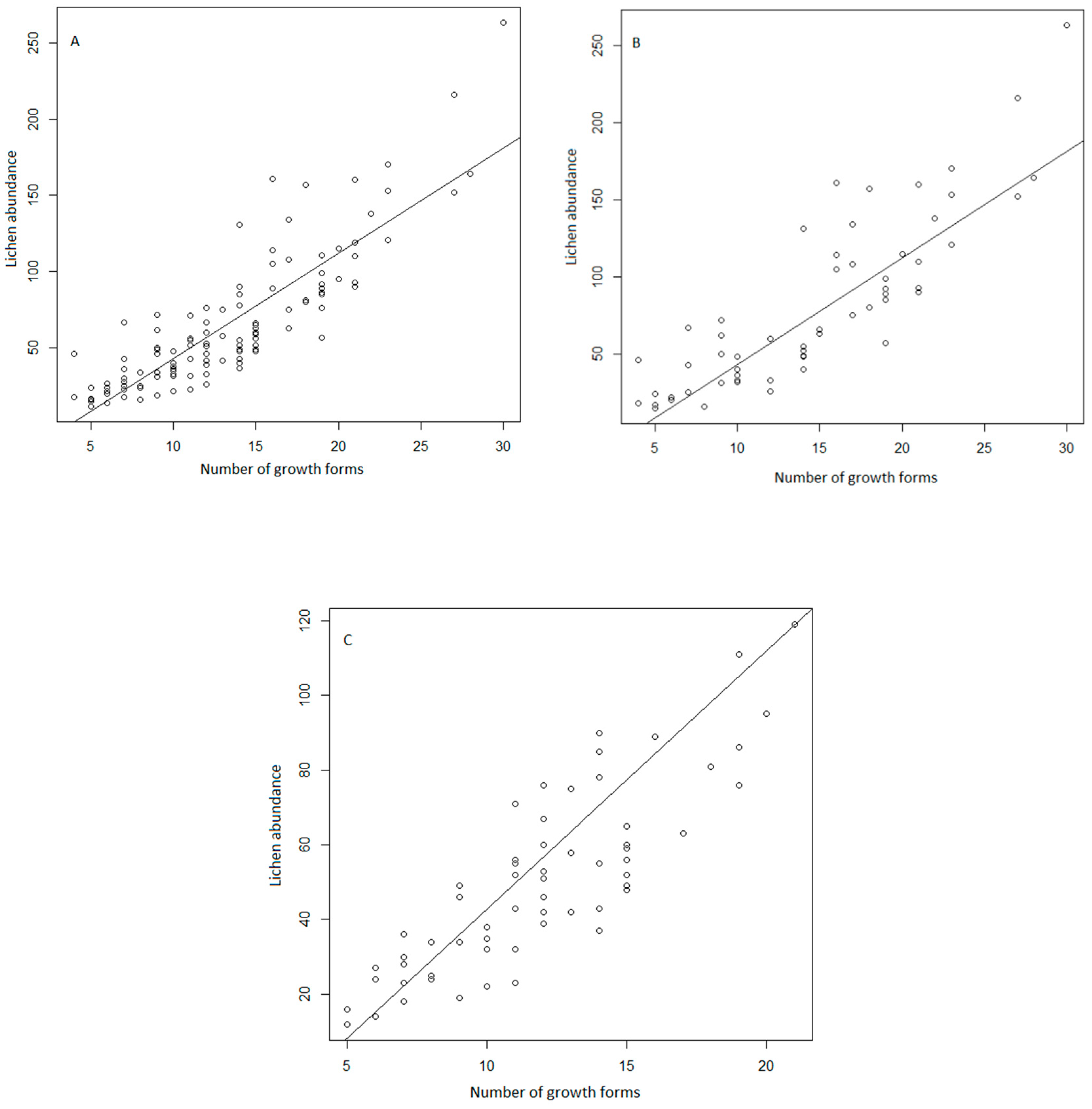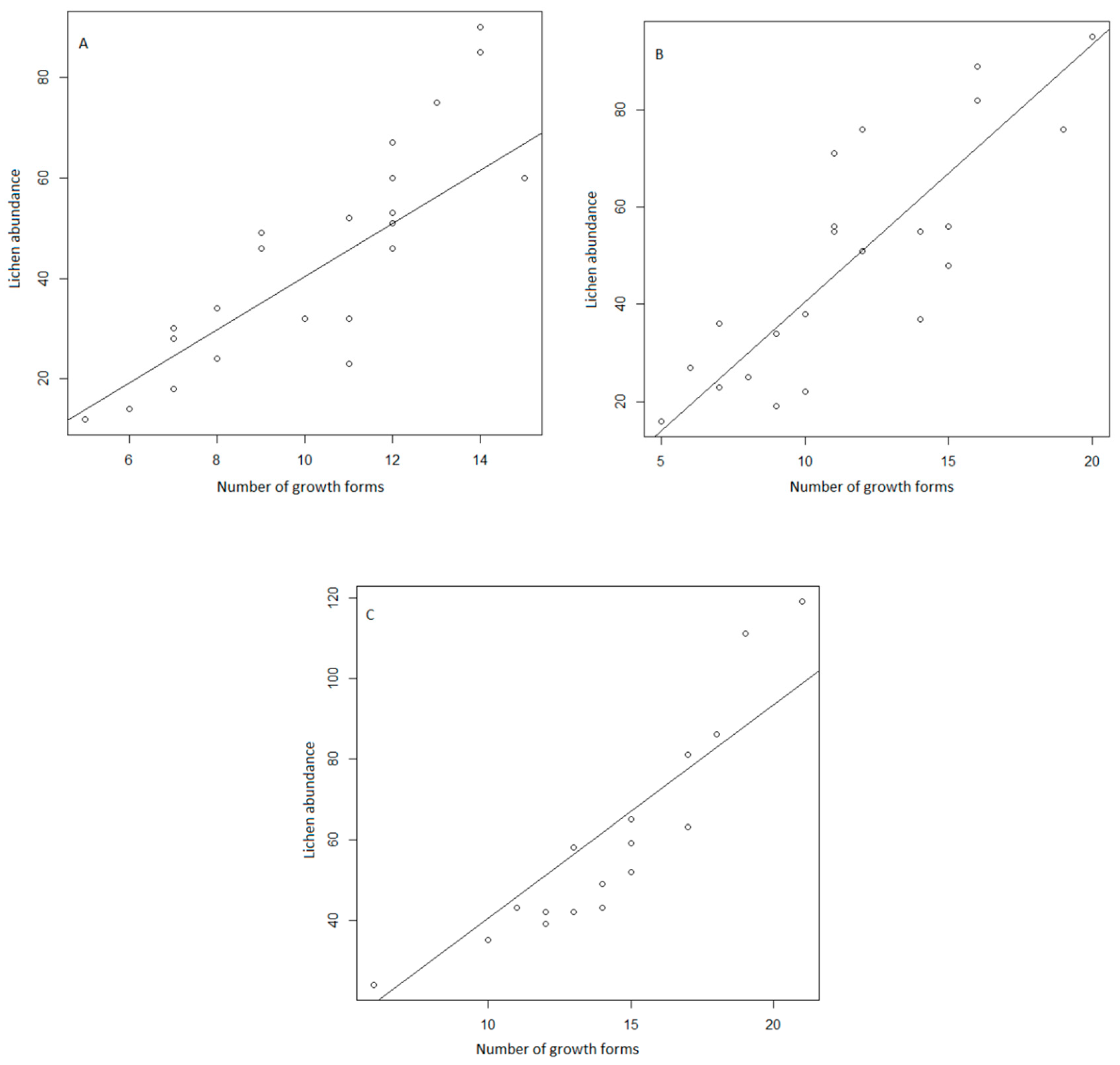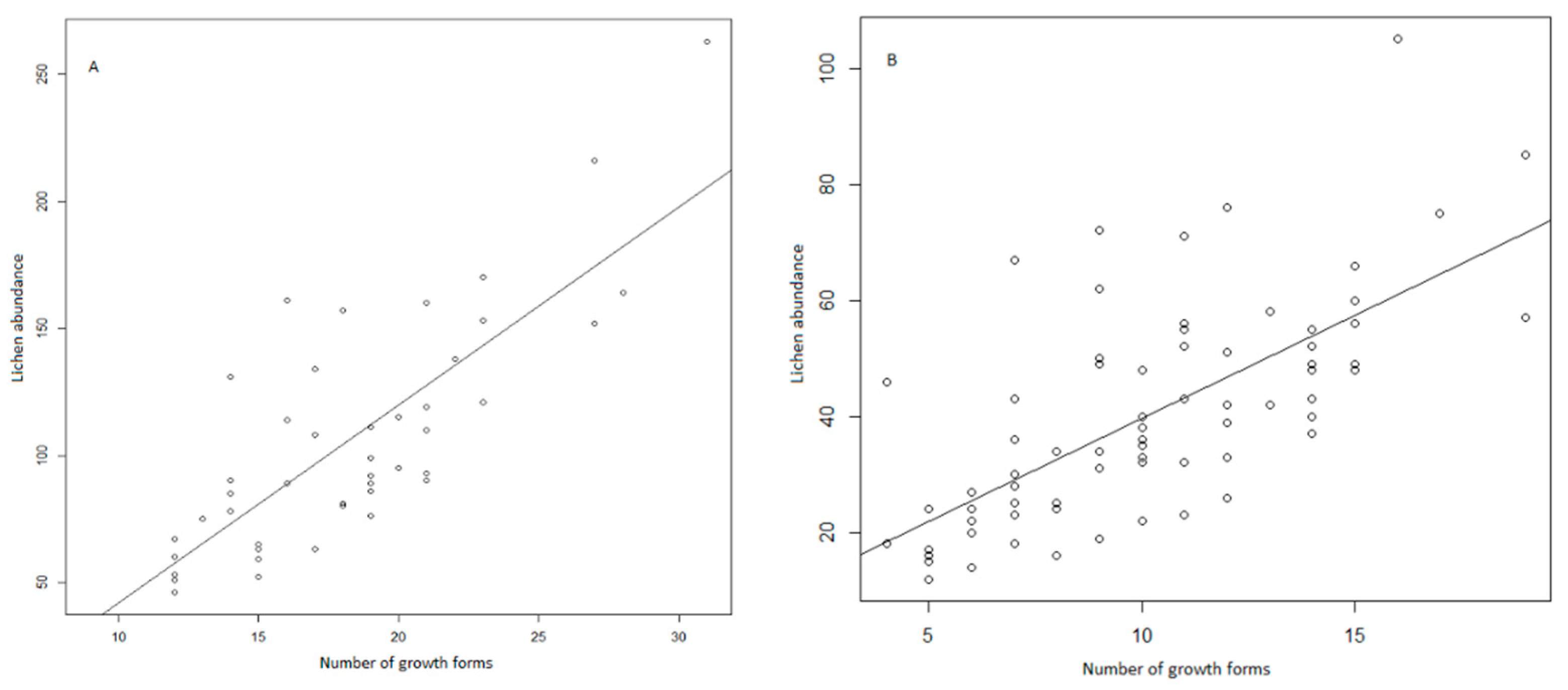

Using Growth Forms to Predict Epiphytic Lichen Abundance in a Wide Variety of Forest Types



Abstract
1. Introduction
2. Material and Methods
2.1. Literature Search and Selection
2.2. Data Analyses
3. Results
4. Discussion
Author Contributions
Funding
Conflicts of Interest
References
- Aragón, G.; Martínez, I.; Izquierdo, P.; Belinchón, R.; Escudero, A. Effects of forest management on epiphytic lichen diversity in Mediterranean forests. Appl. Veg. Sci. 2010, 13, 183–194. [Google Scholar] [CrossRef] [Scilit]
- Benítez, A.; Aragón, G.; González, Y.; Prieto, M. Functional traits of epiphytic lichens in response to forest disturbance and as predictors of total richness and diversity. Ecol. Ind. 2018, 86, 18–26. [Google Scholar] [CrossRef] [Scilit]
- Myers, N.; Mittermeier, R.A.; Mittermeier, C.G.; Da Fonseca, G.A.; Kent, J. Biodiversity hotspots for conservation priorities. Nature 2000, 403, 853–858. [Google Scholar] [CrossRef] [Scilit] [PubMed]
- Gibson, L.; Lee, T.M.; Koh, L.P.; Brook, B.W.; Gardner, T.A.; Barlow, J.; Peres, C.A.; Bradshaw, C.J.; Laurance, W.F.; Lovejoy, T.E.; et al. Primary forests are irreplaceable for sustaining tropical biodiversity. Nature 2011, 478, 378–381. [Google Scholar] [CrossRef] [Scilit] [PubMed]
- Chazdon, R.L. Beyond deforestation: Restoring forests and ecosystem services on degraded lands. Science 2008, 320, 1458–1460. [Google Scholar] [CrossRef] [Scilit] [PubMed]
- Gibbs, H.K.; Ruesch, A.S.; Achard, F.; Clayton, M.K.; Holmgren, P.; Ramankutty, N.; Foley, J.A. Tropical forests were the primary sources of new agricultural land in the 1980s and 1990s. Proc. Natl. Acad. Sci. USA 2010, 107, 16732–16737. [Google Scholar] [CrossRef] [Scilit] [PubMed]
- Bergamini, A.; Scheidegger, C.; Stofer, S.; Carvalho, P.; Davey, S.; Dietrich, M.; Dubs, F.; Farkas, E.; Groner, U.; Kärkkäinen, K.; et al. Performance of macrolichens and lichen genera as indicators of lichen species richness and composition. Conserv. Biol. 2005, 19, 1051–1062. [Google Scholar] [CrossRef] [Scilit]
- Kelly, L.J.; Hollingsworth, P.M.; Coppins, B.J.; Ellis, C.J.; Harrold, P.; Tosh, J.; Yahr, R. DNA barcoding of lichenized fungi demonstrates high identification success in a floristic context. New Phytol. 2011, 191, 288–300. [Google Scholar] [CrossRef] [Scilit] [PubMed]
- Giordani, P.; Brunialti, G.; Benesperi, R.; Rizzi, G.; Frati, L.; Modenesi, P. Rapid biodiversity assessment in lichen diversity surveys: Implications for quality assurance. J. Environ. Monit. 2009, 11, 730–735. [Google Scholar] [CrossRef] [Scilit] [PubMed]
- Aragón, G.; Belinchón, R.; Martínez, I.; Prieto, M. Estimating epiphytic lichen richness by simple families in Mediterranean forests. For. Ecol. Manag. 2013, 310, 187–193. [Google Scholar] [CrossRef] [Scilit]
- Kranner, I.; Beckett, R.; Hochman, A.; Nash, T., III. Desiccation-Tolerance in Lichens: A Review. Bryologist 2008, 111, 576–593. [Google Scholar] [CrossRef] [Scilit]
- Giordani, P.; Brunialti, G.; Bacaro, G.; Nascimbene, J. Functional traits of epiphytic lichens as potential indicators of environmental conditions in forest ecosystems. Ecol. Ind. 2012, 18, 413–420. [Google Scholar] [CrossRef] [Scilit]
- Pinho, P.; Bergamini, A.; Carvalho, P.; Branquinho, C.; Stofer, S.; Scheidegger, C.; Maguas, C. Lichen functional groups as ecological indicators of the effects of land-use in Mediterranean ecosystems. Ecol. Ind. 2012, 15, 36–42. [Google Scholar] [CrossRef] [Scilit]
- Büdel, B.; Scheidegger, C. Thallus morphology and anatomy. In Lichen Biology, 2nd ed.; Nash, T.H., III, Ed.; Cambridge University Press: Cambridge, UK, 2008; pp. 40–68. [Google Scholar]
- Asplund, J.; Wardle, D.A. How lichens impact on terrestrial community and ecosystem properties. Biol. Rev. 2016, 92, 1720–1738. [Google Scholar] [CrossRef] [Scilit]
- Aragón, G.; Belinchón, R.; Martínez, I.; Prieto, M. A survey method for assessing the richness of epiphytic lichens using growth forms. Ecol. Ind. 2016, 62, 101–105. [Google Scholar] [CrossRef] [Scilit]
- Aragón, G.; López, R.; Martínez, I. Effects of Mediterranean dehesa management on epiphytic lichens. Sci. Total Environ. 2010, 409, 116–122. [Google Scholar] [CrossRef] [Scilit] [PubMed]
- Friedel, A.; Oheimb, G.V.; Dengler, J.; Härdtle, W. Species diversity and species composition of epiphytic bryophytes and lichens—A comparison of managed and unmanaged beech forests in NE Germany. Feddes Repert. 2006, 117, 172–185. [Google Scholar] [CrossRef] [Scilit]
- Nascimbene, J.; Marini, L. Oak forests exploitation and black locust invasion caused severe shifts in epiphytic lichen communities in northern Italy. Sci. Tot. Environ. 2010, 408, 5506–5512. [Google Scholar] [CrossRef] [Scilit]
- Estrabou, C.; Stiefkens, L.; Hadid, M.; Rodríguez, J.; Pérez, A. Estudio comparativo de la comunidad liquénica en cuatro ecosistemas de la provincia de Córdoba. Bol. Soc. Argent. Bot. 2005, 40, 3–12. [Google Scholar]
- Quiroga, G.; Estrabou, C.; Rodríguez, J.M. Lichen community response to different management situations in Cerro Colorado protected forest (Córdoba, Argentina). Lazaroa 2008, 29, 131–138. [Google Scholar]
- García, R.; Rosato, V. Nuevas citas de líquenes para la Reserva Natural de Punta Lara, provincia de Buenos Aires, Argentina. Rev. Mus. Argent. Cienc. Nat. 2013, 15, 169–174. [Google Scholar] [CrossRef] [Scilit]
- Flakus, A. Contribution to the knowledge of the lichen biota of Bolivia. 2. Pol. Bot. J. 2008, 53, 145–153. [Google Scholar]
- Flakus, A.; Oset, M.; Jablonska, A.; Rodríguez, P.; Kurka, M. Contribution to the knowledge of the lichen biota of Bolivia. 3. Pol. Bot. J. 2011, 56, 159–183. [Google Scholar]
- Flakus, A.; Etayo, J.; Schiefelbein, U.; Ahti, T.; Jablonska, A.; Oset, M.; Bach, K.; Rodríguez, P.; Kukwa, M. Contribution to the knowledge of the lichen biota of Bolivia. 4. Pol. Bot. J. 2012, 57, 427–461. [Google Scholar]
- Flakus, A.; Sipman, H.J.M.; Bach, K.; Rodríguez, P.; Knudsen, K.; Ahti, T.; Schiefelbein, U.; Palice, Z.; Jablonska, A.; Oset, M.; et al. Contribution to the knowledge of the lichen biota of Bolivia. 5. Pol. Bot. J. 2013, 58, 697–733. [Google Scholar] [CrossRef] [Scilit]
- Flakus, A.; Sipman, H.J.M.; Rodríguez, P.; Schiefelbein, U.; Jablonska, A.; Oset, M.; Kukwa, M. Contribution to the knowledge of the lichen biota of Bolivia. 6. Pol. Bot. J. 2014, 59, 63–83. [Google Scholar] [CrossRef] [Scilit]
- Flakus, A.; Sipman, H.J.M.; Rodríguez, P.; Jablonska, A.; Oset, M.; Meneses, R.I.; Kukwa, M. Contribution to the knowledge of the lichen biota of Bolivia. 7. Pol. Bot. J. 2015, 60, 81–98. [Google Scholar] [CrossRef] [Scilit]
- Flakus, A.; Oset, M.; Rykaczewski, M.; Schiefelbein, U.; Kukwa, M. Contribution to the knowledge of the lichen biota of Bolivia. 8. Pol. Bot. J. 2016, 61, 107–126. [Google Scholar] [CrossRef] [Scilit]
- Silva-Cáceres, M.E.; Aptroot, A. Lichens from the Brazilian Amazon, with special reference to the genus Astrothelium. Bryologist 2017, 120, 166–182. [Google Scholar] [CrossRef] [Scilit]
- Silva-Cáceres, M.E.; Mota, N.; Alves, L.; de Almeida Pereira, T.; Aptroot, A. New records to Brazil and Southern Hemisphere f corticolous and saxicolous lichens from the semiarid region in Ceará State. Iheringia 2017, 72, 239–245. [Google Scholar] [CrossRef] [Scilit]
- Barrero, A.; Anjos, A.; de Sousa, L.; Aptroot, A.; Lücking, R.; Monique, V.; Silva-Cáceres, M.E. Epiphytic micdrolichens as indicators of phytosociological differentiation between Caatinga and Brejos Altitude. Acta Bot. Braslilica 2015, 29, 457–466. [Google Scholar] [CrossRef] [Scilit]
- Koch, N.M.; de Azevedo, S.M.; Lucheta, F.; Müller, S.C. Functional diversity and traits assembly patterns of lichens as indicators of succesional stages in a tropical rainforest. Ecol. Ind. 2013, 34, 22–30. [Google Scholar] [CrossRef] [Scilit]
- Käffer, M.I.; Dantas, R.V.; de Azevedo Martins, S.M. Characterization of the epiphytic lichen vegetation in a riparian forest in southern Brazil. Plant Ecol. Evol. 2016, 149, 92–100. [Google Scholar] [CrossRef] [Scilit]
- Silva-Cáceres, M.E.; Lücking, R.; Rambold, G. Phorophyte specificity and environmental parameters versus stocasticity as determinants for species composition of corticolous crustose lichen communities in the Atlantic rain forests of northeastern Brazil. Mycol. Prog. 2007, 6, 117–136. [Google Scholar] [CrossRef] [Scilit]
- Silva-Cáceres, M.E. Corticolous Crustose and Microfoliose Lichens of Northeastern Brazil; Libri botanici; IHW-Verlag: Eching, Postfach, 2007; Volume 22, pp. 1–168. ISBN 9783930167685. [Google Scholar]
- Rubio, C.; Saavedra, M.; Cuéllar, M.; Díaz, R.; Quilhot, W. Epiphytic lichens of Conguillío National Park, southern Chile. Gayana Bot. 2013, 70, 66–81. [Google Scholar] [CrossRef] [Scilit]
- Gatica, A.; Pereira, I.; Vallejos, O. Líquenes epífitos: Una herramienta para estudiar la continuidad ecológica en Isla Mocha, Chile. Gayana Bot. 2011, 68, 226–235. [Google Scholar] [CrossRef] [Scilit]
- Pereira, I. Micobiota liquenizada del Parque Katalapi, X Región, Chile. Gayana Bot. 2007, 64, 192–200. [Google Scholar] [CrossRef] [Scilit]
- Quilhot, W.; Cuellar, M.; Díaz, R.; Riquelme, F.; Rubio, C. Estudio preliminar de la flora liquénica de Isla Mocha, sur de Chile. Gayana Bot. 2010, 67, 206–212. [Google Scholar] [CrossRef] [Scilit]
- Pereira, I.; Müller, F.; Moya, M. Influence of Nothofagus bark pH on the lichen and bryophytes richness, Central Chile. Gayana Bot. 2014, 71, 120–130. [Google Scholar] [CrossRef] [Scilit]
- Wolf, J.H.D. Epiphyte communities of tropical montane rain forests in the northern Andes I. Lower montane communities. Phytocoenologia 1993, 22, 1–52. [Google Scholar] [CrossRef] [Scilit]
- Soto, E.; Bolaños, A.C. Diversidad de líquenes corticolas en el bosque subandino de la finca Zíngara (Cali, valle del Cauca). Rev. Cienc. 2010, 14, 35–44. [Google Scholar]
- Ramírez-Morán, N.A.; León-Gómez, M.; Lücking, R. Uso de biotipos de líquenes como bioindicadores de perturbación en fragmentos de bosque altoandino (Reserva Biológica “Encenillo”, Colombia). Caldasia 2016, 38, 31–52. [Google Scholar] [CrossRef] [Scilit]
- Holz, I.; Gradstein, S.R. Cryptogamic epiphytes in primary and recovering upper montane oak forests of Costa Rica—Species richness, community composition and ecology. Plant Ecol. 2005, 178, 89–109. [Google Scholar] [CrossRef] [Scilit]
- Rosabal, D.; Burgaz, A.R.; Reyes, O.J. Diversidad y distribución vertical de líquenes corticícolas en la pluvisilva montana de la Gran Piedra, Cuba. Bot. Compl. 2012, 36, 19–30. [Google Scholar] [CrossRef] [Scilit]
- Rosabal, D.; Aragón, G. Líquenes epífitos en el matorral costero de la Reserva Ecológica Siboney-Juticí (cuba). Bot. Compl. 2010, 34, 21–25. [Google Scholar]
- Benítez, A.; Prieto, M.; Aragon, G. Large trees and dense canopies: Key factors for maintaining high epiphytic diversity on trunk bases (bryophytes and lichens) in tropical montane forests. Forestry 2015, 88, 521–527. [Google Scholar] [CrossRef] [Scilit]
- Benítez, A.R.; Aragón, G.; Prieto, M. Lichen Diversity in Tropical Dry Forests Is Highly Influenced by Host Tree Traits (doc. ined). Chapter 4. Ph.D. Thesis, University Rey Juan Carlos, Móstoles, Spain, 2016. [Google Scholar]
- Nöske, N.M.; Sipman, H.J.M. Cryptogams of the Reserva Biológica San Francisco Province Zamora-Chinchipe, Southern Ecuador. II. Lichens. Cryptogam. Mycol. 2004, 25, 91–100. [Google Scholar]
- Pérez-Pérez, R.E.; Miramontes-Rojas, N.; Aguilar-Rosales, J.; Quiroz-Castelán, H. Macrolíquenes cortícolas de dos especies de coníferas del Parque Nacional lagunas de Zempoala. Acta Univ. 2008, 18, 33–39. [Google Scholar]
- Etayo, J.; Aptroot, A. Líquenes epífitos y hongos liquenícolas de Bahía Honda (Veraguas, Panamá). In Estudios Sobre la Biodiversidad de la Región de Bahía Honda (Veraguas, Panamá); Ibáñez, A., Castroviejo, S., Eds.; CSIC: Madrid, Spain, 2005; pp. 63–94. ISBN 978-84-00-08405-9. [Google Scholar]
- Ramos, D. Lista de especies de líquenes y hongos liquenícolas del Perú. Glalia 2014, 6, 1–49. [Google Scholar]
- Lugo, G. Preliminary inventory of corticolous lichens of the Sierra de San Luis, Venezuela. Rev. Biodivers. Neotrop. 2013, 3, 98–105. [Google Scholar] [CrossRef] [Scilit]
- Marcano, V.; Molares, A.; Sipman, H.; Calderón, L. A first checklist of the lichen-forming fungi of the Venezuelan Andes. Trop. Bryol. 1996, 12, 193–235. [Google Scholar] [CrossRef] [Scilit]
- Aragón, G.; Martínez, I.; Burgaz, A.R.; Belinchón, R.; Prieto, M.; Otálora, M.A.G.; Garcia, A.; Lopez, R.; de Paz, G.A. Inventariación de la diversidad liquénica del Parque Nacional de los Picos de Europa. In Proyectos de Investigación en Parques Nacionales, 2003–2006; Ramírez, L., Asensio, B., Eds.; Organismo Autónomo Parques Nacionales: Madrid, Spain, 2007; pp. 79–106. ISBN 978-84-8014-722-4. [Google Scholar]
- Aragón, G.; Martínez, I.; Belinchón, R. Aportación al conocimiento de los líquenes epífitos de Pinus halepensis, P. nigra y P. sylvestris en la Península Ibérica. Bot. Compl. 2006, 30, 61–70. [Google Scholar]
- Aragón, G.; Rico, V.J.; Belinchón, R. Lichen diversity from Cazorla, Segura and Las Villas Biosphere Reserve (SE Spain). Nova Hedwigia 2006, 82, 31–50. [Google Scholar] [CrossRef] [Scilit]
- Fos, S. Líquenes epífitos de los alcornocales ibéricos. Correlaciones bioclimáticas, anatómicas y densimétricas con el corcho de reproducción. Guineana 1998, 4, 1–507. [Google Scholar]
- Aragón, G.; Martínez, I. Contribución al conocimiento de los líquenes epifíticos de la Sierra de Alcaraz (Albacete, España). Cryptogam. Mycol. 1999, 20, 57–70. [Google Scholar] [CrossRef] [Scilit]
- Aragón, G.; Martínez, I. Contribución al conocimiento de los líquenes epifíticos de los Montes de Toledo (Toledo, España). Cryptogam. Bryol. Lichenol. 1997, 18, 63–75. [Google Scholar]
- Lohmus, P.; Lohmus, A. Snags, and their lichen flora in old Estonian peatland forets. Ann. Bot. Fennici 2001, 38, 265–280. [Google Scholar]
- Marmor, L.; Torra, T.; Saag, T.; Leppik, E.; Randlane, T. Lichens on Picea abies and Pinus sylvestris—From the bottom to the top. Lichenologist 2013, 45, 51–63. [Google Scholar] [CrossRef] [Scilit]
- Kivistö, L.; Kuusinen, M. Edge effects on the epiphytic lichen flora of Picea abies in middle boreal Finland. Lichenologist 2000, 32, 387–398. [Google Scholar] [CrossRef] [Scilit]
- Bricaud, O.; Roux, C. Deux associations lichéniques corticoles nouvelles, mésoméditerranéennes, sciaphiles: Le Ramonio-Striguletum mediterraneae et le Striguletum affinis. Lichenologist 1994, 26, 113–134. [Google Scholar] [CrossRef] [Scilit]
- Muggia, L.; Kati, V.; Rohrer, A.; Hallet, J.; Mayrhofer, H. Species diversity of lichens in the sacred groves of Epirus (Greece). Herzogia 2018, 31, 231–244. [Google Scholar] [CrossRef] [Scilit]
- Christensen, S.N. Lichens associated with Pinus nigra on Mt. Trapezitsa, Epirus, NW Greece. Acta Bot. Fennica 1994, 150, 11–20. [Google Scholar]
- Pirintsos, S.A.; Diamantopoulos, J.; Stamou, G.P. Analysis of the vertical distribution of epiphytic lichens on Pinus nigra (Mount Olympos, Greece) along an altitudinal gradient. Vegetatio 1993, 109, 63–70. [Google Scholar] [CrossRef] [Scilit]
- Király, I.; Nascimbene, J.; Tinya, F.; Ódor, P. Factors influencing epiphytic bryophyte and lichen species at different spatial scales in managed temperate forests. Biodivers. Conserv. 2013, 22, 209–223. [Google Scholar] [CrossRef] [Scilit]
- Loppi, S.; Pirintsos, S.A.; Olivieri, N.; Pacioni, G. Distribution of epiphytic lichens on Quercus pubescens along an altitudinal gradient on the Adriatic side of Central Italy. Stud. Geobot. 1999, 17, 85–90. [Google Scholar]
- Brunialti, G.; Frati, L.; Loppi, S. Fragmentation of mediterranean oak forests affects the diversity of epiphytic lichens. Nova Hedwig. 2012, 96, 265–278. [Google Scholar] [CrossRef] [Scilit]
- Loppi, S.; Pritintsos, S.A.; de Dominicis, V. Analysis of the distribution of epiphytic lichens on Quercus pubescens along an altitudinal gradient in a mediterranean area (Tuscany, ventral Italy). Isr. J. Plant Sci. 1997, 45, 53–58. [Google Scholar] [CrossRef] [Scilit]
- Nascimbene, J.; Nimis, P.L.; Dainese, M. Epiphytic lichen conservation in the Italian Alps: The role of forest type. Fungal Ecol. 2014, 11, 164–172. [Google Scholar] [CrossRef] [Scilit]
- Kubiak, D. Lichens of read oak Quercus rubra in the forest environment in the Olsztyn Lake District (NE Poland). Acta Mycol. 2006, 41, 319–328. [Google Scholar] [CrossRef] [Scilit]
- Fritz, O.; Heilmann-Clausen, J. Rot holes create key microhabitats for epiphytic lichens and bryophytes on beech (Fagus sylvatica). Biol. Conserv. 2010, 143, 1008–1016. [Google Scholar] [CrossRef] [Scilit]
- Bäcklund, A.; Jönsson, M.; Strengbom, J.; Frisch, A.; Thor, G. A pine is a pine and a spruce is a spruce—The effect of tree species and stand age on epihytic lichen communities. PLoS ONE 2016, 11, e0147004. [Google Scholar] [CrossRef] [Scilit]
- Özturk, Ş.; Oran, S.; Güvenç, Ş.; Dalkiran, N. Analysis of the distribution of epiphytic lichens in the oriental beech (Fagus orientalis Lipsky) forests along an altitudinal gradient in Uludag mountain, Bursa—Turkey. Pak. J. Bot. 2010, 42, 2661–2670. [Google Scholar]
- Güvenc, S.; Öztürk, S. Difference in epiphytic lichen communities on Quercus cerris from urban and rural areas in Bursa (Turkey). Pak. J. Bot. 2017, 49, 631–637. [Google Scholar]
- Dymytrova, L.; Nadyeina, O.; Naumovych, A.; Keller, C.; Scheidegger, C. Primeval Beech Forests of Ukrainian Carpathians are Sanctuaries for Rare and Endangered Epiphytic Lichens. Herzogia 2013, 26, 73–89. [Google Scholar] [CrossRef] [Scilit]
- Nimis, P.L.; Martellos, S. ITALIC-The Information System on Italian Lichens. 4.0. University of Trieste, Dept. of Biology, IN4.0/1. 2008. Available online: http://dbiodbs.univ.trieste.it/ (accessed on 26 November 2018).
- Rivas-Plata, E.; Lücking, R.; Sipman, H.J.; Mangold, A.; Kalb, K.; Lumbsch, H.T. A world-wide key to the thelotremoid Graphidaceae, excluding the Ocellularia-Myriotrema-Stegobolus clade. Lichenologist 2010, 42, 139–185. [Google Scholar] [CrossRef] [Scilit]
- Lakatos, M.; Rascher, U.; Büdel, B. Functional characteristics of corticolouslichens in the understory of a tropical lowland rain forest. New Phytol. 2006, 172, 679–695. [Google Scholar] [CrossRef] [Scilit]
- Smith, C.W.; Aptroot, A.; Coppins, B.J.; Fletcher, A.; Gilbert, O.L.; James, P.W.; Wolseley, P.A. The Lichens of Great Britain and Ireland; British Lichen Society: London, UK, 2009. [Google Scholar]
- San Miguel-Ayanz, J.; de Rigo, D.; Caudullo, G.; Houston, T.D.; Mauri, A. European Atlas of Forest Tree Species; European Commission: Luxembourg, 2016. [Google Scholar]
- Nimis, P.L.; Scheidegger, C.; Wolseley, P.A. Monitoring with Lichens: Monitoring Lichens; Kluwer Academic Published in Association with the NATO Scientific Affairs Division; Springer: Dordrecht, The Netherlands; London, UK, 2002. [Google Scholar]
- Svoboda, D.; Peksa, O.; Veselà, J. Epiphytic lichen diversity in central European oak forests: Assessment of the effects of natural environmental factors and human influences. Environ. Pollut. 2010, 158, 812–819. [Google Scholar] [CrossRef] [Scilit]
- Matos, P.; Pinho, P.; Aragón, G.; Martínez, I.; Nunes, A.; Soares, A.M.V.M.; Branquinho, C. Lichen traits responding to aridity. J. Ecol. 2015, 103, 451–458. [Google Scholar] [CrossRef] [Scilit]
- Prieto, M.; Martínez, I.; Aragón, G.; Verdú, M. Phylogenetic and functional structure of lichen communities under contrasting environmental conditions. J. Veg. Sci. 2017, 28, 871–881. [Google Scholar] [CrossRef] [Scilit]
- Ellis, C.J. Lichen epiphyte diversity: A species, community and trait-based review. Perspect. Plant Ecol. Evol. Syst. 2012, 14, 131–152. [Google Scholar] [CrossRef] [Scilit]
- Concostrina-Zubiri, L.; Pescador, D.S.; Martínez, I.; Escudero, A. Climate and small-scale factors determine functional diversity shifts of biological soil crusts in Iberian drylands. Biodiv. Conserv. 2014, 23, 1757–1770. [Google Scholar] [CrossRef] [Scilit]
- Newmaster, S.G.; Bell, F.W. The effects of silvicultural disturbances on cryptogam diversity in the boreal-mixed wood forests. Can. J. For. Res. 2002, 32, 38–51. [Google Scholar] [CrossRef] [Scilit]
- Benítez, A.; Prieto, M.; González, Y.; Aragón, G. Effects of tropical montane forest disturbance on epiphytic macrolichens. Sci. Total Environ. 2012, 441, 169–175. [Google Scholar] [CrossRef] [Scilit] [PubMed]
- Marini, L.; Nascimbene, J.; Nimis, P.L. Large-scale patterns of epiphytic lichen species richness: Photobiont-dependent response to climate and forest structure. Sci. Total Environ. 2011, 409, 4381–4386. [Google Scholar] [CrossRef] [Scilit]
- Li, S.; Liu, W.Y.; Li, D.W. Bole epiphytic lichens as potential indicators of environmental change in subtropical forest ecosystems in Southwest China. Ecol. Indic. 2013, 29, 93–104. [Google Scholar] [CrossRef] [Scilit]
- Nash, T.H. Lichen Biology; Cambridge University Press: New York, NY, USA, 2008. [Google Scholar]
- Sillett, S.C.; Antoine, M.E. Lichens and bryophytes in forest canopies. In Forest Canopies; Lowman, M.D., Inker, H.B., Eds.; Elsevier Academic Press: Oxford, UK, 2004; pp. 151–174. ISBN 9780080491349. [Google Scholar]
- Keddy, P.A. Assembly and response rules: Two goals for predictive community ecology. J. Veg. Sci. 1992, 3, 157–164. [Google Scholar] [CrossRef] [Scilit]
- Weiher, E.; Clarke, G.D.P.; Keddy, P.A. Community assembly rules, morphological dispersion, and the coexistence of plant species. OIKOS 1998, 81, 309–322. [Google Scholar] [CrossRef] [Scilit]
- Grime, J.P. Trait convergence and trait divergence in herbaceous plant communities: Mechanisms and consequences. J. Veg. Sci. 2006, 17, 255–260. [Google Scholar] [CrossRef]
- Petchey, O.L.; Gaston, K.J. Functional diversity (FD), species richness and community composition. Ecol. Lett. 2002, 5, 402–411. [Google Scholar] [CrossRef] [Scilit]
- FAO. El Estado de los Bosques del Mundo. Los Bosques y la Agricultura: Desafíos y Oportunidades; FAO: Rome, Italy, 2016; 36p, ISBN 9789253092086. [Google Scholar]



| Bibliographic Reference | Country | Alt (m) | Forest Type |
|---|---|---|---|
| Central-South America | |||
| [20] | Argentina | 500–1350 | Chaco, semiarid lowland forest |
| [21] | Argentina | 1000 | Belt of mountain woodland and the transition with the Chaco lowland forest |
| [22] | Argentina | 4 | Riverside forest |
| [23,24,25,26,27,28,29] | Bolivia | 155–4500 | Chiquitano-Chaqueno forest, lowland Amazon forest, Tucumano-boliviano montane forest, Yungas montane forest, Podocarpus, Polylepis |
| [30] | Brazil | 80 | Tropical rainforest |
| [31] | Brazil | 130–250 | Caatinga vegetation |
| [32] | Brazil | 400–600 | Brejos and Caatinga |
| [33] | Brazil | 300–800 | Atlantic rainforest |
| [34] | Brazil | 240–872 | Riparian forest |
| [35] | Brazil | 800–900 | Atlantic rainforest |
| [36] | Brazil | 0–800 | Atlantic rainforest, Caatinga |
| [37] | Chile | 1000–1500 | Andean-Patagonian forests and the Andean deciduous forest |
| [38] | Chile | 8–308 | Valdivian temperate rainforest (without Nothofagus spp.) |
| [39] | Chile | 1100–1150 | Montane coniferous forest (Fitzroya cupressoides) |
| [40] | Chile | 0–349 | Valdivian temperate rainforest |
| [41] | Chile | 1100–1150 | Temperate forest (Nothofagus dombeyi, N. nitida, and N. obliqua) |
| *Rodríguez et al. (in prep.) | Chile | 930–1050 | Temperate forest (Nothofagus pumilio) |
| [42] | Colombia | 700–4000 | Lowland forest, lower montane rainforest, tropical montane rainforest, and Polylepis forest |
| [43] | Colombia | 1900–2000 | Premontane forest |
| [44] | Colombia | 2800–3200 | High Andean forest |
| [45] | Costa Rica | 2900 | Oak forest |
| [46] | Cuba | 1000 | Tropical montane rainforest |
| [47] | Cuba | 20 | Coastal sclerophyllous forest |
| [48] | Ecuador | 2196–2848 | Tropical montane rainforest (primary, secondary, and monospecific Alnus acuminata) |
| [49] | Ecuador | 0–300 | Tropical dry forest |
| [50] | Ecuador | 1800–2650 | Tropical montane rainforest |
| *Aragón et al. (in prep.) | Ecuador | 80–300 | Amazonian forest |
| [51] | Mexico | 2714–2775 | Coniferous forest (Pinus ayacahuite, Abies religiosa) |
| [52] | Panama | 0–160 | Lowland and coastal forest |
| [53] | Peru | 300–1500 | Tropical dry forest |
| [54] | Venezuela | 106–1400 | Tropical rainforest |
| [55] | Venezuela | 800–5000 | Montane forest (lower and upper) and Polylepis sericea forest |
| Europe | |||
| *Hurtado et al. (in prep) | Austria | 750–1120 | Temperate forest (Fagus sylvatica) |
| [56] | Spain | 800 | Temperate forest (Fagus sylvatica) |
| [57] | Spain | 870–1100 | Mediterranean pine forest (Pinus pinaster, P. nigra) |
| [58] | Spain | 1280–1560 | Mediterranean pine forest |
| [59] | Spain | 300–700 | Oak forest (Quercus suber) |
| [60] | Spain | 1550 | Mediterranean pine forest (Pinus nigra, Ilex, Acer) |
| [61] | Spain | 1000 | Oak forest (Quercus ilex, Juniperus oxycedrus) |
| *Aragón et al. (in prep.) | Spain | 710 | Oak forest (Quercus faginea) |
| *Hurtado et al. (in prep) | Spain | 856 | Temperate forest (Fagus sylvatica) |
| [62] | Estonia | 30–40 | Coniferous forest (Picea abies, Pinus sylvestris) |
| [63] | Estonia | 170–200 | Coniferous forest (Picea abies, Pinus sylvestris) |
| [64] | Finland | 170 | Coniferous forest (Picea abies) |
| [65] | France | 350–500 | Oak forest (Quercus ilex) |
| *Hurtado et al. (in prep) | France | 1180–1272 | Temperate forest (Fagus sylvatica) |
| [66] | Greece | 570–1210 | Oak forest (Quercus cerris, Q. coccifera, Q. frainetto, Q. petraea, Q. pubescens, Q. trojana, Pinus nigra) |
| [67] | Greece | 800–1500 | Mediterranean pine forest (Pinus nigra) |
| [68] | Greece | 750–1510 | Mediterranean pine forest (Pinus nigra) |
| [69] | Hungary | 250-350 | Temperate forest (Fagus, Quercus, Carpinus, Pinus) |
| [70] | Italy | 0–1000 | Oak forest (Quercus pubescens) |
| [71] | Italy | 50–390 | Oak forest (Quercus ilex, Q. cerris, Q. pubescens) |
| [72] | Italy | 0–900 | Oak forest (Quercus pubescens) |
| [73] | Italy | 400–1900 | Oak forest (Quercus) and coniferous forest (Pinus sylvestris, Abies alba) |
| *Hurtado et al. (in prep) | Italy | 1077–1213 | Temperate forest (Fagus sylvatica) |
| [74] | Poland | 88–150 | Oak forest (Quercus rubra) |
| *Hurtado et al. (in prep) | Slovakia | 1233 | Temperate forest (Fagus sylvatica) |
| [75] | Sweden | 25–170 | Temperate forest (Fagus sylvatica) |
| [76] | Sweden | 260–583 | Coniferous forest (Pinus contorta, P. sylvestris, Picea abies) |
| *Hurtado et al. (in prep) | Sweden | 107–161 | Temperate forest (Fagus sylvatica) |
| [77] | Turkey | 900–1400 | Temperate forest (Fagus orientalis) |
| [78] | Turkey | 21–717 | Oak forest (Quercus cerris) |
| [79] | Ukraine | 400–1350 | Temperate forest (Fagus sylvatica) |
| Growth Forms (Examples) |
|---|
| Leprarioid (Lepraria incana) |
| Crustose |
| Conspicuous (Pertusaria albescens) |
Inconspicuous
|
| Granular crustose (Agonimia octospora) |
| Crustose ecorticate (Herpothallon rubrocinctum) |
| Crustose placodioid (Pyxine berteriana) |
| Squamulose |
| Flat squamulose (Normandina pulchella) |
| Convex squamulose (Phyllopsora furfuracea) |
| Thallus Psoroma-type (Psoroma hypnorum) |
| Squamulose-foliose (Pannaria rubiginosa) |
| Foliose |
| Foliose placodioid (Pectenia plumbea) |
| Foliose umbilicate (Dictyonema glabratum) |
| Foliose narrow-lobed (Physconia venusta) |
| Foliose broad-lobed (Parmelina tiliacea) |
| Large foliose tomentose (Erioderma leylandii) |
| Large foliose glabrae and appressed (Peltigera horizontalis) |
| Large foliose glabrae and ascending (Sticta weigelii) |
| Foliose gelatinous swollen (Collema nigrescens) |
| Foliose gelatinous flat (Leptogium cyanescens) |
| Filamentous (Coenogonium linkii) |
| Fruticose |
| Fruticose cylindrical light-colored (Usnea glabrescens) |
| Fruticose cylindrical dark-colored (Bryoria implexa) |
| Fruticose dorsiventral light-colored (Ramalina fraxinea) |
| Fruticose dorsiventral dark-colored (Pseudevernia furfuracea) |
| Mixed (Cladonia fimbriata) |
© 2019 by the authors. Licensee MDPI, Basel, Switzerland. This article is an open access article distributed under the terms and conditions of the Creative Commons Attribution (CC BY) license (http://creativecommons.org/licenses/by/4.0/).
Share and Cite
Aragón, G.; Martínez, I.; Hurtado, P.; Benítez, Á.; Rodríguez, C.; Prieto, M. Using Growth Forms to Predict Epiphytic Lichen Abundance in a Wide Variety of Forest Types. Diversity 2019, 11, 51. https://doi.org/10.3390/d11040051
Aragón G, Martínez I, Hurtado P, Benítez Á, Rodríguez C, Prieto M. Using Growth Forms to Predict Epiphytic Lichen Abundance in a Wide Variety of Forest Types. Diversity. 2019; 11(4):51. https://doi.org/10.3390/d11040051
Chicago/Turabian StyleAragón, Gregorio, Isabel Martínez, Pilar Hurtado, Ángel Benítez, Clara Rodríguez, and María Prieto. 2019. "Using Growth Forms to Predict Epiphytic Lichen Abundance in a Wide Variety of Forest Types" Diversity 11, no. 4: 51. https://doi.org/10.3390/d11040051
APA StyleAragón, G., Martínez, I., Hurtado, P., Benítez, Á., Rodríguez, C., & Prieto, M. (2019). Using Growth Forms to Predict Epiphytic Lichen Abundance in a Wide Variety of Forest Types. Diversity, 11(4), 51. https://doi.org/10.3390/d11040051