


Abstract
The COVID-19 pandemic, caused by severe acute respiratory syndrome coronavirus 2 (SARS-CoV-2), has spread all over the world, creating a devastating socio-economic impact. Even though protective vaccines are starting to be administered, an effective antiviral agent for the prevention and treatment of COVID-19 is not available yet. Moreover, since new and deadly CoVs can emerge at any time with the potential of becoming pandemics, the development of therapeutic agents against potentially deadly CoVs is a research area of much current interest. In the search for anti-coronaviral drugs, researchers soon turned their heads towards glycosylated flavonoids. Glycosyl flavonoids, widespread in the plant kingdom, have received a lot of attention due to their widely recognized antioxidant, anti-inflammatory, neuroprotective, anticarcinogenic, antidiabetic, antimicrobial, and antiviral properties together with their capacity to modulate key cellular functions. The wide range of biological activities displayed by glycosyl flavonoids, along with their low toxicity, make them ideal candidates for drug development. In this review, we examine and discuss the up-to-date developments on glycosyl flavonoids as evidence-based natural sources of antivirals against coronaviruses and their potential role in the management of COVID-19.
1. Introduction
In December 2019, an outbreak of a severe pneumonia of unknown origin started in Wuhan, China. Soon after, similar cases were found in other countries around the world, and the number of infected people increased rapidly. At the end of January 2020, the World Health Organization (WHO) officially confirmed this pneumonia, caused by a new coronavirus, to be a public health emergency of global concern due to its rapid spread. The disease caused by this virus was named Coronavirus disease 2019 (COVID-19). On 11 March 2020, WHO declared it a global pandemic. Once the genetic analysis and information about the COVID-19 virus became available, the International Committee on Taxonomy of Viruses (ICTV) gave it its official name—severe acute respiratory syndrome coronavirus 2 (SARS-CoV-2) [1,2]. Data received by WHO from national authorities of different countries by 28 January 2021 indicated that there were more than 98 million confirmed cases with COVID-19 and more than 2 million deaths. At the time of writing (12 April 2021), WHO reported a total of 135,057,587 confirmed cases of COVID-19 and 2,919,932 deaths worldwide (https://www.who.int/emergencies/diseases/novel-coronavirus-2019/situation-reports, accessed on 12 April 2021).
Even though protective vaccines are starting to be available, an effective antiviral agent for the prevention and treatment of COVID-19 is still lacking. Since new and deadly coronaviruses (CoVs) can emerge at any time with the potential of becoming pandemics, the development of therapeutic agents against potentially deadly CoVs is a research area of much current interest. In this regard, flavonoids were soon recognized as potential leads for the development of anti-coronaviral drugs.
Flavonoids are a large group of polyphenolic compounds consisting of different sub-classes, such as flavonols, flavones, flavanonols, flavanones, flavanols (or catechins), isoflavones, chalcones, and anthocyanidins [3]. In plants, flavonoids are formed as secondary metabolites that provide color to seeds, flowers, and fruits. Furthermore, they also provide protection by blocking the entry of solar ultraviolet (UV) radiation, and against pathogenic microorganisms; they also regulate plant growth and enzyme activity [4,5]. These compounds are widely distributed in the plant kingdom and are therefore the most common polyphenols in the human diet [6]. In fact, flavonoids have received a lot of attention due to their benefits on preventing and managing chronic diseases, such as diabetes, cancer, cardiovascular diseases, obesity, and much more [7,8]. These health benefits are mainly due to their highly recognized antioxidant [9,10], anti-inflammatory [11,12], neuroprotective [13,14], anticarcinogenic [15,16], antidiabetic [17], antimicrobial [18], and antiviral [19,20] properties, together with their capacity to modulate key cellular functions [21]. In view of the wide range of biological activities displayed by flavonoids, researchers soon turned their heads towards these natural products in the search for weapons against the new coronavirus.
In nature, flavonoids are extensively distributed in their glycosylated form, as glycosyl flavonoids. The glycosyl part of these hybrid derivatives is not only related to improved solubility and the absorption profile, but also has a great influence on recognition processes, and consequently, on the biological profile.
3. Structure and Function of Glycosyl Flavonoids
Glycosyl flavonoids are structurally composed of a flavonoid aglycone linked to a sugar moiety. Different sugar moieties can be found in its structure, such as glucose, galactose, rhamnose, arabinose, and rutinose [8]. Glycosylation has a tremendous impact on the biological properties of flavonoid derivatives [61]. Flavonoids are poorly soluble in aqueous solutions, in which they also have the tendency to for insoluble polymers. Upon glycosylation, the solubility of flavonoids in water is greatly enhanced, leading to an improvement of their pharmacological properties. Thus, glycosylation not only increases flavonoids bioavailability, but also decreases their acute toxicity or harmful effects [62]. The stability of flavonoids towards oxidative degradation is also affected upon glycosylation; thus, the addition of a sugar moiety can block the phenolic group, resulting in enhanced stability [63]. In general terms, most biological activities are usually less pronounced in glycosides, but some specific bioactivities, including the anti-human immunodeficiency virus (HIV) and anti-rotavirus, are enhanced [8].
Glycosyl flavonoids are divided into two groups: O-glycosyl flavonoids and C-glycosyl flavonoids. In nature, they exist primarily as O-glycosyl flavonoids, where the sugar moiety is linked by an O-glycosidic bond to the flavonoid aglycone. In the C-glycosyl flavonoids, the flavonoid and sugar group are linked by a C-glycosidic bond. The types of glycosidic bonds, and the regioselectivity and stereoselectivity of the glycosylation are related with the glycosyl transferase involved in their biosynthesis [61]. Despite O-glycosyl flavonoids being the most common and structurally diverse metabolites in plants, C-glycosyl flavonoids exhibit different activities and properties in comparison to the O-glycosyl flavonoids. Since C-glycosidic bonds are less prone to hydrolysis than O-glycosidic bonds, C-glycosyl flavonoids present enhanced stability towards enzymatic and chemical hydrolysis [6]. In fact, the deglycosylation of C-glycosyl flavonoids is not imperative for their absorption, and this is corroborated by the presence of intact C-glycosyl flavonoids in human urine after oral consumption [6].
3.1. Biological Activity of Glycosyl Flavonoids
Flavonoids have long been associated with their powerful antioxidant activities. Since oxidative stress has recently been proposed as an essential factor that increases the severity of COVID-19, interest in natural flavonoids has grown exponentially over the past year [64].
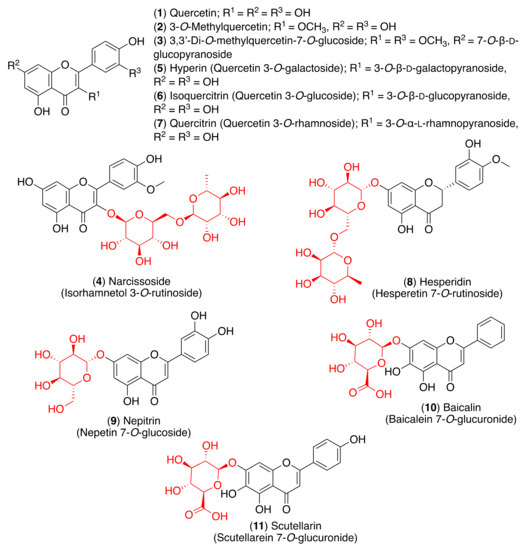
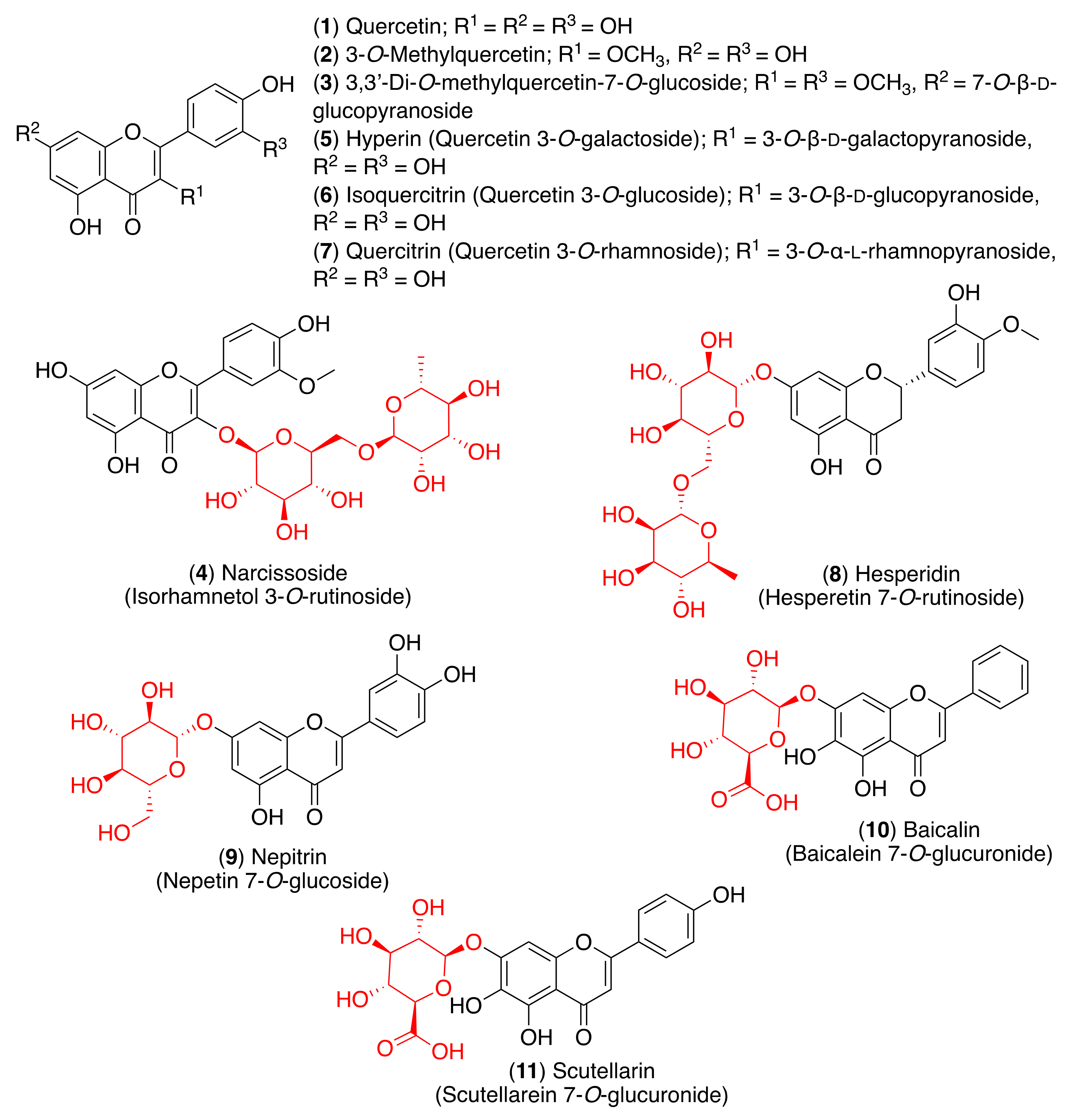
As stated above, flavonoids can be found in nature in their glycosidic form and the sugar molecules attached to the flavonoid aglycone play a crucial role in biological activity. In this regard, glycosylation seems to generally reduce antioxidant activity. For example, the radical scavenging activities of quercetin and its glycosides, isolated from Halimodendron halodendron, were determined in the DPPH assay, and quercetin (1) and 3-O-methylquercetin (2) presented the highest antioxidant activities. The 3,3′-di-O-methylquercetin-7-O-glucoside (3) and narcissoside (4) presented weak radical scavenging activity (Figure 4) [65]. Choi et al. tested the in vitro and cellular antioxidant capacities of quercetin and its glycosides. Although isoquercitrin (6) and quercitrin (7) showed moderate antioxidant activity, quercetin (1) and hyperin (5) displayed strong cellular antioxidant capacity (Figure 4) [66]. Hesperidin (8) showed high antioxidant activity; however, it has been shown that this property is not limited to radical scavenging. In fact, hesperidin has the capability to attenuate tissue damage through antioxidant cellular defenses via the ERK/Nrf2 signaling pathway, which leads to the decrease in intracellular pro-oxidants and an increase in bilirubin as an internal antioxidant [67].
Figure 4.
Anti-inflammatory and antioxidant glycosyl flavonoids.
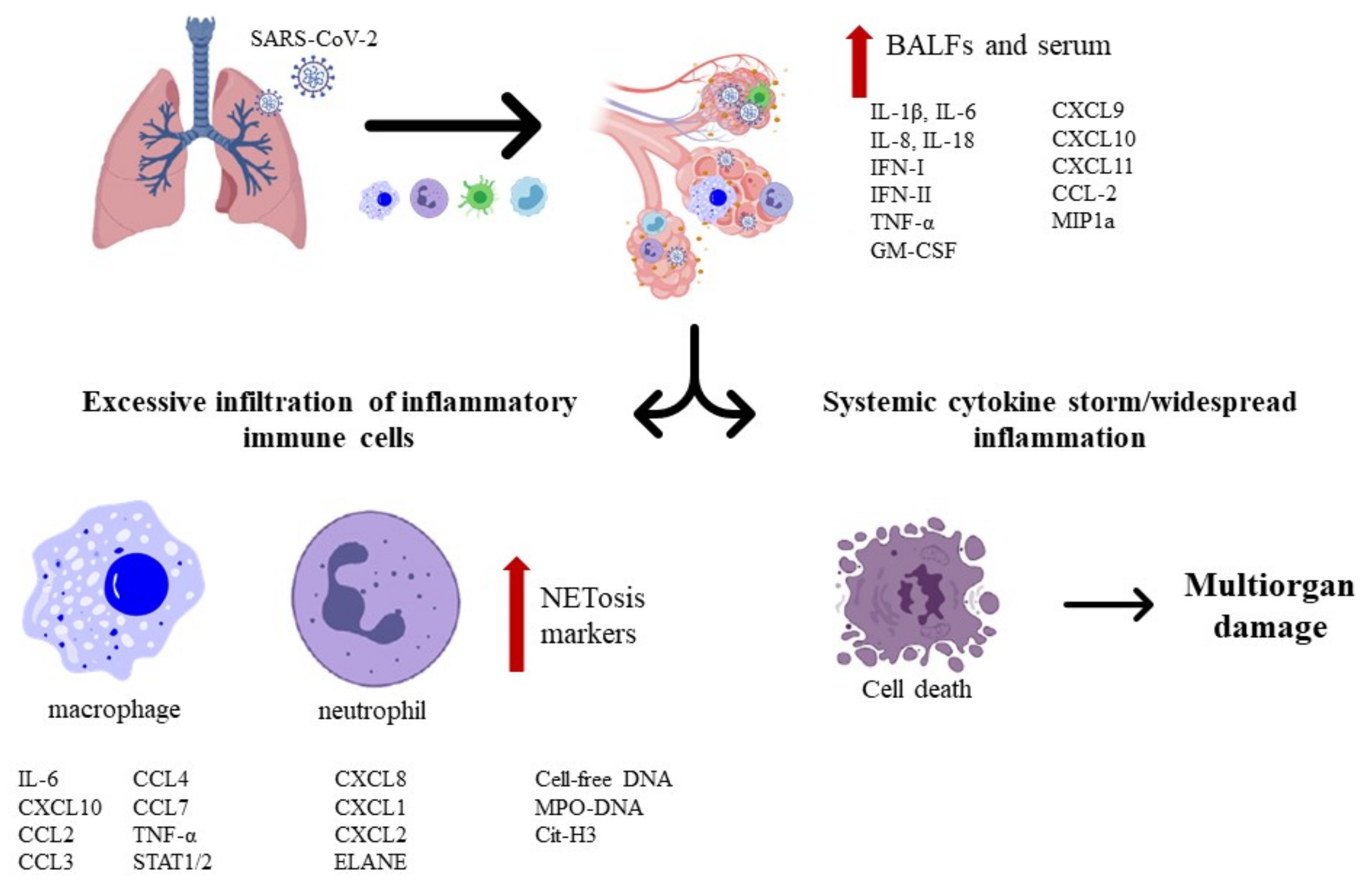
Besides their antioxidant activity, flavonoids are also well-known anti-inflammatory agents due to their cytokine-modulatory effects. The severity of COVID-19 infection is related to hypercytokinemia, an exaggerated immune response associated with an excessive and uncontrolled release of proinflammatory cytokine mediators—the so-called cytokine storm [68]. Choi et al. also tested the anti-inflammatory activity of quercetin (1) and its glycosides [66]. Although every compound presented anti-inflammatory activity, quercetin showed the highest efficacy in suppressing nitric oxide (NO) production, decreasing inducible nitric oxide synthase (iNOS) and cyclooxygenase-2 (COX-2) expression, and suppressing nuclear factor kappa B (NF-κB) activation. Quercetin (1) and quercitrin (7) showed a dose-dependent decrease of iNOS levels, while treatment with hyperin (5) and isoquercitrin (6) presented a non-dose-dependent suppressive effect. Consequently, the other mediator of the pro-inflammatory process, COX-2, was also attenuated in a dose-dependent manner. These results indicated that quercetin and its glycosides inhibit NO production in LPS-stimulated RWAS 264.7 cells through the attenuation of iNOS and COX-2 expression. The decrease of these levels is induced through the suppression of NF-κB activation via phosphorylation, since NF-κB upregulates the iNOS and COX-2 expression [66]. Hesperidin (8) also showed anti-inflammatory activity through down-regulation of iNOS and COX-2 in various in vitro and in vivo studies [66]. More recently, hesperidin was found to attenuate high levels of angiotensin II (AngII) in hypertensive rat models [69]. The anti-inflammatory effect mediated through anti-angiotensin action has previously been described for other flavonoid derivatives, such as glycosyl flavonoid nepitrin (9) [70].
Several other glycosyl flavonoids have been reported to modulate inflammatory mediators or signaling cascades, including toll-like receptors (TLRs) and NLR family pyrin domain containing 3 (NLRP3) inflammasomes. For example, baicalin (10) showed an effective protection of neurons from microglia-mediated neuroinflammation via the suppression of NLRP3 inflammasomes and the TLR4/NF-κB signaling pathway [71], while scutellarin (11) displayed the suppression of NLRP3 inflammasome activation in macrophages [72]. Considering that the deregulation of TLRs and NLRP3 is closely related to the severity of SARS-CoV-2 pathology, it can be assumed that glycosyl flavonoids could exert significant antiviral and immunomodulatory effects mediated through TLRs or NLRP3 inflammasomes in COVID-19 patients. However, these potential effects need to be evaluated further in well-defined pre-clinical and clinical studies.
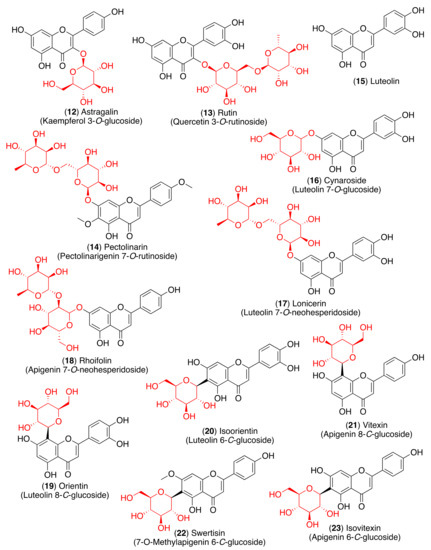
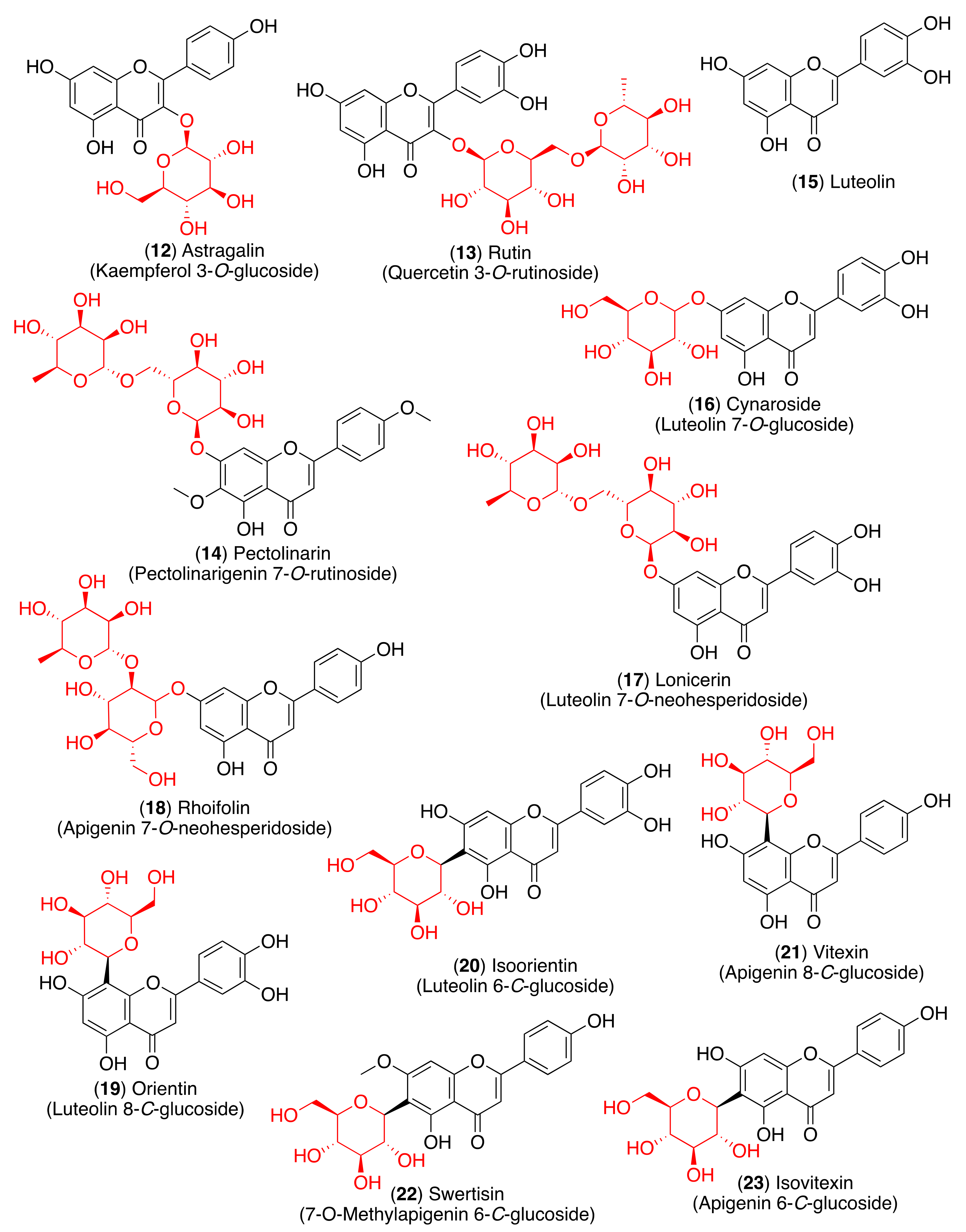
As most viral envelope glycoproteins contain N-linked glycans, α-glucosidase inhibitors have been proposed as potentially useful broad-spectrum antiviral agents based on their activity on a variety of enveloped viruses [73]. In this regard, some flavonoids and glycosyl flavonoids have been evaluated for their inhibitory activity of glucosidases. Hyperin (5), quercitrin (7), baicalin (10), astragalin (12), rutin (13) and pectolinarin (14) (Figure 4 and Figure 5) exhibited low α-glucosidase inhibitory activity. On the other hand, luteolin (15) and cynaroside (16) showed strong inhibitory activity against α-glucosidase (IC50 1.7–3.5 µM), while lonicerin (17) and rhoifolin (18) inhibited α-amylase strongly (IC50 8.4–84.0 µM) [74]. Shibano et al. studied the antioxidant and antidiabetic activity of several glycosyl flavonoids. The DPPH radical scavenging activities of the glycosyl flavonoids isolated from Commelina communis L., showed that isoquercitrin (6), cynaroside (16), orientin (19), and isoorientin (20) (Figure 5) were potent antioxidants. In addition to their antioxidant activity, narcissoside (4), isoquercitrin (6), vitexin (21), and swertisin (22) (Figure 4 and Figure 5) inhibited α-glucosidase (IC50 0.51, 0.24, 0.42 and 0.37 µM, respectively) [75]. Choo et al. reported the α-glucosidase inhibitory potential of vitexin (21) and isovitexin (23) (Figure 5) isolated from the leaves of Ficus deltoidea. In this in vivo study, vitexin (21) and isovitexin (23) showed a high percentage of postprandial blood glucose reduction on sucrose-loaded normoglycemic mice and induced diabetic rats. Therefore, the report supports the use of vitexin and isovitexin for managing diabetes mellitus and its complications [76].
Figure 5.
Glycosyl flavonoids with α-glucosidase inhibitory activity.
3.2. Antiviral Activity of Glycosyl Flavonoids
The antiviral properties of flavonoids were discovered in the 1940s [77,78,79]. Since then, flavonoids have been studied as possible therapeutic agents against many viruses. In fact, they can work through several different mechanisms, such as blocking the attachment and entry of the virus into host cells, interfering with various stages of viral replication processes or translation, and polyprotein processing to prevent the release of the viruses to infect other cells [80].
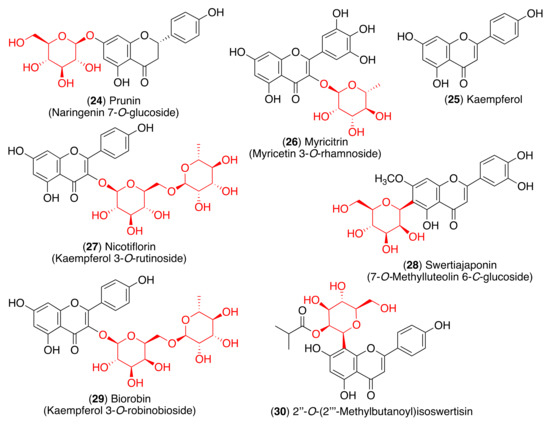
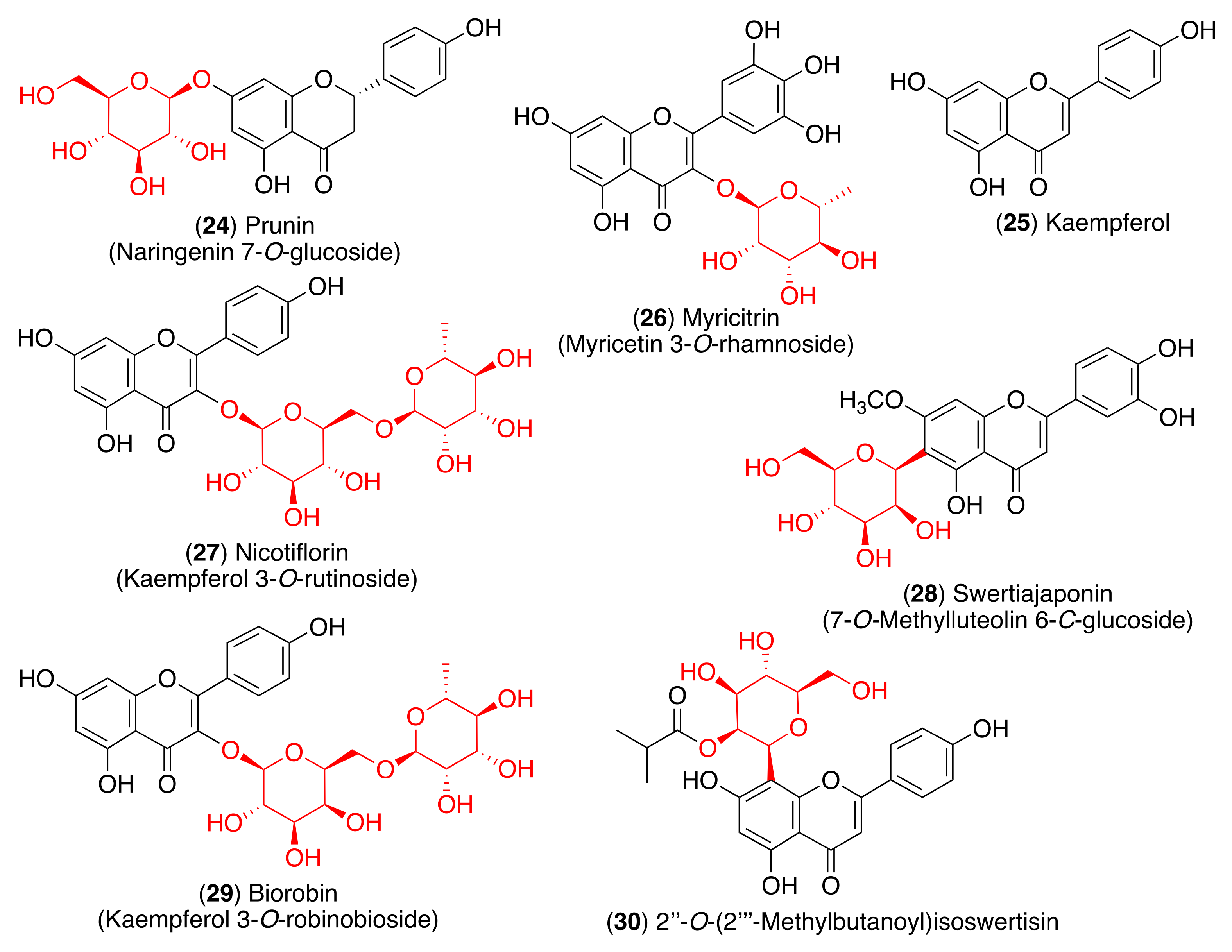
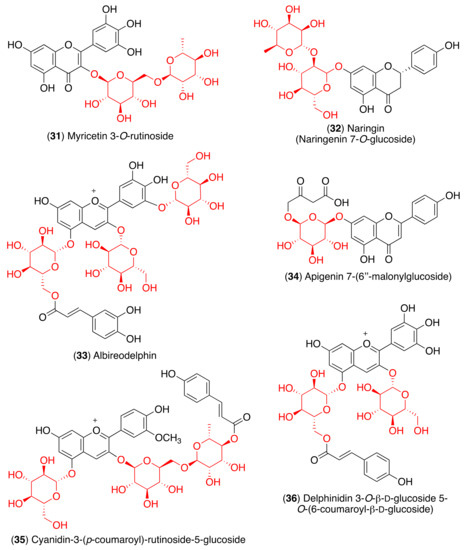
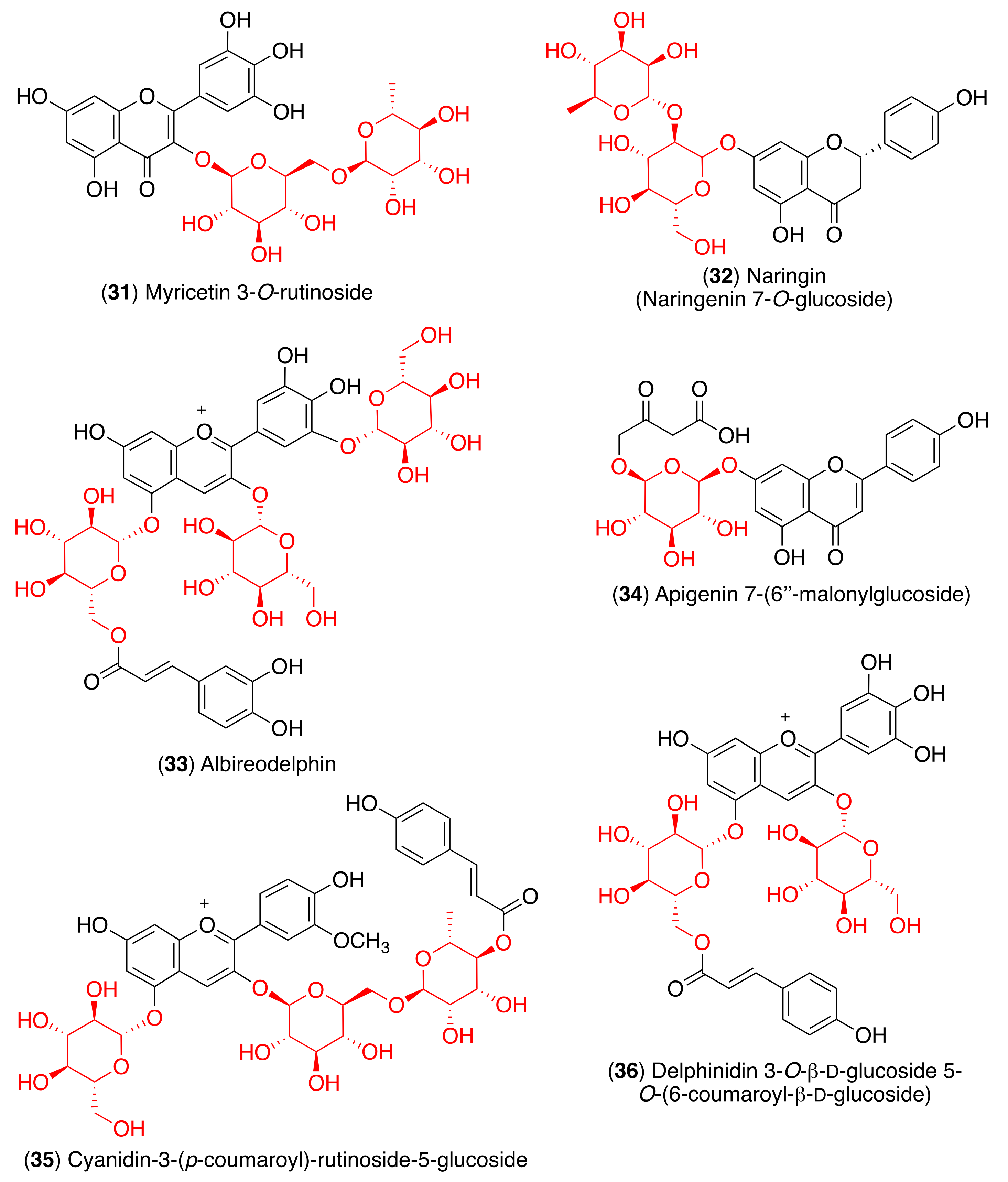
Since glycosyl flavonoids are widely distributed in the plant kingdom, they have also been studied as antiviral agents. Indeed, several glycosyl flavonoids have demonstrated inhibitory effects against several viruses (Figure 6, Table 1) [81,82,83,84,85,86,87,88,89,90,91,92,93,94,95].
Figure 6.
Antiviral glycosyl flavonoids.
Table 1.
Antiviral activity of glycosyl flavonoids.
For example, isoquercitrin (6) has the ability to protect mice from the Ebola virus when given prior to infection. Even though the mechanism of action is unknown, isoquercitrin targets the early steps of viral entry (IC50 5.3 µM) [81]. Another quercetin glucoside, quercitrin (7), was found to inhibit the initial stage of virus replication in the influenza A virus infection [82]. Moreover, glycosyl flavonoid rutin (13) inhibits the Enterovirus A71 3C protease with an IC50 of 109.6 ± 1.1 µM, significantly reducing viral plaque formation and the cytopathic effect [83]. This inhibition is associated with the suppression of the MERK-ERK signaling pathway that is required for an efficient Enterovirus A71 replication [84]. Baicalin (10) is another glycosyl flavonoid known to be an antiviral agent against human immunodeficiency virus type 1 (HIV-1), influenza A virus, and Enterovirus A71 (Table 1). Baicalin can inhibit the entry of HIV-1 since it interferes with the interaction of the envelope proteins of the virus with the host immune cells [85].
Baicalin can increase the interferon-gamma (INF-γ) in human CD4+ and CD8+T lymphocytes (CTL) and natural killer cells (NK) during an influenza A virus infection. The induction of INF-γ leads to the activation of Janus Kinase/Signal Transducer and Activator of Transcription (JAK/STAT-1) signaling pathway, leading to the expression and secretion of INF-γ [86]. In addition, baicalin exhibits potent antiviral activity for Enterovirus A71. Regarding the mode of action, baicalin blocked the expression of mRNA and polymerase in the early stages of infection by decreasing the expressions of Fas ligand (FasL) and caspase-3 that inhibit the Enterovirus A71 apoptosis in Rhabdomyosarcoma cells. Moreover, baicalin suppresses the NF-κB signaling pathway, decreasing the secretion of cytokines [87].
5. Conclusions
The SARS-CoV-2 outbreak has become a threat to the global population and health care systems. This virus has infected many people due to its quick spread, leading to the collapse of health care systems. In fact, the SARS-CoV-2 infection can cause respiratory and organ failure, which ultimately result in the death of infected patients. Despite the approval of several vaccines against COVID-19 infection, there is no defined curative treatment for SARS-CoV-2 or any related human coronavirus infection, such as SARS-CoV and MERS-CoV. Hence, the development of antiviral drugs against SARS-CoV-2 is considered urgent, not only to fight COVID-19, but also to be prepared for the very possible appearance of other human pathogenic coronaviruses.
In this review, we have discussed the information reported in the literature about glycosyl flavonoids as potential antiviral drugs for the inhibition of SARS-CoV-2 infection. Glycosyl flavonoids, structurally characterized by a flavonoid aglycone linked to a sugar moiety, are widely distributed in the plant kingdom. These natural products are highly recognized for their capacity to regulate antiviral, anti-inflammatory, and immunomodulatory responses, which also denotes their potential importance in the treatment of COVID-19. Recent reports also suggest that glycosyl flavonoids are promising inhibitors of SARS-CoV-2 target proteins (3CLpro, spike glycoprotein, PLpro, and RdRp), which would inhibit viral entrance in the cell, replication, and transcription. Despite the promising results of the studies published thus far on the use of glycosyl flavonoids against COVID-19, further studies focused on pharmacological in vitro and in vivo assays are needed to evaluate the applicability of these derivatives in the development of treatments against SARS-CoV-2. In addition, more glycosyl flavonoid analogues are required, especially those designed based on structure–activity relationship studies. In this sense, C-glycosyl flavonoids are especially important because, despite being naturally less abundant and having been much less studied than O-glycosyl flavonoids, they are remarkably more stable.
In this review, we believe that we have painted an accurate picture of the current status of glycosyl flavonoids as therapeutic substances targeting COVID-19, and we hope that this will provide a good starting point for researchers.
Author Contributions
Conceptualization, R.G.S. and V.L.M.S.; writing—original draft preparation, P.I.C.G.; writing—review and editing, P.I.C.G., R.G.S., and V.L.M.S.; supervision, R.G.S. and V.L.M.S. All authors have read and agreed to the published version of the manuscript.
Funding
This work received financial support from the University of Aveiro, Fundação para a Ciência e Tecnologia, FCT/MEC, through the financial support of the LAQV-REQUIMTE (UIDB/50006/2020), Principado de Asturias (FICYT IDI/2018/000181), and MINECO (PID2019-109253RB-I00). Vera L. M. Silva is also thankful for the Assistant Professor position (within CEE-CINST/2018; since 01/09/2019).
Institutional Review Board Statement
Not applicable.
Informed Consent Statement
Not applicable.
Data Availability Statement
No new data were created or analyzed in this study. Data sharing is not applicable to this article.
Conflicts of Interest
The authors declare no conflict of interest.
References
- Sun, P.; Lu, X.; Xu, C.; Sun, W.; Pan, B. Understanding of COVID-19 based on current evidence. J. Med. Virol. 2020, 92, 548–551. [Google Scholar] [CrossRef] [Scilit]
- Wrapp, D.; Wang, N.; Corbett, K.S.; Goldsmith, J.A.; Hsieh, C.-L.; Abiona, O.; Graham, B.S.; McLellan, J.S. Cryo-EM structure of the 2019-nCoV spike in the prefusion conformation. Science 2020, 367, 1260–1263. [Google Scholar] [CrossRef] [Scilit] [PubMed]
- Xiao, J.; Capanoglu, E.; Jassbi, A.R.; Miron, A. Advance on the Flavonoid C-glycosides and Health Benefits. Crit. Rev. Food Sci. Nutr. 2016, 56, S29–S45. [Google Scholar] [CrossRef] [Scilit]
- Forkmann, G.; Martens, S. Metabolic engineering and applications of flavonoids. Curr. Opin. Biotechnol. 2001, 12, 155–160. [Google Scholar] [CrossRef] [Scilit]
- Ferreyra, M.L.E.; Rius, S.P.; Ecasati, P. Flavonoids: Biosynthesis, biological functions, and biotechnological applications. Front. Plant Sci. 2012, 3, 222. [Google Scholar] [CrossRef] [Scilit]
- Courts, F.L.; Williamson, G. The Occurrence, Fate and Biological Activities of C-glycosyl Flavonoids in the Human Diet. Crit. Rev. Food Sci. Nutr. 2015, 55, 1352–1367. [Google Scholar] [CrossRef] [Scilit]
- Sak, K. Cytotoxicity of dietary flavonoids on different human cancer types. Pharmacogn. Rev. 2014, 8, 122–146. [Google Scholar] [CrossRef] [Scilit]
- Xiao, J. Dietary Flavonoid Aglycones and Their Glycosides: Which Show Better Biological Significance? Crit. Rev. Food Sci. Nutr. 2015, 57, 1874–1905. [Google Scholar] [CrossRef] [Scilit] [PubMed]
- Pietta, P.-G. Flavonoids as Antioxidants. J. Nat. Prod. 2000, 63, 1035–1042. [Google Scholar] [CrossRef] [Scilit]
- Rice-Evans, C. Flavonoid Antioxidants. Curr. Med. Chem. 2001, 8, 797–807. [Google Scholar] [CrossRef] [Scilit]
- Ribeiro, D.; Freitas, M.; Tomé, S.M.; Silva, A.M.; Porto, G.; Fernandes, E. Modulation of human neutrophils’ oxidative burst by flavonoids. Eur. J. Med. Chem. 2013, 67, 280–292. [Google Scholar] [CrossRef] [Scilit]
- Maleki, S.J.; Crespo, J.F.; Cabanillas, B. Anti-inflammatory effects of flavonoids. Food Chem. 2019, 299, 125124. [Google Scholar] [CrossRef] [Scilit]
- Nabavi, S.F.; Braidy, N.; Habtemariam, S.; Orhan, I.E.; Daglia, M.; Manayi, A.; Gortzi, O. Neuroprotective effects of chrysin: From chemistry to medicine. Neurochem. Int. 2015, 90, 224–231. [Google Scholar] [CrossRef] [Scilit]
- Nakajima, A.; Ohizumi, Y. Potential Benefits of Nobiletin, A Citrus Flavonoid, against Alzheimer’s Disease and Parkinson’s Disease. Int. J. Mol. Sci. 2019, 20, 3380. [Google Scholar] [CrossRef] [Scilit] [PubMed]
- Batra, P.; Sharma, A.K. Anti-cancer potential of flavonoids: Recent trends and future perspectives. 3 Biotech 2013, 3, 439–459. [Google Scholar] [CrossRef] [Scilit] [PubMed]
- Abotaleb, M.; Samuel, S.M.; Varghese, E.; Varghese, S.; Kubatka, P.; Líšková, A.; Büsselberg, D. Flavonoids in Cancer and Apoptosis. Cancers 2018, 11, 28. [Google Scholar] [CrossRef] [Scilit]
- Proença, C.; Freitas, M.; Ribeiro, D.; Tomé, S.M.; Oliveira, E.F.T.; Viegas, M.F.; Araújo, A.N.; Ramos, M.J.; Silva, A.M.S.; Fernandes, P.A.; et al. Evaluation of a flavonoids library for inhibition of pancreatic α-amylase towards a structure–activity relationship. J. Enzym. Inhib. Med. Chem. 2019, 34, 577–588. [Google Scholar] [CrossRef] [Scilit]
- Ahmad, A.; Kaleem, M.; Ahmed, Z.; Shafiq, H. Therapeutic potential of flavonoids and their mechanism of action against microbial and viral infections—A review. Food Res. Int. 2015, 77, 221–235. [Google Scholar] [CrossRef] [Scilit]
- Zakaryan, H.; Arabyan, E.; Oo, A.; Zandi, K. Flavonoids: Promising natural compounds against viral infections. Arch. Virol. 2017, 162, 2539–2551. [Google Scholar] [CrossRef] [Scilit] [PubMed]
- Zou, M.; Liu, H.; Li, J.; Yao, X.; Chen, Y.; Ke, C.; Liu, S. Structure-activity relationship of flavonoid bifunctional inhibitors against Zika virus infection. Biochem. Pharmacol. 2020, 177, 113962. [Google Scholar] [CrossRef] [Scilit]
- Rengasamy, K.R.; Khan, H.; Gowrishankar, S.; Lagoa, R.J.; Mahomoodally, F.M.; Khan, Z.; Suroowan, S.; Tewari, D.; Zengin, G.; Hassan, S.T.; et al. The role of flavonoids in autoimmune diseases: Therapeutic updates. Pharmacol. Ther. 2019, 194, 107–131. [Google Scholar] [CrossRef] [Scilit]
- Zheng, J. SARS-CoV-2: An Emerging Coronavirus that Causes a Global Threat. Int. J. Biol. Sci. 2020, 16, 1678–1685. [Google Scholar] [CrossRef] [Scilit] [PubMed]
- Cui, J.; Li, F.; Shi, Z.-L. Origin and evolution of pathogenic coronaviruses. Nat. Rev. Microbiol. 2019, 17, 181–192. [Google Scholar] [CrossRef] [Scilit] [PubMed]
- Wang, M.-Y.; Zhao, R.; Gao, L.-J.; Gao, X.-F.; Wang, D.-P.; Cao, J.-M. SARS-CoV-2: Structure, Biology, and Structure-Based Therapeutics Development. Front. Cell. Infect. Microbiol. 2020, 10, 587269. [Google Scholar] [CrossRef] [Scilit] [PubMed]
- Perlman, S.; Netland, J. Coronaviruses post-SARS: Update on replication and pathogenesis. Nat. Rev. Genet. 2009, 7, 439–450. [Google Scholar] [CrossRef] [Scilit]
- Woo, P.C.Y.; Lau, S.K.P.; Huang, Y.; Yuen, K.-Y. Coronavirus Diversity, Phylogeny and Interspecies Jumping. Exp. Biol. Med. 2009, 234, 1117–1127. [Google Scholar] [CrossRef] [Scilit]
- Duffy, S.; Shackelton, L.A.; Holmes, E.C. Rates of evolutionary change in viruses: Patterns and determinants. Nat. Rev. Genet. 2008, 9, 267–276. [Google Scholar] [CrossRef] [Scilit] [PubMed]
- Harrison, A.G.; Lin, T.; Wang, P. Mechanisms of SARS-CoV-2 Transmission and Pathogenesis. Trends Immunol. 2020, 41, 1100–1115. [Google Scholar] [CrossRef] [Scilit]
- Kochi, A.N.; Tagliari, A.P.; Forleo, G.B.; Fassini, G.M.; Tondo, C. Cardiac and arrhythmic complications in patients with COVID-19. J. Cardiovasc. Electrophysiol. 2020, 31, 1003–1008. [Google Scholar] [CrossRef] [Scilit]
- Berger, J.R. COVID-19 and the nervous system. J. Neurovirol. 2020, 26, 143–148. [Google Scholar] [CrossRef] [Scilit]
- Hess, D.C.; Eldahshan, W.; Rutkowski, E. COVID-19-Related Stroke. Transl. Stroke Res. 2020, 11, 322–325. [Google Scholar] [CrossRef] [Scilit] [PubMed]
- Watanabe, Y.; Allen, J.D.; Wrapp, D.; McLellan, J.S.; Crispin, M. Site-specific glycan analysis of the SARS-CoV-2 spike. Science 2020, 369, 330–333. [Google Scholar] [CrossRef] [Scilit] [PubMed]
- Walls, A.C.; Park, Y.-J.; Tortorici, M.A.; Wall, A.; McGuire, A.T.; Veesler, D. Structure, Function, and Antigenicity of the SARS-CoV-2 Spike Glycoprotein. Cell 2020, 181, 281–292. [Google Scholar] [CrossRef] [Scilit] [PubMed]
- Wang, Q.; Zhang, Y.; Wu, L.; Niu, S.; Song, C.; Zhang, Z.; Lu, G.; Qiao, C.; Hu, Y.; Yuen, K.-Y.; et al. Structural and Functional Basis of SARS-CoV-2 Entry by Using Human ACE2. Cell 2020, 181, 894–904. [Google Scholar] [CrossRef] [Scilit]
- Williams, S.J.; Goddard-Borger, E.D. α-Glucosidase inhibitors as host-directed antiviral agents with potential for the treatment of COVID-19. Biochem. Soc. Trans. 2020, 48, 1287–1295. [Google Scholar] [CrossRef] [Scilit]
- Shang, J.; Ye, G.; Shi, K.; Wan, Y.; Luo, C.; Aihara, H.; Geng, Q.; Auerbach, A.; Li, F. Structural basis of receptor recognition by SARS-CoV-2. Nat. Cell Biol. 2020, 581, 221–224. [Google Scholar] [CrossRef] [Scilit]
- Lan, J.; Ge, J.; Yu, J.; Shan, S.; Zhou, H.; Fan, S.; Zhang, Q.; Shi, X.; Wang, Q.; Zhang, L.; et al. Structure of the SARS-CoV-2 spike receptor-binding domain bound to the ACE2 receptor. Nature 2020, 581, 215–220. [Google Scholar] [CrossRef] [Scilit] [PubMed]
- Zhao, P.; Praissman, J.L.; Grant, O.C.; Cai, Y.; Xiao, T.; Rosenbalm, K.E.; Aoki, K.; Kellman, B.P.; Bridger, R.; Barouch, D.H.; et al. Virus-Receptor Interactions of Glycosylated SARS-CoV-2 Spike and Human ACE2 Receptor. Cell Host Microbe 2020, 28, 586–601. [Google Scholar] [CrossRef] [Scilit] [PubMed]
- Konwar, M.; Sarma, D. Advances in developing small molecule SARS 3CLpro inhibitors as potential remedy for corona virus infection. Tetrahedron 2021, 77, 131761. [Google Scholar] [CrossRef] [Scilit] [PubMed]
- Mouffouk, C.; Mouffouk, S.; Mouffouk, S.; Hambaba, L.; Haba, H. Flavonols as potential antiviral drugs targeting SARS-CoV-2 proteases (3CLpro and PLpro), spike protein, RNA-dependent RNA polymerase (RdRp) and angiotensin-converting enzyme II receptor (ACE2). Eur. J. Pharmacol. 2021, 891, 173759. [Google Scholar] [CrossRef] [Scilit]
- Li, Q.; Kang, C. Progress in Developing Inhibitors of SARS-CoV-2 3C-Like Protease. Microorganisms 2020, 8, 1250. [Google Scholar] [CrossRef] [Scilit] [PubMed]
- Xu, J.; Zhao, S.; Teng, T.; Abdalla, A.; Zhu, W.; Xie, L.; Wang, Y.; Guo, X. Systematic Comparison of Two Animal-to-Human Transmitted Human Coronaviruses: SARS-CoV-2 and SARS-CoV. Viruses 2020, 12, 244. [Google Scholar] [CrossRef] [Scilit] [PubMed]
- Abdusalam, A.A.A.; Murugaiyah, V. Identification of Potential Inhibitors of 3CL Protease of SARS-CoV-2 From ZINC Database by Molecular Docking-Based Virtual Screening. Front. Mol. Biosci. 2020, 7, 603037. [Google Scholar] [CrossRef] [Scilit]
- Kuo, C.-J.; Chao, T.-L.; Kao, H.-C.; Tsai, Y.-M.; Liu, Y.-K.; Wang, L.H.-C.; Hsieh, M.-C.; Chang, S.-Y.; Liang, P.-H. Kinetic Characterization and Inhibitor Screening for the Proteases Leading to Identification of Drugs against SARS-CoV-2. Antimicrob. Agents Chemother. 2021, 65, 02577-20. [Google Scholar] [CrossRef] [Scilit] [PubMed]
- Freitas, B.T.; Durie, I.A.; Murray, J.; Longo, J.E.; Miller, H.C.; Crich, D.; Hogan, R.J.; Tripp, R.A.; Pegan, S.D. Characterization and Noncovalent Inhibition of the Deubiquitinase and deISGylase Activity of SARS-CoV-2 Papain-Like Protease. ACS Infect. Dis. 2020, 6, 2099–2109. [Google Scholar] [CrossRef] [Scilit]
- Adhikari, N.; Baidya, S.K.; Saha, A.; Jha, T. Structural Insight into the Viral 3C-Like Protease Inhibitors: Comparative SAR/QSAR Approaches. In Viral Proteases and Their Inhibitors; Elsevier BV: Amsterdam, The Netherlands, 2017; pp. 317–409. [Google Scholar]
- Dai, W.; Zhang, B.; Jiang, X.-M.; Su, H.; Li, J.; Zhao, Y.; Xie, X.; Jin, Z.; Peng, J.; Liu, F.; et al. Structure-based design of antiviral drug candidates targeting the SARS-CoV-2 main protease. Science 2020, 368, 1331–1335. [Google Scholar] [CrossRef] [Scilit]
- Ullrich, S.; Nitsche, C. The SARS-CoV-2 main protease as drug target. Bioorganic Med. Chem. Lett. 2020, 30, 127377. [Google Scholar] [CrossRef] [Scilit]
- Yang, H.; Xie, W.; Xue, X.; Yang, K.; Ma, J.; Liang, W.; Zhao, Q.; Zhou, Z.; Pei, D.; Ziebuhr, J.; et al. Design of Wide-Spectrum Inhibitors Targeting Coronavirus Main Proteases. PLoS Biol. 2005, 3, e324. [Google Scholar] [CrossRef] [Scilit]
- Báez-Santos, Y.M.; John, S.E.S.; Mesecar, A.D. The SARS-coronavirus papain-like protease: Structure, function and inhibition by designed antiviral compounds. Antivir. Res. 2015, 115, 21–38. [Google Scholar] [CrossRef] [Scilit]
- Yan, S.; Wu, G. Spatial and temporal roles of SARS-CoV PLpro —A snapshot. FASEB J. 2021, 35, e21197. [Google Scholar] [CrossRef] [Scilit]
- Wu, C.; Liu, Y.; Yang, Y.; Zhang, P.; Zhong, W.; Wang, Y.; Wang, Q.; Xu, Y.; Li, M.; Li, X.; et al. Analysis of therapeutic targets for SARS-CoV-2 and discovery of potential drugs by computational methods. Acta Pharm. Sin. B 2020, 10, 766–788. [Google Scholar] [CrossRef] [Scilit] [PubMed]
- Shin, D.; Mukherjee, R.; Grewe, D.; Bojkova, D.; Baek, K.; Bhattacharya, A.; Schulz, L.; Widera, M.; Mehdipour, A.R.; Tascher, G.; et al. Papain-like protease regulates SARS-CoV-2 viral spread and innate immunity. Nature 2020, 575, 210–216. [Google Scholar] [CrossRef] [Scilit] [PubMed]
- Lenschow, D.J.; Lai, C.; Frias-Staheli, N.; Giannakopoulos, N.V.; Lutz, A.; Wolff, T.; Osiak, A.; Levine, B.; Schmidt, R.E.; García-Sastre, A.; et al. From the cover: IFN-stimulated gene 15 functions as a critical antiviral molecule against influenza, herpes, and Sindbis viruses. Proc. Natl. Acad. Sci. USA 2007, 104, 1371–1376. [Google Scholar] [CrossRef] [Scilit] [PubMed]
- Picarazzi, F.; Vicenti, I.; Saladini, F.; Zazzi, M.; Mori, M. Targeting the RdRp of Emerging RNA Viruses: The Structure-Based Drug Design Challenge. Molecules 2020, 25, 5695. [Google Scholar] [CrossRef] [Scilit]
- Kirchdoerfer, R.N.; Ward, A.B. Structure of the SARS-CoV nsp12 polymerase bound to nsp7 and nsp8 co-factors. Nat. Commun. 2019, 10, 1–9. [Google Scholar] [CrossRef] [Scilit]
- Ahn, D.-G.; Choi, J.-K.; Taylor, D.R.; Oh, J.-W. Biochemical characterization of a recombinant SARS coronavirus nsp12 RNA-dependent RNA polymerase capable of copying viral RNA templates. Arch. Virol. 2012, 157, 2095–2104. [Google Scholar] [CrossRef] [Scilit]
- Subissi, L.; Posthuma, C.C.; Collet, A.; Zevenhoven-Dobbe, J.C.; Gorbalenya, A.; Decroly, E.; Snijder, E.; Canard, B.; Imbert, I. One severe acute respiratory syndrome coronavirus protein complex integrates processive RNA polymerase and exonuclease activities. Proc. Natl. Acad. Sci. USA 2014, 111, E3900–E3909. [Google Scholar] [CrossRef] [Scilit]
- Gao, Y.; Yan, L.; Huang, Y.; Liu, F.; Zhao, Y.; Cao, L.; Wang, T.; Sun, Q.; Ming, Z.; Zhang, L.; et al. Structure of the RNA-dependent RNA polymerase from COVID-19 virus. Science 2020, 368, 779–782. [Google Scholar] [CrossRef] [Scilit]
- Elfiky, A.A. Anti-HCV, nucleotide inhibitors, repurposing against COVID-19. Life Sci. 2020, 248, 117477. [Google Scholar] [CrossRef] [Scilit] [PubMed]
- Ji, Y.; Li, B.; Qiao, M.; Li, J.; Xu, H.; Zhang, L.; Zhang, X. Advances on the in vivo and in vitro glycosylations of flavonoids. Appl. Microbiol. Biotechnol. 2020, 104, 6587–6600. [Google Scholar] [CrossRef] [Scilit] [PubMed]
- Plaza, M.; Pozzo, T.; Liu, J.; Ara, K.Z.G.; Turner, C.; Karlsson, E.N. Substituent Effects on in Vitro Antioxidizing Properties, Stability, and Solubility in Flavonoids. J. Agric. Food Chem. 2014, 62, 3321–3333. [Google Scholar] [CrossRef] [Scilit] [PubMed]
- Slámová, K.; Kapešová, J.; Valentová, K. “Sweet Flavonoids”: Glycosidase-Catalyzed Modifications. Int. J. Mol. Sci. 2018, 19, 2126. [Google Scholar] [CrossRef] [Scilit] [PubMed]
- Beltrán-García, J.; Osca-Verdegal, R.; Pallardó, F.V.; Ferreres, J.; Rodríguez, M.; Mulet, S.; Carbonell, F.; García-Giménez, J.L. Oxidative Stress and Inflammation in COVID-19-Associated Sepsis: The Potential Role of Anti-Oxidant Therapy in Avoiding Disease Progression. Antioxidants 2020, 9, 936. [Google Scholar] [CrossRef] [Scilit] [PubMed]
- Wang, J.; Lou, J.; Luo, C.; Zhou, L.; Wang, M.; Wang, L. Phenolic Compounds from Halimodendron halodendron (Pall.) Voss and Their Antimicrobial and Antioxidant Activities. Int. J. Mol. Sci. 2012, 13, 11349–11364. [Google Scholar] [CrossRef] [Scilit] [PubMed]
- Choi, S.-J.; Tai, B.H.; Cuong, N.M.; Kim, Y.-H.; Jang, H.-D. Antioxidative and anti-inflammatory effect of quercetin and its glycosides isolated from mampat (Cratoxylum formosum). Food Sci. Biotechnol. 2012, 21, 587–595. [Google Scholar] [CrossRef] [Scilit]
- Parhiz, H.; Roohbakhsh, A.; Soltani, F.; Rezaee, R.; Iranshahi, M. Antioxidant and Anti-Inflammatory Properties of the Citrus Flavonoids Hesperidin and Hesperetin: An Updated Review of their Molecular Mechanisms and Experimental Models. Phytother. Res. 2015, 29, 323–331. [Google Scholar] [CrossRef] [Scilit]
- Liskova, A.; Samec, M.; Koklesova, L.; Samuel, S.M.; Zhai, K.; Al-Ishaq, R.K.; Abotaleb, M.; Nosal, V.; Kajo, K.; Ashrafizadeh, M.; et al. Flavonoids against the SARS-CoV-2 induced inflammatory storm. Biomed. Pharmacother. 2021, 138, 111430. [Google Scholar] [CrossRef] [Scilit]
- Wunpathe, C.; Potue, P.; Maneesai, P.; Bunbupha, S.; Prachaney, P.; Kukongviriyapan, U.; Kukongviriyapan, V.; Pakdeechote, P. Hesperidin Suppresses Renin-Angiotensin System Mediated NOX2 Over-Expression and Sympathoexcitation in 2K-1C Hypertensive Rats. Am. J. Chin. Med. 2018, 46, 751–767. [Google Scholar] [CrossRef] [Scilit]
- Agarwal, O.P. The anti-inflammatory action of nepitrin, a flavonoid. Inflamm. Res. 1982, 12, 298–302. [Google Scholar] [CrossRef] [Scilit]
- Jin, X.; Liu, M.; Zhang, D.; Zhong, X.; Du, K.; Qian, P.; Yao, W.; Gao, H.; Wei, M. Baicalin mitigates cognitive impairment and protects neurons from microglia-mediated neuroinflammation via suppressing NLRP 3 inflammasomes and TLR 4/ NF -κB signaling pathway. CNS Neurosci. Ther. 2019, 25, 575–590. [Google Scholar] [CrossRef] [Scilit] [PubMed]
- Liu, Y.; Jing, Y.-Y.; Zeng, C.-Y.; Li, C.-G.; Xu, L.-H.; Yan, L.; Bai, W.-J.; Zha, Q.-B.; Ouyang, D.-Y.; He, X.-H. Scutellarin Suppresses NLRP3 Inflammasome Activation in Macrophages and Protects Mice against Bacterial Sepsis. Front. Pharmacol. 2018, 8, 975. [Google Scholar] [CrossRef] [Scilit]
- Chang, J.; Block, T.M.; Guo, J.-T. Antiviral therapies targeting host ER alpha-glucosidases: Current status and future directions. Antivir. Res. 2013, 99, 251–260. [Google Scholar] [CrossRef] [Scilit]
- Kim, J.-S.; Kwon, C.-S.; Son, K.H. Inhibition of Alpha-glucosidase and Amylase by Luteolin, a Flavonoid. Biosci. Biotechnol. Biochem. 2000, 64, 2458–2461. [Google Scholar] [CrossRef] [Scilit] [PubMed]
- Shibano, M.; Kakutani, K.; Taniguchi, M.; Yasuda, M.; Baba, K. Antioxidant constituents in the dayflower (Commelina communis L.) and their α-glucosidase-inhibitory activity. J. Nat. Med. 2008, 62, 349–353. [Google Scholar] [CrossRef] [Scilit]
- Choo, C.; Sulong, N.; Man, F.; Wong, T. Vitexin and isovitexin from the Leaves of Ficus deltoidea with in-vivo α-glucosidase inhibition. J. Ethnopharmacol. 2012, 142, 776–781. [Google Scholar] [CrossRef] [Scilit]
- Wang, T.-Y.; Li, Q.; Bi, K.-S. Bioactive flavonoids in medicinal plants: Structure, activity and biological fate. Asian J. Pharm. Sci. 2018, 13, 12–23. [Google Scholar] [CrossRef] [Scilit] [PubMed]
- Wang, H.-K.; Xia, Y.; Yang, Z.-Y.; Natschke, S.L.M.; Lee, K.-H. Recent Advances in the Discovery and Development of Flavonoids and their Analogues as Antitumor and Anti-HIV Agents. In Advances in Experimental Medicine and Biology; Springer Science and Business Media LLC: Berlin/Heidelberg, Germany, 1998; Volume 439, pp. 191–225. [Google Scholar]
- Russo, M.; Moccia, S.; Spagnuolo, C.; Tedesco, I.; Russo, G.L. Roles of flavonoids against coronavirus infection. Chem. Interact. 2020, 328, 109211. [Google Scholar] [CrossRef] [Scilit]
- Lalani, S.; Poh, C.L. Flavonoids as Antiviral Agents for Enterovirus A71 (EV-A71). Viruses 2020, 12, 184. [Google Scholar] [CrossRef] [Scilit]
- Qiu, X.; Kroeker, A.; He, S.; Kozak, R.; Audet, J.; Mbikay, M.; Chrétien, M. Prophylactic Efficacy of Quercetin 3-β-O-D-Glucoside against Ebola Virus Infection. Antimicrob. Agents Chemother. 2016, 60, 5182–5188. [Google Scholar] [CrossRef] [Scilit] [PubMed]
- Choi, H.J.; Song, J.H.; Park, K.S.; Kwon, D.H. Inhibitory effects of quercetin 3-rhamnoside on influenza A virus replication. Eur. J. Pharm. Sci. 2009, 37, 329–333. [Google Scholar] [CrossRef] [Scilit]
- Lin, Y.-J.; Chang, Y.-C.; Hsiao, N.-W.; Hsieh, J.-L.; Wang, C.-Y.; Kung, S.-H.; Tsai, F.-J.; Lan, Y.-C.; Lin, C.-W. Fisetin and rutin as 3C protease inhibitors of enterovirus A71. J. Virol. Methods 2012, 182, 93–98. [Google Scholar] [CrossRef] [Scilit] [PubMed]
- Wang, C.; Wang, P.; Chen, X.; Wang, W.; Jin, Y. Saururus chinensis (Lour.) Baill blocks enterovirus 71 infection by hijacking MEK1–ERK signaling pathway. Antivir. Res. 2015, 119, 47–56. [Google Scholar] [CrossRef] [Scilit] [PubMed]
- Li, B.Q.; Fu, T.; Dongyan, Y.; Mikovits, J.A.; Ruscetti, F.W.; Wang, J.M. Flavonoid Baicalin Inhibits HIV-1 Infection at the Level of Viral Entry. Biochem. Biophys. Res. Commun. 2000, 276, 534–538. [Google Scholar] [CrossRef] [Scilit]
- Chu, M.; Xu, L.; Zhang, M.-B.; Chu, Z.-Y.; Wang, Y.-D. Role of Baicalin in Anti-Influenza Virus A as a Potent Inducer of IFN-Gamma. BioMed Res. Int. 2015, 2015, 1–11. [Google Scholar] [CrossRef] [Scilit]
- Li, X.; Liu, Y.; Wu, T.; Jin, Y.; Cheng, J.; Wan, C.; Qian, W.; Xing, F.; Shi, W. The Antiviral Effect of Baicalin on Enterovirus 71 In Vitro. Viruses 2015, 7, 4756–4771. [Google Scholar] [CrossRef] [Scilit]
- Tsai, F.-J.; Lin, C.-W.; Lai, C.-C.; Lan, Y.-C.; Lai, C.-H.; Hung, C.-H.; Hsueh, K.-C.; Lin, T.-H.; Chang, H.C.; Wan, L.; et al. Kaempferol inhibits enterovirus 71 replication and internal ribosome entry site (IRES) activity through FUBP and HNRP proteins. Food Chem. 2011, 128, 312–322. [Google Scholar] [CrossRef] [Scilit] [PubMed]
- Gunaseelan, S.; Wong, K.Z.; Min, N.; Sun, J.; Ismail, N.K.B.M.; Tan, Y.J.; Lee, R.C.H.; Chu, J.J.H. Prunin suppresses viral IRES activity and is a potential candidate for treating enterovirus A71 infection. Sci. Transl. Med. 2019, 11, eaar5759. [Google Scholar] [CrossRef] [Scilit] [PubMed]
- Cao, T.-W.; Geng, C.-A.; Jiang, F.-Q.; Ma, Y.-B.; He, K.; Zhou, N.-J.; Zhang, X.-M.; Zhou, J.; Chen, J.-J. Chemical constituents of Swertia yunnanensis and their anti-hepatitis B virus activity. Fitoterapia 2013, 89, 175–182. [Google Scholar] [CrossRef] [Scilit]
- Yarmolinsky, L.; Huleihel, M.; Zaccai, M.; Ben-Shabat, S. Potent antiviral flavone glycosides from Ficus benjamina leaves. Fitoterapia 2012, 83, 362–367. [Google Scholar] [CrossRef] [Scilit] [PubMed]
- Ortega, J.T.; Suárez, A.I.; Serrano, M.L.; Baptista, J.; Pujol, F.H.; Rangel, H.R. The role of the glycosyl moiety of myricetin derivatives in anti-HIV-1 activity in vitro. AIDS Res. Ther. 2017, 14, 1–6. [Google Scholar] [CrossRef] [Scilit] [PubMed]
- Cai, S.-Q.; Wang, R.; Yang, X.; Shang, M.; Ma, C.; Shoyama, Y. Antiviral Flavonoid-Type C-Glycosides from the Flowers of Trollius chinensis. Chem. Biodivers. 2006, 3, 343–348. [Google Scholar] [CrossRef] [Scilit]
- Nayak, M.K.; Agrawal, A.S.; Bose, S.; Naskar, S.; Bhowmick, R.; Chakrabarti, S.; Sarkar, S.; Chawla-Sarkar, M. Antiviral activity of baicalin against influenza virus H1N1-pdm09 is due to modulation of NS1-mediated cellular innate immune responses. J. Antimicrob. Chemother. 2014, 69, 1298–1310. [Google Scholar] [CrossRef] [Scilit]
- Wang, M.; Tao, L.; Xu, H. Chinese herbal medicines as a source of molecules with anti-enterovirus 71 activity. Chin. Med. 2016, 11, 1–26. [Google Scholar] [CrossRef] [Scilit]
- Huang, J.; Tao, G.; Liu, J.; Cai, J.; Huang, Z.; Chen, J.-X. Current Prevention of COVID-19: Natural Products and Herbal Medicine. Front. Pharmacol. 2020, 11, 588508. [Google Scholar] [CrossRef] [Scilit] [PubMed]
- Huang, F.; Li, Y.; Leung, E.L.-H.; Liu, X.; Liu, K.; Wang, Q.; Lan, Y.; Li, X.; Yu, H.; Cui, L.; et al. A review of therapeutic agents and Chinese herbal medicines against SARS-COV-2 (COVID-19). Pharmacol. Res. 2020, 158, 104929. [Google Scholar] [CrossRef] [Scilit]
- Yang, R.; Liu, H.; Bai, C.; Wang, Y.; Zhang, X.; Guo, R.; Wu, S.; Wang, J.; Leung, E.; Chang, H.; et al. Chemical composition and pharmacological mechanism of Qingfei Paidu Decoction and Ma Xing Shi Gan Decoction against Coronavirus Disease 2019 (COVID-19): In silico and experimental study. Pharmacol. Res. 2020, 157, 104820. [Google Scholar] [CrossRef] [Scilit]
- Solnier, J.; Fladerer, J.-P. Flavonoids: A complementary approach to conventional therapy of COVID-19? Phytochem. Rev. 2020, 1–23. [Google Scholar] [CrossRef] [Scilit] [PubMed]
- Ngwa, W.; Kumar, R.; Thompson, D.; Lyerly, W.; Moore, R.; Reid, T.-E.; Lowe, H.; Toyang, N. Potential of Flavonoid-Inspired Phytomedicines against COVID-19. Molecules 2020, 25, 2707. [Google Scholar] [CrossRef] [Scilit] [PubMed]
- Diniz, L.R.L.; Filho, C.D.S.M.B.; Fielding, B.C.; De Sousa, D.P. Natural Antioxidants: A Review of Studies on Human and Animal Coronavirus. Oxidative Med. Cell. Longev. 2020, 2020, 1–14. [Google Scholar] [CrossRef] [Scilit] [PubMed]
- Nguyen, T.T.H.; Woo, H.-J.; Kang, H.-K.; Nguyen, V.D.; Kim, Y.-M.; Kim, D.-W.; Ahn, S.-A.; Xia, Y.; Kim, D. Flavonoid-mediated inhibition of SARS coronavirus 3C-like protease expressed in Pichia pastoris. Biotechnol. Lett. 2012, 34, 831–838. [Google Scholar] [CrossRef] [Scilit] [PubMed]
- Jo, S.; Kim, H.; Kim, S.; Shin, D.H.; Kim, M. Characteristics of flavonoids as potent MERS-CoV 3C-like protease inhibitors. Chem. Biol. Drug Des. 2019, 94, 2023–2030. [Google Scholar] [CrossRef] [Scilit] [PubMed]
- Jo, S.; Kim, S.; Shin, D.H.; Kim, M.-S. Inhibition of SARS-CoV 3CL protease by flavonoids. J. Enzym. Inhib. Med. Chem. 2020, 35, 145–151. [Google Scholar] [CrossRef] [Scilit]
- Su, H.X.; Yao, S.; Zhao, W.F.; Li, M.J.; Liu, J.; Shang, W.J.; Xie, H.; Ke, C.Q.; Hu, H.C.; Gao, M.N.; et al. Anti-SARS-CoV-2 activities in vitro of Shuanghuanglian preparations and bioactive ingredients. Acta Pharmacol. Sin. 2020, 41, 1167–1177. [Google Scholar] [CrossRef] [Scilit] [PubMed]
- Chen, L.-R.; Wang, Y.-C.; Lin, Y.W.; Chou, S.-Y.; Chen, S.-F.; Liu, L.T.; Wu, Y.-T.; Kuo, C.-J.; Chen, T.S.-S.; Juang, S.-H. Synthesis and evaluation of isatin derivatives as effective SARS coronavirus 3CL protease inhibitors. Bioorganic Med. Chem. Lett. 2005, 15, 3058–3062. [Google Scholar] [CrossRef] [Scilit] [PubMed]
- Zhang, J.; Huitema, C.; Niu, C.; Yin, J.; James, M.N.; Eltis, L.D.; Vederas, J.C. Aryl methylene ketones and fluorinated methylene ketones as reversible inhibitors for severe acute respiratory syndrome (SARS) 3C-like proteinase. Bioorg. Chem. 2008, 36, 229–240. [Google Scholar] [CrossRef] [Scilit]
- Shitrit, A.; Zaidman, D.; Kalid, O.; Bloch, I.; Doron, D.; Yarnizky, T.; Buch, I.; Segev, I.; Ben-Zeev, E.; Segev, E.; et al. Conserved interactions required for inhibition of the main protease of severe acute respiratory syndrome coronavirus 2 (SARS-CoV-2). Sci. Rep. 2020, 10, 1–11. [Google Scholar] [CrossRef] [Scilit]
- Su, H.; Zhou, F.; Huang, Z.; Ma, X.; Natarajan, K.; Zhang, M.; Huang, Y.; Su, H. Molecular Insights into Small-Molecule Drug Discovery for SARS-CoV-2. Angew. Chem. Int. Ed. 2021, 60, 9789–9802. [Google Scholar] [CrossRef] [Scilit]
- Jo, S.; Kim, S.; Kim, D.Y.; Kim, M.-S.; Shin, D.H. Flavonoids with inhibitory activity against SARS-CoV-2 3CLpro. J. Enzym. Inhib. Med. Chem. 2020, 35, 1539–1544. [Google Scholar] [CrossRef] [Scilit]
- Dubey, K.; Dubey, R. Computation screening of narcissoside a glycosyloxyflavone for potential novel coronavirus 2019 (COVID-19) inhibitor. Biomed. J. 2020, 43, 363–367. [Google Scholar] [CrossRef] [Scilit]
- Abian, O.; Ortega-Alarcon, D.; Jimenez-Alesanco, A.; Ceballos-Laita, L.; Vega, S.; Reyburn, H.T.; Rizzuti, B.; Velazquez-Campoy, A. Structural stability of SARS-CoV-2 3CLpro and identification of quercetin as an inhibitor by experimental screening. Int. J. Biol. Macromol. 2020, 164, 1693–1703. [Google Scholar] [CrossRef] [Scilit]
- Rizzuti, B.; Grande, F.; Conforti, F.; Jimenez-Alesanco, A.; Ceballos-Laita, L.; Ortega-Alarcon, D.; Vega, S.; Reyburn, H.T.; Abian, O.; Velazquez-Campoy, A. Rutin is a low micromolar inhibitor of SARS-CoV-2 main protease 3CLpro: Implications for drug design of quercetin analogs. Biomedicines 2021, 9, 375. [Google Scholar] [CrossRef] [Scilit]
- Cherrak, S.A.; Merzouk, H.; Mokhtari-Soulimane, N. Potential bioactive glycosylated flavonoids as SARS-CoV-2 main protease inhibitors: A molecular docking and simulation studies. PLoS ONE 2020, 15, e0240653. [Google Scholar] [CrossRef] [Scilit]
- A Da Silva, F.M.; Da Silva, K.P.A.; De Oliveira, L.P.M.; Costa, E.V.; Koolen, H.H.; Pinheiro, M.L.B.; De Souza, A.Q.L.; De Souza, A.D.L. Flavonoid glycosides and their putative human metabolites as potential inhibitors of the SARS-CoV-2 main protease (Mpro) and RNA-dependent RNA polymerase (RdRp). Memórias do Instituto Oswaldo Cruz 2020, 115, 200207. [Google Scholar] [CrossRef] [Scilit]
- Agrawal, P.K.; Agrawal, C.; Blunden, G. Rutin: A potential antiviral for repurposing as a SARS-CoV-2 Main Protease (Mpro) inhibitor. Nat. Prod. Commun. 2021, 16, 1–12. [Google Scholar] [CrossRef] [Scilit]
- Sharma, A.; Goyal, S.; Yadav, A.K.; Kumar, P.; Gupta, L. In-silico screening of plant-derived antivirals against main protease, 3CLpro and endoribonuclease, NSP15 proteins of SARS-CoV-2. J. Biomol. Struct. Dyn. 2020, 1–15. [Google Scholar] [CrossRef] [Scilit]
- Pandey, P.; Rane, J.S.; Chatterjee, A.; Kumar, A.; Khan, R.; Prakash, A.; Ray, S. Targeting SARS-CoV-2 spike protein of COVID-19 with naturally occurring phytochemicals: An in silico study for drug development. J. Biomol. Struct. Dyn. 2020, 1–11. [Google Scholar] [CrossRef] [Scilit] [PubMed]
- Yao, X.; Ye, F.; Zhang, M.; Cui, C.; Huang, B.; Niu, P.; Liu, X.; Zhao, L.; Dong, E.; Song, C.; et al. In Vitro Antiviral Activity and Projection of Optimized Dosing Design of Hydroxychloroquine for the Treatment of Severe Acute Respiratory Syndrome Coronavirus 2 (SARS-CoV-2). Clin. Infect. Dis. 2020, 71, 732–739. [Google Scholar] [CrossRef] [Scilit] [PubMed]
- Pandey, P.; Khan, F.; Rana, A.K.; Srivastava, Y.; Jha, S.K.; Jha, N.K. A Drug Repurposing Approach Towards Elucidating the Potential of Flavonoids as COVID-19 Spike Protein Inhibitors. Biointerface Res. Appl. Chem. 2020, 11, 8482–8501. [Google Scholar] [CrossRef] [Scilit]
- Jain, A.S.; Sushma, P.; Dharmashekar, C.; Beelagi, M.S.; Prasad, S.K.; Shivamallu, C.; Prasad, A.; Syed, A.; Marraiki, N.; Prasad, K.S. In silico evaluation of flavonoids as effective antiviral agents on the spike glycoprotein of SARS-CoV-2. Saudi J. Biol. Sci. 2021, 28, 1040–1051. [Google Scholar] [CrossRef] [Scilit]
- Biagioli, M.; Marchianò, S.; Roselli, R.; Di Giorgio, C.; Bellini, R.; Bordoni, M.; Gidari, A.; Sabbatini, S.; Francisci, D.; Fiorillo, B.; et al. Discovery of a AHR pelargonidin agonist that counter-regulates ACE2 expression and attenuates ACE2-SARS-CoV-2 interaction. Biochem. Pharmacol. 2021, 188, 114564. [Google Scholar] [CrossRef] [Scilit] [PubMed]
- Guler, H.I.; Ay Sal, F.; Can, Z.; Kara, Y.; Yildiz, O.; Belduz, A.O.; Çanakci, S.; Kolayli, S. Targeting CoV-2 Spike RBD and ACE-2 interaction with flavonoids of anatolian propolis by in silico and in vitro studies in terms of possible COVID-19 therapeutics. bioRxiv 2021. [Google Scholar] [CrossRef] [Scilit]
- Rameshkumar, M.R.; Indu, P.; Arunagirinathan, N.; Venkatadri, B.; El-Serehy, H.A.; Ahmad, A. Computational selection of flavonoid compounds as inhibitors against SARS-CoV-2 main protease, RNA-dependent RNA polymerase and spike proteins: A molecular docking study. Saudi J. Biol. Sci. 2021, 28, 448–458. [Google Scholar] [CrossRef] [Scilit] [PubMed]
- Hiremath, S.; Kumar, H.D.V.; Nandan, M.; Mantesh, M.; Shankarappa, K.S.; Venkataravanappa, V.; Basha, C.R.J.; Reddy, C.N.L. In silico docking analysis revealed the potential of phytochemicals present in Phyllanthus amarus and Andrographis paniculata, used in Ayurveda medicine in inhibiting SARS-CoV-2. 3 Biotech 2021, 11, 1–18. [Google Scholar] [CrossRef] [Scilit] [PubMed]

Publisher’s Note: MDPI stays neutral with regard to jurisdictional claims in published maps and institutional affiliations. |
© 2021 by the authors. Licensee MDPI, Basel, Switzerland. This article is an open access article distributed under the terms and conditions of the Creative Commons Attribution (CC BY) license (https://creativecommons.org/licenses/by/4.0/).