


Abstract
The aim of this study was to provide a summary of the existing published knowledge on the possible relationship between the workplace as a stressor factor and nurses’ tobacco use. A systematic review of the literature from 1995 to 2009, using the MEDLINE database took place. Studies, that referred to nurses’ smoking habit exclusively or as a part of the study, were included in the review. 491 studies were retrieved and their titles/abstracts were examined systematically. Twenty one studies were retrieved for further consideration by a comprehensive literature review. Ten studies fulfilled the eligibility criteria and they were examined further. There is a conflict on the possible relationship between workplace as a stressor factor and nurses’ smoking habits, because there is no evidence on if the nurses’ work environment causes smoking initiation.
1. Introduction
Smoking has been identified by the World Health Organization as a global epidemic [1,2]. The crucial role of health care professionals in tobacco control can be demonstrated by the fact that the number of smokers would decrease by an additional two million per year, if only 100,000 health care providers were to help just 10% of their patients to stop smoking [3]. Nurses, as well as physicians, have an important role in educating their patients. They are seen as symbols of good health practice and they can influence the smoking habits of their patients by counseling them on smoking cessation interventions [4]. Nurses-led interventions for smoking cessation increase the chance of successful quitting by 50% [5]. However, there are barriers in achieving this goal by the nurses and therefore it is estimated that only 20% to 30% of nurses provide smoking cessation interventions to their patients [5]. The main barrier is nurses’ smoking behavior [6,8–15]. There are three main reasons that may explain why nurses smoke: stress caused by the working environment, peer and social influence and socioeconomic status and education [7]. Nurses who smoke perceive themselves as not being credible role models to help their patients quitting smoking. There are many studies demonstrating that a strong barrier to conducting smoking cessation interventions with the patients is the nurses themselves who continue to smoke and lack of confidence in their ability to support patients in their efforts to stop smoking [6,8–13]. Nurses who smoke seem to be less willing to take part in such practices and they are more likely to hold attitudes that might reduce the effects of their advice [14,15]. Nurses who smoke, may also be less supportive of smoke-free policy at health-care facilities [16].
Several studies mention that smoke-free health care facilities, like other smoke-free workplaces, can have an impact on nurses’ ability to quit [17–19]. Hospitals may be a potential factor that leads nursing staff to smoke in order to cope against stressful situations caused by the nursing environment. There is no clear link between working environment and tobacco use among nurses, as a lot of nurses have started smoking before entering hospitals, even before commencing training [7,20–23]. Older studies that examined nurses’ smoking behavior, had attempted to demonstrate that smoking as a coping mechanism against stress was associated to the nursing environment [24–30]. There were studies that presented the view that most of the nurses were women whose smoking was described to be related to stress at work, dissatisfaction with work and lack of social support [25,31,32]. The lack of controlling their own work, as well as stressful and high expectations increased smoking in women [33]. The reasons that were given by Leathar’s study for tobacco consumption were: not knowing anyone and having to make friends, having to cope with more responsibility than one should for his/her status on night shift and the general lack of support given by trained staff [24]. Although these studies tried to identify that the nursing environment may cause stress, they failed to comprehensively demonstrate a clear link between stress in the workplace and tobacco use [7]. Rowe and Macleod Clark performed a systematic review about the reasons that nurses smoke and they concluded that nurses were subject to the same kinds of stress as other females and thus were smoking for the same reasons [7]. The relationship between job stress and nicotine dependence could be stronger in hospitals with higher smoking prevalence among nurses, because it was speculated that nurses in such hospitals would be more allowed to smoke when feeling stressful during their assignment [34]. The aim of this systematic review is to provide a summary of the existing published knowledge on the nurses’ tobacco consumption as a coping mechanism against stressful working environment.
2. Methodology
A systematic review of the existing literature on the link between stress caused by the working environment and nurses’ tobacco use was carried out. The question posed was: “Is there an association between the stressful working environment and the beginning of tobacco use or the increase in smoking rates among nursing staff as a coping mechanism?” A review protocol was drawn up following standards outlined by the MOOSE Guidelines for Meta-Analysis and Systematic Reviews of Observational Studies [35]. The review was undertaken using the computer database of the US National Library of Medicine Medline for the years 1995–2009, with the help of the PubMed interface. Key words that were used for retrieving studies were: “Working Environment” or “Hospital” or “Nursing Environment” and “Smoking” or “Tobacco Use” or “Tobacco Consumption” and “Nurse” or “Nursing Staff” and “job stress”. The keywords were used all together and in pairs in order to retrieve the best possible number of studies. A single search string was not used, but we paired the different keywords in multiple ways. For example by using the keywords “hospital” and “smoking, 370 studies were retrieved. An additional 31 studies were retrieved by using the keywords “hospital” and “tobacco use”. Three studies were retrieved with the use of the keywords “working environment” and “smoking” etc. Studies on human subjects, published in English language that referred to nurses’ smoking habit exclusively or as a part of the study, were candidates for inclusion in the review Retrieved studies were checked against a list of eligibility criteria, while references of each study were checked manually in order to find additional studies that may meet the eligibility criteria.
Inclusion criteria were a priori defined in order to include or exclude the studies. These criteria included: (a) reference to human beings, (b) publication in English language, (c) time interval between 1995 and 2009, (d) epidemiological studies (of any design), (e) reference to nurses’ smoking habit exclusively or as a part of the study. The studies were searched without restrictions and then eliminated studies not in English or not with humans. Studies that did not meet these criteria were excluded from the review. Two researchers, who were working separately, used a standardized data extraction form in order to extract data from every included study systematically. The researchers independently reviewed each of the 491 titles and abstracts when they were available. Any disagreement was noted and discussed in a common meeting by the researchers. A major disagreement was the inclusion of two studies referred to nursing aids instead of nurses. In Greece, nursing aids’ duties overlap those of nurses several times. As nursing aids’ tasks may overlap those of nurses several times, it was decided to be included in the review. Moreover, these studies mentioned the smoking habit of nursing aids and the potential effect of stressful working environment, thus they were relative to the aim of the review, although the sample was not consisted of nurses. Data extracted from each study included study main characteristics, study population, sampling method, hospitals or nursing wards, topic, statistics and conclusions.
3. Results
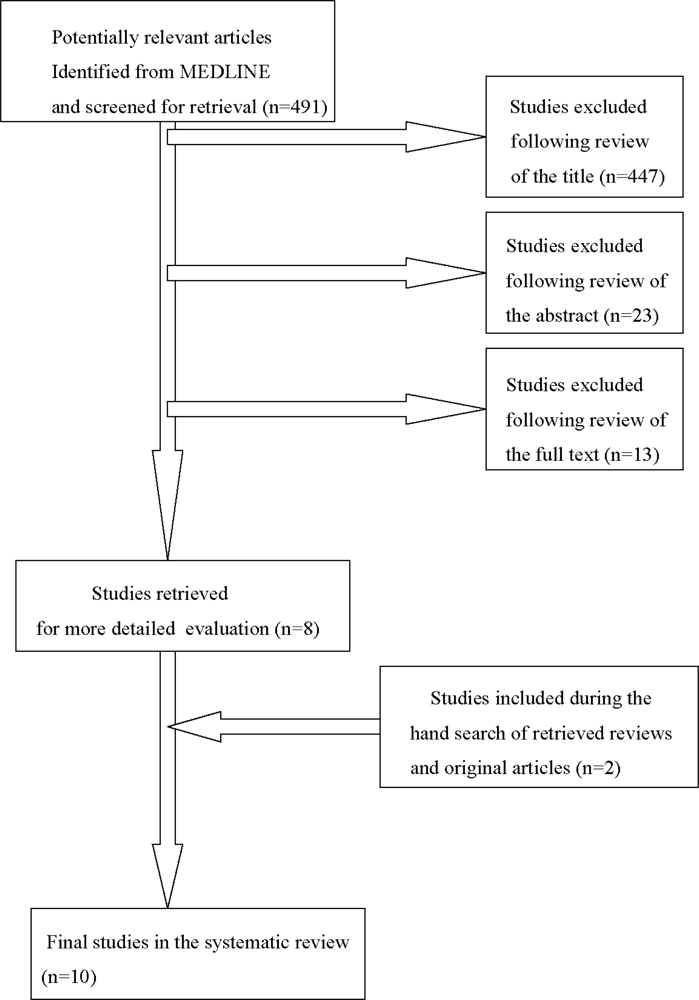
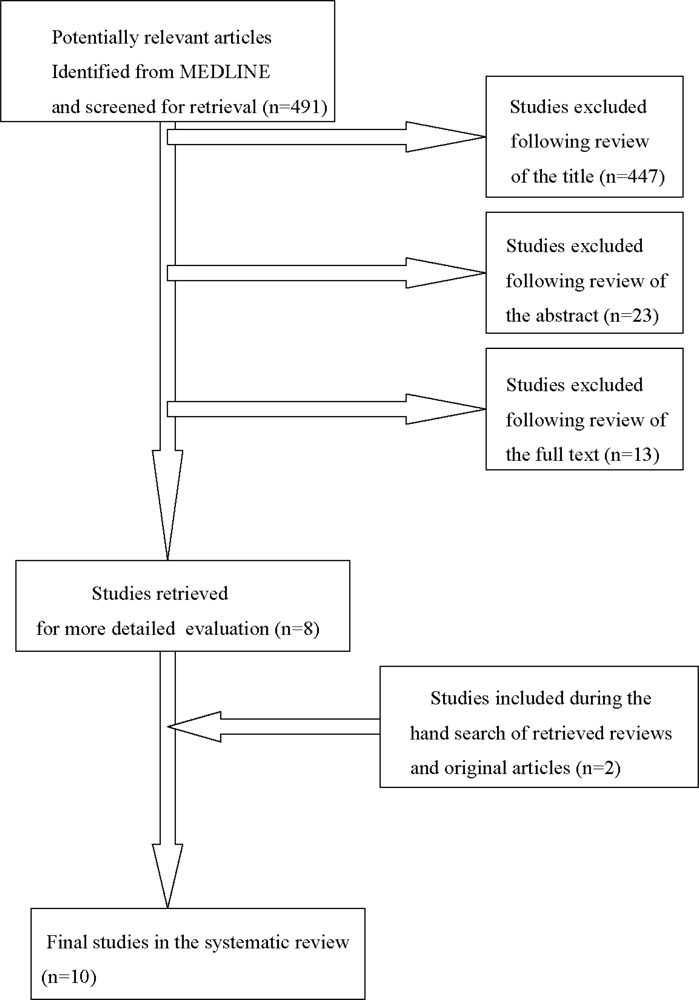
491 studies were retrieved by using the above key words. The number of studies identified and selected or excluded in each phase of the research is shown in Figure 1. Additionally, seven studies were provided by manual searching of the bibliography. However, only two of them met the eligibility criteria and were ultimately included in the systematic review. Ten studies were deemed suitable for inclusion in the review, although there were studies (3) where the link between working environment as a stressor factor and nurses’ smoking habits was not so clear.
Figure 1.
Literature research and strategy outcomes.
The main characteristics of the studies included in the systematic review are presented in Table 1. Four prospective cohort studies and four cross-sectional studies were included in the systematic review. Two studies were conducted in the USA, while seven were conducted in Europe (Poland, Northern Ireland, Greece, Norway, and Denmark) and one in Asia (Japan).
Table 1.
Summary of characteristics of studies included in the systematic review.
Table 2 summarizes the main findings as well as the conclusions of the retrieved studies, regarding the association between the working environment as a stressor factor and the tobacco consumption by the nurses. Job stress at the workplace was described in terms of psychological demand, decision latitude, supervisor support and coworker support [34] or by working more than 18 hours per week [36]. Eriksen’s study mentioned the social climate and the exposure to threats and violence as factors that caused stress at work [37]. There were studies where job stress was described as working at night [38] or having heavy physical job strain [39].
Table 2.
Main findings of studies included in the systematic review.
Five studies examined the association between workplace, stress levels and nurses’ smoking behavior or attitudes and experiences. Sarna et al. conducted a survey of eight focus groups with current or former smokers (n = 60). Smokers indicated higher levels of stress in the current job (6.9 ± 1.6) in a scale range 1–10 with higher scores indicating greater stress. Former smokers reported lower stress levels than current smokers (5.7 ± 2.7). As Sarna et al. mentioned “smoking was described as a way of taking time out and coping with the stressful environment of the busy hospital” [40]. Ota et al. performed a cross-sectional study in order to reveal a possible relationship between perceived job demand and self-reported nicotine dependence. They found a correlation between nicotine dependence scores and job stress scales among current smokers (n = 39). In particular, there were four job stress scales: psychological demand, decision latitude, supervisor support and coworker support. Statistically significant correlation was found between nicotine dependence and psychological demand (p < 0.001). The same result arose by multiple regression analysis while controlling for age (standardized beta TDS = 0.417, p = 0.009) [34].
McKenna et al. estimated that 68.4% of the nurses who were smokers had increased their consumption once they began their nursing career, while 65.3% of the ex-smokers had increased the tobacco use thereafter. 3.2% of smokers and 44.5% of ex-smokers had taken up the habit after beginning nursing [20]. Another study of McKenna et al. quoted nurses’ reasons for smoking. Work pressure was found to be the third reason (5.32 ± 3.23), following addiction (7.13 ± 3.1) and enjoyment (6.56 ± 2.84) in a scale range 1–10 with 1 representing “not important” and 10 being “important” [15]. Tselebis et al. examined nursing staff’s anxiety and smoking habits and it was found that smokers’ anxiety scores correlated strongly and positively with their per day quota of cigarettes (Pearson’s r = +0.65, p < 0.002) [41].
Five studies examined the role of work environment and work factors on smoking cessation among nurses. Sanderson et al. found that nurses who were working night shift (OR = 0.63, CI: 0.44–0.89) or having physical job strain (OR = 0.51, CI: 0.33–0.80) were less likely to quit smoking [39]. Eriksen conducted two surveys about work factors and smoking cessation in nurses’ aides and work factors as predictors of smoking relapse in the same occupational group [36, 37]. When work factors on smoking cessation were examined, it was found that nurses’ aides who were working 19–36 hours per week (OR = 0.35, CI: 0.13–0.91) or more than 36 hours per week (OR = 0.27, CI: 0.09–0.78) were less likely to quit smoking [36]. When work factors were examined as predictors of smoking relapse, Eriksen found that an increased risk of relapse was associated with the lowest level of the social climate (OR = 2.12, CI: 1.03–4.36), as well as with the reporting of rather often or very often exposure to threats and violence at work during the previous 2 years (OR = 2.08, CI: 1.01–4.29) [37].
Cofta and Staszewski found that hospital staff being on call or working at night were consuming more cigarettes per day than those who were not working at night (17.5 ± 7.7 and 14.4 ± 5.8 respectively). Furthermore, hospital staff on call or working at night were decreasing the time interval of the first cigarette after waking up (<30 min: 58.5% and 31–60 min: 32.1%) in comparison to those who were not working at night (<30 min: 54.7% and 31–60 min: 30.7%), although there was no statistical significance (p = 0.67) [38]. Sarna et al. found that there was a statistically significant difference between smokers and non-smokers in reporting stress as a barrier for quitting smoking at the 6 month time interval (67% vs. 46%, p = 0.02), whereas there was no significant difference at 3 and 12 months (78% vs. 80%, p = 0.73 and 80% vs. 69%, p = 0.19 respectively) [42].
4. Discussion
The aim of this systematic review was to bring together the existing body of knowledge regarding the potential association between nursing environment, job stress and nurses’ tobacco use. Workplace, as a stress factor, was examined either as a motivator for starting or increasing smoking habits among nursing staff, or as a barrier for cessation tobacco use. The review of the literature revealed various variables that describe what it is called “job stress”. These variables include heavy physical job strain, long working hours, perceived busyness, perceived work tempo/pressure, poor social climate, shift working, psychological demand, decision latitude, supervisor support, coworker support and patient care activities. That fact could possibly explain the existence of the conflict regarding the potential relationship of stress caused by the workplace and the smoking habits of the nursing staff. Because of the various descriptions of what it is called “job stress” it may be not clear a possible relationship between stress caused by hospital environment and nurses’ tobacco habits.
Studies dealing with the work stress and the smoking behavior of nurses have revealed a link between them. Ota et al. found an association between perceived job demand and self-reported nicotine dependence. Nurses with increased levels of high psychological demand may crave tobacco, smoke and became psychologically more dependent on smoking in order to diminish symptoms of mental stress caused by the workplace. Moreover, the relationship between job stress and tobacco use could be stronger in hospital with high smoking prevalence among nurses and among shift workers. Tobacco use may be a way of stress management instead of using other measures of stress reduction [34]. The results of Sarna’s et al. study indicated that smoking was not just a personal issue, but it was affecting nurses’ ability to cope with stress. Smoking was described as a way of taking out and coping with the stressful environment of the busy hospital. Cigarettes were described as “stress relieving devices” and the workplace as a place for relapse [40]. According to McKenna et al. job stress may not be the causative factor for most nurses’ taking up smoking, but it may play a role in the maintenance of the habit. It seems that job stress had little effect in the etiology of smoking behavior among nurses [20]. Although a strong positive correlation between anxiety scores and smoking that retrieved an anxiolytic influence of smoking was found by the study of Tselebis et al., it can explain only the maintenance of the habit and not the habit of smoking itself [41]. As Steward et al mentioned, smoking has been associated with the relief of anxiety in unselected populations, especially in women [43]. It is well known that smoking is highly addictive and has been marketed as something to promote calm and take a break. Cofta and Staszewski mentioned that hospital staff was smoking more cigarettes in their attempt to find a way of getting away from stress at work. However, there was not a clear way to distinguish the nurses’ involvement, although separate analysis for each category of personnel was performed [38].
Studies that examined the effect of work factors on nurses’ smoking cessation supported a potential link between workplace and tobacco consumption. Eriksen’s surveys indicated that the frequent exposures to threats and violence at work, the lack of supportive, trustful and relaxed social climate in the work unit and the long working hours were associated with increased risk of smoking relapse [36]. Increased risk of experiencing negative emotions could explain an increased risk of relapse [37]. Moreover, long working hours may evoke emotional distress, a well-known inhibitor of smoking cessation [44]. Sanderson et al. found that nurses who had heavy physical job strain, as well as those who perceived themselves as having little or no influence on their work were more likely to continue smoking. Two additional job stress related variables: perceived busyness and perceived work tempo/pressure were found to be no statistically significant [39]. Sarna et al. concluded that barriers and facilitators to quitting smoking may be present in the workplace, however stress found to be a statistically significant barrier only at 6 month time interval of “quitting smoking using the internet” program by nurses [42].
There are a number of limitations that should be considered in evaluating the review. We used only the computer database of the US National Library of Medicine Medline. We retrieved 491 studies by using the keywords all together and in pairs. By not using a single search string to capture all relevant articles, it may be rather difficult for others to replicate the search. Although language restrictions are generally not recommended in systematic reviews and that is an important limitation, the limits of the review included search on human subjects and English language. Other limitations include the reliance on cross-sectional data for many studies. We also included the survey of Cofta & Staszewski although there was not a clear way to distinguish the nurses’ smoking habit and the possible relationship with stress at hospital, besides of the separate analysis for each category of personnel.
5. Conclusions
The systematic review of the literature revealed evidence that the working environment for nurses can be a barrier for cessation and potentially a barrier to maintenance of a previous quit attempt. However, there is a conflict on the possible relationship between workplace as a stressor factor and nurses’ smoking habits, because there is no evidence on if the nurses’ work environment causes smoking initiation. Many nurses and nursing students started smoking before entering hospitals and nursing faculties. Creating a smoke-free and healthy environment will obviously help nurses quit smoking as well as prevent relapse of tobacco use. The recommended methods include use of counseling and support by telephone, internet, other forms of counseling and health provider support and use of pharmacotherapy (nicotine gum, nicotine lozenge, nicotine patch, nicotine inhaler, nicotine nasal spray buproprion). More restricted polices regarding healthcare systems and facilities that promote smoke-free living among nursing staff are necessary to achieve 100% tobacco-free hospitals. It is of great importance to perform further studies for evaluating the time of commencing tobacco consumption by nurses as well as the possible increase of smoking rates among nurses after entering the profession. Such well designed epidemiological studies will obviously help to identify a potential correlation between nurses’ smoking behavior and stress levels in the workplace.
References
- World Health Organization. The World Health Report 2003; WHO: Geneva, Switzerland, 2003. [Google Scholar]
- Sarna, L; Danao, L; Chan, S; Shin, S; Baldago, L; Endo, E; Minegishi, H; Wewers, M. Tobacco control curricula content in baccalaureate nursing programs in four Asian nations. Nurs. Outlook 2006, 54, 334–344. [Google Scholar]
- Heath, J; Crowell, N. Factors influencing intentions to integrate tobacco education among advanced practice nursing faculty. J. Prof. Nurs 2007, 23, 189–200. [Google Scholar]
- Hodgetts, G; Broers, T; Godwin, M. Smoking behaviour, kmowledge and attitudes among Family Medicine physicians and nurses in Bosnia and Herzegovina. BMC Public Health 2004, 5, 12. [Google Scholar]
- Froelicher, ES; Kohlman, VC. Tobacco free nurses. The facts on nurses and smoking. J. Cardiopulm. Rehabil 2005, 25, 198–199. [Google Scholar]
- Trinkoff, A; Storr, C. Substance use among nurses: differences between specialities. Am. J. Public Health 1998, 88, 581–585. [Google Scholar]
- Rowe, K; Macleod Clark, J. Why nurses smoke: a review of the literature. Int. J. Nurs. Studies 2000, 37, 173–181. [Google Scholar]
- Sarna, L; Brown, J; Lillington, L; Wewers, M; Brecht, M. Tobacco-control attitudes, advocacy and smoking behaviours of oncology nurses. Oncol. Nurs. Forum 2000, 27, 1519–1528. [Google Scholar]
- Jenkins, K; Ahljevych, K. Nursing students’ beliefs about smoking, their own smoking behaviours and use of professional tobacco treatment intervention. Appl. Nurs. Res 2003, 16, 164–172. [Google Scholar]
- Patkar, AA; Hill, K; Batra, V; Vergare, MJ; Leone, FT. A comparison of smoking habits among medical and nursing students. Chest 2003, 124, 1415–1420. [Google Scholar]
- Berman, BL; Read, LL; Marcus, AC; Gritz, ER. Nurses enrolled in a stop smoking program. The role of occupational stress. J. Womens Health 1992, 1, 41–46. [Google Scholar]
- Kitajima, T; Ohida, T; Harano, S; Kamal, AMJ; Takemura, S; Nozaki, N; Kawahara, K; Minaowa, M. Smoking behaviour, initiating and cessation factors among Japanese nurses: a cohort study. Public Health 2002, 116, 347–352. [Google Scholar]
- Kneeshaw, M. Nurses’ perceptions of co-worker responses to smoking cessation attempts. J. N. State Nurses Assoc 1990, 21, 9–13. [Google Scholar]
- Sarna, L; Bialous, S. Tobacco control in the 21st century: A critical issue for the nursing profession. Res. Search Nurs. Pract 2005, 19, 15–24. [Google Scholar]
- McKenna, H; Slater, P; McCance, T; Bunting, B; Spiers, A; McElwee, G. Qualified nurses’ smoking prevalence: their reasons for smoking and desire to quit. J. Adv. Nurs 2001, 35, 769–775. [Google Scholar]
- Offord, KP; Hurt, RD; Berge, KG; Frusti, DK; Schmidt, L. Effects of the implementation of a smoke-free policy in a medical centre. Chest 1992, 102, 1531–1536. [Google Scholar]
- Frichtenberg, CM; Glantz, SA. Effect of smoke-free workplaces on smoking behaviour: Systematic Review. BMJ 2002, 325, 188–195. [Google Scholar]
- Moher, M; Hey, K; Lancaster, T. Workplace interventions for smoking cessation. Cochrane Database of Systematic Review 2003, 2, CD003440. [Google Scholar]
- Stillman, FA; Hantula, DA; Swank, R. Creating a smoke-free hospital: Attitudes and smoking behaviours of nurses and physicians. Am. J. Health Prom 1994, 9, 108–114. [Google Scholar]
- McKenna, H; Slater, P; McCance, T; Bunting, B; Spiers, A; McElwee, G. The role of stress, peer influence and education levels on the smoking behavior of nurses. Int J Nurs Studies 2003, 40, 359–366. [Google Scholar]
- Nagle, A; Schofeld, M; Redman, S. Australian nurses’ smoking behaviour, knowledge and attitude towards providing smoking cessation care to their patients. Health Promot. Int 1999, 14, 133–144. [Google Scholar]
- Blakey, R; Seaton, A. Attitude among nursing tutors and their students. Health Bulletin 1992, 50, 417–421. [Google Scholar]
- Carmichael, A; Cockcroft, A. Links between nurses and cigarette smoking habits in a London teaching hospital. Respir. Med 1986, 84, 277–282. [Google Scholar]
- Leathar, DS. Smoking among student nurses. Nurs. Times 1980, 76, 589–590. [Google Scholar]
- Tagliacozzo, R; Vaughn, S. Stress and smoking in hospital nurses. Am. J. Public Health 1982, 5, 441–448. [Google Scholar]
- Spencer, JK. Nurses cigarette smoking in England and Wales. Int. J. Nurs. Studies 1984, 21, 69–79. [Google Scholar]
- Booth, K; Faulkner, A. Links between nurses and cigarette smoking. Nurs. Educ. Today 1986, 6, 176–182. [Google Scholar]
- Elkind, AK. Do nurses smoke because of stress? J. Advance Nurs 1988, 13, 733–745. [Google Scholar]
- Cinelli, B; Glover, ED. Nurses smoking in the workplace: causes and solutions. J. Community Health Nurs 1988, 5, 255–261. [Google Scholar]
- Carmichael, A; Cockcroft, A. Survey of student nurses’ smoking habits in a London teaching hospital. Respir. Med 1990, 84, 277–282. [Google Scholar]
- Murray, M; Swan, AV; Mattar, N. The task of nursing and the risk of smoking. J. Adv. Nurs 1983, 2, 131–138. [Google Scholar]
- Alexander, L; Beck, K. The smoking behaviour of military nurses: the relationship to job stress, job satisfaction and social support. J. Adv. Nurs 1990, 15, 843–849. [Google Scholar]
- Pelkonen, M; Kankkunen, P. Work stress, smoking habits and competence in supporting clients to cease smoking-a survey among Finnish nurses. Public Health 2000, 114, 464–467. [Google Scholar]
- Ota, A; Yasuda, N; Okamoto, Y; Kobayashi, Y; Sugihara, Y; Koda, S; Kawakami, N; Ohara, H. Relationship of job stress with nicotine dependence of smokers-A cross sectional study of female nurses in a general hospital. J. Occup. Health 2004, 46, 220–224. [Google Scholar]
- Stroup, DF; Berlin, JA; Morton, SC; Olkin, I; Williamson, GD; Rennie, D; Moher, D; Becker, BJ; Sipe, TA; Thacker, SB. Meta-analysis of Observational Studies in Epidemiology: A Proposal for Reporting. Am. Med. Assoc 2000, 283, 2008–2012. [Google Scholar]
- Eriksen, W. Work factors and smoking cessation in nurses’ aides: a prospective cohort study. BMC Public Health 2005, 5, 142. [Google Scholar]
- Eriksen, W. Work factors as predictors of smoking relapse in nurses’ aides. Int. Arch. Occup. Environ. Health 2006, 79, 244–250. [Google Scholar]
- Cofta, S; Staszewski, R. Hospital staff and smoking habits: do we need modification of smoking behavior in Polish hospitals? J. Physiol. Pharmacol 2008, 59, 191–199. [Google Scholar]
- Sanderson, DM; Ekholm, O; Hundrup, YA; Rasmussen, NK. Influence of lifestyle, health and work environment on smoking cessation among Danish nurses followed over 6 years. Prev. Med 2005, 41, 757–760. [Google Scholar]
- Sarna, L; Bialous, SA; Wewers, ME; Froelicher, ES; Danao, L. Nurses, smoking and the workplace. Res. Nurs. Health 2005, 28, 79–90. [Google Scholar]
- Tselebis, A; Panaghiotou, A; Theotoka, I; Ilias, I. Nursing staff anxiety versus smoking habits. Int. J. Nurs. Pract 2001, 7, 221–223. [Google Scholar]
- Sarna, L; Bialous, SA; Wewers, ME; Froelicher, ES; Wells, MJ; Kotlerman, J; Elashoff, D. Nurses trying to quit smoking using the Internet. Nurs. Outlook 2009, 57, 246–256. [Google Scholar]
- Stewart, SH; Karp, J; Pihl, RO; Peterson, RAJ. Anxiety sensitivity and self-reported reasons for drug use. J. Subst. Abuse 1997, 9, 223–240. [Google Scholar]
- Spurgeon, A; Harrington, JM; Cooper, CL. Health and safety problems associated with long working hours: a review of the current position. Occup. Environ. Med 1997, 54, 367–375. [Google Scholar]

© 2010 by the authors; licensee Molecular Diversity Preservation International, Basel, Switzerland. This article is an open-access article distributed under the terms and conditions of the Creative Commons Attribution license (http://creativecommons.org/licenses/by/3.0/).