A Study on Optimal Machining Conditions and Energy Efficiency in Plasma Assisted Machining of Ti-6Al-4V


Abstract
1. Introduction
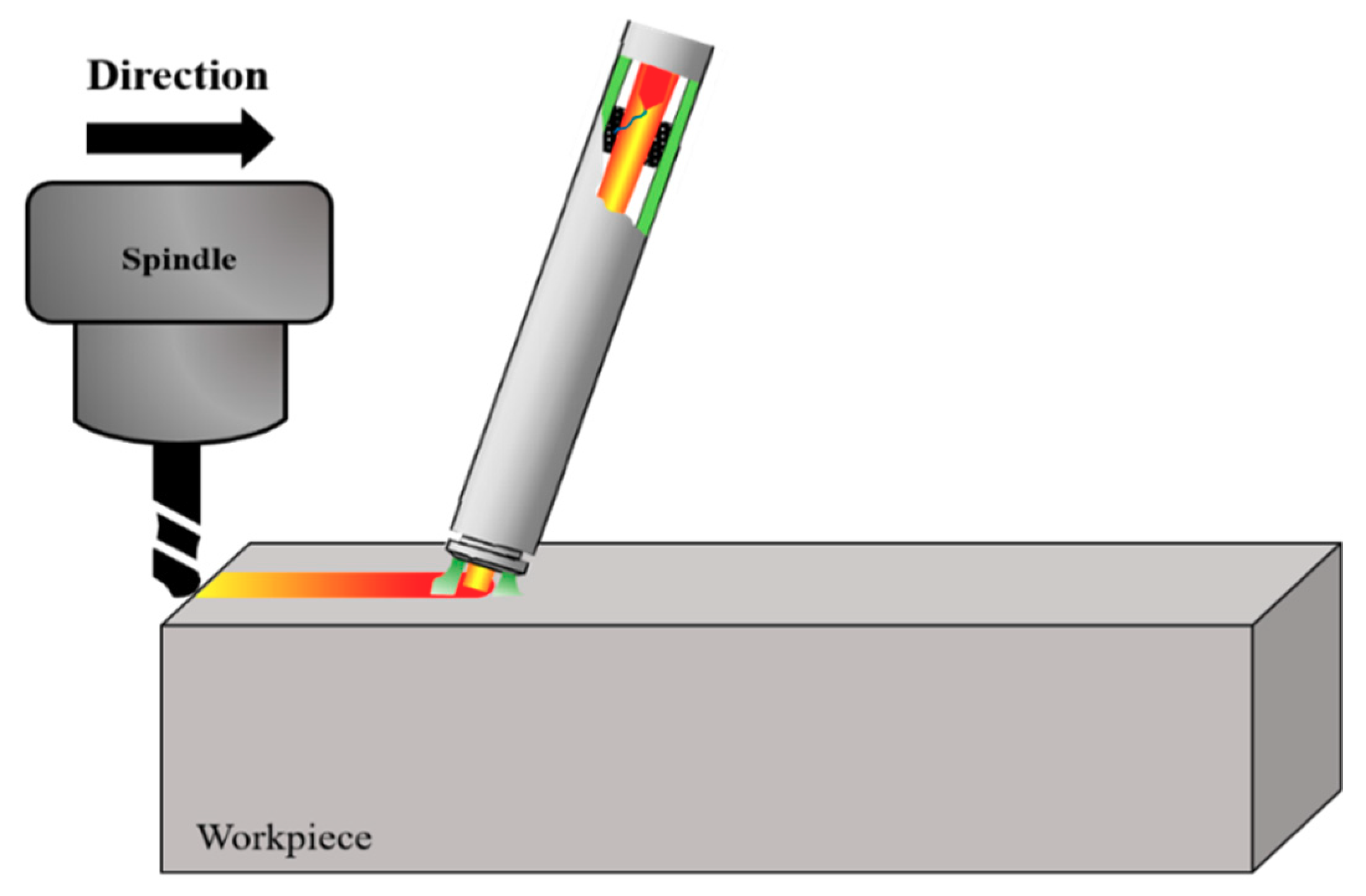
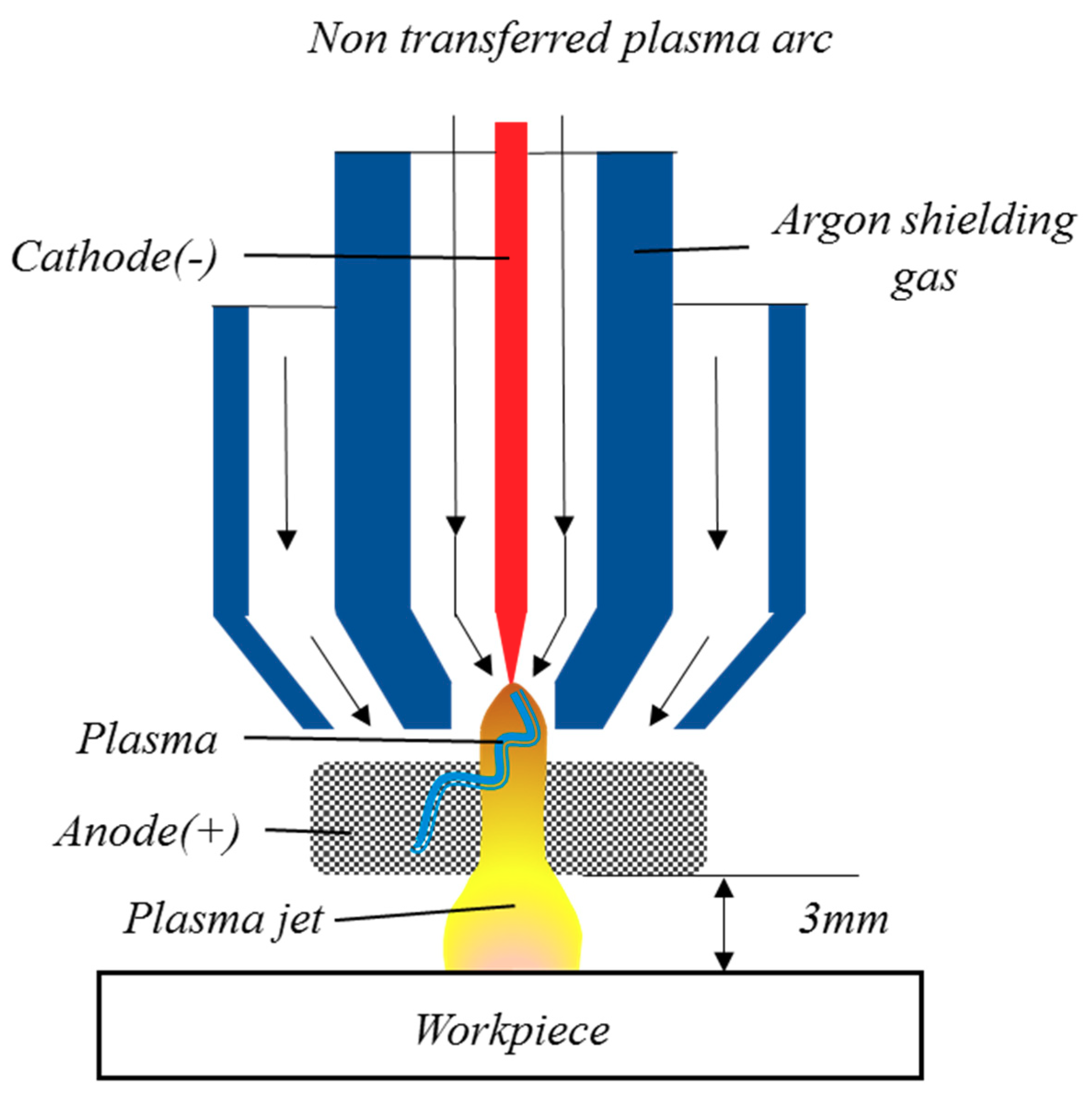
2. Plasma Assisted Machining
3. Finite Element Method
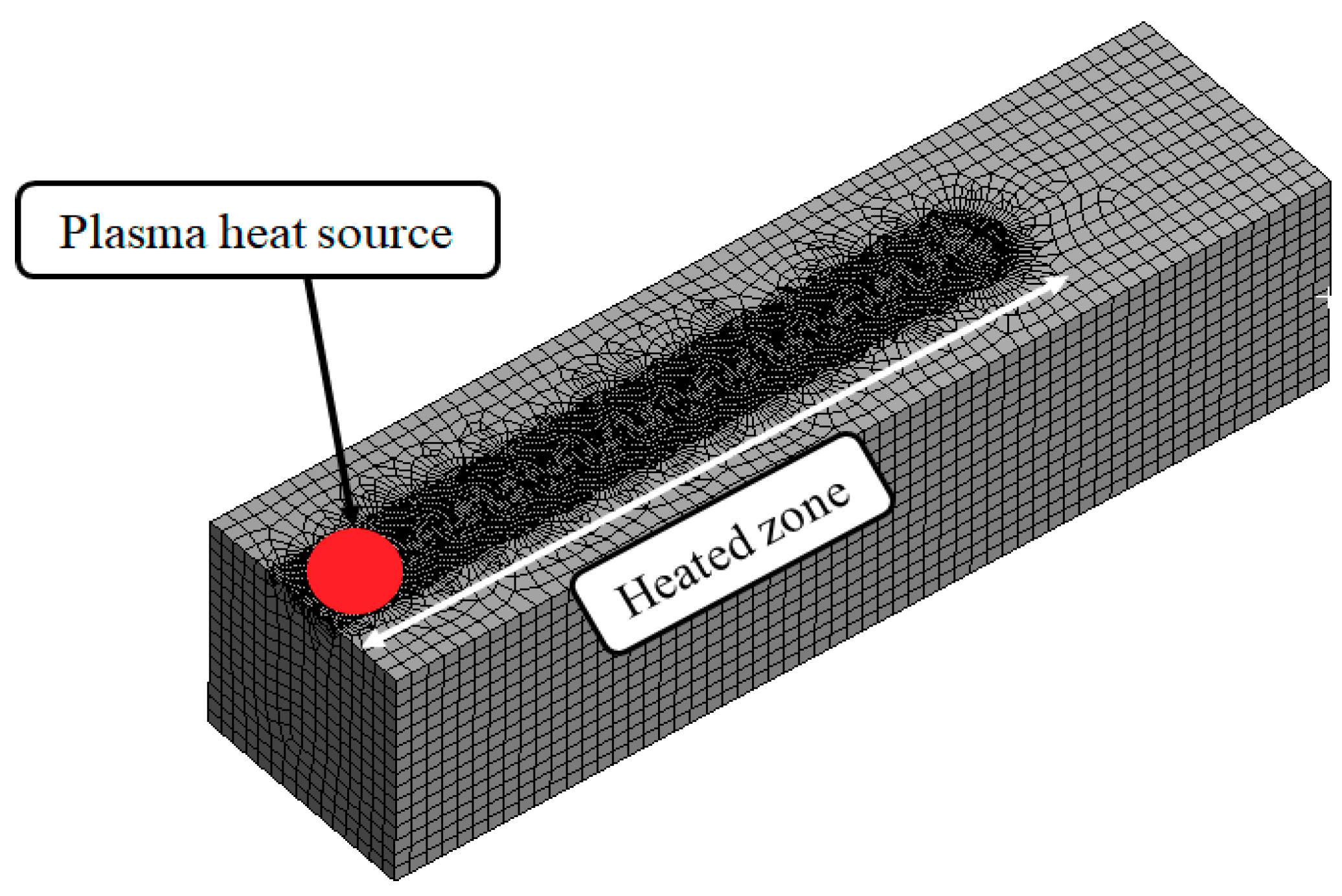
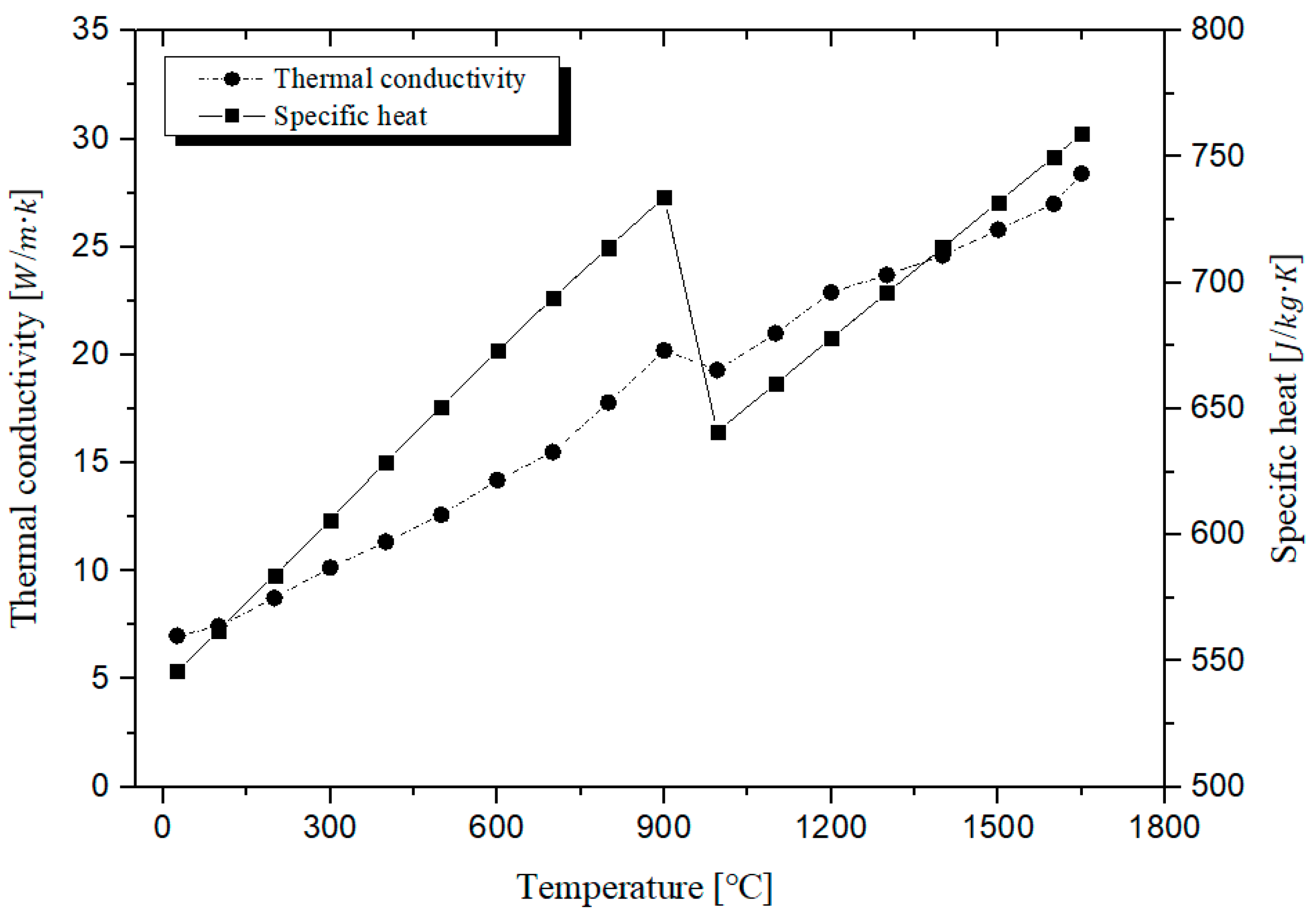
3.1. Thermal Analysis
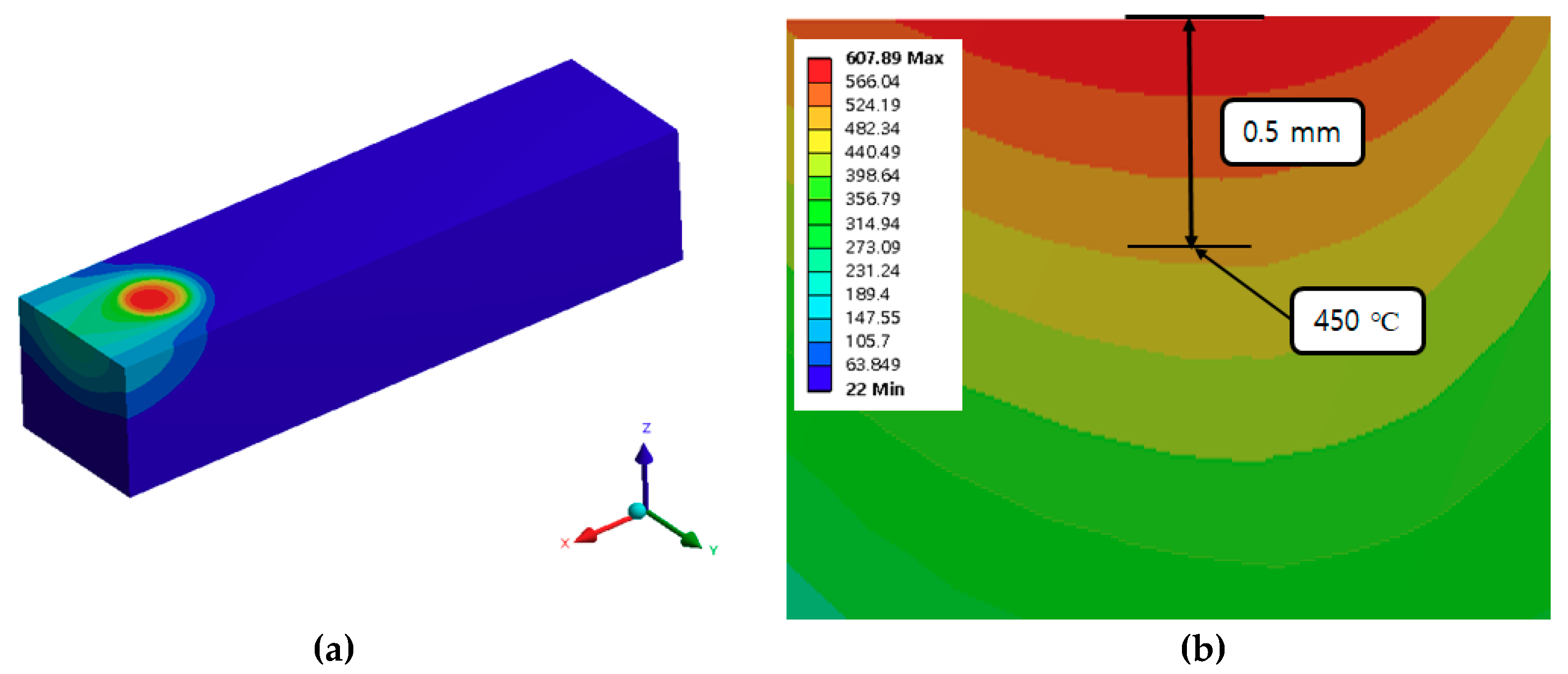
3.2. Results of Analysis
4. Experiment
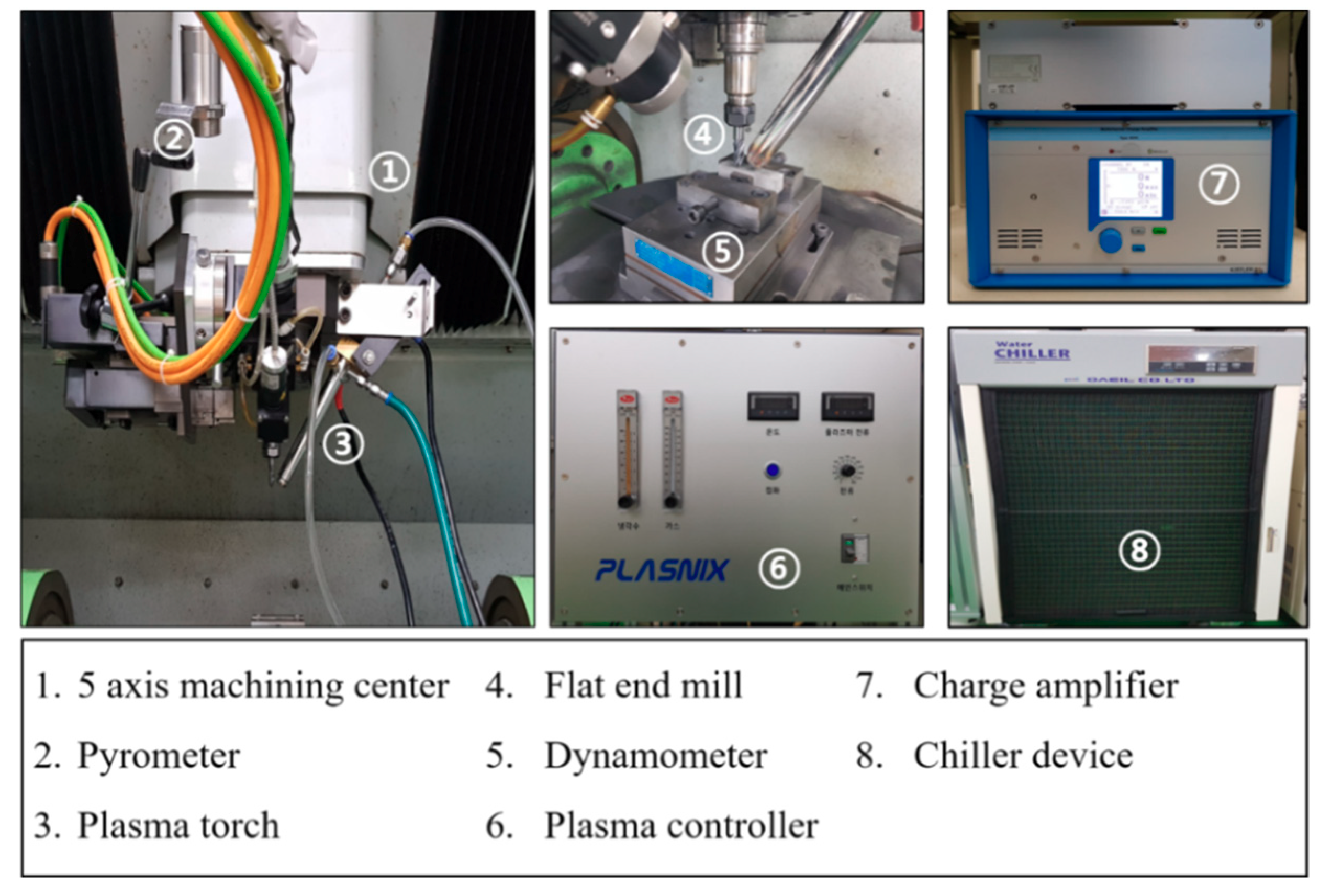
4.1. Experiment Setup
4.2. Design of Experiments
4.3. Machining Condition
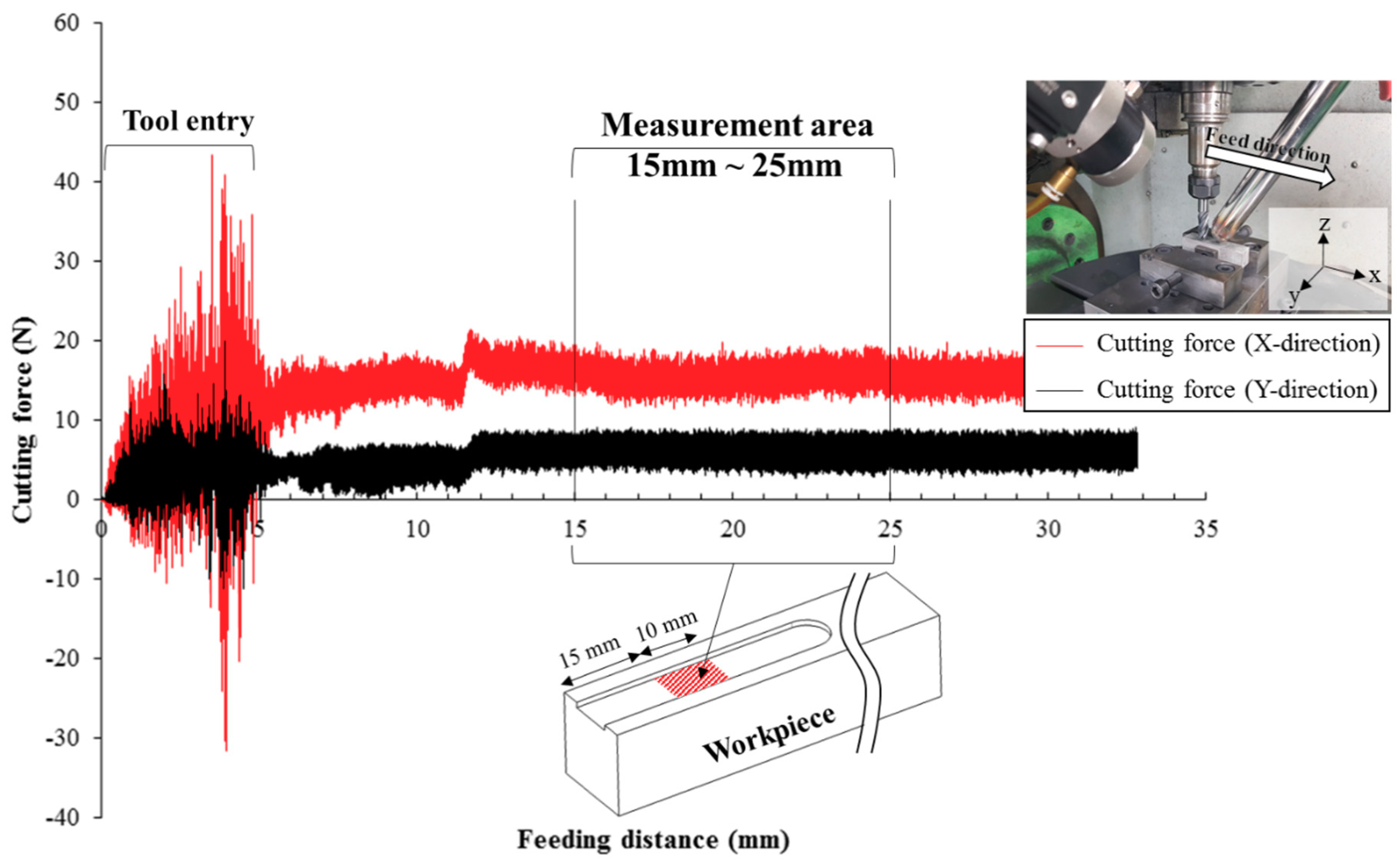
4.4. Measurement
5. Results and Discussion
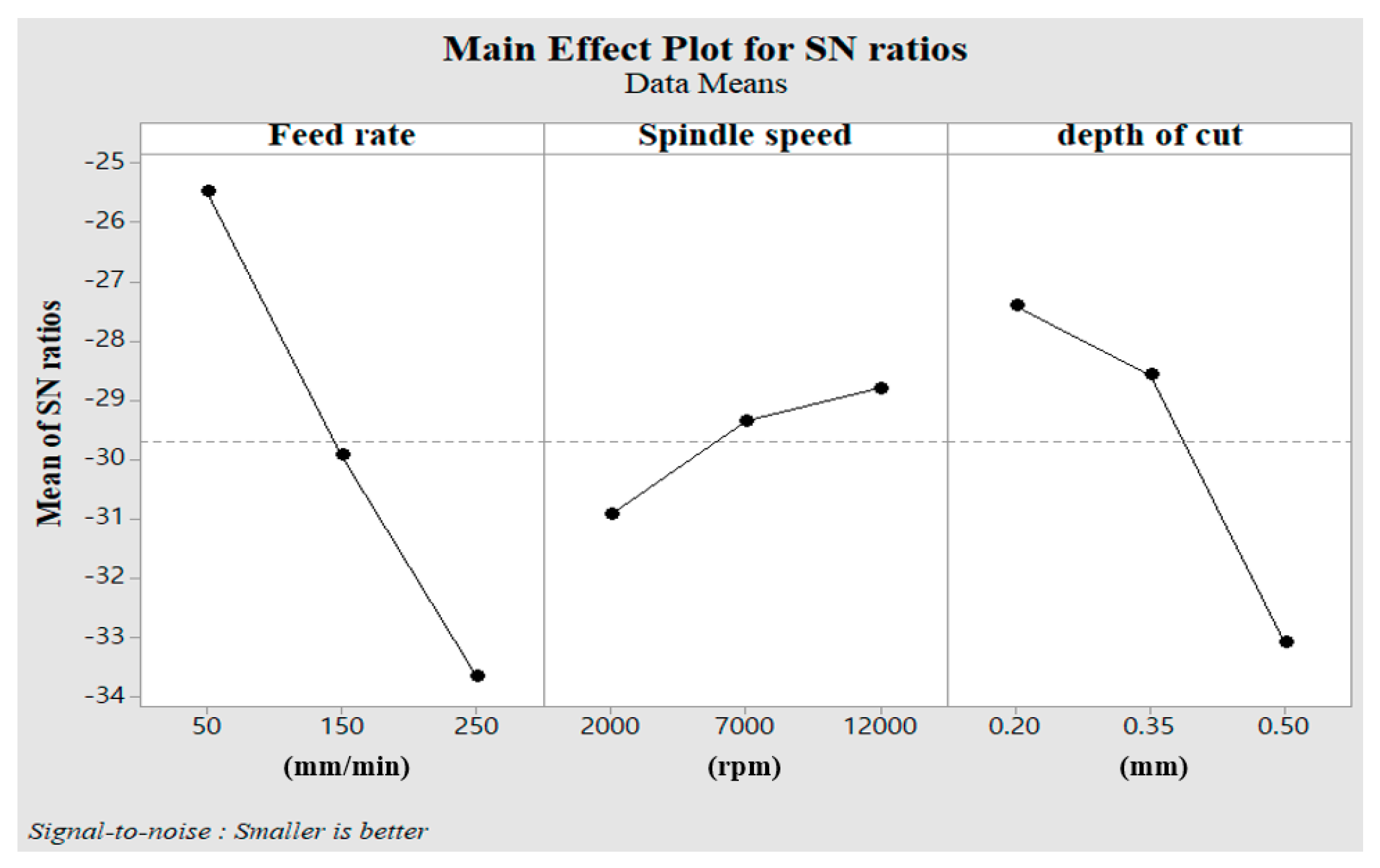
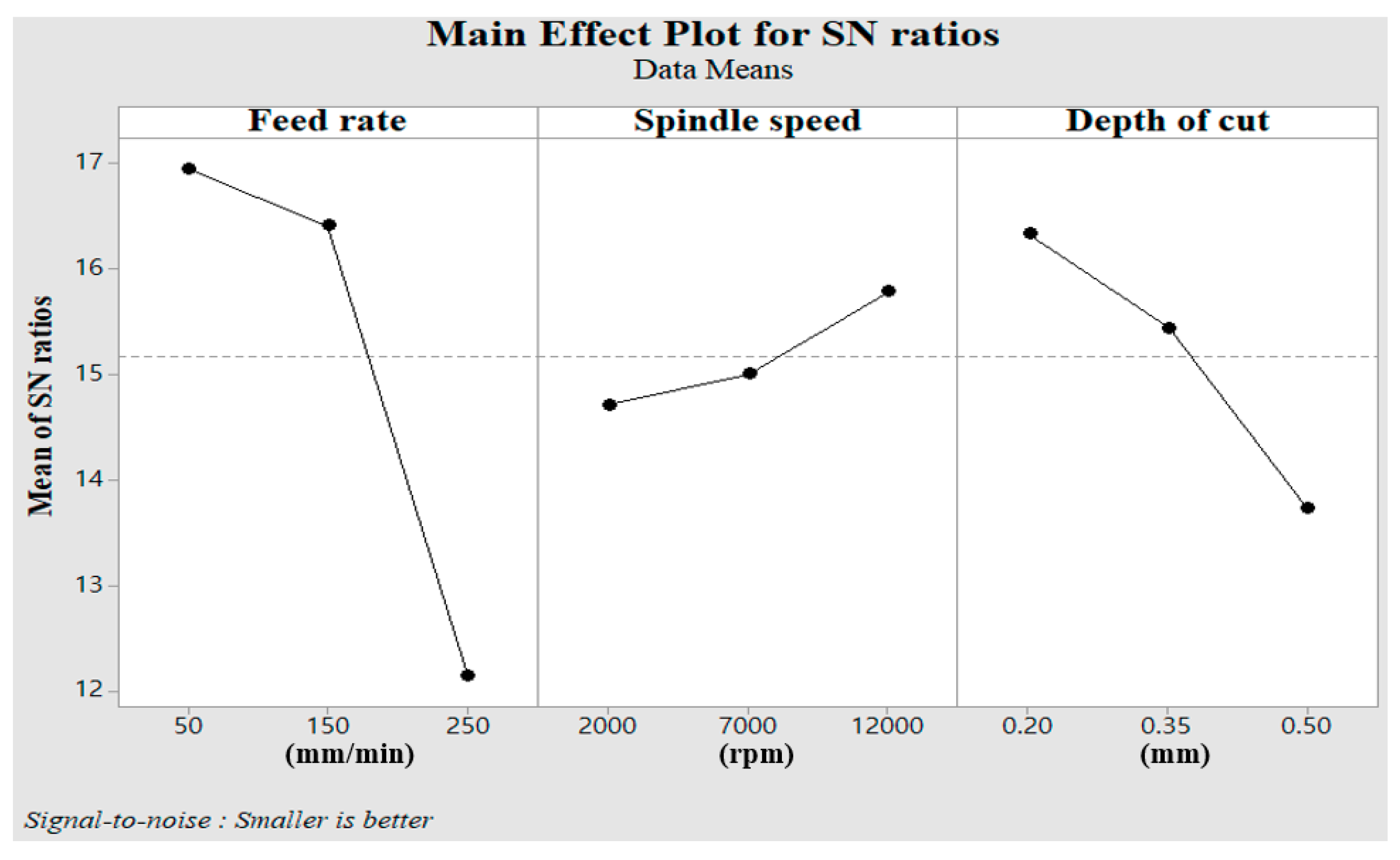
5.1. Main Effect
5.2. Analysis of Variance
5.3. Response Optimization
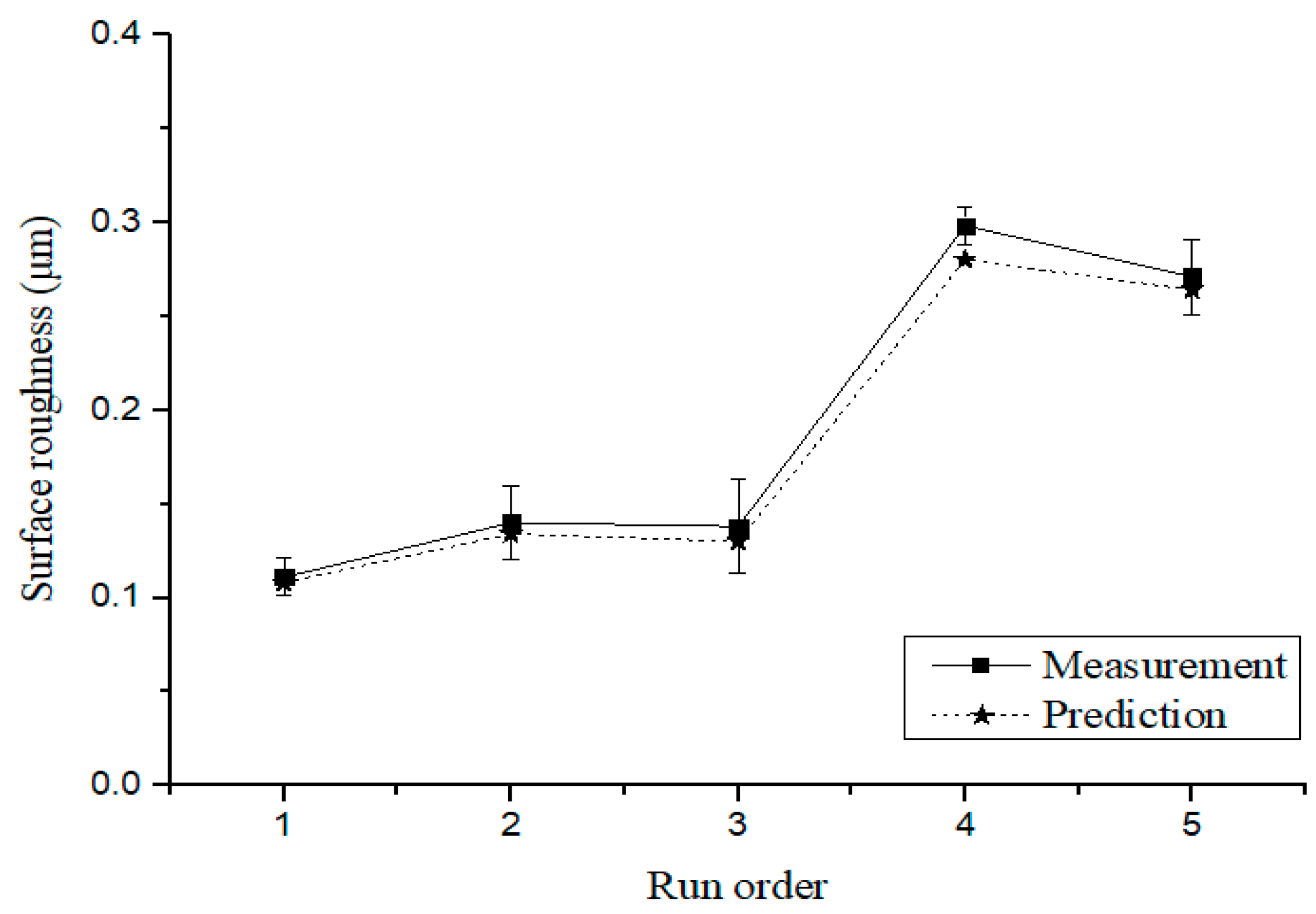
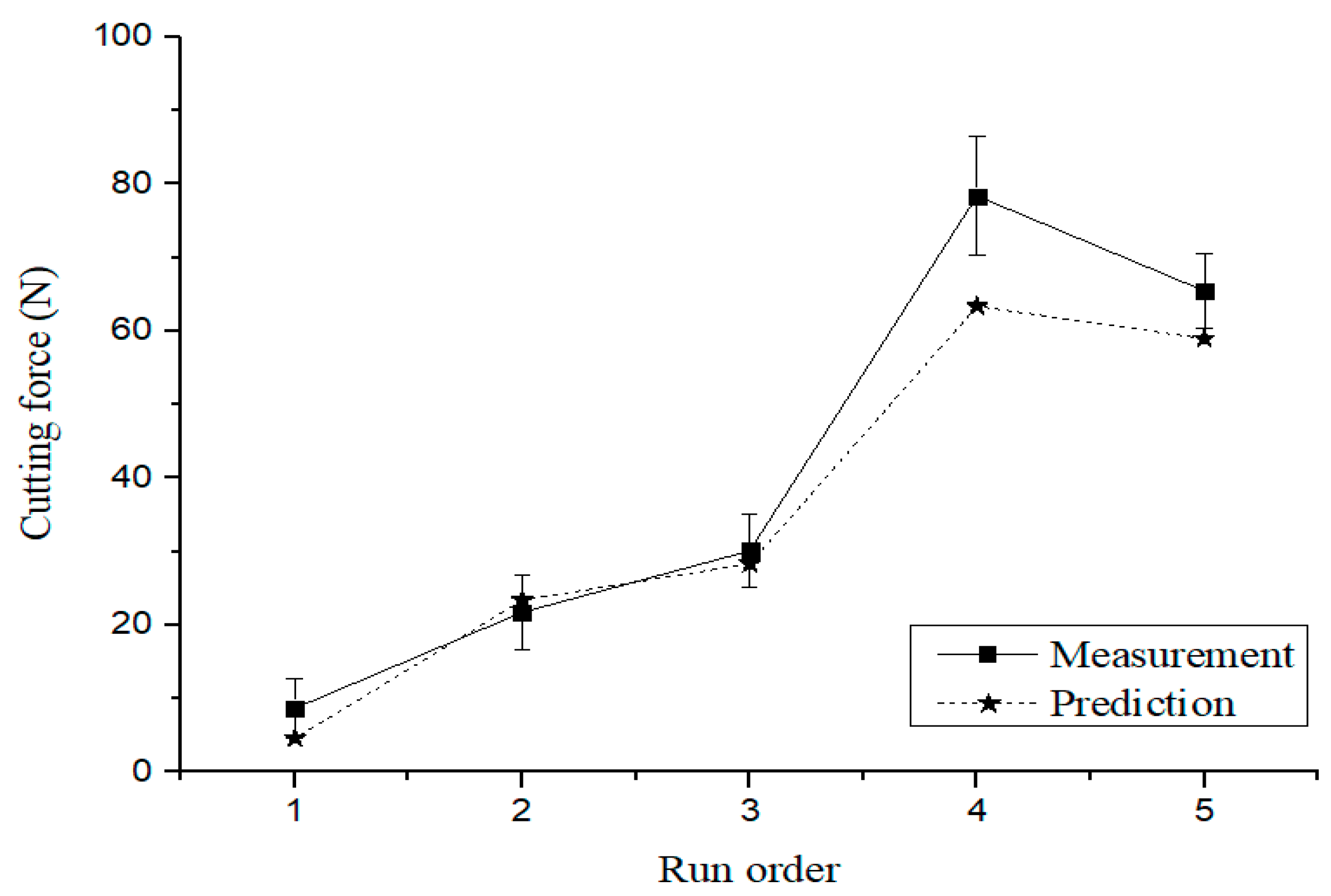
5.4. Verification Experiment of and Prediction Equations
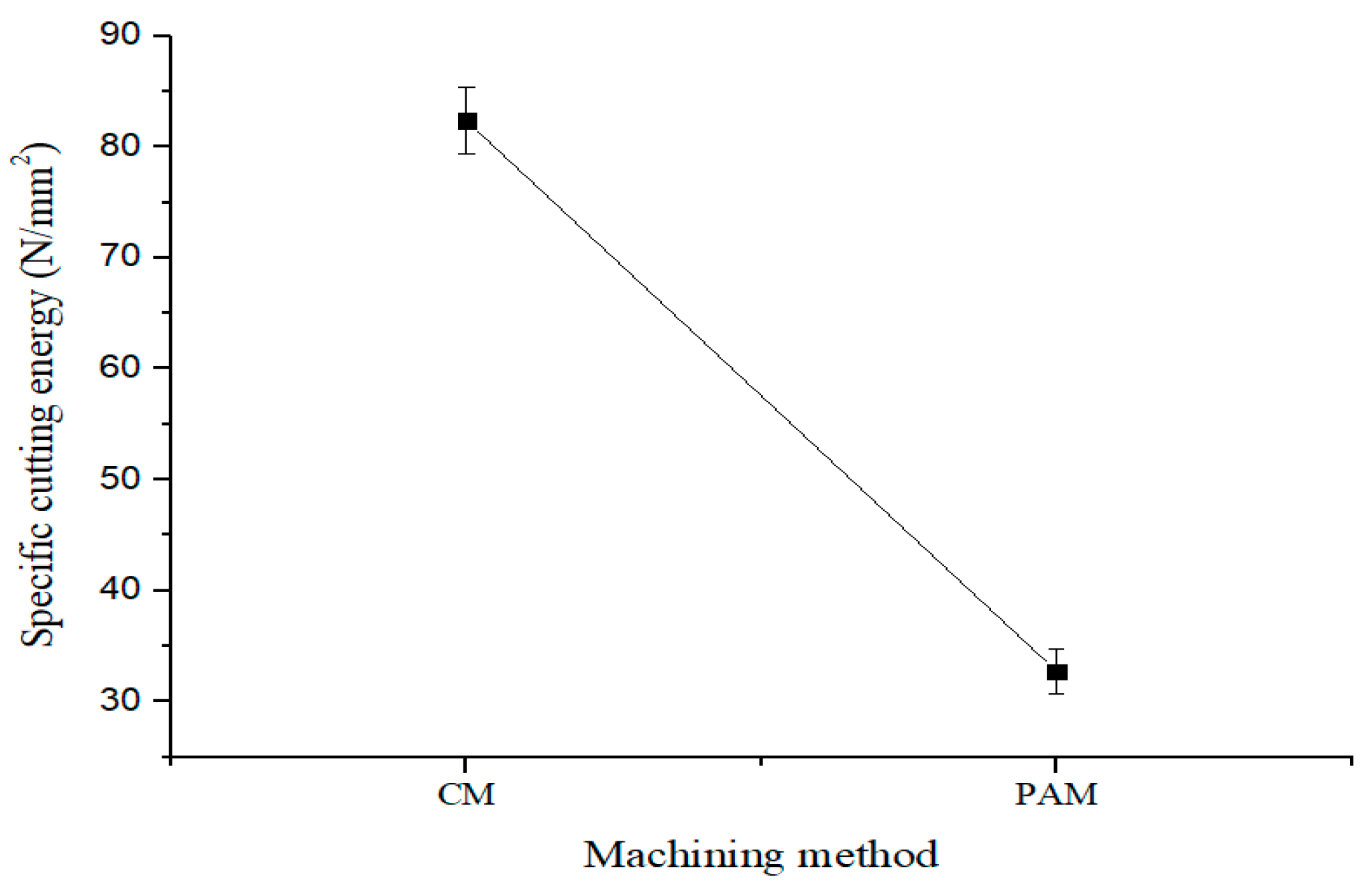
5.5. Specific Cutting Energy
6. Conclusions
- (1)
- The preheating temperature and the depth of cut were determined as 600 °C and 0.5 mm, respectively. These values were determined by thermal analysis and considered the tensile strength change of Ti-6Al-4V by temperature.
- (2)
- The relative contributions of the factors were analyzed through the analysis of variance. Feed rate had the most influence on cutting force and surface roughness.
- (3)
- Prediction equation was verified by verification experiments. The optimal machining conditions for PAM were determined as a feed rate of 50 mm/min, spindle speed of 12,000 rpm, and depth of cut of 0.2 mm.
- (4)
- In optimal machining conditions, the cutting force of CM and PAM was 21.84 N and 8.68 N, respectively. The cutting force of PAM was decreased by 60.2% when compared to CM. In addition, the surface roughness of CM and PAM was 0.376 um and 0.111 um, respectively. The surface roughness of PAM was improved by 70.47% when compared to CM.
- (5)
- The energy efficiency of PAM was analyzed by comparing the specific cutting energy. The specific cutting energy of PAM was 32.9 . The energy efficiency of PAM improved to above 60.26% when compared to CM.
Author Contributions
Funding
Conflicts of Interest
References
- Brecher, C.; Rosen, C.J.; Emonts, M. Laser-assisted milling of advanced materials. Phys. Procedia 2010, 5, 259–272. [Google Scholar] [CrossRef] [Scilit]
- Wiedenmann, R.; Liebl, S.; Zaeh, M.F. Influencing factors and workpiece’s microstructure in laser-assisted milling of titanium. Phys. Procedia 2012, 39, 265–276. [Google Scholar] [CrossRef] [Scilit]
- Shelton, J.A.; Shin, Y.C. Comparative evaluation of laser-assisted micro-milling for AISI 316, AISI 422, TI-6Al-4V and Inconel 718 in a side-cutting configuration. J. Micromech. Microeng. 2010, 20, 075012. [Google Scholar] [CrossRef] [Scilit]
- Lee, C.M.; Kim, D.H.; Baek, J.T.; Kim, E.J. Laser assisted milling device, A review. Int. J. Precis. Eng. Manuf. Green Technol. 2016, 3, 199–208. [Google Scholar] [CrossRef] [Scilit]
- Jeon, Y.H.; Lee, C.M. Current research trend on laser assisted machining. Int. J. Precis. Eng. Manuf. 2012, 13, 311–317. [Google Scholar] [CrossRef] [Scilit]
- Tian, Y.; Shin, Y.C. Thermal modeling for laser-assisted machining of silicon nitride ceramics with complex features. J. Manuf. Sci. Eng. 2005, 128, 425–434. [Google Scholar] [CrossRef] [Scilit]
- Wiedenmann, R.; Zaeh, M.F. Laser-assisted milling—Process modeling and experimental validation. CIRP J. Manuf. Sci. Technol. 2015, 8, 70–77. [Google Scholar] [CrossRef] [Scilit]
- Kashani, M.M.; Movahhedy, M.R.; Ahmadian, M.T.; Razavi, R.S. Analytical prediction of the temperature field in laser assisted machining. Procedia CIRP 2016, 46, 575–578. [Google Scholar] [CrossRef] [Scilit]
- Navas, V.G.; Arriola, I.; Gonzalo, O.; Leunda, J. Mechanisms involved in the improvement of Inconel 718 machinability by laser assisted machining (LAM). Int. J. Mach. Tools Manuf. 2013, 74, 19–28. [Google Scholar] [CrossRef] [Scilit]
- Leopardi, G.; Tagliaferri, F.; Rüger, C.; Dix, M. Analysis of laser assisted milling (LAM) of Inconel 718 with Ceramic Tools. Procedia CIRP 2015, 33, 514–519. [Google Scholar] [CrossRef] [Scilit]
- Ito, Y.; Ueki, M.; Kizaki, T.; Sugita, N.; Mitsuichi, M. Precision cutting of glass by laser-assisted machining. Procedia Manuf. 2017, 7, 240–245. [Google Scholar] [CrossRef] [Scilit]
- Ito, Y.; Kizaki, T.; Shinomoto, R.; Ueki, M.; Sugita, N.; Mitsuichi, M. High-efficiency and precision cutting of glass by selective laser-assisted milling. Precis. Eng. 2017, 47, 498–507. [Google Scholar] [CrossRef] [Scilit]
- Research report of the National Research Foundation of Korea (NRF). A New Conceptual 3-Dimensional Laser Assisted Machining System; NRF: Seoul, Korea, 2016; 2016R1A2A1A05005492. [Google Scholar]
- Kim, T.W.; Lee, C.M. A study on the development of milling process for silicon nitride using ball end-mill tools by laser-assisted machining. Int. J. Adv. Manuf. Technol. 2015, 77, 1205–1211. [Google Scholar] [CrossRef] [Scilit]
- Lee, C.M.; Woo, W.S.; Kim, D.H.; Oh, W.J.; Oh, N.S. Laser-assisted hybrid processes—A review. Int. J. Precis. Eng. Manuf. 2016, 17, 257–267. [Google Scholar] [CrossRef] [Scilit]
- Lee, C.M.; Woo, W.S.; Baek, J.T.; Kim, E.J. Laser and arc manufacturing processes—A review. Int. J. Precis. Eng. Manuf. 2016, 17, 973–985. [Google Scholar] [CrossRef] [Scilit]
- Lo’pez de Lacalle, L.N.; Sanchez, J.A.; Lamikiz, A.; Celaya, A. Plasma assisted milling of heat-resistant superalloys. J. Manuf. Sci. Eng. 2004, 126, 274–285. [Google Scholar] [CrossRef] [Scilit]
- Moon, S.H.; Lee, C.M. A study on the machining characteristics using plasma assisted machining of AISI 1045 and Inconel 718. Int. J. Mech. Sci. 2018, 142, 595–602. [Google Scholar] [CrossRef] [Scilit]
- Kttagawa, T.; Maekawa, K. Plasma hot machining for new engineering materials. Wear 1990, 139, 251–267. [Google Scholar] [CrossRef] [Scilit]
- Lee, Y.H.; Khulan, E.; Lee, C.M. A basic study on the thermal and machining characteristic of inclined workpiece according to the torch angle in plasma assisted machining. Proceed KSPE Autumn Conf. 2017, 12, 86–87. [Google Scholar]
- Kim, J.H.; Jung, H.I.; Lee, C.M. An analytical study on the preheating effect of workpieces with cylindrical shape in plasma assisted machining. Proceed. KSPE Autumn Conf. 2017, 12, 93–94. [Google Scholar]
- Baek, J.T.; Moon, S.H.; Lee, Y.H.; Lee, C.M. An analytical study on the preheating effect of flat workpiece for laser-plasma assisted machining. Proceed. KSPE Autumn Conf. 2016, 10, 236. [Google Scholar]
- Lee, C.M.; Lee, Y.H. A study on the effect of gas flow rate and power in plasma assisted machining. J. Korean Soc. Precis. Eng. 2018, 35, 603–608. [Google Scholar] [CrossRef] [Scilit]
- Leshock, C.E.; Kim, J.N.; Shin, Y.C. Plasma enhanced machining of Inconel 718, modeling of workpiece temperature with plasma heating and experimental results. Int. J. Mach. Tools Manuf. 2001, 41, 877–897. [Google Scholar] [CrossRef] [Scilit]
- Wang, Z.Y.; Rajurkar, K.P.; Fan, J.; Lei, S.; Shin, Y.C.; Petrescu, G. Hybrid machining of Inconel 718. Int. J. Mach. Tools Manuf. 2003, 43, 1391–1396. [Google Scholar] [CrossRef] [Scilit]
- Kim, D.H.; Lee, C.M. A study of cutting force and preheating-temperature prediction for laser-assisted milling of Inconel 718 and AISI 1045 steel. Int. J. Heat Mass Transf. 2014, 71, 264–274. [Google Scholar] [CrossRef] [Scilit]
- Sim, M.S.; Lee, C.M. Determination of optimal laser power according to the tool path inclination angle of a titanium alloy workpiece in laser-assisted machining. Int. J. Adv. Manuf. Technol. 2016, 83, 1717–1724. [Google Scholar] [CrossRef] [Scilit]
- Woo, W.S.; Lee, C.M. A study on the optimum machining conditions and energy efficiency of a laser-assisted fillet milling. Int. J. Precis. Eng. Manuf. Green Technol. 2018, 5, 593–604. [Google Scholar] [CrossRef] [Scilit]
- Datta, S.; Bandyopadhyay, A.; Pal, P.K. Grey-based taguchi method for optimization of bead geometry in submerged arc bead-on-plate welding. Int. J. Adv. Manuf. Technol. 2008, 39, 1136–1143. [Google Scholar] [CrossRef] [Scilit]
- Mohd, A.; Siti, S.; Abdul, F.; Raja, L.; Mohd, H.; Manshoor, B.; Mohd, S.; Mohd, A. Effect of injection moulding machine parameters on the warpage by applying taguchi method. Appl. Mech. Mater. 2014, 699, 20–25. [Google Scholar]
- Liu, J.W.; Jin, J.; Ko, T.J.; Baek, D.K. Study of optimal machining conditions of ultrasonic machining by taguchi’s method. Trans. Korean Soc. Mech. Eng. A 2013, 37, 213–218. [Google Scholar] [CrossRef] [Scilit]
- Lee, B.Y.; Lee, H.W. Shape optimal design of an automotive pedal arm using the taguchi method. J. Korean Soc. Precis. Eng. 2007, 24, 76–83. [Google Scholar]
- Yoo, W.S.; Jin, Q.Q.; Chung, Y.B. A study on the optimization for the blasting process of glass by taguchi method. J. Soc. Korea Ind. Syst. Eng. 2007, 30, 8–14. [Google Scholar]
- Chang, C.W.; Kuo, C.P. Evaluation of surface roughness in laser-assisted machining of aluminum oxide ceramics with the Taguchi method. Int. J. Mach. Tools Manuf. 2007, 47, 141–147. [Google Scholar] [CrossRef] [Scilit]





| Ti | Al | V | Fe | O | C | N | H |
|---|---|---|---|---|---|---|---|
| 88.02% | 6.75% | 4.5% | 0.4% | 0.2% | 0.08% | 0.03% | 0.01% |
| Factors | Code | Level | ||
|---|---|---|---|---|
| 1 | 2 | 3 | ||
| Feed rate (mm/min) | A | 50 | 150 | 250 |
| Spindle speed (rpm) | B | 2000 | 7000 | 12,000 |
| Depth of cut (mm) | C | 0.2 | 0.35 | 0.5 |
| Constant factors | Gas flow rate: 25 l/min Torch angle: 60° Preheating temperature: 600 ℃ | |||
| Run Order | Feed Rate (A)(mm/min) | Spindle Speed (B)(rpm) | Depth of Cut (C)(mm) |
|---|---|---|---|
| 1 | 1 | 1 | 1 |
| 2 | 1 | 2 | 2 |
| 3 | 1 | 3 | 3 |
| 4 | 2 | 1 | 2 |
| 5 | 2 | 2 | 3 |
| 6 | 2 | 3 | 1 |
| 7 | 3 | 1 | 3 |
| 8 | 3 | 2 | 1 |
| 9 | 3 | 3 | 2 |
| Exp. No. | Feed Rate (mm/min) | Spindle Speed (rpm) | Depth of Cut (mm) | Cutting Force (N) | Surface |
|---|---|---|---|---|---|
| 1 | 50 | 2000 | 0.2 | 18.548 | 0.128 |
| 2 | 50 | 7000 | 0.35 | 13.61 | 0.131 |
| 3 | 50 | 12,000 | 0.5 | 26.418 | 0.171 |
| 4 | 150 | 2000 | 0.35 | 33.481 | 0.169 |
| 5 | 150 | 7000 | 0.5 | 49.648 | 0.178 |
| 6 | 150 | 12,000 | 0.2 | 17.148 | 0.115 |
| 7 | 250 | 2000 | 0.5 | 70.188 | 0.287 |
| 8 | 250 | 7000 | 0.2 | 37.485 | 0.241 |
| 9 | 250 | 12,000 | 0.35 | 42.484 | 0.218 |
| Level | Feed Rate (mm/min) | Spindle Speed (rpm) | Depth of Cut (mm) |
|---|---|---|---|
| 1 | −25.49 | −30.93 | −27.42 |
| 2 | −29.94 | −29.36 | −28.58 |
| 3 | −33.66 | −28.81 | −33.09 |
| Delta | 8.16 | 2.12 | 5.68 |
| Rank | 1 | 3 | 2 |
| Level | Feed Rate (mm/min) | Spindle Speed (rpm) | Depth of Cut (mm) |
|---|---|---|---|
| 1 | 16.95 | 14.71 | 16.33 |
| 2 | 16.41 | 15.00 | 15.44 |
| 3 | 12.14 | 15.79 | 13.72 |
| Delta | 4.81 | 1.07 | 2.61 |
| Rank | 1 | 3 | 2 |
| Factors | Degree of Freedom | Sum of Squares | Mean of Squares | F Ratio | Contribution (%) |
|---|---|---|---|---|---|
| Feed rate | 2 | 1399.34 | 699.67 | 699.67 | 54.15 |
| Spindle speed | 2 | 204.11 | 102.05 | 102.05 | 7.9 |
| Depth of cut | 2 | 950.78 | 475.39 | 475.39 | 36.79 |
| Error | 2 | 30.20 | 15.01 | 1.16 | |
| Total | 8 | 2584.25 | 100.00 |
| Factors | Degree of freedom | Sum of Squares | Mean of Squares | F ratio | Contribution (%) |
|---|---|---|---|---|---|
| Feed rate | 2 | 0.02 | 0.01 | 32.22 | 77.24 |
| Spindle speed | 2 | 0.001 | 0.0005 | 1.72 | 4.12 |
| Depth of cut | 2 | 0.004 | 0.002 | 6.78 | 16.25 |
| Error | 2 | 0.0006 | 0.0003 | 2.4 | |
| Total | 8 | 0.026 | 100.00 |
| Parameter | Goal | Target | Upper | Weight | Importance |
|---|---|---|---|---|---|
| Cutting force | Minimum | 13.610 N | 70.188 N | 1 | 1 |
| Surface roughness | Minimum | 0.115 m | 0.287 m | 1 | 1 |
| Feed Rate (mm/min) | Spindle Speed (rpm) | Depth of Cut (mm) | Cutting Force Optimization Plot (N) | Surface Roughness Optimization Plot (μm) | Desirability |
|---|---|---|---|---|---|
| 50 | 12,000 | 0.2 | 4.6 | 0.108 | 1 |
| Exp. No. | Feed Rate (mm/min) | Spindle Speed (rpm) | Depth of Cut (mm) |
|---|---|---|---|
| 1 | 50 | 12,000 | 0.2 |
| 2 | 150 | 7000 | 0.2 |
| 3 | 150 | 12,000 | 0.35 |
| 4 | 250 | 7000 | 0.5 |
| 5 | 250 | 12,000 | 0.5 |
© 2019 by the authors. Licensee MDPI, Basel, Switzerland. This article is an open access article distributed under the terms and conditions of the Creative Commons Attribution (CC BY) license (http://creativecommons.org/licenses/by/4.0/).
Share and Cite
Lee, Y.-H.; Lee, C.-M. A Study on Optimal Machining Conditions and Energy Efficiency in Plasma Assisted Machining of Ti-6Al-4V. Materials 2019, 12, 2590. https://doi.org/10.3390/ma12162590
Lee Y-H, Lee C-M. A Study on Optimal Machining Conditions and Energy Efficiency in Plasma Assisted Machining of Ti-6Al-4V. Materials. 2019; 12(16):2590. https://doi.org/10.3390/ma12162590
Chicago/Turabian StyleLee, Young-Hun, and Choon-Man Lee. 2019. "A Study on Optimal Machining Conditions and Energy Efficiency in Plasma Assisted Machining of Ti-6Al-4V" Materials 12, no. 16: 2590. https://doi.org/10.3390/ma12162590
APA StyleLee, Y.-H., & Lee, C.-M. (2019). A Study on Optimal Machining Conditions and Energy Efficiency in Plasma Assisted Machining of Ti-6Al-4V. Materials, 12(16), 2590. https://doi.org/10.3390/ma12162590