


Abstract
Entrepreneurship is one of the critical determinants of economic development. In this research area, many scientists are trying to identify the competencies that influence later decisions about starting a business—so-called entrepreneurial intentions. The subject of the research contained in this article is the relationship between emotional competencies and declared entrepreneurial intentions, which, according to the authors, constitute an added value supporting research in the field of education for entrepreneurship. The article contributes to developing behavioral theories and solves the problem of identifying essential competencies to start a business. The survey was conducted among 209 students at Cracow University of Economics. Based on a binomial logistic regression model applied in the study, a statistically significant correlation between self-awareness and self-motivation and the students’ entrepreneurial intentions was demonstrated. In contrast, the statistically significant influence of self-regulation, empathy, and social skills on the formation of these intentions was not confirmed. Therefore, to shape entrepreneurial intentions, the education process should support developing these two key factors: self-awareness and self-motivation of young people. Decision-makers should formulate the syllabuses to develop the students’ emotional competencies, which, in turn, are a source of entrepreneurial intentions.
1. Introduction
Entrepreneurship is one of the critical determinants of the economic growth of countries [1,2,3]. It is assumed that nearly 99.8% of the total number of enterprises in the European Union are micro, small, and medium-sized, which employ just over 66% of productive-age people and generate 57% of added value in the EU economy [4]. Due to the dynamic nature of economic changes globally, it is crucial to support education in entrepreneurship, which must meet new challenges [5], especially in identifying and developing essential skills and attitudes of future managers [6]. The number of publications published in recent years shows that entrepreneurship education is one of the fastest-growing research areas [7,8,9,10,11,12,13]. In this research area, many scientists are trying to identify the competencies that influence later decisions about starting a business—the so-called entrepreneurial intentions (It is worth mentioning here that Ajzen [14,15] was the forerunner of entrepreneurial intentions research) [16,17,18,19]. Their characteristic feature is the fact that they must meet the expectations of a dynamically developing market.
Many scientific publications draw attention to the fact that a comprehensive educational process, the aim of which should primarily be to shape entrepreneurial attitudes, is a determinant of the proper participation of individuals in social and economic life and is essential for the development of the competitiveness of enterprises and the economy [20,21,22].
The topics we address fit into the current research on entrepreneurship education, which indirectly links to almost all of the new 2013 Agenda’s Sustainable Development Goals of the United Nations (SDG) [23,24]. In the face of persistently high unemployment levels among young people [25], it is essential to proactively support actions to increase (self-)employment among these people by undertaking broadly defined inclusive actions. In this way, at least two out of 17 goals of the SDG can be achieved, mainly goal 4 of the SDG relating to ensuring inclusive and equitable education by promoting lifelong learning opportunities, and goal 8 of the SDG relating to the promotion of sustainable, full, and productive employment and decent work for all [23]. Education for sustainable development should aim at developing competencies that mainly enable individuals to reflect on their own activities. The UNESCO report entitled "Education for sustainable development goals. Learning objectives" lists eight critical competencies for sustainability [26]: (1) systems thinking competency, (2) anticipatory competency, (3) normative competency, (4) strategic competency, (5) collaboration competency, (6) critical thinking competency, (7) self-awareness competency, and (8) integrated problem-solving competency. This type of competence also includes emotional competence, which is known as a set of behaviors that individuals use to recognize and manage their own and others’ emotions.
In this study, we examine whether emotional competencies impact the entrepreneurial intentions of students. The central premise leading us to take up this topic is that our emotions influence our behaviors and decisions [27] and, consequently, our propensity to start a business [28,29,30]. The article fills the research gap in the broadly defined psychology of entrepreneurship [31], derived from cognitive psychology [32], which is currently one of the most dynamically developing research areas [8,19,28,29]. Unfortunately, relatively few researchers have investigated the relationship between students’ emotional competencies and their entrepreneurial intentions. So far, this topic has developed in the current of Ajzen’s theory [14,15], but not from the emotional competencies viewpoint. The article will enhance our understanding of students’ emotional characteristics and critical competencies important in entrepreneurial inclinations. We expect to provide a new perspective on entrepreneurial education. Therefore, we set the article’s aim to empirically verify the impact of emotional competence on students’ entrepreneurial intentions.
The article consists of two parts: theoretical and empirical. In the theoretical part, based on a critical analysis of the literature, we present the relationship between emotional competencies and students’ sustainable entrepreneurial intentions. On their basis, we derive research hypotheses. On the other hand, in the empirical part, we use logistic regression to statistically confirm the interdependence between Goleman’s five types of emotional competencies [33] and students’ willingness to start a business in the future. The calculations were based on a sample of 209 students of International Economic Relations at Cracow University of Economics.
2. Theoretical Background and Literature Review
Competence is usually described as a combination of three essential elements: knowledge, skills, and attitudes [34]. Similarly, Hayton and Kelley [35], based on the competence-based approach, propose a definition of competence as an aggregate of specific knowledge, skills, and personality. They point out that some researchers treat them as equivalent to such terms as ability, skills, and knowledge, thus omitting attitudes. In turn, Boyatzis [36] understands competence as either capability or ability. Others, such as MacLean and Scott [37], recall the definition proposed by the ASTD (American Society for Training and Development) that competence focuses on the skills, knowledge, abilities, and behaviors needed to succeed at work.
In the literature on the subject, we are relatively often dealing with behavioral competencies, which are defined as “a set of related but different sets of behavior organized around an underlying construct called the ‘intent’” [36]. As confirmed by many researchers, these competencies significantly impact individuals’ entrepreneurial intentions [9,11,38,39,40]. For example, Sánchez [39] lists self-efficacy (1), proactiveness (2), and risk-taking propensity (3) among its behavioral competencies. His study, based on a sample of 864 students, confirmed the hypothesis that the greater the individual’s behavioral competencies, the higher their entrepreneurial intentions are. The behavioral competence defined by the researcher indirectly derives from Ajzen’s Theory of Planned Behavior [15], according to which the factors influencing an individual’s entrepreneurial intentions are cognitive: entrepreneurial attitudes (1), subjective norms (2), and perceived behavioral control (According to Ajzen’s Theory of Planned Behavior [15], the perceived behavioral control is based on Bandura’s Self-Efficacy Theory [41]) (3). Cortellazzo, Bonesso, and Gerli [42] promote a relatively interesting division of behavioral competencies. Researchers have grouped behavioral competencies into those related to (1) awareness, (2) action, (3) social, (4) cognitive, (5) exploratory, and (6) strategic, which can be considered a source of entrepreneurial intentions.
Since relatively recently, some researchers have focused their attention on explaining the role of emotional competencies as a subgroup of behavioral competencies in shaping entrepreneurial intentions. These competencies are usually understood as interrelated sets of behaviors that individuals use to recognize and manage their own emotions and others’ emotions [43]. However, it might seem to some that the definition of emotional competence may coincide with emotional intelligence. In contrast to the latter, emotional competence is a measurable skill [33], so it can be taught and learned and consequently also influence individuals’ entrepreneurial intentions [29].
Individuals with developed emotional competence deal with stress much better than others [44,45], and consequently, it may result in them having higher entrepreneurial intentions. For instance, Zampetakis et al. [28] note that emotional competence influences entrepreneurial intentions indirectly through students’ entrepreneurial attitudes. In turn, studies by Miao et al. [46] show that emotional competence is positively linked to individuals’ entrepreneurial intentions, except that this relationship is more potent in long-term-oriented cultures.
Emotional competencies are most often divided into two groups: personal competencies, which determine the level of ability to cope with ourselves, and social competencies, which determine the level of ability to cope with others. Personal competencies include self-awareness, self-regulation, and motivation, while empathy and social skills are social competence subgroups [33].
Higher self-awareness, and thus the ability to become an object of personal attention [47], may be one of the sources of students’ higher entrepreneurial intentions [43,48]. Thanks to the ability to identify their own weaknesses and advantages, draw conclusions from their experiences, or believe in their own competencies, they feel that they can take up the challenge of competitiveness in the business world. Nevertheless, van Ewijk and Al-Aomar [49] stated that the research should be deepened. Therefore, we propose the following research hypothesis:
Hypothesis 1 (H1).
The higher self-awareness is, the higher students’ entrepreneurial intentions are.
On the other hand, self-regulation refers to controlling one’s own internal states, impulses, and possibilities [33]. In other words, it is the ability of individuals to anticipate desirable future events based on their past knowledge and experience and to monitor and guide their behavior in order to realize their vision [50]. The responsibility for one’s own actions, the ability to act efficiently due to good self-organization of work, and being flexible and able to adapt quickly to changing conditions are essential if we are thinking about achieving business success. The feeling of full control over one’s own activity is also fundamental, even in the face of dynamic changes taking place in the company’s environment.
Some researchers see self-regulation as a source of entrepreneurial intentions [51], which is why we propose the following hypothesis:
Hypothesis 2 (H2).
The higher self-regulation is, the higher students’ entrepreneurial intentions are.
Many researchers believe that self-motivation is an essential (if not the most important) factor resulting in higher entrepreneurial intentions [52,53,54,55]. According to Goleman [33], it belongs to the so-called personal competence, and defines it as emotional inclinations that lead to new goals or facilitate achievement. Personalities such as consistency in action and pursuit of a goal despite the difficulties encountered, new challenges, and additional goals to achieve, and faith in success that is stronger than fear of failure are characteristic of leaders who become critical drivers for the whole organization. The entrepreneur’s own motivation will also be transferred to the other organization members and thus constitute one of the company’s critical determinants.
Therefore, the following hypothesis is proposed:
Hypothesis 3 (H3).
The higher self-motivation is, the higher students’ entrepreneurial intentions are.
Empathy is usually defined as the ability to understand the views [56], feelings, needs, and concerns of others [33]. The ability to listen to others and understand their specific views, expectations, and problems, sometimes different from their own, is crucial in managing a team of employees and gaining new clients. Identifying and correctly analyzing processes in the entrepreneur’s social environment is also useful in conducting business activity.
Many studies in the literature on the subject show the positive influence of empathy on entrepreneurial intentions [56,57,58]. Therefore, it can be assumed that:
Hypothesis 4 (H4).
The higher empathy is, the higher students’ entrepreneurial intentions are.
As Fagoulis and Phillips [59] note, social skills are not easy to define because they can be interpreted differently. First of all, they can be understood as the ability to evoke desired reactions in others [33,60]. People who are perceived positively in their own environment can easily acquire others to implement their own plans. Social skills also allow for better communication with the business environment or effective negotiation of business transactions. People with developed social skills, e.g., through active participation in informal networking processes, learn and acquire new knowledge and useful information, which they can then use in their business activities. Above all, these competencies also allow for the more accessible establishment of personal relationships that are useful in any field of business activity (e.g., acquiring investors, cooperators, lobbyists, or the favors of members of government administration).
Some researchers believe that social skills can be a source of entrepreneurial intentions [61]. Therefore, the following hypothesis is worth proposing:
Hypothesis 5 (H5).
The higher social skills are, the higher students’ entrepreneurial intentions are.
In order to verify the above hypotheses, we created the logit model. All calculations were performed in IBM® SPSS® Statistics 26.
3. Materials and Methods
3.1. Sample and Data Collection
The study included 209 students studying international economic relations at the Cracow University of Economics. The choice of course was not accidental. Similarly to Li and Wu [62], we wanted to check the interdependence among the students participating in classes whose syllabuses mainly included subjects in broadly understood (international) entrepreneurship. Based on a previously prepared questionnaire (see Appendix A), we asked 76 anonymous questions about previously defined emotional competencies and entrepreneurial intentions. Additionally, we included four questions associated with basic metrics (gender, forms of studies, city of origin, and family patterns).
The survey was conducted in the first half of October 2020 with our control and other academic teachers (coordinators) among students in the second and third years of undergraduate studies and fourth and fifth years of graduate studies. In the survey, we omitted first-year students because they did not have the opportunity to participate in any entrepreneurship course.
3.2. Research Model
In this research, we applied a binomial logistic regression model—also called the logit model. It is used to explain the dummy qualitative variable Y depending on the level of independent (exogenous) variables X1, X2, …, Xk, which, in turn, can be qualitative or quantitative. Moreover, the logistic regression model is recommended when the assumption of normality distribution of variables may not be met [63]. The dependent variable is a dummy (dichotomous) variable [64]:
In the logistic regression model, the critical function is known as logit and has the following form [65,66]:
Furthermore, the logistic regression model can be written in the following form:
The estimation of model parameters β1, β2, …, βk is usually performed using the maximum likelihood method. The logarithm of the likelihood function with model parameters is maximized using iterative numerical procedures [64].
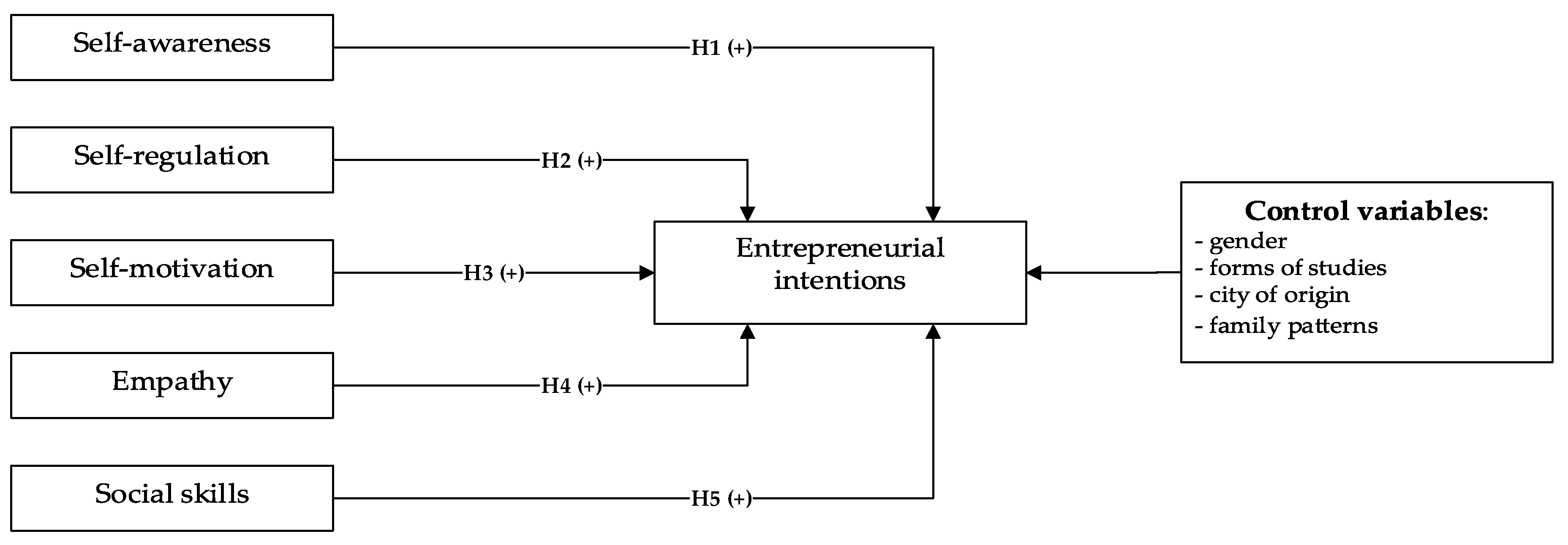
The proposed research model (see Figure 1) suggests a positive relationship between the five main types of emotional competence and students’ entrepreneurial intentions. It means that individuals with higher self-awareness (H1), self-regulation (H2), self-motivation (H3), empathy (H4), and higher social skills (H5) are more likely to start a business in the future.
Figure 1.
Proposed research model.
In the research model, we used a total of 10 variables (see Table 1), where the dependent variable represented students’ entrepreneurial intentions. In contrast, among independent variables, we distinguished five emotional competencies of Goleman. Additionally, we included four control variables: gender, form of studies, city of origin, and family patterns. The research model consists of nominal (dummy) variables and ordinal variables whereby we measured, among other things, emotional competence on a 5-point Likert scale.
Table 1.
List of variables used in the analysis (N = 209).
In the study, 209 students participated altogether. A total of 54.1% were women and 45.9% were men (see Table 2 and Table 3). The vast majority of the respondents were full-time students (88.5%), and only some were part-time students (11.5%). In the study, approximately every third student came from a city with at least 150,000 inhabitants. Moreover, most of the examined students (51.2%) confirmed that at least one parent was or still is self-employed.
Table 2.
Students’ profile.
Table 3.
Summary statistic.
Based on Table 4, it can be observed that there is no strong correlation between the independent variables used in the analysis. The highest correlation occurs between variables describing motivation and social skills (r = −0.47). In contrast, the lowest one occurs between variables representing gender and self-awareness (r = −0.01) and form of studies and self-regulation (r = −0.01).
Table 4.
Correlation matrix.
3.3. Dependent Variable
In the proposed model (see Figure 1), the dependent variable was entrepreneurial intention, which was also defined as the propensity to be an entrepreneur during or after studies [67]. The question we asked the students was: Are you considering starting your own business during or soon after your studies? This variable was the dummy, i.e., it assumed values of 0 and 1. If the student answered positively, we assigned the number 1, while if the student negated, then we assigned the number 0.
3.4. Independent Variable
The study included five categories of independent variables describing emotional competence (see Table 1), which were assigned to two groups: personal competencies and social competencies. The former relates to how we manage our relationships with others [33]. The first category of emotional competence included (1) self-awareness, which distinguishes (1a) emotional awareness, (1b) accurate self-assessment, and (1c) self-confidence. The second category of variables was known as (2) self-regulation. It consists of (2a) self-control, (2b) trustworthiness, (2c) conscientiousness, (2d) adaptability, and (2e) and innovation. The third category of emotional competence, called (3) motivation, included (3a) achievement drive, (3b) commitment, (3c) initiative, and (3d) optimism. The next category of variables was (4) empathy, consisting of (4a) understanding others, (4b) developing others, (4c) service orientation, (4d) leveraging diversity, and (4e) political awareness. Finally, the last category of emotional competence, called (5) social skills, included (5a) influence, (5b) communication, (5c) conflict management, (5d) leadership, (5e) change catalyst, (5f) building bonds, (5g) collaboration and cooperation, and (5h) team capabilities.
Each of the 25 sub-independent variables (1a–5h) included between 3 and 4 questions and was evaluated using a 5-point Likert scale [68], i.e., (1) strongly disagree, (2) disagree, (3) neither agree nor disagree, (4) agree, (5) strongly agree (the questionnaire together with the questions can be found in Appendix A). In the next step, we calculated the average for each subcategory and then the average for each of the main categories of variables (i.e., the five emotional competencies of Goleman).
3.5. Control Variable
In the study, we included several control variables that could potentially affect the results. The first control was gender (1 = male, 0 = female). Zhang et al. [69] believe that women generally have lower entrepreneurial intentions than men. Another control variable was form of study (1 = part-time, 0 = full-time), as we felt that part-time students had higher entrepreneurial intentions than full-time students. This is consistent with the research of Sandhu et al. [70]. We also controlled students’ city of origin because we thought that students coming from larger cities would be more inclined toward entrepreneurship (1 = fewer than 1000 inhabitants, 2 = at least 1000 but fewer than 10,000 inhabitants, 3 = at least 10,000 but fewer than 50,000 inhabitants, 4 = at least 50,000 but fewer than 150,000 inhabitants, 5 = at least 150,000 inhabitants). The last control variable was family patterns, which should be understood as if at least one parent was/is self-employed (1= at least one parent was/is self-employed, 0 = otherwise).
4. Results and Discussion
A logistic regression model with good fit should mainly meet two criteria. First, the likelihood ratio test, estimated with the maximum probability, should be statistically significant. Second, the Hosmer–Lemeshow test should be statistically insignificant [63]. In the binomial logistic regression model, the coefficient of determination R2 is not an adequate measure of the quality of model adjustment to variables; therefore, it is not recommended to be applied [71]. Some researchers suggest using the Cox–Snell Pseudo R2 or Nagelkerke Pseudo R2 [72], which for the first model were 0.205 and 0.279, respectively. In the first logistic regression model, the likelihood test was statistically significant (chi2 = 47.964, df = 9, p = 0.000), which was the desired result. In addition, the Hosmer–Lemeshow test was statistically insignificant (chi2 = 11.898, df = 8, p = 0.156)—see Table 5.
Table 5.
Logistic model verification.
Four control variables were included in the research model, one of which was statistically significant (see Table 6). In the study, we can note that gender is an important factor in predicting entrepreneurial intentions. The results of our research confirm that the likelihood of men having entrepreneurial intentions is 2.33 times higher than women (p = 0.017), which also seems to be confirmed by the research conducted by Grilo and Irigoyen [73]. In a given logistic regression model, the control variables comprised studies (p = 0.093) and city of origin (p = 0.099), but both at the level of significance p < 0.100. In terms of family patterns (p = 0.886), we could not demonstrate a correlation between someone from the immediate family running or having run their own business and students’ entrepreneurial intentions.
Table 6.
Binomial logistic regression model 1 (dependent variables = entrepreneurial intentions).
Turning to the essential independent variables, we can see that the constructed logistic regression model confirmed the interdependence between self-awareness and students’ entrepreneurial intentions (p = 0.046). It turns out that students with higher self-awareness are 2.8 times more likely to set up a business. This situation is similar to motivation. Motivated people are usually about six times more likely to create a business in the future than those who are not. Therefore, we can confirm Hypotheses 1 and 3, i.e., students with higher self-awareness and motivation significantly influence higher inclination toward entrepreneurship. The logistic regression model did not confirm the statistical significance of self-regulation (p = 0.782), empathy (p = 0.989), or social skills (p = 0.077) as predictors of students’ entrepreneurial intentions, hence hypotheses 2, 4, and 5 should be rejected.
Next we asked ourselves which competencies within self-awareness and motivation play a key role in explaining students’ entrepreneurial intentions. We built two more logistic regression models (see Table 7 and Table 8). Before starting the inference, we reassessed the quality of the variables’ adjustment to the newly created models. As far as the likelihood ratio test was concerned, in both cases it turned out to be statistically significant (model 2: chi2 = 35.091, df = 7, p = 0.000; model 3: chi2 = 47.203, df = 8, p = 0.000) which was desirable in this case of analysis. In turn, the Hosmer–Lemeshow test proved to be statistically insignificant (model 2: chi2 = 10.466, df = 8, p = 0.234; model 3: chi2 = 11.807, df = 8, p = 0.16), which also confirms that both models can be examined.
Table 7.
Binomial logistic regression model 2 (dependent variables = entrepreneurial intentions).
Table 8.
Binomial logistic regression model 3 (dependent variables = entrepreneurial intentions).
As for the second model of logistic regression (see Table 7), we noticed that within the framework of self-awareness, the key competencies were accurate self-assessment (p = 0.05) and self-confidence (p = 0.011). In our study, accurate self-assessment was understood as the ability to identify one’s strengths and weaknesses and draw conclusions from one’s own experience. Based on the second logistic regression model, we can observe that the likelihood of entrepreneurial intentions among students who can correctly self-assess is slightly more than two times higher than among those who have difficulty doing a self-assessment (p = 0.05). What is more, self-confidence is also essential, which increases 1.84 times the likelihood of higher willingness to start a business among the examined sample. The model did not confirmed the significance of emotional awareness for inclination toward entrepreneurship.
Based on the third model of logistic regression (see Table 8), it can be seen that within the framework of motivation, a critical competence is an initiative (p = 0.002), which we understood, among other things, as the ability to use every opportunity and the ability to pursue goals. It turns out that there is a chance of entrepreneurial intention in students who show initiative. It is almost 2.4 times higher than among those who do not have such a competence.
This article contributes to essential insights into the relationship between emotional competencies and Economics students’ entrepreneurial intentions. The results contributed to the confirmation of the two proposed hypotheses. Emotional competence, namely self-awareness and motivation, plays a vital role in predicting students’ entrepreneurial intentions.
Considering the form of studies, the city of origin, and the family patterns as control variables, they are not significant predictors of entrepreneurial intentions. The case was different for gender. The studies confirmed that men are more likely to start a business than women. This result is consistent with studies by Zhang et al., who confirmed this correlation based on the results of surveys conducted among students at 10 Chinese universities [69]. Similar conclusions were also reached by Caliendo et al., who, based on surveys among German citizens, noted that women are less likely to set up a business because of their much higher aversion to risk than men [74]. However, studies by other scientists such as Georgescu and Herman do not support the thesis that gender is essential in explaining students’ entrepreneurial intentions [25,75].
As far as self-awareness is concerned, our results confirm the first research hypothesis. It turns out that self-awareness and mostly accurate self-assessment and self-confidence increase the chances of students’ entrepreneurial intentions. This fact is also consistent with the research of other scientists. For example, Archana et al. surveyed students of the postgraduate program in Management Studies in India, which confirmed that self-awareness is a statistically significant predictor of entrepreneurial intentions [48]. Auzoult et al. came to a similar conclusion and, based on 216 French students, confirmed the positive relationship between self-awareness and entrepreneurial intentions [76].
The research also showed statistical significance between self-motivation and students’ entrepreneurial intentions (p = 0.000). More detailed research has shown that it is mainly due to this initiative (p = 0.002), which increases the likelihood of entrepreneurial intentions in students 2.38 times more than if they had not. Similar opinions are held by Fayolle et al. [55] and Giacomin et al. [77], who see motivation as a source of entrepreneurial intentions. A pretty interesting study confirming this dependence was conducted by Solesvik, who, based on the information obtained from 321 Ukrainian students, stated that higher entrepreneurial intentions result from a properly designed entrepreneurship course, which stimulates the internal motivation of the individual [78].
5. Conclusions and Implications
In the current considerations, relatively few researchers have explored entrepreneurship’s inclination from the perspective of emotional competence [79], which has still not been sufficiently investigated. Our research confirmed two of five hypotheses. In our study, self-awareness and self-motivation proved to be factors that play a crucial role in increasing the probability of the individuals’ entrepreneurial intentions examined. This fact confirms previous studies by other authors. We can formulate a thesis that the individual elements examined in these two categories are characteristic of people with leadership tendencies who are ambitious, courageous in making decisions, well organized, and maintain control and composure even in challenging situations. These attributes are characteristic of leaders who prefer to lead than be submissive. This naturally increases their desire for professional fulfilment through their own business activities, where they will be their own superiors and decide on their own actions. However, this does not mean that the influence of other factors such as self-regulation, empathy, and social skills should be rejected. As it has been mentioned, these elements’ influence on entrepreneurial intentions has been demonstrated in other authors’ work, so these aspects should be further researched.
This study was created to find future entrepreneurial education directions that exogenously influence entrepreneurial competencies and intentions. First, the study contributes to the development of research on entrepreneurial competencies [80,81,82,83]. Second, the scientific work intended to prove that entrepreneurial intentions result from each individual’s emotional side [43], which may consequently suggest that the syllabus of entrepreneurial courses stimulates the individual’s cognitive processes. Third, the study contributes to the development of Ajzen’s Theory of Planned Behavior [15].
Future research should generally focus on quantitative and qualitative verification of the impact of emotional competencies on inclination toward entrepreneurship. We suggest that researchers focus more on entrepreneurial education [84] and identify methods for sufficient self-awareness and self-motivation. It is also worth exploring the relationship between entrepreneurial intentions and individual emotional competencies, taking into account active and passive entrepreneurial education forms. Future research should also include students of Economics departments and non-Economics departments (e.g., technical, medical). Undoubtedly, the research should be conducted on a more extensive research sample than in this article.
As with all empirical studies, the current one is not free of limitations. First of all, the research sample included only 209 students of International Economic Relations at the Cracow University of Economics (Poland). Therefore, further research should also include other fields of study at various universities so that potential differences between students in terms of entrepreneurial intentions and emotional competencies can be found. Second, we conducted the study on an individual level [46], so in the future, it is also worthwhile to take into account the national level and to compare different countries with each other. The rationale for such analyses stems from the fact that the entrepreneurial process is multidimensional [85]. It is essential to consider the national context of entrepreneurship concerning the perception of business conditions. In the opinion of young Poles, Poland appears to be a country with many administrative and tax barriers, which may have a negative impact on students’ entrepreneurial intentions. A very frequent reason for Polish students’ unwillingness to start businesses is the relatively favorable labor market situation. This situation is caused by a high supply of jobs in many multinational corporations, which is even more noticeable in Cracow. We consider that caution in formulating far-reaching conclusions from the conducted research should also result from the fact that false answers are often found in surveys. These answers may sometimes result from the respondents’ subconscious willingness to present themselves as better in their opinion, or even the lack of ability to make a reliable self-assessment of themselves. Such a situation may also influence the answers provided in our study. Among the factors influencing the respondents’ answers, the authors also note that the survey was conducted during the COVID-19 pandemic, which significantly reduced the possibility of conducting business activity and the profits made from it, which could also affect the size of declared entrepreneurial intentions.
The conclusions of the study should serve the decision-makers formulating the syllabuses and the teachers implementing them [86,87]. We claim that supporting the development of entrepreneurship among young people should be placed primarily on developing emotional competencies, which are vital to increasing entrepreneurial intentions [28,29,30,36,43,48,88]. It should be remembered that although human development lasts throughout life, the development of emotional competencies takes place to the greatest extent in the early stages of education [89]. Therefore, it is necessary to ensure that these competencies are properly stimulated at the primary education level. The promotion of entrepreneurial attitudes does not start with teaching economics and entrepreneurship, but, among other things, with the development of emotional competencies, which have been studied in this article. The next step should be the education concerning the use of previously built competencies in running a business.
Author Contributions
The contribution of the authors is equal and amounts to 50% for each of them. Conceptualization, K.B. and A.M.; methodology, K.B. and A.M.; formal analysis, K.B. and A.M.; writing the literature review, introduction, and conclusions, K.B. and A.M. All authors have read and agreed to the published version of the manuscript.
Funding
This article is part of a research project financed with the funds allocated to Cracow University of Economics within the framework of grants for maintaining research potential.
Acknowledgments
We would like to thank the anonymous reviewers and Krzysztof Wach for their valuable comments, which helped us to increase the quality of this article.
Conflicts of Interest
The authors declare no conflict of interest.
Appendix A
Table A1.
Survey questionnaire (N = 209).
References
- Wach, K. Europeanisation of Entrepreneurship Education in Europe—Looking Back and Looking Forward. Horyz. Wych. 2014, 13, 11–31. [Google Scholar]
- Stamboulis, Y.; Barlas, A. Entrepreneurship education impact on student attitudes. Int. J. Manag. Educ. 2014, 12, 365–373. [Google Scholar] [CrossRef] [Scilit]
- Obino Mokaya, S.; Namusonge, M.; Sikalieh, D. The Concept of Entrepreneurship; in pursuit of a Universally Acceptable Definition. Int. J. Arts Commer. 2012, 1, 128–135. [Google Scholar]
- Muller, P.; Mattes, A.; Klitou, D.; Lonkeu, O.-K.; Ramada, P.; Aranda Ruiz, F.; Devnani, S.; Farrenkopf, J.; Makowska, A.; Mankovska, N.; et al. SMEs Growing beyond Borders. In Annual Report on European SMEs 2017/2018; Publications Office of the European Union: Luxembourg, 2018; ISBN 927996822X. [Google Scholar]
- Wach, K.; Głodowska, A. The Role of University in the Development of Entrepreneurial Intentions of Younger Generations: Selected Models. In Fostering Entrepreneurial and Sales Competencies in Higher Education; Pietrzykowski, M., Ed.; Bogucki Wydawnictwo Naukowe: Warszawa, Poland, 2019; pp. 47–65. ISBN 9788379862801. [Google Scholar]
- Volkmann, C.; Wilson, K.E.; Marlotti, S.; Rabuzzi, D.; Vyakarnam, S.; Sepulveda, A. Educating the Next Wave of Entrepreneurs: Unlocking entrepreneurial capabilities to meet the global challenges of the 21st Century. In A Report of the Global Education Initiative; World Economic Forum: Cologny/Geneva, Switzerland, 2009. [Google Scholar]
- Wei, X.; Liu, X.; Sha, J. How Does the Entrepreneurship Education Influence the Students’ Innovation? Testing on the Multiple Mediation Model. Front. Psychol. 2019, 10, 1557. [Google Scholar] [CrossRef] [Scilit]
- Wach, K.; Wojciechowski, L. Entrepreneurial Intentions of Students in Poland in the View of Ajzen’s Theory of Planned Behaviour. Entrep. Bus. Econ. Rev. 2016, 4, 83–94. [Google Scholar] [CrossRef] [Scilit]
- Nowiński, W.; Haddoud, M.Y.; Lančarič, D.; Egerová, D.; Czeglédi, C. The impact of entrepreneurship education, entrepreneurial self-efficacy and gender on entrepreneurial intentions of university students in the Visegrad countries. Stud. High. Educ. 2019, 44, 361–379. [Google Scholar] [CrossRef] [Scilit]
- Block, J.H.; Hoogerheide, L.; Thurik, R. Education and entrepreneurial choice: An instrumental variables analysis. Int. Small Bus. J. 2013, 31, 23–33. [Google Scholar] [CrossRef] [Scilit]
- Barba-Sánchez, V.; Atienza-Sahuquillo, C. Entrepreneurial intention among engineering students: The role of entrepreneurship education. Eur. Res. Manag. Bus. Econ. 2018, 24, 53–61. [Google Scholar] [CrossRef] [Scilit]
- Ratten, V.; Usmanij, P. Entrepreneurship education: Time for a change in research direction? Int. J. Manag. Educ. 2020, 100367. [Google Scholar] [CrossRef] [Scilit]
- Hisrich, R.; Drnovsek, M. Entrepreneurship and small business research—A European perspective. J. Small Bus. Enterp. Dev. 2002, 9, 172–222. [Google Scholar] [CrossRef] [Scilit]
- Ajzen, I. From Intentions to Actions: A Theory of Planned Behavior. In Action Control: From Cognition to Behavior; Kuhl, J., Beckmann, J., Eds.; Springer: Berlin/Heidelberg, Germany, 1985; pp. 11–39. ISBN 9783642697463. [Google Scholar]
- Ajzen, I. The theory of planned behavior. Organ. Behav. Hum. Decis. Process. 1991, 50, 179–211. [Google Scholar] [CrossRef] [Scilit]
- van Gelderen, M.; Brand, M.; van Praag, M.; Bodewes, W.; Poutsma, E.; van Gils, A. Explaining entrepreneurial intentions by means of the theory of planned behaviour. Career Dev. Int. 2008, 13, 538–559. [Google Scholar] [CrossRef] [Scilit]
- Peng, Z.; Lu, G.; Kang, H. Entrepreneurial Intentions and Its Influencing Factors: A Survey of the University Students in Xi’an China. Creat. Educ. 2012, 3, 95–100. [Google Scholar] [CrossRef]
- Pauceanu, A.; Alpenidze, O.; Edu, T.; Zaharia, R. What Determinants Influence Students to Start Their Own Business? Empirical Evidence from United Arab Emirates Universities. Sustainability 2019, 11, 92. [Google Scholar] [CrossRef] [Scilit]
- Jena, R.K. Measuring the impact of business management Student’s attitude towards entrepreneurship education on entrepreneurial intention: A case study. Comput. Hum. Behav. 2020, 107, 106275. [Google Scholar] [CrossRef] [Scilit]
- Rachwał, T.; Kurek, S.; Boguś, M. Entrepreneurship Education at Secondary Level in Transition Economies. A Case of Poland. Entrep. Bus. Econ. Rev. 2016, 4, 61–81. [Google Scholar] [CrossRef] [Scilit]
- Rachwał, T. Entrepreneurship Education as a Growth Stimulus for Family Firms. In Exploring the Dynamics of Entrepreneurship; Surdej, A., Wach, K., Eds.; Marszałek Publishing House: Toruń, Poland, 2010; pp. 139–156. [Google Scholar]
- Marona, B.; Głuszak, M. The Ties that Bind? Real Estate Education in Europe and Regulatory Framework in Poland. New Educ. Rev. 2014, 35, 187–201. [Google Scholar]
- United Nations. Transforming Our World: The 2030 Agenda for Sustainable Development. Available online: https://sustainabledevelopment.un.org/content/documents/21252030%20Agenda%20for%20Sustainable%20Development%20web.pdf (accessed on 24 October 2020).
- Hajdukiewicz, A.; Pera, B. Education for Sustainable Development—The Case of Massive Open Online Courses. Sustainability 2020, 12, 8542. [Google Scholar] [CrossRef] [Scilit]
- Georgescu, M.-A.; Herman, E. The Impact of the Family Background on Students’ Entrepreneurial Intentions: An Empirical Analysis. Sustainability 2020, 12, 4775. [Google Scholar] [CrossRef] [Scilit]
- United Nations Educational, Scientific and Cultural Organization. Education for sustainable development goals. In Learning Objectives; UNESCO: Paris, French, 2017; ISBN 9789231002090. [Google Scholar]
- Cohen, J.D. The vulcanization of the human brain: A neural perspective on interactions between cognition. An emotion. J. Econ. Perspect. 2005, 19, 3–24. [Google Scholar] [CrossRef] [Scilit]
- Zampetakis, L.A.; Kafetsios, K.; Bouranta, N.; Dewett, T.; Moustakis, V.S. On the relationship between emotional intelligence and entrepreneurial attitudes and intentions. Int. J. Entrep. Behav. Res. 2009, 15, 595–618. [Google Scholar] [CrossRef] [Scilit]
- Padilla-Meléndez, A.; Fernández-Gámez, M.A.; Molina-Gómez, J. Feeling the risks: Effects of the development of emotional competences with outdoor training on the entrepreneurial intent of university students. Int. Entrep. Manag. J. 2014, 10, 861–884. [Google Scholar] [CrossRef] [Scilit]
- FakhrEldin, H. The relationship between the emotional intelligence of entrepreneurs and the new venture creation: The role of age, gender and motive. Arab Econ. Bus. J. 2017, 12, 99–108. [Google Scholar] [CrossRef] [Scilit]
- Frese, M.; Gielnik, M.M. The Psychology of Entrepreneurship. Annu. Rev. Organ. Psychol. Organ. Behav. 2014, 1, 413–438. [Google Scholar] [CrossRef] [Scilit]
- Boyd, N.G.; Vozikis, G.S. The Influence of Self-Efficacy on the Development of Entrepreneurial Intentions and Actions. Entrep. Theory Pract. 1994, 18, 63–77. [Google Scholar] [CrossRef] [Scilit]
- Goleman, D. Working with Emotional Intellengence; Bantam Books: New York, NY, USA, 1998; ISBN 0553378589. [Google Scholar]
- Baartman, L.K.; de Bruijn, E. Integrating knowledge, skills and attitudes: Conceptualising learning processes towards vocational competence. Educ. Res. Rev. 2011, 6, 125–134. [Google Scholar] [CrossRef] [Scilit]
- Hayton, J.C.; Kelley, D.J. A competency-based framework for promoting corporate entrepreneurship. Hum. Resour. Manag. 2006, 45, 407–427. [Google Scholar] [CrossRef] [Scilit]
- Boyatzis, R.E. Competencies as a behavioral approach to emotional intelligence. J. Manag. Dev. 2009, 28, 749–770. [Google Scholar] [CrossRef] [Scilit]
- MacLean, P.; Scott, B. Competencies for learning design: A review of the literature and a proposed framework. Br. J. Educ. Technol. 2011, 42, 557–572. [Google Scholar] [CrossRef] [Scilit]
- Zhao, H.; Seibert, S.E.; Hills, G.E. The Mediating Role of Self-Efficacy in the Development of Entrepreneurial Intentions. J. Appl. Psychol. 2005, 90, 1265–1272. [Google Scholar] [CrossRef] [Scilit]
- Sánchez, J.C. University training for entrepreneurial competencies: Its impact on intention of venture creation. Int. Entrep. Manag. J. 2011, 7, 239–254. [Google Scholar] [CrossRef] [Scilit]
- Doanh, D.C.; Bernat, T. Entrepreneurial self-efficacy and intention among vietnamese students: A meta-analytic path analysis based on the theory of planned behavior. Procedia Comput. Sci. 2019, 159, 2447–2460. [Google Scholar] [CrossRef] [Scilit]
- Bandura, A. Self-efficacy: Toward a unifying theory of behavioral change. Psychol. Rev. 1977, 84, 191–215. [Google Scholar] [CrossRef] [PubMed]
- Cortellazzo, L.; Bonesso, S.; Gerli, F. Entrepreneurs’ behavioural competencies for internationalisation. Int. J. Entrep. Behav. Res. 2020, 26, 723–747. [Google Scholar] [CrossRef] [Scilit]
- Fernández-Pérez, V.; Montes-Merino, A.; Rodríguez-Ariza, L.; Galicia, P.E.A. Emotional competencies and cognitive antecedents in shaping student’s entrepreneurial intention: The moderating role of entrepreneurship education. Int. Entrep. Manag. J. 2019, 15, 281–305. [Google Scholar] [CrossRef] [Scilit]
- Nikolaou, I.; Tsaousis, I. Emotional intelligence in the workplace: Exploring its effects on occupational stress and organizational commitment. Int. J. Organ. Anal. 2002, 10, 327–342. [Google Scholar] [CrossRef] [Scilit]
- Davis, P.E.; Peake, W.O. The Influence of Political Skill and Emotional Intelligence on Student Entrepreneurial Intentions: An Empirical Analysis. Small Bus. Inst. J. 2014, 10, 19–34. [Google Scholar]
- Miao, C.; Humphrey, R.H.; Qian, S.; Pollack, J.M. Emotional intelligence and entrepreneurial intentions: An exploratory meta-analysis. Career Dev. Int. 2018, 23, 497–512. [Google Scholar] [CrossRef] [Scilit]
- Morin, A. Self-Awareness Part 1: Definition, Measures, Effects, Functions, and Antecedents. Soc. Personal. Psychol. Compass 2011, 5, 807–823. [Google Scholar] [CrossRef] [Scilit]
- Archana, R.V.; Vasanthi Kumari, K. A Study on the Influence of Emotional Intelligence on Entrepreneurship Intention. Int. J. Pure Appl. Math. 2018, 119, 14839–14851. [Google Scholar]
- van Ewijk, A.; Al-Aomar, R. Inspiration, self-awareness and entrepreneurial intentions: A mixed-method case study of postgraduate engineering students in the UAE. J. Entrep. Educ. 2016, 19, 103–126. [Google Scholar]
- Pihie, Z.A.L.; Bagheri, A. Self-Efficacy and Entrepreneurial Intention: The Mediation Effect of Self-Regulation. Vocat. Learn. 2013, 6, 385–401. [Google Scholar] [CrossRef] [Scilit]
- Gu, J.; Hu, L.; Wu, J.; Lado, A.A. Risk Propensity, Self-Regulation, and Entrepreneurial Intention: Empirical Evidence from China. Curr. Psychol. 2018, 37, 648–660. [Google Scholar] [CrossRef] [Scilit]
- Segal, G.; Borgia, D.; Schoenfeld, J. The motivation to become an entrepreneur. Int. J. Entrep. Behav. Res. 2005, 11, 42–57. [Google Scholar] [CrossRef] [Scilit]
- Raza, S.A.; Qazi, W.; Shah, N. Factors affecting the motivation and intention to become an entrepreneur among business university students. Int. J. Knowl. Learn. 2018, 12, 221–241. [Google Scholar] [CrossRef] [Scilit]
- Nabi, G.; Liñán, F. Considering business start-up in recession time. Int. J. Entrep. Behav. Res. 2013, 19, 633–655. [Google Scholar] [CrossRef] [Scilit]
- Fayolle, A.; Liñán, F.; Moriano, J.A. Beyond entrepreneurial intentions: Values and motivations in entrepreneurship. Int. Entrep. Manag. J. 2014, 10, 679–689. [Google Scholar] [CrossRef] [Scilit]
- Younis, A.; Xiaobao, P.; Nadeem, M.A.; Kanwal, S.; Pitafi, A.H.; Qiong, G.; Yuzhen, D. Impact of positivity and empathy on social entrepreneurial intention: The moderating role of perceived social support. J. Public Aff. 2020, 1–15. [Google Scholar] [CrossRef] [Scilit]
- Forster, F.; Grichnik, D. Social Entrepreneurial Intention Formation of Corporate Volunteers. J. Soc. Entrep. 2013, 4, 153–181. [Google Scholar] [CrossRef] [Scilit]
- Bacq, S.; Alt, E. Feeling capable and valued: A prosocial perspective on the link between empathy and social entrepreneurial intentions. J. Bus. Ventur. 2018, 33, 333–350. [Google Scholar] [CrossRef] [Scilit]
- Fagoulis, I.; Phillips, N. Social Skills for Successful Career Development. Rev. Eur. Stud. 2011, 3, 85–93. [Google Scholar] [CrossRef] [Scilit]
- Baron, R.A.; Markman, G.D. Beyond social capital: How social skills can enhance entrepreneurs’ success. Acad. Manag. Exec. 2000, 14, 106–116. [Google Scholar] [CrossRef] [Scilit]
- Ozgur, D.; Mustafa, K.; Hakan, O.A. The Influence of Personality Traits on Entrepreneurial Intention. Int. J. Manag. Sustain. 2017, 6, 33–46. [Google Scholar] [CrossRef] [Scilit]
- Li, L.; Wu, D. Entrepreneurial education and students’ entrepreneurial intention: Does team cooperation matter? J. Glob. Entrep. Res. 2019, 9, 1–13. [Google Scholar] [CrossRef] [Scilit]
- Hair, J.; Anderson, R.E.; Tatham, R.L.; Black, W.C. Multivariate Data Analysis with Readings, 5th ed.; Macmillan Publishing Company: New York, NY, USA, 1998. [Google Scholar]
- Hosmer, D.W.; Lemeshow, S.; Sturdivant, R.X. Applied Logistic Regression, 3rd ed.; John Wiley & Sons: Hoboken, NJ, USA, 2013; ISBN 9781118548356. [Google Scholar]
- Sperandei, S. Understanding logistic regression analysis. Biochem. Med. 2014, 24, 12–18. [Google Scholar] [CrossRef] [Scilit] [PubMed]
- McCullagh, P.; Nelder, J.A. Generalized Linear Models; Springer: Boston, MA, USA, 1989. [Google Scholar]
- Turker, D.; Sonmez Selcuk, S. Which factors affect entrepreneurial intention of university students? J. Eur. Ind. Train. 2009, 33, 142–159. [Google Scholar] [CrossRef] [Scilit]
- Joshi, A.; Kale, S.; Chandel, S.; Pal, D. Likert Scale: Explored and Explained. Br. J. Appl. Sci. Technol. 2015, 7, 396–403. [Google Scholar] [CrossRef] [Scilit]
- Zhang, Y.; Duysters, G.; Cloodt, M. The role of entrepreneurship education as a predictor of university students’ entrepreneurial intention. Int. Entrep. Manag. J. 2014, 10, 623–641. [Google Scholar] [CrossRef] [Scilit]
- Sandhu, M.S.; Jain, K.K.; Yusof, M. Entrepreneurial Inclination of Students at a Private University in Malaysia. New Engl. J. Entrep. 2010, 13, 1–12. [Google Scholar] [CrossRef] [Scilit]
- Blomstermo, A.; Deo Sharma, D.; Sallis, J. Choice of foreign market entry mode in service firms. Int. Mark. Rev. 2006, 23, 211–229. [Google Scholar] [CrossRef] [Scilit]
- Smith, T.J.; McKenna, C.M. A comparison of logistic regression pseudo R2 indices. Mult. Linear Regres. Viewp. 2013, 39, 17–26. [Google Scholar]
- Grilo, I.; Irigoyen, J.-M. Entrepreneurship in the EU: To wish and not to be. Small Bus. Econ. 2006, 26, 305–318. [Google Scholar] [CrossRef] [Scilit]
- Caliendo, M.; Fossen, F.M.; Kritikos, A.S. Risk attitudes of nascent entrepreneurs–new evidence from an experimentally validated survey. Small Bus. Econ. 2009, 32, 153–167. [Google Scholar] [CrossRef] [Scilit]
- Díaz-García, M.C.; Jiménez-Moreno, J. Entrepreneurial intention: The role of gender. Int. Entrep. Manag. J. 2010, 6, 261–283. [Google Scholar] [CrossRef] [Scilit]
- Auzoult, L.; Lheureux, F.; Abdellaoui, S. Are Entrepreneurial Intentions Self-Regulated? Self-Consciousness, Core Self-Evaluations and Entrepreneurial Intentions of Higher Education Students. Span. J. Psychol. 2016, 19, E38. [Google Scholar] [CrossRef] [Scilit] [PubMed]
- Giacomin, O.; Janssen, F.; Pruett, M.; Shinnar, R.S.; Llopis, F.; Toney, B. Entrepreneurial intentions, motivations and barriers: Differences among American, Asian and European students. Int. Entrep. Manag. J. 2011, 7, 219–238. [Google Scholar] [CrossRef] [Scilit]
- Solesvik, M.Z. Entrepreneurial motivations and intentions: Investigating the role of education major. Educ. Train. 2013, 55, 253–271. [Google Scholar] [CrossRef] [Scilit]
- Welpe, I.M.; Spörrle, M.; Grichnik, D.; Michl, T.; Audretsch, D.B. Emotions and Opportunities: The Interplay of Opportunity Evaluation, Fear, Joy, and Anger as Antecedent of Entrepreneurial Exploitation. Entrep. Theory Pract. 2012, 36, 69–96. [Google Scholar] [CrossRef] [Scilit]
- Ni, H.; Ye, Y. Entrepreneurship Education Matters: Exploring Secondary Vocational School Students’ Entrepreneurial Intention in China. Asia-Pac. Educ. Res. 2018, 27, 409–418. [Google Scholar] [CrossRef] [Scilit]
- Arranz, N.; Ubierna, F.; Arroyabe, M.F.; Perez, C.; de Arroyabe, J.C.F. The effect of curricular and extracurricular activities on university students’ entrepreneurial intention and competences. Stud. High. Educ. 2017, 42, 1979–2008. [Google Scholar] [CrossRef] [Scilit]
- Mitchelmore, S.; Rowley, J. Entrepreneurial competencies: A literature review and development agenda. Int. J. Entrep. Behav. Res. 2010, 16, 92–111. [Google Scholar] [CrossRef] [Scilit]
- Solesvik, M.Z. Entrepreneurial Competencies and intentions: The Role of Higher Education. Forum Sci. Oeconomia 2019, 7, 9–23. [Google Scholar]
- Fayolle, A.; Liñán, F. The future of research on entrepreneurial intentions. J. Bus. Res. 2014, 67, 663–666. [Google Scholar] [CrossRef] [Scilit]
- Shepherd, D.A.; Patzelt, H. Trailblazing in entrepreneurship. In Creating New Paths for Understanding the Field; Palgrave Macmillan: Berlin, Germany, 2017; ISBN 9783319487007. [Google Scholar]
- Béchard, J.; Grégoire, D. Entrepreneurship Education Research Revisited: The case of higher education. Acad. Manag. Learn. Educ. 2005, 4, 22–43. [Google Scholar] [CrossRef] [Scilit]
- Jorge-Moreno, J.; Laborda Castillo, L.; Sanz Triguero, M. The effect of business and economics education programs on students’ entrepreneurial intention. Eur. J. Train. Dev. 2012, 36, 409–425. [Google Scholar] [CrossRef] [Scilit]
- Tiwari, P.; Bhat, A.K.; Tikoria, J. The role of emotional intelligence and self-efficacy on social entrepreneurial attitudes and social entrepreneurial intentions. J. Soc. Entrep. 2017, 8, 165–185. [Google Scholar] [CrossRef] [Scilit]
- Izedonmi, P.F.; Okafo, C. The Effect of Entrepreneurship Education on Students’ Entrepreneurial Intentions. Glob. J. Manag. Bus. Res. 2010, 10, 49–60. [Google Scholar]

Publisher’s Note: MDPI stays neutral with regard to jurisdictional claims in published maps and institutional affiliations. |
© 2020 by the authors. Licensee MDPI, Basel, Switzerland. This article is an open access article distributed under the terms and conditions of the Creative Commons Attribution (CC BY) license (http://creativecommons.org/licenses/by/4.0/).