Impact of the Farakka Dam on Thresholds of the Hydrologic Flow Regime in the Lower Ganges River Basin (Bangladesh)


Abstract
1. Introduction
2. Study Area
2.1. The Ganges Basin
2.2. Construction of Farakka Dam and Its Impact
3. Methods
3.1. Data
3.2. Testing the Natural Condition of Discharge


| Yearly Series | Length of the Series | Trend: Test Statistics, Tc | Critical Value at 5% Significance Level, T1 − α/2, ν (t Distribution) | Results |
|---|---|---|---|---|
| Cumulative rainfall | 1964–2005 | 0.205 | 2.02 | Trend does not exist |
| 1964–1974 | 0.382 | 2.02 | Trend does not exist | |
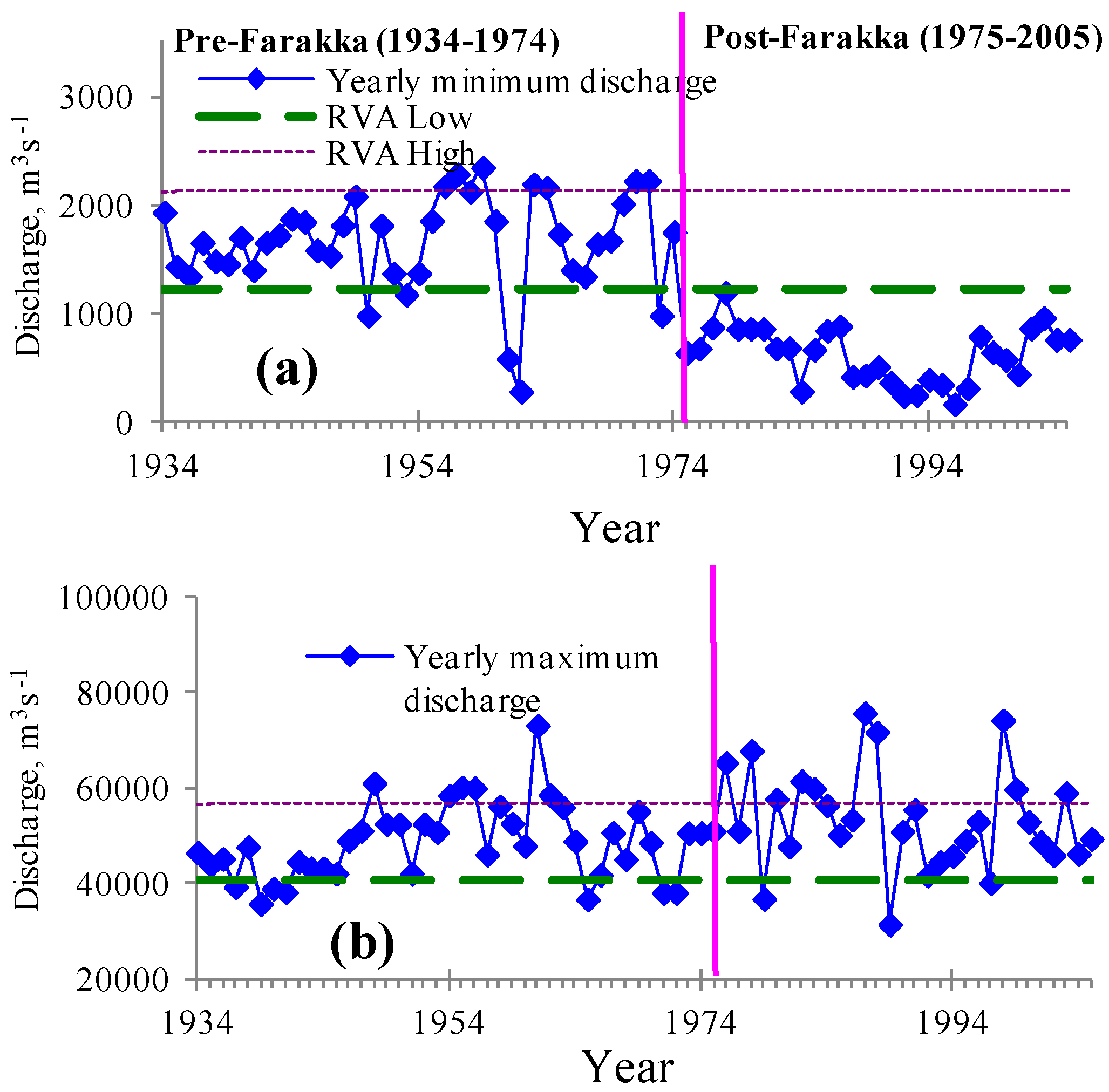
| Minimum discharge | 1934–2005 | 6.00 | 2.00 | Significant trend |
| 1934–1974 | 0.561 | 2.02 | Trend does not exist | |
| Maximum discharge | 1934–2005 | 2.33 | 2.00 | Significant trend |
| 1934–1974 | 1.51 | 2.02 | Trend does not exist |
3.3. Assessment of Thresholds Using RVA Approach
4. Results
4.1. Ecological Flow Threshold
| RVA parameters | Mean and standard deviation | Threshold flow (m3·s−1) | ||
|---|---|---|---|---|
| Means (m3·s−1) | SD (m3·s−1) | Low | High | |
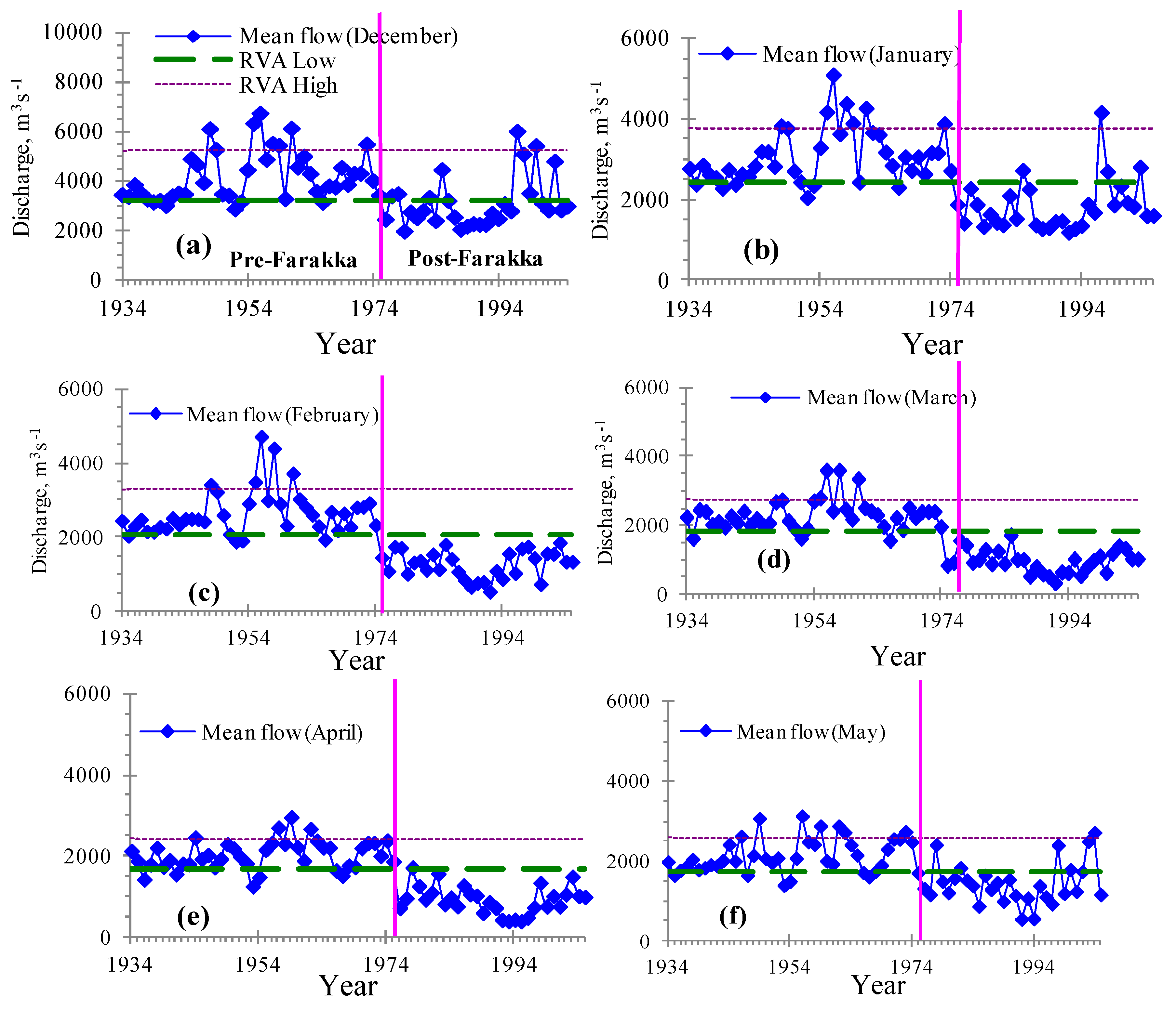
| January | 3,083 | 677 | 2,406 | 3,760 |
| February | 2,670 | 613 | 2,057 | 3,283 |
| March | 2,299 | 454 | 1,845 | 2,752 |
| April | 2,042 | 365 | 1,677 | 2,406 |
| May | 2,161 | 435 | 1,726 | 2,596 |
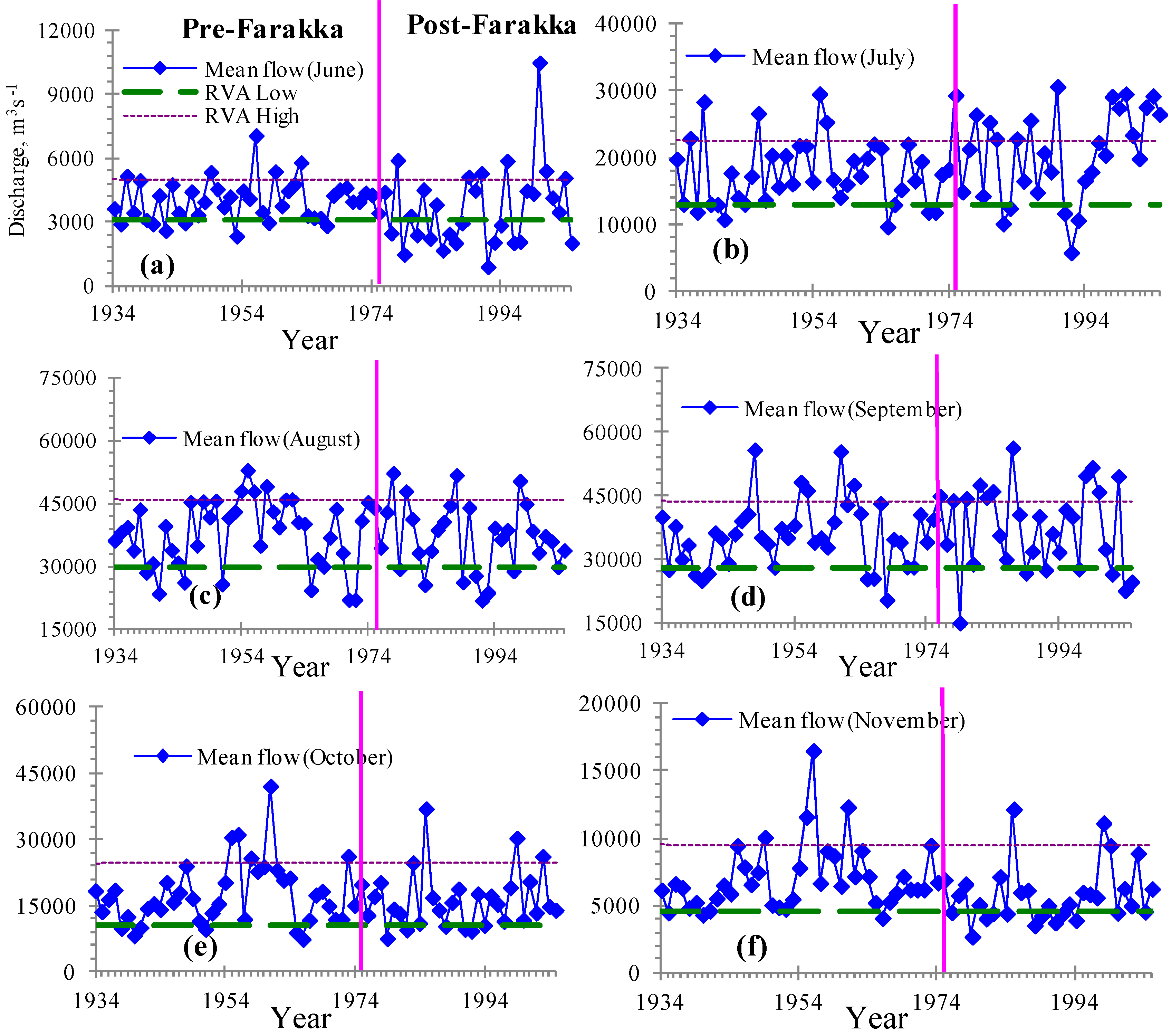
| June | 4,024 | 958 | 3,066 | 4,982 |
| July | 17,672 | 4,781 | 12,890 | 22,453 |
| August | 37,809 | 8,116 | 29,693 | 45,924 |
| September | 35,812 | 7,920 | 27,892 | 43,731 |
| October | 17,661 | 7,056 | 10,605 | 24,717 |
| November | 7,058 | 2,449 | 4,609 | 9,507 |
| December | 4,191 | 1,017 | 3,173 | 5,208 |
| 1-Day Minimum | 1,677 | 446 | 1,231 | 2,123 |
| 3-Day Minimum | 1,780 | 331 | 1,449 | 2,110 |
| 7-Day Minimum | 1,824 | 300 | 1,524 | 2,124 |
| 30-Day Minimum | 1,853 | 307 | 1,546 | 2,161 |
| 90-Day Minimum | 2,122 | 330 | 1,793 | 2,452 |
| 1-Day Maximum | 48,727 | 7,957 | 40,770 | 56,683 |
| 3-Day Maximum | 48,367 | 8,040 | 40,327 | 56,406 |
| 7-Day Maximum | 47,330 | 8,319 | 39,011 | 55,649 |
| 30-Day Maximum | 41,846 | 8,070 | 33,776 | 49,916 |
| 90-Day Maximum | 32,747 | 6,799 | 25,948 | 39,546 |
4.2. Investigation of the Effects of Farakka Dam
| RVA Parameters | Threshold Flow (m3·s−1) Based on the Data of Pre-Farakka Period | Failure Rate of RVA Target at Post-Dam Period (1975–2005) | |
|---|---|---|---|
| Low | High | ||
| January | 2,406 | 3,760 | 90% |
| February | 2,057 | 3,283 | 100% |
| March | 1,845 | 2,752 | 100% |
| April | 1,677 | 2,406 | 94% |
| May | 1,726 | 2,596 | 81% |
| June | 3,066 | 4,982 | 68% |
| July | 12,890 | 22,453 | 61% |
| August | 29,693 | 45,924 | 36% |
| September | 27,892 | 43,731 | 58% |
| October | 10,605 | 24,717 | 32% |
| November | 4,609 | 9,507 | 48% |
| December | 3,173 | 5,208 | 71% |
| 1-Day Minimum | 1,231 | 2,123 | 100% |
| 3-Day Minimum | 1,449 | 2,110 | 100% |
| 7-Day Minimum | 1,524 | 2,124 | 100% |
| 30-Day Minimum | 1,546 | 2,161 | 100% |
| 90-Day Minimum | 1,793 | 2,452 | 100% |
| 1-Day Maximum | 40,770 | 56,683 | 42% |
| 3-Day Maximum | 40,327 | 56,406 | 42% |
| 7-Day Maximum | 39,011 | 55,649 | 45% |
| 30-Day Maximum | 33,776 | 49,916 | 39% |
| 90-Day Maximum | 25,948 | 39,546 | 32% |


5. Impact of Hydrologic Alteration
6. Conclusions
Acknowledgments
Author Contributions
Conflicts of Interest
References
- Gallopín, G.C. Linking between vulnerability, resilience and adaptive capacity. Glob. Environ. Chang. 2006, 16, 293–303. [Google Scholar] [CrossRef]
- Ostrom, E. A general framework for analyzing sustainability of social-ecological systems. Science 2009, 325, 419–422. [Google Scholar] [CrossRef]
- Gleick, P.H. Global freshwater resources: Soft-path solutions for the 21st century. Science 2003, 302, 1524–1528. [Google Scholar] [CrossRef]
- Millennium Ecosystem Assessment. In Ecosystem and Human Wellbeing: Current State and Trends; Island Press: Washington, DC, USA, 2005.
- Vörösmarty, C.J.; Mclntyre, P.B.; Gessner, M.O.; Dudgeon, D.; Prusevich, A.; Green, P.; Glidden, S.; Bunn, S.E.; Sullivan, C.A.; Liermann, C.R.; et al. Global freshwater resources: Soft-path solutions for the 21st century. Nature 2010, 467, 555–561. [Google Scholar] [CrossRef]
- Poff, N.L.; Matthews, J.H. Environmental flows in the Anthropocene: Past progress and future prospects. Curr. Opin. Environ. Sustain. 2013, 5, 667–675. [Google Scholar] [CrossRef]
- Sanz, D.B.; Garcίa del Jalόn, D.; Gutiérrez Teira, B.; Vizcaίno Martίnez, P. Basin influence on natural variability of rivers in semi-arid environments. Int. J. River Basin Manag. 2005, 3, 247–259. [Google Scholar] [CrossRef]
- Gain, A.K.; Apel, H.; Renaud, F.G.; Giupponi, C. Thresholds of hydrologic flow regime of a river and investigation of climate change impact—The case of lower Brahmaputra river Basin. Clim. Chang. 2013, 120, 463–475. [Google Scholar] [CrossRef]
- Poff, N.L.; Allan, J.D.; Bain, M.B.; Karr, J.R.; Prestegaard, K.L.; Brian, D.; Sparks, R.E.; Stromberg, J.C.; Richter, B.D. The natural flow regime—A paradigm for river conservation and restoration. BioScience 1997, 47, 769–784. [Google Scholar] [CrossRef]
- Olden, J.D.; Poff, N.L.; Bestgen, K.R. Life-history strategies predict fish invasions and extirpations in the Colorado River Basin. Ecol. Monogr. 2006, 76, 25–40. [Google Scholar] [CrossRef]
- Poff, N.L.; Richter, B.R.; Arthington, A.H.; Bunn, S.E.; Naiman, R.J.; Kendy, E.; Acreman, M.; Apse, C.; Bledsoe, B.P.; Freeman, M.C.; et al. The ecological limits of hydrological alteration (ELOHA): A new framework for developing regional environmental flow standards. Freshw. Biol. 2010, 55, 147–170. [Google Scholar] [CrossRef]
- Leopold, L.B.; Wolman, M.G.; Miller, J.P. Fluvial Processes in Geomorphology; W.H. Freeman and Sons: San Francisco, CA, USA, 1964. [Google Scholar]
- Tabacchi, E.; Correll, D.L.; Hauer, R.; Pinay, G.; Planty-Tabacchi, A.M. Development, maintenance and role of riparian vegetation in the river landscape. Freshw. Biol. 1998, 40, 497–516. [Google Scholar] [CrossRef]
- Cuny, F.C. Living with floods: Alternatives for riverine flood mitigation. Land Use Policy 1991, 8, 331–342. [Google Scholar] [CrossRef]
- Tockner, K.; Stanford, J.A. Riverine floodplains: Present state and future trends. Environ. Conserv. 2002, 29, 308–330. [Google Scholar]
- Smakhtin, V.U.; Shilpakar, R.L.; Hughes, D.A. Hydrology-based assessment of environmental flows: An example from Nepal. Hydrol. Sci. J. 2006, 51, 207–222. [Google Scholar] [CrossRef]
- Wharton, C.H.; Lambou, V.W.; Newsome, J.; Winger, P.V.; Gaddy, L.L.; Mancke, R. The fauna of bottomland hardwoods in the southeastern United States. In Wetlands of Bottom-Land Hardwood Forests; Clark, J.R., Benforado, J., Eds.; Elsevier: New York, NY, USA, 1981; pp. 87–160. [Google Scholar]
- Gain, A.K.; Giupponi, C.G.; Renaud, F.G. Climate change adaptation and vulnerability assessment of water resources systems in developing countries: A generalized framework and a feasibility study in Bangladesh. Water 2012, 4, 345–366. [Google Scholar] [CrossRef]
- Kundzewicz, Z.W.; Mata, L.J.; Arnell, N.W.; Döll, P.; Kabat, P.; Jiménez, B.; Miller, K.A.; Oki, T.; Sen, Z.; Shiklomanov, I.A. Freshwater resources and their management. In Climate Change 2007: Impacts, Adaptation and Vulnerability. Contribution of Working Group II to the Fourth Assessment Report of the Intergovernmental Panel on Climate Change; Parry, M.L., Canziani, O.F., Palutikof, J.P., van der Linden, P.J., Hanson, C.E., Eds.; Cambridge University Press: Cambridge, UK, 2007; pp. 173–210. [Google Scholar]
- Bates, B.C.; Kundzewicz, Z.W.; Wu, S.; Palutikof, J.P. Climate Change and Water; Technical Paper for Intergovernmental Panel on Climate Change; IPCC Secretariat: Geneva, Switzerland, 2008. [Google Scholar]
- Stocker, T.F.; Qin, D.; Plattner, G.-K.; Tignor, M.; Allen, S.K.; Boschung, J.; Nauels, A.; Xia, Y.; Bex, V.; Midgley, P.M. Climate Change 2013: The Physical Science Basis. Contribution of Working Group I to the Fifth Assessment Report of the Intergovernmental Panel on Climate Change; Cambridge University Press: Cambridge, UK, 2013. [Google Scholar]
- IPCC (The Intergovernmental Panel on Climate Change). Climate Change 2014: Impact, Adaptation and Vulnerability. Summary for Policymakers. Contribution of Working Group II to the Fifth Assessment Report of the Intergovernmental Panel on Climate Change; Cambridge University Press: Cambridge, UK, 2014. [Google Scholar]
- Ghanbarpour, M.R.; Zolfaghari, S.; Geiss, C.; Darvari, Z. Investigation of river flow alterations using environmental flow assessment and hydrologic indices: Tajan River Watershed, Iran. Int. J. River Basin Manag. 2013, 11, 311–321. [Google Scholar] [CrossRef]
- WCD (World Commission on Dams). Dams and Development: A New Framework for Decision Making; Earthscan: London, UK, 2000. [Google Scholar]
- Nilsson, C.; Reidy, C.A.; Dynesius, M.; Revenga, C. Fragmentation and flow regulation of the world’s large river systems. Science 2005, 308, 405–408. [Google Scholar] [CrossRef]
- Poff, N.L.; Hart, D.D. How dams vary and why it matters for the emerging science of dam removal. BioScience 2002, 52, 659–668. [Google Scholar] [CrossRef]
- Bunn, S.E.; Arthington, A.H. Basic principles and ecological consequences of altered flow regimes for aquatic biodiversity. Environ. Manag. 2002, 30, 492–507. [Google Scholar] [CrossRef]
- Richter, B.D.; Baumgartner, J.V.; Powell, J.; Braun, D.P. A method for assessing hydrologic alteration within ecosystems. Conserv. Biol. 1996, 10, 1163–1174. [Google Scholar]
- Richter, B.D.; Baumgartner, J.V.; Wigington, R.; Braun, D.P. How much water does a river need? Freshw. Biol. 1997, 37, 231–249. [Google Scholar]
- Richter, B.D.; Davis, M.M.; Apse, C.; Konrad, C. A presumptive standard for environmental flow protection. River Res. Appl. 2012, 28, 1312–1321. [Google Scholar] [CrossRef]
- Pegg, M.A.; Pierce, C.L.; Roy, A. Hydrological alteration along the Missouri River basin: A time series approach. Aquat. Sci. 2003, 65, 63–72. [Google Scholar] [CrossRef]
- Magilligan, F.J.; Nislow, K.H. Changes in hydrologic regime by dams. Geomorphology 2005, 71, 61–68. [Google Scholar] [CrossRef]
- Jiang, L.; Ban, X.; Wang, X.; Cai, X. Assessment of hydrologic alterations caused by the Three Gorges Dam in the Middle and Lower Reaches of Yangtze River, China. Water 2014, 6, 1419–1434. [Google Scholar] [CrossRef]
- Matthews, R.; Richter, B.D. Application of the indicators of hydrologic alternation software in environmental flow setting. J. Am. Water Resour. Assoc. 2007, 43, 1400–1413. [Google Scholar] [CrossRef]
- Pyron, M.; Neumann, L. Hydrologic alterations in the Wabash River Watershed, USA. River Res. Appl. 2008, 24, 1175–1184. [Google Scholar] [CrossRef]
- Zhang, Y.; Arthington, A.H.; Bunn, S.E.; Mackay, S.; Xia, J.; Kennard, M. Classification of flow regimes for environmental flow assessment in regulated rivers: The Huai River Basin, China. River Res. Appl. 2012, 28, 989–1005. [Google Scholar] [CrossRef]
- Smakhtin, V.U. Low flow hydrology: A review. J. Hydrol. 2001, 240, 147–186. [Google Scholar] [CrossRef]
- Gain, A.K.; Immerzeel, W.W.; Sperna Weiland, F.C.; Bierkens, M.F.P. Impact of climate change on the stream flow of the lower Brahmaputra: Trends in high and low flows based on discharge-weighted ensemble modelling. Hydrol. Earth Syst. Sci. 2011, 15, 1537–1545. [Google Scholar] [CrossRef]
- Mirza, M.M.Q. Diversion of the Ganges Water at Farakka and its effects on salinity in Bangladesh. Environ. Manag. 1998, 22, 711–722. [Google Scholar] [CrossRef]
- Rouillard, J.J.; Benson, D.; Gain, A.K. Evaluating IWRM implementation success: Are water policies in Bangladesh enhancing adaptive capacity to climate impacts. Int. J. Water Resour. Dev. 2014, 30, 515–527. [Google Scholar] [CrossRef]
- Chowdhury, M.R.; Ward, N. Hydro-meteorological variability in the greater Ganges-Brahmaputra-Meghna Basins. Int. J. Climatol. 2004, 24, 1495–1508. [Google Scholar] [CrossRef]
- Jain, S.K.; Kumar, V. Trend analysis of rainfall and temperature data for India. Curr. Sci. India 2012, 102, 37–49. [Google Scholar]
- Gain, A.K.; Hoque, M.M. Flood risk assessment and its application in the eastern part of Dhaka City, Bangladesh. J. Flood Risk Manag. 2013, 6, 219–228. [Google Scholar] [CrossRef]
- Gain, A.K.; Wada, Y. Assessment of future water scarcity at different spatial and temporal scales of the Brahmaputra River Basin. Water Resour. Manag. 2014, 28, 999–1012. [Google Scholar]
- Abbas, N.; Subramanian, V. Erosion and sediment transport in the Ganges River basin, India. J. Hydrol. 1984, 69, 173–182. [Google Scholar] [CrossRef]
- Abbas, B.M. The Ganges Water Dispute; University Press Limited: Dhaka, Bangladesh, 1984. [Google Scholar]
- Mirza, M.M.Q. Hydrological changes in the Ganges system in Bangladesh in the post-Farakka period. Hydrolog. Sci. J. 1997, 42, 613–631. [Google Scholar] [CrossRef]
- Governtment of the People’s Republic of Bangladesh GoB. Ganges Water Sharing Treaty; Government of the People’s Republic of Bangladesh Dhaka: Dhaka, Bangladesh, 1996. [Google Scholar]
- Milhous, R.T. Selected hydrological tools for in-stream flow analysis. In Proceedings of the 34th Annual American Geophysical Union (AGU) Hydrologic Days, CO, USA, 24–26 March 2014; Colorado State University; pp. 32–43.
- Kumar, V.; Jain, S.K. Trend in rainfall amount and number of rainy days in river basins of India (1951–2004). Hydrol. Res. 2011, 42, 290–306. [Google Scholar] [CrossRef]
- Gain, A.K.; Uddin, M.N.; Sana, P. Impact of river salinity on fish diversity in the south-west coastal region of Bangladesh. Int. J. Ecol. Environ. Sci. 2008, 34, 49–54. [Google Scholar]
- Poff, N.L.; Ward, J.V. Implications of streamflow variability and predictability for lotic community structure: A regional analysis of streamflow patterns. Can. J. Aquat. Sci. 1989, 46, 1805–1818. [Google Scholar] [CrossRef]
- Walker, K.F.; Sheldon, F.; Puckridge, J.T. A perspective on dryland river ecosystem. Regul. River 1995, 11, 85–104. [Google Scholar] [CrossRef]
- Olden, J.D.; Poff, N.L. Redundancy and the choice of hydrologic indices for characterizing streamflow regimes. River Res. Appl. 2003, 19, 101–121. [Google Scholar] [CrossRef]
- Monk, W.A.; Wood, P.J.; Hannah, D.M.; Wilson, D.A. Selection of river flow indices for the assessment of hydroecological change. River Res. Appl. 2007, 23, 113–122. [Google Scholar] [CrossRef]
- Poff, N.L.; Zimmerman, J.K.H. Ecological responses to altered flow regimes: A literature review to inform the science and management of environmental flows. Freshw. Biol. 2010, 55, 194–205. [Google Scholar] [CrossRef]
- Swain, A. Displacing the conflict: Environmental destruction in Bangladesh and ethnic conflict in India. J. Peace Res. 1996, 33, 189–204. [Google Scholar] [CrossRef]
- Mallick, B.; Vogt, J. Population displacement after cyclone and its consequences: Empirical evidence from coastal Bangladesh. Nat.Hazards 2014, 73, 191–212. [Google Scholar] [CrossRef]
- Akter, S.; Mallick, B. The poverty-vulnerability-resilience nexus: Evidence from Bangladesh. Ecol.Econ. 2013, 96, 114–124. [Google Scholar] [CrossRef]
- Adel, M.M. Effect on water resources from upstream water diversion in the Ganges basin. J. Environ. Qual. 2001, 30, 356–68. [Google Scholar] [CrossRef]
- Hossain, M.A.; Haque, M.A. Fish species composition in the river Padma near Rajshahi. J. Life Earth Sci. 2005, 1, 35–42. [Google Scholar]
- Gain, A.K.; Aryal, K.P.; Sana, P.; Uddin, M.N. Effect of river salinity on crop diversity: A case study of south west coastal region of Bangladesh. Nepal Agric. Res. J. 2007, 8, 35–43. [Google Scholar]
- Mirza, M.M.Q. The Ganges Water Diversion: Environmental Effects and Implications; Kluwer Academic Publisher: Dordrecht, The Netherlands, 2004. [Google Scholar]
- Meijer, K.S.; van Beek, E. A framework for the quantification of the importance of environmental flows for human well-being. Soc. Nat. Resour. 2011, 24, 1252–1269. [Google Scholar] [CrossRef]
- Hossain, M.S.; Hein, L.; Rip, F.I.; Dearing, J.A. Integrating ecosystem services and climate change responses in coastal wetlands development plans for Bangladesh. Mitig. Adapt. Strateg. Glob. Chang. 2013. [Google Scholar] [CrossRef]
- Sultana, F. Engendering a catastrophe: A gendered analysis of India’s river linking project. In Regional Cooperation on Transboundary Rivers: Impact of the Indian River-linking Project; Ahmed, M.F., Ahmad, Q.K., Khalequzzaman, M., Eds.; BAPA Press: Dhaka, Bangladesh, 2004; pp. 288–305. [Google Scholar]
- Opstal, E.V. O Mother, O Ganges! Water Reduction and Social Changes in Rural Southwest Bangladesh; Working Paper No. 3; Conflict Research Group, Ghent University: Ghent, Belgium, 2006. [Google Scholar]
- Mallick, B.; Rahaman, K.R.; Vogt, J. Social vulnerability analysis for sustainable disaster mitigation planning in coastal Bangladesh. Disaster Prev. Manag. 2011, 20, 220–237. [Google Scholar] [CrossRef]
- Zaman, M. Economic opportunities from Polders in Bangladesh. Int. J. Water Resour. Dev. 1983, 1, 197–204. [Google Scholar] [CrossRef]
- Kamruzzaman, M.; Beecham, S.; Zuppi, G.M. A model for water sharing in the Ganges River Basin. Water Environ. J. 2012, 26, 308–318. [Google Scholar] [CrossRef]
- Rahaman, M.M. Integrated Ganges Basin management: Conflicts and hope for regional development. Water Policy 2009, 11, 168–190. [Google Scholar] [CrossRef]
- Rahaman, M.M. Principles of transboundary water resources management and Ganges Treaties: An analysis. Int. J. Water Resour. Dev. 2009, 25, 159–173. [Google Scholar] [CrossRef]
- Gain, A.K.; Rouillard, J.J.; Benson, D. Can integrated water resources management increase adaptive capacity to climate change adaptation? A critical review. J.Water Resour.Prot. 2013, 5, 11–20. [Google Scholar] [CrossRef]
- Huq, N.; Hugé, J. “Greening” integrated water resources management policies for tackling climate change impacts: A call for sustainable development. In Climate Change and the Sustainable Use of Water Resources; Filho, W.L., Ed.; Springer: Berlin, Germany, 2012; pp. 173–183. [Google Scholar]
- Giupponi, C.; Sgobbi, A. Decision support systems for water resources management in developing countries: Learning from experiences in Africa. Water 2013, 5, 798–818. [Google Scholar] [CrossRef]
- Gain, A.K.; Schwab, M. An assessment of water governance trends: The case of Bangladesh. Water Policy 2012, 14, 821–840. [Google Scholar] [CrossRef]
- Sen, H.S. The drying up of River Ganga: An issue of common concern to both India and Bangladesh. Curr. Sci. India 2010, 99, 725–727. [Google Scholar]
- Gain, A.K.; Giupponi, C. A dynamic assessment of water scarcity risk in the Lower Brahmaputra River Basin: An integrated approach. Ecol. Indic. 2014, in press. [Google Scholar]
© 2014 by the authors; licensee MDPI, Basel, Switzerland. This article is an open access article distributed under the terms and conditions of the Creative Commons Attribution license (http://creativecommons.org/licenses/by/3.0/).
Share and Cite
Gain, A.K.; Giupponi, C. Impact of the Farakka Dam on Thresholds of the Hydrologic Flow Regime in the Lower Ganges River Basin (Bangladesh). Water 2014, 6, 2501-2518. https://doi.org/10.3390/w6082501
Gain AK, Giupponi C. Impact of the Farakka Dam on Thresholds of the Hydrologic Flow Regime in the Lower Ganges River Basin (Bangladesh). Water. 2014; 6(8):2501-2518. https://doi.org/10.3390/w6082501
Chicago/Turabian StyleGain, Animesh K., and Carlo Giupponi. 2014. "Impact of the Farakka Dam on Thresholds of the Hydrologic Flow Regime in the Lower Ganges River Basin (Bangladesh)" Water 6, no. 8: 2501-2518. https://doi.org/10.3390/w6082501
APA StyleGain, A. K., & Giupponi, C. (2014). Impact of the Farakka Dam on Thresholds of the Hydrologic Flow Regime in the Lower Ganges River Basin (Bangladesh). Water, 6(8), 2501-2518. https://doi.org/10.3390/w6082501