

Pitch and Plasticity: Insights from the Pitch Matching of Chords by Musicians with Absolute and Relative Pitch

Abstract
1. Introduction
1.1. The Evolution of Pitch Models
1.2. Concurrent Pitch Processing
1.3. Models of Absolute Pitch
1.4. The Present Research
2. Experimental Section
2.1. Participants

| Musician Group | N | Pitch Naming Performance/50 | Mean Year of Music Training (SD) |
|---|---|---|---|
| RP | 12 | 0–7 | 19.04 (4.9) |
| QAP | 12 | 10–35 | 18.0 (9.7) |
| AP | 9 | 40–50 | 21.2 (8.2) |
2.2. Materials
2.3. Procedure
| Interval (Semitones) | Frequency Difference (%) | Chord Names | |
|---|---|---|---|
| 2 | 12.2 | major 2nd | |
| 3 | 18.9 | minor 3rd | |
| 4 | 26 | major 3rd | |
| 6 | 41.4 | tritone | |
| 7 | 49.8 | perfect 5th | |
| 8 | 58.7 | minor 6th | |
| 2 and 7 | 12.2 | 49.8 | suspended 2nd triad |
| 3 and 6 | 18.9 | 41.4 | diminished 5th triad |
| 3 and 7 | 18.9 | 49.8 | minor triad |
| 4 and 6 | 26 | 41.4 | flattened 5th triad |
| 4 and 7 | 26 | 49.8 | major triad |
| 4 and 8 | 26 | 58.7 | augmented 5th triad |
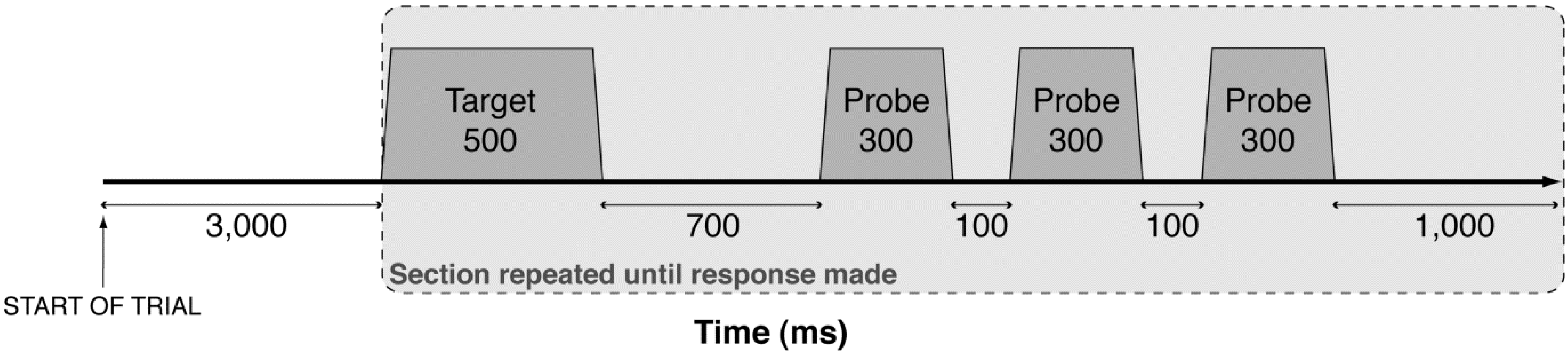
2.4. Pitch Matching Accuracy and Data Analysis
| Chord | Semitone Intervals | Familiarity Rating Mean (SD) | t | Effect size (R2) |
|---|---|---|---|---|
| major triad | 4 and 7 | 4.45 (0.79) | 9.89 | 0.25 |
| major 3rd | 4 | 4.32 (0.93) | 4.87 | 0.11 |
| perfect 5th | 7 | 4.21 (0.94) | 3.11 | 0.05 |
| minor 6th | 8 | 4.13 (1.01) | 1.83 | 0.02 |
| minor triad | 3 and 7 | 4.02 (1.07) | 0.38 | 0.00 |
| minor 3rd | 3 | 3.85 (1.05) | −1.97 | 0.02 |
| tritone | 6 | 3.61 (1.17) | −4.64 | 0.10 |
| diminished 5th triad | 3 and 6 | 3.64 (1.11) | −5.55 | 0.09 |
| suspended 2nd triad | 2 and 7 | 3.60 (1.21) | −5.66 | 0.10 |
| augmented 5th triad | 4 and 8 | 3.48 (1.30) | −6.92 | 0.14 |
| major 2nd | 2 | 3.31 (1.39) | −6.96 | 0.20 |
| flattened 5th triad | 4 and 6 | 3.35 (1.28) | −8.74 | 0.21 |
3. Results and Discussion
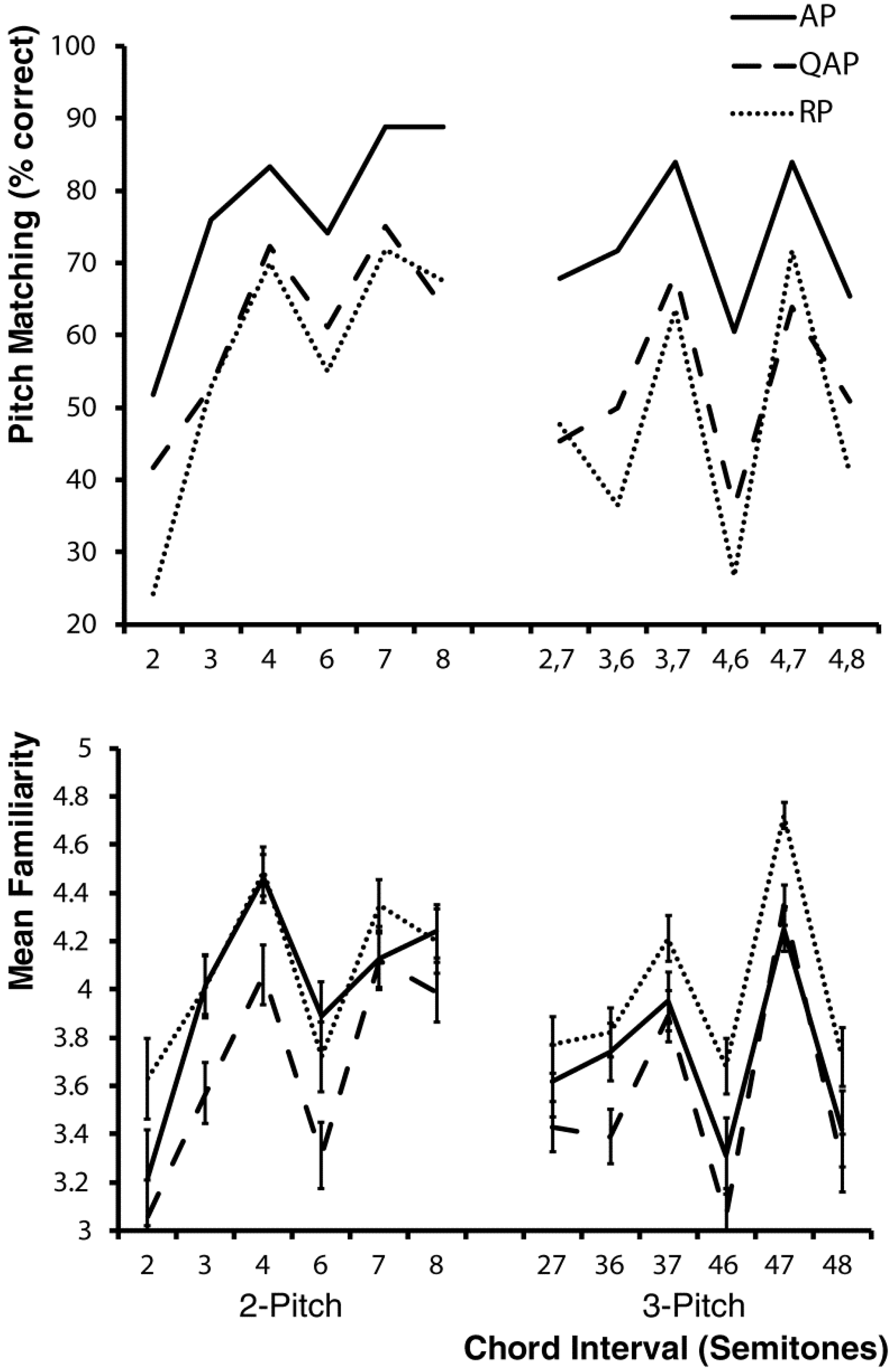
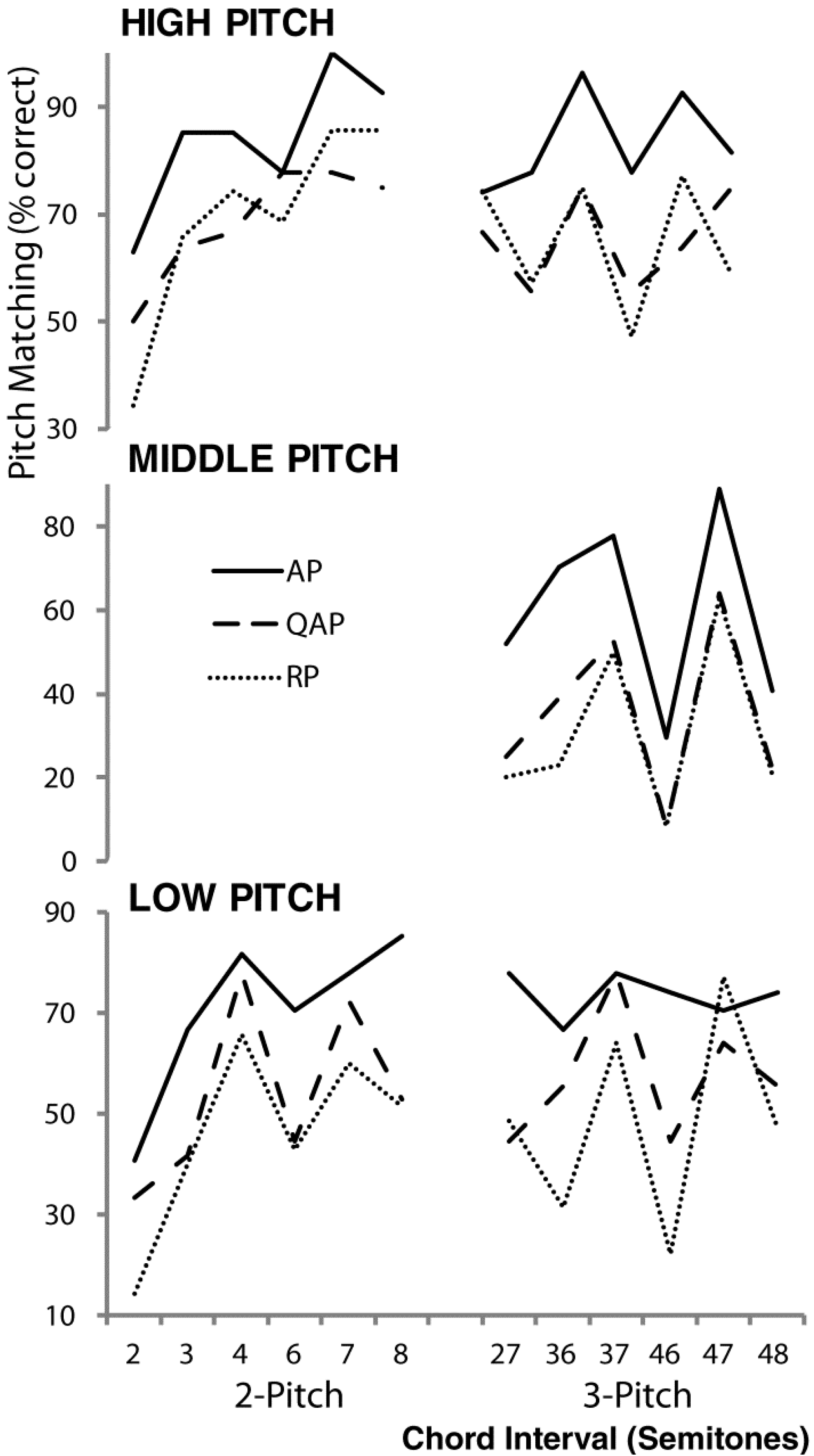
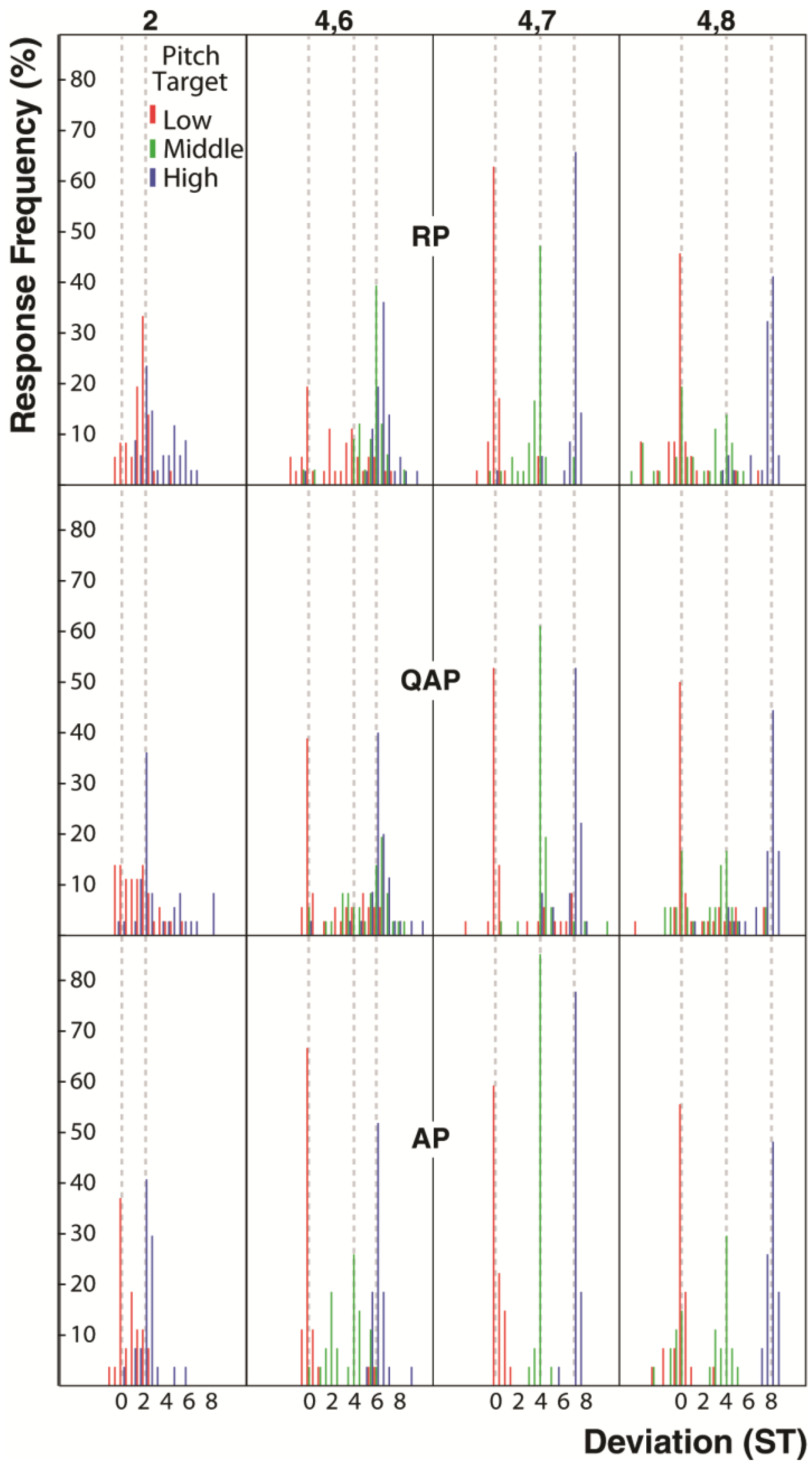
4. Discussion
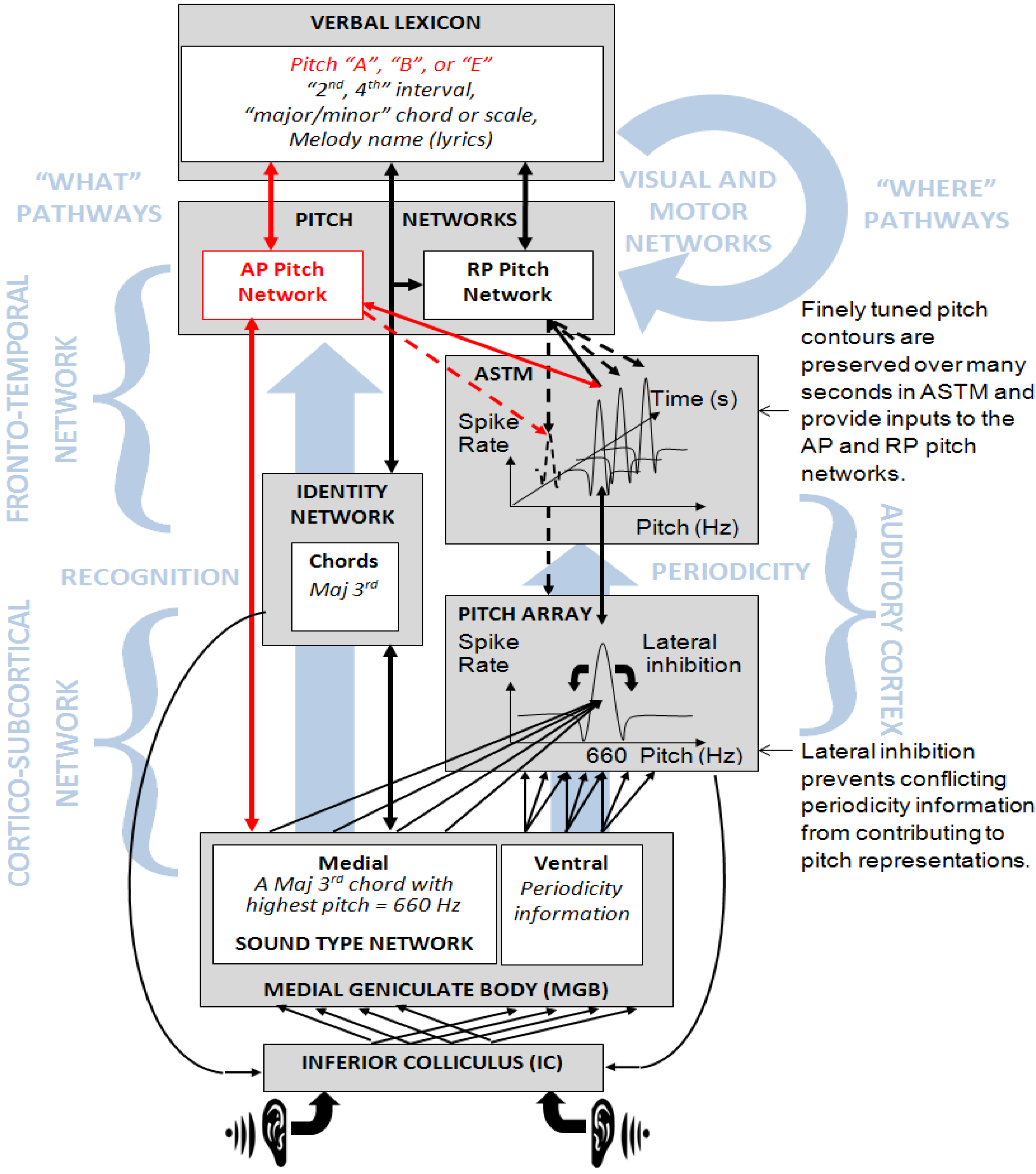
Absolute Pitch in the Dual Mechanism Model of Pitch
5. Conclusions
Acknowledgments
Conflicts of Interest
References and Notes
- Bachem, A. Various types of absolute pitch. J. Acoust. Soc. Am. 1937, 9, 146–151. [Google Scholar] [CrossRef]
- McLachlan, N.M. A computational model of human pitch strength and height judgments. Hear. Res. 2009, 249, 23–35. [Google Scholar] [CrossRef]
- McLachlan, N.M.; Wilson, S.W. The central role of recognition in auditory perception: A neurobiological model. Psychol. Rev. 2010, 117, 175–196. [Google Scholar] [CrossRef]
- McLachlan, N.M. A neurocognitive model of recognition and pitch segregation. J. Acoust. Soc. Am. 2011, 130, 2845–2854. [Google Scholar] [CrossRef]
- McLachlan, N.M.; Marco, D.J.T.; Wilson, S.J. Consonance and pitch. J. Exp. Psychol. Gen. 2013, 142, 1142–1158. [Google Scholar] [CrossRef]
- McLachlan, N.M.; Marco, D.J.T.; Wilson, S.J. The musical environment and auditory plasticity: Hearing the pitch of percussion. Front. Psychol. 2013. [Google Scholar] [CrossRef]
- De Cheveigné, A. Pitch Perception Models. In Pitch—Neural Coding and Perception; Plack, C., Oxenham, A., Fay, R.R., Popper, A.N., Eds.; Springer Verlag: New York, NY, USA, 2005; pp. 169–233. [Google Scholar]
- Terhardt, E.; Stoll, G.; Seewann, M. Algorithm for extraction of pitch and pitch salience from complex tonal signals. J. Acoust. Soc. Am. 1982, 71, 679–688. [Google Scholar] [CrossRef]
- Cohen, M.A.; Grossberg, S.; Wyse, L.L. A spectral network model of pitch perception. J. Acoust. Soc. Am. 1995, 98, 862–879. [Google Scholar] [CrossRef]
- Parncutt, R. Harmony: A Psychoacoustical. Approach; Springer: Berlin, Germany, 1989; pp. 30–42. [Google Scholar]
- Licklider, J.C.R. A duplex theory of pitch perception. Experientia 1951, 8, 128–134. [Google Scholar] [CrossRef]
- Meddis, R.; Hewitt, M.J. Virtual pitch and phase sensitivity of a computer model of the auditory periphery I: Pitch identification. J. Acoust. Soc. Am. 1991, 89, 2866–2882. [Google Scholar] [CrossRef]
- Cariani, P.A.; Delgutte, B. Neural correlates of the pitch of complex tones. I. Pitch and pitch salience. J. Neurophysiol. 1996, 76, 1698–1716. [Google Scholar]
- Langner, G.; Albert, M.; Briede, T. Temporal and spatial coding of periodicity information in the inferior colliculus of awake chinchilla (Chinchilla laniger). Hear. Res. 2002, 168, 110–130. [Google Scholar] [CrossRef]
- Meddis, R.; O’Mard, L.P. Virtual pitch in a computational physiological model. J. Acoust. Soc. Am. 2006, 120, 3861–3869. [Google Scholar] [CrossRef]
- Moore, B.C.J. Frequency difference limens for short duration tones. J. Acoust. Soc. Am. 1973, 54, 610–619. [Google Scholar] [CrossRef]
- Oxenham, A.J.; Micheyl, C.; Keebler, M.V.; Loper, A.; Santurette, S. Pitch perception beyond the traditional existence region of pitch. Proc. Natl. Acad. Sci. USA 2011, 108, 7629–7634. [Google Scholar] [CrossRef]
- Carlyon, R.P.; Shackelton, T.M. Comparing the fundamental frequencies of resolved and unresolved harmonics: Evidence for two pitch mechanisms? J. Acoust. Soc. Am. 1994, 95, 3541–3554. [Google Scholar] [CrossRef]
- Gockel, H.; Carlyon, R.P.; Plack, C.J. Across-frequency interference effects in fundamental frequency discrimination: Questioning evidence for two pitch mechanisms. J. Acoust. Soc. Am. 2004, 116, 1092–1104. [Google Scholar] [CrossRef]
- Smith, Z.M.; Delgutte, B.; Oxenham, A.J. Chimaeric sounds reveal dichotomies in auditory perception. Nature 2002, 416, 87–90. [Google Scholar] [CrossRef]
- Assmann, P.F.; Paschall, D.D. Pitches of concurrent vowels. J. Acoust. Soc. Am. 1998, 103, 1150–1160. [Google Scholar] [CrossRef]
- Thompson, W.F.; Parncutt, R. Perceptual judgments of triads and dyads: Assessment of a psychoacoustic model. Music Percept. 1997, 14, 263–280. [Google Scholar] [CrossRef]
- Platt, J.R.; Racine, R.J. Perceived pitch class of isolated musical triads. J. Exp. Psychol. Hum. Percept. Perform. 1990, 16, 415–428. [Google Scholar] [CrossRef]
- Micheyl, C.; Keebler, M.V.; Oxenham, A.J. Pitch perception for mixtures of spectrally overlapping harmonic complex tones. J. Acoust. Soc. Am. 2010, 128, 257–269. [Google Scholar] [CrossRef]
- Assmann, P.F.; Summerfield, Q. Modeling the perception of concurrent vowels: Vowels with different fundamental frequencies. J. Acoust. Soc. Am. 1990, 88, 680–697. [Google Scholar] [CrossRef]
- De Cheveigné, A.; Kawahara, H. Multiple period estimation and pitch perception model. Speech Commun. 1999, 27, 175–185. [Google Scholar] [CrossRef]
- Shackleton, T.M.; Meddis, R.; Hewitt, M.J. The role of binaural and fundamental frequency difference cues in the identification of concurrently presented vowels. Q. J. Exp. Psychol. A 1994, 47, 545–563. [Google Scholar]
- McLachlan, N.M.; Grayden, D. Enhancement of speech perception in noise by periodicity processing: A neurobiological model and signal processing algorithm. Speech Commun. 2014, 57, 114–125. [Google Scholar] [CrossRef]
- Robinson, K.; Patterson, R.D. The stimulus duration required to identify vowels, their octave, and their pitch chroma. Speech Commun. 1995, 98, 1858–1865. [Google Scholar]
- Alain, C. Breaking the wave: Effects of attention and learning on concurrent sound perception. Hear. Res. 2007, 228, 225–236. [Google Scholar] [CrossRef]
- Piston, W. Harmony, 5th ed.; Gollancz: London, UK, 1948. [Google Scholar]
- Lee, K.M.; Skoe, E.; Kraus, N.; Ashley, R. Selective subcortical enhancement of musical intervals in musicians. J. Neurosci. 2009, 29, 5832–5840. [Google Scholar] [CrossRef]
- Levitin, D.J.; Rogers, S.E. Absolute pitch: Perception, coding, and controversies. Trends Cogn. Sci. 2005, 9, 26–33. [Google Scholar] [CrossRef]
- Deutsch, D. The puzzle of absolute pitch. Curr. Dir. Psychol. Sci. 2002, 11, 200–204. [Google Scholar]
- Halpern, A.R. Memory for the absolute pitch of familiar songs. Mem. Cogn. 1989, 17, 572–581. [Google Scholar] [CrossRef]
- Saffran, J.R.; Griepentrog, G.J. Absolute pitch in infant auditory learning: Evidence for developmental reorganization. Dev. Psychol. 2001, 37, 74–85. [Google Scholar] [CrossRef]
- Zatorre, R.J. Absolute pitch: A model for understanding the influence of genes and development on neural and cognitive function. Nat. Neurosci. 2003, 6, 692–695. [Google Scholar] [CrossRef]
- Terhardt, E.; Ward, W.D. Recognition of musical key: Exploratory study. J. Acoust. Soc. Am. 1982, 72, 26–33. [Google Scholar] [CrossRef]
- Bermudez, P.; Zatorre, R.J. A distribution of absolute pitch ability as revealed by computerized testing. Music Percept. 2009, 27, 89–101. [Google Scholar] [CrossRef]
- Wilson, S.J.; Lusher, D.; Wan, C.Y.; Dudgeon, P.; Reutens, D.C. The neurocognitive components of pitch processing: Insights from absolute pitch. Cereb. Cortex 2009, 19, 724–732. [Google Scholar] [CrossRef]
- Wilson, S.J.; Lusher, D.; Martin, C.L.; Rayner, G.; McLachlan, N.M. Intersecting factors lead to absolute pitch acquisition that is maintained in a “fixed do” environment. Music Percept. 2012, 29, 285–296. [Google Scholar] [CrossRef]
- Hsieh, I.-H.; Saberi, K. Temporal integration in absolute pitch identification of absolute pitch. Hear. Res. 2007, 233, 108–116. [Google Scholar]
- Krumhansl, C.L. Cognitive Foundations of Musical Pitch; Oxford University Press: New York, NY, USA, 1990. [Google Scholar]
- Moore, B.C.J.; Glasberg, B.R. Relative dominance of individual partials in determining the pitch of complex tones. J. Acoust. Soc. Am. 1985, 77, 1853–1860. [Google Scholar] [CrossRef]
- Wilson, S.J.; Pressing, J.; Wales, R.; Pattison, P. Cognitive models of music psychology and the lateralisation of musical function within the brain. Aust. J. Psychol. 1999, 51, 125–139. [Google Scholar] [CrossRef]
- Sergeant, D.C. Experimental investigation of absolute pitch. J. Res. Music Educ. 1969, 17, 135–143. [Google Scholar] [CrossRef]
- Ross, D.A.; Gore, J.C.; Marks, L.E. Absolute pitch: Music and beyond. Epilepsy Behav. 2005, 7, 578–601. [Google Scholar] [CrossRef]
- Arnott, S.R.; Binns, M.A.; Grady, C.L.; Alain, C. Assessing the auditory dual-pathway model in humans. Neuroimage 2004, 22, 401–408. [Google Scholar] [CrossRef]
- Ballas, J.A. Common factors in the identification of an assortment of brief everyday sounds. J. Exp. Psychol. Hum. Percept. Perform. 1993, 19, 250–267. [Google Scholar]
- Bitterman, Y.; Mukamel, R.; Malach, R.; Fried, I.; Nelken, I. Ultra-fine frequency tuning revealed in single neurons of human auditory cortex. Nature 2008, 451, 197–202. [Google Scholar] [CrossRef]
- Smith, N.A.; Schmuckler, M.A. Dial A440 for absolute pitch: Absolute pitch memory by non-absolute pitch possessors. J. Acoust. Soc. Am. 2008, 123, EL77–EL84. [Google Scholar] [CrossRef]
- Levitin, D.J. Absolute memory for musical pitch: Evidence from the production of learned melodies. Percept. Psychophys. 1994, 56, 414–423. [Google Scholar] [CrossRef]
- Frieler, K.; Fischinger, T.; Schlemmer, K.; Lothwesen, K.; Jakubowski, K.; Müllensiefen, D. Absolute memory for pitch: A comparative replication of Levitin’s 1994 study in six European labs. Music Sci. 2013, 17, 334–349. [Google Scholar] [CrossRef]
- Deutsch, D. The Processing of Pitch Combinations. In The Psychology of Music; Deutsch, D., Ed.; Academic Press: San Diego, CA, USA, 1999; pp. 349–404. [Google Scholar]
- Klein, M.; Coles, M.G.H.; Donchin, E. People with absolute pitch process tones without producing a P300. Science 1984, 223, 1306–1309. [Google Scholar]
- Wayman, J.W.; Frisina, R.D.; Walton, J.P.; Hantz, E.C.; Crummer, G.C. Effects of musical training and absolute pitch ability on event-related activity in response to sine tones. J. Acoust. Soc. Am. 1992, 91, 3527–3531. [Google Scholar] [CrossRef]
- Schlaug, G.; Jäncke, L.; Huang, Y.; Steinmetz, H. In vivo evidence of structural brain asymmetry in musicians. Science 1995, 267, 699–701. [Google Scholar] [CrossRef]
- Zatorre, R.J.; Belin, P.; Penhune, V. Structure and function of the auditory cortex: Music and speech. Trends Cogn. Sci. 2002, 6, 37–46. [Google Scholar] [CrossRef]
- Petrides, M.; Milnar, B. Deficits on subject-ordered tasks after frontal- and temporal-lobe lesions in man. Neuropsychologia 1982, 20, 249–262. [Google Scholar] [CrossRef]
- Keenan, J.P.; Thangaraj, V.; Halpern, A.R.; Schlaug, G. Absolute pitch and planum temporale. Neuroimage 2001, 14, 1402–1408. [Google Scholar] [CrossRef]
- Greco, L. Absolute Pitch and Calendrical Calculation in Aspergers. Syndrome: A Case Study. M.Psy. Thesis, Melbourne School of Psychological Sciences, University of Melbourne, Melbourne, Australia, 1 April 2011. [Google Scholar]
- Miyazaki, K. Perception of musical intervals by absolute pitch possessors. Music Percept. 1992, 9, 413–426. [Google Scholar] [CrossRef]
- Zatorre, R.J.; Perry, D.W.; Beckett, C.A.; Westbury, C.F.; Evans, A.C. Functional anatomy of musical processing in listeners with absolute pitch and relative pitch. Proc. Natl. Acad. Sci. USA 1998, 95, 3172–3177. [Google Scholar] [CrossRef]
- Levitin, D.J.; Zatorre, R.J. On the nature of early music training and absolute pitch: A reply to Brown, Sachs, Cammuso, and Folstein. Music Percept. 2003, 21, 105–110. [Google Scholar]
- Chin, C.S. The development of absolute pitch: A theory concerning the roles of music training at an early developmental age and individual cognitive style. Psychol. Music 2003, 31, 155–171. [Google Scholar] [CrossRef]
- Hedger, S.C.; Heald, S.L.M.; Nusbaum, H.C. Absolute pitch may not be so absolute. Psychol. Sci. 2013, 24, 1496–1502. [Google Scholar] [CrossRef]
- Dooley, K.; Deutsch, D. Absolute pitch correlates with high performance on musical dictation. J. Acoust. Soc. Am. 2010, 128, 890–893. [Google Scholar] [CrossRef]
- Ross, D.A.; Olson, I.R.; Marks, L.E.; Gore, J.C. A non-musical paradigm for identifying absolute pitch possessors. J. Acoust. Soc. Am. 2004, 116, 1793–1799. [Google Scholar] [CrossRef]
- Hsieh, I.; Saberi, K. Dissociation of procedural and semantic memory in absolute-pitch processing. Hear. Res. 2008, 240, 73–79. [Google Scholar] [CrossRef]
© 2013 by the authors; licensee MDPI, Basel, Switzerland. This article is an open access article distributed under the terms and conditions of the Creative Commons Attribution license (http://creativecommons.org/licenses/by/3.0/).
Share and Cite
McLachlan, N.M.; Marco, D.J.T.; Wilson, S.J. Pitch and Plasticity: Insights from the Pitch Matching of Chords by Musicians with Absolute and Relative Pitch. Brain Sci. 2013, 3, 1615-1634. https://doi.org/10.3390/brainsci3041615
McLachlan NM, Marco DJT, Wilson SJ. Pitch and Plasticity: Insights from the Pitch Matching of Chords by Musicians with Absolute and Relative Pitch. Brain Sciences. 2013; 3(4):1615-1634. https://doi.org/10.3390/brainsci3041615
Chicago/Turabian StyleMcLachlan, Neil M., David J. T. Marco, and Sarah J. Wilson. 2013. "Pitch and Plasticity: Insights from the Pitch Matching of Chords by Musicians with Absolute and Relative Pitch" Brain Sciences 3, no. 4: 1615-1634. https://doi.org/10.3390/brainsci3041615
APA StyleMcLachlan, N. M., Marco, D. J. T., & Wilson, S. J. (2013). Pitch and Plasticity: Insights from the Pitch Matching of Chords by Musicians with Absolute and Relative Pitch. Brain Sciences, 3(4), 1615-1634. https://doi.org/10.3390/brainsci3041615