


Increased Corticospinal Excitability and Muscular Activity in a Lower Limb Reaction Task under Psychological Pressure
Abstract
1. Introduction
2. Materials and Methods
2.1. Participants
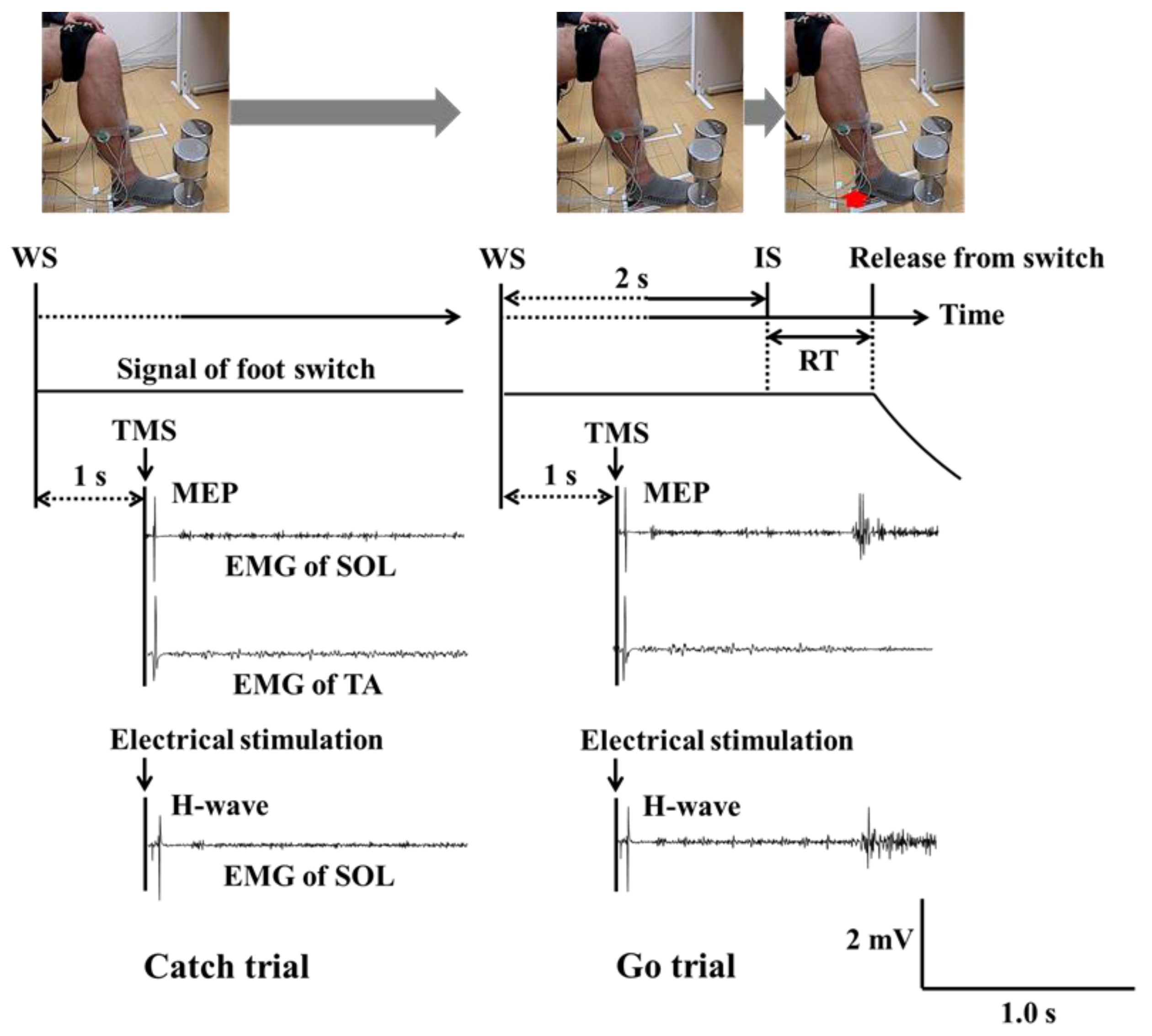
2.2. Task
2.3. Induction and Recording of Physiological Indices
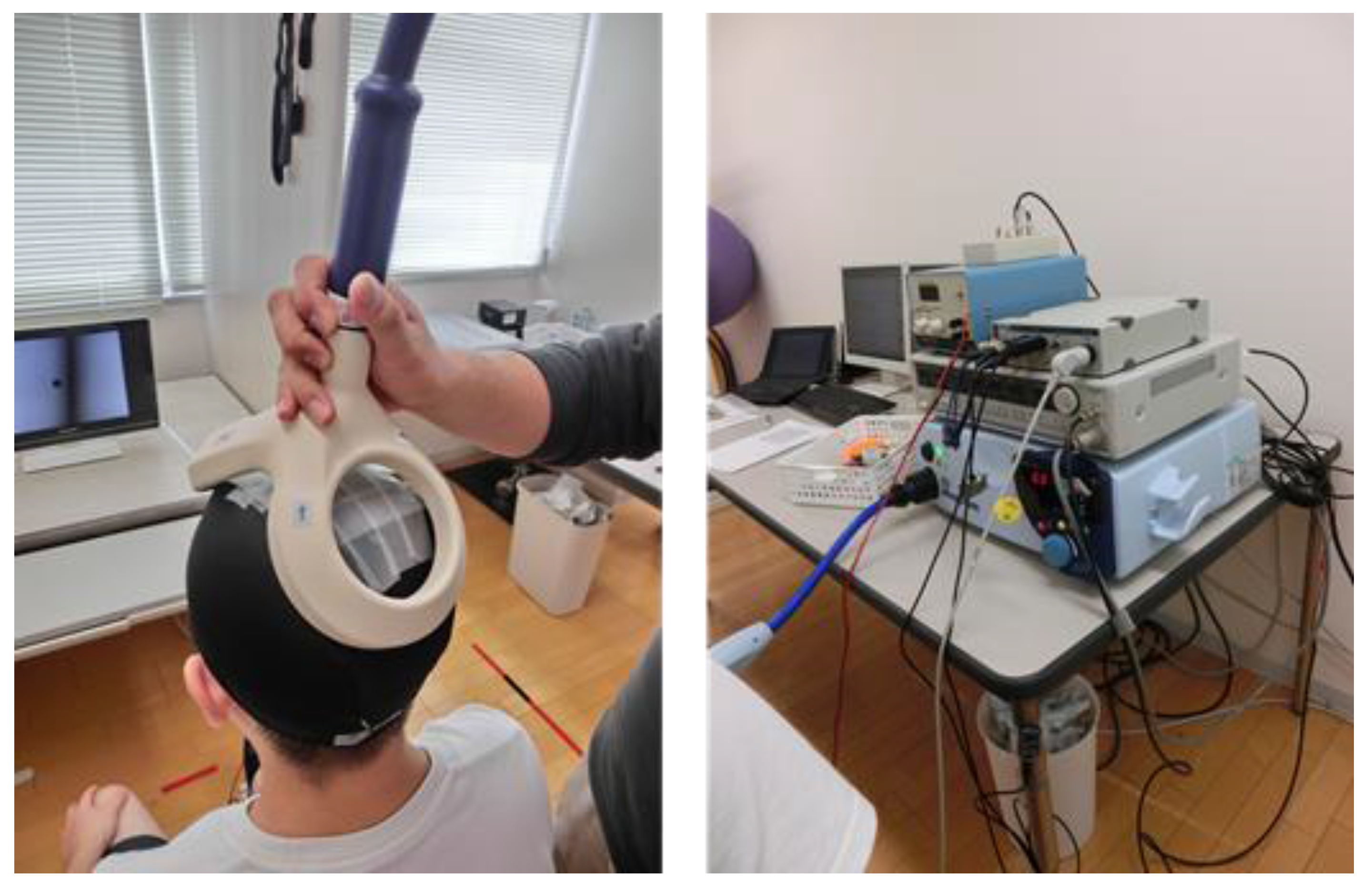
2.3.1. Corticospinal Excitability (MEP)
2.3.2. Spinal Reflex Excitability (H-reflex) and Heart Rate
2.4. Procedure
2.5. Dependent Variables
2.5.1. State Anxiety and Mental Effort
2.5.2. Heart Rate
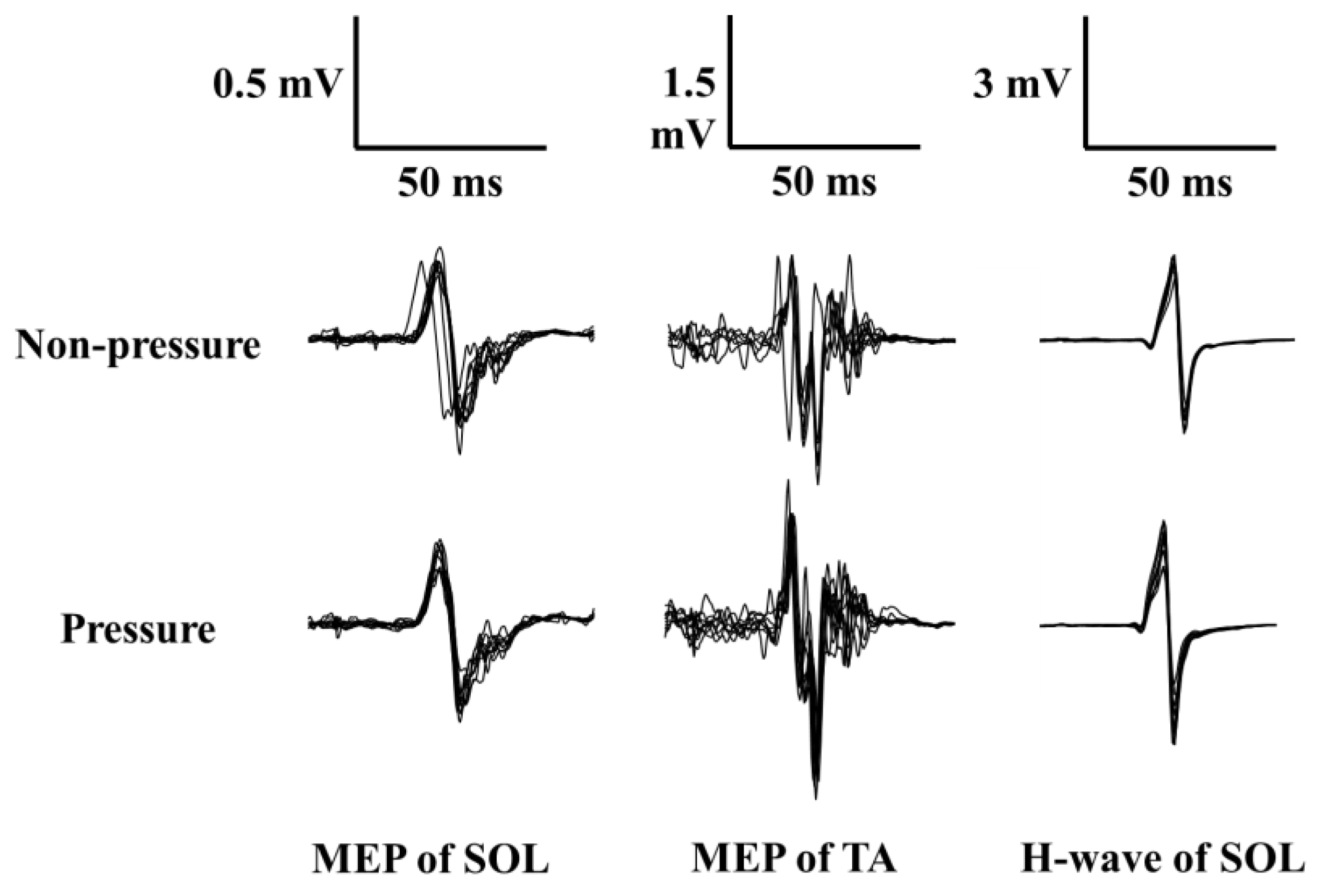
2.5.3. MEP, H-Reflex, and EMG Amplitudes
2.5.4. Task Performance
2.6. Statistical Analysis
3. Results
3.1. Pressure Manipulation Check
3.2. MEP, H-Reflex, and bEMG during Motor Preparation Phase
3.3. EMG Amplitude and Reaction Time during Task Execution Phase
4. Discussion
Acknowledgments
Author Contributions
Conflicts of Interest
References
- Baumeister, R.F. Choking under pressure: Self-consciousness and paradoxical effects of incentives on skillful performance. J. Pers. Soc. Psychol. 1984, 46, 610–620. [Google Scholar] [CrossRef] [PubMed]
- Murray, N.P.; Janelle, C.M. Event-related potential evidence for the processing efficiency theory. J. Sports Sci. 2007, 25, 161–171. [Google Scholar] [CrossRef] [Scilit] [PubMed]
- Rietschel, J.C.; Goodman, R.N.; King, B.R.; Lo, L.C.; Contreras-Vidal, J.L.; Hatfield, B.D. Cerebral cortical dynamics and the quality of motor behavior during social evaluative challenge. Psychophysiology 2011, 48, 479–487. [Google Scholar] [CrossRef] [Scilit] [PubMed]
- Zhu, F.F.; Poolton, J.M.; Wilson, M.R.; Maxwell, J.P.; Masters, R.S.W. Neural co-activation as a yardstick of implicit motor learning and the propensity for conscious control of movement. Biol. Psychol. 2011, 87, 66–73. [Google Scholar] [CrossRef] [Scilit] [PubMed]
- Hatfield, B.D.; Costanzo, M.E.; Goodman, R.N.; Lo, L.C.; Oh, H.; Rietschel, J.C.; Saffer, M.; Bradberry, T.; Contreras-Vidal, J.; Haufler, A. The influence of social evaluation on cerebral cortical activity and motor performance: A study of “Real-Life” competition. Int. J. Psychophysiol. 2013, 90, 240–249. [Google Scholar] [CrossRef] [Scilit] [PubMed]
- Tanaka, Y.; Funase, K.; Sekiya, H.; Sasaki, J.; Tanaka, Y.M. Psychological pressure facilitates corticospinal excitability: Motor preparation processes and EMG activity in a choice reaction task. Int. J. Sport Exerc. Psychol. 2014, 12, 287–301. [Google Scholar] [CrossRef] [Scilit]
- Tanaka, Y.; Funase, K.; Sekiya, H.; Murayama, T. Modulation of corticospinal motor tract excitability during a fine finger movement under psychological pressure: A TMS study. Int. J. Sport Health Sci. 2012, 10, 39–49. [Google Scholar] [CrossRef] [Scilit]
- Rollnik, J.D.; Schubert, M.; Dengler, R. Effects of a competitive stressor on motor cortex excitability: A pilot study. Stress. Med. 2000, 16, 49–54. [Google Scholar] [CrossRef]
- Cooke, A.; Kavussanu, M.; McIntyre, D.; Ring, C. Effects of competition on endurance performance and the underlying psychological and physiological mechanisms. Biol. Psychol. 2011, 86, 370–378. [Google Scholar] [CrossRef] [Scilit] [PubMed]
- Yoshie, M.; Kudo, K.; Ohtsuki, T. Effects of psychological stress on state anxiety, electromyographic activity, and arpeggio performance in pianists. Med. Probl. Perform. Art. 2008, 23, 120–132. [Google Scholar]
- Yoshie, M.; Kudo, K.; Murakoshi, T.; Ohtsuki, T. Music performance anxiety in skilled pianists: Effects of social-evaluative performance situation on subjective, autonomic, and electromyographic reactions. Exp. Brain Res. 2009, 199, 117–126. [Google Scholar] [CrossRef] [Scilit] [PubMed]
- Cooke, A.; Kavussanu, M.; McIntyre, D.; Ring, C. Psychological, muscular and kinematic factors mediate performance under pressure. Psychophysiology 2010, 47, 1109–1118. [Google Scholar] [CrossRef] [Scilit] [PubMed]
- Tanaka, Y.; Funase, K.; Sekiya, H.; Sasaki, J.; Takemoto, T. Multiple EMG activity and intracortical inhibition and facilitation during a fine finger movement under pressure. J. Mot. Behav. 2011, 43, 73–81. [Google Scholar] [CrossRef] [Scilit] [PubMed]
- Sibley, K.M.; Carpenter, M.G.; Perry, J.C.; Frank, J.S. Effects of postural anxiety on the soleus H-reflex. Hum. Mov. Sci. 2007, 26, 103–112. [Google Scholar] [CrossRef] [Scilit] [PubMed]
- Hoffman, M.A.; Koceja, D.M. The effects of vision and task complexity on Hoffmann reflex gain. Brain Res. 1995, 700, 303–307. [Google Scholar] [CrossRef] [Scilit]
- Elias, L.J.; Bryden, M.P. Footedness is a better predictor of language lateralization that handedness. Laterality 1998, 3, 41–51. [Google Scholar] [PubMed]
- Rossini, P.M.; Barker, A.T.; Berardelli, A.; Caramia, M.D.; Caruso, G.; Cracco, R.Q.; Dimitrijević, M.R.; Hallett, M.; Katayama, Y.; Lücking, C.H.; et al. Non-invasive electrical and magnetic stimulation of the brain, spinal cord and roots: Basic principles and procedures for routine clinical application. Report of an IFCN committee. Electroencephalogr. Clin. Neurophysiol. 1994, 91, 79–92. [Google Scholar] [CrossRef] [Scilit]
- Mynark, R.G.; Koceja, D.M. Comparison of soleus H-reflex gain from prone to standing in dancers and controls. Electroencephalogr. Clin. Neurophysiol. 1997, 105, 135–140. [Google Scholar] [CrossRef] [Scilit]
- Cella, D.F.; Perry, S.W. Reliability and concurrent validity of three visual-analogue mood scales. Psychol. Rep. 1986, 59, 827–833. [Google Scholar] [CrossRef] [Scilit] [PubMed]
- Tanaka, Y. Spinal reflexes during postural control under psychological pressure. Motor Control 2015, 19, 242–249. [Google Scholar] [CrossRef] [PubMed]
- Winter, D.A. Biomechanics and Motor Control of Human Movement, 5th ed.; Wiley: Hoboken, NJ, USA, 2009. [Google Scholar]
- Field, A. Discovering Statistics Using SPSS, 4th ed.; Sage Publications: London, UK, 2013. [Google Scholar]
- Yang, F.A.; Gorassini, M. Spinal and brain control of human walking: Implications for retraining of walking. Neuroscientist 2006, 12, 379–389. [Google Scholar] [CrossRef] [Scilit] [PubMed]
- Matsumura, M.; Sawaguchi, T.; Oishi, T.; Ueki, K.; Kubota, K. Behavioral deficits induced by local injection of bicuculline and muscimol into the primate motor and premotor cortex. J. Neurophysiol. 1991, 65, 1542–1553. [Google Scholar] [PubMed]
- Tokimura, H.; Di Lazzaro, V.; Tokimura, Y.; Oliviero, A.; Profice, P.; Insola, A.; Mazzone, P.; Tonali, P.; Rothwell, J.C. Short-latency inhibition of human motor cortex by somatosensory input from the hand. J. Physiol. 2000, 523, 503–513. [Google Scholar] [CrossRef] [Scilit] [PubMed]
- Hallett, M. Surround inhibition. Suppl. Clin. Neurophysiol. 2003, 56, 153–159. [Google Scholar] [PubMed]
- Osu, R.; Franklin, D.W.; Kato, H.; Gomi, H.; Domen, K.; Yoshioka, T.; Kawato, M. Short- and long-term changes in joint co-contraction associated with motor learning as revealed from surface EMG. J. Neurophysiol. 2002, 88, 991–1004. [Google Scholar] [PubMed]
- Coombes, S.A.; Tandonnet, C.; Fujiyama, H.; Janelle, C.M.; Cauraugh, J.H.; Summers, J.J. Emotion and motor preparation: A transcranial magnetic stimulation study of corticospinal motor tract excitability. Cogn. Affect. Behav. Neurosci. 2009, 9, 380–388. [Google Scholar] [CrossRef] [Scilit] [PubMed]
- Vall-Solé, J.; Rothwell, J.C.; Goulart, F.; Cossu, G.; Muňoz, E. Patterned ballistic movements triggered by a startle in healthy humans. J. Physiol. 1999, 516, 931–938. [Google Scholar] [CrossRef] [Scilit]
- Siegmund, G.P.; Inglis, J.T.; Sanderson, D.J. Startle response of human neck muscles sculpted by readiness to perform ballistic head movements. J. Physiol. 2001, 535, 289–300. [Google Scholar] [CrossRef] [Scilit] [PubMed]
- Nijhus, L.B.O.; Janssen, L.; Bloem, B.R.; van Dijk, J.G.; Gielen, S.C.; Borm, G.F.; Overeem, S. Choice reaction times for human head rotations are shortened by startling acoustic stimuli, irrespective of stimulus direction. J. Physiol. 2007, 584, 97–109. [Google Scholar] [CrossRef] [Scilit] [PubMed]
- Koceja, D.M.; Burke, J.R.; Kamen, G. Organization of segmental reflexes in trained dancers. Int. J. Sports Med. 1991, 12, 285–289. [Google Scholar] [CrossRef] [Scilit] [PubMed]
- Nielsen, J.; Crone, C.; Hultborn, H. H-reflexes are smaller in dancers from The Royal Danish Ballet than in well-trained athletes. Eur. J. Appl. Physiol. Occup. Physiol. 1993, 66, 116–121. [Google Scholar] [CrossRef] [Scilit] [PubMed]
- Trimble, M.H.; Koceja, D.M. Modulation of the triceps surae H-reflex with training. Int. J. Neurosci. 1994, 76, 293–303. [Google Scholar] [CrossRef] [Scilit] [PubMed]
- Mynark, R.G.; Koceja, D.M. Down training of the elderly soleus H reflex with the use of a spinally induced balance perturbation. J. Appl. Physiol. 2002, 93, 127–133. [Google Scholar] [CrossRef] [Scilit] [PubMed]
- Ware, J.E.; Sherboune, C.D. The MOS 36-item Short-Form Health Survey (SF-36): I. Conceptual framework and item selection. Med. Care 1992, 30, 473–489. [Google Scholar] [CrossRef] [Scilit] [PubMed]
- Mchorney, C.A.; Ware, J.E.; Raczek, A.E. The MOS 36-item Short-Form Health Survey (SF-36): II. Psychometric and clinical tests of validity in measuring physical and mental health constructs. Med. Care 1994, 31, 247–263. [Google Scholar] [CrossRef] [Scilit]
- Mchorney, C.A.; Ware, J.E.; Raczek, A.E. The MOS 36-item Short-Form Health Survey (SF-36): III. Tests of data quality, scaling assumptions, and reliability across diverse patient groups. Med. Care 1994, 32, 40–66. [Google Scholar] [CrossRef] [Scilit] [PubMed]
- Martens, R.; Landers, D.M. Motor performance under stress: A test of the inverted-U hypothesis. J. Pers. Soc. Psychol. 1970, 16, 29–37. [Google Scholar] [CrossRef] [Scilit] [PubMed]
- Pitcher, J.B.; Ogston, K.M.; Miles, T.S. Age and sex differences in human motor cortex input–output characteristics. J. Physiol. 2003, 546, 605–613. [Google Scholar] [CrossRef] [Scilit] [PubMed]

| Dependent variables | Non-Pressure | Pressure |
|---|---|---|
| Subjective state anxiety (mm) | 53.11 ± 8.87 | 83.11 ± 5.09 * |
| Mental effort (mm) | 74.78 ± 4.38 | 93.56 ± 2.03 ** |
| Heart rate (bpm) | 88.30 ± 4.76 | 91.16 ± 5.27 * |
| Dependent Variables | Non-Pressure | Pressure |
|---|---|---|
| MEP amplitude of SOL (mV) | 2.80 ± 0.81 | 2.98 ± 1.48 |
| MEP amplitude of TA (mV) | 2.28 ± 0.35 | 2.57 ± 0.35 * |
| H-reflex amplitude of SOL (mV) | 5.13 ± 1.23 | 4.63 ± 1.56 |
| bEMG amplitude of SOL in the TMS block (%MVC) | 3.60 ± 0.62 | 4.83 ± 0.81 * |
| bEMG amplitude of TA in the TMS block (%MVC) | 4.42 ± 0.93 | 4.99 ± 1.09 * |
| bEMG amplitude of SOL in the H-reflex block (%MVC) | 4.19 ± 0.73 | 4.86 ± 1.13 |
| Dependen Variables | Non-Pressure | Pressure |
|---|---|---|
| Maximum EMG of SOL (%MVC) | 51.70 ± 3.77 | 64.68 ± 4.81 ** |
| Maximum EMG of TA (%MVC) | 7.89 ± 0.93 | 8.63 ± 1.07 * |
| Co-contraction rate (%) | 0.80 ± 0.08 | 0.90 ± 0.11 * |
| RT (ms) | 236.91 ± 15.98 | 230.38 ± 12.58 |
© 2017 by the authors. Licensee MDPI, Basel, Switzerland. This article is an open access article distributed under the terms and conditions of the Creative Commons Attribution (CC BY) license (http://creativecommons.org/licenses/by/4.0/).
Share and Cite
Tanaka, Y.; Shimo, T. Increased Corticospinal Excitability and Muscular Activity in a Lower Limb Reaction Task under Psychological Pressure. J. Funct. Morphol. Kinesiol. 2017, 2, 14. https://doi.org/10.3390/jfmk2020014
Tanaka Y, Shimo T. Increased Corticospinal Excitability and Muscular Activity in a Lower Limb Reaction Task under Psychological Pressure. Journal of Functional Morphology and Kinesiology. 2017; 2(2):14. https://doi.org/10.3390/jfmk2020014
Chicago/Turabian StyleTanaka, Yoshifumi, and Tatsunori Shimo. 2017. "Increased Corticospinal Excitability and Muscular Activity in a Lower Limb Reaction Task under Psychological Pressure" Journal of Functional Morphology and Kinesiology 2, no. 2: 14. https://doi.org/10.3390/jfmk2020014
APA StyleTanaka, Y., & Shimo, T. (2017). Increased Corticospinal Excitability and Muscular Activity in a Lower Limb Reaction Task under Psychological Pressure. Journal of Functional Morphology and Kinesiology, 2(2), 14. https://doi.org/10.3390/jfmk2020014

