


Abstract
In the era of the Internet of Things (IoT), where data sensing is expected anywhere and anytime, important issues about energy autonomy of sensors and acquisition systems are still open. This work addresses the problem of powering sensors and transmitting efficiently data on request in a multitude of outdoor/indoor applications, where the presence of soil is considered (e.g., smart farming, home surveillance, smart cities …). We present an ultra-low power wireless architecture, supplied directly by colony of bacteria naturally present in any kind of soil on Earth. The ultra-low power challenges limit the use of wireless communication at the minimum (receiving radio off). Nevertheless, the system is still ready to promptly start any incoming communication thanks to a radio-trigger sub-circuit capable of detecting receiving messages at nearly-zero power consumption.
1. Introduction
Existing implementations of low-power wireless sensors are usually powered by batteries or by harvesting the energy from surroundings [1,2,3,4,5]; and use a radio that transmits data regularly, unless a power loss occurs [6,7].
We demonstrate the feasibility of collecting environmental parameters and sending information when requested by a data aggregator thank to a radio-trigger circuit exploiting only the energy harvested from a microbial environment [8]. The combination of Microbial Fuel Cell technology (MFC) as an energy supplier and a smart wake-up system [9] to activate the platform, makes this system suitable for pervasive and continuous sensing applications. As a demonstration, we used temperature, humidity and light intensity as sensed parameters that are stored in local memory and transmitted when a radio-trigger is received, at almost zero-energy budget. Moreover, the system can be used in an ultra-low power mesh network since the radio-trigger circuit can address single nodes in the network.
2. System Design
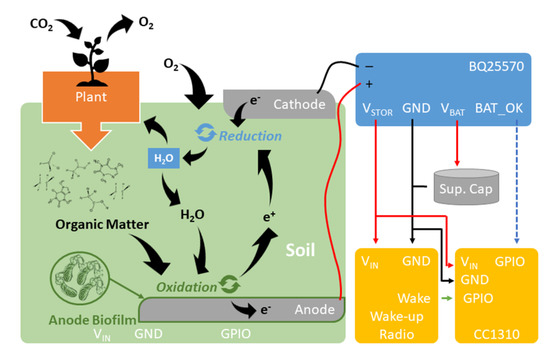
The system is designed to match the power delivered by a 1 dm2 Plant-Microbial Fuel Cell (PMFC), a hybrid system that exploits electrogenic bacteria living in many soils combined with a living plant that produces organic matter to feed the bacteria [10]. The PMFC provides about 70 μW over several months of experiments and monitoring, which permitted us to test different configurations of the wireless sensor [11]. The block scheme of the proposed solution is shown in Figure 1.
Figure 1.
Block scheme of the proposed solution.
The plant provides nutrients to bacteria living in the soil, that in turn release electrons as byproduct of organic nutrient metabolism in an anaerobic environment. This energy is then harvested by a BQ25570 integrated circuit and stored inside a super capacitor. The accumulated energy is used to power a CC1310 System on Chip–SoC that consists in an ARM microcontroller with integrated sub-GHz radio transceiver. The SoC operates always in shutdown mode and is awaken by the radio-trigger circuit only when an external request of data is received. The wake-up sub-system extracts most of the necessary energy from the very same RF trigger signal received, reducing its actual power needs to less than 2 µW.
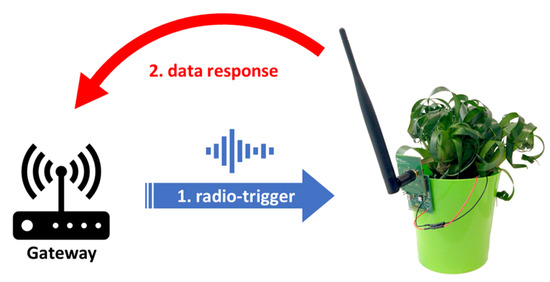
Figure 2 shows a typical application scenario. First the RF trigger is sent to the wake-up module, which decodes it, and activate the main SoC radio (CC1310) to send back all the data stored in the local memory. The RF trigger signal embeds a digital code that can be used to address multiple nodes in a network, making the system fully scalable.
Figure 2.
Application scenario. The data aggregator requests data by triggering the sensors powered by the PMFC.
3. Evaluation
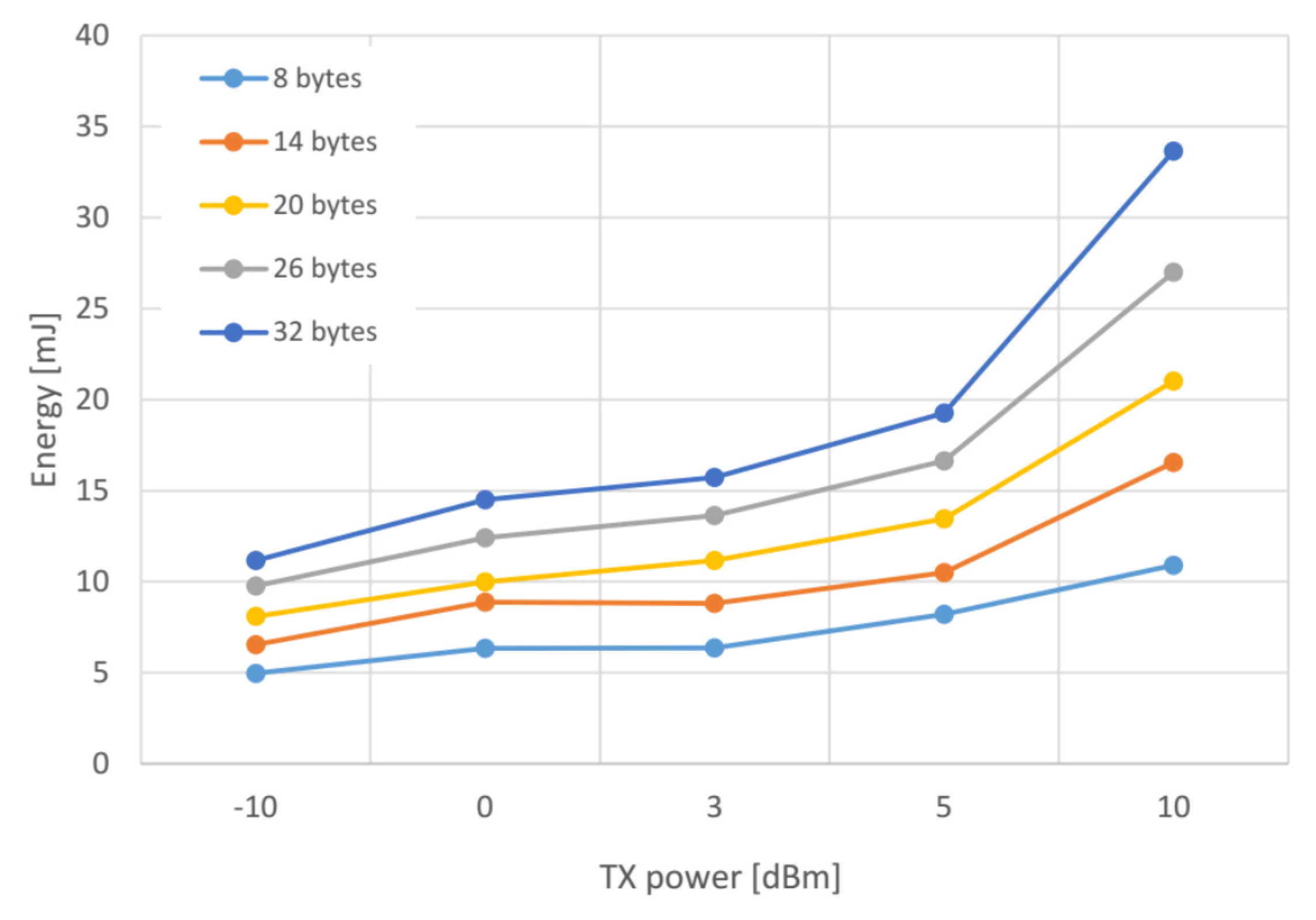
To assess the performance of the proposed solution, we have built a prototype configured to acquire and record a measurement every minute at 5 μW power consumption. The prototype transmits the data only when the radio-trigger is received. The main radio consumes an average of 7 mJ during the transmission of a 20 bytes packet at 0 dBm. The power consumption and the energy provided by the PMFC are shown in Table 1. Notice that to achieve an energy neutral system, the duty-cycle of the application cannot be higher than 0.3%.
Table 1.
Power consumption and generation summary.
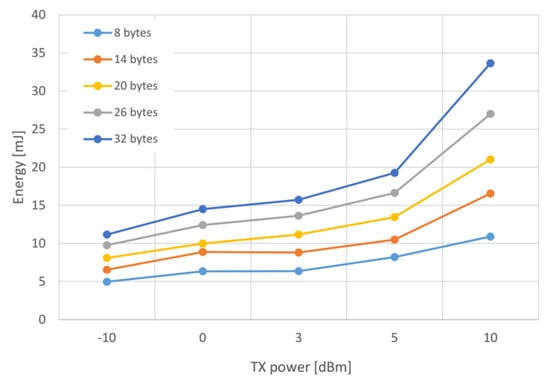
The Figure 3 shows the radio energy budget as a function of the payload and of the transmission power, which determines the communication range (up to 1.5 km in case of 14 dBm). As it can be noted, the optimal trade-off for short-range communications is a 32 bytes payload @ −10 dBm, which consumes 47 nJ/bit. To transmit up to 400 m (medium range) a configuration of 32 bytes payload @ 3 dBm is the most efficient, with 58 nJ/bit.
Figure 3.
Measured energy consumption of CC1310 SoC as a function of the transmitted power and of the payload size.
4. Discussion
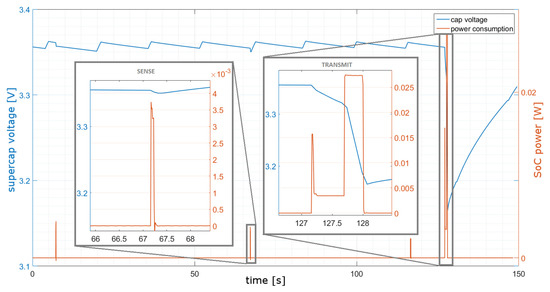
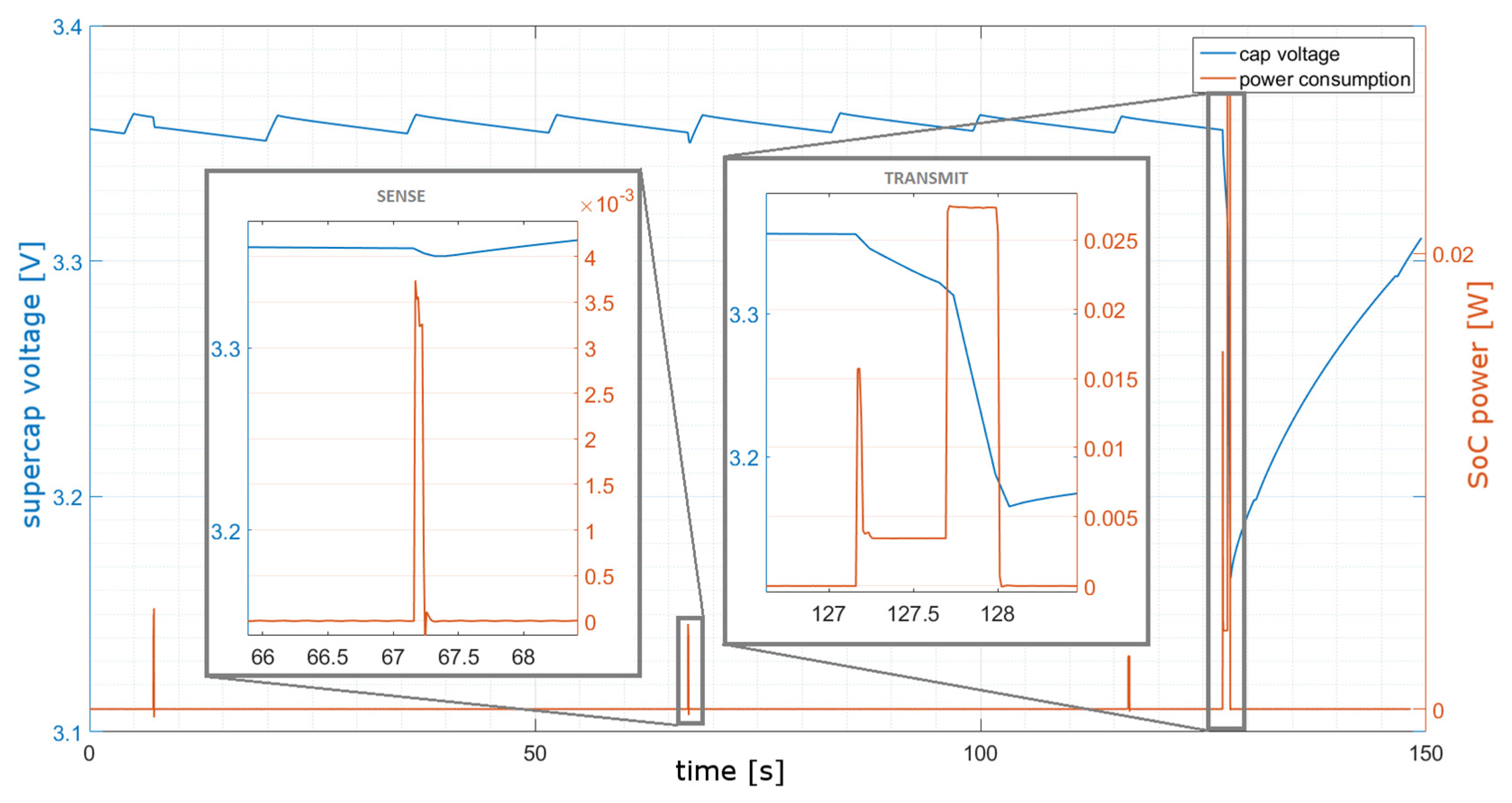
The use of the radio-triggered communication paradigm, changes completely the approach to the low-power design. In fact, for low duty-cycle applications, the energy consumed for sensing becomes negligible in comparison to the long interval of idle/sleep power consumption between each measurement. Figure 4 shows this concept by highlighting the power consumption of the sensing and transmitting operations. The sensing is executed periodically and driven by a timer. The transmission occurs on demand by the aggregator, when the dedicated wake-up front-end of the node receives a RF radio-trigger. Left axis shows the voltage of the supercapacitor used as energy storage and the right axis indicates the power consumption of the system as a function of the time.
Figure 4.
Power profile during a full cycle, sensing and transmitting, left axis shows voltage level of the storage supercapacitor, right axis shows the power consumption (W) of the CC1310 performing tasks.
5. Conclusions
In this work we present an ultralow-power wireless architecture that exploits a zero-power wake-up receiver to address and initiate a communication task while a dedicated sub-GHz SoC implements the data sensing and transmission tasks. This architecture allows to run monitoring applications exploiting ultralow-power characteristics of modern microcontrollers, while high energy demanding communication tasks (to stream data and to exchange configuration parameters) are executed only when requested. In this case the data collector exploits the addressing capability of the wake-up sub-system to trigger the downstream of the history of collected data. The system has been validated using a microbial fuel cell as unique power supply for more than six months, demonstrating the capability to achieve an energy-neutral sensing system by adapting the activity and to match the mW class in power consumption to the μW class of the power supply.
Acknowledgments
Authors would like to acknowledge the IEEE Smart City initiative and the Fondazione Cassa di Risparmio di Trento e Rovereto—CARITRO, that supported this research.
Conflicts of Interest
The authors declare no conflict of interest.
References
- Bergonzini, C.; Brunelli, D.; Benini, L. Comparison of energy intake prediction algorithms for systems powered by photovoltaic harvesters. Microelectron. J. 2010, 41, 766–777. [Google Scholar] [CrossRef] [Scilit]
- Rossi, M.; Rizzon, L.; Fait, M.; Passerone, R.; Brunelli, D. Energy Neutral Wireless Sensing for Server Farms Monitoring. IEEE J. Emerg. Sel. Top. Circuits Syst. 2014, 4, 324–334. [Google Scholar] [CrossRef] [Scilit]
- Porcarelli, D.; Spenza, D.; Brunelli, D.; Cammarano, A.; Petrioli, C.; Benini, L. Adaptive Rectifier Driven by Power Intake Predictors for Wind Energy Harvesting Sensor Networks. IEEE J. Emerg. Sel. Top. Power Electron. 2015, 3, 471–482. [Google Scholar] [CrossRef] [Scilit]
- Porcarelli, D.; Brunelli, D.; Benini, L. Clamp-and-Forget: A self-sustainable non-invasive wireless sensor node for smart metering applications. Microelectron. J. 2014, 45, 1671–1678. [Google Scholar] [CrossRef] [Scilit]
- Brunelli, D. A high-efficiency wind energy harvester for autonomous embedded systems. Sensors 2016, 16, 327. [Google Scholar] [CrossRef] [Scilit] [PubMed]
- Rossi, M.; Tosato, P.; Gemma, L.; Torquati, L.; Catania, C.; Camalo, S.; Brunelli, D. Long Range wireless sensing powered by plant-microbial fuel cell. In Proceedings of the 2017 Design, Automation & Test in Europe Conference & Exhibition (DATE), Lausanne, Switzerland, 27–31 March 2017. [Google Scholar]
- Sartori, D.; Brunelli, D. A smart sensor for precision agriculture powered by microbial fuel cells. In Proceedings of the 2016 IEEE Sensors Applications Symposium (SAS), Catania, Italy, 20–22 April 2016; pp. 1–6. [Google Scholar]
- Wetser, K.; Sudirjo, E.; Buisman, C.J.; Strik, D.P. Electricity generation by a plant microbial fuel cell with an integrated oxygen reducing biocathode. Appl. Energy 2015, 137, 151–157. [Google Scholar] [CrossRef] [Scilit]
- Spenza, D.; Magno, M.; Basagni, S.; Benini, L.; Paoli, M.; Petrioli, C. Beyond duty cycling: Wake-up radio with selective awakenings for long-lived wireless sensing systems. In Proceedings of the IEEE Conference on Computer Communications (INFOCOM), Hong Kong, China, 26 April–1 May 2015. [Google Scholar]
- Brunelli, D.; Tosato, P.; Rossi, M. Flora Health Wireless Monitoring with Plant-Microbial Fuel Cell. Procedia Eng. 2016, 168, 1646–1650. [Google Scholar] [CrossRef] [Scilit]
- Brunelli, D.; Tosato, P.; Rossi, M. Microbial fuel cell as a biosensor and a power source for flora health monitoring. In Proceedings of the 2016 IEEE Sensors, Orlando, FL, USA, 30 October–3 November 2016; pp. 1–3. [Google Scholar]

Publisher’s Note: MDPI stays neutral with regard to jurisdictional claims in published maps and institutional affiliations. |
© 2017 by the authors. Licensee MDPI, Basel, Switzerland. This article is an open access article distributed under the terms and conditions of the Creative Commons Attribution (CC BY) license (https://creativecommons.org/licenses/by/4.0/).