


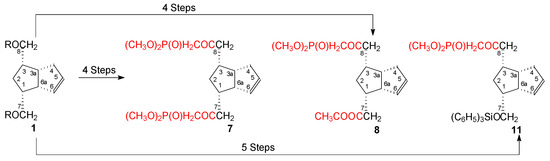
The modifications of the ω-side chain have led to the most interesting biological activities of the prostaglandin analogues [1,2] and the research in this direction is most extensive. In the total stereo-controlled Corey synthesis of natural prostaglandin and prostaglandin analogues, the-side chain is introduced by an E-Horner–Emmons–Wadsworth (HEW) selective olefination of an aldehyde with a β-ketophosphonate in the presence of a base. For obtaining new prostaglandin analogues, we planned to introduce a bicyclo[3.3.0] octane scaffold in the ω-side chain, this fragment being found in the molecule of carbacyclins and their analogues, in the molecule of many natural products, like hirsutic acid, isocomene or antitumor compounds like coriolin, pentalenolactone, quadrone. The starting compounds 1 were obtained as previously [3]; the key step for obtaining β-ketophosphonates was the reaction of an ester with lithium salt of dimethyl methanephosphonate, usually used in prostaglandin synthesis. Starting from the diol 1, protected with good leaving groups (mesyl and tosyl), we performed a sequence of reactions with good yields: the carbon chain lengthening by reaction with KCN, the hydrolysis of the nitrile groups to carboxyl, the esterification of carboxyl to ester and finally the phosphonate synthesis, which gave one bis-β-ketophosphonate 7 and two mono β-ketophosphonates, 8 and 11 (Scheme 1):
| The new β-ketophosphonates are key intermediates for obtaining new prostaglandin analogues with a bicyclo[3.3.0]octene fragment in the ω-side chain I and II. | 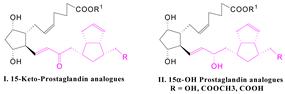 |
| The use of bis β-ketophosphonate 7 in the usual stereoselective Z-Horner-Emmons-Wadsworts selective olefination conditions should gave the pseudo-prostaglandin compound III: | 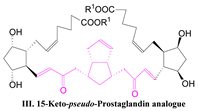 |
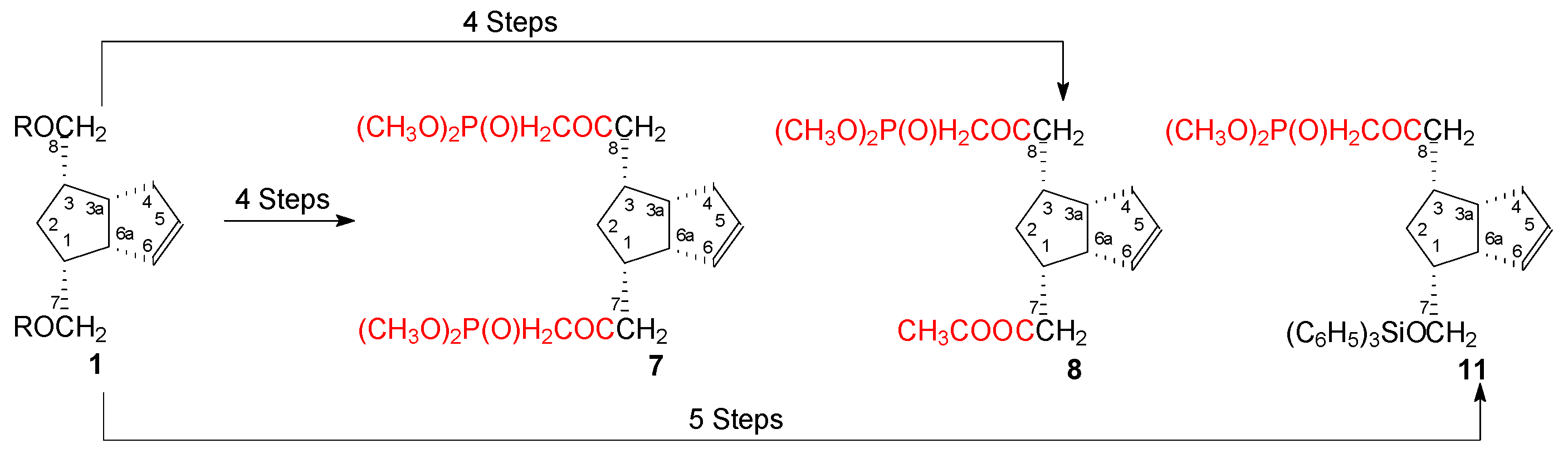
Scheme 1.
Synthesis of β-ketophosphonates 7, 8 and 11 for obtaining new prostaglandin analogs of type I and II.
The synthesis of β-ketophosphonates, linked by a methylene group to a bicyclo[3.3.0]octene fragment, was performed by the reaction of dimethyl methanephosphonate with the ester group (as previously we used for obtaining prostaglandin intermediates for hydrogenation and prostaglandin analogs obtained in microproduction) [4] of two intermediates with this scaffold in good yields (74% 7, 92% 11, and 16.6% 8 as secondary compound).
Acknowledgments
This work was supported by a grant of the Romanian Ministry of Research and Innovation, CCCDI—UEFISCDI, Orizont-2000, project number 45/1999/1.
References
- Collins, P.W.; Djuric, S.W. Synthesis of therapeutically useful prostaglandin and prostacyclin analogs. Chem. Rev. 1993, 93, 1533–1564. [Google Scholar] [CrossRef] [Scilit]
- Das, S.; Chandrasekhar, S.; Yadav, J.S.; Gree, R. Recent developments in the synthesis of prostaglandins and analogues. Chem. Rev. 2007, 107, 3286–3337. [Google Scholar] [CrossRef] [Scilit] [PubMed]
- 1,2,3,3a,4,6a-hexahydro-1,3-pentalenedimethanol, mono and bis oh-protected derivatives, useful intermediates for fine organic synthesis. Rev. Roum. Chim. 2008, 53, 195–202.
- Tănase, C.; Cocu, F.; Drăghici, C.; Hanganu, A.; Pintilie, L.; Maganu, M.; Munteanu, C.V.A.; Shova, S. Secondary compounds in the catalytic hydrogenation of enone and allylic alcohol prostaglandin intermediates: Isolation, characterization, and X-ray crystallography. New J. Chem. 2019, 43, 7582–7599. [Google Scholar] [CrossRef] [Scilit]
Publisher’s Note: MDPI stays neutral with regard to jurisdictional claims in published maps and institutional affiliations. |
© 2020 by the authors. Licensee MDPI, Basel, Switzerland. This article is an open access article distributed under the terms and conditions of the Creative Commons Attribution (CC BY) license (https://creativecommons.org/licenses/by/4.0/).