


Abstract
Nowadays, water purification technologies are based on nano-scaled adsorbents, such as metal or polymeric nanoadsorbents, metal organic frameworks, metal oxide nanoparticles, and carbonated nanomaterials, which have shown exceptional results in water decontamination. Adsorption is one of the most environmentally friendly and efficient methods used for pollutant removal from aquatic environments due to the large specific surface area of nanoadsorbents, which creates multiple adsorption sites. Therefore, we developed a synthesis method for the large-scale production of an apatitic adsorbent, which we will further use in a water treatment system.
1. Introduction
With the great industrial revolution, pollution, whether we are talking about water, soil, or air pollution, has gained an exponential increase. Adsorption is one of the most environmentally friendly and efficient methods of removing pollutants from aquatic environments due to the large specific surface area of nanoadsorbents, which creates more adsorption sites. Moreover, by controlling the synthesis parameters, adsorbents with controllable morphology, high mechanical and thermal stability, and, most importantly, ecological character can be obtained [1].
2. Materials and Methods
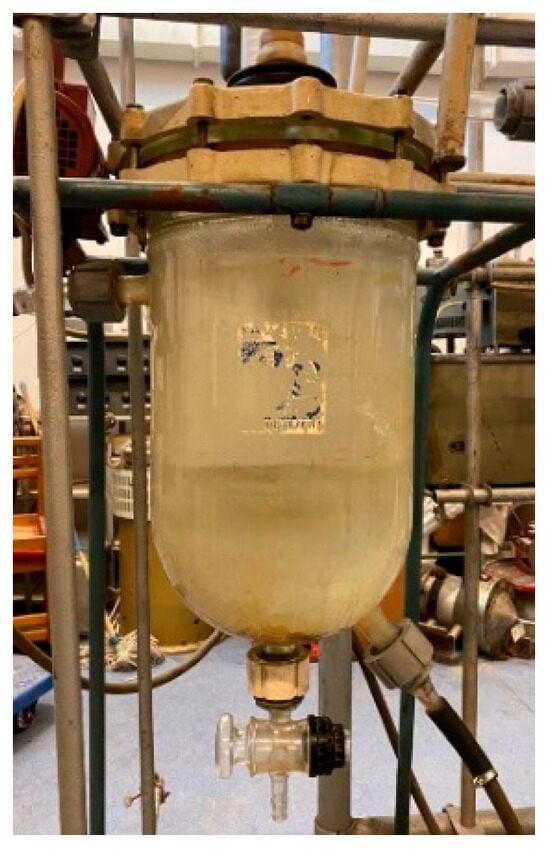
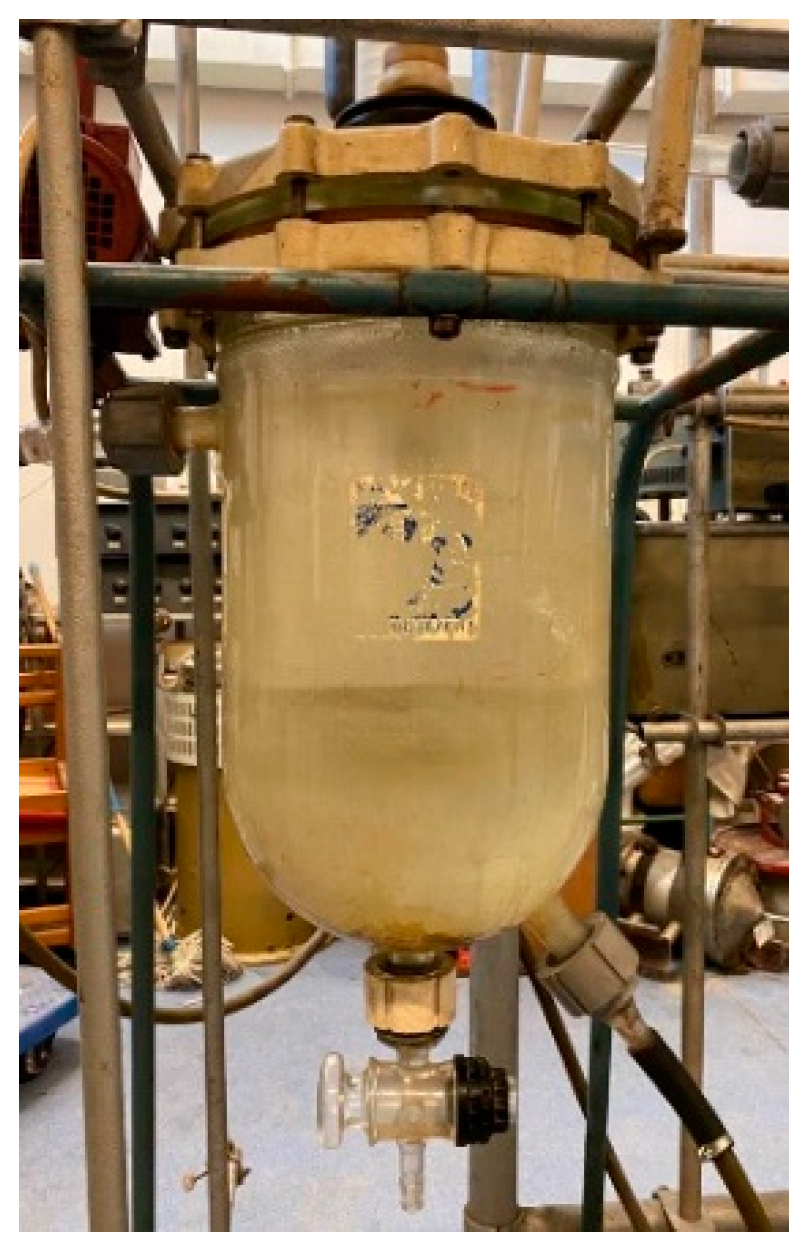
In this study, we prepared an apatitic material-based adsorbent at a large scale based on a protocol previously presented by our group [2,3] in two reactors of 20 L volume each (Figure 1), using Ca(NO3)2 × 4H2O and (NH4)2HPO4. Both of the reactors were maintained at 80 °C and continuously stirred for 3h. The obtained material was characterized via X-ray diffraction to confirm the synthesis.
Figure 1.
The 20 L reactor used for the synthesis.
3. Results
The obtained powder was further conditioned using PVA (JP-24, J-Poval) and calcinated at 600 °C.
4. Conclusions
The efficiency of the material was evaluated for arsenic removal in a synthetic water matrix using column experiments.
Author Contributions
Conceptualization, R.I.M. and R.C.F.; methodology, R.I.M., V.R. and R.C.F.; formal analysis, V.R., I.F., S.C.U., and S.M.A.; investigation, R.I.M., A.M.B., T.F., D.R. and R.C.F.; writing—original draft preparation, R.I.M. and I.F.; writing—review and editing, R.C.F.; supervision, I.F.; project administration, R.C.F. All authors have read and agreed to the published version of the manuscript.
Funding
This work was funded by the Ministry of Research, Innovation, and Digitization, CCCDI—UEFISCDI, project number PN-III-P2-2.1-PTE-2021-0309, contract 81PTE/2022, within PNCDI III. The support provided by the Ministry of Research, Innovation, and Digitization through Program 1—Development of the national research and development system, Subprogram 1.2—Institutional performance—Projects to finance excellence in RDI, contract no. 15PFE/2021, is also gratefully acknowledged.
Institutional Review Board Statement
Not applicable.
Informed Consent Statement
Not applicable.
Data Availability Statement
The supporting data are available from the corresponding author.
Conflicts of Interest
The authors declare no conflict of interest.
References
- Puri, N.; Gupta, A.; Mishra, A. Recent advances on nano-adsorbents and nanomembranes for the remediation of water. J. Clean. Prod. 2021, 322, 129051. [Google Scholar] [CrossRef] [Scilit]
- Fierascu, R.C.; Fierascu, I.; Raditoiu, V. Adsorbent with Magnetic Properties Based on Apatite Material for the Treatment of Water Polluted with Organic and Inorganic Compounds and the Method of Obtaining It. Patent application A00380/2019.
- Fierascu, I.; Avramescu, S.M.; Petreanu, I.; Marinoiu, A.; Soare, A.; Nica, A.; Fierascu, R.C. Efficient removal of phenol from aqueous solutions using hydroxyapatite and substituted hydroxyapatites. React. Kin. Mech. Catal. 2017, 122, 155–175. [Google Scholar] [CrossRef] [Scilit]
Disclaimer/Publisher’s Note: The statements, opinions and data contained in all publications are solely those of the individual author(s) and contributor(s) and not of MDPI and/or the editor(s). MDPI and/or the editor(s) disclaim responsibility for any injury to people or property resulting from any ideas, methods, instructions or products referred to in the content. |
© 2023 by the authors. Licensee MDPI, Basel, Switzerland. This article is an open access article distributed under the terms and conditions of the Creative Commons Attribution (CC BY) license (https://creativecommons.org/licenses/by/4.0/).