


Abstract
In recent years, micromachined microphones have evolved into versatile transducers for gas-sensing applications in the fields of both direct and indirect photoacoustics. However, their noise properties have not yet caught much attention. In this contribution, we present an analysis of the noise spectrum of a MEMS microphone and show how it may be employed as a gas-sensing tool and to characterize photoacoustic detectors. The results highlight the potential to determine the speed of sound, ambient temperature, and gas composition via Fourier analysis of the microphone noise.
1. Introduction
MEMS microphones have the potential to serve as transducers not only for soundwaves as such but also for detecting gases. In the last decade, miniaturized photoacoustic setups have been demonstrated wherein MEMS microphones serve as transducers to determine the light intensity [1]. In particular, in indirect photoacoustic setups, the use of acoustic resonances is often not desirable [2] because it introduces undesired dependencies, e.g., on ambient temperature. Instead, a constant sensitivity in a broad acoustic frequency spectrum enables simultaneous, selective multi-gas detection by analyzing multiple frequencies in parallel [3]. Recently, the resonance of MEMS microphone microstructures [4] has also been used in a direct, laser-based photoacoustic setup.
However, to date, the noise spectrum of bare MEMS microphones has been largely omitted as a means for gas sensing. Nonetheless, the analysis of MEMS microphone noise may be employed as a gas species- and temperature-sensing tool.
2. Materials and Methods
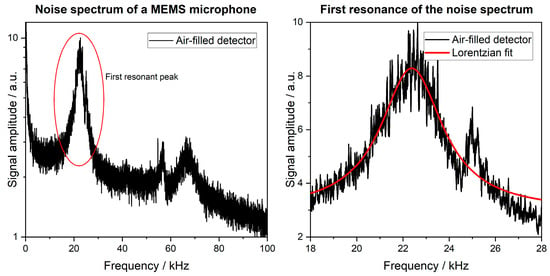
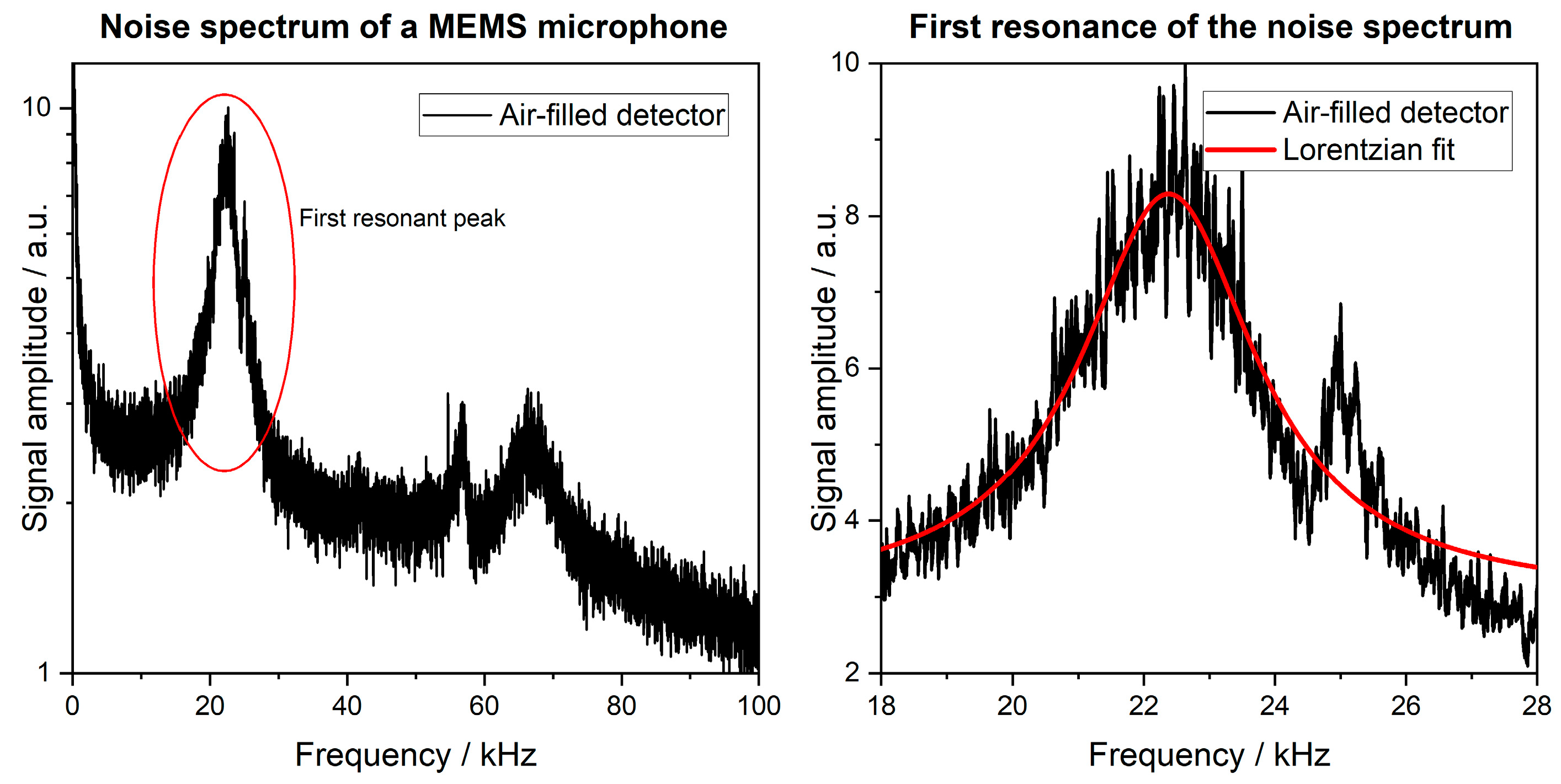
Micromachined silicon microphones feature a low-quality acoustic resonator due to the design of the sensing chip [5]. To analyze the noise spectrum, the signal of a MEMS microphone ICS-40720 from Invensense-TDK (Tokyo, Japan) was amplified and its noise spectrum recorded. First, photoacoustic detectors were produced with various gas compositions at 1 bar pressure and fillings of 100% synthetic air, 100% methane (CH4), and 100% carbon dioxide (CO2). Figure 1 shows the recorded noise spectrum, from which the Q-factor of the resonators was calculated.
Figure 1.
(Left): Noise spectrum measured for an ICS-40720 microphone encapsulated in a synthetic-air atmosphere. (Right): The first resonant peak of the microphone’s noise fitted to a Lorentzian shape. The resonant frequency was determined by its geometry, the speed of sound in the gas, and the temperature.
3. Discussion
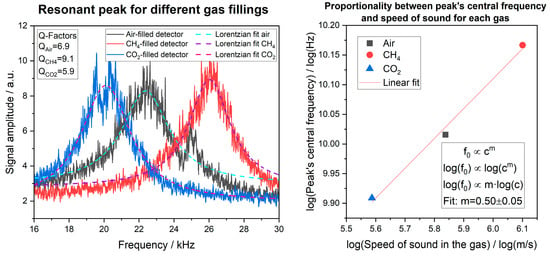
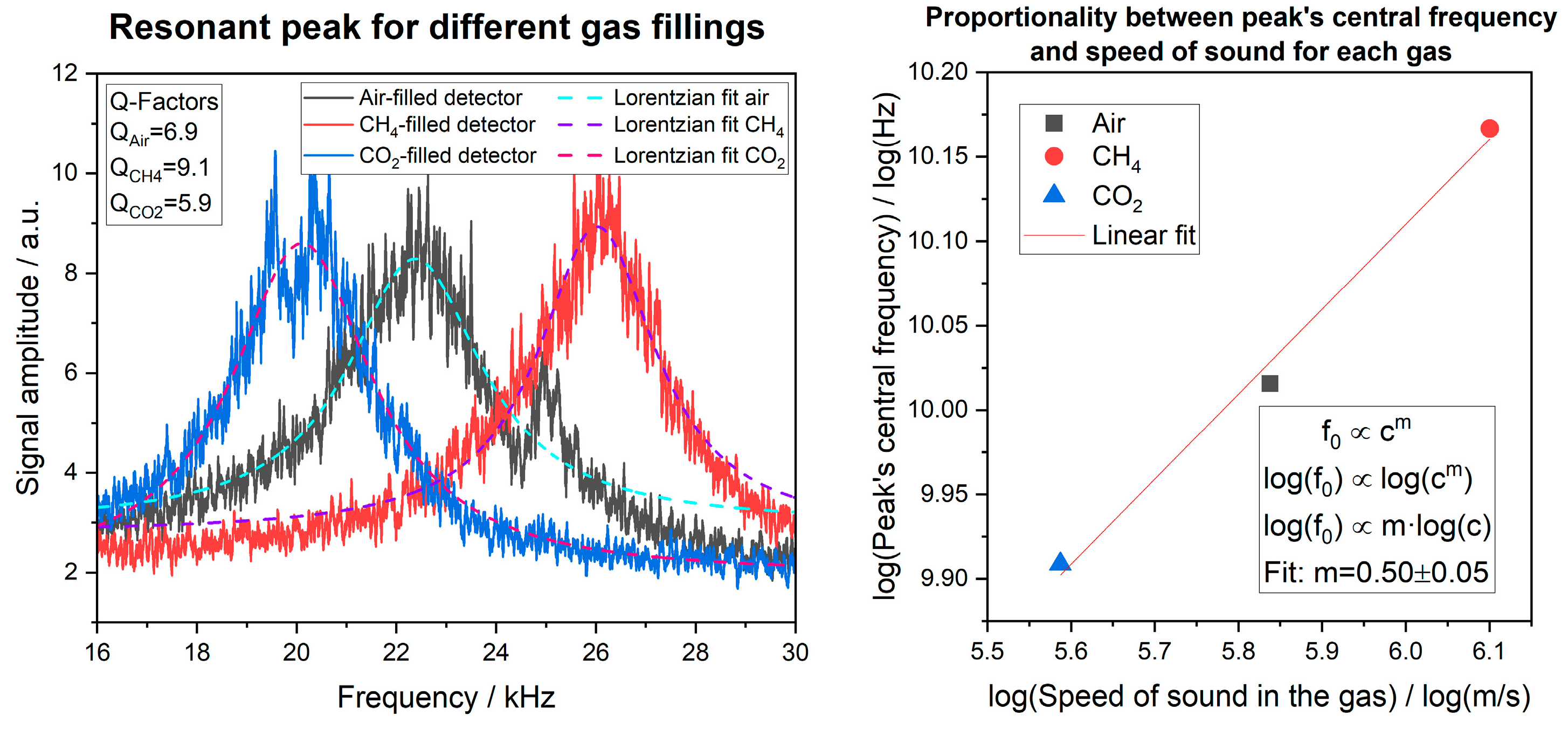
From the results in Figure 2, a marked shift in the microphone’s resonance frequency when encapsulated in atmospheres with different gas compositions is evident. For CH4, which features a higher speed of sound than synthetic air, the shift happened upwards in frequency; the opposite effect took place for CO2. The obtained square root of the dependency of the resonant frequency with the speed of sound deviates from the linearity expected in a Helmholtz resonator. Therefore, further exploration with different gases must be conducted to verify this tendency. The same is true for the behavior of the second resonance that was observed. Therefore, the concept of microphone noise measurement as a method for the detection of different gas compositions has been verified. The dependency of the speed of sound with temperature suggests it can be determined in this way.
Figure 2.
(Left): Noise spectrum recorded for microphones encapsulated in atmospheres with different gas compositions. (Right): Relationship between the resonance frequency at the first peak and the speed of sound in the atmosphere of each sensor. Note the rather exact 0.5 exponent in the proportionality.
Author Contributions
G.R.G. built the sensing system, performed the experiments and the data analysis. G.R.G. and S.P. wrote the manuscript. S.P. and G.R.G. devised the experimental setup and edited the manuscript. All authors have read and agreed to the published version of the manuscript.
Funding
G.R.G. acknowledges funding from the Research Council of Norway under Grant Number 301552 (Upscaling Hotpots).
Institutional Review Board Statement
Not applicable.
Informed Consent Statement
Not applicable.
Data Availability Statement
The raw data supporting the conclusions of this article will be made available by the authors on request.
Conflicts of Interest
The authors declare no conflicts of interest.
References
- Palzer, S. Photoacoustic-Based Gas Sensing: A Review. Sensors 2020, 20, 2745. [Google Scholar] [CrossRef] [Scilit] [PubMed]
- Scholz, L.; Ortiz Perez, A.; Bierer, B.; Eaksen, P.; Wollenstein, J.; Palzer, S. Miniature Low-Cost Carbon Dioxide Sensor for Mobile Devices. IEEE Sens. J. 2017, 17, 2889–2895. [Google Scholar] [CrossRef] [Scilit]
- Rodríguez Gutiérrez, G.; Palzer, S. Photoacoustic-based, selective, and integrated multigas sensing. In Proceedings of the Eurosensors, Leuven, Belgium, 19–23 September 2022. [Google Scholar]
- Strahl, T.; Steinebrunner, J.; Weber, C.; Wöllenstein, J.; Schmitt, K. Photoacoustic methane detection inside a MEMS microphone. Photoacoustics 2023, 29, 100428. [Google Scholar] [CrossRef] [Scilit] [PubMed]
- Dehé, A. Silicon microphone development and application. Sens. Actuators A Phys. 2007, 133, 283–287. [Google Scholar] [CrossRef] [Scilit]
Disclaimer/Publisher’s Note: The statements, opinions and data contained in all publications are solely those of the individual author(s) and contributor(s) and not of MDPI and/or the editor(s). MDPI and/or the editor(s) disclaim responsibility for any injury to people or property resulting from any ideas, methods, instructions or products referred to in the content. |
© 2024 by the authors. Licensee MDPI, Basel, Switzerland. This article is an open access article distributed under the terms and conditions of the Creative Commons Attribution (CC BY) license (https://creativecommons.org/licenses/by/4.0/).